© Technical Spark
- SARVESH SINGH
1403213090
1
© Technical Spark
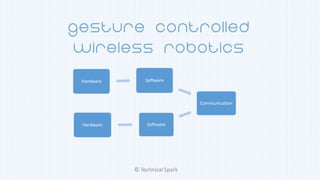
Hardware Software
Communication
SoftwareHardware
© Technical Spark
© Technical Spark
Code
© Technical Spark
Hardware
© Technical Spark
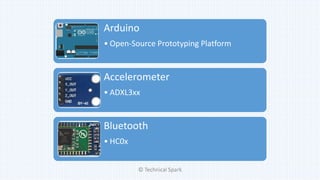
Arduino
• Open-Source Prototyping Platform
Accelerometer
• ADXL3xx
Bluetooth
• HC0x
© Technical Spark
Gesture Control
Wireless
Communication
Introduction ToAccelerometer
What’s Inside Accelerometer??
Various Classifications
Bluetooth
Master
Slave
© Technical Spark
Gesture Control
Wireless
Communication
Introduction To Accelerometer
Various Classifications
Bluetooth
Master
What’s Inside Accelerometer??
Slave
© Technical Spark
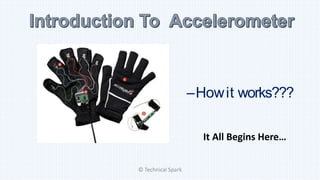
–Howit works???
It All Begins Here…
© Technical Spark
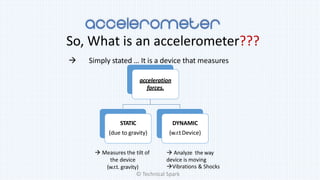
So, What is an accelerometer???
 Simply stated … It is a device that measures
acceleration
forces.
STATIC
(due to gravity)
DYNAMIC
(w.r.tDevice)
 Measures the tilt of
the device
(w.r.t. gravity)
 Analyze the way
device is moving
Vibrations & Shocks
© Technical Spark
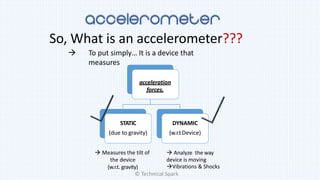
So, What is an accelerometer???
 To put simply… It is a device that
measures
acceleration
forces.
STATIC
(due to gravity)
DYNAMIC
(w.r.tDevice)
 Measures the tilt of
the device
(w.r.t. gravity)
 Analyze the way
device is moving
Vibrations & Shocks
© Technical Spark
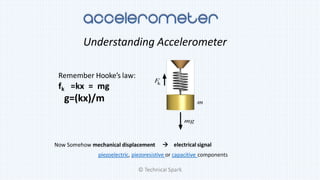
Understanding Accelerometer
Remember Hooke’s law:
fk =kx = mg
g=(kx)/m
Now Somehow mechanical displacement  electrical signal
piezoelectric, piezoresistive or capacitive components
© Technical Spark
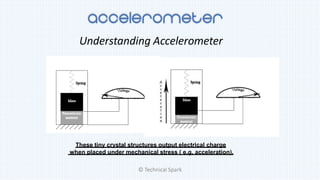
These tiny crystal structures output electrical charge
when placed under mechanical stress ( e.g. acceleration).
Understanding Accelerometer
© Technical Spark
So, How does it work???
© Technical Spark
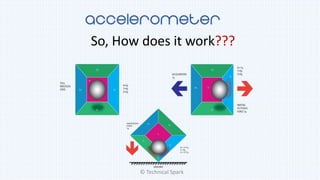
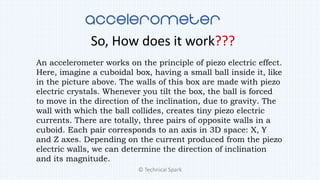
An accelerometer works on the principle of piezo electric effect.
Here, imagine a cuboidal box, having a small ball inside it, like
in the picture above. The walls of this box are made with piezo
electric crystals. Whenever you tilt the box, the ball is forced
to move in the direction of the inclination, due to gravity. The
wall with which the ball collides, creates tiny piezo electric
currents. There are totally, three pairs of opposite walls in a
cuboid. Each pair corresponds to an axis in 3D space: X, Y
and Z axes. Depending on the current produced from the piezo
electric walls, we can determine the direction of inclination
and its magnitude.
So, How does it work???
© Technical Spark
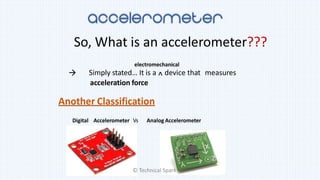
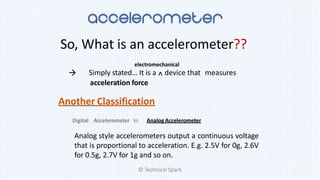
So, What is an accelerometer???
Simply stated… It is a ^ device that measures
acceleration force
electromechanical

Another Classification
Digital Accelerometer Vs Analog Accelerometer
© Technical Spark
So, What is an accelerometer??
Simply stated… It is a ^ device that measures
acceleration force
electromechanical

Another Classification
Digital Accelerometer Vs Analog Accelerometer
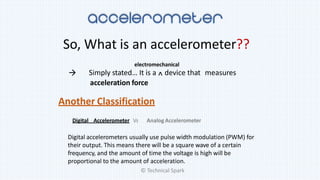
Digital accelerometers usually use pulse width modulation (PWM) for
their output. This means there will be a square wave of a certain
frequency, and the amount of time the voltage is high will be
proportional to the amount of acceleration.
© Technical Spark
So, What is an accelerometer??
Simply stated… It is a ^ device that measures
acceleration force
electromechanical

Another Classification
Digital Accelerometer Vs Analog Accelerometer
Analog style accelerometers output a continuous voltage
that is proportional to acceleration. E.g. 2.5V for 0g, 2.6V
for 0.5g, 2.7V for 1g and so on.

© Technical Spark
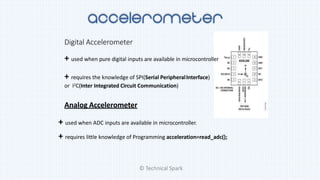
Digital Accelerometer
+ used when pure digital inputs are available in microcontroller
+ requires the knowledge of SPI(Serial PeripheralInterface)
or I2C(Inter Integrated Circuit Communication)
Analog Accelerometer
+ used when ADC inputs are available in microcontroller.
+ requires little knowledge of Programming acceleration=read_adc();
© Technical Spark
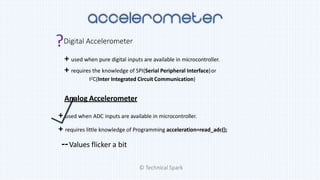
?Digital Accelerometer
+ used when pure digital inputs are available in microcontroller.
+ requires the knowledge of SPI(Serial Peripheral Interface)or
I2C(Inter Integrated Circuit Communication)
Analog Accelerometer
+ used when ADC inputs are available in microcontroller.
+ requires little knowledge of Programming acceleration=read_adc();
--Values flicker a bit
© Technical Spark
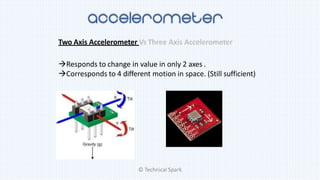
Two Axis Accelerometer Vs Three Axis Accelerometer
Responds to change in value in only 2 axes .
Corresponds to 4 different motion in space. (Still sufficient)
© Technical Spark
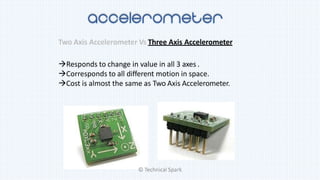
Two Axis Accelerometer Vs Three Axis Accelerometer
Responds to change in value in all 3 axes .
Corresponds to all different motion in space.
Cost is almost the same as Two Axis Accelerometer.
© Technical Spark
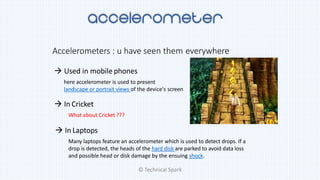
Accelerometers : u have seen them everywhere
 Used in mobile phones
here accelerometer is used to present
landscape or portrait views of the device's screen
 In Cricket
What about Cricket ???
 In Laptops
Many laptops feature an accelerometer which is used to detect drops. If a
drop is detected, the heads of the hard disk are parked to avoid data loss
and possible head or disk damage by the ensuing shock.
© Technical Spark
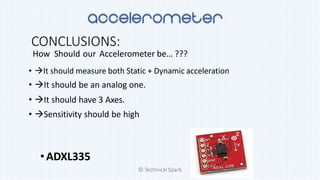
CONCLUSIONS:
How Should our Accelerometer be… ???
• It should measure both Static + Dynamic acceleration
• It should be an analog one.
• It should have 3 Axes.
• Sensitivity should be high
•ADXL335
© Technical Spark
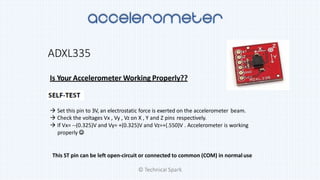
ADXL335
Is Your Accelerometer Working Properly??
 Set this pin to 3V, an electrostatic force is exerted on the accelerometer beam.
 Check the voltages Vx , Vy , Vz on X , Y and Z pins respectively.
 If Vx= --(0.325)V and Vy= +(0.325)V and Vz=+(.550)V . Accelerometer is working
properly 
This ST pin can be left open-circuit or connected to common (COM) in normaluse
© Technical Spark
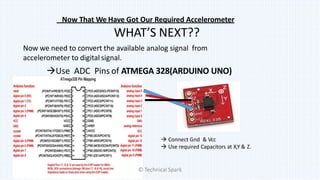
Now That We Have Got Our Required Accelerometer
WHAT’S NEXT??
Now we need to convert the available analog signal from
accelerometer to digital signal.
Use ADC Pins of ATMEGA 328(ARDUINO UNO)
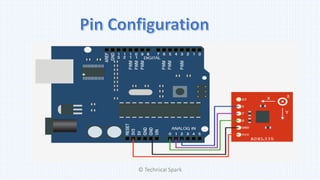
 Connect Gnd & Vcc
 Use required Capacitors at X,Y & Z.
© Technical Spark
© Technical Spark
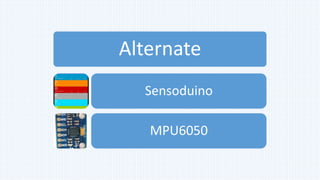
Alternate
Sensoduino
MPU6050
© Technical Spark
Communication
© Technical Spark
© Technical Spark
© Technical Spark
Master
Slave
© Technical Spark
© Technical Spark© Technical Spark

Powerpoint Gesture Recognition

  • 1.
  • 2.
  • 3.
  • 4.
  • 6.
  • 7.
  • 8.
    Arduino • Open-Source PrototypingPlatform Accelerometer • ADXL3xx Bluetooth • HC0x © Technical Spark
  • 9.
    Gesture Control Wireless Communication Introduction ToAccelerometer What’sInside Accelerometer?? Various Classifications Bluetooth Master Slave © Technical Spark
  • 10.
    Gesture Control Wireless Communication Introduction ToAccelerometer Various Classifications Bluetooth Master What’s Inside Accelerometer?? Slave © Technical Spark
  • 11.
    –Howit works??? It AllBegins Here… © Technical Spark
  • 12.
    So, What isan accelerometer???  Simply stated … It is a device that measures acceleration forces. STATIC (due to gravity) DYNAMIC (w.r.tDevice)  Measures the tilt of the device (w.r.t. gravity)  Analyze the way device is moving Vibrations & Shocks © Technical Spark
  • 13.
    So, What isan accelerometer???  To put simply… It is a device that measures acceleration forces. STATIC (due to gravity) DYNAMIC (w.r.tDevice)  Measures the tilt of the device (w.r.t. gravity)  Analyze the way device is moving Vibrations & Shocks © Technical Spark
  • 14.
    Understanding Accelerometer Remember Hooke’slaw: fk =kx = mg g=(kx)/m Now Somehow mechanical displacement  electrical signal piezoelectric, piezoresistive or capacitive components © Technical Spark
  • 15.
    These tiny crystalstructures output electrical charge when placed under mechanical stress ( e.g. acceleration). Understanding Accelerometer © Technical Spark
  • 16.
    So, How doesit work??? © Technical Spark
  • 17.
    An accelerometer workson the principle of piezo electric effect. Here, imagine a cuboidal box, having a small ball inside it, like in the picture above. The walls of this box are made with piezo electric crystals. Whenever you tilt the box, the ball is forced to move in the direction of the inclination, due to gravity. The wall with which the ball collides, creates tiny piezo electric currents. There are totally, three pairs of opposite walls in a cuboid. Each pair corresponds to an axis in 3D space: X, Y and Z axes. Depending on the current produced from the piezo electric walls, we can determine the direction of inclination and its magnitude. So, How does it work??? © Technical Spark
  • 18.
    So, What isan accelerometer??? Simply stated… It is a ^ device that measures acceleration force electromechanical  Another Classification Digital Accelerometer Vs Analog Accelerometer © Technical Spark
  • 19.
    So, What isan accelerometer?? Simply stated… It is a ^ device that measures acceleration force electromechanical  Another Classification Digital Accelerometer Vs Analog Accelerometer Digital accelerometers usually use pulse width modulation (PWM) for their output. This means there will be a square wave of a certain frequency, and the amount of time the voltage is high will be proportional to the amount of acceleration. © Technical Spark
  • 20.
    So, What isan accelerometer?? Simply stated… It is a ^ device that measures acceleration force electromechanical  Another Classification Digital Accelerometer Vs Analog Accelerometer Analog style accelerometers output a continuous voltage that is proportional to acceleration. E.g. 2.5V for 0g, 2.6V for 0.5g, 2.7V for 1g and so on. © Technical Spark
  • 21.
    Digital Accelerometer + usedwhen pure digital inputs are available in microcontroller + requires the knowledge of SPI(Serial PeripheralInterface) or I2C(Inter Integrated Circuit Communication) Analog Accelerometer + used when ADC inputs are available in microcontroller. + requires little knowledge of Programming acceleration=read_adc(); © Technical Spark
  • 22.
    ?Digital Accelerometer + usedwhen pure digital inputs are available in microcontroller. + requires the knowledge of SPI(Serial Peripheral Interface)or I2C(Inter Integrated Circuit Communication) Analog Accelerometer + used when ADC inputs are available in microcontroller. + requires little knowledge of Programming acceleration=read_adc(); --Values flicker a bit © Technical Spark
  • 23.
    Two Axis AccelerometerVs Three Axis Accelerometer Responds to change in value in only 2 axes . Corresponds to 4 different motion in space. (Still sufficient) © Technical Spark
  • 24.
    Two Axis AccelerometerVs Three Axis Accelerometer Responds to change in value in all 3 axes . Corresponds to all different motion in space. Cost is almost the same as Two Axis Accelerometer. © Technical Spark
  • 25.
    Accelerometers : uhave seen them everywhere  Used in mobile phones here accelerometer is used to present landscape or portrait views of the device's screen  In Cricket What about Cricket ???  In Laptops Many laptops feature an accelerometer which is used to detect drops. If a drop is detected, the heads of the hard disk are parked to avoid data loss and possible head or disk damage by the ensuing shock. © Technical Spark
  • 26.
    CONCLUSIONS: How Should ourAccelerometer be… ??? • It should measure both Static + Dynamic acceleration • It should be an analog one. • It should have 3 Axes. • Sensitivity should be high •ADXL335 © Technical Spark
  • 27.
    ADXL335 Is Your AccelerometerWorking Properly??  Set this pin to 3V, an electrostatic force is exerted on the accelerometer beam.  Check the voltages Vx , Vy , Vz on X , Y and Z pins respectively.  If Vx= --(0.325)V and Vy= +(0.325)V and Vz=+(.550)V . Accelerometer is working properly  This ST pin can be left open-circuit or connected to common (COM) in normaluse © Technical Spark
  • 28.
    Now That WeHave Got Our Required Accelerometer WHAT’S NEXT?? Now we need to convert the available analog signal from accelerometer to digital signal. Use ADC Pins of ATMEGA 328(ARDUINO UNO)  Connect Gnd & Vcc  Use required Capacitors at X,Y & Z. © Technical Spark
  • 29.
  • 30.
  • 31.
  • 32.
  • 33.
  • 34.
  • 35.
  • 36.
    © Technical Spark©Technical Spark