Digital
Accelerometers and
Magnetometers
Design Team 3
Introduction
Master of Ceremonies
Ryan Popa
Accelerometers
Background and Applications Jeremy
Iamurri
Technical Explanation and Physics Yan Sidronio
Magnetometers
Background and Applications
Austin Fletcher
Technical Explanation
Chris Sigler
Introduction Magnetometer
Background
Accelerometer
Fundamentals
Accelerometer
Background
Magnetometer
Fundamentals
Conclusion and
Questions
Accelerometers - History - Types
Accelerometers behave as a damped mass on a spring.
Acceleration causes displacement of this "spring"
proportional to the acceleration experienced.
• Original Invention
o 1923 - Burton McCollum and
Peter Orville
o Commercialized in 1927
• Piezoelectric
o 1943 - Used Rochelle salt
• Piezoresistive
o 1959 - Warren P. Mason
Introduction
Magnetometer
Background
Accelerometer
Fundamentals
Accelerometer
Background
Magnetometer
Fundamentals
Conclusion and
Questions
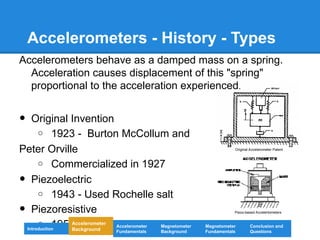
Original Accelerometer Patent
Piezo-based Accelertometers
• Hall Effect
o 1961 - Heinz E. Kallmann
• Magnetoresistive
o 1973 - Tetsuji Shimizu
• Capacitive
o 1989 - Hitachi, Ltd.
• Digital Capacitive
o 1994 - William C. Tang/Ford Motors
Introduction
Magnetometer
Background
Accelerometer
Fundamentals
Accelerometer
Background
Magnetometer
Fundamentals
Conclusion and
Questions
Accelerometers - History - Types
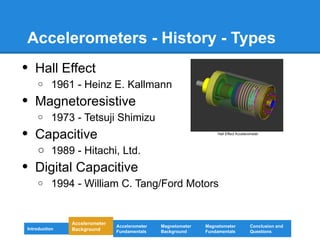
Hall Effect Accelerometer
Accelerometer - Applications
• Video games
• Hard drive protection
• Electronic Stability Package
• Vehicle crash detection
Introduction
Magnetometer
Background
Accelerometer
Fundamentals
Accelerometer
Background
Magnetometer
Fundamentals
Conclusion and
Questions
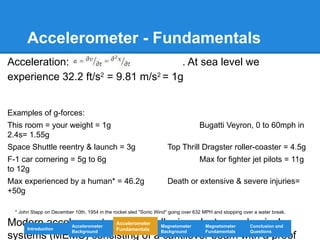
Acceleration: . At sea level we
experience 32.2 ft/s2
= 9.81 m/s2
= 1g
Examples of g-forces:
This room = your weight = 1g Bugatti Veyron, 0 to 60mph in
2.4s= 1.55g
Space Shuttle reentry & launch = 3g Top Thrill Dragster roller-coaster = 4.5g
F-1 car cornering = 5g to 6g Max for fighter jet pilots = 11g
to 12g
Max experienced by a human* = 46.2g Death or extensive & severe injuries=
+50g
Modern accelerometers are small microelectromechanical
systems (MEMS) consisting of a cantilever beam with a proof
Accelerometer - Fundamentals
* John Stapp on December 10th, 1954 in the rocket sled "Sonic Wind" going over 632 MPH and stopping over a water break.
Introduction
Magnetometer
Background
Accelerometer
Fundamentals
Accelerometer
Background
Magnetometer
Fundamentals
Conclusion and
Questions
Capacitive Accelerometer
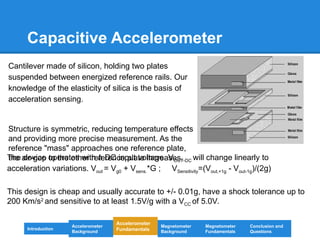
Cantilever made of silicon, holding two plates
suspended between energized reference rails. Our
knowledge of the elasticity of silica is the basis of
acceleration sensing.
Structure is symmetric, reducing temperature effects
and providing more precise measurement. As the
reference "mass" approaches one reference plate,
the air-gap to the other reference plate increases.
Introduction
Magnetometer
Background
Accelerometer
Fundamentals
Accelerometer
Background
Magnetometer
Fundamentals
Conclusion and
Questions
The device operates with a DC input voltage. VOUT-DC will change linearly to
acceleration variations. Vout = Vg0 + Vsens.*G ; VSensitivity=(Vout,+1g - Vout-1g)/(2g)
This design is cheap and usually accurate to +/- 0.01g, have a shock tolerance up to
200 Km/s2
and sensitive to at least 1.5V/g with a VCC of 5.0V.
Accelerometer - Examples
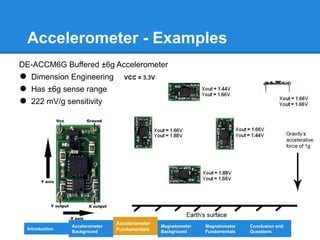
DE-ACCM6G Buffered ±6g Accelerometer
• Dimension Engineering
• Has ±6g sense range
• 222 mV/g sensitivity
Introduction
Magnetometer
Background
Accelerometer
Fundamentals
Accelerometer
Background
Magnetometer
Fundamentals
Conclusion and
Questions
Accelerometer - Examples
Acceleration to voltage example:
”What voltage will correspond to an acceleration of -0.5g?”
The 0g point is approximately 1.66V. Sensitivity is 222mV/g
Vout = Vg0 + Vsens.*G.
-0.5g * 0.222mV/g = -0.111V
1.66V – 0.111V = 1.55V
Therefore you can expect a voltage of approximately 1.55V when experiencing
an acceleration of -0.5g.
Introduction
Magnetometer
Background
Accelerometer
Fundamentals
Accelerometer
Background
Magnetometer
Fundamentals
Conclusion and
Questions
Accelerometer - Examples
Tilt to voltage example:
“I am making an antitheft device that will sound an alarm if it is tilted more than
10º with respect to ground in any direction. I have measured the 0g bias
point to be 1.663V, and I want to know what voltage to trigger the alarm at.”
Sin(10º) = 0.1736 so acceleration with a tilt of 10º will be 0.1736g
0.1736g * 0.222V/g = 0.0385V
1.663 + 0.0385 = 1.7015V
1.663 – 0.0385 = 1.6245V
Sound the alarm when the voltage reaches more than 1.7015V or less than
1.6245V.
Introduction
Magnetometer
Background
Accelerometer
Fundamentals
Accelerometer
Background
Magnetometer
Fundamentals
Conclusion and
Questions
Magnetometers - Background
• Compass invented by the Chinese in the 4th
century
• Carl Gauss invents the "magnometer" in
1833
• Two types of magnetometers
o Scalar - measures the total strength of the magnetic
field they are subject to
o Vector - measure the component of the magnetic
field in a particular direction, relative to the spatial
orientation of the device
Introduction
Magnetometer
Background
Accelerometer
Fundamentals
Accelerometer
Background
Magnetometer
Fundamentals
Conclusion and
Questions
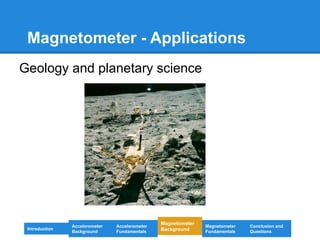
Magnetometer - Applications
Geology and planetary science
Introduction
Magnetometer
Background
Accelerometer
Fundamentals
Accelerometer
Background
Magnetometer
Fundamentals
Conclusion and
Questions
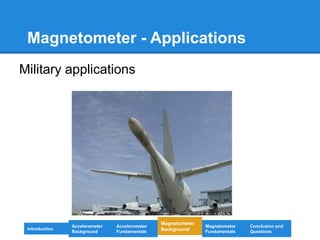
Magnetometer - Applications
Military applications
Introduction
Magnetometer
Background
Accelerometer
Fundamentals
Accelerometer
Background
Magnetometer
Fundamentals
Conclusion and
Questions
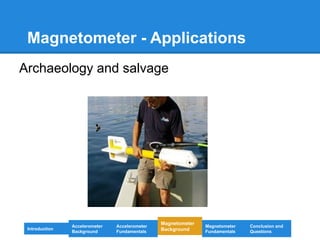
Magnetometer - Applications
Archaeology and salvage
Introduction
Magnetometer
Background
Accelerometer
Fundamentals
Accelerometer
Background
Magnetometer
Fundamentals
Conclusion and
Questions
Magnetometer - Applications
• Navigation
• Compass
• Mineral exploration
• Security
Introduction
Magnetometer
Background
Accelerometer
Fundamentals
Accelerometer
Background
Magnetometer
Fundamentals
Conclusion and
Questions
Magnetometers - Principles of
Operation
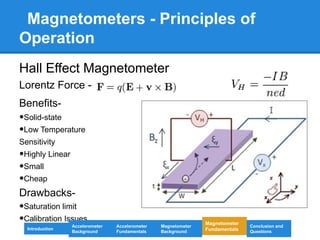
Hall Effect Magnetometer
Lorentz Force -
Benefits-
•Solid-state
•Low Temperature
Sensitivity
•Highly Linear
•Small
•Cheap
Drawbacks-
•Saturation limit
•Calibration Issues
Introduction
Magnetometer
Background
Accelerometer
Fundamentals
Accelerometer
Background
Magnetometer
Fundamentals
Conclusion and
Questions
Magnetometers - Principles of
Operation
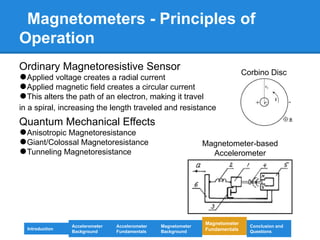
Ordinary Magnetoresistive Sensor
•Applied voltage creates a radial current
•Applied magnetic field creates a circular current
•This alters the path of an electron, making it travel
in a spiral, increasing the length traveled and resistance
Quantum Mechanical Effects
•Anisotropic Magnetoresistance
•Giant/Colossal Magnetoresistance
•Tunneling Magnetoresistance
Corbino Disc
Magnetometer-based
Accelerometer
Introduction
Magnetometer
Background
Accelerometer
Fundamentals
Accelerometer
Background
Magnetometer
Fundamentals
Conclusion and
Questions
Conclusion
• The history and applications of
accelerometers
• Overview of G-Force
• Operation of Capacitive accelerometers
• Two types of magnetometers
o Scalar
o Vector
• Applications of magnetometers
• Operation of Hall Effect Magnetometer
Introduction
Magnetometer
Background
Accelerometer
Fundamentals
Accelerometer
Background
Magnetometer
Fundamentals
Conclusion and
Questions
Questions
Introduction
Magnetometer
Background
Accelerometer
Fundamentals
Accelerometer
Background
Magnetometer
Fundamentals
Conclusion and
Questions

TechnicalLecturePresentationAccelerometers.ppt

  • 1.
  • 2.
    Introduction Master of Ceremonies RyanPopa Accelerometers Background and Applications Jeremy Iamurri Technical Explanation and Physics Yan Sidronio Magnetometers Background and Applications Austin Fletcher Technical Explanation Chris Sigler Introduction Magnetometer Background Accelerometer Fundamentals Accelerometer Background Magnetometer Fundamentals Conclusion and Questions
  • 3.
    Accelerometers - History- Types Accelerometers behave as a damped mass on a spring. Acceleration causes displacement of this "spring" proportional to the acceleration experienced. • Original Invention o 1923 - Burton McCollum and Peter Orville o Commercialized in 1927 • Piezoelectric o 1943 - Used Rochelle salt • Piezoresistive o 1959 - Warren P. Mason Introduction Magnetometer Background Accelerometer Fundamentals Accelerometer Background Magnetometer Fundamentals Conclusion and Questions Original Accelerometer Patent Piezo-based Accelertometers
  • 4.
    • Hall Effect o1961 - Heinz E. Kallmann • Magnetoresistive o 1973 - Tetsuji Shimizu • Capacitive o 1989 - Hitachi, Ltd. • Digital Capacitive o 1994 - William C. Tang/Ford Motors Introduction Magnetometer Background Accelerometer Fundamentals Accelerometer Background Magnetometer Fundamentals Conclusion and Questions Accelerometers - History - Types Hall Effect Accelerometer
  • 5.
    Accelerometer - Applications •Video games • Hard drive protection • Electronic Stability Package • Vehicle crash detection Introduction Magnetometer Background Accelerometer Fundamentals Accelerometer Background Magnetometer Fundamentals Conclusion and Questions
  • 6.
    Acceleration: . Atsea level we experience 32.2 ft/s2 = 9.81 m/s2 = 1g Examples of g-forces: This room = your weight = 1g Bugatti Veyron, 0 to 60mph in 2.4s= 1.55g Space Shuttle reentry & launch = 3g Top Thrill Dragster roller-coaster = 4.5g F-1 car cornering = 5g to 6g Max for fighter jet pilots = 11g to 12g Max experienced by a human* = 46.2g Death or extensive & severe injuries= +50g Modern accelerometers are small microelectromechanical systems (MEMS) consisting of a cantilever beam with a proof Accelerometer - Fundamentals * John Stapp on December 10th, 1954 in the rocket sled "Sonic Wind" going over 632 MPH and stopping over a water break. Introduction Magnetometer Background Accelerometer Fundamentals Accelerometer Background Magnetometer Fundamentals Conclusion and Questions
  • 7.
    Capacitive Accelerometer Cantilever madeof silicon, holding two plates suspended between energized reference rails. Our knowledge of the elasticity of silica is the basis of acceleration sensing. Structure is symmetric, reducing temperature effects and providing more precise measurement. As the reference "mass" approaches one reference plate, the air-gap to the other reference plate increases. Introduction Magnetometer Background Accelerometer Fundamentals Accelerometer Background Magnetometer Fundamentals Conclusion and Questions The device operates with a DC input voltage. VOUT-DC will change linearly to acceleration variations. Vout = Vg0 + Vsens.*G ; VSensitivity=(Vout,+1g - Vout-1g)/(2g) This design is cheap and usually accurate to +/- 0.01g, have a shock tolerance up to 200 Km/s2 and sensitive to at least 1.5V/g with a VCC of 5.0V.
  • 8.
    Accelerometer - Examples DE-ACCM6GBuffered ±6g Accelerometer • Dimension Engineering • Has ±6g sense range • 222 mV/g sensitivity Introduction Magnetometer Background Accelerometer Fundamentals Accelerometer Background Magnetometer Fundamentals Conclusion and Questions
  • 9.
    Accelerometer - Examples Accelerationto voltage example: ”What voltage will correspond to an acceleration of -0.5g?” The 0g point is approximately 1.66V. Sensitivity is 222mV/g Vout = Vg0 + Vsens.*G. -0.5g * 0.222mV/g = -0.111V 1.66V – 0.111V = 1.55V Therefore you can expect a voltage of approximately 1.55V when experiencing an acceleration of -0.5g. Introduction Magnetometer Background Accelerometer Fundamentals Accelerometer Background Magnetometer Fundamentals Conclusion and Questions
  • 10.
    Accelerometer - Examples Tiltto voltage example: “I am making an antitheft device that will sound an alarm if it is tilted more than 10º with respect to ground in any direction. I have measured the 0g bias point to be 1.663V, and I want to know what voltage to trigger the alarm at.” Sin(10º) = 0.1736 so acceleration with a tilt of 10º will be 0.1736g 0.1736g * 0.222V/g = 0.0385V 1.663 + 0.0385 = 1.7015V 1.663 – 0.0385 = 1.6245V Sound the alarm when the voltage reaches more than 1.7015V or less than 1.6245V. Introduction Magnetometer Background Accelerometer Fundamentals Accelerometer Background Magnetometer Fundamentals Conclusion and Questions
  • 11.
    Magnetometers - Background •Compass invented by the Chinese in the 4th century • Carl Gauss invents the "magnometer" in 1833 • Two types of magnetometers o Scalar - measures the total strength of the magnetic field they are subject to o Vector - measure the component of the magnetic field in a particular direction, relative to the spatial orientation of the device Introduction Magnetometer Background Accelerometer Fundamentals Accelerometer Background Magnetometer Fundamentals Conclusion and Questions
  • 12.
    Magnetometer - Applications Geologyand planetary science Introduction Magnetometer Background Accelerometer Fundamentals Accelerometer Background Magnetometer Fundamentals Conclusion and Questions
  • 13.
    Magnetometer - Applications Militaryapplications Introduction Magnetometer Background Accelerometer Fundamentals Accelerometer Background Magnetometer Fundamentals Conclusion and Questions
  • 14.
    Magnetometer - Applications Archaeologyand salvage Introduction Magnetometer Background Accelerometer Fundamentals Accelerometer Background Magnetometer Fundamentals Conclusion and Questions
  • 15.
    Magnetometer - Applications •Navigation • Compass • Mineral exploration • Security Introduction Magnetometer Background Accelerometer Fundamentals Accelerometer Background Magnetometer Fundamentals Conclusion and Questions
  • 16.
    Magnetometers - Principlesof Operation Hall Effect Magnetometer Lorentz Force - Benefits- •Solid-state •Low Temperature Sensitivity •Highly Linear •Small •Cheap Drawbacks- •Saturation limit •Calibration Issues Introduction Magnetometer Background Accelerometer Fundamentals Accelerometer Background Magnetometer Fundamentals Conclusion and Questions
  • 17.
    Magnetometers - Principlesof Operation Ordinary Magnetoresistive Sensor •Applied voltage creates a radial current •Applied magnetic field creates a circular current •This alters the path of an electron, making it travel in a spiral, increasing the length traveled and resistance Quantum Mechanical Effects •Anisotropic Magnetoresistance •Giant/Colossal Magnetoresistance •Tunneling Magnetoresistance Corbino Disc Magnetometer-based Accelerometer Introduction Magnetometer Background Accelerometer Fundamentals Accelerometer Background Magnetometer Fundamentals Conclusion and Questions
  • 18.
    Conclusion • The historyand applications of accelerometers • Overview of G-Force • Operation of Capacitive accelerometers • Two types of magnetometers o Scalar o Vector • Applications of magnetometers • Operation of Hall Effect Magnetometer Introduction Magnetometer Background Accelerometer Fundamentals Accelerometer Background Magnetometer Fundamentals Conclusion and Questions
  • 19.

Editor's Notes

  • #15 Navigation Compass Mineral exploration - Oil- insects consume hydrocarbons and create magnetite Military applications - submarines Archaeology- can find buried stones, rocks, bricks, basalt and granite. Security- Airport metal detectors