Presented By:-
Amrit Raj (B16CS013)
Arun Kumar Verma (B16CS021)
Guided by :-
Dr Soumen Moulik
Assistant Professor
Human Activity Monitoring
Using Wearable Sensors
1/25
CONTENTS
⮚ OBJECTIVE
⮚ INTRODUCTION
⮚ MOTIVATION
⮚ LITERATURE REVIEW
⮚ USED COMPONENT
⮚ ARDUINO UNO
⮚ NODE-MCU
⮚ ANALOG TO DIGITAL CONVERTER
⮚ ACCELEROMETER
⮚ CIRCUIT DIAGRAM
⮚ WORKING PROCEDURE
⮚ RESULTS AND DISCUSSION
⮚ FUTURE SCOPE
⮚ REFERENCES
4/6/2020 2/25
⮚ Activity Monitoring of Human with Wearable Sensors using
Accelerometer.
⮚ Monitoring over old/elderly people at home using sensor.
⮚ Using Google Excel sheet and Web App we can see the status of
the old person/patients.
⮚ To provide an objective indication of the activity levels or
restrictions experienced by patients or the elderly.
3/25
OBJECTIVE
4/6/2020
INTRODUCTION
⮚ Real-time activity monitoring using wearable sensors and hybrid
classifiers.
⮚ Recognizing activities such as standing, walking, running, or
sitting.
⮚ Patients with dementia and other mental pathologies could be
monitored to detect abnormal activities and thereby prevent
undesirable consequences.
⮚ 50% of the old age(70+) group hospitalized due to injuries by falling
down.
4/25
4/6/2020
MOTIVATION
⮚ The emphasis is given on the monitoring of the elderly people. An
example of that includes the continuous monitoring of elderly
people.
⮚ Integration of cheap and replaceable components makes it feasible
for public.
⮚ Authorise person can monitor using Internet from anywhere.
⮚ The devices which do not intrude into the privacy of the person to
be monitored can have an advantage over the devices like camera.
5/25
4/6/2020
LITERATURE REVIEW
6/25
Authors Aspects Remarks
Uslu et
al. [3]
Human activity monitoring with
wearable sensors and hybrid
classifiers.
1.How to effectively
use Accelerometer
sensor.
Asim et
al. [4]
Context-Aware Human Activity
Recognition (CAHAR) in-the-Wild
using Smartphone Accelerometer.
1. Related with the
mathematical
Calculations.
S. Bosch
et al. [2]
Keep on moving! activity
monitoring and stimulation using
wireless sensor networks.
1. Stimulation using
wireless network.
2. Different types of the
proposed algorithm.
4/6/2020
USED COMPONENTS
⮚ Accelerometer
⮚ Arduino Uno
⮚ ESP8266 Wi-Fi Module(Node MCU)
⮚ Analog to Digital Converter (ADS1115)
⮚ Breadboard
⮚ Connecting Wires
⮚ Power Supply (5 V)
7/25
4/6/2020
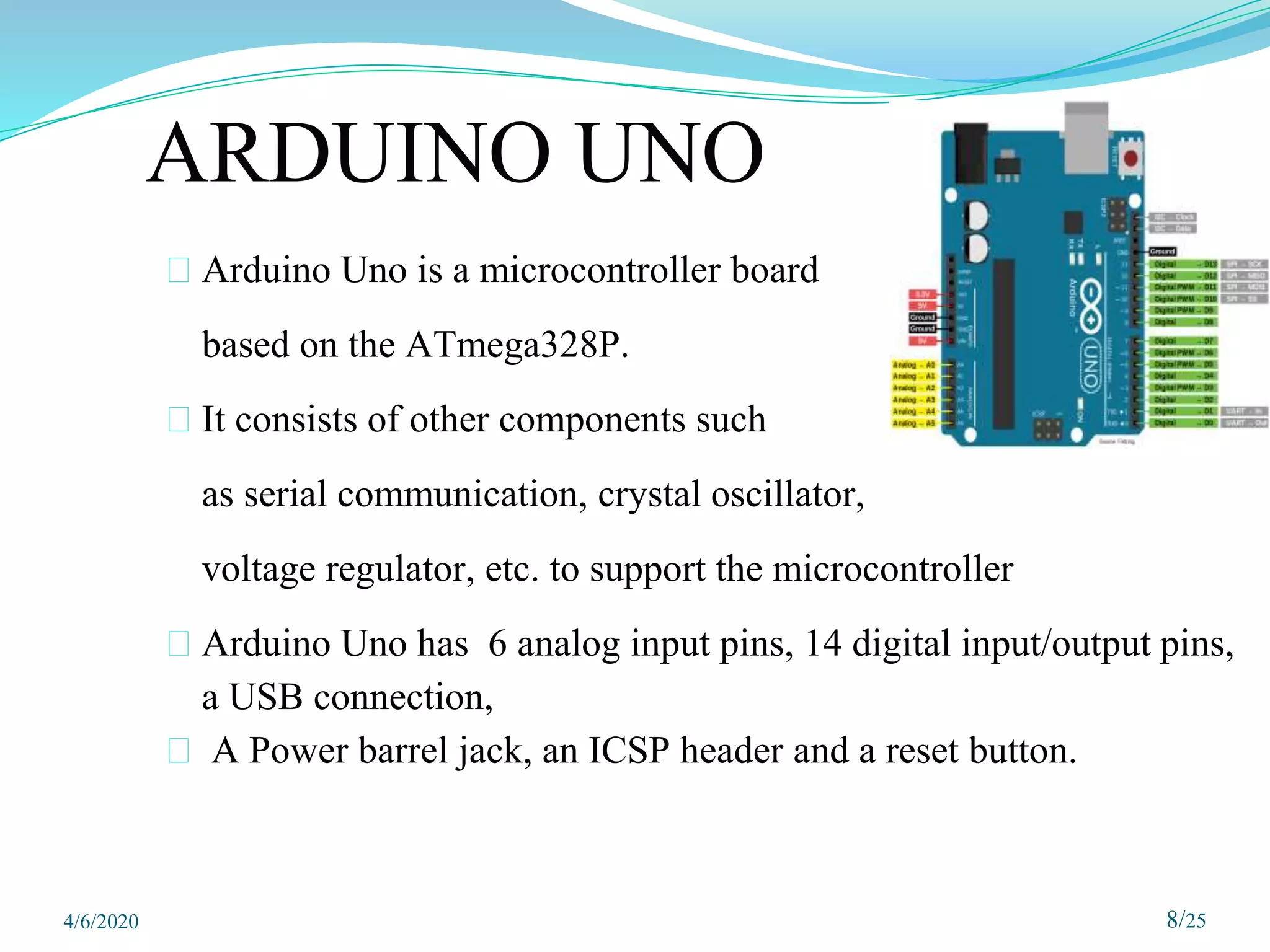
ARDUINO UNO
⮚ Arduino Uno is a microcontroller board
based on the ATmega328P.
⮚ It consists of other components such
as serial communication, crystal oscillator,
voltage regulator, etc. to support the microcontroller
⮚ Arduino Uno has 6 analog input pins, 14 digital input/output pins,
a USB connection,
⮚ A Power barrel jack, an ICSP header and a reset button.
4/6/2020 8/25
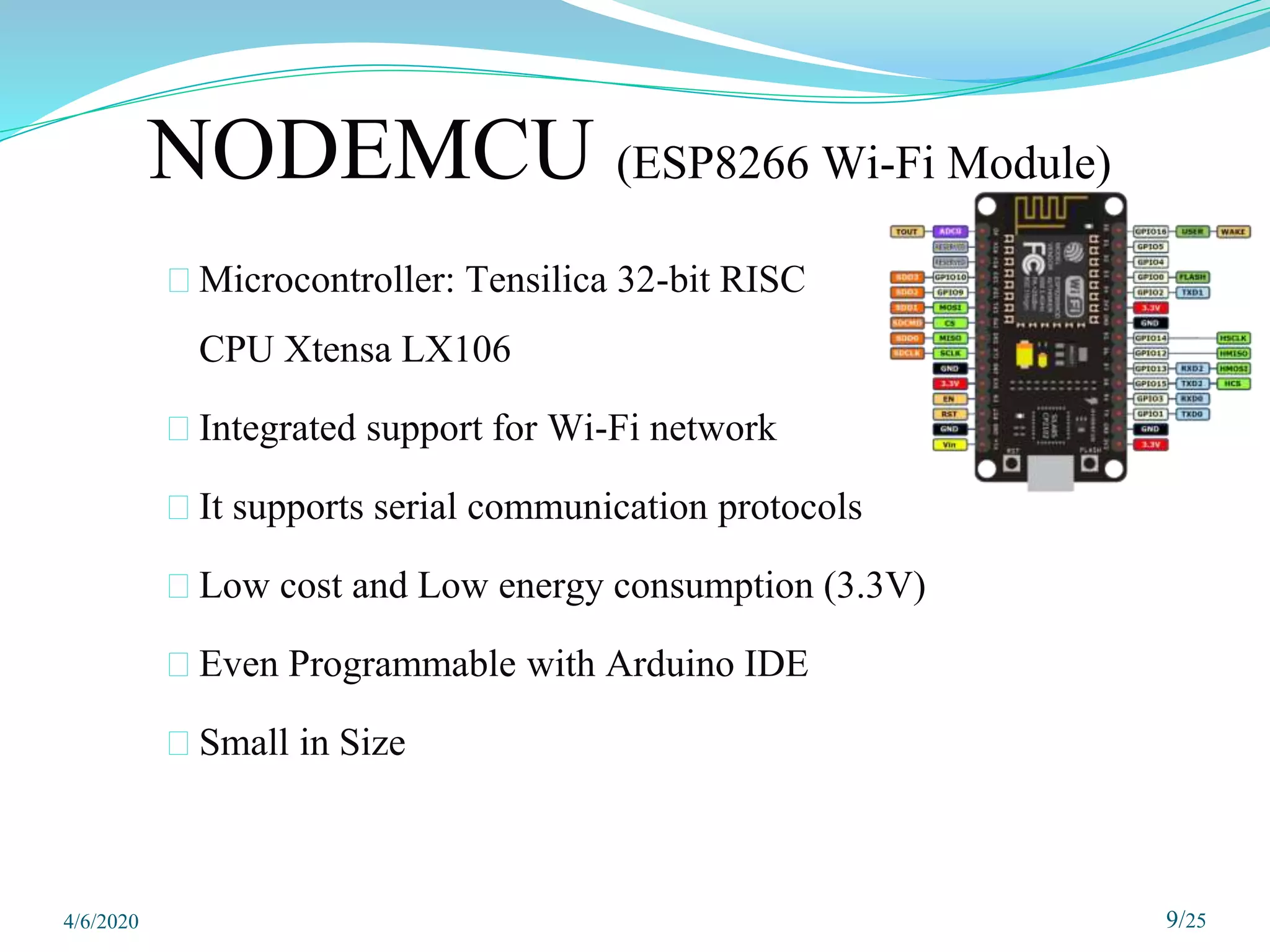
NODEMCU (ESP8266 Wi-Fi Module)
⮚ Microcontroller: Tensilica 32-bit RISC
CPU Xtensa LX106
⮚ Integrated support for Wi-Fi network
⮚ It supports serial communication protocols
⮚ Low cost and Low energy consumption (3.3V)
⮚ Even Programmable with Arduino IDE
⮚ Small in Size
9/25
4/6/2020
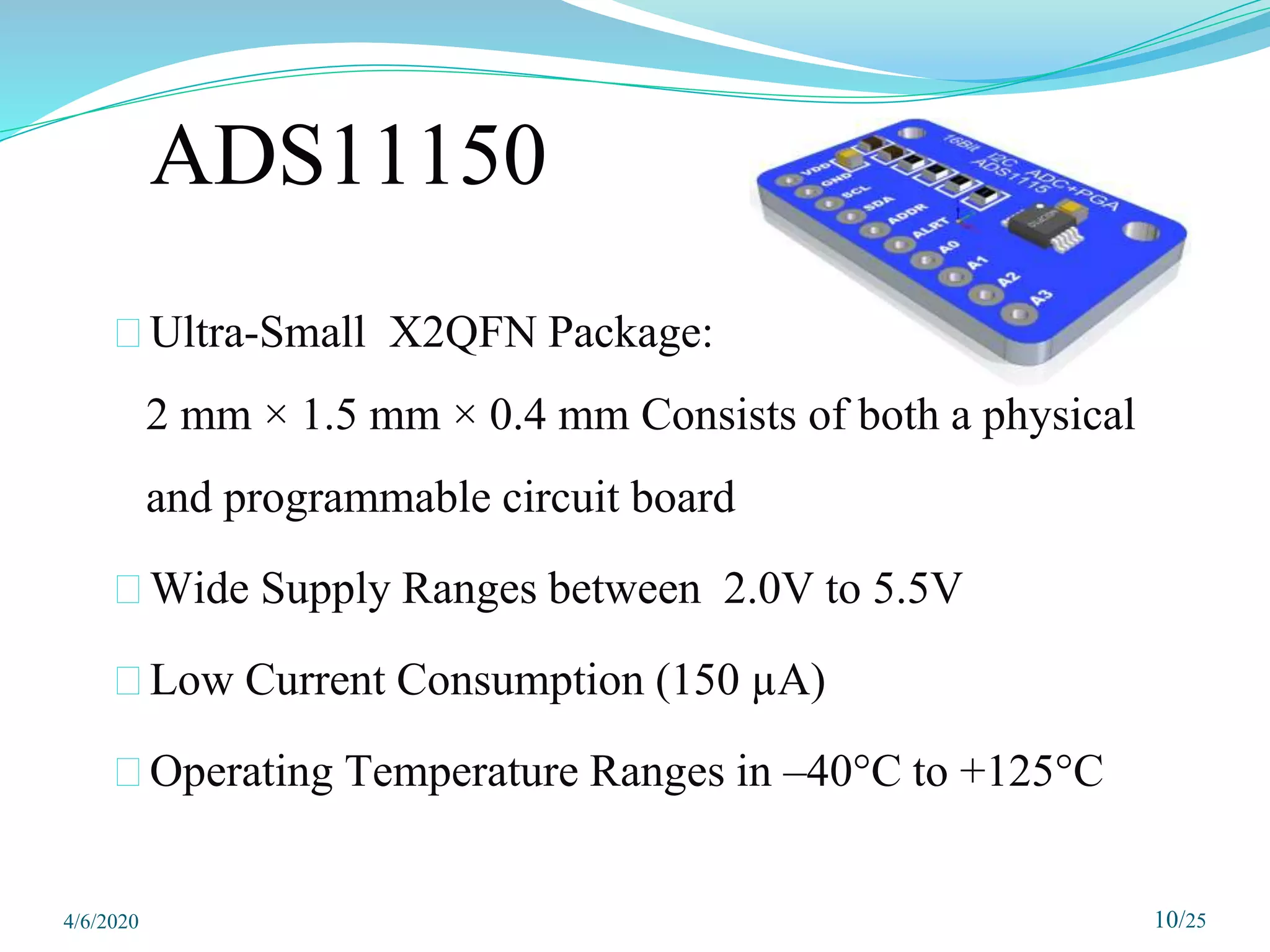
ADS11150
⮚Ultra-Small X2QFN Package:
2 mm × 1.5 mm × 0.4 mm Consists of both a physical
and programmable circuit board
⮚Wide Supply Ranges between 2.0V to 5.5V
⮚Low Current Consumption (150 µA)
⮚Operating Temperature Ranges in –40°C to +125°C
10/25
4/6/2020
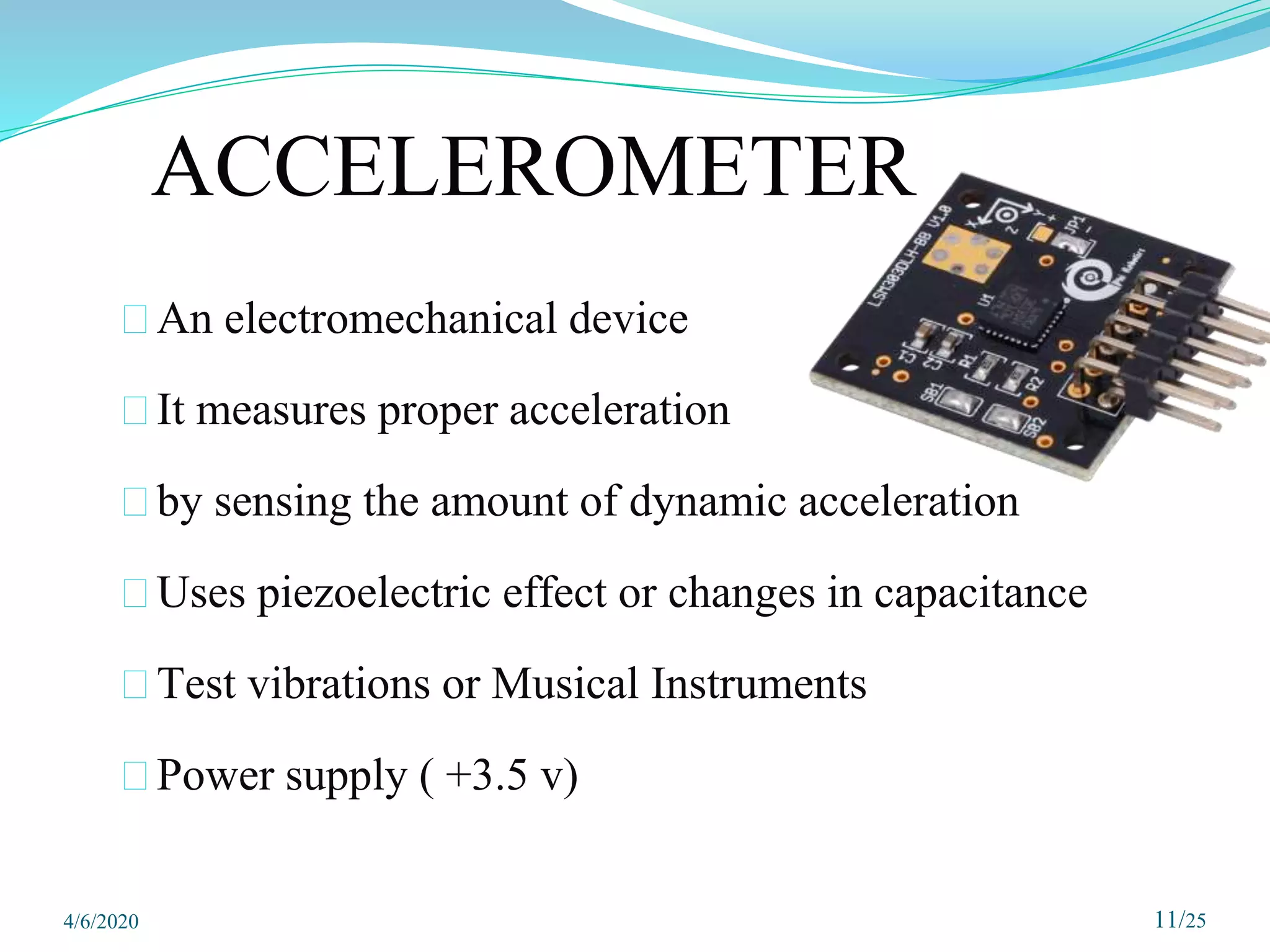
ACCELEROMETER
⮚An electromechanical device
⮚It measures proper acceleration
⮚by sensing the amount of dynamic acceleration
⮚Uses piezoelectric effect or changes in capacitance
⮚Test vibrations or Musical Instruments
⮚Power supply ( +3.5 v)
11/25
4/6/2020
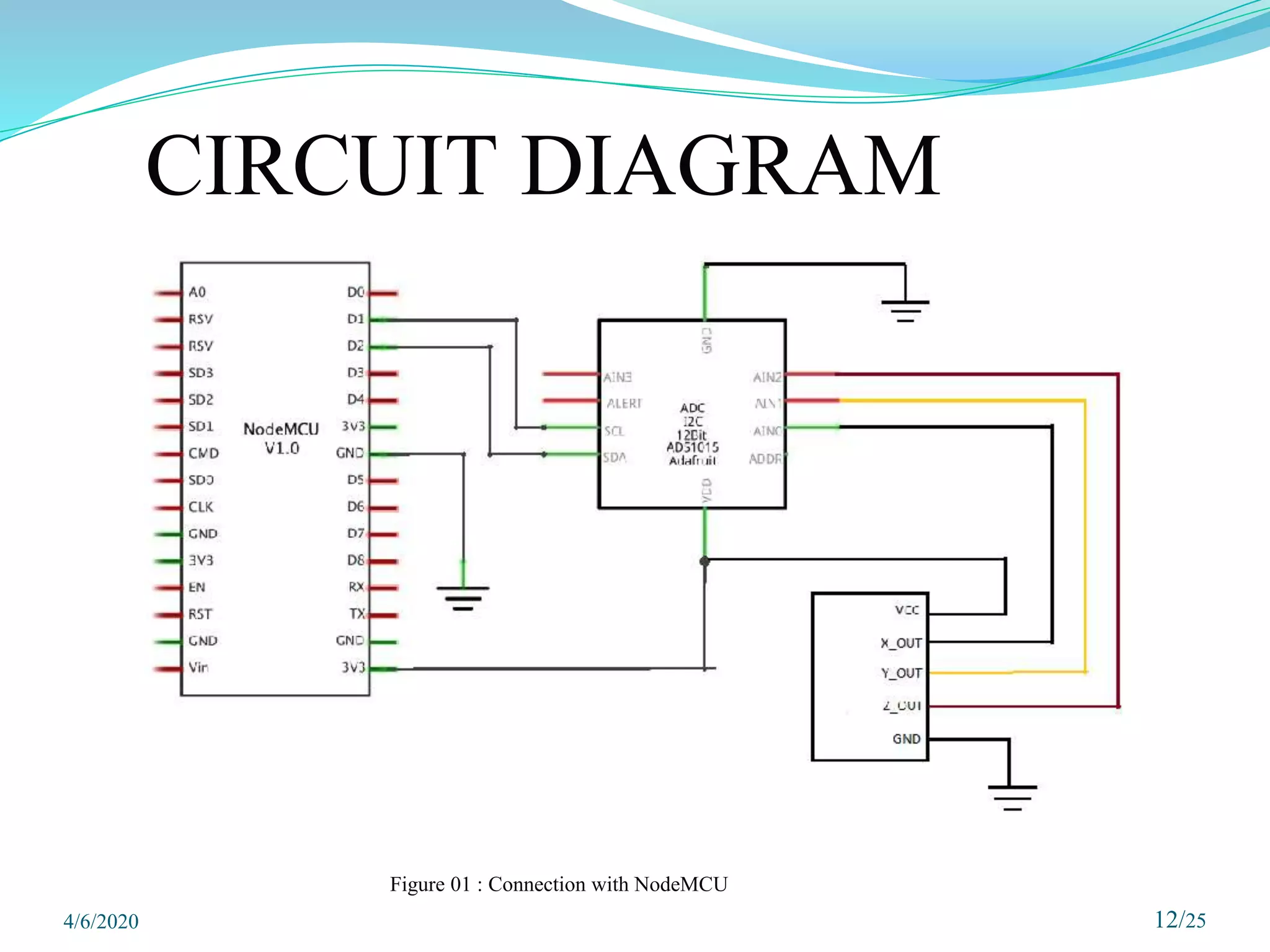
CIRCUIT DIAGRAM
12/25
Figure 01 : Connection with NodeMCU
4/6/2020
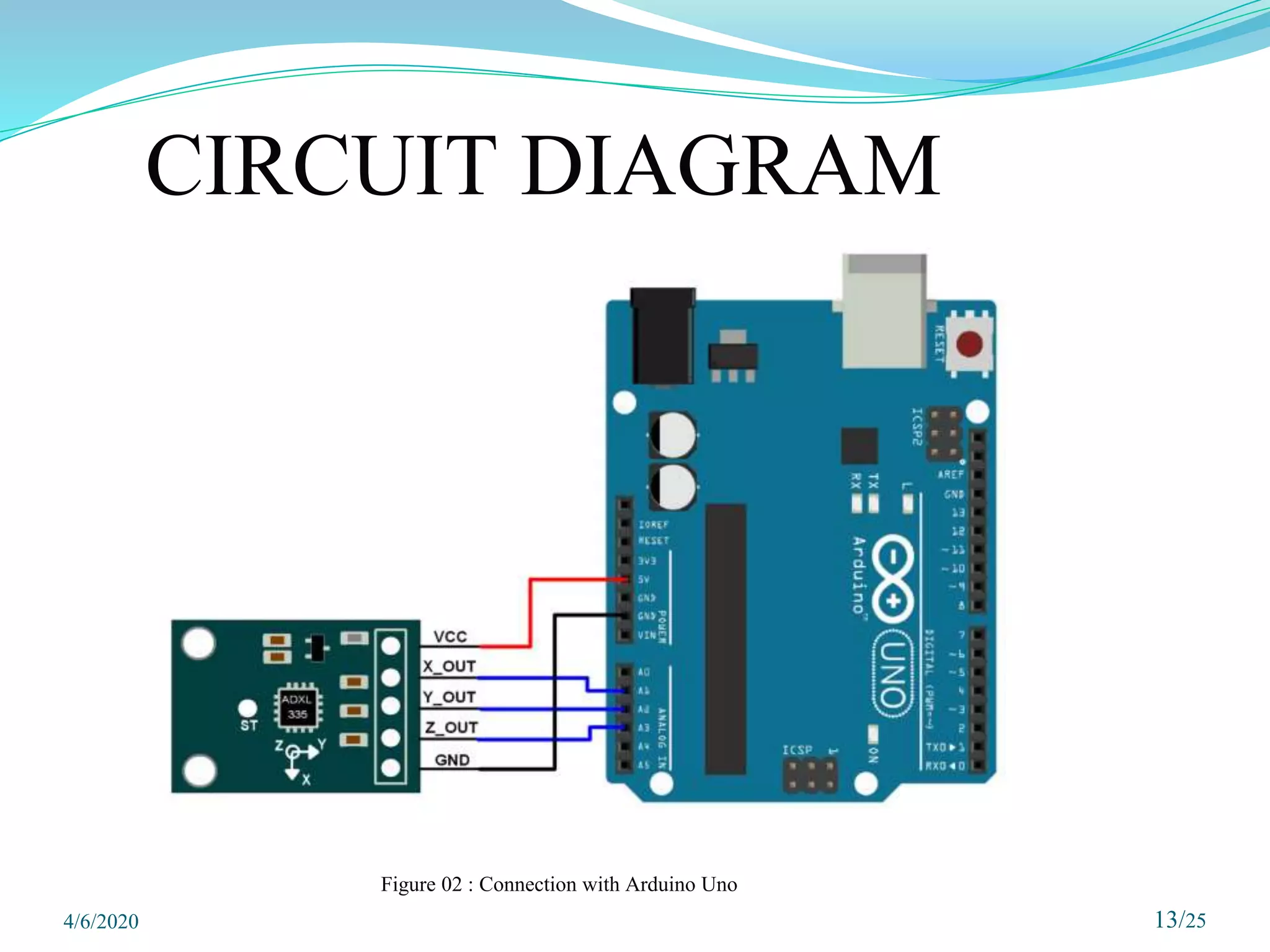
CIRCUIT DIAGRAM
13/25
Figure 02 : Connection with Arduino Uno
4/6/2020
For Module 1(Arduino UNO):
⮚Arduino is connected through USB
⮚The accelerometer measures orientation
⮚The data is captured using serial monitor
⮚PLX-DAQ Data Acquisition for Excel
⮚Data is being analyzed using mean algorithm
14/25
WORKING PROCEDURE
4/6/2020
WORKING PROCEDURE
For Module 2(NodeMCU):
⮚Wi-Fi module connects to the personal hotspot/Wi-Fi
⮚The accelerometer measured orientation
⮚The data is sent through an internet
⮚Data is being collected in a Google sheet
⮚Data is being analyzed using Standard deviation, mean
absolute value and Energy
15/25
4/6/2020
16/25
WORKING PROCEDURE
⮚ Data stored in excel sheet as training data
⮚ All calculations are automatic
⮚ 25 data test for each activity is being tested
⮚ Calculating different characteristics for test data
⮚ According to 25 test data predicts activity
⮚ Shows activity in summary sheet
4/6/2020
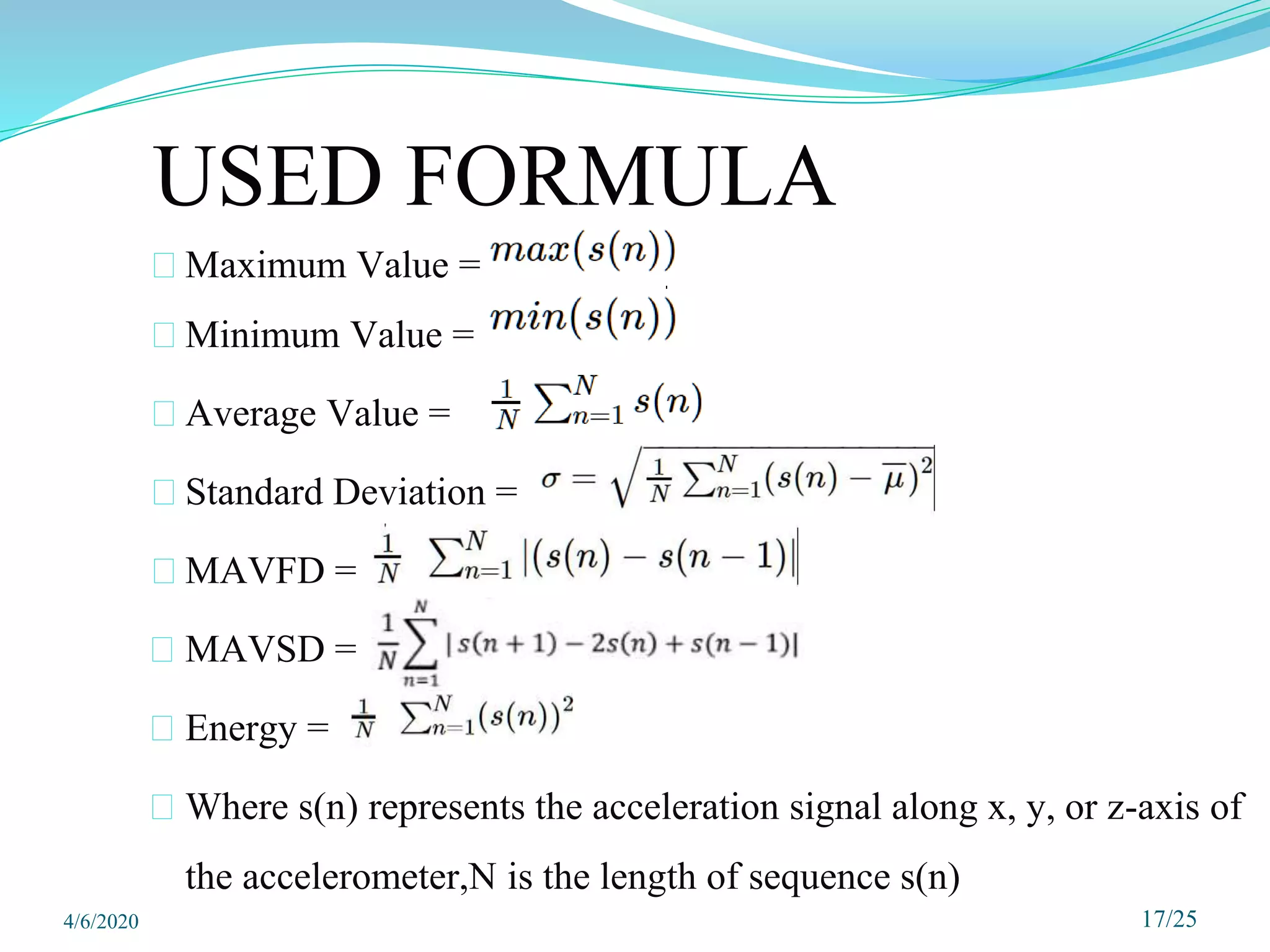
USED FORMULA
⮚ Maximum Value =
⮚ Minimum Value =
⮚ Average Value =
⮚ Standard Deviation =
⮚ MAVFD =
⮚ MAVSD =
⮚ Energy =
⮚ Where s(n) represents the acceleration signal along x, y, or z-axis of
the accelerometer,N is the length of sequence s(n)
17/25
4/6/2020
18/25
RESULT AND DISCUSSION
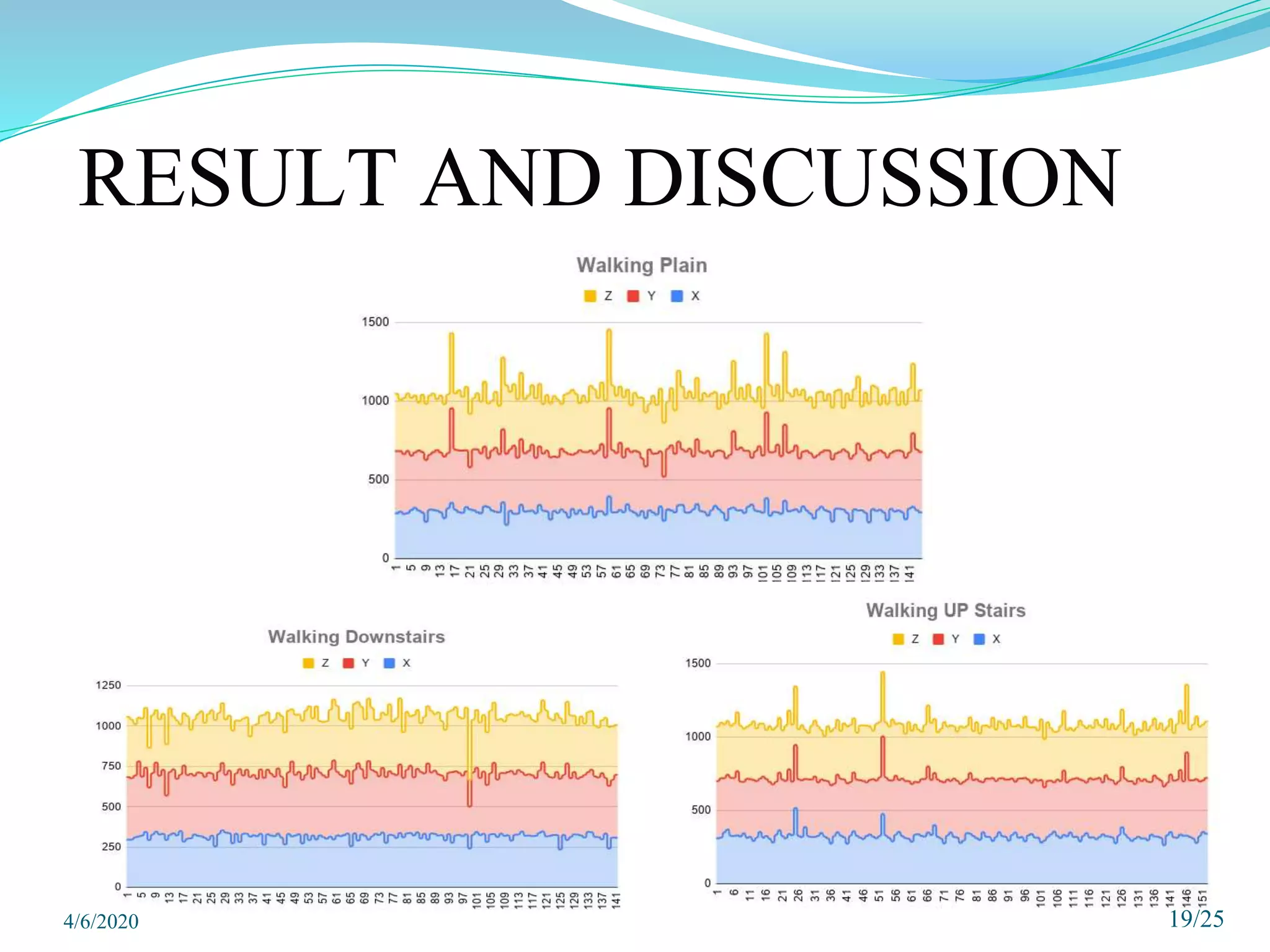
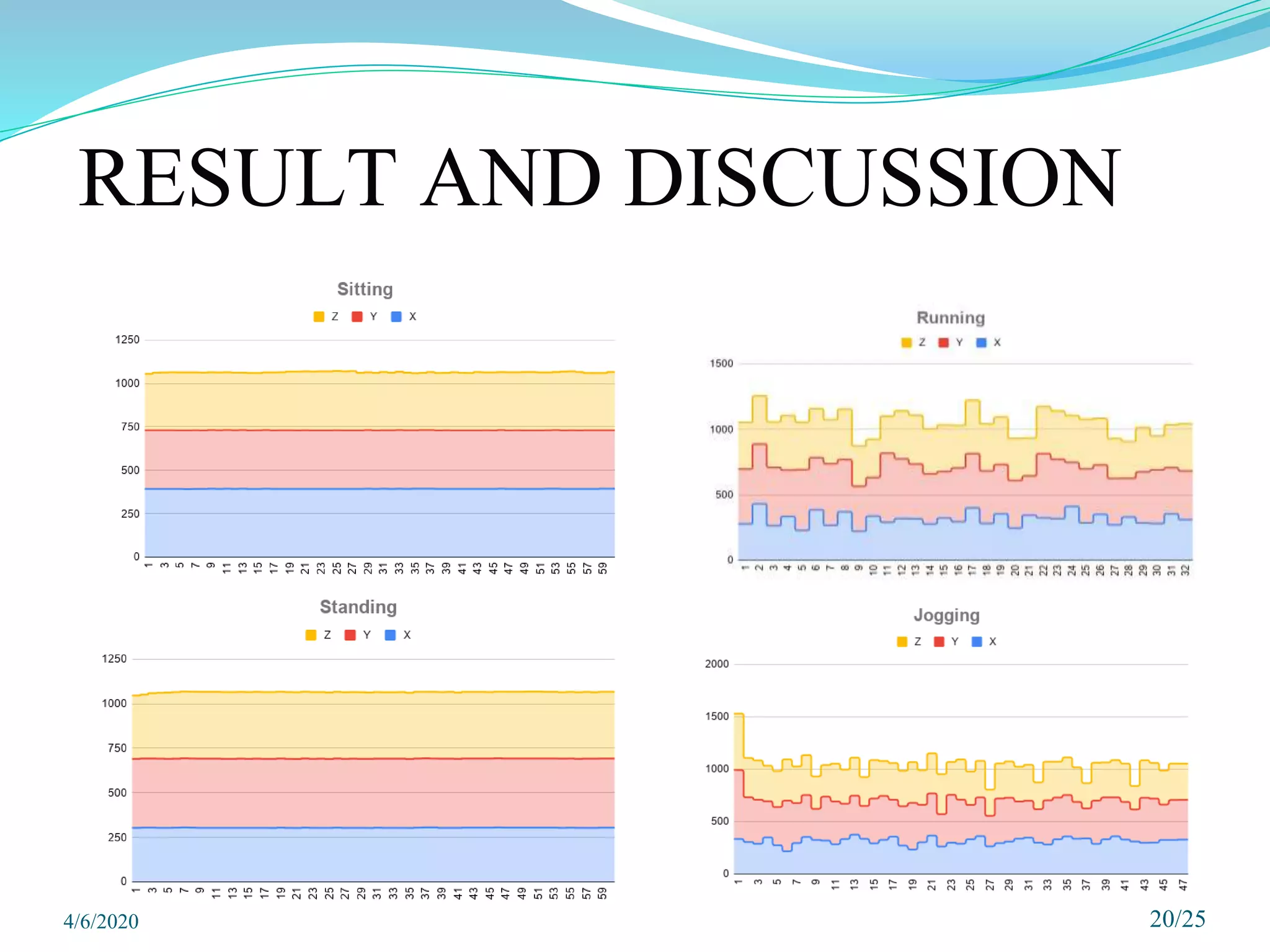
⮚Our hardware module detects the different activities
● Walking Plane
● Sitting
● Standing
● Jogging
● Running
● Walking Up
● Walking Down
4/6/2020
RESULT AND DISCUSSION
19/25
4/6/2020
20/25
RESULT AND DISCUSSION
4/6/2020
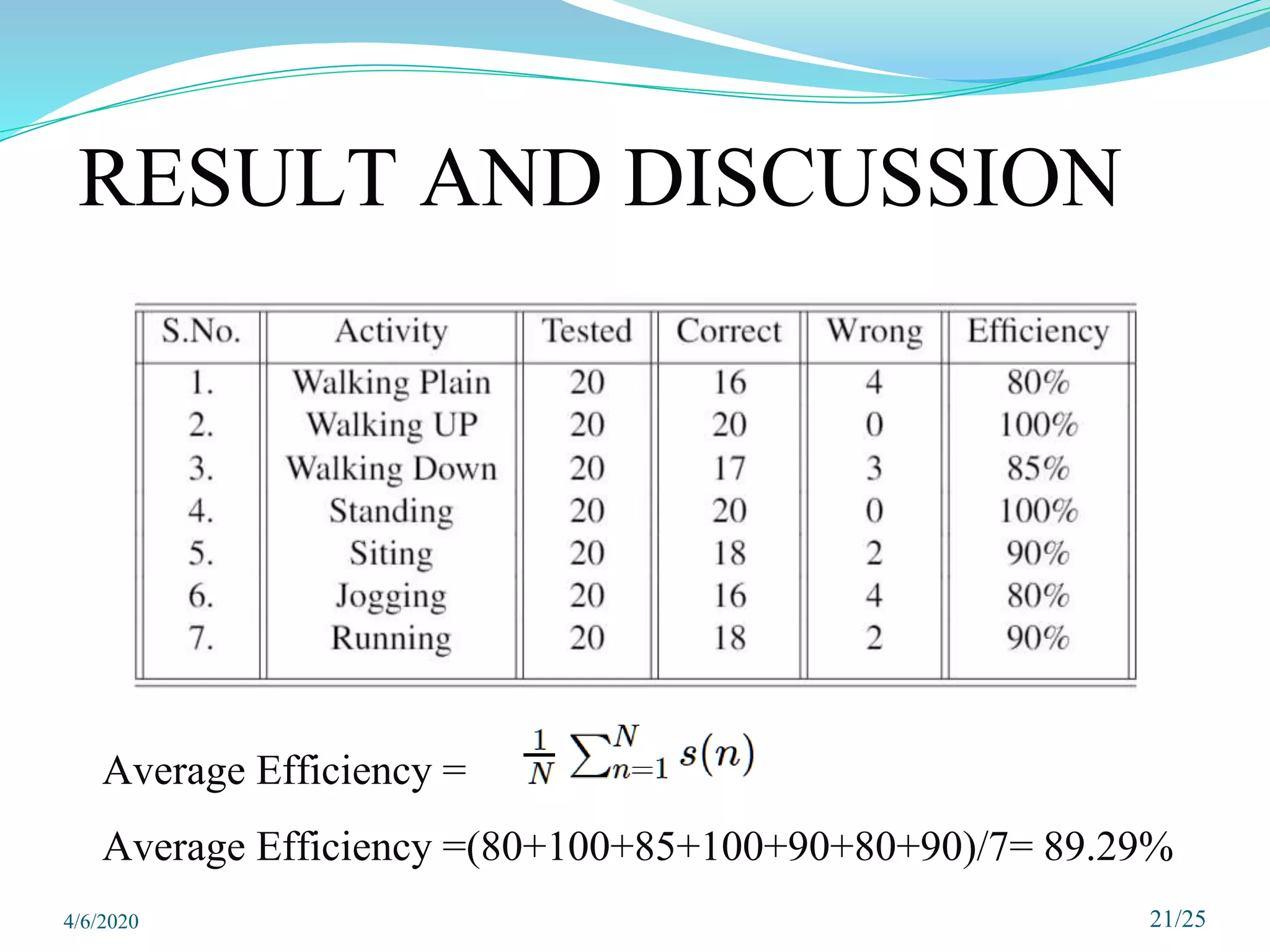
Average Efficiency =
Average Efficiency =(80+100+85+100+90+80+90)/7= 89.29%
21/25
RESULT AND DISCUSSION
4/6/2020
FUTURE SCOPE
⮚Other human physical analysis like heartbeat, pressure, specific
disease like asthma and other medical issues.
⮚A clear distinction between almost similar types of activities like
Staircase Down-and-Walking and Jogging-and-Running
⮚The incorporation of multiple human subjects would also lead to a
new direction of research that would study the interaction between
people and help to analyze group behaviour.
⮚The application domains are as broad as from healthcare to security
services and fitness monitoring.
22/25
4/6/2020
REFERENCES
1. A. Czabke, S. Marsch, and T. Lueth, “Accelerometer based real-
time activity analysis on a microcontroller,” in Pervasive
Computing Technologies for Healthcare (Pervasive Health), 2011
5th IEEE International Conference on, may 2011, pp. 40 –46.
2. S. Bosch, M. Marin-Perianu, R. Marin-Perianu, P. Havinga, and H.
Hermens, “Keep on moving! activity monitoring and stimulation
using wireless sensor networks,” Proceedings of EuroSSC’09, the
4th European conference on Smart sensing and context, pp. 11–
23, ACM, 2009.
3. Uslu, Gamze, H. Ibrahim Dursunoglu, Ozgur Altun, and Sebnem
Baydere. "Human activity monitoring with wearable sensors and
hybrid classifiers." International Journal of Computer Information
Systems and Industrial Management Applications 5 (2013): 345-
353.
23/25
4/6/2020
4. Asim, Y., Azam, M. A., Ehatisham-ul-Haq, M., Naeem, U., &
Khalid, A. (2020). “Context-Aware Human Activity Recognition
(CAHAR) in-the-Wild using Smartphone Accelerometer.” IEEE
Sensors Journal,pp.1–1,2020.
5. M. Espinilla, J. Medina, J. Hallberg, and C. Nugent,“A new
approach based on temporal sub-windows for online sensor-
based activity recognition,” Journal of Ambient Intelligence and
Humanized Computing, pp.1–13, 2018.
24/25
REFERENCES
4/6/2020
25/25

Human Activity Monitoring System Using Wearable Sensors presentation

  • 1.
    Presented By:- Amrit Raj(B16CS013) Arun Kumar Verma (B16CS021) Guided by :- Dr Soumen Moulik Assistant Professor Human Activity Monitoring Using Wearable Sensors 1/25
  • 2.
    CONTENTS ⮚ OBJECTIVE ⮚ INTRODUCTION ⮚MOTIVATION ⮚ LITERATURE REVIEW ⮚ USED COMPONENT ⮚ ARDUINO UNO ⮚ NODE-MCU ⮚ ANALOG TO DIGITAL CONVERTER ⮚ ACCELEROMETER ⮚ CIRCUIT DIAGRAM ⮚ WORKING PROCEDURE ⮚ RESULTS AND DISCUSSION ⮚ FUTURE SCOPE ⮚ REFERENCES 4/6/2020 2/25
  • 3.
    ⮚ Activity Monitoringof Human with Wearable Sensors using Accelerometer. ⮚ Monitoring over old/elderly people at home using sensor. ⮚ Using Google Excel sheet and Web App we can see the status of the old person/patients. ⮚ To provide an objective indication of the activity levels or restrictions experienced by patients or the elderly. 3/25 OBJECTIVE 4/6/2020
  • 4.
    INTRODUCTION ⮚ Real-time activitymonitoring using wearable sensors and hybrid classifiers. ⮚ Recognizing activities such as standing, walking, running, or sitting. ⮚ Patients with dementia and other mental pathologies could be monitored to detect abnormal activities and thereby prevent undesirable consequences. ⮚ 50% of the old age(70+) group hospitalized due to injuries by falling down. 4/25 4/6/2020
  • 5.
    MOTIVATION ⮚ The emphasisis given on the monitoring of the elderly people. An example of that includes the continuous monitoring of elderly people. ⮚ Integration of cheap and replaceable components makes it feasible for public. ⮚ Authorise person can monitor using Internet from anywhere. ⮚ The devices which do not intrude into the privacy of the person to be monitored can have an advantage over the devices like camera. 5/25 4/6/2020
  • 6.
    LITERATURE REVIEW 6/25 Authors AspectsRemarks Uslu et al. [3] Human activity monitoring with wearable sensors and hybrid classifiers. 1.How to effectively use Accelerometer sensor. Asim et al. [4] Context-Aware Human Activity Recognition (CAHAR) in-the-Wild using Smartphone Accelerometer. 1. Related with the mathematical Calculations. S. Bosch et al. [2] Keep on moving! activity monitoring and stimulation using wireless sensor networks. 1. Stimulation using wireless network. 2. Different types of the proposed algorithm. 4/6/2020
  • 7.
    USED COMPONENTS ⮚ Accelerometer ⮚Arduino Uno ⮚ ESP8266 Wi-Fi Module(Node MCU) ⮚ Analog to Digital Converter (ADS1115) ⮚ Breadboard ⮚ Connecting Wires ⮚ Power Supply (5 V) 7/25 4/6/2020
  • 8.
    ARDUINO UNO ⮚ ArduinoUno is a microcontroller board based on the ATmega328P. ⮚ It consists of other components such as serial communication, crystal oscillator, voltage regulator, etc. to support the microcontroller ⮚ Arduino Uno has 6 analog input pins, 14 digital input/output pins, a USB connection, ⮚ A Power barrel jack, an ICSP header and a reset button. 4/6/2020 8/25
  • 9.
    NODEMCU (ESP8266 Wi-FiModule) ⮚ Microcontroller: Tensilica 32-bit RISC CPU Xtensa LX106 ⮚ Integrated support for Wi-Fi network ⮚ It supports serial communication protocols ⮚ Low cost and Low energy consumption (3.3V) ⮚ Even Programmable with Arduino IDE ⮚ Small in Size 9/25 4/6/2020
  • 10.
    ADS11150 ⮚Ultra-Small X2QFN Package: 2mm × 1.5 mm × 0.4 mm Consists of both a physical and programmable circuit board ⮚Wide Supply Ranges between 2.0V to 5.5V ⮚Low Current Consumption (150 µA) ⮚Operating Temperature Ranges in –40°C to +125°C 10/25 4/6/2020
  • 11.
    ACCELEROMETER ⮚An electromechanical device ⮚Itmeasures proper acceleration ⮚by sensing the amount of dynamic acceleration ⮚Uses piezoelectric effect or changes in capacitance ⮚Test vibrations or Musical Instruments ⮚Power supply ( +3.5 v) 11/25 4/6/2020
  • 12.
    CIRCUIT DIAGRAM 12/25 Figure 01: Connection with NodeMCU 4/6/2020
  • 13.
    CIRCUIT DIAGRAM 13/25 Figure 02: Connection with Arduino Uno 4/6/2020
  • 14.
    For Module 1(ArduinoUNO): ⮚Arduino is connected through USB ⮚The accelerometer measures orientation ⮚The data is captured using serial monitor ⮚PLX-DAQ Data Acquisition for Excel ⮚Data is being analyzed using mean algorithm 14/25 WORKING PROCEDURE 4/6/2020
  • 15.
    WORKING PROCEDURE For Module2(NodeMCU): ⮚Wi-Fi module connects to the personal hotspot/Wi-Fi ⮚The accelerometer measured orientation ⮚The data is sent through an internet ⮚Data is being collected in a Google sheet ⮚Data is being analyzed using Standard deviation, mean absolute value and Energy 15/25 4/6/2020
  • 16.
    16/25 WORKING PROCEDURE ⮚ Datastored in excel sheet as training data ⮚ All calculations are automatic ⮚ 25 data test for each activity is being tested ⮚ Calculating different characteristics for test data ⮚ According to 25 test data predicts activity ⮚ Shows activity in summary sheet 4/6/2020
  • 17.
    USED FORMULA ⮚ MaximumValue = ⮚ Minimum Value = ⮚ Average Value = ⮚ Standard Deviation = ⮚ MAVFD = ⮚ MAVSD = ⮚ Energy = ⮚ Where s(n) represents the acceleration signal along x, y, or z-axis of the accelerometer,N is the length of sequence s(n) 17/25 4/6/2020
  • 18.
    18/25 RESULT AND DISCUSSION ⮚Ourhardware module detects the different activities ● Walking Plane ● Sitting ● Standing ● Jogging ● Running ● Walking Up ● Walking Down 4/6/2020
  • 19.
  • 20.
  • 21.
    Average Efficiency = AverageEfficiency =(80+100+85+100+90+80+90)/7= 89.29% 21/25 RESULT AND DISCUSSION 4/6/2020
  • 22.
    FUTURE SCOPE ⮚Other humanphysical analysis like heartbeat, pressure, specific disease like asthma and other medical issues. ⮚A clear distinction between almost similar types of activities like Staircase Down-and-Walking and Jogging-and-Running ⮚The incorporation of multiple human subjects would also lead to a new direction of research that would study the interaction between people and help to analyze group behaviour. ⮚The application domains are as broad as from healthcare to security services and fitness monitoring. 22/25 4/6/2020
  • 23.
    REFERENCES 1. A. Czabke,S. Marsch, and T. Lueth, “Accelerometer based real- time activity analysis on a microcontroller,” in Pervasive Computing Technologies for Healthcare (Pervasive Health), 2011 5th IEEE International Conference on, may 2011, pp. 40 –46. 2. S. Bosch, M. Marin-Perianu, R. Marin-Perianu, P. Havinga, and H. Hermens, “Keep on moving! activity monitoring and stimulation using wireless sensor networks,” Proceedings of EuroSSC’09, the 4th European conference on Smart sensing and context, pp. 11– 23, ACM, 2009. 3. Uslu, Gamze, H. Ibrahim Dursunoglu, Ozgur Altun, and Sebnem Baydere. "Human activity monitoring with wearable sensors and hybrid classifiers." International Journal of Computer Information Systems and Industrial Management Applications 5 (2013): 345- 353. 23/25 4/6/2020
  • 24.
    4. Asim, Y.,Azam, M. A., Ehatisham-ul-Haq, M., Naeem, U., & Khalid, A. (2020). “Context-Aware Human Activity Recognition (CAHAR) in-the-Wild using Smartphone Accelerometer.” IEEE Sensors Journal,pp.1–1,2020. 5. M. Espinilla, J. Medina, J. Hallberg, and C. Nugent,“A new approach based on temporal sub-windows for online sensor- based activity recognition,” Journal of Ambient Intelligence and Humanized Computing, pp.1–13, 2018. 24/25 REFERENCES 4/6/2020
  • 25.