Open Minds: Another way to access Knowledge and
share your ideas
Maria Perifanou
Stylianos Mystakidis
What is open access?
“Open means that anyone can freely access, use,
modify, and share for any purpose (subject, at most,
to requirements that preserve provenance and
openness).” Opendefinition.org
Why open access?
Enhance visibility & impact of research
 Speeds up publication process
Allows others to build on your work
Research paid by public funds => innovation,
prestige, funding
How to provide open access?
"Green" OA: Self-archiving Author archives an
electronic copy of a peer-reviewed publication
in an institutional or subject repository.
 "Gold” OA: Open access publishing Authors
publish their scholarship in open access
journals or monograph series.
Best practice: always self-archive an OA
version of your work, regardless if & where
you publish.
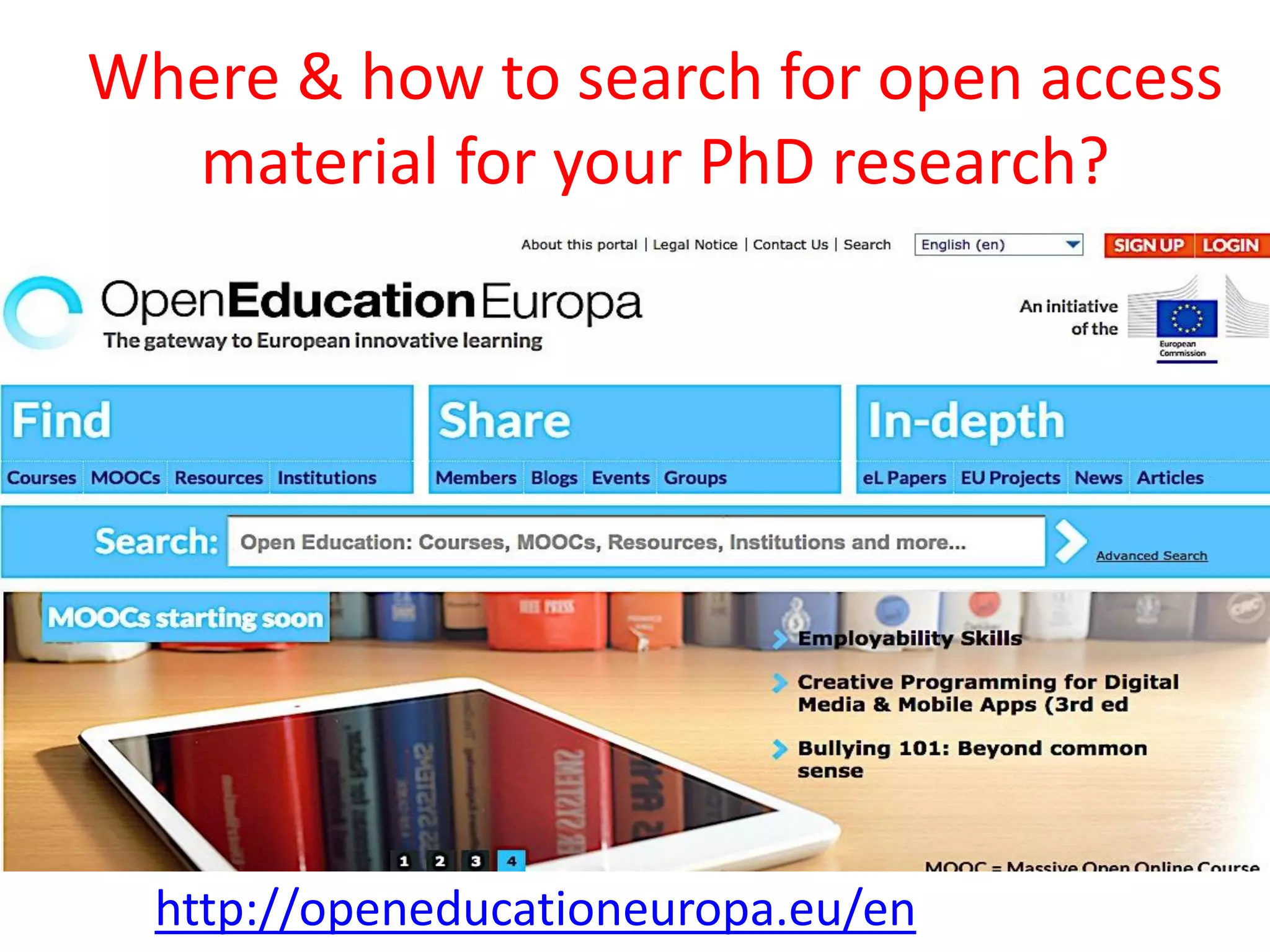
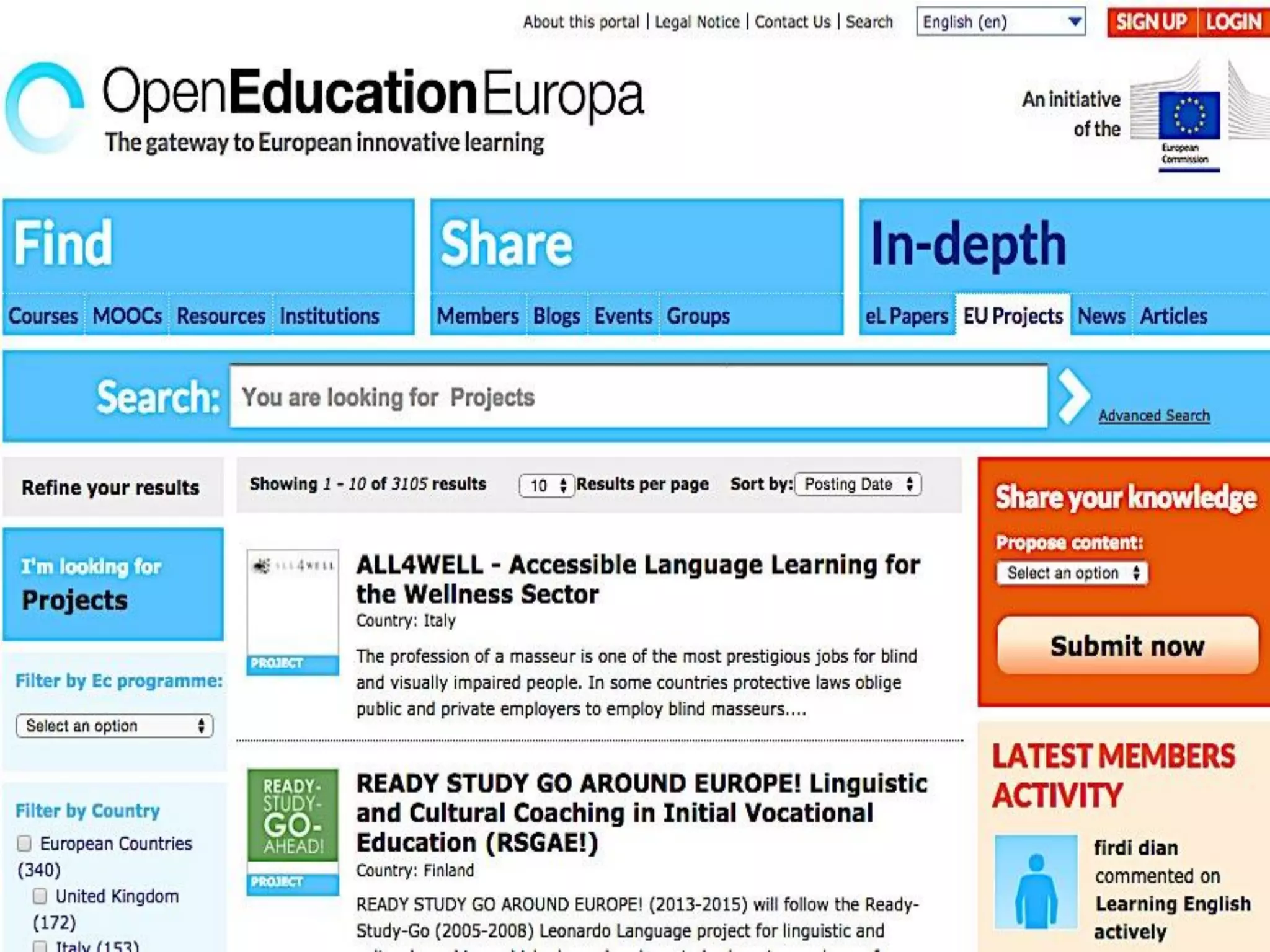
Where & how to search for open access
material for your PhD research?
http://openeducationeuropa.eu/en
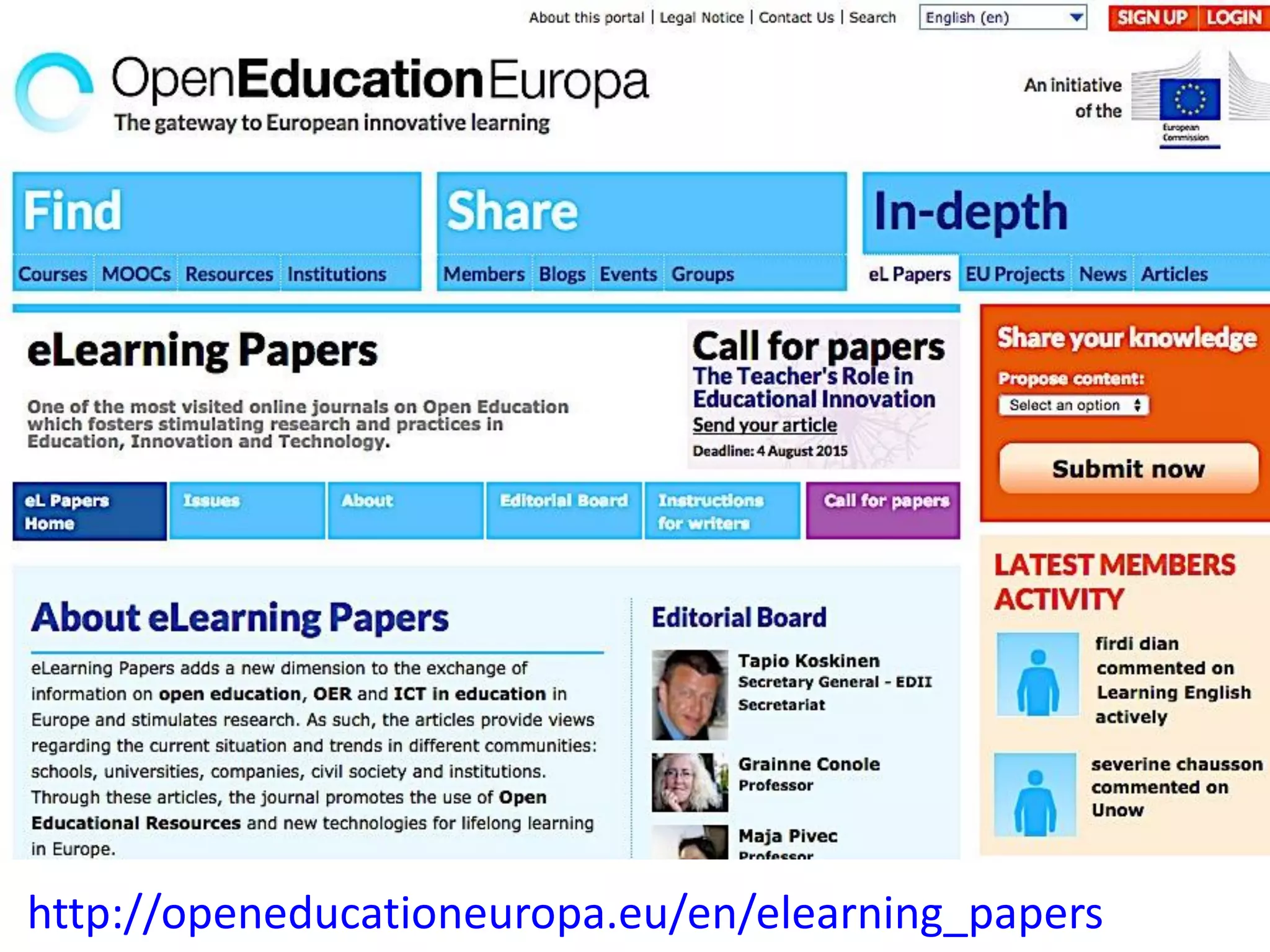
http://openeducationeuropa.eu/en/elearning_papers
Hands on session
Preparation
Individual work
Group work
Let’s work together _ gdoc
Getting prepared: Check our Twitter channel
#jtelss15 to access the open minds gdoc
Step 1:
 Please add your information to the gdocs
 Form groups of 3-4 people
http://bit.ly/jtel15-oa01
Let’s work together _ gdoc
Step 2: Individual Work
a. Create your account (or login) in the Open
Education Europa portal (OEE) here
http://openeducationeuropa.eu/el/user/register
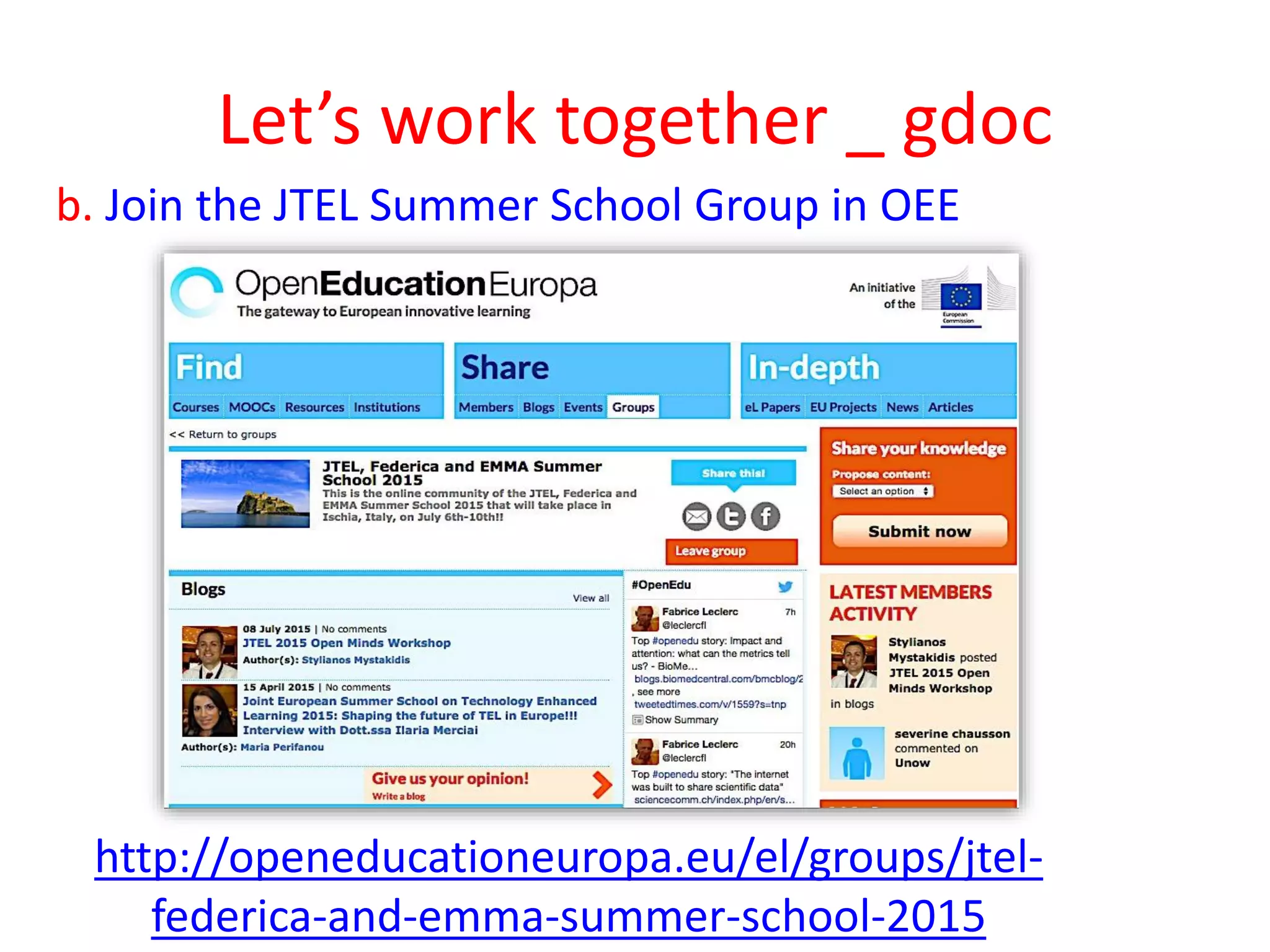
b. Join the JTEL Summer School Group in OEE
http://openeducationeuropa.eu/el/groups/jtel-
federica-and-emma-summer-school-2015
Let’s work together _ gdoc
Check the Twitter channel #jtelss15 to access the
open minds gdoc
Step 3: Group work A
 Q1. Where can a researcher locate open access
material/resources e.g. for a Phd literature
review???
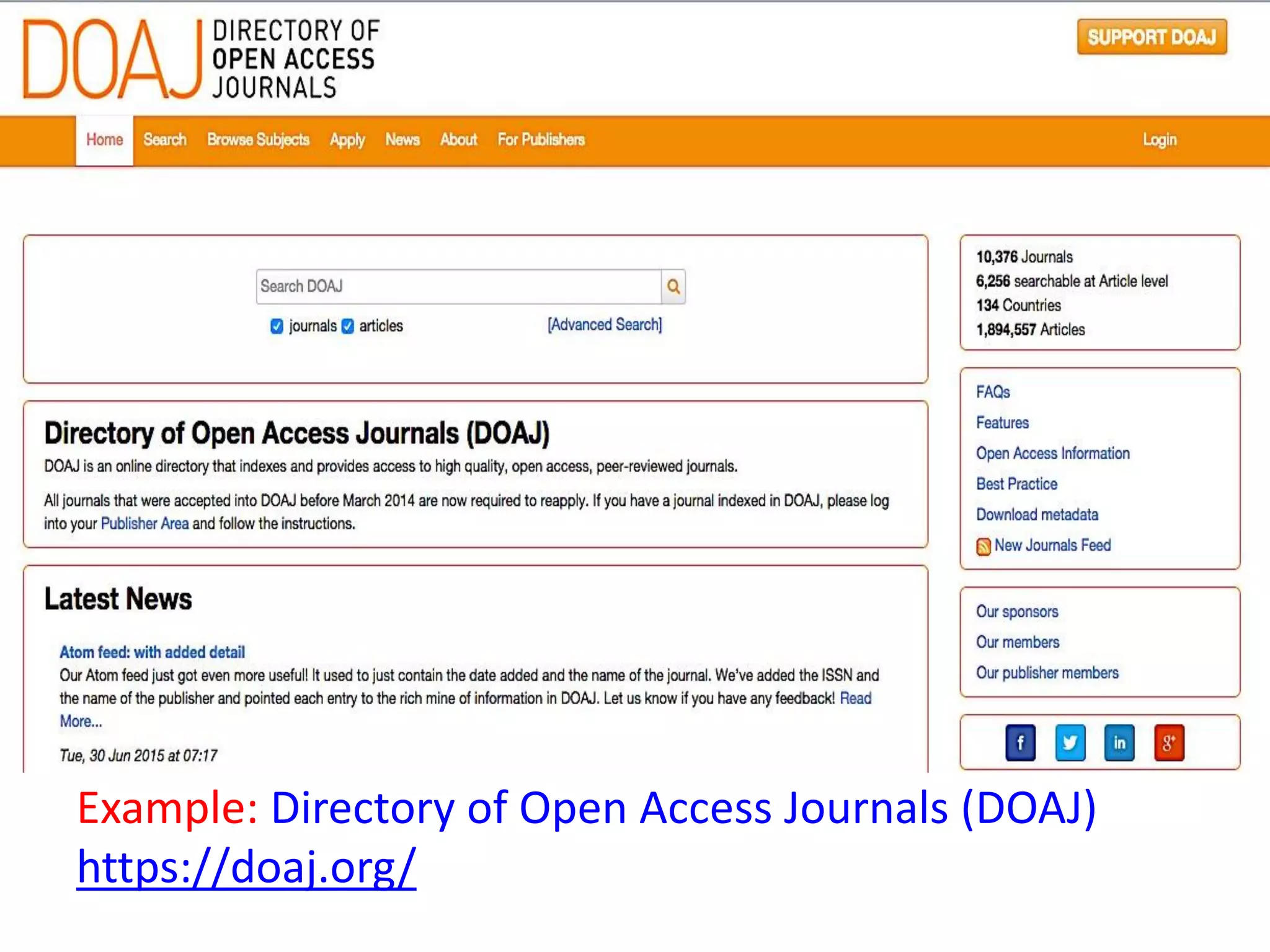
Example: Directory of Open Access Journals (DOAJ)
https://doaj.org/
Let’s work together _ gdoc
Check the Twitter channel #jtelss15 to access the
open minds gdoc
Step 3: Group work B
 Q2. How to share your research "safely" to
open access databases? Do you know how to
protect your research work?
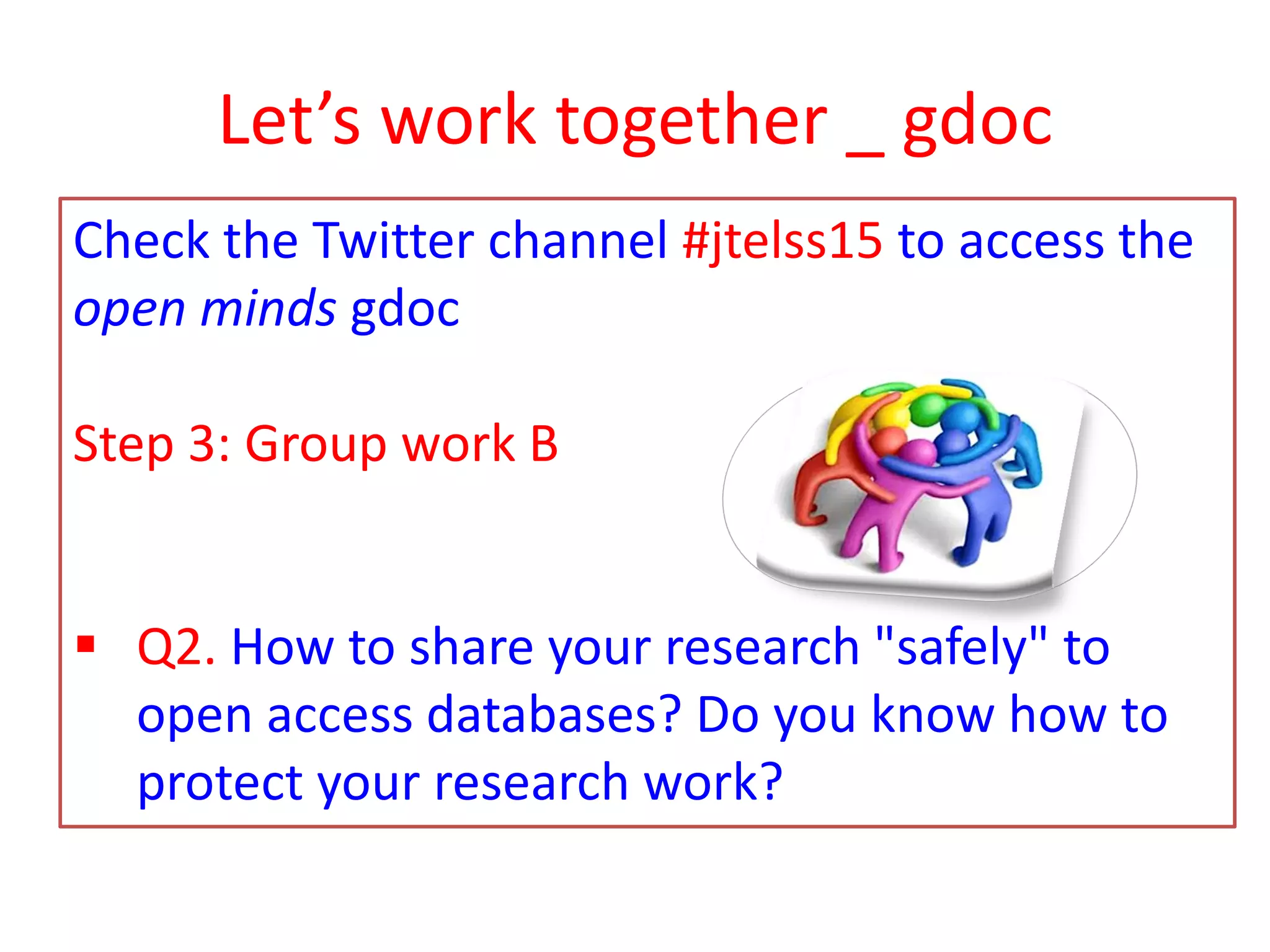
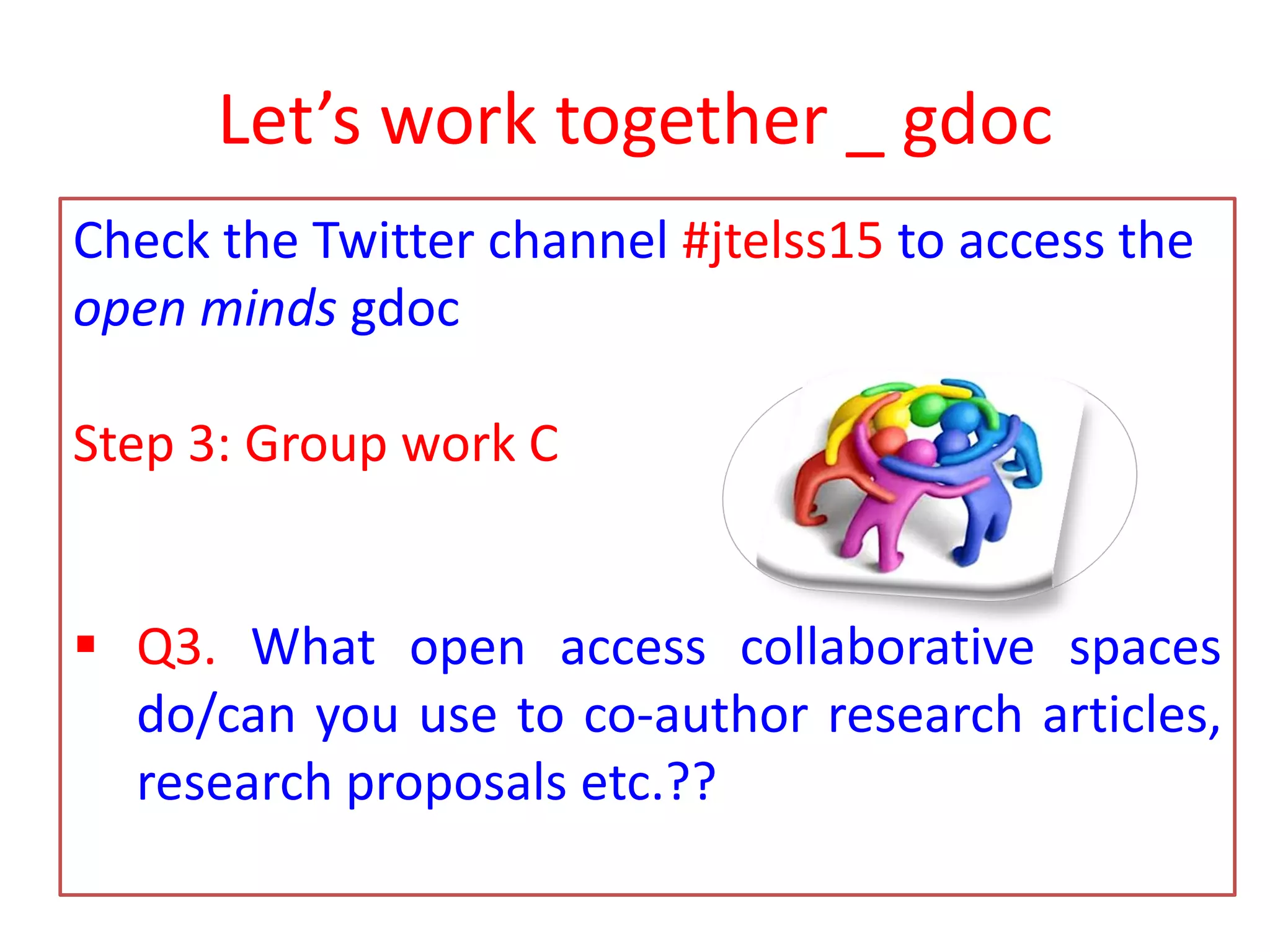
Let’s work together _ gdoc
Check the Twitter channel #jtelss15 to access the
open minds gdoc
Step 3: Group work C
 Q3. What open access collaborative spaces
do/can you use to co-author research articles,
research proposals etc.??
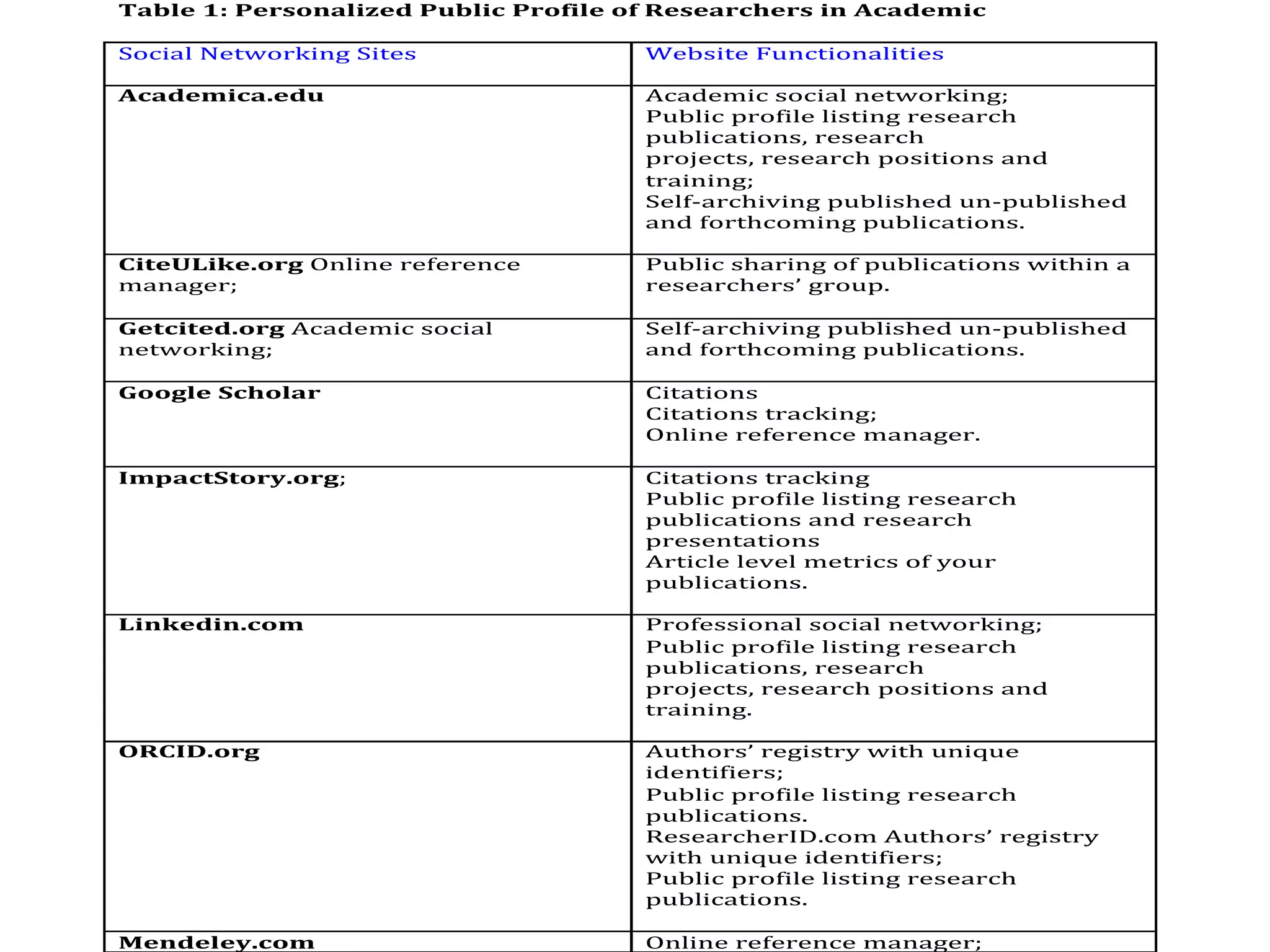
Table 1: Personalized Public Profile of Researchers in Academic
Social Networking Sites Website Functionalities
Academica.edu Academic social networking;
Public profile listing research
publications, research
projects, research positions and
training;
Self-archiving published un-published
and forthcoming publications.
CiteULike.org Online reference
manager;
Public sharing of publications within a
researchers’ group.
Getcited.org Academic social
networking;
Self-archiving published un-published
and forthcoming publications.
Google Scholar Citations
Citations tracking;
Online reference manager.
ImpactStory.org; Citations tracking
Public profile listing research
publications and research
presentations
Article level metrics of your
publications.
Linkedin.com Professional social networking;
Public profile listing research
publications, research
projects, research positions and
training.
ORCID.org Authors’ registry with unique
identifiers;
Public profile listing research
publications.
ResearcherID.com Authors’ registry
with unique identifiers;
Public profile listing research
publications.
Mendeley.com Online reference manager;
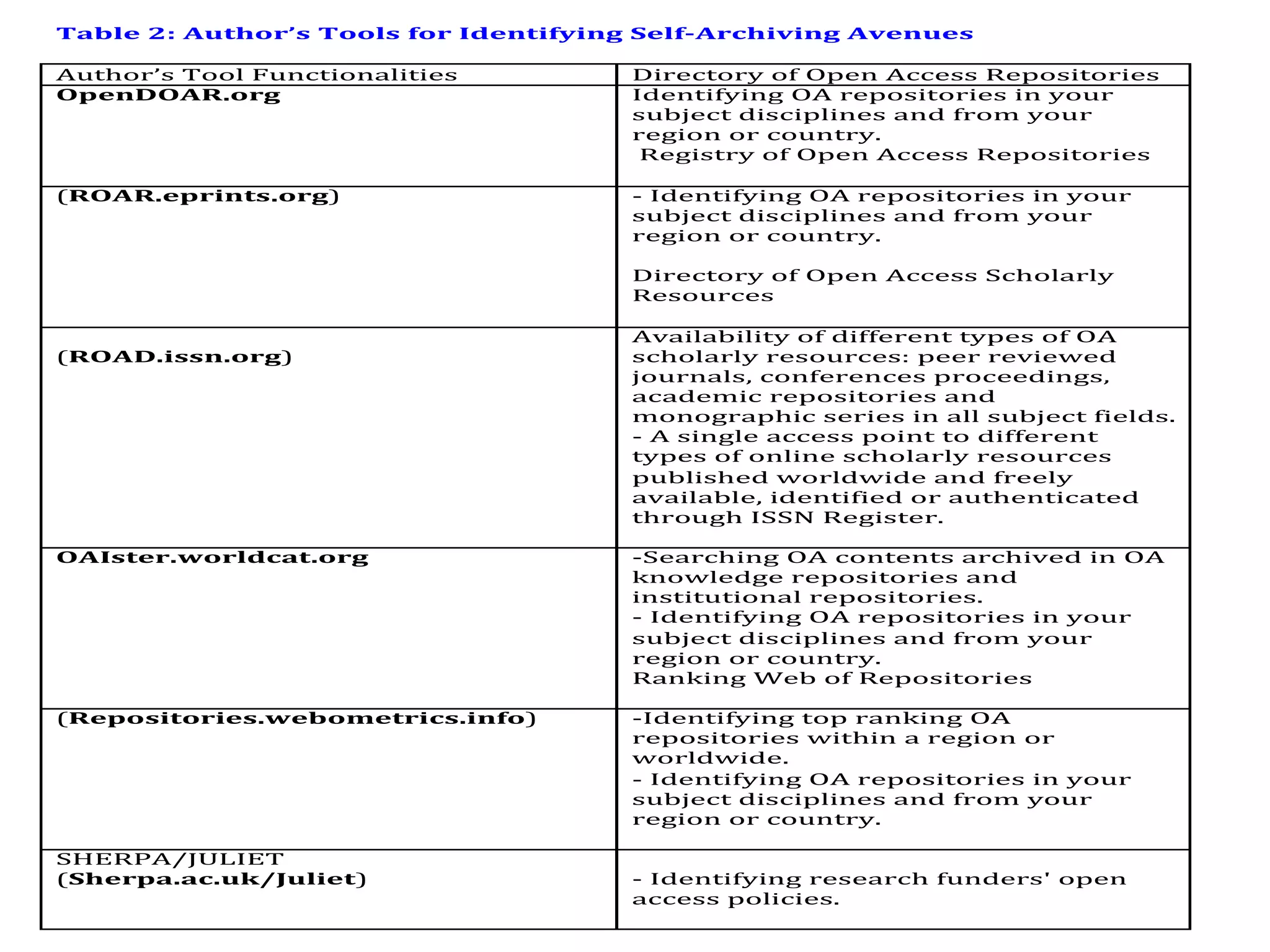
Table 2: Author’s Tools for Identifying Self-Archiving Avenues
Author’s Tool Functionalities Directory of Open Access Repositories
OpenDOAR.org Identifying OA repositories in your
subject disciplines and from your
region or country.
Registry of Open Access Repositories
(ROAR.eprints.org) - Identifying OA repositories in your
subject disciplines and from your
region or country.
Directory of Open Access Scholarly
Resources
(ROAD.issn.org)
Availability of different types of OA
scholarly resources: peer reviewed
journals, conferences proceedings,
academic repositories and
monographic series in all subject fields.
- A single access point to different
types of online scholarly resources
published worldwide and freely
available, identified or authenticated
through ISSN Register.
OAIster.worldcat.org -Searching OA contents archived in OA
knowledge repositories and
institutional repositories.
- Identifying OA repositories in your
subject disciplines and from your
region or country.
Ranking Web of Repositories
(Repositories.webometrics.info) -Identifying top ranking OA
repositories within a region or
worldwide.
- Identifying OA repositories in your
subject disciplines and from your
region or country.
SHERPA/JULIET
(Sherpa.ac.uk/Juliet) - Identifying research funders' open
access policies.
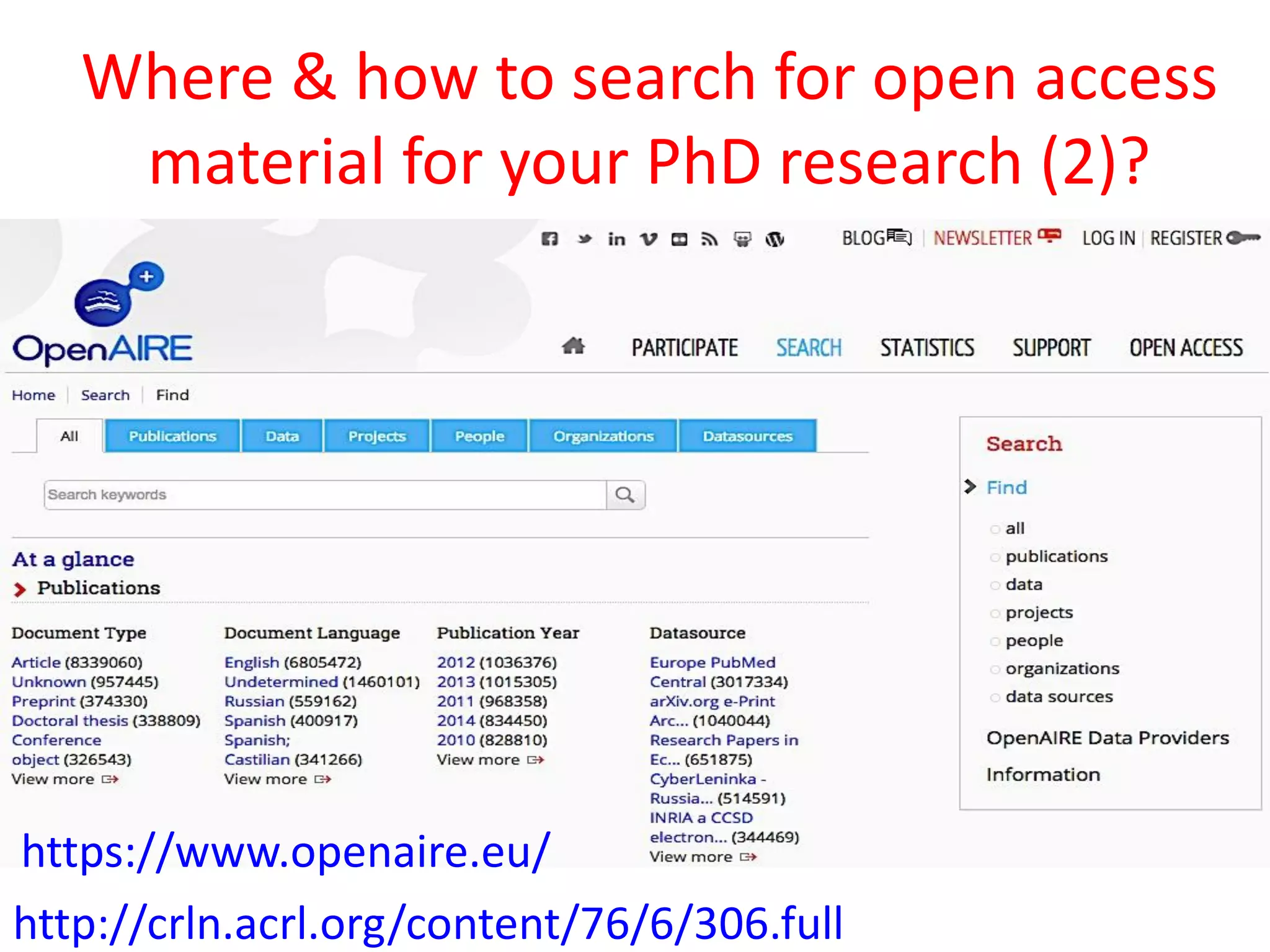
Where & how to search for open access
material for your PhD research (2)?
https://www.openaire.eu/
http://crln.acrl.org/content/76/6/306.full
https://www.facebook.com/groups/EdDigEraConference/
Thank you all!
21
Maria Perifanou
mariaperif@gmail.com
Stylianos Mystakidis
stylianosm@gmail.com

Open Minds Workshop: Open Access for Research

  • 1.
    Open Minds: Anotherway to access Knowledge and share your ideas Maria Perifanou Stylianos Mystakidis
  • 2.
    What is openaccess? “Open means that anyone can freely access, use, modify, and share for any purpose (subject, at most, to requirements that preserve provenance and openness).” Opendefinition.org
  • 3.
    Why open access? Enhancevisibility & impact of research  Speeds up publication process Allows others to build on your work Research paid by public funds => innovation, prestige, funding
  • 4.
    How to provideopen access? "Green" OA: Self-archiving Author archives an electronic copy of a peer-reviewed publication in an institutional or subject repository.  "Gold” OA: Open access publishing Authors publish their scholarship in open access journals or monograph series. Best practice: always self-archive an OA version of your work, regardless if & where you publish.
  • 5.
    Where & howto search for open access material for your PhD research? http://openeducationeuropa.eu/en
  • 6.
  • 9.
  • 10.
    Let’s work together_ gdoc Getting prepared: Check our Twitter channel #jtelss15 to access the open minds gdoc Step 1:  Please add your information to the gdocs  Form groups of 3-4 people http://bit.ly/jtel15-oa01
  • 11.
    Let’s work together_ gdoc Step 2: Individual Work a. Create your account (or login) in the Open Education Europa portal (OEE) here http://openeducationeuropa.eu/el/user/register
  • 12.
    b. Join theJTEL Summer School Group in OEE http://openeducationeuropa.eu/el/groups/jtel- federica-and-emma-summer-school-2015 Let’s work together _ gdoc
  • 13.
    Let’s work together_ gdoc Check the Twitter channel #jtelss15 to access the open minds gdoc Step 3: Group work A  Q1. Where can a researcher locate open access material/resources e.g. for a Phd literature review???
  • 14.
    Example: Directory ofOpen Access Journals (DOAJ) https://doaj.org/ Let’s work together _ gdoc
  • 15.
    Let’s work together_ gdoc Check the Twitter channel #jtelss15 to access the open minds gdoc Step 3: Group work B  Q2. How to share your research "safely" to open access databases? Do you know how to protect your research work?
  • 16.
    Let’s work together_ gdoc Check the Twitter channel #jtelss15 to access the open minds gdoc Step 3: Group work C  Q3. What open access collaborative spaces do/can you use to co-author research articles, research proposals etc.??
  • 17.
    Table 1: PersonalizedPublic Profile of Researchers in Academic Social Networking Sites Website Functionalities Academica.edu Academic social networking; Public profile listing research publications, research projects, research positions and training; Self-archiving published un-published and forthcoming publications. CiteULike.org Online reference manager; Public sharing of publications within a researchers’ group. Getcited.org Academic social networking; Self-archiving published un-published and forthcoming publications. Google Scholar Citations Citations tracking; Online reference manager. ImpactStory.org; Citations tracking Public profile listing research publications and research presentations Article level metrics of your publications. Linkedin.com Professional social networking; Public profile listing research publications, research projects, research positions and training. ORCID.org Authors’ registry with unique identifiers; Public profile listing research publications. ResearcherID.com Authors’ registry with unique identifiers; Public profile listing research publications. Mendeley.com Online reference manager;
  • 18.
    Table 2: Author’sTools for Identifying Self-Archiving Avenues Author’s Tool Functionalities Directory of Open Access Repositories OpenDOAR.org Identifying OA repositories in your subject disciplines and from your region or country. Registry of Open Access Repositories (ROAR.eprints.org) - Identifying OA repositories in your subject disciplines and from your region or country. Directory of Open Access Scholarly Resources (ROAD.issn.org) Availability of different types of OA scholarly resources: peer reviewed journals, conferences proceedings, academic repositories and monographic series in all subject fields. - A single access point to different types of online scholarly resources published worldwide and freely available, identified or authenticated through ISSN Register. OAIster.worldcat.org -Searching OA contents archived in OA knowledge repositories and institutional repositories. - Identifying OA repositories in your subject disciplines and from your region or country. Ranking Web of Repositories (Repositories.webometrics.info) -Identifying top ranking OA repositories within a region or worldwide. - Identifying OA repositories in your subject disciplines and from your region or country. SHERPA/JULIET (Sherpa.ac.uk/Juliet) - Identifying research funders' open access policies.
  • 19.
    Where & howto search for open access material for your PhD research (2)? https://www.openaire.eu/ http://crln.acrl.org/content/76/6/306.full
  • 20.
  • 21.
    Thank you all! 21 MariaPerifanou mariaperif@gmail.com Stylianos Mystakidis stylianosm@gmail.com