
+
Academic writing
An introduction for international students
Karen Marie Øvern – September 13, 2013
+
On the agenda today
 Academic honesty vs dishonesty
 Writing your term paper/ essay
 What does it mean to have access to ”everything”?
 IMRAD-structure vs. Essay structure
 Guidelines
 Referencing
 EndNote
 Vancouver and Harvard systems for bibliographies
+
Academic honesty
 Three principles:
 When you said you did the work yourself, you actually did it.
 When you rely on someone else’s work, you cite it.
 When you present research materials as data, documents etc, you
present them fairly and truthfully.
(Lipton 2004, p.3)
+
Academic DIShonesty
 Common cases:
 Incorrect/non-exsistent citation
 Data corruption (wilful or as accident)
 Copying papers with or without permission
 Using copyrighted material without proper authorization
 Reasons:
 Competition and pressure
 Conviction
 Ambitions
 Difficult to detect
+
Avoiding academic DIShonesty
 Follow the guidelines (for the school)
 Cite what you use
 Be open about your data and analysis
 Plan your papers well
 Remember the three principles..
+
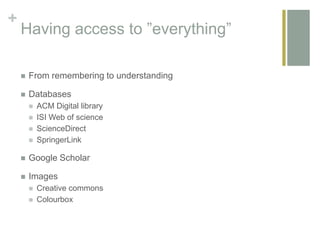
Having access to ”everything”
 From remembering to understanding
 Databases
 ACM Digital library
 ISI Web of science
 ScienceDirect
 SpringerLink
 Google Scholar
 Images
 Creative commons
 Colourbox
+
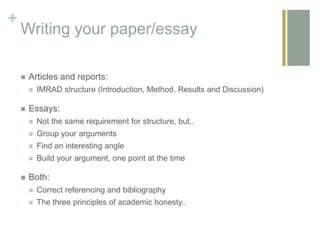
Writing your paper/essay
 Articles and reports:
 IMRAD structure (Introduction, Method, Results and Discussion)
 Essays:
 Not the same requirement for structure, but..
 Group your arguments
 Find an interesting angle
 Build your argument, one point at the time
 Both:
 Correct referencing and bibliography
 The three principles of academic honesty..
+
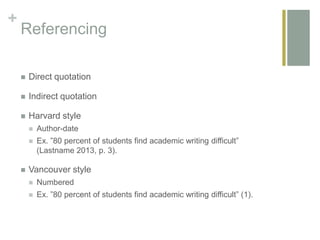
Referencing
 Direct quotation
 Indirect quotation
 Harvard style
 Author-date
 Ex. ”80 percent of students find academic writing difficult”
(Lastname 2013, p. 3).
 Vancouver style
 Numbered
 Ex. ”80 percent of students find academic writing difficult” (1).
+
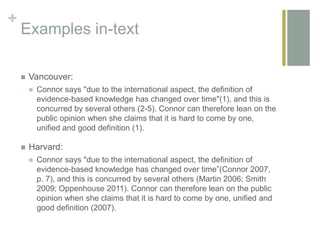
Examples in-text
 Vancouver:
 Connor says "due to the international aspect, the definition of
evidence-based knowledge has changed over time"(1), and this is
concurred by several others (2-5). Connor can therefore lean on the
public opinion when she claims that it is hard to come by one,
unified and good definition (1).
 Harvard:
 Connor says "due to the international aspect, the definition of
evidence-based knowledge has changed over time”(Connor 2007,
p. 7), and this is concurred by several others (Martin 2006; Smith
2009; Oppenhouse 2011). Connor can therefore lean on the public
opinion when she claims that it is hard to come by one, unified and
good definition (2007).
+
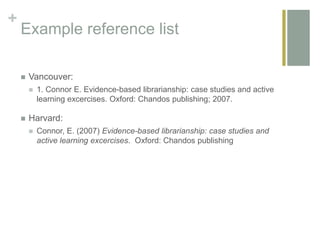
Example reference list
 Vancouver:
 1. Connor E. Evidence-based librarianship: case studies and active
learning excercises. Oxford: Chandos publishing; 2007.
 Harvard:
 Connor, E. (2007) Evidence-based librarianship: case studies and
active learning excercises. Oxford: Chandos publishing
+
Bibliography
 Lipton, C. (2004) Doing honest work in college. Chicago:
University of Chicago
 Suggested reading:
 Guntlett, D. (1998) Essay-writing: the essential guide. [online].
Study Skills Institute of Communication Studies. URL:
http://www.theory.org.uk/david/essaywriting.pdf (05.09.2013).

Academic honesty

  • 1.
    + Academic writing An introductionfor international students Karen Marie Øvern – September 13, 2013
  • 2.
    + On the agendatoday  Academic honesty vs dishonesty  Writing your term paper/ essay  What does it mean to have access to ”everything”?  IMRAD-structure vs. Essay structure  Guidelines  Referencing  EndNote  Vancouver and Harvard systems for bibliographies
  • 3.
    + Academic honesty  Threeprinciples:  When you said you did the work yourself, you actually did it.  When you rely on someone else’s work, you cite it.  When you present research materials as data, documents etc, you present them fairly and truthfully. (Lipton 2004, p.3)
  • 4.
    + Academic DIShonesty  Commoncases:  Incorrect/non-exsistent citation  Data corruption (wilful or as accident)  Copying papers with or without permission  Using copyrighted material without proper authorization  Reasons:  Competition and pressure  Conviction  Ambitions  Difficult to detect
  • 5.
    + Avoiding academic DIShonesty Follow the guidelines (for the school)  Cite what you use  Be open about your data and analysis  Plan your papers well  Remember the three principles..
  • 6.
    + Having access to”everything”  From remembering to understanding  Databases  ACM Digital library  ISI Web of science  ScienceDirect  SpringerLink  Google Scholar  Images  Creative commons  Colourbox
  • 7.
    + Writing your paper/essay Articles and reports:  IMRAD structure (Introduction, Method, Results and Discussion)  Essays:  Not the same requirement for structure, but..  Group your arguments  Find an interesting angle  Build your argument, one point at the time  Both:  Correct referencing and bibliography  The three principles of academic honesty..
  • 8.
    + Referencing  Direct quotation Indirect quotation  Harvard style  Author-date  Ex. ”80 percent of students find academic writing difficult” (Lastname 2013, p. 3).  Vancouver style  Numbered  Ex. ”80 percent of students find academic writing difficult” (1).
  • 9.
    + Examples in-text  Vancouver: Connor says "due to the international aspect, the definition of evidence-based knowledge has changed over time"(1), and this is concurred by several others (2-5). Connor can therefore lean on the public opinion when she claims that it is hard to come by one, unified and good definition (1).  Harvard:  Connor says "due to the international aspect, the definition of evidence-based knowledge has changed over time”(Connor 2007, p. 7), and this is concurred by several others (Martin 2006; Smith 2009; Oppenhouse 2011). Connor can therefore lean on the public opinion when she claims that it is hard to come by one, unified and good definition (2007).
  • 10.
    + Example reference list Vancouver:  1. Connor E. Evidence-based librarianship: case studies and active learning excercises. Oxford: Chandos publishing; 2007.  Harvard:  Connor, E. (2007) Evidence-based librarianship: case studies and active learning excercises. Oxford: Chandos publishing
  • 11.
    + Bibliography  Lipton, C.(2004) Doing honest work in college. Chicago: University of Chicago  Suggested reading:  Guntlett, D. (1998) Essay-writing: the essential guide. [online]. Study Skills Institute of Communication Studies. URL: http://www.theory.org.uk/david/essaywriting.pdf (05.09.2013).