INTRODUCTION TO
RESEARCH ESSAYS
BASIC CONCEPTS FOR WRITING A RESEARCH PAPER
LISA WEIDEMAN & SHENA LAMB DU-PLESSIS
Academic Literacies and Writing
Nelson Mandela Metropolitan University (NMMU)
2015
Assignment Writing and Referencing by Academic Literacies and Writing at NMMU is licensed under a
Creative Commons Attribution-ShareAlike 4.0 International License
Use your smartphone, laptop, or tablet to explain what each
of the following means in terms of academic writing:
A discipline
A text genre
Research
KEY CONCEPTS
KEY CONCEPTS
Discipline – refers to a field or area of expertise (for example, Logistics, Nursing
Sciences, Tourism.)
Genre – refers to a ‘text type’ or kind or writing (for example, proposal, report,
or essay)
Research – refers to a “systematic process of collecting, analysing and
interpreting information (data) in order to increase our understanding of
phenomena about which we are interested or concerned” (Leedy & Ormond
2000: 2).
BEGINNING A RESEARCH PAPER
1. Clarify the assignment instructions
2. Organise the structure of the paper (the outline)
3. Break the workload into sub-tasks (more manageable
pieces)
4. Begin your first draft
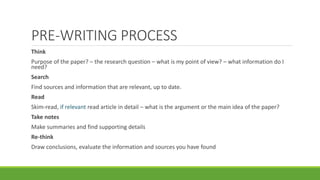
PRE-WRITING PROCESS
Think
Purpose of the paper? – the research question – what is my point of view? – what information do I
need?
Search
Find sources and information that are relevant, up to date.
Read
Skim-read, if relevant read article in detail – what is the argument or the main idea of the paper?
Take notes
Make summaries and find supporting details
Re-think
Draw conclusions, evaluate the information and sources you have found
THE IMPORTANCE OF PLANNING
“The quality of everything we do is determined by the
quality of the thinking we do first” (Kline 2005: 5).
STRATEGIC PLANNING
Set goals for each stage of your paper
◦ deadline for the first draft (to understand the structure
and organisation of the paper)
◦Get feedback on your first draft from the Writing Centre or
from your lecturer/peers
◦Set a personal deadline for final draft
STRATEGY IS ALL IMPORTANT
What is the purpose of an introduction?
WRITING AN INTRODUCTION
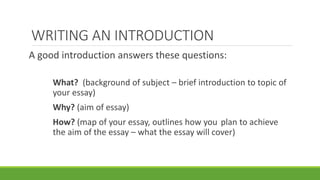
A good introduction answers these questions:
What? (background of subject – brief introduction to topic of
your essay)
Why? (aim of essay)
How? (map of your essay, outlines how you plan to achieve
the aim of the essay – what the essay will cover)
WRITING AN INTRODUCTION
In the following example, which
sentence explains the ‘What’ question?
WRITING AN INTRODUCTION
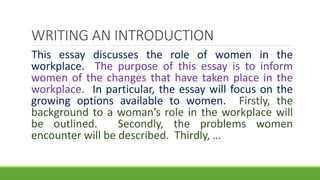
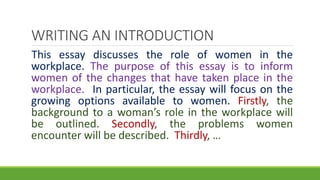
This essay discusses the role of women in the
workplace. The purpose of this essay is to inform
women of the changes that have taken place in the
workplace. In particular, the essay will focus on the
growing options available to women. Firstly, the
background to a woman’s role in the workplace will
be outlined. Secondly, the problems women
encounter will be described. Thirdly, …
WRITING AN INTRODUCTION
In the example, which sentence explains
the ‘Why’ question?
WRITING AN INTRODUCTION
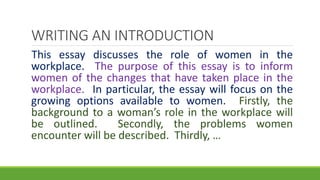
This essay discusses the role of women in the
workplace. The purpose of this essay is to inform
women of the changes that have taken place in the
workplace. In particular, the essay will focus on the
growing options available to women. Firstly, the
background to a woman’s role in the workplace will
be outlined. Secondly, the problems women
encounter will be described. Thirdly, …
WRITING AN INTRODUCTION
In the example, where does the
Introduction show how the essay will
achieve its objectives?
WRITING AN INTRODUCTION
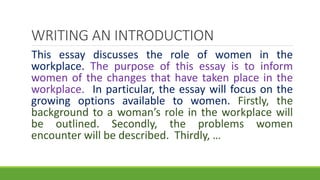
This essay discusses the role of women in the
workplace. The purpose of this essay is to inform
women of the changes that have taken place in the
workplace. In particular, the essay will focus on the
growing options available to women. Firstly, the
background to a woman’s role in the workplace will
be outlined. Secondly, the problems women
encounter will be described. Thirdly, …
WRITING AN INTRODUCTION
Which words in the Introduction make it
easier for the reader to follow the essay’s
path?
WRITING AN INTRODUCTION
This essay discusses the role of women in the
workplace. The purpose of this essay is to inform
women of the changes that have taken place in the
workplace. In particular, the essay will focus on the
growing options available to women. Firstly, the
background to a woman’s role in the workplace will
be outlined. Secondly, the problems women
encounter will be described. Thirdly, …
WRITING AN INTRODUCTION
READING JOURNAL
ARTICLES EFFECTIVELY
SMART AND ACTIVE READING TO SAVE YOU TIME
INTRODUCTION TO ACADEMIC ARTICLES
Have you ever used an academic article?
What makes an academic article different from other kinds
of writing?
What are the benefits of using an academic article instead
of a textbook?
WHAT IS AN ACADEMIC ARTICLE?
Use your device to search for the differences
between an academic article and a textbook.
WHAT ARE THE BENEFITS OF USING
JOURNAL ARTICLES?
Use your device to search for the benefits of using
an academic article in research.
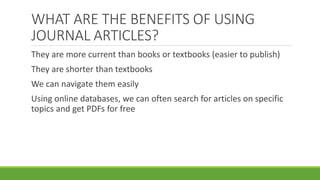
They are more current than books or textbooks (easier to publish)
They are shorter than textbooks
We can navigate them easily
Using online databases, we can often search for articles on specific
topics and get PDFs for free
WHAT ARE THE BENEFITS OF USING
JOURNAL ARTICLES?
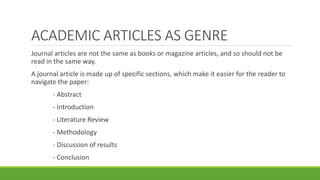
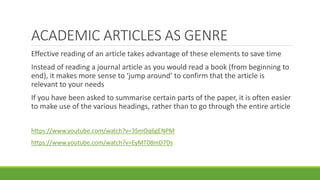
ACADEMIC ARTICLES AS GENRE
Journal articles are not the same as books or magazine articles, and so should not be
read in the same way.
A journal article is made up of specific sections, which make it easier for the reader to
navigate the paper:
- Abstract
- Introduction
- Literature Review
- Methodology
- Discussion of results
- Conclusion
Effective reading of an article takes advantage of these elements to save time
Instead of reading a journal article as you would read a book (from beginning to
end), it makes more sense to ‘jump around’ to confirm that the article is
relevant to your needs
If you have been asked to summarise certain parts of the paper, it is often easier
to make use of the various headings, rather than to go through the entire article
https://www.youtube.com/watch?v=3SmOq6gENPM
https://www.youtube.com/watch?v=EyMT08mD7Ds
ACADEMIC ARTICLES AS GENRE
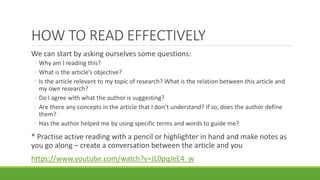
HOW TO READ EFFECTIVELY
We can start by asking ourselves some questions:
◦ Why am I reading this?
◦ What is the article’s objective?
◦ Is the article relevant to my topic of research? What is the relation between this article and
my own research?
◦ Do I agree with what the author is suggesting?
◦ Are there any concepts in the article that I don’t understand? If so, does the author define
them?
◦ Has the author helped me by using specific terms and words to guide me?
* Practise active reading with a pencil or highlighter in hand and make notes as
you go along – create a conversation between the article and you
https://www.youtube.com/watch?v=JL0pqJeE4_w
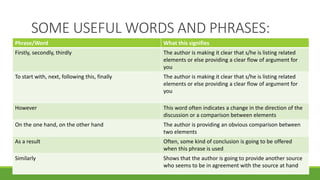
SOME USEFUL WORDS AND PHRASES:
Phrase/Word What this signifies
Firstly, secondly, thirdly The author is making it clear that s/he is listing related
elements or else providing a clear flow of argument for
you
To start with, next, following this, finally The author is making it clear that s/he is listing related
elements or else providing a clear flow of argument for
you
However This word often indicates a change in the direction of the
discussion or a comparison between elements
On the one hand, on the other hand The author is providing an obvious comparison between
two elements
As a result Often, some kind of conclusion is going to be offered
when this phrase is used
Similarly Shows that the author is going to provide another source
who seems to be in agreement with the source at hand
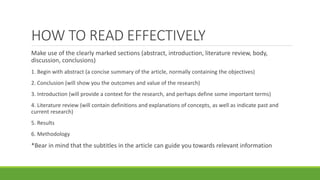
Make use of the clearly marked sections (abstract, introduction, literature review, body,
discussion, conclusions)
1. Begin with abstract (a concise summary of the article, normally containing the objectives)
2. Conclusion (will show you the outcomes and value of the research)
3. Introduction (will provide a context for the research, and perhaps define some important terms)
4. Literature review (will contain definitions and explanations of concepts, as well as indicate past and
current research)
5. Results
6. Methodology
*Bear in mind that the subtitles in the article can guide you towards relevant information
HOW TO READ EFFECTIVELY
THE IMPORTANCE OF EFFECTIVE
READING
◦ Better comprehension (don’t become weighed down by ‘heavy’ concepts –
sometimes authors can say too much)
◦ Reading articles becomes less daunting
◦ One can save time and energy (don’t waste time by reading irrelevant articles
or information)
◦ Mastering this skill gives one a significant advantage in postgraduate research
◦ Reading journal articles effectively is a crucial aspect of academic literacy, and
it will help you throughout your university career
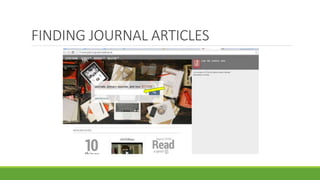
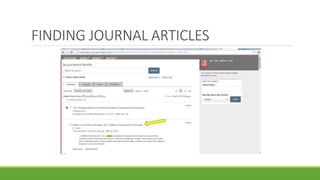
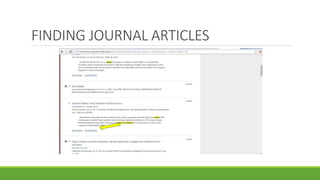
FINDING JOURNAL ARTICLES
Do you know where and/or how to find journal
articles?
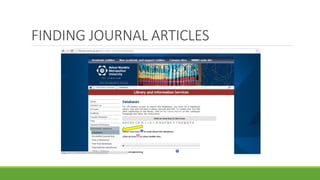
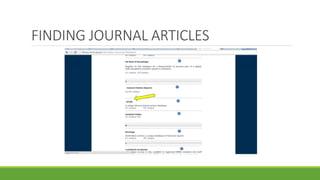
FINDING JOURNAL ARTICLES
LEARNING TO REFERENCE
AND UNDERSTANDING
PLAGIARISM
IN-TEXT REFERENCING, REFERENCE LISTS, AND PLAGIARISM
WRITING STYLE
1. Academic writing is formal and objective (not personal, subjective
or ‘chatty’)
2. Academic writing always supplies evidence (references) for any
claim or opinion
3. Your voice shows in the references you choose and how you refer
to them.
SOURCES YOU MAY CONSULT
1)Books
2)Academic journals
3)Newspaper articles
4)Certain official websites (NOT blogs)
What is plagiarism?
Use your device to find a definition of
plagiarism.
PLAGIARISM
• Unintentionally using someone else’s work without
acknowledgement
• Deliberately pretending someone else’s work is your own
(stealing)
Either way, it means trouble. Acknowledge your source – whether
it’s a direct quote, an indirect quote or a summary.
PLAGIARISM
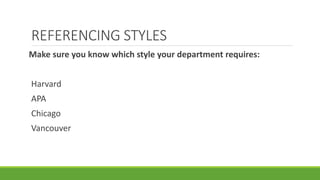
Make sure you know which style your department requires:
Harvard
APA
Chicago
Vancouver
REFERENCING STYLES
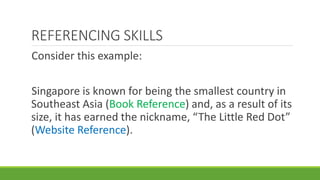
Consider this example:
Singapore is known for being the smallest country in
Southeast Asia (Book Reference) and, as a result of its
size, it has earned the nickname, “The Little Red Dot”
(Website Reference).
REFERENCING SKILLS
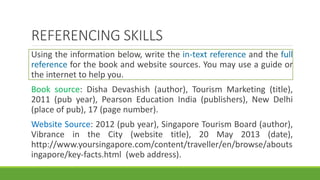
Using the information below, write the in-text reference and the full
reference for the book and website sources. You may use a guide or
the internet to help you.
Book source: Disha Devashish (author), Tourism Marketing (title),
2011 (pub year), Pearson Education India (publishers), New Delhi
(place of pub), 17 (page number).
Website Source: 2012 (pub year), Singapore Tourism Board (author),
Vibrance in the City (website title), 20 May 2013 (date),
http://www.yoursingapore.com/content/traveller/en/browse/abouts
ingapore/key-facts.html (web address).
REFERENCING SKILLS
Devashish, D. 2011. Tourism Marketing. New Delhi: Pearson Education India.
(Devashish 2011: 17)
Singapore Tourism Board. 2012. Vibrance in the City. [Online]. Available:
http://www.yoursingapore.com/content/traveller/en/browse/aboutsingapore/k
ey-facts.html [Accessed: 20 May 2013].
(Singapore Tourism Board, 2012)
REFERENCING SKILLS
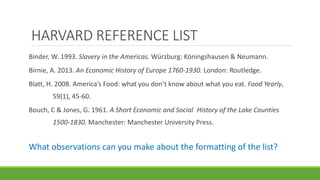
HARVARD REFERENCE LIST
Binder, W. 1993. Slavery in the Americas. Würzburg: Köningshausen & Neumann.
Birnie, A. 2013. An Economic History of Europe 1760-1930. London: Routledge.
Blatt, H. 2008. America’s Food: what you don’t know about what you eat. Food Yearly,
59(1), 45-60.
Bouch, C & Jones, G. 1961. A Short Economic and Social History of the Lake Counties
1500-1830. Manchester: Manchester University Press.
What observations can you make about the formatting of the list?
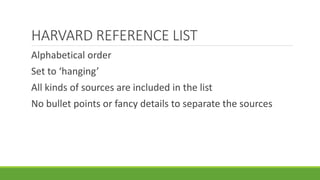
HARVARD REFERENCE LIST
Alphabetical order
Set to ‘hanging’
All kinds of sources are included in the list
No bullet points or fancy details to separate the sources
HARVARD REFERENCE LIST EXAMPLES
1) Referencing a book:
Tracey, D. 2011. Urban Agriculture: Ideas and designs for the new food revolution.
Gabriola Island: New Society Publishers.
2) Referencing an academic journal:
Mackenzie, R. 1998. Psychologist: to be or not to be? Journal of philosophical
psychologists, 34(2), 345-347.
3) Referencing newspaper articles:
Matomela, S. 2010. Crime rampant in Gauteng. The Sun, 29 March: 3.
4) Referencing websites:
Johnston, A. 2014. The Fall of Neoliberal Politics. [Online]. Available:
http://socialistreview.org.uk/351/rise-and-fall-neoliberalism [28 August 2014].
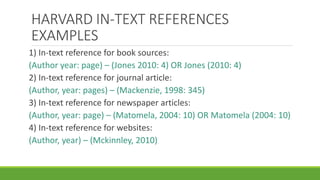
HARVARD IN-TEXT REFERENCES
EXAMPLES
1) In-text reference for book sources:
(Author year: page) – (Jones 2010: 4) OR Jones (2010: 4)
2) In-text reference for journal article:
(Author, year: pages) – (Mackenzie, 1998: 345)
3) In-text reference for newspaper articles:
(Author, year: page) – (Matomela, 2004: 10) OR Matomela (2004: 10)
4) In-text reference for websites:
(Author, year) – (Mckinnley, 2010)
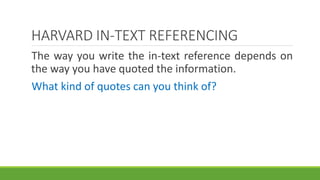
HARVARD IN-TEXT REFERENCING
The way you write the in-text reference depends on
the way you have quoted the information.
What kind of quotes can you think of?
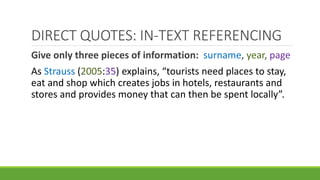
Give only three pieces of information: surname, year, page
As Strauss (2005:35) explains, “tourists need places to stay,
eat and shop which creates jobs in hotels, restaurants and
stores and provides money that can then be spent locally”.
DIRECT QUOTES: IN-TEXT REFERENCING
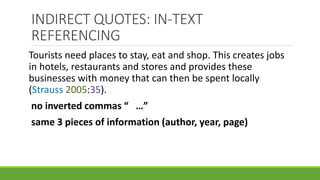
Tourists need places to stay, eat and shop. This creates jobs
in hotels, restaurants and stores and provides these
businesses with money that can then be spent locally
(Strauss 2005:35).
no inverted commas “ …”
same 3 pieces of information (author, year, page)
INDIRECT QUOTES: IN-TEXT
REFERENCING
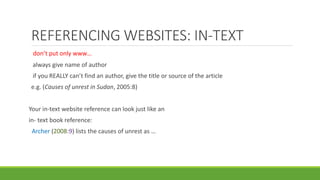
don’t put only www…
always give name of author
if you REALLY can’t find an author, give the title or source of the article
e.g. (Causes of unrest in Sudan, 2005:8)
Your in-text website reference can look just like an
in- text book reference:
Archer (2008:9) lists the causes of unrest as …
REFERENCING WEBSITES: IN-TEXT
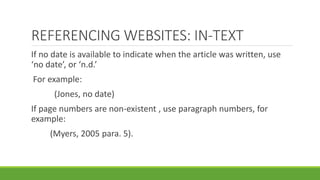
If no date is available to indicate when the article was written, use
‘no date’, or ‘n.d.’
For example:
(Jones, no date)
If page numbers are non-existent , use paragraph numbers, for
example:
(Myers, 2005 para. 5).
REFERENCING WEBSITES: IN-TEXT
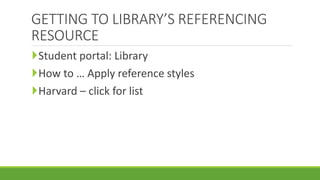
GETTING TO LIBRARY’S REFERENCING
RESOURCE
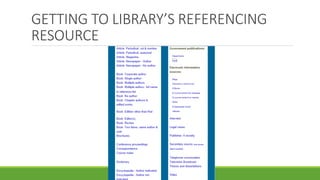
Student portal: Library
How to … Apply reference styles
Harvard – click for list
GETTING TO LIBRARY’S REFERENCING
RESOURCE
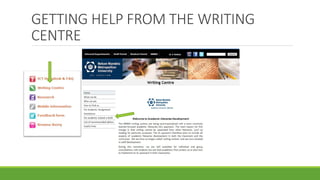
GETTING HELP FROM THE WRITING
CENTRE
gino.fransman@nmmu.ac.za
ginofransman@gmail.com
Twitter: @ginofransman
Assignment Writing and Referencing by Academic Literacies and Writing at NMMU is licensed under a
Creative Commons Attribution-ShareAlike 4.0 International License
Content:
Lisa Weideman lisaweideman1@gmail.com
Shena Lamb Du-Plessis shena.lambdu-plessis@nmmu.ac.za
Visit Scoopit!
http://www.scoop.it/t/academic-literacy-development
&
http://www.scoop.it/t/21st-century-graduate-literacies
57

Research Assignment Writing & Referencing Workshop ALW NMMU 2015

  • 1.
    INTRODUCTION TO RESEARCH ESSAYS BASICCONCEPTS FOR WRITING A RESEARCH PAPER LISA WEIDEMAN & SHENA LAMB DU-PLESSIS Academic Literacies and Writing Nelson Mandela Metropolitan University (NMMU) 2015 Assignment Writing and Referencing by Academic Literacies and Writing at NMMU is licensed under a Creative Commons Attribution-ShareAlike 4.0 International License
  • 2.
    Use your smartphone,laptop, or tablet to explain what each of the following means in terms of academic writing: A discipline A text genre Research KEY CONCEPTS
  • 3.
    KEY CONCEPTS Discipline –refers to a field or area of expertise (for example, Logistics, Nursing Sciences, Tourism.) Genre – refers to a ‘text type’ or kind or writing (for example, proposal, report, or essay) Research – refers to a “systematic process of collecting, analysing and interpreting information (data) in order to increase our understanding of phenomena about which we are interested or concerned” (Leedy & Ormond 2000: 2).
  • 4.
    BEGINNING A RESEARCHPAPER 1. Clarify the assignment instructions 2. Organise the structure of the paper (the outline) 3. Break the workload into sub-tasks (more manageable pieces) 4. Begin your first draft
  • 5.
    PRE-WRITING PROCESS Think Purpose ofthe paper? – the research question – what is my point of view? – what information do I need? Search Find sources and information that are relevant, up to date. Read Skim-read, if relevant read article in detail – what is the argument or the main idea of the paper? Take notes Make summaries and find supporting details Re-think Draw conclusions, evaluate the information and sources you have found
  • 6.
    THE IMPORTANCE OFPLANNING “The quality of everything we do is determined by the quality of the thinking we do first” (Kline 2005: 5).
  • 7.
    STRATEGIC PLANNING Set goalsfor each stage of your paper ◦ deadline for the first draft (to understand the structure and organisation of the paper) ◦Get feedback on your first draft from the Writing Centre or from your lecturer/peers ◦Set a personal deadline for final draft
  • 8.
    STRATEGY IS ALLIMPORTANT
  • 9.
    What is thepurpose of an introduction? WRITING AN INTRODUCTION
  • 10.
    A good introductionanswers these questions: What? (background of subject – brief introduction to topic of your essay) Why? (aim of essay) How? (map of your essay, outlines how you plan to achieve the aim of the essay – what the essay will cover) WRITING AN INTRODUCTION
  • 11.
    In the followingexample, which sentence explains the ‘What’ question? WRITING AN INTRODUCTION
  • 12.
    This essay discussesthe role of women in the workplace. The purpose of this essay is to inform women of the changes that have taken place in the workplace. In particular, the essay will focus on the growing options available to women. Firstly, the background to a woman’s role in the workplace will be outlined. Secondly, the problems women encounter will be described. Thirdly, … WRITING AN INTRODUCTION
  • 13.
    In the example,which sentence explains the ‘Why’ question? WRITING AN INTRODUCTION
  • 14.
    This essay discussesthe role of women in the workplace. The purpose of this essay is to inform women of the changes that have taken place in the workplace. In particular, the essay will focus on the growing options available to women. Firstly, the background to a woman’s role in the workplace will be outlined. Secondly, the problems women encounter will be described. Thirdly, … WRITING AN INTRODUCTION
  • 15.
    In the example,where does the Introduction show how the essay will achieve its objectives? WRITING AN INTRODUCTION
  • 16.
    This essay discussesthe role of women in the workplace. The purpose of this essay is to inform women of the changes that have taken place in the workplace. In particular, the essay will focus on the growing options available to women. Firstly, the background to a woman’s role in the workplace will be outlined. Secondly, the problems women encounter will be described. Thirdly, … WRITING AN INTRODUCTION
  • 17.
    Which words inthe Introduction make it easier for the reader to follow the essay’s path? WRITING AN INTRODUCTION
  • 18.
    This essay discussesthe role of women in the workplace. The purpose of this essay is to inform women of the changes that have taken place in the workplace. In particular, the essay will focus on the growing options available to women. Firstly, the background to a woman’s role in the workplace will be outlined. Secondly, the problems women encounter will be described. Thirdly, … WRITING AN INTRODUCTION
  • 19.
    READING JOURNAL ARTICLES EFFECTIVELY SMARTAND ACTIVE READING TO SAVE YOU TIME
  • 20.
    INTRODUCTION TO ACADEMICARTICLES Have you ever used an academic article? What makes an academic article different from other kinds of writing? What are the benefits of using an academic article instead of a textbook?
  • 21.
    WHAT IS ANACADEMIC ARTICLE? Use your device to search for the differences between an academic article and a textbook.
  • 22.
    WHAT ARE THEBENEFITS OF USING JOURNAL ARTICLES? Use your device to search for the benefits of using an academic article in research.
  • 23.
    They are morecurrent than books or textbooks (easier to publish) They are shorter than textbooks We can navigate them easily Using online databases, we can often search for articles on specific topics and get PDFs for free WHAT ARE THE BENEFITS OF USING JOURNAL ARTICLES?
  • 24.
    ACADEMIC ARTICLES ASGENRE Journal articles are not the same as books or magazine articles, and so should not be read in the same way. A journal article is made up of specific sections, which make it easier for the reader to navigate the paper: - Abstract - Introduction - Literature Review - Methodology - Discussion of results - Conclusion
  • 25.
    Effective reading ofan article takes advantage of these elements to save time Instead of reading a journal article as you would read a book (from beginning to end), it makes more sense to ‘jump around’ to confirm that the article is relevant to your needs If you have been asked to summarise certain parts of the paper, it is often easier to make use of the various headings, rather than to go through the entire article https://www.youtube.com/watch?v=3SmOq6gENPM https://www.youtube.com/watch?v=EyMT08mD7Ds ACADEMIC ARTICLES AS GENRE
  • 26.
    HOW TO READEFFECTIVELY We can start by asking ourselves some questions: ◦ Why am I reading this? ◦ What is the article’s objective? ◦ Is the article relevant to my topic of research? What is the relation between this article and my own research? ◦ Do I agree with what the author is suggesting? ◦ Are there any concepts in the article that I don’t understand? If so, does the author define them? ◦ Has the author helped me by using specific terms and words to guide me? * Practise active reading with a pencil or highlighter in hand and make notes as you go along – create a conversation between the article and you https://www.youtube.com/watch?v=JL0pqJeE4_w
  • 27.
    SOME USEFUL WORDSAND PHRASES: Phrase/Word What this signifies Firstly, secondly, thirdly The author is making it clear that s/he is listing related elements or else providing a clear flow of argument for you To start with, next, following this, finally The author is making it clear that s/he is listing related elements or else providing a clear flow of argument for you However This word often indicates a change in the direction of the discussion or a comparison between elements On the one hand, on the other hand The author is providing an obvious comparison between two elements As a result Often, some kind of conclusion is going to be offered when this phrase is used Similarly Shows that the author is going to provide another source who seems to be in agreement with the source at hand
  • 28.
    Make use ofthe clearly marked sections (abstract, introduction, literature review, body, discussion, conclusions) 1. Begin with abstract (a concise summary of the article, normally containing the objectives) 2. Conclusion (will show you the outcomes and value of the research) 3. Introduction (will provide a context for the research, and perhaps define some important terms) 4. Literature review (will contain definitions and explanations of concepts, as well as indicate past and current research) 5. Results 6. Methodology *Bear in mind that the subtitles in the article can guide you towards relevant information HOW TO READ EFFECTIVELY
  • 29.
    THE IMPORTANCE OFEFFECTIVE READING ◦ Better comprehension (don’t become weighed down by ‘heavy’ concepts – sometimes authors can say too much) ◦ Reading articles becomes less daunting ◦ One can save time and energy (don’t waste time by reading irrelevant articles or information) ◦ Mastering this skill gives one a significant advantage in postgraduate research ◦ Reading journal articles effectively is a crucial aspect of academic literacy, and it will help you throughout your university career
  • 30.
    FINDING JOURNAL ARTICLES Doyou know where and/or how to find journal articles?
  • 31.
  • 32.
  • 33.
  • 34.
  • 35.
  • 36.
    LEARNING TO REFERENCE ANDUNDERSTANDING PLAGIARISM IN-TEXT REFERENCING, REFERENCE LISTS, AND PLAGIARISM
  • 37.
    WRITING STYLE 1. Academicwriting is formal and objective (not personal, subjective or ‘chatty’) 2. Academic writing always supplies evidence (references) for any claim or opinion 3. Your voice shows in the references you choose and how you refer to them.
  • 38.
    SOURCES YOU MAYCONSULT 1)Books 2)Academic journals 3)Newspaper articles 4)Certain official websites (NOT blogs)
  • 39.
    What is plagiarism? Useyour device to find a definition of plagiarism. PLAGIARISM
  • 40.
    • Unintentionally usingsomeone else’s work without acknowledgement • Deliberately pretending someone else’s work is your own (stealing) Either way, it means trouble. Acknowledge your source – whether it’s a direct quote, an indirect quote or a summary. PLAGIARISM
  • 41.
    Make sure youknow which style your department requires: Harvard APA Chicago Vancouver REFERENCING STYLES
  • 42.
    Consider this example: Singaporeis known for being the smallest country in Southeast Asia (Book Reference) and, as a result of its size, it has earned the nickname, “The Little Red Dot” (Website Reference). REFERENCING SKILLS
  • 43.
    Using the informationbelow, write the in-text reference and the full reference for the book and website sources. You may use a guide or the internet to help you. Book source: Disha Devashish (author), Tourism Marketing (title), 2011 (pub year), Pearson Education India (publishers), New Delhi (place of pub), 17 (page number). Website Source: 2012 (pub year), Singapore Tourism Board (author), Vibrance in the City (website title), 20 May 2013 (date), http://www.yoursingapore.com/content/traveller/en/browse/abouts ingapore/key-facts.html (web address). REFERENCING SKILLS
  • 44.
    Devashish, D. 2011.Tourism Marketing. New Delhi: Pearson Education India. (Devashish 2011: 17) Singapore Tourism Board. 2012. Vibrance in the City. [Online]. Available: http://www.yoursingapore.com/content/traveller/en/browse/aboutsingapore/k ey-facts.html [Accessed: 20 May 2013]. (Singapore Tourism Board, 2012) REFERENCING SKILLS
  • 45.
    HARVARD REFERENCE LIST Binder,W. 1993. Slavery in the Americas. Würzburg: Köningshausen & Neumann. Birnie, A. 2013. An Economic History of Europe 1760-1930. London: Routledge. Blatt, H. 2008. America’s Food: what you don’t know about what you eat. Food Yearly, 59(1), 45-60. Bouch, C & Jones, G. 1961. A Short Economic and Social History of the Lake Counties 1500-1830. Manchester: Manchester University Press. What observations can you make about the formatting of the list?
  • 46.
    HARVARD REFERENCE LIST Alphabeticalorder Set to ‘hanging’ All kinds of sources are included in the list No bullet points or fancy details to separate the sources
  • 47.
    HARVARD REFERENCE LISTEXAMPLES 1) Referencing a book: Tracey, D. 2011. Urban Agriculture: Ideas and designs for the new food revolution. Gabriola Island: New Society Publishers. 2) Referencing an academic journal: Mackenzie, R. 1998. Psychologist: to be or not to be? Journal of philosophical psychologists, 34(2), 345-347. 3) Referencing newspaper articles: Matomela, S. 2010. Crime rampant in Gauteng. The Sun, 29 March: 3. 4) Referencing websites: Johnston, A. 2014. The Fall of Neoliberal Politics. [Online]. Available: http://socialistreview.org.uk/351/rise-and-fall-neoliberalism [28 August 2014].
  • 48.
    HARVARD IN-TEXT REFERENCES EXAMPLES 1)In-text reference for book sources: (Author year: page) – (Jones 2010: 4) OR Jones (2010: 4) 2) In-text reference for journal article: (Author, year: pages) – (Mackenzie, 1998: 345) 3) In-text reference for newspaper articles: (Author, year: page) – (Matomela, 2004: 10) OR Matomela (2004: 10) 4) In-text reference for websites: (Author, year) – (Mckinnley, 2010)
  • 49.
    HARVARD IN-TEXT REFERENCING Theway you write the in-text reference depends on the way you have quoted the information. What kind of quotes can you think of?
  • 50.
    Give only threepieces of information: surname, year, page As Strauss (2005:35) explains, “tourists need places to stay, eat and shop which creates jobs in hotels, restaurants and stores and provides money that can then be spent locally”. DIRECT QUOTES: IN-TEXT REFERENCING
  • 51.
    Tourists need placesto stay, eat and shop. This creates jobs in hotels, restaurants and stores and provides these businesses with money that can then be spent locally (Strauss 2005:35). no inverted commas “ …” same 3 pieces of information (author, year, page) INDIRECT QUOTES: IN-TEXT REFERENCING
  • 52.
    don’t put onlywww… always give name of author if you REALLY can’t find an author, give the title or source of the article e.g. (Causes of unrest in Sudan, 2005:8) Your in-text website reference can look just like an in- text book reference: Archer (2008:9) lists the causes of unrest as … REFERENCING WEBSITES: IN-TEXT
  • 53.
    If no dateis available to indicate when the article was written, use ‘no date’, or ‘n.d.’ For example: (Jones, no date) If page numbers are non-existent , use paragraph numbers, for example: (Myers, 2005 para. 5). REFERENCING WEBSITES: IN-TEXT
  • 54.
    GETTING TO LIBRARY’SREFERENCING RESOURCE Student portal: Library How to … Apply reference styles Harvard – click for list
  • 55.
    GETTING TO LIBRARY’SREFERENCING RESOURCE
  • 56.
    GETTING HELP FROMTHE WRITING CENTRE
  • 57.
    gino.fransman@nmmu.ac.za ginofransman@gmail.com Twitter: @ginofransman Assignment Writingand Referencing by Academic Literacies and Writing at NMMU is licensed under a Creative Commons Attribution-ShareAlike 4.0 International License Content: Lisa Weideman lisaweideman1@gmail.com Shena Lamb Du-Plessis shena.lambdu-plessis@nmmu.ac.za Visit Scoopit! http://www.scoop.it/t/academic-literacy-development & http://www.scoop.it/t/21st-century-graduate-literacies 57