(Stanford BUS-21)
Martin Westhead
Mastering Marketing
Scarcity vs Abundance
How to make money
by giving things away
Overview
 Visions of abundance
 Wired for scarcity
 Waste is good
 Managing scarcity vs.
abundance
The best way to manage
abundance is to
relinquish control
Great things to come
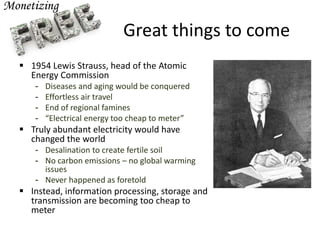
 1954 Lewis Strauss, head of the Atomic
Energy Commission
- Diseases and aging would be conquered
- Effortless air travel
- End of regional famines
- “Electrical energy too cheap to meter”
 Truly abundant electricity would have
changed the world
- Desalination to create fertile soil
- No carbon emissions – no global warming
issues
- Never happened as foretold
 Instead, information processing, storage and
transmission are becoming too cheap to
meter
Sometimes we miss
abundance..
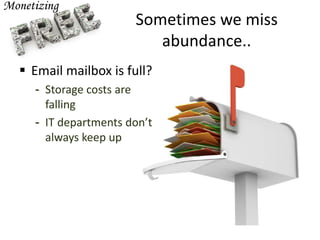
 Email mailbox is full?
- Storage costs are
falling
- IT departments don’t
always keep up
Scarcity vs. Abundance
 Mammals
- Small numbers of babies
- Loss of a single human is
tragic
 Compare with fish
- Loss of millions of
fertilized eggs is the
norm
Ehrlich’s bad bet
 The cast
- Paul Ehrlich population biologist
- Julian Simon economist
 The bet
- $10,000 – price of raw minerals
- Ehrlich – inherently scarce: would rise
- Simon – replacement effect: would fall
 Ehrlich chose: copper, chrome,
nickel, tin, tungsten
 The price of all fell over 10 years
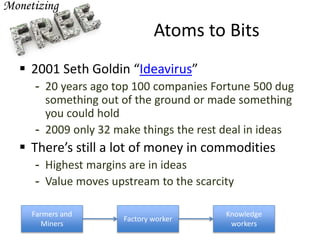
Atoms to Bits
 2001 Seth Goldin “Ideavirus”
- 20 years ago top 100 companies Fortune 500 dug
something out of the ground or made something
you could hold
- 2009 only 32 make things the rest deal in ideas
 There’s still a lot of money in commodities
- Highest margins are in ideas
- Value moves upstream to the scarcity
Farmers and
Miners
Factory worker
Knowledge
workers
Waste is good
 “Wasted” CPU cycles on
GUIs
- Windows, Icons, Pointers
- Animations
- Variable width fonts
 Led to the Apple Mac
Alto Workstation
Alan Kay
YouTube Wastes Video
 No threat to TV because its “Full of Crap”
- But what is “crap”?
- Quality is subjective
- E.g. Stop motion Lego Star Wars
 Importance of relevance
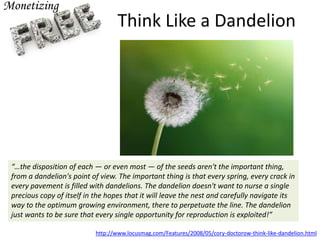
Think Like a Dandelion
http://www.locusmag.com/Features/2008/05/cory-doctorow-think-like-dandelion.html
“…the disposition of each — or even most — of the seeds aren't the important thing,
from a dandelion's point of view. The important thing is that every spring, every crack in
every pavement is filled with dandelions. The dandelion doesn't want to nurse a single
precious copy of itself in the hopes that it will leave the nest and carefully navigate its
way to the optimum growing environment, there to perpetuate the line. The dandelion
just wants to be sure that every single opportunity for reproduction is exploited!”
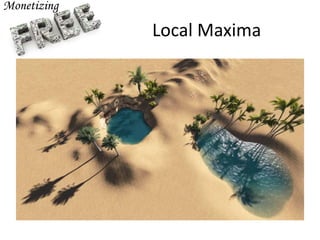
Local Maxima
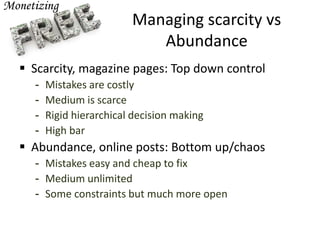
Managing scarcity vs
Abundance
 Scarcity, magazine pages: Top down control
- Mistakes are costly
- Medium is scarce
- Rigid hierarchical decision making
- High bar
 Abundance, online posts: Bottom up/chaos
- Mistakes easy and cheap to fix
- Medium unlimited
- Some constraints but much more open
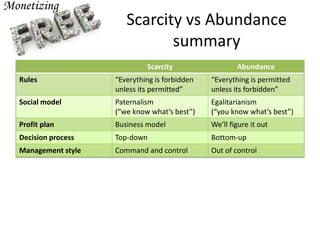
Scarcity vs Abundance
summary
Scarcity Abundance
Rules “Everything is forbidden
unless its permitted”
“Everything is permitted
unless its forbidden”
Social model Paternalism
(“we know what’s best”)
Egalitarianism
(“you know what’s best”)
Profit plan Business model We’ll figure it out
Decision process Top-down Bottom-up
Management style Command and control Out of control
Summary
 Visions of abundance
 Wired for scarcity
 Waste is good
 Managing scarcity vs.
abundance
The best way to manage
abundance is to
relinquish control

Abundance and Scarcity Thinking

  • 1.
    (Stanford BUS-21) Martin Westhead MasteringMarketing Scarcity vs Abundance How to make money by giving things away
  • 2.
    Overview  Visions ofabundance  Wired for scarcity  Waste is good  Managing scarcity vs. abundance The best way to manage abundance is to relinquish control
  • 3.
    Great things tocome  1954 Lewis Strauss, head of the Atomic Energy Commission - Diseases and aging would be conquered - Effortless air travel - End of regional famines - “Electrical energy too cheap to meter”  Truly abundant electricity would have changed the world - Desalination to create fertile soil - No carbon emissions – no global warming issues - Never happened as foretold  Instead, information processing, storage and transmission are becoming too cheap to meter
  • 4.
    Sometimes we miss abundance.. Email mailbox is full? - Storage costs are falling - IT departments don’t always keep up
  • 5.
    Scarcity vs. Abundance Mammals - Small numbers of babies - Loss of a single human is tragic  Compare with fish - Loss of millions of fertilized eggs is the norm
  • 6.
    Ehrlich’s bad bet The cast - Paul Ehrlich population biologist - Julian Simon economist  The bet - $10,000 – price of raw minerals - Ehrlich – inherently scarce: would rise - Simon – replacement effect: would fall  Ehrlich chose: copper, chrome, nickel, tin, tungsten  The price of all fell over 10 years
  • 7.
    Atoms to Bits 2001 Seth Goldin “Ideavirus” - 20 years ago top 100 companies Fortune 500 dug something out of the ground or made something you could hold - 2009 only 32 make things the rest deal in ideas  There’s still a lot of money in commodities - Highest margins are in ideas - Value moves upstream to the scarcity Farmers and Miners Factory worker Knowledge workers
  • 8.
    Waste is good “Wasted” CPU cycles on GUIs - Windows, Icons, Pointers - Animations - Variable width fonts  Led to the Apple Mac Alto Workstation Alan Kay
  • 9.
    YouTube Wastes Video No threat to TV because its “Full of Crap” - But what is “crap”? - Quality is subjective - E.g. Stop motion Lego Star Wars  Importance of relevance
  • 10.
    Think Like aDandelion http://www.locusmag.com/Features/2008/05/cory-doctorow-think-like-dandelion.html “…the disposition of each — or even most — of the seeds aren't the important thing, from a dandelion's point of view. The important thing is that every spring, every crack in every pavement is filled with dandelions. The dandelion doesn't want to nurse a single precious copy of itself in the hopes that it will leave the nest and carefully navigate its way to the optimum growing environment, there to perpetuate the line. The dandelion just wants to be sure that every single opportunity for reproduction is exploited!”
  • 11.
  • 12.
    Managing scarcity vs Abundance Scarcity, magazine pages: Top down control - Mistakes are costly - Medium is scarce - Rigid hierarchical decision making - High bar  Abundance, online posts: Bottom up/chaos - Mistakes easy and cheap to fix - Medium unlimited - Some constraints but much more open
  • 13.
    Scarcity vs Abundance summary ScarcityAbundance Rules “Everything is forbidden unless its permitted” “Everything is permitted unless its forbidden” Social model Paternalism (“we know what’s best”) Egalitarianism (“you know what’s best”) Profit plan Business model We’ll figure it out Decision process Top-down Bottom-up Management style Command and control Out of control
  • 14.
    Summary  Visions ofabundance  Wired for scarcity  Waste is good  Managing scarcity vs. abundance The best way to manage abundance is to relinquish control