(Stanford BUS-21)
Martin Westhead
Mastering Marketing
Platforms – Two/multi-sided
markets
How to make money
by giving things away
Overview
 Theory of Two-sided markets (Platforms)
 Platform Examples
 Strategic Challenges
 Free Platforms
THEORY OF TWO SIDED MARKETS
Strategies for Two-Sided Markets
by Thomas Eisenmann, Geoffrey Parker, and Marshall W. Van Alstyne
http://en.wikipedia.org/wiki/Two-sided_market
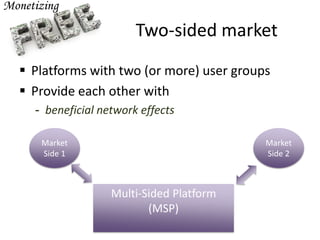
Two-sided market
 Platforms with two (or more) user groups
 Provide each other with
- beneficial network effects
Market
Side 1
Market
Side 2
Multi-Sided Platform
(MSP)
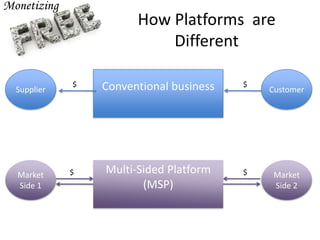
How Platforms are
Different
Multi-Sided Platform
(MSP)
Conventional business
Market
Side 1
Market
Side 2
$ $
Supplier Customer
$ $
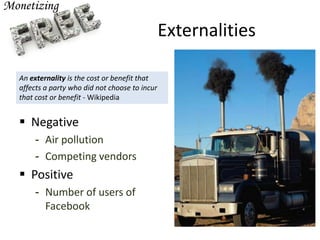
Externalities
 Negative
- Air pollution
- Competing vendors
 Positive
- Number of users of
Facebook
An externality is the cost or benefit that
affects a party who did not choose to incur
that cost or benefit - Wikipedia
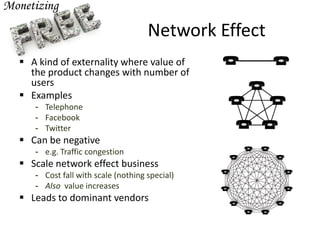
Network Effect
 A kind of externality where value of
the product changes with number of
users
 Examples
- Telephone
- Facebook
- Twitter
 Can be negative
- e.g. Traffic congestion
 Scale network effect business
- Cost fall with scale (nothing special)
- Also value increases
 Leads to dominant vendors
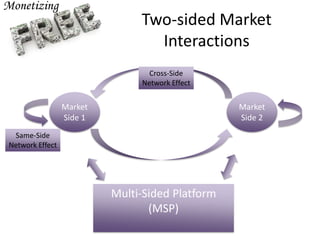
Two-sided Market
Interactions
Market
Side 1
Market
Side 2
Cross-Side
Network Effect
Same-Side
Network Effect
Multi-Sided Platform
(MSP)
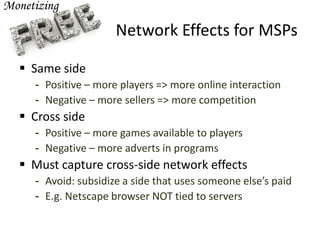
Network Effects for MSPs
 Same side
- Positive – more players => more online interaction
- Negative – more sellers => more competition
 Cross side
- Positive – more games available to players
- Negative – more adverts in programs
 Must capture cross-side network effects
- Avoid: subsidize a side that uses someone else’s paid
- E.g. Netscape browser NOT tied to servers
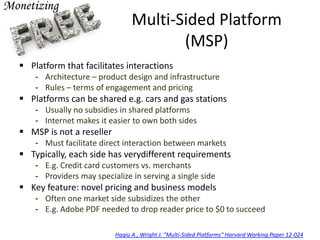
Multi-Sided Platform
(MSP)
 Platform that facilitates interactions
- Architecture – product design and infrastructure
- Rules – terms of engagement and pricing
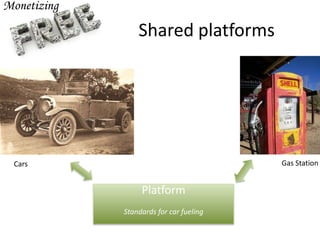
 Platforms can be shared e.g. cars and gas stations
- Usually no subsidies in shared platforms
- Internet makes it easier to own both sides
 MSP is not a reseller
- Must facilitate direct interaction between markets
 Typically, each side has verydifferent requirements
- E.g. Credit card customers vs. merchants
- Providers may specialize in serving a single side
 Key feature: novel pricing and business models
- Often one market side subsidizes the other
- E.g. Adobe PDF needed to drop reader price to $0 to succeed
Hagiu A., Wright J. "Multi-Sided Platforms" Harvard Working Paper 12-024
PLATFORM EXAMPLES
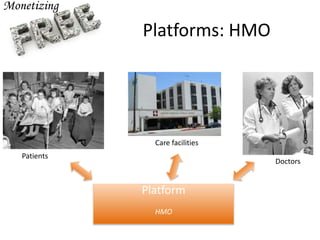
Platforms: HMO
Platform
HMO
Doctors
Patients
Care facilities
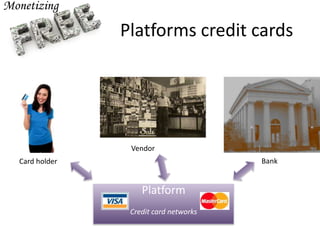
Platforms credit cards
Platform
Credit card networks
Card holder Bank
Vendor
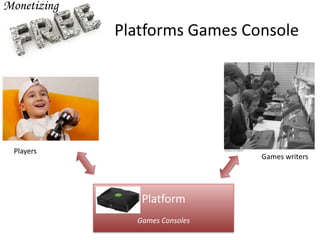
Platforms Games Console
Platform
Games Consoles
Players
Games writers
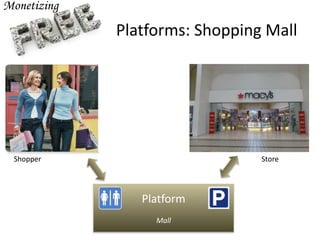
Platforms: Shopping Mall
Platform
Mall
Shopper Store
Shared platforms
Platform
Standards for car fueling
Cars Gas Station
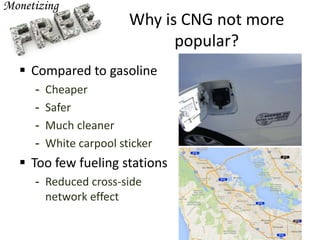
Why is CNG not more
popular?
 Compared to gasoline
- Cheaper
- Safer
- Much cleaner
- White carpool sticker
 Too few fueling stations
- Reduced cross-side
network effect
PRICING IN TWO-SIDED MARKETS
Pricing in Two-Sided
Markets
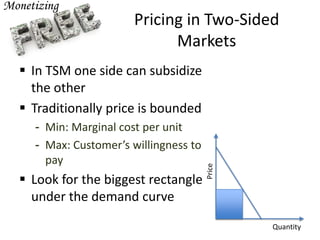
 In TSM one side can subsidize
the other
 Traditionally price is bounded
- Min: Marginal cost per unit
- Max: Customer’s willingness to
pay
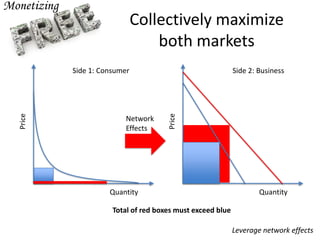
 Look for the biggest rectangle
under the demand curve
Price
Quantity
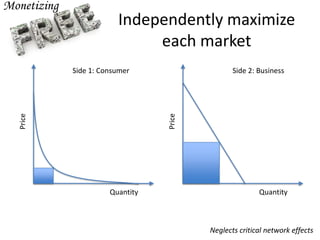
Independently maximize
each market
Price
Quantity
Price
Quantity
Neglects critical network effects
Side 1: Consumer Side 2: Business
Collectively maximize
both markets
Price
Quantity
Price
Quantity
Side 1: Consumer Side 2: Business
Leverage network effects
Network
Effects
Total of red boxes must exceed blue
STRATEGIC CHALLENGES IN TWO-
SIDED MARKETS
Strategic Challenges
1. Which side to subsidize?
- Who pays and how much?
2. Winner-takes-all or shared?
- How to manage winner-takes-all dynamic
3. Threat of envelopment
- Competitors can come at you sideways
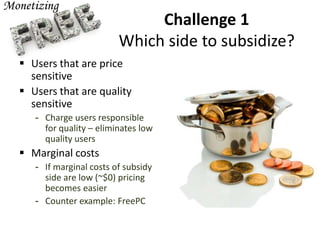
Challenge 1
Which side to subsidize?
 Users that are price
sensitive
 Users that are quality
sensitive
- Charge users responsible
for quality – eliminates low
quality users
 Marginal costs
- If marginal costs of subsidy
side are low (~$0) pricing
becomes easier
- Counter example: FreePC
Other Factors
 Same side network effect
- Consider excluding users to avoid negative network
effects
- Examples
- Covisint – failed due to seller competition
- Autobytel – succeed by offering only 1 dealership in a region
 User Brand Value
- Marquee users can be key
- Celebrities for Twitter/Ning
Price is all about
perception
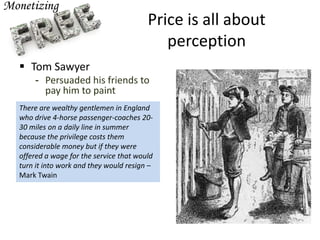
 Tom Sawyer
- Persuaded his friends to
pay him to paint
There are wealthy gentlemen in England
who drive 4-horse passenger-coaches 20-
30 miles on a daily line in summer
because the privilege costs them
considerable money but if they were
offered a wage for the service that would
turn it into work and they would resign –
Mark Twain
Reversible business
models
 From Derek Sivers, founder of CD Baby
 Night clubs in LA
- Pay to play
- Bands crave exposure more than money
 Doctors in China
- Paid by the healthy
- Payment stops when you get sick
 Gym in Denmark
- Don’t pay if you go every week
- Pay when you miss a week
Challenge 2
Winner-takes-all or shared platform?
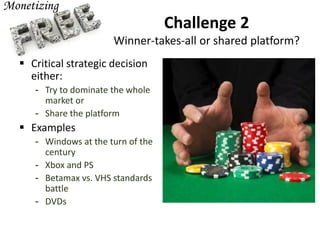
 Critical strategic decision
either:
- Try to dominate the whole
market or
- Share the platform
 Examples
- Windows at the turn of the
century
- Xbox and PS
- Betamax vs. VHS standards
battle
- DVDs
Winner-takes-all market
characteristics
 Multi-homing costs are high
- For at least one side
 Network effects are positive and strong
- At least for the side with high multi-homing costs
 Neither side’s users require special features
- Differentiation is difficult or irrelevant
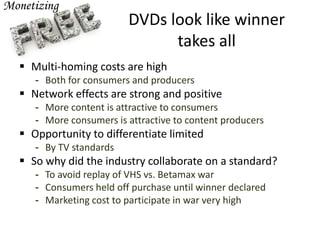
DVDs look like winner
takes all
 Multi-homing costs are high
- Both for consumers and producers
 Network effects are strong and positive
- More content is attractive to consumers
- More consumers is attractive to content producers
 Opportunity to differentiate limited
- By TV standards
 So why did the industry collaborate on a standard?
- To avoid replay of VHS vs. Betamax war
- Consumers held off purchase until winner declared
- Marketing cost to participate in war very high
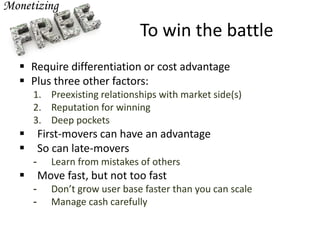
To win the battle
 Require differentiation or cost advantage
 Plus three other factors:
1. Preexisting relationships with market side(s)
2. Reputation for winning
3. Deep pockets
 First-movers can have an advantage
 So can late-movers
- Learn from mistakes of others
 Move fast, but not too fast
- Don’t grow user base faster than you can scale
- Manage cash carefully
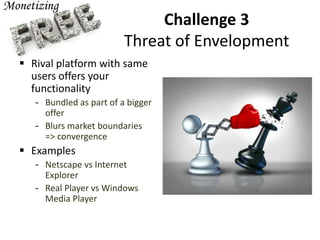
Challenge 3
Threat of Envelopment
 Rival platform with same
users offers your
functionality
- Bundled as part of a bigger
offer
- Blurs market boundaries
=> convergence
 Examples
- Netscape vs Internet
Explorer
- Real Player vs Windows
Media Player
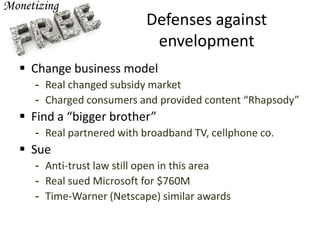
Defenses against
envelopment
 Change business model
- Real changed subsidy market
- Charged consumers and provided content “Rhapsody”
 Find a “bigger brother”
- Real partnered with broadband TV, cellphone co.
 Sue
- Anti-trust law still open in this area
- Real sued Microsoft for $760M
- Time-Warner (Netscape) similar awards
FREE PLATFORMS
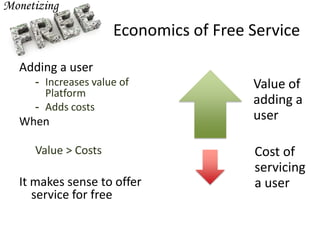
Economics of Free Service
Adding a user
- Increases value of
Platform
- Adds costs
When
Value > Costs
It makes sense to offer
service for free
Value of
adding a
user
Cost of
servicing
a user
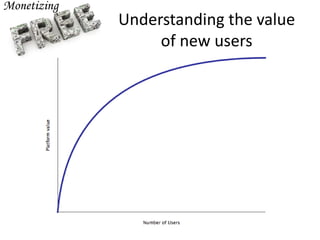
Understanding the value
of new users
Use Case: Adobe PDF
 Leveraged existing user base for PostScript
 Initially charged for both reader and writer
 Moved reader to Free
- Over 500 million users
- Very attractive to content creators
- Everyone has reader
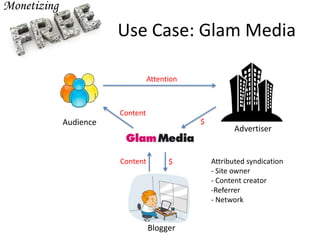
Use Case: Glam Media
Audience
Advertiser
Blogger
Content $
Content
Attention
$
Attributed syndication
- Site owner
- Content creator
-Referrer
- Network
SampleLab: The Store
Where Everything is Free
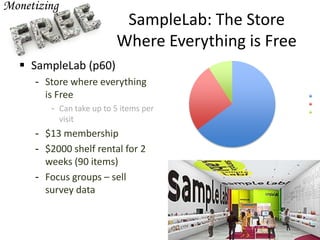
 SampleLab (p60)
- Store where everything
is Free
- Can take up to 5 items per
visit
- $13 membership
- $2000 shelf rental for 2
weeks (90 items)
- Focus groups – sell
survey data
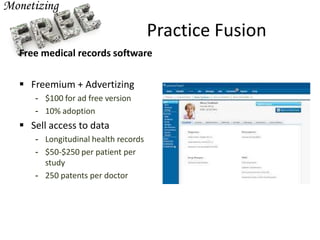
Practice Fusion
Free medical records software
 Freemium + Advertizing
- $100 for ad free version
- 10% adoption
 Sell access to data
- Longitudinal health records
- $50-$250 per patient per
study
- 250 patents per doctor
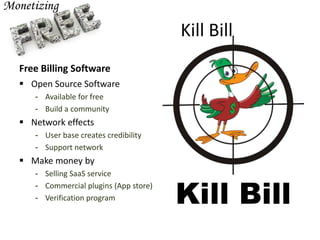
Kill Bill
Free Billing Software
 Open Source Software
- Available for free
- Build a community
 Network effects
- User base creates credibility
- Support network
 Make money by
- Selling SaaS service
- Commercial plugins (App store)
- Verification program Kill Bill
PLATFORM BUSINESS MODELS
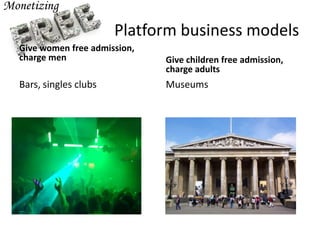
Platform business models
Give women free admission,
charge men
Bars, singles clubs
Give children free admission,
charge adults
Museums
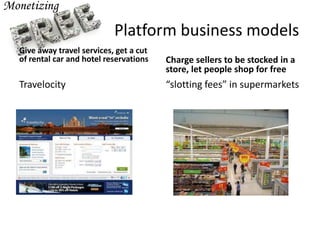
Platform business models
Give away travel services, get a cut
of rental car and hotel reservations
Travelocity
Charge sellers to be stocked in a
store, let people shop for free
“slotting fees” in supermarkets
Platform business models
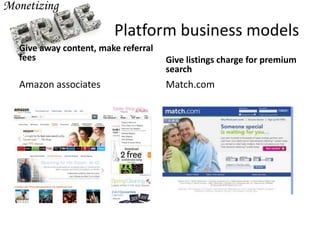
Give away content, make referral
fees
Amazon associates
Give listings charge for premium
search
Match.com
Platform business models
Give away content, sell stuff
Slashdot/ThinkGeek
Give away content, charge
advertisers to be featured in it
Product placement
Platform business models
Give away resume
listings, charge for power search
Linkedin
Give away limited “Green” house
plans, charge builders and contractors
to be listed as green resources
Free Green
Summary
 Theory of Two-sided markets (Platforms)
 Platform Examples
 Strategic Challenges
 Free Platforms

Platforms or Two-sided markets

  • 1.
    (Stanford BUS-21) Martin Westhead MasteringMarketing Platforms – Two/multi-sided markets How to make money by giving things away
  • 2.
    Overview  Theory ofTwo-sided markets (Platforms)  Platform Examples  Strategic Challenges  Free Platforms
  • 3.
    THEORY OF TWOSIDED MARKETS Strategies for Two-Sided Markets by Thomas Eisenmann, Geoffrey Parker, and Marshall W. Van Alstyne http://en.wikipedia.org/wiki/Two-sided_market
  • 4.
    Two-sided market  Platformswith two (or more) user groups  Provide each other with - beneficial network effects Market Side 1 Market Side 2 Multi-Sided Platform (MSP)
  • 5.
    How Platforms are Different Multi-SidedPlatform (MSP) Conventional business Market Side 1 Market Side 2 $ $ Supplier Customer $ $
  • 6.
    Externalities  Negative - Airpollution - Competing vendors  Positive - Number of users of Facebook An externality is the cost or benefit that affects a party who did not choose to incur that cost or benefit - Wikipedia
  • 7.
    Network Effect  Akind of externality where value of the product changes with number of users  Examples - Telephone - Facebook - Twitter  Can be negative - e.g. Traffic congestion  Scale network effect business - Cost fall with scale (nothing special) - Also value increases  Leads to dominant vendors
  • 8.
    Two-sided Market Interactions Market Side 1 Market Side2 Cross-Side Network Effect Same-Side Network Effect Multi-Sided Platform (MSP)
  • 9.
    Network Effects forMSPs  Same side - Positive – more players => more online interaction - Negative – more sellers => more competition  Cross side - Positive – more games available to players - Negative – more adverts in programs  Must capture cross-side network effects - Avoid: subsidize a side that uses someone else’s paid - E.g. Netscape browser NOT tied to servers
  • 10.
    Multi-Sided Platform (MSP)  Platformthat facilitates interactions - Architecture – product design and infrastructure - Rules – terms of engagement and pricing  Platforms can be shared e.g. cars and gas stations - Usually no subsidies in shared platforms - Internet makes it easier to own both sides  MSP is not a reseller - Must facilitate direct interaction between markets  Typically, each side has verydifferent requirements - E.g. Credit card customers vs. merchants - Providers may specialize in serving a single side  Key feature: novel pricing and business models - Often one market side subsidizes the other - E.g. Adobe PDF needed to drop reader price to $0 to succeed Hagiu A., Wright J. "Multi-Sided Platforms" Harvard Working Paper 12-024
  • 11.
  • 12.
  • 13.
    Platforms credit cards Platform Creditcard networks Card holder Bank Vendor
  • 14.
    Platforms Games Console Platform GamesConsoles Players Games writers
  • 15.
  • 16.
    Shared platforms Platform Standards forcar fueling Cars Gas Station
  • 17.
    Why is CNGnot more popular?  Compared to gasoline - Cheaper - Safer - Much cleaner - White carpool sticker  Too few fueling stations - Reduced cross-side network effect
  • 18.
  • 19.
    Pricing in Two-Sided Markets In TSM one side can subsidize the other  Traditionally price is bounded - Min: Marginal cost per unit - Max: Customer’s willingness to pay  Look for the biggest rectangle under the demand curve Price Quantity
  • 20.
    Independently maximize each market Price Quantity Price Quantity Neglectscritical network effects Side 1: Consumer Side 2: Business
  • 21.
    Collectively maximize both markets Price Quantity Price Quantity Side1: Consumer Side 2: Business Leverage network effects Network Effects Total of red boxes must exceed blue
  • 22.
    STRATEGIC CHALLENGES INTWO- SIDED MARKETS
  • 23.
    Strategic Challenges 1. Whichside to subsidize? - Who pays and how much? 2. Winner-takes-all or shared? - How to manage winner-takes-all dynamic 3. Threat of envelopment - Competitors can come at you sideways
  • 24.
    Challenge 1 Which sideto subsidize?  Users that are price sensitive  Users that are quality sensitive - Charge users responsible for quality – eliminates low quality users  Marginal costs - If marginal costs of subsidy side are low (~$0) pricing becomes easier - Counter example: FreePC
  • 25.
    Other Factors  Sameside network effect - Consider excluding users to avoid negative network effects - Examples - Covisint – failed due to seller competition - Autobytel – succeed by offering only 1 dealership in a region  User Brand Value - Marquee users can be key - Celebrities for Twitter/Ning
  • 26.
    Price is allabout perception  Tom Sawyer - Persuaded his friends to pay him to paint There are wealthy gentlemen in England who drive 4-horse passenger-coaches 20- 30 miles on a daily line in summer because the privilege costs them considerable money but if they were offered a wage for the service that would turn it into work and they would resign – Mark Twain
  • 27.
    Reversible business models  FromDerek Sivers, founder of CD Baby  Night clubs in LA - Pay to play - Bands crave exposure more than money  Doctors in China - Paid by the healthy - Payment stops when you get sick  Gym in Denmark - Don’t pay if you go every week - Pay when you miss a week
  • 28.
    Challenge 2 Winner-takes-all orshared platform?  Critical strategic decision either: - Try to dominate the whole market or - Share the platform  Examples - Windows at the turn of the century - Xbox and PS - Betamax vs. VHS standards battle - DVDs
  • 29.
    Winner-takes-all market characteristics  Multi-homingcosts are high - For at least one side  Network effects are positive and strong - At least for the side with high multi-homing costs  Neither side’s users require special features - Differentiation is difficult or irrelevant
  • 30.
    DVDs look likewinner takes all  Multi-homing costs are high - Both for consumers and producers  Network effects are strong and positive - More content is attractive to consumers - More consumers is attractive to content producers  Opportunity to differentiate limited - By TV standards  So why did the industry collaborate on a standard? - To avoid replay of VHS vs. Betamax war - Consumers held off purchase until winner declared - Marketing cost to participate in war very high
  • 31.
    To win thebattle  Require differentiation or cost advantage  Plus three other factors: 1. Preexisting relationships with market side(s) 2. Reputation for winning 3. Deep pockets  First-movers can have an advantage  So can late-movers - Learn from mistakes of others  Move fast, but not too fast - Don’t grow user base faster than you can scale - Manage cash carefully
  • 32.
    Challenge 3 Threat ofEnvelopment  Rival platform with same users offers your functionality - Bundled as part of a bigger offer - Blurs market boundaries => convergence  Examples - Netscape vs Internet Explorer - Real Player vs Windows Media Player
  • 33.
    Defenses against envelopment  Changebusiness model - Real changed subsidy market - Charged consumers and provided content “Rhapsody”  Find a “bigger brother” - Real partnered with broadband TV, cellphone co.  Sue - Anti-trust law still open in this area - Real sued Microsoft for $760M - Time-Warner (Netscape) similar awards
  • 34.
  • 35.
    Economics of FreeService Adding a user - Increases value of Platform - Adds costs When Value > Costs It makes sense to offer service for free Value of adding a user Cost of servicing a user
  • 36.
  • 37.
    Use Case: AdobePDF  Leveraged existing user base for PostScript  Initially charged for both reader and writer  Moved reader to Free - Over 500 million users - Very attractive to content creators - Everyone has reader
  • 38.
    Use Case: GlamMedia Audience Advertiser Blogger Content $ Content Attention $ Attributed syndication - Site owner - Content creator -Referrer - Network
  • 39.
    SampleLab: The Store WhereEverything is Free  SampleLab (p60) - Store where everything is Free - Can take up to 5 items per visit - $13 membership - $2000 shelf rental for 2 weeks (90 items) - Focus groups – sell survey data
  • 40.
    Practice Fusion Free medicalrecords software  Freemium + Advertizing - $100 for ad free version - 10% adoption  Sell access to data - Longitudinal health records - $50-$250 per patient per study - 250 patents per doctor
  • 41.
    Kill Bill Free BillingSoftware  Open Source Software - Available for free - Build a community  Network effects - User base creates credibility - Support network  Make money by - Selling SaaS service - Commercial plugins (App store) - Verification program Kill Bill
  • 42.
  • 43.
    Platform business models Givewomen free admission, charge men Bars, singles clubs Give children free admission, charge adults Museums
  • 44.
    Platform business models Giveaway travel services, get a cut of rental car and hotel reservations Travelocity Charge sellers to be stocked in a store, let people shop for free “slotting fees” in supermarkets
  • 45.
    Platform business models Giveaway content, make referral fees Amazon associates Give listings charge for premium search Match.com
  • 46.
    Platform business models Giveaway content, sell stuff Slashdot/ThinkGeek Give away content, charge advertisers to be featured in it Product placement
  • 47.
    Platform business models Giveaway resume listings, charge for power search Linkedin Give away limited “Green” house plans, charge builders and contractors to be listed as green resources Free Green
  • 48.
    Summary  Theory ofTwo-sided markets (Platforms)  Platform Examples  Strategic Challenges  Free Platforms

Editor's Notes

  • #29 http://hbr.org/2006/10/strategies-for-two-sided-markets/ar/1