(Stanford BUS-21)
Martin Westhead
Mastering Marketing
Open Source
How to make money
by giving things away
Overview
 What is Open Source
 Open Source companies
- How can you make money when you give away
your IP?
 Examples and adoption
 Open Source Licenses
 Open Source creations and hardware
 Future of Open Source
What is Open Source?
 Extension of free
 Free so far:
- Give away product or service
 Open Source:
- Give away the Intellectual Property
- Allows others to
- Read the code
- Fix bugs and add features
- Sell the software or service
 Uses other meaning free (Libra)
- Free as in Speech
EXAMPLES
Linux
 Free, Open Source Operating System
 Created by Linus Torvalds
 Licensed under GNU GPL
 Originally PC only
 Now ported to more platforms than any other OS
 95% of top 500 fastest computers use Linux
 Many Distributions
- Ubuntu
- Debian
- Red Hat / Fedora
- SUSE
Andoid
 Linux-based mobile operating system
 Most popular Mobile OS
- 83% smart phone market
- 1 million apps published
- 50B apps downloaded
- 1B Android devices activated
 Acquired by Google 2005
 2007 Nov - Open Handset Alliance
- Google, Samsung, HTC, Sony, Sprint Nextel, T-Mobile,
Qualcomm, Texas Instruments
 2008 Oct - HTC Dream
Apache Server
 Originally based on
NCSA HTTPd
 2005 - Work started
 2009 - first to serve
100 million websites
 Today – Powers 54.2%
active websites
- Followed by Microsoft
16%
MySQL
 Most popular OSS server DB
 Defacto standard for Web
development
 Powers many big websites
 Company bought by sun and
now Oracle
 Developers left and forked
the code: MariaDB
Libraries
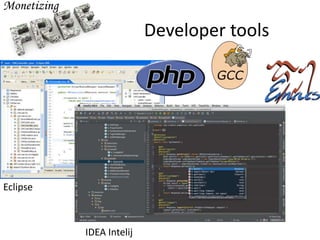
Developer tools
Eclipse
IDEA Intelij
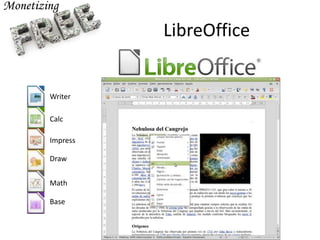
LibreOffice
Writer
Calc
Impress
Draw
Math
Base
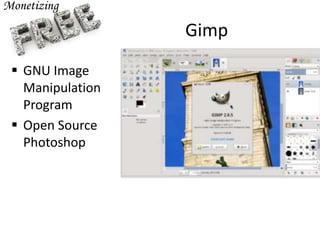
Gimp
 GNU Image
Manipulation
Program
 Open Source
Photoshop
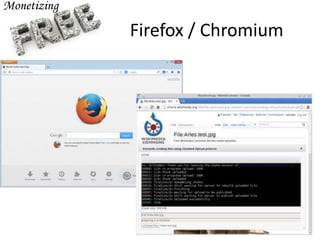
Firefox / Chromium
Why do people use it?
 800 vendor and non
vendor respondents
1. Quality
2. Freedom from lock-in
3. Flexibility of access to
large software libraries
4. Scalability
5. Superior security
6. Pace of innovaton
7. Lower cost
8. Access to source code
"It's been recognized that software
is eating the world,” said Michael
Skok, general partner at North
Bridge Venture Partners. “Our
survey points to the fact that open
source is eating the software
world."
http://www.pcworld.com/article/2035651/open-source-is-taking-over-the-software-world-survey-says.html
Open Source Adoption
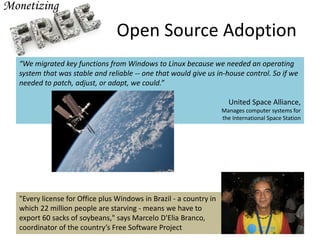
“We migrated key functions from Windows to Linux because we needed an operating
system that was stable and reliable -- one that would give us in-house control. So if we
needed to patch, adjust, or adapt, we could.”
United Space Alliance,
Manages computer systems for
the International Space Station
"Every license for Office plus Windows in Brazil - a country in
which 22 million people are starving - means we have to
export 60 sacks of soybeans," says Marcelo D'Elia Branco,
coordinator of the country’s Free Software Project
Open Source Adoption
 Major websites all run on open source
- Facebook
- Twitter
- Linkedin
- Google
- Amazon
- Wikipedia
 Virgin America (in-flight entertainment)
 KLM – Web services
 London stock exchange – trading platform
 New York stock exchange – trading applications
 Banco do Brasil – biggest bank in Brazil, desktops, ATMs
 French Parliament moved to Ubuntu on desktop PCs in 2007
 French Gendarmerie Nationale switch to Ubuntu by 2015
http://en.wikipedia.org/wiki/List_of_Linux_adopters
 Linux Ecosystem is
around $30B [IDC]
- Red Hat
- Ubuntu
- IBM’s open source
consulting
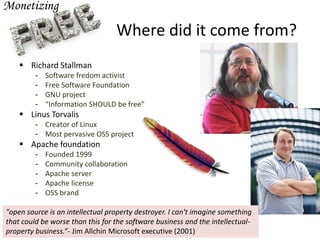
Where did it come from?
 Richard Stallman
- Software fredom activist
- Free Software Foundation
- GNU project
- “Information SHOULD be free”
 Linus Torvalis
- Creator of Linux
- Most pervasive OSS project
 Apache foundation
- Founded 1999
- Community collaboration
- Apache server
- Apache license
- OSS brand
"open source is an intellectual property destroyer. I can't imagine something
that could be worse than this for the software business and the intellectual-
property business.”- Jim Allchin Microsoft executive (2001)
Open Source origins
 1998 Netscape public release of browser
- Was Navigator became Firefox
 Meeting convened by Tim O’Reilly
 New term: Open Source
- Avoided “free” muddied by Stallman ideology
Why would anyone do it?
Corporations
 Everyone uses open source
- Except small number of
Windows only shops
- Software involves solving the
same problems over and over
- Open source means someone
solves is right once and
everyone else uses it
- Sharing makes sense for non-
competitive features
 Attracting top talent
- Developers go to places that
support it
Developers
 Way to make a name
- Celebrity developers
- Proven abilities
- High salaries
 Even pre-celebrity
- Create a portfolio
- Good for job seeking
How can you make
money from OSS?
 Ownership comes from
- Knowledge of code base
- Active development
- Community support
- Brand
 Can sell
- Pro version / Close source add-ons (i.e. Freemium model)
- IDEA Intellij,
- A SaaS service using the software (usually Freemium)
- e.g. Wordpress, Suger Sync
- Other services
- Custom development services
- Support and maintenance
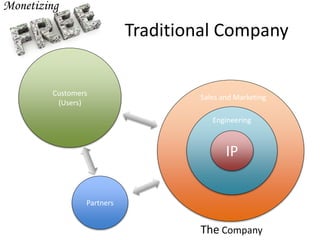
Customers
(Users)
Traditional Company
Partners
IP
Engineering
Sales and Marketing
The Company
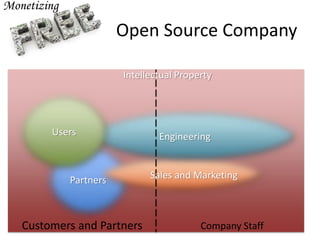
Open Source Company
Partners
Engineering
Company StaffCustomers and Partners
Intellectual Property
Users
Sales and Marketing
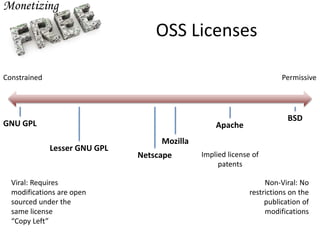
OSS Licenses
PermissiveConstrained
BSD
ApacheGNU GPL
Lesser GNU GPL
Mozilla
Netscape
Viral: Requires
modifications are open
sourced under the
same license
“Copy Left”
Non-Viral: No
restrictions on the
publication of
modifications
Implied license of
patents
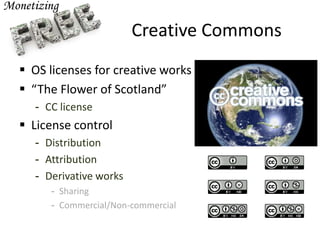
Creative Commons
 OS licenses for creative works
 “The Flower of Scotland”
- CC license
 License control
- Distribution
- Attribution
- Derivative works
- Sharing
- Commercial/Non-commercial
Open Source Hardware
 Open source hardware designs
 Benefit from community input
 Business models leverage Brand
 Popular in emerging areas
- 3d printers
- Arial drones
- Robotics
RepRap 3D printer
Future
Prediction: Within 10 years all broadly adopted
software will be either Open Source or SaaS
 Why?
- Free is an economic force of gravity
- Reproducing software has zero marginal cost
- For every piece of broadly adopted software today,
someone is making an Open Source version
- Many of these are getting better and better
- Once its good enough the free version will win
 Will Paid software continue to exist?
- Yes – High end needs, niche functionality
Summary
 What is Open Source
 Open Source companies
- How can you make money when you give away
your IP?
 Examples and adoption
 Open Source Licenses
 Open Source creations and hardware
 Future of Open Source

The Rise of Open Source

  • 1.
    (Stanford BUS-21) Martin Westhead MasteringMarketing Open Source How to make money by giving things away
  • 2.
    Overview  What isOpen Source  Open Source companies - How can you make money when you give away your IP?  Examples and adoption  Open Source Licenses  Open Source creations and hardware  Future of Open Source
  • 3.
    What is OpenSource?  Extension of free  Free so far: - Give away product or service  Open Source: - Give away the Intellectual Property - Allows others to - Read the code - Fix bugs and add features - Sell the software or service  Uses other meaning free (Libra) - Free as in Speech
  • 4.
  • 5.
    Linux  Free, OpenSource Operating System  Created by Linus Torvalds  Licensed under GNU GPL  Originally PC only  Now ported to more platforms than any other OS  95% of top 500 fastest computers use Linux  Many Distributions - Ubuntu - Debian - Red Hat / Fedora - SUSE
  • 6.
    Andoid  Linux-based mobileoperating system  Most popular Mobile OS - 83% smart phone market - 1 million apps published - 50B apps downloaded - 1B Android devices activated  Acquired by Google 2005  2007 Nov - Open Handset Alliance - Google, Samsung, HTC, Sony, Sprint Nextel, T-Mobile, Qualcomm, Texas Instruments  2008 Oct - HTC Dream
  • 7.
    Apache Server  Originallybased on NCSA HTTPd  2005 - Work started  2009 - first to serve 100 million websites  Today – Powers 54.2% active websites - Followed by Microsoft 16%
  • 8.
    MySQL  Most popularOSS server DB  Defacto standard for Web development  Powers many big websites  Company bought by sun and now Oracle  Developers left and forked the code: MariaDB
  • 9.
  • 10.
  • 11.
  • 12.
  • 13.
  • 14.
    Why do peopleuse it?  800 vendor and non vendor respondents 1. Quality 2. Freedom from lock-in 3. Flexibility of access to large software libraries 4. Scalability 5. Superior security 6. Pace of innovaton 7. Lower cost 8. Access to source code "It's been recognized that software is eating the world,” said Michael Skok, general partner at North Bridge Venture Partners. “Our survey points to the fact that open source is eating the software world." http://www.pcworld.com/article/2035651/open-source-is-taking-over-the-software-world-survey-says.html
  • 15.
    Open Source Adoption “Wemigrated key functions from Windows to Linux because we needed an operating system that was stable and reliable -- one that would give us in-house control. So if we needed to patch, adjust, or adapt, we could.” United Space Alliance, Manages computer systems for the International Space Station "Every license for Office plus Windows in Brazil - a country in which 22 million people are starving - means we have to export 60 sacks of soybeans," says Marcelo D'Elia Branco, coordinator of the country’s Free Software Project
  • 16.
    Open Source Adoption Major websites all run on open source - Facebook - Twitter - Linkedin - Google - Amazon - Wikipedia  Virgin America (in-flight entertainment)  KLM – Web services  London stock exchange – trading platform  New York stock exchange – trading applications  Banco do Brasil – biggest bank in Brazil, desktops, ATMs  French Parliament moved to Ubuntu on desktop PCs in 2007  French Gendarmerie Nationale switch to Ubuntu by 2015 http://en.wikipedia.org/wiki/List_of_Linux_adopters  Linux Ecosystem is around $30B [IDC] - Red Hat - Ubuntu - IBM’s open source consulting
  • 17.
    Where did itcome from?  Richard Stallman - Software fredom activist - Free Software Foundation - GNU project - “Information SHOULD be free”  Linus Torvalis - Creator of Linux - Most pervasive OSS project  Apache foundation - Founded 1999 - Community collaboration - Apache server - Apache license - OSS brand "open source is an intellectual property destroyer. I can't imagine something that could be worse than this for the software business and the intellectual- property business.”- Jim Allchin Microsoft executive (2001)
  • 18.
    Open Source origins 1998 Netscape public release of browser - Was Navigator became Firefox  Meeting convened by Tim O’Reilly  New term: Open Source - Avoided “free” muddied by Stallman ideology
  • 19.
    Why would anyonedo it? Corporations  Everyone uses open source - Except small number of Windows only shops - Software involves solving the same problems over and over - Open source means someone solves is right once and everyone else uses it - Sharing makes sense for non- competitive features  Attracting top talent - Developers go to places that support it Developers  Way to make a name - Celebrity developers - Proven abilities - High salaries  Even pre-celebrity - Create a portfolio - Good for job seeking
  • 20.
    How can youmake money from OSS?  Ownership comes from - Knowledge of code base - Active development - Community support - Brand  Can sell - Pro version / Close source add-ons (i.e. Freemium model) - IDEA Intellij, - A SaaS service using the software (usually Freemium) - e.g. Wordpress, Suger Sync - Other services - Custom development services - Support and maintenance
  • 21.
  • 22.
    Open Source Company Partners Engineering CompanyStaffCustomers and Partners Intellectual Property Users Sales and Marketing
  • 23.
    OSS Licenses PermissiveConstrained BSD ApacheGNU GPL LesserGNU GPL Mozilla Netscape Viral: Requires modifications are open sourced under the same license “Copy Left” Non-Viral: No restrictions on the publication of modifications Implied license of patents
  • 24.
    Creative Commons  OSlicenses for creative works  “The Flower of Scotland” - CC license  License control - Distribution - Attribution - Derivative works - Sharing - Commercial/Non-commercial
  • 25.
    Open Source Hardware Open source hardware designs  Benefit from community input  Business models leverage Brand  Popular in emerging areas - 3d printers - Arial drones - Robotics RepRap 3D printer
  • 26.
    Future Prediction: Within 10years all broadly adopted software will be either Open Source or SaaS  Why? - Free is an economic force of gravity - Reproducing software has zero marginal cost - For every piece of broadly adopted software today, someone is making an Open Source version - Many of these are getting better and better - Once its good enough the free version will win  Will Paid software continue to exist? - Yes – High end needs, niche functionality
  • 27.
    Summary  What isOpen Source  Open Source companies - How can you make money when you give away your IP?  Examples and adoption  Open Source Licenses  Open Source creations and hardware  Future of Open Source