ACADEMIC REGULATIONS
COURSE STRUCTURE
AND
DETAILED SYLLABUS
For
B.Tech., FOUR YEAR DEGREE COURSE
(Applicable for the batches admitted from 2013-14)
JAWAHARLAL NEHRU TECHNOLOGICAL
UNIVERSITY KAKINADA
KAKINADA – 533003, ANDHRA PRADESH, INDIA.
ELECTRONICS &
COMMUNICATION
ENGINEERING
Electronics & Communication Engineering 3
Academic Regulations (R13) for B. Tech. (Regular)
Applicable for the students of B. Tech. (Regular) from the Academic
Year 2013-14 onwards
1. Award of B. Tech. Degree
A student will be declared eligible for the award of B. Tech. Degree if he
fulfils the following academic regulations :
1. A student shall be declared eligible for the award of the B. Tech
Degree, if he pursues a course of study in not less than four and not
more than eight academic years.
2. The candidate shall register for 180 credits and secure all the 180
credits.
2. Courses of study
The following courses of study are offered at present as specializations
for the B. Tech. Courses :
S.No. Branch
01 Electronics and Communication Engineering
02 Electrical and Electronics Engineering
03 Civil Engineering
04 Mechanical Engineering
05 Computer Science and Engineering
06 Petro Chemical Engineering
07 Information Technology
08 Chemical Engineering
09 Electronics and Instrumentation Engineering
10 Bio-Medical Engineering
11 Aeronautical Engineering
12 Automobile Engineering
13 Bio Technology
14 Electronics and Computer Engineering
15 Mining Engineering
16 Petroleum Engineering
17 Metallurgical Engineering
18 Agricultural Engineering
Electronics & Communication Engineering 4
3. Distribution and Weightage of Marks
(i) The performance of a student in each semester shall be evaluated
subject – wise with a maximum of 100 marks for theory subject and
75 marks for practical subject. The project work shall be evaluated for
200 marks.
(ii) For theory subjects the distribution shall be 30 marks for Internal
Evaluation and 70 marks for the End - Examinations.
(iii) For theory subjects, during the semester there shall be 2 tests. The
weightage of Internal marks for 30 consists of Descriptive – 15,
Assignment - 05 (Theory, Design, Analysis, Simulation, Algorithms,
Drawing, etc. as the case may be) Objective -10 (Conducted at
College level with 20 Multiple choice question with a weightage of ½
Mark each). The objective examination is for 20 minutes duration.
The subjective examination is for 90 minutes duration conducted for
15 marks. Each subjective type test question paper shall contain 3
questions and all questions need to be answered. The Objective
examination conducted for 10 marks and subjective examination
conducted for 15 marks are to be added to the assignment marks of 5
for finalizing internal marks for 30. The best of the two tests will be
taken for internal marks. As the syllabus is framed for 6 units, the 1st
mid examination (both Objective and Subjective) is conducted in 1-3
units and second test in 4-6 units of each subject in a semester.
(iv) The end semester examination is conducted covering the topics of all
Units for 70 marks. Part – A contains a mandatory question
(Brainstorming / Thought provoking / case study) for 22 marks. Part –
B has 6 questions (One from each Unit). The student has to answer 3
out of 6 questions in Part – B and carries a weightage of 16 marks
each.
(v) For practical subjects there shall be continuous evaluation during the
semester for 25 internal marks and 50 end examination marks. The
internal 25 marks shall be awarded as follows: day to day work - 10
marks, Record-5 marks and the remaining 10 marks to be awarded by
conducting an internal laboratory test. The end examination shall be
conducted by the teacher concerned and external examiner.
(vi) For the subject having design and / or drawing, (such as Engineering
Graphics, Engineering Drawing, Machine Drawing) and estimation,
the distribution shall be 30 marks for internal evaluation ( 20 marks
for day – to – day work, and 10 marks for internal tests) and 70 marks
for end examination. There shall be two internal tests in a Semester
and the better of the two shall be considered for the award of marks
for internal tests.
Electronics & Communication Engineering 5
(vii) For the seminar, the student shall collect the information on a
specialized topic and prepare a technical report, showing his
understanding over the topic, and submit to the department, which
shall be evaluated by the Departmental committee consisting of Head
of the department, seminar supervisor and a senior faculty member.
The seminar report shall be evaluated for 50 marks. There shall be no
external examination for seminar.
(viii) Out of a total of 200 marks for the project work, 60 marks shall be for
Internal Evaluation and 140 marks for the End Semester Examination.
The End Semester Examination (Viva – Voce) shall be conducted by
the committee. The committee consists of an external examiner, Head
of the Department and Supervisor of the Project. The evaluation of
project work shall be conducted at the end of the IV year. The Internal
Evaluation shall be on the basis of two seminars given by each student
on the topic of his project and evaluated by an internal committee.
(ix) Laboratory marks and the internal marks awarded by the College are
not final. The marks are subject to scrutiny and scaling by the
University wherever felt desirable. The internal and laboratory marks
awarded by the College will be referred to a Committee. The
Committee shall arrive at a scaling factor and the marks will be scaled
as per the scaling factor. The recommendations of the Committee are
final and binding. The laboratory records and internal test papers shall
be preserved in the respective departments as per the University norms
and shall be produced to the Committees of the University as and
when they ask for.
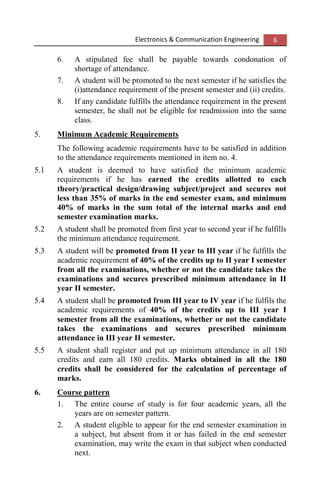
4. Attendance Requirements
1. A student is eligible to write the University examinations if he
acquires a minimum of 75% of attendance in aggregate of all the
subjects.
2. Condonation of shortage of attendance in aggregate up to 10%
(65% and above and below 75%) in each semester may be
granted by the College Academic Committee
3. Shortage of Attendance below 65% in aggregate shall not be
condoned.
4. A student who is short of attendance in semester may seek re-
admission into that semester when offered within 4 weeks from
the date of the commencement of class work.
5. Students whose shortage of attendance is not condoned in any
semester are not eligible to write their end semester examination
of that class.
Electronics & Communication Engineering 6
6. A stipulated fee shall be payable towards condonation of
shortage of attendance.
7. A student will be promoted to the next semester if he satisfies the
(i)attendance requirement of the present semester and (ii) credits.
8. If any candidate fulfills the attendance requirement in the present
semester, he shall not be eligible for readmission into the same
class.
5. Minimum Academic Requirements
The following academic requirements have to be satisfied in addition
to the attendance requirements mentioned in item no. 4.
5.1 A student is deemed to have satisfied the minimum academic
requirements if he has earned the credits allotted to each
theory/practical design/drawing subject/project and secures not
less than 35% of marks in the end semester exam, and minimum
40% of marks in the sum total of the internal marks and end
semester examination marks.
5.2 A student shall be promoted from first year to second year if he fulfills
the minimum attendance requirement.
5.3 A student will be promoted from II year to III year if he fulfills the
academic requirement of 40% of the credits up to II year I semester
from all the examinations, whether or not the candidate takes the
examinations and secures prescribed minimum attendance in II
year II semester.
5.4 A student shall be promoted from III year to IV year if he fulfils the
academic requirements of 40% of the credits up to III year I
semester from all the examinations, whether or not the candidate
takes the examinations and secures prescribed minimum
attendance in III year II semester.
5.5 A student shall register and put up minimum attendance in all 180
credits and earn all 180 credits. Marks obtained in all the 180
credits shall be considered for the calculation of percentage of
marks.
6. Course pattern
1. The entire course of study is for four academic years, all the
years are on semester pattern.
2. A student eligible to appear for the end semester examination in
a subject, but absent from it or has failed in the end semester
examination, may write the exam in that subject when conducted
next.
Electronics & Communication Engineering 7
3. When a student is detained for lack of credits / shortage of
attendance, he may be re-admitted into the same semester / year
in which he has been detained. However, the academic
regulations under which he was first admitted shall continues to
be applicable to him.
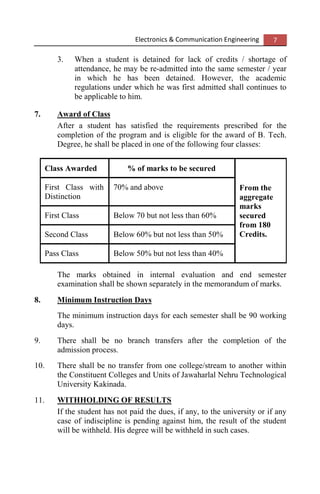
7. Award of Class
After a student has satisfied the requirements prescribed for the
completion of the program and is eligible for the award of B. Tech.
Degree, he shall be placed in one of the following four classes:
Class Awarded % of marks to be secured
From the
aggregate
marks
secured
from 180
Credits.
First Class with
Distinction
70% and above
First Class Below 70 but not less than 60%
Second Class Below 60% but not less than 50%
Pass Class Below 50% but not less than 40%
The marks obtained in internal evaluation and end semester
examination shall be shown separately in the memorandum of marks.
8. Minimum Instruction Days
The minimum instruction days for each semester shall be 90 working
days.
9. There shall be no branch transfers after the completion of the
admission process.
10. There shall be no transfer from one college/stream to another within
the Constituent Colleges and Units of Jawaharlal Nehru Technological
University Kakinada.
11. WITHHOLDING OF RESULTS
If the student has not paid the dues, if any, to the university or if any
case of indiscipline is pending against him, the result of the student
will be withheld. His degree will be withheld in such cases.
Electronics & Communication Engineering 8
12. TRANSITORY REGULATIONS
1. Discontinued or detained candidates are eligible for readmission
as and when next offered.
2. In case of transferred students from other Universities, the credits
shall be transferred to JNTUK as per the academic regulations
and course structure of the JNTUK.
13. General
1. Wherever the words “he”, “him”, “his”, occur in the regulations,
they include “she”, “her”, “hers”.
2. The academic regulation should be read as a whole for the
purpose of any interpretation.
3. In case of any doubt or ambiguity in the interpretation of the
above rules, the decision of the Vice-Chancellor is final.
4. The University may change or amend the academic regulations
or syllabi at any time and the changes or amendments made shall
be applicable to all the students with effect from the dates
notified by the University.
5. The students seeking transfer to colleges affiliated to JNTUK
from various other Universities/ Institutions have to pass the
failed subjects which are equivalent to the subjects of JNTUK,
and also pass the subjects of JNTUK on their own without the
right to sessional marks which the candidates have not studied at
the earlier Institution.
* * * *
Electronics & Communication Engineering 9
Academic Regulations (R13) for B. Tech.
(Lateral entry Scheme)
Applicable for the students admitted into II year B. Tech. from the Academic
Year 2014-15 onwards
1 Award of B. Tech. Degree
A student will be declared eligible for the award of B. Tech. Degree if he
fulfils the following academic regulations:
1.1 A student shall be declared eligible for the award of the B. Tech
Degree, if he pursues a course of study in not less than three
academic years and not more than six academic years.
1.2 The candidate shall register for 132 credits and secure all the 132
credits.
2. The attendance regulations of B. Tech. (Regular) shall be applicable to
B.Tech.
3. Promotion Rule
A student shall be promoted from second year to third year if he
fulfills the minimum attendance requirement.
A student shall be promoted from III year to IV year if he fulfils the
academic requirements of 40% of the credits up to III year I semester
from all the examinations, whether or not the candidate takes the
examinations and secures prescribed minimum attendance in III year
II semester.
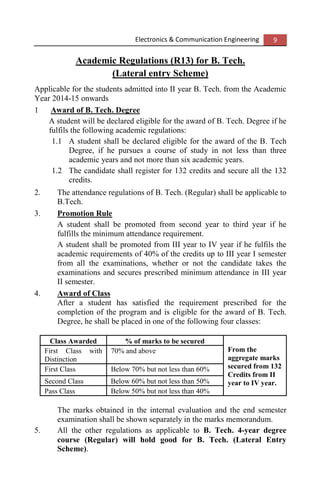
4. Award of Class
After a student has satisfied the requirement prescribed for the
completion of the program and is eligible for the award of B. Tech.
Degree, he shall be placed in one of the following four classes:
Class Awarded % of marks to be secured
From the
aggregate marks
secured from 132
Credits from II
year to IV year.
First Class with
Distinction
70% and above
First Class Below 70% but not less than 60%
Second Class Below 60% but not less than 50%
Pass Class Below 50% but not less than 40%
The marks obtained in the internal evaluation and the end semester
examination shall be shown separately in the marks memorandum.
5. All the other regulations as applicable to B. Tech. 4-year degree
course (Regular) will hold good for B. Tech. (Lateral Entry
Scheme).
Electronics & Communication Engineering 10
MALPRACTICES RULES
Disciplinary Action for / Improper Conduct in Examinations
Nature of Malpractices /
Improper conduct
Punishment
If the candidate:
1.
(a)
Possesses or keeps accessible in
examination hall, any paper, note
book, programmable calculators, Cell
phones, pager, palm computers or any
other form of material concerned with
or related to the subject of the
examination (theory or practical) in
which he is appearing but has not
made use of (material shall include
any marks on the body of the
candidate which can be used as an aid
in the subject of the examination)
Expulsion from the examination
hall and cancellation of the
performance in that subject only.
(b)
Gives assistance or guidance or
receives it from any other candidate
orally or by any other body language
methods or communicates through
cell phones with any candidate or
persons in or outside the exam hall in
respect of any matter.
Expulsion from the examination
hall and cancellation of the
performance in that subject only of
all the candidates involved. In case
of an outsider, he will be handed
over to the police and a case is
registered against him.
2.
Has copied in the examination hall
from any paper, book, programmable
calculators, palm computers or any
other form of material relevant to the
subject of the examination (theory or
practical) in which the candidate is
appearing.
Expulsion from the examination
hall and cancellation of the
performance in that subject and all
other subjects the candidate has
already appeared including practical
examinations and project work and
shall not be permitted to appear for
the remaining examinations of the
subjects of that Semester/year.
The Hall Ticket of the candidate
is to be cancelled and sent to the
University.
3.
Impersonates any other candidate in
connection with the examination.
The candidate who has
impersonated shall be expelled
from examination hall. The
candidate is also debarred and
forfeits the seat. The performance
of the original candidate who has
been impersonated, shall be
cancelled in all the subjects of the
Electronics & Communication Engineering 11
examination (including practicals
and project work) already appeared
and shall not be allowed to appear
for examinations of the remaining
subjects of that semester/year. The
candidate is also debarred for two
consecutive semesters from class
work and all University
examinations. The continuation of
the course by the candidate is
subject to the academic regulations
in connection with forfeiture of
seat. If the imposter is an outsider,
he will be handed over to the police
and a case is registered against him.
4.
Smuggles in the Answer book or
additional sheet or takes out or
arranges to send out the question
paper during the examination or
answer book or additional sheet,
during or after the examination.
Expulsion from the examination
hall and cancellation of
performance in that subject and all
the other subjects the candidate has
already appeared including practical
examinations and project work and
shall not be permitted for the
remaining examinations of the
subjects of that semester/year. The
candidate is also debarred for two
consecutive semesters from class
work and all University
examinations. The continuation of
the course by the candidate is
subject to the academic regulations
in connection with forfeiture of
seat.
5.
Uses objectionable, abusive or
offensive language in the answer
paper or in letters to the examiners or
writes to the examiner requesting him
to award pass marks.
Cancellation of the performance in
that subject.
6.
Refuses to obey the orders of the
Chief Superintendent/Assistant –
Superintendent / any officer on duty
or misbehaves or creates disturbance
of any kind in and around the
examination hall or organizes a walk
out or instigates others to walk out, or
threatens the officer-in charge or any
person on duty in or outside the
In case of students of the college,
they shall be expelled from
examination halls and cancellation
of their performance in that subject
and all other subjects the
candidate(s) has (have) already
appeared and shall not be permitted
to appear for the remaining
examinations of the subjects of that
Electronics & Communication Engineering 12
examination hall of any injury to his
person or to any of his relations
whether by words, either spoken or
written or by signs or by visible
representation, assaults the officer-in-
charge, or any person on duty in or
outside the examination hall or any of
his relations, or indulges in any other
act of misconduct or mischief which
result in damage to or destruction of
property in the examination hall or
any part of the College campus or
engages in any other act which in the
opinion of the officer on duty
amounts to use of unfair means or
misconduct or has the tendency to
disrupt the orderly conduct of the
examination.
semester/year. The candidates also
are debarred and forfeit their seats.
In case of outsiders, they will be
handed over to the police and a
police case is registered against
them.
7.
Leaves the exam hall taking away
answer script or intentionally tears of
the script or any part thereof inside or
outside the examination hall.
Expulsion from the examination
hall and cancellation of
performance in that subject and all
the other subjects the candidate has
already appeared including practical
examinations and project work and
shall not be permitted for the
remaining examinations of the
subjects of that semester/year. The
candidate is also debarred for two
consecutive semesters from class
work and all University
examinations. The continuation of
the course by the candidate is
subject to the academic regulations
in connection with forfeiture of
seat.
8.
Possess any lethal weapon or firearm
in the examination hall.
Expulsion from the examination
hall and cancellation of the
performance in that subject and all
other subjects the candidate has
already appeared including practical
examinations and project work and
shall not be permitted for the
remaining examinations of the
subjects of that semester/year. The
candidate is also debarred and
forfeits the seat.
Electronics & Communication Engineering 13
9.
If student of the college, who is not a
candidate for the particular
examination or any person not
connected with the college indulges
in any malpractice or improper
conduct mentioned in clause 6 to 8.
Student of the colleges expulsion
from the examination hall and
cancellation of the performance in
that subject and all other subjects
the candidate has already appeared
including practical examinations
and project work and shall not be
permitted for the remaining
examinations of the subjects of that
semester/year. The candidate is also
debarred and forfeits the seat.
Person(s) who do not belong
to the College will be handed over
to police and, a police case will be
registered against them.
10.
Comes in a drunken condition to the
examination hall.
Expulsion from the examination
hall and cancellation of the
performance in that subject and all
other subjects the candidate has
already appeared including practical
examinations and project work and
shall not be permitted for the
remaining examinations of the
subjects of that semester/year.
11.
Copying detected on the basis of
internal evidence, such as, during
valuation or during special scrutiny.
Cancellation of the performance in
that subject and all other subjects
the candidate has appeared
including practical examinations
and project work of that
semester/year examinations.
12.
If any malpractice is detected which
is not covered in the above clauses 1
to 11 shall be reported to the
University for further action to award
suitable punishment.
Malpractices identified by squad or special invigilators
1. Punishments to the candidates as per the above guidelines.
2. Punishment for institutions : (if the squad reports that the college is
also involved in encouraging malpractices)
(i) A show cause notice shall be issued to the college.
(ii) Impose a suitable fine on the college.
(iii) Shifting the examination centre from the college to another college for
a specific period of not less than one year.
* * * * *
Electronics & Communication Engineering 14
JAWAHARLAL NEHRU TECHNOLOGICAL
UNIVERSITY: KAKINADA
KAKINADA-533003, Andhra Pradesh (India)
For Constituent Colleges and Affiliated Colleges of JNTUK
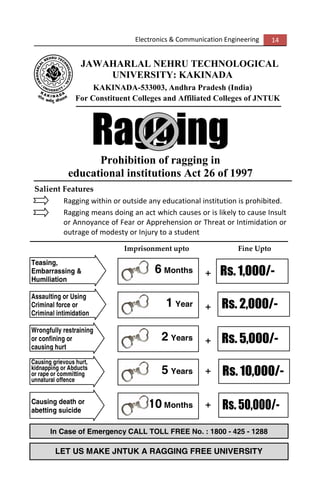
RaggingProhibition of ragging in
educational institutions Act 26 of 1997
Salient Features
Ragging within or outside any educational institution is prohibited.
Ragging means doing an act which causes or is likely to cause Insult
or Annoyance of Fear or Apprehension or Threat or Intimidation or
outrage of modesty or Injury to a student
Imprisonment upto Fine Upto
+
+
+
+
+
Teasing,
Embarrassing &
Humiliation
6 Months
Assaulting or Using
Criminal force or
Criminal intimidation
1 Year
Wrongfully restraining
or confining or
causing hurt
2 Years
Causing grievous hurt,
kidnapping or Abducts
or rape or committing
unnatural offence
5 Years
Causing death or
abetting suicide
10 Months Rs. 50,000/-
In Case of Emergency CALL TOLL FREE No. : 1800 - 425 - 1288
LET US MAKE JNTUK A RAGGING FREE UNIVERSITY
Rs. 10,000/-
Rs. 5,000/-
Rs. 2,000/-
Rs. 1,000/-
Electronics & Communication Engineering 15
JAWAHARLAL NEHRU TECHNOLOGICAL
UNIVERSITY: KAKINADA
KAKINADA-533003, Andhra Pradesh (India)
For Constituent Colleges and Affiliated Colleges of JNTUK
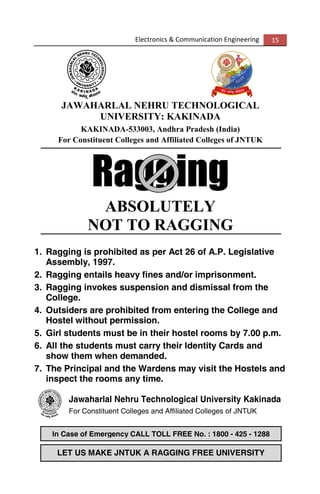
Ragging
ABSOLUTELY
NOT TO RAGGING
1. Ragging is prohibited as per Act 26 of A.P. Legislative
Assembly, 1997.
2. Ragging entails heavy fines and/or imprisonment.
3. Ragging invokes suspension and dismissal from the
College.
4. Outsiders are prohibited from entering the College and
Hostel without permission.
5. Girl students must be in their hostel rooms by 7.00 p.m.
6. All the students must carry their Identity Cards and
show them when demanded.
7. The Principal and the Wardens may visit the Hostels and
inspect the rooms any time.
Jawaharlal Nehru Technological University Kakinada
For Constituent Colleges and Affiliated Colleges of JNTUK
In Case of Emergency CALL TOLL FREE No. : 1800 - 425 - 1288
LET US MAKE JNTUK A RAGGING FREE UNIVERSITY
Electronics & Communication Engineering 16
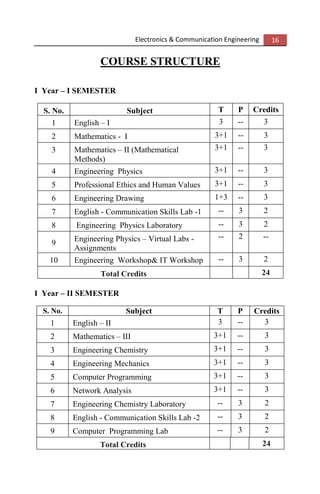
COURSE STRUCTURE
I Year – I SEMESTER
S. No. Subject T P Credits
1 English – I 3 -- 3
2 Mathematics - I 3+1 -- 3
3 Mathematics – II (Mathematical
Methods)
3+1 -- 3
4 Engineering Physics 3+1 -- 3
5 Professional Ethics and Human Values 3+1 -- 3
6 Engineering Drawing 1+3 -- 3
7 English - Communication Skills Lab -1 -- 3 2
8 Engineering Physics Laboratory -- 3 2
9 Engineering Physics – Virtual Labs -
Assignments
-- 2 --
10 Engineering Workshop& IT Workshop -- 3 2
Total Credits 24
I Year – II SEMESTER
S. No. Subject T P Credits
1 English – II 3 -- 3
2 Mathematics – III 3+1 -- 3
3 Engineering Chemistry 3+1 -- 3
4 Engineering Mechanics 3+1 -- 3
5 Computer Programming 3+1 -- 3
6 Network Analysis 3+1 -- 3
7 Engineering Chemistry Laboratory -- 3 2
8 English - Communication Skills Lab -2 -- 3 2
9 Computer Programming Lab -- 3 2
Total Credits 24
Electronics & Communication Engineering 17
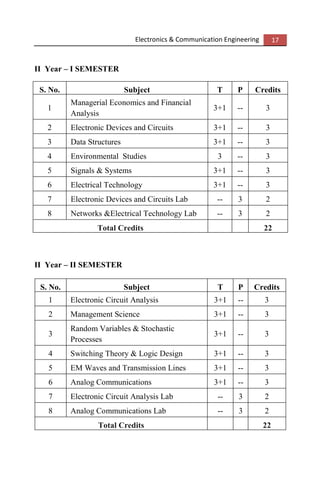
II Year – I SEMESTER
S. No. Subject T P Credits
1
Managerial Economics and Financial
Analysis
3+1 -- 3
2 Electronic Devices and Circuits 3+1 -- 3
3 Data Structures 3+1 -- 3
4 Environmental Studies 3 -- 3
5 Signals & Systems 3+1 -- 3
6 Electrical Technology 3+1 -- 3
7 Electronic Devices and Circuits Lab -- 3 2
8 Networks &Electrical Technology Lab -- 3 2
Total Credits 22
II Year – II SEMESTER
S. No. Subject T P Credits
1 Electronic Circuit Analysis 3+1 -- 3
2 Management Science 3+1 -- 3
3
Random Variables & Stochastic
Processes
3+1 -- 3
4 Switching Theory & Logic Design 3+1 -- 3
5 EM Waves and Transmission Lines 3+1 -- 3
6 Analog Communications 3+1 -- 3
7 Electronic Circuit Analysis Lab -- 3 2
8 Analog Communications Lab -- 3 2
Total Credits 22
Electronics & Communication Engineering 18
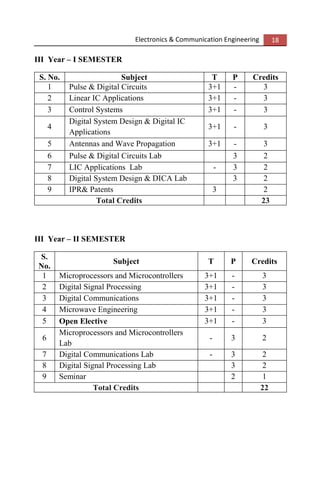
III Year – I SEMESTER
S. No. Subject T P Credits
1 Pulse & Digital Circuits 3+1 - 3
2 Linear IC Applications 3+1 - 3
3 Control Systems 3+1 - 3
4
Digital System Design & Digital IC
Applications
3+1 - 3
5 Antennas and Wave Propagation 3+1 - 3
6 Pulse & Digital Circuits Lab 3 2
7 LIC Applications Lab - 3 2
8 Digital System Design & DICA Lab 3 2
9 IPR& Patents 3 2
Total Credits 23
III Year – II SEMESTER
S.
No.
Subject T P Credits
1 Microprocessors and Microcontrollers 3+1 - 3
2 Digital Signal Processing 3+1 - 3
3 Digital Communications 3+1 - 3
4 Microwave Engineering 3+1 - 3
5 Open Elective 3+1 - 3
6
Microprocessors and Microcontrollers
Lab
- 3 2
7 Digital Communications Lab - 3 2
8 Digital Signal Processing Lab 3 2
9 Seminar 2 1
Total Credits 22
Electronics & Communication Engineering 19
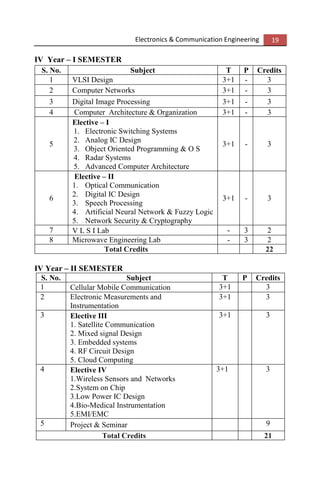
IV Year – I SEMESTER
S. No. Subject T P Credits
1 VLSI Design 3+1 - 3
2 Computer Networks 3+1 - 3
3 Digital Image Processing 3+1 - 3
4 Computer Architecture & Organization 3+1 - 3
5
Elective – I
1. Electronic Switching Systems
2. Analog IC Design
3. Object Oriented Programming & O S
4. Radar Systems
5. Advanced Computer Architecture
3+1 - 3
6
Elective – II
1. Optical Communication
2. Digital IC Design
3. Speech Processing
4. Artificial Neural Network & Fuzzy Logic
5. Network Security & Cryptography
3+1 - 3
7 V L S I Lab - 3 2
8 Microwave Engineering Lab - 3 2
Total Credits 22
IV Year – II SEMESTER
S. No. Subject T P Credits
1 Cellular Mobile Communication 3+1 3
2 Electronic Measurements and
Instrumentation
3+1 3
3 Elective III
1. Satellite Communication
2. Mixed signal Design
3. Embedded systems
4. RF Circuit Design
5. Cloud Computing
3+1 3
4 Elective IV
1.Wireless Sensors and Networks
2.System on Chip
3.Low Power IC Design
4.Bio-Medical Instrumentation
5.EMI/EMC
3+1 3
5 Project & Seminar 9
Total Credits 21
Electronics & Communication Engineering 20
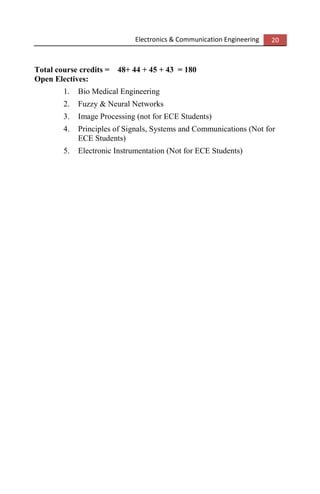
Total course credits = 48+ 44 + 45 + 43 = 180
Open Electives:
1. Bio Medical Engineering
2. Fuzzy & Neural Networks
3. Image Processing (not for ECE Students)
4. Principles of Signals, Systems and Communications (Not for
ECE Students)
5. Electronic Instrumentation (Not for ECE Students)
Electronics & Communication Engineering 21
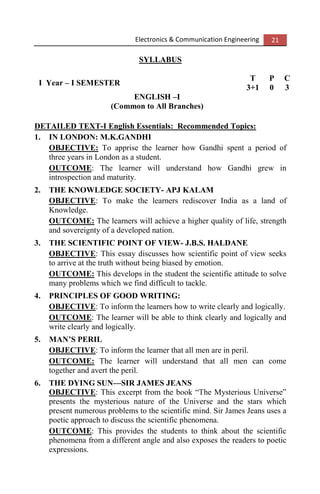
SYLLABUS
I Year – I SEMESTER
T P C
3+1 0 3
ENGLISH –I
(Common to All Branches)
DETAILED TEXT-I English Essentials: Recommended Topics:
1. IN LONDON: M.K.GANDHI
OBJECTIVE: To apprise the learner how Gandhi spent a period of
three years in London as a student.
OUTCOME: The learner will understand how Gandhi grew in
introspection and maturity.
2. THE KNOWLEDGE SOCIETY- APJ KALAM
OBJECTIVE: To make the learners rediscover India as a land of
Knowledge.
OUTCOME: The learners will achieve a higher quality of life, strength
and sovereignty of a developed nation.
3. THE SCIENTIFIC POINT OF VIEW- J.B.S. HALDANE
OBJECTIVE: This essay discusses how scientific point of view seeks
to arrive at the truth without being biased by emotion.
OUTCOME: This develops in the student the scientific attitude to solve
many problems which we find difficult to tackle.
4. PRINCIPLES OF GOOD WRITING:
OBJECTIVE: To inform the learners how to write clearly and logically.
OUTCOME: The learner will be able to think clearly and logically and
write clearly and logically.
5. MAN’S PERIL
OBJECTIVE: To inform the learner that all men are in peril.
OUTCOME: The learner will understand that all men can come
together and avert the peril.
6. THE DYING SUN—SIR JAMES JEANS
OBJECTIVE: This excerpt from the book “The Mysterious Universe”
presents the mysterious nature of the Universe and the stars which
present numerous problems to the scientific mind. Sir James Jeans uses a
poetic approach to discuss the scientific phenomena.
OUTCOME: This provides the students to think about the scientific
phenomena from a different angle and also exposes the readers to poetic
expressions.
Electronics & Communication Engineering 22
7. LUCK—MARK TWAIN
OBJECTIVE: This is a short story about a man’s public image and his
true nature. The theme of the story is that luck can be a factor of life, so
that even if one is incompetent but lucky, one can still succeed.
OUTCOME: The story is humourous in that it contains a lot of irony.
Thus this develops in the learner understand humourous texts and use of
words for irony.
Text Book : ‘English Essentials’ by Ravindra Publications
NON-DETAILED TEXT:
(From Modern Trailblazers of Orient Blackswan)
(Common single Text book for two semesters)
(Semester I (1 to 4 lessons)/ Semester II (5 to 8 lessons)
1. G.D.Naidu
OBJECTIVE: To inspire the learners by G.D.Naidu’s example of
inventions and contributions.
OUTCOME: The learner will be in a position to emulate G.D.Naidu
and take to practical applications.
2. G.R.Gopinath
OBJECTIVE: To inspire the learners by his example of inventions.
OUTCOME: Like G.R.Gopinath, the learners will be able to achieve
much at a low cost and help the common man.
3. Sudhamurthy
OBJECTIVE: To inspire the learners by the unique interests and
contributions of Sudha Murthy.
OUTCOME: The learner will take interest in multiple fields of
knowledge and make life worthwhile through social service.
4. Vijay Bhatkar
OBJECTIVE: To inspire the learner by his work and studies in different
fields of engineering and science.
OUTCOME: The learner will emulate him and produce memorable
things.
Text Book : ‘Trail Blazers’ by Orient Black Swan Pvt. Ltd. Publishers
Electronics & Communication Engineering 23
I Year – I SEMESTER
T P C
3+1 0 3
MATHEMATICS – I (DIFFERENTIAL EQUATIONS)
(Common to All Branches)
UNIT I: Differential equations of first order and first degree:
Linear-Bernoulli-Exact-Reducible to exact.
Applications : Newton’s Law of cooling-Law of natural growth and decay-
orthogonal trajectories.
Subject Category
ABET Learning Objectives a d e
ABET internal assessments 1 2 6
JNTUK External Evaluation A B E
UNIT II: Linear differential equations of higher order:
Non-homogeneous equations of higher order with constant coefficients with
RHS term of the type e ax
, Sin ax, cos ax, polynomials in x, e ax
V(x), xV(x).
Applications: LCR circuit, Simple Harmonic motion
Subject Category
ABET Learning Objectives a d e
ABET internal assessments 1 2 6
JNTUK External Evaluation A B E
UNIT III Laplace transforms:
Laplace transforms of standard functions-ShiftingTheorems, Transforms of
derivatives and integrals – Unit step function –Dirac’s delta function- Inverse
Laplace transforms– Convolution theorem (with out proof).
Application: Solutions of ordinary differential equations using Laplace
transforms.
Subject Category
ABET Learning Objectives a e
ABET internal assessments 1 2 6
JNTUK External Evaluation A B E
UNIT IV Partial differentiation:
Introduction- Total derivative-Chain rule-Generalized Mean Value theorem
for single variable (without proof)-Taylors and Mc Laurent’s series for two
variables– Functional dependence- Jacobian.
Applications: Maxima and Minima of functions of two variables with
constraints and without constraints.
Electronics & Communication Engineering 24
Subject Category
ABET Learning Objectives a c e
ABET internal assessments 1 2 6
JNTUK External Evaluation A B E
UNIT V First order Partial differential equations:
Formation of partial differential equations by elimination of arbitrary
constants and arbitrary functions –solutions of first order linear (Lagrange)
equation and nonlinear (standard type) equations
Subject Category
ABET Learning Objectives a e
ABET internal assessments 1 2 6
JNTUK External Evaluation A B E
UNIT VI Higher order Partial differential equations:
Solutions of Linear Partial differential equations with constant coefficients-
Method of separation of Variables
Applications : One- dimensional Wave, Heat equations - two-dimensional
Laplace Equation.
Subject Category
ABET Learning Objectives a e
ABET internal assessments 1 2 6
JNTUK External Evaluation B E
Books:
1. B.S.GREWAL, Higher Engineering Mathematics, 42nd
Edition,
Khanna Publishers
2. ERWIN KREYSZIG, Advanced Engineering Mathematics, 9th
Edition, Wiley-India
3. GREENBERG, Advanced Engineering Mathematics, 2nd
edition,
Pearson edn
4. DEAN G. DUFFY, Advanced engineering mathematics with
MATLAB, CRC Press
5. PETER O’NEIL, advanced Engineering Mathematics, Cengage
Learning.
Electronics & Communication Engineering 25
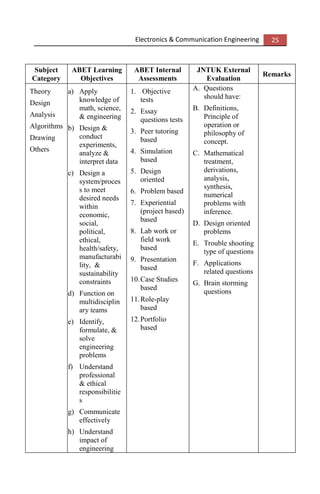
Subject
Category
ABET Learning
Objectives
ABET Internal
Assessments
JNTUK External
Evaluation
Remarks
Theory
Design
Analysis
Algorithms
Drawing
Others
a) Apply
knowledge of
math, science,
& engineering
b) Design &
conduct
experiments,
analyze &
interpret data
c) Design a
system/proces
s to meet
desired needs
within
economic,
social,
political,
ethical,
health/safety,
manufacturabi
lity, &
sustainability
constraints
d) Function on
multidisciplin
ary teams
e) Identify,
formulate, &
solve
engineering
problems
f) Understand
professional
& ethical
responsibilitie
s
g) Communicate
effectively
h) Understand
impact of
engineering
1. Objective
tests
2. Essay
questions tests
3. Peer tutoring
based
4. Simulation
based
5. Design
oriented
6. Problem based
7. Experiential
(project based)
based
8. Lab work or
field work
based
9. Presentation
based
10.Case Studies
based
11.Role-play
based
12.Portfolio
based
A. Questions
should have:
B. Definitions,
Principle of
operation or
philosophy of
concept.
C. Mathematical
treatment,
derivations,
analysis,
synthesis,
numerical
problems with
inference.
D. Design oriented
problems
E. Trouble shooting
type of questions
F. Applications
related questions
G. Brain storming
questions
Electronics & Communication Engineering 26
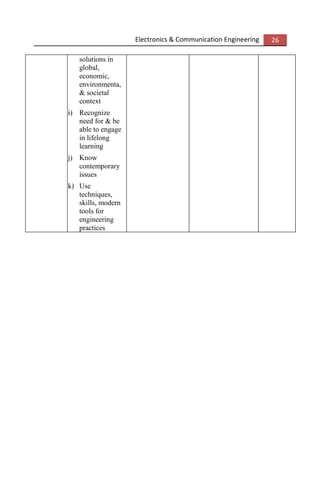
solutions in
global,
economic,
environmenta,
& societal
context
i) Recognize
need for & be
able to engage
in lifelong
learning
j) Know
contemporary
issues
k) Use
techniques,
skills, modern
tools for
engineering
practices
Electronics & Communication Engineering 27
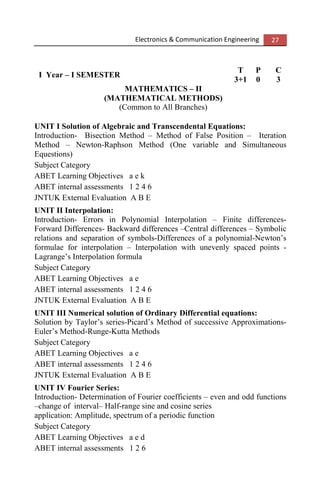
I Year – I SEMESTER
T P C
3+1 0 3
MATHEMATICS – II
(MATHEMATICAL METHODS)
(Common to All Branches)
UNIT I Solution of Algebraic and Transcendental Equations:
Introduction- Bisection Method – Method of False Position – Iteration
Method – Newton-Raphson Method (One variable and Simultaneous
Equestions)
Subject Category
ABET Learning Objectives a e k
ABET internal assessments 1 2 4 6
JNTUK External Evaluation A B E
UNIT II Interpolation:
Introduction- Errors in Polynomial Interpolation – Finite differences-
Forward Differences- Backward differences –Central differences – Symbolic
relations and separation of symbols-Differences of a polynomial-Newton’s
formulae for interpolation – Interpolation with unevenly spaced points -
Lagrange’s Interpolation formula
Subject Category
ABET Learning Objectives a e
ABET internal assessments 1 2 4 6
JNTUK External Evaluation A B E
UNIT III Numerical solution of Ordinary Differential equations:
Solution by Taylor’s series-Picard’s Method of successive Approximations-
Euler’s Method-Runge-Kutta Methods
Subject Category
ABET Learning Objectives a e
ABET internal assessments 1 2 4 6
JNTUK External Evaluation A B E
UNIT IV Fourier Series:
Introduction- Determination of Fourier coefficients – even and odd functions
–change of interval– Half-range sine and cosine series
application: Amplitude, spectrum of a periodic function
Subject Category
ABET Learning Objectives a e d
ABET internal assessments 1 2 6
Electronics & Communication Engineering 28
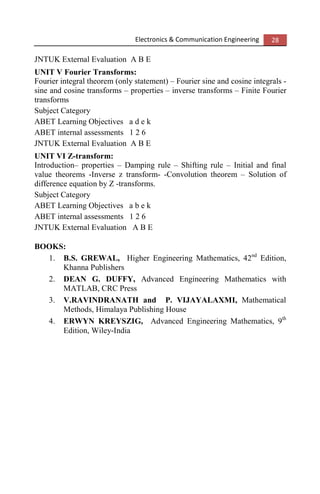
JNTUK External Evaluation A B E
UNIT V Fourier Transforms:
Fourier integral theorem (only statement) – Fourier sine and cosine integrals -
sine and cosine transforms – properties – inverse transforms – Finite Fourier
transforms
Subject Category
ABET Learning Objectives a d e k
ABET internal assessments 1 2 6
JNTUK External Evaluation A B E
UNIT VI Z-transform:
Introduction– properties – Damping rule – Shifting rule – Initial and final
value theorems -Inverse z transform- -Convolution theorem – Solution of
difference equation by Z -transforms.
Subject Category
ABET Learning Objectives a b e k
ABET internal assessments 1 2 6
JNTUK External Evaluation A B E
BOOKS:
1. B.S. GREWAL, Higher Engineering Mathematics, 42nd
Edition,
Khanna Publishers
2. DEAN G. DUFFY, Advanced Engineering Mathematics with
MATLAB, CRC Press
3. V.RAVINDRANATH and P. VIJAYALAXMI, Mathematical
Methods, Himalaya Publishing House
4. ERWYN KREYSZIG, Advanced Engineering Mathematics, 9th
Edition, Wiley-India
Electronics & Communication Engineering 29
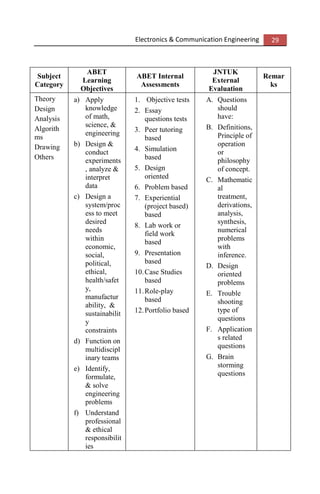
Subject
Category
ABET
Learning
Objectives
ABET Internal
Assessments
JNTUK
External
Evaluation
Remar
ks
Theory
Design
Analysis
Algorith
ms
Drawing
Others
a) Apply
knowledge
of math,
science, &
engineering
b) Design &
conduct
experiments
, analyze &
interpret
data
c) Design a
system/proc
ess to meet
desired
needs
within
economic,
social,
political,
ethical,
health/safet
y,
manufactur
ability, &
sustainabilit
y
constraints
d) Function on
multidiscipl
inary teams
e) Identify,
formulate,
& solve
engineering
problems
f) Understand
professional
& ethical
responsibilit
ies
1. Objective tests
2. Essay
questions tests
3. Peer tutoring
based
4. Simulation
based
5. Design
oriented
6. Problem based
7. Experiential
(project based)
based
8. Lab work or
field work
based
9. Presentation
based
10.Case Studies
based
11.Role-play
based
12.Portfolio based
A. Questions
should
have:
B. Definitions,
Principle of
operation
or
philosophy
of concept.
C. Mathematic
al
treatment,
derivations,
analysis,
synthesis,
numerical
problems
with
inference.
D. Design
oriented
problems
E. Trouble
shooting
type of
questions
F. Application
s related
questions
G. Brain
storming
questions
Electronics & Communication Engineering 30
g) Communica
te
effectively
h) Understand
impact of
engineering
solutions in
global,
economic,
environmen
ta, &
societal
context
i) Recognize
need for &
be able to
engage in
lifelong
learning
j) Know
contempora
ry issues
k) Use
techniques,
skills,
modern
tools for
engineering
practices
Electronics & Communication Engineering 31
I Year – I SEMESTER
T P C
3+1 0 3
ENGINEERING PHYSICS
UNIT-I
PHYSICAL OPTICS FOR INSTRUMENTS
“Objective Designing an instrument and enhancing the resolution for its
operation would be effective as achieved through study of applicational
aspects of physical Optics”
INTERFACE : Introduction – Interference in thin films by reflection –
Newton’s rings.
DIFFRACTION : Introduction – Fraunhofer diffraction - Fraunhofer
diffraction at double slit (qualitative) – Diffraction grating – Grating
spectrum – Resolving power of a grating – Rayleigh’s criterion for resolving
power.
POLARIZATION : Introduction – Types of Polarization – Double
refraction – Quarter wave plate ad Half Wave plate.
UNIT-II
COHERENT OPTICS – COMMUNICATIONS AND STRUCTURE OF
MATERIALS
Objectives while lasers are trusted Non-linear coherent sources established
for the fitness of instrumentation, establishing a structure property
relationship for materials requires allotment of an equivalent footing in
convening the physics knowledge base.
LASERS: Introduction – coherent sources – Characteristics of lasers –
Spontaneous and Stimulated emission of radiation – Einstein’s coefficients –
Population inversion – Three and Four level pumping schemes – Ruby laser
– Helium Neon laser.
FIBER OPTICS : Introduction – Principle of Optical Fiber – Acceptance
angle and acceptance cone – Numerical aperture.
CRYSTALLOGRAPHY : Introduction – Space lattice – Basis – Unit Cell –
Lattice parameters – Bravais lattices – Crystal systems – Structures and
packing fractions of SC,BCC and FCC
X-RAY DIFFRACTION TECHNIQUES : Directions and planes in
crystals – Miller indices – Separation between successive [h k l] planes –
Bragg’s law.
Electronics & Communication Engineering 32
UNIT-III
MAGNETIC, ELECTRIC FIELD RESPONSE OF MATERIALS &
SUPERCONDUCTIVITY
Objective: Many of the Electrical or Electronic gadgets are designed basing
on the response of naturally abundant and artificially made materials, while
their response to E- or H- fields controls their performance.
MAGNETIC PROPERTIES : Magnetic permeability – Magnetization –
Organ or magnetic moment – Classification of Magnetic materials – Dir,
para, Ferro, anti ferro and ferri-magnetism – Hysteresis curve
DIELECTRIC PROPERTIES : Introduction – Dielectric constant –
Electronic, ionic and orientational polarization – internal fields – Clausius –
Mossotti equation – Dielectric loss, Breakdown and Strength.
SUPERCONDUCTIVITY : General properties – Meissner effect – Type I
and Type II superconductors – BCS Theory Flux quantization London’s
equations – Penetration depth – DC and AC Josephson effects – SQUIDS.
UNIT – IV
ACOUSTICS AND EM – FIELDS:
Objective: The utility and nuances of ever pervading SHM and its
consequences would be the first hand-on to as it clearly conveyed through the
detailed studies of Acoustics of Buildings, while vectorial concepts of EM
fields paves the student to gear – up for a deeper understanding.
ACOUSTICS: Sound absorption, absorption coefficient and its
measurements, Reverberations time – Sabine’s formula, Eyring’s formula.
ELECTRO-MAGNETIC FIELDS: Gauss and stokes theorems (qualitative)
– Fundamental laws of electromagnetism – Maxwell’s Electromagnetic
Equations (Calculus approach).
UNIT – V
QUANTUM MECHANICS FOR ELECTRONIC TRANSPORT
Objective: The discrepancy between classical estimates and laboratory
observations of physical properties exhibited by materials would be lifted out
through the understanding quantum picture of sub-atomic world dominated
by electron and its presence.
QUANTUM MECHANICS: Introduction to matter waves – Schrodinger
Time Independent and Time Dependent wave equations – Particle in a box.
FREE ELECTRON THEORY: Classical free electron theory – electrical
conductivity – Mean free path – Relaxation time and drifty velocity –
Quantum free electron theory – Fermi – Dirac (analytical) and its dependence
Electronics & Communication Engineering 33
on temperature – Fermi energy – density of states – derivations for current
density.
BAND THEORY OF SOLIDS: Bloch theorem (qualitative) – Kronig –
Penney model – Origin of energy band formation in solids – Classification of
materials into conductors, semi – conductors & insulators – Concepts of
effective mass of electron - concept of hole.
UNIT – VI
SEMICONDUCTOR PHYSICS:
Objective: In the wake of ever increasing demand for the space and power
the watch word “small is beautiful”, understanding the physics of electronic
transport as underlying mechanism for appliances would provide a
knowledge base.
Introduction – Intrinsic semiconductor and carrier concentration – Equation
for conductivity – Extrinsic semiconductor and carrier concentration – Drift
and diffusion – Einstein’s equation – Hall Effect – direct & indirect band gap
semiconductors – Electronic transport Mechanism for LEDs, Photo
conductors and solar cells.
TEXT BOOKS
1. Solid state Physics by A.J. Dekker (Mc Millan India Ltd.) .
2. A text book of Engineering Physics by M.N. Avadhanulu & P.G.
Kshirasagar (S. Chand publications).
3. Engineering Physics b;y M.R. Srinivasan (New Age international
publishers).
REFERENCE BOOKS
1. ‘Introduction to solid state physics’ by Charles Kittle (Willey India
Pvt. Ltd).
2. ‘Applied Physics’ by T. Bhimasenkaram (BSP BH Publications )
3. ‘Applied Physics’ by M.Arumugam (Anuradha Agencies)
4. ‘Engineering Physics’ by Palanisamy (Scitech Publishers )
5. ‘Engineering Physics’ by D.K.Bhattacharya (Oxford University
press).
6. ‘Engineering Physics’ by Mani Naidu S (Pearson Publications)
7. ‘Engineering Physics’ by Sanjay D Jain and Girish G Sahasrabudhe
(University Press).
8. ‘Engineering Physics’ by B.K.Pandey & S. Chaturvedi (Cengage
Learning).
Electronics & Communication Engineering 34
I Year – I SEMESTER
T P C
3+1 0 3
Professional Ethics and Human Values
UNIT I : Human Values:
Morals, Values and Ethics – Integrity – Work Ethics – Service Learning –
Civic Virtue – Respect for others – Living Peacefully – Caring – Sharing –
Honesty –Courage – Value time – Co-operation – Commitment – Empathy –
Self-confidence – Spirituality- Character.
UNIT II : Engineering Ethics:
The History of Ethics-Purposes for Engineering Ethics-Engineering Ethics-
Consensus and Controversy –Professional and Professionalism –Professional
Roles to be played by an Engineer –Self Interest, Customs and Religion-Uses
of Ethical Theories-Professional Ethics-Types of Inquiry – Engineering and
Ethics-Kohlberg’s Theory – Gilligan’s Argument –Heinz’s Dilemma.
UNIT III : Engineering as Social Experimentation:
Comparison with Standard Experiments – Knowledge gained –
Conscientiousness – Relevant Information – Learning from the Past –
Engineers as Managers, Consultants, and Leaders – Accountability – Role of
Codes – Codes and Experimental Nature of Engineering.
UNIT IV : Engineers’ Responsibility for Safety and Risk:
Safety and Risk, Concept of Safety – Types of Risks – Voluntary v/s
Involuntary Risk- Short term v/s Long term Consequences- Expected
Probability- Reversible Effects- Threshold Levels for Risk- Delayed v/s
Immediate Risk- Safety and the Engineer – Designing for Safety – Risk-
Benefit Analysis-Accidents.
UNIT V : Engineers’ Responsibilities and Rights:
Collegiality-Techniques for Achieving Collegiality –Two Senses of Loyalty-
obligations of Loyalty-misguided Loyalty – professionalism and Loyalty-
Professional Rights –Professional Responsibilities – confidential and
proprietary information-Conflict of Interest-solving conflict problems – Self-
interest, Customs and Religion- Ethical egoism-Collective bargaining-
Confidentiality-Acceptance of Bribes/Gifts-when is a Gift and a Bribe-
examples of Gifts v/s Bribes-problem solving-interests in other companies-
Occupational Crimes-industrial espionage-price fixing-endangering lives-
Whistle Blowing-types of whistle blowing-when should it be attempted-
preventing whistle blowing.
Electronics & Communication Engineering 35
UNIT VI : Global Issues:
Globalization- Cross-culture Issues-Environmental Ethics-Computer Ethics-
computers as the instrument of Unethical behaviour-computers as the object
of Unethical Acts-autonomous computers-computer codes of Ethics-
Weapons Development-Ethics and Research-Analysing Ethical Problems in
Research-Intellectual Property Rights.
********
Text Books:
1. “Engineering Ethics and Human Values” by M.Govindarajan,
S.Natarajan and V.S.SenthilKumar-PHI Learning Pvt. Ltd-2009.
2. “Professional Ethics and Morals” by Prof.A.R.Aryasri, Dharanikota
Suyodhana-Maruthi Publications.
3. “Professional Ethics and Human Values” by A.Alavudeen, R.Kalil
Rahman and M.Jayakumaran- Laxmi Publications.
4. “Professional Ethics and Human Values” by Prof. D.R. Kiran.
5. “Indian Culture, Values and Professional Ethics” by PSR Murthy-
BS Publication.
6. “Ethics in Engineering” by Mike W. Martin and Roland Schinzinger
– Tata McGraw-Hill – 2003.
7. “Engineering Ethics” by Harris, Pritchard and Rabins, CENGAGE
Learning, India Edition, 2009.
Electronics & Communication Engineering 36
I Year – I SEMESTER
T P C
3+1 0 3
ENGINEERING DRAWING
Objective: Engineering drawing being the principle method of
communication for engineers, the objective to introduce the students, the
techniques of constructing the various types of polygons, curves and scales.
The objective is also to visualize and represent the 3D objects in 2D planes
with proper dimensioning, scaling etc.
UNIT I
Objective: The objective is to introduce the use and the application of
drawing instruments and to make the students construct the polygons, curves
and various types of scales. The student will be able to understand the need
to enlarge or reduce the size of objects in representing them.
Polygons, Construction of regular polygons using given length of a side;
Ellipse, arcs of circles and Oblong methods; Scales – Vernier and Diagonal
scales.
UNIT II
Objective: The objective is to introduce orthographic projections and to
project the points and lines parallel to one plane and inclined to other.
Introduction to orthographic projections; projections of points; projections of
straight lines parallel to both the planes; projections of straight lines – parallel
to one plane and inclined to the other plane.
UNIT III
Objective: The objective is to make the students draw the projections of the
lines inclined to both the planes.
Projections of straight lines inclined to both the planes, determination of true
lengths, angle of inclinations and traces.
UNIT IV
Objective: The objective is to make the students draw the projections of the
plane inclined to both the planes.
Projections of planes: regular planes perpendicular/parallel to one plane and
inclined to the other reference plane; inclined to both the reference planes.
Electronics & Communication Engineering 37
UNIT V
Objective: The objective is to make the students draw the projections of the
various types of solids in different positions inclined to one of the planes.
Projections of Solids – Prisms, Pyramids, Cones and Cylinders with the axis
inclined to one of the planes.
UNIT VI
Objective: The objective is to represent the object in 3D view through
isometric views. The student will be able to represent and convert the
isometric view to orthographic view and vice versa.
Conversion of isometric views to orthographic views; Conversion of
orthographic views to isometric views.
TEXT BOOKS:
1. Engineering Drawing by N.D. Butt, Chariot Publications
2. Engineering Drawing by K.L.Narayana & P. Kannaiah, Scitech
Publishers.
3. Engineering Graphics by PI Varghese, McGrawHill Publishers
REFERENCE BOOKS:
1. Engineering Graphics for Degree by K.C. John, PHI Publishers
2. Engineering Drawing by Agarwal & Agarwal, Tata McGraw
Hill Publishers.
3. Engineering Drawing + AutoCad – K Venugopal, V. Prabhu
Raja, New Age.
Electronics & Communication Engineering 38
I Year – I SEMESTER
T P C
0 3 2
ENGLISH – COMMUNICATION SKILLS LAB – I
Suggested Lab Manuals:
OBJECTIVE: To impart to the learner the skills of grammar as well as
communication through listening, speaking, reading, and writing including
soft, that is life skills.
BASIC COMMUNICATION SKILLS
UNIT 1 A. Greeting and Introductions
B. Pure Vowels
UNIT 2 A. Asking for information and Requests
B. Diphthongs
UNIT 3 A. Invitations
B. Consonants
UNIT 4 A. Commands and Instructions
B. Accent and Rhythm
UNIT 5 A. Suggestions and Opinions
B. Intonation
Text Book:
‘Strengthen your Communication Skills’ Part-A by Maruthi
Publications
Reference Books:
1. INFOTECH English (Maruthi Publications)
2. Personality Development and Soft Skills (Oxford University
Press, New Delhi).
Electronics & Communication Engineering 39
I Year – I SEMESTER
T P C
0 3 2
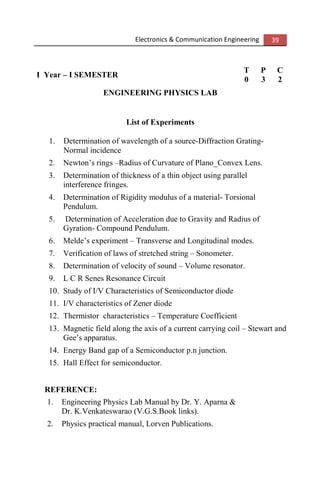
ENGINEERING PHYSICS LAB
List of Experiments
1. Determination of wavelength of a source-Diffraction Grating-
Normal incidence
2. Newton’s rings –Radius of Curvature of Plano_Convex Lens.
3. Determination of thickness of a thin object using parallel
interference fringes.
4. Determination of Rigidity modulus of a material- Torsional
Pendulum.
5. Determination of Acceleration due to Gravity and Radius of
Gyration- Compound Pendulum.
6. Melde’s experiment – Transverse and Longitudinal modes.
7. Verification of laws of stretched string – Sonometer.
8. Determination of velocity of sound – Volume resonator.
9. L C R Senes Resonance Circuit
10. Study of I/V Characteristics of Semiconductor diode
11. I/V characteristics of Zener diode
12. Thermistor characteristics – Temperature Coefficient
13. Magnetic field along the axis of a current carrying coil – Stewart and
Gee’s apparatus.
14. Energy Band gap of a Semiconductor p.n junction.
15. Hall Effect for semiconductor.
REFERENCE:
1. Engineering Physics Lab Manual by Dr. Y. Aparna &
Dr. K.Venkateswarao (V.G.S.Book links).
2. Physics practical manual, Lorven Publications.
Electronics & Communication Engineering 40
I Year – I SEMESTER
T P C
0 2 0
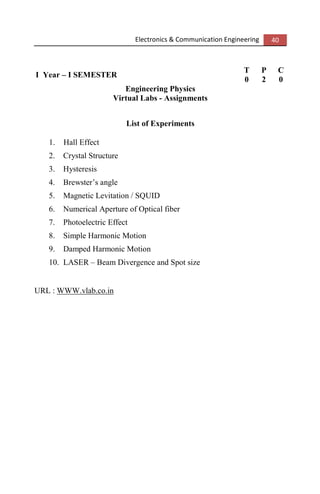
Engineering Physics
Virtual Labs - Assignments
List of Experiments
1. Hall Effect
2. Crystal Structure
3. Hysteresis
4. Brewster’s angle
5. Magnetic Levitation / SQUID
6. Numerical Aperture of Optical fiber
7. Photoelectric Effect
8. Simple Harmonic Motion
9. Damped Harmonic Motion
10. LASER – Beam Divergence and Spot size
URL : WWW.vlab.co.in
Electronics & Communication Engineering 41
I Year – I SEMESTER
T P C
0 3 2
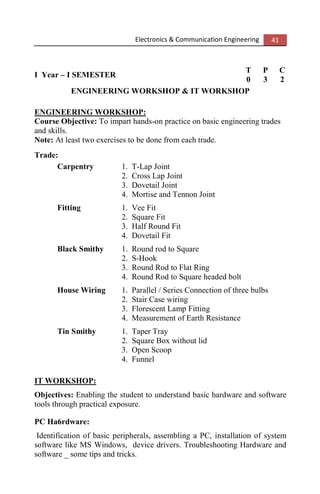
ENGINEERING WORKSHOP & IT WORKSHOP
ENGINEERING WORKSHOP:
Course Objective: To impart hands-on practice on basic engineering trades
and skills.
Note: At least two exercises to be done from each trade.
Trade:
Carpentry 1. T-Lap Joint
2. Cross Lap Joint
3. Dovetail Joint
4. Mortise and Tennon Joint
Fitting 1. Vee Fit
2. Square Fit
3. Half Round Fit
4. Dovetail Fit
Black Smithy 1. Round rod to Square
2. S-Hook
3. Round Rod to Flat Ring
4. Round Rod to Square headed bolt
House Wiring 1. Parallel / Series Connection of three bulbs
2. Stair Case wiring
3. Florescent Lamp Fitting
4. Measurement of Earth Resistance
Tin Smithy 1. Taper Tray
2. Square Box without lid
3. Open Scoop
4. Funnel
IT WORKSHOP:
Objectives: Enabling the student to understand basic hardware and software
tools through practical exposure.
PC Ha6rdware:
Identification of basic peripherals, assembling a PC, installation of system
software like MS Windows, device drivers. Troubleshooting Hardware and
software _ some tips and tricks.
Electronics & Communication Engineering 42
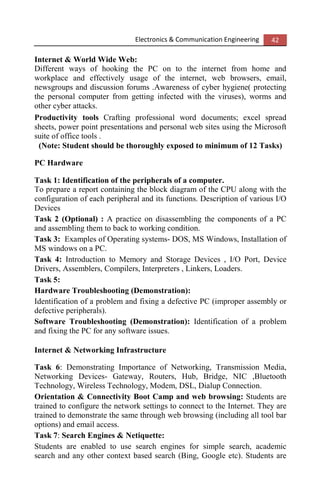
Internet & World Wide Web:
Different ways of hooking the PC on to the internet from home and
workplace and effectively usage of the internet, web browsers, email,
newsgroups and discussion forums .Awareness of cyber hygiene( protecting
the personal computer from getting infected with the viruses), worms and
other cyber attacks.
Productivity tools Crafting professional word documents; excel spread
sheets, power point presentations and personal web sites using the Microsoft
suite of office tools .
(Note: Student should be thoroughly exposed to minimum of 12 Tasks)
PC Hardware
Task 1: Identification of the peripherals of a computer.
To prepare a report containing the block diagram of the CPU along with the
configuration of each peripheral and its functions. Description of various I/O
Devices
Task 2 (Optional) : A practice on disassembling the components of a PC
and assembling them to back to working condition.
Task 3: Examples of Operating systems- DOS, MS Windows, Installation of
MS windows on a PC.
Task 4: Introduction to Memory and Storage Devices , I/O Port, Device
Drivers, Assemblers, Compilers, Interpreters , Linkers, Loaders.
Task 5:
Hardware Troubleshooting (Demonstration):
Identification of a problem and fixing a defective PC (improper assembly or
defective peripherals).
Software Troubleshooting (Demonstration): Identification of a problem
and fixing the PC for any software issues.
Internet & Networking Infrastructure
Task 6: Demonstrating Importance of Networking, Transmission Media,
Networking Devices- Gateway, Routers, Hub, Bridge, NIC ,Bluetooth
Technology, Wireless Technology, Modem, DSL, Dialup Connection.
Orientation & Connectivity Boot Camp and web browsing: Students are
trained to configure the network settings to connect to the Internet. They are
trained to demonstrate the same through web browsing (including all tool bar
options) and email access.
Task 7: Search Engines & Netiquette:
Students are enabled to use search engines for simple search, academic
search and any other context based search (Bing, Google etc). Students are
Electronics & Communication Engineering 43
acquainted to the principles of micro-blogging, wiki, collaboration using
social networks, participating in online technology forums
Task 8: Cyber Hygiene (Demonstration): Awareness of various threats on
the internet. Importance of security patch updates and anti-virus solutions.
Ethical Hacking, Firewalls, Multi-factor authentication techniques including
Smartcard, Biometrics are also practiced.
Word
Task 9 : MS Word Orientation:
Accessing, overview of toolbars, saving files, Using help and resources,
rulers, formatting, Drop Cap, Applying Text effects, Using Character
Spacing, OLE in Word, using templates, Borders and Colors, Inserting
Header and Footer, Using Date and Time option, security features in word,
converting documents while saving.
Task 10: Creating project : Abstract Features to be covered:-Formatting
Styles, Inserting table, Bullets and Numbering, Changing Text Direction,
Cell alignment, Footnote, Hyperlink, Symbols, Spell Check , Track Changes,
Images from files and clipart, Drawing toolbar and Word Art, Formatting
Images, Textboxes and Paragraphs.
Excel
Task 11: Using spread sheet features of EXCEL including the macros,
formulae, pivot tables, graphical representations.
Creating a Scheduler - Features to be covered:- Gridlines, Format Cells,
Summation, auto fill, Formatting Text.
LOOKUP/VLOOKUP
Task 12: Performance Analysis - Features to be covered:- Split cells, freeze
panes, group and outline, Sorting, Boolean and logical operators, Conditional
formatting.
Power Point
Task 13: Students will be working on basic power point utilities and tools
which help them create basic power point presentation. Topic covered during
this week includes :- PPT Orientation, Slide Layouts, Inserting Text, Word
Art, Formatting Text, Bullets and Numbering, Auto Shapes, Lines and
Arrows, Hyperlinks, Inserting –Images, Clip Art, Tables and Charts in
Powerpoint.
Electronics & Communication Engineering 44
Task 14: Focusing on the power and potential of Microsoft power point.
Helps them learn best practices in designing and preparing power point
presentation. Topic covered during this week includes: - Master Layouts
(slide, template, and notes), Types of views (basic, presentation, slide slotter,
notes etc), Inserting – Background, textures, Design Templates, Hidden
slides, OLE in PPT.
TEXT BOOK:
Faculty to consolidate the workshop manuals using the following
references
1. Computer Fundamentals, Anita Goel, Pearson
2. Scott Mueller’s Upgrading and Repairing PCs, 18/e, Scott. Mueller,
QUE, Pearson,2008
3. Information Technology Workshop,3e, G Praveen Babu, M V Narayana
BS Publications.
4. Comdex Information Technology , Vikas Gupta, dreamtech.
REFERENCE BOOK:
1. Essential Computer and IT Fundamentals for Engineering and Science
Students, Dr. N.B. Venkateswarlu.
2. PC Hardware trouble shooting made easy, TMH.
Electronics & Communication Engineering 45
I Year – II SEMESTER
T P C
3+1 0 3
ENGLISH –II
(Common to All Branches)
DETAILED TEXT-II : Sure Outcomes: English for Engineers and
Technologists Recommended Topics :
1. TECHNOLOGY WITH A HUMAN FACE
OBJECTIVE: To make the learner understand how modern life has
been shaped by technology.
OUTCOME: The proposed technology is people’s technology. It serves
the human person instead of making him the servant of machines.
2. CLIMATE CHANGE AND HUMAN STRATEGY
OBJECTIVE: To make the learner understand how the unequal heating
of earth’s surface by the Sun, an atmospheric circulation pattern is
developed and maintained.
OUTCOME: The learner’s understand that climate must be preserved.
3. EMERGING TECHNOLOGIES
OBJECTIVE: To introduce the technologies of the 20th
century and 21st
centuries to the learners.
OUTCOME: The learner will adopt the applications of modern
technologies such as nanotechnology.
4. WATER- THE ELIXIR OF LIFE
OBJECTIVE: To inform the learner of the various advantages and
characteristics of water.
OUTCOME: The learners will understand that water is the elixir of life.
5. THE SECRET OF WORK
OBJECTIVE:: In this lesson, Swami Vivekananda highlights the
importance of work for any development.
OUTCOME: The students will learn to work hard with devotion and
dedication.
6. WORK BRINGS SOLACE
OBJECTIVE: In this lesson Abdul Kalam highlights the advantage of
work.
OUTCOME: The students will understand the advantages of work.
They will overcome their personal problems and address themselves to
national and other problems.
Electronics & Communication Engineering 46
Text Book : ‘Sure Outcomes’ by Orient Black Swan Pvt. Ltd. Publishers
NON-DETAILED TEXT:
(From Modern Trailblazers of Orient Blackswan)
(Common single Text book for two semesters)
(Semester I (1 to 4 lessons) / Semester II (5 to 8 lessons)
5. J.C. Bose
OBJECTIVE: To apprise of J.C.Bose’s original contributions.
OUTCOME: The learner will be inspired by Bose’s achievements so
that he may start his own original work.
6. Homi Jehangir Bhaba
OBJECTIVE: To show Bhabha as the originator of nuclear experiments
in India.
OUTCOME: The learner will be inspired by Bhabha’s achievements so
as to make his own experiments.
7. Vikram Sarabhai
OBJECTIVE: To inform the learner of the pioneering experiments
conducted by Sarabhai in nuclear energy and relevance of space
programmes.
OUTCOME: The learner will realize that development is impossible
without scientific research.
8. A Shadow- R.K.Narayan
OBJECTIVE: To expose the reader to the pleasure of the humorous
story
OUTCOME: The learner will be in a position to appreciate the art of
writing a short story and try his hand at it.
Text Book : ‘Trail Blazers’ by Orient Black Swan Pvt. Ltd. Publishers
Electronics & Communication Engineering 47
I Year – II SEMESTER
T P C
3+1 0 3
MATHEMATICS – III
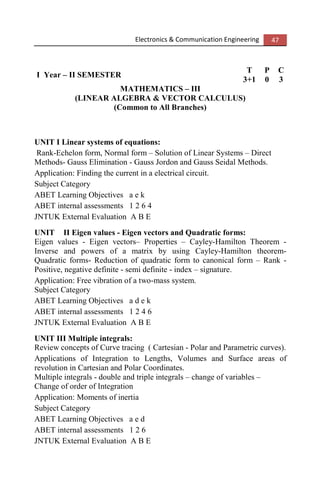
(LINEAR ALGEBRA & VECTOR CALCULUS)
(Common to All Branches)
UNIT I Linear systems of equations:
Rank-Echelon form, Normal form – Solution of Linear Systems – Direct
Methods- Gauss Elimination - Gauss Jordon and Gauss Seidal Methods.
Application: Finding the current in a electrical circuit.
Subject Category
ABET Learning Objectives a e k
ABET internal assessments 1 2 6 4
JNTUK External Evaluation A B E
UNIT II Eigen values - Eigen vectors and Quadratic forms:
Eigen values - Eigen vectors– Properties – Cayley-Hamilton Theorem -
Inverse and powers of a matrix by using Cayley-Hamilton theorem-
Quadratic forms- Reduction of quadratic form to canonical form – Rank -
Positive, negative definite - semi definite - index – signature.
Application: Free vibration of a two-mass system.
Subject Category
ABET Learning Objectives a d e k
ABET internal assessments 1 2 4 6
JNTUK External Evaluation A B E
UNIT III Multiple integrals:
Review concepts of Curve tracing ( Cartesian - Polar and Parametric curves).
Applications of Integration to Lengths, Volumes and Surface areas of
revolution in Cartesian and Polar Coordinates.
Multiple integrals - double and triple integrals – change of variables –
Change of order of Integration
Application: Moments of inertia
Subject Category
ABET Learning Objectives a e d
ABET internal assessments 1 2 6
JNTUK External Evaluation A B E
Electronics & Communication Engineering 48
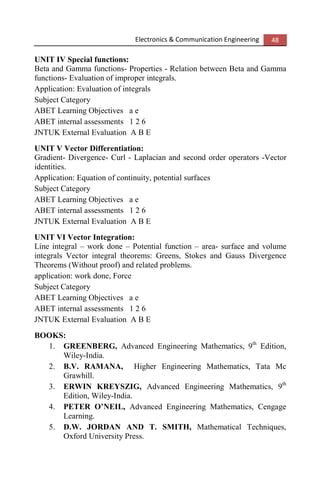
UNIT IV Special functions:
Beta and Gamma functions- Properties - Relation between Beta and Gamma
functions- Evaluation of improper integrals.
Application: Evaluation of integrals
Subject Category
ABET Learning Objectives a e
ABET internal assessments 1 2 6
JNTUK External Evaluation A B E
UNIT V Vector Differentiation:
Gradient- Divergence- Curl - Laplacian and second order operators -Vector
identities.
Application: Equation of continuity, potential surfaces
Subject Category
ABET Learning Objectives a e
ABET internal assessments 1 2 6
JNTUK External Evaluation A B E
UNIT VI Vector Integration:
Line integral – work done – Potential function – area- surface and volume
integrals Vector integral theorems: Greens, Stokes and Gauss Divergence
Theorems (Without proof) and related problems.
application: work done, Force
Subject Category
ABET Learning Objectives a e
ABET internal assessments 1 2 6
JNTUK External Evaluation A B E
BOOKS:
1. GREENBERG, Advanced Engineering Mathematics, 9th
Edition,
Wiley-India.
2. B.V. RAMANA, Higher Engineering Mathematics, Tata Mc
Grawhill.
3. ERWIN KREYSZIG, Advanced Engineering Mathematics, 9th
Edition, Wiley-India.
4. PETER O’NEIL, Advanced Engineering Mathematics, Cengage
Learning.
5. D.W. JORDAN AND T. SMITH, Mathematical Techniques,
Oxford University Press.
Electronics & Communication Engineering 49
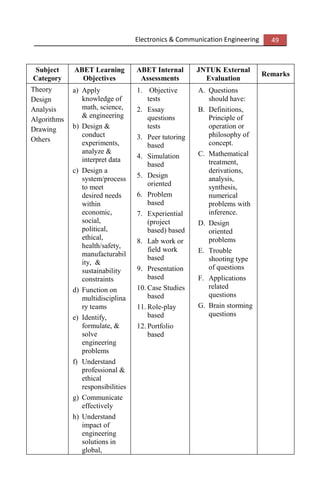
Subject
Category
ABET Learning
Objectives
ABET Internal
Assessments
JNTUK External
Evaluation
Remarks
Theory
Design
Analysis
Algorithms
Drawing
Others
a) Apply
knowledge of
math, science,
& engineering
b) Design &
conduct
experiments,
analyze &
interpret data
c) Design a
system/process
to meet
desired needs
within
economic,
social,
political,
ethical,
health/safety,
manufacturabil
ity, &
sustainability
constraints
d) Function on
multidisciplina
ry teams
e) Identify,
formulate, &
solve
engineering
problems
f) Understand
professional &
ethical
responsibilities
g) Communicate
effectively
h) Understand
impact of
engineering
solutions in
global,
1. Objective
tests
2. Essay
questions
tests
3. Peer tutoring
based
4. Simulation
based
5. Design
oriented
6. Problem
based
7. Experiential
(project
based) based
8. Lab work or
field work
based
9. Presentation
based
10. Case Studies
based
11. Role-play
based
12. Portfolio
based
A. Questions
should have:
B. Definitions,
Principle of
operation or
philosophy of
concept.
C. Mathematical
treatment,
derivations,
analysis,
synthesis,
numerical
problems with
inference.
D. Design
oriented
problems
E. Trouble
shooting type
of questions
F. Applications
related
questions
G. Brain storming
questions
Electronics & Communication Engineering 50
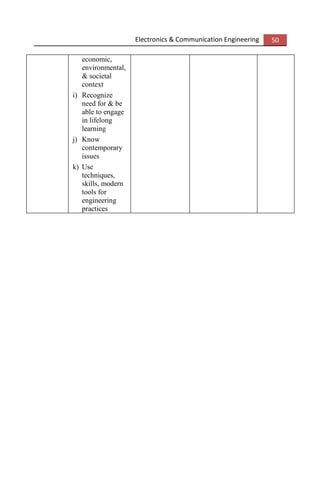
economic,
environmental,
& societal
context
i) Recognize
need for & be
able to engage
in lifelong
learning
j) Know
contemporary
issues
k) Use
techniques,
skills, modern
tools for
engineering
practices
Electronics & Communication Engineering 51
I Year – II SEMESTER
T P C
3+1 0 3
ENGINEERING CHEMISTRY
UNIT-I: WATER TECHNOLOGY
Hard Water – Estimation of hardness by EDTA method – Potable water-
Sterilization and Disinfection – Boiler feed water – Boiler troubles – Priming
and foaming , scale formation, corrosion, caustic embrittlement, turbine
deposits – Softening of water – Lime soda, Zeolite processes – Reverse
osmosis – Electro Dialysis, Ion exchange process.
Objectives : For prospective engineers knowledge about water used in
industries (boilers etc.) and for drinking purposes is useful; hence chemistry
of hard water, boiler troubles and modern methods of softening hard water is
introduced.
UNIT-II : ELECTROCHEMISTRY
Concept of Ionic conductance – Ionic Mobilities – Applications of
Kohlrausch law – Conductometric titrations – Galvanic cells – Electrode
potentials – Nernst equation – Electrochemical series – Potentiometric
titrations – Concentration cells – Ion selective electrode –Glass electrodes –
Fluoride electrode; Batteries and Fuel cells.
Objectives : Knowledge of galvanic cells, electrode potentials, concentration
cells is necessary for engineers to understand corrosion problem and its
control ; also this knowledge helps in understanding modern bio-sensors, fuel
cells and improve them.
UNIT-III : CORROSION
Causes and effects of corrosion – theories of corrosion (dry, chemical and
electrochemical corrosion) – Factors affecting corrosion – Corrosion control
methods – Cathodic protection –Sacrificial Anodic, Impressed current
methods – Surface coatings – Methods of application on metals (Hot dipping,
Galvanizing, tinning, Cladding, Electroplating, Electroless plating) – Organic
surface coatings – Paints – Their constituents and their functions.
Objectives : the problems associated with corrosion are well known and the
engineers must be aware of these problems and also how to counter them
UNIT-IV : HIGH POLYMERS
Types of Polymerization – Stereo regular Polymers – Physical and
Mechanical properties of polymers – Plastics – Thermoplastics and thermo
setting plastics – Compounding and Fabrication of plastics – Preparation and
Electronics & Communication Engineering 52
properties of Polyethylene, PVC and Bakelite – Elastomers – Rubber and
Vulcanization – Synthetic rubbers – Styrene butadiene rubber – Thiokol –
applications.
Objectives : Plastics are materials used very widely as engineering materials.
An understanding of properties particularly physical and mechanical
properties of polymers / plastics / elastomers helps in selecting suitable
materials for different purposes.
UNIT-V : FUELS
Coal – Proximate and ultimate analysis – Numerical problems based on
analysis – Calorific vaule – HCV and LCV – Problems based on calorific
values; petroleum – Refining – Cracking – Petrol – Diesel knocking; Gaseous
fuels – Natural gas – LPG, CNG – Combustion – Problems on air
requirements.
Objectives : A board understanding of the more important fuels employed on
a large scale is necessary for all engineer to understand energy – related
problems and solve them.
UNIT-VI : CHEMISTRY OF ADVANCED MATERIALS
Nanometerials (Preparation of carbon nanotubes and fullerenes – Properties
of nanomaterials – Engineering applications) – Liquid crystals (Types –
Application in LCD and Engineering Applications) – Fiber reinforced
plastics – Biodegradable polymers – Conducting polymers – Solar cells
(Solar heaters – Photo voltaic cells – Solar reflectors – Green house concepts
– Green chemistry (Methods for green synthesis and Applications) – Cement
– Hardening and setting – Deterioration of cement concrete.
Objectives : With the knowledge available now, future engineers should
know at least some of the advanced materials that are becoming available.
Hence some of them are introduced here.
TEXT BOOKSS
1. Jain and Jain (Latest Edition), Engineering Chemistry, Dhanpat Rai
Publishing company Ltd.
2. N.Y.S.Murthy, V.Anuradha, KRamaRao “A Text Book of Engineering
Chemistry”, Maruthi Publications.
3. C.Parameswara Murthy, C.V.Agarwal, Adhra Naidu (2006) Text Book
of Engineering Chemistry, B.S. Publications.
4. B.Sivasankar (2010), Engineering Chemistry, Mc Graw-Hill companies.
5. Ch.Venkata Ramana Reddy and Ramadevi (2013), Engineering
Chemistry, Cengage Learning.
Electronics & Communication Engineering 53
REFERENCES
1. S.S. Dara (2013) Text Book of Engineering Chemistry, S.Chand
Technical Series.
2. K.Sesha Maheswaramma and Mridula Chugh (2013), Engineering
Chemistry, Pearson Publications.
3. R.Gopalan, D.Venkatappayya, Sulochana Nagarajan (2011), Text Book
of Engineering Chemistry, Vikas Publications.
4. B.Viswanathan and M.Aulice Scibioh (2009), Fuel Cells, Principals and
applications, University Press.
Electronics & Communication Engineering 54
I Year – II SEMESTER
T P C
3+1 0 3
ENGINEERING MECHANICS
Objectives: The students completing this course are expected to understand
the concepts of forces and its resolution in different planes ,resultant of force
system, Forces acting on a body, their free body diagrams using graphical
methods. They are required to understand the concepts of centre of gravity
and moments of inertia and their application, Analysis of frames and trusses,
different types of motion, friction and application of work - energy method.
UNIT – I
Objectives: The students are to be exposed to the concepts of force and
friction , direction and its application.
Introduction to Engg. Mechanics – Basic Concepts.
Systems of Forces : Coplanar Concurrent Forces – Components in Space –
Resultant – Moment of Force and its Application – Couples and Resultant of
Force Systems. Introduction, limiting friction and impending motion,
coulomb’s laws of dry friction , coefficient of friction, cone of friction.
UNIT II
Objectives: The students are to be exposed to application of free body
diagrams. Solution to problems using graphical methods and law of
triangle of forces.
Equilibrium of Systems of Forces : Free Body Diagrams, Equations of
Equilibrium of Coplanar Systems, Spatial Systems for concurrent forces.
Lamis Theorm, Graphical method for the equilibrium of coplanar forces,
Converse of the law of Triangle of forces, converse of the law of polygon of
forces condition of equilibrium.
UNIT – III
Objectives : The students are to be exposed to concepts of centre of gravity.
Centroid : Centroids of simple figures (from basic principles ) – Centroids of
Composite Figures.
Centre of Gravity : Centre of gravity of simple body (from basis principles),
centre of gravity of composite bodies, pappus theorem.
UNIT IV
Objective: The students are to be exposed to concepts of moment of
inertia and polar moment of inertia including transfer methods and their
applications.
Area moments of Inertia : Definition – Polar Moment of Inertia, Transfer
Theorem, Moments of Inertia of Composite Figures, Products of Inertia,
Transfer Formula for Product of Inertia. Mass Moment of Inertia : Moment
Electronics & Communication Engineering 55
of Inertia of Masses, Transfer Formula for Mass Moments of Inertia, mass
moment of inertia of composite bodies.
UNIT – V
Objectives : The students are to be exposed to motion in straight line and
in curvilinear paths, its velocity and acceleration computation and
methods of representing plane motion.
Kinematics : Rectilinear and Curvelinear motions – Velocity and
Acceleration – Motion of Rigid Body – Types and their Analysis in Planar
Motion. Kinetics : Analysis as a Particle and Analysis as a Rigid Body in
Translation – Central Force Motion – Equations of Plane Motion – Fixed
Axis Rotation – Rolling Bodies.
UNIT – VI
Objectives: The students are to be exposed to concepts of work, energy
and particle motion
Work – Energy Method : Equations for Translation, Work-Energy
Applications to Particle Motion, Connected System-Fixed Axis Rotation and
Plane Motion. Impulse momentum method.
TEXT BOOKS:
1. Engg. Mechanics - S.Timoshenko & D.H.Young., 4th
Edn - , Mc Graw
Hill publications.
2. Engineering Mechanics: Statics and Dynamics 3rd
edition, Andrew Pytel
and Jaan Kiusalaas; Cengage Learning publishers.
REFERENCES:
1. Engineering Mechanics statics and dynamics – R.C.Hibbeler, 11th
Edn –
Pearson Publ.
2. Engineering Mechanics, statics–J.L.Meriam, 6th
Edn–Wiley India Pvt Ltd.
3. Engineering Mechanics , dynamics – J.L.Meriam, 6th
Edn – Wiley India
Pvt. Ltd.
4. Engineering Mechanics , statics and dynamics – I.H.Shames, – Pearson
Publ.
5. Mechanics For Engineers , statics - F.P.Beer & E.R.Johnston – 5th
Edn
Mc Graw Hill Publ.
6. Mechanics For Engineers, dynamics - F.P. Beer & E.R. Johnston – 5th
Edn Mc Graw Hill Publ.
7. Theory & Problems of engineering mechanics, statics & dynamics –
E.W.Nelson, C.L.Best & W.G. McLean, 5th
Edn – Schaum’s outline
series - Mc Graw Hill Publ.
8. Engineering Mechanics , Fedinand . L. Singer , Harper – Collins.
9. Engineering Mechanics statics and dynamics , A Nelson, Mc Graw Hill
publications.
10. Engineering Mechanics, Tayal. Umesh Publ.
Electronics & Communication Engineering 56
I Year – II SEMESTER
T P C
3+1 0 3
COMPUTER PROGRAMMING
Objectives: Formulating algorithmic solutions to problems and
implementing algorithms in C.
UNIT I:
Unit objective: Notion of Operation of a CPU, Notion of an algorithm
and computational procedure, editing and executing programs in Linux
Introduction: Computer systems, Hardware and Software Concepts.
Problem Solving: Algorithm / Pseudo code, flowchart, program
development steps, computer languages: machine, symbolic and highlevel
languages, Creating and Running Programs: Writing, Editing (vi/emacs
editor), Compiling (gcc), Linking and Executing in under Linux.
BASICS OF C: Structure of a C program, identifiers, basic data types and
sizes. Constants, Variables, Arthmetic , relational and logical operators,
increment and decrement operators, conditional operator, assignment
operator, expressions, type conversions, Conditional Expressions, precedence
and order of evaluation, Sample Programs.
UNIT II:
Unit objective: understanding branching, iteration and data
representation using arrays
SELECTION – MAKING DECISION: TWO WAY SELECTION: if-else, null
else, nested if, examples, Multi-way selection: switch, else-if, examples.
ITERATIVE: loops- while, do-while and for statements , break, continue,
initialization and updating, event and counter controlled loops, Looping
applications: Summation, powers, smallest and largest.
ARRAYS: Arrays- concepts, declaration, definition, accessing elements,
storing elements, Strings and String Manipulations, 1-D arrays, 2-D arrays
and character arrays, string manipulations, Multidimensional arrays, array
applications: Matrix operations, checking the symmetricity of a Matrix.
STRINGS: concepts, c strings.
UNIT III:
Objective: Modular programming and recursive solution formulation
FUNCTIONS- MODULAR PROGRAMMING: functions, basics,
parameter passing, storage classes extern, auto, register, static, scope rules,
block structure, user defined functions, standard library functions, recursive
functions, Recursive solutions for fibonacci series, towers of Hanoi, header
Electronics & Communication Engineering 57
files, C Preprocessor, example c programs, Passing 1-D arrays, 2-D arrays to
functions.
UNIT IV:
Objective: Understanding pointers and dynamic memory allocation
POINTERS: pointers- concepts, initialization of pointer variables, pointers
and function arguments, passing by address- dangling memory, address
arithmetic, character pointers and functions, pointers to pointers, pointers and
multi-dimensional arrays, dynamic memory management functions,
command line arguments.
UNIT V:
Objective: Understanding miscellaneous aspects of C
ENUMERATED, STRUCTURE AND UNION TYPES: Derived types-
structures- declaration, definition and initialization of structures, accessing
structures, nested structures, arrays of structures, structures and functions,
pointers to structures, self referential structures, unions, typedef, bit-fields,
program applications
BIT-WISE OPERATORS: logical, shift, rotation, masks.
UNIT VI:
Objective: Comprehension of file operations
FILE HANDLING: Input and output- concept of a file, text files and binary
files, Formatted I/O, File I/O operations, example programs
Text Books:
1. Problem Solving and Program Design in C, Hanly, Koffman, 7th
ed,
PERSON
2. Programming in C, Second Edition Pradip Dey and Manas Ghosh,
OXFORD Higher Education .
3. Programming in C, A practical approach Ajay Mittal PEARSON
4. The C programming Language by Dennis Richie and Brian Kernighan
5. Programming in C, B. L. Juneja, Anith Seth, Cengage Learning.
Reference Books and web links:
1. C Programming, A Problem Solving Approach, Forouzan, Gilberg,
Prasad, CENGAGE.
2. Programming with C, Bichkar, Universities Press
3. Programming in C, Reema Thareja, OXFORD
4. C by Example, Noel Kalicharan, Cambridge
Electronics & Communication Engineering 58
I Year – II SEMESTER
T P C
3+1 0 3
NETWORK ANALYSIS
UNIT – I
Introduction to Electrical Circuits : Network elements classification,
Electric charge and current, Electric energy and potential, Resistance
parameter – series and parallel combination, Inductance parameter – series
and parallel combination, Capacitance parameter – series and parallel
combination. Energy sources: Ideal, Non-ideal, Independent and dependent
sources, Source transformation, Kirchoff’s laws, Mesh analysis and Nodal
analysis problem solving with resistances only including dependent sources
also. (Text Books: 1,2,3, Reference Books: 3)
A.C Fundamentals and Network Topology: Definitions of terms associated
with periodic functions: Time period, Angular velocity and frequency, RMS
value, Average value, Form factor and peak factor- problem solving, Phase
angle, Phasor representation, Addition and subtraction of phasors,
mathematical representation of sinusoidal quantities, explanation with
relevant theory, problem solving. Principal of Duality with examples.
Network Topology: Definitions of branch, node, tree, planar, non-planar
graph, incidence matrix, basic tie set schedule, basic cut set schedule. (Text
Books: 2,3, Reference Books: 3)
UNIT – II
Steady State Analysis of A.C Circuits : Response to sinusoidal excitation -
pure resistance, pure inductance, pure capacitance, impedance concept, phase
angle, series R-L, R-C, R-L-C circuits problem solving. Complex impedance
and phasor notation for R-L, R-C, R-L-C problem solving using mesh and
nodal analysis, Star-Delta conversion, problem solving. (Text Books: 1,2,
Reference Books: 3)
UNIT – III
Coupled Circuits : Coupled Circuits: Self inductance, Mutual inductance,
Coefficient of coupling, analysis of coupled circuits, Natural current, Dot rule
of coupled circuits, Conductively coupled equivalent circuits- problem
solving.
Resonance: Introduction, Definition of Q, Series resonance, Bandwidth of
series resonance, Parallel resonance, Condition for maximum impedance,
current in anti resonance, Bandwidth of parallel resonance, general case-
resistance present in both branches, anti resonance at all frequencies. (Text
Books:2,3, Reference Books: 3)
Electronics & Communication Engineering 59
UNIT – IV
Network Theorems: Thevinin’s, Norton’s, Milliman’s, Reciprocity,
Compensation, Substitution, Superposition, Max Power Transfer, Tellegens-
problem solving using dependent sources also. (Text Books: 1,2,3, Reference
Books: 2)
UNIT – V
Two-port networks : Relationship of two port networks, Z-parameters, Y-
parameters, Transmission line parameters, h-parameters, Inverse h-
parameters, Inverse Transmission line parameters, Relationship between
parameter sets, Parallel connection of two port networks, Cascading of two
port networks, series connection of two port networks, problem solving
including dependent sources also. (Text Books: 1,2, Reference Books: 1,3)
UNIT – VI
Transients : First order differential equations, Definition of time constants,
R-L circuit, R-C circuit with DC excitation, Evaluating initial conditions
procedure, second order differential equations, homogeneous, non-
homogenous, problem solving using R-L-C elements with DC excitation and
AC excitation, Response as related to s-plane rotation of roots. Solutions
using Laplace transform method. (Text Books: 1,2,3, Reference Books: 1,3)
TEXT BOOKS :
1. Network Analysis – ME Van Valkenburg, Prentice Hall of India, 3rd
Edition, 2000.
2. Network Analysis by K.Satya Prasad and S Sivanagaraju, Cengage
Learning
3. Electric Circuit Analysis by Hayt and Kimmarle, TMH
REFERENCES:
1. Network lines and Fields by John. D. Ryder 2nd
edition, Asia
publishing house.
2. Basic Circuit Analysis by DR Cunninghan, Jaico Publishers.
3. Network Analysis and Filter Design by Chadha, Umesh
Publications.
Electronics & Communication Engineering 60
I Year – II SEMESTER
T P C
0 3 2
ENGINEERING CHEMISTRY LABORATORY
List of Experiments
1. Introduction to chemistry laboratory – Molarity, Normality,
Primary, Secondary standard solutions, Volumetric titrations,
Quantitative analysis, Quantitative analysis etc.,
2. Trial experiment – Estimation of HCI using standard Na2co3
solutions
3. Estimation of KMnO4 using standard Oxalic acid solution.
4. Estimation of Ferric iron using standard K2Cr2O7 solution.
5. Estimation of Copper using standard K2Cr2O7 solution.
6. Estimation of Total Hardness water using standard EDTA solution.
7. Estimation of Copper using standard EDTA solution.
8. Estimation of Copper using Colorimeter
9. Estimation of pH of the given sample solution using pH meter.
10. Conductometric Titrations between strong acid and strong base
11. Conductometric Titrations between strong acid and Weak base
12. Potentiometric Titrations between strong acid and strong base
13. Potentiometric Titrations between strong acid and Weak base
14. Estimatinog of Zinc using standard potassium ferrocyanide solution
15. Estimation of Vitamin – C
TEXT BOOKSS
1. Dr. Jyotsna Cherukuis(2012)Laboratory Manual of Engineering
Chemistry-II, VGS Techno Series
2. Chemistry Practical Manual, Lorven Publications
3. K. Mukkanti (2009) Practical Engineering Chemistry,
B.S.Publication.
Electronics & Communication Engineering 61
I Year – II SEMESTER
T P C
0 3 2
ENGLISH – COMMUNICATION SKILLS LAB – II
Suggested Lab Manuals:
OBJECTIVE: To impart to the learner the skills of grammar as well as
communication through listening, speaking, reading, and writing including
soft, that is life skills.
ADVANCED COMMUNICATION SKILLS
UNIT 6 Body language
UNIT 7 Dialogues
UNIT 8 Interviews and Telephonic Interviews
UNIT 9 Group Discussions
UNIT 10 Presentation Skills
UNIT 11 Debates
Text Book:
‘Strengthen your Communication Skills’ Part-B by Maruthi
Publications
Reference Books:
1. INFOTECH English (Maruthi Publications)
2. Personality Development and Soft Skills (Oxford University
Press, New Delhi).
Electronics & Communication Engineering 62
I Year – II SEMESTER
T P C
0 3 2
COMPUTER PROGRAMMING LAB
Exercise l
a) Write a C Program to calculate the area of triangle using the formula
area = ( s (s-a) (s-b)(s-c))1/2
where s= (a+b+c)/2
b) Write a C program to find the largest of three numbers using ternary
operator.
c) Write a C Program to swap two numbers without using a temporary
variable.
Exercise 2
a) 2’s complement of a number is obtained by scanning it from right to left
and complementing all the bits after the first appearance of a 1. Thus 2’s
complement of 11100 is 00100. Write a C program to find the 2’s
complement of a binary number.
b) Write a C program to find the roots of a quadratic equation.
c) Write a C program, which takes two integer operands and one operator
form the user, performs the operation and then prints the result. (Consider
the operators +,-,*, /, % and use Switch Statement)
Exercise 3
a) Write a C program to find the sum of individual digits of a positive
integer and find the reverse of the given number.
b) A Fibonacci sequence is defined as follows: the first and second terms in
the sequence are 0 and 1. Subsequent terms are found by adding the
preceding two terms in the sequence. Write a C program to generate the
first n terms of the seqence.
c) Write a C program to generate all the prime numbers between 1 and n,
where n is a value supplied by the user.
Exercise 4
a) Write a C Program to print the multiplication table of a given number n
up to a given value, where n is entered by the user.
b) Write a C Program to enter a decimal number, and calculate and display
the binary equivalent of that number.
c) Write a C Program to check whether the given number is Armstrong
number or not.
Electronics & Communication Engineering 63
Exercise 5
a) Write a C program to interchange the largest and smallest numbers in the
array.
b) Write a C program to implement a liner search.
c) Write a C program to implement binary search.
Exercise 6
a) Write a C program to implement sorting of an array of elements .
b) Write a C program to input two m x n matrices, check the compatibility
and perform addition and multiplication of them.
Exercise 7
Write a C program that uses functions to perform the following operations:
i. To insert a sub-string in to given main string from a given position.
ii. To delete n Characters from a given position in a given string.
iii. To replace a character of string either from beginning or ending or at a
specified location.
Exercise 8
Write a C program that uses functions to perform the following operations
using Structure:
i) Reading a complex number ii) Writing a complex number
iii) Addition of two complex numbers iv) Multiplication of two complex
numbers
Exercise 9
Write C Programs for the following string operations without using the built
in functions
- to concatenate two strings
- to append a string to another string
- to compare two strings
Exercise 10
Write C Programs for the following string operations without using the built
in functions
- to find t he length of a string
- to find whether a given string is palindrome or not
Exercise 11
a) Write a C functions to find both the largest and smallest number of an
array of integers.
b) Write C programs illustrating call by value and call by reference cncepts.
Electronics & Communication Engineering 64
Exercise 12
Write C programs that use both recursive and non-recursive functions for the
following
i) To find the factorial of a given integer.
ii) To find the GCD (greatest common divisor) of two given integers.
iii) To find Fibonacci sequence
Exercise 13
a) Write C Program to reverse a string using pointers
b) Write a C Program to compare two arrays using pointers
Exercise 14
a) Write a C program consisting of Pointer based function to exchange
value of two integers using passing by address.
b) Write a C program to swap two numbers using pointers.
Exercise 15
Examples which explores the use of structures, union and other user defined
variables.
Exercise 16
a) Write a C program which copies one file to another.
b) Write a C program to count the number of characters and number of lines
in a file.
c) Write a C Program to merge two files into a third file. The names of the
files must be entered using command line arguments.
Electronics & Communication Engineering 65
II Year – I SEMESTER
T P C
3+1 0 3
MANAGERIAL ECONOMICS AND FINANCIAL ANALYSIS
Unit – I:
(*The Learning objective of this Unit is to understand the concept and
nature of Managerial Economic s and its relationship with other
disciplines, Concept of Demand and Demand forecasting)
Introduction to Managerial Economics and demand Analysis:
Definition of Managerial Economics and Scope-Managerial Economics and
its relation with other subjects-Concepts of Demand-Types-Determents-Law
of Demand its Exception-Elasticity of Demand-Types and Measurement-
Demand forecasting and its Methods.
(**The Learner is equipped with the knowledge of estimating the Demand
for a product and the relationship between Price and Demand).
Unit – II:
(*The Learning objective of this Unit is to understand the concept of
Production function, Input Output relationship, different Cost Concepts
and Concept of Cost-Volume-Profit Analysis)
Production and Cost Analyses:
Production function-Isoquants and Isocosts-Law of Variable proportions-
Cobb-Douglas Production function-Economics of Sale-Cost Concepts-
Opportunity Cost-Fixed vs Variable Costs-Explicit Costs vs Implicit Costs-
Out of Pocket Costs vs Imputed Costs-Cost Volume Profit analysis-
Determination of Break-Even Point (Simple Problem).
(**One should understand the Cost Concepts for decision making and to
estimate the least cost combination of inputs).
Unit – III:
(*The Learning Objective of this Unit is t understand the Nature of
Competition, Characteristics of Pricing in the different market structure
and significance of various pricing methods).
Introduction to Markets, Theories of the Firm & Pricing Policies:
Market Structures: Perfect Competition, Monopoly and Monopolistic and
Oligopoly – Features – Price, Output Determination – Managerial Theories
of firm: Maris and Williamson’s models – Methods of Pricing: Limit Pricing,
Electronics & Communication Engineering 66
Market Skimming Pricing, Internet Pricing: Flat Rate Pricing, Usage
sensitive, Transaction based pricing, Priority Pricing.
(** One has to understand the nature of different markets and Price Output
determination under various market conditions).
Unit – IV:
(*The Learning objective of this Unit is to know the different forms of
Business organization and their Merits and Demerits both public &
private Enterprises and the concepts of Business Cycles)
Types of Business Organization and Business Cycles:
Features and Evaluation of Sole Trader – Partnership – Joint Stock Company
– State/Public Enterprises and their forms – Business Cycles – Meaning and
Features – Phases of Business Cycle.
(**One should equipped with the knowledge of different Business Units)
Unit – V:
(*The Learning objective of this Unit is to understand the different
Accounting Systems preparation of Financial Statements and uses of
different tools for performance evaluation)
Introduction to Accounting & Financing Analysis:
Introduction to Double Entry Systems – Preparation of Financial Statements-
Analysis and Interpretation of Financial Statements-Ratio Analysis –
Preparation of Funds flow cash flow statements (Simple Problems).
(**The Learner is able to prepare Financial Statements and the usage of
various Accounting tools for Analysis).
Unit – VI:
(*The Learning objective of this Unit is to understand the concept of Capital,
Capitalization, Capital Budgeting and to know the techniques used to
evaluate Capital Budgeting proposals by using different methods).
Capital and Capital Budgeting: Capital Budgeting: Meaning of Capital-
Capitalization-Meaning of Capital Budgeting-Need for Capital Budgeting-
Techniques of Capital Budgeting-Traditional and Modern Methods.
(**The Learner is able to evaluate various investment project proposals with
the help of capital budgeting techniques for decision making).
Note : *Learning Objective
** Learning Assessment
TEXT BOOKS :
1. Dr. N. Appa Rao, Dr. P. Vijay Kumar: ‘Managerial Economics and
Financial Analysis’, Cengage Publications, New Delhi – 2011.
Electronics & Communication Engineering 67
2. Dr. A. R. Aryasri – Managerial Economics and Financial Analysis,
TMH 2011.
3. Prof. J.V.Prabhakara rao, Prof. P. Venkatarao. ‘Managerial Economics
and Financial Analysis’, Ravindra Publication.
REFERENCES :
1. V. Maheswari : Managerial Economics, Sultan Chand.
2. Suma Damodaran : Managerial Economics, Oxford 2011.
3. Dr. B. Kuberudu and Dr. T. V. Ramana : Managerial Economics &
Financial Analysis, Himalaya Publishing House 2011.
4. Vanitha Agarwal : Managerial Economics, Pearson Publications 2011.
5. Sanjay Dhameja : Financial Accounting for Managers, Pearson.
6. Maheswari : Financial Accounting, Vikas Publications.
7. S. A. Siddiqui & A. S. Siddiqui : Managerial Economics and Financial
Analysis, New Age International Publishers, 2012.
Electronics & Communication Engineering 68
II Year – I SEMESTER
T P C
3+1 0 3
ELECTRONIC DEVICES AND CIRCUITS
UNIT-I
Semi Conductor Physics : Insulators, Semi conductors and Metals
classification using energy band diagrams, mobility and conductivity,
electrons and holes in intrinsic semi conductors, extrinsic semi conductors,
drift and diffusion, charge densities in semiconductors, Hall effect, continuity
equation, law of junction, Fermi Dirac function, Fermi level in intrinsic and
extrinsic Semiconductors.
UNIT- II
Junction Diode Characteristics : Open circuited p-n junction, Biased p-n
junction, p-n junction diode, current components in PN junction Diode, diode
equation, V-I Characteristics, temperature dependence on V-I characteristics,
Diode resistance, Diode capacitance, energy band diagram of PN junction
Diode.
Special Semiconductor Devices: Zener Diode, Breakdown mechanisms,
Zener diode applications, LED, LCD, Photo diode, Varactor diode, Tunnel
Diode, DIAC, TRIAC, SCR, UJT. Construction, operation and characteristics
of all the diodes is required to be considered.
UNIT- III
Rectifiers and Filters: Basic Rectifier setup, half wave rectifier, full wave
rectifier, bridge rectifier, derivations of characteristics of rectifiers, rectifier
circuits-operation, input and output waveforms; Filters; Inductor filter,
Capacitor filter, L- section filter, Π- section filter, Multiple L- section and
Multiple Π section filter ,comparison of various filter circuits in terms of
ripple factors.
UNIT- IV
Transistor Characteristics:
BJT: Junction transistor, transistor current components, transistor equation,
transistor configurations, transistor as an amplifier, characteristics of
transistor in Common Base, Common Emitter and Common Collector
configurations, Ebers-Moll model of a transistor, punch through/ reach
through, Photo transistor, typical transistor junction voltage values.
Electronics & Communication Engineering 69
FET: FET types, construction, operation, characteristics, parameters,
MOSFET-types, construction, operation, characteristics, comparison between
JFET and MOSFET.
UNIT- V
Transistor Biasing and Thermal Stabilization : Need for biasing, operating
point, load line analysis, BJT biasing- methods, basic stability, fixed bias,
collector to base bias, self bias, Stabilization against variations in VBE, Ic, and
β, Stability factors, (S, S'
, S'’
), Bias compensation, Thermal runaway,
Thermal stability. FET Biasing- methods and stabilization.
UNIT- VI
Small Signal Low Frequency Transistor Amplifier Models:
BJT: Two port network, Transistor hybrid model, determination of h-
parameters, conversion of h-parameters, generalized analysis of transistor
amplifier model using h-parameters, Analysis of CB, CE and CC amplifiers
using exact and approximate analysis, Comparison of transistor amplifiers.
FET: Generalized analysis of small signal model, Analysis of CG, CS and
CD amplifiers, comparison of FET amplifiers.
TEXT BOOKS:
1. Electronic Devices and Circuits- J. Millman, C. Halkias, Tata Mc-
Graw Hill, Second Edition.
2. Electronic Devices and Circuits-B.P.Singh, Rekha Singh,Pearson
Publications,Second Edition.
3. Electronic Devices and Circuits-David A.Bell, Oxford University
Press, Fifth Edition.
REFERENCES:
1. Electronic Devices and Circuits- K. Satya Prasad.
2. Electronic Devices and Circuits-Salivahanan, Kumar, Vallavaraj, Tata
Mc-Graw Hill, Second Edition .
3. Electronic Devices and Circuit Theory-R.L. Boylestad and Louis
Nashelsky, Pearson Publications,Tenth Edition.
4. Electronic Devices and Circuits -BV Rao, KBR Murty, K Raja
Rajeswari, PCR Pantulu, Pearson, 2nd
edition.
5. Integrated Electronics- Jacob Millman, C. Halkies, C.D. Parikh, Tata
Mc-Graw Hill, 2009.
Electronics & Communication Engineering 70
II Year – I SEMESTER
T P C
3+1 0 3
DATA STRUCTURES
Objectives: Comprehensive knowledge of data structures and ability to
implement the same in software applications.
UNIT I:
Objective: exposure to algorithmic complexities, recursive algorithms,
searching and sorting techniques
Preliminaries of algorithm, Algorithm analysis and complexity
Data structure- Definition, types of data structures
Recursion: Definition, Design Methodology and Implementation of recursive
algorithms, Linear and binary recursion, recursive algorithms for factorial
function, GCD computation, Fibonacci sequence, Towers of Hanoi, Tail
recursion.
List Searches using Linear Search, Binary Search, Fibonacci Search
Sorting Techniques: Basic concepts, Sorting by : insertion (Insertion sort),
selection (heap sort), exchange (bubble sort, quick sort), distribution (radix
sort ) and merging (merge sort ) Algorithms.
UNIT II:
Objectives: Applying stack and queue techniques for logical operations
Stacks and Queues: Basic Stack Operations, Representation of a Stack using
Arrays, Stack Applications: Reversing list, Factorial Calculation, Infix to
postfix Transformation, Evaluating Arithmetic Expressions.
Queues: Basic Queues Operations, Representation of a Queue using array,
Implementation of Queue Operations using Stack, Applications of Queues-
Round robin Algorithm, Circular Queues, Priority Queues.
UNIT III:
Objectives: Exposure to list representation models in various types of
applications
Linked Lists: Introduction, single linked list, representation of a linked list
in memory, Operations on a single linked list, Reversing a single linked list,
applications of single linked list to represent polynomial expressions and
sparse matrix manipulation, Advantages and disadvantages of single linked
list, Circular linked list, Double linked list
Electronics & Communication Engineering 71
UNIT IV:
Objectives: Implementation of tree implementation in various forms
Trees: Basic tree concepts, Binary Trees: Properties, Representation of
Binary Trees using arrays and linked lists, operations on a Binary tree ,
Binary Tree Traversals (recursive), Creation of binary tree from in, pre and
post order traversals
UNIT-V:
Objectives: Advanced understanding of other variants of trees and their
operations.
Advanced concepts of Trees: Tree Travels using stack (non recursive),
Threaded Binary Trees. Binary search tree, Basic concepts, BST operations:
insertion, deletion, Balanced binary trees – need, basics and applications in
computer science (No operations).
UNIT VI:
Objectives: orientation on graphs, representation of graphs, graph
traversals, spanning trees.
Graphs: Basic concepts, Representations of Graphs: using Linked list and
adjacency matrix, Graph algorithms.
Graph Traversals (BFS & DFS), applications: Dijkstra’s shortest path,
Transitive closure, Minimum Spanning Tree using Prim’s Algorithm,
warshall’s Algorithm (Algorithemic Concepts Only, No Programs
required).
TEXT BOOKS:
1. Data Structure with C, Seymour Lipschutz, TMH
2. Data Structures using C,Reema Thareja, Oxford
3. Data Structures, 2/e, Richard F, Gilberg , Forouzan, Cengage
4. Data structures and algorithm analysis in C, 2nd
ed, mark allen weiss
REFERENCE BOOKS:
1. Data Structures and Algorithms, 2008,G.A.V.Pai, TMH
2. Classic Data Structures, 2/e, Debasis ,Samanta,PHI,2009
3. Fundamentals of Data Structure in C, 2/e, Horowitz,Sahni,
Anderson Freed,University Prees.
Electronics & Communication Engineering 72
II Year – I SEMESTER
T P C
3 0 3
ENVIRONMENTAL STUDIES
Course Learning Objectives:
The objectives of the course is to impart
1. Overall understanding of the natural resources
2. Basic understanding of the ecosystem and its diversity
3. Acquaintance on various environmental challenges induced due to
unplanned anthropogenic activities
4. An understanding of the environmental impact of developmental activities
5. Awareness on the social issues, environmental legislation and global
treaties
Course Outcomes:
The student should have knowledge on
1. The natural resources and their importance for the sustenance of the life
and recognise the need to conserve the natural resources
2. The concepts of the ecosystem and its function in the environment. The
need for protecting the producers and consumers in various ecosystems
and their role in the food web
3. The biodiversity of India and the threats to biodiversity, and conservation
practices to protect the biodiversity
4. Various attributes of the pollution and their impacts and measures to
reduce or control the pollution along with waste management practices
5. Social issues both rural and urban environment and the possible means to
combat the challenges
6. The environmental legislations of India and the first global initiatives
towards sustainable development.
7. About environmental assessment and the stages involved in EIA and the
environmental audit
Syllabus:
UNIT - I
Multidisciplinary nature of Environmental Studies: Definition, Scope and
Importance –Sustainability: Stockholm and Rio Summit–Global
Environmental Challenges: Global warming and climate change, acid rains,
Electronics & Communication Engineering 73
ozone layer depletion, population growth and explosion, effects. Role of
information Technology in Environment and human health.
Ecosystems: Concept of an ecosystem. - Structure and function of an
ecosystem. - Producers, consumers and decomposers. - Energy flow in the
ecosystem - Ecological succession. - Food chains, food webs and ecological
pyramids. - Introduction, types, characteristic features, structure and function
of Forest ecosystem, Grassland ecosystem, Desert ecosystem, Aquatic
ecosystems.
UNIT - II
Natural Resources: Natural resources and associated problems
Forest resources – Use and over – exploitation, deforestation – Timber
extraction – Mining, dams and other effects on forest and tribal people.
Water resources – Use and over utilization of surface and ground water –
Floods, drought, conflicts over water, dams – benefits and problems.
Mineral resources: Use and exploitation, environmental effects of extracting
and using mineral resources.
Food resources: World food problems, changes caused by non-agriculture
activities-effects of modern agriculture, fertilizer-pesticide problems, water
logging, salinity.
Energy resources: Growing energy needs, renewable and non-renewable
energy sources use of alternate energy sources.
Land resources: Land as a resource, land degradation, Wasteland
reclamation, man induced landslides, soil erosion and desertification. Role of
an individual in conservation of natural resources. Equitable use of resources
for sustainable lifestyles.
UNIT - III
Biodiversity and its conservation: Definition: genetic, species and
ecosystem diversity- classification - Value of biodiversity: consumptive use,
productive use, social-Biodiversity at national and local levels. India as a
mega-diversity nation - Hot-sports of biodiversity - Threats to biodiversity:
habitat loss, man-wildlife conflicts. - Endangered and endemic species of
India – Conservation of biodiversity: conservation of biodiversity.
UNIT - IV
Environmental Pollution: Definition, Cause, effects and control measures
of Air pollution, Water pollution, Soil pollution, Noise pollution, Nuclear
Electronics & Communication Engineering 74
hazards. Role of an individual in prevention of pollution. - Pollution case
studies.
Solid Waste Management: Sources, classification, effects and control
measures of urban and industrial solid wastes. Consumerism and waste
products.
UNIT - V
Social Issues and the Environment: Urban problems related to energy -
Water conservation, rain water harvesting-Resettlement and rehabilitation of
people; its problems and concerns. Environmental ethics: Issues and possible
solutions. Environmental Protection Act -Air (Prevention and Control of
Pollution) Act. –Water (Prevention and control of Pollution) Act -Wildlife
Protection Act -Forest Conservation Act-Issues involved in enforcement of
environmental legislation. -Public awareness.
UNIT - VI
Environmental Management: Impact Assessment and its significance
various stages of EIA, preparation of EMP and EIS, Environmental audit.
Ecotourism.
The student should submit a report individually on any issues related to
Environmental Studies course and make a power point presentation.
Text Books:
1. Environmental Studies by R. Rajagopalan, 2nd
Edition, 2011, Oxford
University Press.
2. A Textbook of Environmental Studies by Shaashi Chawla, TMH, New
Delhi.
3. Environmental Studies by P.N. Palanisamy, P. Manikandan, A. Geetha,
and K. Manjula Rani; Pearson Education, Chennai.
Reference:
1. Text Book of Environmental Studies by Deeshita Dave & P. Udaya
Bhaskar, Cengage Learning.
2. Environmental Studies by K.V.S.G. Murali Krishna, VGS Publishers,
Vijayawada.
3. Environmental Studies by Benny Joseph, Tata McGraw Hill Co, New
Delhi.
4. Environmental Studies by Piyush Malaviya, Pratibha Singh, Anoop
singh: Acme Learning, New Delhi.
***
Electronics & Communication Engineering 75
II Year – I SEMESTER
T P C
3+1 0 3
SIGNALS AND SYSTEMS
UNIT I
SIGNAL ANALYSIS & FOURIER SERIES : Analogy between vectors
and signals, Orthogonal signal space, Signal approximation using orthogonal
functions, Mean square error, Closed or complete set of orthogonal functions,
Orthogonality in complex functions, Exponential and sinusoidal signals,
Concepts of Impulse function, Unit step function, Signum function.
Representation of Fourier series, Continuous time periodic signals, properties
of Fourier series, Dirichlet’s conditions, Trigonometric Fourier series and
Exponential Fourier series, Complex Fourier spectrum.
UNIT II
FOURIER TRANSFORMS & SAMPLING: Deriving Fourier transform
from Fourier series, Fourier transform of arbitrary signal, Fourier transform
of standard signals, Fourier transform of periodic signals, properties of
Fourier transforms, Fourier transforms involving impulse function and
Signum function. Introduction to Hilbert Transform. Sampling theorem –
Graphical and analytical proof for Band Limited Signals, impulse sampling,
Natural and Flat top Sampling, Reconstruction of signal from its samples,
effect of under sampling – Aliasing, Introduction to Band Pass sampling.
UNIT III
SIGNAL TRANSMISSION THROUGH LINEAR SYSTEMS : Linear
system, impulse response, Response of a linear system, Linear time invariant
(LTI) system, Linear time variant (LTV) system, Transfer function of a LTI
system. Filter characteristics of linear systems. Distortion less transmission
through a system, Signal bandwidth, system bandwidth, Ideal LPF, HPF and
BPF characteristics, Causality and Poly-Wiener criterion for physical
realization, relationship between bandwidth and rise time.
UNIT IV
CONVOLUTION AND CORRELATION OF SIGNALS : Concept of
convolution in time domain and frequency domain, Graphical representation
of convolution, Convolution property of Fourier transforms. Cross
Electronics & Communication Engineering 76
correlation and auto correlation of functions, properties of correlation
function, Energy density spectrum, Parseval’s theorem, Power density
spectrum, Relation between auto correlation function and energy/power
spectral density function. Relation between convolution and correlation,
Detection of periodic signals in the presence of noise by correlation,
Extraction of signal from noise by filtering.
UNIT V
LAPLACE TRANSFORMS :Review of Laplace transforms, Partial fraction
expansion, Inverse Laplace transform, Concept of region of convergence
(ROC) for Laplace transforms, constraints on ROC for various classes of
signals, Properties of L.T’s, Relation between L.T’s, and F.T. of a signal.
Laplace transform of certain signals using waveform synthesis.
UNIT VI
Z–TRANSFORMS : Fundamental difference between continuous and
discrete time signals, discrete time signal representation using complex
exponential and sinusoidal components, Periodicity of discrete time using
complex exponential signal, Concept of Z- Transform of a discrete sequence.
Distinction between Laplace, Fourier and Z transforms. Region of
convergence in Z-Transform, constraints on ROC for various classes of
signals, Inverse Z-transform, properties of Z-transforms.
TEXT BOOKS :
1. Signals, Systems & Communications - B.P. Lathi, BS Publications,
2003.
2. Signals and Systems - A.V. Oppenheim, A.S. Willsky and S.H.
Nawab, PHI, 2nd Edn.
3. Signals & Systems- Narayan Iyer and K Satya Prasad , Cenage Pub.
REFERENCES :
1. Signals & Systems - Simon Haykin and Van Veen,Wiley, 2nd
Edition.
2. Signals and Systems – K R Rajeswari
3. Fundamentals of Signals and Systems- Michel J. Robert, MGH
International Edition, 2008.
4. Signals and Systems
Electronics & Communication Engineering 77
II Year – I SEMESTER
T P C
3+1 0 3
ELECTRICAL TECHNOLOGY
This course covers various topics related to principle of operation and
performance of various electrical machines.
Learning objectives:
i. To learn the principle of electromechanical energy conversion of
single excited and multi excited machines.
ii. To understand the principle of operation, constructional details and
operational characteristics of DC generators.
iii. To understand the principle and characteristics of DC motors. To
introduce starting and speed control methods of DC motors.
iv. To learn the principle of operation and constructional details of
transformers. Develop the equivalent circuit and evaluate the
performance of transformers.
v. To learn the principle of operation and constructional details of three
phase induction motor. Study the torque – slip characteristics and
starting methods of induction motor.
vi. To study the principle of operation of single phase induction motor,
shaded pole motor, capacitor motor and AC servo motor.
UNIT I
ELECTROMECHANICAL ENERGY CONVERSION : Introduction to
S.I units – Principles of electromechanical energy conversion – forces and
torque in a magnetic field systems-energy balance – single excited machine –
magnetic forces– co-energy – multi excited magnetic field system.
UNIT II
DC GENERATORS : Principle of operation and construction of DC
generators - EMF equation – types of generators – magnetization and load
characteristics of DC generators.
UNIT III
DC MOTORS : Principle of operation and construction of DC Motors –
types of DC Motors – Characteristics of DC motors – basic starting methods
Electronics & Communication Engineering 78
for DC shunt motor – losses and efficiency – Swinburne’s test – speed
control of DC shunt motor – flux and Armature voltage control methods.
UNIT IV
TRANSFORMERS : Principle of operation of single phase transformer –
types – constructional features – phasor diagram on no-load and load –
equivalent circuit, losses and efficiency of transformer - regulation of
transformer – OC and SC tests – predetermination of efficiency and
regulation.
UNIT V
INDUCTION MACHINE : Principle of operation and construction of three-
phase induction motors –slip ring and squirrel cage motors – slip-torque
characteristics – efficiency calculation – starting methods.
UNIT VI
SPECIAL MACHINES : Principle of operation and construction - single
phase induction motor - shaded pole motors – capacitor motors and AC
servomotor.
Learning outcomes:
1. Able to understand the principles of electro mechanical energy
conversion.
2. Able to explain the operation of DC generator and analyze the
characteristics of DC generator.
3. Able to explain the principle of operation of DC motor and analyze their
characteristics. Acquire the skills to analyze the starting and speed
control methods of DC motors.
4. Capability to develop equivalent circuit and evaluate performance of
transformers.
5. Ability to analyze speed – torque characteristics of induction motor and
understand starting methods of induction motor.
6. Capability to understand the operation of various special machines.
TEXT BOOKS:
1. Principles of Electrical Machines by V.K. Mehta & Rohit Mehta,
S.Chand publications.
2. Theory & performance of Electrical Machines by J.B.Guptha, S.K.Kataria
& Sons.
Electronics & Communication Engineering 79
REFERENCE BOOKS:
1. Basic Electrical Engineering by M.S.Naidu and S.Kamakshiah,TMH
Publications.
2. Fundamentals of Electrical Engineering by Rajendra Prasad, PHI
Publications, 2nd
edition.
3. Basic Electrical Engineering by Nagsarkar, Sukhija, Oxford Publications,
2nd
edition.
Electronics & Communication Engineering 80
II Year – I SEMESTER
T P C
0 3 2
ELECTRONIC DEVICES AND CIRCUITS LAB
PART A: Electronic Workshop Practice
1. Identification, Specifications, Testing of R, L, C Components (Colour
Codes), Potentiometers, Coils, Gang Condensers, Relays, Bread Boards.
2. Identification, Specifications and Testing of active devices, Diodes,
BJTs, JFETs, LEDs, LCDs, SCR, UJT.
3. Soldering Practice- Simple circuits using active and passive components.
4. Study and operation of Ammeters, Voltmeters, Transformers, Analog
and Digital Multimeter, Function Generator, Regulated Power Supply
and CRO.
PART B: List of Experiments
(For Laboratory Examination-Minimum of Ten Experiments)
1. P-N Junction Diode Characteristics
Part A: Germanium Diode (Forward bias& Reverse bias)
Part B: Silicon Diode (Forward Bias only)
2. Zener Diode Characteristics
Part A: V-I Characteristics
Part B: Zener Diode as Voltage Regulator
3. Rectifiers (without and with c-filter)
Part A: Half-wave Rectifier
Part B: Full-wave Rectifier
4. BJT Characteristics(CE Configuration)
Part A: Input Characteristics
Part B: Output Characteristics
5. FET Characteristics(CS Configuration)
Part A: Drain Characteristics
Part B: Transfer Characteristics
Electronics & Communication Engineering 81
6. SCR Characteristics
7. UJT Characteristics
8. Transistor Biasing
9. CRO Operation and its Measurements
10. BJT-CE Amplifier
11. Emitter Follower-CC Amplifier
12. FET-CS Amplifier
PART C: Equipment required for Laboratory
1. Boxes
2. Ammeters (Analog or Digital)
3. Voltmeters (Analog or Digital)
4. Active & Passive Electronic Components
5. Regulated Power supplies
6. Analog/Digital Storage Oscilloscopes
7. Analog/Digital Function Generators
8. Digital Multimeters
9. Decade Résistance Boxes/Rheostats
10. Decade Capacitance
Electronics & Communication Engineering 82
II Year – I SEMESTER
T P C
0 3 2
NETWORKS & ELECTRICAL TECHNOLOGY LAB
PART – A
Any five experiments are to be conducted from each part
1. Series and Parallel Resonance – Timing, Resonant frequency, Bandwidth
and Q-factor determination for RLC network.
2. Time response of first order RC/RL network for periodic non-sinusoidal
inputs – time constant and steady state error determination.
3. Two port network parameters – Z-Y Parameters, chain matrix and
analytical verification.
4. Verification of Superposition and Reciprocity theorems.
5. Verification of maximum power transfer theorem. Verification on DC,
verification on AC with Resistive and Reactive loads.
6. Experimental determination of Thevenin’s and Norton’s equivalent
circuits and verification by direct test.
PART – B
1. Magnetization characteristics of D.C. Shunt generator. Determination of
critical field resistance.
2. Swinburne’s Test on DC shunt machine (Predetermination of efficiency
of a given DC Shunt machine working as motor and generator).
3. Brake test on DC shunt motor. Determination of performance
characteristics.
4. OC & SC tests on Single-phase transformer (Predetermination of
efficiency and regulation at given power factors and determination of
equivalent circuit).
5. Brake test on 3-phase Induction motor (performance characteristics).
6. Regulation of alternator by synchronous impedance method.
Electronics & Communication Engineering 83
II Year – II SEMESTER
T P C
3+1 0 3
ELECTRONIC CIRCUIT ANALYSIS
UNIT-I
Small Signal High Frequency Transistor Amplifier models:
BJT: Transistor at high frequencies, Hybrid- π common emitter transistor
model, Hybrid π conductances, Hybrid π capacitances, validity of hybrid π
model, determination of high-frequency parameters in terms of low-
frequency parameters , CE short circuit current gain, current gain with
resistive load, cut-off frequencies, frequency response and gain bandwidth
product.
FET: Analysis of common Source and common drain Amplifier circuits at
high frequencies.
UNIT-II
Multistage Amplifiers : Classification of amplifiers, methods of coupling,
cascaded transistor amplifier and its analysis, analysis of two stage RC
coupled amplifier, high input resistance transistor amplifier circuits and their
analysis-Darlington pair amplifier, Cascode amplifier, Boot-strap emitter
follower, Analysis of multi stage amplifiers using FET, Differential amplifier
using BJT.
UNIT -III
Feedback Amplifiers : Feedback principle and concept, types of feedback,
classification of amplifiers, feedback topologies, Characteristics of negative
feedback amplifiers, Generalized analysis of feedback amplifiers,
Performance comparison of feedback amplifiers, Method of analysis of
feedback amplifiers.
UNIT-IV
Oscillators: Oscillator principle, condition for oscillations, types of
oscillators, RC-phase shift and Wein bridge oscillators with BJT and FET
and their analysis, Generalized analysis of LC Oscillators, Hartley and
Electronics & Communication Engineering 84
Colpitt’s oscillators with BJT and FET and their analysis, Crystal oscillators,
Frequency and amplitude stability of oscillators.
UNIT-V
Power Amplifiers: Classification of amplifiers, Class A power Amplifiers
and their analysis, Harmonic Distortions, Class B Push-pull amplifiers and
their analysis, Complementary symmetry push pull amplifier, Class AB
power amplifier, Class-C power amplifier, Thermal stability and Heat sinks,
Advanced power amplifiers, Distortion in amplifiers.
UNIT-VI
Tuned Amplifiers : Introduction, Q-Factor, small signal tuned amplifier,
capacitance single tuned amplifier, double tuned amplifiers, effect of
cascading single tuned amplifiers on band width, effect of cascading double
tuned amplifiers on band width, staggered tuned amplifiers, stability of tuned
amplifiers, wideband amplifiers.
TEXT BOOKS:
1. Integrated Electronics- J. Millman and C.C. Halkias, Tata Mc Graw-
Hill, 1972.
2. Electronic Circuit Analysis-B.V.Rao,K.R.Rajeswari,
P.C.R.Pantulu,K.B.R.Murthy, Pearson Publications.
3. Electronic Devices and Circuits- Salivahanan, N.Suressh Kumar,
A. Vallavaraj, TATA McGraw Hill, Second Edition
REFERENCES:
1. Microelectronic Circuits-Sedra A.S. and K.C. Smith, Oxford
University Press, Sixth Edition.
2. Electronic Circuit Analysis and Design – Donald A. Neaman, Mc
Graw Hill.
3. Electronic Circuits-I-Ravish R Singh-Peason Publications.
4. Electronic Devices and Circuits Theory – Robert L. Boylestad and
Louis Nashelsky, Pearson/Prentice Hall, Tenth Edition.
5. Electronic circuits Principles and Application - R.D.S.Samuel,
B.Sujatha, Elesevier Publications.
Electronics & Communication Engineering 85
II Year – II SEMESTER
T P C
3+1 0 3
MANAGEMENT SCIENCE
UNIT – I:
(*The Learning objective of this Unit is to understand the concept and nature
of Management, Evolution of Management theories, Motivation and
leadership Styles).
Introduction to Management: Concept – Nature and Importance of
Management, Functions-Evaluation of Management, Motivation Theories –
Leadership Styles – Decision Making Process-designing Organization
Structure – Principles and types of Organization.
(**The learner is able to understand the concept and functions of
Management, and Theeories of Motivation, Styles of Leardership)
UNIT – II:
(The Learning objective of this Unit is to Equip with the concepts of
Operations, project management and inventory control).
Operations and Project Management: Work-Study-Statistical Quality Control
Through Control Charts-Inventory Control-EOQ & ABC Analysis (Simple
Problems) Project Management-PERT/CPM-Project Crashing (Simple Problem).
(**The learner is able to understand the main idea of Inspection and
scrutinize the different methods of inspection, the concept of Inventory
Management and Control and Inventory Pricing).
UNIT – III:
(* The Objective of this unit is to understand the main functional areas of
organization i.e., Financial Management, Production Management,
Marketing Management, Human Resource Management, and Product Life
Cycles and Channels of Distribution).
Functional Management: Concept and Functions of Finance, HR, Production,
Marketing Management and Services – Job Evolution and Merit Rating – Product
Life Cycles – Channels of Distribution – Types/Methods of Production.
(**At the end of this chapter the learner is able to understand the different
functional areas in an organization and their responsibilities – Product Life
Cycle and Channels of Distribution.).
UNIT – IV:
(*The objective of this unit is to equip with the concept and practical issues
relating to Strategic Management)
Strategic Management: Vision, Mission, Goals, Strategy – Corporate
Planning Process – Environmental Scanning – SWOT analysis – Different
Steps in Strategy Formulation, Implementation and Evaluation.
Electronics & Communication Engineering 86
(**The learner is able to familiar with the meaning of Vision, Mission, Goals
and Strategies of the Organization and to implement successfully).
UNIT – V:
(*The objective of this unit is to understand the need and importance of
Business Ethics and Communication Skills in Contemporary situations).
Business Ethics & Communications: Ethics in Business and Management –
Ethics in HRM, Finance & Marketing Management – Business Ethics & Law
(** The Learner is able to know the practical Issues of Business Ethics in
various functional areas, to improve Report Writing skills and Understand the
Communication Process).
UNIT – VI:
(*The Learning objective of this unit is to equip with the contemporary
management practices, i.e., MIS, MRP, JIT and ERP etc.,)
Contemporary Management Practices: Basic concepts of MIS, MRP, Just-
In-Time (JIT)System, Total Quality Management (TQM), Six Sigma and
Capability Maturity Models (CMM) Levies, Supply Chain Management,
Enterprise Resource Planning (ERP), Performance Management, Business
Process Outsourcing (BPO), Business Process Re-Engineering and Bench
Marking, Balance Score Card.
(**The Learner is able to Understand the various contemporary issues in
Management Practices like TQM and BPO etc.,)
Note: *Learning Objective
** Learning Assessment
TEXT BOOKS
1. Kumar/Rao/Chhalill ‘Introduction to Management Science’
Cengage, Delhi, 2012.
2. Dr. A. R. Aryasri, Management Science’ TMH 2011.
REFERENCES
1. Koontz & Weihrich: ‘Essentials of Management’ TMH 2011
2. Seth & Rastogi: Global Management Systems, Cengage Learning,
Delhi, 2011.
3. Robbins: Organizational Behaviors, Pearson Publications, 2011
4. Kanishka Bedi: Production & Operational Management, Oxford
Publications, 2011.
5. Manjunath: Management Science, Pearson Publications, 2013.
6. Biswajit Patnaik: Human Resource Management, PHI, 2011.
7. Hitt and Vijaya Kumar: Strategic Management, Cengage Learning.
8. Dr. PG. Ramanujam, BVR Naidu, PV Rama Sastry : Management
Science Himalaya Publishing House, 2013.
9. Management Shapers, Universities Press.
Electronics & Communication Engineering 87
II Year – II SEMESTER
T P C
3+1 0 3
RANDOM VARIABLES & STOCHASTIC PROCESSES
UNIT I
THE RANDOM VARIABLE : Introduction, Definition of a Random
Variable, Conditions for a Function to be a Random Variable, Discrete,
Continuous and Mixed Random Variables, Distribution and Density
functions, Properties, Binomial, Poisson, Uniform, Gaussian, Exponential,
Rayleigh, Conditional Distribution, Conditional Density, Properties.
UNIT II
OPERATION ON ONE RANDOM VARIABLE – EXPECTATIONS :
Introduction, Expected Value of a Random Variable, Function of a Random
Variable, Moments about the Origin, Central Moments, Variance and Skew,
Chebychev’s Inequality, Characteristic Function, Moment Generating
Function, Transformations of a Random Variable: Monotonic
Transformations for a Continuous Random Variable, Nonmonotonic
Transformations of Continuous Random Variable.
UNIT III
MULTIPLE RANDOM VARIABLES : Vector Random Variables, Joint
Distribution Function, Properties of Joint Distribution, Marginal Distribution
Functions, Conditional Distribution and Density, Statistical Independence,
Sum of Two Random Variables, Sum of Several Random Variables, Central
Limit Theorem: Unequal Distribution, Equal Distributions.
OPERATIONS ON MULTIPLE RANDOM VARIABLES: Joint Moments
about the Origin, Joint Central Moments, Joint Characteristic Functions,
Jointly Gaussian Random Variables: Two Random Variables case, N
Random Variables case, Properties, Transformations of Multiple Random
Variables, Linear Transformations of Gaussian Random Variables.
UNIT IV
RANDOM PROCESSES – TEMPORAL CHARACTERISTICS: The
Random Process Concept, Classification of Processes, Deterministic and
Nondeterministic Processes, Distribution and Density Functions, Concept of
Stationarity and Statistical Independence. First-Order Stationary Processes,
Second- Order and Wide-Sense Stationarity, Nth
-order and Strict-Sense
Stationarity, Time Averages and Ergodicity, Autocorrelation Function and its
Properties, Cross-Correlation Function and its Properties, Covariance
Functions, Gaussian Random Processes, Poisson Random Process.
Electronics & Communication Engineering 88
UNIT V
RANDOM PROCESSES – SPECTRAL CHARACTERISTICS: The Power
Spectrum: Properties, Relationship between Power Spectrum and Autocorrelation
Function, The Cross-Power Density Spectrum, Properties, Relationship between
Cross-Power Spectrum and Cross-Correlation Function.
UNIT VI
LINEAR SYSTEMS WITH RANDOM INPUTS : Random Signal
Response of Linear Systems: System Response – Convolution, Mean and
Mean-squared Value of System Response, Autocorrelation Function of
Response, Cross-Correlation Functions of Input and Output, Spectral
Characteristics of System Response: Power Density Spectrum of Response,
Cross-Power Density Spectra of Input and Output, Band pass, Band-Limited
and Narrowband Processes, Properties, Modeling of Noise Sources: Resistive
(Thermal) Noise Source, Arbitrary Noise Sources, Effective Noise
Temperature, Average Noise Figure, Average Noise Figure of cascaded
networks.
TEXT BOOKS:
1. Probability, Random Variables & Random Signal Principles, Peyton
Z. Peebles, TMH, 4th
Edition, 2001.
2. Probability, Random Variables and Stochastic Processes, Athanasios
Papoulis and S.Unnikrisha, PHI, 4th
Edition, 2002.
REFERENCES:
1. Probability Theory and Stochastic Processes – B. Prabhakara Rao,
Oxford University Press.
2. Probability and Random Processes with Applications to Signal
Processing, Henry Stark and John W. Woods, Pearson Education, 3rd
Edition.
3. Probabilistic Methods of Signal & System Analysis, George R.
Cooper, Clave D. Mc Gillem, Oxford, 3rd
Edition, 1999.
4. Statistical Theory of Communication, S.P.Eugene Xavier, New Age
Publications, 2003.
5. Signals, Systems & Communications, B.P. Lathi, B.S. Publications,
2003.
6. Probability and Random Processes, An Introduction for Applied
Scientists and Engineers, Davenport W.B, McGraw-Hill, 1970.
7. Introduction to Random Processes with Applications to Signals and
Systems, Gardener W.A, McGraw-Hill, 2nd
Edition.
8. Schaum's Outline of Probability, Random Variables, and Random
Processes.
9. An Introduction to Random Signals and Communication Theory,
B.P. Lathi, International Textbook, 1968.
Electronics & Communication Engineering 89
II Year – II SEMESTER
T P C
3+1 0 3
SWITCHING THEORY AND LOGIC DESIGN
UNIT – I
REVIEW OF NUMBER SYSTEMS & CODES:
i) Representation of numbers of different radix, conversation from one
radix to another radix, r-1’s compliments and r’s compliments of
signed members, problem solving.
ii) 4 bit codes, BCD, Excess-3, 2421, 84-2-1 9’s
compliment code etc.,
iii) Logic operations and error detection & correction codes; Basic logic
operations -NOT, OR, AND, Universal building blocks, EX-OR,
EX-NOR - Gates, Standard SOP and POS, Forms, Gray code, error
detection, error correction codes (parity checking, even parity, odd
parity, Hamming code) NAND-NAND and NOR-NOR realizations.
UNIT – II
MINIMIZATION TECHNIQUES:
Boolean theorems, principle of complementation & duality, De-morgan
theorems, minimization of logic functions using Boolean theorems,
minimization of switching functions using K-Map up to 6 variables,
tabular minimization, problem solving (code-converters using K-Map
etc..).
UNIT – III
COMBINATIONAL LOGIC CIRCUITS DESIGN :
Design of Half adder, full adder, half subtractor, full subtractor,
applications of full adders, 4-bit binary subtractor, adder-subtractor
circuit, BCD adder circuit, Excess 3 adder circuit, look-a-head adder
circuit, Design of decoder, demultiplexer, 7 segment decoder, higher
order demultiplexing, encoder, multiplexer, higher order multiplexing,
realization of Boolean functions using decoders and multiplexers, priority
encoder, 4-bit digital comparator.
Electronics & Communication Engineering 90
UNIT – IV
INTRODUCTION OF PLD’s :
PROM, PAL, PLA-Basics structures, realization of Boolean function
with PLDs, programming tables of PLDs, merits & demerits of PROM,
PAL, PLA comparison, realization of Boolean functions using PROM,
PAL, PLA, programming tables of PROM, PAL, PLA.
UNIT – V
SEQUENTIAL CIRCUITS I:
Classification of sequential circuits (synchronous and asynchronous);
basic flip-flops, truth tables and excitation tables (nand RS latch, nor RS
latch, RS flip-flop, JK flip-flop, T flip-flop, D flip-flop with reset and
clear terminals). Conversion from one flip-flop to flip-flop. Design of
ripple counters, design of synchronous counters, Johnson counter, ring
counter. Design of registers - Buffer register, control buffer register,
shift register, bi-directional shift register, universal shift register.
UNIT – VI
SEQUENTIAL CIRCUITS II :
Finite state machine; Analysis of clocked sequential circuits, state
diagrams, state tables, reduction of state tables and state assignment,
design procedures. Realization of circuits using various flip-flops.
Meelay to Moore conversion and vice-versa.
TEXT BOOKS:
1. Switching Theory and Logic Design by Hill and Peterson Mc-Graw
Hill TMH edition.
2. Switching Theory and Logic Design by A. Anand Kumar
3. Digital Design by Mano PHI.
REFERENCE BOOKS:
1. Modern Digital Electronics by RP Jain, TMH.
2. Fundamentals of Logic Design by Charles H. Roth Jr, Jaico
Publishers.
3. Micro electronics by Milliman MH edition.
Electronics & Communication Engineering 91
II Year – II SEMESTER
T P C
3+1 0 3
EM WAVES AND TRANSMISSION LINES
UNIT I
Electrostatics: Coulomb’s Law, Electric Field Intensity Electric Flux
Density, Gauss Law and Applications, Electric Potential, Maxwell’s Two
Equations for Electrostatic Fields, Energy Density, Illustrative Problems.
Convection and Conduction Currents, Dielectric Constant, Continuity
Equation, Relaxation Time, Poisson’s and Laplace’s Equations; Capacitance
– Parallel Plate, Coaxial, Spherical Capacitors, Illustrative Problems.
Magneto Statics : Biot-Savart Law, Ampere’s Circuital Law and
Applications, Magnetic Flux Density, Maxwell’s Two Equations for
Magnetostatic Fields, Magnetic Scalar and Vector Potentials, Forces due to
Magnetic Fields, Ampere’s Force Law, Inductances and Magnetic Energy.
Illustrative Problems.
UNIT II
Maxwell’s Equations (Time Varying Fields): Faraday’s Law and
Transformer emf, Inconsistency of Ampere’s Law and Displacement Current
Density, Maxwell’s Equations in Different Final Forms and Word
Statements. Conditions at a Boundary Surface : Dielectric-Dielectric and
Dielectric-Conductor Interfaces. Illustrative Problems.
UNIT III
EM Wave Characteristics - I: Wave Equations for Conducting and Perfect
Dielectric Media, Uniform Plane Waves – Definition, All Relations Between
E & H. Sinusoidal Variations. Wave Propagation in Lossless and Conducting
Media. Conductors & Dielectrics – Characterization, Wave Propagation in
Good Conductors and Good Dielectrics. Polarization. Illustrative Problems.
UNIT IV
EM Wave Characteristics – II: Reflection and Refraction of Plane Waves –
Normal and Oblique Incidences, for both Perfect Conductor and Perfect
Dielectrics, Brewster Angle, Critical Angle and Total Internal Reflection,
Electronics & Communication Engineering 92
Surface Impedance. Poynting Vector and Poynting Theorem – Applications,
Power Loss in a Plane Conductor. Illustrative Problems.
UNIT VI
Transmission Lines - I : Types, Parameters, Transmission Line Equations,
Primary & Secondary Constants, Expressions for Characteristic Impedance,
Propagation Constant, Phase and Group Velocities, Infinite Line Concepts,
Losslessness/Low Loss Characterization, Distortion – Condition for
Distortionlessness and Minimum Attenuation, Loading - Types of Loading.
Illustrative Problems.
UNIT VI
Transmission Lines – II : Input Impedance Relations, SC and OC Lines,
Reflection Coefficient, VSWR. UHF Lines as Circuit Elements; λ/4, λ /2, λ/8
Lines – Impedance Transformations. Smith Chart – Configuration and
Applications, Single and Double Stub Matching. Illustrative Problems.
TEXT BOOKS :
1. Elements of Electromagnetic – Matthew N.O. Sadiku, Oxford Univ.
Press, 3rd ed., 2001.
2. Electromagnetic Waves and Radiating Systems – E.C. Jordan and
K.G. Balmain, PHI, 2nd
Edition, 2000.
REFERENCES :
1. Electromagnetic Fields and Wave Theory –GSN Raju, Pearson
Education 2006
2. Engineering Electromagnetics – Nathan Ida, Springer (India) Pvt.
Ltd., New Delhi, 2nd ed., 2005.
3. Engineering Electromagnetics – William H. Hayt Jr. and John A.
Buck, TMH, 7th ed., 2006.
4. Transmission Lines and Networks – Umesh Sinha, Satya Prakashan
(Tech. India Publications), New Delhi, 2001.
Electronics & Communication Engineering 93
II Year – II SEMESTER
T P C
3+1 0 3
ANALOG COMMUNICATIONS
UNIT I
AMPLITUDE MODULATION : Introduction to communication system,
Need for modulation, Frequency Division Multiplexing , Amplitude
Modulation, Definition, Time domain and frequency domain description,
single tone modulation, power relations in AM waves, Generation of AM
waves, square law Modulator, Switching modulator, Detection of AM
Waves; Square law detector, Envelope detector.
UNIT II
DSB & SSB MODULATION : Double side band suppressed carrier
modulators, time domain and frequency domain description, Generation of
DSBSC Waves, Balanced Modulators, Ring Modulator, Coherent detection
of DSB-SC Modulated waves, COSTAS Loop. Frequency domain
description, Frequency discrimination method for generation of AM SSB
Modulated Wave, Time domain description, Phase discrimination method for
generating AM SSB Modulated waves. Demodulation of SSB Waves,
Vestigial side band modulation: Frequency description, Generation of VSB
Modulated wave, Time domain description, Envelope detection of a VSB
Wave pulse Carrier, Comparison of AM Techniques, Applications of
different AM Systems.
UNIT III
ANGLE MODULATION : Basic concepts, Frequency Modulation: Single
tone frequency modulation, Spectrum Analysis of Sinusoidal FM Wave,
Narrow band FM, Wide band FM, Constant Average Power, Transmission
bandwidth of FM Wave - Generation of FM Waves, Direct FM, Detection of
FM Waves: Balanced Frequency discriminator, Zero crossing detector, Phase
locked loop, Comparison of FM & AM.
UNIT IV
NOISE : Noise in Analog communication System, Noise in DSB & SSB
Electronics & Communication Engineering 94
System, Noise in AM System, Noise in Angle Modulation System, Threshold
effect in Angle Modulation System, Pre-emphasis & de-emphasis.
UNIT V
TRANSMITTERS & RECEIVERS: Radio Transmitter - Classification
of Transmitter, AM Transmitter, Effect of feedback on performance of AM
Transmitter, FM Transmitter – Variable reactance type and phase modulated
FM Transmitter, frequency stability in FM Transmitter. Radio Receiver -
Receiver Types - Tuned radio frequency receiver, Superhetrodyne receiver,
RF section and Characteristics - Frequency changing and tracking,
Intermediate frequency, AGC, FM Receiver, Comparison with AM Receiver,
Amplitude limiting.
UNIT VI
PULSE MODULATION : Time Division Multiplexing, Types of Pulse
modulation, PAM (Single polarity, double polarity) PWM: Generation &
demodulation of PWM, PPM, Generation and demodulation of PPM, TDM
Vs FDM.
TEXT BOOKS:
1. Principles of Communication Systems – H Taub & D. Schilling,
Gautam Sahe, TMH, 2007 3rd
Edition.
2. Communication Systems – B.P. Lathi, BS Publication, 2006.
REFERENCES:
1. Principles of Communication Systems - Simon Haykin, John Wiley,
2nd
Ed.
2. Electronics & Communication System – George Kennedy and
Bernard Davis, TMH 2004.
3. Communication Systems– R.P. Singh, SP Sapre, Second Edition
TMH, 2007.
4. Fundamentals of Communication Systems - John G. Proakis,
Masond, Salehi PEA, 2006.
Electronics & Communication Engineering 95
II Year – II SEMESTER
T P C
0 3 2
ELECTRONIC CIRCUIT ANALYSIS LAB
Note : The students are required to design the electronic circuit and they have
to perform the simulation using Multisim/ Pspice/Equivalent Licensed
simulation software tool. Further they are required to verify the result using
necessary hardware in the hardware laboratory.
PART A: List of Experiments :( Minimum of Ten Experiments has to be
performed)
1. Determination of fT of a given transistor.
2. Voltage-Series Feedback Amplifier
3. Current-Shunt Feedback Amplifier
4. RC Phase Shift/Wien Bridge Oscillator
5. Hartley/Colpitt’s Oscillator
6. Two Stage RC Coupled Amplifier
7. Darlington Pair Amplifier
8. Bootstrapped Emitter Follower
9. Class A Series-fed Power Amplifier
10. Transformer-coupled Class A Power Amplifier
11. Class B Push-Pull Power Amplifier
12. Complementary Symmetry Class B Push-Pull Power Amplifier
13. Single Tuned Voltage Amplifier
14. Double Tuned Voltage Amplifier
PART B: Equipment required for Laboratory
Software:
i. Multisim/ Pspice/Equivalent Licensed simulation software tool
ii. Computer Systems with required specifications
Hardware:
1. Regulated Power supplies
2. Analog/Digital Storage Oscilloscopes
3. Analog/Digital Function Generators
4. Digital Multimeters
5. Decade Résistance Boxes/Rheostats
6. Decade Capacitance Boxes
7. Ammeters (Analog or Digital)
8. Voltmeters (Analog or Digital)
Active & Passive Electronic Components
Electronics & Communication Engineering 96
II Year – II SEMESTER
T P C
0 3 2
ANALOG COMMUNICATIONS LAB
List of Experiments (Twelve experiments to be done) - (a. Hardware,
b. MATLAB Simulink, c. MATLAB Communication tool box)
A. Amplitude Modulation - Mod. & Demod.
B. AM - DSB SC - Mod. & Demod.
C. Spectrum Analysis of Modulated signal using Spectrum
Analyser
D. Diode Detector
E. Pre-emphasis & De-emphasis
F. Frequency Modulation - Mod. & Demod.
G. AGC Circuits
H. Sampling Theorem
I. Pulse Amplitude Modulation - Mod. & Demod.
J. PWM , PPM - Mod. & Demod.
K. PLL
Equipments & Software required:
Software :
i.) Computer Systems with latest specifications
ii) Connected in Lan (Optional)
iii) Operating system (Windows XP)
iv) Simulations software (Simulink & MATLAB)
Equipment:
1. RPS - 0 – 30 V
2. CRO - 0 – 20 M Hz.
3. Function Generators - 0 – 1 M Hz
4. Components
5. Multimeters
6. Spectrum Analyser
Electronics & Communication Engineering 97
III Year – I SEMESTER
T P C
3+1 0 3
PULSE AND DIGITAL CIRCUITS
OBJECTIVES
The student will be made
• To understand the concept of wave shaping circuits, Switching
Characteristics of diode and transistor.
• To analyze different types of Multi vibrators and their design
procedures.
• To Introduce to Time-base Generators and Principles of
Synchronization and Frequency division.
• To Understand Sampling Gates and to Design NAND and NOR
gates using various logic families.
UNIT I
LINEAR WAVE SHAPING: High pass, low pass RC circuits, their
response for sinusoidal, step, pulse, square and ramp inputs. RC network as
differentiator and integrator, attenuators, its applications in CRO probe, RL
and RLC circuits and their response for step input, Ringing circuit.
UNIT II
NON-LINEAR WAVE SHAPING : Diode clippers, Transistor clippers,
clipping at two independent levels, Transfer characteristics of clippers,
Emitter coupled clipper, Comparators, applications of voltage comparators,
clamping operation, clamping circuits using diode with different inputs,
Clamping circuit theorem, practical clamping circuits, effect of diode
characteristics on clamping voltage, Transfer characteristics of clampers.
UNIT III
SWITCHING CHARACTERISTICS OF DEVICES : Diode as a switch,
piecewise linear diode characteristics, Transistor as a switch, Break down
voltage consideration of transistor, saturation parameters of Transistor and
their variation with temperature, Design of transistor switch, transistor-
switching times.
Digital Logic gate circuits: Realization of Logic Gates using DTL, TTL,
ECL and CMOS logic circuits, Comparison of logic families.
UNIT IV
MULTIVIBRATORS :
Bistable Multi Vibrator: Analysis and Design of Fixed Bias, Self Bias
Bistable Multi Vibrator, Collector catching Diodes, Commutating Capacitors,
Electronics & Communication Engineering 98
Methods of Triggering using RC network & Diode, Emitter Coupled Bistable
Multi Vibrator (Schmitt trigger).
Monostable Multi Vibrator: Analysis and Design of Collector Coupled
Monostable Multi Vibrator, Triggering method of a Monostable Multi
Vibrator, Application of Monostable Multi Vibrator as a Voltage to Time
Converter.
Astable Multi Vibrator: Analysis and Design of Collector Coupled Astable
Multi vibrator , Application of Astable Multi Vibrator as a Voltage to
Frequency Converter. All circuits are transistor version.
UNIT V
VOLTAGE TIME BASE GENERATORS : General features of a time
base signal, methods of generating time base waveform, Miller and Bootstrap
time base generators – basic principles, Transistor miller time base generator,
Transistor Bootstrap time base generator.
UNIT VI
SYNCHRONIZATION AND FREQUENCY DIVISION & SAMPLING
GATES : Principles of Synchronization, Frequency division in sweep circuit,
Astable relaxation circuits, Monostable relaxation circuits, Synchronization
of a sweep circuit with symmetrical signals.
Basic operating principles of sampling gates, Unidirectional and Bi-
directional sampling gates, Reduction of pedestal in gate circuits,
Applications of sampling gates.
TEXT BOOKS :
1. Pulse, Digital and Switching Waveforms - J. Millman and H. Taub,
McGraw-Hill, 1991.
2. Solid State Pulse circuits - David A. Bell, PHI, 4th Edn., 2002 .
REFERENCES :
1. Pulse and Digital Circuits – A. Anand Kumar, PHI, 2005.
2. Wave Generation and Shaping - L. Strauss.
3. Pulse, Digital Circuits and Computer Fundamentals - R.Venkataraman.
OUTCOMES
After going through this course the student will be able to
• Design linear and non-linear wave shaping circuits.
• Apply the fundamental concepts of wave shaping for various
switching and signal generating circuits.
• Design different multivibrators and time base generators.
Electronics & Communication Engineering 99
III Year – I SEMESTER
T P C
3+1 0 3
LINEAR IC APPLICATIONS
OBJECTIVES
The student will
• Study characteristics, realize circuits, design for signal analysis
using Op-amp ICs.
• Study the linear and non-linear applications of operational
amplifiers.
• Study IC 555 timer, PLL and VCO with their applications.
• Study and understand different types of ADCs and DACs
• Acquire skills required for designing and testing integrated circuits
UNIT I
INTEGRATED CIRCUITS: Differential Amplifier- DC and AC analysis of
Dual input Balanced output Configuration, Properties of other differential
amplifier configuration (Dual Input Unbalanced Output, Single Ended Input
– Balanced/ Unbalanced Output), DC Coupling and Cascade Differential
Amplifier Stages, Level translator.
UNIT II
Characteristics of OP-Amps, Integrated circuits-Types, Classification,
Package Types and Temperature ranges, Power supplies, Op-amp Block
Diagram, ideal and practical Op-amp Specifications, DC and AC
characteristics, 741 op-amp & its features, FET input. Op-Amps, Op-Amp
parameters & Measurement, Input & Out put Off set voltages & currents,
slew rates, CMRR, PSRR, drift, Frequency Compensation technique.
UNIT III
LINEAR and NON-LINEAR APPLICATIONS OF OP- AMPS:
Inverting and Non-inverting amplifier, Integrator and differentiator,
Difference amplifier, Instrumentation amplifier, AC amplifier, V to I, I to V
converters, Buffers. Non- Linear function generation, Comparators,
Multivibrators, Triangular and Square wave generators, Log and Anti log
Amplifiers, Precision rectifiers.
UNIT IV
ACTIVE FILTERS, ANALOG MULTIPLIERS AND MODULATORS:
Introduction, Butter worth filters – 1st order, 2nd order LPF, HPF filters.
Band pass, Band reject and All pass filters.
Electronics & Communication Engineering 100
Four Quadrant multiplier, balanced modulator, IC1496,Applications of
analog switches and Multiplexers, Sample & Hold amplifiers.
UNIT V
TIMERS & PHASE LOCKED LOOPS: Introduction to 555 timer,
functional diagram, Monostable and Astable operations and applications,
Schmitt Trigger. PLL - introduction, block schematic, principles and
description of individual blocks, 565 PLL, Applications of PLL – frequency
multiplication, frequency translation, AM, FM & FSK demodulators.
Applications of VCO (566).
UNIT VI
DIGITAL TO ANALOG AND ANALOG TO DIGITAL
CONVERTERS : Introduction, basic DAC techniques, weighted resistor
DAC, R-2R ladder DAC, inverted R-2R DAC, and IC 1408 DAC, Different
types of ADCs – parallel Comparator type ADC, counter type ADC,
successive approximation ADC and dual slope ADC.DAC and ADC
Specifications, Specifications AD 574 (12 bit ADC).
TEXT BOOKS :
1. Linear Integrated Circuits – D. Roy Chowdhury, New Age International
(p) Ltd, 2nd
Edition,2003.
2. Op-Amps & Linear ICs - Ramakanth A. Gayakwad, PHI,1987.
REFERENCES :
1. Design with Operational Amplifiers & Analog Integrated Circuits -
Sergio Franco, McGraw Hill, 1988.
2. OP AMPS and Linear Integrated Circuits concepts and Applications,
James M Fiore, Cenage Learning India Ltd.
3. Operational Amplifiers & Linear Integrated Circuits–R.F.Coughlin &
Fredrick Driscoll, PHI, 6th
Edition.
4. Operational Amplifiers – C.G. Clayton, Butterworth & Company
Publ.Ltd./ Elsevier, 1971.
5. Operational Amplifiers & Linear ICs – David A Bell, Oxford Uni. Press,
3rd Edition.
OUTCOMES
After going through this course the student will be able to
• Design circuits using operational amplifiers for various applications.
• Analyze and design amplifiers and active filters using Op-amp.
• Acquire skills required for designing and testing integrated circuits
• Understand the gain-bandwidth concept and frequency response of
the three basic amplifiers. Understand thoroughly the operational
amplifiers with linear integrated circuits.
• Design combinational logic circuits for different applications.
Electronics & Communication Engineering 101
III Year – I SEMESTER
T P C
3+1 0 3
CONTROL SYSTEMS
OBJECTIVES
The student will
• Learn the fundamental concepts of Control systems and
mathematical modelling of the system.
• Study the concepts of time response and frequency response of the
system.
• Understand the basics of stability analysis of the system.
UNIT I
INTRODUCTION
Concepts of Control Systems- Open Loop and closed loop control systems
and their differences- Different examples of control systems- Classification
of control systems, Feed-Back Characteristics, Effects of feedback.
Mathematical models – Differential equations, Impulse Response and
transfer functions - Translational and Rotational mechanical systems
UNIT II
TRANSFER FUNCTION REPRESENTATION
Transfer Function of DC Servo motor - AC Servo motor- Synchro
transmitter and Receiver, Block diagram representation of systems
considering electrical systems as examples -Block diagram algebra –
Representation by Signal flow graph - Reduction using mason’s gain
formula.
UNIT III
TIME RESPONSE ANALYSIS
Standard test signals - Time response of first order systems – Characteristic
Equation of Feedback control systems, Transient response of second order
systems - Time domain specifications – Steady state response - Steady state
errors and error constants – Effects of proportional derivative, proportional
integral systems.
UNIT IV
STABILITY ANALYSIS IN S-DOMAIN
The concept of stability – Routh’s stability criterion – qualitative stability and
Electronics & Communication Engineering 102
conditional stability – limitations of Routh’s stability.
Root Locus Technique:
The root locus concept - construction of root loci-effects of adding poles and
zeros to G(s)H(s) on the root loci.
UNIT V
FREQUENCY RESPONSE ANALYSIS
Introduction, Frequency domain specifications-Bode diagrams-Determination
of Frequency domain specifications and transfer function from the Bode
Diagram-Phase margin and Gain margin-Stability Analysis from Bode Plots.
STABILITY ANALYSIS IN FREQUENCY DOMAIN:
Polar Plots, Nyquist Plots Stability Analysis.
UNIT VI
CLASSICAL CONTROL DESIGN TECHNIQUES
Compensation techniques – Lag, Lead, Lead-Lag Controllers design in
frequency Domain, PID Controllers. State Space Analysis of Continuous
Systems Concepts of state, state variables and state model, derivation of state
models from block diagrams, Diagonalization- Solving the Time invariant
state Equations- State Transition Matrix and it’s Properties – Concepts of
Controllability and Observability.
TEXT BOOKS:
1. Automatic Control Systems 8th edition– by B. C. Kuo 2003– John
wiley and son’s.,
2. Control Systems Engineering – by I. J. Nagrath and M. Gopal, New
Age International (P) Limited, Publishers, 2nd edition.
REFERENCE BOOKS:
1. Modern Control Engineering – by Katsuhiko Ogata – Prentice Hall of
India Pvt. Ltd., 3rd edition, 1998.
2. Control Systems by N.K.Sinha, New Age International (P) Limited
Publishers, 3rd Edition, 1998.
OUTCOMES
After going through this course the student will be able to
• Represent the mathematical model of a system.
• Determine the response of different order systems for various step
inputs.
• Analyse the stability of the system.
Electronics & Communication Engineering 103
III Year – I SEMESTER
T P C
3+1 0 3
DIGITAL SYSTEM DESIGN & DIGITAL IC APPLICATIONS
OBJECTIVES
The student will be introduced to
• The electrical behavior of CMOS both in static and dynamic conditions
and before that study the diode/transistor-transistor logic and Emitter
coupled logic.
• In this course, students can study Integrated circuits for all digital
operational designs like adder, subtractor, multipliers, multiplexers,
registers, counters, flip flops, encoders, decoders and memory elements
like RAM and ROM.
• Design and to develop the internal circuits for different digital operations
and simulate them using hardware languages using integrated circuits.
• Understand the concepts of SSI Latches and Flip-Flops and Design of
Counters using Digital ICs, modeling of sequential logic integrated
circuits using VHDL.
Unit-I:
Digital Design Using HDL: Design flow, program structure, History of
VHDL, VHDL requirements, Levels of Abstraction, Elements of VHDL,
Concurrent and Sequential Statements, Packages, Libraries and Bindings,
Objects and Classes, Subprograms, Comparison of VHDL and Verilog HDL.
Unit-II:
VHDL Modelling : Simulation, Logic Synthesis, Inside a logic Synthesizer,
Constraints, Technology Libraries, VHDL and Logic Synthesis, Functional
Gate-Level verification, Place and Route, Post Layout Timing Simulation,
Static Timing, Major Netlist formats for design representation, VHDL
Synthesis-Programming Approach.
Unit-III:
Programmable Logic Devices (PLDs) & Memories: Programmable Read Only
Memory, Programmable Logic Array, Programmable Array Logic Devices,
ROM: Internal structure, 2D-Decoding, Commercial ROM types, timing and
applications,. Static RAM: Internal structure, SRAM timing, standard,
synchronous SRAMS, Dynamic RAM: Internal structure, timing, synchronous
DRAMs. Design considerations of PLDs with relevant Digital ICs.
Unit-IV:
Digital Logic Families and Interfacing: Introduction to logic families,
CMOS logic, CMOS steady state and dynamic electrical behavior, CMOS
Electronics & Communication Engineering 104
logic families.bipolar logic, transistor-transistor logic, TTL families,
CMOS/TTL interfacing, low voltage CMOS logic and interfacing, Emitter
coupled logic.
Unit-V:
Combinational Logic Design: Adders & Subtractors, Ripple Adder, Look
Ahead Carry Generator, Binary Parallel Adder, Binary Adder-Subtractor,
ALU, Decoders, encoders, three state devices, multiplexers and
demultiplexers, Code Converters, parity circuits, comparators, multipliers,
Barrel Shifter, Simple Floating-Point Encoder, Cascading Comparators, Dual
Priority Encoder, Design considerations with relevant Digital ICs, modeling
of Circuits by using VHDL.
Unit-VI:
Sequential Logic Design: SSI Latches and Flip-Flops, Counters, Design of
Counters using Digital ICs, Ring Counter, Johnson Counter, Modulus N
Synchronous Counters, MSI Registers, Shift Registers, Modes of Operation
of Shift Registers, Universal Shift Registers, MSI Shift Registers, Design
considerations with relevant Digital ICs, modeling of circuits by using
VHDL.
.
TEXT BOOKS:
1. Digital Design Principles & Practices – John F.Wakerly, PHI/ Pearson
Education Asia, 3rd Edition, 2005.
2. Designing with TTL Integrated Circuits: Robert L. / John R. Morris &
Miller.
REFERENCES:
1. "Fundamentals of Digital logic design with VHDL". Stephen Brown
& Zvonko Vranesic, Tata McGraw Hill, 2nd
edition.
2. VHDL Primer – J. Bhasker, Pearson Education/ PHI, 3rd Edition.
OUTCOMES:
After going through this course the student will be able to
• Understand the concepts of different logics and implementations
using Integrated circuits.
• Design and analyze any Digital design in real time applications.
• Extend the digital operations to any width by connecting the ICs and
can also design, simulate their results using hardware description
language.
• Understand the concepts of MSI Registers and Modes of Operation
of Shift Registers, Universal Shift Registers.
******
Electronics & Communication Engineering 105
III Year – I SEMESTER
T P C
3+1 0 3
ANTENNAS AND WAVE PROPAGATION
OBJECTIVES
The student will be able to
• understand the applications of the electromagnetic waves in free
space.
• introduce the working principles of various types of antennas
• discuss the major applications of antennas with an emphasis on how
antennas are employed to meet electronic system requirements.
• understand the concepts of radio wave propagation in the
atmosphere.
UNIT I
ANTENNA FUNDAMENTALS: Introduction, Radiation Mechanism –
single wire, 2 wire, dipoles, Current Distribution on a thin wire antenna.
Antenna Parameters - Radiation Patterns, Patterns in Principal Planes, Main
Lobe and Side Lobes, Beamwidths, Polarization, Beam Area, Radiation
Intensity, Beam Efficiency, Directivity, Gain and Resolution, Antenna
Apertures, Aperture Efficiency, Effective Height, illustrated Problems.
UNIT II
THIN LINEAR WIRE ANTENNAS: Retarded Potentials, Radiation from
Small Electric Dipole, Quarter wave Monopole and Half wave Dipole –
Current Distributions, Evaluation of Field Components, Power Radiated,
Radiation Resistance, Beamwidths, Directivity, Effective Area and Effective
Height. Natural current distributions, fields and patterns of Thin Linear
Center-fed Antennas of different lengths, Radiation Resistance at a point
which is not current maximum. Antenna Theorems – Applicability and
Proofs for equivalence of directional characteristics, Loop Antennas: Small
Loops - Field Components, Comparison of far fields of small loop and short
dipole, Concept of short magnetic dipole, D and Rr relations for small loops.
UNIT III
ANTENNA ARRAYS : 2 element arrays – different cases, Principle of
Pattern Multiplication, N element Uniform Linear Arrays – Broadside, End-
fire Arrays, EFA with Increased Directivity, Derivation of their
characteristics and comparison; Concept of Scanning Arrays. Directivity
Electronics & Communication Engineering 106
Relations (no derivations). Related Problems. Binomial Arrays, Effects of
Uniform and Non-uniform Amplitude Distributions, Design Relations.
Arrays with Parasitic Elements, Yagi-Uda Arrays, Folded Dipoles and their
characteristics.
UNIT IV
NON-RESONANT RADIATORS : Introduction, Traveling wave radiators
– basic concepts, Long wire antennas – field strength calculations and
patterns, Microstrip Antennas-Introduction, Features, Advantages and
Limitations, Rectangular Patch Antennas –Geometry and Parameters, Impact
of different parameters on characteristics. Broadband Antennas: Helical
Antennas – Significance, Geometry, basic properties; Design considerations
for monofilar helical antennas in Axial Mode and Normal Modes (Qualitative
Treatment).
UNIT V
VHF, UHF AND MICROWAVE ANTENNAS : Reflector Antennas : Flat
Sheet and Corner Reflectors. Paraboloidal Reflectors – Geometry,
characteristics, types of feeds, F/D Ratio, Spill Over, Back Lobes, Aperture
Blocking, Off-set Feeds, Cassegrain Feeds.
Horn Antennas – Types, Optimum Horns, Design Characteristics of
Pyramidal Horns; Lens Antennas – Geometry, Features, Dielectric Lenses
and Zoning, Applications, Antenna Measurements – Patterns Required, Set
Up, Distance Criterion, Directivity and Gain Measurements (Comparison,
Absolute and 3-Antenna Methods).
UNIT VI
WAVE PROPAGATION : Concepts of Propagation – frequency ranges and
types of propagations. Ground Wave Propagation–Characteristics,
Parameters, Wave Tilt, Flat and Spherical Earth Considerations. Sky Wave
Propagation – Formation of Ionospheric Layers and their Characteristics,
Mechanism of Reflection and Refraction, Critical Frequency, MUF and Skip
Distance – Calculations for flat and spherical earth cases, Optimum
Frequency, LUHF, Virtual Height, Ionospheric Abnormalities, Ionospheric
Absorption.
Fundamental Equation for Free-Space Propagation, Basic Transmission Loss
Calculations. Space Wave Propagation – Mechanism, LOS and Radio
Horizon. Tropospheric Wave Propagation – Radius of Curvature of path,
Effective Earth’s Radius, Effect of Earth’s Curvature, Field Strength
Calculations, M-curves and Duct Propagation, Tropospheric Scattering.
Electronics & Communication Engineering 107
TEXT BOOKS
1. Antennas for All Applications – John D. Kraus and Ronald J.
Marhefka, 3rd
Edition, TMH, 2003.
2. Electromagnetic Waves and Radiating Systems – E.C. Jordan and
K.G. Balmain, PHI, 2nd
Edition, 2000.
REFERENCES
1. Antenna Theory - C.A. Balanis, John Wiley and Sons, 2nd
Edition,
2001.
2. Antennas and Wave Propagation – K.D. Prasad, Satya Prakashan,
Tech India Publications, New Delhi, 2001.
3. Transmission and Propagation – E.V.D. Glazier and H.R.L. Lamont,
The Services Text Book of Radio, vol. 5, Standard Publishers
Distributors, Delhi.
4. Electronic and Radio Engineering – F.E. Terman, McGraw-Hill, 4th
Edition, 1955.
5. Antennas – John D. Kraus, McGraw-Hill, 2nd
Edition, 1988.
OUTCOMES
After going through this course the student will be able to
• Identify basic antenna parameters.
• Design and analyze wire antennas, loop antennas, reflector antennas,
lens antennas, horn antennas and microstrip antennas
• Quantify the fields radiated by various types of antennas
• Design and analyze antenna arrays
• Analyze antenna measurements to assess antenna’s performance
• Identify the characteristics of radio wave propagation
Electronics & Communication Engineering 108
III Year – I SEMESTER
T P C
0 3 2
Pulse & Digital Circuits Lab
1. Linear wave shaping.
2. Non Linear wave shaping – Clippers.
3. Non Linear wave shaping – Clampers.
4. Transistor as a switch.
5. Study of Logic Gates & Some applications.
6. Study of Flip-Flops & some applications.
7. Sampling Gates.
8. Astable Multivibrator.
9. Monostable Multivibrator.
10. Bistable Multivibrator.
11. Schmitt Trigger.
12. UJT Relaxation Oscillator.
13. Bootstrap sweep circuit.
EQUIPMENT REQUIRED FOR LABORATORY:
1. RPS - 0 – 30 V
2. CRO - 0 – 20 M Hz.
3. Function Generators - 0 – 1 M Hz
4. Components
5. Multi Meters
Electronics & Communication Engineering 109
III Year – I SEMESTER
T P C
0 3 2
LIC APPLICATIONS LAB
Minimum Twelve Experiments to be conducted :
1. Study of ICs – IC 741, IC 555, IC 565, IC 566, IC 1496 – functioning,
parameters and Specifications.
2. OP AMP Applications – Adder, Subtractor, Comparator Circuits.
3. Integrator and Differentiator Circuits using IC 741.
4. Active Filter Applications – LPF, HPF (first order)
5. Active Filter Applications – BPF, Band Reject (Wideband) and Notch
Filters.
6. IC 741 Oscillator Circuits – Phase Shift and Wien Bridge Oscillators.
7. Function Generator using OP AMPs.
8. IC 555 Timer – Monostable Operation Circuit.
9. IC 555 Timer – Astable Operation Circuit.
10. Schmitt Trigger Circuits – using IC 741 and IC 555.
11. IC 565 – PLL Applications.
12. IC 566 – VCO Applications.
13. Voltage Regulator using IC 723.
14. Three Terminal Voltage Regulators – 7805, 7809, 7912.
15. 4 bit DAC using OP AMP.
EQUIPMENT REQUIRED FOR LABORATORIES:
1. RPS
2. CRO
3. Function Generator
4. Multi Meters
5. IC Trainer Kits (Optional)
6. Bread Boards
7. Components:- IC741, IC555, IC565, IC1496, IC723, 7805, 7809,
7912 and other essential components.
8. Analog IC Tester
***
Electronics & Communication Engineering 110
III Year – I SEMESTER
T P C
0 3 2
Digital System Design & DICA Laboratory
The students are required to design and draw the internal structure of the
following Digital Integrated Circuits and to develop VHDL source code,
perform simulation using relevant simulator and analyze the obtained
simulation results using necessary synthesizer. Further, it is required to verify
the logic with necessary hardware.
List of Experiments:
1. Realization of Logic Gates
2. 3 to 8 Decoder- 74138
3. 8*1 Multiplexer-74151 and 2*1 De-multiplexer-74155
4. 4-Bit Comparator-7485.
5. D Flip-Flop- 7474
6. Decade Counter- 7490
7. 4 Bit Counter-7493
8. Shift Register-7495
9. Universal shift register-74194/195
10. Ram (16*4)-74189 (read and write operations)
11. ALU
Equipment Required:
1. Xilinix ISE software-latest version
2. Personal computer with necessary pheripherals
3. Hardware kits- Various FPGA families.
Electronics & Communication Engineering 111
III Year – I SEMESTER
T P C
3 0 2
INTELLECTUAL PROPERTY RIGHTS AND PATENTS
Unit I
Introduction to Intellectual Property Law – Evolutionary past – Intellectual
Property Law Basics - Types of Intellectual Property - Innovations and
Inventions of Trade related Intellectual Property Rights – Agencies
Responsible for Intellectual Property Registration – Infringement -
Regulatory – Over use or Misuse of Intellectual Property Rights -
Compliance and Liability Issues.
Unit II
Introduction to Copyrights – Principles of Copyright – Subject Matters of
Copyright – Rights Afforded by Copyright Law –Copyright Ownership –
Transfer and Duration – Right to Prepare Derivative Works –Rights of
Distribution – Rights of performers – Copyright Formalities and Registration
– Limitations – Infringement of Copyright – International Copyright Law-
Semiconductor Chip Protection Act.
Unit III
Introduction to Patent Law – Rights and Limitations – Rights under Patent
Law – Patent Requirements – Ownership and Transfer – Patent Application
Process and Granting of Patent – Patent Infringement and Litigation –
International Patent Law – Double Patenting – Patent Searching – Patent
Cooperation Treaty – New developments in Patent Law- Invention
Developers and Promoters.
Unit IV
Introduction to Trade Mark – Trade Mark Registration Process – Post
registration procedures – Trade Mark maintenance – Transfer of rights – Inter
parties Proceedings – Infringement – Dilution of Ownership of Trade Mark –
Likelihood of confusion – Trade Mark claims – Trade Marks Litigation –
International Trade Mark Law
Unit V
Introduction to Trade Secrets – Maintaining Trade Secret – Physical Security
– Employee Access Limitation – Employee Confidentiality Agreement –
Electronics & Communication Engineering 112
Trade Secret Law – Unfair Competition – Trade Secret Litigation – Breach of
Contract – Applying State Law.
Unit VI
Introduction to Cyber Law – Information Technology Act - Cyber Crime and
E-commerce – Data Security – Confidentiality – Privacy - International
aspects of Computer and Online Crime.
REFERENCE BOOKS:
1. Deborah E.Bouchoux: “Intellectual Property”. Cengage learning , New
Delhi
2. Kompal Bansal & Parishit Bansal "Fundamentals of IPR for Engineers",
BS Publications (Press)
3. Cyber Law. Texts & Cases, South-Western’s Special Topics Collections
4. Prabhuddha Ganguli: ‘ Intellectual Property Rights” Tata Mc-Graw –
Hill, New Delhi
5. Richard Stim: "Intellectual Property", Cengage Learning, New Delhi.
6. R. Radha Krishnan, S. Balasubramanian: "Intellectual Property
Rights",Excel Books. New Delhi.
7. M. Ashok Kumar and Mohd.Iqbal Ali: “Intellectual Property Right”
Serials Pub.
Electronics & Communication Engineering 113
III Year – II SEMESTER
T P C
3+1 0 3
MICRO PROCESSORS AND MICRO CONTROLLERS
OBJECTIVES : The student will
• learn concepts of microprocessor, different addressing modes and
programming of 8086.
• understand interfacing of 8086, with memory and other peripherals.
• learn concept of DMA, USART RS-232 and PIC controller.
• study the features of advanced processors and Pentium processors.
• study the features of 8051 Microcontroller, its instruction set and
also other controllers.
UNIT-I: 8086/8088 MICROPROCESSORS
Register organization of 8086, Architecture, signal description of 8086,
physical memory organization, general bus operation, I/O addressing
capability, special purpose activities, Minimum mode, maximum mode of
8086 system and timings, the processor 8088, machine language instruction
formats, addressing mode of 8086, instruction set off 8086,assembler
directives and operators.
UNIT-II: PROGRAMMING WITH 8086 MICROPROCESSOR
Machine level programs, programming with an assembler, Assembly
language programs, introduction to stack, stack structure of 8086/8088,
interrupts and interrupt service routines, interrupt cycle of 8086, non-mask
able interrupt and mask able interrupts, interrupt programming.
UNIT-III: BASIC AND SPECIAL PURPOSE PROGRAMMABLE
PERIPHERALS AND THEIR INTERFACING WITH 8086/88
Semiconductor memory interfacing, dynamic RAM interfacing, interfacing
i/o ports, PIO 8255 modes of operation of 8255,interfacing to D/A and A/D
converters, stepper motor interfacing, control of high power devices using
8255.Programmable interrupt controller 8259A, the keyboard /display
controller8279, programmable communication interface 8251 USART, DMA
Controller 8257.
UNIT-IV: ADVANCED MICRO PROCESSORS
Salient features of 0386DX, architecture and signal description of 80386,
register organization of 80386 and addressing modes, data types of 80386,
Electronics & Communication Engineering 114
real address mode of 80386, protected mode of 80386, segmentation and
Paging, virtual 8086 mode and enhanced mode. Instruction set of 80386.The
coprocessor 80387.
UNIT-V: 8051 MICROCONTROLLER
Introduction to microcontrollers, 8051Microcontrollers, 8051pin description,
connections, I/O ports and memory organization, MCS51addressing modes
and instructions, assembly language programming tools.
UNIT-VI: PIC MICROCONTROLLERS AND ARM 32-BIT
MICROCONTROLLER
Overview and features, PIC16Cx/7X instructions, interrupts in PIC
16C61/71, PIC 16F8XX Flash controllers, I/O ports and timers. Introduction
to 16/32 Bit processors, ARM architecture and organization, ARM / Thumb
programming model, ARM / Thumb instruction set.
TEXT BOOKS:
1. A.K.Ray, K.M.Bhurchandi ,”Advanced Microprocessors and
Peripherals”, Tata McGraw Hill Publications, 2000.
2. N.Sentil Kumar, M.Saravanan, S.Jeevananthan, “Microprocessors and
Microcontrollers”, Oxford University Press, 2010.
REFERENCES:
1. Ajay V Deshmukh, ”Microcontrollers”, TATA McGraw Hill
publications, 2012.
2. Krishna Kant, “Microprocessors and Microcontrollers”, PHI
Publications, 2010.
OUTCOMES
After going through this course the student will be able to
• develop programs for different addressing modes.
• perform 8086 interfacing with different peripherals and implement
programs.
• describe the key features of serial and parallel communication and
able to
• Design a microcontroller for simple applications.
Electronics & Communication Engineering 115
III Year – II SEMESTER
T P C
3+1 0 3
DIGITAL SIGNAL PROCESSING
OBJECTIVES
The student will be able to
• Define and use Discrete Fourier Transforms (DFTs)
• Use Z - transforms and discrete time Fourier transforms to analyze a
digital system.
• Understand simple finite impulse response filters
• Learn the design procedures used for filter bank
• Learn to program a DSP processor to filter signals
UNIT I
INTRODUCTION: Introduction to Digital Signal Processing: Discrete time
signals & sequences, linear shift invariant systems, stability, and causality.
Linear constant coefficient difference equations. Frequency domain
representation of discrete time signals and systems.
UNIT II
DISCRETE FOURIER SERIES & FOURIER TRANSFORMS: Properties of
discrete Fourier series, DFS representation of periodic sequences, Discrete
Fourier transforms: Properties of DFT, linear convolution of sequences using
DFT,Computation of DFT, Fast Fourier transforms (FFT) - Radix-2 decimation
in time and decimation in frequency FFT Algorithms, Inverse FFT.
UNIT III
REALIZATION OF DIGITAL FILTERS: Review of Z-transforms,
Applications of Z – transforms, solution of difference equations - digital
filters, Block diagram representation of linear constant-coefficient difference
equations, Basic structures of IIR systems, Transposed forms, Basic
structures of FIR systems, System function,
UNIT IV
IIR & FIR DIGITAL FILTERS: Analog filter approximations – Butter worth
and Chebyshev, Design of IIR Digital filters from analog filters, Design
Examples: Analog-Digital transformations Characteristics of FIR Digital
Filters, frequency response. Design of FIR Digital Filters using Window
Techniques, Frequency Sampling technique, Comparison of IIR & FIR filters.
UNIT V
MULTIRATE DIGITAL SIGNAL PROCESSING: Decimation, interpolation,
sampling rate conversion, Implementation of sampling rate conversion.
Electronics & Communication Engineering 116
UNIT VI
INTRODUCTION TO DSP PROCESSORS: Introduction to
programmable DSPs: Multiplier and Multiplier Accumulator (MAC),
Modified Bus Structures and Memory Access schemes in DSPs Multiple
access memory ,multiport memory, VLSI architecture, Pipelining, Special
addressing modes, On-Chip Peripherals. Architecture of TMS 320C5X-
Introduction, Bus Structure, Central Arithmetic Logic Unit, Auxiliary
Register, Index Register, Block Move Address Register, Parallel Logic Unit,
Memory mapped registers, program controller, Some flags in the status
registers, On- chip registers, On-chip peripherals.
TEXT BOOKS:
1. Digital Signal Processing, Principles, Algorithms, and Applications: John
G. Proakis, Dimitris G.Manolakis,Pearson Education / PHI, 2007.
2. Discrete Time Signal Processing – A.V.Oppenheim and R.W. Schaffer,
PHI.
3. Digital Signal Processors – Architecture, Programming and Applications,,
B.Venkataramani, M.Bhaskar, TATA McGraw Hill, 2002.
4. Digital Signal Processing – K Raja Rajeswari, I.K. International
Publishing House.
Reference Books:
1. Digital Signal Processing: Andreas Antoniou, TATA McGraw Hill , 2006
2. Digital Signal Processing: MH Hayes, Schaum’s Outlines, TATA Mc-
Graw Hill, 2007.
3. DSP Primer - C. Britton Rorabaugh, Tata McGraw Hill, 2005.
4. Fundamentals of Digital Signal Processing using Matlab – Robert J.
Schilling, Sandra
L. Harris,Thomson, 2007.
5. Digital Signal Processing – Alan V. Oppenheim, Ronald W. Schafer, PHI
Ed., 2006
OUTCOMES
After going through this course the student will be able to
• Estimate the spectra of signals that are to be processed by a discrete time
filter, and to verify the performance of a variety of modern and classical
spectrum estimation techniques.
• Design and simulate a digital filter
• Design new digital signal processing systems.
• Design and realize FIR, IIR filters
• Program a DSP processor to filter signals
Electronics & Communication Engineering 117
III Year – II SEMESTER
T P C
3+1 0 3
DIGITAL COMMUNICATIONS
OBJECTIVES
The student will be able to
• understand pulse digital modulation systems such as PCM,DPCM
and DM.
• understand various digital modulation techniques and able to
analyze various systems for their performance in terms of
probability of error.
• study the concept of entropy and need for source coding.
• study Block codes, cyclic codes and convolution codes.
UNIT I
PULSE DIGITAL MODULATION: Elements of digital communication
systems, advantages of digital communication systems, Elements of PCM:
Sampling, Quantization & Coding, Quantization error, Companding in PCM
systems. Differential PCM systems (DPCM). Delta modulation, its draw
backs, adaptive delta modulation, comparison of PCM and DM systems,
noise in PCM and DM systems.
UNIT II
DIGITAL MODULATION TECHNIQUES: Introduction, ASK, FSK,
PSK, DPSK, DEPSK, QPSK, M-ary PSK, ASK, FSK, similarity of BFSK
and BPSK.
UNIT III
DATA TRANSMISSION : Base band signal receiver, probability of error,
the optimum filter, matched filter, probability of error using matched filter,
coherent reception, non-coherent detection of FSK, calculation of error
probability of ASK, BPSK, BFSK,QPSK.
UNIT IV
INFORMATION THEORY: Discrete messages, concept of amount of
information and its properties. Average information, Entropy and its
properties. Information rate, Mutual information and its properties.
Electronics & Communication Engineering 118
UNIT V
SOURCE CODING: Introductions, Advantages, Shannon’s theorem,
Shanon-Fano coding, Huffman coding, efficiency calculations, channel
capacity of discrete and analog Channels, capacity of a Gaussian channel,
bandwidth –S/N trade off.
UNIT VI
LINEAR BLOCK CODES: Introduction, Matrix description of Linear
Block codes, Error detection and error correction capabilities of Linear
block codes, Hamming codes, Binary cyclic codes, Algebraic structure,
encoding, syndrome calculation, BCH Codes.
CONVOLUTION CODES: Introduction, encoding of convolution codes,
time domain approach, transform domain approach. Graphical approach:
state, tree and trellis diagram decoding using Viterbi algorithm.
TEXT BOOKS:
1. Digital communications - Simon Haykin, John Wiley, 2005
2. Principles of Communication Systems – H. Taub and D. Schilling,
TMH, 2003
REFERENCES:
1. Digital and Analog Communication Systems - Sam Shanmugam, John
Wiley, 2005.
2. Digital Communications – John Proakis, TMH, 1983. Communication
Systems Analog & Digital – Singh & Sapre, TMH, 2004.
3. Modern Analog and Digital Communication – B.P.Lathi, Oxford
reprint, 3rd edition, 2004.
OUTCOMES
After going through this course the student will be able to
• analyze the performance of a Digital Communication System for
probability of error and are able to design a digital communication
system.
• analyze various source coding techniques
• Compute and analyze Block codes, cyclic codes and convolution
codes.
• Design a coded communication system.
Electronics & Communication Engineering 119
III Year – II SEMESTER
T P C
3+1 0 3
MICROWAVE ENGINEERING
OBJECTIVES
The student will
• Understand fundamental electrical characteristics of waveguides and
transmission lines through electromagnetic field analysis.
• Understand the basic properties of Polarization and Ferrite materials
composition in the case of waveguide components.
• Understand the multiport junction concept for splitting the microwave
energy in a desired direction.
• Understand the function, design, and integration of the major
microwave components like oscillator, modulator, power amplifier,
filter, and mixer in building a Microwave test bench setup for
measurements.
UNIT I
MICROWAVE TRANSMISSION LINES: Introduction, Microwave
Spectrum and Bands, Applications of Microwaves. Rectangular Waveguides
– TE/TM mode analysis, Expressions for Fields, Characteristic Equation and
Cut-off Frequencies, Filter Characteristics, Dominant and Degenerate Modes,
Sketches of TE and TM mode fields in the cross-section, Mode
Characteristics – Phase and Group Velocities, Wavelengths and Impedance
Relations; Power Transmission and Power Losses in Rectangular Guide,
Impossibility of TEM mode. Related Problems.
UNIT II
CIRCULAR WAVEGUIDES: Introduction, Nature of Fields, Characteristic
Equation, Dominant and Degenerate Modes. Microstrip Lines– Introduction,
Zo Relations, Effective Dielectric Constant, Losses, Q factor.
Cavity Resonators– Introduction, Rectangular and Cylindrical Cavities,
Dominant Modes and Resonant Frequencies, Q factor and Coupling
Coefficients, Excitation techniques- waveguides and cavities, Related
Problems.
UNIT III
WAVEGUIDE COMPONENTS AND APPLICATIONS - I :Coupling
Mechanisms – Probe, Loop, Aperture types. Waveguide Discontinuities –
Electronics & Communication Engineering 120
Waveguide irises, Tuning Screws and Posts, Matched Loads. Waveguide
Attenuators – Resistive Card, Rotary Vane types; Waveguide Phase Shifters
– Dielectric, Rotary Vane types. Scattering Matrix– Significance,
Formulation and Properties. S-Matrix Calculations for – 2 port Junction, E-
plane and H-plane Tees, Magic Tee, Hybrid Ring; Directional Couplers –
2Hole, Bethe Hole types, Ferrite Components– Faraday Rotation, S-Matrix
Calculations for Gyrator, Isolator, Circulator, Related Problems.
UNIT - IV
MICROWAVE TUBES :Limitations and Losses of conventional tubes at
microwave frequencies.
Microwave tubes – O type and M type classifications. O-type tubes : 2 Cavity
Klystrons – Structure, Reentrant Cavities, Velocity Modulation Process and
Applegate Diagram, Bunching Process and Small Signal Theory –
Expressions for o/p Power and Efficiency. Reflex Klystrons – Structure,
Applegate Diagram and Principle of working, Mathematical Theory of
Bunching, Power Output, Efficiency, Electronic Admittance; Oscillating
Modes and o/p Characteristics, Electronic and Mechanical Tuning, Related
Problems.
UNIT V
HELIX TWTS: Significance, Types and Characteristics of Slow Wave
Structures; Structure of TWT and
Suppression of Oscillations, Nature of the four Propagation Constants.
M-type Tubes
Introduction, Cross-field effects, Magnetrons – Different Types, 8-Cavity
Cylindrical Travelling Wave.
Magnetron – Hull Cut-off and Hartree Conditions, Modes of Resonance and
PI-Mode Operation, Separation of PI-Mode, o/p characteristics.
UNIT VI
MICROWAVE SOLID STATE DEVICES: Introduction, Classification,
Applications. TEDs – Introduction, Gunn Diode – Principle, RWH Theory,
Characteristics, Basic Modes of Operation, Oscillation Modes. Avalanche
Transit Time Devices – Introduction, IMPATT and TRAPATT Diodes –
Principle of Operation and Characteristics.
MICROWAVE MEASUREMENTS: Description of Microwave Bench –
Different Blocks and their Features, Precautions; Microwave Power
Measurement – Bolometer Method. Measurement of Attenuation, Frequency,
VSWR, Cavity Q. Impedance Measurements.
Electronics & Communication Engineering 121
TEXT BOOKS :
1. Microwave Devices and Circuits – Samuel Y. Liao, PHI, 3rd
Edition,1994.
2. Microwave Principles – Herbert J. Reich, J.G. Skalnik, P.F. Ordung and
H.L. Krauss, CBS Publishers and Distributors, New Delhi, 2004.
REFERENCES :
1. Foundations for Microwave Engineering – R.E. Collin, IEEE Press,
John Wiley, 2nd Edition, 2002.
2. Microwave Circuits and Passive Devices – M.L. Sisodia and
G.S.Raghuvanshi, Wiley Eastern Ltd., New Age International
Publishers Ltd., 1995.
3. Microwave Engineering Passive Circuits – Peter A. Rizzi, PHI, 1999.
4. Microwave Engineering – G S N Raju , I K International
5. Microwave and Radar Engineering – G Sasibhushana Rao Pearson
6. Electronic and Radio Engineering – F.E. Terman, McGraw-Hill, 4th ed.,
1955.
OUTCOMES : After going through this course the student will
• Gain knowledge of transmissionlines and waveguide structures and
how they are used as elements in impedance matching and filter
circuits.
• Apply analysis methods to determine circuit properties of passive or
active microwave devices.
• Gain knowledge and understanding of microwave analysis methods.
• Distinguish between M-type and O-type tubes
• Analyze and measure various microwave parameters using a
Microwave test bench
Electronics & Communication Engineering 122
III Year – II SEMESTER
T P C
3+1 0 3
Open Elective
Open Electives:
1. Bio Medical Engineering
2. Fuzzy & Neural Networks
3. Image Processing (not for ECE Students)
4. Principles of Signals, Systems and Communications (Not for
ECE Students)
5. Electronic Instrumentation (Not for ECE Students)
Note: ECE Students can also Choose the OPEN ELECTIVES
Offered by any Other Department.
BIO-MEDICAL ENGINEERING
(OPEN ELECTIVE)
UNIT-I:
INTRODUCTION TO BIOMEDICAL INSTRUMENTATION: Age of
Biomedical Engineering, Development of Biomedical Instrumentation, Man
Instrumentation System, Components of the Man-Instrument System,
Physiological System of the Body, Problems Encountered in Measuring a
Living System, Sources of Bioelectric Potentials, Muscle, Bioelectric
Potentials, Sources of Bioelectric Potentials, Resting and Action Potentials,
Propagation of Action Potential, Bioelectric Potentials-ECG, EEG and EMG,
Envoked Responses.
UNIT-II:
ELECTRODES AND TRANSDUCERS: Introduction, Electrode Theory,
Biopotential Electrodes, Examples of Electrodes, Basic Transducer
Principles, Biochemical Transducers, The Transducer and Transduction
Principles, Active Transducers, Passive Transducers, Transducers for
Biomedical Applications, Pulse Sensors, Respiration Sensor, Transducers
with Digital Output.
Electronics & Communication Engineering 123
UNIT-III:
CARDIOVASCULAR SYSTEM AND MEASUREMENTS: The Heart
and Cardiovascular System, Electro Cardiography, Blood Pressure
Measurement, Measurement of Blood Flow and Cardiac Output,
Measurement of Heart Sound, Plethysmography.
MEASUREMENTS IN THE RESPIRATORY SYSTEM: The
Physiology of The Respiratory System, Tests and Instrumentation for
The Mechanics of Breathing, Respiratory Therapy Equipment.
UNIT-IV:
PATIENT CARE AND MONITORING: Elements of Intensive-Care
Monitoring, Patient Monitoring Displays, Diagnosis, Calibration and Repair
ability of Patient-Monitoring Equipment, Other Instrumentation for
Monitoring Patients, Organization of the Hospital for Patient-Care
Monitoring, Pacemakers, Defibrillators, Radio Frequency Applications of
Therapeutic use.
THERAPEUTIC AND PROSTHETIC DEVICES: Audiometers and
Hearing Aids.
Myoelectric Arm, Laparoscope, Ophthalmology Instruments, Anatomy of
Vision,.
Electrophysiological Tests, Ophthalmoscope, Tonometer for Eye Pressure
Measurement.
Diathermy, Clinical Laboratory Instruments, Biomaterials, Stimulators.
UNIT-V:
DIAGNOSTIC TECHNIQUES AND BIO-TELEMETRY: Principles of
Ultrasonic Measurement, Ultrasonic Imaging, Ultrasonic Applications of
Therapeutic Uses, Ultrasonic Diagnosis, X-Ray and Radio-Isotope
Instrumentations, CAT Scan, Emission Computerized Tomography, MRI,
Introduction to Biotelemetry, Physiological Parameters Adaptable to
Biotelemetry, The Components of Biotelemetry System, Implantable Units,
Telemetry for ECG Measurements during Exercise, Telemetry for
Emergency Patient Monitoring.
UNIT-VI:
MONITORS, RECORDERS AND SHOCK HAZARDS: Biopotential
Amplifiers, Monitors, Recorders, Shock Hazards and Prevention,
Electronics & Communication Engineering 124
Physiological Effects and Electrical Current, Shock Hazards from Electrical
Equipment, Methods of Accident Prevention, Isolated Power Distribution
System.
Text Books:
1. “Bio-Medical Electronics and Instrumentation”, Onkar N. Pandey,
Rakesh Kumar, Katson Books.
2. “Bio-Medical Instrumentation”, Cromewell , Wiebell, Pfeiffer
References:
1. “Introduction to Bio-Medical Equipment Technology”, 4th
Edition,
Joseph J. Carr, John M. Brown, Pearson Publications.
2. “Hand Book of Bio-Medical Instrumentation”, Khandapur.
McGrawHill
Electronics & Communication Engineering 125
Image Processing
(OPEN ELECTIVE)
Unit: 1
Introduction to Image Processing:
Overview of Image Processing, Nature of Image Processing, Image
Processing Computer Graphics, Signal Processing, Machine Vision, video
Processing, Optics, Statistics, Digital Image Representation, Types of
Images, Digital Image Processing Operations, Fundamental steps in Image
Processing, Image Processing Applications.
Digital Imaging System
Digital Imaging System:
Physical Aspects of Imaging Acquisition, Biological Aspects of Image
Acquisition, Properties of Human Visual System, Review of Digital Camera,
Sampling and Quantization, Image Quality – Optical Resolution, Image
Display Device and Device Resolution, Digital Halftone Process – Random
Dithering, Ordered Dithering, Non-Periodic Dithering, Image Storage and
File Formats – Need for File Format
Types of File Formats – GIF, JPEG, PNG, DICOM, SVG Structure of TIFF
File Format.
Unit: 2
Digital Image Processing Operations: Basic Relationship and Distance
Metrics, Classification of Image Processing Operations, Arithmetic and
Logical Operations, Geometric Operations, Image Interpolation Techniques,
Set Operations, Statistical Operations, Convolution and Correlation
Operations, Data Structures and Image Processing Applications Development
– Relational Structures, Hierarchical Data Structures, Pyramids, Quadtrees,
Application Development.
Digital Image Transforms: Need for Image Transforms, Spatial
Frequencies in Image Processing, Introduction to Fourier Transform, Discrete
Fourier Transform, Fast Fourier Transform and its algorithm, Properties of
Fourier transform – Sampling Theorem, Parseval’s Theorem, Discrete Cosine
Transform, Discrete Sine Transform, Walsh Transform, Hadamard
Transform, Haar Transform, Slant Transform, SVD and KL Transforms or
Hotelling Transform.
Unit: 3
Image Enhancement: Image Quality and Need for Image Enhancement,
Image Quality Metrics, Image Enhancement Point Operations Linear and
Electronics & Communication Engineering 126
Non-linear Functions, Piecewise Linear Functions, Histogram-based
Techniques, Spatial Filtering Concepts, Image Smoothing Spatial Filters and
its design, Image Sharpening Spatial Filters Frequency Domain Filtering
Image Restoration: Image Degradation (Restoration) Model, Categories of
Image Degradations, Noise Modeling, Blur and Distortions, Image
Restoration in the Presence of Noise Only, Mean Filters, Order-statistics
Filters, Image Restoration Techniques, Constrained and Unconstrained
Methods, Geometrical Transforms for Image Restoration.
Unit: 4
Image Compression:
Image Compression Model, Compression Algorithm and its types – Entropy
Coding, Predictive Coding, Transform Coding, Layered Coding, Types of
Redundancy – Coding Redundancy, Inter-pixel Redundancy, Psychovisual
Redundancy, Chromatic Redundancy.
Lossless Compression Algorithms, Run-length Coding, Huffman Coding ,
Shannon–Fano Coding, Bit-plane Coding, Arithmetic Coding, Lossless
Predictive Coding, Lossy Compression Algorithms, Block Transform
Coding, Image and Video Compression standards, JPEG, Video
Compression – MPEG.
Unit: 5
Image Segmentation:
Introduction – Classification of Image Segmentation Algorithms, Detection
of Discontinuities, Edge Detection – Staged in Edge Detection – Types of
Edge Detectors, First-order Edge Detection Operators – Second-order
Derivative Filters, Edge Operator Performance, Edge Linking Algorithms,
Principle of Thresholding - Effect of Noise over Threshold Process and
Peakiness Test - Parametric Methods, Non-parametric Methods, Principle of
Region- growing –Dynamic Segmentation approaches , Validation of
Segmentation Algorithms.
Unit: 6
Colour Image Processing:
Introduction – Colour Fundamentals, Devices for Colour Imaging, Colour
Image Storage and Processing – Colour Models – RGB Colour Model, HIS
Colour Model, HSV Colour Model, HLS Colour Model, TV Colour Model–
Electronics & Communication Engineering 127
YUV Model, YIQ Model, Y Cb Cr Colour Model, Printing Colour Models-
CMK and CMYK Models.
Colour Quantization – Popularity Algorithm, Median-cut Algorithm, Octree-
based Algorithm, Pseudo Colour Image Processing.
Full Colour Processing – Colour Transformation – Image Filters for Colour
Images – Noise in Colour Images, Colour Image Segmentation–
Thresholding, K-means Clustering Technique, RGB Colour Space
Segmentation, Colour Features.
Text Books:
1. S.Sridhar, “Digital Image Processing” Oxford Publishers, 2011
2. S.Jayaraman, S.Esakkirajan, T.Veerakumar, “Digital Image
Processing” Mc Graw Hill Publishers, 2009
Reference Books:
1. Rafael C.Gonzalez and Richard E. Woods, “Digital Image
Processing” Pearson Education, 2011.
2. B.Chanda and D. Dutta Majumder, “Digital Image Processing and
Analysis” Prentice Hall of India, 2011/2012 (Print).
3. Anil K. Jain, “Fundamentals of Digital Image Processing,” Prentice
Hall of India, 2012.
4. Milan Sonka, Hlavac & Boyle “Digital Image Processing and
Computer Vision,” Cengage Learning Publishers, 2010 (Reprinted).
Electronics & Communication Engineering 128
Principles of Signals, Systems and Communications
(OPEN ELECTIVE)
Unit – I
Signal Analysis: Introduction, Fourier Series - Trigonometric Fourier Series,
Complex Exponential Fourier Series; Complex Fourier Spectrum – Time
Domain and Frequency Domain Representation of a Signal; Fourier
Transform - Analysis of a Non Periodic Function over entire interval; Fourier
Transform Involving Impulse Function; Properties of Fourier Transform and
Significance- Convolution Integral, Fourier Transform of Periodic Functions.
Unit – II
Linear Systems: Introduction; System Function – Representation of a
function f(t) and its response r(t), Definition of System Function;
Distortionless Transmission – Band width of a system, Rise Time and System
Band Width; Energy Signals and Power Signals, Energy and Power Spectral
Densities; Correlation – Cross and Auto Correlation and their properties.
Unit – III
Amplitude Modulation: Introduction to Communication System, Need for
Modulation, Types of Amplitude Modulations, AM-SC- DSB-SC & SSB-SC,
AM- DSB, SSB & VSB, Power and BW requirements, Generation of AM,
DSB-SC, SSB-SC; Demodulation of AM-: Diode detectors.
Unit – IV
Angle Modulation: Frequency & Phase Modulations, Advantages of FM
over AM, Bandwidth consideration, Narrow band and Wide band FM,
Comparison of FM & PM, FM Modulators – Direct Method and Indirect or
Armstrong method of generations; FM Demodulators- Slope Detection,
Balanced Slope, Foster Seeley and Ratio Detectors.
Unit – V
Pulse Modulations: Sampling Theorem – Nyquist Interval, Aliasing, Signal
recovery from its sampled version; Flat Top and Natural Sampling, PAM-
PAM Modulation and Demodulation, PWM and PPM, Time Division
Electronics & Communication Engineering 129
Multiplexing, Frequency Division Multiplexing and Comparison between
TDM and FDM.
Unit – VI
Pulse Code Modulations: Digital Representation of Analog Signal-
Quantization of Signals, Quantization Error, Pulse Code Modulation- PCM
System, Line Codes and their properties, Delta Modulation, Adaptive DM
and comparisons.
Digital Modulation: ASK, FSK, PSK and DPSK, QPSK demodulation,
Coherent and Non-coherent Reception, Comparison of Binary and
Quaternary Modulation Schemes, M-ary modulation techniques.
TEXT BOOKS:
1. Communication Systems Analog and Digital – R.P. Singh and SD
Sapre, TMH, 2nd
Edition, 2008
2. Principles of Communication Systems- H. Taub and D. Schilling,
TMH, 2003.
REFERENCE BOOKS:
1. Modern Digital and Analog Communication Systems – B.P. Lathi,
Oxford 3rd
Edition.
2. Communication Systems – Simon Haykin, John Wiley, 3rd
Edition
3. Digital and Analog Communication Systems – K Sam Shanmugam,
WSE, 2006.
4. Electronic & Communication Systems – Kennedy and Davis, TMH,
4th
Edition, 2004.
Electronics & Communication Engineering 130
III Year – II SEMESTER
T P C
0 3 2
MICROPROCESSORS AND MICROCONTROLLERS LAB
The students are required to develop the necessary Algorithm, Flowchart and
Assembly Language Program Source Code for executing the following
functions using MASM/TASM software and to verify the results with
necessary Hardware Kits.
PART-I: MICROPROCESSOR 8086
1. Introduction to MASM/TASM.
2. Arithmetic operation- Multi byte Addition and Subtraction,
Multiplication and Division- Signed and unsigned Arithmetic operation,
ASCII- Arithmetic operation.
3. Logic operations-Shift and rotate- Converting packed BCD to
unpacked BCD, BCD to ASCII conversion.
4. By using string operation and Instruction prefix: Move Block, Reverse
string, Sorting, Inserting, Deleting, Length of the string, String
comparison.
5. DOS/BIOS programming : Reading keyboard (Buffered with and
without echo) - Display characters, Strings.
PART-II: INTERFACING WITH MICROPROCESSOR
1. 8259 – Interrupt Controller-Generate an interrupt using 8259 timer.
2. 8279 – Keyboard Display- Write a program to display a string of
characters.
3. 8255 – PPI-Write ALP to generate sinusoidal wave using PPI.
4. 8251 – USART-Write a program in ALP to establish Communication
between two processors.
PART-III: MICROCONTROLLER 8051
1. Reading and Writing on a parallel port.
2. Timer in different modes.
3. Serial communication implementation.
Electronics & Communication Engineering 131
PART-IV: INTERFACING WITH MICROCONTROLLER
Write C programs to interface 8051 chip to Interfacing modules to Develop
single chip solutions.
1. Simple Calculator using 6 digit seven segment display and Hex
Keyboard interface to 8051.
2. Alphanumeric LCD panel and Hex keypad input interface to 8051.
3. External ADC and Temperature control interface to 8051.
4. Generate different waveforms Sine, Square, Triangular, and
Rampetc. using DAC interface to 8051; change the frequency and
Amplitude.
EQUIPMENT REQUIRED FOR LABORATORY
1. MASM/TASM software 2. 8086 Microprocessor
Kits
1. 8051 Micro Controller kits
2. Interfaces/peripheral subsystems
i) 8259 PIC
ii) 8279-KB/Display
iii) 8255 PPI
iv) 8251 USART
5. A/D and D/AC Interface
Electronics & Communication Engineering 132
III Year – II SEMESTER
T P C
0 3 2
DIGITAL COMMUNICATIONS LAB
1. Time division multiplexing.
2. Pulse code modulation.
3. Differential pulse code modulation.
4. Delta modulation.
5. Frequency shift keying.
6. Phase shift keying .
7. Differential phase shift keying.
8. Companding
9. Source Encoder and Decoder
10. Linear Block Code-Encoder and Decoder
11. Binary Cyclic Code - Encoder and Decoder
12. Convolution Code - Encoder and Decoder
Equipment required for Laboratories:
1. RPS - 0 – 30 V
2. CRO - 0 – 20 M Hz.
3. Function Generators - 0 – 1 M Hz
4. RF Generators - 0 – 1000 M Hz./0 – 100 M Hz.
5. Multimeters
6. Lab Experimental kits for Digital Communication
7. Components
8. Radio Receiver/TV Receiver Demo kits or Trainees.
***
Electronics & Communication Engineering 133
III Year – II SEMESTER
T P C
0 3 2
DIGITAL SIGNAL PROCESSING LAB
LIST OF EXPERIMENTS:
1. To study the architecture of DSP chips – TMS 320C 5X/6X
Instructions.
2. To verify linear convolution.
3. To verify the circular convolution.
4. To design FIR filter (LP/HP) using windowing technique
a) Using rectangular window
b) Using triangular window
c) Using Kaiser window
5. To Implement IIR filter (LP/HP) on DSP Processors
6. N-point FFT algorithm.
7. MATLAB program to generate sum of sinusoidal signals.
8. MATLAB program to find frequency response of analog LP/HP filters.
9. To compute power density spectrum of a sequence.
10. To find the FFT of given 1-D signal and plot.
III Year – II SEMESTER
T P C
0 2 1
Seminar
Electronics & Communication Engineering 134
IV Year – I SEMESTER
T P C
3+1 0 3
VLSI DESIGN
OBJECTIVES
The student will be introduced to
• Use mathematical methods and circuit analysis models in
analysis of CMOS digital electronics circuits, including logic
components and their interconnects.
• Learn the various fabrication steps of IC and come across basic
electrical properties of MOSFET.
• Apply CMOS technology-specific layout rules in the placement
and routing of transistors and interconnect and to verify the
functionality, timing, power and parasitic effects.
• The concepts and techniques of modern integrated circuit design
and testing (CMOS VLSI).
• Design static CMOS combinational and sequential logic at the
transistor level, including mask layout.
Unit-I:
Introduction : Introduction to IC Technology, MOS and related VLSI
Technology, Basic MOS Transistors, Enhancement and Depletion modes of
transistor action, IC production process, MOS and CMOS Fabrication
processes, BiCMOS Technology, Comparison between CMOS and Bipolar
technologies.
Basic Electrical Properties Of MOS and Bi-CMOS Circuits: Ids versus Vds
Relationships, Aspects of MOS transistor Threshold Voltage, MOS transistor
Trans, Output Conductance and Figure of Merit. The Pass transistor, NMOS
Inverter, Pull-up to Pull-down Ratio for NMOS inverter driven by another
NMOS inverter. Alternative forms of pull-up, The CMOS Inverter, MOS
transistor circuit model, Bi-CMOS Inverter, Latch-up in CMOS circuits and
BiCMOS Latch-up Susceptibility.
Unit-II:
MOS and Bi-CMOS Circuit Design Processes: MOS Layers, Stick
Diagrams, Design Rules and Layout, General observations on the Design
Electronics & Communication Engineering 135
rules, 2µm Double Metal, Double Poly, CMOS/BiCMOS rules, 1.2µm
Double Metal, Double Poly CMOS rules, Layout Diagrams of NAND and
NOR gates and CMOS inverter, Symbolic Diagrams-Translation to Mask
Form.
Unit-III:
Basic Circuit Concepts: Sheet Resistance, Sheet Resistance concept applied
to MOS transistors and Inverters, Area Capacitance of Layers, Standard unit
of capacitance, The Delay Unit, Inverter Delays, Propagation Delays, Wiring
Capacitances, Fan-in and fan-out characteristics, Choice of layers, Transistor
switches, Realization of gates using NMOS, PMOS and CMOS technologies.
Scaling Of MOS Circuits: Scaling models, Scaling factors for device
parameters, Limits due to sub threshold currents, current density limits on
logic levels and supply voltage due to noise.
Unit-IV:
Subsystem Design: Architectural issues, switch logic, Gate logic, examples
of structured design, clocked sequential circuits, system considerations,
general considerations of subsystem design processes, an illustration of
design processes.
Unit-V:
VlSI Design Issues: VLSI Design issues and design trends, design process,
design for testability, technology options, power calculations, package
selection, clock mechanisms, mixed signal design, ASIC design flow, FPGA
design flow, introduction to SoC design.
Unit-VI:
FPGA Design: Basic FPGA architecture, , FPGA configuration,
configuration modes, FPGA design process- FPGA design flow, FPGA
families, FPGA design examples-stack, queue and shift register
implementation using VHDL, step-by-step approach of FPGA design process
on Xilinx environment.
Text Books:
1. Essentials of VLSI Circuits and Systems By Kamran Eshraghian,
Douglas and A. Pucknell and Sholeh Eshraghian, Prentice-Hall of
India Private Limited,2005 Edition.
2. VLSI Design-Black Book By Dr. K.V.K.K. Prasad, Kattula
Shyamala, Kogent Learning Solutions Inc.2012 Edition.
Electronics & Communication Engineering 136
References:
1. VLSI Design By A.Albert Raj & T.Latha,PHI Learning Private
Limited,2010.
2. VLSI Design-A.Shanthi and A.Kavita, New Age International
Private Limited, 2006 First Edition.
OUTCOMES
After going through this course the student will be able to
• Apply the Concept of design rules during the layout of a circuit.
• Model and simulate digital VLSI systems using hardware design
language.
• Synthesize digital VLSI systems from register-transfer or higher
level descriptions
• Understand current trends in semiconductor technology, and how it
impacts scaling and performance.
*******
Electronics & Communication Engineering 137
IV Year – I SEMESTER
T P C
3+1 0 3
COMPUTER NETWORKS
Objectives
The aim of this course is to introduce key concepts and principles of
computer networks. The course will use a top-down approach to study the
Internet and its protocol stack. Architecture, protocol, application-examples
will include email, web and media-streaming. We will cover communications
services (e.g., TCP/IP) required to support such network applications. The
implementation and deployment of communications services in practical
networks: including wired and wireless LAN environments, will be followed
by a discussion of issues of network-security and network-management.
Internet’s architecture and protocols will be used as the primary examples to
illustrate the fundamental principles of computer networking.
UNIT I
INTRODUCTION
OSI, TCP/IP and other networks models, Examples of Networks: Novell
Networks, Arpanet, Internet, Network Topologies WAN, LAN, MAN.
UNIT II
PHYSICAL LAYER
Transmission media copper, twisted pair wireless, switching and encoding
asynchronous communications; Narrow band, broad band ISDN and ATM.
UNIT III
DATA LINK LAYER
Design issues, framing, error detection and correction, CRC, Elementary
Protocol-stop and wait, Sliding Window. Medium Access Sub Layer:
ALOHA, MAC addresses, Carrier sense multiple access, IEEE 802.X
Standard Ethernet, wireless LANS, Bridges.
UNIT IV
NETWORK LAYER
Virtual circuit and Datagram subnets-Routing algorithm shortest path
routing, Flooding, Hierarchical routing, Broad cast, Multi cast, distance
vector routing. DYNAMIC ROUTING: Broadcast routing. Rotary for
mobility, Congestion, Control Algorithms – General Principles of Congestion
prevention policies. Internetworking: The Network layer in the internet and
in the ATM Networks.
Electronics & Communication Engineering 138
UNIT V
TRANSPORT LAYER
Transport Services, Connection management, TCP and UDP protocols; ATM
AAL Layer Protocol.
UNIT VI
APPLICATION LAYER
Network Security, Domain name system, SNMP, Electronic Mail; the World
WEB, Multi Media.
TEXT BOOKS
1. Computer Networks — Andrew S Tanenbaum, 4th Edition. Pearson
Education/PHI.
2. Data Communications and Networking – Behrouz A. Forouzan.Third
Edition TMH.
REFERENCES
1. An Engineering Approach to Computer Networks-S.Keshav, 2nd
Edition,Pearson Education.
2. Understanding communications and Networks, 3rd Edition, W.A. Shay,
Thomson.
Outcomes:
The student will be able to
Analyze a communication system by separating out the different functions
provided by the network; and some example networks.
Understand various network topologies required for communication
Understand that there are fundamental limits to any communications
system;
Understand the general principles behind addressing, routing, reliable
transmission and other stateful protocols as well as specific examples of
each;
Have an informed view of both the internal workings of the Internet and of
a number of common Internet applications and protocols.
Electronics & Communication Engineering 139
IV Year – I SEMESTER
T P C
3+1 0 3
DIGITAL IMAGE PROCESSING
OBJECTIVES
The student will
• Learn the fundamental concepts and applications of Digital Image
Processing.
• Learn the concepts of and how to perform Intensity transformations
and spatial filtering.
• Understand the relationship between Filtering in spatial and
frequency domains,
• Understand the concepts of and how to perform Image restoration
and reconstruction.
• Understand the concepts of different color models and Color image
processing.
• Learn the concepts of Wavelets and multi-resolution processing,
Image compression and Watermarking, Morphological image
processing, Image segmentation, Representation and description.
UNIT-1
Introduction: Origins of digital image processing, uses digital image
processing, fundamental steps in digital image processing, components of an
image processing system, digital image fundamentals, Elements of visual
perception, light and electromagnetic spectrum, imaging sensing and
acquisition, image sampling and quantization. Some basic relationships
between pixels, an introduction to the mathematical tools used in digital
image processing.
Image Transforms: Need for image transforms, Spatial Frequencies in
image processing, introduction to Fourier transform, discrete Fourier
transform, fast Fourier transform and its algorithm, properties of Fourier
transform. Discrete sine transforms. Walsh Transform. Hadamard transform,
Haar Transform. Slant transforms, SVD and KL Transforms or Hotelling
Transform
UNIT-2
Intensity Transformations and Spatial Filtering: Background, Some basic
intensity transformation functions, histogram processing, fundamentals of
Electronics & Communication Engineering 140
spatial filtering, smoothing spatial filters, sharpening spatial filters,
Combining spatial enhancement methods, using fuzzy techniques for
intensity transformations and spatial filtering.
Filtering in the frequency domain: Preliminary concepts, Sampling and the
Fourier transform of sampled functions, the discrete Fourier transform (DFT)
of one variable, Extension to functions of two variables, some properties of
the 2-D Discrete Fourier transform. The Basic of filtering in the frequency
domain, image smoothing using frequency domain filters, Selective filtering,
Implementation.
UNIT-3
Image restoration and Reconstruction: A model of the image degradation /
Restoration process, Noise models, restoration in the presence of noise only-
Spatial Filtering, Periodic Noise Reduction by frequency domain filtering,
Linear, Position –Invariant Degradations, Estimation the degradation
function, Inverse filtering, Minimum mean square error(Wiener) filtering
,constrained least squares filtering ,geometric mean filtering ,image
reconstruction from projections.
Unit-4
Color image processing: color fundamentals, color models, pseudo color
image processing, basic of full color image processing, color transformations,
smoothing and sharpening. Image segmentation based on color, noise in color
images, color image compression.
Unit-5
Wavelets and Multi-resolution Processing: image pyramids, sub band
coding & Haar transforms multi resolution expressions, wavelet transforms in
one dimensions. The fast wavelets transform, wavelet transforms in two
dimensions, wavelet packets.
Image compression: Fundamentals, various compression methods-coding
techniques, digital image water marking.
Unit-6
Morphological image processing: preliminaries Erosion and dilation,
opening and closing, the Hit-or-miss transformation, some Basic
Morphological algorithms, grey –scale morphology
Image segmentation: Fundamentals, point, line, edge detection thresholding,
region –based segmentation, segmentation using Morphological watersheds,
the use of motion in segmentation.
Electronics & Communication Engineering 141
TEXT BOOKS :
1. R. C. Gonzalez and R. E. Woods, Digital Image Processing, 3rd edition,
Prentice Hall, 2008.
2. R. C. Gonzalez, R. E. Woods and Steven L. Eddins , Digital Image
Processing Using MATLAB , 2rd edition, Prentice Hall, 2009.
3. Anil K.Jain, “Fundamentals of Digital Image Processing”, Prentice Hall
of India, 9th Edition, Indian Reprint, 2002.
4. Jayaraman, S. Esakkirajan, and T. Veerakumar, Digital Image
Processing, Tata McGraw-Hill Education, 2011.
OUTCOMES
After going through this course the student will be able to
• Perform different transforms on image useful for image processing
applications
• Perform spatial and frequency domain filtering on image and can
implement all smoothing and sharpening operations on images
• Perform image restoration operations/techniques on images
• Operate effectively on color images and different color conversions
on images and can code images to achieve good compression
• Do wavelet based image processing and image compression using
wavelets
• Perform all morphological operations on images and can be able to
do image segmentation also.
• Develop simple algorithms for image processing and use the various
techniques involved in Bio Medical applications, etc.
Electronics & Communication Engineering 142
IV Year – I SEMESTER
T P C
3+1 0 3
COMPUTER ARCHITECTURE AND ORGANIZATION
Objectives
The student will
Understand the fundamentals of different instruction set
architectures and their relationship to the CPU design.
Understand the principles and the implementation of computer
arithmetic and ALU.
Understand the memory system, I/O organization
Understand the operation of modern CPUs including interfacing,
pipelining, memory systems and busses.
Understand the principles of operation of multiprocessor systems.
UNIT-I
BASIC STRUCTURE OF COMPUTERS: Computer Types, Functional
units, Basic operational concepts, Bus structures, Software, Performance,
multiprocessors and multi computers. Data types, Complements, Data
Representation. Fixed Point Representation. Floating – Point Representation.
Error Detection codes.
COMPUTER ARITHMETIC: Addition and subtraction, multiplication
Algorithms, Division Algorithms, Floating point Arithmetic operations.
Decimal Arithmetic unit, Decimal Arithmetic operations.
UNIT-II
REGISTER TRANSFER LANGUAGE AND MICRO-OPERATIONS:
Register Transfer language. Register Transfer, Bus and memory transfer,
Arithmetic Micro-operations, logic micro operations, shift micro-operations,
Arithmetic logic shift unit. Instruction codes. Computer Registers Computer
instructions –Instruction cycle. Memory Reference Instructions. Input Onput
and Interrupt. CENTRAL PROCESSING UNIT - Stack organization.
Instruction formats. Addressing modes. DATA Transfer and manipulation.
Program control. Reduced Instruction set computer
UNIT-III
MICRO PROGRAMMED CONTROL: Control memory, Address
sequencing, micro program example, Design of control unit-Hard wired
control. Micro programmed control
Electronics & Communication Engineering 143
UNIT-IV
THE MEMORY SYSTEM: Memory Hierarchy, Main memory, Auxiliary
memory, Associative memory, Cache memory, Virtual memory, Memory
management hardware
UNIT-V
INPUT-OUTPUT ORGANIZATION : Peripheral Devices, Input-Output
Interface, Asynchronous data transfer Modes of Transfer, Priority Interrupt,
Direct memory Access, Input –Output Processor (IOP), Serial
communication;
UNIT-VI
PIPELINE AND VECTOR PROCESSING: Parallel Processing,
Pipelining, Arithmetic Pipeline, Instruction Pipeline, RISC Pipeline Vector
Processing, Array Processors. Multi processors: Characteristics of
Multiprocessors, Interconnection Structures, Interprocessor Arbitration.
Interprocessor Communication and Synchronization, Cache Coherence.
TEXT BOOKS:
1. Computer System Architecture – M.Moris Mano, IIIrd Edition, PHI /
Pearson, 2006.
2. Computer Organization – Car Hamacher, ZvonksVranesic, SafwatZaky,
V Edition, McGraw Hill, 2002.
REFERENCES:
1. Computer Organization and Architecture – William Stallings Seventh
Edition, PHI/Pearson, 2006.
2. Computer Architecture and Organization – John P. Hayes, Mc Graw
Hill International editions, 1998.
Objectives :
Understand the fundamentals of different instruction set
architectures and their relationship to the CPU design.
Understand the principles and the implementation of computer
arithmetic and ALU.
Understand the memory system, I/O organization
Understand the operation of modern CPUs including interfacing,
pipelining, memory systems and busses.
Understand the principles of operation of multiprocessor systems.
Demonstrate the relationship between the software and the hardware
and focuses on the foundational concepts that are the basis for
current computer design.
Electronics & Communication Engineering 144
IV Year – I SEMESTER
T P C
3+1 0 3
Elective I
ELECTRONIC SWITCHING SYSTEMS
Objectives :
The student will
• Understand the means of measuring traffic.
• Understand the implication of the traffic level on system design.
UNIT -I:
Introduction: Evolution of Telecommunications, Simple Telephone
Communication, Basics of Switching System, Manual Switching System,
Major Telecommunication Networks.
Crossbar Switching: Principles of Common Control, Touch Tone Dial
Telephone, Principles of Crossbar Switching, Crossbar Switch
Configurations, Cross point Technology, Crossbar Exchange Organization.
UNIT -II:
Electronic Space Division Switching: Stored Program Control, Centralized
SPC, Distributed SPC, Software Architecture, Application Software,
Enhanced Services, Two-Stage Networks, Three-Stage Networks, n- Stage
Networks.
Time Division Switching: Basic Time Division Space Switching, Basic
Time Division Time Switching, Time Multiplexed Space Switching, Time
Multiplexed Time Switching, Combination Switching, Three-Stage
Combination Switching, n- Stage Combination Switching.
UNIT -III:
Telephone Networks: Subscriber Loop System, Switching Hierarchy and
Routing, Transmission Plan, Transmission Systems, Numbering Plan,
Charging Plan, Signaling Techniques, In-channel Signaling, Common
Channel Signaling, Cellular Mobile Telephony.
Signaling: Customer Line Signaling, Audio- Frequency Junctions and Trunk
Circuits, FDM Carrier Systems, PCM Signaling, Inter- Register Signaling,
Common- Channel Signaling Principles, CCITT Signaling System no.6,
CCITT Signaling System no.7, Digital Customer Line Signaling.
UNIT -IV:
Packet Switching: Statistical Multiplexing, Local- Area and Wide- Area
Networks, Large-scale Networks, Broadband Networks.
Electronics & Communication Engineering 145
Telecommunications Traffic: The Unit of Traffic, Congestion, Traffic
Measurement, A Mathematical Model, Lost-call Systems, Queuing Systems.
UNIT -V:
Switching Networks: Single- Stage Networks, Grading, Link Systems,
Grades of service of link systems, Application of Graph Theory to link
Systems, Use of Expansion, Call Packing,
Rearrange-able Networks, Strict- Sense non-blocking Networks,
Sectionalized Switching Networks
UNIT -VI:
Integrated Services Digital Network: Motivation for ISDN, New Services,
Network and Protocol Architecture, Transmission Channels, User- Network
Interfaces, Signaling, Numbering and Addressing, Service Characterization,
Interworking, ISDN Standards, Expert Systems in ISDN, Broadband ISDN,
Voice Data Integration.
TEXT BOOKS:
1. Telecommunication Switching Systems and Networks- Thiagarajan
Viswanathan, 2000, PHI.
2. Telecommunications Switching, Traffic and Networks- J. E. Flood,
2006, Pearson Education.
REFERENCES:
1. Digital Telephony- J. Bellamy, 2nd Edition, 2001, John Wiley.
2. Data Communications and Networks- Achyut S. Godbole, 2004, TMH.
3. Principles of Communication Ststems- H. Taub & D. Schilling, 2nd
Edition, 2003, TMH.
4. Data Communication & Networking- B. A. Forouzan, 3rd Edition,
2004, TMH.
5. Telecommunication System Engineering – Roger L. Freeman, 4th Ed.,
Wiley-Inter Science, John Wiley & Sons, 2004.
Outcomes
The student will be able to
• Evaluate the time and space parameters of a switched signal
• Establish the digital signal path in time and space, between two
terminals
• Evaluate the inherent facilities within the system to test some of the
SLIC, CODEC and digital switch functions.
• Investigate the traffic capacity of the system.
• Evaluate methods of collecting traffic data.
• Evaluate the method of interconnecting two separate digital
switches.
Electronics & Communication Engineering 146
ANALOG IC DESIGN
( Elective I )
OBJECTIVES
The student will be introduced to
• The student will be able to understand the behavior of MOS Devices
and Small-Signal & Large-Signal Modeling of MOS Transistor and
Analog Sub-Circuits.
• In this course, students can study CMOS Amplifiers like Differential
Amplifiers, Cascode Amplifiers, Output Amplifiers, and Operational
Amplifiers.
• Another main object of this course is to motivate the graduate
students to design and to develop the Analog CMOS Circuits for
different Analog operations.
• The concepts of Open-Loop Comparators and Different Types of
Oscillators like Ring Oscillator, LC Oscillator etc.
UNIT -I:
MOS Devices and Modeling: The MOS Transistor, Passive Components-
Capacitor & Resistor, Integrated circuit Layout, CMOS Device Modeling -
Simple MOS Large-Signal Model, Other Model Parameters, Small-Signal
Model for the MOS Transistor, Computer Simulation Models, Sub-threshold
MOS Model.
UNIT -II:
Analog CMOS Sub-Circuits: MOS Switch, MOS Diode, MOS Active
Resistor, Current Sinks and Sources, Current Mirrors-Current mirror with
Beta Helper, Degeneration, Cascode current Mirror and Wilson Current
Mirror, Current and Voltage References, Band gap Reference.
UNIT -III:
CMOS Amplifiers: Inverters, Differential Amplifiers, Cascode Amplifiers,
Current Amplifiers, Output Amplifiers, High Gain Amplifiers Architectures.
UNIT -IV:
CMOS Operational Amplifiers: Design of CMOS Op Amps,
Compensation of Op Amps, Design of Two-Stage Op Amps, Power- Supply
Rejection Ratio of Two-Stage Op Amps, Cascode Op Amps, Measurement
Techniques of OP Amp.
Electronics & Communication Engineering 147
UNIT -V:
Comparators: Characterization of Comparator, Two-Stage, Open-Loop
Comparators, Other Open-Loop Comparators, Improving the Performance of
Open-Loop Comparators, Discrete-Time Comparators.
UNIT -VI:
Oscillators & Phase-Locked Loops: General Considerations, Ring
Oscillators, LC Oscillators, Voltage Controlled Oscillators.
Simple PLL, Charge Pump PLLs, Non-Ideal Effects in PLLs, Delay Locked
Loops, Applications.
Text Books:
1. Design of Analog CMOS Integrated Circuits- Behzad Razavi, TMH
Edition.
2. CMOS Analog Circuit Design - Philip E. Allen and Douglas R.
Holberg, Oxford University Press, International Second
Edition/Indian Edition, 2010.
References:
1. Analysis and Design of Analog Integrated Circuits- Paul R. Gray,
Paul J. Hurst, S. Lewis and R. G. Meyer, Wiley India, Fifth Edition,
2010.
2. Analog Integrated Circuit Design- David A.Johns, Ken Martin,
Wiley Student Edn, 2013.
OUTCOMES
After going through this course the student will be able to
• Understand the concepts of MOS Devices and Modeling.
• Design and analyze any Analog Circuits in real time applications.
• Extend the Analog Circuit Design to Different Applications in Real
Time.
• Understand of Open-Loop Comparators and Different Types of
Oscillators.
Electronics & Communication Engineering 148
OBJECT ORIENTED PROGRAMMING &
OPERATING SYSTEM
(Elective I )
Course Objectives:
By the end of the course student will
• Describe the general architecture of computers
• Describe object oriented concepts
• Describe, contrast and compare differing structures for operating
Systems
• Understand and analyze theory and implementation of: processes,
resource control (concurrency etc.), physical and virtual memory,
scheduling, I/O and files
UNIT-I:
Introduction to OOP
Introduction, Need of Object Oriented Programming, Principles of Object
Oriented Languages, Procedural languages Vs OOP, Applications of OOP.
UNIT-II:
Computer System and Operating System Overview: Overview of
computer operating systems, operating systems functions, protection and
security, distributed systems, special purpose systems, operating systems
structures and systems calls, operating systems generation.
UNIT-III:
Process Management – Process concept- process scheduling, operations,
Inter process communication. Multi Thread programming models. Process
scheduling criteria and algorithms, and their evaluation.
UNIT-IV:
Memory Management: Swapping, contiguous memory allocation, paging,
structure of the page table, segmentation.
UNIT-V:
Virtual Memory Management:
virtual memory, demand paging, page-Replacement, algorithms, Allocation
of Frames, Thrashing.
Electronics & Communication Engineering 149
UNIT-VI:
File system Interface- the concept of a file, Access Methods, Directory
structure, File system mounting, file sharing, protection.
TEXT BOOKS:
1. The Complete Reference Java, 8ed, Herbert Schildt, TMH.
2. Operating System Concepts- Abraham Silberchatz, Peter B. Galvin,
Greg Gagne 7th
Edition, John Wiley.
3. Operating Systems’ – Internal and Design Principles Stallings, Sixth
Edition–2005, Pearson education.
REFERENCES:
1. http://nptel.iitm.ac.in/courses/Webcourse-contents/IISc-BANG/
Operating%20Systems/New_index1.html.
2. Operating systems- A Concept based Approach-D.M.Dhamdhere,
2nd
Edition, TMH.
3. Operating System A Design Approach-Crowley, TMH.
4. Modern Operating Systems, Andrew S Tanenbaum 3rd
edition PHI.
Course Outcomes:
By the end of the course student will be able to
• describe the general architecture of computers
• describe object oriented concepts
• describe, contrast and compare differing structures for operating
Systems.
• understand and analyze theory and implementation of: processes,
resource control (concurrency etc.), physical and virtual memory,
scheduling, I/O and files.
Electronics & Communication Engineering 150
RADAR SYSTEMS
(Elective-I)
OBJECTIVES
The student will be introduced to
• the knowledge of different Antennas systems and communication
equipment required for the operation of RADAR.
• different parameters of Transmitter and Receiver of RADAR
• the concept of Doppler Effect to measure parameters of RADAR.
• different types of RADARS and applications based on the type of
Transmitters, Receivers, and their functions.
Pre requisites: Antennas and wave propagation; Electromagnetics and
Communications
UNIT – I
Introduction: Nature of Radar. Maximum Unambiguous Range. Radar
Waveforms, Simple form of Radar Equation, Radar Block Diagram and
Operation, Radar Frequencies and Applications. Related Problems. Radar
Equation: Prediction of Range Performance, Minimum Detectable Signal,
Receiver Noise and SNR, Integration of Radar Pulses, Radar Cross Section
of Targets (simple targets-sphere, cone-sphere). Transmitter power.
UNIT – II
PRF and Range Ambiguities, System Losses (Qualitative treatment). Related
Problems. CW and Frequency Modulated Radar: Doppler effect, CW Radar –
Block Diagram, Isolation between Transmitter and Receiver, Non-zero IF
Receiver, Receiver Bandwidth Requirement, Applications of CW radar. FM-
CW Radar, Range and Doppler Measurement, Block Diagram and
Characteristics (Approaching/ Receding Targets), FM-CW altimeter,
Measurement Errors, Multiple Frequency CW Radar.
UNIT – III
MTI and Pulse Doppler Radar: Introduction, Principle, MTIR Radar with-
Power Amplifier Transmitter and Power Oscillator Transmitter, Delay Line
Cancellers – Filter Characteristics, Blind Speeds, Double Cancellation
staggered PRFs. Range Gated Doppler Filters. MTI Radar Parameters,
Limitations to MTI Performance. Non-coherent MTI, MTI versus Pulse
Doppler Radar. Tracking Rader : Tracking with Rader, Sequential Lobing,
Conical Scan, Mono-pulse Tracking.
Electronics & Communication Engineering 151
UNIT – IV
Rader Amplitude Comparison Mono-pulse (one – and two –coordinates),
Phase Comparison Mono-pulse. Target Reflection Characteristics and
Angular Accuracy. Tracking in Range Acquisition and Scanning Patterns.
Comparison of Trackers. Radar Antennas – Antenna Parameters, Reflector
Antennas, Lens Antennas, Lens Antennas Cosecant- Squared Antenna
Pattern, Radomes.
UNIT- V
Electronically Steered Phased Array Antennas, Phase Shifters, Frequency –
scan Arrays, Radiation for Phased Array, Architecture for Phased Arrays.
Detection of Radar Signals in Noise: Introduction, Matched Filter Receiver –
Response Characteristics and Derivation, Correlation detection, Detection
criteria, Detector Characteristics, Automatic Detection, Constant False Alarm
Rate Receiver
UNIT – VI
Radar Receivers – Noise Figure and Noise Temperature. Displays – types.
Duplexer – Branch type and Balanced type, Circulators as Duplexers.
Introduction to Phased Array Antennas- Basic Concepts, Radiation Pattern.
Beam Steering and Beam Width changes, Series versus Parallel Feeds.
Applications, Advantages and Limitations.
TEXT BOOKS:
1. Introduction to Radar Systems – Merrill I. Skolnik, SECOND
EDITION, McGraw – Hill, 1981.
2. Radar Engineering and fundamentals of Navigational Aids-G.S.N.Raju,
I.K International, 2008.
REFERENCES:
1. Introduction to Radar Systems – Merrill I. Skolnik, THIRD EDITION,
Tata McGraw – Hill, 2001.
2. Radar: Principles, Technologies, Applications- Byron Edde, Pearson
Education.
OUTCOMES
After going through this course the student will be able to
• Acquire the knowledge to apply and to design required parameters
for a RADAR system.
• Apply the techniques learned, to choose suitable RADAR from the
available, for the required application.
Electronics & Communication Engineering 152
ADVANCED COMPUTER ARCHITECTURE
( Elective I )
UNIT -I:
Fundamentals of Computer Design:
Fundamentals of Computer design, Changing faces of computing and task of
computer designer, Technology trends, Cost price and their trends,
Measuring and reporting performance, Quantitative principles of computer
design, Amdahl’s law.
Instruction set principles and examples- Introduction, Classifying instruction
set- MEmory addressing- type and size of operands, Operations in the
instruction set.
UNIT –II:
Pipelines:
Introduction, Basic RISC instruction set, Simple implementation of RISC
instruction set, Classic five stage pipe lined RISC processor, Basic
performance issues in pipelining, Pipeline hazards, Reducing pipeline branch
penalties.
Memory Hierarchy Design:
Introduction, Review of ABC of cache, Cache performance, Reducing cache
miss penalty, Virtual memory.
UNIT -III:
Instruction Level Parallelism the Hardware Approach:
Instruction-Level parallelism, Dynamic scheduling, Dynamic scheduling
using Tomasulo’s approach, Branch prediction, high performance instruction
delivery- hardware based speculation.
UNIT-IV
ILP Software Approach
Basic compiler level techniques, Static branch prediction, VLIW approach,
Exploiting ILP, Parallelism at compile time, Cross cutting issues -Hardware
verses Software.
Electronics & Communication Engineering 153
UNIT –V:
Multi Processors and Thread Level Parallelism:
Multi Processors and Thread level Parallelism- Introduction, Characteristics
of application domain, Systematic shared memory architecture, Distributed
shared – memory architecture, Synchronization.
UNIT –VI:
Inter Connection and Networks:
Introduction, Interconnection network media, Practical issues in
interconnecting networks, Examples of inter connection, Cluster, Designing
of clusters.
Intel Architecture: Intel IA-64 ILP in embedded and mobile markets
Fallacies and pit falls.
TEXT BOOKS:
1. John L. Hennessy, David A. Patterson - Computer Architecture: A
Quantitative Approach, 3rd Edition, An Imprint of Elsevier.
REFERENCES:
1. John P. Shen and Miikko H. Lipasti - Modern Processor Design :
Fundamentals of Super Scalar Processors
2. Computer Architecture and Parallel Processing - Kai Hwang, Faye
A.Brigs., MC Graw Hill.
3. Advanced Computer Architecture - A Design Space Approach -
Dezso Sima, Terence Fountain, Peter Kacsuk , Pearson Ed.
Electronics & Communication Engineering 154
IV Year – I SEMESTER
T P C
3+1 0 3
Elective II
OPTICAL COMMUNICATIONS
OBJECTIVES
The student will be introduced to
• the functionality of each of the components that comprise a fiber-
optic communication system
• the properties of optical fiber that affect the performance of a
communication link and types of fiber materials with their properties
and the losses occur in fibers.
• the principles of single and multi-mode optical fibers and their
characteristics
• working of semiconductor lasers, and differentiate between direct
modulation and external electro-optic modulation.
• Analyze the operation of LEDs, laser diodes, and PIN photo
detectors (spectral
properties, bandwidth, and circuits) and apply in optical systems.
• Analyze and design optical communication and fiber optic sensor
systems.
• the models of analog and digital receivers.
UNIT I
Overview of optical fiber communication - Historical development, The
general system, advantages of optical fiber communications. Optical fiber
wave guides- Introduction, Ray theory transmission, Total Internal
Reflection, Acceptance angle, Numerical Aperture, Skew rays, Cylindrical
fibers- Modes, V-number, Mode coupling, Step Index fibers, Graded Index
fibers, Single mode fibers- Cut off wavelength, Mode Field Diameter,
Effective Refractive Index, Related problems.
UNIT II
Fiber materials:- Glass, Halide, Active glass, Chalgenide glass, Plastic optical
fibers. Signal distortion in optical fibers-Attenuation, Absorption, Scattering
and Bending losses, Core and Cladding losses, Information capacity
Electronics & Communication Engineering 155
determination, Group delay, Types of Dispersion:- Material dispersion,
Wave-guide dispersion, Polarization-Mode dispersion, Intermodal dispersion,
Pulse broadening in Graded index fiber, Related problems.
UNIT III
Optical fiber Connectors-Connector types, Single mode fiber connectors,
Connector return loss, Fiber Splicing- Splicing techniques, Splicing single
mode fibers, Fiber alignment and joint loss- Multimode fiber joints, single
mode fiber joints.
UNIT IV
Optical sources- LEDs, Structures, Materials, Quantum efficiency, Power,
Modulation, Power bandwidth product. Injection Laser Diodes- Modes,
Threshold conditions, External quantum efficiency, Laser diode rate
equations, Resonant frequencies, Reliability of LED&ILD, Optical detectors-
Physical principles of PIN and APD, Detector response time, Temperature
effect on Avalanche gain, Comparison of Photo detectors, Related problems.
UNIT V
Source to fiber power launching - Output patterns, Power coupling, Power
launching, Equilibrium Numerical Aperture, Laser diode to fiber coupling,
Optical receiver operation- Fundamental receiver operation, Digital signal
transmission, error sources, Receiver configuration, Digital receiver
performance, Probability of Error, Quantum limit, Analog receivers.
UNIT VI
Optical system design - Point-to- point links- Component choice and
considerations, Link power budget, Rise time budget with examples, Line
coding in Optical links, WDM, Necessity, Principles, Measurement of
Attenuation and Dispersion, Eye pattern.
TEXT BOOKS :
1. Optical Fiber Communications – Gerd Keiser, Mc Graw-Hill
International edition, 3rd Edition, 2000.
2. Optical Fiber Communications – John M. Senior, PHI, 2nd Edition,
2002.
RERFERENCES :
1. Fiber Optic Communications – D.K. Mynbaev , S.C. Gupta and Lowell
L. Scheiner, Pearson Education,2005.
2. Text Book on Optical Fiber Communication and its Applications –
S.C.Gupta, PHI, 2005.
Electronics & Communication Engineering 156
3. Fiber Optic Communication Systems – Govind P. Agarwal , John
Wiley, 3rd Ediition, 2004.
4. Fiber Optic Communications – Joseph C. Palais, 4th Edition, Pearson
Education, 2004.
OUTCOMES
After going through this course the student will be able to
• Choose necessary components required in modern optical
communications systems .
• Design and build optical fiber experiments in the laboratory, and
learn how to calculate electromagnetic modes in waveguides, the
amount of light lost going through an optical system, dispersion of
optical fibers.
• Use different types of photo detectors and optical test equipment to
analyze optical fiber and light wave systems.
• Choose the optical cables for better communication with minimum
losses
• Design, build, and demonstrate optical fiber experiments in the
laboratory.
Electronics & Communication Engineering 157
DIGITAL IC DESIGN
( Elective II )
OBJECTIVES
• The student will be able to understand the MOS Design.
• In this course, students can study Combinational MOS Logic
Circuits and Sequential MOS Logic Circuits.
• Another main object of this course is to motivate the graduate
students to design and to develop the Digital Integreated Circuits for
different Applications.
• The concepts of Semiconductor Memories, Flash Memory, RAM
array organization.
UNIT-I:
MOS Design: Pseudo NMOS Logic – Inverter, Inverter threshold voltage,
Output high voltage, Output Low voltage, Gain at gate threshold voltage,
Transient response, Rise time, Fall time, Pseudo NMOS logic gates,
Transistor equivalency, CMOS Inverter logic.
UNIT-II:
Combinational MOS Logic Circuits: MOS logic circuits with NMOS loads,
Primitive CMOS logic gates – NOR & NAND gate, Complex Logic circuits
design – Realizing Boolean expressions using NMOS gates and CMOS gates,
AOI and OIA gates, CMOS full adder, CMOS transmission gates, Designing
with Transmission gates.
UNIT-III:
Sequential MOS Logic Circuits: Behaviour of bistable elements, SR Latch,
Clocked latch and flip flop circuits, CMOS D latch and edge triggered flip-
flop.
UNIT-IV:
Dynamic Logic Circuits: Basic principle, Voltage Bootstrapping,
Synchronous dynamic pass transistor circuits, Dynamic CMOS transmission
gate logic, High performance Dynamic CMOS circuits.
Electronics & Communication Engineering 158
UNIT-V:
Interconnect: Capacitive Parasitics, Resistive Parasitics, Inductive
Parasitics, Advanced Interconncet Techniques.
UNIT-VI:
Semiconductor Memories: Memory Types, RAM array organization,
DRAM – Types, Operation, Leakage currents in DRAM cell and refresh
operation, SRAM operation Leakage currents in SRAM cells, Flash Memory-
NOR flash and NAND flash.
Text Books:
1. Digital Integrated Circuits – A Design Perspective, Jan M. Rabaey,
Anantha Chandrakasan, Borivoje Nikolic, 2nd
Ed., PHI.
2. Digital Integrated Circuit Design – Ken Martin, Oxford University
Press, 2011.
References:
1. CMOS Digital Integrated Circuits Analysis and Design – Sung-Mo
Kang, Yusuf Leblebici, TMH, 3rd
Ed., 2011.
2. CMOS VLSI Design – Neil H.E Weste, David harris, Ayan
Banerjee 3rd
Edition, Pearson
OUTCOMES
After going through this course the student will be able to
• Understand the concepts of MOS Design.
• Design and analysis of Combinational and Sequential MOS Circuits.
• Extend the Digital IC Design to Different Applications.
• Understand the Concepts of Semiconductor Memories, Flash
Memory, RAM array organization.
Electronics & Communication Engineering 159
SPEECH PROCESSING
(ELECTIVE – II)
UNIT –I:
Fundamentals of Digital Speech Processing:
Anatomy & Physiology of Speech Organs, The process of Speech
Production, Acoustic Phonetics, Articulatory Phonetics, The Acoustic Theory
of Speech Production- Uniform lossless tube model, effect of losses in vocal
tract, effect of radiation at lips, Digital models for speech signals.
UNIT –II:
Time Domain Models for Speech Processing:
Introduction- Window considerations, Short time energy and average
magnitude Short time average zero crossing rate, Speech Vs Silence
discrimination using energy and zero crossing, Pitch period estimation using
a parallel processing approach, The short time autocorrelation function, The
short time average magnitude difference function, Pitch period estimation
using the autocorrelation function.
UNIT –III:
Linear Predictive Coding (LPC) Analysis:
Basic principles of Linear Predictive Analysis: The Autocorrelation Method,
The Covariance Method, Solution of LPC Equations: Cholesky
Decomposition Solution for Covariance Method, Durbin’s Recursive
Solution for the Autocorrelation Equations, Comparison between the
Methods of Solution of the LPC Analysis Equations, Applications of LPC
Parameters: Pitch Detection using LPC Parameters, Formant Analysis using
LPC Parameters.
UNIT –IV:
Homomorphic Speech Processing:
Introduction, Homomorphic Systems for Convolution: Properties of the
Complex Cepstrum, Computational Considerations, The Complex Cepstrum
of Speech, Pitch Detection, Formant Estimation, The Homomorphic
Vocoder.
UNIT-V
Speech Enhancement:
Nature of interfering sounds, Speech enhancement techniques: Single
Electronics & Communication Engineering 160
Microphone Approach : spectral subtraction, Enhancement by re-synthesis,
Comb filter, Wiener filter, Multi microphone Approach.
UNIT-VI:
Automatic Speech & Speaker Recognition:
Basic pattern recognition approaches, Parametric representation of speech,
Evaluating the similarity of speech patterns, Isolated digit Recognition
System, Continuous digit Recognition System.
Hidden Markov Model (HMM) for Speech:
Hidden Markov Model (HMM) for speech recognition, Viterbi algorithm,
Training and testing using HMMS,
Speaker Recognition:
Recognition techniques, Features that distinguish speakers, Speaker
Recognition Systems: Speaker Verification System, Speaker Identification
System.
TEXT BOOKS:
1. Digital Processing of Speech Signals - L.R. Rabiner and S. W.
Schafer. Pearson Education.
2. Speech Communications: Human & Machine - Douglas
O'Shaughnessy, 2nd
Ed., Wiley India, 2000.
3. Digital Processing of Speech Signals. L.R Rabinar and R W Jhaung,
1978, Pearson Education.
REFERENCE BOOKS:
1. Discrete Time Speech Signal Processing: Principles and Practice -
Thomas F. Quateri, 1st
Ed., PE.
2. Speech & Audio Signal Processing- Ben Gold & Nelson Morgan, 1st
Ed., Wiley.
Electronics & Communication Engineering 161
Artificial Neural Networks and Fuzzy Logic
(Elective II )
1. Introduction to Neural Networks
Introduction, Humans and Computers, Organization of the Brain, Biological
Neuron, Biological and Artificial Neuron Models, Hodgkin-Huxley Neuron
Model, Integrate-and-Fire Neuron Model, Spiking Neuron Model,
Characteristics of ANN, McCulloch-Pitts Model, Potential Applications of
ANN.
Essentials of Artificial Neural Networks
Artificial Neuron Model, Operations of Artificial Neuron, Types of Neuron
Activation Function, ANN Architectures, Classification Taxonomy of ANN-
Connectivity, Neural Dynamics (Activation and Synaptic), Learning Strategy
(Supervised, Unsupervised, Reinforcement), Learning Rules, Types of
Application.
2. Feed Forward Neural Networks
Introduction, Perceptron Models: Discrete, Continuous and Multi-Category,
Training
Algorithms: Discrete and Continuous Perceptron Networks, Perceptron
Convergence
theorem, Limitations of the Perceptron Model, Applications.
Multilayer Feed Forward Neural Networks
Credit Assignment Problem, Generalized Delta Rule, Derivation of Back-
propagation (BP)
Training, Summary of Back-propagation Algorithm, Kolmogorov Theorem,
Learning
Difficulties and Improvements.
3. Associative Memories
Paradigms of Associative Memory, Pattern Mathematics, Hebbian Learning,
General Concepts of Associative Memory Associative Matrix, Association
Rules, Hamming Distance, The Linear Associator, Matrix Memories, Content
Addressable Memory, Bidirectional Associative Memory (BAM)
Architecture, BAM Training Algorithms: Storage and Recall Algorithm,
Electronics & Communication Engineering 162
BAM Energy Function, Proof of BAM Stability Theorem. Architecture of
Hopfield Network: Discrete and Continuous versions, Storage and Recall
Algorithm, Stability Analysis, Capacity of the Hopfield Network.
4. Self-Organizing Maps (SOM) and Adaptive Resonance Theory (ART)
Introduction, Competitive Learning, Vector Quantization, Self-Organized
Learning Networks, Kohonen Networks, Training Algorithms, Linear
Vector Quantization, Stability- Plasticity Dilemma, Feed forward
competition, Feedback Competition, Instar, Outstar, ART1, ART2,
Applications.
5. Classical & Fuzzy Sets
Introduction to classical sets – properties, Operations and relations; Fuzzy
sets, Membership, Uncertainty, Operations, Properties, fuzzy relations,
cardinalities, membership functions.
6. Fuzzy Logic System Components
Fuzzification, Membership Value assignment, development of rule base and
decision making system, Defuzzification to crisp sets, Defuzzification
methods.
Applications :
Neural network applications: Process identification, Fraction Approximation,
Control and Process Monitoring, Fault diagnosis and Load forecasting.
Fuzzy logic applications: Fuzzy logic control and Fuzzy classification.
Text Books:
1. Neural Netwroks, Fuzy logic , Gnenetic algorithms: synthesis and
applications by Rajasekharan and Rai- PHI Publication.
2. Introduction to Artificial Neural Systems- Jacek M.Zurada, Jaico
Publishing House, 1997.
Reference Books:
1. Neural and Fuzzy Systems: Foundation, Architectures and
Applications, - N. Yadaiah and S. Bapi Raju, Pearson Education
2. Neural Netwroks – James A Freeman and Davis Skapura, Pearson, 2002
3. Neural Netwroks – Simon Hykins, Pearson Education.
4. Neural Engineering by C. Eliasmith and CH. Anderson, PHI.
Neural Netwroks and Fuzzy Logic System by Brok Kosko, PHI
Publications.
Electronics & Communication Engineering 163
NETWORK SECURITY & CRYPTOGRAPHY
(Elective-II)
Course objectives:
The main objective of this course is to teach students to understand and how
to address various software security problems in a secure and controlled
environment. During this course the students will gain knowledge (both
theoretical and practical) in various kinds of software security problems, and
techniques that could be used to protect the software from security threats.
The students will also learn to understand the “modus operandi” of
adversaries; which could be used for increasing software dependability.
Course outcomes:
1. be able to individually reason about software security problems and
protection techniques on both an abstract and a more technically
advanced level.
2. be able to individually explain how software exploitation
techniques, used by adversaries, function and how to protect against
them.
Syllabus:
UNIT I : Classical Encryption Techniques
Objectives: The Objectives of this unit is to present an overview of the main
concepts of cryptography, understand the threats & attacks, understand
ethical hacking.
Introduction: Security attacks, services & mechanisms, Symmetric Cipher
Model, Substitution Techniques, Transportation Techniques, Cyber threats and
their defense (Phishing Defensive measures, web based attacks, SQL injection &
Defense techniques) TEXT BOOK 2), Buffer overflow & format string
vulnerabilities, TCP session hijacking (ARP attacks, route table modification)
UDP hijacking (man-in-the-middle attacks) (TEXT BOOK3).
UNIT II: Block Ciphers & Symmetric Key Cryptography
Objectives: The Objectives of this unit is to understand the difference
between stream ciphers & block ciphers, present an overview of the Feistel
Cipher and explain the encryption and decryption, present an overview of
DES, Triple DES, Blowfish, IDEA.
Traditional Block Cipher Structure, DES, Block Cipher Design Principles,
Electronics & Communication Engineering 164
AES-Structure, Transformation functions, Key Expansion, Blowfish, CAST-
128, IDEA, Block Cipher Modes of Operations.
UNIT III: Number Theory & Asymmetric Key Cryptography
Objectives: Presents the basic principles of public key cryptography,
Distinct uses of public key cryptosystems.
Number Theory: Prime and Relatively Prime Numbers, Modular
Arithmetic, Fermat’s and Euler’s Theorems, The Chinese Remainder
theorem, Discrete logarithms.
Public Key Cryptography: Principles, public key cryptography algorithms,
RSA Algorithms, Diffie Hellman Key Exchange, Elgamal encryption &
decryption, Elliptic Curve Cryptography.
UNIT IV : Cryptographic Hash Functions & Digital Signatures
Objectives: Present overview of the basic structure of cryptographic
functions, Message Authentication Codes, Understand the operation of
SHA-512, HMAC, Digital Signature
Application of Cryptographic hash Functions, Requirements & Security,
Secure Hash Algorithm, Message Authentication Functions, Requirements
& Security, HMAC & CMAC. Digital Signatures, NIST Digital Signature
Algorithm. Key management & distribution.
UNIT V: User Authentication, Transport Layer Security & Email
Security
Objectives: Present an overview of techniques for remote user
authentication, Kerberos, Summarize Web Security threats and Web traffic
security approaches, overview of SSL & TLS. Present an overview of
electronic mail security.
User Authentication: Remote user authentication principles, Kerberos
Transport Level Security: Web Security Requirements, Secure Socket
Layer (SSL) and Transport Layer Security (TLS), Secure Shell(SSH)
Electronic Mail Security: Pretty Good Privacy (PGP) and S/MIME.
UNIT VI: IP Security & Intrusion Detection Systems
Objectives: Provide an overview of IP Security, concept of security
association, Intrusion Detection Techniques
IP Security: IP Security Overview, IP Security Architecture,
Authentication Header, Encapsulating Security Payload, Combining
Security Associations and Key Management.
Electronics & Communication Engineering 165
Intrusion detection: Overview, Approaches for IDS/IPS, Signature based
IDS, Host based IDS/IPS. (TEXT BOOK 2)
TEXT BOOKS:
1. Cryptography & Network Security: Principles and Practices, William
Stallings, PEA, Sixth edition.
2. Introduction to Computer Networks & Cyber Security, Chwan Hwa
Wu, J.David Irwin, CRC press.
3. Hack Proofing your Network, Russell, Kaminsky, Forest Puppy,
Wiley Dreamtech.
REFERENCE BOOKS:
1. Everyday Cryptography, Fundamental Principles & Applications,
Keith Martin, Oxford.
2. Network Security & Cryptography, Bernard Menezes, Cengage, 2010.
Electronics & Communication Engineering 166
IV Year – I SEMESTER
T P C
0 3 2
VLSI Laboratory
The students are required to design the schematic diagrams using CMOS
logic and to draw the layout diagrams to perform the following experiments
using CMOS 130nm Technology with necessary EDA tools (Mentor
Graphics/Tanner).
List of Experiments:
1. Design and implementation of an inverter
2. Design and implementation of universal gates
3. Design and implementation of full adder
4. Design and implementation of full subtractor
5. Design and implementation of RS-latch
6. Design and implementation of D-latch
7. Design and implementation asynchronous counter
8. Design and Implementation of static RAM cell
9. Design and Implementation of differential amplifier
10. Design and Implementation of ring oscillator
Equipment Required:
1. Mentor Graphics/Tanner software-latest version
2. Personal computer with necessary peripherals.
Electronics & Communication Engineering 167
IV Year – I SEMESTER
T P C
0 3 2
MICROWAVE ENGINEERING LAB
Minimum Twelve Experiments to be conducted:
Part – A (Any 7 Experiments) :
1. Reflex Klystron Characteristics.
2. Gunn Diode Characteristics.
3. Attenuation Measurement.
4. Directional Coupler Characteristics.
5. VSWR Measurement.
6. Impedance and Frequency Measurement.
7. Waveguide parameters measurement.
8. Scattering parameters of Circulator.
9. Scattering parameters of Magic Tee.
Part – B (Any 5 Experiments ) :
10. Characterization of LED.
11. Characterization of Laser Diode.
12. Intensity modulation of Laser output through an optical fiber.
13. Measurement of Data rate for Digital Optical link.
14. Measurement of NA.
15. Measurement of losses for Analog Optical link.
Equipment required for Laboratories:
1. Regulated Klystron Power Supply
2. VSWR Meter -
3. Micro Ammeter - 0 – 500 μA
4. Multi meter
5. CRO
6. GUNN Power Supply, Pin Modulator
7. Reflex Klystron
Electronics & Communication Engineering 168
8. Crystal Diodes
9. Micro wave components (Attenuation)
10. Frequency Meter
11. Slotted line carriage
12. Probe detector
13. wave guide shorts
14. Pyramidal Horn Antennas
15. Directional Coupler
16. E, H, Magic Tees
17. Circulators, Isolator
18. Matched Loads
19. Fiber Optic Analog Trainer based LED
20. Fiber Optic Analog Trainer based laser
21. Fiber Optic Digital Trainer
22. Fiber cables - (Plastic, Glass)
Electronics & Communication Engineering 169
IV Year – II SEMESTER
T P C
3+1 0 3
CELLULAR AND MOBILE COMMUNICATIONS
UNIT I
CELLULAR MOBILE RADIO SYSTEMS: Introduction to Cellular
Mobile System, Performance criteria, uniqueness of mobile radio
environment, operation of cellular systems, Hexagonal shaped cells, Analog
and Digital Cellular systems.
ELEMENTS OF CELLULAR RADIO SYSTEM DESIGN : General
description of the problem, concept of frequency channels, Co-channel
Interference Reduction Factor, desired C/I from a normal case in a Omni
directional Antenna system, Cell splitting, consideration of the components
of Cellular system.
UNIT II
INTERFERENCE : Introduction to Co-Channel Interference, real time Co-
Channel interference, Co-Channel measurement, design of Antenna system,
Antenna parameters and their effects, diversity receiver, non-cochannel
interference-different types. CELL COVERAGE FOR SIGNAL AND
TRAFFIC: Signal reflections in flat and hilly terrain, effect of human made
structures, phase difference between direct and reflected paths, constant
standard deviation, straight line path loss slope, general formula for mobile
propagation over water and flat open area, near and long distance propagation
antenna height gain, form of a point to point model.
UNIT III
CELL SITE AND MOBILE ANTENNAS : Sum and difference patterns
and their synthesis, omni directional antennas, directional antennas for
interference reduction, space diversity antennas, umbrella pattern antennas,
minimum separation of cell site antennas, high gain antennas.
UNIT IV
FREQUENCY MANAGEMENT AND CHANNEL ASSIGNMENT:
Numbering and grouping, setup access and paging channels channel
assignments to cell sites and mobile units, channel sharing and borrowing,
sectorization, overlaid cells, non fixed channel assignment.
Electronics & Communication Engineering 170
UNIT V
Handoff, dropped calls and cell splitting, types of handoff, handoff invitation,
delaying handoff, forced handoff, mobile assigned handoff. Intersystem
handoff, cell splitting, micro cells, vehicle locating methods, dropped call
rates and their evaluation.
UNIT VI
DIGITAL CELLULAR NETWORKS : GSM architecture, GSM channels,
multiplex access scheme, TDMA, CDMA.
TEXTBOOKS :
1. Mobile Cellular Telecommunications – W.C.Y. Lee, Tata McGraw Hill,
2rd Edn., 2006.
2. Principles of Mobile Communications – Gordon L. Stuber, Springer
International 2nd Edition, 2007.
REFERENCES :
1. Wireless Communications - Theodore. S. Rapport, Pearson education,
2nd Edn., 2002.
2. Wireless and Mobile Communications – Lee McGraw Hills, 3rd Edition,
2006.
3. Mobile Cellular Communication – G Sasibhushana Rao Pearson
3. Wireless Communication and Networking – Jon W. Mark and Weihua
Zhqung, PHI, 2005.
4. Wireless Communication Technology – R. Blake, Thompson Asia Pvt.
Ltd., 2004.
Electronics & Communication Engineering 171
IV Year – II SEMESTER
T P C
3+1 0 3
ELECTRONIC MEASUREMENTS AND INSTRUMENTATION
UNIT I
Performance characteristics of instruments, Static characteristics, Accuracy,
Resolution, Precision, Expected value, Error, Sensitivity. Errors in
Measurement, Dynamic Characteristics-speed of response, Fidelity, Lag and
Dynamic error. DC Voltmeters- Multi-range, Range extension/Solid state and
differential voltmeters, AC voltmeters- multi range, range extension, shunt.
Thermocouple type RF ammeter, Ohmmeters series type, shunt type, Multi-
meter for Voltage, Current and resistance measurements.
UNIT II
Signal Generator- fixed and variable, AF oscillators, Standard and AF sine
and square wave signal generators, Function Generators, Square pulse,
Random noise, sweep, Arbitrary waveform. Wave Analyzers, Harmonic
Distortion Analyzers, Spectrum Analyzers, Digital Fourier Analyzers.
UNIT III
Oscilloscopes CRT features, vertical amplifiers, horizontal deflection system,
sweep, trigger pulse, delay line, sync selector circuits, simple CRO, triggered
sweep CRO, Dual beam CRO, . Dual trace oscilloscope, sampling
oscilloscope, storage oscilloscope, digital readout oscilloscope, digital
storage oscilloscope, Lissajous method of frequency measurement, standard
specifications of CRO, probes for CRO- Active & Passive, attenuator type.
UNIT IV
AC Bridges Measurement of inductance- Maxwell’s bridge, Anderson
bridge. Measurement of capacitance -Schearing Bridge. Wheat stone bridge.
Wien Bridge, Errors and precautions in using bridges. Q-meter.
UNIT V
Transducers- active & passive transducers : Resistance, Capacitance,
inductance; Strain gauges, LVDT, Piezo Electric transducers, Resistance
Thermometers, Thermocouples, Thermistors, Sensistors.
Electronics & Communication Engineering 172
UNIT VI
Measurement of physical parameters force, pressure, velocity, humidity,
moisture, speed, proximity and displacement. Data acquisition systems.
TEXTBOOKS :
1. Electronic instrumentation, second edition - H.S.Kalsi, Tata McGraw
Hill, 2004.
2. Modern Electronic Instrumentation and Measurement Techniques –
A.D. Helfrick and W.D. Cooper, PHI, 5th Edition, 2002.
REFERENCES :
1. Electronic Instrumentation & Measurements - David A. Bell, PHI, 2nd
Edition, 2003.
2. Electronic Test Instruments, Analog and Digital Measurements -
Robert A.Witte, Pearson Education, 2nd
Ed., 2004.
3. Electronic Measurements & Instrumentations by K. Lal Kishore,
Pearson Education - 2005.
OUTCOMES
The student will be able to
• Select the instrument to be used based on the requirements.
• Understand and analyze different signal generators and analyzers.
• Understand the design of oscilloscopes for different applications.
• Design different transducers for measurement of different parameters.
Electronics & Communication Engineering 173
IV Year – II SEMESTER
T P C
3+1 0 3
ELECTIVE – III
SATELLITE COMMUNICATIONS
UNIT I
INTRODUCTION : Origin of Satellite Communications, Historical Back-
ground, Basic Concepts of Satellite Communications, Frequency allocations
for Satellite Services, Applications, Future Trends of Satellite
Communications.
UNIT II
ORBITAL MECHANICS AND LAUNCHERS: Orbital Mechanics, Look
Angle determination, Orbital perturbations, Orbit determination, launches
and launch vehicles, Orbital effects in communication systems performance.
UNIT III
SATELLITE SUBSYSTEMS : Attitude and orbit control system, telemetry,
tracking, Command and monitoring, power systems, communication
subsystems, Satellite antenna Equipment reliability and Space qualification.
UNIT IV
SATELLITE LINK DESIGN : Basic transmission theory, system noise
temperature and G/T ratio, Design of down links, up link design, Design of
satellite links for specified C/N, System design example.
MULTIPLE ACCESS: Frequency division multiple access (FDMA)
Intermodulation, Calculation of C/N. Time division Multiple Access
(TDMA) Frame structure, Examples. Satellite Switched TDMA Onboard
processing, DAMA, Code Division Multiple access (CDMA),Spread
spectrum transmission and reception.
UNIT V
EARTH STATION TECHNOLOGY : Introduction, Transmitters,
Receivers, Antennas, Tracking systems, Terrestrial interface, Primary power
test methods.
LOW EARTH ORBIT AND GEO-STATIONARY SATELLITE
SYSTEMS: Orbit consideration, coverage and frequency considerations,
Electronics & Communication Engineering 174
Delay & Throughput considerations, System considerations, Operational
NGSO constellation Designs
UNIT VI
SATELLITE NAVIGATION & THE GLOBAL POSITIONING
SYSTEM [1] : Radio and Satellite Navigation, GPS Position Location
principles, GPS Receivers and codes, Satellite signal acquisition, GPS
Navigation Message, GPS signal levels, GPS receiver operation, GPS C/A
code accuracy, Differential GPS.
TEXT BOOKS:
1. Satellite Communications – Timothy Pratt, Charles Bostian and Jeremy
Allnutt, WSE, Wiley Publications, 2nd Edition, 2003.
2. Satellite Communications Engineering – Wilbur L. Pritchard, Robert A
Nelson and Henri G.Suyderhoud, 2nd Edition, Pearson Publications,
2003.
REFERENCES :
1. Satellite Communications : Design Principles – M. Richharia, BS
Publications, 2nd Edition, 2003.
2. Satellite Communication - D.C Agarwal, Khanna Publications, 5th Ed.
3. Fundamentals of Satellite Communications – K.N. Raja Rao, PHI, 2004
4. Satellite Communications – Dennis Roddy, McGraw Hill, 2nd Edition,
1996.
Electronics & Communication Engineering 175
MIXED SIGNAL DESIGN
(ELECTIVE – III)
OBJECTIVES
The student will be introduced to
• Understand the Switched capacitors Circuits and Operation and
Analysis, PLLS.
• In this course, students can study Data Converter Fundamentals,
Nyquist Rate A/D Converters.
• Another main object of this course is to motivate the graduate
students to study and to analyze the Oversampling Converters and
Continuous-Time Filters.
• The concepts of Continuous-Time Filters, CMOS Transconductors
Using Triode and Active Transistors and MOSFET-C Filters.
UNIT-I:
Switched Capacitor Circuits: Introduction to Switched Capacitor circuits-
basic building blocks, Operation and Analysis, Non-ideal effects in switched
capacitor circuits, Switched capacitor integrators first order filters, Switch
sharing, biquad filters.
UNIT-II:
Phased Lock Loop (PLL): Basic PLL topology, Dynamics of simple PLL,
Charge pump PLLs-Lock acquisition, Phase/Frequency detector and charge
pump, Basic charge pump PLL, Non-ideal effects in PLLs-PFD/CP non-
idealities, Jitter in PLLs, Delay locked loops, applications.
UNIT-III:
Data Converter Fundamentals: DC and dynamic specifications,
Quantization noise, Nyquist rate D/A converters- Decoder based converters,
Binary-Scaled converters, Thermometer-code converters, Hybrid converters
UNIT-IV:
Nyquist Rate A/D Converters: Successive approximation converters, Flash
converter, Two-step A/D converters, Interpolating A/D converters, Folding
A/D converters, Pipelined A/D converters, Time-interleaved converters.
Electronics & Communication Engineering 176
UNIT-V:
Oversampling Converters: Noise shaping modulators, Decimating filters
and interpolating filters, Higher order modulators, Delta sigma modulators
with multi-bit quantizers, Delta sigma D/A
UNIT-VI:
Continuous-Time Filters: Introduction to Gm-C Filters, Bipolar
Transconductors, CMOS transconductors Using Triode and Active
Transistors, BiCMOS Tran conductors, MOSFET-C Filters.
Text Books:
1. Design of Analog CMOS Integrated Circuits- Behzad Razavi, TMH
Edition, 2002
2. Analog Integrated Circuit Design- David A. Johns,Ken Martin, Wiley
Student Edition, 2013
Reference Books:
1. CMOS Mixed-Signal Circuit Design - R. Jacob Baker, Wiley
Interscience, 2009.
2. CMOS Analog Circuit Design –Philip E. Allen and Douglas R.
Holberg, Oxford University Press, International Second
Edition/Indian Edition, 2010.
OUTCOMES
After going through this course the student will be able to
• Understand the concepts of Switched Capacitor circuits.
• Design and analysis of Nyquist Rate A/D Converters.
• Extend the Mixed Signal Design to Different Applications.
• Concepts of Oversampling Converters and Continuous-Time Filters.
Electronics & Communication Engineering 177
EMBEDDED SYSTEMS
(ELECTIVE – III)
OBJECTIVES
After going through this course the student will be able to
• Understand the building blocks of typical embedded system and
different memory technology and memory types.
• Learn the characteristics of an embedded system, quality attributes
of embedded systems, application specific and domain specific
embedded system,
• Learn about communication devices and basics about VLSI and
integrated circuit design and learn concept of firmware design
approaches, ISR concept. Interrupt sources, interrupt servicing
mechanism, multiple interrupts,
• Understand the concepts of c versus embedded c and compiler
versus cross-compiler.
• Learn about the integrated development environment, software
utility tool. Also learn about quality assurance and testing of the
design, testing on host machine, simulators.
Unit-I:
Introduction: Embedded System-Definition, History, Classification,
application areas and purpose of embedded systems, The typical embedded
system-Core of the embedded system, Memory, Sensors and Actuators,
Communication Interface, Embedded firmware, PCB and passive
components. Characteristics, Quality attributes of an Embedded systems,
Application-specific and Domain-Specific examples of an embedded system.
Unit-II:
Embedded Hardware Design: Analog and digital electronic components,
I/O types and examples, Serial communication devices, Parallel device ports,
Wireless devices, Timer and counting devices, Watchdog timer, Real time
clock.
Unit-III:
Embedded Firmware Design: Embedded Firmware design approaches,
Embedded Firmware development languages, ISR concept, Interrupt sources,
Interrupt servicing mechanism, Multiple interrupts, DMA, Device driver
programming, Concepts of C versus Embedded C and Compiler versus
Cross-compiler.
Electronics & Communication Engineering 178
Unit-IV:
Real Time Operating System: Operating system basics, Types of operating
systems, Tasks, Process and Threads, Multiprocessing and Multitasking,
Threads, Processes and Scheduling, Task Scheduling, Communication,
Synchronization, Device Drivers, How to choose an RTOS.
Hardware Software Co-Design: Fundamental Issues in Hardware Software
Co-Design, Computational models in embedded design, Hardware software
Trade-offs, Integration of Hardware and Firmware, ICE.
Unit-V:
Embedded System Development: The integrated development environment,
Types of files generated on cross-compilation, Deassembler/Decompiler,
Simulators, Emulators and Debugging, Target hardware debugging,
Boundary Scan, Embedded Software development process and tools.
Unit-VI:
Embedded System Implementation And Testing: The main software
utility tool, CAD and the hardware, Translation tools-Pre-processors,
Interpreters, Compilers and Linkers, Debugging tools, Quality assurance and
testing of the design, Testing on host machine, Simulators, Laboratory Tools.
Text Books:
1. Embedded Systems Architecture By Tammy Noergaard, Elsevier
Publications, 2005
2. Embedded System Design, Frank Vahid, Tony Givargis, John Wiley
Publications.
References:
1. Embedded Systems, Raj Kamal-Tata McGraw Hill Education
Private Limited, Second Edition, 2008
2. Embedding system building blocks By Labrosse, CMP publishers.
OUTCOMES
After going through this course the student will be able to
• Know basics of embedded system, classification, memories,
different communication interface and what embedded firmware is
and its role in embedded system, different system components.
• Distinguish all communication devices in embedded system, other
peripheral device.
• Distinguish concepts of C versus embedded C and compiler versus
cross-compiler.
• Choose an operating system, and learn how to choose an RTOS
Electronics & Communication Engineering 179
RF CIRCUIT DESIGN
(ELECTIVE – III)
UNIT -I:
Introduction to RF Electronics:
The Electromagnetic Spectrum, units and Physical Constants, Microwave
bands – RF behavior of Passive components: Tuned resonant circuits,
Vectors, Inductors and Capacitors - Voltage and Current in capacitor circuits
– Tuned RF / IF Transformers.
UNIT -II:
Transmission Line Analysis: Examples of transmission lines- Transmission
line equations and Biasing- Micro Strip Transmission Lines- Special
Termination Conditions- sourced and Loaded Transmission Lines. Single
And Multiport Networks: The Smith Chart, Interconnectivity networks,
Network properties and Applications, Scattering Parameters.
UNIT -III:
Matching and Biasing Networks:
Impedance matching using discrete components – Micro strip line matching
networks, Amplifier classes of Operation and Biasing networks.
UNIT-IV
RF Passive & Active Components: Filter Basics – Lumped filter design –
Distributed Filter Design – Diplexer Filters- Crystal and Saw filters- Active
Filters - Tunable filters – Power Combiners / Dividers – Directional Couplers
– Hybrid Couplers – Isolators. RF Diodes – BJTs- FETs- HEMTs and
Models.
UNIT -V:
RF Transistor Amplifier Design: Characteristics of Amplifiers - Amplifier
Circuit Configurations, Amplifier Matching Basics, Distortion and noise
products, Stability Considerations, Small Signal amplifier design, Power
amplifier design, MMIC amplifiers, Broadband High Power multistage
amplifiers, Low noise amplifiers, VGA Amplifiers.
UNIT -VI:
Oscillators: Oscillator basics, Low phase noise oscillator design, High
frequency Oscillator configuration, LC Oscillators, VCOs, Crystal
Oscillators, PLL Synthesizer, and Direct Digital Synthesizer. RF Mixers:
Electronics & Communication Engineering 180
Basic characteristics of a mixer - Active mixers- Image Reject and Harmonic
mixers, Frequency domain considerations.
TEXT BOOKS:
1. RF Circuit design: Theory and applications by Reinhold Ludwing,
Pavel Bretchko. Pearson Education Asia Publication, New Delhi
2001.
2. Radio Frequency and Microwave Communication Circuits –
Analysis and Design – Devendra K. Misra, Wiley Student Edition,
John Wiley & Sons
REFERENCE BOOKS:
1. Radio frequency and Microwave Electronics - Mathew M.Radmangh,
2001, PE Asia Publ.
2. RF Circuit Design – Christopher Bowick, Cheryl Aljuni and John
Biyler, Elsevier Science, 2008.
3. Secrets of RF Design - Joseph Carr., 3rd
Edition, Tab Electronics.
4. Complete Wireless Design - Cotter W. Sawyer, 2nd
Edition, Mc-Graw
Hill.
5. Practical RF Circuit Design for Modem Wireless Systems Vol.2 -Less
Besser and Rowan Gilmore.
Electronics & Communication Engineering 181
Cloud Computing
(ELECTIVE – III)
Course Objectives: The student will learn about the cloud environment,
building software systems and components that scale to millions of users in
modern internet, cloud concepts capabilities across the various cloud service
models including Iaas, Paas, Saas, and developing cloud based software
applications on top of cloud platforms.
Course Outcomes:
1. Understanding the key dimensions of the challenge of Cloud
Computing.
2. Assessment of the economics , financial, and technological
implications for selecting cloud computing for own organization.
3. Assessing the financial, technological, and organizational capacity
of employer’s for actively initiating and installing cloud-based
applications.
4. Assessment of own organizations’ needs for capacity building and
training in cloud computing-related IT areas.
Syllabus:
UNIT I: Systems modeling, Clustering and virtualization:
Scalable Computing over the Internet, Technologies for Network based
systems, System models for Distributed and Cloud Computing, Software
environments for distributed systems and clouds, Performance, Security And
Energy Efficiency.
UNIT II: Virtual Machines and Virtualization of Clusters and Data
Centers:
Implementation Levels of Virtualization, Virtualization Structures/ Tools and
mechanisms, Virtualization of CPU, Memory and I/O Devices, Virtual
Clusters and Resource Management, Virtualization for Data Center
Automation.
UNIT III: Cloud Platform Architecture:
Cloud Computing and service Models, Architectural Design of Compute and
Storage Clouds, Public Cloud Platforms, Inter Cloud Resource Management,
Cloud Security and Trust Management. Service Oriented Architecture,
Message Oriented Middleware.
Electronics & Communication Engineering 182
UNIT IV: Cloud Programming and Software Environments:
Features of Cloud and Grid Platforms, Parallel & Distributed Programming
Paradigms, Programming Support of Google App Engine, Programming on
Amazon AWS and Microsoft Azure, Emerging Cloud Software
Environments.
UNIT V: Cloud Resource Management and Scheduling:
Policies and Mechanisms for Resource Management Applications of Control
Theory to Task Scheduling on a Cloud, Stability of a Two Level Resource
Allocation Architecture, Feedback Control Based on Dynamic Thresholds.
Coordination of Specialized Autonomic Performance Managers, Resource
Bundling, Scheduling Algorithms for Computing Clouds, Fair Queuing, Start
Time Fair Queuing, Borrowed Virtual Time, Cloud Scheduling Subject to
Deadlines, Scheduling Map Reduce Applications Subject to Deadlines.
UNIT VI:
Storage Systems: Evolution of storage technology, storage models, file
systems and database, distributed file systems, general parallel file systems.
Google file system., Apache Hadoop, Big Table, Megastore, Amazon Simple
Storage Service (S3) .
TEXT BOOKS:
1. Distributed and Cloud Computing, Kai Hwang, Geoffry C. Fox,
Jack J. Dongarra MK Elsevier.
2. Cloud Computing, Theory and Practice, Dan C Marinescu, MK
Elsevier.
3. Cloud Computing, A Hands on approach, Arshadeep Bahga, Vijay
Madisetti, University Press.
REFERNCE BOOK:
1. Cloud Computing, A Practical Approach, Anthony T Velte, Toby J
Velte, Robert Elsenpeter, TMH.
2. Mastering Cloud Computing, Foundations and Application
Programming, Raj Kumar Buyya, Christen vecctiola, S Tammarai
selvi, TMH.
Electronics & Communication Engineering 183
IV Year – II SEMESTER
T P C
3+1 0 3
ELECTIVE - IV
WIRELESS SENSORS AND NETWORKS
UNIT I
OVERVIEW OF WIRELESS SENSOR NETWORKS:
Key definitions of sensor networks, Advantages of sensor Networks, Unique
constraints an challenges, Driving Applications, Enabling Technologies for
Wireless Sensor Networks.
ARCHITECTURES:
Single-Node Architecture - Hardware Components, Energy Consumption of
Sensor Nodes, Operating Systems and Execution Environments, Network
Architecture -Sensor Network Scenarios, Optimization Goals and Figures of
Merit, Gateway Concepts.
UNIT II
NETWORKING Technologies:
Physical Layer and Transceiver Design Considerations, Personal area
networks (PANs), hidden node and exposed node problem, Topologies of
PANs, MANETs, WANETs.
UNIT-III
MAC Protocols for Wireless Sensor Networks:
Issues in Designing a MAC protocol for Ad Hoc Wireless Networks, Design
goals of a MAC Protocol for Ad Hoc Wireless Networks, Classifications of
MAC Protocols, Contention - Based Protocols, Contention - Based Protocols
with reservation Mechanisms, Contention – Based MAC Protocols with
Scheduling Mechanisms, MAC Protocols that use Directional Antennas,
Other MAC Protocols.
UNIT-IV
ROUTING PROTOCOLS:
Introduction, Issues in Designing a Routing Protocol for Ad Hoc Wireless
Networks, Classification of Routing Protocols, Table –Driven Routing
Protocols, On – Demand Routing Protocols, Hybrid Routing Protocols,
Routing Protocols with Efficient Flooding Mechanisms, Hierarchical Routing
Protocols, Power – Aware Routing Protocols, Proactive Routing.
Electronics & Communication Engineering 184
UNIT-V
TRANSPORT LAYER AND SECURITY PROTOCOLS:
Introduction, Issues in Designing a Transport Layer Protocol for Ad Hoc
Wireless Networks, Design Goals of a Transport Layer Protocol for Ad Hoc
Wireless Networks, Classification of Transport Layer Solutions, TCP Over
Ad Hoc Wireless Networks, Other Transport Layer Protocol for Ad Hoc
Wireless Networks.
UNIT- VI
SECURITY IN WSNs:
Security in Ad Hoc Wireless Networks, Network Security Requirements,
Issues and Challenges in Security Provisioning, Network Security Attacks,
Key Management, Secure Routing in Ad Hoc Wireless Networks.
SENSOR NETWORK PLATFORMS AND TOOLS:
Sensor Node Hardware – Berkeley Motes, Programming Challenges, Node-
level software platforms, Node-level Simulators, State-centric programming.
APPLICATIONS of WSN:
S Ultra wide band radio communication, Wireless fidelity systems. Future
directions, Home automation, smart metering Applications.
TEXT BOOKS:
1. Ad Hoc Wireless Networks: Architectures and Protocols - C. Siva Ram
Murthy and B.S.Manoj, 2004, PHI
2. Wireless Ad- hoc and Sensor Networks: Protocols, Performance and
Control – Jagannathan Sarangapani, CRC Press
3. Holger Karl & Andreas Willig, “Protocols And Architectures for
Wireless Sensor Networks", John Wiley, 2005.
REFERENCES:
1. . Kazem Sohraby, Daniel Minoli, & Taieb Znati, “Wireless Sensor
Networks- Technology, Protocols, and Applications”, John Wiley,
2007.
2. Feng Zhao & Leonidas J. Guibas, “Wireless Sensor Networks- An
Information Processing Approach", Elsevier, 2007.
3. Ad- Hoc Mobile Wireless Networks: Protocols & Systems, C.K. Toh ,1
ed. Pearson Education.
4. Wireless Sensor Networks - C. S. Raghavendra, Krishna M.
Sivalingam, 2004, Springer.
5. Wireless Sensor Networks – S Anandamurugan , Lakshmi Publications
***
Electronics & Communication Engineering 185
SYSTEM ON CHIP
(ELECTIVE - IV)
OBJECTIVES
After going through this course the student will be able to
• Understand the System Architecture and Processor Architecture,
approach for a SOC Design.
• Learn the, Basic concepts in Processor Micro Architecture, and
Learn Different Types of Processors like VLIW Processors,
Superscalar Processors etc.
• Learn about SOC external memory, Scratchpads and Cache memory
and Multilevel Caches.
• Learn the SOC Design approach, Design and evaluation,
Applications Like Image compression etc…
UNIT-I:
Introduction to the System Approach: System Architecture, Components
of the system, Hardware & Software, Processor Architectures, Memory and
Addressing. System level interconnection, an approach for SOC Design,
System Architecture and Complexity.
UNIT-II:
Processors : Introduction , Processor Selection for SOC, Basic concepts in
Processor Architecture, Micro Architecture, Basic elements in Instruction
handling. Buffers: minimizing Pipeline Delays, Branches, More Robust
Processors, Vector Processors and Vector Instructions extensions, VLIW
Processors, Superscalar Processors.
UNIT-III:
Memory Design for SOC: Overview of SOC external memory, Internal
Memory, Size, Scratchpads and Cache memory, Cache Organization, Cache
data, Write Policies, Strategies for line replacement at miss time, Types of
Cache, Split – I, and D – Caches, Multilevel Caches, Virtual to real
translation , SOC Memory System, Models of Simple Processor – memory
interaction.
UNIT-IV:
Interconnect Customization and Configuration: Inter Connect
Architectures, Bus: Basic Architectures, SOC Standard Buses, Analytic Bus
Models, Using the Bus model, Effects of Bus transactions and contention
time. SOC Customization: An overview, Customizing Instruction Processor
Electronics & Communication Engineering 186
UNIT-V:
Interconnect Configuration: Reconfiguration Technologies, Mapping
design onto Reconfigurable devices, Instance- Specific design, Customizable
Soft Processor, Reconfiguration - overhead analysis and trade-off analysis on
reconfigurable Parallelism.
UNIT-VI:
Application Studies / Case Studies: SOC Design approach, AES
algorithms, Design and evaluation, Image compression – JPEG compression.
Text Books:
1. Computer System Design System-on-Chip - Michael J. Flynn and
Wayne Luk, Wiely India Pvt. Ltd.
2. Design of System on a Chip: Devices and Components – Ricardo
Reis, 1st
Ed., 2004, Springer
Reference Books:
1. ARM System on Chip Architecture – Steve Furber –2nd
Ed., 2000,
Addison Wesley Professional.
2. System on Chip Verification – Methodologies and Techniques –
Prakash Rashinkar, Peter Paterson and Leena Singh L, 2001, Kluwer
Academic Publishers.
OUTCOMES
After going through this course the student will be able to
• Know basics of System Architecture and Processor Architecture.
• Know different Types of Processors Like VLIW Processors,
Superscalar Processors etc. and Basic concepts in Processor Micro
Architecture.
• Distinguish Cache memory and Multilevel Caches, SOC external
memory.
• Know the Concept of Inter Connect Architectures, SOC Standard
Buses and Reconfiguration Technologies.
Electronics & Communication Engineering 187
LOW POWER VLSI DESIGN
(ELECTIVE - IV)
OBJECTIVES
• The student will be able to understand the Fundamentals of Low
Power VLSI Design.
• In this course, students can study low-Power Design Approaches,
Power estimation and analysis.
• Another main object of this course is to motivate the graduate
students to study and to analyze the Low-Voltage Low-Power
Adders, Multipliers.
• The concepts of Low-Voltage Low-Power Memories and Future
Trend and Development of DRAM.
UNIT-I:
Fundamentals of Low Power VLSI Design: Need for Low Power Circuit
Design, Sources of Power Dissipation – Switching Power Dissipation, Short
Circuit Power Dissipation, Leakage Power Dissipation, Glitching Power
Dissipation, Short Channel Effects –Drain Induced Barrier Lowering and
Punch Through, Surface Scattering, Velocity Saturation, Impact Ionization,
Hot Electron Effect.
UNIT-II:
Low-Power Design Approaches:
Low-Power Design through Voltage Scaling: VTCMOS circuits,
MTCMOS circuits, Architectural Level Approach –Pipelining and Parallel
Processing Approaches.
Switched Capacitance Minimization Approaches: System Level
Measures, Circuit Level Measures, Mask level Measures.
UNIT-III:
Power estimation and analysis: SPICE circuit simulators, gate level logic
simulation, capacitive power estimation, static state power and gate level
capacitance estimation.
UNIT-IV:
Low-Voltage Low-Power Adders: Introduction, Standard Adder Cells,
CMOS Adder’s Architectures – Ripple Carry Adders, Carry Look-Ahead
Adders, Carry Select Adders, Carry Save Adders, Low-Voltage Low-Power
Electronics & Communication Engineering 188
Design Techniques –Trends of Technology and Power Supply Voltage, Low-
Voltage Low-Power Logic Styles.
UNIT-V:
Low-Voltage Low-Power Multipliers Introduction, Overview of
Multiplication, Types of Multiplier Architectures, Braun Multiplier, Baugh-
Wooley Multiplier, Booth Multiplier, Introduction to Wallace Tree
Multiplier.
UNIT-VI:
Low-Voltage Low-Power Memories: Basics of ROM, Low-Power ROM
Technology, Future Trend and Development of ROMs, Basics of SRAM,
Memory Cell, Precharge and Equalization Circuit, Low-Power SRAM
Technologies, Basics of DRAM, Self-Refresh Circuit, Future Trend and
Development of DRAM.
Text Books:
1. Low-Voltage, Low-Power VLSI Subsystems – Kiat-Seng Yeo,
Kaushik Roy, TMH Professional Engineering.
Reference Books:
1. Low Power CMOS VLSI Circuit Design – Kaushik Roy, Sharat C.
Prasad, John Wiley & Sons, 2000.
2. Practical Low Power Digital VLSI Design – Gary K. Yeap, Kluwer
Academic Press, 2002.
OUTCOMES
After going through this course the student will be able to
• Understand the concepts of Low-Power Design Approaches.
• Design and analysis of Low-Voltage Low-Power Circuits.
• Extend the Low Power Design to Different Applications.
• Understand of Low-Voltage Low-Power Memories and Basics of
DRAM.
Electronics & Communication Engineering 189
BIO-MEDICAL INSTRUMENTATION
(ELECTIVE - IV)
UNIT-I
Sources of Bioelectric potentials and Electrodes: Resisting and Action
Potentials, Propagation of Action Potentials, The Bioelectric Potentials.
Electrodes: Electrode theory, Bio Potential Electrodes, Biochemical
Transducers, introduction to bio-medical signals.
UNIT-II
The Cardiovascular System: The Heart and Cardiovascular System, The
Heart, Blood Pressure, Characteristics of Blood Flow, Heart Sounds, Cardio
Vascular Measurements, Electrocardiography, Measurement of Blood
Pressure, Measurement of Blood Flow and Cardiac output, Plethysmography,
Measurement of Heart Sounds, Event detection, PQRS & T-Waves in ECG,
the first & second Heart beats, ECG rhythm analysis, the di-crotic notch in
the carotid pulse detection of events and waves, analysis of exercise ECG,
analysis of event related potentials, correlation analysis of EEG channels,
correlation of muscular contraction.
UNIT- III
Patient Care & Monitory and Measurements in Respiratory System: The
elements of Intensive Care Monitory, Diagnosis, Calibration and reparability
of Patient Monitoring equipment, other instrumentation for monitoring
patients, pace makers, defibrillators, the physiology of respiratory system,
tests and instrumentation for mechanics of breathing, respiratory theory
equipment, analysis of respiration.
UNIT-IV
Bio telemetry and Instrumentation for the clinical laboratory Introduction to
bio telemetry, Physiological parameters adaptable to bio telemetry, the
components of bio telemetry system, implantable units, applications of
telemetry in patient care – The blood, tests on blood cells, chemical test,
automation of chemical tests.
UNIT-V
X-ray and radioisotope instrumentation and electrical safety of medical
equipment: Generation of Ionizing radiation, instrumentation for diagnostic
X-rays, special techniques, instrumentation for the medical use of
Electronics & Communication Engineering 190
radioisotopes, radiation therapy - Physiological effects of electrical current,
shock Hazards from electrical equipment, Methods of accident prevention.
UNIT-VI
Modern Imaging Systems: Tomography, Magnetic resonance Imaging
System, Ultrasonic Imaging System, Medical Thermography.
TEXT BOOK:
1. Biomedical Instrumentation and Measurements – C. Cromwell, F.J.
Weibell, E.A.Pfeiffer – Pearson education.
2. Biomedical signal analysis – Rangaraj, M. Rangayya – Wiley Inter
science – John willey & Sons Inc.
Reference:
1. Hand Book of Bio-Medical Instrumentation – R.S. Khandpur, (TMH)
2. Introduction to Bio-Medical Engineering – Domach, (Pearson)
3. Introduction to Bio-Medical Equipment Technology – Cart, (Pearson)
Electronics & Communication Engineering 191
EMI / EMC
Pre requisites: EMTL and AWP Courses.
Objectives:
• Student shall be able to understand the root causes for
Electromagnetic Noise (EMI), its sources.
• Shall be able to understand the effects of EMI and the required
precautions to be taken/to be discussed with his peer group.
• Shall be able to understand the different measurement techniques of
EMI (for conducted and normal) and their influences in detail.
• Shall be able to understand different compatibility techniques (EMC)
to reduce/suppress EMI.
• Shall be able to understand different standards being followed across
the world in the fields of EMI/EMC.
UNIT-I:Natural and Nuclear sources of EMI / EMC : Introduction,
Electromagnetic environment, History, Concepts, Practical experiences and
concerns, frequency spectrum conservations. An overview of EMI / EMC,
Natural and Nuclear sources of EMI.
UNIT-II: EMI from apparatus, circuits and open area test sites :
Electromagnetic emissions, noise from relays and switches, non-linearities in
circuits, passive inter modulation, cross talk in transmission lines, transients
in power supply lines, electromagnetic interference (EMI). Open area test
sites and measurements.
UNIT-III: Radiated and conducted interference measurements:
Anechoic chamber, TEM cell, GH TEM Cell, characterization of conduction
currents / voltages, conducted EM noise on power lines, conducted EMI from
equipment, Immunity to conducted EMI detectors and measurements.
UNIT-IV:ESD, Grounding, shielding, bonding and EMI filters :
Principles and types of grounding, shielding and bonding, characterization of
filters, power lines filter design. ESD, Electrical fast transients / bursts,
electrical surges.
UNIT-V: Cables, connectors, components: Introduction, EMI suppression
cables, EMC connectors, EMC gaskets, Isolation transformers, opto-isolators,
Transient and Surge Suppression Devices.
Electronics & Communication Engineering 192
UNIT-VI: EMC standards- National / International .: Introduction,
Standards for EMI and EMC, MIL-Standards, IEEE/ANSI standards,
CISPR/IEC standards, FCC regulations, Euro norms, British Standards,
EMI/EMC standards in JAPAN, Conclusions.
Text Books :
1. Engineering Electromagnetic Compatibility by Dr. V.P. Kodali, IEEE
Publication, Printed in India by S. Chand & Co. Ltd., New Delhi,
2000.
2. Electromagnetic Interference and Compatibility IMPACT series, IIT –
Delhi, Modules 1 – 9.
References :
1. Introduction to Electromagnetic Compatibility, NY, John Wiley, 1992,
by C.R. Pal.
Outcomes-
At the end of this Course
o Students shall be able to distinguish effects of EMI and counter
measures by EMC-techniques.
o Students shall apply the knowledge gained in selecting proper
gadget/device/appliance/system, as per EMC- norms specified by
regulating authorities.
o Students shall choose career in the fields of EMI/EMC as an
Engineer/Researcher/Entrepreneur in India/abroad.
IV Year – II SEMESTER
T P C
0 0 9
Project & Seminar

R13 ece

  • 1.
    ACADEMIC REGULATIONS COURSE STRUCTURE AND DETAILEDSYLLABUS For B.Tech., FOUR YEAR DEGREE COURSE (Applicable for the batches admitted from 2013-14) JAWAHARLAL NEHRU TECHNOLOGICAL UNIVERSITY KAKINADA KAKINADA – 533003, ANDHRA PRADESH, INDIA. ELECTRONICS & COMMUNICATION ENGINEERING
  • 3.
    Electronics & CommunicationEngineering 3 Academic Regulations (R13) for B. Tech. (Regular) Applicable for the students of B. Tech. (Regular) from the Academic Year 2013-14 onwards 1. Award of B. Tech. Degree A student will be declared eligible for the award of B. Tech. Degree if he fulfils the following academic regulations : 1. A student shall be declared eligible for the award of the B. Tech Degree, if he pursues a course of study in not less than four and not more than eight academic years. 2. The candidate shall register for 180 credits and secure all the 180 credits. 2. Courses of study The following courses of study are offered at present as specializations for the B. Tech. Courses : S.No. Branch 01 Electronics and Communication Engineering 02 Electrical and Electronics Engineering 03 Civil Engineering 04 Mechanical Engineering 05 Computer Science and Engineering 06 Petro Chemical Engineering 07 Information Technology 08 Chemical Engineering 09 Electronics and Instrumentation Engineering 10 Bio-Medical Engineering 11 Aeronautical Engineering 12 Automobile Engineering 13 Bio Technology 14 Electronics and Computer Engineering 15 Mining Engineering 16 Petroleum Engineering 17 Metallurgical Engineering 18 Agricultural Engineering
  • 4.
    Electronics & CommunicationEngineering 4 3. Distribution and Weightage of Marks (i) The performance of a student in each semester shall be evaluated subject – wise with a maximum of 100 marks for theory subject and 75 marks for practical subject. The project work shall be evaluated for 200 marks. (ii) For theory subjects the distribution shall be 30 marks for Internal Evaluation and 70 marks for the End - Examinations. (iii) For theory subjects, during the semester there shall be 2 tests. The weightage of Internal marks for 30 consists of Descriptive – 15, Assignment - 05 (Theory, Design, Analysis, Simulation, Algorithms, Drawing, etc. as the case may be) Objective -10 (Conducted at College level with 20 Multiple choice question with a weightage of ½ Mark each). The objective examination is for 20 minutes duration. The subjective examination is for 90 minutes duration conducted for 15 marks. Each subjective type test question paper shall contain 3 questions and all questions need to be answered. The Objective examination conducted for 10 marks and subjective examination conducted for 15 marks are to be added to the assignment marks of 5 for finalizing internal marks for 30. The best of the two tests will be taken for internal marks. As the syllabus is framed for 6 units, the 1st mid examination (both Objective and Subjective) is conducted in 1-3 units and second test in 4-6 units of each subject in a semester. (iv) The end semester examination is conducted covering the topics of all Units for 70 marks. Part – A contains a mandatory question (Brainstorming / Thought provoking / case study) for 22 marks. Part – B has 6 questions (One from each Unit). The student has to answer 3 out of 6 questions in Part – B and carries a weightage of 16 marks each. (v) For practical subjects there shall be continuous evaluation during the semester for 25 internal marks and 50 end examination marks. The internal 25 marks shall be awarded as follows: day to day work - 10 marks, Record-5 marks and the remaining 10 marks to be awarded by conducting an internal laboratory test. The end examination shall be conducted by the teacher concerned and external examiner. (vi) For the subject having design and / or drawing, (such as Engineering Graphics, Engineering Drawing, Machine Drawing) and estimation, the distribution shall be 30 marks for internal evaluation ( 20 marks for day – to – day work, and 10 marks for internal tests) and 70 marks for end examination. There shall be two internal tests in a Semester and the better of the two shall be considered for the award of marks for internal tests.
  • 5.
    Electronics & CommunicationEngineering 5 (vii) For the seminar, the student shall collect the information on a specialized topic and prepare a technical report, showing his understanding over the topic, and submit to the department, which shall be evaluated by the Departmental committee consisting of Head of the department, seminar supervisor and a senior faculty member. The seminar report shall be evaluated for 50 marks. There shall be no external examination for seminar. (viii) Out of a total of 200 marks for the project work, 60 marks shall be for Internal Evaluation and 140 marks for the End Semester Examination. The End Semester Examination (Viva – Voce) shall be conducted by the committee. The committee consists of an external examiner, Head of the Department and Supervisor of the Project. The evaluation of project work shall be conducted at the end of the IV year. The Internal Evaluation shall be on the basis of two seminars given by each student on the topic of his project and evaluated by an internal committee. (ix) Laboratory marks and the internal marks awarded by the College are not final. The marks are subject to scrutiny and scaling by the University wherever felt desirable. The internal and laboratory marks awarded by the College will be referred to a Committee. The Committee shall arrive at a scaling factor and the marks will be scaled as per the scaling factor. The recommendations of the Committee are final and binding. The laboratory records and internal test papers shall be preserved in the respective departments as per the University norms and shall be produced to the Committees of the University as and when they ask for. 4. Attendance Requirements 1. A student is eligible to write the University examinations if he acquires a minimum of 75% of attendance in aggregate of all the subjects. 2. Condonation of shortage of attendance in aggregate up to 10% (65% and above and below 75%) in each semester may be granted by the College Academic Committee 3. Shortage of Attendance below 65% in aggregate shall not be condoned. 4. A student who is short of attendance in semester may seek re- admission into that semester when offered within 4 weeks from the date of the commencement of class work. 5. Students whose shortage of attendance is not condoned in any semester are not eligible to write their end semester examination of that class.
  • 6.
    Electronics & CommunicationEngineering 6 6. A stipulated fee shall be payable towards condonation of shortage of attendance. 7. A student will be promoted to the next semester if he satisfies the (i)attendance requirement of the present semester and (ii) credits. 8. If any candidate fulfills the attendance requirement in the present semester, he shall not be eligible for readmission into the same class. 5. Minimum Academic Requirements The following academic requirements have to be satisfied in addition to the attendance requirements mentioned in item no. 4. 5.1 A student is deemed to have satisfied the minimum academic requirements if he has earned the credits allotted to each theory/practical design/drawing subject/project and secures not less than 35% of marks in the end semester exam, and minimum 40% of marks in the sum total of the internal marks and end semester examination marks. 5.2 A student shall be promoted from first year to second year if he fulfills the minimum attendance requirement. 5.3 A student will be promoted from II year to III year if he fulfills the academic requirement of 40% of the credits up to II year I semester from all the examinations, whether or not the candidate takes the examinations and secures prescribed minimum attendance in II year II semester. 5.4 A student shall be promoted from III year to IV year if he fulfils the academic requirements of 40% of the credits up to III year I semester from all the examinations, whether or not the candidate takes the examinations and secures prescribed minimum attendance in III year II semester. 5.5 A student shall register and put up minimum attendance in all 180 credits and earn all 180 credits. Marks obtained in all the 180 credits shall be considered for the calculation of percentage of marks. 6. Course pattern 1. The entire course of study is for four academic years, all the years are on semester pattern. 2. A student eligible to appear for the end semester examination in a subject, but absent from it or has failed in the end semester examination, may write the exam in that subject when conducted next.
  • 7.
    Electronics & CommunicationEngineering 7 3. When a student is detained for lack of credits / shortage of attendance, he may be re-admitted into the same semester / year in which he has been detained. However, the academic regulations under which he was first admitted shall continues to be applicable to him. 7. Award of Class After a student has satisfied the requirements prescribed for the completion of the program and is eligible for the award of B. Tech. Degree, he shall be placed in one of the following four classes: Class Awarded % of marks to be secured From the aggregate marks secured from 180 Credits. First Class with Distinction 70% and above First Class Below 70 but not less than 60% Second Class Below 60% but not less than 50% Pass Class Below 50% but not less than 40% The marks obtained in internal evaluation and end semester examination shall be shown separately in the memorandum of marks. 8. Minimum Instruction Days The minimum instruction days for each semester shall be 90 working days. 9. There shall be no branch transfers after the completion of the admission process. 10. There shall be no transfer from one college/stream to another within the Constituent Colleges and Units of Jawaharlal Nehru Technological University Kakinada. 11. WITHHOLDING OF RESULTS If the student has not paid the dues, if any, to the university or if any case of indiscipline is pending against him, the result of the student will be withheld. His degree will be withheld in such cases.
  • 8.
    Electronics & CommunicationEngineering 8 12. TRANSITORY REGULATIONS 1. Discontinued or detained candidates are eligible for readmission as and when next offered. 2. In case of transferred students from other Universities, the credits shall be transferred to JNTUK as per the academic regulations and course structure of the JNTUK. 13. General 1. Wherever the words “he”, “him”, “his”, occur in the regulations, they include “she”, “her”, “hers”. 2. The academic regulation should be read as a whole for the purpose of any interpretation. 3. In case of any doubt or ambiguity in the interpretation of the above rules, the decision of the Vice-Chancellor is final. 4. The University may change or amend the academic regulations or syllabi at any time and the changes or amendments made shall be applicable to all the students with effect from the dates notified by the University. 5. The students seeking transfer to colleges affiliated to JNTUK from various other Universities/ Institutions have to pass the failed subjects which are equivalent to the subjects of JNTUK, and also pass the subjects of JNTUK on their own without the right to sessional marks which the candidates have not studied at the earlier Institution. * * * *
  • 9.
    Electronics & CommunicationEngineering 9 Academic Regulations (R13) for B. Tech. (Lateral entry Scheme) Applicable for the students admitted into II year B. Tech. from the Academic Year 2014-15 onwards 1 Award of B. Tech. Degree A student will be declared eligible for the award of B. Tech. Degree if he fulfils the following academic regulations: 1.1 A student shall be declared eligible for the award of the B. Tech Degree, if he pursues a course of study in not less than three academic years and not more than six academic years. 1.2 The candidate shall register for 132 credits and secure all the 132 credits. 2. The attendance regulations of B. Tech. (Regular) shall be applicable to B.Tech. 3. Promotion Rule A student shall be promoted from second year to third year if he fulfills the minimum attendance requirement. A student shall be promoted from III year to IV year if he fulfils the academic requirements of 40% of the credits up to III year I semester from all the examinations, whether or not the candidate takes the examinations and secures prescribed minimum attendance in III year II semester. 4. Award of Class After a student has satisfied the requirement prescribed for the completion of the program and is eligible for the award of B. Tech. Degree, he shall be placed in one of the following four classes: Class Awarded % of marks to be secured From the aggregate marks secured from 132 Credits from II year to IV year. First Class with Distinction 70% and above First Class Below 70% but not less than 60% Second Class Below 60% but not less than 50% Pass Class Below 50% but not less than 40% The marks obtained in the internal evaluation and the end semester examination shall be shown separately in the marks memorandum. 5. All the other regulations as applicable to B. Tech. 4-year degree course (Regular) will hold good for B. Tech. (Lateral Entry Scheme).
  • 10.
    Electronics & CommunicationEngineering 10 MALPRACTICES RULES Disciplinary Action for / Improper Conduct in Examinations Nature of Malpractices / Improper conduct Punishment If the candidate: 1. (a) Possesses or keeps accessible in examination hall, any paper, note book, programmable calculators, Cell phones, pager, palm computers or any other form of material concerned with or related to the subject of the examination (theory or practical) in which he is appearing but has not made use of (material shall include any marks on the body of the candidate which can be used as an aid in the subject of the examination) Expulsion from the examination hall and cancellation of the performance in that subject only. (b) Gives assistance or guidance or receives it from any other candidate orally or by any other body language methods or communicates through cell phones with any candidate or persons in or outside the exam hall in respect of any matter. Expulsion from the examination hall and cancellation of the performance in that subject only of all the candidates involved. In case of an outsider, he will be handed over to the police and a case is registered against him. 2. Has copied in the examination hall from any paper, book, programmable calculators, palm computers or any other form of material relevant to the subject of the examination (theory or practical) in which the candidate is appearing. Expulsion from the examination hall and cancellation of the performance in that subject and all other subjects the candidate has already appeared including practical examinations and project work and shall not be permitted to appear for the remaining examinations of the subjects of that Semester/year. The Hall Ticket of the candidate is to be cancelled and sent to the University. 3. Impersonates any other candidate in connection with the examination. The candidate who has impersonated shall be expelled from examination hall. The candidate is also debarred and forfeits the seat. The performance of the original candidate who has been impersonated, shall be cancelled in all the subjects of the
  • 11.
    Electronics & CommunicationEngineering 11 examination (including practicals and project work) already appeared and shall not be allowed to appear for examinations of the remaining subjects of that semester/year. The candidate is also debarred for two consecutive semesters from class work and all University examinations. The continuation of the course by the candidate is subject to the academic regulations in connection with forfeiture of seat. If the imposter is an outsider, he will be handed over to the police and a case is registered against him. 4. Smuggles in the Answer book or additional sheet or takes out or arranges to send out the question paper during the examination or answer book or additional sheet, during or after the examination. Expulsion from the examination hall and cancellation of performance in that subject and all the other subjects the candidate has already appeared including practical examinations and project work and shall not be permitted for the remaining examinations of the subjects of that semester/year. The candidate is also debarred for two consecutive semesters from class work and all University examinations. The continuation of the course by the candidate is subject to the academic regulations in connection with forfeiture of seat. 5. Uses objectionable, abusive or offensive language in the answer paper or in letters to the examiners or writes to the examiner requesting him to award pass marks. Cancellation of the performance in that subject. 6. Refuses to obey the orders of the Chief Superintendent/Assistant – Superintendent / any officer on duty or misbehaves or creates disturbance of any kind in and around the examination hall or organizes a walk out or instigates others to walk out, or threatens the officer-in charge or any person on duty in or outside the In case of students of the college, they shall be expelled from examination halls and cancellation of their performance in that subject and all other subjects the candidate(s) has (have) already appeared and shall not be permitted to appear for the remaining examinations of the subjects of that
  • 12.
    Electronics & CommunicationEngineering 12 examination hall of any injury to his person or to any of his relations whether by words, either spoken or written or by signs or by visible representation, assaults the officer-in- charge, or any person on duty in or outside the examination hall or any of his relations, or indulges in any other act of misconduct or mischief which result in damage to or destruction of property in the examination hall or any part of the College campus or engages in any other act which in the opinion of the officer on duty amounts to use of unfair means or misconduct or has the tendency to disrupt the orderly conduct of the examination. semester/year. The candidates also are debarred and forfeit their seats. In case of outsiders, they will be handed over to the police and a police case is registered against them. 7. Leaves the exam hall taking away answer script or intentionally tears of the script or any part thereof inside or outside the examination hall. Expulsion from the examination hall and cancellation of performance in that subject and all the other subjects the candidate has already appeared including practical examinations and project work and shall not be permitted for the remaining examinations of the subjects of that semester/year. The candidate is also debarred for two consecutive semesters from class work and all University examinations. The continuation of the course by the candidate is subject to the academic regulations in connection with forfeiture of seat. 8. Possess any lethal weapon or firearm in the examination hall. Expulsion from the examination hall and cancellation of the performance in that subject and all other subjects the candidate has already appeared including practical examinations and project work and shall not be permitted for the remaining examinations of the subjects of that semester/year. The candidate is also debarred and forfeits the seat.
  • 13.
    Electronics & CommunicationEngineering 13 9. If student of the college, who is not a candidate for the particular examination or any person not connected with the college indulges in any malpractice or improper conduct mentioned in clause 6 to 8. Student of the colleges expulsion from the examination hall and cancellation of the performance in that subject and all other subjects the candidate has already appeared including practical examinations and project work and shall not be permitted for the remaining examinations of the subjects of that semester/year. The candidate is also debarred and forfeits the seat. Person(s) who do not belong to the College will be handed over to police and, a police case will be registered against them. 10. Comes in a drunken condition to the examination hall. Expulsion from the examination hall and cancellation of the performance in that subject and all other subjects the candidate has already appeared including practical examinations and project work and shall not be permitted for the remaining examinations of the subjects of that semester/year. 11. Copying detected on the basis of internal evidence, such as, during valuation or during special scrutiny. Cancellation of the performance in that subject and all other subjects the candidate has appeared including practical examinations and project work of that semester/year examinations. 12. If any malpractice is detected which is not covered in the above clauses 1 to 11 shall be reported to the University for further action to award suitable punishment. Malpractices identified by squad or special invigilators 1. Punishments to the candidates as per the above guidelines. 2. Punishment for institutions : (if the squad reports that the college is also involved in encouraging malpractices) (i) A show cause notice shall be issued to the college. (ii) Impose a suitable fine on the college. (iii) Shifting the examination centre from the college to another college for a specific period of not less than one year. * * * * *
  • 14.
    Electronics & CommunicationEngineering 14 JAWAHARLAL NEHRU TECHNOLOGICAL UNIVERSITY: KAKINADA KAKINADA-533003, Andhra Pradesh (India) For Constituent Colleges and Affiliated Colleges of JNTUK RaggingProhibition of ragging in educational institutions Act 26 of 1997 Salient Features Ragging within or outside any educational institution is prohibited. Ragging means doing an act which causes or is likely to cause Insult or Annoyance of Fear or Apprehension or Threat or Intimidation or outrage of modesty or Injury to a student Imprisonment upto Fine Upto + + + + + Teasing, Embarrassing & Humiliation 6 Months Assaulting or Using Criminal force or Criminal intimidation 1 Year Wrongfully restraining or confining or causing hurt 2 Years Causing grievous hurt, kidnapping or Abducts or rape or committing unnatural offence 5 Years Causing death or abetting suicide 10 Months Rs. 50,000/- In Case of Emergency CALL TOLL FREE No. : 1800 - 425 - 1288 LET US MAKE JNTUK A RAGGING FREE UNIVERSITY Rs. 10,000/- Rs. 5,000/- Rs. 2,000/- Rs. 1,000/-
  • 15.
    Electronics & CommunicationEngineering 15 JAWAHARLAL NEHRU TECHNOLOGICAL UNIVERSITY: KAKINADA KAKINADA-533003, Andhra Pradesh (India) For Constituent Colleges and Affiliated Colleges of JNTUK Ragging ABSOLUTELY NOT TO RAGGING 1. Ragging is prohibited as per Act 26 of A.P. Legislative Assembly, 1997. 2. Ragging entails heavy fines and/or imprisonment. 3. Ragging invokes suspension and dismissal from the College. 4. Outsiders are prohibited from entering the College and Hostel without permission. 5. Girl students must be in their hostel rooms by 7.00 p.m. 6. All the students must carry their Identity Cards and show them when demanded. 7. The Principal and the Wardens may visit the Hostels and inspect the rooms any time. Jawaharlal Nehru Technological University Kakinada For Constituent Colleges and Affiliated Colleges of JNTUK In Case of Emergency CALL TOLL FREE No. : 1800 - 425 - 1288 LET US MAKE JNTUK A RAGGING FREE UNIVERSITY
  • 16.
    Electronics & CommunicationEngineering 16 COURSE STRUCTURE I Year – I SEMESTER S. No. Subject T P Credits 1 English – I 3 -- 3 2 Mathematics - I 3+1 -- 3 3 Mathematics – II (Mathematical Methods) 3+1 -- 3 4 Engineering Physics 3+1 -- 3 5 Professional Ethics and Human Values 3+1 -- 3 6 Engineering Drawing 1+3 -- 3 7 English - Communication Skills Lab -1 -- 3 2 8 Engineering Physics Laboratory -- 3 2 9 Engineering Physics – Virtual Labs - Assignments -- 2 -- 10 Engineering Workshop& IT Workshop -- 3 2 Total Credits 24 I Year – II SEMESTER S. No. Subject T P Credits 1 English – II 3 -- 3 2 Mathematics – III 3+1 -- 3 3 Engineering Chemistry 3+1 -- 3 4 Engineering Mechanics 3+1 -- 3 5 Computer Programming 3+1 -- 3 6 Network Analysis 3+1 -- 3 7 Engineering Chemistry Laboratory -- 3 2 8 English - Communication Skills Lab -2 -- 3 2 9 Computer Programming Lab -- 3 2 Total Credits 24
  • 17.
    Electronics & CommunicationEngineering 17 II Year – I SEMESTER S. No. Subject T P Credits 1 Managerial Economics and Financial Analysis 3+1 -- 3 2 Electronic Devices and Circuits 3+1 -- 3 3 Data Structures 3+1 -- 3 4 Environmental Studies 3 -- 3 5 Signals & Systems 3+1 -- 3 6 Electrical Technology 3+1 -- 3 7 Electronic Devices and Circuits Lab -- 3 2 8 Networks &Electrical Technology Lab -- 3 2 Total Credits 22 II Year – II SEMESTER S. No. Subject T P Credits 1 Electronic Circuit Analysis 3+1 -- 3 2 Management Science 3+1 -- 3 3 Random Variables & Stochastic Processes 3+1 -- 3 4 Switching Theory & Logic Design 3+1 -- 3 5 EM Waves and Transmission Lines 3+1 -- 3 6 Analog Communications 3+1 -- 3 7 Electronic Circuit Analysis Lab -- 3 2 8 Analog Communications Lab -- 3 2 Total Credits 22
  • 18.
    Electronics & CommunicationEngineering 18 III Year – I SEMESTER S. No. Subject T P Credits 1 Pulse & Digital Circuits 3+1 - 3 2 Linear IC Applications 3+1 - 3 3 Control Systems 3+1 - 3 4 Digital System Design & Digital IC Applications 3+1 - 3 5 Antennas and Wave Propagation 3+1 - 3 6 Pulse & Digital Circuits Lab 3 2 7 LIC Applications Lab - 3 2 8 Digital System Design & DICA Lab 3 2 9 IPR& Patents 3 2 Total Credits 23 III Year – II SEMESTER S. No. Subject T P Credits 1 Microprocessors and Microcontrollers 3+1 - 3 2 Digital Signal Processing 3+1 - 3 3 Digital Communications 3+1 - 3 4 Microwave Engineering 3+1 - 3 5 Open Elective 3+1 - 3 6 Microprocessors and Microcontrollers Lab - 3 2 7 Digital Communications Lab - 3 2 8 Digital Signal Processing Lab 3 2 9 Seminar 2 1 Total Credits 22
  • 19.
    Electronics & CommunicationEngineering 19 IV Year – I SEMESTER S. No. Subject T P Credits 1 VLSI Design 3+1 - 3 2 Computer Networks 3+1 - 3 3 Digital Image Processing 3+1 - 3 4 Computer Architecture & Organization 3+1 - 3 5 Elective – I 1. Electronic Switching Systems 2. Analog IC Design 3. Object Oriented Programming & O S 4. Radar Systems 5. Advanced Computer Architecture 3+1 - 3 6 Elective – II 1. Optical Communication 2. Digital IC Design 3. Speech Processing 4. Artificial Neural Network & Fuzzy Logic 5. Network Security & Cryptography 3+1 - 3 7 V L S I Lab - 3 2 8 Microwave Engineering Lab - 3 2 Total Credits 22 IV Year – II SEMESTER S. No. Subject T P Credits 1 Cellular Mobile Communication 3+1 3 2 Electronic Measurements and Instrumentation 3+1 3 3 Elective III 1. Satellite Communication 2. Mixed signal Design 3. Embedded systems 4. RF Circuit Design 5. Cloud Computing 3+1 3 4 Elective IV 1.Wireless Sensors and Networks 2.System on Chip 3.Low Power IC Design 4.Bio-Medical Instrumentation 5.EMI/EMC 3+1 3 5 Project & Seminar 9 Total Credits 21
  • 20.
    Electronics & CommunicationEngineering 20 Total course credits = 48+ 44 + 45 + 43 = 180 Open Electives: 1. Bio Medical Engineering 2. Fuzzy & Neural Networks 3. Image Processing (not for ECE Students) 4. Principles of Signals, Systems and Communications (Not for ECE Students) 5. Electronic Instrumentation (Not for ECE Students)
  • 21.
    Electronics & CommunicationEngineering 21 SYLLABUS I Year – I SEMESTER T P C 3+1 0 3 ENGLISH –I (Common to All Branches) DETAILED TEXT-I English Essentials: Recommended Topics: 1. IN LONDON: M.K.GANDHI OBJECTIVE: To apprise the learner how Gandhi spent a period of three years in London as a student. OUTCOME: The learner will understand how Gandhi grew in introspection and maturity. 2. THE KNOWLEDGE SOCIETY- APJ KALAM OBJECTIVE: To make the learners rediscover India as a land of Knowledge. OUTCOME: The learners will achieve a higher quality of life, strength and sovereignty of a developed nation. 3. THE SCIENTIFIC POINT OF VIEW- J.B.S. HALDANE OBJECTIVE: This essay discusses how scientific point of view seeks to arrive at the truth without being biased by emotion. OUTCOME: This develops in the student the scientific attitude to solve many problems which we find difficult to tackle. 4. PRINCIPLES OF GOOD WRITING: OBJECTIVE: To inform the learners how to write clearly and logically. OUTCOME: The learner will be able to think clearly and logically and write clearly and logically. 5. MAN’S PERIL OBJECTIVE: To inform the learner that all men are in peril. OUTCOME: The learner will understand that all men can come together and avert the peril. 6. THE DYING SUN—SIR JAMES JEANS OBJECTIVE: This excerpt from the book “The Mysterious Universe” presents the mysterious nature of the Universe and the stars which present numerous problems to the scientific mind. Sir James Jeans uses a poetic approach to discuss the scientific phenomena. OUTCOME: This provides the students to think about the scientific phenomena from a different angle and also exposes the readers to poetic expressions.
  • 22.
    Electronics & CommunicationEngineering 22 7. LUCK—MARK TWAIN OBJECTIVE: This is a short story about a man’s public image and his true nature. The theme of the story is that luck can be a factor of life, so that even if one is incompetent but lucky, one can still succeed. OUTCOME: The story is humourous in that it contains a lot of irony. Thus this develops in the learner understand humourous texts and use of words for irony. Text Book : ‘English Essentials’ by Ravindra Publications NON-DETAILED TEXT: (From Modern Trailblazers of Orient Blackswan) (Common single Text book for two semesters) (Semester I (1 to 4 lessons)/ Semester II (5 to 8 lessons) 1. G.D.Naidu OBJECTIVE: To inspire the learners by G.D.Naidu’s example of inventions and contributions. OUTCOME: The learner will be in a position to emulate G.D.Naidu and take to practical applications. 2. G.R.Gopinath OBJECTIVE: To inspire the learners by his example of inventions. OUTCOME: Like G.R.Gopinath, the learners will be able to achieve much at a low cost and help the common man. 3. Sudhamurthy OBJECTIVE: To inspire the learners by the unique interests and contributions of Sudha Murthy. OUTCOME: The learner will take interest in multiple fields of knowledge and make life worthwhile through social service. 4. Vijay Bhatkar OBJECTIVE: To inspire the learner by his work and studies in different fields of engineering and science. OUTCOME: The learner will emulate him and produce memorable things. Text Book : ‘Trail Blazers’ by Orient Black Swan Pvt. Ltd. Publishers
  • 23.
    Electronics & CommunicationEngineering 23 I Year – I SEMESTER T P C 3+1 0 3 MATHEMATICS – I (DIFFERENTIAL EQUATIONS) (Common to All Branches) UNIT I: Differential equations of first order and first degree: Linear-Bernoulli-Exact-Reducible to exact. Applications : Newton’s Law of cooling-Law of natural growth and decay- orthogonal trajectories. Subject Category ABET Learning Objectives a d e ABET internal assessments 1 2 6 JNTUK External Evaluation A B E UNIT II: Linear differential equations of higher order: Non-homogeneous equations of higher order with constant coefficients with RHS term of the type e ax , Sin ax, cos ax, polynomials in x, e ax V(x), xV(x). Applications: LCR circuit, Simple Harmonic motion Subject Category ABET Learning Objectives a d e ABET internal assessments 1 2 6 JNTUK External Evaluation A B E UNIT III Laplace transforms: Laplace transforms of standard functions-ShiftingTheorems, Transforms of derivatives and integrals – Unit step function –Dirac’s delta function- Inverse Laplace transforms– Convolution theorem (with out proof). Application: Solutions of ordinary differential equations using Laplace transforms. Subject Category ABET Learning Objectives a e ABET internal assessments 1 2 6 JNTUK External Evaluation A B E UNIT IV Partial differentiation: Introduction- Total derivative-Chain rule-Generalized Mean Value theorem for single variable (without proof)-Taylors and Mc Laurent’s series for two variables– Functional dependence- Jacobian. Applications: Maxima and Minima of functions of two variables with constraints and without constraints.
  • 24.
    Electronics & CommunicationEngineering 24 Subject Category ABET Learning Objectives a c e ABET internal assessments 1 2 6 JNTUK External Evaluation A B E UNIT V First order Partial differential equations: Formation of partial differential equations by elimination of arbitrary constants and arbitrary functions –solutions of first order linear (Lagrange) equation and nonlinear (standard type) equations Subject Category ABET Learning Objectives a e ABET internal assessments 1 2 6 JNTUK External Evaluation A B E UNIT VI Higher order Partial differential equations: Solutions of Linear Partial differential equations with constant coefficients- Method of separation of Variables Applications : One- dimensional Wave, Heat equations - two-dimensional Laplace Equation. Subject Category ABET Learning Objectives a e ABET internal assessments 1 2 6 JNTUK External Evaluation B E Books: 1. B.S.GREWAL, Higher Engineering Mathematics, 42nd Edition, Khanna Publishers 2. ERWIN KREYSZIG, Advanced Engineering Mathematics, 9th Edition, Wiley-India 3. GREENBERG, Advanced Engineering Mathematics, 2nd edition, Pearson edn 4. DEAN G. DUFFY, Advanced engineering mathematics with MATLAB, CRC Press 5. PETER O’NEIL, advanced Engineering Mathematics, Cengage Learning.
  • 25.
    Electronics & CommunicationEngineering 25 Subject Category ABET Learning Objectives ABET Internal Assessments JNTUK External Evaluation Remarks Theory Design Analysis Algorithms Drawing Others a) Apply knowledge of math, science, & engineering b) Design & conduct experiments, analyze & interpret data c) Design a system/proces s to meet desired needs within economic, social, political, ethical, health/safety, manufacturabi lity, & sustainability constraints d) Function on multidisciplin ary teams e) Identify, formulate, & solve engineering problems f) Understand professional & ethical responsibilitie s g) Communicate effectively h) Understand impact of engineering 1. Objective tests 2. Essay questions tests 3. Peer tutoring based 4. Simulation based 5. Design oriented 6. Problem based 7. Experiential (project based) based 8. Lab work or field work based 9. Presentation based 10.Case Studies based 11.Role-play based 12.Portfolio based A. Questions should have: B. Definitions, Principle of operation or philosophy of concept. C. Mathematical treatment, derivations, analysis, synthesis, numerical problems with inference. D. Design oriented problems E. Trouble shooting type of questions F. Applications related questions G. Brain storming questions
  • 26.
    Electronics & CommunicationEngineering 26 solutions in global, economic, environmenta, & societal context i) Recognize need for & be able to engage in lifelong learning j) Know contemporary issues k) Use techniques, skills, modern tools for engineering practices
  • 27.
    Electronics & CommunicationEngineering 27 I Year – I SEMESTER T P C 3+1 0 3 MATHEMATICS – II (MATHEMATICAL METHODS) (Common to All Branches) UNIT I Solution of Algebraic and Transcendental Equations: Introduction- Bisection Method – Method of False Position – Iteration Method – Newton-Raphson Method (One variable and Simultaneous Equestions) Subject Category ABET Learning Objectives a e k ABET internal assessments 1 2 4 6 JNTUK External Evaluation A B E UNIT II Interpolation: Introduction- Errors in Polynomial Interpolation – Finite differences- Forward Differences- Backward differences –Central differences – Symbolic relations and separation of symbols-Differences of a polynomial-Newton’s formulae for interpolation – Interpolation with unevenly spaced points - Lagrange’s Interpolation formula Subject Category ABET Learning Objectives a e ABET internal assessments 1 2 4 6 JNTUK External Evaluation A B E UNIT III Numerical solution of Ordinary Differential equations: Solution by Taylor’s series-Picard’s Method of successive Approximations- Euler’s Method-Runge-Kutta Methods Subject Category ABET Learning Objectives a e ABET internal assessments 1 2 4 6 JNTUK External Evaluation A B E UNIT IV Fourier Series: Introduction- Determination of Fourier coefficients – even and odd functions –change of interval– Half-range sine and cosine series application: Amplitude, spectrum of a periodic function Subject Category ABET Learning Objectives a e d ABET internal assessments 1 2 6
  • 28.
    Electronics & CommunicationEngineering 28 JNTUK External Evaluation A B E UNIT V Fourier Transforms: Fourier integral theorem (only statement) – Fourier sine and cosine integrals - sine and cosine transforms – properties – inverse transforms – Finite Fourier transforms Subject Category ABET Learning Objectives a d e k ABET internal assessments 1 2 6 JNTUK External Evaluation A B E UNIT VI Z-transform: Introduction– properties – Damping rule – Shifting rule – Initial and final value theorems -Inverse z transform- -Convolution theorem – Solution of difference equation by Z -transforms. Subject Category ABET Learning Objectives a b e k ABET internal assessments 1 2 6 JNTUK External Evaluation A B E BOOKS: 1. B.S. GREWAL, Higher Engineering Mathematics, 42nd Edition, Khanna Publishers 2. DEAN G. DUFFY, Advanced Engineering Mathematics with MATLAB, CRC Press 3. V.RAVINDRANATH and P. VIJAYALAXMI, Mathematical Methods, Himalaya Publishing House 4. ERWYN KREYSZIG, Advanced Engineering Mathematics, 9th Edition, Wiley-India
  • 29.
    Electronics & CommunicationEngineering 29 Subject Category ABET Learning Objectives ABET Internal Assessments JNTUK External Evaluation Remar ks Theory Design Analysis Algorith ms Drawing Others a) Apply knowledge of math, science, & engineering b) Design & conduct experiments , analyze & interpret data c) Design a system/proc ess to meet desired needs within economic, social, political, ethical, health/safet y, manufactur ability, & sustainabilit y constraints d) Function on multidiscipl inary teams e) Identify, formulate, & solve engineering problems f) Understand professional & ethical responsibilit ies 1. Objective tests 2. Essay questions tests 3. Peer tutoring based 4. Simulation based 5. Design oriented 6. Problem based 7. Experiential (project based) based 8. Lab work or field work based 9. Presentation based 10.Case Studies based 11.Role-play based 12.Portfolio based A. Questions should have: B. Definitions, Principle of operation or philosophy of concept. C. Mathematic al treatment, derivations, analysis, synthesis, numerical problems with inference. D. Design oriented problems E. Trouble shooting type of questions F. Application s related questions G. Brain storming questions
  • 30.
    Electronics & CommunicationEngineering 30 g) Communica te effectively h) Understand impact of engineering solutions in global, economic, environmen ta, & societal context i) Recognize need for & be able to engage in lifelong learning j) Know contempora ry issues k) Use techniques, skills, modern tools for engineering practices
  • 31.
    Electronics & CommunicationEngineering 31 I Year – I SEMESTER T P C 3+1 0 3 ENGINEERING PHYSICS UNIT-I PHYSICAL OPTICS FOR INSTRUMENTS “Objective Designing an instrument and enhancing the resolution for its operation would be effective as achieved through study of applicational aspects of physical Optics” INTERFACE : Introduction – Interference in thin films by reflection – Newton’s rings. DIFFRACTION : Introduction – Fraunhofer diffraction - Fraunhofer diffraction at double slit (qualitative) – Diffraction grating – Grating spectrum – Resolving power of a grating – Rayleigh’s criterion for resolving power. POLARIZATION : Introduction – Types of Polarization – Double refraction – Quarter wave plate ad Half Wave plate. UNIT-II COHERENT OPTICS – COMMUNICATIONS AND STRUCTURE OF MATERIALS Objectives while lasers are trusted Non-linear coherent sources established for the fitness of instrumentation, establishing a structure property relationship for materials requires allotment of an equivalent footing in convening the physics knowledge base. LASERS: Introduction – coherent sources – Characteristics of lasers – Spontaneous and Stimulated emission of radiation – Einstein’s coefficients – Population inversion – Three and Four level pumping schemes – Ruby laser – Helium Neon laser. FIBER OPTICS : Introduction – Principle of Optical Fiber – Acceptance angle and acceptance cone – Numerical aperture. CRYSTALLOGRAPHY : Introduction – Space lattice – Basis – Unit Cell – Lattice parameters – Bravais lattices – Crystal systems – Structures and packing fractions of SC,BCC and FCC X-RAY DIFFRACTION TECHNIQUES : Directions and planes in crystals – Miller indices – Separation between successive [h k l] planes – Bragg’s law.
  • 32.
    Electronics & CommunicationEngineering 32 UNIT-III MAGNETIC, ELECTRIC FIELD RESPONSE OF MATERIALS & SUPERCONDUCTIVITY Objective: Many of the Electrical or Electronic gadgets are designed basing on the response of naturally abundant and artificially made materials, while their response to E- or H- fields controls their performance. MAGNETIC PROPERTIES : Magnetic permeability – Magnetization – Organ or magnetic moment – Classification of Magnetic materials – Dir, para, Ferro, anti ferro and ferri-magnetism – Hysteresis curve DIELECTRIC PROPERTIES : Introduction – Dielectric constant – Electronic, ionic and orientational polarization – internal fields – Clausius – Mossotti equation – Dielectric loss, Breakdown and Strength. SUPERCONDUCTIVITY : General properties – Meissner effect – Type I and Type II superconductors – BCS Theory Flux quantization London’s equations – Penetration depth – DC and AC Josephson effects – SQUIDS. UNIT – IV ACOUSTICS AND EM – FIELDS: Objective: The utility and nuances of ever pervading SHM and its consequences would be the first hand-on to as it clearly conveyed through the detailed studies of Acoustics of Buildings, while vectorial concepts of EM fields paves the student to gear – up for a deeper understanding. ACOUSTICS: Sound absorption, absorption coefficient and its measurements, Reverberations time – Sabine’s formula, Eyring’s formula. ELECTRO-MAGNETIC FIELDS: Gauss and stokes theorems (qualitative) – Fundamental laws of electromagnetism – Maxwell’s Electromagnetic Equations (Calculus approach). UNIT – V QUANTUM MECHANICS FOR ELECTRONIC TRANSPORT Objective: The discrepancy between classical estimates and laboratory observations of physical properties exhibited by materials would be lifted out through the understanding quantum picture of sub-atomic world dominated by electron and its presence. QUANTUM MECHANICS: Introduction to matter waves – Schrodinger Time Independent and Time Dependent wave equations – Particle in a box. FREE ELECTRON THEORY: Classical free electron theory – electrical conductivity – Mean free path – Relaxation time and drifty velocity – Quantum free electron theory – Fermi – Dirac (analytical) and its dependence
  • 33.
    Electronics & CommunicationEngineering 33 on temperature – Fermi energy – density of states – derivations for current density. BAND THEORY OF SOLIDS: Bloch theorem (qualitative) – Kronig – Penney model – Origin of energy band formation in solids – Classification of materials into conductors, semi – conductors & insulators – Concepts of effective mass of electron - concept of hole. UNIT – VI SEMICONDUCTOR PHYSICS: Objective: In the wake of ever increasing demand for the space and power the watch word “small is beautiful”, understanding the physics of electronic transport as underlying mechanism for appliances would provide a knowledge base. Introduction – Intrinsic semiconductor and carrier concentration – Equation for conductivity – Extrinsic semiconductor and carrier concentration – Drift and diffusion – Einstein’s equation – Hall Effect – direct & indirect band gap semiconductors – Electronic transport Mechanism for LEDs, Photo conductors and solar cells. TEXT BOOKS 1. Solid state Physics by A.J. Dekker (Mc Millan India Ltd.) . 2. A text book of Engineering Physics by M.N. Avadhanulu & P.G. Kshirasagar (S. Chand publications). 3. Engineering Physics b;y M.R. Srinivasan (New Age international publishers). REFERENCE BOOKS 1. ‘Introduction to solid state physics’ by Charles Kittle (Willey India Pvt. Ltd). 2. ‘Applied Physics’ by T. Bhimasenkaram (BSP BH Publications ) 3. ‘Applied Physics’ by M.Arumugam (Anuradha Agencies) 4. ‘Engineering Physics’ by Palanisamy (Scitech Publishers ) 5. ‘Engineering Physics’ by D.K.Bhattacharya (Oxford University press). 6. ‘Engineering Physics’ by Mani Naidu S (Pearson Publications) 7. ‘Engineering Physics’ by Sanjay D Jain and Girish G Sahasrabudhe (University Press). 8. ‘Engineering Physics’ by B.K.Pandey & S. Chaturvedi (Cengage Learning).
  • 34.
    Electronics & CommunicationEngineering 34 I Year – I SEMESTER T P C 3+1 0 3 Professional Ethics and Human Values UNIT I : Human Values: Morals, Values and Ethics – Integrity – Work Ethics – Service Learning – Civic Virtue – Respect for others – Living Peacefully – Caring – Sharing – Honesty –Courage – Value time – Co-operation – Commitment – Empathy – Self-confidence – Spirituality- Character. UNIT II : Engineering Ethics: The History of Ethics-Purposes for Engineering Ethics-Engineering Ethics- Consensus and Controversy –Professional and Professionalism –Professional Roles to be played by an Engineer –Self Interest, Customs and Religion-Uses of Ethical Theories-Professional Ethics-Types of Inquiry – Engineering and Ethics-Kohlberg’s Theory – Gilligan’s Argument –Heinz’s Dilemma. UNIT III : Engineering as Social Experimentation: Comparison with Standard Experiments – Knowledge gained – Conscientiousness – Relevant Information – Learning from the Past – Engineers as Managers, Consultants, and Leaders – Accountability – Role of Codes – Codes and Experimental Nature of Engineering. UNIT IV : Engineers’ Responsibility for Safety and Risk: Safety and Risk, Concept of Safety – Types of Risks – Voluntary v/s Involuntary Risk- Short term v/s Long term Consequences- Expected Probability- Reversible Effects- Threshold Levels for Risk- Delayed v/s Immediate Risk- Safety and the Engineer – Designing for Safety – Risk- Benefit Analysis-Accidents. UNIT V : Engineers’ Responsibilities and Rights: Collegiality-Techniques for Achieving Collegiality –Two Senses of Loyalty- obligations of Loyalty-misguided Loyalty – professionalism and Loyalty- Professional Rights –Professional Responsibilities – confidential and proprietary information-Conflict of Interest-solving conflict problems – Self- interest, Customs and Religion- Ethical egoism-Collective bargaining- Confidentiality-Acceptance of Bribes/Gifts-when is a Gift and a Bribe- examples of Gifts v/s Bribes-problem solving-interests in other companies- Occupational Crimes-industrial espionage-price fixing-endangering lives- Whistle Blowing-types of whistle blowing-when should it be attempted- preventing whistle blowing.
  • 35.
    Electronics & CommunicationEngineering 35 UNIT VI : Global Issues: Globalization- Cross-culture Issues-Environmental Ethics-Computer Ethics- computers as the instrument of Unethical behaviour-computers as the object of Unethical Acts-autonomous computers-computer codes of Ethics- Weapons Development-Ethics and Research-Analysing Ethical Problems in Research-Intellectual Property Rights. ******** Text Books: 1. “Engineering Ethics and Human Values” by M.Govindarajan, S.Natarajan and V.S.SenthilKumar-PHI Learning Pvt. Ltd-2009. 2. “Professional Ethics and Morals” by Prof.A.R.Aryasri, Dharanikota Suyodhana-Maruthi Publications. 3. “Professional Ethics and Human Values” by A.Alavudeen, R.Kalil Rahman and M.Jayakumaran- Laxmi Publications. 4. “Professional Ethics and Human Values” by Prof. D.R. Kiran. 5. “Indian Culture, Values and Professional Ethics” by PSR Murthy- BS Publication. 6. “Ethics in Engineering” by Mike W. Martin and Roland Schinzinger – Tata McGraw-Hill – 2003. 7. “Engineering Ethics” by Harris, Pritchard and Rabins, CENGAGE Learning, India Edition, 2009.
  • 36.
    Electronics & CommunicationEngineering 36 I Year – I SEMESTER T P C 3+1 0 3 ENGINEERING DRAWING Objective: Engineering drawing being the principle method of communication for engineers, the objective to introduce the students, the techniques of constructing the various types of polygons, curves and scales. The objective is also to visualize and represent the 3D objects in 2D planes with proper dimensioning, scaling etc. UNIT I Objective: The objective is to introduce the use and the application of drawing instruments and to make the students construct the polygons, curves and various types of scales. The student will be able to understand the need to enlarge or reduce the size of objects in representing them. Polygons, Construction of regular polygons using given length of a side; Ellipse, arcs of circles and Oblong methods; Scales – Vernier and Diagonal scales. UNIT II Objective: The objective is to introduce orthographic projections and to project the points and lines parallel to one plane and inclined to other. Introduction to orthographic projections; projections of points; projections of straight lines parallel to both the planes; projections of straight lines – parallel to one plane and inclined to the other plane. UNIT III Objective: The objective is to make the students draw the projections of the lines inclined to both the planes. Projections of straight lines inclined to both the planes, determination of true lengths, angle of inclinations and traces. UNIT IV Objective: The objective is to make the students draw the projections of the plane inclined to both the planes. Projections of planes: regular planes perpendicular/parallel to one plane and inclined to the other reference plane; inclined to both the reference planes.
  • 37.
    Electronics & CommunicationEngineering 37 UNIT V Objective: The objective is to make the students draw the projections of the various types of solids in different positions inclined to one of the planes. Projections of Solids – Prisms, Pyramids, Cones and Cylinders with the axis inclined to one of the planes. UNIT VI Objective: The objective is to represent the object in 3D view through isometric views. The student will be able to represent and convert the isometric view to orthographic view and vice versa. Conversion of isometric views to orthographic views; Conversion of orthographic views to isometric views. TEXT BOOKS: 1. Engineering Drawing by N.D. Butt, Chariot Publications 2. Engineering Drawing by K.L.Narayana & P. Kannaiah, Scitech Publishers. 3. Engineering Graphics by PI Varghese, McGrawHill Publishers REFERENCE BOOKS: 1. Engineering Graphics for Degree by K.C. John, PHI Publishers 2. Engineering Drawing by Agarwal & Agarwal, Tata McGraw Hill Publishers. 3. Engineering Drawing + AutoCad – K Venugopal, V. Prabhu Raja, New Age.
  • 38.
    Electronics & CommunicationEngineering 38 I Year – I SEMESTER T P C 0 3 2 ENGLISH – COMMUNICATION SKILLS LAB – I Suggested Lab Manuals: OBJECTIVE: To impart to the learner the skills of grammar as well as communication through listening, speaking, reading, and writing including soft, that is life skills. BASIC COMMUNICATION SKILLS UNIT 1 A. Greeting and Introductions B. Pure Vowels UNIT 2 A. Asking for information and Requests B. Diphthongs UNIT 3 A. Invitations B. Consonants UNIT 4 A. Commands and Instructions B. Accent and Rhythm UNIT 5 A. Suggestions and Opinions B. Intonation Text Book: ‘Strengthen your Communication Skills’ Part-A by Maruthi Publications Reference Books: 1. INFOTECH English (Maruthi Publications) 2. Personality Development and Soft Skills (Oxford University Press, New Delhi).
  • 39.
    Electronics & CommunicationEngineering 39 I Year – I SEMESTER T P C 0 3 2 ENGINEERING PHYSICS LAB List of Experiments 1. Determination of wavelength of a source-Diffraction Grating- Normal incidence 2. Newton’s rings –Radius of Curvature of Plano_Convex Lens. 3. Determination of thickness of a thin object using parallel interference fringes. 4. Determination of Rigidity modulus of a material- Torsional Pendulum. 5. Determination of Acceleration due to Gravity and Radius of Gyration- Compound Pendulum. 6. Melde’s experiment – Transverse and Longitudinal modes. 7. Verification of laws of stretched string – Sonometer. 8. Determination of velocity of sound – Volume resonator. 9. L C R Senes Resonance Circuit 10. Study of I/V Characteristics of Semiconductor diode 11. I/V characteristics of Zener diode 12. Thermistor characteristics – Temperature Coefficient 13. Magnetic field along the axis of a current carrying coil – Stewart and Gee’s apparatus. 14. Energy Band gap of a Semiconductor p.n junction. 15. Hall Effect for semiconductor. REFERENCE: 1. Engineering Physics Lab Manual by Dr. Y. Aparna & Dr. K.Venkateswarao (V.G.S.Book links). 2. Physics practical manual, Lorven Publications.
  • 40.
    Electronics & CommunicationEngineering 40 I Year – I SEMESTER T P C 0 2 0 Engineering Physics Virtual Labs - Assignments List of Experiments 1. Hall Effect 2. Crystal Structure 3. Hysteresis 4. Brewster’s angle 5. Magnetic Levitation / SQUID 6. Numerical Aperture of Optical fiber 7. Photoelectric Effect 8. Simple Harmonic Motion 9. Damped Harmonic Motion 10. LASER – Beam Divergence and Spot size URL : WWW.vlab.co.in
  • 41.
    Electronics & CommunicationEngineering 41 I Year – I SEMESTER T P C 0 3 2 ENGINEERING WORKSHOP & IT WORKSHOP ENGINEERING WORKSHOP: Course Objective: To impart hands-on practice on basic engineering trades and skills. Note: At least two exercises to be done from each trade. Trade: Carpentry 1. T-Lap Joint 2. Cross Lap Joint 3. Dovetail Joint 4. Mortise and Tennon Joint Fitting 1. Vee Fit 2. Square Fit 3. Half Round Fit 4. Dovetail Fit Black Smithy 1. Round rod to Square 2. S-Hook 3. Round Rod to Flat Ring 4. Round Rod to Square headed bolt House Wiring 1. Parallel / Series Connection of three bulbs 2. Stair Case wiring 3. Florescent Lamp Fitting 4. Measurement of Earth Resistance Tin Smithy 1. Taper Tray 2. Square Box without lid 3. Open Scoop 4. Funnel IT WORKSHOP: Objectives: Enabling the student to understand basic hardware and software tools through practical exposure. PC Ha6rdware: Identification of basic peripherals, assembling a PC, installation of system software like MS Windows, device drivers. Troubleshooting Hardware and software _ some tips and tricks.
  • 42.
    Electronics & CommunicationEngineering 42 Internet & World Wide Web: Different ways of hooking the PC on to the internet from home and workplace and effectively usage of the internet, web browsers, email, newsgroups and discussion forums .Awareness of cyber hygiene( protecting the personal computer from getting infected with the viruses), worms and other cyber attacks. Productivity tools Crafting professional word documents; excel spread sheets, power point presentations and personal web sites using the Microsoft suite of office tools . (Note: Student should be thoroughly exposed to minimum of 12 Tasks) PC Hardware Task 1: Identification of the peripherals of a computer. To prepare a report containing the block diagram of the CPU along with the configuration of each peripheral and its functions. Description of various I/O Devices Task 2 (Optional) : A practice on disassembling the components of a PC and assembling them to back to working condition. Task 3: Examples of Operating systems- DOS, MS Windows, Installation of MS windows on a PC. Task 4: Introduction to Memory and Storage Devices , I/O Port, Device Drivers, Assemblers, Compilers, Interpreters , Linkers, Loaders. Task 5: Hardware Troubleshooting (Demonstration): Identification of a problem and fixing a defective PC (improper assembly or defective peripherals). Software Troubleshooting (Demonstration): Identification of a problem and fixing the PC for any software issues. Internet & Networking Infrastructure Task 6: Demonstrating Importance of Networking, Transmission Media, Networking Devices- Gateway, Routers, Hub, Bridge, NIC ,Bluetooth Technology, Wireless Technology, Modem, DSL, Dialup Connection. Orientation & Connectivity Boot Camp and web browsing: Students are trained to configure the network settings to connect to the Internet. They are trained to demonstrate the same through web browsing (including all tool bar options) and email access. Task 7: Search Engines & Netiquette: Students are enabled to use search engines for simple search, academic search and any other context based search (Bing, Google etc). Students are
  • 43.
    Electronics & CommunicationEngineering 43 acquainted to the principles of micro-blogging, wiki, collaboration using social networks, participating in online technology forums Task 8: Cyber Hygiene (Demonstration): Awareness of various threats on the internet. Importance of security patch updates and anti-virus solutions. Ethical Hacking, Firewalls, Multi-factor authentication techniques including Smartcard, Biometrics are also practiced. Word Task 9 : MS Word Orientation: Accessing, overview of toolbars, saving files, Using help and resources, rulers, formatting, Drop Cap, Applying Text effects, Using Character Spacing, OLE in Word, using templates, Borders and Colors, Inserting Header and Footer, Using Date and Time option, security features in word, converting documents while saving. Task 10: Creating project : Abstract Features to be covered:-Formatting Styles, Inserting table, Bullets and Numbering, Changing Text Direction, Cell alignment, Footnote, Hyperlink, Symbols, Spell Check , Track Changes, Images from files and clipart, Drawing toolbar and Word Art, Formatting Images, Textboxes and Paragraphs. Excel Task 11: Using spread sheet features of EXCEL including the macros, formulae, pivot tables, graphical representations. Creating a Scheduler - Features to be covered:- Gridlines, Format Cells, Summation, auto fill, Formatting Text. LOOKUP/VLOOKUP Task 12: Performance Analysis - Features to be covered:- Split cells, freeze panes, group and outline, Sorting, Boolean and logical operators, Conditional formatting. Power Point Task 13: Students will be working on basic power point utilities and tools which help them create basic power point presentation. Topic covered during this week includes :- PPT Orientation, Slide Layouts, Inserting Text, Word Art, Formatting Text, Bullets and Numbering, Auto Shapes, Lines and Arrows, Hyperlinks, Inserting –Images, Clip Art, Tables and Charts in Powerpoint.
  • 44.
    Electronics & CommunicationEngineering 44 Task 14: Focusing on the power and potential of Microsoft power point. Helps them learn best practices in designing and preparing power point presentation. Topic covered during this week includes: - Master Layouts (slide, template, and notes), Types of views (basic, presentation, slide slotter, notes etc), Inserting – Background, textures, Design Templates, Hidden slides, OLE in PPT. TEXT BOOK: Faculty to consolidate the workshop manuals using the following references 1. Computer Fundamentals, Anita Goel, Pearson 2. Scott Mueller’s Upgrading and Repairing PCs, 18/e, Scott. Mueller, QUE, Pearson,2008 3. Information Technology Workshop,3e, G Praveen Babu, M V Narayana BS Publications. 4. Comdex Information Technology , Vikas Gupta, dreamtech. REFERENCE BOOK: 1. Essential Computer and IT Fundamentals for Engineering and Science Students, Dr. N.B. Venkateswarlu. 2. PC Hardware trouble shooting made easy, TMH.
  • 45.
    Electronics & CommunicationEngineering 45 I Year – II SEMESTER T P C 3+1 0 3 ENGLISH –II (Common to All Branches) DETAILED TEXT-II : Sure Outcomes: English for Engineers and Technologists Recommended Topics : 1. TECHNOLOGY WITH A HUMAN FACE OBJECTIVE: To make the learner understand how modern life has been shaped by technology. OUTCOME: The proposed technology is people’s technology. It serves the human person instead of making him the servant of machines. 2. CLIMATE CHANGE AND HUMAN STRATEGY OBJECTIVE: To make the learner understand how the unequal heating of earth’s surface by the Sun, an atmospheric circulation pattern is developed and maintained. OUTCOME: The learner’s understand that climate must be preserved. 3. EMERGING TECHNOLOGIES OBJECTIVE: To introduce the technologies of the 20th century and 21st centuries to the learners. OUTCOME: The learner will adopt the applications of modern technologies such as nanotechnology. 4. WATER- THE ELIXIR OF LIFE OBJECTIVE: To inform the learner of the various advantages and characteristics of water. OUTCOME: The learners will understand that water is the elixir of life. 5. THE SECRET OF WORK OBJECTIVE:: In this lesson, Swami Vivekananda highlights the importance of work for any development. OUTCOME: The students will learn to work hard with devotion and dedication. 6. WORK BRINGS SOLACE OBJECTIVE: In this lesson Abdul Kalam highlights the advantage of work. OUTCOME: The students will understand the advantages of work. They will overcome their personal problems and address themselves to national and other problems.
  • 46.
    Electronics & CommunicationEngineering 46 Text Book : ‘Sure Outcomes’ by Orient Black Swan Pvt. Ltd. Publishers NON-DETAILED TEXT: (From Modern Trailblazers of Orient Blackswan) (Common single Text book for two semesters) (Semester I (1 to 4 lessons) / Semester II (5 to 8 lessons) 5. J.C. Bose OBJECTIVE: To apprise of J.C.Bose’s original contributions. OUTCOME: The learner will be inspired by Bose’s achievements so that he may start his own original work. 6. Homi Jehangir Bhaba OBJECTIVE: To show Bhabha as the originator of nuclear experiments in India. OUTCOME: The learner will be inspired by Bhabha’s achievements so as to make his own experiments. 7. Vikram Sarabhai OBJECTIVE: To inform the learner of the pioneering experiments conducted by Sarabhai in nuclear energy and relevance of space programmes. OUTCOME: The learner will realize that development is impossible without scientific research. 8. A Shadow- R.K.Narayan OBJECTIVE: To expose the reader to the pleasure of the humorous story OUTCOME: The learner will be in a position to appreciate the art of writing a short story and try his hand at it. Text Book : ‘Trail Blazers’ by Orient Black Swan Pvt. Ltd. Publishers
  • 47.
    Electronics & CommunicationEngineering 47 I Year – II SEMESTER T P C 3+1 0 3 MATHEMATICS – III (LINEAR ALGEBRA & VECTOR CALCULUS) (Common to All Branches) UNIT I Linear systems of equations: Rank-Echelon form, Normal form – Solution of Linear Systems – Direct Methods- Gauss Elimination - Gauss Jordon and Gauss Seidal Methods. Application: Finding the current in a electrical circuit. Subject Category ABET Learning Objectives a e k ABET internal assessments 1 2 6 4 JNTUK External Evaluation A B E UNIT II Eigen values - Eigen vectors and Quadratic forms: Eigen values - Eigen vectors– Properties – Cayley-Hamilton Theorem - Inverse and powers of a matrix by using Cayley-Hamilton theorem- Quadratic forms- Reduction of quadratic form to canonical form – Rank - Positive, negative definite - semi definite - index – signature. Application: Free vibration of a two-mass system. Subject Category ABET Learning Objectives a d e k ABET internal assessments 1 2 4 6 JNTUK External Evaluation A B E UNIT III Multiple integrals: Review concepts of Curve tracing ( Cartesian - Polar and Parametric curves). Applications of Integration to Lengths, Volumes and Surface areas of revolution in Cartesian and Polar Coordinates. Multiple integrals - double and triple integrals – change of variables – Change of order of Integration Application: Moments of inertia Subject Category ABET Learning Objectives a e d ABET internal assessments 1 2 6 JNTUK External Evaluation A B E
  • 48.
    Electronics & CommunicationEngineering 48 UNIT IV Special functions: Beta and Gamma functions- Properties - Relation between Beta and Gamma functions- Evaluation of improper integrals. Application: Evaluation of integrals Subject Category ABET Learning Objectives a e ABET internal assessments 1 2 6 JNTUK External Evaluation A B E UNIT V Vector Differentiation: Gradient- Divergence- Curl - Laplacian and second order operators -Vector identities. Application: Equation of continuity, potential surfaces Subject Category ABET Learning Objectives a e ABET internal assessments 1 2 6 JNTUK External Evaluation A B E UNIT VI Vector Integration: Line integral – work done – Potential function – area- surface and volume integrals Vector integral theorems: Greens, Stokes and Gauss Divergence Theorems (Without proof) and related problems. application: work done, Force Subject Category ABET Learning Objectives a e ABET internal assessments 1 2 6 JNTUK External Evaluation A B E BOOKS: 1. GREENBERG, Advanced Engineering Mathematics, 9th Edition, Wiley-India. 2. B.V. RAMANA, Higher Engineering Mathematics, Tata Mc Grawhill. 3. ERWIN KREYSZIG, Advanced Engineering Mathematics, 9th Edition, Wiley-India. 4. PETER O’NEIL, Advanced Engineering Mathematics, Cengage Learning. 5. D.W. JORDAN AND T. SMITH, Mathematical Techniques, Oxford University Press.
  • 49.
    Electronics & CommunicationEngineering 49 Subject Category ABET Learning Objectives ABET Internal Assessments JNTUK External Evaluation Remarks Theory Design Analysis Algorithms Drawing Others a) Apply knowledge of math, science, & engineering b) Design & conduct experiments, analyze & interpret data c) Design a system/process to meet desired needs within economic, social, political, ethical, health/safety, manufacturabil ity, & sustainability constraints d) Function on multidisciplina ry teams e) Identify, formulate, & solve engineering problems f) Understand professional & ethical responsibilities g) Communicate effectively h) Understand impact of engineering solutions in global, 1. Objective tests 2. Essay questions tests 3. Peer tutoring based 4. Simulation based 5. Design oriented 6. Problem based 7. Experiential (project based) based 8. Lab work or field work based 9. Presentation based 10. Case Studies based 11. Role-play based 12. Portfolio based A. Questions should have: B. Definitions, Principle of operation or philosophy of concept. C. Mathematical treatment, derivations, analysis, synthesis, numerical problems with inference. D. Design oriented problems E. Trouble shooting type of questions F. Applications related questions G. Brain storming questions
  • 50.
    Electronics & CommunicationEngineering 50 economic, environmental, & societal context i) Recognize need for & be able to engage in lifelong learning j) Know contemporary issues k) Use techniques, skills, modern tools for engineering practices
  • 51.
    Electronics & CommunicationEngineering 51 I Year – II SEMESTER T P C 3+1 0 3 ENGINEERING CHEMISTRY UNIT-I: WATER TECHNOLOGY Hard Water – Estimation of hardness by EDTA method – Potable water- Sterilization and Disinfection – Boiler feed water – Boiler troubles – Priming and foaming , scale formation, corrosion, caustic embrittlement, turbine deposits – Softening of water – Lime soda, Zeolite processes – Reverse osmosis – Electro Dialysis, Ion exchange process. Objectives : For prospective engineers knowledge about water used in industries (boilers etc.) and for drinking purposes is useful; hence chemistry of hard water, boiler troubles and modern methods of softening hard water is introduced. UNIT-II : ELECTROCHEMISTRY Concept of Ionic conductance – Ionic Mobilities – Applications of Kohlrausch law – Conductometric titrations – Galvanic cells – Electrode potentials – Nernst equation – Electrochemical series – Potentiometric titrations – Concentration cells – Ion selective electrode –Glass electrodes – Fluoride electrode; Batteries and Fuel cells. Objectives : Knowledge of galvanic cells, electrode potentials, concentration cells is necessary for engineers to understand corrosion problem and its control ; also this knowledge helps in understanding modern bio-sensors, fuel cells and improve them. UNIT-III : CORROSION Causes and effects of corrosion – theories of corrosion (dry, chemical and electrochemical corrosion) – Factors affecting corrosion – Corrosion control methods – Cathodic protection –Sacrificial Anodic, Impressed current methods – Surface coatings – Methods of application on metals (Hot dipping, Galvanizing, tinning, Cladding, Electroplating, Electroless plating) – Organic surface coatings – Paints – Their constituents and their functions. Objectives : the problems associated with corrosion are well known and the engineers must be aware of these problems and also how to counter them UNIT-IV : HIGH POLYMERS Types of Polymerization – Stereo regular Polymers – Physical and Mechanical properties of polymers – Plastics – Thermoplastics and thermo setting plastics – Compounding and Fabrication of plastics – Preparation and
  • 52.
    Electronics & CommunicationEngineering 52 properties of Polyethylene, PVC and Bakelite – Elastomers – Rubber and Vulcanization – Synthetic rubbers – Styrene butadiene rubber – Thiokol – applications. Objectives : Plastics are materials used very widely as engineering materials. An understanding of properties particularly physical and mechanical properties of polymers / plastics / elastomers helps in selecting suitable materials for different purposes. UNIT-V : FUELS Coal – Proximate and ultimate analysis – Numerical problems based on analysis – Calorific vaule – HCV and LCV – Problems based on calorific values; petroleum – Refining – Cracking – Petrol – Diesel knocking; Gaseous fuels – Natural gas – LPG, CNG – Combustion – Problems on air requirements. Objectives : A board understanding of the more important fuels employed on a large scale is necessary for all engineer to understand energy – related problems and solve them. UNIT-VI : CHEMISTRY OF ADVANCED MATERIALS Nanometerials (Preparation of carbon nanotubes and fullerenes – Properties of nanomaterials – Engineering applications) – Liquid crystals (Types – Application in LCD and Engineering Applications) – Fiber reinforced plastics – Biodegradable polymers – Conducting polymers – Solar cells (Solar heaters – Photo voltaic cells – Solar reflectors – Green house concepts – Green chemistry (Methods for green synthesis and Applications) – Cement – Hardening and setting – Deterioration of cement concrete. Objectives : With the knowledge available now, future engineers should know at least some of the advanced materials that are becoming available. Hence some of them are introduced here. TEXT BOOKSS 1. Jain and Jain (Latest Edition), Engineering Chemistry, Dhanpat Rai Publishing company Ltd. 2. N.Y.S.Murthy, V.Anuradha, KRamaRao “A Text Book of Engineering Chemistry”, Maruthi Publications. 3. C.Parameswara Murthy, C.V.Agarwal, Adhra Naidu (2006) Text Book of Engineering Chemistry, B.S. Publications. 4. B.Sivasankar (2010), Engineering Chemistry, Mc Graw-Hill companies. 5. Ch.Venkata Ramana Reddy and Ramadevi (2013), Engineering Chemistry, Cengage Learning.
  • 53.
    Electronics & CommunicationEngineering 53 REFERENCES 1. S.S. Dara (2013) Text Book of Engineering Chemistry, S.Chand Technical Series. 2. K.Sesha Maheswaramma and Mridula Chugh (2013), Engineering Chemistry, Pearson Publications. 3. R.Gopalan, D.Venkatappayya, Sulochana Nagarajan (2011), Text Book of Engineering Chemistry, Vikas Publications. 4. B.Viswanathan and M.Aulice Scibioh (2009), Fuel Cells, Principals and applications, University Press.
  • 54.
    Electronics & CommunicationEngineering 54 I Year – II SEMESTER T P C 3+1 0 3 ENGINEERING MECHANICS Objectives: The students completing this course are expected to understand the concepts of forces and its resolution in different planes ,resultant of force system, Forces acting on a body, their free body diagrams using graphical methods. They are required to understand the concepts of centre of gravity and moments of inertia and their application, Analysis of frames and trusses, different types of motion, friction and application of work - energy method. UNIT – I Objectives: The students are to be exposed to the concepts of force and friction , direction and its application. Introduction to Engg. Mechanics – Basic Concepts. Systems of Forces : Coplanar Concurrent Forces – Components in Space – Resultant – Moment of Force and its Application – Couples and Resultant of Force Systems. Introduction, limiting friction and impending motion, coulomb’s laws of dry friction , coefficient of friction, cone of friction. UNIT II Objectives: The students are to be exposed to application of free body diagrams. Solution to problems using graphical methods and law of triangle of forces. Equilibrium of Systems of Forces : Free Body Diagrams, Equations of Equilibrium of Coplanar Systems, Spatial Systems for concurrent forces. Lamis Theorm, Graphical method for the equilibrium of coplanar forces, Converse of the law of Triangle of forces, converse of the law of polygon of forces condition of equilibrium. UNIT – III Objectives : The students are to be exposed to concepts of centre of gravity. Centroid : Centroids of simple figures (from basic principles ) – Centroids of Composite Figures. Centre of Gravity : Centre of gravity of simple body (from basis principles), centre of gravity of composite bodies, pappus theorem. UNIT IV Objective: The students are to be exposed to concepts of moment of inertia and polar moment of inertia including transfer methods and their applications. Area moments of Inertia : Definition – Polar Moment of Inertia, Transfer Theorem, Moments of Inertia of Composite Figures, Products of Inertia, Transfer Formula for Product of Inertia. Mass Moment of Inertia : Moment
  • 55.
    Electronics & CommunicationEngineering 55 of Inertia of Masses, Transfer Formula for Mass Moments of Inertia, mass moment of inertia of composite bodies. UNIT – V Objectives : The students are to be exposed to motion in straight line and in curvilinear paths, its velocity and acceleration computation and methods of representing plane motion. Kinematics : Rectilinear and Curvelinear motions – Velocity and Acceleration – Motion of Rigid Body – Types and their Analysis in Planar Motion. Kinetics : Analysis as a Particle and Analysis as a Rigid Body in Translation – Central Force Motion – Equations of Plane Motion – Fixed Axis Rotation – Rolling Bodies. UNIT – VI Objectives: The students are to be exposed to concepts of work, energy and particle motion Work – Energy Method : Equations for Translation, Work-Energy Applications to Particle Motion, Connected System-Fixed Axis Rotation and Plane Motion. Impulse momentum method. TEXT BOOKS: 1. Engg. Mechanics - S.Timoshenko & D.H.Young., 4th Edn - , Mc Graw Hill publications. 2. Engineering Mechanics: Statics and Dynamics 3rd edition, Andrew Pytel and Jaan Kiusalaas; Cengage Learning publishers. REFERENCES: 1. Engineering Mechanics statics and dynamics – R.C.Hibbeler, 11th Edn – Pearson Publ. 2. Engineering Mechanics, statics–J.L.Meriam, 6th Edn–Wiley India Pvt Ltd. 3. Engineering Mechanics , dynamics – J.L.Meriam, 6th Edn – Wiley India Pvt. Ltd. 4. Engineering Mechanics , statics and dynamics – I.H.Shames, – Pearson Publ. 5. Mechanics For Engineers , statics - F.P.Beer & E.R.Johnston – 5th Edn Mc Graw Hill Publ. 6. Mechanics For Engineers, dynamics - F.P. Beer & E.R. Johnston – 5th Edn Mc Graw Hill Publ. 7. Theory & Problems of engineering mechanics, statics & dynamics – E.W.Nelson, C.L.Best & W.G. McLean, 5th Edn – Schaum’s outline series - Mc Graw Hill Publ. 8. Engineering Mechanics , Fedinand . L. Singer , Harper – Collins. 9. Engineering Mechanics statics and dynamics , A Nelson, Mc Graw Hill publications. 10. Engineering Mechanics, Tayal. Umesh Publ.
  • 56.
    Electronics & CommunicationEngineering 56 I Year – II SEMESTER T P C 3+1 0 3 COMPUTER PROGRAMMING Objectives: Formulating algorithmic solutions to problems and implementing algorithms in C. UNIT I: Unit objective: Notion of Operation of a CPU, Notion of an algorithm and computational procedure, editing and executing programs in Linux Introduction: Computer systems, Hardware and Software Concepts. Problem Solving: Algorithm / Pseudo code, flowchart, program development steps, computer languages: machine, symbolic and highlevel languages, Creating and Running Programs: Writing, Editing (vi/emacs editor), Compiling (gcc), Linking and Executing in under Linux. BASICS OF C: Structure of a C program, identifiers, basic data types and sizes. Constants, Variables, Arthmetic , relational and logical operators, increment and decrement operators, conditional operator, assignment operator, expressions, type conversions, Conditional Expressions, precedence and order of evaluation, Sample Programs. UNIT II: Unit objective: understanding branching, iteration and data representation using arrays SELECTION – MAKING DECISION: TWO WAY SELECTION: if-else, null else, nested if, examples, Multi-way selection: switch, else-if, examples. ITERATIVE: loops- while, do-while and for statements , break, continue, initialization and updating, event and counter controlled loops, Looping applications: Summation, powers, smallest and largest. ARRAYS: Arrays- concepts, declaration, definition, accessing elements, storing elements, Strings and String Manipulations, 1-D arrays, 2-D arrays and character arrays, string manipulations, Multidimensional arrays, array applications: Matrix operations, checking the symmetricity of a Matrix. STRINGS: concepts, c strings. UNIT III: Objective: Modular programming and recursive solution formulation FUNCTIONS- MODULAR PROGRAMMING: functions, basics, parameter passing, storage classes extern, auto, register, static, scope rules, block structure, user defined functions, standard library functions, recursive functions, Recursive solutions for fibonacci series, towers of Hanoi, header
  • 57.
    Electronics & CommunicationEngineering 57 files, C Preprocessor, example c programs, Passing 1-D arrays, 2-D arrays to functions. UNIT IV: Objective: Understanding pointers and dynamic memory allocation POINTERS: pointers- concepts, initialization of pointer variables, pointers and function arguments, passing by address- dangling memory, address arithmetic, character pointers and functions, pointers to pointers, pointers and multi-dimensional arrays, dynamic memory management functions, command line arguments. UNIT V: Objective: Understanding miscellaneous aspects of C ENUMERATED, STRUCTURE AND UNION TYPES: Derived types- structures- declaration, definition and initialization of structures, accessing structures, nested structures, arrays of structures, structures and functions, pointers to structures, self referential structures, unions, typedef, bit-fields, program applications BIT-WISE OPERATORS: logical, shift, rotation, masks. UNIT VI: Objective: Comprehension of file operations FILE HANDLING: Input and output- concept of a file, text files and binary files, Formatted I/O, File I/O operations, example programs Text Books: 1. Problem Solving and Program Design in C, Hanly, Koffman, 7th ed, PERSON 2. Programming in C, Second Edition Pradip Dey and Manas Ghosh, OXFORD Higher Education . 3. Programming in C, A practical approach Ajay Mittal PEARSON 4. The C programming Language by Dennis Richie and Brian Kernighan 5. Programming in C, B. L. Juneja, Anith Seth, Cengage Learning. Reference Books and web links: 1. C Programming, A Problem Solving Approach, Forouzan, Gilberg, Prasad, CENGAGE. 2. Programming with C, Bichkar, Universities Press 3. Programming in C, Reema Thareja, OXFORD 4. C by Example, Noel Kalicharan, Cambridge
  • 58.
    Electronics & CommunicationEngineering 58 I Year – II SEMESTER T P C 3+1 0 3 NETWORK ANALYSIS UNIT – I Introduction to Electrical Circuits : Network elements classification, Electric charge and current, Electric energy and potential, Resistance parameter – series and parallel combination, Inductance parameter – series and parallel combination, Capacitance parameter – series and parallel combination. Energy sources: Ideal, Non-ideal, Independent and dependent sources, Source transformation, Kirchoff’s laws, Mesh analysis and Nodal analysis problem solving with resistances only including dependent sources also. (Text Books: 1,2,3, Reference Books: 3) A.C Fundamentals and Network Topology: Definitions of terms associated with periodic functions: Time period, Angular velocity and frequency, RMS value, Average value, Form factor and peak factor- problem solving, Phase angle, Phasor representation, Addition and subtraction of phasors, mathematical representation of sinusoidal quantities, explanation with relevant theory, problem solving. Principal of Duality with examples. Network Topology: Definitions of branch, node, tree, planar, non-planar graph, incidence matrix, basic tie set schedule, basic cut set schedule. (Text Books: 2,3, Reference Books: 3) UNIT – II Steady State Analysis of A.C Circuits : Response to sinusoidal excitation - pure resistance, pure inductance, pure capacitance, impedance concept, phase angle, series R-L, R-C, R-L-C circuits problem solving. Complex impedance and phasor notation for R-L, R-C, R-L-C problem solving using mesh and nodal analysis, Star-Delta conversion, problem solving. (Text Books: 1,2, Reference Books: 3) UNIT – III Coupled Circuits : Coupled Circuits: Self inductance, Mutual inductance, Coefficient of coupling, analysis of coupled circuits, Natural current, Dot rule of coupled circuits, Conductively coupled equivalent circuits- problem solving. Resonance: Introduction, Definition of Q, Series resonance, Bandwidth of series resonance, Parallel resonance, Condition for maximum impedance, current in anti resonance, Bandwidth of parallel resonance, general case- resistance present in both branches, anti resonance at all frequencies. (Text Books:2,3, Reference Books: 3)
  • 59.
    Electronics & CommunicationEngineering 59 UNIT – IV Network Theorems: Thevinin’s, Norton’s, Milliman’s, Reciprocity, Compensation, Substitution, Superposition, Max Power Transfer, Tellegens- problem solving using dependent sources also. (Text Books: 1,2,3, Reference Books: 2) UNIT – V Two-port networks : Relationship of two port networks, Z-parameters, Y- parameters, Transmission line parameters, h-parameters, Inverse h- parameters, Inverse Transmission line parameters, Relationship between parameter sets, Parallel connection of two port networks, Cascading of two port networks, series connection of two port networks, problem solving including dependent sources also. (Text Books: 1,2, Reference Books: 1,3) UNIT – VI Transients : First order differential equations, Definition of time constants, R-L circuit, R-C circuit with DC excitation, Evaluating initial conditions procedure, second order differential equations, homogeneous, non- homogenous, problem solving using R-L-C elements with DC excitation and AC excitation, Response as related to s-plane rotation of roots. Solutions using Laplace transform method. (Text Books: 1,2,3, Reference Books: 1,3) TEXT BOOKS : 1. Network Analysis – ME Van Valkenburg, Prentice Hall of India, 3rd Edition, 2000. 2. Network Analysis by K.Satya Prasad and S Sivanagaraju, Cengage Learning 3. Electric Circuit Analysis by Hayt and Kimmarle, TMH REFERENCES: 1. Network lines and Fields by John. D. Ryder 2nd edition, Asia publishing house. 2. Basic Circuit Analysis by DR Cunninghan, Jaico Publishers. 3. Network Analysis and Filter Design by Chadha, Umesh Publications.
  • 60.
    Electronics & CommunicationEngineering 60 I Year – II SEMESTER T P C 0 3 2 ENGINEERING CHEMISTRY LABORATORY List of Experiments 1. Introduction to chemistry laboratory – Molarity, Normality, Primary, Secondary standard solutions, Volumetric titrations, Quantitative analysis, Quantitative analysis etc., 2. Trial experiment – Estimation of HCI using standard Na2co3 solutions 3. Estimation of KMnO4 using standard Oxalic acid solution. 4. Estimation of Ferric iron using standard K2Cr2O7 solution. 5. Estimation of Copper using standard K2Cr2O7 solution. 6. Estimation of Total Hardness water using standard EDTA solution. 7. Estimation of Copper using standard EDTA solution. 8. Estimation of Copper using Colorimeter 9. Estimation of pH of the given sample solution using pH meter. 10. Conductometric Titrations between strong acid and strong base 11. Conductometric Titrations between strong acid and Weak base 12. Potentiometric Titrations between strong acid and strong base 13. Potentiometric Titrations between strong acid and Weak base 14. Estimatinog of Zinc using standard potassium ferrocyanide solution 15. Estimation of Vitamin – C TEXT BOOKSS 1. Dr. Jyotsna Cherukuis(2012)Laboratory Manual of Engineering Chemistry-II, VGS Techno Series 2. Chemistry Practical Manual, Lorven Publications 3. K. Mukkanti (2009) Practical Engineering Chemistry, B.S.Publication.
  • 61.
    Electronics & CommunicationEngineering 61 I Year – II SEMESTER T P C 0 3 2 ENGLISH – COMMUNICATION SKILLS LAB – II Suggested Lab Manuals: OBJECTIVE: To impart to the learner the skills of grammar as well as communication through listening, speaking, reading, and writing including soft, that is life skills. ADVANCED COMMUNICATION SKILLS UNIT 6 Body language UNIT 7 Dialogues UNIT 8 Interviews and Telephonic Interviews UNIT 9 Group Discussions UNIT 10 Presentation Skills UNIT 11 Debates Text Book: ‘Strengthen your Communication Skills’ Part-B by Maruthi Publications Reference Books: 1. INFOTECH English (Maruthi Publications) 2. Personality Development and Soft Skills (Oxford University Press, New Delhi).
  • 62.
    Electronics & CommunicationEngineering 62 I Year – II SEMESTER T P C 0 3 2 COMPUTER PROGRAMMING LAB Exercise l a) Write a C Program to calculate the area of triangle using the formula area = ( s (s-a) (s-b)(s-c))1/2 where s= (a+b+c)/2 b) Write a C program to find the largest of three numbers using ternary operator. c) Write a C Program to swap two numbers without using a temporary variable. Exercise 2 a) 2’s complement of a number is obtained by scanning it from right to left and complementing all the bits after the first appearance of a 1. Thus 2’s complement of 11100 is 00100. Write a C program to find the 2’s complement of a binary number. b) Write a C program to find the roots of a quadratic equation. c) Write a C program, which takes two integer operands and one operator form the user, performs the operation and then prints the result. (Consider the operators +,-,*, /, % and use Switch Statement) Exercise 3 a) Write a C program to find the sum of individual digits of a positive integer and find the reverse of the given number. b) A Fibonacci sequence is defined as follows: the first and second terms in the sequence are 0 and 1. Subsequent terms are found by adding the preceding two terms in the sequence. Write a C program to generate the first n terms of the seqence. c) Write a C program to generate all the prime numbers between 1 and n, where n is a value supplied by the user. Exercise 4 a) Write a C Program to print the multiplication table of a given number n up to a given value, where n is entered by the user. b) Write a C Program to enter a decimal number, and calculate and display the binary equivalent of that number. c) Write a C Program to check whether the given number is Armstrong number or not.
  • 63.
    Electronics & CommunicationEngineering 63 Exercise 5 a) Write a C program to interchange the largest and smallest numbers in the array. b) Write a C program to implement a liner search. c) Write a C program to implement binary search. Exercise 6 a) Write a C program to implement sorting of an array of elements . b) Write a C program to input two m x n matrices, check the compatibility and perform addition and multiplication of them. Exercise 7 Write a C program that uses functions to perform the following operations: i. To insert a sub-string in to given main string from a given position. ii. To delete n Characters from a given position in a given string. iii. To replace a character of string either from beginning or ending or at a specified location. Exercise 8 Write a C program that uses functions to perform the following operations using Structure: i) Reading a complex number ii) Writing a complex number iii) Addition of two complex numbers iv) Multiplication of two complex numbers Exercise 9 Write C Programs for the following string operations without using the built in functions - to concatenate two strings - to append a string to another string - to compare two strings Exercise 10 Write C Programs for the following string operations without using the built in functions - to find t he length of a string - to find whether a given string is palindrome or not Exercise 11 a) Write a C functions to find both the largest and smallest number of an array of integers. b) Write C programs illustrating call by value and call by reference cncepts.
  • 64.
    Electronics & CommunicationEngineering 64 Exercise 12 Write C programs that use both recursive and non-recursive functions for the following i) To find the factorial of a given integer. ii) To find the GCD (greatest common divisor) of two given integers. iii) To find Fibonacci sequence Exercise 13 a) Write C Program to reverse a string using pointers b) Write a C Program to compare two arrays using pointers Exercise 14 a) Write a C program consisting of Pointer based function to exchange value of two integers using passing by address. b) Write a C program to swap two numbers using pointers. Exercise 15 Examples which explores the use of structures, union and other user defined variables. Exercise 16 a) Write a C program which copies one file to another. b) Write a C program to count the number of characters and number of lines in a file. c) Write a C Program to merge two files into a third file. The names of the files must be entered using command line arguments.
  • 65.
    Electronics & CommunicationEngineering 65 II Year – I SEMESTER T P C 3+1 0 3 MANAGERIAL ECONOMICS AND FINANCIAL ANALYSIS Unit – I: (*The Learning objective of this Unit is to understand the concept and nature of Managerial Economic s and its relationship with other disciplines, Concept of Demand and Demand forecasting) Introduction to Managerial Economics and demand Analysis: Definition of Managerial Economics and Scope-Managerial Economics and its relation with other subjects-Concepts of Demand-Types-Determents-Law of Demand its Exception-Elasticity of Demand-Types and Measurement- Demand forecasting and its Methods. (**The Learner is equipped with the knowledge of estimating the Demand for a product and the relationship between Price and Demand). Unit – II: (*The Learning objective of this Unit is to understand the concept of Production function, Input Output relationship, different Cost Concepts and Concept of Cost-Volume-Profit Analysis) Production and Cost Analyses: Production function-Isoquants and Isocosts-Law of Variable proportions- Cobb-Douglas Production function-Economics of Sale-Cost Concepts- Opportunity Cost-Fixed vs Variable Costs-Explicit Costs vs Implicit Costs- Out of Pocket Costs vs Imputed Costs-Cost Volume Profit analysis- Determination of Break-Even Point (Simple Problem). (**One should understand the Cost Concepts for decision making and to estimate the least cost combination of inputs). Unit – III: (*The Learning Objective of this Unit is t understand the Nature of Competition, Characteristics of Pricing in the different market structure and significance of various pricing methods). Introduction to Markets, Theories of the Firm & Pricing Policies: Market Structures: Perfect Competition, Monopoly and Monopolistic and Oligopoly – Features – Price, Output Determination – Managerial Theories of firm: Maris and Williamson’s models – Methods of Pricing: Limit Pricing,
  • 66.
    Electronics & CommunicationEngineering 66 Market Skimming Pricing, Internet Pricing: Flat Rate Pricing, Usage sensitive, Transaction based pricing, Priority Pricing. (** One has to understand the nature of different markets and Price Output determination under various market conditions). Unit – IV: (*The Learning objective of this Unit is to know the different forms of Business organization and their Merits and Demerits both public & private Enterprises and the concepts of Business Cycles) Types of Business Organization and Business Cycles: Features and Evaluation of Sole Trader – Partnership – Joint Stock Company – State/Public Enterprises and their forms – Business Cycles – Meaning and Features – Phases of Business Cycle. (**One should equipped with the knowledge of different Business Units) Unit – V: (*The Learning objective of this Unit is to understand the different Accounting Systems preparation of Financial Statements and uses of different tools for performance evaluation) Introduction to Accounting & Financing Analysis: Introduction to Double Entry Systems – Preparation of Financial Statements- Analysis and Interpretation of Financial Statements-Ratio Analysis – Preparation of Funds flow cash flow statements (Simple Problems). (**The Learner is able to prepare Financial Statements and the usage of various Accounting tools for Analysis). Unit – VI: (*The Learning objective of this Unit is to understand the concept of Capital, Capitalization, Capital Budgeting and to know the techniques used to evaluate Capital Budgeting proposals by using different methods). Capital and Capital Budgeting: Capital Budgeting: Meaning of Capital- Capitalization-Meaning of Capital Budgeting-Need for Capital Budgeting- Techniques of Capital Budgeting-Traditional and Modern Methods. (**The Learner is able to evaluate various investment project proposals with the help of capital budgeting techniques for decision making). Note : *Learning Objective ** Learning Assessment TEXT BOOKS : 1. Dr. N. Appa Rao, Dr. P. Vijay Kumar: ‘Managerial Economics and Financial Analysis’, Cengage Publications, New Delhi – 2011.
  • 67.
    Electronics & CommunicationEngineering 67 2. Dr. A. R. Aryasri – Managerial Economics and Financial Analysis, TMH 2011. 3. Prof. J.V.Prabhakara rao, Prof. P. Venkatarao. ‘Managerial Economics and Financial Analysis’, Ravindra Publication. REFERENCES : 1. V. Maheswari : Managerial Economics, Sultan Chand. 2. Suma Damodaran : Managerial Economics, Oxford 2011. 3. Dr. B. Kuberudu and Dr. T. V. Ramana : Managerial Economics & Financial Analysis, Himalaya Publishing House 2011. 4. Vanitha Agarwal : Managerial Economics, Pearson Publications 2011. 5. Sanjay Dhameja : Financial Accounting for Managers, Pearson. 6. Maheswari : Financial Accounting, Vikas Publications. 7. S. A. Siddiqui & A. S. Siddiqui : Managerial Economics and Financial Analysis, New Age International Publishers, 2012.
  • 68.
    Electronics & CommunicationEngineering 68 II Year – I SEMESTER T P C 3+1 0 3 ELECTRONIC DEVICES AND CIRCUITS UNIT-I Semi Conductor Physics : Insulators, Semi conductors and Metals classification using energy band diagrams, mobility and conductivity, electrons and holes in intrinsic semi conductors, extrinsic semi conductors, drift and diffusion, charge densities in semiconductors, Hall effect, continuity equation, law of junction, Fermi Dirac function, Fermi level in intrinsic and extrinsic Semiconductors. UNIT- II Junction Diode Characteristics : Open circuited p-n junction, Biased p-n junction, p-n junction diode, current components in PN junction Diode, diode equation, V-I Characteristics, temperature dependence on V-I characteristics, Diode resistance, Diode capacitance, energy band diagram of PN junction Diode. Special Semiconductor Devices: Zener Diode, Breakdown mechanisms, Zener diode applications, LED, LCD, Photo diode, Varactor diode, Tunnel Diode, DIAC, TRIAC, SCR, UJT. Construction, operation and characteristics of all the diodes is required to be considered. UNIT- III Rectifiers and Filters: Basic Rectifier setup, half wave rectifier, full wave rectifier, bridge rectifier, derivations of characteristics of rectifiers, rectifier circuits-operation, input and output waveforms; Filters; Inductor filter, Capacitor filter, L- section filter, Π- section filter, Multiple L- section and Multiple Π section filter ,comparison of various filter circuits in terms of ripple factors. UNIT- IV Transistor Characteristics: BJT: Junction transistor, transistor current components, transistor equation, transistor configurations, transistor as an amplifier, characteristics of transistor in Common Base, Common Emitter and Common Collector configurations, Ebers-Moll model of a transistor, punch through/ reach through, Photo transistor, typical transistor junction voltage values.
  • 69.
    Electronics & CommunicationEngineering 69 FET: FET types, construction, operation, characteristics, parameters, MOSFET-types, construction, operation, characteristics, comparison between JFET and MOSFET. UNIT- V Transistor Biasing and Thermal Stabilization : Need for biasing, operating point, load line analysis, BJT biasing- methods, basic stability, fixed bias, collector to base bias, self bias, Stabilization against variations in VBE, Ic, and β, Stability factors, (S, S' , S'’ ), Bias compensation, Thermal runaway, Thermal stability. FET Biasing- methods and stabilization. UNIT- VI Small Signal Low Frequency Transistor Amplifier Models: BJT: Two port network, Transistor hybrid model, determination of h- parameters, conversion of h-parameters, generalized analysis of transistor amplifier model using h-parameters, Analysis of CB, CE and CC amplifiers using exact and approximate analysis, Comparison of transistor amplifiers. FET: Generalized analysis of small signal model, Analysis of CG, CS and CD amplifiers, comparison of FET amplifiers. TEXT BOOKS: 1. Electronic Devices and Circuits- J. Millman, C. Halkias, Tata Mc- Graw Hill, Second Edition. 2. Electronic Devices and Circuits-B.P.Singh, Rekha Singh,Pearson Publications,Second Edition. 3. Electronic Devices and Circuits-David A.Bell, Oxford University Press, Fifth Edition. REFERENCES: 1. Electronic Devices and Circuits- K. Satya Prasad. 2. Electronic Devices and Circuits-Salivahanan, Kumar, Vallavaraj, Tata Mc-Graw Hill, Second Edition . 3. Electronic Devices and Circuit Theory-R.L. Boylestad and Louis Nashelsky, Pearson Publications,Tenth Edition. 4. Electronic Devices and Circuits -BV Rao, KBR Murty, K Raja Rajeswari, PCR Pantulu, Pearson, 2nd edition. 5. Integrated Electronics- Jacob Millman, C. Halkies, C.D. Parikh, Tata Mc-Graw Hill, 2009.
  • 70.
    Electronics & CommunicationEngineering 70 II Year – I SEMESTER T P C 3+1 0 3 DATA STRUCTURES Objectives: Comprehensive knowledge of data structures and ability to implement the same in software applications. UNIT I: Objective: exposure to algorithmic complexities, recursive algorithms, searching and sorting techniques Preliminaries of algorithm, Algorithm analysis and complexity Data structure- Definition, types of data structures Recursion: Definition, Design Methodology and Implementation of recursive algorithms, Linear and binary recursion, recursive algorithms for factorial function, GCD computation, Fibonacci sequence, Towers of Hanoi, Tail recursion. List Searches using Linear Search, Binary Search, Fibonacci Search Sorting Techniques: Basic concepts, Sorting by : insertion (Insertion sort), selection (heap sort), exchange (bubble sort, quick sort), distribution (radix sort ) and merging (merge sort ) Algorithms. UNIT II: Objectives: Applying stack and queue techniques for logical operations Stacks and Queues: Basic Stack Operations, Representation of a Stack using Arrays, Stack Applications: Reversing list, Factorial Calculation, Infix to postfix Transformation, Evaluating Arithmetic Expressions. Queues: Basic Queues Operations, Representation of a Queue using array, Implementation of Queue Operations using Stack, Applications of Queues- Round robin Algorithm, Circular Queues, Priority Queues. UNIT III: Objectives: Exposure to list representation models in various types of applications Linked Lists: Introduction, single linked list, representation of a linked list in memory, Operations on a single linked list, Reversing a single linked list, applications of single linked list to represent polynomial expressions and sparse matrix manipulation, Advantages and disadvantages of single linked list, Circular linked list, Double linked list
  • 71.
    Electronics & CommunicationEngineering 71 UNIT IV: Objectives: Implementation of tree implementation in various forms Trees: Basic tree concepts, Binary Trees: Properties, Representation of Binary Trees using arrays and linked lists, operations on a Binary tree , Binary Tree Traversals (recursive), Creation of binary tree from in, pre and post order traversals UNIT-V: Objectives: Advanced understanding of other variants of trees and their operations. Advanced concepts of Trees: Tree Travels using stack (non recursive), Threaded Binary Trees. Binary search tree, Basic concepts, BST operations: insertion, deletion, Balanced binary trees – need, basics and applications in computer science (No operations). UNIT VI: Objectives: orientation on graphs, representation of graphs, graph traversals, spanning trees. Graphs: Basic concepts, Representations of Graphs: using Linked list and adjacency matrix, Graph algorithms. Graph Traversals (BFS & DFS), applications: Dijkstra’s shortest path, Transitive closure, Minimum Spanning Tree using Prim’s Algorithm, warshall’s Algorithm (Algorithemic Concepts Only, No Programs required). TEXT BOOKS: 1. Data Structure with C, Seymour Lipschutz, TMH 2. Data Structures using C,Reema Thareja, Oxford 3. Data Structures, 2/e, Richard F, Gilberg , Forouzan, Cengage 4. Data structures and algorithm analysis in C, 2nd ed, mark allen weiss REFERENCE BOOKS: 1. Data Structures and Algorithms, 2008,G.A.V.Pai, TMH 2. Classic Data Structures, 2/e, Debasis ,Samanta,PHI,2009 3. Fundamentals of Data Structure in C, 2/e, Horowitz,Sahni, Anderson Freed,University Prees.
  • 72.
    Electronics & CommunicationEngineering 72 II Year – I SEMESTER T P C 3 0 3 ENVIRONMENTAL STUDIES Course Learning Objectives: The objectives of the course is to impart 1. Overall understanding of the natural resources 2. Basic understanding of the ecosystem and its diversity 3. Acquaintance on various environmental challenges induced due to unplanned anthropogenic activities 4. An understanding of the environmental impact of developmental activities 5. Awareness on the social issues, environmental legislation and global treaties Course Outcomes: The student should have knowledge on 1. The natural resources and their importance for the sustenance of the life and recognise the need to conserve the natural resources 2. The concepts of the ecosystem and its function in the environment. The need for protecting the producers and consumers in various ecosystems and their role in the food web 3. The biodiversity of India and the threats to biodiversity, and conservation practices to protect the biodiversity 4. Various attributes of the pollution and their impacts and measures to reduce or control the pollution along with waste management practices 5. Social issues both rural and urban environment and the possible means to combat the challenges 6. The environmental legislations of India and the first global initiatives towards sustainable development. 7. About environmental assessment and the stages involved in EIA and the environmental audit Syllabus: UNIT - I Multidisciplinary nature of Environmental Studies: Definition, Scope and Importance –Sustainability: Stockholm and Rio Summit–Global Environmental Challenges: Global warming and climate change, acid rains,
  • 73.
    Electronics & CommunicationEngineering 73 ozone layer depletion, population growth and explosion, effects. Role of information Technology in Environment and human health. Ecosystems: Concept of an ecosystem. - Structure and function of an ecosystem. - Producers, consumers and decomposers. - Energy flow in the ecosystem - Ecological succession. - Food chains, food webs and ecological pyramids. - Introduction, types, characteristic features, structure and function of Forest ecosystem, Grassland ecosystem, Desert ecosystem, Aquatic ecosystems. UNIT - II Natural Resources: Natural resources and associated problems Forest resources – Use and over – exploitation, deforestation – Timber extraction – Mining, dams and other effects on forest and tribal people. Water resources – Use and over utilization of surface and ground water – Floods, drought, conflicts over water, dams – benefits and problems. Mineral resources: Use and exploitation, environmental effects of extracting and using mineral resources. Food resources: World food problems, changes caused by non-agriculture activities-effects of modern agriculture, fertilizer-pesticide problems, water logging, salinity. Energy resources: Growing energy needs, renewable and non-renewable energy sources use of alternate energy sources. Land resources: Land as a resource, land degradation, Wasteland reclamation, man induced landslides, soil erosion and desertification. Role of an individual in conservation of natural resources. Equitable use of resources for sustainable lifestyles. UNIT - III Biodiversity and its conservation: Definition: genetic, species and ecosystem diversity- classification - Value of biodiversity: consumptive use, productive use, social-Biodiversity at national and local levels. India as a mega-diversity nation - Hot-sports of biodiversity - Threats to biodiversity: habitat loss, man-wildlife conflicts. - Endangered and endemic species of India – Conservation of biodiversity: conservation of biodiversity. UNIT - IV Environmental Pollution: Definition, Cause, effects and control measures of Air pollution, Water pollution, Soil pollution, Noise pollution, Nuclear
  • 74.
    Electronics & CommunicationEngineering 74 hazards. Role of an individual in prevention of pollution. - Pollution case studies. Solid Waste Management: Sources, classification, effects and control measures of urban and industrial solid wastes. Consumerism and waste products. UNIT - V Social Issues and the Environment: Urban problems related to energy - Water conservation, rain water harvesting-Resettlement and rehabilitation of people; its problems and concerns. Environmental ethics: Issues and possible solutions. Environmental Protection Act -Air (Prevention and Control of Pollution) Act. –Water (Prevention and control of Pollution) Act -Wildlife Protection Act -Forest Conservation Act-Issues involved in enforcement of environmental legislation. -Public awareness. UNIT - VI Environmental Management: Impact Assessment and its significance various stages of EIA, preparation of EMP and EIS, Environmental audit. Ecotourism. The student should submit a report individually on any issues related to Environmental Studies course and make a power point presentation. Text Books: 1. Environmental Studies by R. Rajagopalan, 2nd Edition, 2011, Oxford University Press. 2. A Textbook of Environmental Studies by Shaashi Chawla, TMH, New Delhi. 3. Environmental Studies by P.N. Palanisamy, P. Manikandan, A. Geetha, and K. Manjula Rani; Pearson Education, Chennai. Reference: 1. Text Book of Environmental Studies by Deeshita Dave & P. Udaya Bhaskar, Cengage Learning. 2. Environmental Studies by K.V.S.G. Murali Krishna, VGS Publishers, Vijayawada. 3. Environmental Studies by Benny Joseph, Tata McGraw Hill Co, New Delhi. 4. Environmental Studies by Piyush Malaviya, Pratibha Singh, Anoop singh: Acme Learning, New Delhi. ***
  • 75.
    Electronics & CommunicationEngineering 75 II Year – I SEMESTER T P C 3+1 0 3 SIGNALS AND SYSTEMS UNIT I SIGNAL ANALYSIS & FOURIER SERIES : Analogy between vectors and signals, Orthogonal signal space, Signal approximation using orthogonal functions, Mean square error, Closed or complete set of orthogonal functions, Orthogonality in complex functions, Exponential and sinusoidal signals, Concepts of Impulse function, Unit step function, Signum function. Representation of Fourier series, Continuous time periodic signals, properties of Fourier series, Dirichlet’s conditions, Trigonometric Fourier series and Exponential Fourier series, Complex Fourier spectrum. UNIT II FOURIER TRANSFORMS & SAMPLING: Deriving Fourier transform from Fourier series, Fourier transform of arbitrary signal, Fourier transform of standard signals, Fourier transform of periodic signals, properties of Fourier transforms, Fourier transforms involving impulse function and Signum function. Introduction to Hilbert Transform. Sampling theorem – Graphical and analytical proof for Band Limited Signals, impulse sampling, Natural and Flat top Sampling, Reconstruction of signal from its samples, effect of under sampling – Aliasing, Introduction to Band Pass sampling. UNIT III SIGNAL TRANSMISSION THROUGH LINEAR SYSTEMS : Linear system, impulse response, Response of a linear system, Linear time invariant (LTI) system, Linear time variant (LTV) system, Transfer function of a LTI system. Filter characteristics of linear systems. Distortion less transmission through a system, Signal bandwidth, system bandwidth, Ideal LPF, HPF and BPF characteristics, Causality and Poly-Wiener criterion for physical realization, relationship between bandwidth and rise time. UNIT IV CONVOLUTION AND CORRELATION OF SIGNALS : Concept of convolution in time domain and frequency domain, Graphical representation of convolution, Convolution property of Fourier transforms. Cross
  • 76.
    Electronics & CommunicationEngineering 76 correlation and auto correlation of functions, properties of correlation function, Energy density spectrum, Parseval’s theorem, Power density spectrum, Relation between auto correlation function and energy/power spectral density function. Relation between convolution and correlation, Detection of periodic signals in the presence of noise by correlation, Extraction of signal from noise by filtering. UNIT V LAPLACE TRANSFORMS :Review of Laplace transforms, Partial fraction expansion, Inverse Laplace transform, Concept of region of convergence (ROC) for Laplace transforms, constraints on ROC for various classes of signals, Properties of L.T’s, Relation between L.T’s, and F.T. of a signal. Laplace transform of certain signals using waveform synthesis. UNIT VI Z–TRANSFORMS : Fundamental difference between continuous and discrete time signals, discrete time signal representation using complex exponential and sinusoidal components, Periodicity of discrete time using complex exponential signal, Concept of Z- Transform of a discrete sequence. Distinction between Laplace, Fourier and Z transforms. Region of convergence in Z-Transform, constraints on ROC for various classes of signals, Inverse Z-transform, properties of Z-transforms. TEXT BOOKS : 1. Signals, Systems & Communications - B.P. Lathi, BS Publications, 2003. 2. Signals and Systems - A.V. Oppenheim, A.S. Willsky and S.H. Nawab, PHI, 2nd Edn. 3. Signals & Systems- Narayan Iyer and K Satya Prasad , Cenage Pub. REFERENCES : 1. Signals & Systems - Simon Haykin and Van Veen,Wiley, 2nd Edition. 2. Signals and Systems – K R Rajeswari 3. Fundamentals of Signals and Systems- Michel J. Robert, MGH International Edition, 2008. 4. Signals and Systems
  • 77.
    Electronics & CommunicationEngineering 77 II Year – I SEMESTER T P C 3+1 0 3 ELECTRICAL TECHNOLOGY This course covers various topics related to principle of operation and performance of various electrical machines. Learning objectives: i. To learn the principle of electromechanical energy conversion of single excited and multi excited machines. ii. To understand the principle of operation, constructional details and operational characteristics of DC generators. iii. To understand the principle and characteristics of DC motors. To introduce starting and speed control methods of DC motors. iv. To learn the principle of operation and constructional details of transformers. Develop the equivalent circuit and evaluate the performance of transformers. v. To learn the principle of operation and constructional details of three phase induction motor. Study the torque – slip characteristics and starting methods of induction motor. vi. To study the principle of operation of single phase induction motor, shaded pole motor, capacitor motor and AC servo motor. UNIT I ELECTROMECHANICAL ENERGY CONVERSION : Introduction to S.I units – Principles of electromechanical energy conversion – forces and torque in a magnetic field systems-energy balance – single excited machine – magnetic forces– co-energy – multi excited magnetic field system. UNIT II DC GENERATORS : Principle of operation and construction of DC generators - EMF equation – types of generators – magnetization and load characteristics of DC generators. UNIT III DC MOTORS : Principle of operation and construction of DC Motors – types of DC Motors – Characteristics of DC motors – basic starting methods
  • 78.
    Electronics & CommunicationEngineering 78 for DC shunt motor – losses and efficiency – Swinburne’s test – speed control of DC shunt motor – flux and Armature voltage control methods. UNIT IV TRANSFORMERS : Principle of operation of single phase transformer – types – constructional features – phasor diagram on no-load and load – equivalent circuit, losses and efficiency of transformer - regulation of transformer – OC and SC tests – predetermination of efficiency and regulation. UNIT V INDUCTION MACHINE : Principle of operation and construction of three- phase induction motors –slip ring and squirrel cage motors – slip-torque characteristics – efficiency calculation – starting methods. UNIT VI SPECIAL MACHINES : Principle of operation and construction - single phase induction motor - shaded pole motors – capacitor motors and AC servomotor. Learning outcomes: 1. Able to understand the principles of electro mechanical energy conversion. 2. Able to explain the operation of DC generator and analyze the characteristics of DC generator. 3. Able to explain the principle of operation of DC motor and analyze their characteristics. Acquire the skills to analyze the starting and speed control methods of DC motors. 4. Capability to develop equivalent circuit and evaluate performance of transformers. 5. Ability to analyze speed – torque characteristics of induction motor and understand starting methods of induction motor. 6. Capability to understand the operation of various special machines. TEXT BOOKS: 1. Principles of Electrical Machines by V.K. Mehta & Rohit Mehta, S.Chand publications. 2. Theory & performance of Electrical Machines by J.B.Guptha, S.K.Kataria & Sons.
  • 79.
    Electronics & CommunicationEngineering 79 REFERENCE BOOKS: 1. Basic Electrical Engineering by M.S.Naidu and S.Kamakshiah,TMH Publications. 2. Fundamentals of Electrical Engineering by Rajendra Prasad, PHI Publications, 2nd edition. 3. Basic Electrical Engineering by Nagsarkar, Sukhija, Oxford Publications, 2nd edition.
  • 80.
    Electronics & CommunicationEngineering 80 II Year – I SEMESTER T P C 0 3 2 ELECTRONIC DEVICES AND CIRCUITS LAB PART A: Electronic Workshop Practice 1. Identification, Specifications, Testing of R, L, C Components (Colour Codes), Potentiometers, Coils, Gang Condensers, Relays, Bread Boards. 2. Identification, Specifications and Testing of active devices, Diodes, BJTs, JFETs, LEDs, LCDs, SCR, UJT. 3. Soldering Practice- Simple circuits using active and passive components. 4. Study and operation of Ammeters, Voltmeters, Transformers, Analog and Digital Multimeter, Function Generator, Regulated Power Supply and CRO. PART B: List of Experiments (For Laboratory Examination-Minimum of Ten Experiments) 1. P-N Junction Diode Characteristics Part A: Germanium Diode (Forward bias& Reverse bias) Part B: Silicon Diode (Forward Bias only) 2. Zener Diode Characteristics Part A: V-I Characteristics Part B: Zener Diode as Voltage Regulator 3. Rectifiers (without and with c-filter) Part A: Half-wave Rectifier Part B: Full-wave Rectifier 4. BJT Characteristics(CE Configuration) Part A: Input Characteristics Part B: Output Characteristics 5. FET Characteristics(CS Configuration) Part A: Drain Characteristics Part B: Transfer Characteristics
  • 81.
    Electronics & CommunicationEngineering 81 6. SCR Characteristics 7. UJT Characteristics 8. Transistor Biasing 9. CRO Operation and its Measurements 10. BJT-CE Amplifier 11. Emitter Follower-CC Amplifier 12. FET-CS Amplifier PART C: Equipment required for Laboratory 1. Boxes 2. Ammeters (Analog or Digital) 3. Voltmeters (Analog or Digital) 4. Active & Passive Electronic Components 5. Regulated Power supplies 6. Analog/Digital Storage Oscilloscopes 7. Analog/Digital Function Generators 8. Digital Multimeters 9. Decade Résistance Boxes/Rheostats 10. Decade Capacitance
  • 82.
    Electronics & CommunicationEngineering 82 II Year – I SEMESTER T P C 0 3 2 NETWORKS & ELECTRICAL TECHNOLOGY LAB PART – A Any five experiments are to be conducted from each part 1. Series and Parallel Resonance – Timing, Resonant frequency, Bandwidth and Q-factor determination for RLC network. 2. Time response of first order RC/RL network for periodic non-sinusoidal inputs – time constant and steady state error determination. 3. Two port network parameters – Z-Y Parameters, chain matrix and analytical verification. 4. Verification of Superposition and Reciprocity theorems. 5. Verification of maximum power transfer theorem. Verification on DC, verification on AC with Resistive and Reactive loads. 6. Experimental determination of Thevenin’s and Norton’s equivalent circuits and verification by direct test. PART – B 1. Magnetization characteristics of D.C. Shunt generator. Determination of critical field resistance. 2. Swinburne’s Test on DC shunt machine (Predetermination of efficiency of a given DC Shunt machine working as motor and generator). 3. Brake test on DC shunt motor. Determination of performance characteristics. 4. OC & SC tests on Single-phase transformer (Predetermination of efficiency and regulation at given power factors and determination of equivalent circuit). 5. Brake test on 3-phase Induction motor (performance characteristics). 6. Regulation of alternator by synchronous impedance method.
  • 83.
    Electronics & CommunicationEngineering 83 II Year – II SEMESTER T P C 3+1 0 3 ELECTRONIC CIRCUIT ANALYSIS UNIT-I Small Signal High Frequency Transistor Amplifier models: BJT: Transistor at high frequencies, Hybrid- π common emitter transistor model, Hybrid π conductances, Hybrid π capacitances, validity of hybrid π model, determination of high-frequency parameters in terms of low- frequency parameters , CE short circuit current gain, current gain with resistive load, cut-off frequencies, frequency response and gain bandwidth product. FET: Analysis of common Source and common drain Amplifier circuits at high frequencies. UNIT-II Multistage Amplifiers : Classification of amplifiers, methods of coupling, cascaded transistor amplifier and its analysis, analysis of two stage RC coupled amplifier, high input resistance transistor amplifier circuits and their analysis-Darlington pair amplifier, Cascode amplifier, Boot-strap emitter follower, Analysis of multi stage amplifiers using FET, Differential amplifier using BJT. UNIT -III Feedback Amplifiers : Feedback principle and concept, types of feedback, classification of amplifiers, feedback topologies, Characteristics of negative feedback amplifiers, Generalized analysis of feedback amplifiers, Performance comparison of feedback amplifiers, Method of analysis of feedback amplifiers. UNIT-IV Oscillators: Oscillator principle, condition for oscillations, types of oscillators, RC-phase shift and Wein bridge oscillators with BJT and FET and their analysis, Generalized analysis of LC Oscillators, Hartley and
  • 84.
    Electronics & CommunicationEngineering 84 Colpitt’s oscillators with BJT and FET and their analysis, Crystal oscillators, Frequency and amplitude stability of oscillators. UNIT-V Power Amplifiers: Classification of amplifiers, Class A power Amplifiers and their analysis, Harmonic Distortions, Class B Push-pull amplifiers and their analysis, Complementary symmetry push pull amplifier, Class AB power amplifier, Class-C power amplifier, Thermal stability and Heat sinks, Advanced power amplifiers, Distortion in amplifiers. UNIT-VI Tuned Amplifiers : Introduction, Q-Factor, small signal tuned amplifier, capacitance single tuned amplifier, double tuned amplifiers, effect of cascading single tuned amplifiers on band width, effect of cascading double tuned amplifiers on band width, staggered tuned amplifiers, stability of tuned amplifiers, wideband amplifiers. TEXT BOOKS: 1. Integrated Electronics- J. Millman and C.C. Halkias, Tata Mc Graw- Hill, 1972. 2. Electronic Circuit Analysis-B.V.Rao,K.R.Rajeswari, P.C.R.Pantulu,K.B.R.Murthy, Pearson Publications. 3. Electronic Devices and Circuits- Salivahanan, N.Suressh Kumar, A. Vallavaraj, TATA McGraw Hill, Second Edition REFERENCES: 1. Microelectronic Circuits-Sedra A.S. and K.C. Smith, Oxford University Press, Sixth Edition. 2. Electronic Circuit Analysis and Design – Donald A. Neaman, Mc Graw Hill. 3. Electronic Circuits-I-Ravish R Singh-Peason Publications. 4. Electronic Devices and Circuits Theory – Robert L. Boylestad and Louis Nashelsky, Pearson/Prentice Hall, Tenth Edition. 5. Electronic circuits Principles and Application - R.D.S.Samuel, B.Sujatha, Elesevier Publications.
  • 85.
    Electronics & CommunicationEngineering 85 II Year – II SEMESTER T P C 3+1 0 3 MANAGEMENT SCIENCE UNIT – I: (*The Learning objective of this Unit is to understand the concept and nature of Management, Evolution of Management theories, Motivation and leadership Styles). Introduction to Management: Concept – Nature and Importance of Management, Functions-Evaluation of Management, Motivation Theories – Leadership Styles – Decision Making Process-designing Organization Structure – Principles and types of Organization. (**The learner is able to understand the concept and functions of Management, and Theeories of Motivation, Styles of Leardership) UNIT – II: (The Learning objective of this Unit is to Equip with the concepts of Operations, project management and inventory control). Operations and Project Management: Work-Study-Statistical Quality Control Through Control Charts-Inventory Control-EOQ & ABC Analysis (Simple Problems) Project Management-PERT/CPM-Project Crashing (Simple Problem). (**The learner is able to understand the main idea of Inspection and scrutinize the different methods of inspection, the concept of Inventory Management and Control and Inventory Pricing). UNIT – III: (* The Objective of this unit is to understand the main functional areas of organization i.e., Financial Management, Production Management, Marketing Management, Human Resource Management, and Product Life Cycles and Channels of Distribution). Functional Management: Concept and Functions of Finance, HR, Production, Marketing Management and Services – Job Evolution and Merit Rating – Product Life Cycles – Channels of Distribution – Types/Methods of Production. (**At the end of this chapter the learner is able to understand the different functional areas in an organization and their responsibilities – Product Life Cycle and Channels of Distribution.). UNIT – IV: (*The objective of this unit is to equip with the concept and practical issues relating to Strategic Management) Strategic Management: Vision, Mission, Goals, Strategy – Corporate Planning Process – Environmental Scanning – SWOT analysis – Different Steps in Strategy Formulation, Implementation and Evaluation.
  • 86.
    Electronics & CommunicationEngineering 86 (**The learner is able to familiar with the meaning of Vision, Mission, Goals and Strategies of the Organization and to implement successfully). UNIT – V: (*The objective of this unit is to understand the need and importance of Business Ethics and Communication Skills in Contemporary situations). Business Ethics & Communications: Ethics in Business and Management – Ethics in HRM, Finance & Marketing Management – Business Ethics & Law (** The Learner is able to know the practical Issues of Business Ethics in various functional areas, to improve Report Writing skills and Understand the Communication Process). UNIT – VI: (*The Learning objective of this unit is to equip with the contemporary management practices, i.e., MIS, MRP, JIT and ERP etc.,) Contemporary Management Practices: Basic concepts of MIS, MRP, Just- In-Time (JIT)System, Total Quality Management (TQM), Six Sigma and Capability Maturity Models (CMM) Levies, Supply Chain Management, Enterprise Resource Planning (ERP), Performance Management, Business Process Outsourcing (BPO), Business Process Re-Engineering and Bench Marking, Balance Score Card. (**The Learner is able to Understand the various contemporary issues in Management Practices like TQM and BPO etc.,) Note: *Learning Objective ** Learning Assessment TEXT BOOKS 1. Kumar/Rao/Chhalill ‘Introduction to Management Science’ Cengage, Delhi, 2012. 2. Dr. A. R. Aryasri, Management Science’ TMH 2011. REFERENCES 1. Koontz & Weihrich: ‘Essentials of Management’ TMH 2011 2. Seth & Rastogi: Global Management Systems, Cengage Learning, Delhi, 2011. 3. Robbins: Organizational Behaviors, Pearson Publications, 2011 4. Kanishka Bedi: Production & Operational Management, Oxford Publications, 2011. 5. Manjunath: Management Science, Pearson Publications, 2013. 6. Biswajit Patnaik: Human Resource Management, PHI, 2011. 7. Hitt and Vijaya Kumar: Strategic Management, Cengage Learning. 8. Dr. PG. Ramanujam, BVR Naidu, PV Rama Sastry : Management Science Himalaya Publishing House, 2013. 9. Management Shapers, Universities Press.
  • 87.
    Electronics & CommunicationEngineering 87 II Year – II SEMESTER T P C 3+1 0 3 RANDOM VARIABLES & STOCHASTIC PROCESSES UNIT I THE RANDOM VARIABLE : Introduction, Definition of a Random Variable, Conditions for a Function to be a Random Variable, Discrete, Continuous and Mixed Random Variables, Distribution and Density functions, Properties, Binomial, Poisson, Uniform, Gaussian, Exponential, Rayleigh, Conditional Distribution, Conditional Density, Properties. UNIT II OPERATION ON ONE RANDOM VARIABLE – EXPECTATIONS : Introduction, Expected Value of a Random Variable, Function of a Random Variable, Moments about the Origin, Central Moments, Variance and Skew, Chebychev’s Inequality, Characteristic Function, Moment Generating Function, Transformations of a Random Variable: Monotonic Transformations for a Continuous Random Variable, Nonmonotonic Transformations of Continuous Random Variable. UNIT III MULTIPLE RANDOM VARIABLES : Vector Random Variables, Joint Distribution Function, Properties of Joint Distribution, Marginal Distribution Functions, Conditional Distribution and Density, Statistical Independence, Sum of Two Random Variables, Sum of Several Random Variables, Central Limit Theorem: Unequal Distribution, Equal Distributions. OPERATIONS ON MULTIPLE RANDOM VARIABLES: Joint Moments about the Origin, Joint Central Moments, Joint Characteristic Functions, Jointly Gaussian Random Variables: Two Random Variables case, N Random Variables case, Properties, Transformations of Multiple Random Variables, Linear Transformations of Gaussian Random Variables. UNIT IV RANDOM PROCESSES – TEMPORAL CHARACTERISTICS: The Random Process Concept, Classification of Processes, Deterministic and Nondeterministic Processes, Distribution and Density Functions, Concept of Stationarity and Statistical Independence. First-Order Stationary Processes, Second- Order and Wide-Sense Stationarity, Nth -order and Strict-Sense Stationarity, Time Averages and Ergodicity, Autocorrelation Function and its Properties, Cross-Correlation Function and its Properties, Covariance Functions, Gaussian Random Processes, Poisson Random Process.
  • 88.
    Electronics & CommunicationEngineering 88 UNIT V RANDOM PROCESSES – SPECTRAL CHARACTERISTICS: The Power Spectrum: Properties, Relationship between Power Spectrum and Autocorrelation Function, The Cross-Power Density Spectrum, Properties, Relationship between Cross-Power Spectrum and Cross-Correlation Function. UNIT VI LINEAR SYSTEMS WITH RANDOM INPUTS : Random Signal Response of Linear Systems: System Response – Convolution, Mean and Mean-squared Value of System Response, Autocorrelation Function of Response, Cross-Correlation Functions of Input and Output, Spectral Characteristics of System Response: Power Density Spectrum of Response, Cross-Power Density Spectra of Input and Output, Band pass, Band-Limited and Narrowband Processes, Properties, Modeling of Noise Sources: Resistive (Thermal) Noise Source, Arbitrary Noise Sources, Effective Noise Temperature, Average Noise Figure, Average Noise Figure of cascaded networks. TEXT BOOKS: 1. Probability, Random Variables & Random Signal Principles, Peyton Z. Peebles, TMH, 4th Edition, 2001. 2. Probability, Random Variables and Stochastic Processes, Athanasios Papoulis and S.Unnikrisha, PHI, 4th Edition, 2002. REFERENCES: 1. Probability Theory and Stochastic Processes – B. Prabhakara Rao, Oxford University Press. 2. Probability and Random Processes with Applications to Signal Processing, Henry Stark and John W. Woods, Pearson Education, 3rd Edition. 3. Probabilistic Methods of Signal & System Analysis, George R. Cooper, Clave D. Mc Gillem, Oxford, 3rd Edition, 1999. 4. Statistical Theory of Communication, S.P.Eugene Xavier, New Age Publications, 2003. 5. Signals, Systems & Communications, B.P. Lathi, B.S. Publications, 2003. 6. Probability and Random Processes, An Introduction for Applied Scientists and Engineers, Davenport W.B, McGraw-Hill, 1970. 7. Introduction to Random Processes with Applications to Signals and Systems, Gardener W.A, McGraw-Hill, 2nd Edition. 8. Schaum's Outline of Probability, Random Variables, and Random Processes. 9. An Introduction to Random Signals and Communication Theory, B.P. Lathi, International Textbook, 1968.
  • 89.
    Electronics & CommunicationEngineering 89 II Year – II SEMESTER T P C 3+1 0 3 SWITCHING THEORY AND LOGIC DESIGN UNIT – I REVIEW OF NUMBER SYSTEMS & CODES: i) Representation of numbers of different radix, conversation from one radix to another radix, r-1’s compliments and r’s compliments of signed members, problem solving. ii) 4 bit codes, BCD, Excess-3, 2421, 84-2-1 9’s compliment code etc., iii) Logic operations and error detection & correction codes; Basic logic operations -NOT, OR, AND, Universal building blocks, EX-OR, EX-NOR - Gates, Standard SOP and POS, Forms, Gray code, error detection, error correction codes (parity checking, even parity, odd parity, Hamming code) NAND-NAND and NOR-NOR realizations. UNIT – II MINIMIZATION TECHNIQUES: Boolean theorems, principle of complementation & duality, De-morgan theorems, minimization of logic functions using Boolean theorems, minimization of switching functions using K-Map up to 6 variables, tabular minimization, problem solving (code-converters using K-Map etc..). UNIT – III COMBINATIONAL LOGIC CIRCUITS DESIGN : Design of Half adder, full adder, half subtractor, full subtractor, applications of full adders, 4-bit binary subtractor, adder-subtractor circuit, BCD adder circuit, Excess 3 adder circuit, look-a-head adder circuit, Design of decoder, demultiplexer, 7 segment decoder, higher order demultiplexing, encoder, multiplexer, higher order multiplexing, realization of Boolean functions using decoders and multiplexers, priority encoder, 4-bit digital comparator.
  • 90.
    Electronics & CommunicationEngineering 90 UNIT – IV INTRODUCTION OF PLD’s : PROM, PAL, PLA-Basics structures, realization of Boolean function with PLDs, programming tables of PLDs, merits & demerits of PROM, PAL, PLA comparison, realization of Boolean functions using PROM, PAL, PLA, programming tables of PROM, PAL, PLA. UNIT – V SEQUENTIAL CIRCUITS I: Classification of sequential circuits (synchronous and asynchronous); basic flip-flops, truth tables and excitation tables (nand RS latch, nor RS latch, RS flip-flop, JK flip-flop, T flip-flop, D flip-flop with reset and clear terminals). Conversion from one flip-flop to flip-flop. Design of ripple counters, design of synchronous counters, Johnson counter, ring counter. Design of registers - Buffer register, control buffer register, shift register, bi-directional shift register, universal shift register. UNIT – VI SEQUENTIAL CIRCUITS II : Finite state machine; Analysis of clocked sequential circuits, state diagrams, state tables, reduction of state tables and state assignment, design procedures. Realization of circuits using various flip-flops. Meelay to Moore conversion and vice-versa. TEXT BOOKS: 1. Switching Theory and Logic Design by Hill and Peterson Mc-Graw Hill TMH edition. 2. Switching Theory and Logic Design by A. Anand Kumar 3. Digital Design by Mano PHI. REFERENCE BOOKS: 1. Modern Digital Electronics by RP Jain, TMH. 2. Fundamentals of Logic Design by Charles H. Roth Jr, Jaico Publishers. 3. Micro electronics by Milliman MH edition.
  • 91.
    Electronics & CommunicationEngineering 91 II Year – II SEMESTER T P C 3+1 0 3 EM WAVES AND TRANSMISSION LINES UNIT I Electrostatics: Coulomb’s Law, Electric Field Intensity Electric Flux Density, Gauss Law and Applications, Electric Potential, Maxwell’s Two Equations for Electrostatic Fields, Energy Density, Illustrative Problems. Convection and Conduction Currents, Dielectric Constant, Continuity Equation, Relaxation Time, Poisson’s and Laplace’s Equations; Capacitance – Parallel Plate, Coaxial, Spherical Capacitors, Illustrative Problems. Magneto Statics : Biot-Savart Law, Ampere’s Circuital Law and Applications, Magnetic Flux Density, Maxwell’s Two Equations for Magnetostatic Fields, Magnetic Scalar and Vector Potentials, Forces due to Magnetic Fields, Ampere’s Force Law, Inductances and Magnetic Energy. Illustrative Problems. UNIT II Maxwell’s Equations (Time Varying Fields): Faraday’s Law and Transformer emf, Inconsistency of Ampere’s Law and Displacement Current Density, Maxwell’s Equations in Different Final Forms and Word Statements. Conditions at a Boundary Surface : Dielectric-Dielectric and Dielectric-Conductor Interfaces. Illustrative Problems. UNIT III EM Wave Characteristics - I: Wave Equations for Conducting and Perfect Dielectric Media, Uniform Plane Waves – Definition, All Relations Between E & H. Sinusoidal Variations. Wave Propagation in Lossless and Conducting Media. Conductors & Dielectrics – Characterization, Wave Propagation in Good Conductors and Good Dielectrics. Polarization. Illustrative Problems. UNIT IV EM Wave Characteristics – II: Reflection and Refraction of Plane Waves – Normal and Oblique Incidences, for both Perfect Conductor and Perfect Dielectrics, Brewster Angle, Critical Angle and Total Internal Reflection,
  • 92.
    Electronics & CommunicationEngineering 92 Surface Impedance. Poynting Vector and Poynting Theorem – Applications, Power Loss in a Plane Conductor. Illustrative Problems. UNIT VI Transmission Lines - I : Types, Parameters, Transmission Line Equations, Primary & Secondary Constants, Expressions for Characteristic Impedance, Propagation Constant, Phase and Group Velocities, Infinite Line Concepts, Losslessness/Low Loss Characterization, Distortion – Condition for Distortionlessness and Minimum Attenuation, Loading - Types of Loading. Illustrative Problems. UNIT VI Transmission Lines – II : Input Impedance Relations, SC and OC Lines, Reflection Coefficient, VSWR. UHF Lines as Circuit Elements; λ/4, λ /2, λ/8 Lines – Impedance Transformations. Smith Chart – Configuration and Applications, Single and Double Stub Matching. Illustrative Problems. TEXT BOOKS : 1. Elements of Electromagnetic – Matthew N.O. Sadiku, Oxford Univ. Press, 3rd ed., 2001. 2. Electromagnetic Waves and Radiating Systems – E.C. Jordan and K.G. Balmain, PHI, 2nd Edition, 2000. REFERENCES : 1. Electromagnetic Fields and Wave Theory –GSN Raju, Pearson Education 2006 2. Engineering Electromagnetics – Nathan Ida, Springer (India) Pvt. Ltd., New Delhi, 2nd ed., 2005. 3. Engineering Electromagnetics – William H. Hayt Jr. and John A. Buck, TMH, 7th ed., 2006. 4. Transmission Lines and Networks – Umesh Sinha, Satya Prakashan (Tech. India Publications), New Delhi, 2001.
  • 93.
    Electronics & CommunicationEngineering 93 II Year – II SEMESTER T P C 3+1 0 3 ANALOG COMMUNICATIONS UNIT I AMPLITUDE MODULATION : Introduction to communication system, Need for modulation, Frequency Division Multiplexing , Amplitude Modulation, Definition, Time domain and frequency domain description, single tone modulation, power relations in AM waves, Generation of AM waves, square law Modulator, Switching modulator, Detection of AM Waves; Square law detector, Envelope detector. UNIT II DSB & SSB MODULATION : Double side band suppressed carrier modulators, time domain and frequency domain description, Generation of DSBSC Waves, Balanced Modulators, Ring Modulator, Coherent detection of DSB-SC Modulated waves, COSTAS Loop. Frequency domain description, Frequency discrimination method for generation of AM SSB Modulated Wave, Time domain description, Phase discrimination method for generating AM SSB Modulated waves. Demodulation of SSB Waves, Vestigial side band modulation: Frequency description, Generation of VSB Modulated wave, Time domain description, Envelope detection of a VSB Wave pulse Carrier, Comparison of AM Techniques, Applications of different AM Systems. UNIT III ANGLE MODULATION : Basic concepts, Frequency Modulation: Single tone frequency modulation, Spectrum Analysis of Sinusoidal FM Wave, Narrow band FM, Wide band FM, Constant Average Power, Transmission bandwidth of FM Wave - Generation of FM Waves, Direct FM, Detection of FM Waves: Balanced Frequency discriminator, Zero crossing detector, Phase locked loop, Comparison of FM & AM. UNIT IV NOISE : Noise in Analog communication System, Noise in DSB & SSB
  • 94.
    Electronics & CommunicationEngineering 94 System, Noise in AM System, Noise in Angle Modulation System, Threshold effect in Angle Modulation System, Pre-emphasis & de-emphasis. UNIT V TRANSMITTERS & RECEIVERS: Radio Transmitter - Classification of Transmitter, AM Transmitter, Effect of feedback on performance of AM Transmitter, FM Transmitter – Variable reactance type and phase modulated FM Transmitter, frequency stability in FM Transmitter. Radio Receiver - Receiver Types - Tuned radio frequency receiver, Superhetrodyne receiver, RF section and Characteristics - Frequency changing and tracking, Intermediate frequency, AGC, FM Receiver, Comparison with AM Receiver, Amplitude limiting. UNIT VI PULSE MODULATION : Time Division Multiplexing, Types of Pulse modulation, PAM (Single polarity, double polarity) PWM: Generation & demodulation of PWM, PPM, Generation and demodulation of PPM, TDM Vs FDM. TEXT BOOKS: 1. Principles of Communication Systems – H Taub & D. Schilling, Gautam Sahe, TMH, 2007 3rd Edition. 2. Communication Systems – B.P. Lathi, BS Publication, 2006. REFERENCES: 1. Principles of Communication Systems - Simon Haykin, John Wiley, 2nd Ed. 2. Electronics & Communication System – George Kennedy and Bernard Davis, TMH 2004. 3. Communication Systems– R.P. Singh, SP Sapre, Second Edition TMH, 2007. 4. Fundamentals of Communication Systems - John G. Proakis, Masond, Salehi PEA, 2006.
  • 95.
    Electronics & CommunicationEngineering 95 II Year – II SEMESTER T P C 0 3 2 ELECTRONIC CIRCUIT ANALYSIS LAB Note : The students are required to design the electronic circuit and they have to perform the simulation using Multisim/ Pspice/Equivalent Licensed simulation software tool. Further they are required to verify the result using necessary hardware in the hardware laboratory. PART A: List of Experiments :( Minimum of Ten Experiments has to be performed) 1. Determination of fT of a given transistor. 2. Voltage-Series Feedback Amplifier 3. Current-Shunt Feedback Amplifier 4. RC Phase Shift/Wien Bridge Oscillator 5. Hartley/Colpitt’s Oscillator 6. Two Stage RC Coupled Amplifier 7. Darlington Pair Amplifier 8. Bootstrapped Emitter Follower 9. Class A Series-fed Power Amplifier 10. Transformer-coupled Class A Power Amplifier 11. Class B Push-Pull Power Amplifier 12. Complementary Symmetry Class B Push-Pull Power Amplifier 13. Single Tuned Voltage Amplifier 14. Double Tuned Voltage Amplifier PART B: Equipment required for Laboratory Software: i. Multisim/ Pspice/Equivalent Licensed simulation software tool ii. Computer Systems with required specifications Hardware: 1. Regulated Power supplies 2. Analog/Digital Storage Oscilloscopes 3. Analog/Digital Function Generators 4. Digital Multimeters 5. Decade Résistance Boxes/Rheostats 6. Decade Capacitance Boxes 7. Ammeters (Analog or Digital) 8. Voltmeters (Analog or Digital) Active & Passive Electronic Components
  • 96.
    Electronics & CommunicationEngineering 96 II Year – II SEMESTER T P C 0 3 2 ANALOG COMMUNICATIONS LAB List of Experiments (Twelve experiments to be done) - (a. Hardware, b. MATLAB Simulink, c. MATLAB Communication tool box) A. Amplitude Modulation - Mod. & Demod. B. AM - DSB SC - Mod. & Demod. C. Spectrum Analysis of Modulated signal using Spectrum Analyser D. Diode Detector E. Pre-emphasis & De-emphasis F. Frequency Modulation - Mod. & Demod. G. AGC Circuits H. Sampling Theorem I. Pulse Amplitude Modulation - Mod. & Demod. J. PWM , PPM - Mod. & Demod. K. PLL Equipments & Software required: Software : i.) Computer Systems with latest specifications ii) Connected in Lan (Optional) iii) Operating system (Windows XP) iv) Simulations software (Simulink & MATLAB) Equipment: 1. RPS - 0 – 30 V 2. CRO - 0 – 20 M Hz. 3. Function Generators - 0 – 1 M Hz 4. Components 5. Multimeters 6. Spectrum Analyser
  • 97.
    Electronics & CommunicationEngineering 97 III Year – I SEMESTER T P C 3+1 0 3 PULSE AND DIGITAL CIRCUITS OBJECTIVES The student will be made • To understand the concept of wave shaping circuits, Switching Characteristics of diode and transistor. • To analyze different types of Multi vibrators and their design procedures. • To Introduce to Time-base Generators and Principles of Synchronization and Frequency division. • To Understand Sampling Gates and to Design NAND and NOR gates using various logic families. UNIT I LINEAR WAVE SHAPING: High pass, low pass RC circuits, their response for sinusoidal, step, pulse, square and ramp inputs. RC network as differentiator and integrator, attenuators, its applications in CRO probe, RL and RLC circuits and their response for step input, Ringing circuit. UNIT II NON-LINEAR WAVE SHAPING : Diode clippers, Transistor clippers, clipping at two independent levels, Transfer characteristics of clippers, Emitter coupled clipper, Comparators, applications of voltage comparators, clamping operation, clamping circuits using diode with different inputs, Clamping circuit theorem, practical clamping circuits, effect of diode characteristics on clamping voltage, Transfer characteristics of clampers. UNIT III SWITCHING CHARACTERISTICS OF DEVICES : Diode as a switch, piecewise linear diode characteristics, Transistor as a switch, Break down voltage consideration of transistor, saturation parameters of Transistor and their variation with temperature, Design of transistor switch, transistor- switching times. Digital Logic gate circuits: Realization of Logic Gates using DTL, TTL, ECL and CMOS logic circuits, Comparison of logic families. UNIT IV MULTIVIBRATORS : Bistable Multi Vibrator: Analysis and Design of Fixed Bias, Self Bias Bistable Multi Vibrator, Collector catching Diodes, Commutating Capacitors,
  • 98.
    Electronics & CommunicationEngineering 98 Methods of Triggering using RC network & Diode, Emitter Coupled Bistable Multi Vibrator (Schmitt trigger). Monostable Multi Vibrator: Analysis and Design of Collector Coupled Monostable Multi Vibrator, Triggering method of a Monostable Multi Vibrator, Application of Monostable Multi Vibrator as a Voltage to Time Converter. Astable Multi Vibrator: Analysis and Design of Collector Coupled Astable Multi vibrator , Application of Astable Multi Vibrator as a Voltage to Frequency Converter. All circuits are transistor version. UNIT V VOLTAGE TIME BASE GENERATORS : General features of a time base signal, methods of generating time base waveform, Miller and Bootstrap time base generators – basic principles, Transistor miller time base generator, Transistor Bootstrap time base generator. UNIT VI SYNCHRONIZATION AND FREQUENCY DIVISION & SAMPLING GATES : Principles of Synchronization, Frequency division in sweep circuit, Astable relaxation circuits, Monostable relaxation circuits, Synchronization of a sweep circuit with symmetrical signals. Basic operating principles of sampling gates, Unidirectional and Bi- directional sampling gates, Reduction of pedestal in gate circuits, Applications of sampling gates. TEXT BOOKS : 1. Pulse, Digital and Switching Waveforms - J. Millman and H. Taub, McGraw-Hill, 1991. 2. Solid State Pulse circuits - David A. Bell, PHI, 4th Edn., 2002 . REFERENCES : 1. Pulse and Digital Circuits – A. Anand Kumar, PHI, 2005. 2. Wave Generation and Shaping - L. Strauss. 3. Pulse, Digital Circuits and Computer Fundamentals - R.Venkataraman. OUTCOMES After going through this course the student will be able to • Design linear and non-linear wave shaping circuits. • Apply the fundamental concepts of wave shaping for various switching and signal generating circuits. • Design different multivibrators and time base generators.
  • 99.
    Electronics & CommunicationEngineering 99 III Year – I SEMESTER T P C 3+1 0 3 LINEAR IC APPLICATIONS OBJECTIVES The student will • Study characteristics, realize circuits, design for signal analysis using Op-amp ICs. • Study the linear and non-linear applications of operational amplifiers. • Study IC 555 timer, PLL and VCO with their applications. • Study and understand different types of ADCs and DACs • Acquire skills required for designing and testing integrated circuits UNIT I INTEGRATED CIRCUITS: Differential Amplifier- DC and AC analysis of Dual input Balanced output Configuration, Properties of other differential amplifier configuration (Dual Input Unbalanced Output, Single Ended Input – Balanced/ Unbalanced Output), DC Coupling and Cascade Differential Amplifier Stages, Level translator. UNIT II Characteristics of OP-Amps, Integrated circuits-Types, Classification, Package Types and Temperature ranges, Power supplies, Op-amp Block Diagram, ideal and practical Op-amp Specifications, DC and AC characteristics, 741 op-amp & its features, FET input. Op-Amps, Op-Amp parameters & Measurement, Input & Out put Off set voltages & currents, slew rates, CMRR, PSRR, drift, Frequency Compensation technique. UNIT III LINEAR and NON-LINEAR APPLICATIONS OF OP- AMPS: Inverting and Non-inverting amplifier, Integrator and differentiator, Difference amplifier, Instrumentation amplifier, AC amplifier, V to I, I to V converters, Buffers. Non- Linear function generation, Comparators, Multivibrators, Triangular and Square wave generators, Log and Anti log Amplifiers, Precision rectifiers. UNIT IV ACTIVE FILTERS, ANALOG MULTIPLIERS AND MODULATORS: Introduction, Butter worth filters – 1st order, 2nd order LPF, HPF filters. Band pass, Band reject and All pass filters.
  • 100.
    Electronics & CommunicationEngineering 100 Four Quadrant multiplier, balanced modulator, IC1496,Applications of analog switches and Multiplexers, Sample & Hold amplifiers. UNIT V TIMERS & PHASE LOCKED LOOPS: Introduction to 555 timer, functional diagram, Monostable and Astable operations and applications, Schmitt Trigger. PLL - introduction, block schematic, principles and description of individual blocks, 565 PLL, Applications of PLL – frequency multiplication, frequency translation, AM, FM & FSK demodulators. Applications of VCO (566). UNIT VI DIGITAL TO ANALOG AND ANALOG TO DIGITAL CONVERTERS : Introduction, basic DAC techniques, weighted resistor DAC, R-2R ladder DAC, inverted R-2R DAC, and IC 1408 DAC, Different types of ADCs – parallel Comparator type ADC, counter type ADC, successive approximation ADC and dual slope ADC.DAC and ADC Specifications, Specifications AD 574 (12 bit ADC). TEXT BOOKS : 1. Linear Integrated Circuits – D. Roy Chowdhury, New Age International (p) Ltd, 2nd Edition,2003. 2. Op-Amps & Linear ICs - Ramakanth A. Gayakwad, PHI,1987. REFERENCES : 1. Design with Operational Amplifiers & Analog Integrated Circuits - Sergio Franco, McGraw Hill, 1988. 2. OP AMPS and Linear Integrated Circuits concepts and Applications, James M Fiore, Cenage Learning India Ltd. 3. Operational Amplifiers & Linear Integrated Circuits–R.F.Coughlin & Fredrick Driscoll, PHI, 6th Edition. 4. Operational Amplifiers – C.G. Clayton, Butterworth & Company Publ.Ltd./ Elsevier, 1971. 5. Operational Amplifiers & Linear ICs – David A Bell, Oxford Uni. Press, 3rd Edition. OUTCOMES After going through this course the student will be able to • Design circuits using operational amplifiers for various applications. • Analyze and design amplifiers and active filters using Op-amp. • Acquire skills required for designing and testing integrated circuits • Understand the gain-bandwidth concept and frequency response of the three basic amplifiers. Understand thoroughly the operational amplifiers with linear integrated circuits. • Design combinational logic circuits for different applications.
  • 101.
    Electronics & CommunicationEngineering 101 III Year – I SEMESTER T P C 3+1 0 3 CONTROL SYSTEMS OBJECTIVES The student will • Learn the fundamental concepts of Control systems and mathematical modelling of the system. • Study the concepts of time response and frequency response of the system. • Understand the basics of stability analysis of the system. UNIT I INTRODUCTION Concepts of Control Systems- Open Loop and closed loop control systems and their differences- Different examples of control systems- Classification of control systems, Feed-Back Characteristics, Effects of feedback. Mathematical models – Differential equations, Impulse Response and transfer functions - Translational and Rotational mechanical systems UNIT II TRANSFER FUNCTION REPRESENTATION Transfer Function of DC Servo motor - AC Servo motor- Synchro transmitter and Receiver, Block diagram representation of systems considering electrical systems as examples -Block diagram algebra – Representation by Signal flow graph - Reduction using mason’s gain formula. UNIT III TIME RESPONSE ANALYSIS Standard test signals - Time response of first order systems – Characteristic Equation of Feedback control systems, Transient response of second order systems - Time domain specifications – Steady state response - Steady state errors and error constants – Effects of proportional derivative, proportional integral systems. UNIT IV STABILITY ANALYSIS IN S-DOMAIN The concept of stability – Routh’s stability criterion – qualitative stability and
  • 102.
    Electronics & CommunicationEngineering 102 conditional stability – limitations of Routh’s stability. Root Locus Technique: The root locus concept - construction of root loci-effects of adding poles and zeros to G(s)H(s) on the root loci. UNIT V FREQUENCY RESPONSE ANALYSIS Introduction, Frequency domain specifications-Bode diagrams-Determination of Frequency domain specifications and transfer function from the Bode Diagram-Phase margin and Gain margin-Stability Analysis from Bode Plots. STABILITY ANALYSIS IN FREQUENCY DOMAIN: Polar Plots, Nyquist Plots Stability Analysis. UNIT VI CLASSICAL CONTROL DESIGN TECHNIQUES Compensation techniques – Lag, Lead, Lead-Lag Controllers design in frequency Domain, PID Controllers. State Space Analysis of Continuous Systems Concepts of state, state variables and state model, derivation of state models from block diagrams, Diagonalization- Solving the Time invariant state Equations- State Transition Matrix and it’s Properties – Concepts of Controllability and Observability. TEXT BOOKS: 1. Automatic Control Systems 8th edition– by B. C. Kuo 2003– John wiley and son’s., 2. Control Systems Engineering – by I. J. Nagrath and M. Gopal, New Age International (P) Limited, Publishers, 2nd edition. REFERENCE BOOKS: 1. Modern Control Engineering – by Katsuhiko Ogata – Prentice Hall of India Pvt. Ltd., 3rd edition, 1998. 2. Control Systems by N.K.Sinha, New Age International (P) Limited Publishers, 3rd Edition, 1998. OUTCOMES After going through this course the student will be able to • Represent the mathematical model of a system. • Determine the response of different order systems for various step inputs. • Analyse the stability of the system.
  • 103.
    Electronics & CommunicationEngineering 103 III Year – I SEMESTER T P C 3+1 0 3 DIGITAL SYSTEM DESIGN & DIGITAL IC APPLICATIONS OBJECTIVES The student will be introduced to • The electrical behavior of CMOS both in static and dynamic conditions and before that study the diode/transistor-transistor logic and Emitter coupled logic. • In this course, students can study Integrated circuits for all digital operational designs like adder, subtractor, multipliers, multiplexers, registers, counters, flip flops, encoders, decoders and memory elements like RAM and ROM. • Design and to develop the internal circuits for different digital operations and simulate them using hardware languages using integrated circuits. • Understand the concepts of SSI Latches and Flip-Flops and Design of Counters using Digital ICs, modeling of sequential logic integrated circuits using VHDL. Unit-I: Digital Design Using HDL: Design flow, program structure, History of VHDL, VHDL requirements, Levels of Abstraction, Elements of VHDL, Concurrent and Sequential Statements, Packages, Libraries and Bindings, Objects and Classes, Subprograms, Comparison of VHDL and Verilog HDL. Unit-II: VHDL Modelling : Simulation, Logic Synthesis, Inside a logic Synthesizer, Constraints, Technology Libraries, VHDL and Logic Synthesis, Functional Gate-Level verification, Place and Route, Post Layout Timing Simulation, Static Timing, Major Netlist formats for design representation, VHDL Synthesis-Programming Approach. Unit-III: Programmable Logic Devices (PLDs) & Memories: Programmable Read Only Memory, Programmable Logic Array, Programmable Array Logic Devices, ROM: Internal structure, 2D-Decoding, Commercial ROM types, timing and applications,. Static RAM: Internal structure, SRAM timing, standard, synchronous SRAMS, Dynamic RAM: Internal structure, timing, synchronous DRAMs. Design considerations of PLDs with relevant Digital ICs. Unit-IV: Digital Logic Families and Interfacing: Introduction to logic families, CMOS logic, CMOS steady state and dynamic electrical behavior, CMOS
  • 104.
    Electronics & CommunicationEngineering 104 logic families.bipolar logic, transistor-transistor logic, TTL families, CMOS/TTL interfacing, low voltage CMOS logic and interfacing, Emitter coupled logic. Unit-V: Combinational Logic Design: Adders & Subtractors, Ripple Adder, Look Ahead Carry Generator, Binary Parallel Adder, Binary Adder-Subtractor, ALU, Decoders, encoders, three state devices, multiplexers and demultiplexers, Code Converters, parity circuits, comparators, multipliers, Barrel Shifter, Simple Floating-Point Encoder, Cascading Comparators, Dual Priority Encoder, Design considerations with relevant Digital ICs, modeling of Circuits by using VHDL. Unit-VI: Sequential Logic Design: SSI Latches and Flip-Flops, Counters, Design of Counters using Digital ICs, Ring Counter, Johnson Counter, Modulus N Synchronous Counters, MSI Registers, Shift Registers, Modes of Operation of Shift Registers, Universal Shift Registers, MSI Shift Registers, Design considerations with relevant Digital ICs, modeling of circuits by using VHDL. . TEXT BOOKS: 1. Digital Design Principles & Practices – John F.Wakerly, PHI/ Pearson Education Asia, 3rd Edition, 2005. 2. Designing with TTL Integrated Circuits: Robert L. / John R. Morris & Miller. REFERENCES: 1. "Fundamentals of Digital logic design with VHDL". Stephen Brown & Zvonko Vranesic, Tata McGraw Hill, 2nd edition. 2. VHDL Primer – J. Bhasker, Pearson Education/ PHI, 3rd Edition. OUTCOMES: After going through this course the student will be able to • Understand the concepts of different logics and implementations using Integrated circuits. • Design and analyze any Digital design in real time applications. • Extend the digital operations to any width by connecting the ICs and can also design, simulate their results using hardware description language. • Understand the concepts of MSI Registers and Modes of Operation of Shift Registers, Universal Shift Registers. ******
  • 105.
    Electronics & CommunicationEngineering 105 III Year – I SEMESTER T P C 3+1 0 3 ANTENNAS AND WAVE PROPAGATION OBJECTIVES The student will be able to • understand the applications of the electromagnetic waves in free space. • introduce the working principles of various types of antennas • discuss the major applications of antennas with an emphasis on how antennas are employed to meet electronic system requirements. • understand the concepts of radio wave propagation in the atmosphere. UNIT I ANTENNA FUNDAMENTALS: Introduction, Radiation Mechanism – single wire, 2 wire, dipoles, Current Distribution on a thin wire antenna. Antenna Parameters - Radiation Patterns, Patterns in Principal Planes, Main Lobe and Side Lobes, Beamwidths, Polarization, Beam Area, Radiation Intensity, Beam Efficiency, Directivity, Gain and Resolution, Antenna Apertures, Aperture Efficiency, Effective Height, illustrated Problems. UNIT II THIN LINEAR WIRE ANTENNAS: Retarded Potentials, Radiation from Small Electric Dipole, Quarter wave Monopole and Half wave Dipole – Current Distributions, Evaluation of Field Components, Power Radiated, Radiation Resistance, Beamwidths, Directivity, Effective Area and Effective Height. Natural current distributions, fields and patterns of Thin Linear Center-fed Antennas of different lengths, Radiation Resistance at a point which is not current maximum. Antenna Theorems – Applicability and Proofs for equivalence of directional characteristics, Loop Antennas: Small Loops - Field Components, Comparison of far fields of small loop and short dipole, Concept of short magnetic dipole, D and Rr relations for small loops. UNIT III ANTENNA ARRAYS : 2 element arrays – different cases, Principle of Pattern Multiplication, N element Uniform Linear Arrays – Broadside, End- fire Arrays, EFA with Increased Directivity, Derivation of their characteristics and comparison; Concept of Scanning Arrays. Directivity
  • 106.
    Electronics & CommunicationEngineering 106 Relations (no derivations). Related Problems. Binomial Arrays, Effects of Uniform and Non-uniform Amplitude Distributions, Design Relations. Arrays with Parasitic Elements, Yagi-Uda Arrays, Folded Dipoles and their characteristics. UNIT IV NON-RESONANT RADIATORS : Introduction, Traveling wave radiators – basic concepts, Long wire antennas – field strength calculations and patterns, Microstrip Antennas-Introduction, Features, Advantages and Limitations, Rectangular Patch Antennas –Geometry and Parameters, Impact of different parameters on characteristics. Broadband Antennas: Helical Antennas – Significance, Geometry, basic properties; Design considerations for monofilar helical antennas in Axial Mode and Normal Modes (Qualitative Treatment). UNIT V VHF, UHF AND MICROWAVE ANTENNAS : Reflector Antennas : Flat Sheet and Corner Reflectors. Paraboloidal Reflectors – Geometry, characteristics, types of feeds, F/D Ratio, Spill Over, Back Lobes, Aperture Blocking, Off-set Feeds, Cassegrain Feeds. Horn Antennas – Types, Optimum Horns, Design Characteristics of Pyramidal Horns; Lens Antennas – Geometry, Features, Dielectric Lenses and Zoning, Applications, Antenna Measurements – Patterns Required, Set Up, Distance Criterion, Directivity and Gain Measurements (Comparison, Absolute and 3-Antenna Methods). UNIT VI WAVE PROPAGATION : Concepts of Propagation – frequency ranges and types of propagations. Ground Wave Propagation–Characteristics, Parameters, Wave Tilt, Flat and Spherical Earth Considerations. Sky Wave Propagation – Formation of Ionospheric Layers and their Characteristics, Mechanism of Reflection and Refraction, Critical Frequency, MUF and Skip Distance – Calculations for flat and spherical earth cases, Optimum Frequency, LUHF, Virtual Height, Ionospheric Abnormalities, Ionospheric Absorption. Fundamental Equation for Free-Space Propagation, Basic Transmission Loss Calculations. Space Wave Propagation – Mechanism, LOS and Radio Horizon. Tropospheric Wave Propagation – Radius of Curvature of path, Effective Earth’s Radius, Effect of Earth’s Curvature, Field Strength Calculations, M-curves and Duct Propagation, Tropospheric Scattering.
  • 107.
    Electronics & CommunicationEngineering 107 TEXT BOOKS 1. Antennas for All Applications – John D. Kraus and Ronald J. Marhefka, 3rd Edition, TMH, 2003. 2. Electromagnetic Waves and Radiating Systems – E.C. Jordan and K.G. Balmain, PHI, 2nd Edition, 2000. REFERENCES 1. Antenna Theory - C.A. Balanis, John Wiley and Sons, 2nd Edition, 2001. 2. Antennas and Wave Propagation – K.D. Prasad, Satya Prakashan, Tech India Publications, New Delhi, 2001. 3. Transmission and Propagation – E.V.D. Glazier and H.R.L. Lamont, The Services Text Book of Radio, vol. 5, Standard Publishers Distributors, Delhi. 4. Electronic and Radio Engineering – F.E. Terman, McGraw-Hill, 4th Edition, 1955. 5. Antennas – John D. Kraus, McGraw-Hill, 2nd Edition, 1988. OUTCOMES After going through this course the student will be able to • Identify basic antenna parameters. • Design and analyze wire antennas, loop antennas, reflector antennas, lens antennas, horn antennas and microstrip antennas • Quantify the fields radiated by various types of antennas • Design and analyze antenna arrays • Analyze antenna measurements to assess antenna’s performance • Identify the characteristics of radio wave propagation
  • 108.
    Electronics & CommunicationEngineering 108 III Year – I SEMESTER T P C 0 3 2 Pulse & Digital Circuits Lab 1. Linear wave shaping. 2. Non Linear wave shaping – Clippers. 3. Non Linear wave shaping – Clampers. 4. Transistor as a switch. 5. Study of Logic Gates & Some applications. 6. Study of Flip-Flops & some applications. 7. Sampling Gates. 8. Astable Multivibrator. 9. Monostable Multivibrator. 10. Bistable Multivibrator. 11. Schmitt Trigger. 12. UJT Relaxation Oscillator. 13. Bootstrap sweep circuit. EQUIPMENT REQUIRED FOR LABORATORY: 1. RPS - 0 – 30 V 2. CRO - 0 – 20 M Hz. 3. Function Generators - 0 – 1 M Hz 4. Components 5. Multi Meters
  • 109.
    Electronics & CommunicationEngineering 109 III Year – I SEMESTER T P C 0 3 2 LIC APPLICATIONS LAB Minimum Twelve Experiments to be conducted : 1. Study of ICs – IC 741, IC 555, IC 565, IC 566, IC 1496 – functioning, parameters and Specifications. 2. OP AMP Applications – Adder, Subtractor, Comparator Circuits. 3. Integrator and Differentiator Circuits using IC 741. 4. Active Filter Applications – LPF, HPF (first order) 5. Active Filter Applications – BPF, Band Reject (Wideband) and Notch Filters. 6. IC 741 Oscillator Circuits – Phase Shift and Wien Bridge Oscillators. 7. Function Generator using OP AMPs. 8. IC 555 Timer – Monostable Operation Circuit. 9. IC 555 Timer – Astable Operation Circuit. 10. Schmitt Trigger Circuits – using IC 741 and IC 555. 11. IC 565 – PLL Applications. 12. IC 566 – VCO Applications. 13. Voltage Regulator using IC 723. 14. Three Terminal Voltage Regulators – 7805, 7809, 7912. 15. 4 bit DAC using OP AMP. EQUIPMENT REQUIRED FOR LABORATORIES: 1. RPS 2. CRO 3. Function Generator 4. Multi Meters 5. IC Trainer Kits (Optional) 6. Bread Boards 7. Components:- IC741, IC555, IC565, IC1496, IC723, 7805, 7809, 7912 and other essential components. 8. Analog IC Tester ***
  • 110.
    Electronics & CommunicationEngineering 110 III Year – I SEMESTER T P C 0 3 2 Digital System Design & DICA Laboratory The students are required to design and draw the internal structure of the following Digital Integrated Circuits and to develop VHDL source code, perform simulation using relevant simulator and analyze the obtained simulation results using necessary synthesizer. Further, it is required to verify the logic with necessary hardware. List of Experiments: 1. Realization of Logic Gates 2. 3 to 8 Decoder- 74138 3. 8*1 Multiplexer-74151 and 2*1 De-multiplexer-74155 4. 4-Bit Comparator-7485. 5. D Flip-Flop- 7474 6. Decade Counter- 7490 7. 4 Bit Counter-7493 8. Shift Register-7495 9. Universal shift register-74194/195 10. Ram (16*4)-74189 (read and write operations) 11. ALU Equipment Required: 1. Xilinix ISE software-latest version 2. Personal computer with necessary pheripherals 3. Hardware kits- Various FPGA families.
  • 111.
    Electronics & CommunicationEngineering 111 III Year – I SEMESTER T P C 3 0 2 INTELLECTUAL PROPERTY RIGHTS AND PATENTS Unit I Introduction to Intellectual Property Law – Evolutionary past – Intellectual Property Law Basics - Types of Intellectual Property - Innovations and Inventions of Trade related Intellectual Property Rights – Agencies Responsible for Intellectual Property Registration – Infringement - Regulatory – Over use or Misuse of Intellectual Property Rights - Compliance and Liability Issues. Unit II Introduction to Copyrights – Principles of Copyright – Subject Matters of Copyright – Rights Afforded by Copyright Law –Copyright Ownership – Transfer and Duration – Right to Prepare Derivative Works –Rights of Distribution – Rights of performers – Copyright Formalities and Registration – Limitations – Infringement of Copyright – International Copyright Law- Semiconductor Chip Protection Act. Unit III Introduction to Patent Law – Rights and Limitations – Rights under Patent Law – Patent Requirements – Ownership and Transfer – Patent Application Process and Granting of Patent – Patent Infringement and Litigation – International Patent Law – Double Patenting – Patent Searching – Patent Cooperation Treaty – New developments in Patent Law- Invention Developers and Promoters. Unit IV Introduction to Trade Mark – Trade Mark Registration Process – Post registration procedures – Trade Mark maintenance – Transfer of rights – Inter parties Proceedings – Infringement – Dilution of Ownership of Trade Mark – Likelihood of confusion – Trade Mark claims – Trade Marks Litigation – International Trade Mark Law Unit V Introduction to Trade Secrets – Maintaining Trade Secret – Physical Security – Employee Access Limitation – Employee Confidentiality Agreement –
  • 112.
    Electronics & CommunicationEngineering 112 Trade Secret Law – Unfair Competition – Trade Secret Litigation – Breach of Contract – Applying State Law. Unit VI Introduction to Cyber Law – Information Technology Act - Cyber Crime and E-commerce – Data Security – Confidentiality – Privacy - International aspects of Computer and Online Crime. REFERENCE BOOKS: 1. Deborah E.Bouchoux: “Intellectual Property”. Cengage learning , New Delhi 2. Kompal Bansal & Parishit Bansal "Fundamentals of IPR for Engineers", BS Publications (Press) 3. Cyber Law. Texts & Cases, South-Western’s Special Topics Collections 4. Prabhuddha Ganguli: ‘ Intellectual Property Rights” Tata Mc-Graw – Hill, New Delhi 5. Richard Stim: "Intellectual Property", Cengage Learning, New Delhi. 6. R. Radha Krishnan, S. Balasubramanian: "Intellectual Property Rights",Excel Books. New Delhi. 7. M. Ashok Kumar and Mohd.Iqbal Ali: “Intellectual Property Right” Serials Pub.
  • 113.
    Electronics & CommunicationEngineering 113 III Year – II SEMESTER T P C 3+1 0 3 MICRO PROCESSORS AND MICRO CONTROLLERS OBJECTIVES : The student will • learn concepts of microprocessor, different addressing modes and programming of 8086. • understand interfacing of 8086, with memory and other peripherals. • learn concept of DMA, USART RS-232 and PIC controller. • study the features of advanced processors and Pentium processors. • study the features of 8051 Microcontroller, its instruction set and also other controllers. UNIT-I: 8086/8088 MICROPROCESSORS Register organization of 8086, Architecture, signal description of 8086, physical memory organization, general bus operation, I/O addressing capability, special purpose activities, Minimum mode, maximum mode of 8086 system and timings, the processor 8088, machine language instruction formats, addressing mode of 8086, instruction set off 8086,assembler directives and operators. UNIT-II: PROGRAMMING WITH 8086 MICROPROCESSOR Machine level programs, programming with an assembler, Assembly language programs, introduction to stack, stack structure of 8086/8088, interrupts and interrupt service routines, interrupt cycle of 8086, non-mask able interrupt and mask able interrupts, interrupt programming. UNIT-III: BASIC AND SPECIAL PURPOSE PROGRAMMABLE PERIPHERALS AND THEIR INTERFACING WITH 8086/88 Semiconductor memory interfacing, dynamic RAM interfacing, interfacing i/o ports, PIO 8255 modes of operation of 8255,interfacing to D/A and A/D converters, stepper motor interfacing, control of high power devices using 8255.Programmable interrupt controller 8259A, the keyboard /display controller8279, programmable communication interface 8251 USART, DMA Controller 8257. UNIT-IV: ADVANCED MICRO PROCESSORS Salient features of 0386DX, architecture and signal description of 80386, register organization of 80386 and addressing modes, data types of 80386,
  • 114.
    Electronics & CommunicationEngineering 114 real address mode of 80386, protected mode of 80386, segmentation and Paging, virtual 8086 mode and enhanced mode. Instruction set of 80386.The coprocessor 80387. UNIT-V: 8051 MICROCONTROLLER Introduction to microcontrollers, 8051Microcontrollers, 8051pin description, connections, I/O ports and memory organization, MCS51addressing modes and instructions, assembly language programming tools. UNIT-VI: PIC MICROCONTROLLERS AND ARM 32-BIT MICROCONTROLLER Overview and features, PIC16Cx/7X instructions, interrupts in PIC 16C61/71, PIC 16F8XX Flash controllers, I/O ports and timers. Introduction to 16/32 Bit processors, ARM architecture and organization, ARM / Thumb programming model, ARM / Thumb instruction set. TEXT BOOKS: 1. A.K.Ray, K.M.Bhurchandi ,”Advanced Microprocessors and Peripherals”, Tata McGraw Hill Publications, 2000. 2. N.Sentil Kumar, M.Saravanan, S.Jeevananthan, “Microprocessors and Microcontrollers”, Oxford University Press, 2010. REFERENCES: 1. Ajay V Deshmukh, ”Microcontrollers”, TATA McGraw Hill publications, 2012. 2. Krishna Kant, “Microprocessors and Microcontrollers”, PHI Publications, 2010. OUTCOMES After going through this course the student will be able to • develop programs for different addressing modes. • perform 8086 interfacing with different peripherals and implement programs. • describe the key features of serial and parallel communication and able to • Design a microcontroller for simple applications.
  • 115.
    Electronics & CommunicationEngineering 115 III Year – II SEMESTER T P C 3+1 0 3 DIGITAL SIGNAL PROCESSING OBJECTIVES The student will be able to • Define and use Discrete Fourier Transforms (DFTs) • Use Z - transforms and discrete time Fourier transforms to analyze a digital system. • Understand simple finite impulse response filters • Learn the design procedures used for filter bank • Learn to program a DSP processor to filter signals UNIT I INTRODUCTION: Introduction to Digital Signal Processing: Discrete time signals & sequences, linear shift invariant systems, stability, and causality. Linear constant coefficient difference equations. Frequency domain representation of discrete time signals and systems. UNIT II DISCRETE FOURIER SERIES & FOURIER TRANSFORMS: Properties of discrete Fourier series, DFS representation of periodic sequences, Discrete Fourier transforms: Properties of DFT, linear convolution of sequences using DFT,Computation of DFT, Fast Fourier transforms (FFT) - Radix-2 decimation in time and decimation in frequency FFT Algorithms, Inverse FFT. UNIT III REALIZATION OF DIGITAL FILTERS: Review of Z-transforms, Applications of Z – transforms, solution of difference equations - digital filters, Block diagram representation of linear constant-coefficient difference equations, Basic structures of IIR systems, Transposed forms, Basic structures of FIR systems, System function, UNIT IV IIR & FIR DIGITAL FILTERS: Analog filter approximations – Butter worth and Chebyshev, Design of IIR Digital filters from analog filters, Design Examples: Analog-Digital transformations Characteristics of FIR Digital Filters, frequency response. Design of FIR Digital Filters using Window Techniques, Frequency Sampling technique, Comparison of IIR & FIR filters. UNIT V MULTIRATE DIGITAL SIGNAL PROCESSING: Decimation, interpolation, sampling rate conversion, Implementation of sampling rate conversion.
  • 116.
    Electronics & CommunicationEngineering 116 UNIT VI INTRODUCTION TO DSP PROCESSORS: Introduction to programmable DSPs: Multiplier and Multiplier Accumulator (MAC), Modified Bus Structures and Memory Access schemes in DSPs Multiple access memory ,multiport memory, VLSI architecture, Pipelining, Special addressing modes, On-Chip Peripherals. Architecture of TMS 320C5X- Introduction, Bus Structure, Central Arithmetic Logic Unit, Auxiliary Register, Index Register, Block Move Address Register, Parallel Logic Unit, Memory mapped registers, program controller, Some flags in the status registers, On- chip registers, On-chip peripherals. TEXT BOOKS: 1. Digital Signal Processing, Principles, Algorithms, and Applications: John G. Proakis, Dimitris G.Manolakis,Pearson Education / PHI, 2007. 2. Discrete Time Signal Processing – A.V.Oppenheim and R.W. Schaffer, PHI. 3. Digital Signal Processors – Architecture, Programming and Applications,, B.Venkataramani, M.Bhaskar, TATA McGraw Hill, 2002. 4. Digital Signal Processing – K Raja Rajeswari, I.K. International Publishing House. Reference Books: 1. Digital Signal Processing: Andreas Antoniou, TATA McGraw Hill , 2006 2. Digital Signal Processing: MH Hayes, Schaum’s Outlines, TATA Mc- Graw Hill, 2007. 3. DSP Primer - C. Britton Rorabaugh, Tata McGraw Hill, 2005. 4. Fundamentals of Digital Signal Processing using Matlab – Robert J. Schilling, Sandra L. Harris,Thomson, 2007. 5. Digital Signal Processing – Alan V. Oppenheim, Ronald W. Schafer, PHI Ed., 2006 OUTCOMES After going through this course the student will be able to • Estimate the spectra of signals that are to be processed by a discrete time filter, and to verify the performance of a variety of modern and classical spectrum estimation techniques. • Design and simulate a digital filter • Design new digital signal processing systems. • Design and realize FIR, IIR filters • Program a DSP processor to filter signals
  • 117.
    Electronics & CommunicationEngineering 117 III Year – II SEMESTER T P C 3+1 0 3 DIGITAL COMMUNICATIONS OBJECTIVES The student will be able to • understand pulse digital modulation systems such as PCM,DPCM and DM. • understand various digital modulation techniques and able to analyze various systems for their performance in terms of probability of error. • study the concept of entropy and need for source coding. • study Block codes, cyclic codes and convolution codes. UNIT I PULSE DIGITAL MODULATION: Elements of digital communication systems, advantages of digital communication systems, Elements of PCM: Sampling, Quantization & Coding, Quantization error, Companding in PCM systems. Differential PCM systems (DPCM). Delta modulation, its draw backs, adaptive delta modulation, comparison of PCM and DM systems, noise in PCM and DM systems. UNIT II DIGITAL MODULATION TECHNIQUES: Introduction, ASK, FSK, PSK, DPSK, DEPSK, QPSK, M-ary PSK, ASK, FSK, similarity of BFSK and BPSK. UNIT III DATA TRANSMISSION : Base band signal receiver, probability of error, the optimum filter, matched filter, probability of error using matched filter, coherent reception, non-coherent detection of FSK, calculation of error probability of ASK, BPSK, BFSK,QPSK. UNIT IV INFORMATION THEORY: Discrete messages, concept of amount of information and its properties. Average information, Entropy and its properties. Information rate, Mutual information and its properties.
  • 118.
    Electronics & CommunicationEngineering 118 UNIT V SOURCE CODING: Introductions, Advantages, Shannon’s theorem, Shanon-Fano coding, Huffman coding, efficiency calculations, channel capacity of discrete and analog Channels, capacity of a Gaussian channel, bandwidth –S/N trade off. UNIT VI LINEAR BLOCK CODES: Introduction, Matrix description of Linear Block codes, Error detection and error correction capabilities of Linear block codes, Hamming codes, Binary cyclic codes, Algebraic structure, encoding, syndrome calculation, BCH Codes. CONVOLUTION CODES: Introduction, encoding of convolution codes, time domain approach, transform domain approach. Graphical approach: state, tree and trellis diagram decoding using Viterbi algorithm. TEXT BOOKS: 1. Digital communications - Simon Haykin, John Wiley, 2005 2. Principles of Communication Systems – H. Taub and D. Schilling, TMH, 2003 REFERENCES: 1. Digital and Analog Communication Systems - Sam Shanmugam, John Wiley, 2005. 2. Digital Communications – John Proakis, TMH, 1983. Communication Systems Analog & Digital – Singh & Sapre, TMH, 2004. 3. Modern Analog and Digital Communication – B.P.Lathi, Oxford reprint, 3rd edition, 2004. OUTCOMES After going through this course the student will be able to • analyze the performance of a Digital Communication System for probability of error and are able to design a digital communication system. • analyze various source coding techniques • Compute and analyze Block codes, cyclic codes and convolution codes. • Design a coded communication system.
  • 119.
    Electronics & CommunicationEngineering 119 III Year – II SEMESTER T P C 3+1 0 3 MICROWAVE ENGINEERING OBJECTIVES The student will • Understand fundamental electrical characteristics of waveguides and transmission lines through electromagnetic field analysis. • Understand the basic properties of Polarization and Ferrite materials composition in the case of waveguide components. • Understand the multiport junction concept for splitting the microwave energy in a desired direction. • Understand the function, design, and integration of the major microwave components like oscillator, modulator, power amplifier, filter, and mixer in building a Microwave test bench setup for measurements. UNIT I MICROWAVE TRANSMISSION LINES: Introduction, Microwave Spectrum and Bands, Applications of Microwaves. Rectangular Waveguides – TE/TM mode analysis, Expressions for Fields, Characteristic Equation and Cut-off Frequencies, Filter Characteristics, Dominant and Degenerate Modes, Sketches of TE and TM mode fields in the cross-section, Mode Characteristics – Phase and Group Velocities, Wavelengths and Impedance Relations; Power Transmission and Power Losses in Rectangular Guide, Impossibility of TEM mode. Related Problems. UNIT II CIRCULAR WAVEGUIDES: Introduction, Nature of Fields, Characteristic Equation, Dominant and Degenerate Modes. Microstrip Lines– Introduction, Zo Relations, Effective Dielectric Constant, Losses, Q factor. Cavity Resonators– Introduction, Rectangular and Cylindrical Cavities, Dominant Modes and Resonant Frequencies, Q factor and Coupling Coefficients, Excitation techniques- waveguides and cavities, Related Problems. UNIT III WAVEGUIDE COMPONENTS AND APPLICATIONS - I :Coupling Mechanisms – Probe, Loop, Aperture types. Waveguide Discontinuities –
  • 120.
    Electronics & CommunicationEngineering 120 Waveguide irises, Tuning Screws and Posts, Matched Loads. Waveguide Attenuators – Resistive Card, Rotary Vane types; Waveguide Phase Shifters – Dielectric, Rotary Vane types. Scattering Matrix– Significance, Formulation and Properties. S-Matrix Calculations for – 2 port Junction, E- plane and H-plane Tees, Magic Tee, Hybrid Ring; Directional Couplers – 2Hole, Bethe Hole types, Ferrite Components– Faraday Rotation, S-Matrix Calculations for Gyrator, Isolator, Circulator, Related Problems. UNIT - IV MICROWAVE TUBES :Limitations and Losses of conventional tubes at microwave frequencies. Microwave tubes – O type and M type classifications. O-type tubes : 2 Cavity Klystrons – Structure, Reentrant Cavities, Velocity Modulation Process and Applegate Diagram, Bunching Process and Small Signal Theory – Expressions for o/p Power and Efficiency. Reflex Klystrons – Structure, Applegate Diagram and Principle of working, Mathematical Theory of Bunching, Power Output, Efficiency, Electronic Admittance; Oscillating Modes and o/p Characteristics, Electronic and Mechanical Tuning, Related Problems. UNIT V HELIX TWTS: Significance, Types and Characteristics of Slow Wave Structures; Structure of TWT and Suppression of Oscillations, Nature of the four Propagation Constants. M-type Tubes Introduction, Cross-field effects, Magnetrons – Different Types, 8-Cavity Cylindrical Travelling Wave. Magnetron – Hull Cut-off and Hartree Conditions, Modes of Resonance and PI-Mode Operation, Separation of PI-Mode, o/p characteristics. UNIT VI MICROWAVE SOLID STATE DEVICES: Introduction, Classification, Applications. TEDs – Introduction, Gunn Diode – Principle, RWH Theory, Characteristics, Basic Modes of Operation, Oscillation Modes. Avalanche Transit Time Devices – Introduction, IMPATT and TRAPATT Diodes – Principle of Operation and Characteristics. MICROWAVE MEASUREMENTS: Description of Microwave Bench – Different Blocks and their Features, Precautions; Microwave Power Measurement – Bolometer Method. Measurement of Attenuation, Frequency, VSWR, Cavity Q. Impedance Measurements.
  • 121.
    Electronics & CommunicationEngineering 121 TEXT BOOKS : 1. Microwave Devices and Circuits – Samuel Y. Liao, PHI, 3rd Edition,1994. 2. Microwave Principles – Herbert J. Reich, J.G. Skalnik, P.F. Ordung and H.L. Krauss, CBS Publishers and Distributors, New Delhi, 2004. REFERENCES : 1. Foundations for Microwave Engineering – R.E. Collin, IEEE Press, John Wiley, 2nd Edition, 2002. 2. Microwave Circuits and Passive Devices – M.L. Sisodia and G.S.Raghuvanshi, Wiley Eastern Ltd., New Age International Publishers Ltd., 1995. 3. Microwave Engineering Passive Circuits – Peter A. Rizzi, PHI, 1999. 4. Microwave Engineering – G S N Raju , I K International 5. Microwave and Radar Engineering – G Sasibhushana Rao Pearson 6. Electronic and Radio Engineering – F.E. Terman, McGraw-Hill, 4th ed., 1955. OUTCOMES : After going through this course the student will • Gain knowledge of transmissionlines and waveguide structures and how they are used as elements in impedance matching and filter circuits. • Apply analysis methods to determine circuit properties of passive or active microwave devices. • Gain knowledge and understanding of microwave analysis methods. • Distinguish between M-type and O-type tubes • Analyze and measure various microwave parameters using a Microwave test bench
  • 122.
    Electronics & CommunicationEngineering 122 III Year – II SEMESTER T P C 3+1 0 3 Open Elective Open Electives: 1. Bio Medical Engineering 2. Fuzzy & Neural Networks 3. Image Processing (not for ECE Students) 4. Principles of Signals, Systems and Communications (Not for ECE Students) 5. Electronic Instrumentation (Not for ECE Students) Note: ECE Students can also Choose the OPEN ELECTIVES Offered by any Other Department. BIO-MEDICAL ENGINEERING (OPEN ELECTIVE) UNIT-I: INTRODUCTION TO BIOMEDICAL INSTRUMENTATION: Age of Biomedical Engineering, Development of Biomedical Instrumentation, Man Instrumentation System, Components of the Man-Instrument System, Physiological System of the Body, Problems Encountered in Measuring a Living System, Sources of Bioelectric Potentials, Muscle, Bioelectric Potentials, Sources of Bioelectric Potentials, Resting and Action Potentials, Propagation of Action Potential, Bioelectric Potentials-ECG, EEG and EMG, Envoked Responses. UNIT-II: ELECTRODES AND TRANSDUCERS: Introduction, Electrode Theory, Biopotential Electrodes, Examples of Electrodes, Basic Transducer Principles, Biochemical Transducers, The Transducer and Transduction Principles, Active Transducers, Passive Transducers, Transducers for Biomedical Applications, Pulse Sensors, Respiration Sensor, Transducers with Digital Output.
  • 123.
    Electronics & CommunicationEngineering 123 UNIT-III: CARDIOVASCULAR SYSTEM AND MEASUREMENTS: The Heart and Cardiovascular System, Electro Cardiography, Blood Pressure Measurement, Measurement of Blood Flow and Cardiac Output, Measurement of Heart Sound, Plethysmography. MEASUREMENTS IN THE RESPIRATORY SYSTEM: The Physiology of The Respiratory System, Tests and Instrumentation for The Mechanics of Breathing, Respiratory Therapy Equipment. UNIT-IV: PATIENT CARE AND MONITORING: Elements of Intensive-Care Monitoring, Patient Monitoring Displays, Diagnosis, Calibration and Repair ability of Patient-Monitoring Equipment, Other Instrumentation for Monitoring Patients, Organization of the Hospital for Patient-Care Monitoring, Pacemakers, Defibrillators, Radio Frequency Applications of Therapeutic use. THERAPEUTIC AND PROSTHETIC DEVICES: Audiometers and Hearing Aids. Myoelectric Arm, Laparoscope, Ophthalmology Instruments, Anatomy of Vision,. Electrophysiological Tests, Ophthalmoscope, Tonometer for Eye Pressure Measurement. Diathermy, Clinical Laboratory Instruments, Biomaterials, Stimulators. UNIT-V: DIAGNOSTIC TECHNIQUES AND BIO-TELEMETRY: Principles of Ultrasonic Measurement, Ultrasonic Imaging, Ultrasonic Applications of Therapeutic Uses, Ultrasonic Diagnosis, X-Ray and Radio-Isotope Instrumentations, CAT Scan, Emission Computerized Tomography, MRI, Introduction to Biotelemetry, Physiological Parameters Adaptable to Biotelemetry, The Components of Biotelemetry System, Implantable Units, Telemetry for ECG Measurements during Exercise, Telemetry for Emergency Patient Monitoring. UNIT-VI: MONITORS, RECORDERS AND SHOCK HAZARDS: Biopotential Amplifiers, Monitors, Recorders, Shock Hazards and Prevention,
  • 124.
    Electronics & CommunicationEngineering 124 Physiological Effects and Electrical Current, Shock Hazards from Electrical Equipment, Methods of Accident Prevention, Isolated Power Distribution System. Text Books: 1. “Bio-Medical Electronics and Instrumentation”, Onkar N. Pandey, Rakesh Kumar, Katson Books. 2. “Bio-Medical Instrumentation”, Cromewell , Wiebell, Pfeiffer References: 1. “Introduction to Bio-Medical Equipment Technology”, 4th Edition, Joseph J. Carr, John M. Brown, Pearson Publications. 2. “Hand Book of Bio-Medical Instrumentation”, Khandapur. McGrawHill
  • 125.
    Electronics & CommunicationEngineering 125 Image Processing (OPEN ELECTIVE) Unit: 1 Introduction to Image Processing: Overview of Image Processing, Nature of Image Processing, Image Processing Computer Graphics, Signal Processing, Machine Vision, video Processing, Optics, Statistics, Digital Image Representation, Types of Images, Digital Image Processing Operations, Fundamental steps in Image Processing, Image Processing Applications. Digital Imaging System Digital Imaging System: Physical Aspects of Imaging Acquisition, Biological Aspects of Image Acquisition, Properties of Human Visual System, Review of Digital Camera, Sampling and Quantization, Image Quality – Optical Resolution, Image Display Device and Device Resolution, Digital Halftone Process – Random Dithering, Ordered Dithering, Non-Periodic Dithering, Image Storage and File Formats – Need for File Format Types of File Formats – GIF, JPEG, PNG, DICOM, SVG Structure of TIFF File Format. Unit: 2 Digital Image Processing Operations: Basic Relationship and Distance Metrics, Classification of Image Processing Operations, Arithmetic and Logical Operations, Geometric Operations, Image Interpolation Techniques, Set Operations, Statistical Operations, Convolution and Correlation Operations, Data Structures and Image Processing Applications Development – Relational Structures, Hierarchical Data Structures, Pyramids, Quadtrees, Application Development. Digital Image Transforms: Need for Image Transforms, Spatial Frequencies in Image Processing, Introduction to Fourier Transform, Discrete Fourier Transform, Fast Fourier Transform and its algorithm, Properties of Fourier transform – Sampling Theorem, Parseval’s Theorem, Discrete Cosine Transform, Discrete Sine Transform, Walsh Transform, Hadamard Transform, Haar Transform, Slant Transform, SVD and KL Transforms or Hotelling Transform. Unit: 3 Image Enhancement: Image Quality and Need for Image Enhancement, Image Quality Metrics, Image Enhancement Point Operations Linear and
  • 126.
    Electronics & CommunicationEngineering 126 Non-linear Functions, Piecewise Linear Functions, Histogram-based Techniques, Spatial Filtering Concepts, Image Smoothing Spatial Filters and its design, Image Sharpening Spatial Filters Frequency Domain Filtering Image Restoration: Image Degradation (Restoration) Model, Categories of Image Degradations, Noise Modeling, Blur and Distortions, Image Restoration in the Presence of Noise Only, Mean Filters, Order-statistics Filters, Image Restoration Techniques, Constrained and Unconstrained Methods, Geometrical Transforms for Image Restoration. Unit: 4 Image Compression: Image Compression Model, Compression Algorithm and its types – Entropy Coding, Predictive Coding, Transform Coding, Layered Coding, Types of Redundancy – Coding Redundancy, Inter-pixel Redundancy, Psychovisual Redundancy, Chromatic Redundancy. Lossless Compression Algorithms, Run-length Coding, Huffman Coding , Shannon–Fano Coding, Bit-plane Coding, Arithmetic Coding, Lossless Predictive Coding, Lossy Compression Algorithms, Block Transform Coding, Image and Video Compression standards, JPEG, Video Compression – MPEG. Unit: 5 Image Segmentation: Introduction – Classification of Image Segmentation Algorithms, Detection of Discontinuities, Edge Detection – Staged in Edge Detection – Types of Edge Detectors, First-order Edge Detection Operators – Second-order Derivative Filters, Edge Operator Performance, Edge Linking Algorithms, Principle of Thresholding - Effect of Noise over Threshold Process and Peakiness Test - Parametric Methods, Non-parametric Methods, Principle of Region- growing –Dynamic Segmentation approaches , Validation of Segmentation Algorithms. Unit: 6 Colour Image Processing: Introduction – Colour Fundamentals, Devices for Colour Imaging, Colour Image Storage and Processing – Colour Models – RGB Colour Model, HIS Colour Model, HSV Colour Model, HLS Colour Model, TV Colour Model–
  • 127.
    Electronics & CommunicationEngineering 127 YUV Model, YIQ Model, Y Cb Cr Colour Model, Printing Colour Models- CMK and CMYK Models. Colour Quantization – Popularity Algorithm, Median-cut Algorithm, Octree- based Algorithm, Pseudo Colour Image Processing. Full Colour Processing – Colour Transformation – Image Filters for Colour Images – Noise in Colour Images, Colour Image Segmentation– Thresholding, K-means Clustering Technique, RGB Colour Space Segmentation, Colour Features. Text Books: 1. S.Sridhar, “Digital Image Processing” Oxford Publishers, 2011 2. S.Jayaraman, S.Esakkirajan, T.Veerakumar, “Digital Image Processing” Mc Graw Hill Publishers, 2009 Reference Books: 1. Rafael C.Gonzalez and Richard E. Woods, “Digital Image Processing” Pearson Education, 2011. 2. B.Chanda and D. Dutta Majumder, “Digital Image Processing and Analysis” Prentice Hall of India, 2011/2012 (Print). 3. Anil K. Jain, “Fundamentals of Digital Image Processing,” Prentice Hall of India, 2012. 4. Milan Sonka, Hlavac & Boyle “Digital Image Processing and Computer Vision,” Cengage Learning Publishers, 2010 (Reprinted).
  • 128.
    Electronics & CommunicationEngineering 128 Principles of Signals, Systems and Communications (OPEN ELECTIVE) Unit – I Signal Analysis: Introduction, Fourier Series - Trigonometric Fourier Series, Complex Exponential Fourier Series; Complex Fourier Spectrum – Time Domain and Frequency Domain Representation of a Signal; Fourier Transform - Analysis of a Non Periodic Function over entire interval; Fourier Transform Involving Impulse Function; Properties of Fourier Transform and Significance- Convolution Integral, Fourier Transform of Periodic Functions. Unit – II Linear Systems: Introduction; System Function – Representation of a function f(t) and its response r(t), Definition of System Function; Distortionless Transmission – Band width of a system, Rise Time and System Band Width; Energy Signals and Power Signals, Energy and Power Spectral Densities; Correlation – Cross and Auto Correlation and their properties. Unit – III Amplitude Modulation: Introduction to Communication System, Need for Modulation, Types of Amplitude Modulations, AM-SC- DSB-SC & SSB-SC, AM- DSB, SSB & VSB, Power and BW requirements, Generation of AM, DSB-SC, SSB-SC; Demodulation of AM-: Diode detectors. Unit – IV Angle Modulation: Frequency & Phase Modulations, Advantages of FM over AM, Bandwidth consideration, Narrow band and Wide band FM, Comparison of FM & PM, FM Modulators – Direct Method and Indirect or Armstrong method of generations; FM Demodulators- Slope Detection, Balanced Slope, Foster Seeley and Ratio Detectors. Unit – V Pulse Modulations: Sampling Theorem – Nyquist Interval, Aliasing, Signal recovery from its sampled version; Flat Top and Natural Sampling, PAM- PAM Modulation and Demodulation, PWM and PPM, Time Division
  • 129.
    Electronics & CommunicationEngineering 129 Multiplexing, Frequency Division Multiplexing and Comparison between TDM and FDM. Unit – VI Pulse Code Modulations: Digital Representation of Analog Signal- Quantization of Signals, Quantization Error, Pulse Code Modulation- PCM System, Line Codes and their properties, Delta Modulation, Adaptive DM and comparisons. Digital Modulation: ASK, FSK, PSK and DPSK, QPSK demodulation, Coherent and Non-coherent Reception, Comparison of Binary and Quaternary Modulation Schemes, M-ary modulation techniques. TEXT BOOKS: 1. Communication Systems Analog and Digital – R.P. Singh and SD Sapre, TMH, 2nd Edition, 2008 2. Principles of Communication Systems- H. Taub and D. Schilling, TMH, 2003. REFERENCE BOOKS: 1. Modern Digital and Analog Communication Systems – B.P. Lathi, Oxford 3rd Edition. 2. Communication Systems – Simon Haykin, John Wiley, 3rd Edition 3. Digital and Analog Communication Systems – K Sam Shanmugam, WSE, 2006. 4. Electronic & Communication Systems – Kennedy and Davis, TMH, 4th Edition, 2004.
  • 130.
    Electronics & CommunicationEngineering 130 III Year – II SEMESTER T P C 0 3 2 MICROPROCESSORS AND MICROCONTROLLERS LAB The students are required to develop the necessary Algorithm, Flowchart and Assembly Language Program Source Code for executing the following functions using MASM/TASM software and to verify the results with necessary Hardware Kits. PART-I: MICROPROCESSOR 8086 1. Introduction to MASM/TASM. 2. Arithmetic operation- Multi byte Addition and Subtraction, Multiplication and Division- Signed and unsigned Arithmetic operation, ASCII- Arithmetic operation. 3. Logic operations-Shift and rotate- Converting packed BCD to unpacked BCD, BCD to ASCII conversion. 4. By using string operation and Instruction prefix: Move Block, Reverse string, Sorting, Inserting, Deleting, Length of the string, String comparison. 5. DOS/BIOS programming : Reading keyboard (Buffered with and without echo) - Display characters, Strings. PART-II: INTERFACING WITH MICROPROCESSOR 1. 8259 – Interrupt Controller-Generate an interrupt using 8259 timer. 2. 8279 – Keyboard Display- Write a program to display a string of characters. 3. 8255 – PPI-Write ALP to generate sinusoidal wave using PPI. 4. 8251 – USART-Write a program in ALP to establish Communication between two processors. PART-III: MICROCONTROLLER 8051 1. Reading and Writing on a parallel port. 2. Timer in different modes. 3. Serial communication implementation.
  • 131.
    Electronics & CommunicationEngineering 131 PART-IV: INTERFACING WITH MICROCONTROLLER Write C programs to interface 8051 chip to Interfacing modules to Develop single chip solutions. 1. Simple Calculator using 6 digit seven segment display and Hex Keyboard interface to 8051. 2. Alphanumeric LCD panel and Hex keypad input interface to 8051. 3. External ADC and Temperature control interface to 8051. 4. Generate different waveforms Sine, Square, Triangular, and Rampetc. using DAC interface to 8051; change the frequency and Amplitude. EQUIPMENT REQUIRED FOR LABORATORY 1. MASM/TASM software 2. 8086 Microprocessor Kits 1. 8051 Micro Controller kits 2. Interfaces/peripheral subsystems i) 8259 PIC ii) 8279-KB/Display iii) 8255 PPI iv) 8251 USART 5. A/D and D/AC Interface
  • 132.
    Electronics & CommunicationEngineering 132 III Year – II SEMESTER T P C 0 3 2 DIGITAL COMMUNICATIONS LAB 1. Time division multiplexing. 2. Pulse code modulation. 3. Differential pulse code modulation. 4. Delta modulation. 5. Frequency shift keying. 6. Phase shift keying . 7. Differential phase shift keying. 8. Companding 9. Source Encoder and Decoder 10. Linear Block Code-Encoder and Decoder 11. Binary Cyclic Code - Encoder and Decoder 12. Convolution Code - Encoder and Decoder Equipment required for Laboratories: 1. RPS - 0 – 30 V 2. CRO - 0 – 20 M Hz. 3. Function Generators - 0 – 1 M Hz 4. RF Generators - 0 – 1000 M Hz./0 – 100 M Hz. 5. Multimeters 6. Lab Experimental kits for Digital Communication 7. Components 8. Radio Receiver/TV Receiver Demo kits or Trainees. ***
  • 133.
    Electronics & CommunicationEngineering 133 III Year – II SEMESTER T P C 0 3 2 DIGITAL SIGNAL PROCESSING LAB LIST OF EXPERIMENTS: 1. To study the architecture of DSP chips – TMS 320C 5X/6X Instructions. 2. To verify linear convolution. 3. To verify the circular convolution. 4. To design FIR filter (LP/HP) using windowing technique a) Using rectangular window b) Using triangular window c) Using Kaiser window 5. To Implement IIR filter (LP/HP) on DSP Processors 6. N-point FFT algorithm. 7. MATLAB program to generate sum of sinusoidal signals. 8. MATLAB program to find frequency response of analog LP/HP filters. 9. To compute power density spectrum of a sequence. 10. To find the FFT of given 1-D signal and plot. III Year – II SEMESTER T P C 0 2 1 Seminar
  • 134.
    Electronics & CommunicationEngineering 134 IV Year – I SEMESTER T P C 3+1 0 3 VLSI DESIGN OBJECTIVES The student will be introduced to • Use mathematical methods and circuit analysis models in analysis of CMOS digital electronics circuits, including logic components and their interconnects. • Learn the various fabrication steps of IC and come across basic electrical properties of MOSFET. • Apply CMOS technology-specific layout rules in the placement and routing of transistors and interconnect and to verify the functionality, timing, power and parasitic effects. • The concepts and techniques of modern integrated circuit design and testing (CMOS VLSI). • Design static CMOS combinational and sequential logic at the transistor level, including mask layout. Unit-I: Introduction : Introduction to IC Technology, MOS and related VLSI Technology, Basic MOS Transistors, Enhancement and Depletion modes of transistor action, IC production process, MOS and CMOS Fabrication processes, BiCMOS Technology, Comparison between CMOS and Bipolar technologies. Basic Electrical Properties Of MOS and Bi-CMOS Circuits: Ids versus Vds Relationships, Aspects of MOS transistor Threshold Voltage, MOS transistor Trans, Output Conductance and Figure of Merit. The Pass transistor, NMOS Inverter, Pull-up to Pull-down Ratio for NMOS inverter driven by another NMOS inverter. Alternative forms of pull-up, The CMOS Inverter, MOS transistor circuit model, Bi-CMOS Inverter, Latch-up in CMOS circuits and BiCMOS Latch-up Susceptibility. Unit-II: MOS and Bi-CMOS Circuit Design Processes: MOS Layers, Stick Diagrams, Design Rules and Layout, General observations on the Design
  • 135.
    Electronics & CommunicationEngineering 135 rules, 2µm Double Metal, Double Poly, CMOS/BiCMOS rules, 1.2µm Double Metal, Double Poly CMOS rules, Layout Diagrams of NAND and NOR gates and CMOS inverter, Symbolic Diagrams-Translation to Mask Form. Unit-III: Basic Circuit Concepts: Sheet Resistance, Sheet Resistance concept applied to MOS transistors and Inverters, Area Capacitance of Layers, Standard unit of capacitance, The Delay Unit, Inverter Delays, Propagation Delays, Wiring Capacitances, Fan-in and fan-out characteristics, Choice of layers, Transistor switches, Realization of gates using NMOS, PMOS and CMOS technologies. Scaling Of MOS Circuits: Scaling models, Scaling factors for device parameters, Limits due to sub threshold currents, current density limits on logic levels and supply voltage due to noise. Unit-IV: Subsystem Design: Architectural issues, switch logic, Gate logic, examples of structured design, clocked sequential circuits, system considerations, general considerations of subsystem design processes, an illustration of design processes. Unit-V: VlSI Design Issues: VLSI Design issues and design trends, design process, design for testability, technology options, power calculations, package selection, clock mechanisms, mixed signal design, ASIC design flow, FPGA design flow, introduction to SoC design. Unit-VI: FPGA Design: Basic FPGA architecture, , FPGA configuration, configuration modes, FPGA design process- FPGA design flow, FPGA families, FPGA design examples-stack, queue and shift register implementation using VHDL, step-by-step approach of FPGA design process on Xilinx environment. Text Books: 1. Essentials of VLSI Circuits and Systems By Kamran Eshraghian, Douglas and A. Pucknell and Sholeh Eshraghian, Prentice-Hall of India Private Limited,2005 Edition. 2. VLSI Design-Black Book By Dr. K.V.K.K. Prasad, Kattula Shyamala, Kogent Learning Solutions Inc.2012 Edition.
  • 136.
    Electronics & CommunicationEngineering 136 References: 1. VLSI Design By A.Albert Raj & T.Latha,PHI Learning Private Limited,2010. 2. VLSI Design-A.Shanthi and A.Kavita, New Age International Private Limited, 2006 First Edition. OUTCOMES After going through this course the student will be able to • Apply the Concept of design rules during the layout of a circuit. • Model and simulate digital VLSI systems using hardware design language. • Synthesize digital VLSI systems from register-transfer or higher level descriptions • Understand current trends in semiconductor technology, and how it impacts scaling and performance. *******
  • 137.
    Electronics & CommunicationEngineering 137 IV Year – I SEMESTER T P C 3+1 0 3 COMPUTER NETWORKS Objectives The aim of this course is to introduce key concepts and principles of computer networks. The course will use a top-down approach to study the Internet and its protocol stack. Architecture, protocol, application-examples will include email, web and media-streaming. We will cover communications services (e.g., TCP/IP) required to support such network applications. The implementation and deployment of communications services in practical networks: including wired and wireless LAN environments, will be followed by a discussion of issues of network-security and network-management. Internet’s architecture and protocols will be used as the primary examples to illustrate the fundamental principles of computer networking. UNIT I INTRODUCTION OSI, TCP/IP and other networks models, Examples of Networks: Novell Networks, Arpanet, Internet, Network Topologies WAN, LAN, MAN. UNIT II PHYSICAL LAYER Transmission media copper, twisted pair wireless, switching and encoding asynchronous communications; Narrow band, broad band ISDN and ATM. UNIT III DATA LINK LAYER Design issues, framing, error detection and correction, CRC, Elementary Protocol-stop and wait, Sliding Window. Medium Access Sub Layer: ALOHA, MAC addresses, Carrier sense multiple access, IEEE 802.X Standard Ethernet, wireless LANS, Bridges. UNIT IV NETWORK LAYER Virtual circuit and Datagram subnets-Routing algorithm shortest path routing, Flooding, Hierarchical routing, Broad cast, Multi cast, distance vector routing. DYNAMIC ROUTING: Broadcast routing. Rotary for mobility, Congestion, Control Algorithms – General Principles of Congestion prevention policies. Internetworking: The Network layer in the internet and in the ATM Networks.
  • 138.
    Electronics & CommunicationEngineering 138 UNIT V TRANSPORT LAYER Transport Services, Connection management, TCP and UDP protocols; ATM AAL Layer Protocol. UNIT VI APPLICATION LAYER Network Security, Domain name system, SNMP, Electronic Mail; the World WEB, Multi Media. TEXT BOOKS 1. Computer Networks — Andrew S Tanenbaum, 4th Edition. Pearson Education/PHI. 2. Data Communications and Networking – Behrouz A. Forouzan.Third Edition TMH. REFERENCES 1. An Engineering Approach to Computer Networks-S.Keshav, 2nd Edition,Pearson Education. 2. Understanding communications and Networks, 3rd Edition, W.A. Shay, Thomson. Outcomes: The student will be able to Analyze a communication system by separating out the different functions provided by the network; and some example networks. Understand various network topologies required for communication Understand that there are fundamental limits to any communications system; Understand the general principles behind addressing, routing, reliable transmission and other stateful protocols as well as specific examples of each; Have an informed view of both the internal workings of the Internet and of a number of common Internet applications and protocols.
  • 139.
    Electronics & CommunicationEngineering 139 IV Year – I SEMESTER T P C 3+1 0 3 DIGITAL IMAGE PROCESSING OBJECTIVES The student will • Learn the fundamental concepts and applications of Digital Image Processing. • Learn the concepts of and how to perform Intensity transformations and spatial filtering. • Understand the relationship between Filtering in spatial and frequency domains, • Understand the concepts of and how to perform Image restoration and reconstruction. • Understand the concepts of different color models and Color image processing. • Learn the concepts of Wavelets and multi-resolution processing, Image compression and Watermarking, Morphological image processing, Image segmentation, Representation and description. UNIT-1 Introduction: Origins of digital image processing, uses digital image processing, fundamental steps in digital image processing, components of an image processing system, digital image fundamentals, Elements of visual perception, light and electromagnetic spectrum, imaging sensing and acquisition, image sampling and quantization. Some basic relationships between pixels, an introduction to the mathematical tools used in digital image processing. Image Transforms: Need for image transforms, Spatial Frequencies in image processing, introduction to Fourier transform, discrete Fourier transform, fast Fourier transform and its algorithm, properties of Fourier transform. Discrete sine transforms. Walsh Transform. Hadamard transform, Haar Transform. Slant transforms, SVD and KL Transforms or Hotelling Transform UNIT-2 Intensity Transformations and Spatial Filtering: Background, Some basic intensity transformation functions, histogram processing, fundamentals of
  • 140.
    Electronics & CommunicationEngineering 140 spatial filtering, smoothing spatial filters, sharpening spatial filters, Combining spatial enhancement methods, using fuzzy techniques for intensity transformations and spatial filtering. Filtering in the frequency domain: Preliminary concepts, Sampling and the Fourier transform of sampled functions, the discrete Fourier transform (DFT) of one variable, Extension to functions of two variables, some properties of the 2-D Discrete Fourier transform. The Basic of filtering in the frequency domain, image smoothing using frequency domain filters, Selective filtering, Implementation. UNIT-3 Image restoration and Reconstruction: A model of the image degradation / Restoration process, Noise models, restoration in the presence of noise only- Spatial Filtering, Periodic Noise Reduction by frequency domain filtering, Linear, Position –Invariant Degradations, Estimation the degradation function, Inverse filtering, Minimum mean square error(Wiener) filtering ,constrained least squares filtering ,geometric mean filtering ,image reconstruction from projections. Unit-4 Color image processing: color fundamentals, color models, pseudo color image processing, basic of full color image processing, color transformations, smoothing and sharpening. Image segmentation based on color, noise in color images, color image compression. Unit-5 Wavelets and Multi-resolution Processing: image pyramids, sub band coding & Haar transforms multi resolution expressions, wavelet transforms in one dimensions. The fast wavelets transform, wavelet transforms in two dimensions, wavelet packets. Image compression: Fundamentals, various compression methods-coding techniques, digital image water marking. Unit-6 Morphological image processing: preliminaries Erosion and dilation, opening and closing, the Hit-or-miss transformation, some Basic Morphological algorithms, grey –scale morphology Image segmentation: Fundamentals, point, line, edge detection thresholding, region –based segmentation, segmentation using Morphological watersheds, the use of motion in segmentation.
  • 141.
    Electronics & CommunicationEngineering 141 TEXT BOOKS : 1. R. C. Gonzalez and R. E. Woods, Digital Image Processing, 3rd edition, Prentice Hall, 2008. 2. R. C. Gonzalez, R. E. Woods and Steven L. Eddins , Digital Image Processing Using MATLAB , 2rd edition, Prentice Hall, 2009. 3. Anil K.Jain, “Fundamentals of Digital Image Processing”, Prentice Hall of India, 9th Edition, Indian Reprint, 2002. 4. Jayaraman, S. Esakkirajan, and T. Veerakumar, Digital Image Processing, Tata McGraw-Hill Education, 2011. OUTCOMES After going through this course the student will be able to • Perform different transforms on image useful for image processing applications • Perform spatial and frequency domain filtering on image and can implement all smoothing and sharpening operations on images • Perform image restoration operations/techniques on images • Operate effectively on color images and different color conversions on images and can code images to achieve good compression • Do wavelet based image processing and image compression using wavelets • Perform all morphological operations on images and can be able to do image segmentation also. • Develop simple algorithms for image processing and use the various techniques involved in Bio Medical applications, etc.
  • 142.
    Electronics & CommunicationEngineering 142 IV Year – I SEMESTER T P C 3+1 0 3 COMPUTER ARCHITECTURE AND ORGANIZATION Objectives The student will Understand the fundamentals of different instruction set architectures and their relationship to the CPU design. Understand the principles and the implementation of computer arithmetic and ALU. Understand the memory system, I/O organization Understand the operation of modern CPUs including interfacing, pipelining, memory systems and busses. Understand the principles of operation of multiprocessor systems. UNIT-I BASIC STRUCTURE OF COMPUTERS: Computer Types, Functional units, Basic operational concepts, Bus structures, Software, Performance, multiprocessors and multi computers. Data types, Complements, Data Representation. Fixed Point Representation. Floating – Point Representation. Error Detection codes. COMPUTER ARITHMETIC: Addition and subtraction, multiplication Algorithms, Division Algorithms, Floating point Arithmetic operations. Decimal Arithmetic unit, Decimal Arithmetic operations. UNIT-II REGISTER TRANSFER LANGUAGE AND MICRO-OPERATIONS: Register Transfer language. Register Transfer, Bus and memory transfer, Arithmetic Micro-operations, logic micro operations, shift micro-operations, Arithmetic logic shift unit. Instruction codes. Computer Registers Computer instructions –Instruction cycle. Memory Reference Instructions. Input Onput and Interrupt. CENTRAL PROCESSING UNIT - Stack organization. Instruction formats. Addressing modes. DATA Transfer and manipulation. Program control. Reduced Instruction set computer UNIT-III MICRO PROGRAMMED CONTROL: Control memory, Address sequencing, micro program example, Design of control unit-Hard wired control. Micro programmed control
  • 143.
    Electronics & CommunicationEngineering 143 UNIT-IV THE MEMORY SYSTEM: Memory Hierarchy, Main memory, Auxiliary memory, Associative memory, Cache memory, Virtual memory, Memory management hardware UNIT-V INPUT-OUTPUT ORGANIZATION : Peripheral Devices, Input-Output Interface, Asynchronous data transfer Modes of Transfer, Priority Interrupt, Direct memory Access, Input –Output Processor (IOP), Serial communication; UNIT-VI PIPELINE AND VECTOR PROCESSING: Parallel Processing, Pipelining, Arithmetic Pipeline, Instruction Pipeline, RISC Pipeline Vector Processing, Array Processors. Multi processors: Characteristics of Multiprocessors, Interconnection Structures, Interprocessor Arbitration. Interprocessor Communication and Synchronization, Cache Coherence. TEXT BOOKS: 1. Computer System Architecture – M.Moris Mano, IIIrd Edition, PHI / Pearson, 2006. 2. Computer Organization – Car Hamacher, ZvonksVranesic, SafwatZaky, V Edition, McGraw Hill, 2002. REFERENCES: 1. Computer Organization and Architecture – William Stallings Seventh Edition, PHI/Pearson, 2006. 2. Computer Architecture and Organization – John P. Hayes, Mc Graw Hill International editions, 1998. Objectives : Understand the fundamentals of different instruction set architectures and their relationship to the CPU design. Understand the principles and the implementation of computer arithmetic and ALU. Understand the memory system, I/O organization Understand the operation of modern CPUs including interfacing, pipelining, memory systems and busses. Understand the principles of operation of multiprocessor systems. Demonstrate the relationship between the software and the hardware and focuses on the foundational concepts that are the basis for current computer design.
  • 144.
    Electronics & CommunicationEngineering 144 IV Year – I SEMESTER T P C 3+1 0 3 Elective I ELECTRONIC SWITCHING SYSTEMS Objectives : The student will • Understand the means of measuring traffic. • Understand the implication of the traffic level on system design. UNIT -I: Introduction: Evolution of Telecommunications, Simple Telephone Communication, Basics of Switching System, Manual Switching System, Major Telecommunication Networks. Crossbar Switching: Principles of Common Control, Touch Tone Dial Telephone, Principles of Crossbar Switching, Crossbar Switch Configurations, Cross point Technology, Crossbar Exchange Organization. UNIT -II: Electronic Space Division Switching: Stored Program Control, Centralized SPC, Distributed SPC, Software Architecture, Application Software, Enhanced Services, Two-Stage Networks, Three-Stage Networks, n- Stage Networks. Time Division Switching: Basic Time Division Space Switching, Basic Time Division Time Switching, Time Multiplexed Space Switching, Time Multiplexed Time Switching, Combination Switching, Three-Stage Combination Switching, n- Stage Combination Switching. UNIT -III: Telephone Networks: Subscriber Loop System, Switching Hierarchy and Routing, Transmission Plan, Transmission Systems, Numbering Plan, Charging Plan, Signaling Techniques, In-channel Signaling, Common Channel Signaling, Cellular Mobile Telephony. Signaling: Customer Line Signaling, Audio- Frequency Junctions and Trunk Circuits, FDM Carrier Systems, PCM Signaling, Inter- Register Signaling, Common- Channel Signaling Principles, CCITT Signaling System no.6, CCITT Signaling System no.7, Digital Customer Line Signaling. UNIT -IV: Packet Switching: Statistical Multiplexing, Local- Area and Wide- Area Networks, Large-scale Networks, Broadband Networks.
  • 145.
    Electronics & CommunicationEngineering 145 Telecommunications Traffic: The Unit of Traffic, Congestion, Traffic Measurement, A Mathematical Model, Lost-call Systems, Queuing Systems. UNIT -V: Switching Networks: Single- Stage Networks, Grading, Link Systems, Grades of service of link systems, Application of Graph Theory to link Systems, Use of Expansion, Call Packing, Rearrange-able Networks, Strict- Sense non-blocking Networks, Sectionalized Switching Networks UNIT -VI: Integrated Services Digital Network: Motivation for ISDN, New Services, Network and Protocol Architecture, Transmission Channels, User- Network Interfaces, Signaling, Numbering and Addressing, Service Characterization, Interworking, ISDN Standards, Expert Systems in ISDN, Broadband ISDN, Voice Data Integration. TEXT BOOKS: 1. Telecommunication Switching Systems and Networks- Thiagarajan Viswanathan, 2000, PHI. 2. Telecommunications Switching, Traffic and Networks- J. E. Flood, 2006, Pearson Education. REFERENCES: 1. Digital Telephony- J. Bellamy, 2nd Edition, 2001, John Wiley. 2. Data Communications and Networks- Achyut S. Godbole, 2004, TMH. 3. Principles of Communication Ststems- H. Taub & D. Schilling, 2nd Edition, 2003, TMH. 4. Data Communication & Networking- B. A. Forouzan, 3rd Edition, 2004, TMH. 5. Telecommunication System Engineering – Roger L. Freeman, 4th Ed., Wiley-Inter Science, John Wiley & Sons, 2004. Outcomes The student will be able to • Evaluate the time and space parameters of a switched signal • Establish the digital signal path in time and space, between two terminals • Evaluate the inherent facilities within the system to test some of the SLIC, CODEC and digital switch functions. • Investigate the traffic capacity of the system. • Evaluate methods of collecting traffic data. • Evaluate the method of interconnecting two separate digital switches.
  • 146.
    Electronics & CommunicationEngineering 146 ANALOG IC DESIGN ( Elective I ) OBJECTIVES The student will be introduced to • The student will be able to understand the behavior of MOS Devices and Small-Signal & Large-Signal Modeling of MOS Transistor and Analog Sub-Circuits. • In this course, students can study CMOS Amplifiers like Differential Amplifiers, Cascode Amplifiers, Output Amplifiers, and Operational Amplifiers. • Another main object of this course is to motivate the graduate students to design and to develop the Analog CMOS Circuits for different Analog operations. • The concepts of Open-Loop Comparators and Different Types of Oscillators like Ring Oscillator, LC Oscillator etc. UNIT -I: MOS Devices and Modeling: The MOS Transistor, Passive Components- Capacitor & Resistor, Integrated circuit Layout, CMOS Device Modeling - Simple MOS Large-Signal Model, Other Model Parameters, Small-Signal Model for the MOS Transistor, Computer Simulation Models, Sub-threshold MOS Model. UNIT -II: Analog CMOS Sub-Circuits: MOS Switch, MOS Diode, MOS Active Resistor, Current Sinks and Sources, Current Mirrors-Current mirror with Beta Helper, Degeneration, Cascode current Mirror and Wilson Current Mirror, Current and Voltage References, Band gap Reference. UNIT -III: CMOS Amplifiers: Inverters, Differential Amplifiers, Cascode Amplifiers, Current Amplifiers, Output Amplifiers, High Gain Amplifiers Architectures. UNIT -IV: CMOS Operational Amplifiers: Design of CMOS Op Amps, Compensation of Op Amps, Design of Two-Stage Op Amps, Power- Supply Rejection Ratio of Two-Stage Op Amps, Cascode Op Amps, Measurement Techniques of OP Amp.
  • 147.
    Electronics & CommunicationEngineering 147 UNIT -V: Comparators: Characterization of Comparator, Two-Stage, Open-Loop Comparators, Other Open-Loop Comparators, Improving the Performance of Open-Loop Comparators, Discrete-Time Comparators. UNIT -VI: Oscillators & Phase-Locked Loops: General Considerations, Ring Oscillators, LC Oscillators, Voltage Controlled Oscillators. Simple PLL, Charge Pump PLLs, Non-Ideal Effects in PLLs, Delay Locked Loops, Applications. Text Books: 1. Design of Analog CMOS Integrated Circuits- Behzad Razavi, TMH Edition. 2. CMOS Analog Circuit Design - Philip E. Allen and Douglas R. Holberg, Oxford University Press, International Second Edition/Indian Edition, 2010. References: 1. Analysis and Design of Analog Integrated Circuits- Paul R. Gray, Paul J. Hurst, S. Lewis and R. G. Meyer, Wiley India, Fifth Edition, 2010. 2. Analog Integrated Circuit Design- David A.Johns, Ken Martin, Wiley Student Edn, 2013. OUTCOMES After going through this course the student will be able to • Understand the concepts of MOS Devices and Modeling. • Design and analyze any Analog Circuits in real time applications. • Extend the Analog Circuit Design to Different Applications in Real Time. • Understand of Open-Loop Comparators and Different Types of Oscillators.
  • 148.
    Electronics & CommunicationEngineering 148 OBJECT ORIENTED PROGRAMMING & OPERATING SYSTEM (Elective I ) Course Objectives: By the end of the course student will • Describe the general architecture of computers • Describe object oriented concepts • Describe, contrast and compare differing structures for operating Systems • Understand and analyze theory and implementation of: processes, resource control (concurrency etc.), physical and virtual memory, scheduling, I/O and files UNIT-I: Introduction to OOP Introduction, Need of Object Oriented Programming, Principles of Object Oriented Languages, Procedural languages Vs OOP, Applications of OOP. UNIT-II: Computer System and Operating System Overview: Overview of computer operating systems, operating systems functions, protection and security, distributed systems, special purpose systems, operating systems structures and systems calls, operating systems generation. UNIT-III: Process Management – Process concept- process scheduling, operations, Inter process communication. Multi Thread programming models. Process scheduling criteria and algorithms, and their evaluation. UNIT-IV: Memory Management: Swapping, contiguous memory allocation, paging, structure of the page table, segmentation. UNIT-V: Virtual Memory Management: virtual memory, demand paging, page-Replacement, algorithms, Allocation of Frames, Thrashing.
  • 149.
    Electronics & CommunicationEngineering 149 UNIT-VI: File system Interface- the concept of a file, Access Methods, Directory structure, File system mounting, file sharing, protection. TEXT BOOKS: 1. The Complete Reference Java, 8ed, Herbert Schildt, TMH. 2. Operating System Concepts- Abraham Silberchatz, Peter B. Galvin, Greg Gagne 7th Edition, John Wiley. 3. Operating Systems’ – Internal and Design Principles Stallings, Sixth Edition–2005, Pearson education. REFERENCES: 1. http://nptel.iitm.ac.in/courses/Webcourse-contents/IISc-BANG/ Operating%20Systems/New_index1.html. 2. Operating systems- A Concept based Approach-D.M.Dhamdhere, 2nd Edition, TMH. 3. Operating System A Design Approach-Crowley, TMH. 4. Modern Operating Systems, Andrew S Tanenbaum 3rd edition PHI. Course Outcomes: By the end of the course student will be able to • describe the general architecture of computers • describe object oriented concepts • describe, contrast and compare differing structures for operating Systems. • understand and analyze theory and implementation of: processes, resource control (concurrency etc.), physical and virtual memory, scheduling, I/O and files.
  • 150.
    Electronics & CommunicationEngineering 150 RADAR SYSTEMS (Elective-I) OBJECTIVES The student will be introduced to • the knowledge of different Antennas systems and communication equipment required for the operation of RADAR. • different parameters of Transmitter and Receiver of RADAR • the concept of Doppler Effect to measure parameters of RADAR. • different types of RADARS and applications based on the type of Transmitters, Receivers, and their functions. Pre requisites: Antennas and wave propagation; Electromagnetics and Communications UNIT – I Introduction: Nature of Radar. Maximum Unambiguous Range. Radar Waveforms, Simple form of Radar Equation, Radar Block Diagram and Operation, Radar Frequencies and Applications. Related Problems. Radar Equation: Prediction of Range Performance, Minimum Detectable Signal, Receiver Noise and SNR, Integration of Radar Pulses, Radar Cross Section of Targets (simple targets-sphere, cone-sphere). Transmitter power. UNIT – II PRF and Range Ambiguities, System Losses (Qualitative treatment). Related Problems. CW and Frequency Modulated Radar: Doppler effect, CW Radar – Block Diagram, Isolation between Transmitter and Receiver, Non-zero IF Receiver, Receiver Bandwidth Requirement, Applications of CW radar. FM- CW Radar, Range and Doppler Measurement, Block Diagram and Characteristics (Approaching/ Receding Targets), FM-CW altimeter, Measurement Errors, Multiple Frequency CW Radar. UNIT – III MTI and Pulse Doppler Radar: Introduction, Principle, MTIR Radar with- Power Amplifier Transmitter and Power Oscillator Transmitter, Delay Line Cancellers – Filter Characteristics, Blind Speeds, Double Cancellation staggered PRFs. Range Gated Doppler Filters. MTI Radar Parameters, Limitations to MTI Performance. Non-coherent MTI, MTI versus Pulse Doppler Radar. Tracking Rader : Tracking with Rader, Sequential Lobing, Conical Scan, Mono-pulse Tracking.
  • 151.
    Electronics & CommunicationEngineering 151 UNIT – IV Rader Amplitude Comparison Mono-pulse (one – and two –coordinates), Phase Comparison Mono-pulse. Target Reflection Characteristics and Angular Accuracy. Tracking in Range Acquisition and Scanning Patterns. Comparison of Trackers. Radar Antennas – Antenna Parameters, Reflector Antennas, Lens Antennas, Lens Antennas Cosecant- Squared Antenna Pattern, Radomes. UNIT- V Electronically Steered Phased Array Antennas, Phase Shifters, Frequency – scan Arrays, Radiation for Phased Array, Architecture for Phased Arrays. Detection of Radar Signals in Noise: Introduction, Matched Filter Receiver – Response Characteristics and Derivation, Correlation detection, Detection criteria, Detector Characteristics, Automatic Detection, Constant False Alarm Rate Receiver UNIT – VI Radar Receivers – Noise Figure and Noise Temperature. Displays – types. Duplexer – Branch type and Balanced type, Circulators as Duplexers. Introduction to Phased Array Antennas- Basic Concepts, Radiation Pattern. Beam Steering and Beam Width changes, Series versus Parallel Feeds. Applications, Advantages and Limitations. TEXT BOOKS: 1. Introduction to Radar Systems – Merrill I. Skolnik, SECOND EDITION, McGraw – Hill, 1981. 2. Radar Engineering and fundamentals of Navigational Aids-G.S.N.Raju, I.K International, 2008. REFERENCES: 1. Introduction to Radar Systems – Merrill I. Skolnik, THIRD EDITION, Tata McGraw – Hill, 2001. 2. Radar: Principles, Technologies, Applications- Byron Edde, Pearson Education. OUTCOMES After going through this course the student will be able to • Acquire the knowledge to apply and to design required parameters for a RADAR system. • Apply the techniques learned, to choose suitable RADAR from the available, for the required application.
  • 152.
    Electronics & CommunicationEngineering 152 ADVANCED COMPUTER ARCHITECTURE ( Elective I ) UNIT -I: Fundamentals of Computer Design: Fundamentals of Computer design, Changing faces of computing and task of computer designer, Technology trends, Cost price and their trends, Measuring and reporting performance, Quantitative principles of computer design, Amdahl’s law. Instruction set principles and examples- Introduction, Classifying instruction set- MEmory addressing- type and size of operands, Operations in the instruction set. UNIT –II: Pipelines: Introduction, Basic RISC instruction set, Simple implementation of RISC instruction set, Classic five stage pipe lined RISC processor, Basic performance issues in pipelining, Pipeline hazards, Reducing pipeline branch penalties. Memory Hierarchy Design: Introduction, Review of ABC of cache, Cache performance, Reducing cache miss penalty, Virtual memory. UNIT -III: Instruction Level Parallelism the Hardware Approach: Instruction-Level parallelism, Dynamic scheduling, Dynamic scheduling using Tomasulo’s approach, Branch prediction, high performance instruction delivery- hardware based speculation. UNIT-IV ILP Software Approach Basic compiler level techniques, Static branch prediction, VLIW approach, Exploiting ILP, Parallelism at compile time, Cross cutting issues -Hardware verses Software.
  • 153.
    Electronics & CommunicationEngineering 153 UNIT –V: Multi Processors and Thread Level Parallelism: Multi Processors and Thread level Parallelism- Introduction, Characteristics of application domain, Systematic shared memory architecture, Distributed shared – memory architecture, Synchronization. UNIT –VI: Inter Connection and Networks: Introduction, Interconnection network media, Practical issues in interconnecting networks, Examples of inter connection, Cluster, Designing of clusters. Intel Architecture: Intel IA-64 ILP in embedded and mobile markets Fallacies and pit falls. TEXT BOOKS: 1. John L. Hennessy, David A. Patterson - Computer Architecture: A Quantitative Approach, 3rd Edition, An Imprint of Elsevier. REFERENCES: 1. John P. Shen and Miikko H. Lipasti - Modern Processor Design : Fundamentals of Super Scalar Processors 2. Computer Architecture and Parallel Processing - Kai Hwang, Faye A.Brigs., MC Graw Hill. 3. Advanced Computer Architecture - A Design Space Approach - Dezso Sima, Terence Fountain, Peter Kacsuk , Pearson Ed.
  • 154.
    Electronics & CommunicationEngineering 154 IV Year – I SEMESTER T P C 3+1 0 3 Elective II OPTICAL COMMUNICATIONS OBJECTIVES The student will be introduced to • the functionality of each of the components that comprise a fiber- optic communication system • the properties of optical fiber that affect the performance of a communication link and types of fiber materials with their properties and the losses occur in fibers. • the principles of single and multi-mode optical fibers and their characteristics • working of semiconductor lasers, and differentiate between direct modulation and external electro-optic modulation. • Analyze the operation of LEDs, laser diodes, and PIN photo detectors (spectral properties, bandwidth, and circuits) and apply in optical systems. • Analyze and design optical communication and fiber optic sensor systems. • the models of analog and digital receivers. UNIT I Overview of optical fiber communication - Historical development, The general system, advantages of optical fiber communications. Optical fiber wave guides- Introduction, Ray theory transmission, Total Internal Reflection, Acceptance angle, Numerical Aperture, Skew rays, Cylindrical fibers- Modes, V-number, Mode coupling, Step Index fibers, Graded Index fibers, Single mode fibers- Cut off wavelength, Mode Field Diameter, Effective Refractive Index, Related problems. UNIT II Fiber materials:- Glass, Halide, Active glass, Chalgenide glass, Plastic optical fibers. Signal distortion in optical fibers-Attenuation, Absorption, Scattering and Bending losses, Core and Cladding losses, Information capacity
  • 155.
    Electronics & CommunicationEngineering 155 determination, Group delay, Types of Dispersion:- Material dispersion, Wave-guide dispersion, Polarization-Mode dispersion, Intermodal dispersion, Pulse broadening in Graded index fiber, Related problems. UNIT III Optical fiber Connectors-Connector types, Single mode fiber connectors, Connector return loss, Fiber Splicing- Splicing techniques, Splicing single mode fibers, Fiber alignment and joint loss- Multimode fiber joints, single mode fiber joints. UNIT IV Optical sources- LEDs, Structures, Materials, Quantum efficiency, Power, Modulation, Power bandwidth product. Injection Laser Diodes- Modes, Threshold conditions, External quantum efficiency, Laser diode rate equations, Resonant frequencies, Reliability of LED&ILD, Optical detectors- Physical principles of PIN and APD, Detector response time, Temperature effect on Avalanche gain, Comparison of Photo detectors, Related problems. UNIT V Source to fiber power launching - Output patterns, Power coupling, Power launching, Equilibrium Numerical Aperture, Laser diode to fiber coupling, Optical receiver operation- Fundamental receiver operation, Digital signal transmission, error sources, Receiver configuration, Digital receiver performance, Probability of Error, Quantum limit, Analog receivers. UNIT VI Optical system design - Point-to- point links- Component choice and considerations, Link power budget, Rise time budget with examples, Line coding in Optical links, WDM, Necessity, Principles, Measurement of Attenuation and Dispersion, Eye pattern. TEXT BOOKS : 1. Optical Fiber Communications – Gerd Keiser, Mc Graw-Hill International edition, 3rd Edition, 2000. 2. Optical Fiber Communications – John M. Senior, PHI, 2nd Edition, 2002. RERFERENCES : 1. Fiber Optic Communications – D.K. Mynbaev , S.C. Gupta and Lowell L. Scheiner, Pearson Education,2005. 2. Text Book on Optical Fiber Communication and its Applications – S.C.Gupta, PHI, 2005.
  • 156.
    Electronics & CommunicationEngineering 156 3. Fiber Optic Communication Systems – Govind P. Agarwal , John Wiley, 3rd Ediition, 2004. 4. Fiber Optic Communications – Joseph C. Palais, 4th Edition, Pearson Education, 2004. OUTCOMES After going through this course the student will be able to • Choose necessary components required in modern optical communications systems . • Design and build optical fiber experiments in the laboratory, and learn how to calculate electromagnetic modes in waveguides, the amount of light lost going through an optical system, dispersion of optical fibers. • Use different types of photo detectors and optical test equipment to analyze optical fiber and light wave systems. • Choose the optical cables for better communication with minimum losses • Design, build, and demonstrate optical fiber experiments in the laboratory.
  • 157.
    Electronics & CommunicationEngineering 157 DIGITAL IC DESIGN ( Elective II ) OBJECTIVES • The student will be able to understand the MOS Design. • In this course, students can study Combinational MOS Logic Circuits and Sequential MOS Logic Circuits. • Another main object of this course is to motivate the graduate students to design and to develop the Digital Integreated Circuits for different Applications. • The concepts of Semiconductor Memories, Flash Memory, RAM array organization. UNIT-I: MOS Design: Pseudo NMOS Logic – Inverter, Inverter threshold voltage, Output high voltage, Output Low voltage, Gain at gate threshold voltage, Transient response, Rise time, Fall time, Pseudo NMOS logic gates, Transistor equivalency, CMOS Inverter logic. UNIT-II: Combinational MOS Logic Circuits: MOS logic circuits with NMOS loads, Primitive CMOS logic gates – NOR & NAND gate, Complex Logic circuits design – Realizing Boolean expressions using NMOS gates and CMOS gates, AOI and OIA gates, CMOS full adder, CMOS transmission gates, Designing with Transmission gates. UNIT-III: Sequential MOS Logic Circuits: Behaviour of bistable elements, SR Latch, Clocked latch and flip flop circuits, CMOS D latch and edge triggered flip- flop. UNIT-IV: Dynamic Logic Circuits: Basic principle, Voltage Bootstrapping, Synchronous dynamic pass transistor circuits, Dynamic CMOS transmission gate logic, High performance Dynamic CMOS circuits.
  • 158.
    Electronics & CommunicationEngineering 158 UNIT-V: Interconnect: Capacitive Parasitics, Resistive Parasitics, Inductive Parasitics, Advanced Interconncet Techniques. UNIT-VI: Semiconductor Memories: Memory Types, RAM array organization, DRAM – Types, Operation, Leakage currents in DRAM cell and refresh operation, SRAM operation Leakage currents in SRAM cells, Flash Memory- NOR flash and NAND flash. Text Books: 1. Digital Integrated Circuits – A Design Perspective, Jan M. Rabaey, Anantha Chandrakasan, Borivoje Nikolic, 2nd Ed., PHI. 2. Digital Integrated Circuit Design – Ken Martin, Oxford University Press, 2011. References: 1. CMOS Digital Integrated Circuits Analysis and Design – Sung-Mo Kang, Yusuf Leblebici, TMH, 3rd Ed., 2011. 2. CMOS VLSI Design – Neil H.E Weste, David harris, Ayan Banerjee 3rd Edition, Pearson OUTCOMES After going through this course the student will be able to • Understand the concepts of MOS Design. • Design and analysis of Combinational and Sequential MOS Circuits. • Extend the Digital IC Design to Different Applications. • Understand the Concepts of Semiconductor Memories, Flash Memory, RAM array organization.
  • 159.
    Electronics & CommunicationEngineering 159 SPEECH PROCESSING (ELECTIVE – II) UNIT –I: Fundamentals of Digital Speech Processing: Anatomy & Physiology of Speech Organs, The process of Speech Production, Acoustic Phonetics, Articulatory Phonetics, The Acoustic Theory of Speech Production- Uniform lossless tube model, effect of losses in vocal tract, effect of radiation at lips, Digital models for speech signals. UNIT –II: Time Domain Models for Speech Processing: Introduction- Window considerations, Short time energy and average magnitude Short time average zero crossing rate, Speech Vs Silence discrimination using energy and zero crossing, Pitch period estimation using a parallel processing approach, The short time autocorrelation function, The short time average magnitude difference function, Pitch period estimation using the autocorrelation function. UNIT –III: Linear Predictive Coding (LPC) Analysis: Basic principles of Linear Predictive Analysis: The Autocorrelation Method, The Covariance Method, Solution of LPC Equations: Cholesky Decomposition Solution for Covariance Method, Durbin’s Recursive Solution for the Autocorrelation Equations, Comparison between the Methods of Solution of the LPC Analysis Equations, Applications of LPC Parameters: Pitch Detection using LPC Parameters, Formant Analysis using LPC Parameters. UNIT –IV: Homomorphic Speech Processing: Introduction, Homomorphic Systems for Convolution: Properties of the Complex Cepstrum, Computational Considerations, The Complex Cepstrum of Speech, Pitch Detection, Formant Estimation, The Homomorphic Vocoder. UNIT-V Speech Enhancement: Nature of interfering sounds, Speech enhancement techniques: Single
  • 160.
    Electronics & CommunicationEngineering 160 Microphone Approach : spectral subtraction, Enhancement by re-synthesis, Comb filter, Wiener filter, Multi microphone Approach. UNIT-VI: Automatic Speech & Speaker Recognition: Basic pattern recognition approaches, Parametric representation of speech, Evaluating the similarity of speech patterns, Isolated digit Recognition System, Continuous digit Recognition System. Hidden Markov Model (HMM) for Speech: Hidden Markov Model (HMM) for speech recognition, Viterbi algorithm, Training and testing using HMMS, Speaker Recognition: Recognition techniques, Features that distinguish speakers, Speaker Recognition Systems: Speaker Verification System, Speaker Identification System. TEXT BOOKS: 1. Digital Processing of Speech Signals - L.R. Rabiner and S. W. Schafer. Pearson Education. 2. Speech Communications: Human & Machine - Douglas O'Shaughnessy, 2nd Ed., Wiley India, 2000. 3. Digital Processing of Speech Signals. L.R Rabinar and R W Jhaung, 1978, Pearson Education. REFERENCE BOOKS: 1. Discrete Time Speech Signal Processing: Principles and Practice - Thomas F. Quateri, 1st Ed., PE. 2. Speech & Audio Signal Processing- Ben Gold & Nelson Morgan, 1st Ed., Wiley.
  • 161.
    Electronics & CommunicationEngineering 161 Artificial Neural Networks and Fuzzy Logic (Elective II ) 1. Introduction to Neural Networks Introduction, Humans and Computers, Organization of the Brain, Biological Neuron, Biological and Artificial Neuron Models, Hodgkin-Huxley Neuron Model, Integrate-and-Fire Neuron Model, Spiking Neuron Model, Characteristics of ANN, McCulloch-Pitts Model, Potential Applications of ANN. Essentials of Artificial Neural Networks Artificial Neuron Model, Operations of Artificial Neuron, Types of Neuron Activation Function, ANN Architectures, Classification Taxonomy of ANN- Connectivity, Neural Dynamics (Activation and Synaptic), Learning Strategy (Supervised, Unsupervised, Reinforcement), Learning Rules, Types of Application. 2. Feed Forward Neural Networks Introduction, Perceptron Models: Discrete, Continuous and Multi-Category, Training Algorithms: Discrete and Continuous Perceptron Networks, Perceptron Convergence theorem, Limitations of the Perceptron Model, Applications. Multilayer Feed Forward Neural Networks Credit Assignment Problem, Generalized Delta Rule, Derivation of Back- propagation (BP) Training, Summary of Back-propagation Algorithm, Kolmogorov Theorem, Learning Difficulties and Improvements. 3. Associative Memories Paradigms of Associative Memory, Pattern Mathematics, Hebbian Learning, General Concepts of Associative Memory Associative Matrix, Association Rules, Hamming Distance, The Linear Associator, Matrix Memories, Content Addressable Memory, Bidirectional Associative Memory (BAM) Architecture, BAM Training Algorithms: Storage and Recall Algorithm,
  • 162.
    Electronics & CommunicationEngineering 162 BAM Energy Function, Proof of BAM Stability Theorem. Architecture of Hopfield Network: Discrete and Continuous versions, Storage and Recall Algorithm, Stability Analysis, Capacity of the Hopfield Network. 4. Self-Organizing Maps (SOM) and Adaptive Resonance Theory (ART) Introduction, Competitive Learning, Vector Quantization, Self-Organized Learning Networks, Kohonen Networks, Training Algorithms, Linear Vector Quantization, Stability- Plasticity Dilemma, Feed forward competition, Feedback Competition, Instar, Outstar, ART1, ART2, Applications. 5. Classical & Fuzzy Sets Introduction to classical sets – properties, Operations and relations; Fuzzy sets, Membership, Uncertainty, Operations, Properties, fuzzy relations, cardinalities, membership functions. 6. Fuzzy Logic System Components Fuzzification, Membership Value assignment, development of rule base and decision making system, Defuzzification to crisp sets, Defuzzification methods. Applications : Neural network applications: Process identification, Fraction Approximation, Control and Process Monitoring, Fault diagnosis and Load forecasting. Fuzzy logic applications: Fuzzy logic control and Fuzzy classification. Text Books: 1. Neural Netwroks, Fuzy logic , Gnenetic algorithms: synthesis and applications by Rajasekharan and Rai- PHI Publication. 2. Introduction to Artificial Neural Systems- Jacek M.Zurada, Jaico Publishing House, 1997. Reference Books: 1. Neural and Fuzzy Systems: Foundation, Architectures and Applications, - N. Yadaiah and S. Bapi Raju, Pearson Education 2. Neural Netwroks – James A Freeman and Davis Skapura, Pearson, 2002 3. Neural Netwroks – Simon Hykins, Pearson Education. 4. Neural Engineering by C. Eliasmith and CH. Anderson, PHI. Neural Netwroks and Fuzzy Logic System by Brok Kosko, PHI Publications.
  • 163.
    Electronics & CommunicationEngineering 163 NETWORK SECURITY & CRYPTOGRAPHY (Elective-II) Course objectives: The main objective of this course is to teach students to understand and how to address various software security problems in a secure and controlled environment. During this course the students will gain knowledge (both theoretical and practical) in various kinds of software security problems, and techniques that could be used to protect the software from security threats. The students will also learn to understand the “modus operandi” of adversaries; which could be used for increasing software dependability. Course outcomes: 1. be able to individually reason about software security problems and protection techniques on both an abstract and a more technically advanced level. 2. be able to individually explain how software exploitation techniques, used by adversaries, function and how to protect against them. Syllabus: UNIT I : Classical Encryption Techniques Objectives: The Objectives of this unit is to present an overview of the main concepts of cryptography, understand the threats & attacks, understand ethical hacking. Introduction: Security attacks, services & mechanisms, Symmetric Cipher Model, Substitution Techniques, Transportation Techniques, Cyber threats and their defense (Phishing Defensive measures, web based attacks, SQL injection & Defense techniques) TEXT BOOK 2), Buffer overflow & format string vulnerabilities, TCP session hijacking (ARP attacks, route table modification) UDP hijacking (man-in-the-middle attacks) (TEXT BOOK3). UNIT II: Block Ciphers & Symmetric Key Cryptography Objectives: The Objectives of this unit is to understand the difference between stream ciphers & block ciphers, present an overview of the Feistel Cipher and explain the encryption and decryption, present an overview of DES, Triple DES, Blowfish, IDEA. Traditional Block Cipher Structure, DES, Block Cipher Design Principles,
  • 164.
    Electronics & CommunicationEngineering 164 AES-Structure, Transformation functions, Key Expansion, Blowfish, CAST- 128, IDEA, Block Cipher Modes of Operations. UNIT III: Number Theory & Asymmetric Key Cryptography Objectives: Presents the basic principles of public key cryptography, Distinct uses of public key cryptosystems. Number Theory: Prime and Relatively Prime Numbers, Modular Arithmetic, Fermat’s and Euler’s Theorems, The Chinese Remainder theorem, Discrete logarithms. Public Key Cryptography: Principles, public key cryptography algorithms, RSA Algorithms, Diffie Hellman Key Exchange, Elgamal encryption & decryption, Elliptic Curve Cryptography. UNIT IV : Cryptographic Hash Functions & Digital Signatures Objectives: Present overview of the basic structure of cryptographic functions, Message Authentication Codes, Understand the operation of SHA-512, HMAC, Digital Signature Application of Cryptographic hash Functions, Requirements & Security, Secure Hash Algorithm, Message Authentication Functions, Requirements & Security, HMAC & CMAC. Digital Signatures, NIST Digital Signature Algorithm. Key management & distribution. UNIT V: User Authentication, Transport Layer Security & Email Security Objectives: Present an overview of techniques for remote user authentication, Kerberos, Summarize Web Security threats and Web traffic security approaches, overview of SSL & TLS. Present an overview of electronic mail security. User Authentication: Remote user authentication principles, Kerberos Transport Level Security: Web Security Requirements, Secure Socket Layer (SSL) and Transport Layer Security (TLS), Secure Shell(SSH) Electronic Mail Security: Pretty Good Privacy (PGP) and S/MIME. UNIT VI: IP Security & Intrusion Detection Systems Objectives: Provide an overview of IP Security, concept of security association, Intrusion Detection Techniques IP Security: IP Security Overview, IP Security Architecture, Authentication Header, Encapsulating Security Payload, Combining Security Associations and Key Management.
  • 165.
    Electronics & CommunicationEngineering 165 Intrusion detection: Overview, Approaches for IDS/IPS, Signature based IDS, Host based IDS/IPS. (TEXT BOOK 2) TEXT BOOKS: 1. Cryptography & Network Security: Principles and Practices, William Stallings, PEA, Sixth edition. 2. Introduction to Computer Networks & Cyber Security, Chwan Hwa Wu, J.David Irwin, CRC press. 3. Hack Proofing your Network, Russell, Kaminsky, Forest Puppy, Wiley Dreamtech. REFERENCE BOOKS: 1. Everyday Cryptography, Fundamental Principles & Applications, Keith Martin, Oxford. 2. Network Security & Cryptography, Bernard Menezes, Cengage, 2010.
  • 166.
    Electronics & CommunicationEngineering 166 IV Year – I SEMESTER T P C 0 3 2 VLSI Laboratory The students are required to design the schematic diagrams using CMOS logic and to draw the layout diagrams to perform the following experiments using CMOS 130nm Technology with necessary EDA tools (Mentor Graphics/Tanner). List of Experiments: 1. Design and implementation of an inverter 2. Design and implementation of universal gates 3. Design and implementation of full adder 4. Design and implementation of full subtractor 5. Design and implementation of RS-latch 6. Design and implementation of D-latch 7. Design and implementation asynchronous counter 8. Design and Implementation of static RAM cell 9. Design and Implementation of differential amplifier 10. Design and Implementation of ring oscillator Equipment Required: 1. Mentor Graphics/Tanner software-latest version 2. Personal computer with necessary peripherals.
  • 167.
    Electronics & CommunicationEngineering 167 IV Year – I SEMESTER T P C 0 3 2 MICROWAVE ENGINEERING LAB Minimum Twelve Experiments to be conducted: Part – A (Any 7 Experiments) : 1. Reflex Klystron Characteristics. 2. Gunn Diode Characteristics. 3. Attenuation Measurement. 4. Directional Coupler Characteristics. 5. VSWR Measurement. 6. Impedance and Frequency Measurement. 7. Waveguide parameters measurement. 8. Scattering parameters of Circulator. 9. Scattering parameters of Magic Tee. Part – B (Any 5 Experiments ) : 10. Characterization of LED. 11. Characterization of Laser Diode. 12. Intensity modulation of Laser output through an optical fiber. 13. Measurement of Data rate for Digital Optical link. 14. Measurement of NA. 15. Measurement of losses for Analog Optical link. Equipment required for Laboratories: 1. Regulated Klystron Power Supply 2. VSWR Meter - 3. Micro Ammeter - 0 – 500 μA 4. Multi meter 5. CRO 6. GUNN Power Supply, Pin Modulator 7. Reflex Klystron
  • 168.
    Electronics & CommunicationEngineering 168 8. Crystal Diodes 9. Micro wave components (Attenuation) 10. Frequency Meter 11. Slotted line carriage 12. Probe detector 13. wave guide shorts 14. Pyramidal Horn Antennas 15. Directional Coupler 16. E, H, Magic Tees 17. Circulators, Isolator 18. Matched Loads 19. Fiber Optic Analog Trainer based LED 20. Fiber Optic Analog Trainer based laser 21. Fiber Optic Digital Trainer 22. Fiber cables - (Plastic, Glass)
  • 169.
    Electronics & CommunicationEngineering 169 IV Year – II SEMESTER T P C 3+1 0 3 CELLULAR AND MOBILE COMMUNICATIONS UNIT I CELLULAR MOBILE RADIO SYSTEMS: Introduction to Cellular Mobile System, Performance criteria, uniqueness of mobile radio environment, operation of cellular systems, Hexagonal shaped cells, Analog and Digital Cellular systems. ELEMENTS OF CELLULAR RADIO SYSTEM DESIGN : General description of the problem, concept of frequency channels, Co-channel Interference Reduction Factor, desired C/I from a normal case in a Omni directional Antenna system, Cell splitting, consideration of the components of Cellular system. UNIT II INTERFERENCE : Introduction to Co-Channel Interference, real time Co- Channel interference, Co-Channel measurement, design of Antenna system, Antenna parameters and their effects, diversity receiver, non-cochannel interference-different types. CELL COVERAGE FOR SIGNAL AND TRAFFIC: Signal reflections in flat and hilly terrain, effect of human made structures, phase difference between direct and reflected paths, constant standard deviation, straight line path loss slope, general formula for mobile propagation over water and flat open area, near and long distance propagation antenna height gain, form of a point to point model. UNIT III CELL SITE AND MOBILE ANTENNAS : Sum and difference patterns and their synthesis, omni directional antennas, directional antennas for interference reduction, space diversity antennas, umbrella pattern antennas, minimum separation of cell site antennas, high gain antennas. UNIT IV FREQUENCY MANAGEMENT AND CHANNEL ASSIGNMENT: Numbering and grouping, setup access and paging channels channel assignments to cell sites and mobile units, channel sharing and borrowing, sectorization, overlaid cells, non fixed channel assignment.
  • 170.
    Electronics & CommunicationEngineering 170 UNIT V Handoff, dropped calls and cell splitting, types of handoff, handoff invitation, delaying handoff, forced handoff, mobile assigned handoff. Intersystem handoff, cell splitting, micro cells, vehicle locating methods, dropped call rates and their evaluation. UNIT VI DIGITAL CELLULAR NETWORKS : GSM architecture, GSM channels, multiplex access scheme, TDMA, CDMA. TEXTBOOKS : 1. Mobile Cellular Telecommunications – W.C.Y. Lee, Tata McGraw Hill, 2rd Edn., 2006. 2. Principles of Mobile Communications – Gordon L. Stuber, Springer International 2nd Edition, 2007. REFERENCES : 1. Wireless Communications - Theodore. S. Rapport, Pearson education, 2nd Edn., 2002. 2. Wireless and Mobile Communications – Lee McGraw Hills, 3rd Edition, 2006. 3. Mobile Cellular Communication – G Sasibhushana Rao Pearson 3. Wireless Communication and Networking – Jon W. Mark and Weihua Zhqung, PHI, 2005. 4. Wireless Communication Technology – R. Blake, Thompson Asia Pvt. Ltd., 2004.
  • 171.
    Electronics & CommunicationEngineering 171 IV Year – II SEMESTER T P C 3+1 0 3 ELECTRONIC MEASUREMENTS AND INSTRUMENTATION UNIT I Performance characteristics of instruments, Static characteristics, Accuracy, Resolution, Precision, Expected value, Error, Sensitivity. Errors in Measurement, Dynamic Characteristics-speed of response, Fidelity, Lag and Dynamic error. DC Voltmeters- Multi-range, Range extension/Solid state and differential voltmeters, AC voltmeters- multi range, range extension, shunt. Thermocouple type RF ammeter, Ohmmeters series type, shunt type, Multi- meter for Voltage, Current and resistance measurements. UNIT II Signal Generator- fixed and variable, AF oscillators, Standard and AF sine and square wave signal generators, Function Generators, Square pulse, Random noise, sweep, Arbitrary waveform. Wave Analyzers, Harmonic Distortion Analyzers, Spectrum Analyzers, Digital Fourier Analyzers. UNIT III Oscilloscopes CRT features, vertical amplifiers, horizontal deflection system, sweep, trigger pulse, delay line, sync selector circuits, simple CRO, triggered sweep CRO, Dual beam CRO, . Dual trace oscilloscope, sampling oscilloscope, storage oscilloscope, digital readout oscilloscope, digital storage oscilloscope, Lissajous method of frequency measurement, standard specifications of CRO, probes for CRO- Active & Passive, attenuator type. UNIT IV AC Bridges Measurement of inductance- Maxwell’s bridge, Anderson bridge. Measurement of capacitance -Schearing Bridge. Wheat stone bridge. Wien Bridge, Errors and precautions in using bridges. Q-meter. UNIT V Transducers- active & passive transducers : Resistance, Capacitance, inductance; Strain gauges, LVDT, Piezo Electric transducers, Resistance Thermometers, Thermocouples, Thermistors, Sensistors.
  • 172.
    Electronics & CommunicationEngineering 172 UNIT VI Measurement of physical parameters force, pressure, velocity, humidity, moisture, speed, proximity and displacement. Data acquisition systems. TEXTBOOKS : 1. Electronic instrumentation, second edition - H.S.Kalsi, Tata McGraw Hill, 2004. 2. Modern Electronic Instrumentation and Measurement Techniques – A.D. Helfrick and W.D. Cooper, PHI, 5th Edition, 2002. REFERENCES : 1. Electronic Instrumentation & Measurements - David A. Bell, PHI, 2nd Edition, 2003. 2. Electronic Test Instruments, Analog and Digital Measurements - Robert A.Witte, Pearson Education, 2nd Ed., 2004. 3. Electronic Measurements & Instrumentations by K. Lal Kishore, Pearson Education - 2005. OUTCOMES The student will be able to • Select the instrument to be used based on the requirements. • Understand and analyze different signal generators and analyzers. • Understand the design of oscilloscopes for different applications. • Design different transducers for measurement of different parameters.
  • 173.
    Electronics & CommunicationEngineering 173 IV Year – II SEMESTER T P C 3+1 0 3 ELECTIVE – III SATELLITE COMMUNICATIONS UNIT I INTRODUCTION : Origin of Satellite Communications, Historical Back- ground, Basic Concepts of Satellite Communications, Frequency allocations for Satellite Services, Applications, Future Trends of Satellite Communications. UNIT II ORBITAL MECHANICS AND LAUNCHERS: Orbital Mechanics, Look Angle determination, Orbital perturbations, Orbit determination, launches and launch vehicles, Orbital effects in communication systems performance. UNIT III SATELLITE SUBSYSTEMS : Attitude and orbit control system, telemetry, tracking, Command and monitoring, power systems, communication subsystems, Satellite antenna Equipment reliability and Space qualification. UNIT IV SATELLITE LINK DESIGN : Basic transmission theory, system noise temperature and G/T ratio, Design of down links, up link design, Design of satellite links for specified C/N, System design example. MULTIPLE ACCESS: Frequency division multiple access (FDMA) Intermodulation, Calculation of C/N. Time division Multiple Access (TDMA) Frame structure, Examples. Satellite Switched TDMA Onboard processing, DAMA, Code Division Multiple access (CDMA),Spread spectrum transmission and reception. UNIT V EARTH STATION TECHNOLOGY : Introduction, Transmitters, Receivers, Antennas, Tracking systems, Terrestrial interface, Primary power test methods. LOW EARTH ORBIT AND GEO-STATIONARY SATELLITE SYSTEMS: Orbit consideration, coverage and frequency considerations,
  • 174.
    Electronics & CommunicationEngineering 174 Delay & Throughput considerations, System considerations, Operational NGSO constellation Designs UNIT VI SATELLITE NAVIGATION & THE GLOBAL POSITIONING SYSTEM [1] : Radio and Satellite Navigation, GPS Position Location principles, GPS Receivers and codes, Satellite signal acquisition, GPS Navigation Message, GPS signal levels, GPS receiver operation, GPS C/A code accuracy, Differential GPS. TEXT BOOKS: 1. Satellite Communications – Timothy Pratt, Charles Bostian and Jeremy Allnutt, WSE, Wiley Publications, 2nd Edition, 2003. 2. Satellite Communications Engineering – Wilbur L. Pritchard, Robert A Nelson and Henri G.Suyderhoud, 2nd Edition, Pearson Publications, 2003. REFERENCES : 1. Satellite Communications : Design Principles – M. Richharia, BS Publications, 2nd Edition, 2003. 2. Satellite Communication - D.C Agarwal, Khanna Publications, 5th Ed. 3. Fundamentals of Satellite Communications – K.N. Raja Rao, PHI, 2004 4. Satellite Communications – Dennis Roddy, McGraw Hill, 2nd Edition, 1996.
  • 175.
    Electronics & CommunicationEngineering 175 MIXED SIGNAL DESIGN (ELECTIVE – III) OBJECTIVES The student will be introduced to • Understand the Switched capacitors Circuits and Operation and Analysis, PLLS. • In this course, students can study Data Converter Fundamentals, Nyquist Rate A/D Converters. • Another main object of this course is to motivate the graduate students to study and to analyze the Oversampling Converters and Continuous-Time Filters. • The concepts of Continuous-Time Filters, CMOS Transconductors Using Triode and Active Transistors and MOSFET-C Filters. UNIT-I: Switched Capacitor Circuits: Introduction to Switched Capacitor circuits- basic building blocks, Operation and Analysis, Non-ideal effects in switched capacitor circuits, Switched capacitor integrators first order filters, Switch sharing, biquad filters. UNIT-II: Phased Lock Loop (PLL): Basic PLL topology, Dynamics of simple PLL, Charge pump PLLs-Lock acquisition, Phase/Frequency detector and charge pump, Basic charge pump PLL, Non-ideal effects in PLLs-PFD/CP non- idealities, Jitter in PLLs, Delay locked loops, applications. UNIT-III: Data Converter Fundamentals: DC and dynamic specifications, Quantization noise, Nyquist rate D/A converters- Decoder based converters, Binary-Scaled converters, Thermometer-code converters, Hybrid converters UNIT-IV: Nyquist Rate A/D Converters: Successive approximation converters, Flash converter, Two-step A/D converters, Interpolating A/D converters, Folding A/D converters, Pipelined A/D converters, Time-interleaved converters.
  • 176.
    Electronics & CommunicationEngineering 176 UNIT-V: Oversampling Converters: Noise shaping modulators, Decimating filters and interpolating filters, Higher order modulators, Delta sigma modulators with multi-bit quantizers, Delta sigma D/A UNIT-VI: Continuous-Time Filters: Introduction to Gm-C Filters, Bipolar Transconductors, CMOS transconductors Using Triode and Active Transistors, BiCMOS Tran conductors, MOSFET-C Filters. Text Books: 1. Design of Analog CMOS Integrated Circuits- Behzad Razavi, TMH Edition, 2002 2. Analog Integrated Circuit Design- David A. Johns,Ken Martin, Wiley Student Edition, 2013 Reference Books: 1. CMOS Mixed-Signal Circuit Design - R. Jacob Baker, Wiley Interscience, 2009. 2. CMOS Analog Circuit Design –Philip E. Allen and Douglas R. Holberg, Oxford University Press, International Second Edition/Indian Edition, 2010. OUTCOMES After going through this course the student will be able to • Understand the concepts of Switched Capacitor circuits. • Design and analysis of Nyquist Rate A/D Converters. • Extend the Mixed Signal Design to Different Applications. • Concepts of Oversampling Converters and Continuous-Time Filters.
  • 177.
    Electronics & CommunicationEngineering 177 EMBEDDED SYSTEMS (ELECTIVE – III) OBJECTIVES After going through this course the student will be able to • Understand the building blocks of typical embedded system and different memory technology and memory types. • Learn the characteristics of an embedded system, quality attributes of embedded systems, application specific and domain specific embedded system, • Learn about communication devices and basics about VLSI and integrated circuit design and learn concept of firmware design approaches, ISR concept. Interrupt sources, interrupt servicing mechanism, multiple interrupts, • Understand the concepts of c versus embedded c and compiler versus cross-compiler. • Learn about the integrated development environment, software utility tool. Also learn about quality assurance and testing of the design, testing on host machine, simulators. Unit-I: Introduction: Embedded System-Definition, History, Classification, application areas and purpose of embedded systems, The typical embedded system-Core of the embedded system, Memory, Sensors and Actuators, Communication Interface, Embedded firmware, PCB and passive components. Characteristics, Quality attributes of an Embedded systems, Application-specific and Domain-Specific examples of an embedded system. Unit-II: Embedded Hardware Design: Analog and digital electronic components, I/O types and examples, Serial communication devices, Parallel device ports, Wireless devices, Timer and counting devices, Watchdog timer, Real time clock. Unit-III: Embedded Firmware Design: Embedded Firmware design approaches, Embedded Firmware development languages, ISR concept, Interrupt sources, Interrupt servicing mechanism, Multiple interrupts, DMA, Device driver programming, Concepts of C versus Embedded C and Compiler versus Cross-compiler.
  • 178.
    Electronics & CommunicationEngineering 178 Unit-IV: Real Time Operating System: Operating system basics, Types of operating systems, Tasks, Process and Threads, Multiprocessing and Multitasking, Threads, Processes and Scheduling, Task Scheduling, Communication, Synchronization, Device Drivers, How to choose an RTOS. Hardware Software Co-Design: Fundamental Issues in Hardware Software Co-Design, Computational models in embedded design, Hardware software Trade-offs, Integration of Hardware and Firmware, ICE. Unit-V: Embedded System Development: The integrated development environment, Types of files generated on cross-compilation, Deassembler/Decompiler, Simulators, Emulators and Debugging, Target hardware debugging, Boundary Scan, Embedded Software development process and tools. Unit-VI: Embedded System Implementation And Testing: The main software utility tool, CAD and the hardware, Translation tools-Pre-processors, Interpreters, Compilers and Linkers, Debugging tools, Quality assurance and testing of the design, Testing on host machine, Simulators, Laboratory Tools. Text Books: 1. Embedded Systems Architecture By Tammy Noergaard, Elsevier Publications, 2005 2. Embedded System Design, Frank Vahid, Tony Givargis, John Wiley Publications. References: 1. Embedded Systems, Raj Kamal-Tata McGraw Hill Education Private Limited, Second Edition, 2008 2. Embedding system building blocks By Labrosse, CMP publishers. OUTCOMES After going through this course the student will be able to • Know basics of embedded system, classification, memories, different communication interface and what embedded firmware is and its role in embedded system, different system components. • Distinguish all communication devices in embedded system, other peripheral device. • Distinguish concepts of C versus embedded C and compiler versus cross-compiler. • Choose an operating system, and learn how to choose an RTOS
  • 179.
    Electronics & CommunicationEngineering 179 RF CIRCUIT DESIGN (ELECTIVE – III) UNIT -I: Introduction to RF Electronics: The Electromagnetic Spectrum, units and Physical Constants, Microwave bands – RF behavior of Passive components: Tuned resonant circuits, Vectors, Inductors and Capacitors - Voltage and Current in capacitor circuits – Tuned RF / IF Transformers. UNIT -II: Transmission Line Analysis: Examples of transmission lines- Transmission line equations and Biasing- Micro Strip Transmission Lines- Special Termination Conditions- sourced and Loaded Transmission Lines. Single And Multiport Networks: The Smith Chart, Interconnectivity networks, Network properties and Applications, Scattering Parameters. UNIT -III: Matching and Biasing Networks: Impedance matching using discrete components – Micro strip line matching networks, Amplifier classes of Operation and Biasing networks. UNIT-IV RF Passive & Active Components: Filter Basics – Lumped filter design – Distributed Filter Design – Diplexer Filters- Crystal and Saw filters- Active Filters - Tunable filters – Power Combiners / Dividers – Directional Couplers – Hybrid Couplers – Isolators. RF Diodes – BJTs- FETs- HEMTs and Models. UNIT -V: RF Transistor Amplifier Design: Characteristics of Amplifiers - Amplifier Circuit Configurations, Amplifier Matching Basics, Distortion and noise products, Stability Considerations, Small Signal amplifier design, Power amplifier design, MMIC amplifiers, Broadband High Power multistage amplifiers, Low noise amplifiers, VGA Amplifiers. UNIT -VI: Oscillators: Oscillator basics, Low phase noise oscillator design, High frequency Oscillator configuration, LC Oscillators, VCOs, Crystal Oscillators, PLL Synthesizer, and Direct Digital Synthesizer. RF Mixers:
  • 180.
    Electronics & CommunicationEngineering 180 Basic characteristics of a mixer - Active mixers- Image Reject and Harmonic mixers, Frequency domain considerations. TEXT BOOKS: 1. RF Circuit design: Theory and applications by Reinhold Ludwing, Pavel Bretchko. Pearson Education Asia Publication, New Delhi 2001. 2. Radio Frequency and Microwave Communication Circuits – Analysis and Design – Devendra K. Misra, Wiley Student Edition, John Wiley & Sons REFERENCE BOOKS: 1. Radio frequency and Microwave Electronics - Mathew M.Radmangh, 2001, PE Asia Publ. 2. RF Circuit Design – Christopher Bowick, Cheryl Aljuni and John Biyler, Elsevier Science, 2008. 3. Secrets of RF Design - Joseph Carr., 3rd Edition, Tab Electronics. 4. Complete Wireless Design - Cotter W. Sawyer, 2nd Edition, Mc-Graw Hill. 5. Practical RF Circuit Design for Modem Wireless Systems Vol.2 -Less Besser and Rowan Gilmore.
  • 181.
    Electronics & CommunicationEngineering 181 Cloud Computing (ELECTIVE – III) Course Objectives: The student will learn about the cloud environment, building software systems and components that scale to millions of users in modern internet, cloud concepts capabilities across the various cloud service models including Iaas, Paas, Saas, and developing cloud based software applications on top of cloud platforms. Course Outcomes: 1. Understanding the key dimensions of the challenge of Cloud Computing. 2. Assessment of the economics , financial, and technological implications for selecting cloud computing for own organization. 3. Assessing the financial, technological, and organizational capacity of employer’s for actively initiating and installing cloud-based applications. 4. Assessment of own organizations’ needs for capacity building and training in cloud computing-related IT areas. Syllabus: UNIT I: Systems modeling, Clustering and virtualization: Scalable Computing over the Internet, Technologies for Network based systems, System models for Distributed and Cloud Computing, Software environments for distributed systems and clouds, Performance, Security And Energy Efficiency. UNIT II: Virtual Machines and Virtualization of Clusters and Data Centers: Implementation Levels of Virtualization, Virtualization Structures/ Tools and mechanisms, Virtualization of CPU, Memory and I/O Devices, Virtual Clusters and Resource Management, Virtualization for Data Center Automation. UNIT III: Cloud Platform Architecture: Cloud Computing and service Models, Architectural Design of Compute and Storage Clouds, Public Cloud Platforms, Inter Cloud Resource Management, Cloud Security and Trust Management. Service Oriented Architecture, Message Oriented Middleware.
  • 182.
    Electronics & CommunicationEngineering 182 UNIT IV: Cloud Programming and Software Environments: Features of Cloud and Grid Platforms, Parallel & Distributed Programming Paradigms, Programming Support of Google App Engine, Programming on Amazon AWS and Microsoft Azure, Emerging Cloud Software Environments. UNIT V: Cloud Resource Management and Scheduling: Policies and Mechanisms for Resource Management Applications of Control Theory to Task Scheduling on a Cloud, Stability of a Two Level Resource Allocation Architecture, Feedback Control Based on Dynamic Thresholds. Coordination of Specialized Autonomic Performance Managers, Resource Bundling, Scheduling Algorithms for Computing Clouds, Fair Queuing, Start Time Fair Queuing, Borrowed Virtual Time, Cloud Scheduling Subject to Deadlines, Scheduling Map Reduce Applications Subject to Deadlines. UNIT VI: Storage Systems: Evolution of storage technology, storage models, file systems and database, distributed file systems, general parallel file systems. Google file system., Apache Hadoop, Big Table, Megastore, Amazon Simple Storage Service (S3) . TEXT BOOKS: 1. Distributed and Cloud Computing, Kai Hwang, Geoffry C. Fox, Jack J. Dongarra MK Elsevier. 2. Cloud Computing, Theory and Practice, Dan C Marinescu, MK Elsevier. 3. Cloud Computing, A Hands on approach, Arshadeep Bahga, Vijay Madisetti, University Press. REFERNCE BOOK: 1. Cloud Computing, A Practical Approach, Anthony T Velte, Toby J Velte, Robert Elsenpeter, TMH. 2. Mastering Cloud Computing, Foundations and Application Programming, Raj Kumar Buyya, Christen vecctiola, S Tammarai selvi, TMH.
  • 183.
    Electronics & CommunicationEngineering 183 IV Year – II SEMESTER T P C 3+1 0 3 ELECTIVE - IV WIRELESS SENSORS AND NETWORKS UNIT I OVERVIEW OF WIRELESS SENSOR NETWORKS: Key definitions of sensor networks, Advantages of sensor Networks, Unique constraints an challenges, Driving Applications, Enabling Technologies for Wireless Sensor Networks. ARCHITECTURES: Single-Node Architecture - Hardware Components, Energy Consumption of Sensor Nodes, Operating Systems and Execution Environments, Network Architecture -Sensor Network Scenarios, Optimization Goals and Figures of Merit, Gateway Concepts. UNIT II NETWORKING Technologies: Physical Layer and Transceiver Design Considerations, Personal area networks (PANs), hidden node and exposed node problem, Topologies of PANs, MANETs, WANETs. UNIT-III MAC Protocols for Wireless Sensor Networks: Issues in Designing a MAC protocol for Ad Hoc Wireless Networks, Design goals of a MAC Protocol for Ad Hoc Wireless Networks, Classifications of MAC Protocols, Contention - Based Protocols, Contention - Based Protocols with reservation Mechanisms, Contention – Based MAC Protocols with Scheduling Mechanisms, MAC Protocols that use Directional Antennas, Other MAC Protocols. UNIT-IV ROUTING PROTOCOLS: Introduction, Issues in Designing a Routing Protocol for Ad Hoc Wireless Networks, Classification of Routing Protocols, Table –Driven Routing Protocols, On – Demand Routing Protocols, Hybrid Routing Protocols, Routing Protocols with Efficient Flooding Mechanisms, Hierarchical Routing Protocols, Power – Aware Routing Protocols, Proactive Routing.
  • 184.
    Electronics & CommunicationEngineering 184 UNIT-V TRANSPORT LAYER AND SECURITY PROTOCOLS: Introduction, Issues in Designing a Transport Layer Protocol for Ad Hoc Wireless Networks, Design Goals of a Transport Layer Protocol for Ad Hoc Wireless Networks, Classification of Transport Layer Solutions, TCP Over Ad Hoc Wireless Networks, Other Transport Layer Protocol for Ad Hoc Wireless Networks. UNIT- VI SECURITY IN WSNs: Security in Ad Hoc Wireless Networks, Network Security Requirements, Issues and Challenges in Security Provisioning, Network Security Attacks, Key Management, Secure Routing in Ad Hoc Wireless Networks. SENSOR NETWORK PLATFORMS AND TOOLS: Sensor Node Hardware – Berkeley Motes, Programming Challenges, Node- level software platforms, Node-level Simulators, State-centric programming. APPLICATIONS of WSN: S Ultra wide band radio communication, Wireless fidelity systems. Future directions, Home automation, smart metering Applications. TEXT BOOKS: 1. Ad Hoc Wireless Networks: Architectures and Protocols - C. Siva Ram Murthy and B.S.Manoj, 2004, PHI 2. Wireless Ad- hoc and Sensor Networks: Protocols, Performance and Control – Jagannathan Sarangapani, CRC Press 3. Holger Karl & Andreas Willig, “Protocols And Architectures for Wireless Sensor Networks", John Wiley, 2005. REFERENCES: 1. . Kazem Sohraby, Daniel Minoli, & Taieb Znati, “Wireless Sensor Networks- Technology, Protocols, and Applications”, John Wiley, 2007. 2. Feng Zhao & Leonidas J. Guibas, “Wireless Sensor Networks- An Information Processing Approach", Elsevier, 2007. 3. Ad- Hoc Mobile Wireless Networks: Protocols & Systems, C.K. Toh ,1 ed. Pearson Education. 4. Wireless Sensor Networks - C. S. Raghavendra, Krishna M. Sivalingam, 2004, Springer. 5. Wireless Sensor Networks – S Anandamurugan , Lakshmi Publications ***
  • 185.
    Electronics & CommunicationEngineering 185 SYSTEM ON CHIP (ELECTIVE - IV) OBJECTIVES After going through this course the student will be able to • Understand the System Architecture and Processor Architecture, approach for a SOC Design. • Learn the, Basic concepts in Processor Micro Architecture, and Learn Different Types of Processors like VLIW Processors, Superscalar Processors etc. • Learn about SOC external memory, Scratchpads and Cache memory and Multilevel Caches. • Learn the SOC Design approach, Design and evaluation, Applications Like Image compression etc… UNIT-I: Introduction to the System Approach: System Architecture, Components of the system, Hardware & Software, Processor Architectures, Memory and Addressing. System level interconnection, an approach for SOC Design, System Architecture and Complexity. UNIT-II: Processors : Introduction , Processor Selection for SOC, Basic concepts in Processor Architecture, Micro Architecture, Basic elements in Instruction handling. Buffers: minimizing Pipeline Delays, Branches, More Robust Processors, Vector Processors and Vector Instructions extensions, VLIW Processors, Superscalar Processors. UNIT-III: Memory Design for SOC: Overview of SOC external memory, Internal Memory, Size, Scratchpads and Cache memory, Cache Organization, Cache data, Write Policies, Strategies for line replacement at miss time, Types of Cache, Split – I, and D – Caches, Multilevel Caches, Virtual to real translation , SOC Memory System, Models of Simple Processor – memory interaction. UNIT-IV: Interconnect Customization and Configuration: Inter Connect Architectures, Bus: Basic Architectures, SOC Standard Buses, Analytic Bus Models, Using the Bus model, Effects of Bus transactions and contention time. SOC Customization: An overview, Customizing Instruction Processor
  • 186.
    Electronics & CommunicationEngineering 186 UNIT-V: Interconnect Configuration: Reconfiguration Technologies, Mapping design onto Reconfigurable devices, Instance- Specific design, Customizable Soft Processor, Reconfiguration - overhead analysis and trade-off analysis on reconfigurable Parallelism. UNIT-VI: Application Studies / Case Studies: SOC Design approach, AES algorithms, Design and evaluation, Image compression – JPEG compression. Text Books: 1. Computer System Design System-on-Chip - Michael J. Flynn and Wayne Luk, Wiely India Pvt. Ltd. 2. Design of System on a Chip: Devices and Components – Ricardo Reis, 1st Ed., 2004, Springer Reference Books: 1. ARM System on Chip Architecture – Steve Furber –2nd Ed., 2000, Addison Wesley Professional. 2. System on Chip Verification – Methodologies and Techniques – Prakash Rashinkar, Peter Paterson and Leena Singh L, 2001, Kluwer Academic Publishers. OUTCOMES After going through this course the student will be able to • Know basics of System Architecture and Processor Architecture. • Know different Types of Processors Like VLIW Processors, Superscalar Processors etc. and Basic concepts in Processor Micro Architecture. • Distinguish Cache memory and Multilevel Caches, SOC external memory. • Know the Concept of Inter Connect Architectures, SOC Standard Buses and Reconfiguration Technologies.
  • 187.
    Electronics & CommunicationEngineering 187 LOW POWER VLSI DESIGN (ELECTIVE - IV) OBJECTIVES • The student will be able to understand the Fundamentals of Low Power VLSI Design. • In this course, students can study low-Power Design Approaches, Power estimation and analysis. • Another main object of this course is to motivate the graduate students to study and to analyze the Low-Voltage Low-Power Adders, Multipliers. • The concepts of Low-Voltage Low-Power Memories and Future Trend and Development of DRAM. UNIT-I: Fundamentals of Low Power VLSI Design: Need for Low Power Circuit Design, Sources of Power Dissipation – Switching Power Dissipation, Short Circuit Power Dissipation, Leakage Power Dissipation, Glitching Power Dissipation, Short Channel Effects –Drain Induced Barrier Lowering and Punch Through, Surface Scattering, Velocity Saturation, Impact Ionization, Hot Electron Effect. UNIT-II: Low-Power Design Approaches: Low-Power Design through Voltage Scaling: VTCMOS circuits, MTCMOS circuits, Architectural Level Approach –Pipelining and Parallel Processing Approaches. Switched Capacitance Minimization Approaches: System Level Measures, Circuit Level Measures, Mask level Measures. UNIT-III: Power estimation and analysis: SPICE circuit simulators, gate level logic simulation, capacitive power estimation, static state power and gate level capacitance estimation. UNIT-IV: Low-Voltage Low-Power Adders: Introduction, Standard Adder Cells, CMOS Adder’s Architectures – Ripple Carry Adders, Carry Look-Ahead Adders, Carry Select Adders, Carry Save Adders, Low-Voltage Low-Power
  • 188.
    Electronics & CommunicationEngineering 188 Design Techniques –Trends of Technology and Power Supply Voltage, Low- Voltage Low-Power Logic Styles. UNIT-V: Low-Voltage Low-Power Multipliers Introduction, Overview of Multiplication, Types of Multiplier Architectures, Braun Multiplier, Baugh- Wooley Multiplier, Booth Multiplier, Introduction to Wallace Tree Multiplier. UNIT-VI: Low-Voltage Low-Power Memories: Basics of ROM, Low-Power ROM Technology, Future Trend and Development of ROMs, Basics of SRAM, Memory Cell, Precharge and Equalization Circuit, Low-Power SRAM Technologies, Basics of DRAM, Self-Refresh Circuit, Future Trend and Development of DRAM. Text Books: 1. Low-Voltage, Low-Power VLSI Subsystems – Kiat-Seng Yeo, Kaushik Roy, TMH Professional Engineering. Reference Books: 1. Low Power CMOS VLSI Circuit Design – Kaushik Roy, Sharat C. Prasad, John Wiley & Sons, 2000. 2. Practical Low Power Digital VLSI Design – Gary K. Yeap, Kluwer Academic Press, 2002. OUTCOMES After going through this course the student will be able to • Understand the concepts of Low-Power Design Approaches. • Design and analysis of Low-Voltage Low-Power Circuits. • Extend the Low Power Design to Different Applications. • Understand of Low-Voltage Low-Power Memories and Basics of DRAM.
  • 189.
    Electronics & CommunicationEngineering 189 BIO-MEDICAL INSTRUMENTATION (ELECTIVE - IV) UNIT-I Sources of Bioelectric potentials and Electrodes: Resisting and Action Potentials, Propagation of Action Potentials, The Bioelectric Potentials. Electrodes: Electrode theory, Bio Potential Electrodes, Biochemical Transducers, introduction to bio-medical signals. UNIT-II The Cardiovascular System: The Heart and Cardiovascular System, The Heart, Blood Pressure, Characteristics of Blood Flow, Heart Sounds, Cardio Vascular Measurements, Electrocardiography, Measurement of Blood Pressure, Measurement of Blood Flow and Cardiac output, Plethysmography, Measurement of Heart Sounds, Event detection, PQRS & T-Waves in ECG, the first & second Heart beats, ECG rhythm analysis, the di-crotic notch in the carotid pulse detection of events and waves, analysis of exercise ECG, analysis of event related potentials, correlation analysis of EEG channels, correlation of muscular contraction. UNIT- III Patient Care & Monitory and Measurements in Respiratory System: The elements of Intensive Care Monitory, Diagnosis, Calibration and reparability of Patient Monitoring equipment, other instrumentation for monitoring patients, pace makers, defibrillators, the physiology of respiratory system, tests and instrumentation for mechanics of breathing, respiratory theory equipment, analysis of respiration. UNIT-IV Bio telemetry and Instrumentation for the clinical laboratory Introduction to bio telemetry, Physiological parameters adaptable to bio telemetry, the components of bio telemetry system, implantable units, applications of telemetry in patient care – The blood, tests on blood cells, chemical test, automation of chemical tests. UNIT-V X-ray and radioisotope instrumentation and electrical safety of medical equipment: Generation of Ionizing radiation, instrumentation for diagnostic X-rays, special techniques, instrumentation for the medical use of
  • 190.
    Electronics & CommunicationEngineering 190 radioisotopes, radiation therapy - Physiological effects of electrical current, shock Hazards from electrical equipment, Methods of accident prevention. UNIT-VI Modern Imaging Systems: Tomography, Magnetic resonance Imaging System, Ultrasonic Imaging System, Medical Thermography. TEXT BOOK: 1. Biomedical Instrumentation and Measurements – C. Cromwell, F.J. Weibell, E.A.Pfeiffer – Pearson education. 2. Biomedical signal analysis – Rangaraj, M. Rangayya – Wiley Inter science – John willey & Sons Inc. Reference: 1. Hand Book of Bio-Medical Instrumentation – R.S. Khandpur, (TMH) 2. Introduction to Bio-Medical Engineering – Domach, (Pearson) 3. Introduction to Bio-Medical Equipment Technology – Cart, (Pearson)
  • 191.
    Electronics & CommunicationEngineering 191 EMI / EMC Pre requisites: EMTL and AWP Courses. Objectives: • Student shall be able to understand the root causes for Electromagnetic Noise (EMI), its sources. • Shall be able to understand the effects of EMI and the required precautions to be taken/to be discussed with his peer group. • Shall be able to understand the different measurement techniques of EMI (for conducted and normal) and their influences in detail. • Shall be able to understand different compatibility techniques (EMC) to reduce/suppress EMI. • Shall be able to understand different standards being followed across the world in the fields of EMI/EMC. UNIT-I:Natural and Nuclear sources of EMI / EMC : Introduction, Electromagnetic environment, History, Concepts, Practical experiences and concerns, frequency spectrum conservations. An overview of EMI / EMC, Natural and Nuclear sources of EMI. UNIT-II: EMI from apparatus, circuits and open area test sites : Electromagnetic emissions, noise from relays and switches, non-linearities in circuits, passive inter modulation, cross talk in transmission lines, transients in power supply lines, electromagnetic interference (EMI). Open area test sites and measurements. UNIT-III: Radiated and conducted interference measurements: Anechoic chamber, TEM cell, GH TEM Cell, characterization of conduction currents / voltages, conducted EM noise on power lines, conducted EMI from equipment, Immunity to conducted EMI detectors and measurements. UNIT-IV:ESD, Grounding, shielding, bonding and EMI filters : Principles and types of grounding, shielding and bonding, characterization of filters, power lines filter design. ESD, Electrical fast transients / bursts, electrical surges. UNIT-V: Cables, connectors, components: Introduction, EMI suppression cables, EMC connectors, EMC gaskets, Isolation transformers, opto-isolators, Transient and Surge Suppression Devices.
  • 192.
    Electronics & CommunicationEngineering 192 UNIT-VI: EMC standards- National / International .: Introduction, Standards for EMI and EMC, MIL-Standards, IEEE/ANSI standards, CISPR/IEC standards, FCC regulations, Euro norms, British Standards, EMI/EMC standards in JAPAN, Conclusions. Text Books : 1. Engineering Electromagnetic Compatibility by Dr. V.P. Kodali, IEEE Publication, Printed in India by S. Chand & Co. Ltd., New Delhi, 2000. 2. Electromagnetic Interference and Compatibility IMPACT series, IIT – Delhi, Modules 1 – 9. References : 1. Introduction to Electromagnetic Compatibility, NY, John Wiley, 1992, by C.R. Pal. Outcomes- At the end of this Course o Students shall be able to distinguish effects of EMI and counter measures by EMC-techniques. o Students shall apply the knowledge gained in selecting proper gadget/device/appliance/system, as per EMC- norms specified by regulating authorities. o Students shall choose career in the fields of EMI/EMC as an Engineer/Researcher/Entrepreneur in India/abroad. IV Year – II SEMESTER T P C 0 0 9 Project & Seminar