UNIT OPERATION II
INTRODUCTION
 The concept of unit operations was introduced by A.D. Little in 1905.
 The operations carried out in the process industries involving physical changes in the
system under consideration are regarded as the unit operations.
 Features :
 1. These are physical in nature, i.e., changes involved in them are primarily physical.
 2. These are common to all types of diverse industries.
 3. Individual operations have common techniques and are based on the same scientific
 principles regardless of the material being processed.
 4. They are independent of industries in which they are carried out.
 5. Practical methods of carrying them out may be more or less different in different
 industries.
INTRODUCTION
 Broadly, unit operations are
 Mechanical Operations, e.g., size reduction (crushing and grinding), filtration, size
separation, etc. Fluid Flow Operations in which the pressure difference acts as a driving
force,
 Heat Transfer (Operations) in which the temperature difference acts as a driving force and
 Mass Transfer Operations in which the concentration difference/ gradient acts as a driving
force, e.g., distillation, gas absorption, drying, etc.
INTRODUCTION
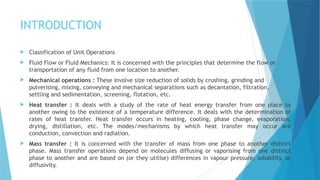
 Classification of Unit Operations
 Fluid Flow or Fluid Mechanics: It is concerned with the principles that determine the flow or
transportation of any fluid from one location to another.
 Mechanical operations : These involve size reduction of solids by crushing, grinding and
pulverising, mixing, conveying and mechanical separations such as decantation, filtration,
settling and sedimentation, screening, flotation, etc.
 Heat transfer : It deals with a study of the rate of heat energy transfer from one place to
another owing to the existence of a temperature difference. It deals with the determination of
rates of heat transfer. Heat transfer occurs in heating, cooling, phase change, evaporation,
drying, distillation, etc. The modes/mechanisms by which heat transfer may occur are
conduction, convection and radiation.
 Mass transfer : It is concerned with the transfer of mass from one phase to another distinct
phase. Mass transfer operations depend on molecules diffusing or vaporising from one distinct
phase to another and are based on (or they utilise) differences in vapour pressure, solubility, or
diffusivity.
INTRODUCTION TO UNIT OPERATIONS II
 Unit operations II is focused on Mechanical operations of separation
 Gas Absorption
 Liquid –Liquid Extraction
 Crystallisation
 Drying
 Humidification
 Leaching
 Adsorption
INTRODUCTION TO UNIT OPERATIONS II
 At the end of each chapter students are expected to know
 Principle
 Equations of importance
 Be able to solve problems under this unit operation
 Know the various industrial equipment's used in the unit operation and
how the function
GAS ABSORPTION
INTRODUCTION
 In gas absorption, a gas phase contacts a liquid phase and mass is transferred from the gas
phase to the liquid phase (liquid solvent).
 Gas absorption refers to an operation in which a gas mixture is contacted with a liquid to
preferentially dissolve one or more soluble components of the gas mixture in the liquid.
 This unit operation is also termed as scrubbing.
 The differences in solubility of gases in a given solvent are utilised to effect such a
separation.
 Gas absorption is the second most important mass transfer operation encountered in the
chemical industry and is used for the recovery or removal of the solute gas.
GAS ABSORPTION
INTRODUCTION
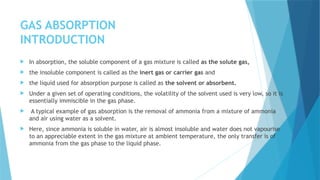
 In absorption, the soluble component of a gas mixture is called as the solute gas,
 the insoluble component is called as the inert gas or carrier gas and
 the liquid used for absorption purpose is called as the solvent or absorbent.
 Under a given set of operating conditions, the volatility of the solvent used is very low, so it is
essentially immiscible in the gas phase.
 A typical example of gas absorption is the removal of ammonia from a mixture of ammonia
and air using water as a solvent.
 Here, since ammonia is soluble in water, air is almost insoluble and water does not vapourise
to an appreciable extent in the gas mixture at ambient temperature, the only transfer is of
ammonia from the gas phase to the liquid phase.
GAS ABSORPTION
INTRODUCTION
 The reverse of absorption is called desorption or stripping.
 It is an operation in which a dissolved gas from a solution (a liquid) is
removed from the liquid by contacting it with an inert gas (i.e., a
stripping medium).
 Therefore, the removal of sulfur dioxide from flue gases by alkaline
solutions is an example of absorption, whereas the removal of the
volatile components of oil by steam is an example of stripping.
 The absorption may be a purely physical phenomenon - physical
absorption, e.g., absorption of ammonia from a mixture of ammonia
and air by water or it may be accompanied by a chemical reaction
(the transfer of a solute component to the liquid phase and then
reaction of this solute with a constituent of the liquid), e.g.,
absorption of NO2 in water to produce nitric acid.
GAS ABSORPTION
INTRODUCTION
 Gas absorption is exothermic in nature, so this operation
demands a cooling provision and is normally carried out at
low temperatures (since the solubility of a solute gas in a
given solvent is high at low temperatures).
 Though both the gas absorption and distillation operations
can be carried out in plate or packed columns, packed
columns are very common for absorption.
GAS ABSORPTION
INTRODUCTION
GAS ABSORPTION
INTRODUCTION
GAS ABSORPTION
INTRODUCTION
GAS ABSORPTION
PRINCIPLE
 Absorption, or gas absorption, is a unit operation used in the chemical industry to separate gases by
washing or scrubbing a gas mixture with a suitable liquid.
 The fundamental physical principles underlying the process of gas absorption are the solubility of the
absorbed gas and the rate of mass transfer.
 One or more of the constituents of the gas mixture dissolves or is absorbed in the liquid and can thus be
removed from the mixture.
 In some systems, this gaseous constituent forms a physical solution with the liquid or the solvent, and in
other cases, it reacts with the liquid chemically.
 The purpose of such scrubbing operations may be any of the following:
 Gas purification (eg, removal of air pollutants from exhausts gases or contaminants from gases that will
be further processed),
 Product Recovery, or production of solutions of gases for various purposes.
 The absorber may be a packed column, plate column, spray column, venturi scrubbers, bubble column,
falling films, wet scrubbers, stirred tanks
GAS ABSORPTION
PRINCIPLE
 The degree to which a gas is absorbed from a gaseous mixture by a liquid solvent is
determined by its partial pressure.
 Each dissolved gas exerts a definite partial pressure at a given temperature and
concentration.
 The gas is said to be slightly soluble when the partial pressure exerted by the dissolved gas
from the solution is higher, while it is said to be more soluble when the partial pressure
exerted by the dissolved gas from the solution of given concentration is lower.
 A given quantity of liquid will dissolve any amount of a slightly or more soluble gas depending
upon the partial pressure of the dissolved gas in the gas phase in contact with the liquid.
 A slightly soluble (insoluble gas) gas requires a higher partial pressure of the gas in contact
with the liquid to yield the solution of a desired concentration, while a very soluble gas
requires very low partial pressure to give the solution of the same concentration.
GAS ABSORPTION
PRINCIPLE
 Equilibrium condition will be reached when the partial pressure of solute gas in the gas
phase is equal to its partial pressure from the liquid phase. The equilibrium condition thus
fixes the upper limit for operation of an absorption unit.
 The solubility of a gas (the concentration of a dissolved gas in the liquid at a given
temperature and pressure) is not substantially affected by the total pressure over the
system but gets influenced by the temperature.
 Generally, the solubility of a gas in a given solvent decreases with increase in temperature.
 In a majority of cases, the gas absorption results with the evolution of heat and solubility
falls off if provisions are not made to remove the heat evolved. Usually adequate cooling
arrangements are provided to keep the temperature sufficiently low to achieve a good rate
of absorption.
GAS ABSORPTION
PRINCIPLE
 For dilute solutions of most gases, the equilibrium relationship is given by
Henry's law:
GAS ABSORPTION
PRINCIPLE-Material balances – One Component Transferred
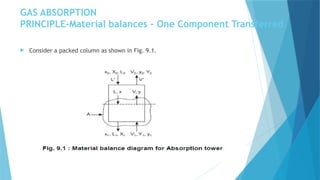
 Consider a packed column as shown in Fig. 9.1.
GAS ABSORPTION
PRINCIPLE-Material balances – One
Component Transferred
 Let V1, V2 and V be the molal flow rates of the total gas at the inlet (rich gas), outlet (lean
gas) and at an arbitrary section in the column, respectively.
 Let y1, y2 and y be the mole fractions of the solute gas at the respective stations.
 Let L1, L2 and L be the molal flow rates of the liquid (as a whole) at the outlet, inlet and at
an arbitrary sections, respectively and x1, x2 and x be the mole fractions of the solute gas in
the liquid at the respective stations.
 Also let V' and L' be the molal flow rates of the inert (insoluble) gas and the non-volatile
solvent (solute free solvent), respectively through the column.
 The overall material balance over the control surface 'A' of Fig. 9.1 gives
GAS ABSORPTION
PRINCIPLE-Material balances – One Component Transferred
 Material balance of the solute component over the control surface A of Fig. 9.1
 The overall material balance over the entire column is
 The material balance of the solute over the entire column is
 where y is the mole fraction of the solute in the gas phase
 (1 – y) is the mole fraction of the inert gas in the gas phase
GAS ABSORPTION
PRINCIPLE-Material balances – One Component Transferred
 Therefore,
GAS ABSORPTION
PRINCIPLE-Material balances – One Component Transferred
 Equation (9.9) is the equation of the operating line for absorption operation in terms of mole fraction
and is a curve on x - y co-ordinates. Equation (9.9) in terms of mole ratio is :
 Equation (9.10) is the equation of the operating line for absorption operation. It is a straight line on x
- y co-ordinates with a slope equal to L'/V' and passes through point (X1, Y1).
 The line also passes through point (X2, Y2).
 Material balance of the solute gas component over the entire tower/column in terms of L', V' and
mole ratios is :
GAS ABSORPTION
PRINCIPLE-Selection criteria for solvent in gas absorption :
 While selecting a particular solvent for absorption operation, the following properties of the solvent
are considered:
 1. Gas solubility: The solubility of a solute gas in a solvent should be high, i.e., the solvent should
have a high capacity for dissolving the desired solute gas so that the less amount of the solvent will
be required for a given absorption duty. In general, for good solubility, a solvent of chemical nature
similar to that of the solute to be absorbed must be searched out and used. The solvent selected
should have a high solubility for the solute to be absorbed.
 2. Volatility : As the gas leaving an absorption unit is generally saturated with the solvent, there will
be a loss of the solvent with the gas leaving the unit operation. Hence, to minimise the solvent loss
(in the gas leaving), the solvent should be less volatile, i.e., it should have a low vapour pressure
under given operating conditions.
GAS ABSORPTION
PRINCIPLE-Selection criteria for solvent in gas
absorption :
 3. Corrosive nature : The solvent should not be corrosive (as far as possible)
towards common materials of construction so that the construction material
for an absorption equipment will not be too expensive.
 4. Viscosity : The solvent should have a low viscosity for rapid absorption
rates, low pumping cost and better heat transfer. The solvent should be non-
viscous.
 5. Cost and availability : The solvent should be cheap and readily available.
Losses are less costly with the cheap solvent.
 6. Miscellaneous : The solvent should be non-toxic, non-flammable, non-
foaming, and chemically stable from a handling and storage point of view.
GAS ABSORPTION
Gas Absorption Equipments :
 Various gas absorption equipments used are :
 1. Mechanically agitated vessels.
 2. Packed Columns/towers.
 3. Plate Columns.
GAS ABSORPTION
Gas Absorption Equipments : Mechanically agitated vessel
GAS ABSORPTION
Gas Absorption Equipments : Mechanically agitated vessel
 It is usually used in a small scale industry. This unit gives performance equivalent to one theoretical
stage.
 It consists of a baffled vessel usually incorporating an open or disc flat blade turbine type agitator as
it maintains very large discharge velocities normal to the gas flow.
 Solvent liquid with a depth equal to the vessel diameter is taken in the vessel and gas is introduced
below the impeller through a ring shaped sparger under agitation.
 Adequate free board is provided over the liquid level for the gas hold up during gas flow and
ultimately the unabsorbed gas leaves the top of the vessel.
 For a high absorption capacity, the operation is carried out at low temperature and for maintaining
it, a cooling coil is incorporated in the vessel.
 The diameter of sparger is equal to or slightly less than that of the impeller and is arranged with
holes (3 to 6.5 mm in diameter) on top.
 Deep vessels with usually two impellers are used when the time of contact required is relatively
large, wherein a large interfacial area is maintained by redispersing the gas bubble coalesced.
GAS ABSORPTION
Gas Absorption Equipments :Packed Columns/Towers
 Packed columns are most frequently used for gas absorption (and are used to a limited extent for
distillation) wherein the liquid is dispersed in the form of film and the gas flows as a continuous
phase.
 These are continuous contact equipments generally operated in a counter current fashion.
GAS ABSORPTION
Gas Absorption Equipments : Packed Columns/Towers
 A packed column consists of a vertical cylindrical shell constructed out of metal, plastic, ceramic,
etc. and filled with suitable packings which offer a large interfacial area for gas-liquid contact for
mass transfer between the phases.
 A bed of the packing rests on a support plate which offers very low resistance to gas flow. It is
provided with a gas inlet and distributing space at the bottom, a liquid inlet and a liquid distributor
at the top and gas and liquid outlets at the top and bottom.
 A liquid solvent is introduced from the top through the liquid distributor (which distributes the liquid
on the packing), which irrigates/wets the surface of packing uniformly, liquid trickles down the bed,
and finally the liquid enriched in the solute to be absorbed called a strong liquor (solute + solvent)
leaves the bottom of the column.
 The liquid flow rate should be sufficient for good wetting of packing. A solute-containing gas (rich
gas) is introduced from the bottom of the tower and rise upward through the interstices/open spaces
in the packing counter current to the flow of the liquid.
 The lean gas (dilute gas) leaves the column from the top of the tower. In case of tall
columns/towers, liquid redistributors are used to redistribute the liquid to avoid channeling of the
same (flow the liquid along the wall).
GAS ABSORPTION
Gas Absorption Equipments : Packed Columns/Towers
 Advantages of packed columns :
 (i) Minimum structure
 (ii) low pressure drop
 (iii) low liquid hold-up
 (iv) handle corrosive liquids and liquids that tends to foam
 (v) low initial investment and
 (vi) high liquid to gas ratios.
 Disadvantages of packed columns :
 (i) Relatively inflexible
 (ii) can not operate over wide ranges of either vapour or liquid rates per unit cross section
 (iii) distribution of liquid is difficult
 (iv) can not handle dirty fluids that tend to deposit a sediment on packings
 (v) can not be used where large temperature changes are occurred.
GAS ABSORPTION
Gas Absorption Equipments : Packed Columns/Towers
 Packed columns are well suited for :
 1. Small diameters
 2. Handling highly corrosive fluids.
 3. Handling liquids that tend to foam.
 4. Operations where it is important to have a low pressure drop and low liquid hold up.
GAS ABSORPTION
Gas Absorption Equipments :Tower Packings :
 Many types of packings are in use ranging from simple to complex geometric shapes.
 Packings are made of ceramics, metals and plastics and vary in size from 6 to 75 mm.
 Characteristics of a Tower Packing :
 1. It should provide a large interfacial area for phase contacting., i.e., it should have a large wetted
surface area per unit volume of packed space for high efficiencies.
 2. It should provide a large void volume or empty space in the packed bed so that reasonable
throughputs of the phases are handled without excessive pressure drop.
 3. It should possess good wetting characteristic.
 4. It should have a high corrosion resistance.
 5. It should be relatively cheap/inexpensive.
 6. It should have a low bulk density so that the weight of the entire packed bed is low which thereby
reduces serious support problems.
 7. It should possess enough structural strength.
 8. It should be chemically inert to the fluids handled in the tower.
GAS ABSORPTION
Gas Absorption Equipments :Tower Packings :
 Types of packings :
 In order to obtain the efficient gas-liquid contact, many different types of packings are available
ranging from simple to complex geometrical shapes but are generally classified as random packings
and regular packings.
 If the packings are simply dumped into the tower during installation and fall in a random fashion (the
individual pieces are not arranged in any particular pattern), they are called random packings.
 The packings arranged in a
 particular pattern are called stacked packings.
LIQUID-LIQUID EXTRACTION
 The techniques of removing one component from a solid or liquid by means of a liquid solvent fall
into two categories,
 the first one is called as leaching or solid extraction and
 the second as liquid extraction.
 Leaching is used to dissolve soluble matter from its mixture with an insoluble solid
 (Leaching is an operation in which a particular component of the solid is leached out with the help
of a solvent), whereas
 liquid extraction is used to separate two miscible liquids using a solvent which preferentially
dissolves one of them.
 In this chapter, our discussion is restricted to liquid extraction – the extraction of the liquid phase
with a solvent.
LIQUID-LIQUID EXTRACTION
introduction
 When a mixture of liquids is not easily separable by distillation, i.e., when the separation by
distillation is ineffective or very difficult, liquid extraction is used.
 Close boiling mixtures or substances that cannot withstand the temperature of distillation, even
under vacuum [i.e., substances that are thermally unstable (heat sensitive)] may often be separated
by extraction.
 In this operation, a solvent is added to the liquid-mixture.
 As a result, two immiscible layers are formed, both containing varying amounts of different
components.
 The isolated layers are then separated using density difference as extract phase and raffinate phase.
For the recovery of the solvent for re-use, extraction is followed often by distillation or evaporation.
LIQUID-LIQUID EXTRACTION
 Liquid-liquid extraction (liquid extraction) refers to an operation in which the constituents of a
liquid mixture are separated by contacting it with a suitable insoluble liquid solvent, which
preferentially dissolves one or more constituents.
 This operation is sometimes also termed as solvent extraction.
 Extraction utilises the differences in solubility of constituents/components to effect a separation.
 In this operation, a solute in a liquid solution is removed by contacting the solution with another
liquid solvent.
 The solvent is relatively immiscible with the solution. In liquid extraction, the feed solution to be
handled represents one phase and the solvent to be used to effect separation represents the second
phase. In this operation, the two immiscible phases in contact are both liquid and so is a liquid-liquid
operation.
 The mass transfer of the solute (liquid) takes place from the feed solution to the solvent phase.
LIQUID-LIQUID EXTRACTION
Difference between distillation and extraction.
 Distillation and extraction both are used for separation of the constituents of a liquid mixture based
on relative merits/demerits of the individual methods.
LIQUID-LIQUID EXTRACTION
Difference between distillation and extraction.
Applications of Liquid Extraction :
 In extraction, the solvent should be recovered for reuse and hence extraction is usually followed by
distillation for the recovery of the solvent.
 This combined operation is more complicated and more expensive than ordinary distillation
 But whenever separation of the components of a liquid mixture is very difficult or ineffective by
distillation, extraction can be thought of as an alternate process (alternative) to it (distillation).
 Thus, extraction is attractive and preferred.
 (i) whenever very large amount of latent heats are required (as in the case with very dilute solutions
where water must be vaporised, the latent heats of organic liquids are substantially lower than that
of water),
 (ii) whenever we are dealing with a liquid mixture forming an azeotrope / close boiling mixtures and
 (iii) whenever we are dealing with substances that are thermally degradable/heat sensitive,
separation by distillation is expensive, ineffective and difficult.
Applications of Liquid Extraction :
 For example,
 (i) Recovery of acetic acid from dilute aqueous solutions is done more economically by extraction
followed by distillation than distillation alone because of high latent heat of vaporisation of water
(distillation would be possible but extraction reduces substantially the amount of water to be
vaporised)
 (ii) Long chain fatty acids can be removed from vegetable oils economically by extraction with liquid
propane than by a high vacuum distillation technique.
 (iii) Separation of petroleum products are having approximately the same boiling range. The
separation of aromatics from lube oil fractions using furfural as a solvent and
 (iv) Recovery of penicillin from the fermentation broth using butyl acetate.
Steps and terminology in Liquid Extraction :
 A typical liquid-liquid extraction utilising the difference in solubilities of the components of a liquid
mixture may be consisting of the following steps :
 1 Contacting the feed with a solvent.
 2 Separation of the resulting phases, and
 3 Removal / Recovery of solvent(s) from each phase.
Steps and terminology in Liquid Extraction
 In liquid-liquid extraction operation, the liquid solution and a insoluble solvent are brought into
intimate contact, the constituents of the liquid mixture are distributed between the phases resulting
into some degree of separation (which can be improved by a multistage contact), and then the
phases are separated from one another based on density difference.
 For example, acetone may be preferentially extracted from a solution in water with the help of
chloroform and the resulting chloroform phase is found to contain large part of acetone, but little
water
Steps and terminology in Liquid Extraction
 In extraction operation, the solution which is to be extracted is called the feed
 and the liquid with which the feed is contacted for the extraction of solute (i.e., to bring about the
extraction) is called as the solvent.
 The solvent lean, residual liquid solution from which solute is removed is called as the raffinate
(also termed as the raffinate phase/layer) and the solvent-rich product of the operation, containing
the extracted solute, is 20 called as the extract (also termed as the extract phase/layer).
 The extract phase contains the desired product in a larger proportion.
Steps and terminology in Liquid Extraction
 Thus, if we contact a solution of acetic acid in water with a solvent such as ethylacetate, then the
two phases/layers will result.
 The extract (ester layer/organic layer) will contain most of the acetic acid in ethylacetate with some
water.
 While the raffinate (aqueous layer) will contain weaker acetic acid solution with a small amount of
ethylacetate.
 The amount of water in the extract and ethyl acetate in the raffinate depends upon their solubilities
into one another.
Distribution coefficient :
 In dilute solutions at equilibrium, the ratio of the concentrations of the solute in the two phases is
called the distribution coefficient or distribution constant K. It is given by
 where CE the extract and
 CR the concentrations of the solute in the raffinate phases respectively.
 The distribution coefficient can also be given in terms of weight fraction of the solute in the two
phases in contact at equilibrium.
 where xE is the weight fraction of the solute in the extract and
 xR is the weight fraction of the solute in the raffinate.
Ternary Systems :
 The addition of a new solvent to a binary liquid mixture yields different types of mixtures or
systems.
 i. The solvent may be completely immiscible with the feed solvent. This is the ideal case.
 ii. The solvent may be partially miscible with the feed solvent, forming one pair of partially miscible
liquid. If A is the feed solvent, C is the solute and B is the extracting solvent, then C dissolves in A
and B completely while A and B dissolve only to a limited extent in each other. This is the most
common type of system.
 iii. A homogeneous solution may be formed, then the solvent selected is not suitable and should be
rejected.
 Iv -The solvent may lead to the formation of two or three partially miscible liquids. A and C are
completely soluble, while A and B, and B and C dissolve only to a limited extent in each other (two
pairs partially miscible). It is observed occasionally and not desired.
Triangular Diagrams :
 In liquid-liquid extraction, when the solvent is partially miscible with the original solvent (diluent), the
solubility and equilibrium relations are often shown on a triangular diagram.
 The composition of ternary systems can be shown by a point lying inside an equilateral triangle.
 Consider a system consisting of C (acetone), A (water) and B (methyl isobutyl ketone) at 25o C wherein acetone
is the solute, water is the diluent and methyl isobutyl ketone is the solvent for extracting the solute.
 This system is shown in Fig. 10.1. In this system, the (acetone) solute 'C' is completely miscible with the two
solvents A(water) and B(MIK) and the two solvents A - B are partially miscible with each other. Apex C
represents 100% acetone and apexes A and B represent 100% water and 100% Methyl Isobutyl Ketone
respectively.
 Along line BC, concentration of A is zero and the same is true for B and C along AC and AB. The ternary system
represented by point 'P' consists of three components C, A and B in the ratio of perpendiculars PL, PJ and PK
respectively.
 The distances AD and BE represent the solubility of solvent B in A and that of A in B, respectively. Every mixture
of MIK and water of composition lying between points D and E forms two liquid layers, and for calculating mass
ratio of these two-layers, centre of gravity principle is applicable.
 When acetone is added to the two phase/layer mixture of MIK and water, acetone gets distributed between the
phases/layers, and compositions of phases/layers follow the raffinate phase and extract phase solubility curves.
Triangular Diagrams :
 The curved line ERF indicates composition of saturated MIK layer and the curved line DQF indicates
the composition of saturated water layer.
 The area under the binodal solubility curve represented by the curved line DQFRE represents a two -
phase region that will split up into two layers in equilibrium with each other. Equilibrium composition
of the two phases lie on this curve.
 These two layers have composition represented by points Q and R and QR is a tie - line. The line
joining equilibrium compositions of the two phases is called the tie line. The points of tie lines must
be found by experiment.
 The point F on the binodal solubility curve represents a single phase which does not split into two
phases (i.e. at this point, phases become identical) and corresponds to a tie line of zero length and is
known as a plait point.
Triangular Diagrams :
 The plait point must be found by experiment and at a given temperature and pressure it is fixed. It is
not necessary that the plait point be at the peak of the binodal curve and tie lines be parallel.
 In the system under consideration wherein C is the solute and B is the extraction solvent, the
separation will increase as the plait point approaches A and tie lines increase in slope.
 All points outside the binodal curve represent single phase mixtures.
 If a solution of composition X is mixed with another solution of composition Y, then the mixture
obtained will have a composition represented by point Z on the line XY, such that
 This type of plot is very useful in selecting the solvent and determining the number of stages
required.
Selection of Solvent for Extraction :
 One of the important factors in selecting a solvent is the selectivity of the solvent and is given by
 where xA and xB are the weight fractions/mole fractions of C and A in the extract and the
 raffinate phase.
Selection of Solvent for Extraction :
 Any particular liquid to be used as a solvent for extraction will not possess all the properties
considered desirable for extraction and hence compromise is usually necessary of selecting the best
solvent out of various possible liquid solvents available.
 While selecting a solvent for extraction, the qualities such as selectivity, recoverability, distribution
coefficient, density, etc. must be considered.
 1. Selectivity : The ratio of the concentration ratio of solute to feed solvent in the extract phase
to that in the raffinate phase is called the selectivity or separation factor. It is a measure of the
effectiveness of solvent for separating the constituents of a solution. The selectivity should be
greater than one for all useful extraction operation and if it is equal to one, separation by extraction
is not possible.
 If B is the solvent, feed contains A and C, where C is the solute, and E and R are the equilibrium
phases, then the selectivity or separation factor, β is given by
Selection of Solvent for Extraction :
 Recoverability :
 As the solvent should be recovered for reuse frequently by distillation, it should not form an
azeotrope with the extracted solute for low cost recovery, the relative volatility of the mixture
formed should be high.
 The latent heat of vaporisation of the solvent selected should be small whenever the solvent is to be
vaproised.
 3. Distribution coefficient : Higher values (>1) of the distribution coefficient are generally desirable
as less solvent will then be required for a given extraction duty.
 4. Density : The difference in densities of the saturated liquid phases should be larger for ease is
physical separation.
 5. Insolubility of solvent : The solvent insoluble in the original liquid solvent should be preferred. It
should have a high solubility for the solute to be extracted as then small amounts of the solvent are
required.
Selection of Solvent for Extraction
 6. Interfacial tension : Interfacial tension should be high for coalescence of emulsions to occur more
readily, as the same is of a greater importance than dispersion.
 7. The solvent should be stable chemically. It should be inert towards the components of the system.
 8. It should not be corrosive towards common materials of construction.
 9. The solvent should be cheap.
 10. The solvent should be non-toxic and non-flammable.
 11. The solvent should have a low viscosity, freezing point, vapour pressure for ease in handling
and storage.
Extraction Equipments :
 Industrial extraction equipments are classified as :
 1. Stage-type extractors and
 2. Differential (continuous contact) extractors.
 Mixer-settler (single and multistage), plate column, pulsed sieve plate column, etc. are examples of
stage-type extractor.
 Packed column, spray column, pulsed packed column, rotating disc contactors, etc. are examples of
differential extractor.
UNIT  OPERATIONS  II     POWERPOINT.pptx

UNIT OPERATIONS II POWERPOINT.pptx

  • 1.
  • 2.
    INTRODUCTION  The conceptof unit operations was introduced by A.D. Little in 1905.  The operations carried out in the process industries involving physical changes in the system under consideration are regarded as the unit operations.  Features :  1. These are physical in nature, i.e., changes involved in them are primarily physical.  2. These are common to all types of diverse industries.  3. Individual operations have common techniques and are based on the same scientific  principles regardless of the material being processed.  4. They are independent of industries in which they are carried out.  5. Practical methods of carrying them out may be more or less different in different  industries.
  • 3.
    INTRODUCTION  Broadly, unitoperations are  Mechanical Operations, e.g., size reduction (crushing and grinding), filtration, size separation, etc. Fluid Flow Operations in which the pressure difference acts as a driving force,  Heat Transfer (Operations) in which the temperature difference acts as a driving force and  Mass Transfer Operations in which the concentration difference/ gradient acts as a driving force, e.g., distillation, gas absorption, drying, etc.
  • 4.
    INTRODUCTION  Classification ofUnit Operations  Fluid Flow or Fluid Mechanics: It is concerned with the principles that determine the flow or transportation of any fluid from one location to another.  Mechanical operations : These involve size reduction of solids by crushing, grinding and pulverising, mixing, conveying and mechanical separations such as decantation, filtration, settling and sedimentation, screening, flotation, etc.  Heat transfer : It deals with a study of the rate of heat energy transfer from one place to another owing to the existence of a temperature difference. It deals with the determination of rates of heat transfer. Heat transfer occurs in heating, cooling, phase change, evaporation, drying, distillation, etc. The modes/mechanisms by which heat transfer may occur are conduction, convection and radiation.  Mass transfer : It is concerned with the transfer of mass from one phase to another distinct phase. Mass transfer operations depend on molecules diffusing or vaporising from one distinct phase to another and are based on (or they utilise) differences in vapour pressure, solubility, or diffusivity.
  • 5.
    INTRODUCTION TO UNITOPERATIONS II  Unit operations II is focused on Mechanical operations of separation  Gas Absorption  Liquid –Liquid Extraction  Crystallisation  Drying  Humidification  Leaching  Adsorption
  • 6.
    INTRODUCTION TO UNITOPERATIONS II  At the end of each chapter students are expected to know  Principle  Equations of importance  Be able to solve problems under this unit operation  Know the various industrial equipment's used in the unit operation and how the function
  • 7.
    GAS ABSORPTION INTRODUCTION  Ingas absorption, a gas phase contacts a liquid phase and mass is transferred from the gas phase to the liquid phase (liquid solvent).  Gas absorption refers to an operation in which a gas mixture is contacted with a liquid to preferentially dissolve one or more soluble components of the gas mixture in the liquid.  This unit operation is also termed as scrubbing.  The differences in solubility of gases in a given solvent are utilised to effect such a separation.  Gas absorption is the second most important mass transfer operation encountered in the chemical industry and is used for the recovery or removal of the solute gas.
  • 8.
    GAS ABSORPTION INTRODUCTION  Inabsorption, the soluble component of a gas mixture is called as the solute gas,  the insoluble component is called as the inert gas or carrier gas and  the liquid used for absorption purpose is called as the solvent or absorbent.  Under a given set of operating conditions, the volatility of the solvent used is very low, so it is essentially immiscible in the gas phase.  A typical example of gas absorption is the removal of ammonia from a mixture of ammonia and air using water as a solvent.  Here, since ammonia is soluble in water, air is almost insoluble and water does not vapourise to an appreciable extent in the gas mixture at ambient temperature, the only transfer is of ammonia from the gas phase to the liquid phase.
  • 9.
    GAS ABSORPTION INTRODUCTION  Thereverse of absorption is called desorption or stripping.  It is an operation in which a dissolved gas from a solution (a liquid) is removed from the liquid by contacting it with an inert gas (i.e., a stripping medium).  Therefore, the removal of sulfur dioxide from flue gases by alkaline solutions is an example of absorption, whereas the removal of the volatile components of oil by steam is an example of stripping.  The absorption may be a purely physical phenomenon - physical absorption, e.g., absorption of ammonia from a mixture of ammonia and air by water or it may be accompanied by a chemical reaction (the transfer of a solute component to the liquid phase and then reaction of this solute with a constituent of the liquid), e.g., absorption of NO2 in water to produce nitric acid.
  • 10.
    GAS ABSORPTION INTRODUCTION  Gasabsorption is exothermic in nature, so this operation demands a cooling provision and is normally carried out at low temperatures (since the solubility of a solute gas in a given solvent is high at low temperatures).  Though both the gas absorption and distillation operations can be carried out in plate or packed columns, packed columns are very common for absorption.
  • 11.
  • 12.
  • 13.
  • 14.
    GAS ABSORPTION PRINCIPLE  Absorption,or gas absorption, is a unit operation used in the chemical industry to separate gases by washing or scrubbing a gas mixture with a suitable liquid.  The fundamental physical principles underlying the process of gas absorption are the solubility of the absorbed gas and the rate of mass transfer.  One or more of the constituents of the gas mixture dissolves or is absorbed in the liquid and can thus be removed from the mixture.  In some systems, this gaseous constituent forms a physical solution with the liquid or the solvent, and in other cases, it reacts with the liquid chemically.  The purpose of such scrubbing operations may be any of the following:  Gas purification (eg, removal of air pollutants from exhausts gases or contaminants from gases that will be further processed),  Product Recovery, or production of solutions of gases for various purposes.  The absorber may be a packed column, plate column, spray column, venturi scrubbers, bubble column, falling films, wet scrubbers, stirred tanks
  • 15.
    GAS ABSORPTION PRINCIPLE  Thedegree to which a gas is absorbed from a gaseous mixture by a liquid solvent is determined by its partial pressure.  Each dissolved gas exerts a definite partial pressure at a given temperature and concentration.  The gas is said to be slightly soluble when the partial pressure exerted by the dissolved gas from the solution is higher, while it is said to be more soluble when the partial pressure exerted by the dissolved gas from the solution of given concentration is lower.  A given quantity of liquid will dissolve any amount of a slightly or more soluble gas depending upon the partial pressure of the dissolved gas in the gas phase in contact with the liquid.  A slightly soluble (insoluble gas) gas requires a higher partial pressure of the gas in contact with the liquid to yield the solution of a desired concentration, while a very soluble gas requires very low partial pressure to give the solution of the same concentration.
  • 16.
    GAS ABSORPTION PRINCIPLE  Equilibriumcondition will be reached when the partial pressure of solute gas in the gas phase is equal to its partial pressure from the liquid phase. The equilibrium condition thus fixes the upper limit for operation of an absorption unit.  The solubility of a gas (the concentration of a dissolved gas in the liquid at a given temperature and pressure) is not substantially affected by the total pressure over the system but gets influenced by the temperature.  Generally, the solubility of a gas in a given solvent decreases with increase in temperature.  In a majority of cases, the gas absorption results with the evolution of heat and solubility falls off if provisions are not made to remove the heat evolved. Usually adequate cooling arrangements are provided to keep the temperature sufficiently low to achieve a good rate of absorption.
  • 17.
    GAS ABSORPTION PRINCIPLE  Fordilute solutions of most gases, the equilibrium relationship is given by Henry's law:
  • 18.
    GAS ABSORPTION PRINCIPLE-Material balances– One Component Transferred  Consider a packed column as shown in Fig. 9.1.
  • 19.
    GAS ABSORPTION PRINCIPLE-Material balances– One Component Transferred  Let V1, V2 and V be the molal flow rates of the total gas at the inlet (rich gas), outlet (lean gas) and at an arbitrary section in the column, respectively.  Let y1, y2 and y be the mole fractions of the solute gas at the respective stations.  Let L1, L2 and L be the molal flow rates of the liquid (as a whole) at the outlet, inlet and at an arbitrary sections, respectively and x1, x2 and x be the mole fractions of the solute gas in the liquid at the respective stations.  Also let V' and L' be the molal flow rates of the inert (insoluble) gas and the non-volatile solvent (solute free solvent), respectively through the column.  The overall material balance over the control surface 'A' of Fig. 9.1 gives
  • 20.
    GAS ABSORPTION PRINCIPLE-Material balances– One Component Transferred  Material balance of the solute component over the control surface A of Fig. 9.1  The overall material balance over the entire column is  The material balance of the solute over the entire column is  where y is the mole fraction of the solute in the gas phase  (1 – y) is the mole fraction of the inert gas in the gas phase
  • 21.
    GAS ABSORPTION PRINCIPLE-Material balances– One Component Transferred  Therefore,
  • 22.
    GAS ABSORPTION PRINCIPLE-Material balances– One Component Transferred  Equation (9.9) is the equation of the operating line for absorption operation in terms of mole fraction and is a curve on x - y co-ordinates. Equation (9.9) in terms of mole ratio is :  Equation (9.10) is the equation of the operating line for absorption operation. It is a straight line on x - y co-ordinates with a slope equal to L'/V' and passes through point (X1, Y1).  The line also passes through point (X2, Y2).  Material balance of the solute gas component over the entire tower/column in terms of L', V' and mole ratios is :
  • 23.
    GAS ABSORPTION PRINCIPLE-Selection criteriafor solvent in gas absorption :  While selecting a particular solvent for absorption operation, the following properties of the solvent are considered:  1. Gas solubility: The solubility of a solute gas in a solvent should be high, i.e., the solvent should have a high capacity for dissolving the desired solute gas so that the less amount of the solvent will be required for a given absorption duty. In general, for good solubility, a solvent of chemical nature similar to that of the solute to be absorbed must be searched out and used. The solvent selected should have a high solubility for the solute to be absorbed.  2. Volatility : As the gas leaving an absorption unit is generally saturated with the solvent, there will be a loss of the solvent with the gas leaving the unit operation. Hence, to minimise the solvent loss (in the gas leaving), the solvent should be less volatile, i.e., it should have a low vapour pressure under given operating conditions.
  • 24.
    GAS ABSORPTION PRINCIPLE-Selection criteriafor solvent in gas absorption :  3. Corrosive nature : The solvent should not be corrosive (as far as possible) towards common materials of construction so that the construction material for an absorption equipment will not be too expensive.  4. Viscosity : The solvent should have a low viscosity for rapid absorption rates, low pumping cost and better heat transfer. The solvent should be non- viscous.  5. Cost and availability : The solvent should be cheap and readily available. Losses are less costly with the cheap solvent.  6. Miscellaneous : The solvent should be non-toxic, non-flammable, non- foaming, and chemically stable from a handling and storage point of view.
  • 25.
    GAS ABSORPTION Gas AbsorptionEquipments :  Various gas absorption equipments used are :  1. Mechanically agitated vessels.  2. Packed Columns/towers.  3. Plate Columns.
  • 26.
    GAS ABSORPTION Gas AbsorptionEquipments : Mechanically agitated vessel
  • 27.
    GAS ABSORPTION Gas AbsorptionEquipments : Mechanically agitated vessel  It is usually used in a small scale industry. This unit gives performance equivalent to one theoretical stage.  It consists of a baffled vessel usually incorporating an open or disc flat blade turbine type agitator as it maintains very large discharge velocities normal to the gas flow.  Solvent liquid with a depth equal to the vessel diameter is taken in the vessel and gas is introduced below the impeller through a ring shaped sparger under agitation.  Adequate free board is provided over the liquid level for the gas hold up during gas flow and ultimately the unabsorbed gas leaves the top of the vessel.  For a high absorption capacity, the operation is carried out at low temperature and for maintaining it, a cooling coil is incorporated in the vessel.  The diameter of sparger is equal to or slightly less than that of the impeller and is arranged with holes (3 to 6.5 mm in diameter) on top.  Deep vessels with usually two impellers are used when the time of contact required is relatively large, wherein a large interfacial area is maintained by redispersing the gas bubble coalesced.
  • 28.
    GAS ABSORPTION Gas AbsorptionEquipments :Packed Columns/Towers  Packed columns are most frequently used for gas absorption (and are used to a limited extent for distillation) wherein the liquid is dispersed in the form of film and the gas flows as a continuous phase.  These are continuous contact equipments generally operated in a counter current fashion.
  • 29.
    GAS ABSORPTION Gas AbsorptionEquipments : Packed Columns/Towers  A packed column consists of a vertical cylindrical shell constructed out of metal, plastic, ceramic, etc. and filled with suitable packings which offer a large interfacial area for gas-liquid contact for mass transfer between the phases.  A bed of the packing rests on a support plate which offers very low resistance to gas flow. It is provided with a gas inlet and distributing space at the bottom, a liquid inlet and a liquid distributor at the top and gas and liquid outlets at the top and bottom.  A liquid solvent is introduced from the top through the liquid distributor (which distributes the liquid on the packing), which irrigates/wets the surface of packing uniformly, liquid trickles down the bed, and finally the liquid enriched in the solute to be absorbed called a strong liquor (solute + solvent) leaves the bottom of the column.  The liquid flow rate should be sufficient for good wetting of packing. A solute-containing gas (rich gas) is introduced from the bottom of the tower and rise upward through the interstices/open spaces in the packing counter current to the flow of the liquid.  The lean gas (dilute gas) leaves the column from the top of the tower. In case of tall columns/towers, liquid redistributors are used to redistribute the liquid to avoid channeling of the same (flow the liquid along the wall).
  • 30.
    GAS ABSORPTION Gas AbsorptionEquipments : Packed Columns/Towers  Advantages of packed columns :  (i) Minimum structure  (ii) low pressure drop  (iii) low liquid hold-up  (iv) handle corrosive liquids and liquids that tends to foam  (v) low initial investment and  (vi) high liquid to gas ratios.  Disadvantages of packed columns :  (i) Relatively inflexible  (ii) can not operate over wide ranges of either vapour or liquid rates per unit cross section  (iii) distribution of liquid is difficult  (iv) can not handle dirty fluids that tend to deposit a sediment on packings  (v) can not be used where large temperature changes are occurred.
  • 31.
    GAS ABSORPTION Gas AbsorptionEquipments : Packed Columns/Towers  Packed columns are well suited for :  1. Small diameters  2. Handling highly corrosive fluids.  3. Handling liquids that tend to foam.  4. Operations where it is important to have a low pressure drop and low liquid hold up.
  • 32.
    GAS ABSORPTION Gas AbsorptionEquipments :Tower Packings :  Many types of packings are in use ranging from simple to complex geometric shapes.  Packings are made of ceramics, metals and plastics and vary in size from 6 to 75 mm.  Characteristics of a Tower Packing :  1. It should provide a large interfacial area for phase contacting., i.e., it should have a large wetted surface area per unit volume of packed space for high efficiencies.  2. It should provide a large void volume or empty space in the packed bed so that reasonable throughputs of the phases are handled without excessive pressure drop.  3. It should possess good wetting characteristic.  4. It should have a high corrosion resistance.  5. It should be relatively cheap/inexpensive.  6. It should have a low bulk density so that the weight of the entire packed bed is low which thereby reduces serious support problems.  7. It should possess enough structural strength.  8. It should be chemically inert to the fluids handled in the tower.
  • 33.
    GAS ABSORPTION Gas AbsorptionEquipments :Tower Packings :  Types of packings :  In order to obtain the efficient gas-liquid contact, many different types of packings are available ranging from simple to complex geometrical shapes but are generally classified as random packings and regular packings.  If the packings are simply dumped into the tower during installation and fall in a random fashion (the individual pieces are not arranged in any particular pattern), they are called random packings.  The packings arranged in a  particular pattern are called stacked packings.
  • 34.
    LIQUID-LIQUID EXTRACTION  Thetechniques of removing one component from a solid or liquid by means of a liquid solvent fall into two categories,  the first one is called as leaching or solid extraction and  the second as liquid extraction.  Leaching is used to dissolve soluble matter from its mixture with an insoluble solid  (Leaching is an operation in which a particular component of the solid is leached out with the help of a solvent), whereas  liquid extraction is used to separate two miscible liquids using a solvent which preferentially dissolves one of them.  In this chapter, our discussion is restricted to liquid extraction – the extraction of the liquid phase with a solvent.
  • 35.
    LIQUID-LIQUID EXTRACTION introduction  Whena mixture of liquids is not easily separable by distillation, i.e., when the separation by distillation is ineffective or very difficult, liquid extraction is used.  Close boiling mixtures or substances that cannot withstand the temperature of distillation, even under vacuum [i.e., substances that are thermally unstable (heat sensitive)] may often be separated by extraction.  In this operation, a solvent is added to the liquid-mixture.  As a result, two immiscible layers are formed, both containing varying amounts of different components.  The isolated layers are then separated using density difference as extract phase and raffinate phase. For the recovery of the solvent for re-use, extraction is followed often by distillation or evaporation.
  • 36.
    LIQUID-LIQUID EXTRACTION  Liquid-liquidextraction (liquid extraction) refers to an operation in which the constituents of a liquid mixture are separated by contacting it with a suitable insoluble liquid solvent, which preferentially dissolves one or more constituents.  This operation is sometimes also termed as solvent extraction.  Extraction utilises the differences in solubility of constituents/components to effect a separation.  In this operation, a solute in a liquid solution is removed by contacting the solution with another liquid solvent.  The solvent is relatively immiscible with the solution. In liquid extraction, the feed solution to be handled represents one phase and the solvent to be used to effect separation represents the second phase. In this operation, the two immiscible phases in contact are both liquid and so is a liquid-liquid operation.  The mass transfer of the solute (liquid) takes place from the feed solution to the solvent phase.
  • 37.
    LIQUID-LIQUID EXTRACTION Difference betweendistillation and extraction.  Distillation and extraction both are used for separation of the constituents of a liquid mixture based on relative merits/demerits of the individual methods.
  • 38.
    LIQUID-LIQUID EXTRACTION Difference betweendistillation and extraction.
  • 39.
    Applications of LiquidExtraction :  In extraction, the solvent should be recovered for reuse and hence extraction is usually followed by distillation for the recovery of the solvent.  This combined operation is more complicated and more expensive than ordinary distillation  But whenever separation of the components of a liquid mixture is very difficult or ineffective by distillation, extraction can be thought of as an alternate process (alternative) to it (distillation).  Thus, extraction is attractive and preferred.  (i) whenever very large amount of latent heats are required (as in the case with very dilute solutions where water must be vaporised, the latent heats of organic liquids are substantially lower than that of water),  (ii) whenever we are dealing with a liquid mixture forming an azeotrope / close boiling mixtures and  (iii) whenever we are dealing with substances that are thermally degradable/heat sensitive, separation by distillation is expensive, ineffective and difficult.
  • 40.
    Applications of LiquidExtraction :  For example,  (i) Recovery of acetic acid from dilute aqueous solutions is done more economically by extraction followed by distillation than distillation alone because of high latent heat of vaporisation of water (distillation would be possible but extraction reduces substantially the amount of water to be vaporised)  (ii) Long chain fatty acids can be removed from vegetable oils economically by extraction with liquid propane than by a high vacuum distillation technique.  (iii) Separation of petroleum products are having approximately the same boiling range. The separation of aromatics from lube oil fractions using furfural as a solvent and  (iv) Recovery of penicillin from the fermentation broth using butyl acetate.
  • 41.
    Steps and terminologyin Liquid Extraction :  A typical liquid-liquid extraction utilising the difference in solubilities of the components of a liquid mixture may be consisting of the following steps :  1 Contacting the feed with a solvent.  2 Separation of the resulting phases, and  3 Removal / Recovery of solvent(s) from each phase.
  • 42.
    Steps and terminologyin Liquid Extraction  In liquid-liquid extraction operation, the liquid solution and a insoluble solvent are brought into intimate contact, the constituents of the liquid mixture are distributed between the phases resulting into some degree of separation (which can be improved by a multistage contact), and then the phases are separated from one another based on density difference.  For example, acetone may be preferentially extracted from a solution in water with the help of chloroform and the resulting chloroform phase is found to contain large part of acetone, but little water
  • 43.
    Steps and terminologyin Liquid Extraction  In extraction operation, the solution which is to be extracted is called the feed  and the liquid with which the feed is contacted for the extraction of solute (i.e., to bring about the extraction) is called as the solvent.  The solvent lean, residual liquid solution from which solute is removed is called as the raffinate (also termed as the raffinate phase/layer) and the solvent-rich product of the operation, containing the extracted solute, is 20 called as the extract (also termed as the extract phase/layer).  The extract phase contains the desired product in a larger proportion.
  • 44.
    Steps and terminologyin Liquid Extraction  Thus, if we contact a solution of acetic acid in water with a solvent such as ethylacetate, then the two phases/layers will result.  The extract (ester layer/organic layer) will contain most of the acetic acid in ethylacetate with some water.  While the raffinate (aqueous layer) will contain weaker acetic acid solution with a small amount of ethylacetate.  The amount of water in the extract and ethyl acetate in the raffinate depends upon their solubilities into one another.
  • 45.
    Distribution coefficient : In dilute solutions at equilibrium, the ratio of the concentrations of the solute in the two phases is called the distribution coefficient or distribution constant K. It is given by  where CE the extract and  CR the concentrations of the solute in the raffinate phases respectively.  The distribution coefficient can also be given in terms of weight fraction of the solute in the two phases in contact at equilibrium.  where xE is the weight fraction of the solute in the extract and  xR is the weight fraction of the solute in the raffinate.
  • 46.
    Ternary Systems : The addition of a new solvent to a binary liquid mixture yields different types of mixtures or systems.  i. The solvent may be completely immiscible with the feed solvent. This is the ideal case.  ii. The solvent may be partially miscible with the feed solvent, forming one pair of partially miscible liquid. If A is the feed solvent, C is the solute and B is the extracting solvent, then C dissolves in A and B completely while A and B dissolve only to a limited extent in each other. This is the most common type of system.  iii. A homogeneous solution may be formed, then the solvent selected is not suitable and should be rejected.  Iv -The solvent may lead to the formation of two or three partially miscible liquids. A and C are completely soluble, while A and B, and B and C dissolve only to a limited extent in each other (two pairs partially miscible). It is observed occasionally and not desired.
  • 47.
    Triangular Diagrams : In liquid-liquid extraction, when the solvent is partially miscible with the original solvent (diluent), the solubility and equilibrium relations are often shown on a triangular diagram.  The composition of ternary systems can be shown by a point lying inside an equilateral triangle.  Consider a system consisting of C (acetone), A (water) and B (methyl isobutyl ketone) at 25o C wherein acetone is the solute, water is the diluent and methyl isobutyl ketone is the solvent for extracting the solute.  This system is shown in Fig. 10.1. In this system, the (acetone) solute 'C' is completely miscible with the two solvents A(water) and B(MIK) and the two solvents A - B are partially miscible with each other. Apex C represents 100% acetone and apexes A and B represent 100% water and 100% Methyl Isobutyl Ketone respectively.  Along line BC, concentration of A is zero and the same is true for B and C along AC and AB. The ternary system represented by point 'P' consists of three components C, A and B in the ratio of perpendiculars PL, PJ and PK respectively.  The distances AD and BE represent the solubility of solvent B in A and that of A in B, respectively. Every mixture of MIK and water of composition lying between points D and E forms two liquid layers, and for calculating mass ratio of these two-layers, centre of gravity principle is applicable.  When acetone is added to the two phase/layer mixture of MIK and water, acetone gets distributed between the phases/layers, and compositions of phases/layers follow the raffinate phase and extract phase solubility curves.
  • 48.
    Triangular Diagrams : The curved line ERF indicates composition of saturated MIK layer and the curved line DQF indicates the composition of saturated water layer.  The area under the binodal solubility curve represented by the curved line DQFRE represents a two - phase region that will split up into two layers in equilibrium with each other. Equilibrium composition of the two phases lie on this curve.  These two layers have composition represented by points Q and R and QR is a tie - line. The line joining equilibrium compositions of the two phases is called the tie line. The points of tie lines must be found by experiment.  The point F on the binodal solubility curve represents a single phase which does not split into two phases (i.e. at this point, phases become identical) and corresponds to a tie line of zero length and is known as a plait point.
  • 49.
    Triangular Diagrams : The plait point must be found by experiment and at a given temperature and pressure it is fixed. It is not necessary that the plait point be at the peak of the binodal curve and tie lines be parallel.  In the system under consideration wherein C is the solute and B is the extraction solvent, the separation will increase as the plait point approaches A and tie lines increase in slope.  All points outside the binodal curve represent single phase mixtures.  If a solution of composition X is mixed with another solution of composition Y, then the mixture obtained will have a composition represented by point Z on the line XY, such that  This type of plot is very useful in selecting the solvent and determining the number of stages required.
  • 50.
    Selection of Solventfor Extraction :  One of the important factors in selecting a solvent is the selectivity of the solvent and is given by  where xA and xB are the weight fractions/mole fractions of C and A in the extract and the  raffinate phase.
  • 51.
    Selection of Solventfor Extraction :  Any particular liquid to be used as a solvent for extraction will not possess all the properties considered desirable for extraction and hence compromise is usually necessary of selecting the best solvent out of various possible liquid solvents available.  While selecting a solvent for extraction, the qualities such as selectivity, recoverability, distribution coefficient, density, etc. must be considered.  1. Selectivity : The ratio of the concentration ratio of solute to feed solvent in the extract phase to that in the raffinate phase is called the selectivity or separation factor. It is a measure of the effectiveness of solvent for separating the constituents of a solution. The selectivity should be greater than one for all useful extraction operation and if it is equal to one, separation by extraction is not possible.  If B is the solvent, feed contains A and C, where C is the solute, and E and R are the equilibrium phases, then the selectivity or separation factor, β is given by
  • 52.
    Selection of Solventfor Extraction :  Recoverability :  As the solvent should be recovered for reuse frequently by distillation, it should not form an azeotrope with the extracted solute for low cost recovery, the relative volatility of the mixture formed should be high.  The latent heat of vaporisation of the solvent selected should be small whenever the solvent is to be vaproised.  3. Distribution coefficient : Higher values (>1) of the distribution coefficient are generally desirable as less solvent will then be required for a given extraction duty.  4. Density : The difference in densities of the saturated liquid phases should be larger for ease is physical separation.  5. Insolubility of solvent : The solvent insoluble in the original liquid solvent should be preferred. It should have a high solubility for the solute to be extracted as then small amounts of the solvent are required.
  • 53.
    Selection of Solventfor Extraction  6. Interfacial tension : Interfacial tension should be high for coalescence of emulsions to occur more readily, as the same is of a greater importance than dispersion.  7. The solvent should be stable chemically. It should be inert towards the components of the system.  8. It should not be corrosive towards common materials of construction.  9. The solvent should be cheap.  10. The solvent should be non-toxic and non-flammable.  11. The solvent should have a low viscosity, freezing point, vapour pressure for ease in handling and storage.
  • 54.
    Extraction Equipments : Industrial extraction equipments are classified as :  1. Stage-type extractors and  2. Differential (continuous contact) extractors.  Mixer-settler (single and multistage), plate column, pulsed sieve plate column, etc. are examples of stage-type extractor.  Packed column, spray column, pulsed packed column, rotating disc contactors, etc. are examples of differential extractor.