Absorption
Maurizio Fermeglia
Maurizio.fermeglia@units.it
Department of Engineering & Architecture
University of Trieste
Separation Processes – Maurizio Fermeglia Trieste, 4 May, 2021 - slide 2
Agenda
Absorption and stripping: introduction
Absorption process fundamentals
Henry’s law and phase equilibrium
Absorption: McCabe Thiele solution for dilute solutions
Stripping analysis for dilute systems
Analytical solution for dilute systems: Kremser equation
Relationship of HETP and HTU
Absorption: general case of non dilute solutions
Absorption: calculation of equilibrium and material balances
Degrees of freedom
Recycling of the solvent
Energy balances and adiabatic process
The Kremse-Brown-Souders equation
Absorption with Radfrac
Separation Processes – Maurizio Fermeglia Trieste, 4 May, 2021 - slide 3
Absorption and Stripping
Absorption (or scrubbing) is the removal of a component
(the solute or absorbate) from a gas stream via uptake
by a nonvolatile liquid (the solvent or absorbent).
Desorption (or stripping) is the removal of a component
from a liquid stream via vaporization and uptake by an
insoluble gas stream.
Thus, absorption and stripping are opposite unit
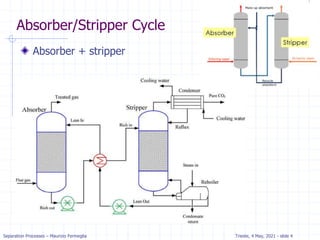
operations, and are often used together as a cycle.
Both absorption and stripping can be operated as
equilibrium stage processes using trayed columns or,
more commonly, using packed columns.
Separation Processes – Maurizio Fermeglia Trieste, 4 May, 2021 - slide 4
Absorber/Stripper Cycle
Absorber + stripper
Separation Processes – Maurizio Fermeglia Trieste, 4 May, 2021 - slide 5
Absorption Systems – Physical
Physical absorption relies on the solubility of a
particular gas in a liquid.
 This solubility is often quite low; consequently, a relatively large
amount of liquid solvent is needed to obtain the required separation.
 This liquid solvent containing the solute is typically regenerated by
heating or stripping to drive the solute back out.
 Because of the low solubility and large solvent amounts required in
physical absorption, chemical absorption is also used…
Examples:
 CO2 and water Acetylene and acetic acid
 CO and water NH3 and acetone
 H2S and water Ethane and carbon disulfide
 NH3 and water N2 and methyl acetate
 NO2 and water NO and ethanol
Separation Processes – Maurizio Fermeglia Trieste, 4 May, 2021 - slide 6
Absorption Systems – Chemical
Chemical absorption relies on reaction of a particular
gas with a reagent in a liquid.
 This absorption can often be quite high; consequently, a smaller
amount of liquid solvent/reagent is needed to obtain the required
separation.
 However, the reagent may be relatively expensive, and it is often
desirable to regenerate when possible.
Examples:
 CO2 / H2S and aqueous ethanol amines
 CO2 / H2S and aqueous hydroxides
 CO and aqueous Cu ammonium salt
 SO2 and aqueous dimethyl aniline
 HCN and aqueous NaOH
 HCl / HF and aqueous NaOH
Separation Processes – Maurizio Fermeglia Trieste, 4 May, 2021 - slide 7
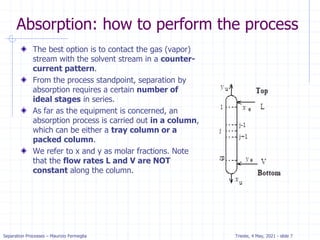
Absorption: how to perform the process
The best option is to contact the gas (vapor)
stream with the solvent stream in a counter-
current pattern.
From the process standpoint, separation by
absorption requires a certain number of
ideal stages in series.
As far as the equipment is concerned, an
absorption process is carried out in a column,
which can be either a tray column or a
packed column.
We refer to x and y as molar fractions. Note
that the flow rates L and V are NOT
constant along the column.
Separation Processes – Maurizio Fermeglia Trieste, 4 May, 2021 - slide 8
Absorption and Stripping – the Problem
The principal difference in handling adsorption and
stripping, compared to distillation, is how we represent
the equilibria (equilibrium curve) and mass balances
(operating lines).
 In distillation, the liquid and vapor streams were assumed to remain
constant under CMO.
 In absorption, we have removal of the solute from the gas stream and
uptake by the solvent liquid stream; thus, the total liquid and gas stream
amounts or flow rates can change.
 Due to absorption, at the bottom the flow rates are larger than at the
top.
 So, it is impossible to obtain an operating line which is a straight
line.
Separation Processes – Maurizio Fermeglia Trieste, 4 May, 2021 - slide 9
Absorption and Stripping Assumptions
If we use mole fractions of the solute and assume that the
gas and liquid stream amounts or flow rates remain constant,
significant error can result if the solute concentration in the
inlet gas stream is greater than about 1%.
 If we can set up our equilibrium curve and operating line to account for this
change in the overall gas and liquid flow rates, we can use the McCabe-
Thiele method to solve absorption and stripping problems.
We assume that:
 The carrier gas is insoluble (or it has a very low solubility), e.g, N2 or Ar in
water.
 The solvent is nonvolatile (or it has a low vapor pressure), e.g., water in air
at low temperatures.
 The system is isothermal. e.g., the effects of heat of solution or reaction are
low or there is a cooling or heating system in the column.
 The system is isobaric.
 The concentration of the solute is low, say <10% – this is the limit for the
use of Henry’s Law.
Separation Processes – Maurizio Fermeglia Trieste, 4 May, 2021 - slide 10
Absorption fundamentals
The separation of components from a gaseous mixture can be
achieved in various ways.
 For example, the fractionation of oxygen and nitrogen from an air stream is carried out by
distillation at a low temperature. This requires a refrigeration cycle but is an economically
sustainable process anyway.
 In other cases, when it is desired to separate only one or some components, it is not
possible to recover the components of interest by condensation because the temperature
required would be too low, and a thermal separation process would not be economically
convenient.
An alternative option is a non-thermal separation process such as
absorption.
In absorption, a second phase is added to the starting gas (or
vapor) mixture, which is a liquid phase often referred to as the
solvent.
 This liquid solvent is chosen so that to maximize its affinity with respect to one (or more)
components of the gas (vapor) phase to be separated from the rest of the gas (vapor).
In a chemical engineering language, the solvent is selected to obtain a
favorable distribution of the components of interest between the
two phases.
Separation Processes – Maurizio Fermeglia Trieste, 4 May, 2021 - slide 11
Absorption fundamentals
The separation by absorption is obtained by suitably contacting the gas
stream with the liquid solvent. With this operation some components can be
transferred from a gaseous to a liquid phase in a selective way.
The aim of an absorption process may be:
1. To recover valuable components by condensing them in the solvent
2. To purify a gas (vapor) stream by separating unwanted heavier components
3. To achieve both 1 and 2 goals
The minimum number of components in an absorption process is 3:
• the component to be recovered by direct condensation in the liquid
• one component in the gas(vapor) phase, which is not condensed
• the solvent, which is heavy enough not to be significantly present in the gas
phase
Separation Processes – Maurizio Fermeglia Trieste, 4 May, 2021 - slide 12
Absorption: equilibrium curve
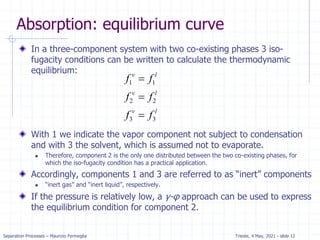
In a three-component system with two co-existing phases 3 iso-
fugacity conditions can be written to calculate the thermodynamic
equilibrium:
With 1 we indicate the vapor component not subject to condensation
and with 3 the solvent, which is assumed not to evaporate.
 Therefore, component 2 is the only one distributed between the two co-existing phases, for
which the iso-fugacity condition has a practical application.
Accordingly, components 1 and 3 are referred to as “inert” components
 “inert gas” and “inert liquid”, respectively.
If the pressure is relatively low, a γ-φ approach can be used to express
the equilibrium condition for component 2.
1 1
2 2
3 3
v l
v l
v l
f f
f f
f f



Separation Processes – Maurizio Fermeglia Trieste, 4 May, 2021 - slide 13
Vapor phase fugacity
Liquid phase fugacity:
Where
Since pure liquid does not exist
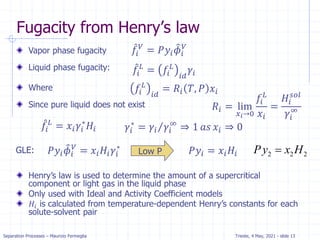
Henry’s law is used to determine the amount of a supercritical
component or light gas in the liquid phase
Only used with Ideal and Activity Coefficient models
𝐻𝑖 is calculated from temperature-dependent Henry’s constants for each
solute-solvent pair
Fugacity from Henry’s law
GLE: Low P
መ
𝑓𝑖
𝑉
= 𝑃𝑦𝑖
෠
𝜙𝑖
𝑉
መ
𝑓𝑖
𝐿
= 𝑓𝑖
𝐿
𝑖𝑑
𝛾𝑖
𝑓𝑖
𝐿
𝑖𝑑
= 𝑅𝑖 𝑇, 𝑃 𝑥𝑖
𝑅𝑖 = lim
𝑥𝑖→0
𝑓𝑖
𝐿
𝑥𝑖
=
𝐻𝑖
𝑠𝑜𝑙
𝛾𝑖
∞
መ
𝑓𝑖
𝐿
= 𝑥𝑖𝛾𝑖
∗
𝐻𝑖 𝛾𝑖
∗
= Τ
𝛾𝑖 𝛾𝑖
∞
⇒ 1 𝑎𝑠 𝑥𝑖 ⇒ 0
𝑃𝑦𝑖
෠
𝜙𝑖
𝑉
= 𝑥𝑖𝐻𝑖𝛾𝑖
∗
𝑃𝑦𝑖 = 𝑥𝑖𝐻𝑖 2 2 2
Py x H

Separation Processes – Maurizio Fermeglia Trieste, 4 May, 2021 - slide 14
Absorption: equilibrium curve
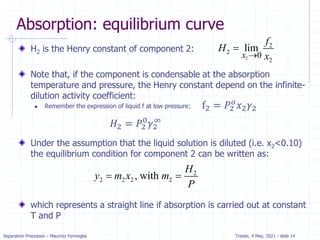
H2 is the Henry constant of component 2:
Note that, if the component is condensable at the absorption
temperature and pressure, the Henry constant depend on the infinite-
dilution activity coefficient:
 Remember the expression of liquid f at low pressure:
Under the assumption that the liquid solution is diluted (i.e. x2<0.10)
the equilibrium condition for component 2 can be written as:
which represents a straight line if absorption is carried out at constant
T and P
2
2
2
2
0
lim
x
f
H
x


2
2 2 2 2
, with
H
y m x m
P
 
f2 = 𝑃2
𝑜
𝑥2𝛾2
𝐻2 = 𝑃2
0
𝛾2
∞
Separation Processes – Maurizio Fermeglia Trieste, 4 May, 2021 - slide 15
Henry’s Law Constants
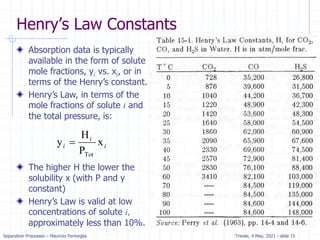
Absorption data is typically
available in the form of solute
mole fractions, yi vs. xi, or in
terms of the Henry’s constant.
Henry’s Law, in terms of the
mole fractions of solute i and
the total pressure, is:
The higher H the lower the
solubility x (with P and y
constant)
Henry’s Law is valid at low
concentrations of solute i,
approximately less than 10%.
i
i
i x
P
H
y
Tot

Separation Processes – Maurizio Fermeglia Trieste, 4 May, 2021 - slide 17
Absorption: different cases
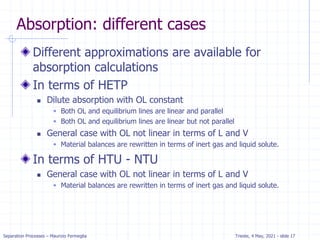
Different approximations are available for
absorption calculations
In terms of HETP
 Dilute absorption with OL constant
 Both OL and equilibrium lines are linear and parallel
 Both OL and equilibrium lines are linear but not parallel
 General case with OL not linear in terms of L and V
 Material balances are rewritten in terms of inert gas and liquid solute.
In terms of HTU - NTU
 General case with OL not linear in terms of L and V
 Material balances are rewritten in terms of inert gas and liquid solute.
Separation Processes – Maurizio Fermeglia Trieste, 4 May, 2021 - slide 18
Absorption: McCabe Thiele solution
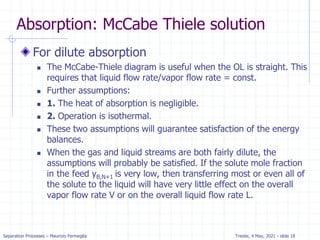
For dilute absorption
 The McCabe-Thiele diagram is useful when the OL is straight. This
requires that liquid flow rate/vapor flow rate = const.
 Further assumptions:
 1. The heat of absorption is negligible.
 2. Operation is isothermal.
 These two assumptions will guarantee satisfaction of the energy
balances.
 When the gas and liquid streams are both fairly dilute, the
assumptions will probably be satisfied. If the solute mole fraction
in the feed yB,N+1 is very low, then transferring most or even all of
the solute to the liquid will have very little effect on the overall
vapor flow rate V or on the overall liquid flow rate L.
Separation Processes – Maurizio Fermeglia Trieste, 4 May, 2021 - slide 19
Absorption: McCabe Thiele solution
For dilute absorption
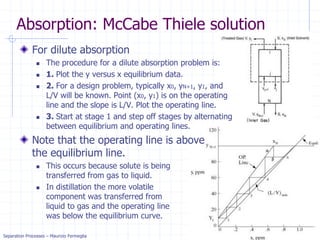
 We can assume that L and V are both constant, and the
operating line on a McCabe-Thiele diagram will be
straight.
 Using the mass balance envelope around the top of the
absorption column shown in Figure, we can write the
solute mass balance for constant L and V.
 Solving for yj+1 we obtain the equation for the McCabe-
Thiele operating line.
 With slope L/V and y-intercept [y1 – (L/V)x0].
 All possible passing streams with compositions (xj, yj+1)
must lie on the operating line.
 This includes the two streams at the top of the absorber
(x0, y1) and the two streams at the bottom of the
absorber (xN, yN+1).
𝑦𝑖+1𝑉 + 𝑥0𝐿 = 𝑦1 + 𝑥𝑦𝐿
𝑦𝑖+1 =
𝐿
𝑉
𝑥𝑗 + [𝑦1 −
𝐿
𝑉
𝑥0]
Separation Processes – Maurizio Fermeglia Trieste, 4 May, 2021 - slide 20
Absorption: McCabe Thiele solution
For dilute absorption
 The procedure for a dilute absorption problem is:
 1. Plot the y versus x equilibrium data.
 2. For a design problem, typically x0, yN+1, y1, and
L/V will be known. Point (x0, y1) is on the operating
line and the slope is L/V. Plot the operating line.
 3. Start at stage 1 and step off stages by alternating
between equilibrium and operating lines.
Note that the operating line is above
the equilibrium line.
 This occurs because solute is being
transferred from gas to liquid.
 In distillation the more volatile
component was transferred from
liquid to gas and the operating line
was below the equilibrium curve.
Separation Processes – Maurizio Fermeglia Trieste, 4 May, 2021 - slide 21
Example: dilute absorption
1000 kmol/h of air containing 100 ppm (mol) of
chloroform at 25°C and 2.0 atmosphere is to be
processed.
We plan to absorb the chloroform with pure water at
25°C.
Operation is at L/V = 1.4 (L/V)min.
If we want an outlet air stream containing 10.0 ppm
chloroform, how many equilibrium stages are required?
Separation Processes – Maurizio Fermeglia Trieste, 4 May, 2021 - slide 22
c
a
Example: dilute absorption
Solution
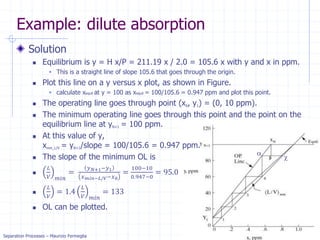
 Equilibrium is y = H x/P = 211.19 x / 2.0 = 105.6 x with y and x in ppm.
 This is a straight line of slope 105.6 that goes through the origin.
 Plot this line on a y versus x plot, as shown in Figure.
 calculate xequil at y = 100 as xequil = 100/105.6 = 0.947 ppm and plot this point.
 The operating line goes through point (x0, y1) = (0, 10 ppm).
 The minimum operating line goes through this point and the point on the
equilibrium line at yN+1 = 100 ppm.
 At this value of y,
xmin_L/V = yN+1/slope = 100/105.6 = 0.947 ppm.
 The slope of the minimum OL is

𝐿
𝑉 𝑚𝑖𝑛
=
𝑦𝑁+1−𝑦1
𝑥𝑚𝑖𝑛−𝐿/𝑉−𝑥0
=
100−10
0.947−0
= 95.0

𝐿
𝑉
= 1.4
𝐿
𝑉 𝑚𝑖𝑛
= 133
 OL can be plotted.
Separation Processes – Maurizio Fermeglia Trieste, 4 May, 2021 - slide 23
c
a
Example: dilute absorption
 Equation of OL is valid when j=N.
 Solving for xN with x0=0 we get.
 xN= (yN+1-y1) / (L/V) =
(100-10) / 133 = .68 ppm
 Five equilibrium stages are
more than sufficient.
 If desired, we can estimate a
fractional number of
equilibrium contacts:
𝑦𝑖+1 =
𝐿
𝑉
𝑥𝑗 + [𝑦1 −
𝐿
𝑉
𝑥0]
Fraction = (distance from OL to xN)/
(distance from OL to equilibrium line)
= (distance a to b)/(distance a to c)
= 0.08/0.2 = 0.4
Thus, we need 4.4 equilibrium contacts.
Separation Processes – Maurizio Fermeglia Trieste, 4 May, 2021 - slide 24
Stripping analysis for dilute systems
Since stripping is very similar to absorption we expect the
method to be similar.
 The mass balance for the column is the same and the OL is the same:
 For stripping we know x0, xN, yN+1, and L/V. Since (xN, yN+1) is a point on
the operating line, we can plot the operating line and step off stages.
𝑦𝑖+1 =
𝐿
𝑉
𝑥𝑗 + [𝑦1 −
𝐿
𝑉
𝑥0]
Separation Processes – Maurizio Fermeglia Trieste, 4 May, 2021 - slide 25
Stripping analysis for dilute systems
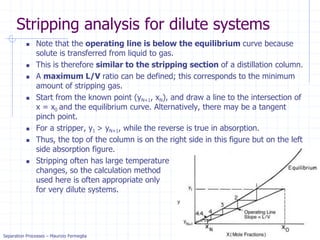
 Note that the operating line is below the equilibrium curve because
solute is transferred from liquid to gas.
 This is therefore similar to the stripping section of a distillation column.
 A maximum L/V ratio can be defined; this corresponds to the minimum
amount of stripping gas.
 Start from the known point (yN+1, xN), and draw a line to the intersection of
x = x0 and the equilibrium curve. Alternatively, there may be a tangent
pinch point.
 For a stripper, y1 > yN+1, while the reverse is true in absorption.
 Thus, the top of the column is on the right side in this figure but on the left
side absorption figure.
 Stripping often has large temperature
changes, so the calculation method
used here is often appropriate only
for very dilute systems.
Separation Processes – Maurizio Fermeglia Trieste, 4 May, 2021 - slide 26
Analytical solution for dilute systems:
Kremser equation
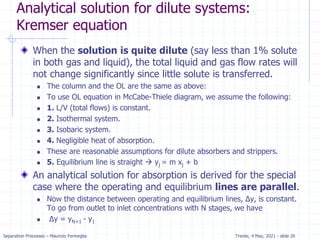
When the solution is quite dilute (say less than 1% solute
in both gas and liquid), the total liquid and gas flow rates will
not change significantly since little solute is transferred.
 The column and the OL are the same as above:
 To use OL equation in McCabe-Thiele diagram, we assume the following:
 1. L/V (total flows) is constant.
 2. Isothermal system.
 3. Isobaric system.
 4. Negligible heat of absorption.
 These are reasonable assumptions for dilute absorbers and strippers.
 5. Equilibrium line is straight  yj = m xj + b
An analytical solution for absorption is derived for the special
case where the operating and equilibrium lines are parallel.
 Now the distance between operating and equilibrium lines, Δy, is constant.
To go from outlet to inlet concentrations with N stages, we have
 Δy = yN+1 - y1
Separation Processes – Maurizio Fermeglia Trieste, 4 May, 2021 - slide 27
Analytical solution for dilute systems:
Kremser equation
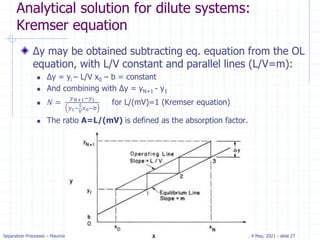
Δy may be obtained subtracting eq. equation from the OL
equation, with L/V constant and parallel lines (L/V=m):
 Δy = yi – L/V x0 – b = constant
 And combining with Δy = yN+1 - y1
 𝑁 =
𝑦𝑁+1−𝑦1
𝑦1−
𝐿
𝑉
𝑥0−𝑏
for L/(mV)=1 (Kremser equation)
 The ratio A=L/(mV) is defined as the absorption factor.
Separation Processes – Maurizio Fermeglia Trieste, 4 May, 2021 - slide 28
Analytical solution for dilute systems:
Kremser equation
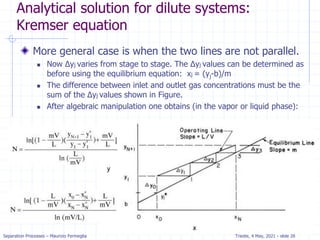
More general case is when the two lines are not parallel.
 Now Δyj varies from stage to stage. The Δyj values can be determined as
before using the equilibrium equation: xj = (yj-b)/m
 The difference between inlet and outlet gas concentrations must be the
sum of the Δyj values shown in Figure.
 After algebraic manipulation one obtains (in the vapor or liquid phase):
Separation Processes – Maurizio Fermeglia Trieste, 4 May, 2021 - slide 31
Absorption: the Kremse-Brown-Souders equation
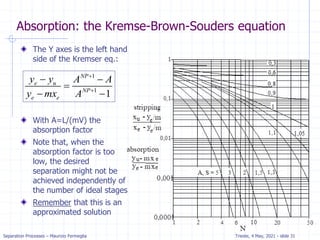
The Y axes is the left hand
side of the Kremser eq.:
With A=L/(mV) the
absorption factor
Note that, when the
absorption factor is too
low, the desired
separation might not be
achieved independently of
the number of ideal stages
Remember that this is an
approximated solution
1
1
1
NP
e u
NP
e e
y y A A
y mx A


 

 
Separation Processes – Maurizio Fermeglia Trieste, 4 May, 2021 - slide 35
Absorption and Stripping: circumventing the
Problem
While the total gas and liquid streams can change in
absorption, the flow rate of the carrier gas, which we
assume to be insoluble in the solvent, does not change.
Similarly, the flow rate of the solvent, which we
assume to be nonvolatile, does not change.
Consequently, we can define our equilibrium curve and
operating line in terms of mole ratios with respect to
the carrier gas and solvent, instead of mole fractions as
we did in distillation.
Doing so circumvents the problem of the changing
total gas and liquid stream amounts or flow rates in
absorption and stripping.
Separation Processes – Maurizio Fermeglia Trieste, 4 May, 2021 - slide 36
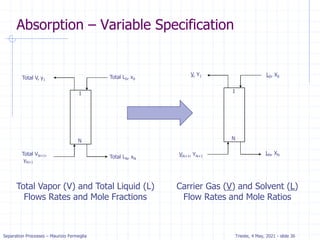
Absorption – Variable Specification
Total Vapor (V) and Total Liquid (L)
Flows Rates and Mole Fractions
Carrier Gas (V) and Solvent (L)
Flow Rates and Mole Ratios
L0, X0
V, Y1
LN, XN
VN+1, YN+1
1
N
Total L0, x0
Total V, y1
Total LN, xN
Total VN+1,
yN+1
1
N
Separation Processes – Maurizio Fermeglia Trieste, 4 May, 2021 - slide 37
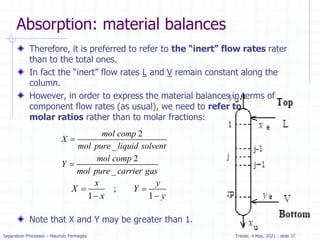
Absorption: material balances
Therefore, it is preferred to refer to the “inert” flow rates rater
than to the total ones.
In fact the “inert” flow rates L and V remain constant along the
column.
However, in order to express the material balances in terms of
component flow rates (as usual), we need to refer to
molar ratios rather than to molar fractions:
Note that X and Y may be greater than 1.
2
_
mol comp
X
mol pure liquid solvent

2
_
mol comp
Y
mol pure carrier gas

;
1 1
x y
X Y
x y
 
 
Separation Processes – Maurizio Fermeglia Trieste, 4 May, 2021 - slide 38
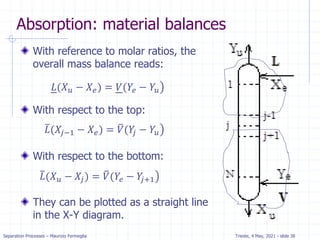
Absorption: material balances
With reference to molar ratios, the
overall mass balance reads:
With respect to the top:
With respect to the bottom:
They can be plotted as a straight line
in the X-Y diagram.
൯
𝐿(𝑋𝑢 − 𝑋𝑒) = 𝑉(𝑌𝑒 − 𝑌𝑢
൯
ത
𝐿(𝑋𝑗−1 − 𝑋𝑒) = ത
𝑉(𝑌
𝑗 − 𝑌𝑢
൯
ത
𝐿(𝑋𝑢 − 𝑋𝑗) = ത
𝑉(𝑌𝑒 − 𝑌
𝑗+1
Separation Processes – Maurizio Fermeglia Trieste, 4 May, 2021 - slide 39
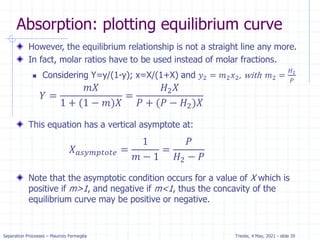
Absorption: plotting equilibrium curve
However, the equilibrium relationship is not a straight line any more.
In fact, molar ratios have to be used instead of molar fractions.
 Considering Y=y/(1-y); x=X/(1+X) and 𝑦2 = 𝑚2𝑥2, with 𝑚2 =
𝐻2
𝑃
This equation has a vertical asymptote at:
Note that the asymptotic condition occurs for a value of X which is
positive if m>1, and negative if m<1, thus the concavity of the
equilibrium curve may be positive or negative.
𝑌 =
𝑚𝑋
1 + (1 − 𝑚)𝑋
=
𝐻2𝑋
𝑃 + (𝑃 − 𝐻2)𝑋
𝑋𝑎𝑠𝑦𝑚𝑝𝑡𝑜𝑡𝑒 =
1
𝑚 − 1
=
𝑃
𝐻2 − 𝑃
Separation Processes – Maurizio Fermeglia Trieste, 4 May, 2021 - slide 40
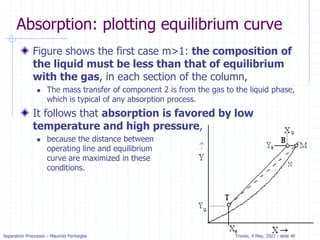
Absorption: plotting equilibrium curve
Figure shows the first case m>1: the composition of
the liquid must be less than that of equilibrium
with the gas, in each section of the column,
 The mass transfer of component 2 is from the gas to the liquid phase,
which is typical of any absorption process.
It follows that absorption is favored by low
temperature and high pressure,
 because the distance between
operating line and equilibrium
curve are maximized in these
conditions.
Separation Processes – Maurizio Fermeglia Trieste, 4 May, 2021 - slide 41
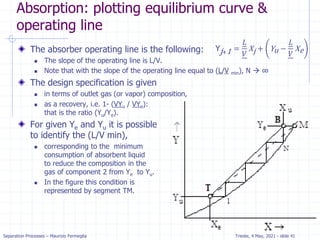
Absorption: plotting equilibrium curve &
operating line
The absorber operating line is the following:
 The slope of the operating line is L/V.
 Note that with the slope of the operating line equal to (L/V min), N  ∞
The design specification is given
 in terms of outlet gas (or vapor) composition,
 as a recovery, i.e. 1- (VYu / VYe):
that is the ratio (Yu/Ye).
For given Ye and Yu it is possible
to identify the (L/V min),
 corresponding to the minimum
consumption of absorbent liquid
to reduce the composition in the
gas of component 2 from Ye to Yu.
 In the figure this condition is
represented by segment TM.
Yj+1 =
𝐿
𝑉
Xj + Yu −
𝐿
𝑉
Xe
Separation Processes – Maurizio Fermeglia Trieste, 4 May, 2021 - slide 42
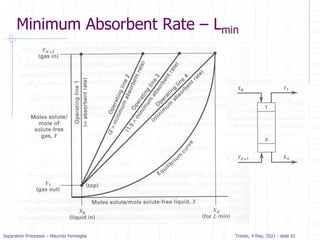
Minimum Absorbent Rate – Lmin
Separation Processes – Maurizio Fermeglia Trieste, 4 May, 2021 - slide 51
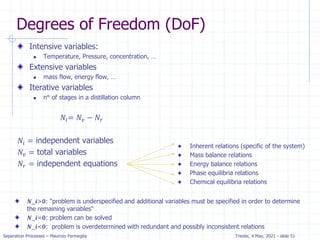
Degrees of Freedom (DoF)
Inherent relations (specific of the system)
Mass balance relations
Energy balance relations
Phase equilibria relations
Chemical equilibria relations
Intensive variables:
 Temperature, Pressure, concentration, …
Extensive variables
 mass flow, energy flow, …
Iterative variables
 n° of stages in a distillation column
𝑁𝑖= 𝑁𝑣 − 𝑁𝑟
𝑁𝑖 = independent variables
𝑁𝑣 = total variables
𝑁𝑟 = independent equations
𝑵_𝒊>𝟎: "problem is underspecified and additional variables must be specified in order to determine
the remaining variables"
𝑵_𝒊=𝟎: problem can be solved
𝑵_𝒊<𝟎: problem is overdetermined with redundant and possibly inconsistent relations
Separation Processes – Maurizio Fermeglia Trieste, 4 May, 2021 - slide 52
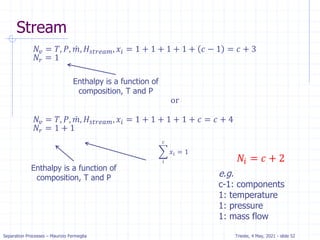
𝑁𝑣 = 𝑇, 𝑃, ሶ
𝑚, 𝐻𝑠𝑡𝑟𝑒𝑎𝑚, 𝑥𝑖 = 1 + 1 + 1 + 1 + 𝑐 − 1 = 𝑐 + 3
𝑁𝑟 = 1
or
𝑁𝑣 = 𝑇, 𝑃, ሶ
𝑚, 𝐻𝑠𝑡𝑟𝑒𝑎𝑚, 𝑥𝑖 = 1 + 1 + 1 + 1 + 𝑐 = 𝑐 + 4
𝑁𝑟 = 1 + 1
෍
𝑖
𝑐
𝑥𝑖 = 1
𝑁𝑖 = 𝑐 + 2
Enthalpy is a function of
composition, T and P
Enthalpy is a function of
composition, T and P e.g.
c-1: components
1: temperature
1: pressure
1: mass flow
Stream
Separation Processes – Maurizio Fermeglia Trieste, 4 May, 2021 - slide 53
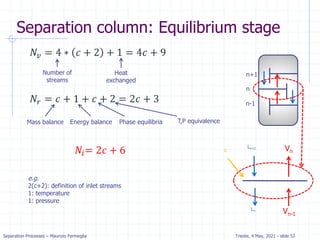
Separation column: Equilibrium stage
𝑁𝑣 = 4 ∗ 𝑐 + 2 + 1 = 4𝑐 + 9
𝑁𝑟 = 𝑐 + 1 + 𝑐 + 2 = 2𝑐 + 3
𝑁𝑖= 2𝑐 + 6
Heat
exchanged
Number of
streams
Mass balance
e.g.
2(c+2): definition of inlet streams
1: temperature
1: pressure
Energy balance Phase equilibria
Ln+1
Vn-1
Vn
Ln
n
n+1
n-1
T,P equivalence
q
Separation Processes – Maurizio Fermeglia Trieste, 4 May, 2021 - slide 54
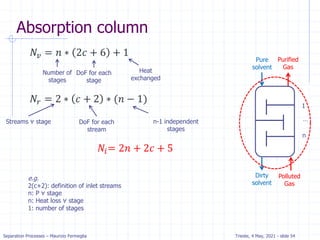
Absorption column
𝑁𝑣 = 𝑛 ∗ 2𝑐 + 6 + 1
𝑁𝑟 = 2 ∗ 𝑐 + 2 ∗ (𝑛 − 1)
𝑁𝑖= 2𝑛 + 2𝑐 + 5
DoF for each
stage
Number of
stages
Streams ∀ stage
e.g.
2(c+2): definition of inlet streams
n: P ∀ stage
n: Heat loss ∀ stage
1: number of stages
DoF for each
stream
n-1 independent
stages
…
1
n
Pure
solvent
Purified
Gas
Polluted
Gas
Dirty
solvent
Heat
exchanged
Separation Processes – Maurizio Fermeglia Trieste, 4 May, 2021 - slide 55
Absorption: number of degrees of freedom
For an absorption stack of NP ideal contact stages, the
number of degrees of freedom is given by:
𝑁𝑖 = 2𝑛 + 2𝑐 + 5
Usually, the values of n thermal dispersions are known,
and those of n pressures must be assigned, as well as C
+ 2 variables of the two feeds are set, so that only 1
degree of freedom remains.
This is an uncomfortable situation, leading to no degrees
of freedom in rating problems.
So, it is decided to increase this number by 1, considering
the inlet liquid flow rate as the second degree of freedom.
So, an absorption column has two degrees of freedom in
process design (for instance Yu and L ) and one in process
rating (for instance Yu).
Separation Processes – Maurizio Fermeglia Trieste, 4 May, 2021 - slide 56
Absorption: selection of degrees of freedom
In design mode:
 When designing a continuous counter-current absorption process, Yu is
usually the design specification.
 The flow rate L of the liquid absorbent (the solvent) is the second degree
of freedom, and is usually kept a lower as possible, to reduce costs
related to the solvent purification and product recovery downstream.
In rating mode:
 In the case of rating, the only available degree of freedom is set on Yu,
which is again the design specification, and the liquid flow rate is the one
resulting from calculation.
It is noteworthy that, differently from a distillation
process, an absorption process is more complicated
because it requires at least two steps:
 the absorption one, followed by a step to regenerate the solvent, and to
recover the product of interest from the mixture with the solvent.
 This second step can be achieved in a number of ways.
Separation Processes – Maurizio Fermeglia Trieste, 4 May, 2021 - slide 57
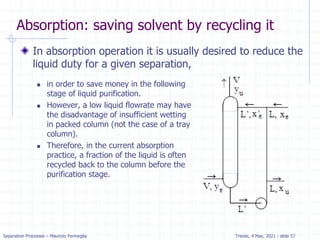
Absorption: saving solvent by recycling it
In absorption operation it is usually desired to reduce the
liquid duty for a given separation,
 in order to save money in the following
stage of liquid purification.
 However, a low liquid flowrate may have
the disadvantage of insufficient wetting
in packed column (not the case of a tray
column).
 Therefore, in the current absorption
practice, a fraction of the liquid is often
recycled back to the column before the
purification stage.
Separation Processes – Maurizio Fermeglia Trieste, 4 May, 2021 - slide 58
Absorption: saving solvent by recycling it
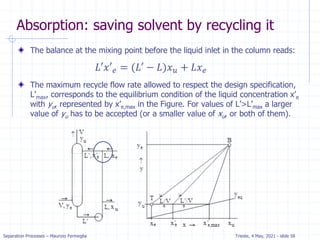
The balance at the mixing point before the liquid inlet in the column reads:
The maximum recycle flow rate allowed to respect the design specification,
L’max, corresponds to the equilibrium condition of the liquid concentration x’e
with yu, represented by x’e,max in the Figure. For values of L’>L’max a larger
value of yu has to be accepted (or a smaller value of xu, or both of them).
𝐿′𝑥′𝑒 = (𝐿′ − 𝐿)𝑥𝑢 + 𝐿𝑥𝑒
Separation Processes – Maurizio Fermeglia Trieste, 4 May, 2021 - slide 59
Absorption: overall energy balance
The absorption of gaseous components in a liquid phase is an
exothermic process, as absorption is a partial condensation
by direct contact.
 So, the energy released upon condensation has to be disposed of in some way.
If the column is assumed to be adiabatic, as occurs in practice,
this energy increases the temperature inside the column.
 The resulting temperature profile increases from the top to the bottom of the
column.
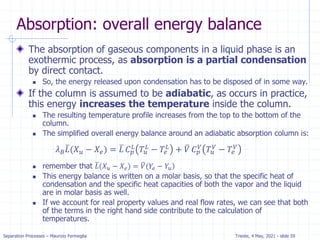
 The simplified overall energy balance around an adiabatic absorption column is:
 remember that )
ത
𝐿(𝑋𝑢 − 𝑋𝑒) = ത
𝑉(𝑌𝑒 − 𝑌𝑢
 This energy balance is written on a molar basis, so that the specific heat of
condensation and the specific heat capacities of both the vapor and the liquid
are in molar basis as well.
 If we account for real property values and real flow rates, we can see that both
of the terms in the right hand side contribute to the calculation of
temperatures.
𝜆𝐵
ത
𝐿(𝑋𝑢 − 𝑋𝑒) = ത
𝐿 𝐶𝑝
𝐿
𝑇𝑢
𝐿
− 𝑇𝑒
𝐿
+ ത
𝑉 𝐶𝑝
𝑉
𝑇𝑢
𝑉
− 𝑇𝑒
𝑉
Separation Processes – Maurizio Fermeglia Trieste, 4 May, 2021 - slide 60
Absorption: adiabatic versus isothermal process
Therefore, the energy balance equation has to be used together with
material balances and to the equilibrium relationship to calculate an
adiabatic absorption process.
 The solution of this model requires an iterative procedure.
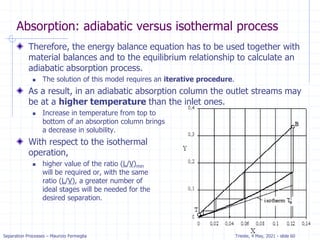
As a result, in an adiabatic absorption column the outlet streams may
be at a higher temperature than the inlet ones.
 Increase in temperature from top to
bottom of an absorption column brings
a decrease in solubility.
With respect to the isothermal
operation,
 higher value of the ratio (L/V)min
will be required or, with the same
ratio (L/V), a greater number of
ideal stages will be needed for the
desired separation.
Separation Processes – Maurizio Fermeglia Trieste, 4 May, 2021 - slide 61
Notes on Absorbers (1)
Note that the operating line for an absorber is above
the equilibrium curve.
 For a given solute concentration in the liquid, the solute concentration in
the gas is always greater than the equilibrium value, which provides the
driving force for the separation.
The solute is transferred from the gas to the liquid in
absorption.
 In distillation, we plotted the more volatile component, which was
transferred from the liquid to the gas.
 In distillation, if we had plotted the less volatile component, which was
transferred from the gas to the liquid, the OL would also lie above the
equilibrium curve.
Separation Processes – Maurizio Fermeglia Trieste, 4 May, 2021 - slide 62
Notes on Absorbers (2)
Also note that the OL is linear if we use mole ratios.
 This results because of the form of the operating line where L/V is a
constant.
 L and V are based upon the nonvolatile solvent and insoluble carrier gas,
respectively, which do not change.
 If we had used mole fractions and total gas and liquid rates, the OL
would be curved because the total gas and liquid rates would change
since we are removing the solute from the gas and absorbing it into the
liquid.
One could use mole fractions and the total gas and liquid
streams in our calculations only if the solute is in low
concentrations, say < 1%, in most systems.
 Don’t confuse this requirement with that for the use of Henry’s Law,
which requires low solute concentrations, < 10%, to be valid.
Separation Processes – Maurizio Fermeglia Trieste, 4 May, 2021 - slide 63
Notes on Absorbers (3)
Note the location of the top and bottom of the column on
the McCabe Thiele diagram.
 We will typically step down from the top of the column, which is
equivalent to stepping up on the McCabe-Thiele plot for absorption.
Since we are starting on the OL, we need to express the
equilibrium curve in terms of XEq = XEq(YEq).
 Although this appears to be opposite of what we did in distillation, where
we used yEq = yEq(xEq) when stepping up the plot, remember that we are
still stepping down from the top of the column on the absorption plot.
We use YEq vs. XEq to plot the equilibrium curve, but we
also need XEq vs YEq to actually solve the problem
analytically.
Separation Processes – Maurizio Fermeglia Trieste, 4 May, 2021 - slide 64
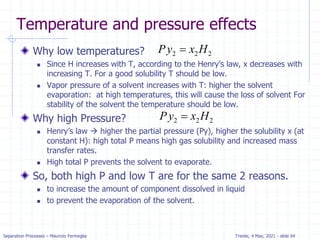
Temperature and pressure effects
Why low temperatures?
 Since H increases with T, according to the Henry’s law, x decreases with
increasing T. For a good solubility T should be low.
 Vapor pressure of a solvent increases with T: higher the solvent
evaporation: at high temperatures, this will cause the loss of solvent For
stability of the solvent the temperature should be low.
Why high Pressure?
 Henry’s law  higher the partial pressure (Py), higher the solubility x (at
constant H): high total P means high gas solubility and increased mass
transfer rates.
 High total P prevents the solvent to evaporate.
So, both high P and low T are for the same 2 reasons.
 to increase the amount of component dissolved in liquid
 to prevent the evaporation of the solvent.
2 2 2
Py x H

2 2 2
Py x H

Separation Processes – Maurizio Fermeglia Trieste, 4 May, 2021 - slide 65
Absorption with Radfrac
It is desired to absorb acetone from air into water.
 The column and feed streams are at 1 atm.
 The inlet gas stream is 3.2 mol% acetone.
 Flow of inlet gas is 100 kmol/h.
 Inlet gas is at 30°C.
 Water flow rate is 200 kmol/h.
 Inlet water is pure and temperature is 20°C.
 N = 6.
Desired specification: 0.003 max mole fraction in gas out
Find the outlet concentrations and flow rates.
Separation Processes – Maurizio Fermeglia Trieste, 4 May, 2021 - slide 66
Absorption with Radfrac
Base case:
 Look at the temperature profile and note the temperature maximum. Look
at the concentration profiles. Does the outlet vapor meet the acetone
requirement?
 Where does all the water in the outlet gas come from?
Case 1:
 Decrease the water flow rate to 100 kmol/h and run again. Do you meet
the required acetone concentration in the gas?
Case 2:
 Double the number of stages to 12 with L = 100. Does this help reduce
the outlet vapor mole frac of acetone significantly?
Case 3:
 Return to N = 6 with L = 100. Reduce the temperature of both the feed
gas and the inlet water to 10°C.
 Did this allow you to meet the outlet specifications for air?
 Did the amount of water in the air decrease? (Why?)
 Do you see much change in the outlet concentration of the liquid stream?
Case 4:
 Repeat case 3 but with feed, solvent, and absorber all at 2.0 atm.

Modelling absorption column for engineers

  • 1.
    Absorption Maurizio Fermeglia Maurizio.fermeglia@units.it Department ofEngineering & Architecture University of Trieste
  • 2.
    Separation Processes –Maurizio Fermeglia Trieste, 4 May, 2021 - slide 2 Agenda Absorption and stripping: introduction Absorption process fundamentals Henry’s law and phase equilibrium Absorption: McCabe Thiele solution for dilute solutions Stripping analysis for dilute systems Analytical solution for dilute systems: Kremser equation Relationship of HETP and HTU Absorption: general case of non dilute solutions Absorption: calculation of equilibrium and material balances Degrees of freedom Recycling of the solvent Energy balances and adiabatic process The Kremse-Brown-Souders equation Absorption with Radfrac
  • 3.
    Separation Processes –Maurizio Fermeglia Trieste, 4 May, 2021 - slide 3 Absorption and Stripping Absorption (or scrubbing) is the removal of a component (the solute or absorbate) from a gas stream via uptake by a nonvolatile liquid (the solvent or absorbent). Desorption (or stripping) is the removal of a component from a liquid stream via vaporization and uptake by an insoluble gas stream. Thus, absorption and stripping are opposite unit operations, and are often used together as a cycle. Both absorption and stripping can be operated as equilibrium stage processes using trayed columns or, more commonly, using packed columns.
  • 4.
    Separation Processes –Maurizio Fermeglia Trieste, 4 May, 2021 - slide 4 Absorber/Stripper Cycle Absorber + stripper
  • 5.
    Separation Processes –Maurizio Fermeglia Trieste, 4 May, 2021 - slide 5 Absorption Systems – Physical Physical absorption relies on the solubility of a particular gas in a liquid.  This solubility is often quite low; consequently, a relatively large amount of liquid solvent is needed to obtain the required separation.  This liquid solvent containing the solute is typically regenerated by heating or stripping to drive the solute back out.  Because of the low solubility and large solvent amounts required in physical absorption, chemical absorption is also used… Examples:  CO2 and water Acetylene and acetic acid  CO and water NH3 and acetone  H2S and water Ethane and carbon disulfide  NH3 and water N2 and methyl acetate  NO2 and water NO and ethanol
  • 6.
    Separation Processes –Maurizio Fermeglia Trieste, 4 May, 2021 - slide 6 Absorption Systems – Chemical Chemical absorption relies on reaction of a particular gas with a reagent in a liquid.  This absorption can often be quite high; consequently, a smaller amount of liquid solvent/reagent is needed to obtain the required separation.  However, the reagent may be relatively expensive, and it is often desirable to regenerate when possible. Examples:  CO2 / H2S and aqueous ethanol amines  CO2 / H2S and aqueous hydroxides  CO and aqueous Cu ammonium salt  SO2 and aqueous dimethyl aniline  HCN and aqueous NaOH  HCl / HF and aqueous NaOH
  • 7.
    Separation Processes –Maurizio Fermeglia Trieste, 4 May, 2021 - slide 7 Absorption: how to perform the process The best option is to contact the gas (vapor) stream with the solvent stream in a counter- current pattern. From the process standpoint, separation by absorption requires a certain number of ideal stages in series. As far as the equipment is concerned, an absorption process is carried out in a column, which can be either a tray column or a packed column. We refer to x and y as molar fractions. Note that the flow rates L and V are NOT constant along the column.
  • 8.
    Separation Processes –Maurizio Fermeglia Trieste, 4 May, 2021 - slide 8 Absorption and Stripping – the Problem The principal difference in handling adsorption and stripping, compared to distillation, is how we represent the equilibria (equilibrium curve) and mass balances (operating lines).  In distillation, the liquid and vapor streams were assumed to remain constant under CMO.  In absorption, we have removal of the solute from the gas stream and uptake by the solvent liquid stream; thus, the total liquid and gas stream amounts or flow rates can change.  Due to absorption, at the bottom the flow rates are larger than at the top.  So, it is impossible to obtain an operating line which is a straight line.
  • 9.
    Separation Processes –Maurizio Fermeglia Trieste, 4 May, 2021 - slide 9 Absorption and Stripping Assumptions If we use mole fractions of the solute and assume that the gas and liquid stream amounts or flow rates remain constant, significant error can result if the solute concentration in the inlet gas stream is greater than about 1%.  If we can set up our equilibrium curve and operating line to account for this change in the overall gas and liquid flow rates, we can use the McCabe- Thiele method to solve absorption and stripping problems. We assume that:  The carrier gas is insoluble (or it has a very low solubility), e.g, N2 or Ar in water.  The solvent is nonvolatile (or it has a low vapor pressure), e.g., water in air at low temperatures.  The system is isothermal. e.g., the effects of heat of solution or reaction are low or there is a cooling or heating system in the column.  The system is isobaric.  The concentration of the solute is low, say <10% – this is the limit for the use of Henry’s Law.
  • 10.
    Separation Processes –Maurizio Fermeglia Trieste, 4 May, 2021 - slide 10 Absorption fundamentals The separation of components from a gaseous mixture can be achieved in various ways.  For example, the fractionation of oxygen and nitrogen from an air stream is carried out by distillation at a low temperature. This requires a refrigeration cycle but is an economically sustainable process anyway.  In other cases, when it is desired to separate only one or some components, it is not possible to recover the components of interest by condensation because the temperature required would be too low, and a thermal separation process would not be economically convenient. An alternative option is a non-thermal separation process such as absorption. In absorption, a second phase is added to the starting gas (or vapor) mixture, which is a liquid phase often referred to as the solvent.  This liquid solvent is chosen so that to maximize its affinity with respect to one (or more) components of the gas (vapor) phase to be separated from the rest of the gas (vapor). In a chemical engineering language, the solvent is selected to obtain a favorable distribution of the components of interest between the two phases.
  • 11.
    Separation Processes –Maurizio Fermeglia Trieste, 4 May, 2021 - slide 11 Absorption fundamentals The separation by absorption is obtained by suitably contacting the gas stream with the liquid solvent. With this operation some components can be transferred from a gaseous to a liquid phase in a selective way. The aim of an absorption process may be: 1. To recover valuable components by condensing them in the solvent 2. To purify a gas (vapor) stream by separating unwanted heavier components 3. To achieve both 1 and 2 goals The minimum number of components in an absorption process is 3: • the component to be recovered by direct condensation in the liquid • one component in the gas(vapor) phase, which is not condensed • the solvent, which is heavy enough not to be significantly present in the gas phase
  • 12.
    Separation Processes –Maurizio Fermeglia Trieste, 4 May, 2021 - slide 12 Absorption: equilibrium curve In a three-component system with two co-existing phases 3 iso- fugacity conditions can be written to calculate the thermodynamic equilibrium: With 1 we indicate the vapor component not subject to condensation and with 3 the solvent, which is assumed not to evaporate.  Therefore, component 2 is the only one distributed between the two co-existing phases, for which the iso-fugacity condition has a practical application. Accordingly, components 1 and 3 are referred to as “inert” components  “inert gas” and “inert liquid”, respectively. If the pressure is relatively low, a γ-φ approach can be used to express the equilibrium condition for component 2. 1 1 2 2 3 3 v l v l v l f f f f f f   
  • 13.
    Separation Processes –Maurizio Fermeglia Trieste, 4 May, 2021 - slide 13 Vapor phase fugacity Liquid phase fugacity: Where Since pure liquid does not exist Henry’s law is used to determine the amount of a supercritical component or light gas in the liquid phase Only used with Ideal and Activity Coefficient models 𝐻𝑖 is calculated from temperature-dependent Henry’s constants for each solute-solvent pair Fugacity from Henry’s law GLE: Low P መ 𝑓𝑖 𝑉 = 𝑃𝑦𝑖 ෠ 𝜙𝑖 𝑉 መ 𝑓𝑖 𝐿 = 𝑓𝑖 𝐿 𝑖𝑑 𝛾𝑖 𝑓𝑖 𝐿 𝑖𝑑 = 𝑅𝑖 𝑇, 𝑃 𝑥𝑖 𝑅𝑖 = lim 𝑥𝑖→0 𝑓𝑖 𝐿 𝑥𝑖 = 𝐻𝑖 𝑠𝑜𝑙 𝛾𝑖 ∞ መ 𝑓𝑖 𝐿 = 𝑥𝑖𝛾𝑖 ∗ 𝐻𝑖 𝛾𝑖 ∗ = Τ 𝛾𝑖 𝛾𝑖 ∞ ⇒ 1 𝑎𝑠 𝑥𝑖 ⇒ 0 𝑃𝑦𝑖 ෠ 𝜙𝑖 𝑉 = 𝑥𝑖𝐻𝑖𝛾𝑖 ∗ 𝑃𝑦𝑖 = 𝑥𝑖𝐻𝑖 2 2 2 Py x H 
  • 14.
    Separation Processes –Maurizio Fermeglia Trieste, 4 May, 2021 - slide 14 Absorption: equilibrium curve H2 is the Henry constant of component 2: Note that, if the component is condensable at the absorption temperature and pressure, the Henry constant depend on the infinite- dilution activity coefficient:  Remember the expression of liquid f at low pressure: Under the assumption that the liquid solution is diluted (i.e. x2<0.10) the equilibrium condition for component 2 can be written as: which represents a straight line if absorption is carried out at constant T and P 2 2 2 2 0 lim x f H x   2 2 2 2 2 , with H y m x m P   f2 = 𝑃2 𝑜 𝑥2𝛾2 𝐻2 = 𝑃2 0 𝛾2 ∞
  • 15.
    Separation Processes –Maurizio Fermeglia Trieste, 4 May, 2021 - slide 15 Henry’s Law Constants Absorption data is typically available in the form of solute mole fractions, yi vs. xi, or in terms of the Henry’s constant. Henry’s Law, in terms of the mole fractions of solute i and the total pressure, is: The higher H the lower the solubility x (with P and y constant) Henry’s Law is valid at low concentrations of solute i, approximately less than 10%. i i i x P H y Tot 
  • 16.
    Separation Processes –Maurizio Fermeglia Trieste, 4 May, 2021 - slide 17 Absorption: different cases Different approximations are available for absorption calculations In terms of HETP  Dilute absorption with OL constant  Both OL and equilibrium lines are linear and parallel  Both OL and equilibrium lines are linear but not parallel  General case with OL not linear in terms of L and V  Material balances are rewritten in terms of inert gas and liquid solute. In terms of HTU - NTU  General case with OL not linear in terms of L and V  Material balances are rewritten in terms of inert gas and liquid solute.
  • 17.
    Separation Processes –Maurizio Fermeglia Trieste, 4 May, 2021 - slide 18 Absorption: McCabe Thiele solution For dilute absorption  The McCabe-Thiele diagram is useful when the OL is straight. This requires that liquid flow rate/vapor flow rate = const.  Further assumptions:  1. The heat of absorption is negligible.  2. Operation is isothermal.  These two assumptions will guarantee satisfaction of the energy balances.  When the gas and liquid streams are both fairly dilute, the assumptions will probably be satisfied. If the solute mole fraction in the feed yB,N+1 is very low, then transferring most or even all of the solute to the liquid will have very little effect on the overall vapor flow rate V or on the overall liquid flow rate L.
  • 18.
    Separation Processes –Maurizio Fermeglia Trieste, 4 May, 2021 - slide 19 Absorption: McCabe Thiele solution For dilute absorption  We can assume that L and V are both constant, and the operating line on a McCabe-Thiele diagram will be straight.  Using the mass balance envelope around the top of the absorption column shown in Figure, we can write the solute mass balance for constant L and V.  Solving for yj+1 we obtain the equation for the McCabe- Thiele operating line.  With slope L/V and y-intercept [y1 – (L/V)x0].  All possible passing streams with compositions (xj, yj+1) must lie on the operating line.  This includes the two streams at the top of the absorber (x0, y1) and the two streams at the bottom of the absorber (xN, yN+1). 𝑦𝑖+1𝑉 + 𝑥0𝐿 = 𝑦1 + 𝑥𝑦𝐿 𝑦𝑖+1 = 𝐿 𝑉 𝑥𝑗 + [𝑦1 − 𝐿 𝑉 𝑥0]
  • 19.
    Separation Processes –Maurizio Fermeglia Trieste, 4 May, 2021 - slide 20 Absorption: McCabe Thiele solution For dilute absorption  The procedure for a dilute absorption problem is:  1. Plot the y versus x equilibrium data.  2. For a design problem, typically x0, yN+1, y1, and L/V will be known. Point (x0, y1) is on the operating line and the slope is L/V. Plot the operating line.  3. Start at stage 1 and step off stages by alternating between equilibrium and operating lines. Note that the operating line is above the equilibrium line.  This occurs because solute is being transferred from gas to liquid.  In distillation the more volatile component was transferred from liquid to gas and the operating line was below the equilibrium curve.
  • 20.
    Separation Processes –Maurizio Fermeglia Trieste, 4 May, 2021 - slide 21 Example: dilute absorption 1000 kmol/h of air containing 100 ppm (mol) of chloroform at 25°C and 2.0 atmosphere is to be processed. We plan to absorb the chloroform with pure water at 25°C. Operation is at L/V = 1.4 (L/V)min. If we want an outlet air stream containing 10.0 ppm chloroform, how many equilibrium stages are required?
  • 21.
    Separation Processes –Maurizio Fermeglia Trieste, 4 May, 2021 - slide 22 c a Example: dilute absorption Solution  Equilibrium is y = H x/P = 211.19 x / 2.0 = 105.6 x with y and x in ppm.  This is a straight line of slope 105.6 that goes through the origin.  Plot this line on a y versus x plot, as shown in Figure.  calculate xequil at y = 100 as xequil = 100/105.6 = 0.947 ppm and plot this point.  The operating line goes through point (x0, y1) = (0, 10 ppm).  The minimum operating line goes through this point and the point on the equilibrium line at yN+1 = 100 ppm.  At this value of y, xmin_L/V = yN+1/slope = 100/105.6 = 0.947 ppm.  The slope of the minimum OL is  𝐿 𝑉 𝑚𝑖𝑛 = 𝑦𝑁+1−𝑦1 𝑥𝑚𝑖𝑛−𝐿/𝑉−𝑥0 = 100−10 0.947−0 = 95.0  𝐿 𝑉 = 1.4 𝐿 𝑉 𝑚𝑖𝑛 = 133  OL can be plotted.
  • 22.
    Separation Processes –Maurizio Fermeglia Trieste, 4 May, 2021 - slide 23 c a Example: dilute absorption  Equation of OL is valid when j=N.  Solving for xN with x0=0 we get.  xN= (yN+1-y1) / (L/V) = (100-10) / 133 = .68 ppm  Five equilibrium stages are more than sufficient.  If desired, we can estimate a fractional number of equilibrium contacts: 𝑦𝑖+1 = 𝐿 𝑉 𝑥𝑗 + [𝑦1 − 𝐿 𝑉 𝑥0] Fraction = (distance from OL to xN)/ (distance from OL to equilibrium line) = (distance a to b)/(distance a to c) = 0.08/0.2 = 0.4 Thus, we need 4.4 equilibrium contacts.
  • 23.
    Separation Processes –Maurizio Fermeglia Trieste, 4 May, 2021 - slide 24 Stripping analysis for dilute systems Since stripping is very similar to absorption we expect the method to be similar.  The mass balance for the column is the same and the OL is the same:  For stripping we know x0, xN, yN+1, and L/V. Since (xN, yN+1) is a point on the operating line, we can plot the operating line and step off stages. 𝑦𝑖+1 = 𝐿 𝑉 𝑥𝑗 + [𝑦1 − 𝐿 𝑉 𝑥0]
  • 24.
    Separation Processes –Maurizio Fermeglia Trieste, 4 May, 2021 - slide 25 Stripping analysis for dilute systems  Note that the operating line is below the equilibrium curve because solute is transferred from liquid to gas.  This is therefore similar to the stripping section of a distillation column.  A maximum L/V ratio can be defined; this corresponds to the minimum amount of stripping gas.  Start from the known point (yN+1, xN), and draw a line to the intersection of x = x0 and the equilibrium curve. Alternatively, there may be a tangent pinch point.  For a stripper, y1 > yN+1, while the reverse is true in absorption.  Thus, the top of the column is on the right side in this figure but on the left side absorption figure.  Stripping often has large temperature changes, so the calculation method used here is often appropriate only for very dilute systems.
  • 25.
    Separation Processes –Maurizio Fermeglia Trieste, 4 May, 2021 - slide 26 Analytical solution for dilute systems: Kremser equation When the solution is quite dilute (say less than 1% solute in both gas and liquid), the total liquid and gas flow rates will not change significantly since little solute is transferred.  The column and the OL are the same as above:  To use OL equation in McCabe-Thiele diagram, we assume the following:  1. L/V (total flows) is constant.  2. Isothermal system.  3. Isobaric system.  4. Negligible heat of absorption.  These are reasonable assumptions for dilute absorbers and strippers.  5. Equilibrium line is straight  yj = m xj + b An analytical solution for absorption is derived for the special case where the operating and equilibrium lines are parallel.  Now the distance between operating and equilibrium lines, Δy, is constant. To go from outlet to inlet concentrations with N stages, we have  Δy = yN+1 - y1
  • 26.
    Separation Processes –Maurizio Fermeglia Trieste, 4 May, 2021 - slide 27 Analytical solution for dilute systems: Kremser equation Δy may be obtained subtracting eq. equation from the OL equation, with L/V constant and parallel lines (L/V=m):  Δy = yi – L/V x0 – b = constant  And combining with Δy = yN+1 - y1  𝑁 = 𝑦𝑁+1−𝑦1 𝑦1− 𝐿 𝑉 𝑥0−𝑏 for L/(mV)=1 (Kremser equation)  The ratio A=L/(mV) is defined as the absorption factor.
  • 27.
    Separation Processes –Maurizio Fermeglia Trieste, 4 May, 2021 - slide 28 Analytical solution for dilute systems: Kremser equation More general case is when the two lines are not parallel.  Now Δyj varies from stage to stage. The Δyj values can be determined as before using the equilibrium equation: xj = (yj-b)/m  The difference between inlet and outlet gas concentrations must be the sum of the Δyj values shown in Figure.  After algebraic manipulation one obtains (in the vapor or liquid phase):
  • 28.
    Separation Processes –Maurizio Fermeglia Trieste, 4 May, 2021 - slide 31 Absorption: the Kremse-Brown-Souders equation The Y axes is the left hand side of the Kremser eq.: With A=L/(mV) the absorption factor Note that, when the absorption factor is too low, the desired separation might not be achieved independently of the number of ideal stages Remember that this is an approximated solution 1 1 1 NP e u NP e e y y A A y mx A       
  • 29.
    Separation Processes –Maurizio Fermeglia Trieste, 4 May, 2021 - slide 35 Absorption and Stripping: circumventing the Problem While the total gas and liquid streams can change in absorption, the flow rate of the carrier gas, which we assume to be insoluble in the solvent, does not change. Similarly, the flow rate of the solvent, which we assume to be nonvolatile, does not change. Consequently, we can define our equilibrium curve and operating line in terms of mole ratios with respect to the carrier gas and solvent, instead of mole fractions as we did in distillation. Doing so circumvents the problem of the changing total gas and liquid stream amounts or flow rates in absorption and stripping.
  • 30.
    Separation Processes –Maurizio Fermeglia Trieste, 4 May, 2021 - slide 36 Absorption – Variable Specification Total Vapor (V) and Total Liquid (L) Flows Rates and Mole Fractions Carrier Gas (V) and Solvent (L) Flow Rates and Mole Ratios L0, X0 V, Y1 LN, XN VN+1, YN+1 1 N Total L0, x0 Total V, y1 Total LN, xN Total VN+1, yN+1 1 N
  • 31.
    Separation Processes –Maurizio Fermeglia Trieste, 4 May, 2021 - slide 37 Absorption: material balances Therefore, it is preferred to refer to the “inert” flow rates rater than to the total ones. In fact the “inert” flow rates L and V remain constant along the column. However, in order to express the material balances in terms of component flow rates (as usual), we need to refer to molar ratios rather than to molar fractions: Note that X and Y may be greater than 1. 2 _ mol comp X mol pure liquid solvent  2 _ mol comp Y mol pure carrier gas  ; 1 1 x y X Y x y    
  • 32.
    Separation Processes –Maurizio Fermeglia Trieste, 4 May, 2021 - slide 38 Absorption: material balances With reference to molar ratios, the overall mass balance reads: With respect to the top: With respect to the bottom: They can be plotted as a straight line in the X-Y diagram. ൯ 𝐿(𝑋𝑢 − 𝑋𝑒) = 𝑉(𝑌𝑒 − 𝑌𝑢 ൯ ത 𝐿(𝑋𝑗−1 − 𝑋𝑒) = ത 𝑉(𝑌 𝑗 − 𝑌𝑢 ൯ ത 𝐿(𝑋𝑢 − 𝑋𝑗) = ത 𝑉(𝑌𝑒 − 𝑌 𝑗+1
  • 33.
    Separation Processes –Maurizio Fermeglia Trieste, 4 May, 2021 - slide 39 Absorption: plotting equilibrium curve However, the equilibrium relationship is not a straight line any more. In fact, molar ratios have to be used instead of molar fractions.  Considering Y=y/(1-y); x=X/(1+X) and 𝑦2 = 𝑚2𝑥2, with 𝑚2 = 𝐻2 𝑃 This equation has a vertical asymptote at: Note that the asymptotic condition occurs for a value of X which is positive if m>1, and negative if m<1, thus the concavity of the equilibrium curve may be positive or negative. 𝑌 = 𝑚𝑋 1 + (1 − 𝑚)𝑋 = 𝐻2𝑋 𝑃 + (𝑃 − 𝐻2)𝑋 𝑋𝑎𝑠𝑦𝑚𝑝𝑡𝑜𝑡𝑒 = 1 𝑚 − 1 = 𝑃 𝐻2 − 𝑃
  • 34.
    Separation Processes –Maurizio Fermeglia Trieste, 4 May, 2021 - slide 40 Absorption: plotting equilibrium curve Figure shows the first case m>1: the composition of the liquid must be less than that of equilibrium with the gas, in each section of the column,  The mass transfer of component 2 is from the gas to the liquid phase, which is typical of any absorption process. It follows that absorption is favored by low temperature and high pressure,  because the distance between operating line and equilibrium curve are maximized in these conditions.
  • 35.
    Separation Processes –Maurizio Fermeglia Trieste, 4 May, 2021 - slide 41 Absorption: plotting equilibrium curve & operating line The absorber operating line is the following:  The slope of the operating line is L/V.  Note that with the slope of the operating line equal to (L/V min), N  ∞ The design specification is given  in terms of outlet gas (or vapor) composition,  as a recovery, i.e. 1- (VYu / VYe): that is the ratio (Yu/Ye). For given Ye and Yu it is possible to identify the (L/V min),  corresponding to the minimum consumption of absorbent liquid to reduce the composition in the gas of component 2 from Ye to Yu.  In the figure this condition is represented by segment TM. Yj+1 = 𝐿 𝑉 Xj + Yu − 𝐿 𝑉 Xe
  • 36.
    Separation Processes –Maurizio Fermeglia Trieste, 4 May, 2021 - slide 42 Minimum Absorbent Rate – Lmin
  • 37.
    Separation Processes –Maurizio Fermeglia Trieste, 4 May, 2021 - slide 51 Degrees of Freedom (DoF) Inherent relations (specific of the system) Mass balance relations Energy balance relations Phase equilibria relations Chemical equilibria relations Intensive variables:  Temperature, Pressure, concentration, … Extensive variables  mass flow, energy flow, … Iterative variables  n° of stages in a distillation column 𝑁𝑖= 𝑁𝑣 − 𝑁𝑟 𝑁𝑖 = independent variables 𝑁𝑣 = total variables 𝑁𝑟 = independent equations 𝑵_𝒊>𝟎: "problem is underspecified and additional variables must be specified in order to determine the remaining variables" 𝑵_𝒊=𝟎: problem can be solved 𝑵_𝒊<𝟎: problem is overdetermined with redundant and possibly inconsistent relations
  • 38.
    Separation Processes –Maurizio Fermeglia Trieste, 4 May, 2021 - slide 52 𝑁𝑣 = 𝑇, 𝑃, ሶ 𝑚, 𝐻𝑠𝑡𝑟𝑒𝑎𝑚, 𝑥𝑖 = 1 + 1 + 1 + 1 + 𝑐 − 1 = 𝑐 + 3 𝑁𝑟 = 1 or 𝑁𝑣 = 𝑇, 𝑃, ሶ 𝑚, 𝐻𝑠𝑡𝑟𝑒𝑎𝑚, 𝑥𝑖 = 1 + 1 + 1 + 1 + 𝑐 = 𝑐 + 4 𝑁𝑟 = 1 + 1 ෍ 𝑖 𝑐 𝑥𝑖 = 1 𝑁𝑖 = 𝑐 + 2 Enthalpy is a function of composition, T and P Enthalpy is a function of composition, T and P e.g. c-1: components 1: temperature 1: pressure 1: mass flow Stream
  • 39.
    Separation Processes –Maurizio Fermeglia Trieste, 4 May, 2021 - slide 53 Separation column: Equilibrium stage 𝑁𝑣 = 4 ∗ 𝑐 + 2 + 1 = 4𝑐 + 9 𝑁𝑟 = 𝑐 + 1 + 𝑐 + 2 = 2𝑐 + 3 𝑁𝑖= 2𝑐 + 6 Heat exchanged Number of streams Mass balance e.g. 2(c+2): definition of inlet streams 1: temperature 1: pressure Energy balance Phase equilibria Ln+1 Vn-1 Vn Ln n n+1 n-1 T,P equivalence q
  • 40.
    Separation Processes –Maurizio Fermeglia Trieste, 4 May, 2021 - slide 54 Absorption column 𝑁𝑣 = 𝑛 ∗ 2𝑐 + 6 + 1 𝑁𝑟 = 2 ∗ 𝑐 + 2 ∗ (𝑛 − 1) 𝑁𝑖= 2𝑛 + 2𝑐 + 5 DoF for each stage Number of stages Streams ∀ stage e.g. 2(c+2): definition of inlet streams n: P ∀ stage n: Heat loss ∀ stage 1: number of stages DoF for each stream n-1 independent stages … 1 n Pure solvent Purified Gas Polluted Gas Dirty solvent Heat exchanged
  • 41.
    Separation Processes –Maurizio Fermeglia Trieste, 4 May, 2021 - slide 55 Absorption: number of degrees of freedom For an absorption stack of NP ideal contact stages, the number of degrees of freedom is given by: 𝑁𝑖 = 2𝑛 + 2𝑐 + 5 Usually, the values of n thermal dispersions are known, and those of n pressures must be assigned, as well as C + 2 variables of the two feeds are set, so that only 1 degree of freedom remains. This is an uncomfortable situation, leading to no degrees of freedom in rating problems. So, it is decided to increase this number by 1, considering the inlet liquid flow rate as the second degree of freedom. So, an absorption column has two degrees of freedom in process design (for instance Yu and L ) and one in process rating (for instance Yu).
  • 42.
    Separation Processes –Maurizio Fermeglia Trieste, 4 May, 2021 - slide 56 Absorption: selection of degrees of freedom In design mode:  When designing a continuous counter-current absorption process, Yu is usually the design specification.  The flow rate L of the liquid absorbent (the solvent) is the second degree of freedom, and is usually kept a lower as possible, to reduce costs related to the solvent purification and product recovery downstream. In rating mode:  In the case of rating, the only available degree of freedom is set on Yu, which is again the design specification, and the liquid flow rate is the one resulting from calculation. It is noteworthy that, differently from a distillation process, an absorption process is more complicated because it requires at least two steps:  the absorption one, followed by a step to regenerate the solvent, and to recover the product of interest from the mixture with the solvent.  This second step can be achieved in a number of ways.
  • 43.
    Separation Processes –Maurizio Fermeglia Trieste, 4 May, 2021 - slide 57 Absorption: saving solvent by recycling it In absorption operation it is usually desired to reduce the liquid duty for a given separation,  in order to save money in the following stage of liquid purification.  However, a low liquid flowrate may have the disadvantage of insufficient wetting in packed column (not the case of a tray column).  Therefore, in the current absorption practice, a fraction of the liquid is often recycled back to the column before the purification stage.
  • 44.
    Separation Processes –Maurizio Fermeglia Trieste, 4 May, 2021 - slide 58 Absorption: saving solvent by recycling it The balance at the mixing point before the liquid inlet in the column reads: The maximum recycle flow rate allowed to respect the design specification, L’max, corresponds to the equilibrium condition of the liquid concentration x’e with yu, represented by x’e,max in the Figure. For values of L’>L’max a larger value of yu has to be accepted (or a smaller value of xu, or both of them). 𝐿′𝑥′𝑒 = (𝐿′ − 𝐿)𝑥𝑢 + 𝐿𝑥𝑒
  • 45.
    Separation Processes –Maurizio Fermeglia Trieste, 4 May, 2021 - slide 59 Absorption: overall energy balance The absorption of gaseous components in a liquid phase is an exothermic process, as absorption is a partial condensation by direct contact.  So, the energy released upon condensation has to be disposed of in some way. If the column is assumed to be adiabatic, as occurs in practice, this energy increases the temperature inside the column.  The resulting temperature profile increases from the top to the bottom of the column.  The simplified overall energy balance around an adiabatic absorption column is:  remember that ) ത 𝐿(𝑋𝑢 − 𝑋𝑒) = ത 𝑉(𝑌𝑒 − 𝑌𝑢  This energy balance is written on a molar basis, so that the specific heat of condensation and the specific heat capacities of both the vapor and the liquid are in molar basis as well.  If we account for real property values and real flow rates, we can see that both of the terms in the right hand side contribute to the calculation of temperatures. 𝜆𝐵 ത 𝐿(𝑋𝑢 − 𝑋𝑒) = ത 𝐿 𝐶𝑝 𝐿 𝑇𝑢 𝐿 − 𝑇𝑒 𝐿 + ത 𝑉 𝐶𝑝 𝑉 𝑇𝑢 𝑉 − 𝑇𝑒 𝑉
  • 46.
    Separation Processes –Maurizio Fermeglia Trieste, 4 May, 2021 - slide 60 Absorption: adiabatic versus isothermal process Therefore, the energy balance equation has to be used together with material balances and to the equilibrium relationship to calculate an adiabatic absorption process.  The solution of this model requires an iterative procedure. As a result, in an adiabatic absorption column the outlet streams may be at a higher temperature than the inlet ones.  Increase in temperature from top to bottom of an absorption column brings a decrease in solubility. With respect to the isothermal operation,  higher value of the ratio (L/V)min will be required or, with the same ratio (L/V), a greater number of ideal stages will be needed for the desired separation.
  • 47.
    Separation Processes –Maurizio Fermeglia Trieste, 4 May, 2021 - slide 61 Notes on Absorbers (1) Note that the operating line for an absorber is above the equilibrium curve.  For a given solute concentration in the liquid, the solute concentration in the gas is always greater than the equilibrium value, which provides the driving force for the separation. The solute is transferred from the gas to the liquid in absorption.  In distillation, we plotted the more volatile component, which was transferred from the liquid to the gas.  In distillation, if we had plotted the less volatile component, which was transferred from the gas to the liquid, the OL would also lie above the equilibrium curve.
  • 48.
    Separation Processes –Maurizio Fermeglia Trieste, 4 May, 2021 - slide 62 Notes on Absorbers (2) Also note that the OL is linear if we use mole ratios.  This results because of the form of the operating line where L/V is a constant.  L and V are based upon the nonvolatile solvent and insoluble carrier gas, respectively, which do not change.  If we had used mole fractions and total gas and liquid rates, the OL would be curved because the total gas and liquid rates would change since we are removing the solute from the gas and absorbing it into the liquid. One could use mole fractions and the total gas and liquid streams in our calculations only if the solute is in low concentrations, say < 1%, in most systems.  Don’t confuse this requirement with that for the use of Henry’s Law, which requires low solute concentrations, < 10%, to be valid.
  • 49.
    Separation Processes –Maurizio Fermeglia Trieste, 4 May, 2021 - slide 63 Notes on Absorbers (3) Note the location of the top and bottom of the column on the McCabe Thiele diagram.  We will typically step down from the top of the column, which is equivalent to stepping up on the McCabe-Thiele plot for absorption. Since we are starting on the OL, we need to express the equilibrium curve in terms of XEq = XEq(YEq).  Although this appears to be opposite of what we did in distillation, where we used yEq = yEq(xEq) when stepping up the plot, remember that we are still stepping down from the top of the column on the absorption plot. We use YEq vs. XEq to plot the equilibrium curve, but we also need XEq vs YEq to actually solve the problem analytically.
  • 50.
    Separation Processes –Maurizio Fermeglia Trieste, 4 May, 2021 - slide 64 Temperature and pressure effects Why low temperatures?  Since H increases with T, according to the Henry’s law, x decreases with increasing T. For a good solubility T should be low.  Vapor pressure of a solvent increases with T: higher the solvent evaporation: at high temperatures, this will cause the loss of solvent For stability of the solvent the temperature should be low. Why high Pressure?  Henry’s law  higher the partial pressure (Py), higher the solubility x (at constant H): high total P means high gas solubility and increased mass transfer rates.  High total P prevents the solvent to evaporate. So, both high P and low T are for the same 2 reasons.  to increase the amount of component dissolved in liquid  to prevent the evaporation of the solvent. 2 2 2 Py x H  2 2 2 Py x H 
  • 51.
    Separation Processes –Maurizio Fermeglia Trieste, 4 May, 2021 - slide 65 Absorption with Radfrac It is desired to absorb acetone from air into water.  The column and feed streams are at 1 atm.  The inlet gas stream is 3.2 mol% acetone.  Flow of inlet gas is 100 kmol/h.  Inlet gas is at 30°C.  Water flow rate is 200 kmol/h.  Inlet water is pure and temperature is 20°C.  N = 6. Desired specification: 0.003 max mole fraction in gas out Find the outlet concentrations and flow rates.
  • 52.
    Separation Processes –Maurizio Fermeglia Trieste, 4 May, 2021 - slide 66 Absorption with Radfrac Base case:  Look at the temperature profile and note the temperature maximum. Look at the concentration profiles. Does the outlet vapor meet the acetone requirement?  Where does all the water in the outlet gas come from? Case 1:  Decrease the water flow rate to 100 kmol/h and run again. Do you meet the required acetone concentration in the gas? Case 2:  Double the number of stages to 12 with L = 100. Does this help reduce the outlet vapor mole frac of acetone significantly? Case 3:  Return to N = 6 with L = 100. Reduce the temperature of both the feed gas and the inlet water to 10°C.  Did this allow you to meet the outlet specifications for air?  Did the amount of water in the air decrease? (Why?)  Do you see much change in the outlet concentration of the liquid stream? Case 4:  Repeat case 3 but with feed, solvent, and absorber all at 2.0 atm.