King suad university 
College of engineering 
Chemical engineering department 
Absorption 
ChE403 
Alawi Al-Awami 423101724 
Meshal Al-Jahani 424105851 
Meshal Al-Saeed 423105653 
Date: 8/5/1429 
Supervised :Dr. Malik Al-Ahmad 
1
 Table of Contents : 
Title Page 
Summary 3 
Introduction 4 
Expierment objective 6 
Theory 7 
Schematic diagram 8 
Experimental procedure 9 
Results & Calculation 10 
Discussion & Conclusion 16 
Reference 17 
2
 Summary : 
 The objective of this experimental To examine the air pressure 
differential across the column as a function of air flow rate 
different water flow rates down the column. 
 Pressure differential should be plotted as a function of air flow 
rate on log-log graph paper for each water flow rate. 
 From our experimental we read differential height and 
calculated the differential pressure by using equation. 
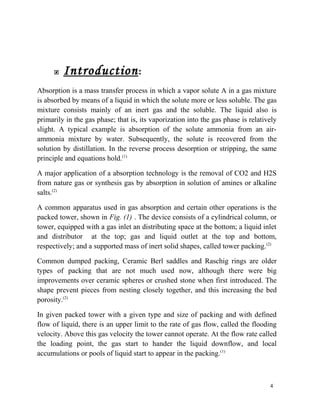
ΔP=ρ *g *Δh 
 We calculated the results from table (1) to (6) and plotted log-log 
graph between air flow rate VS. Differential pressure. 
3
 Introduction : 
Absorption is a mass transfer process in which a vapor solute A in a gas mixture 
is absorbed by means of a liquid in which the solute more or less soluble. The gas 
mixture consists mainly of an inert gas and the soluble. The liquid also is 
primarily in the gas phase; that is, its vaporization into the gas phase is relatively 
slight. A typical example is absorption of the solute ammonia from an air-ammonia 
mixture by water. Subsequently, the solute is recovered from the 
solution by distillation. In the reverse process desorption or stripping, the same 
principle and equations hold.(1) 
A major application of a absorption technology is the removal of CO2 and H2S 
from nature gas or synthesis gas by absorption in solution of amines or alkaline 
salts.(2) 
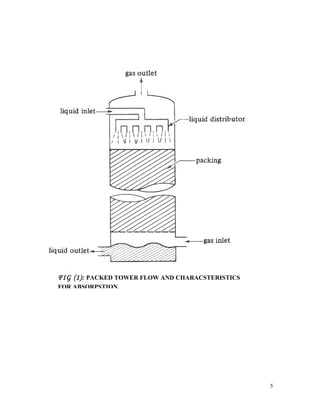
A common apparatus used in gas absorption and certain other operations is the 
packed tower, shown in Fig. (1) . The device consists of a cylindrical column, or 
tower, equipped with a gas inlet an distributing space at the bottom; a liquid inlet 
and distributor at the top; gas and liquid outlet at the top and bottom, 
respectively; and a supported mass of inert solid shapes, called tower packing.(2) 
Common dumped packing, Ceramic Berl saddles and Raschig rings are older 
types of packing that are not much used now, although there were big 
improvements over ceramic spheres or crushed stone when first introduced. The 
shape prevent pieces from nesting closely together, and this increasing the bed 
porosity.(2) 
In given packed tower with a given type and size of packing and with defined 
flow of liquid, there is an upper limit to the rate of gas flow, called the flooding 
velocity. Above this gas velocity the tower cannot operate. At the flow rate called 
the loading point, the gas start to hander the liquid downflow, and local 
accumulations or pools of liquid start to appear in the packing.(1) 
4
5 
FIG (1): PACKED TOWER FLOW AND CHARACSTERISTICS 
FOR ABSORPSTION.
 Expierment objective 
 To exmine the air pressure differential across the column 
as a function of air flow rate for different water flow rate 
down the column by Ploting the pressure differential as a 
function of air flow rate on log-log graph paper and 
establish the relationship between these variable. 
6
 Theory: 
 ΔP=ρ *g *Δh 
Where: 
ΔP: differential pressure. (g/cm.s2) 
ρ: density. (g/cm3) 
g: gravity constant. (cm/s2) 
Δh: hight (cm H2O) 
 Plot the pressure differential as a function of air flow rate 
on log-log graph paper and establish the relationship 
between these variable. 
7
 SCHEMATIC DIAGRAM :( 3) 
8
 
Experimenta l Procedure : 
9 
FIG (2): Gas absorption device.
1- The first step we dried by passing the maximum air flow until all 
evidence of moisture in the packing has disappeared. 
2- We run on of the pump of air. 
3- At zero flow of air we read the hight and recorded it 
4- We increased flow air to 20(l/min) and read of hight a cross the 
column. 
5- We increased flow air to 40,60, 80,…,180(l/min) and read of hight then 
recorded it for each one. 
6- After that we changed flow of water to 1.5(l/min) and repeat step 3 to 5 
after that changed flow water to 2, 2.5, and 3(l/min). 
7- The range of possible air flow rates will decrease with increasing water 
flow rate duo to onset of ‘flooding’ of column, which should be noted. 
10
 Result & Calculation :. 
dry colunm 
air flow rate l /min 20 40 60 80 100 120 140 160 
water flow rate l/min 0 0 0 0 0 0 0 0 
Δp (cm H2O) 0.2 0.4 0.4 0.4 0.3 1.7 2.6 3.8 
Δp (g/cm.s2) 196 392 392 392 294 1666 2548 3724 
log air flow rate (l/min) 1.301029996 1.60206 1.778151 1.90309 2 2.079181 2.146128 2.20412 
log Δp (g/cm.s2) 2.292256071 2.593286 2.593286 2.593286 2.468347 3.221675 3.406199 3.57101 
Table (1): data of flow (air + water) and differential pressure at dried 
column 
dry c olunm 
4 
3.5 
3 
2.5 
2 
1.5 
1 
0.5 
0 
0 0.5 1 1.5 2 2.5 
log Δp (g/cm.s2) 
log air flow rate l /min 
Figure (3): graph of log ΔP vs. log air flow. 
11
. 
wet column 
air flow rate l /min 20 40 60 80 100 120 140 160 
water flow rate l/min 0 0 0 0 0 0 0 0 
Δp (cm H2O) 0.2 0.1 0.2 0.6 1.1 1.8 2.4 4.2 
Δp (g/cm.s2) 196 98 196 588 1078 1764 2352 4116 
log air flow rate (l/min) 1.301029996 1.60206 1.778151 1.90309 2 2.079181 2.146128 2.20412 
log Δp (g/cm.s2) 2.292256071 1.991226 2.292256 2.769377 3.032619 3.246499 3.371437 3.614475 
Table (2): data of flow (air + water) and differential pressure at wet 
column 
wet c olunm 
2.5 
2 
log air flow rate (l/min) Figure (4): graph of log ΔP vs. log air flow. 
1.5 
1 
0.5 
0 
2.5 2.7 2.9 3.1 3.3 3.5 3.7 
log Δp (g/cm.s2) 
12
. 
wet column 
air flow rate l /min 20 40 60 80 100 120 140 160 
water flow rate l/min 1.5 1.5 1.5 1.5 1.5 1.5 1.5 1.5 
Δp (cm H2O) 0.6 1.2 0.2 0.6 1.6 4.4 6.2 10.6 
Δp (g/cm.s2) 588 1176 196 588 1568 4312 6076 10388 
log air flow rate (l/min) 1.301029996 1.60206 1.778151 1.90309 2 2.079181 2.146128 2.20412 
log Δp (g/cm.s2) 2.769377326 3.070407 2.292256 2.769377 3.195346 3.634679 3.783618 4.016532 
Table (3): data of flow (air + water) and differential pressure at 1.5(L/min) of flow 
water 
water flow rate =1.5 (l/min) 
2.5 
2 
1.5 
1 
0.5 
0 
2.5 2.7 2.9 3.1 3.3 3.5 3.7 3.9 4.1 
log Δp (g/cm.s2) 
log air flow rate (l/min) 
Figure (5): graph of log ΔP vs. log air flow. 
13
wet column 
air flow rate l /min 20 40 60 80 100 120 140 160 
water flow rate l/min 2 2 2 2 2 2 2 2 
Δp (cm H2O) 0.4 0.2 0.2 1.8 3.4 6.4 10.6 20.6 
Δp (g/cm.s2) 392 196 196 1764 3332 6272 10388 20188 
log air flow rate (l/min) 1.301029996 1.60206 1.778151 1.90309 2 2.079181 2.146128 2.20412 
log Δp (g/cm.s2) 2.593286067 2.292256 2.292256 3.246499 3.522705 3.797406 4.016532 4.305093 
Table (4): data of flow (air + water) and differential pressure at 2(L/min) of flow 
water. 
water flow rate =2(l/min) 
2.5 
2 
1.5 
1 
0.5 
0 
2.5 2.7 2.9 3.1 3.3 3.5 3.7 3.9 4.1 4.3 4.5 
log Δp (g/cm.s2) 
air flow rate l /min 
Figure (6): graph of log ΔP vs. log air flow. 
14
. 
wet column 
air flow rate l /min 20 40 60 80 100 120 140 160 
water flow rate l/min 2.5 2.5 2.5 2.5 2.5 2.5 2.5 2.5 
Δp (cm H2O) 0.2 0.2 0.4 2.4 4.8 10.2 11.2 20 
Δp (g/cm.s2) 196 196 392 2352 4704 9996 10976 19600 
log air flow rate (l/min) 1.301029996 1.60206 1.778151 1.90309 2 2.079181 2.146128 2.20412 
log Δp (g/cm.s2) 2.292256071 2.292256 2.593286 3.371437 3.672467 3.999826 4.040444 4.292256 
Table (5): data of flow (air + water) and differential pressure at 2.5(L/min) of flow 
water 
waterflow rate =2.5 (l/min) 
2.5 
2 
1.5 
1 
0.5 
0 
2.5 2.7 2.9 3.1 3.3 3.5 3.7 3.9 4.1 4.3 4.5 
log Δp (g/cm.s2) 
log air flow rate (l/min) 
Figure (7): graph of log ΔP vs. log air flow. 
15
. 
wet column 
air flow rate l /min 20 40 60 80 100 120 140 160 
water flow rate l/min 3 3 3 3 3 3 3 3 
Δp (cm H2O) 3.6 2 0.6 1 4.2 11 20 45 
Δp (g/cm.s2) 3528 1960 588 980 4116 10780 19600 44100 
log air flow rate (l/min) 1.301029996 1.60206 1.778151 1.90309 2 2.079181 2.146128 2.20412 
log Δp (g/cm.s2) 3.547528576 3.292256 2.769377 2.991226 3.614475 4.032619 4.292256 4.644439 
Table (6): data of flow (air + water) and differential pressure at 3(L/min) of flow 
water 
water flow rate=3 (l/min) 
2.5 
2 
1.5 
1 
0.5 
0 
1 1.5 2 2.5 3 3.5 4 4.5 5 
log Δp (g/cm.s2) 
log air flow rate (l/min) 
Figure (8): graph of log ΔP vs. log air flow. 
16
Discussion & Conclusions: 
 The pressure difference increased when the air flow and water flow 
increased. 
 The flooding point decreases as the air flow increases (the high water 
flow the gives less flooding point ) 
 The slope of the flooding curve is decreasing with the increasing 
of the water flow rate 
17
References: 
1. Chirstie J.Geankoplis, ( Transport Process and Unit Operation ), 4rd 
edition. University of Minnesota, 2003 by person Education, 
"Publishing as Prentice Hall Professional Technical Reference", 
pages: 645- 650. 
2. Warren L. McCabe, Julian C. Smith and Peter Harriott,(UNIT 
OPERATION OF CHAMICAL ENGINEERING), 7th edition, 
international edition 2005,”published by McGraw-Hill”, Avenue of 
the Americas, pages: 565-568. 
3. Aziz M. Abu-Khalaf, ( Chemical Engineering Education, CEE 32 
(3) ), King Suad University 1998. 
18
19

Absorption

  • 1.
    King suad university College of engineering Chemical engineering department Absorption ChE403 Alawi Al-Awami 423101724 Meshal Al-Jahani 424105851 Meshal Al-Saeed 423105653 Date: 8/5/1429 Supervised :Dr. Malik Al-Ahmad 1
  • 2.
     Table ofContents : Title Page Summary 3 Introduction 4 Expierment objective 6 Theory 7 Schematic diagram 8 Experimental procedure 9 Results & Calculation 10 Discussion & Conclusion 16 Reference 17 2
  • 3.
     Summary :  The objective of this experimental To examine the air pressure differential across the column as a function of air flow rate different water flow rates down the column.  Pressure differential should be plotted as a function of air flow rate on log-log graph paper for each water flow rate.  From our experimental we read differential height and calculated the differential pressure by using equation. ΔP=ρ *g *Δh  We calculated the results from table (1) to (6) and plotted log-log graph between air flow rate VS. Differential pressure. 3
  • 4.
     Introduction : Absorption is a mass transfer process in which a vapor solute A in a gas mixture is absorbed by means of a liquid in which the solute more or less soluble. The gas mixture consists mainly of an inert gas and the soluble. The liquid also is primarily in the gas phase; that is, its vaporization into the gas phase is relatively slight. A typical example is absorption of the solute ammonia from an air-ammonia mixture by water. Subsequently, the solute is recovered from the solution by distillation. In the reverse process desorption or stripping, the same principle and equations hold.(1) A major application of a absorption technology is the removal of CO2 and H2S from nature gas or synthesis gas by absorption in solution of amines or alkaline salts.(2) A common apparatus used in gas absorption and certain other operations is the packed tower, shown in Fig. (1) . The device consists of a cylindrical column, or tower, equipped with a gas inlet an distributing space at the bottom; a liquid inlet and distributor at the top; gas and liquid outlet at the top and bottom, respectively; and a supported mass of inert solid shapes, called tower packing.(2) Common dumped packing, Ceramic Berl saddles and Raschig rings are older types of packing that are not much used now, although there were big improvements over ceramic spheres or crushed stone when first introduced. The shape prevent pieces from nesting closely together, and this increasing the bed porosity.(2) In given packed tower with a given type and size of packing and with defined flow of liquid, there is an upper limit to the rate of gas flow, called the flooding velocity. Above this gas velocity the tower cannot operate. At the flow rate called the loading point, the gas start to hander the liquid downflow, and local accumulations or pools of liquid start to appear in the packing.(1) 4
  • 5.
    5 FIG (1):PACKED TOWER FLOW AND CHARACSTERISTICS FOR ABSORPSTION.
  • 6.
     Expierment objective  To exmine the air pressure differential across the column as a function of air flow rate for different water flow rate down the column by Ploting the pressure differential as a function of air flow rate on log-log graph paper and establish the relationship between these variable. 6
  • 7.
     Theory: ΔP=ρ *g *Δh Where: ΔP: differential pressure. (g/cm.s2) ρ: density. (g/cm3) g: gravity constant. (cm/s2) Δh: hight (cm H2O)  Plot the pressure differential as a function of air flow rate on log-log graph paper and establish the relationship between these variable. 7
  • 8.
  • 9.
     Experimenta lProcedure : 9 FIG (2): Gas absorption device.
  • 10.
    1- The firststep we dried by passing the maximum air flow until all evidence of moisture in the packing has disappeared. 2- We run on of the pump of air. 3- At zero flow of air we read the hight and recorded it 4- We increased flow air to 20(l/min) and read of hight a cross the column. 5- We increased flow air to 40,60, 80,…,180(l/min) and read of hight then recorded it for each one. 6- After that we changed flow of water to 1.5(l/min) and repeat step 3 to 5 after that changed flow water to 2, 2.5, and 3(l/min). 7- The range of possible air flow rates will decrease with increasing water flow rate duo to onset of ‘flooding’ of column, which should be noted. 10
  • 11.
     Result &Calculation :. dry colunm air flow rate l /min 20 40 60 80 100 120 140 160 water flow rate l/min 0 0 0 0 0 0 0 0 Δp (cm H2O) 0.2 0.4 0.4 0.4 0.3 1.7 2.6 3.8 Δp (g/cm.s2) 196 392 392 392 294 1666 2548 3724 log air flow rate (l/min) 1.301029996 1.60206 1.778151 1.90309 2 2.079181 2.146128 2.20412 log Δp (g/cm.s2) 2.292256071 2.593286 2.593286 2.593286 2.468347 3.221675 3.406199 3.57101 Table (1): data of flow (air + water) and differential pressure at dried column dry c olunm 4 3.5 3 2.5 2 1.5 1 0.5 0 0 0.5 1 1.5 2 2.5 log Δp (g/cm.s2) log air flow rate l /min Figure (3): graph of log ΔP vs. log air flow. 11
  • 12.
    . wet column air flow rate l /min 20 40 60 80 100 120 140 160 water flow rate l/min 0 0 0 0 0 0 0 0 Δp (cm H2O) 0.2 0.1 0.2 0.6 1.1 1.8 2.4 4.2 Δp (g/cm.s2) 196 98 196 588 1078 1764 2352 4116 log air flow rate (l/min) 1.301029996 1.60206 1.778151 1.90309 2 2.079181 2.146128 2.20412 log Δp (g/cm.s2) 2.292256071 1.991226 2.292256 2.769377 3.032619 3.246499 3.371437 3.614475 Table (2): data of flow (air + water) and differential pressure at wet column wet c olunm 2.5 2 log air flow rate (l/min) Figure (4): graph of log ΔP vs. log air flow. 1.5 1 0.5 0 2.5 2.7 2.9 3.1 3.3 3.5 3.7 log Δp (g/cm.s2) 12
  • 13.
    . wet column air flow rate l /min 20 40 60 80 100 120 140 160 water flow rate l/min 1.5 1.5 1.5 1.5 1.5 1.5 1.5 1.5 Δp (cm H2O) 0.6 1.2 0.2 0.6 1.6 4.4 6.2 10.6 Δp (g/cm.s2) 588 1176 196 588 1568 4312 6076 10388 log air flow rate (l/min) 1.301029996 1.60206 1.778151 1.90309 2 2.079181 2.146128 2.20412 log Δp (g/cm.s2) 2.769377326 3.070407 2.292256 2.769377 3.195346 3.634679 3.783618 4.016532 Table (3): data of flow (air + water) and differential pressure at 1.5(L/min) of flow water water flow rate =1.5 (l/min) 2.5 2 1.5 1 0.5 0 2.5 2.7 2.9 3.1 3.3 3.5 3.7 3.9 4.1 log Δp (g/cm.s2) log air flow rate (l/min) Figure (5): graph of log ΔP vs. log air flow. 13
  • 14.
    wet column airflow rate l /min 20 40 60 80 100 120 140 160 water flow rate l/min 2 2 2 2 2 2 2 2 Δp (cm H2O) 0.4 0.2 0.2 1.8 3.4 6.4 10.6 20.6 Δp (g/cm.s2) 392 196 196 1764 3332 6272 10388 20188 log air flow rate (l/min) 1.301029996 1.60206 1.778151 1.90309 2 2.079181 2.146128 2.20412 log Δp (g/cm.s2) 2.593286067 2.292256 2.292256 3.246499 3.522705 3.797406 4.016532 4.305093 Table (4): data of flow (air + water) and differential pressure at 2(L/min) of flow water. water flow rate =2(l/min) 2.5 2 1.5 1 0.5 0 2.5 2.7 2.9 3.1 3.3 3.5 3.7 3.9 4.1 4.3 4.5 log Δp (g/cm.s2) air flow rate l /min Figure (6): graph of log ΔP vs. log air flow. 14
  • 15.
    . wet column air flow rate l /min 20 40 60 80 100 120 140 160 water flow rate l/min 2.5 2.5 2.5 2.5 2.5 2.5 2.5 2.5 Δp (cm H2O) 0.2 0.2 0.4 2.4 4.8 10.2 11.2 20 Δp (g/cm.s2) 196 196 392 2352 4704 9996 10976 19600 log air flow rate (l/min) 1.301029996 1.60206 1.778151 1.90309 2 2.079181 2.146128 2.20412 log Δp (g/cm.s2) 2.292256071 2.292256 2.593286 3.371437 3.672467 3.999826 4.040444 4.292256 Table (5): data of flow (air + water) and differential pressure at 2.5(L/min) of flow water waterflow rate =2.5 (l/min) 2.5 2 1.5 1 0.5 0 2.5 2.7 2.9 3.1 3.3 3.5 3.7 3.9 4.1 4.3 4.5 log Δp (g/cm.s2) log air flow rate (l/min) Figure (7): graph of log ΔP vs. log air flow. 15
  • 16.
    . wet column air flow rate l /min 20 40 60 80 100 120 140 160 water flow rate l/min 3 3 3 3 3 3 3 3 Δp (cm H2O) 3.6 2 0.6 1 4.2 11 20 45 Δp (g/cm.s2) 3528 1960 588 980 4116 10780 19600 44100 log air flow rate (l/min) 1.301029996 1.60206 1.778151 1.90309 2 2.079181 2.146128 2.20412 log Δp (g/cm.s2) 3.547528576 3.292256 2.769377 2.991226 3.614475 4.032619 4.292256 4.644439 Table (6): data of flow (air + water) and differential pressure at 3(L/min) of flow water water flow rate=3 (l/min) 2.5 2 1.5 1 0.5 0 1 1.5 2 2.5 3 3.5 4 4.5 5 log Δp (g/cm.s2) log air flow rate (l/min) Figure (8): graph of log ΔP vs. log air flow. 16
  • 17.
    Discussion & Conclusions:  The pressure difference increased when the air flow and water flow increased.  The flooding point decreases as the air flow increases (the high water flow the gives less flooding point )  The slope of the flooding curve is decreasing with the increasing of the water flow rate 17
  • 18.
    References: 1. ChirstieJ.Geankoplis, ( Transport Process and Unit Operation ), 4rd edition. University of Minnesota, 2003 by person Education, "Publishing as Prentice Hall Professional Technical Reference", pages: 645- 650. 2. Warren L. McCabe, Julian C. Smith and Peter Harriott,(UNIT OPERATION OF CHAMICAL ENGINEERING), 7th edition, international edition 2005,”published by McGraw-Hill”, Avenue of the Americas, pages: 565-568. 3. Aziz M. Abu-Khalaf, ( Chemical Engineering Education, CEE 32 (3) ), King Suad University 1998. 18
  • 19.