1
Lecture Notes in
Mass Transfer
Barhm Abdullah Mohamad
Erbil Polytechnic University
LinkedIn: https://www.linkedin.com/in/barhm-mohamad-900b1b138/
Google Scholar: https://scholar.google.com/citations?user=KRQ96qgAAAAJ&hl=en
ResearchGate: https://www.researchgate.net/profile/Barhm_Mohamad
YouTube channel: https://www.youtube.com/channel/UC16-u0i4mxe6TmAUQH0kmNw
2
C H A P T E R 1
Fundamentals of Mass Transfer
Diffusion
Mass transfer is the net movement of a component in a mixture from one location
to another location where the component exists at a different concentration. Often,
the transfer takes place between two phases across an interface. Thus, the
absorption by a liquid of a solute from a gas involves mass transfer of the solute
through the gas to the gas-liquid interface, across the interface, and into the liquid.
Mass transfer models are used to describe processes such as the passage of a
species through a gas to the outer surface of a porous adsorbent particle and into
the pores of the adsorbent, where the species is adsorbed on the porous surface.
Mass transfer is also the selective permeation through a nonporous polymeric
material of a component of a gas mixture. Mass transfer is not the flow of a fluid
through a pipe. However, mass transfer might be superimposed on that flow. Mass
transfer is not the flow of solids on a conveyor belt.
Mass transfer occurs by two basic mechanisms:
(A) Molecular diffusion by random and spontaneous microscopic movement of
individual molecules in a gas, liquid, or solid as a result of thermal motion; and
(B) Eddy (turbulent) diffusion by random macroscopic fluid motion.
Molecular and/or eddy diffusion frequently involves the movement of different
species in opposing directions. When a net flow occurs in one of these directions,
the total rate of mass transfer of individual species is increased or decreased by
this bulk flow or convection effect, which is a third mechanism of mass transfer. As
will be shown later, molecular diffusion is extremely slow, whereas eddy diffusion,
when it occurs, is orders of magnitude more rapid. Therefore, if large-scale
separation processes are to be conducted in equipment of a reasonable size, fluids
must be agitated, interfacial areas maximized, and distances in the direction of
diffusion minimized. In a binary mixture, molecular diffusion occurs because of one
3
or more different potentials or driving forces, including differences (gradients) of
concentration (ordinary diffusion), pressure (pressure diffusion), temperature
(thermal diffusion), and external force fields (forced diffusion) that act unequally on
the different chemical species present. Pressure diffusion requires a large
pressure gradient, which is achieved for gas mixtures with a centrifuge. Thermal
diffusion columns or cascades can be employed to separate liquid and ga s
mixtures by establishing a temperature gradient across the mixture. More widely
applied is forced diffusion in an electrical field, to cause ions of different charges
to move in different directions at different speeds. In this chapter, only molecular
diffusion caused by concentration gradients is considered, because this is the most
common type of molecular diffusion in commercial separation processes.
Furthermore, emphasis is on binary systems, for which molecular diffusion theory
is simple and applications are relatively straightforward. Multi-component
molecular diffusion, which is important in many applications, is much more
complex than diffusion in binary systems, and is a more appropriate topic for
advanced study using a specialized text.
Molecular diffusion occurs in solids and in fluids that are stagnant or in laminar or
turbulent motion. Eddy diffusion occurs in fluids in turbulent motion. When both
molecular diffusion and eddy diffusion occur, they take place in parallel and are
additive. Furthermore, they take place because of the same concentration
difference (gradient). When mass transfer occurs under turbulent flow conditions,
but across an interface or to a solid surface, conditions may be laminar or nearly
stagnant near the interface or solid surface. Thus, even though eddy diffusion may
be the dominant mechanism in the bulk of the fluid, the overall rate of mass transfer
is controlled by molecular diffusion because the eddy diffusion mechanism is
damped or even eliminated as the interface or solid surface is approached. Mass
transfer of one or more species results in a total net rate of bulk flow or flux in one
direction relative to a fixed plane or stationary coordinate system [1].
4
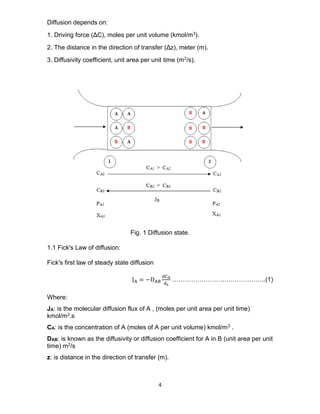
Diffusion depends on:
1. Driving force (ΔC), moles per unit volume (kmol/m3).
2. The distance in the direction of transfer (Δz), meter (m).
3. Diffusivity coefficient, unit area per unit time (m2/s).
Fig. 1 Diffusion state.
1.1 Fick's Law of diffusion:
Fick′s first law of steady state diffusion
JA = −DAB
dCA
dz
…………………….………………..(1)
Where:
JA: is the molecular diffusion flux of A , (moles per unit area per unit time)
kmol/m2.s
CA: is the concentration of A (moles of A per unit volume) kmol/m3 .
DAB: is known as the diffusivity or diffusion coefficient for A in B (unit area per unit
time) m2/s
z: is distance in the direction of transfer (m).
5
Diffusion with bulk of mass in motion:
Total diffusion = Molecular diffusion + Convection term
Convection term = Eddy diffusion = Molar flux due to convection
Convection term = Concentration . mass transfer velocity = CA . V
Mass transfer velocity (V) =
Mass flux
Concentration
=
NA + NB
CT
=
kmol
m2. s
kmol
m3
=
m
s
Total diffusion = NA = JA + CA . V ………………………(2)
Total diffusion equation in the form of concentration (normally used for liquids):
NA = −DAB
dCA
dz
+
CA
CT
(NA + NB)……………………….(3)
Total diffusion equation in the form of partial pressure (normally used for gases):
NA = −
DAB
RT
dPA
dz
+
PA
PT
(NA + NB)……………………….(4)
Total diffusion equation in the form of mole fraction (used for gases and liquids):
NA = −
DABPT
RT
dXA
dz
+ xA (NA + NB)……………………….(4)
If stagnant diffusion layer, then NB = 0
NA =
DAB
RT
PT
dz
Ln [
PT−PA2
PT−PA1
]…………………………….(5)
1.1.1 Counter diffusion type equimolecular counter diffusion:
When the mass transfer rates of the two components are equal and opposite the
process is said to be one of equimolecular counter diffusion. Such a process
occurs in the case of the box with a movable partition. It occurs also in a distillation
column when the molar latent heats of the two components are the same (λA =
λB).
NA =
DAB
RT
[
PA1−PA2
z2−z1
]…………………………………(6)
6
Ex. 1: Ammonia gas is diffusing at a constant rate through a layer of stagnant air
1 mm thick. Conditions are such that the gas contains 50 percent by volume
ammonia at one boundary of the stagnant layer. The ammonia diffusing to the
other boundary is quickly absorbed and the concentration is negligible at that
plane. The temperature is 295 K and the pressure atmospheric, and under these
conditions the diffusivity of ammonia in air is 0.18 cm2/s. Estimate the rate of
diffusion of ammonia through the layer.
Solution:
If the subscripts 1 and 2 refer to the two sides of the stagnant layer and the
subscripts A and B refer to ammonia and air respectively, then the rate of diffusion
through a stagnant layer is given by:
NA =
DAB
RT
PT
dz
Ln [
PT − PA2
PT − PA1
]
PT = 101.3 kPa, PA2 = 0, PA1 = ya.PT = ( 0.5 )101.3 = 50.65 kPa
Δ𝐳 = 𝐳𝟐−𝐳𝟏 = 1 mm = (1)10−3 m
R = 8.314
kj
kmol .K
, T = 295 K and DAB = 0.18
cm2
s
= 1.8 X 10⁻⁵ m2
s
NA =
1.8 X 10⁻⁵
8.314 (295)
101.3
1X10⁻³
Ln [
101.3
101.3−50.65
] = 5.153 X 10⁻³ kmol
m2.s
Ex. 2: In an air-carbon dioxide mixture at 298 K and 202.6 kPa, the concentration
of CO2 at two planes (3 mm) apart are 25 vol.% and 15 vol.% respectively. The
diffusivity of CO2 in air at 298 K and 202.6 kPa is 8.2 X10⁻⁶ m2/s. Calculate the rate
of transfer of CO2 across the two planes, assuming:
a. Equimolecular counter diffusion.
b. Diffusion of CO2 through a stagnant air layer.
7
Solution:
PA1= yA1 . PT = (0.25) 202.6 = 50.65 kPa
PA2 = yA2 . PT = (0.15) 202.6 = 30.39 kPa
a. Equimolecular counter diffusion:
NA =
DAB
RT
[
PA1−PA2
z2−z1
]
NA =
8.2 X 10⁻⁶
8.314 (298)
[
50.65 − 30.39
3 X 10⁻³
] = 2.23X10⁻⁵ kmol
m2. s
b. Stagnant diffusion.
NA =
DAB
RT
PT
dz
Ln [
PT−PA2
PT−PA1
]
NA =
8.2 X 10⁻⁶
(8.314 )(298 )
202.6
3 X 10⁻³
Ln [
202.6 − 30.39
202.6 − 50.65
] = 2.79 X 10⁻⁵ kmol
m2. s
1.2 Distillation
In distillation (fractionation), a feed mixture of two or more component is separated
into two or more products, including, and often limited to an overhead distillate and
a bottom, whose compositions differ from that of the feed. Most often, the feed is
a liquid or vapor – liquid mixture. The bottoms products is almost always a liquid,
but the distillate may be a liquid or a vapor or both. The separation requires that
(1) a second phase be formed so that both li quid and vapor phases are present
and can contact each other on each stage within a separation column, (2) the
components have different volatilities so that they will partition between the two
phases to different extents, and (3) the two phases can be separated by gravity or
other mechanical means. Distillation differs from absorption and stripping in that
the second phase is created by thermal means (vaporization and condensation)
rather than by the introduction of a second phase that usually contains an
additional component or component does not present in the feed mixture. The
8
word distillation is derived from Latin word destillare, which means dripping or
trickling down. By at least the sixteenth century, it was known that the extent of
separation could be improved by providing multiple vapor-liquid contacts (stages)
in a so-called Rectificatorium. The term rectification is derived from the Latin words
recte facere , meaning to improve. Modern distillation derives its ability to produce
almost pure products from the use of multistage contacting.
A- Distillation of binary mixtures
Binary Mixture: mixture contains only two components differ in boiling point.
Equipment and Design Consideration Industrial distillation operations are most
commonly conducted in trayed towers, but packed columns are finding increasing
use. Occasionally, distillation columns contain both trays and packing. Types of
trays and packing are identical to those used for absorption and stripping.
A schematic diagram for the distillation column for binary mixture is presented
below [1].
Fig. 2 A schematic diagram for the distillation process.
Factors that influence the design or analysis of a binary distillation operation
include:
1. Feed flow rate, composition, temperature, pressure, and phase condition.
2. Desired degree of separation between two components.
9
3. Operating pressure (which must be below the critical pressure of the mixture).
4. Vapor pressure drop, particularly for vacuum operation.
5. Minimum reflux ratio and actual reflux ratio.
6. Minimum number of equilibrium stages and act ual number of equilibrium stages
(stage efficiency).
7. Type of condenser (total, partial, or mixed).
8. Degree of sub-cooling, if any, of the liquid reflux.
9. Type of re-boiler (partial or total).
10. Type of contacting (trays or packing or both).
11. Height of the column.
12. Feed entry stage.
13. Diameter of the column.
14. Column internals
1.3 The wetted wall column
The wetted wall column is a small experimental device used to determine the
average mass transfer coefficient (𝐊𝐎𝐆 ). Usually it is (1 - 1.5 inch) in diameter and
one meter long.
Fig. 3 The wetted wall column mass balance [2].
10
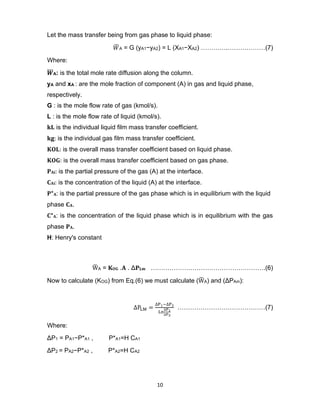
Let the mass transfer being from gas phase to liquid phase:
𝑊
̅ A = G (yA1−yA2) = L (XA1−XA2) ………….………………(7)
Where:
𝑾
̅̅̅A: is the total mole rate diffusion along the column.
yA and xA : are the mole fraction of component (A) in gas and liquid phase,
respectively.
G : is the mole flow rate of gas (kmol/s).
L : is the mole flow rate of liquid (kmol/s).
𝐤𝐋 is the individual liquid film mass transfer coefficient.
𝐤𝐠: is the individual gas film mass transfer coefficient.
𝐊𝐎𝐋: is the overall mass transfer coefficient based on liquid phase.
𝐊𝐎𝐆: is the overall mass transfer coefficient based on gas phase.
𝐏𝐀𝐢: is the partial pressure of the gas (A) at the interface.
𝐂𝐀𝐢: is the concentration of the liquid (A) at the interface.
𝐏*𝐀: is the partial pressure of the gas phase which is in equilibrium with the liquid
phase 𝐂𝐀.
𝐂*𝐀: is the concentration of the liquid phase which is in equilibrium with the gas
phase 𝐏𝐀.
H: Henry's constant
W
̅ A = 𝐊𝐎𝐆 .𝐀 . Δ𝐏𝐋𝐦 ……………………………………………….(6)
Now to calculate (KOG) from Eq.(6) we must calculate (W
̅ A) and (ΔPAm):
∆PLM =
∆P1−∆P2
Ln
∆P1
∆P2
……………………………………(7)
Where:
ΔP1 = PA1−P*A1 , P*A1=H CA1
ΔP2 = PA2−P*A2 , P*A2=H CA2
11
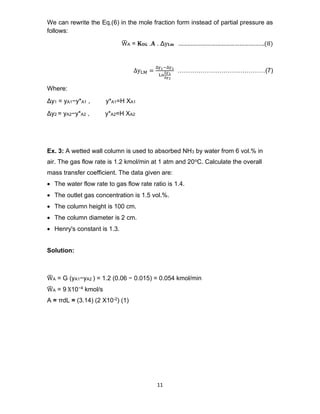
We can rewrite the Eq.(6) in the mole fraction form instead of partial pressure as
follows:
W
̅ A = 𝐊𝐎𝐆 .𝐀 . Δy𝐋𝐦 ……………………………………………….(8)
∆yLM =
∆y1−∆y2
Ln
∆y1
∆y2
……………………………………(7)
Where:
Δy1 = yA1−y*A1 , y*A1=H XA1
Δy2 = yA2−y*A2 , y*A2=H XA2
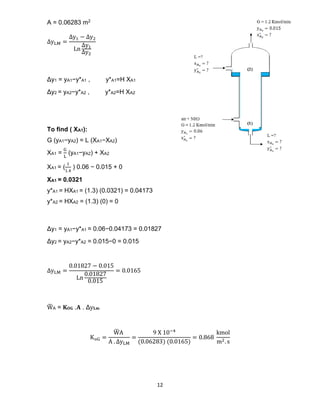
Ex. 3: A wetted wall column is used to absorbed NH3 by water from 6 vol.% in
air. The gas flow rate is 1.2 kmol/min at 1 atm and 20oC. Calculate the overall
mass transfer coefficient. The data given are:
• The water flow rate to gas flow rate ratio is 1.4.
• The outlet gas concentration is 1.5 vol.%.
• The column height is 100 cm.
• The column diameter is 2 cm.
• Henry's constant is 1.3.
Solution:
W
̅ A = G (yA1−yA2 ) = 1.2 (0.06 − 0.015) = 0.054 kmol/min
W
̅ A = 9 X10⁻⁴ kmol/s
A = πdL = (3.14) (2 X10⁻²) (1)
12
A = 0.06283 m2
∆yLM =
∆y1 − ∆y2
Ln
∆y1
∆y2
Δy1 = yA1−y*A1 , y*A1=H XA1
Δy2 = yA2−y*A2 , y*A2=H XA2
To find ( XA1):
G (yA1−yA2) = L (XA1−XA2)
XA1 =
G
L
(yA1−yA2) + XA2
XA1 = (
1
1.4
) 0.06 − 0.015 + 0
XA1 = 0.0321
y*A1 = HXA1 = (1.3) (0.0321) = 0.04173
y*A2 = HXA2 = (1.3) (0) = 0
Δy1 = yA1−y*A1 = 0.06−0.04173 = 0.01827
Δy2 = yA2−y*A2 = 0.015−0 = 0.015
∆yLM =
0.01827 − 0.015
Ln
0.01827
0.015
= 0.0165
W
̅ A = 𝐊𝐎𝐆 .𝐀 . Δy𝐋𝐦
KoG =
W
̅ A
A . ∆yLM
=
9 X 10⁻⁴
(0.06283) (0.0165)
= 0.868
kmol
m2. s
13
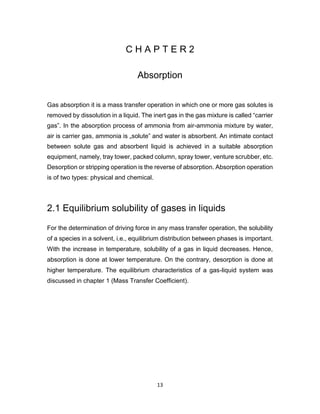
C H A P T E R 2
Absorption
Gas absorption it is a mass transfer operation in which one or more gas solutes is
removed by dissolution in a liquid. The inert gas in the gas mixture is called “carrier
gas”. In the absorption process of ammonia from air-ammonia mixture by water,
air is carrier gas, ammonia is „solute” and water is absorbent. An intimate contact
between solute gas and absorbent liquid is achieved in a suitable absorption
equipment, namely, tray tower, packed column, spray tower, venture scrubber, etc.
Desorption or stripping operation is the reverse of absorption. Absorption operation
is of two types: physical and chemical.
2.1 Equilibrium solubility of gases in liquids
For the determination of driving force in any mass transfer operation, the solubility
of a species in a solvent, i.e., equilibrium distribution between phases is important.
With the increase in temperature, solubility of a gas in liquid decreases. Hence,
absorption is done at lower temperature. On the contrary, desorption is done at
higher temperature. The equilibrium characteristics of a gas-liquid system was
discussed in chapter 1 (Mass Transfer Coefficient).
14
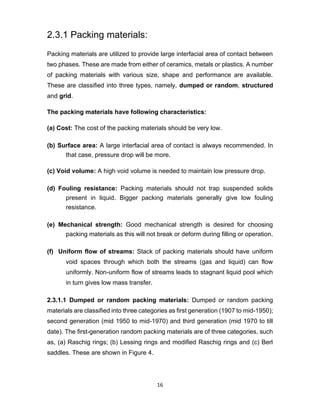
2.2 Selection of solvent for absorption and stripping
If the objective of absorption is separation of a particular component from a
mixture, selection of absorbent plays a great role and when absorption operation
is used to prepare a solution, solvent is selected according to final product.
Few criteria for the selection of an absorbent are as follows:
(A)Gas Solubility: High solubility of a gas in the solvent is preferred, utilizing
low quantity of solvent. Absorbent should not dissolve carrier gas.
Similar chemical nature of solute and absorbent (solvent) gives a good
solubility. If chemical reaction takes place between solute and solvent,
rate of absorption is extremely high. But the reaction should be
reversible to recover solvent during desorption.
(B)Volatility: Low volatility or low vapor pressure of the solvent enhances the
adsorption operation as solvent loss with carrier gas is very small.
Sometimes, a second less volatile solvent is used to recover the first
solvent.
(C)Viscosity: For better absorption, a solvent of low viscosity is required. In
mechanically agitated absorber, greater amount of power is required for
high viscous solvent and flooding is also caused at lower liquid and gas
flow rates.
(D)Corrosiveness: Non-corrosive or less corrosive solvent reduces
equipment construction cost as well as maintenance cost.
(E) Cost: The solvent should be cheap so that losses will be insignificant and
should be easily available.
(F) Toxicity and Hazard: The solvent should be non-toxic, non-flammable,
non-hazardous and should be chemically stable.
Steam is generally used in desorption or stripping medium as stripped
solute can be recovered very easily by condensing steam leaving desorption
tower.
15
2.3 Design of single stage counter-current flow
absorption tower (packed tower)
Two common gas absorption equipments are packed tower and plate tower. Other
absorption equipments are, namely, spray column, agitated contactor, venture
scrubber, etc. The gas and the liquid phases come in contact in several discrete
stages. Thus, a stage wise contact is there in a plate column. But in packed tower,
the up-flowing gas remains in contact with down-flowing liquid throughout the
packing, at every point of the tower. Therefore, packed tower is known as
“continuous’’ differential contact equipment It is different from the stage-wise
distillation column. In the stage distillation column, the equilibrium in each stage
will vary not in a continuous manner whereas in the packed column the equilibrium
is changed point wise in each axial location [2].
Steps for the design of packed tower:
(A) Selection of solvent
(B) Selection of packing
(C) Calculation of minimum solvent flow rate as well as actual solvent flow rate
(D) Column diameter
(E) Height of column
(F) Design of solvent distributors and redistributors (if needed)
(G)Design of gas distributor, packing support, shell, nozzles, column support
The following items and variables should be known for design of a packed
absorption tower:
(a) Equilibrium data; (b) Gas and liquid flow rates; (c) Solute concentration
in two terminals; (d) Individual and overall volumetric mass transfer
coefficients (Ky𝑎
̅, Kx𝑎
̅, KG𝑎
̅, KL𝑎
̅, etc.).
16
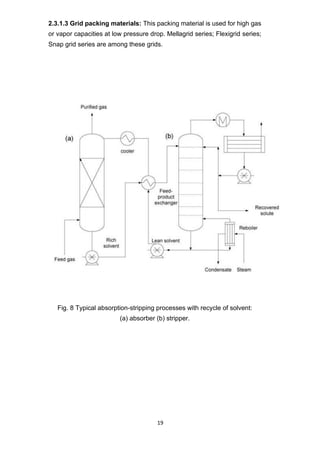
2.3.1 Packing materials:
Packing materials are utilized to provide large interfacial area of contact between
two phases. These are made from either of ceramics, metals or plastics. A number
of packing materials with various size, shape and performance are available.
These are classified into three types, namely, dumped or random, structured
and grid.
The packing materials have following characteristics:
(a) Cost: The cost of the packing materials should be very low.
(b) Surface area: A large interfacial area of contact is always recommended. In
that case, pressure drop will be more.
(c) Void volume: A high void volume is needed to maintain low pressure drop.
(d) Fouling resistance: Packing materials should not trap suspended solids
present in liquid. Bigger packing materials generally give low fouling
resistance.
(e) Mechanical strength: Good mechanical strength is desired for choosing
packing materials as this will not break or deform during filling or operation.
(f) Uniform flow of streams: Stack of packing materials should have uniform
void spaces through which both the streams (gas and liquid) can flow
uniformly. Non-uniform flow of streams leads to stagnant liquid pool which
in turn gives low mass transfer.
2.3.1.1 Dumped or random packing materials: Dumped or random packing
materials are classified into three categories as first generation (1907 to mid-1950);
second generation (mid 1950 to mid-1970) and third generation (mid 1970 to till
date). The first-generation random packing materials are of three categories, such
as, (a) Raschig rings; (b) Lessing rings and modified Raschig rings and (c) Berl
saddles. These are shown in Figure 4.
17
(a) Raschig rings; (b) Lessing rings and (c) Berl saddle
modified Raschig rings
(Cross-partition rings)
Fig.4 First generation dumped or random packing materials [2].
The second-generation random packing materials are mainly (a) Intalox saddle
(modified); (b) Pall ring (modified). Intalox saddle is the modified version of Berl
saddle and offers less friction resistance due to particular shape (two saddles will
never nest). Pall rings are modified version of Raschig rings. These are shown in
Figure 5.
(a) Intalox saddle (modified) (b) Pall ring (modified)
Fig. 5 Second generation dumped or random packing materials [2].
The third-generation random packing materials are numeral; (a) Intalox Metal
Tower Packing (IMTP); (b) Nutter ring; (c) Cascade Mini-Ring (CMR); (d) Jaeger
Tripac; (e) Koch Flexisaddle; (f) Nor-Pac; (g) Hiflow ring, etc. These are shown in
Figure 6.
18
Fig. 6 Third generation dumped or random packing materials [2].
2.3.1.2 Structured packing materials: These materials are used widely as
packing materials in packed tower due to low gas pressure drop and improved
efficiency. Corrugated metal sheet structured packing and Wire mesh structured
packing materials are widely used in the industries. These include Mellapak,
Flexipak, Gempak, Montz and MaxPak. These are shown in Figure 7.
Fig. 7 Snapshots of some structured packing materials [2].
Mellapak Flexipak Montez corrugated
metal sheet
Wire mesh
packing
(e) Koch Flexisaddle (f) Nor-Pac (g) Hiflow ring
(a) Intalox metal
tower packing
(IMTP)
(b) Nutter ring (c) Cascade
Mini ring
(CMR)
(d) Jaeger Tripac
19
2.3.1.3 Grid packing materials: This packing material is used for high gas
or vapor capacities at low pressure drop. Mellagrid series; Flexigrid series;
Snap grid series are among these grids.
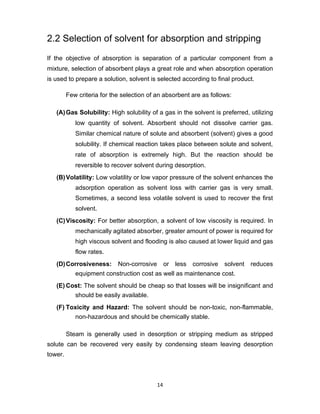
Fig. 8 Typical absorption-stripping processes with recycle of solvent:
(a) absorber (b) stripper.
20
Fig. 9 Industrial gas absorption processes [2].
Table 1 Examples of industrial gas absorption processes [2].
Industry Component to be
removed
Solvent
Wood industry (Kraft
and sulphite methods)
Glass production
SO2 Water
Carbon industry CO2 Water, basic liquids
(K2CO3) or other
solvents (acetone, etc.)
H2SO4 Production SO3 H2SO4 (98%)
HNO3 Production NOX Water (absorption and
chemical reaction)
HCl Production HCL Water
Explosive manufacture NOX Water
21
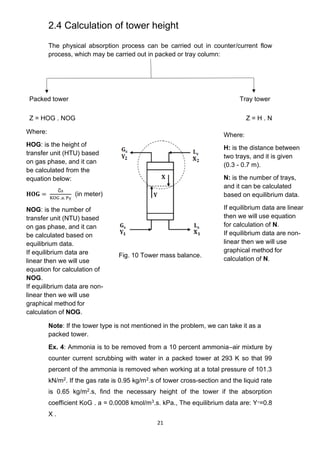
2.4 Calculation of tower height
The physical absorption process can be carried out in counter/current flow
process, which may be carried out in packed or tray column:
Packed tower Tray tower
Z = HOG . NOG Z = H . N
Fig. 10 Tower mass balance.
Note: If the tower type is not mentioned in the problem, we can take it as a
packed tower.
Ex. 4: Ammonia is to be removed from a 10 percent ammonia–air mixture by
counter current scrubbing with water in a packed tower at 293 K so that 99
percent of the ammonia is removed when working at a total pressure of 101.3
kN/m2. If the gas rate is 0.95 kg/m2.s of tower cross-section and the liquid rate
is 0.65 kg/m2.s, find the necessary height of the tower if the absorption
coefficient KoG . a = 0.0008 kmol/m3.s. kPa., The equilibrium data are: Y∗=0.8
X .
Where:
H: is the distance between
two trays, and it is given
(0.3 - 0.7 m).
N: is the number of trays,
and it can be calculated
based on equilibrium data.
If equilibrium data are linear
then we will use equation
for calculation of N.
If equilibrium data are non-
linear then we will use
graphical method for
calculation of N.
Where:
HOG: is the height of
transfer unit (HTU) based
on gas phase, and it can
be calculated from the
equation below:
𝐇𝐎𝐆 =
G
̅s
KOG .a. PT
(in meter)
NOG: is the number of
transfer unit (NTU) based
on gas phase, and it can
be calculated based on
equilibrium data.
If equilibrium data are
linear then we will use
equation for calculation of
NOG.
If equilibrium data are non-
linear then we will use
graphical method for
calculation of NOG.
22
Solution:
y2 = (1−𝑟𝑒𝑐𝑜𝑣𝑒𝑟𝑦) y1 = (1−0.99) (0.1) = 0.001
Convert mole fraction to mole ratio:
𝑦1 =
𝑦1
1 − 𝑦1
=
0.1
1 − 0.1
= 0.11
𝑦2 =
𝑦2
1−𝑦2
=
0.001
1−0.001
= 0.001
We can see that at low conc. (mole ratio = mole fraction):
The gas mole flux, G
̅ =
Gas mass flux
Average gas molecular weight
=
0.95
[(0.1) (17) +(0.99) (29)]
=
0.0312
kmol
m2.s
The liquid mole flux, L
̅ =
Liquid mass flux
Average liquid molecular weight
=
0.65
18
= 0.0361
kmol
m2.s
The mole flux of the inert gas, G
̅𝐬 = G
̅ (𝟏−𝐲𝟏) = (0.0312) (1−0.11) = 0.027
kmol
m2.s
The mole flux of the inert liquid, L
̅s = L
̅ (𝟏−𝐱𝟐 )= (0.0361) (1−0) = 0.0361
kmol
m2.s
Therefore, for pure solvent: L
̅s = L
̅
𝐇𝐎𝐆 =
G
̅s
KOG . a . PT
=
0.027
( 0.0008) (101.3)
= 0.333 m
Since the equilibrium is linear:
∅ =
mGs
̅̅̅̅
Ls
̅̅̅
=
(0.8) (0.027)
(0.0361)
= 0.598
NOG =
1
(1 − ∅)
ln [
(1 − ∅)y1 + ∅y2
(1 − ∅)y2 + ∅y2
]
=
1
(1 − 0.598)
ln [
(1 − 0.598)0.1 + 0.598(0.001)
(1 − 0.598)0.001 + 0.598(0.001)
] = 9.2
Z = HOG . NOG = (0.333)(9.2) = 3.06 m
23
2.5 Mass transfer coefficient from empirical
correlation
Several workers have measured the rate of transfer from a liquid flowing down
the inside wall of a tube to a gas passing counter currently upwards. Gilliland
and Sherwood vaporized a number of liquids including water, toluene, aniline
and propyl, amyl and butyl alcohols into an air stream flowing up the tube in
order to measure the individual mass transfer coefficient (kg). Gilliland and
sherwood used the empirical relation below to measure the individual mass
transfer coefficient (Kg) and this relation in forms of dimensionless [3].
Ex. 5: Calculate the gas film coefficient for the absorption of sulpher dioxide
from a dilute mixture with air in a wetted wall column using Gilliland and
Sherwood correlation for wetted wall column for the following data:
• Gas velocity = 2.5 m/s.
• Gas temperature = 293 K.
• Gas viscosity = 1.78 X 10⁻⁵ N.s/m2.
• Gas density = 1.22 kg/m3.
• Gas diffusivity = 1.22 X 10⁻⁵ m2/s.
• Inside column diameter = 25 mm.
Solution:
Sh = 0.023 (Re) 0.83 (Sc) 0.44
Sh =
Kg. d
D
= kg =
25 X 10−3
1.22 X 10−5
= 2049 kg
Re =
ρud
μ
=
(1.22)(2.5)(25 X 10−3
)
1.78 X 10−5
= 4283.7
Sc =
μ
ρ. D
=
1.78 X 10⁻⁵
(1.22)1.22 X 10−5
= 1.1959
2049 kg = 0.023 (4283.7) 0.83 (1.1959) 0.44
Kg = 0.545
m
s
24
C H A P T E R 3
Design of dryers
3.1 Introduction and types of driers
The term drying refers generally to the removal of moisture from a substance.
It is one of the oldest, most commonly used and most energy consuming unit
operation in the process industries. Drying is often necessary in various
industrial operations particularly in chemical process industries to remove
moisture from a wet solid, a solution or a gas to make it dry and choice of drying
medium is depending on the chemical nature of the materials. Three basic
methods of drying are used today 1) sun drying, a traditional method in which
materials dry naturally in the sun, 2) hot air drying in which materials are
exposed to a blast of hot air and 3) freeze drying, in which frozen materials are
placed in a vacuum chamber to draw out the water. The fundamental nature of
all drying process is the removal of volatile substances (mainly moisture) from
mixture to yield a solid product. In general drying is accomplished by thermal
techniques and thus involves the application of heat, most commonly by
convection from current of air. Throughout the convective drying of solid
materials, two processes occur simultaneously namely, transfer of energy from
the local environment in the dryer and transfer of moisture from within the solid.
Therefore, this unit operation may be considered as simultaneous heat and
mass transfer operation. Drying processes and equipment may be categorized
according to several criteria, including the nature of material and the method of
heat supply and the method of operation. For example, In the sugar industry
washed and centrifuged sugar crystals are dried to get finished product for
packing. Drying is an important operation in food processing. Milk is dried in a
spray chamber to produce milk powder. All the above examples indicate that
wet material loses moisture in direct contact with hot air/gas. The hot air/gas
supplies the energy required for drying and also carries away the moisture
released by the solid. For heat sensitive materials much of the resistance to
drying resides within the material. Unduly high heat and mass transfer rates
25
applied at the surface only result in overheating or over drying of the surface
layer resulting in quality problems without major increase in the drying kinetics.
The rate of migration of the moisture from within the solid to the evaporation
front often controls the overall drying rate. Therefore, drying may be defined as
an operation in which the liquid, generally water, present in a wet solid is
removed by vaporization to get a relatively liquid free solid product. Drying of a
solid does not demand or ensure complete removal of the moisture. Sometimes
it is desirable to retain a little moisture in the solid after drying. Dryer and drying
process selection for a specific operation is a complex problem, and many
factors have to be taken into account. Though, the overall selection and design
of a drying system for a particular material is dictated by the desire to achieve
a favorable combination of a product quality and process economics. In general,
with respect to the rate and total drying time, dryer performance is dependent
on the factors such as air characteristics, product characteristics, equipment
characteristics. But despite the many commercially available drying techniques
at present most dehydrated products (i.e., fruits and vegetables) are still
produced by the method of hot air drying. Because this is regarded as the
simplest and most economical. There are other water/liquid removal processes
such as filtration, settling, centrifugation, supercritical extraction of water from
gels etc. In all these operations liquid is removed by mechanical means, but a
considerable amount of liquid is still retained in the solid. This residual liquid
can be removed by drying. One such example is the production of condensed
milk involves evaporation, but the production of milk powder involves drying.
The phase change and production of a soild phase as end product are essential
features of the drying process. Drying is an essential operation in chemical,
agricultural, biotechnology, food, polymer, pharmaceutical, pulp and paper,
mineral processing, and wood processing industries [3].
3.2 Physical mechanism of drying
Drying does not mean only removal of the moisture but during the process,
physical structure as well as the apperance has to be preserved. Drying is
basically governed by the principles of transport of heat and mass. When a
moist solid is heated to an appropriate temperature, moisture vaporizes at or
near the solid surface and the heat required for evaporating moisture from the
drying product is supplied by the external drying medium, usually air or a hot
26
gas. Drying is a diffusional process in which the transfer of moisture to the
surrounding medium takes place by the evaporation of surface moisture, as
soon as some of the surface moisture vaporizes, more moisture is transported
from interior of the solid to its surface. This transport of moisture within a solid
takes place by a variety of mechanisms depending upon the nature and type of
the solid and its state of aggregation. Different types of solids may have to be
handled for drying crystalline, granular, beads, powders, sheets, slabs, filter-
cakes etc. The mechanism of moisture transport in different solids may be
broadly classified into (i) transport by liquid or vapour diffusion (ii) capillary
section, and (iii) pressure induced transport. The mechanism that dominates
depends on the nature of the solid, its pore structure and the rate of drying.
Different mechanisms may come into play and dominate at different stages of
drying of the same material.
The following term are commonly used in designing of drying systems.
Moisture content of a substance which exerts as equilibrium vapour pressure
less than of the pure liquid at the same temperature is refered to as bound
moisture.
Moisture content of the solid which exters an equillibrium vapour pressure equal
to that of pure liquid at the given temperature is the unbound moisture.
The moisture content of solid in excess of the equilibrium moisture content is
refered as free moisture. During drying, only free moisture can be evporated.
The free moisture content of a solid depends upon the vapour concentration in
the gas.
The moisture contents of solid when it is in equilibrium with given partial
pressure of vapour in gas phase is called as equilibrium moisture content.
Similalry, the moisture content at which the constant rate drying peroid ends
and the falling rate drying period starts is called critical moisture content.
During the constant rate drying period, the moisture evporated per unit time
per unit area of drying surface remains constant and in falling rate drying
period the amount of moisture evporated per unit time per unit area of drying
surface continuously decreases [3].
27
3.3 Classification of dryers
Drying equipment is classified in different ways, according to following design
and operating features:
1. It can be classified based on mode of operation such as batch or
continuous, in case of batch dryer the material is loaded in the drying
equipment and drying proceeds for a given period of time, whereas, in
case of continuous mode the material is continuously added to the dryer
and dried material continuously removed. In some
2. Cases vacuum may be used to reduce the drying temperature. Some
dryers can handle almost any kind of material, whereas others are
severely limited in the style of feed they can accept.
3. Drying processes can also be categorized according to the physical state
of the feed such as wet solid, liquid, and slurry.
4. Conduction, convection, radiation is another way of categorizing the
drying process.
5. Heat may be supplied by direct contact with hot air at atmospheric
pressure, and the water vaporized is removed by the air flowing. Heat
may also be supplied indirectly through the wall of the dryer from a hot
gas flowing outside the wall or by radiation.
6. Dryers exposing the solids to a hot surface with which the solid is in
contact are called adiabatic or direct dryers, while when heat is
transferred from an external medium it is known as non-adiabatic or
indirect dryers.
7. Dryers heated by dielectric, radiant or microwave energy are also non
adiabatic. Some units combine adiabatic and non-adiabatic drying; they
are known as direct-indirect dryers.
To reduce heat losses most of the commercial dryers are insulated and hot air
is recirculated to save energy. Now many designs have energy-saving devices,
which recover heat from the exhaust air or automatically control the air humidity.
Computer control of dryers in sophisticated driers also results in important
savings in energy.
28
3.4 Drying equipment
3.4.1 Batch type dryers
3.4.1.1 Tray dryer
Schematic of a typical batch dryer is shown in figure 11. Tray dryers usually
operate in batch mode, use racks to hold product and circulate air over the
material. It consists of a rectangular chamber of sheet metal containing trucks
that support racks. Each rack carries a number of trays that are loaded with the
material to be dried. Hot air flows through the tunnel over the racks. Sometimes
fans are used to on the tunnel wall to blow hot air across the trays. Even baffles
are used to distribute the air uniformly over the stack of trays. Some moist air is
continuously vented through exhaust duct; makeup fresh air enters through the
inlet. The racks with the dried product are taken to a tray-dumping station.
Fig. 11 Tray dryer [3].
These types of dryers are useful when the production rate is small. They are
used to dry wide range of materials but have high labor requirement for
loading and unloading the materials and are expensive to operate. They find
most frequent application for drying valuable products. Drying operation in
case of such dryers is slow and requires several hours to complete drying of
one batch. With indirect heating often the dryers may be operated under
vaccum. The trays may rest on hollow plates supplied with steam or hot water
or may themselves contain spaces for a heating fluid. Vapour from the solid
may be removed by an ejector or vacuum pump. Freeze-drying involves the
sublimation of water from ice under high vacuum at temperatures well below
0oC. This is done in special vacuum dryers for drying heat-sensitive products.
29
3.4.1.2 Pan dryer
The atmospheric pan drier has a jacketed round pan in which a stirrer or mill
revolves slowly, driven from below. The slow-moving stirrer exposes fresh
surfaces and thereby raises the rate of evaporation and, hence, of drying. The
pan drier is a batch machine and is limited to small batches. Pan driers may
be used first to evaporate a solution to its crystallizing concentration and then
can function as a crystallizer by sending cold water instead of steam into the
jacket. The effect of the stirrer during crystallization prevents the growth of
large crystals and promotes formation of small, uniform crystals. The mother
liquor is then drained off and the crystals dried in the same apparatus [3].
Fig. 12 Pan dryer [3].
3.4.1.3 Agitated vacuum dryer
The agitated vacuum dryer is one of the most versatile in the range and is
similar in principle to a pan dryer. The dryer essentially consists of a jacketed
cylindrical vessel arranged for hot water, steam or a suitable thermal fluid flow
through the jacket for heating. Doors are provided on the shell, at the top for
loading the feed material and at the bottom for discharging. The dryers are
available in variety of sizes. The entire drying chamber is well machined to
insure small clearance with the agitator blade. Thus, ensures proper shuffling
of the material and avoids localized overheating. Due to the agitation of the
product in the agitated vacuum dryer the drying time is substantially reduced.
30
Fig. 13 Agitated pan dryer [3].
A choice of the agitator design which can be arranged with or without heating
depends on the material characteristics and process requirements. While
designing the shell one has to consider the external pressure and the shaft
designing includes fatigue consideration. Designing the impeller needs
consideration of characteristics of the material before and after drying [3].
3.4.2 Continuous dryer
3.4.2.1 Rotary dryer
The rotary drier is basically a cylinder, inclined slightly to the horizontal, which
may be rotated, or the shell may be stationary, and an agitator inside may
revolve slowly. In either case, the wet material is fed in at the upper end, and
the rotation, or agitation, advances the material progressively to the lower end,
where it is discharged. Figure 14 shows a direct heat rotary drier. Typical
dimensions for a unit like this are 9 ft diameter and 45 ft length. In direct heat
revolving rotary driers, hot air or a mixture of flue gases and air travels through
the cylinder. The feed rate, the speed of rotation or agitation, the volume of
31
heated air or gases, and their temperature are so regulated that the solid is
dried just before discharge.
Fig. 14 Counter current direct heat rotary dryer [4].
The shell fits loosely into a stationary housing at each end. The material is
brought to a chute that runs through the housing; the latter also carries the
exhaust pipe. The revolving shell runs on two circular tracks and is turned by
a girth gear that meshes with a driven pinion. The inclination is one in sixteen
for high capacities and one in thirty for low ones. As the shell revolves, the
solid is carried upward one-fourth of the circumference; it then rolls back to a
lower level, exposing fresh surfaces to the action of the heat as it does so.
Simple rotary driers serve well enough when fuel is cheap. The efficiency is
greatly improved by placing longitudinal plates 3 or 4 in. wide on the inside of
the cylinder. These are called lifting flights. These carry part of the solid half-
way around the circumference and drop it through the whole of a diameter in
the central part of the cylinder where the air is hottest and least laden with
moisture. By bending the edge of the lifter slightly inward, some of the material
is delivered only in the third quarter of the circle, producing a nearly uniform
fall of the material throughout the cross section of the cylinder. The heated air
streams through a rain of particles. This is the most common form of revolving
rotary cylinder. It has high capacity, is simple in operation, and is continuous.
32
3.4.2.2 Drum dryer
In drum dryers (Figure 15) a liquid containing dissolved solids or slurry carrying
suspended solids forms a thin layer on the outside surface of a large rotating
drum. For a single drum unit thickness of the film can be controlled by an
adjustable scraping blade. In case of a double drum unit thickness can be
controlled by the gap between the drums (Figure 16). A gas, normally air may
be blown over the surface for rapid removal of moisture. The rotation of the
drum adjusted so that all of the liquid is fully vaporized, and a dried deposit
can be scrapped off with the help of flexible or adjustable knife. This type of
dryer mainly handles the materials that are too thick for a spray dryer and too
thin for a rotary dryer. The solid collects on an apron in front of the knife and
rolls to a container or to a screw conveyor. The operation of the drum drier is
continuous. The drum is rotated continuously by a gear driven by a pinion that
receives its motion through a belt, a chain, or a reduction gear from. The speed
of the drum may be regulated by a variable-speed drive to adopt the speed to
any slight variation in the feed quality. The speed of the drum regulated
depending upon the nature of materials (i.e wet or dry), if the product material
is wet/dry quite a distance before the knife is reached, the speed should be
decreased/increased. The design of the components is similar to that of drum
filter. The knife may be held just against the surface. It may be brought closer
by turning the adjusting wheels. The knife supports may be turned through
part of a circle so that the angle of the blade of the knife relative to the drum
surface may be selected for the greatest shearing effect. In recent years,
double drum dryers have replaced single drum dryer in several applications
(Figure 15), due to their more efficient operation, wide range of products and
high production rates [4].
33
Fig. 15 Single drum dryer [4].
Fig. 16 Double drum dryer [4].
34
3.4.2.3 Flash dryer
The flash driers (Figure 17), also called pneumatic dryers, are similar in their
operating principle to spray dryer. The materials that are to be dried (i.e. solid
or semisolid) are dispersed in finely divided form in an upward flowing stream
of heated air. These types of dryers are mainly used for drying of heat sensitive
or easily oxidizable materials. The wet materials that are too dried can be
passed into a high-temperature air stream that carries it to a hammer mill or
high-speed agitator where the exposed surface is increased. The drying rate is
very high for these dryers (hence the term flash dryers), but the solid
temperature does not rise much because of the short residence time. A flash
dryer is not suitable for particles which are large in size or heavy particles. The
special advantage of this type of dryer is that no separate arrangement is
required for transporting the dried product. The fine particles leave the mill
through a small duct to maintain the carrying velocities (drying gas) and reach
a cyclone separator. A solid particle takes few seconds to pass from the point
of entry into the air stream to the collector. The inlet gas temperature is high
and varies from 650oC to 315oC, for example, in 2 seconds, or from 650oC to
175oC in 4 seconds. The thermal efficiency this type of dryer is generally low.
A material having an initial moisture content of 80 % may be reduced to 5 or 6
% in the dried product [4].
Fig. 17 Flash dryer [4].
35
3.4.2.4 Fluidized bed dryer
Fluidized bed dryer consists of a steel shell of cylindrical or rectangular cross
section. A grid is provided in the column over which the wet material is rests. In
this type of dryer, the drying gas is passed through the bed of solids at a velocity
sufficient to keep the bed in a fluidized state. Mixing and heat transfer are very
rapid in this type of dryers. The dryer can be operated in batch or continuous
mode (Figure 18). Fluidized bed dryer is suitable for granular and crystalline
materials. If fine particles are present, either from the feed or from particle
breakage in the fluidized bed, there may be considerable solid carryover with
the exit gas and bag filters are needed for fines recovery. The main advantage
of this type of dryer are rapid and uniform heat transfer, short drying time, good
control of the drying conditions.
In case of rectangular fluid-bed dryers separate fluidized compartments are
provided through which the solids move in sequence from inlet to outlet. These
are known as plug flow dryers; residence time is almost the same for all
particles in the compartments. But the drying conditions can be changed from
one compartment to another, and often the last compartment is fluidized with
cold gas to cool the solid before discharge [4].
Fig. 18 Continuous fluidized bed dryer [4].
36
3.4.2.5 Screen conveyor dryers
Screen conveyor dryer is also called a direct heat continuous type dryer. The
solid to be dried are fed on to endless, perforated, conveyor belt through which
hot air is forced. The belt is housed in a long rectangular drying chamber or
tunnel (Figure 19). The chamber is divided into series of separate sections,
each with its own fan and air heater. Air may be recirculated through and vented
from each section separately or passed from one section to another counter
current to the solid movement. The solid is carried through the tunnel and
discharged at the opposite end. In order to prevent the higher flow rate of hot
air through thinner regions of the bed a uniform feeding rate and distribution of
the material over the conveyor is necessary. Coarse granular, flakey, or fibers
materials can be dried by through circulation without any pretreatment and
without loss of material through the screen. High drying rate can be achieved
with good product quality control. Thermal efficiency of this type of dryer is high
and with steam heating, the steam consumption for heating the drying gas can
be as low as 1.5 kg per kg of water evaporated. Only disadvantage of this type
of dryer are high initial cost and high maintenance cost due to the mechanical
belt.
Fig. 19 Screen conveyor dryer [4].
37
3.5 Novel drying technologies
Newer technologies focus on saving in energy consumption that result in
considerable overall improvement in energy efficiency. In addition, the final
quality of the product is greatly influenced by the drying technique and strategy.
A brief overview of some novel drying techniques is given below:
3.5.1 Microwave drying
Microwave heating is a direct drying method. High-frequency radio waves are
utilized in microwave drying. A high frequency generates the waves and wave
channel guides them into an oven that is designed to prevent the waves from
leaving the chamber. In microwave drying, heat is generated by directly
transforming the electromagnetic energy into kinetic molecular energy, thus the
heat is generated deep within the material to be dried. Selection of proper
wavelength is necessary to ensure thorough penetration into the material. Apart
from these, other parameters such as material type and depth of material being
exposed also affect the penetration. Therefore, selection of proper wavelengths
and dehydration condition for each product is selected individually.
This type of heating is instantaneous, uniform and penetrating throughout the
material, which is a great advantage for the processing of pharmaceutical
compounds. In case of microwave drying the waves bounce from wall to wall,
until the product absorbs eventually all of the energy, generating heat within the
material, resulting in dehydration. Vapour from the liquid evaporating inside the
product is emitted through the pore structure of the solid material‟s macro-
capillary system, resulting in a high drying rate. This type of dryer is highly
efficient and power utilization efficiencies are generally greater than 70 %.
Important commercial aspects of this dryer include the ability to maintain colour,
moisture and quality of the natural food [4].
3.5.2 Supercritical fluid extraction and its application
to drying
The supercritical fluid (SCF) is a substance at a temperature and pressure
above its critical point. It can effuse through solids like a gas, and dissolve
materials like a liquid. Supercritical fluids possess unique properties that enable
them to extract components selectively from a mixture. This ability has been
investigated as an alternative to currently used separation processes such as
38
distillation or liquid extractions. In addition, close to the critical point, small
changes in pressure or temperature result in large changes in density, allowing
many properties of a supercritical fluid to be "fine-tuned". Above the critical
point, this increased density produces enhanced solvency, approaching that of
a liquid. It is this solvency that makes SCF extraction a feasible alternative.
Mass transfer properties resembling that of gases are also a significant factor
in SCF extraction. An application of SCF extraction that has seemingly gone
unexplored is to the drying of food products. Since moisture content influences
texture, chemical reactions, and susceptibility to microbial spoilage, drying is a
way to retain quality and prolong shelf life. A complication associated with
drying of food products is that they may undergo changes that alter the physical
or chemical structure, thus changing the integrity of the product. SCF extraction
avoids this problem because it allows the food product to be dehydrated without
undergoing a phase change from liquid water to water vapour. Also, if a solvent
such as supercritical carbon dioxide is used, it will not be necessary to heat the
product above ambient temperatures.
3.6 Selection of drying equipment
In view of the enormous choice of dryer types one could possibly deploy for
most products, selection of the best type is a challenging task that should not
be taken lightly. The first consideration in selecting a dryer is its operability.
Above all else, the equipment must produce the desired product in the desired
form at the desired rate. The quality required in a finished product, and its
necessary physical characteristics, are determined by its end use. A wrong
dryer for a given application is still a poor dryer, regardless of how well it is
designed. Although variety of commercial dryers are available in the market,
the different types of mares largely complementary, not competitive, and the
nature of the drying problem dictates the type of dryer that must be used, or at
least limits the choice to perhaps two or three possibilities. The final choice is
then made on the basis of capital and operating costs. Attention must be paid,
however, to the costs of the entire drying system, not just the drying unit alone.
There are some general guidelines which need to be followed to select a dryer,
but it should be recognized that the rules are far from rigid and exceptions not
uncommon. Often batch dryers are used when the production rate of dried
product is less than 150 to 200 kg/h, while continuous dryers are suitable for
production rates greater than 1 or 2 tons/h. To handle intermediate production
39
rates other factors must be considered [4].
The dryer must also operate reliably, safely, and economically. Operation and
maintenance costs must not be excessive; pollution must be controlled; energy
consumption must be minimized. As with other equipment these requirements
may be conflict with one another, and a compromise needs to be reached in
finding the optimum dryer for a given service. As far as the drying operation
itself is concerned, adiabatic dryers are generally less expensive than non-
adiabatic dryers, in spite of the lower thermal efficiency of adiabatic units.
Unfortunately, there is usually a lot of dust carry over from adiabatic dryers, and
these entrained particles must be removed from the drying gas. Elaborate
particle-removal equipment may be needed, equipment that may cost as much
as the dryer itself. This often makes adiabatic dryers less commercially
attractive than a “buttoned-up” non-adiabatic system in which little or no gas is
used.
40
3.6 Design consideration of driers
3.6.1 Design of dryer
Design of a rotary dryer only on the basis of fundamental principle is very difficult.
Few of correlations that are available for design may not prove to be satisfactory
for many systems. The design of a rotary dryer is better done by using pilot plant
test data and the full-scale operating data of dryer of similar type if available,
together with the available design equations. A fairly large number of variables
are involved such as solid to be dried per hour, the inlet and exit moisture
contents of the solid, the critical and equilibrium moisture contents, temperature
and humidity of the drying gas. The design procedure based on the basic
principles and available correlations is discussed below. In this case we assume
that the solid has only unbound moisture and as shown in Figure 20 in stage II
the solid is at the wet bulb temperature of the gas [4].
Fig. 20 Temperature profile for solid and gas in a counter current
rotary dryer [4].
1. Heat losses from dryer surfaces are neglected.
2. Once the capacity of the dryer is known, the drying gas flow rate, its
temperature and humidity are decided considering a number of factors.
And the following moisture & enthalpy balances need to be satisfied.
Gs (Y1 - Y2) = Ms (X1 – X2)
Gs (Hg2 – Hg1) = Ms (HS2 – Hs1) …………………….. (8)
Where;
Gs = flow rate of air (dry basis, kg/h)
Ms = flow rate of solid (kg/h, dry basis)
Hs = humidity of air (kg/H2O/kg dry air)
41
C H A P T E R 4
Separations
4.1 Membrane separations
A membrane is thin interphase that restricts the passage of different components
in a specific mode and over a wide range of particle sizes and molecular weights,
from ions to macromolecules.
The separation of the different components is due to differences in their transport
rate. In a membrane separation process, the transport rate of a component can
be activated by synthetic membranes may be manufactured as solid or liquid
phase, using organic or inorganic materials; they may be homogeneous or
heterogeneous, symmetrical or asymmetrical, porous or dense, electrically
neutral or charged; they may exhibit isotropic or anisotropic properties.
The efficiency of a membrane basically is determined by two parameters:
permeability (the rate at which a given component is transported through the
membrane) and selectivity (the ability to separate in specific way a given
component from others).
The transport of different species through a membrane is a non-equilibrium
process, and various driving forces such as gradients in concentration, pressure,
temperature or electrical potential.
In many membrane operations more than one driving force is involved (e.g.
pressure and concentration in gas separation, concentration and electrical
potential in electro-dialysis, etc.), but all these parameters can be included in one
thermodynamic function, the electrochemical potential η (which includes the
chemical potential).
In multi-component systems, driving forces and fluxes are interdependent, giving
rise to complex interactions; not far from equilibrium, linear equations derived
from
42
Fig. 21 Scanning electron microscopy images of the cross section of a
flat sheet: (a) Hollow fiber (b) Membrane prepared from a modified poly-
ketone [4].
Tubular membranes can be distinguished–in hollow fibers (fiber diameter below
0.5 mm), capillary (fiber diameter comprised between 0.5 and 10 mm) and
tubular (fiber diameter > 10mm).
For applications on large scale, membranes are efficiently packed in small and
compact Plate-and -frame modules make use of flat-sheet membranes (in
sandwich configuration) separated by support plates. These modules have low
packing densities and are correspondingly expensive; they are for examples
used to produce potable water in small-scale applications.
Spiral-wound modules allow the efficient packaging of flat-sheet membrane in a
convenient cylindrical form. They consist in an arrangement of two rectangular
membranes placed back-to-back and sealed on three sides. They are rolled
around a collector tube connected to the fourth side which remains open. The
solution to be treated is brought to one end of this cylinder and the product
circulates between both membranes to the collector tube. A spiral-wound module
is contained in a pressure vessel assembly, consisting of a cylindrical housing
for the modules, a plumbing [4].
43
Fig. 22 Scheme of a plate and frame membrane module [4].
Fig. 23 Scheme of a spiral wound module [4].
44
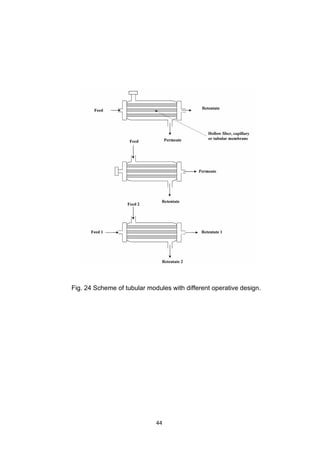
Fig. 24 Scheme of tubular modules with different operative design.
45
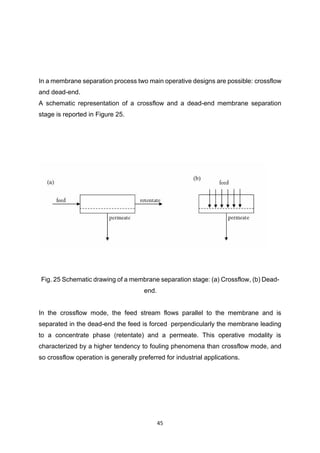
In a membrane separation process two main operative designs are possible: crossflow
and dead-end.
A schematic representation of a crossflow and a dead-end membrane separation
stage is reported in Figure 25.
Fig. 25 Schematic drawing of a membrane separation stage: (a) Crossflow, (b) Dead-
end.
In the crossflow mode, the feed stream flows parallel to the membrane and is
separated in the dead-end the feed is forced–perpendicularly the membrane leading
to a concentrate phase (retentate) and a permeate. This operative modality is
characterized by a higher tendency to fouling phenomena than crossflow mode, and
so crossflow operation is generally preferred for industrial applications.
46
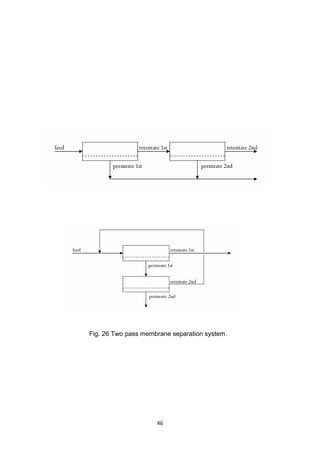
Fig. 26 Two pass membrane separation system.
47
References
1. Coulson J.M. & Richardson J.F., Chemical Engineering, Volume 1, six edition,
ELBS, Pergamon Press. 2002.
2. Coulson J.M. & Richardson J.F., Chemical Engineering, Volume 2, fifth edition,
ELBS, Pergamon Press. 2002.
3. Rousseau R. W., Handbook of Separation Process Technology, John Wiley &
Sons, 2009.
4. Seader J. D.& Henley E. J., Separation Process Principles. John Wiley & Sons,
2011.

Lecture Notes in Mass Transfer

  • 1.
    1 Lecture Notes in MassTransfer Barhm Abdullah Mohamad Erbil Polytechnic University LinkedIn: https://www.linkedin.com/in/barhm-mohamad-900b1b138/ Google Scholar: https://scholar.google.com/citations?user=KRQ96qgAAAAJ&hl=en ResearchGate: https://www.researchgate.net/profile/Barhm_Mohamad YouTube channel: https://www.youtube.com/channel/UC16-u0i4mxe6TmAUQH0kmNw
  • 2.
    2 C H AP T E R 1 Fundamentals of Mass Transfer Diffusion Mass transfer is the net movement of a component in a mixture from one location to another location where the component exists at a different concentration. Often, the transfer takes place between two phases across an interface. Thus, the absorption by a liquid of a solute from a gas involves mass transfer of the solute through the gas to the gas-liquid interface, across the interface, and into the liquid. Mass transfer models are used to describe processes such as the passage of a species through a gas to the outer surface of a porous adsorbent particle and into the pores of the adsorbent, where the species is adsorbed on the porous surface. Mass transfer is also the selective permeation through a nonporous polymeric material of a component of a gas mixture. Mass transfer is not the flow of a fluid through a pipe. However, mass transfer might be superimposed on that flow. Mass transfer is not the flow of solids on a conveyor belt. Mass transfer occurs by two basic mechanisms: (A) Molecular diffusion by random and spontaneous microscopic movement of individual molecules in a gas, liquid, or solid as a result of thermal motion; and (B) Eddy (turbulent) diffusion by random macroscopic fluid motion. Molecular and/or eddy diffusion frequently involves the movement of different species in opposing directions. When a net flow occurs in one of these directions, the total rate of mass transfer of individual species is increased or decreased by this bulk flow or convection effect, which is a third mechanism of mass transfer. As will be shown later, molecular diffusion is extremely slow, whereas eddy diffusion, when it occurs, is orders of magnitude more rapid. Therefore, if large-scale separation processes are to be conducted in equipment of a reasonable size, fluids must be agitated, interfacial areas maximized, and distances in the direction of diffusion minimized. In a binary mixture, molecular diffusion occurs because of one
  • 3.
    3 or more differentpotentials or driving forces, including differences (gradients) of concentration (ordinary diffusion), pressure (pressure diffusion), temperature (thermal diffusion), and external force fields (forced diffusion) that act unequally on the different chemical species present. Pressure diffusion requires a large pressure gradient, which is achieved for gas mixtures with a centrifuge. Thermal diffusion columns or cascades can be employed to separate liquid and ga s mixtures by establishing a temperature gradient across the mixture. More widely applied is forced diffusion in an electrical field, to cause ions of different charges to move in different directions at different speeds. In this chapter, only molecular diffusion caused by concentration gradients is considered, because this is the most common type of molecular diffusion in commercial separation processes. Furthermore, emphasis is on binary systems, for which molecular diffusion theory is simple and applications are relatively straightforward. Multi-component molecular diffusion, which is important in many applications, is much more complex than diffusion in binary systems, and is a more appropriate topic for advanced study using a specialized text. Molecular diffusion occurs in solids and in fluids that are stagnant or in laminar or turbulent motion. Eddy diffusion occurs in fluids in turbulent motion. When both molecular diffusion and eddy diffusion occur, they take place in parallel and are additive. Furthermore, they take place because of the same concentration difference (gradient). When mass transfer occurs under turbulent flow conditions, but across an interface or to a solid surface, conditions may be laminar or nearly stagnant near the interface or solid surface. Thus, even though eddy diffusion may be the dominant mechanism in the bulk of the fluid, the overall rate of mass transfer is controlled by molecular diffusion because the eddy diffusion mechanism is damped or even eliminated as the interface or solid surface is approached. Mass transfer of one or more species results in a total net rate of bulk flow or flux in one direction relative to a fixed plane or stationary coordinate system [1].
  • 4.
    4 Diffusion depends on: 1.Driving force (ΔC), moles per unit volume (kmol/m3). 2. The distance in the direction of transfer (Δz), meter (m). 3. Diffusivity coefficient, unit area per unit time (m2/s). Fig. 1 Diffusion state. 1.1 Fick's Law of diffusion: Fick′s first law of steady state diffusion JA = −DAB dCA dz …………………….………………..(1) Where: JA: is the molecular diffusion flux of A , (moles per unit area per unit time) kmol/m2.s CA: is the concentration of A (moles of A per unit volume) kmol/m3 . DAB: is known as the diffusivity or diffusion coefficient for A in B (unit area per unit time) m2/s z: is distance in the direction of transfer (m).
  • 5.
    5 Diffusion with bulkof mass in motion: Total diffusion = Molecular diffusion + Convection term Convection term = Eddy diffusion = Molar flux due to convection Convection term = Concentration . mass transfer velocity = CA . V Mass transfer velocity (V) = Mass flux Concentration = NA + NB CT = kmol m2. s kmol m3 = m s Total diffusion = NA = JA + CA . V ………………………(2) Total diffusion equation in the form of concentration (normally used for liquids): NA = −DAB dCA dz + CA CT (NA + NB)……………………….(3) Total diffusion equation in the form of partial pressure (normally used for gases): NA = − DAB RT dPA dz + PA PT (NA + NB)……………………….(4) Total diffusion equation in the form of mole fraction (used for gases and liquids): NA = − DABPT RT dXA dz + xA (NA + NB)……………………….(4) If stagnant diffusion layer, then NB = 0 NA = DAB RT PT dz Ln [ PT−PA2 PT−PA1 ]…………………………….(5) 1.1.1 Counter diffusion type equimolecular counter diffusion: When the mass transfer rates of the two components are equal and opposite the process is said to be one of equimolecular counter diffusion. Such a process occurs in the case of the box with a movable partition. It occurs also in a distillation column when the molar latent heats of the two components are the same (λA = λB). NA = DAB RT [ PA1−PA2 z2−z1 ]…………………………………(6)
  • 6.
    6 Ex. 1: Ammoniagas is diffusing at a constant rate through a layer of stagnant air 1 mm thick. Conditions are such that the gas contains 50 percent by volume ammonia at one boundary of the stagnant layer. The ammonia diffusing to the other boundary is quickly absorbed and the concentration is negligible at that plane. The temperature is 295 K and the pressure atmospheric, and under these conditions the diffusivity of ammonia in air is 0.18 cm2/s. Estimate the rate of diffusion of ammonia through the layer. Solution: If the subscripts 1 and 2 refer to the two sides of the stagnant layer and the subscripts A and B refer to ammonia and air respectively, then the rate of diffusion through a stagnant layer is given by: NA = DAB RT PT dz Ln [ PT − PA2 PT − PA1 ] PT = 101.3 kPa, PA2 = 0, PA1 = ya.PT = ( 0.5 )101.3 = 50.65 kPa Δ𝐳 = 𝐳𝟐−𝐳𝟏 = 1 mm = (1)10−3 m R = 8.314 kj kmol .K , T = 295 K and DAB = 0.18 cm2 s = 1.8 X 10⁻⁵ m2 s NA = 1.8 X 10⁻⁵ 8.314 (295) 101.3 1X10⁻³ Ln [ 101.3 101.3−50.65 ] = 5.153 X 10⁻³ kmol m2.s Ex. 2: In an air-carbon dioxide mixture at 298 K and 202.6 kPa, the concentration of CO2 at two planes (3 mm) apart are 25 vol.% and 15 vol.% respectively. The diffusivity of CO2 in air at 298 K and 202.6 kPa is 8.2 X10⁻⁶ m2/s. Calculate the rate of transfer of CO2 across the two planes, assuming: a. Equimolecular counter diffusion. b. Diffusion of CO2 through a stagnant air layer.
  • 7.
    7 Solution: PA1= yA1 .PT = (0.25) 202.6 = 50.65 kPa PA2 = yA2 . PT = (0.15) 202.6 = 30.39 kPa a. Equimolecular counter diffusion: NA = DAB RT [ PA1−PA2 z2−z1 ] NA = 8.2 X 10⁻⁶ 8.314 (298) [ 50.65 − 30.39 3 X 10⁻³ ] = 2.23X10⁻⁵ kmol m2. s b. Stagnant diffusion. NA = DAB RT PT dz Ln [ PT−PA2 PT−PA1 ] NA = 8.2 X 10⁻⁶ (8.314 )(298 ) 202.6 3 X 10⁻³ Ln [ 202.6 − 30.39 202.6 − 50.65 ] = 2.79 X 10⁻⁵ kmol m2. s 1.2 Distillation In distillation (fractionation), a feed mixture of two or more component is separated into two or more products, including, and often limited to an overhead distillate and a bottom, whose compositions differ from that of the feed. Most often, the feed is a liquid or vapor – liquid mixture. The bottoms products is almost always a liquid, but the distillate may be a liquid or a vapor or both. The separation requires that (1) a second phase be formed so that both li quid and vapor phases are present and can contact each other on each stage within a separation column, (2) the components have different volatilities so that they will partition between the two phases to different extents, and (3) the two phases can be separated by gravity or other mechanical means. Distillation differs from absorption and stripping in that the second phase is created by thermal means (vaporization and condensation) rather than by the introduction of a second phase that usually contains an additional component or component does not present in the feed mixture. The
  • 8.
    8 word distillation isderived from Latin word destillare, which means dripping or trickling down. By at least the sixteenth century, it was known that the extent of separation could be improved by providing multiple vapor-liquid contacts (stages) in a so-called Rectificatorium. The term rectification is derived from the Latin words recte facere , meaning to improve. Modern distillation derives its ability to produce almost pure products from the use of multistage contacting. A- Distillation of binary mixtures Binary Mixture: mixture contains only two components differ in boiling point. Equipment and Design Consideration Industrial distillation operations are most commonly conducted in trayed towers, but packed columns are finding increasing use. Occasionally, distillation columns contain both trays and packing. Types of trays and packing are identical to those used for absorption and stripping. A schematic diagram for the distillation column for binary mixture is presented below [1]. Fig. 2 A schematic diagram for the distillation process. Factors that influence the design or analysis of a binary distillation operation include: 1. Feed flow rate, composition, temperature, pressure, and phase condition. 2. Desired degree of separation between two components.
  • 9.
    9 3. Operating pressure(which must be below the critical pressure of the mixture). 4. Vapor pressure drop, particularly for vacuum operation. 5. Minimum reflux ratio and actual reflux ratio. 6. Minimum number of equilibrium stages and act ual number of equilibrium stages (stage efficiency). 7. Type of condenser (total, partial, or mixed). 8. Degree of sub-cooling, if any, of the liquid reflux. 9. Type of re-boiler (partial or total). 10. Type of contacting (trays or packing or both). 11. Height of the column. 12. Feed entry stage. 13. Diameter of the column. 14. Column internals 1.3 The wetted wall column The wetted wall column is a small experimental device used to determine the average mass transfer coefficient (𝐊𝐎𝐆 ). Usually it is (1 - 1.5 inch) in diameter and one meter long. Fig. 3 The wetted wall column mass balance [2].
  • 10.
    10 Let the masstransfer being from gas phase to liquid phase: 𝑊 ̅ A = G (yA1−yA2) = L (XA1−XA2) ………….………………(7) Where: 𝑾 ̅̅̅A: is the total mole rate diffusion along the column. yA and xA : are the mole fraction of component (A) in gas and liquid phase, respectively. G : is the mole flow rate of gas (kmol/s). L : is the mole flow rate of liquid (kmol/s). 𝐤𝐋 is the individual liquid film mass transfer coefficient. 𝐤𝐠: is the individual gas film mass transfer coefficient. 𝐊𝐎𝐋: is the overall mass transfer coefficient based on liquid phase. 𝐊𝐎𝐆: is the overall mass transfer coefficient based on gas phase. 𝐏𝐀𝐢: is the partial pressure of the gas (A) at the interface. 𝐂𝐀𝐢: is the concentration of the liquid (A) at the interface. 𝐏*𝐀: is the partial pressure of the gas phase which is in equilibrium with the liquid phase 𝐂𝐀. 𝐂*𝐀: is the concentration of the liquid phase which is in equilibrium with the gas phase 𝐏𝐀. H: Henry's constant W ̅ A = 𝐊𝐎𝐆 .𝐀 . Δ𝐏𝐋𝐦 ……………………………………………….(6) Now to calculate (KOG) from Eq.(6) we must calculate (W ̅ A) and (ΔPAm): ∆PLM = ∆P1−∆P2 Ln ∆P1 ∆P2 ……………………………………(7) Where: ΔP1 = PA1−P*A1 , P*A1=H CA1 ΔP2 = PA2−P*A2 , P*A2=H CA2
  • 11.
    11 We can rewritethe Eq.(6) in the mole fraction form instead of partial pressure as follows: W ̅ A = 𝐊𝐎𝐆 .𝐀 . Δy𝐋𝐦 ……………………………………………….(8) ∆yLM = ∆y1−∆y2 Ln ∆y1 ∆y2 ……………………………………(7) Where: Δy1 = yA1−y*A1 , y*A1=H XA1 Δy2 = yA2−y*A2 , y*A2=H XA2 Ex. 3: A wetted wall column is used to absorbed NH3 by water from 6 vol.% in air. The gas flow rate is 1.2 kmol/min at 1 atm and 20oC. Calculate the overall mass transfer coefficient. The data given are: • The water flow rate to gas flow rate ratio is 1.4. • The outlet gas concentration is 1.5 vol.%. • The column height is 100 cm. • The column diameter is 2 cm. • Henry's constant is 1.3. Solution: W ̅ A = G (yA1−yA2 ) = 1.2 (0.06 − 0.015) = 0.054 kmol/min W ̅ A = 9 X10⁻⁴ kmol/s A = πdL = (3.14) (2 X10⁻²) (1)
  • 12.
    12 A = 0.06283m2 ∆yLM = ∆y1 − ∆y2 Ln ∆y1 ∆y2 Δy1 = yA1−y*A1 , y*A1=H XA1 Δy2 = yA2−y*A2 , y*A2=H XA2 To find ( XA1): G (yA1−yA2) = L (XA1−XA2) XA1 = G L (yA1−yA2) + XA2 XA1 = ( 1 1.4 ) 0.06 − 0.015 + 0 XA1 = 0.0321 y*A1 = HXA1 = (1.3) (0.0321) = 0.04173 y*A2 = HXA2 = (1.3) (0) = 0 Δy1 = yA1−y*A1 = 0.06−0.04173 = 0.01827 Δy2 = yA2−y*A2 = 0.015−0 = 0.015 ∆yLM = 0.01827 − 0.015 Ln 0.01827 0.015 = 0.0165 W ̅ A = 𝐊𝐎𝐆 .𝐀 . Δy𝐋𝐦 KoG = W ̅ A A . ∆yLM = 9 X 10⁻⁴ (0.06283) (0.0165) = 0.868 kmol m2. s
  • 13.
    13 C H AP T E R 2 Absorption Gas absorption it is a mass transfer operation in which one or more gas solutes is removed by dissolution in a liquid. The inert gas in the gas mixture is called “carrier gas”. In the absorption process of ammonia from air-ammonia mixture by water, air is carrier gas, ammonia is „solute” and water is absorbent. An intimate contact between solute gas and absorbent liquid is achieved in a suitable absorption equipment, namely, tray tower, packed column, spray tower, venture scrubber, etc. Desorption or stripping operation is the reverse of absorption. Absorption operation is of two types: physical and chemical. 2.1 Equilibrium solubility of gases in liquids For the determination of driving force in any mass transfer operation, the solubility of a species in a solvent, i.e., equilibrium distribution between phases is important. With the increase in temperature, solubility of a gas in liquid decreases. Hence, absorption is done at lower temperature. On the contrary, desorption is done at higher temperature. The equilibrium characteristics of a gas-liquid system was discussed in chapter 1 (Mass Transfer Coefficient).
  • 14.
    14 2.2 Selection ofsolvent for absorption and stripping If the objective of absorption is separation of a particular component from a mixture, selection of absorbent plays a great role and when absorption operation is used to prepare a solution, solvent is selected according to final product. Few criteria for the selection of an absorbent are as follows: (A)Gas Solubility: High solubility of a gas in the solvent is preferred, utilizing low quantity of solvent. Absorbent should not dissolve carrier gas. Similar chemical nature of solute and absorbent (solvent) gives a good solubility. If chemical reaction takes place between solute and solvent, rate of absorption is extremely high. But the reaction should be reversible to recover solvent during desorption. (B)Volatility: Low volatility or low vapor pressure of the solvent enhances the adsorption operation as solvent loss with carrier gas is very small. Sometimes, a second less volatile solvent is used to recover the first solvent. (C)Viscosity: For better absorption, a solvent of low viscosity is required. In mechanically agitated absorber, greater amount of power is required for high viscous solvent and flooding is also caused at lower liquid and gas flow rates. (D)Corrosiveness: Non-corrosive or less corrosive solvent reduces equipment construction cost as well as maintenance cost. (E) Cost: The solvent should be cheap so that losses will be insignificant and should be easily available. (F) Toxicity and Hazard: The solvent should be non-toxic, non-flammable, non-hazardous and should be chemically stable. Steam is generally used in desorption or stripping medium as stripped solute can be recovered very easily by condensing steam leaving desorption tower.
  • 15.
    15 2.3 Design ofsingle stage counter-current flow absorption tower (packed tower) Two common gas absorption equipments are packed tower and plate tower. Other absorption equipments are, namely, spray column, agitated contactor, venture scrubber, etc. The gas and the liquid phases come in contact in several discrete stages. Thus, a stage wise contact is there in a plate column. But in packed tower, the up-flowing gas remains in contact with down-flowing liquid throughout the packing, at every point of the tower. Therefore, packed tower is known as “continuous’’ differential contact equipment It is different from the stage-wise distillation column. In the stage distillation column, the equilibrium in each stage will vary not in a continuous manner whereas in the packed column the equilibrium is changed point wise in each axial location [2]. Steps for the design of packed tower: (A) Selection of solvent (B) Selection of packing (C) Calculation of minimum solvent flow rate as well as actual solvent flow rate (D) Column diameter (E) Height of column (F) Design of solvent distributors and redistributors (if needed) (G)Design of gas distributor, packing support, shell, nozzles, column support The following items and variables should be known for design of a packed absorption tower: (a) Equilibrium data; (b) Gas and liquid flow rates; (c) Solute concentration in two terminals; (d) Individual and overall volumetric mass transfer coefficients (Ky𝑎 ̅, Kx𝑎 ̅, KG𝑎 ̅, KL𝑎 ̅, etc.).
  • 16.
    16 2.3.1 Packing materials: Packingmaterials are utilized to provide large interfacial area of contact between two phases. These are made from either of ceramics, metals or plastics. A number of packing materials with various size, shape and performance are available. These are classified into three types, namely, dumped or random, structured and grid. The packing materials have following characteristics: (a) Cost: The cost of the packing materials should be very low. (b) Surface area: A large interfacial area of contact is always recommended. In that case, pressure drop will be more. (c) Void volume: A high void volume is needed to maintain low pressure drop. (d) Fouling resistance: Packing materials should not trap suspended solids present in liquid. Bigger packing materials generally give low fouling resistance. (e) Mechanical strength: Good mechanical strength is desired for choosing packing materials as this will not break or deform during filling or operation. (f) Uniform flow of streams: Stack of packing materials should have uniform void spaces through which both the streams (gas and liquid) can flow uniformly. Non-uniform flow of streams leads to stagnant liquid pool which in turn gives low mass transfer. 2.3.1.1 Dumped or random packing materials: Dumped or random packing materials are classified into three categories as first generation (1907 to mid-1950); second generation (mid 1950 to mid-1970) and third generation (mid 1970 to till date). The first-generation random packing materials are of three categories, such as, (a) Raschig rings; (b) Lessing rings and modified Raschig rings and (c) Berl saddles. These are shown in Figure 4.
  • 17.
    17 (a) Raschig rings;(b) Lessing rings and (c) Berl saddle modified Raschig rings (Cross-partition rings) Fig.4 First generation dumped or random packing materials [2]. The second-generation random packing materials are mainly (a) Intalox saddle (modified); (b) Pall ring (modified). Intalox saddle is the modified version of Berl saddle and offers less friction resistance due to particular shape (two saddles will never nest). Pall rings are modified version of Raschig rings. These are shown in Figure 5. (a) Intalox saddle (modified) (b) Pall ring (modified) Fig. 5 Second generation dumped or random packing materials [2]. The third-generation random packing materials are numeral; (a) Intalox Metal Tower Packing (IMTP); (b) Nutter ring; (c) Cascade Mini-Ring (CMR); (d) Jaeger Tripac; (e) Koch Flexisaddle; (f) Nor-Pac; (g) Hiflow ring, etc. These are shown in Figure 6.
  • 18.
    18 Fig. 6 Thirdgeneration dumped or random packing materials [2]. 2.3.1.2 Structured packing materials: These materials are used widely as packing materials in packed tower due to low gas pressure drop and improved efficiency. Corrugated metal sheet structured packing and Wire mesh structured packing materials are widely used in the industries. These include Mellapak, Flexipak, Gempak, Montz and MaxPak. These are shown in Figure 7. Fig. 7 Snapshots of some structured packing materials [2]. Mellapak Flexipak Montez corrugated metal sheet Wire mesh packing (e) Koch Flexisaddle (f) Nor-Pac (g) Hiflow ring (a) Intalox metal tower packing (IMTP) (b) Nutter ring (c) Cascade Mini ring (CMR) (d) Jaeger Tripac
  • 19.
    19 2.3.1.3 Grid packingmaterials: This packing material is used for high gas or vapor capacities at low pressure drop. Mellagrid series; Flexigrid series; Snap grid series are among these grids. Fig. 8 Typical absorption-stripping processes with recycle of solvent: (a) absorber (b) stripper.
  • 20.
    20 Fig. 9 Industrialgas absorption processes [2]. Table 1 Examples of industrial gas absorption processes [2]. Industry Component to be removed Solvent Wood industry (Kraft and sulphite methods) Glass production SO2 Water Carbon industry CO2 Water, basic liquids (K2CO3) or other solvents (acetone, etc.) H2SO4 Production SO3 H2SO4 (98%) HNO3 Production NOX Water (absorption and chemical reaction) HCl Production HCL Water Explosive manufacture NOX Water
  • 21.
    21 2.4 Calculation oftower height The physical absorption process can be carried out in counter/current flow process, which may be carried out in packed or tray column: Packed tower Tray tower Z = HOG . NOG Z = H . N Fig. 10 Tower mass balance. Note: If the tower type is not mentioned in the problem, we can take it as a packed tower. Ex. 4: Ammonia is to be removed from a 10 percent ammonia–air mixture by counter current scrubbing with water in a packed tower at 293 K so that 99 percent of the ammonia is removed when working at a total pressure of 101.3 kN/m2. If the gas rate is 0.95 kg/m2.s of tower cross-section and the liquid rate is 0.65 kg/m2.s, find the necessary height of the tower if the absorption coefficient KoG . a = 0.0008 kmol/m3.s. kPa., The equilibrium data are: Y∗=0.8 X . Where: H: is the distance between two trays, and it is given (0.3 - 0.7 m). N: is the number of trays, and it can be calculated based on equilibrium data. If equilibrium data are linear then we will use equation for calculation of N. If equilibrium data are non- linear then we will use graphical method for calculation of N. Where: HOG: is the height of transfer unit (HTU) based on gas phase, and it can be calculated from the equation below: 𝐇𝐎𝐆 = G ̅s KOG .a. PT (in meter) NOG: is the number of transfer unit (NTU) based on gas phase, and it can be calculated based on equilibrium data. If equilibrium data are linear then we will use equation for calculation of NOG. If equilibrium data are non- linear then we will use graphical method for calculation of NOG.
  • 22.
    22 Solution: y2 = (1−𝑟𝑒𝑐𝑜𝑣𝑒𝑟𝑦)y1 = (1−0.99) (0.1) = 0.001 Convert mole fraction to mole ratio: 𝑦1 = 𝑦1 1 − 𝑦1 = 0.1 1 − 0.1 = 0.11 𝑦2 = 𝑦2 1−𝑦2 = 0.001 1−0.001 = 0.001 We can see that at low conc. (mole ratio = mole fraction): The gas mole flux, G ̅ = Gas mass flux Average gas molecular weight = 0.95 [(0.1) (17) +(0.99) (29)] = 0.0312 kmol m2.s The liquid mole flux, L ̅ = Liquid mass flux Average liquid molecular weight = 0.65 18 = 0.0361 kmol m2.s The mole flux of the inert gas, G ̅𝐬 = G ̅ (𝟏−𝐲𝟏) = (0.0312) (1−0.11) = 0.027 kmol m2.s The mole flux of the inert liquid, L ̅s = L ̅ (𝟏−𝐱𝟐 )= (0.0361) (1−0) = 0.0361 kmol m2.s Therefore, for pure solvent: L ̅s = L ̅ 𝐇𝐎𝐆 = G ̅s KOG . a . PT = 0.027 ( 0.0008) (101.3) = 0.333 m Since the equilibrium is linear: ∅ = mGs ̅̅̅̅ Ls ̅̅̅ = (0.8) (0.027) (0.0361) = 0.598 NOG = 1 (1 − ∅) ln [ (1 − ∅)y1 + ∅y2 (1 − ∅)y2 + ∅y2 ] = 1 (1 − 0.598) ln [ (1 − 0.598)0.1 + 0.598(0.001) (1 − 0.598)0.001 + 0.598(0.001) ] = 9.2 Z = HOG . NOG = (0.333)(9.2) = 3.06 m
  • 23.
    23 2.5 Mass transfercoefficient from empirical correlation Several workers have measured the rate of transfer from a liquid flowing down the inside wall of a tube to a gas passing counter currently upwards. Gilliland and Sherwood vaporized a number of liquids including water, toluene, aniline and propyl, amyl and butyl alcohols into an air stream flowing up the tube in order to measure the individual mass transfer coefficient (kg). Gilliland and sherwood used the empirical relation below to measure the individual mass transfer coefficient (Kg) and this relation in forms of dimensionless [3]. Ex. 5: Calculate the gas film coefficient for the absorption of sulpher dioxide from a dilute mixture with air in a wetted wall column using Gilliland and Sherwood correlation for wetted wall column for the following data: • Gas velocity = 2.5 m/s. • Gas temperature = 293 K. • Gas viscosity = 1.78 X 10⁻⁵ N.s/m2. • Gas density = 1.22 kg/m3. • Gas diffusivity = 1.22 X 10⁻⁵ m2/s. • Inside column diameter = 25 mm. Solution: Sh = 0.023 (Re) 0.83 (Sc) 0.44 Sh = Kg. d D = kg = 25 X 10−3 1.22 X 10−5 = 2049 kg Re = ρud μ = (1.22)(2.5)(25 X 10−3 ) 1.78 X 10−5 = 4283.7 Sc = μ ρ. D = 1.78 X 10⁻⁵ (1.22)1.22 X 10−5 = 1.1959 2049 kg = 0.023 (4283.7) 0.83 (1.1959) 0.44 Kg = 0.545 m s
  • 24.
    24 C H AP T E R 3 Design of dryers 3.1 Introduction and types of driers The term drying refers generally to the removal of moisture from a substance. It is one of the oldest, most commonly used and most energy consuming unit operation in the process industries. Drying is often necessary in various industrial operations particularly in chemical process industries to remove moisture from a wet solid, a solution or a gas to make it dry and choice of drying medium is depending on the chemical nature of the materials. Three basic methods of drying are used today 1) sun drying, a traditional method in which materials dry naturally in the sun, 2) hot air drying in which materials are exposed to a blast of hot air and 3) freeze drying, in which frozen materials are placed in a vacuum chamber to draw out the water. The fundamental nature of all drying process is the removal of volatile substances (mainly moisture) from mixture to yield a solid product. In general drying is accomplished by thermal techniques and thus involves the application of heat, most commonly by convection from current of air. Throughout the convective drying of solid materials, two processes occur simultaneously namely, transfer of energy from the local environment in the dryer and transfer of moisture from within the solid. Therefore, this unit operation may be considered as simultaneous heat and mass transfer operation. Drying processes and equipment may be categorized according to several criteria, including the nature of material and the method of heat supply and the method of operation. For example, In the sugar industry washed and centrifuged sugar crystals are dried to get finished product for packing. Drying is an important operation in food processing. Milk is dried in a spray chamber to produce milk powder. All the above examples indicate that wet material loses moisture in direct contact with hot air/gas. The hot air/gas supplies the energy required for drying and also carries away the moisture released by the solid. For heat sensitive materials much of the resistance to drying resides within the material. Unduly high heat and mass transfer rates
  • 25.
    25 applied at thesurface only result in overheating or over drying of the surface layer resulting in quality problems without major increase in the drying kinetics. The rate of migration of the moisture from within the solid to the evaporation front often controls the overall drying rate. Therefore, drying may be defined as an operation in which the liquid, generally water, present in a wet solid is removed by vaporization to get a relatively liquid free solid product. Drying of a solid does not demand or ensure complete removal of the moisture. Sometimes it is desirable to retain a little moisture in the solid after drying. Dryer and drying process selection for a specific operation is a complex problem, and many factors have to be taken into account. Though, the overall selection and design of a drying system for a particular material is dictated by the desire to achieve a favorable combination of a product quality and process economics. In general, with respect to the rate and total drying time, dryer performance is dependent on the factors such as air characteristics, product characteristics, equipment characteristics. But despite the many commercially available drying techniques at present most dehydrated products (i.e., fruits and vegetables) are still produced by the method of hot air drying. Because this is regarded as the simplest and most economical. There are other water/liquid removal processes such as filtration, settling, centrifugation, supercritical extraction of water from gels etc. In all these operations liquid is removed by mechanical means, but a considerable amount of liquid is still retained in the solid. This residual liquid can be removed by drying. One such example is the production of condensed milk involves evaporation, but the production of milk powder involves drying. The phase change and production of a soild phase as end product are essential features of the drying process. Drying is an essential operation in chemical, agricultural, biotechnology, food, polymer, pharmaceutical, pulp and paper, mineral processing, and wood processing industries [3]. 3.2 Physical mechanism of drying Drying does not mean only removal of the moisture but during the process, physical structure as well as the apperance has to be preserved. Drying is basically governed by the principles of transport of heat and mass. When a moist solid is heated to an appropriate temperature, moisture vaporizes at or near the solid surface and the heat required for evaporating moisture from the drying product is supplied by the external drying medium, usually air or a hot
  • 26.
    26 gas. Drying isa diffusional process in which the transfer of moisture to the surrounding medium takes place by the evaporation of surface moisture, as soon as some of the surface moisture vaporizes, more moisture is transported from interior of the solid to its surface. This transport of moisture within a solid takes place by a variety of mechanisms depending upon the nature and type of the solid and its state of aggregation. Different types of solids may have to be handled for drying crystalline, granular, beads, powders, sheets, slabs, filter- cakes etc. The mechanism of moisture transport in different solids may be broadly classified into (i) transport by liquid or vapour diffusion (ii) capillary section, and (iii) pressure induced transport. The mechanism that dominates depends on the nature of the solid, its pore structure and the rate of drying. Different mechanisms may come into play and dominate at different stages of drying of the same material. The following term are commonly used in designing of drying systems. Moisture content of a substance which exerts as equilibrium vapour pressure less than of the pure liquid at the same temperature is refered to as bound moisture. Moisture content of the solid which exters an equillibrium vapour pressure equal to that of pure liquid at the given temperature is the unbound moisture. The moisture content of solid in excess of the equilibrium moisture content is refered as free moisture. During drying, only free moisture can be evporated. The free moisture content of a solid depends upon the vapour concentration in the gas. The moisture contents of solid when it is in equilibrium with given partial pressure of vapour in gas phase is called as equilibrium moisture content. Similalry, the moisture content at which the constant rate drying peroid ends and the falling rate drying period starts is called critical moisture content. During the constant rate drying period, the moisture evporated per unit time per unit area of drying surface remains constant and in falling rate drying period the amount of moisture evporated per unit time per unit area of drying surface continuously decreases [3].
  • 27.
    27 3.3 Classification ofdryers Drying equipment is classified in different ways, according to following design and operating features: 1. It can be classified based on mode of operation such as batch or continuous, in case of batch dryer the material is loaded in the drying equipment and drying proceeds for a given period of time, whereas, in case of continuous mode the material is continuously added to the dryer and dried material continuously removed. In some 2. Cases vacuum may be used to reduce the drying temperature. Some dryers can handle almost any kind of material, whereas others are severely limited in the style of feed they can accept. 3. Drying processes can also be categorized according to the physical state of the feed such as wet solid, liquid, and slurry. 4. Conduction, convection, radiation is another way of categorizing the drying process. 5. Heat may be supplied by direct contact with hot air at atmospheric pressure, and the water vaporized is removed by the air flowing. Heat may also be supplied indirectly through the wall of the dryer from a hot gas flowing outside the wall or by radiation. 6. Dryers exposing the solids to a hot surface with which the solid is in contact are called adiabatic or direct dryers, while when heat is transferred from an external medium it is known as non-adiabatic or indirect dryers. 7. Dryers heated by dielectric, radiant or microwave energy are also non adiabatic. Some units combine adiabatic and non-adiabatic drying; they are known as direct-indirect dryers. To reduce heat losses most of the commercial dryers are insulated and hot air is recirculated to save energy. Now many designs have energy-saving devices, which recover heat from the exhaust air or automatically control the air humidity. Computer control of dryers in sophisticated driers also results in important savings in energy.
  • 28.
    28 3.4 Drying equipment 3.4.1Batch type dryers 3.4.1.1 Tray dryer Schematic of a typical batch dryer is shown in figure 11. Tray dryers usually operate in batch mode, use racks to hold product and circulate air over the material. It consists of a rectangular chamber of sheet metal containing trucks that support racks. Each rack carries a number of trays that are loaded with the material to be dried. Hot air flows through the tunnel over the racks. Sometimes fans are used to on the tunnel wall to blow hot air across the trays. Even baffles are used to distribute the air uniformly over the stack of trays. Some moist air is continuously vented through exhaust duct; makeup fresh air enters through the inlet. The racks with the dried product are taken to a tray-dumping station. Fig. 11 Tray dryer [3]. These types of dryers are useful when the production rate is small. They are used to dry wide range of materials but have high labor requirement for loading and unloading the materials and are expensive to operate. They find most frequent application for drying valuable products. Drying operation in case of such dryers is slow and requires several hours to complete drying of one batch. With indirect heating often the dryers may be operated under vaccum. The trays may rest on hollow plates supplied with steam or hot water or may themselves contain spaces for a heating fluid. Vapour from the solid may be removed by an ejector or vacuum pump. Freeze-drying involves the sublimation of water from ice under high vacuum at temperatures well below 0oC. This is done in special vacuum dryers for drying heat-sensitive products.
  • 29.
    29 3.4.1.2 Pan dryer Theatmospheric pan drier has a jacketed round pan in which a stirrer or mill revolves slowly, driven from below. The slow-moving stirrer exposes fresh surfaces and thereby raises the rate of evaporation and, hence, of drying. The pan drier is a batch machine and is limited to small batches. Pan driers may be used first to evaporate a solution to its crystallizing concentration and then can function as a crystallizer by sending cold water instead of steam into the jacket. The effect of the stirrer during crystallization prevents the growth of large crystals and promotes formation of small, uniform crystals. The mother liquor is then drained off and the crystals dried in the same apparatus [3]. Fig. 12 Pan dryer [3]. 3.4.1.3 Agitated vacuum dryer The agitated vacuum dryer is one of the most versatile in the range and is similar in principle to a pan dryer. The dryer essentially consists of a jacketed cylindrical vessel arranged for hot water, steam or a suitable thermal fluid flow through the jacket for heating. Doors are provided on the shell, at the top for loading the feed material and at the bottom for discharging. The dryers are available in variety of sizes. The entire drying chamber is well machined to insure small clearance with the agitator blade. Thus, ensures proper shuffling of the material and avoids localized overheating. Due to the agitation of the product in the agitated vacuum dryer the drying time is substantially reduced.
  • 30.
    30 Fig. 13 Agitatedpan dryer [3]. A choice of the agitator design which can be arranged with or without heating depends on the material characteristics and process requirements. While designing the shell one has to consider the external pressure and the shaft designing includes fatigue consideration. Designing the impeller needs consideration of characteristics of the material before and after drying [3]. 3.4.2 Continuous dryer 3.4.2.1 Rotary dryer The rotary drier is basically a cylinder, inclined slightly to the horizontal, which may be rotated, or the shell may be stationary, and an agitator inside may revolve slowly. In either case, the wet material is fed in at the upper end, and the rotation, or agitation, advances the material progressively to the lower end, where it is discharged. Figure 14 shows a direct heat rotary drier. Typical dimensions for a unit like this are 9 ft diameter and 45 ft length. In direct heat revolving rotary driers, hot air or a mixture of flue gases and air travels through the cylinder. The feed rate, the speed of rotation or agitation, the volume of
  • 31.
    31 heated air orgases, and their temperature are so regulated that the solid is dried just before discharge. Fig. 14 Counter current direct heat rotary dryer [4]. The shell fits loosely into a stationary housing at each end. The material is brought to a chute that runs through the housing; the latter also carries the exhaust pipe. The revolving shell runs on two circular tracks and is turned by a girth gear that meshes with a driven pinion. The inclination is one in sixteen for high capacities and one in thirty for low ones. As the shell revolves, the solid is carried upward one-fourth of the circumference; it then rolls back to a lower level, exposing fresh surfaces to the action of the heat as it does so. Simple rotary driers serve well enough when fuel is cheap. The efficiency is greatly improved by placing longitudinal plates 3 or 4 in. wide on the inside of the cylinder. These are called lifting flights. These carry part of the solid half- way around the circumference and drop it through the whole of a diameter in the central part of the cylinder where the air is hottest and least laden with moisture. By bending the edge of the lifter slightly inward, some of the material is delivered only in the third quarter of the circle, producing a nearly uniform fall of the material throughout the cross section of the cylinder. The heated air streams through a rain of particles. This is the most common form of revolving rotary cylinder. It has high capacity, is simple in operation, and is continuous.
  • 32.
    32 3.4.2.2 Drum dryer Indrum dryers (Figure 15) a liquid containing dissolved solids or slurry carrying suspended solids forms a thin layer on the outside surface of a large rotating drum. For a single drum unit thickness of the film can be controlled by an adjustable scraping blade. In case of a double drum unit thickness can be controlled by the gap between the drums (Figure 16). A gas, normally air may be blown over the surface for rapid removal of moisture. The rotation of the drum adjusted so that all of the liquid is fully vaporized, and a dried deposit can be scrapped off with the help of flexible or adjustable knife. This type of dryer mainly handles the materials that are too thick for a spray dryer and too thin for a rotary dryer. The solid collects on an apron in front of the knife and rolls to a container or to a screw conveyor. The operation of the drum drier is continuous. The drum is rotated continuously by a gear driven by a pinion that receives its motion through a belt, a chain, or a reduction gear from. The speed of the drum may be regulated by a variable-speed drive to adopt the speed to any slight variation in the feed quality. The speed of the drum regulated depending upon the nature of materials (i.e wet or dry), if the product material is wet/dry quite a distance before the knife is reached, the speed should be decreased/increased. The design of the components is similar to that of drum filter. The knife may be held just against the surface. It may be brought closer by turning the adjusting wheels. The knife supports may be turned through part of a circle so that the angle of the blade of the knife relative to the drum surface may be selected for the greatest shearing effect. In recent years, double drum dryers have replaced single drum dryer in several applications (Figure 15), due to their more efficient operation, wide range of products and high production rates [4].
  • 33.
    33 Fig. 15 Singledrum dryer [4]. Fig. 16 Double drum dryer [4].
  • 34.
    34 3.4.2.3 Flash dryer Theflash driers (Figure 17), also called pneumatic dryers, are similar in their operating principle to spray dryer. The materials that are to be dried (i.e. solid or semisolid) are dispersed in finely divided form in an upward flowing stream of heated air. These types of dryers are mainly used for drying of heat sensitive or easily oxidizable materials. The wet materials that are too dried can be passed into a high-temperature air stream that carries it to a hammer mill or high-speed agitator where the exposed surface is increased. The drying rate is very high for these dryers (hence the term flash dryers), but the solid temperature does not rise much because of the short residence time. A flash dryer is not suitable for particles which are large in size or heavy particles. The special advantage of this type of dryer is that no separate arrangement is required for transporting the dried product. The fine particles leave the mill through a small duct to maintain the carrying velocities (drying gas) and reach a cyclone separator. A solid particle takes few seconds to pass from the point of entry into the air stream to the collector. The inlet gas temperature is high and varies from 650oC to 315oC, for example, in 2 seconds, or from 650oC to 175oC in 4 seconds. The thermal efficiency this type of dryer is generally low. A material having an initial moisture content of 80 % may be reduced to 5 or 6 % in the dried product [4]. Fig. 17 Flash dryer [4].
  • 35.
    35 3.4.2.4 Fluidized beddryer Fluidized bed dryer consists of a steel shell of cylindrical or rectangular cross section. A grid is provided in the column over which the wet material is rests. In this type of dryer, the drying gas is passed through the bed of solids at a velocity sufficient to keep the bed in a fluidized state. Mixing and heat transfer are very rapid in this type of dryers. The dryer can be operated in batch or continuous mode (Figure 18). Fluidized bed dryer is suitable for granular and crystalline materials. If fine particles are present, either from the feed or from particle breakage in the fluidized bed, there may be considerable solid carryover with the exit gas and bag filters are needed for fines recovery. The main advantage of this type of dryer are rapid and uniform heat transfer, short drying time, good control of the drying conditions. In case of rectangular fluid-bed dryers separate fluidized compartments are provided through which the solids move in sequence from inlet to outlet. These are known as plug flow dryers; residence time is almost the same for all particles in the compartments. But the drying conditions can be changed from one compartment to another, and often the last compartment is fluidized with cold gas to cool the solid before discharge [4]. Fig. 18 Continuous fluidized bed dryer [4].
  • 36.
    36 3.4.2.5 Screen conveyordryers Screen conveyor dryer is also called a direct heat continuous type dryer. The solid to be dried are fed on to endless, perforated, conveyor belt through which hot air is forced. The belt is housed in a long rectangular drying chamber or tunnel (Figure 19). The chamber is divided into series of separate sections, each with its own fan and air heater. Air may be recirculated through and vented from each section separately or passed from one section to another counter current to the solid movement. The solid is carried through the tunnel and discharged at the opposite end. In order to prevent the higher flow rate of hot air through thinner regions of the bed a uniform feeding rate and distribution of the material over the conveyor is necessary. Coarse granular, flakey, or fibers materials can be dried by through circulation without any pretreatment and without loss of material through the screen. High drying rate can be achieved with good product quality control. Thermal efficiency of this type of dryer is high and with steam heating, the steam consumption for heating the drying gas can be as low as 1.5 kg per kg of water evaporated. Only disadvantage of this type of dryer are high initial cost and high maintenance cost due to the mechanical belt. Fig. 19 Screen conveyor dryer [4].
  • 37.
    37 3.5 Novel dryingtechnologies Newer technologies focus on saving in energy consumption that result in considerable overall improvement in energy efficiency. In addition, the final quality of the product is greatly influenced by the drying technique and strategy. A brief overview of some novel drying techniques is given below: 3.5.1 Microwave drying Microwave heating is a direct drying method. High-frequency radio waves are utilized in microwave drying. A high frequency generates the waves and wave channel guides them into an oven that is designed to prevent the waves from leaving the chamber. In microwave drying, heat is generated by directly transforming the electromagnetic energy into kinetic molecular energy, thus the heat is generated deep within the material to be dried. Selection of proper wavelength is necessary to ensure thorough penetration into the material. Apart from these, other parameters such as material type and depth of material being exposed also affect the penetration. Therefore, selection of proper wavelengths and dehydration condition for each product is selected individually. This type of heating is instantaneous, uniform and penetrating throughout the material, which is a great advantage for the processing of pharmaceutical compounds. In case of microwave drying the waves bounce from wall to wall, until the product absorbs eventually all of the energy, generating heat within the material, resulting in dehydration. Vapour from the liquid evaporating inside the product is emitted through the pore structure of the solid material‟s macro- capillary system, resulting in a high drying rate. This type of dryer is highly efficient and power utilization efficiencies are generally greater than 70 %. Important commercial aspects of this dryer include the ability to maintain colour, moisture and quality of the natural food [4]. 3.5.2 Supercritical fluid extraction and its application to drying The supercritical fluid (SCF) is a substance at a temperature and pressure above its critical point. It can effuse through solids like a gas, and dissolve materials like a liquid. Supercritical fluids possess unique properties that enable them to extract components selectively from a mixture. This ability has been investigated as an alternative to currently used separation processes such as
  • 38.
    38 distillation or liquidextractions. In addition, close to the critical point, small changes in pressure or temperature result in large changes in density, allowing many properties of a supercritical fluid to be "fine-tuned". Above the critical point, this increased density produces enhanced solvency, approaching that of a liquid. It is this solvency that makes SCF extraction a feasible alternative. Mass transfer properties resembling that of gases are also a significant factor in SCF extraction. An application of SCF extraction that has seemingly gone unexplored is to the drying of food products. Since moisture content influences texture, chemical reactions, and susceptibility to microbial spoilage, drying is a way to retain quality and prolong shelf life. A complication associated with drying of food products is that they may undergo changes that alter the physical or chemical structure, thus changing the integrity of the product. SCF extraction avoids this problem because it allows the food product to be dehydrated without undergoing a phase change from liquid water to water vapour. Also, if a solvent such as supercritical carbon dioxide is used, it will not be necessary to heat the product above ambient temperatures. 3.6 Selection of drying equipment In view of the enormous choice of dryer types one could possibly deploy for most products, selection of the best type is a challenging task that should not be taken lightly. The first consideration in selecting a dryer is its operability. Above all else, the equipment must produce the desired product in the desired form at the desired rate. The quality required in a finished product, and its necessary physical characteristics, are determined by its end use. A wrong dryer for a given application is still a poor dryer, regardless of how well it is designed. Although variety of commercial dryers are available in the market, the different types of mares largely complementary, not competitive, and the nature of the drying problem dictates the type of dryer that must be used, or at least limits the choice to perhaps two or three possibilities. The final choice is then made on the basis of capital and operating costs. Attention must be paid, however, to the costs of the entire drying system, not just the drying unit alone. There are some general guidelines which need to be followed to select a dryer, but it should be recognized that the rules are far from rigid and exceptions not uncommon. Often batch dryers are used when the production rate of dried product is less than 150 to 200 kg/h, while continuous dryers are suitable for production rates greater than 1 or 2 tons/h. To handle intermediate production
  • 39.
    39 rates other factorsmust be considered [4]. The dryer must also operate reliably, safely, and economically. Operation and maintenance costs must not be excessive; pollution must be controlled; energy consumption must be minimized. As with other equipment these requirements may be conflict with one another, and a compromise needs to be reached in finding the optimum dryer for a given service. As far as the drying operation itself is concerned, adiabatic dryers are generally less expensive than non- adiabatic dryers, in spite of the lower thermal efficiency of adiabatic units. Unfortunately, there is usually a lot of dust carry over from adiabatic dryers, and these entrained particles must be removed from the drying gas. Elaborate particle-removal equipment may be needed, equipment that may cost as much as the dryer itself. This often makes adiabatic dryers less commercially attractive than a “buttoned-up” non-adiabatic system in which little or no gas is used.
  • 40.
    40 3.6 Design considerationof driers 3.6.1 Design of dryer Design of a rotary dryer only on the basis of fundamental principle is very difficult. Few of correlations that are available for design may not prove to be satisfactory for many systems. The design of a rotary dryer is better done by using pilot plant test data and the full-scale operating data of dryer of similar type if available, together with the available design equations. A fairly large number of variables are involved such as solid to be dried per hour, the inlet and exit moisture contents of the solid, the critical and equilibrium moisture contents, temperature and humidity of the drying gas. The design procedure based on the basic principles and available correlations is discussed below. In this case we assume that the solid has only unbound moisture and as shown in Figure 20 in stage II the solid is at the wet bulb temperature of the gas [4]. Fig. 20 Temperature profile for solid and gas in a counter current rotary dryer [4]. 1. Heat losses from dryer surfaces are neglected. 2. Once the capacity of the dryer is known, the drying gas flow rate, its temperature and humidity are decided considering a number of factors. And the following moisture & enthalpy balances need to be satisfied. Gs (Y1 - Y2) = Ms (X1 – X2) Gs (Hg2 – Hg1) = Ms (HS2 – Hs1) …………………….. (8) Where; Gs = flow rate of air (dry basis, kg/h) Ms = flow rate of solid (kg/h, dry basis) Hs = humidity of air (kg/H2O/kg dry air)
  • 41.
    41 C H AP T E R 4 Separations 4.1 Membrane separations A membrane is thin interphase that restricts the passage of different components in a specific mode and over a wide range of particle sizes and molecular weights, from ions to macromolecules. The separation of the different components is due to differences in their transport rate. In a membrane separation process, the transport rate of a component can be activated by synthetic membranes may be manufactured as solid or liquid phase, using organic or inorganic materials; they may be homogeneous or heterogeneous, symmetrical or asymmetrical, porous or dense, electrically neutral or charged; they may exhibit isotropic or anisotropic properties. The efficiency of a membrane basically is determined by two parameters: permeability (the rate at which a given component is transported through the membrane) and selectivity (the ability to separate in specific way a given component from others). The transport of different species through a membrane is a non-equilibrium process, and various driving forces such as gradients in concentration, pressure, temperature or electrical potential. In many membrane operations more than one driving force is involved (e.g. pressure and concentration in gas separation, concentration and electrical potential in electro-dialysis, etc.), but all these parameters can be included in one thermodynamic function, the electrochemical potential η (which includes the chemical potential). In multi-component systems, driving forces and fluxes are interdependent, giving rise to complex interactions; not far from equilibrium, linear equations derived from
  • 42.
    42 Fig. 21 Scanningelectron microscopy images of the cross section of a flat sheet: (a) Hollow fiber (b) Membrane prepared from a modified poly- ketone [4]. Tubular membranes can be distinguished–in hollow fibers (fiber diameter below 0.5 mm), capillary (fiber diameter comprised between 0.5 and 10 mm) and tubular (fiber diameter > 10mm). For applications on large scale, membranes are efficiently packed in small and compact Plate-and -frame modules make use of flat-sheet membranes (in sandwich configuration) separated by support plates. These modules have low packing densities and are correspondingly expensive; they are for examples used to produce potable water in small-scale applications. Spiral-wound modules allow the efficient packaging of flat-sheet membrane in a convenient cylindrical form. They consist in an arrangement of two rectangular membranes placed back-to-back and sealed on three sides. They are rolled around a collector tube connected to the fourth side which remains open. The solution to be treated is brought to one end of this cylinder and the product circulates between both membranes to the collector tube. A spiral-wound module is contained in a pressure vessel assembly, consisting of a cylindrical housing for the modules, a plumbing [4].
  • 43.
    43 Fig. 22 Schemeof a plate and frame membrane module [4]. Fig. 23 Scheme of a spiral wound module [4].
  • 44.
    44 Fig. 24 Schemeof tubular modules with different operative design.
  • 45.
    45 In a membraneseparation process two main operative designs are possible: crossflow and dead-end. A schematic representation of a crossflow and a dead-end membrane separation stage is reported in Figure 25. Fig. 25 Schematic drawing of a membrane separation stage: (a) Crossflow, (b) Dead- end. In the crossflow mode, the feed stream flows parallel to the membrane and is separated in the dead-end the feed is forced–perpendicularly the membrane leading to a concentrate phase (retentate) and a permeate. This operative modality is characterized by a higher tendency to fouling phenomena than crossflow mode, and so crossflow operation is generally preferred for industrial applications.
  • 46.
    46 Fig. 26 Twopass membrane separation system.
  • 47.
    47 References 1. Coulson J.M.& Richardson J.F., Chemical Engineering, Volume 1, six edition, ELBS, Pergamon Press. 2002. 2. Coulson J.M. & Richardson J.F., Chemical Engineering, Volume 2, fifth edition, ELBS, Pergamon Press. 2002. 3. Rousseau R. W., Handbook of Separation Process Technology, John Wiley & Sons, 2009. 4. Seader J. D.& Henley E. J., Separation Process Principles. John Wiley & Sons, 2011.