Chemical Engineering Plant Design
Course Code: CHE435
Course Cr. Hrs.: 3(3,0)
Course Instructor:
Dr. Muhammad Haris Hamayun
Assistant Professor,
Department of Chemical Engineering,
COMSATS University Islamabad, Lahore Campus.
Contact Email: mhhamayun@cuilahore.edu.pk
1
Course Contents
2
Process design and development. General design consideration. Design codes, standards
and materials selection, optimum design. Health safety and environment, Fire and
explosion hazards: HAZID, HAZIN, HAZOP analysis. Lifecycle analysis. Vessel design:
low, medium and high pressure, storage and transportation vessels, cryogenic vessels.
Hydraulic design of tray and packed columns. Heat exchanger network design, piping and
pipeline design. Properties estimation. Design of mass transfer equipment, material
transport, material handling and heat transfer including furnaces and refrigeration
units. Basic concepts of cost indexing, estimation and optimization: optimization of
unconstrained functions; linear programming applications; non-linear programming with
constraints. Engineering Ethics; local, global impact analysis.
Course Learning Outcomes
3
• CLO # 1: Apply process design considerations and cost analysis on a chemical
engineering plant (C3, PLO1).
• CLO # 2: Apply optimization techniques on chemical engineering equipment/plant
(C3, PLO1).
• CLO # 3: Develop a solution that provides a feasible design of equipment
used in the process industry (C6, PLO3).
• CLO # 4: Develop safety protocols for on-site and surroundings and implement
hazard analysis (C6, PLO3).
• COMPLEX ENGINEERING ATTRIBUTES
Lecture # 7
4
• Example # 11.9
Types of Packings (Recap)
5
1. Provide a large surface area: a high interfacial area between the gas and liquid.
2. Have an open structure: low resistance to gas flow.
3. Promote uniform liquid distribution on the packing surface.
4. Promote uniform vapor or gas flow across the column cross-section.
Classes of Packings:
1. Packings with a regular geometry, such as stacked rings, grids, and proprietary structured
packings.
2. Random packings: rings, saddles, and proprietary shapes, which are dumped into the
column and take up a random arrangement.
Design Procedure for Packed Column
6
1. Select the type and size of packing.
2. Determine the column height required for the specified separation.
3. Determine the column diameter (capacity) to handle the liquid and vapor flow
rates.
4. Select and design the column internal features: packing support, liquid distributor,
redistributors.
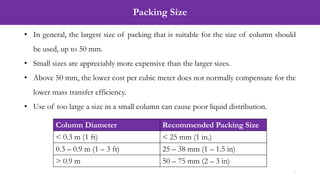
Packing Size
7
• In general, the largest size of packing that is suitable for the size of column should
be used, up to 50 mm.
• Small sizes are appreciably more expensive than the larger sizes.
• Above 50 mm, the lower cost per cubic meter does not normally compensate for the
lower mass transfer efficiency.
• Use of too large a size in a small column can cause poor liquid distribution.
Column Diameter Recommended Packing Size
< 0.3 m (1 ft) < 25 mm (1 in.)
0.3 – 0.9 m (1 – 3 ft) 25 – 38 mm (1 – 1.5 in)
> 0.9 m 50 – 75 mm (2 – 3 in)
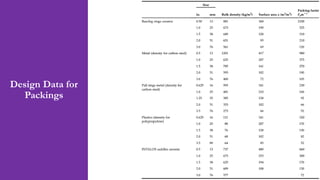
Design Data for
Packings
8
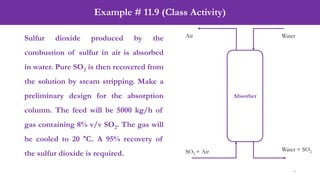
Example # 11.9 (Class Activity)
9
Sulfur dioxide produced by the
combustion of sulfur in air is absorbed
in water. Pure SO2 is then recovered from
the solution by steam stripping. Make a
preliminary design for the absorption
column. The feed will be 5000 kg/h of
gas containing 8% v/v SO2. The gas will
be cooled to 20 °C. A 95% recovery of
the sulfur dioxide is required.
Absorber
SO2 + Air
Air Water
Water + SO2
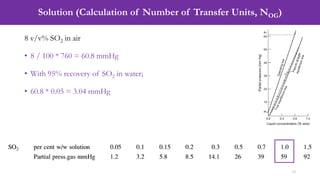
Solution (Calculation of Number of Transfer Units, NOG)
10
8 v/v% SO2 in air
• 8 / 100 * 760 = 60.8 mmHg
• With 95% recovery of SO2 in water;
• 60.8 * 0.05 = 3.04 mmHg
Solution (Calculation of Number of Transfer Units, NOG)
11
1 % w/w SO2 = 59 mmHg
• Mole Fraction (Vapor) = Pi / P = 59 / 760 = 0.0776
• Mole Fraction (Liquid) = [(wt. of SO2 / Mol. wt.)] / [(wt. of SO2 / Mol. wt.) + (wt.
of H2O / Mol. wt.)]
• Mole Fraction (Liquid) = [(1/64)] / [(1/64) + (99/18)] = 0.0028
• Slope = Mole Fraction (Vapor) / Mole Fraction (Liquid) = 0.0776 / 0.0028 = 27.4
Solution (Calculation of Number of
Transfer Units, NOG)
12
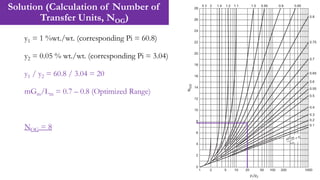
y1 = 1 %wt./wt. (corresponding Pi = 60.8)
y2 = 0.05 % wt./wt. (corresponding Pi = 3.04)
y1 / y2 = 60.8 / 3.04 = 20
mGm/Lm = 0.7 – 0.8 (Optimized Range)
NOG = 8
Solution (Calculation of Number of Transfer Units, NOG)
13
If the equilibrium curve and operating lines can be taken as straight, and the solvent
feed is essentially solute free, the number of transfer units is given by:
NOG = 1/(1-0.8) * ln[(1 – 0.8)*20 + 0.8] = 7.84 ≈ 8
Solution (Calculation of Column Diameter)
14
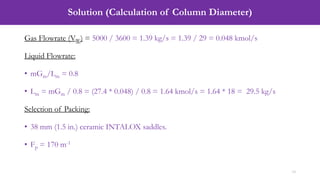
Gas Flowrate (VW) = 5000 / 3600 = 1.39 kg/s = 1.39 / 29 = 0.048 kmol/s
Liquid Flowrate:
• mGm/Lm = 0.8
• Lm = mGm / 0.8 = (27.4 * 0.048) / 0.8 = 1.64 kmol/s = 1.64 * 18 = 29.5 kg/s
Selection of Packing:
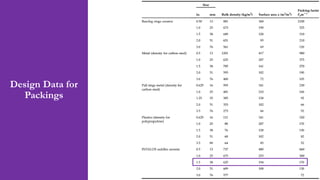
• 38 mm (1.5 in.) ceramic INTALOX saddles.
• Fp = 170 m-1
Design Data for
Packings
15
Solution (Calculation of Column Diameter)
16
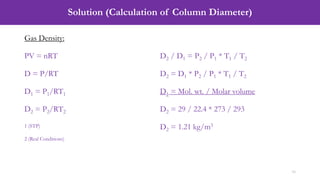
Gas Density:
PV = nRT
D = P/RT
D1 = P1/RT1
D2 = P2/RT2
1 (STP)
2 (Real Conditions)
D2 / D1 = P2 / P1 * T1 / T2
D2 = D1 * P2 / P1 * T1 / T2
D1 = Mol. wt. / Molar volume
D2 = 29 / 22.4 * 273 / 293
D2 = 1.21 kg/m3
Solution (Calculation of Column Diameter)
17
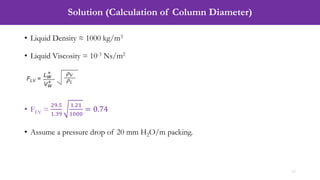
• Liquid Density ≈ 1000 kg/m3
• Liquid Viscosity = 10-3 Ns/m2
• FLV =
29.5
1.39
1.21
1000
= 0.74
• Assume a pressure drop of 20 mm H2O/m packing.
Solution (Calculation of Column
Diameter)
18
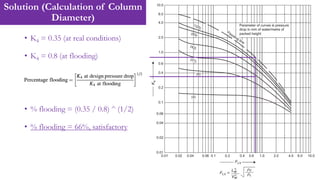
• K4 = 0.35 (at real conditions)
• K4 = 0.8 (at flooding)
• % flooding = (0.35 / 0.8) ^ (1/2)
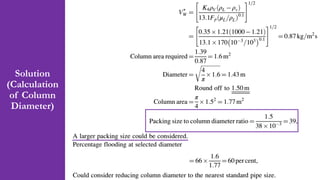
• % flooding = 66%, satisfactory
Solution
(Calculation
of Column
Diameter)
19

Week # 04_Lecture # 07_Packed Column.pdf

  • 1.
    Chemical Engineering PlantDesign Course Code: CHE435 Course Cr. Hrs.: 3(3,0) Course Instructor: Dr. Muhammad Haris Hamayun Assistant Professor, Department of Chemical Engineering, COMSATS University Islamabad, Lahore Campus. Contact Email: mhhamayun@cuilahore.edu.pk 1
  • 2.
    Course Contents 2 Process designand development. General design consideration. Design codes, standards and materials selection, optimum design. Health safety and environment, Fire and explosion hazards: HAZID, HAZIN, HAZOP analysis. Lifecycle analysis. Vessel design: low, medium and high pressure, storage and transportation vessels, cryogenic vessels. Hydraulic design of tray and packed columns. Heat exchanger network design, piping and pipeline design. Properties estimation. Design of mass transfer equipment, material transport, material handling and heat transfer including furnaces and refrigeration units. Basic concepts of cost indexing, estimation and optimization: optimization of unconstrained functions; linear programming applications; non-linear programming with constraints. Engineering Ethics; local, global impact analysis.
  • 3.
    Course Learning Outcomes 3 •CLO # 1: Apply process design considerations and cost analysis on a chemical engineering plant (C3, PLO1). • CLO # 2: Apply optimization techniques on chemical engineering equipment/plant (C3, PLO1). • CLO # 3: Develop a solution that provides a feasible design of equipment used in the process industry (C6, PLO3). • CLO # 4: Develop safety protocols for on-site and surroundings and implement hazard analysis (C6, PLO3). • COMPLEX ENGINEERING ATTRIBUTES
  • 4.
    Lecture # 7 4 •Example # 11.9
  • 5.
    Types of Packings(Recap) 5 1. Provide a large surface area: a high interfacial area between the gas and liquid. 2. Have an open structure: low resistance to gas flow. 3. Promote uniform liquid distribution on the packing surface. 4. Promote uniform vapor or gas flow across the column cross-section. Classes of Packings: 1. Packings with a regular geometry, such as stacked rings, grids, and proprietary structured packings. 2. Random packings: rings, saddles, and proprietary shapes, which are dumped into the column and take up a random arrangement.
  • 6.
    Design Procedure forPacked Column 6 1. Select the type and size of packing. 2. Determine the column height required for the specified separation. 3. Determine the column diameter (capacity) to handle the liquid and vapor flow rates. 4. Select and design the column internal features: packing support, liquid distributor, redistributors.
  • 7.
    Packing Size 7 • Ingeneral, the largest size of packing that is suitable for the size of column should be used, up to 50 mm. • Small sizes are appreciably more expensive than the larger sizes. • Above 50 mm, the lower cost per cubic meter does not normally compensate for the lower mass transfer efficiency. • Use of too large a size in a small column can cause poor liquid distribution. Column Diameter Recommended Packing Size < 0.3 m (1 ft) < 25 mm (1 in.) 0.3 – 0.9 m (1 – 3 ft) 25 – 38 mm (1 – 1.5 in) > 0.9 m 50 – 75 mm (2 – 3 in)
  • 8.
  • 9.
    Example # 11.9(Class Activity) 9 Sulfur dioxide produced by the combustion of sulfur in air is absorbed in water. Pure SO2 is then recovered from the solution by steam stripping. Make a preliminary design for the absorption column. The feed will be 5000 kg/h of gas containing 8% v/v SO2. The gas will be cooled to 20 °C. A 95% recovery of the sulfur dioxide is required. Absorber SO2 + Air Air Water Water + SO2
  • 10.
    Solution (Calculation ofNumber of Transfer Units, NOG) 10 8 v/v% SO2 in air • 8 / 100 * 760 = 60.8 mmHg • With 95% recovery of SO2 in water; • 60.8 * 0.05 = 3.04 mmHg
  • 11.
    Solution (Calculation ofNumber of Transfer Units, NOG) 11 1 % w/w SO2 = 59 mmHg • Mole Fraction (Vapor) = Pi / P = 59 / 760 = 0.0776 • Mole Fraction (Liquid) = [(wt. of SO2 / Mol. wt.)] / [(wt. of SO2 / Mol. wt.) + (wt. of H2O / Mol. wt.)] • Mole Fraction (Liquid) = [(1/64)] / [(1/64) + (99/18)] = 0.0028 • Slope = Mole Fraction (Vapor) / Mole Fraction (Liquid) = 0.0776 / 0.0028 = 27.4
  • 12.
    Solution (Calculation ofNumber of Transfer Units, NOG) 12 y1 = 1 %wt./wt. (corresponding Pi = 60.8) y2 = 0.05 % wt./wt. (corresponding Pi = 3.04) y1 / y2 = 60.8 / 3.04 = 20 mGm/Lm = 0.7 – 0.8 (Optimized Range) NOG = 8
  • 13.
    Solution (Calculation ofNumber of Transfer Units, NOG) 13 If the equilibrium curve and operating lines can be taken as straight, and the solvent feed is essentially solute free, the number of transfer units is given by: NOG = 1/(1-0.8) * ln[(1 – 0.8)*20 + 0.8] = 7.84 ≈ 8
  • 14.
    Solution (Calculation ofColumn Diameter) 14 Gas Flowrate (VW) = 5000 / 3600 = 1.39 kg/s = 1.39 / 29 = 0.048 kmol/s Liquid Flowrate: • mGm/Lm = 0.8 • Lm = mGm / 0.8 = (27.4 * 0.048) / 0.8 = 1.64 kmol/s = 1.64 * 18 = 29.5 kg/s Selection of Packing: • 38 mm (1.5 in.) ceramic INTALOX saddles. • Fp = 170 m-1
  • 15.
  • 16.
    Solution (Calculation ofColumn Diameter) 16 Gas Density: PV = nRT D = P/RT D1 = P1/RT1 D2 = P2/RT2 1 (STP) 2 (Real Conditions) D2 / D1 = P2 / P1 * T1 / T2 D2 = D1 * P2 / P1 * T1 / T2 D1 = Mol. wt. / Molar volume D2 = 29 / 22.4 * 273 / 293 D2 = 1.21 kg/m3
  • 17.
    Solution (Calculation ofColumn Diameter) 17 • Liquid Density ≈ 1000 kg/m3 • Liquid Viscosity = 10-3 Ns/m2 • FLV = 29.5 1.39 1.21 1000 = 0.74 • Assume a pressure drop of 20 mm H2O/m packing.
  • 18.
    Solution (Calculation ofColumn Diameter) 18 • K4 = 0.35 (at real conditions) • K4 = 0.8 (at flooding) • % flooding = (0.35 / 0.8) ^ (1/2) • % flooding = 66%, satisfactory
  • 19.