
A NOT SO BRIEF LOOK AT
Abigail Barrett
&
Annique McLune
What is an egg?
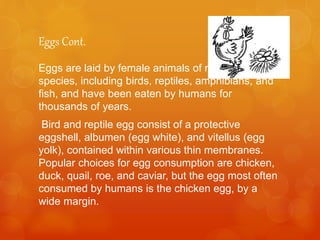
 An egg is an oval or round object laid by a
female bird, reptile, fish, or invertebrate, usually
containing a developing embryo. The eggs of
birds are enclosed in a chalky shell, while those
of reptiles are in a leathery membrane.
Eggs Cont.
Eggs are laid by female animals of many different
species, including birds, reptiles, amphibians, and
fish, and have been eaten by humans for
thousands of years.
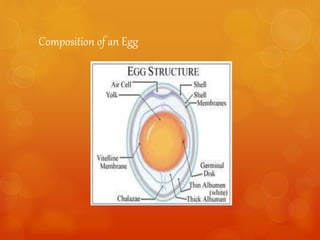
Bird and reptile egg consist of a protective
eggshell, albumen (egg white), and vitellus (egg
yolk), contained within various thin membranes.
Popular choices for egg consumption are chicken,
duck, quail, roe, and caviar, but the egg most often
consumed by humans is the chicken egg, by a
wide margin.
Composition of an Egg
Nutritive Value of Eggs
 Chicken eggs are the most commonly eaten
eggs. They supply all essential amino acids for
humans and provide several vitamins and
minerals, including retinol (vitamin A), riboflavin
(vitamin B2), folic acid (vitamin B9), vitamin B6,
vitamin B12, choline, iron, calcium, phosphorus
and potassium. Although not as abundant as red
meats, eggs are a source of CoQ10 depending
on how they are prepared.
 All of the egg's vitamins A, D, and E are in the
egg yolk. The egg is one of the few foods to
naturally contain vitamin D.
Science of Eggs
 When you apply heat, you agitate those placidly
drifting egg-white proteins, bouncing them
around. They slam into the surrounding water
molecules; they bash into each other. All this
bashing about breaks the weak bonds that kept
the protein curled up.
 The egg proteins uncurl and bump into other
proteins that have also uncurled. New chemical
bonds form—but rather than binding the protein
to itself, these bonds connect one protein to
another.
HEAT ‘EM
Science of Eggs Cont.
After enough of this bashing and bonding,
the solitary egg proteins are solitary no
longer. They’ve formed a network of
interconnected proteins. The water in which
the proteins once floated is captured and
held in the protein web. If you leave the eggs
at a high temperature too long, too many
bonds form and the egg white becomes
rubbery.
Science of Eggs
 When you beat raw egg whites to make a soufflé
or a meringue, you incorporate air bubbles into
the water-protein solution. Adding air bubbles to
egg whites unfolds those egg proteins just as
certainly as heating them.
 Egg-white proteins contain both hydrophilic and
hydrophobic amino acids. When the protein is
curled up, the hydrophobic amino acids are
packed in the center away from the water and
the hydrophilic ones are on the outside closer to
the water.
BEAT ‘EM
Science of Eggs Egg yolk contains a number of emulsifiers, which is
why egg yolks are so important in making foods such
as hollandaise and mayonnaise.
 Many proteins in egg yolk can act as emulsifiers
because they have some amino acids that repel
water and some amino acids that attract water. Mix
egg proteins thoroughly with oil and water, and one
part of the protein will stick to the water and another
part will stick to the oil.
 Lecithin is another important emulsifier found in egg
yolk. Known as a phospholipid, it’s a fatlike molecule
with a water-loving “head” and a long, water-fearing
“tail.” The tail gets buried in the fat droplets, and its
head sticks out of the droplet surface into the
surrounding water. This establishes a barrier that
prevents the surface of the fat droplet from coming
into contact with the surface of another fat droplet.
MIX ‘EM
Uses of Eggs in Cookery
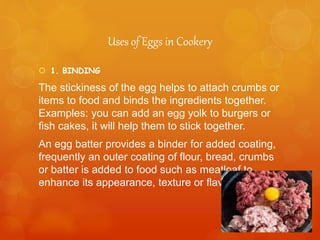
 1. BINDING
The stickiness of the egg helps to attach crumbs or
items to food and binds the ingredients together.
Examples: you can add an egg yolk to burgers or
fish cakes, it will help them to stick together.
An egg batter provides a binder for added coating,
frequently an outer coating of flour, bread, crumbs
or batter is added to food such as meatloaf to
enhance its appearance, texture or flavor.
Uses of Eggs in Cookery Cont.
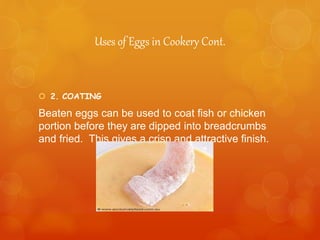
 2. COATING
Beaten eggs can be used to coat fish or chicken
portion before they are dipped into breadcrumbs
and fried. This gives a crisp and attractive finish.
Uses of Eggs in Cookery Cont.
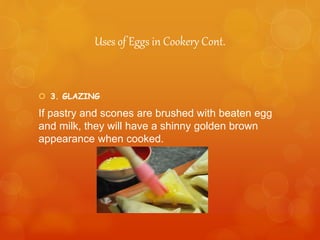
 3. GLAZING
If pastry and scones are brushed with beaten egg
and milk, they will have a shinny golden brown
appearance when cooked.
Uses of Eggs in Cookery
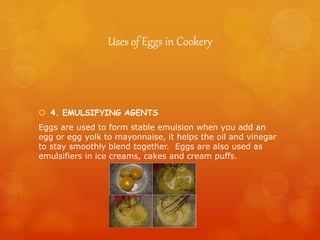
 4. EMULSIFYING AGENTS
Eggs are used to form stable emulsion when you add an
egg or egg yolk to mayonnaise, it helps the oil and vinegar
to stay smoothly blend together. Eggs are also used as
emulsifiers in ice creams, cakes and cream puffs.
Uses of Eggs in Cookery Cont.
 5. CLARIFYING
Raw eggs maybe added to hot broths. Egg whites
will hold impurities and bring them to the top of a
simmering liquid.
Open Discussion
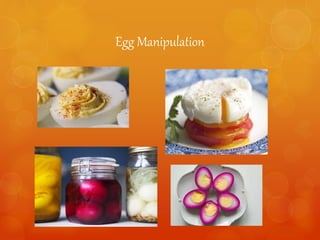
Egg Manipulation
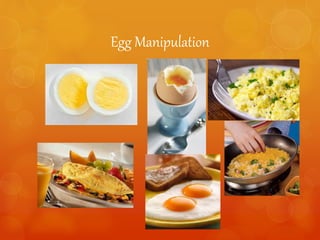
Egg Manipulation
The Egg.  Jk. The End.

Eggs presentation(food &_nutrition)

  • 1.
    A NOT SOBRIEF LOOK AT Abigail Barrett & Annique McLune
  • 2.
    What is anegg?  An egg is an oval or round object laid by a female bird, reptile, fish, or invertebrate, usually containing a developing embryo. The eggs of birds are enclosed in a chalky shell, while those of reptiles are in a leathery membrane.
  • 3.
    Eggs Cont. Eggs arelaid by female animals of many different species, including birds, reptiles, amphibians, and fish, and have been eaten by humans for thousands of years. Bird and reptile egg consist of a protective eggshell, albumen (egg white), and vitellus (egg yolk), contained within various thin membranes. Popular choices for egg consumption are chicken, duck, quail, roe, and caviar, but the egg most often consumed by humans is the chicken egg, by a wide margin.
  • 4.
  • 5.
    Nutritive Value ofEggs  Chicken eggs are the most commonly eaten eggs. They supply all essential amino acids for humans and provide several vitamins and minerals, including retinol (vitamin A), riboflavin (vitamin B2), folic acid (vitamin B9), vitamin B6, vitamin B12, choline, iron, calcium, phosphorus and potassium. Although not as abundant as red meats, eggs are a source of CoQ10 depending on how they are prepared.  All of the egg's vitamins A, D, and E are in the egg yolk. The egg is one of the few foods to naturally contain vitamin D.
  • 6.
    Science of Eggs When you apply heat, you agitate those placidly drifting egg-white proteins, bouncing them around. They slam into the surrounding water molecules; they bash into each other. All this bashing about breaks the weak bonds that kept the protein curled up.  The egg proteins uncurl and bump into other proteins that have also uncurled. New chemical bonds form—but rather than binding the protein to itself, these bonds connect one protein to another. HEAT ‘EM
  • 7.
    Science of EggsCont. After enough of this bashing and bonding, the solitary egg proteins are solitary no longer. They’ve formed a network of interconnected proteins. The water in which the proteins once floated is captured and held in the protein web. If you leave the eggs at a high temperature too long, too many bonds form and the egg white becomes rubbery.
  • 8.
    Science of Eggs When you beat raw egg whites to make a soufflé or a meringue, you incorporate air bubbles into the water-protein solution. Adding air bubbles to egg whites unfolds those egg proteins just as certainly as heating them.  Egg-white proteins contain both hydrophilic and hydrophobic amino acids. When the protein is curled up, the hydrophobic amino acids are packed in the center away from the water and the hydrophilic ones are on the outside closer to the water. BEAT ‘EM
  • 9.
    Science of EggsEgg yolk contains a number of emulsifiers, which is why egg yolks are so important in making foods such as hollandaise and mayonnaise.  Many proteins in egg yolk can act as emulsifiers because they have some amino acids that repel water and some amino acids that attract water. Mix egg proteins thoroughly with oil and water, and one part of the protein will stick to the water and another part will stick to the oil.  Lecithin is another important emulsifier found in egg yolk. Known as a phospholipid, it’s a fatlike molecule with a water-loving “head” and a long, water-fearing “tail.” The tail gets buried in the fat droplets, and its head sticks out of the droplet surface into the surrounding water. This establishes a barrier that prevents the surface of the fat droplet from coming into contact with the surface of another fat droplet. MIX ‘EM
  • 10.
    Uses of Eggsin Cookery  1. BINDING The stickiness of the egg helps to attach crumbs or items to food and binds the ingredients together. Examples: you can add an egg yolk to burgers or fish cakes, it will help them to stick together. An egg batter provides a binder for added coating, frequently an outer coating of flour, bread, crumbs or batter is added to food such as meatloaf to enhance its appearance, texture or flavor.
  • 11.
    Uses of Eggsin Cookery Cont.  2. COATING Beaten eggs can be used to coat fish or chicken portion before they are dipped into breadcrumbs and fried. This gives a crisp and attractive finish.
  • 12.
    Uses of Eggsin Cookery Cont.  3. GLAZING If pastry and scones are brushed with beaten egg and milk, they will have a shinny golden brown appearance when cooked.
  • 13.
    Uses of Eggsin Cookery  4. EMULSIFYING AGENTS Eggs are used to form stable emulsion when you add an egg or egg yolk to mayonnaise, it helps the oil and vinegar to stay smoothly blend together. Eggs are also used as emulsifiers in ice creams, cakes and cream puffs.
  • 14.
    Uses of Eggsin Cookery Cont.  5. CLARIFYING Raw eggs maybe added to hot broths. Egg whites will hold impurities and bring them to the top of a simmering liquid.
  • 15.
  • 16.
  • 17.
  • 18.
    The Egg. Jk. The End.