LESSON 2
PREPARING
PASTA
Prepared by:
Arlyn P. Bonifacio
TLE 10
The First Uniting Christian School
LEARNING GOALS &
TARGETS
 At the end of the lesson, the learner
is expected to:
 Discuss the principles of preparing
pasta
 Identify the different types and
shapes of pasta
 Demonstrate how to make
homemade pasta
 Demonstrate how to cook pasta
Introduction
 Pasta is a staple food of
traditional Italian cuisine.
 Pasta is eaten in Italy only as first .
 The dough is made mostly from durum
wheat or, buckwheat flour, with water
and, sometimes, eggs.
 Pasta comes in a variety of different
shapes that acts as a carrier for the
different types of sauce and foods.
 Pasta can be purchased fresh,
frozen, or dry.
 Lasagna noodles are available
frozen for use from the frozen
state.
 Filled pastas, such as ravioli and
tortellini, are often purchased
frozen.
 Pasta can be substituted for
Introduction
PASTA
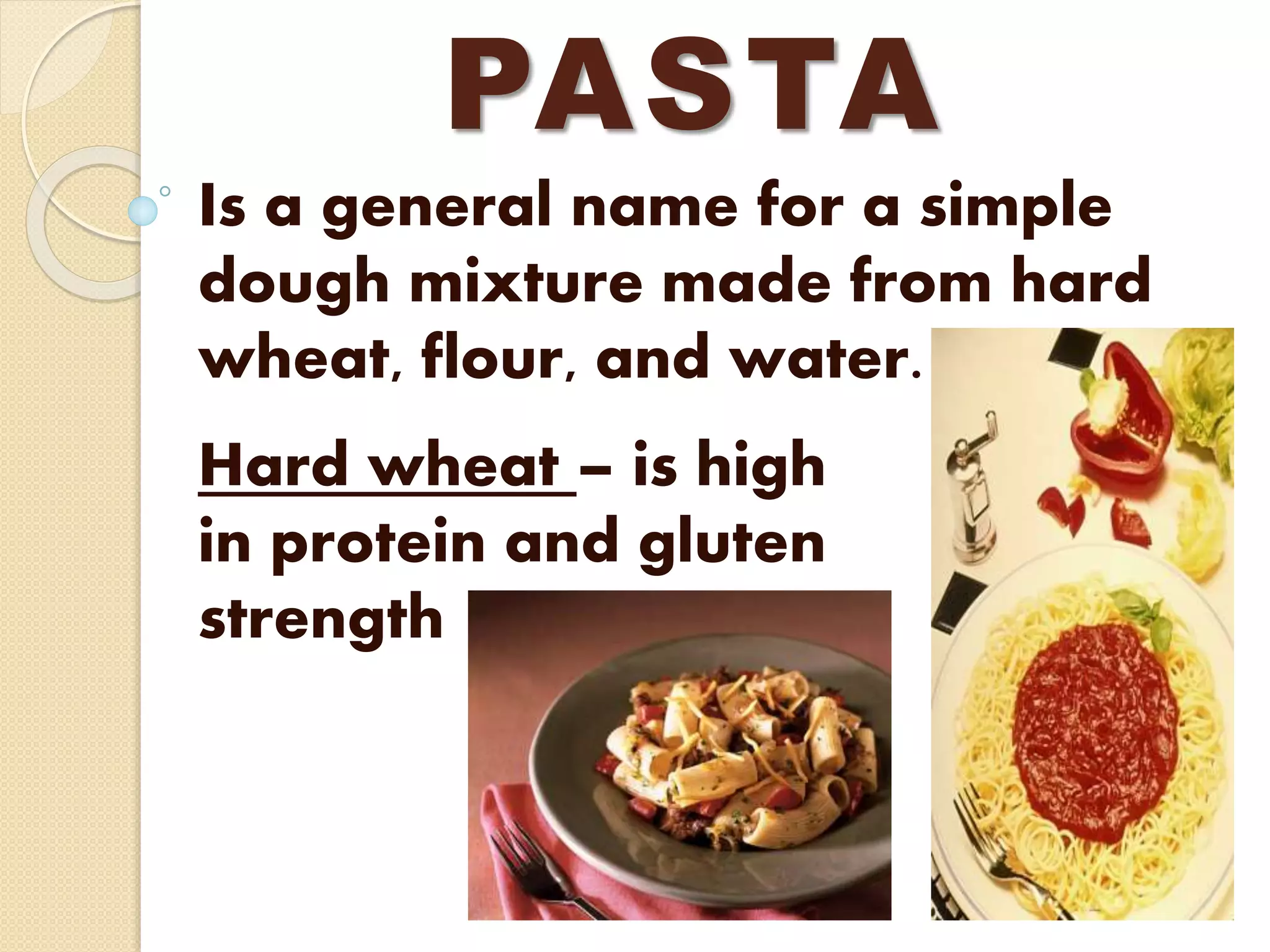
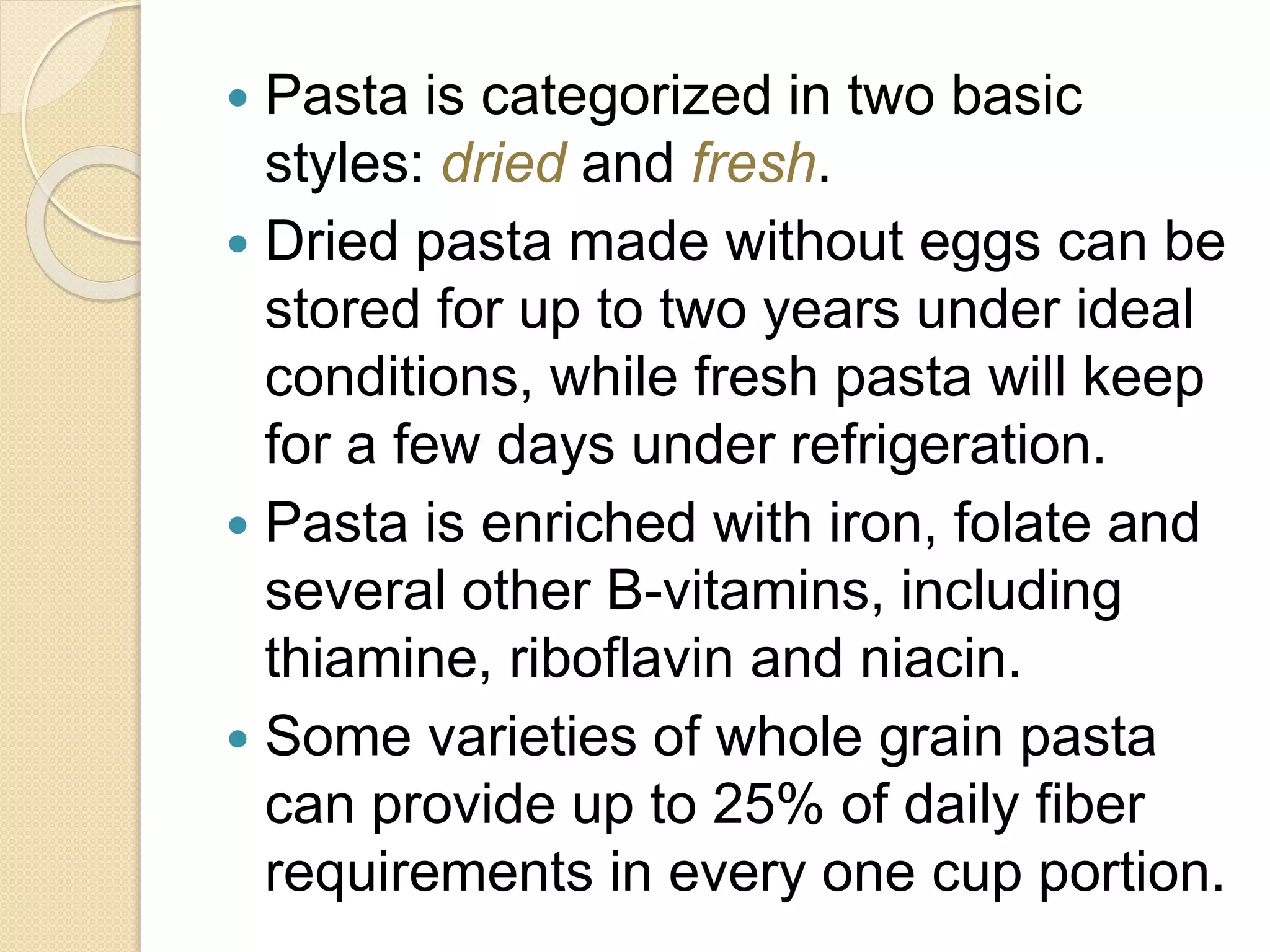
Is a general name for a simple
dough mixture made from hard
wheat, flour, and water.
Hard wheat – is high
in protein and gluten
strength
 Pasta is categorized in two basic
styles: dried and fresh.
 Dried pasta made without eggs can be
stored for up to two years under ideal
conditions, while fresh pasta will keep
for a few days under refrigeration.
 Pasta is enriched with iron, folate and
several other B-vitamins, including
thiamine, riboflavin and niacin.
 Some varieties of whole grain pasta
can provide up to 25% of daily fiber
requirements in every one cup portion.
PRINCIPLES OF PREPARING PASTA
 There are different pasta shapes.
 Cooking time depends on the
shape of the pasta
 Pasta gets bigger and heavier
when it is cooked.
 Follow the recipe properly.
 There are hundreds of shapes and sizes
of pasta with each shape used for
different preparations based on how the
sauce will cling, what the desired texture
is, or how the product will be used.
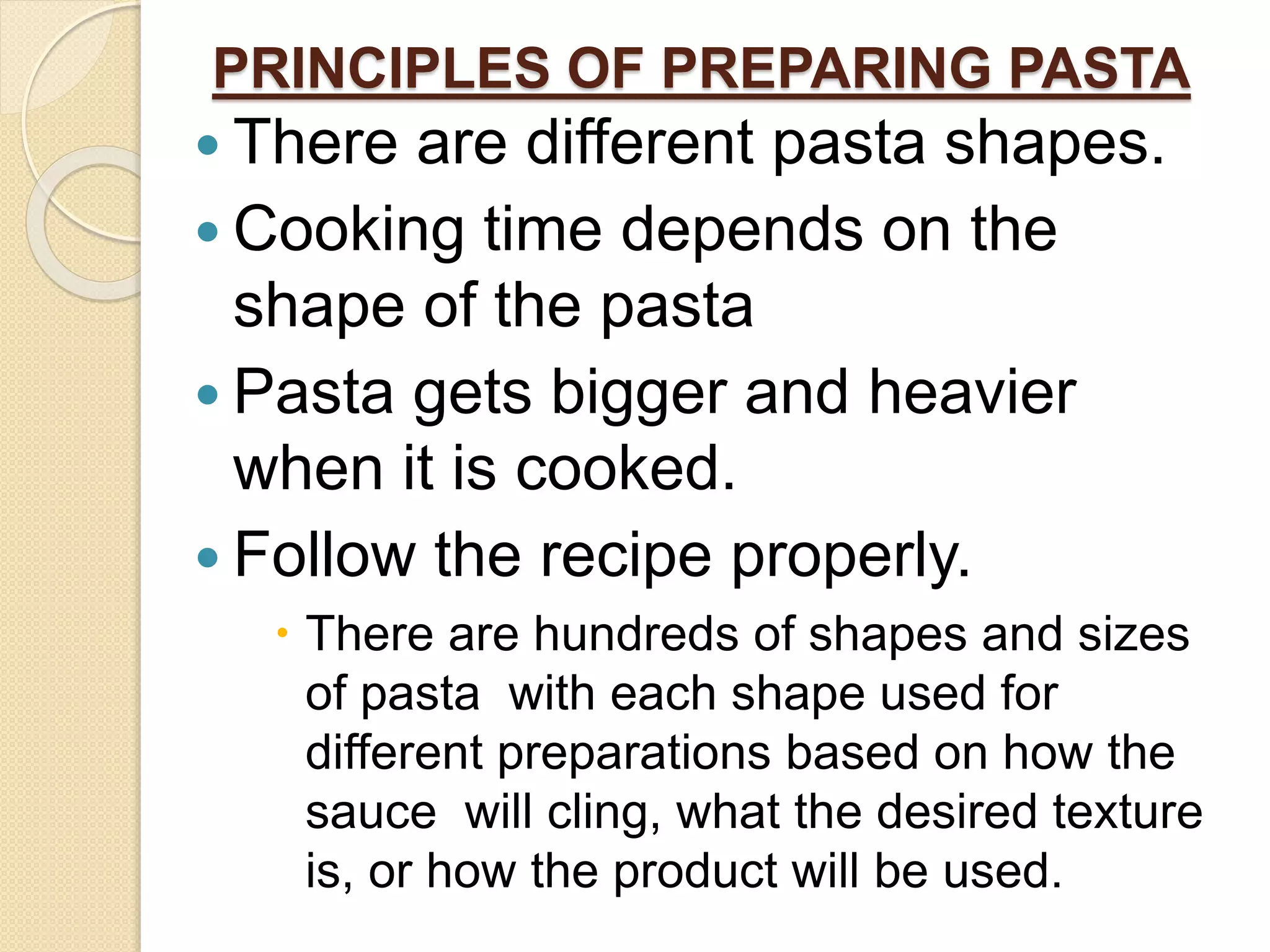
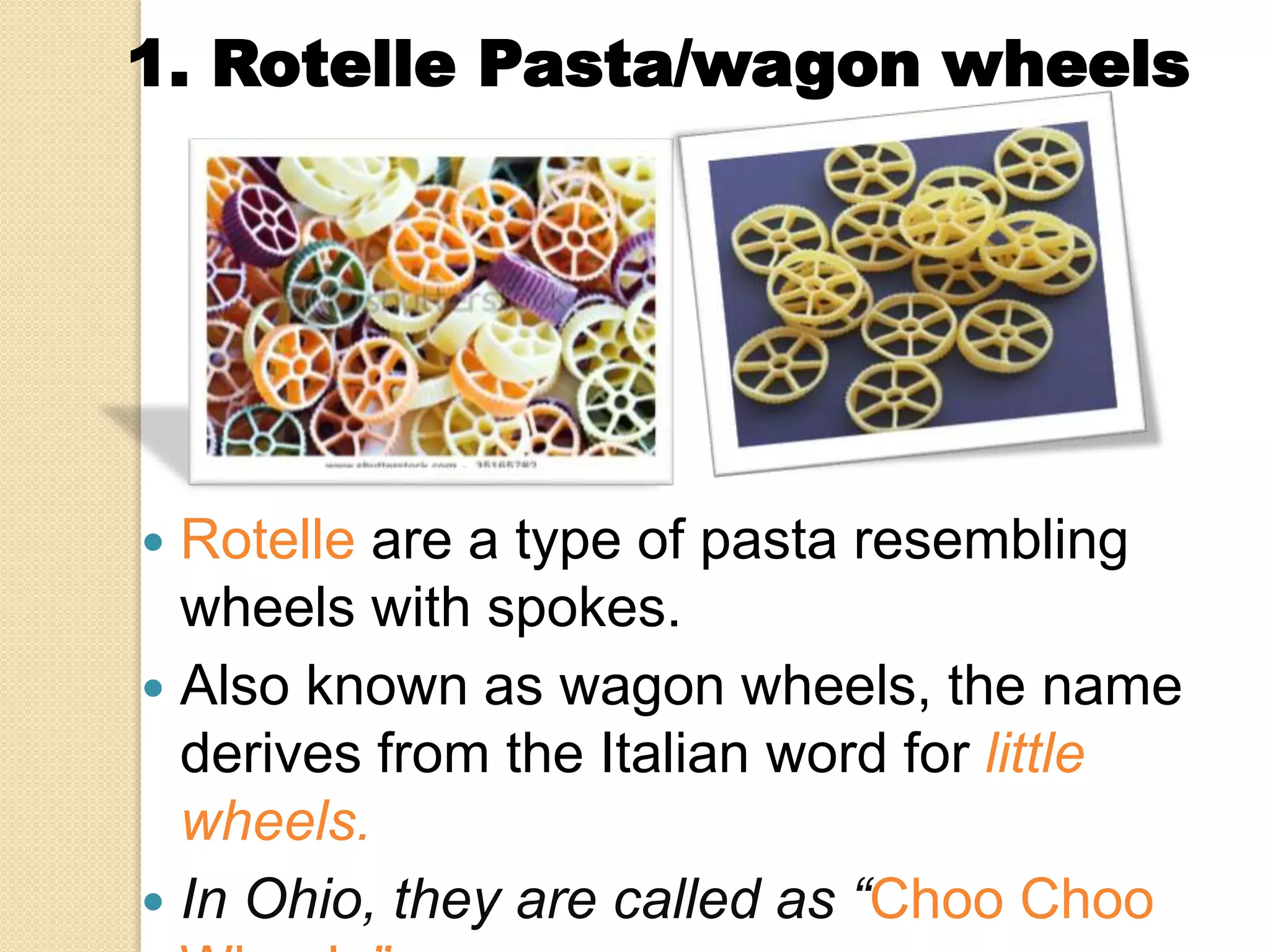
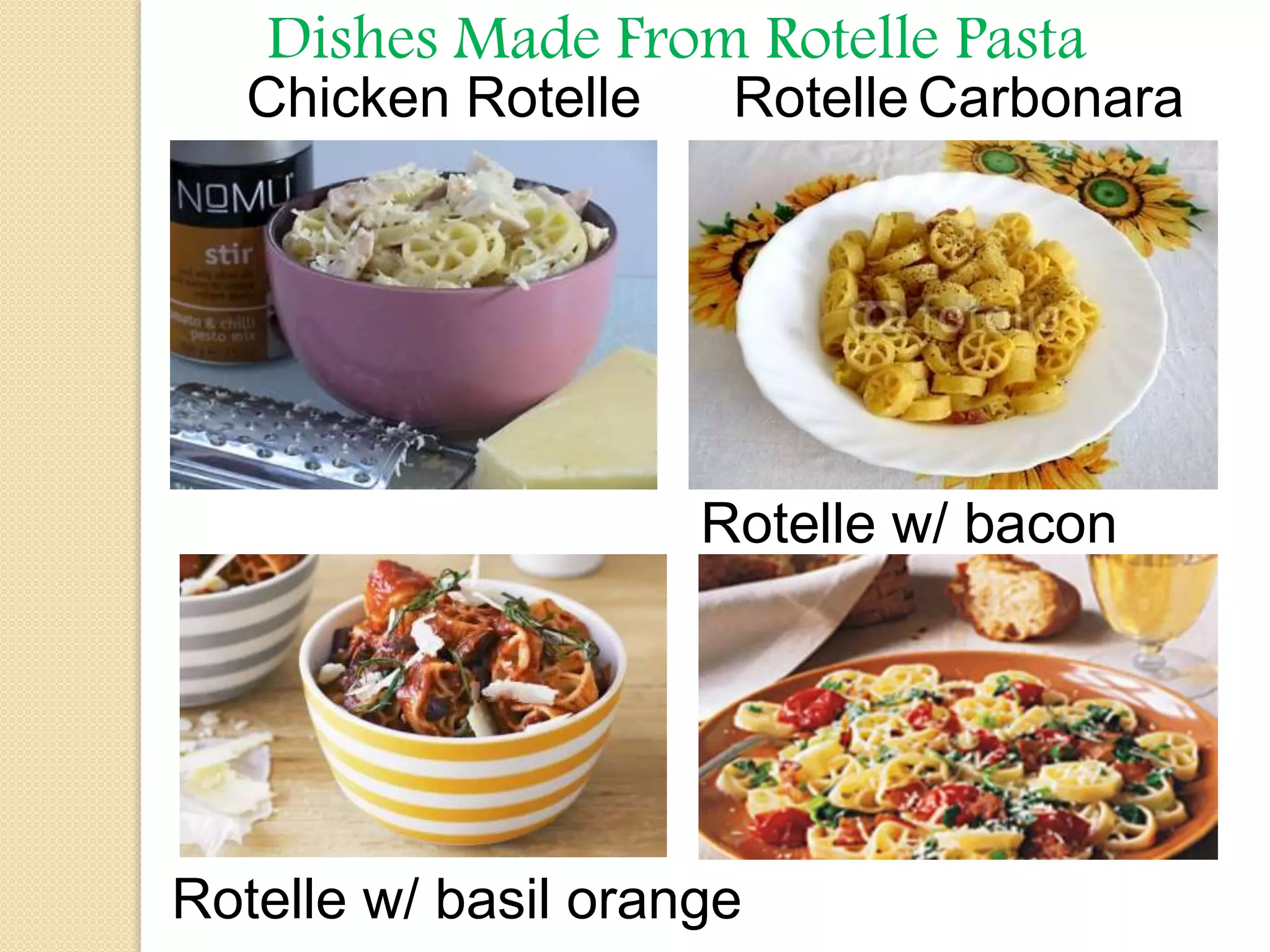
 Rotelle are a type of pasta resembling
wheels with spokes.
 Also known as wagon wheels, the name
derives from the Italian word for little
wheels.
 In Ohio, they are called as “Choo Choo
1. Rotelle Pasta/wagon wheels
Dishes Made From Rotelle Pasta
Chicken Rotelle Rotelle Carbonara
Rotelle w/ basil orange
Rotelle w/ bacon
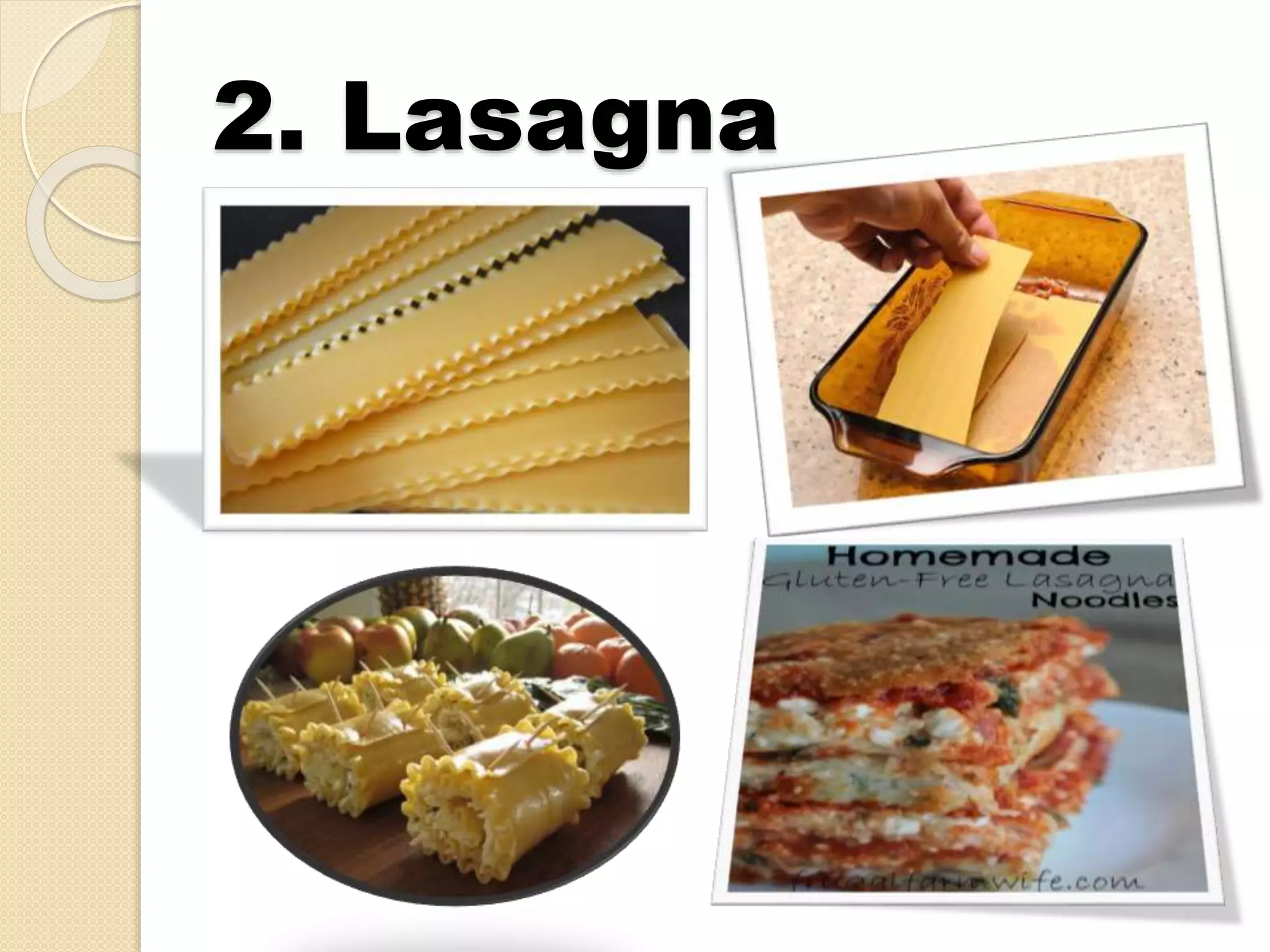
2. Lasagna
3. FARFALLE
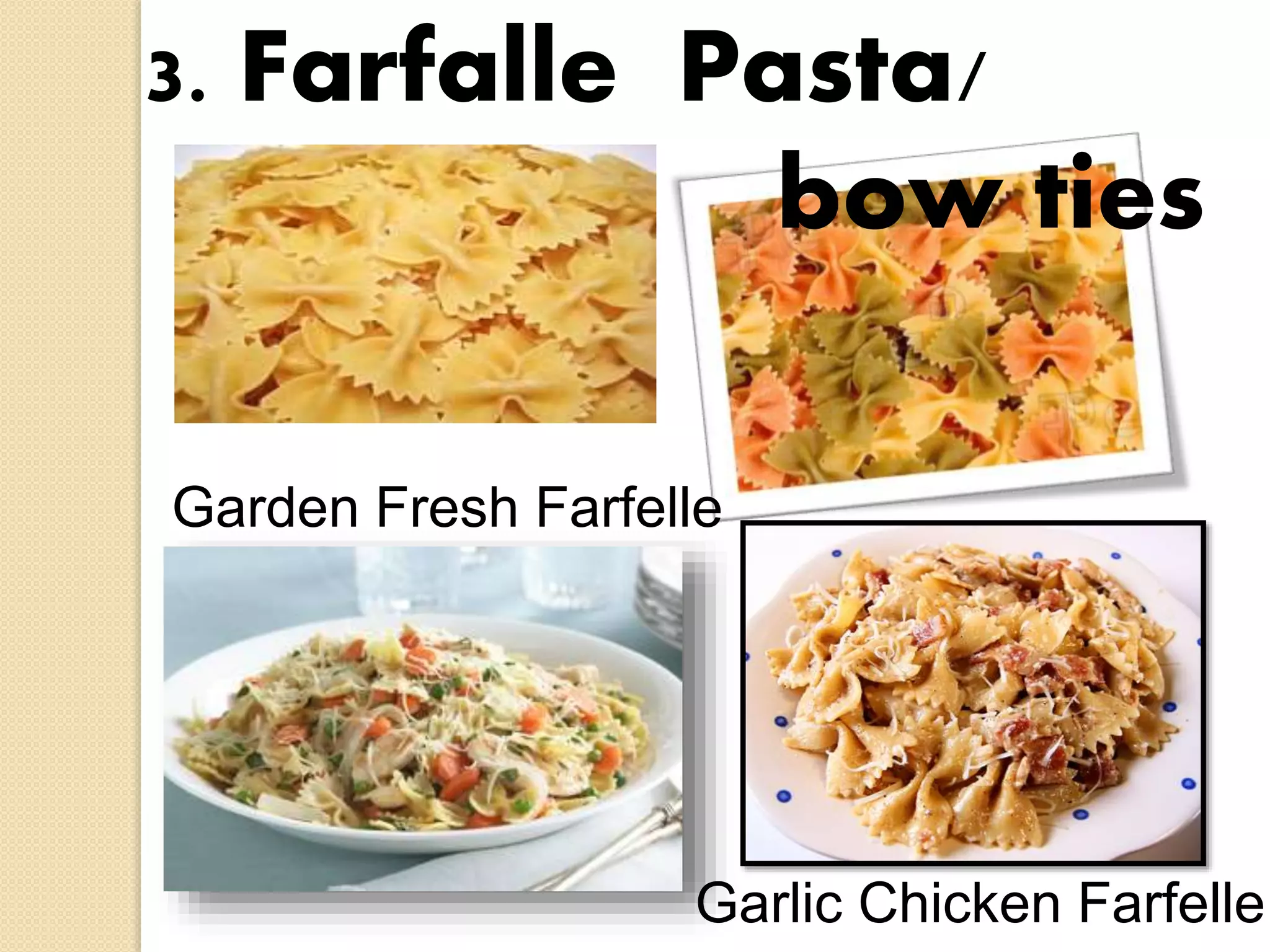
 Farfalle are a type of pasta, commonly known
as "bow-tie pasta" the name is derived from
the Italian word farfalla (butterfly).
 Farfalle date back to the 16th century.
 It originated in Lombardia and Emilia-
Romagna in Northern Italy.
 A larger variation of farfalle is known as
farfallone, while there is a miniature version
called farfalline.
Garden Fresh Farfelle
Garlic Chicken Farfelle
3. Farfalle Pasta/
bow ties
4. Fusilli
 Fusilli are long, thick, corkscrew
shaped pasta.
 The word fusilli presumably comes
from fusile, archaic word for “rifle”
referring to the spiral-grooved barrel of
the latter.
 The word can also mean “little” in
Italian.
 In addition to plain white colour, other
colours can be made by mixing other
ingredients into the dough.
Eg. beetroot for red, spinach for
green, and cuttlefish ink for black.
 Fusilli may be solid or hollow.
Hollow fusilli are also called fusilli
bucati.
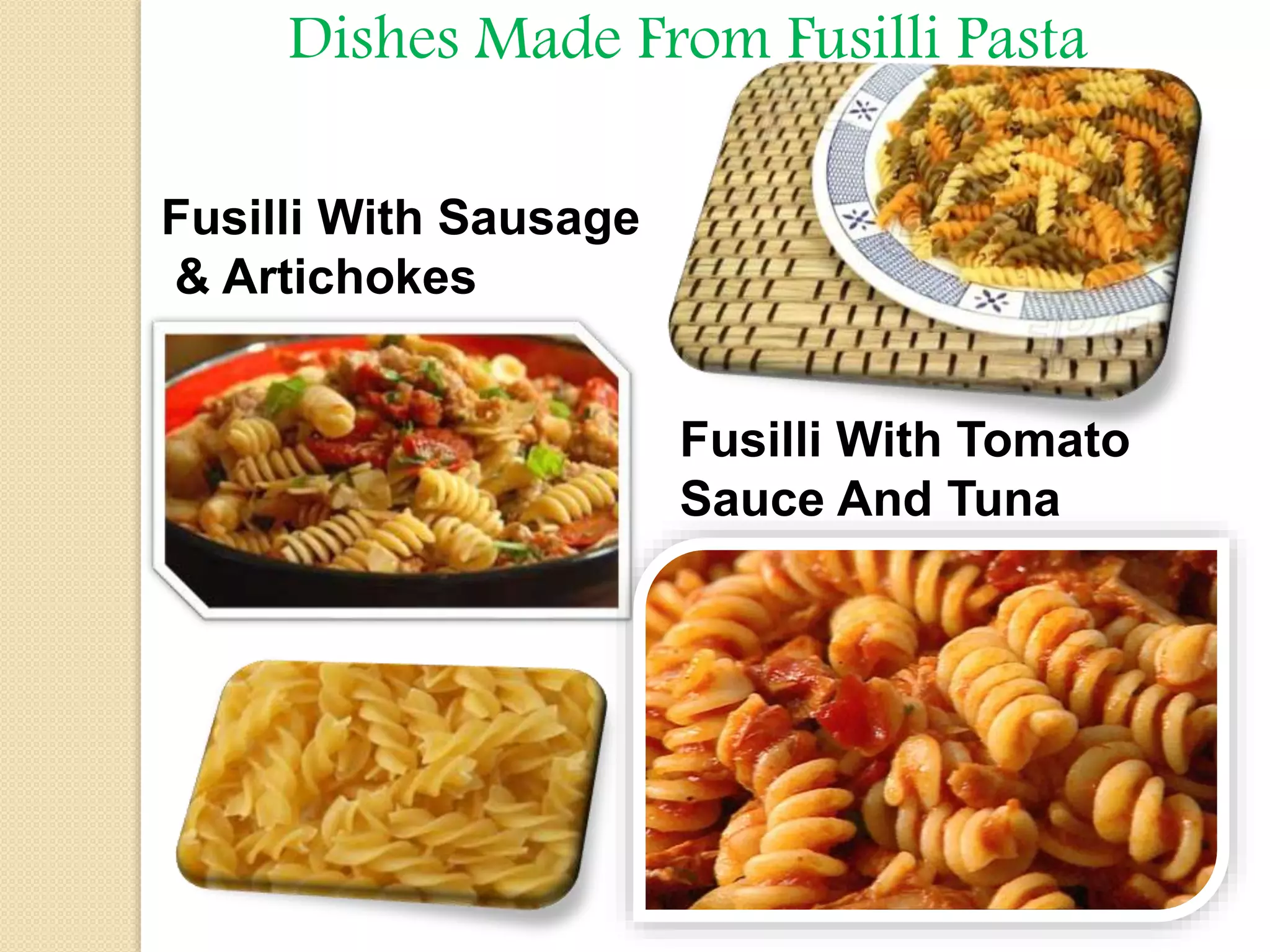
Dishes Made From Fusilli Pasta
Fusilli With Sausage
& Artichokes
Fusilli With Tomato
Sauce And Tuna
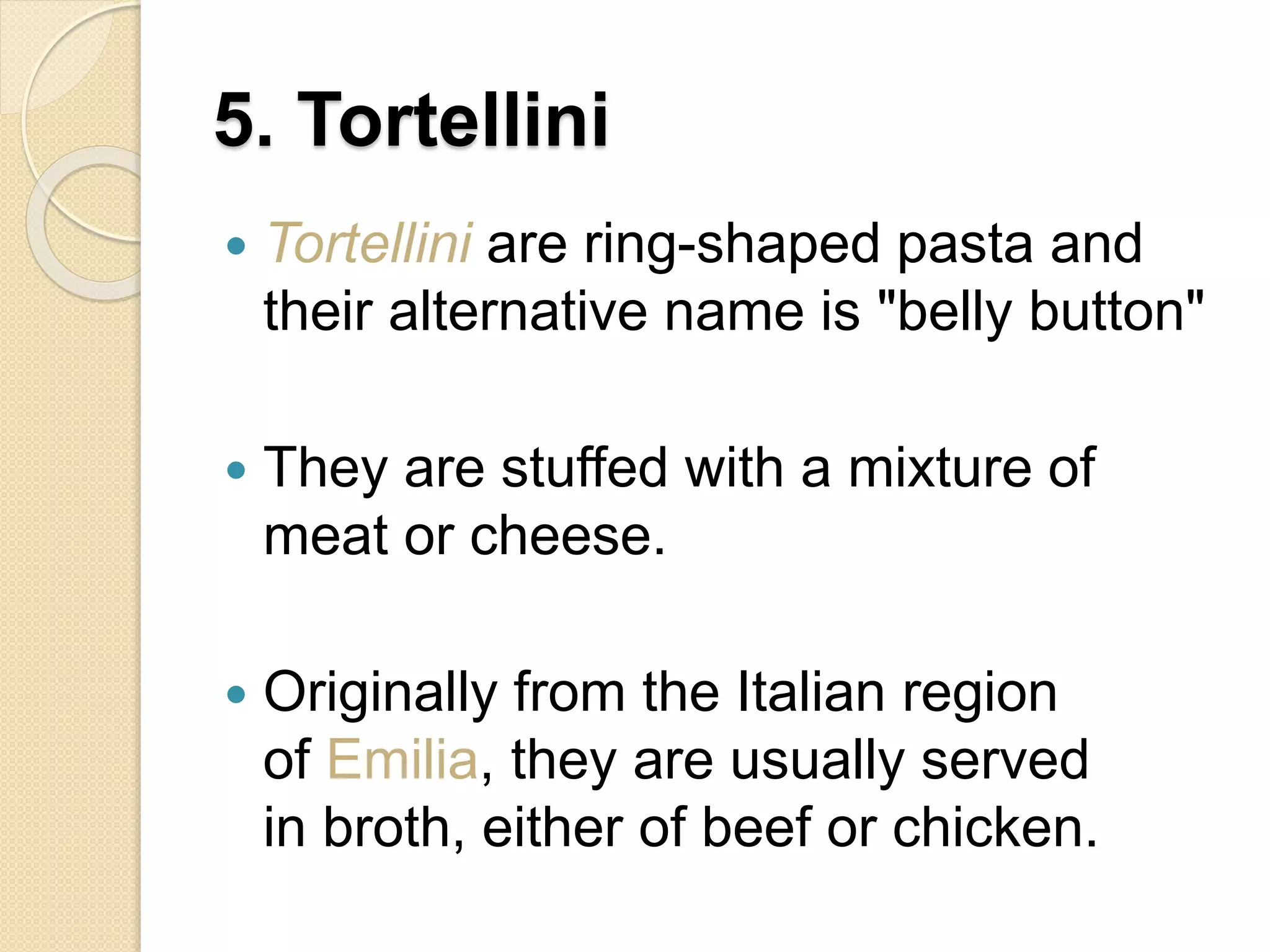
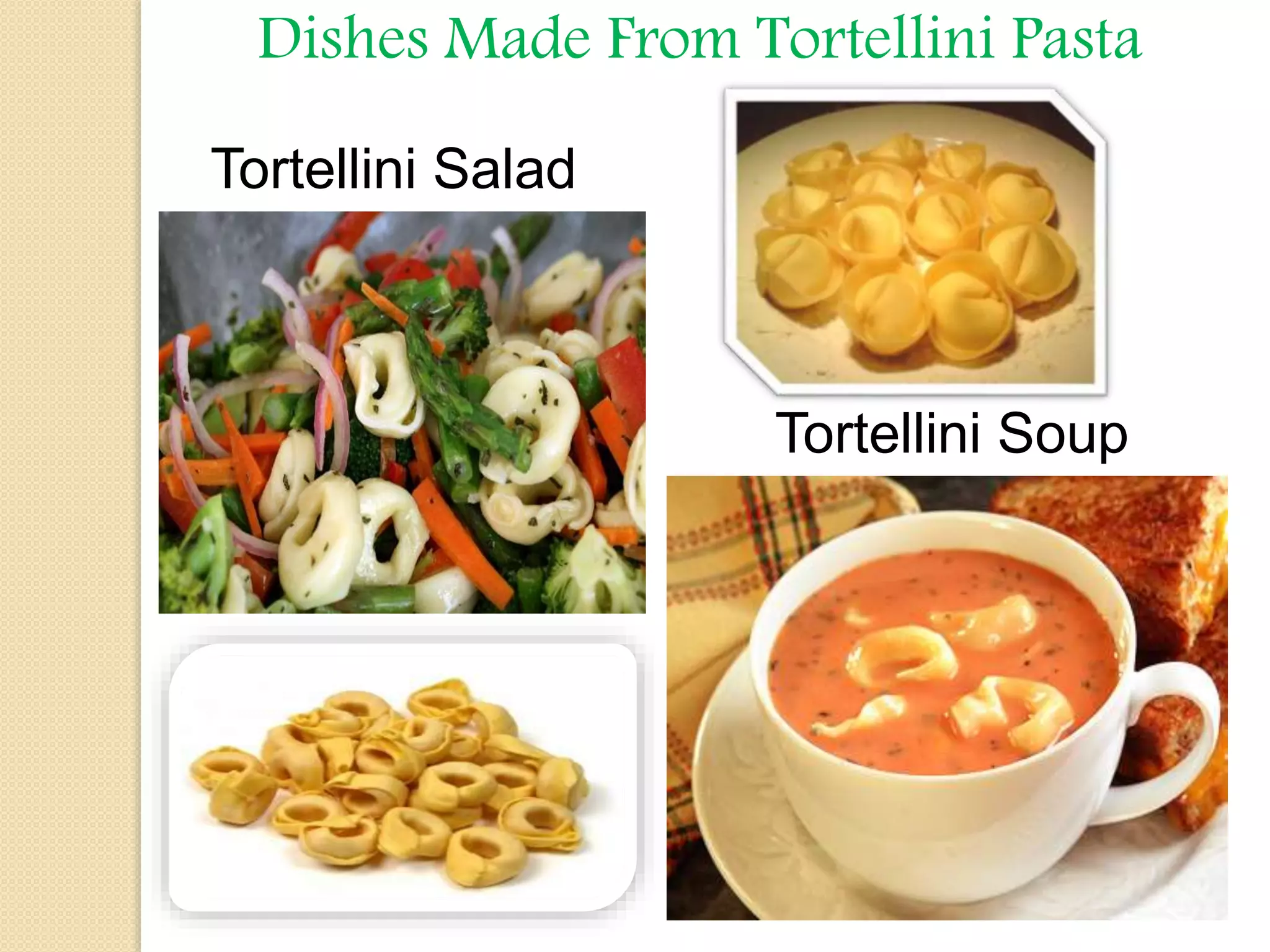
5. Tortellini
 Tortellini are ring-shaped pasta and
their alternative name is "belly button"
 They are stuffed with a mixture of
meat or cheese.
 Originally from the Italian region
of Emilia, they are usually served
in broth, either of beef or chicken.
Dishes Made From Tortellini Pasta
Tortellini Salad
Tortellini Soup
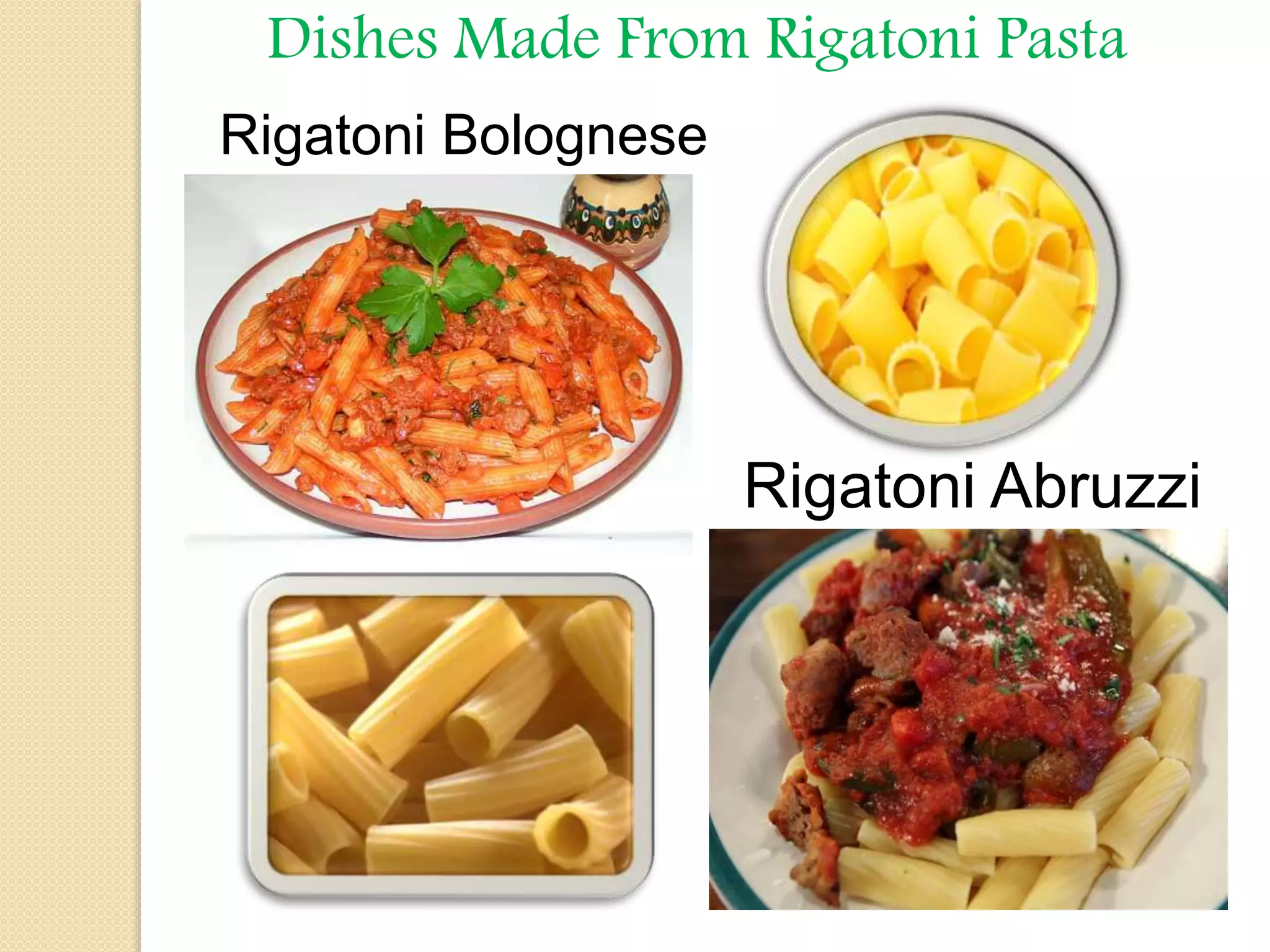
6. Rigatoni
 Rigatoni is a form of tube-
shaped pasta of varying lengths and
diameters.
 It is larger than penne and ziti and
sometimes slightly curved.
 Rigatoni is usually ridged, and the
tube's end is square-cut like ziti, not
diagonal like penne.
 The word rigatoni comes from the
Italian word rigati, which means
"ridged" or “lined”.
Dishes Made From Rigatoni Pasta
Rigatoni Bolognese
Rigatoni Abruzzi
7. Conchiglie
 Conchiglie, commonly known as
"shells" or "seashells" is a type of
pasta.
 It is usually sold in the plain durum
wheat variety, and also in coloured
varieties.
 The shell shape of the pasta is good
at catching the sauce.
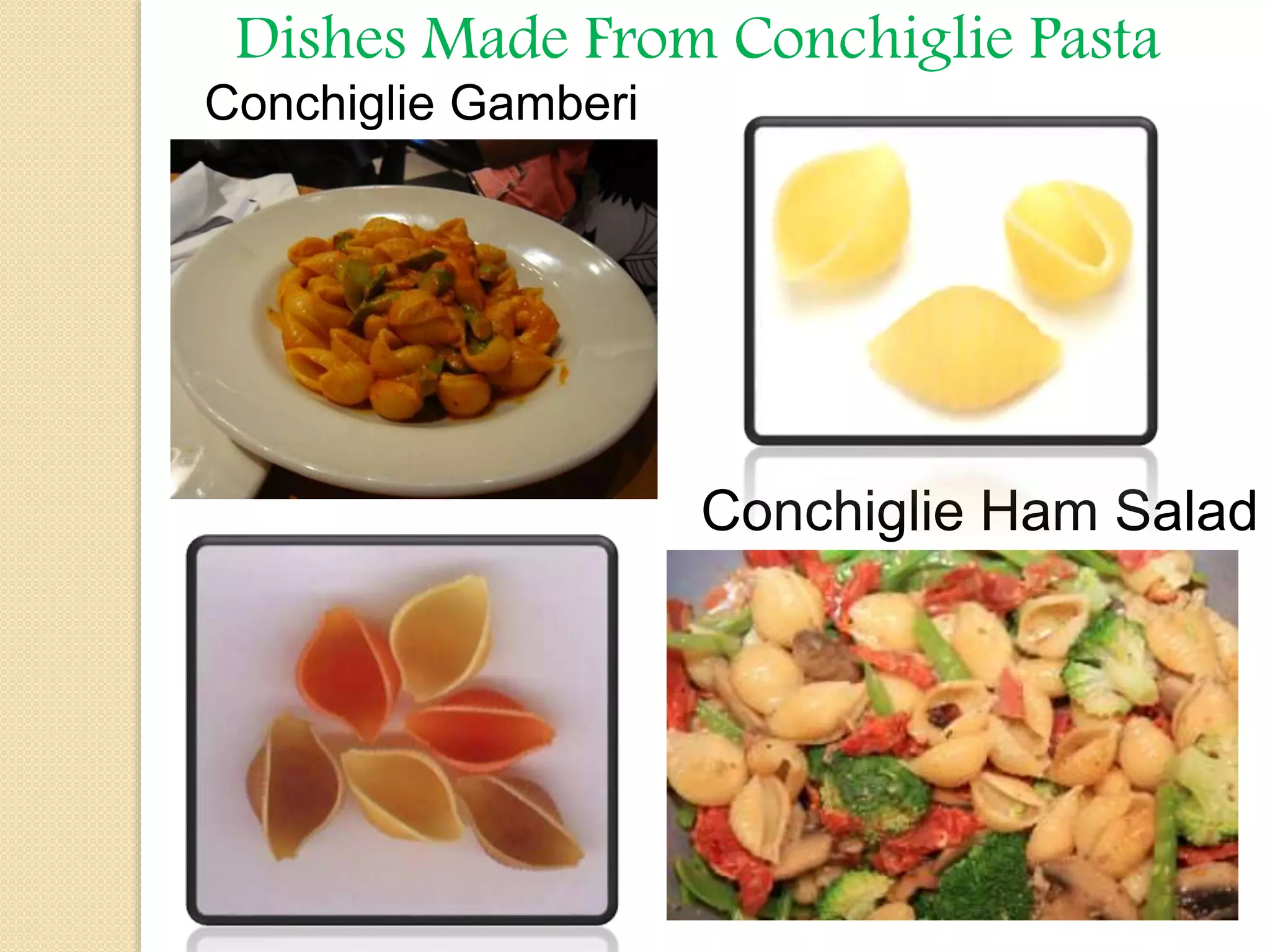
Dishes Made From Conchiglie Pasta
Conchiglie Gamberi
Conchiglie Ham Salad
8. LINGUINE PASTA
SPAGHETTI PASTA
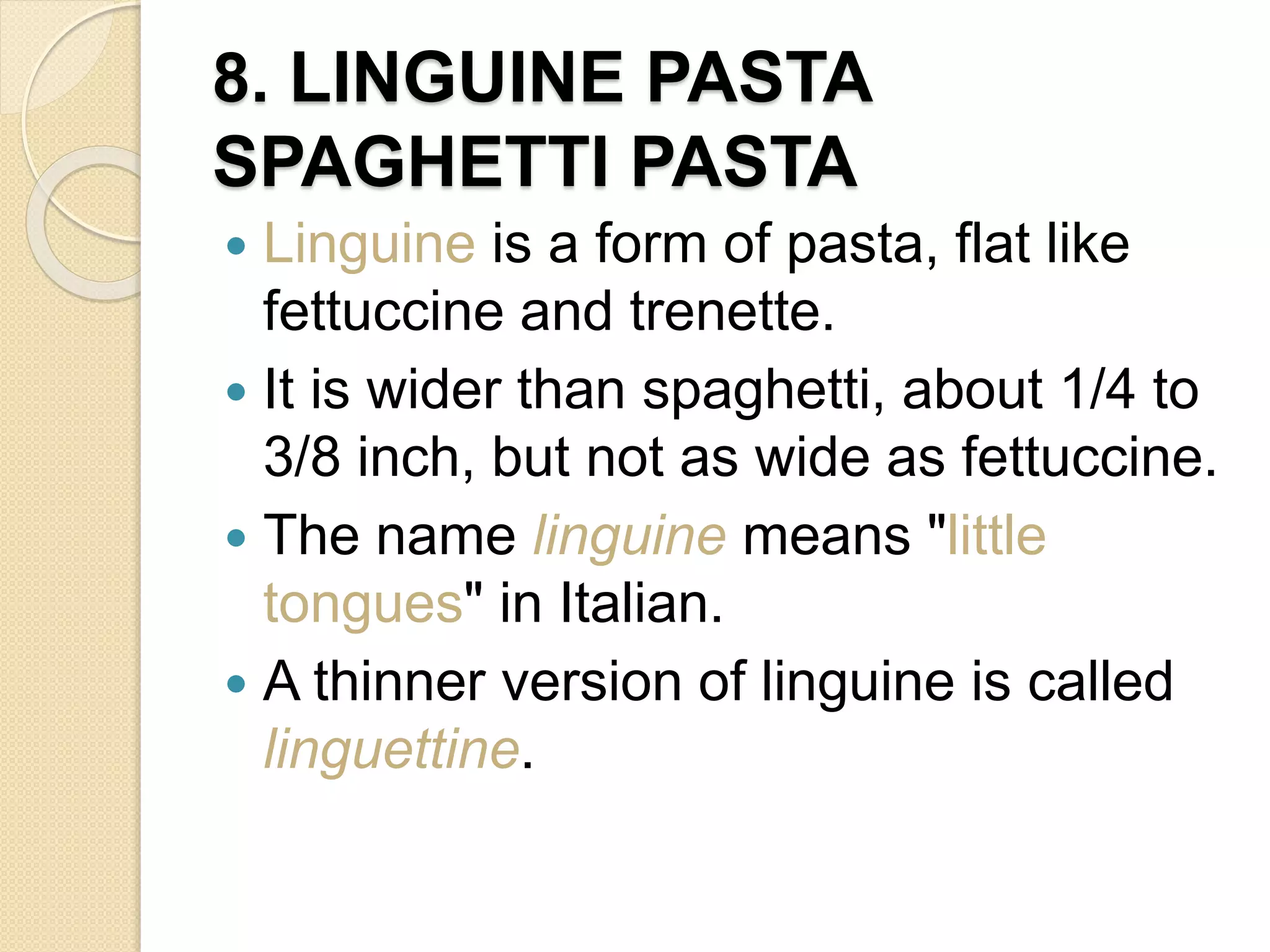
 Linguine is a form of pasta, flat like
fettuccine and trenette.
 It is wider than spaghetti, about 1/4 to
3/8 inch, but not as wide as fettuccine.
 The name linguine means "little
tongues" in Italian.
 A thinner version of linguine is called
linguettine.
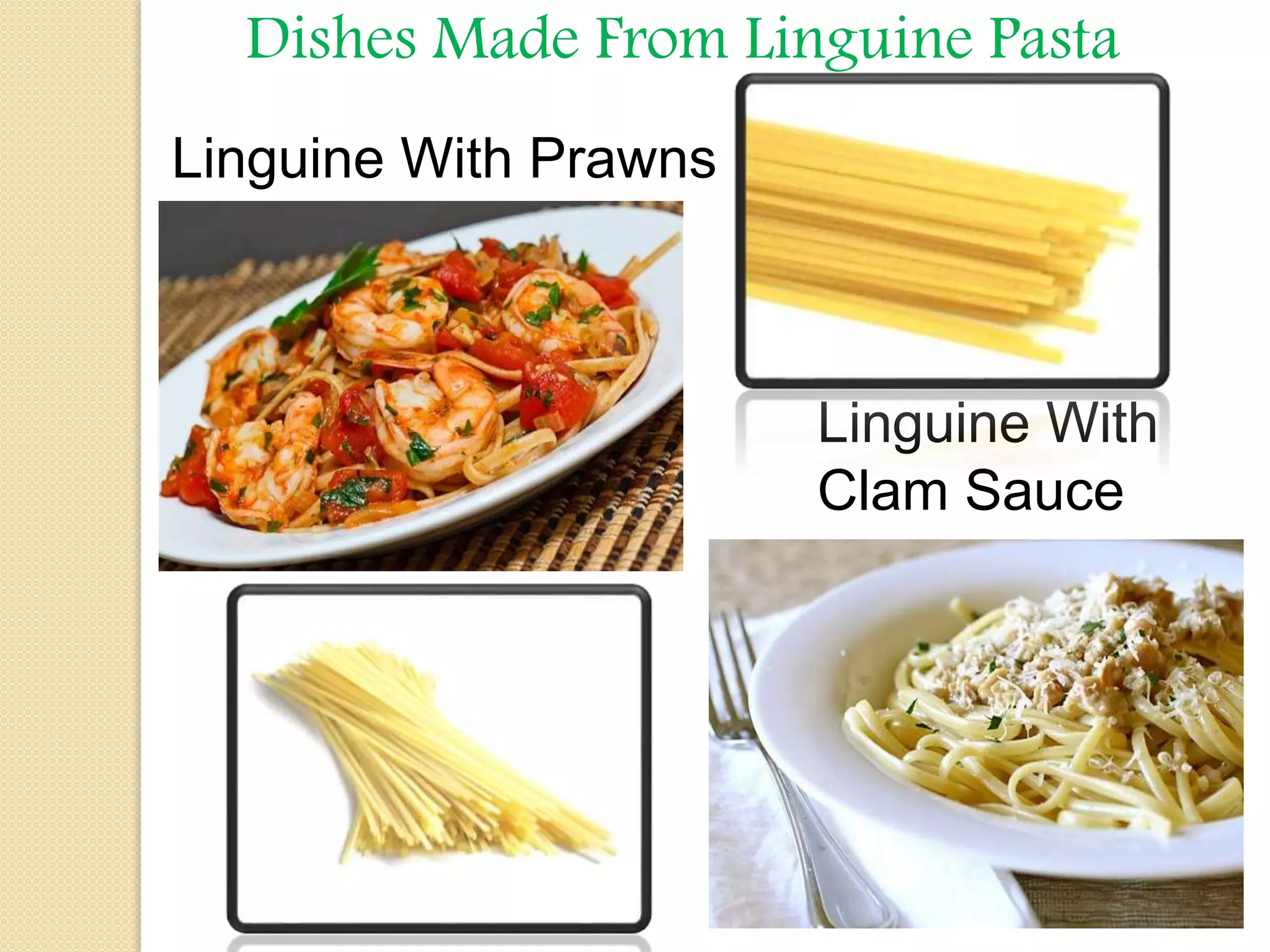
Dishes Made From Linguine Pasta
Linguine With Prawns
Linguine With
Clam Sauce
8. Fetttuccine
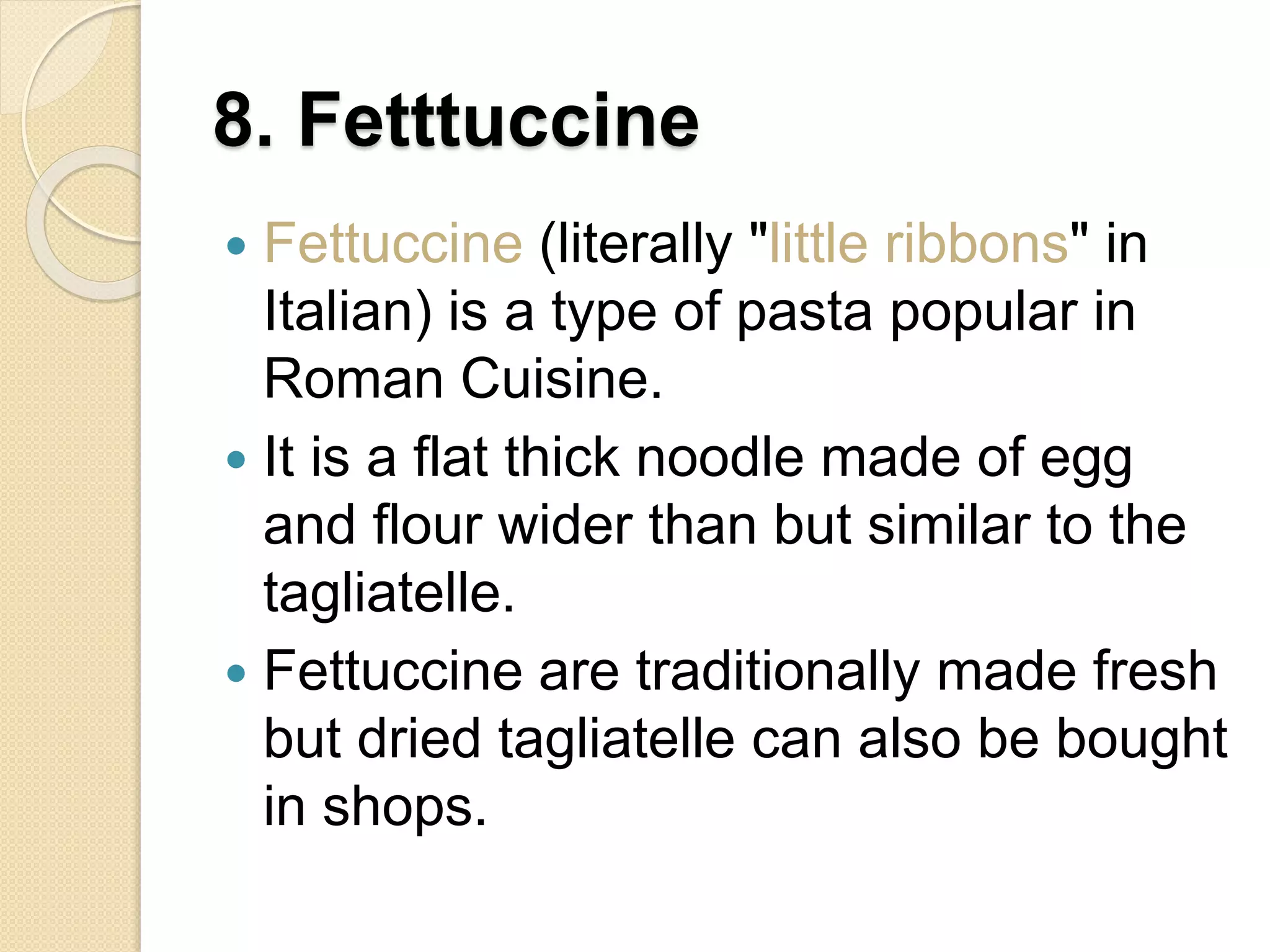
 Fettuccine (literally "little ribbons" in
Italian) is a type of pasta popular in
Roman Cuisine.
 It is a flat thick noodle made of egg
and flour wider than but similar to the
tagliatelle.
 Fettuccine are traditionally made fresh
but dried tagliatelle can also be bought
in shops.
Dishes Made From Fettuccine Pasta
Chicken Fettuccine
Fettuccine With
Alfredo Sauce
9. PENNE / ZITI
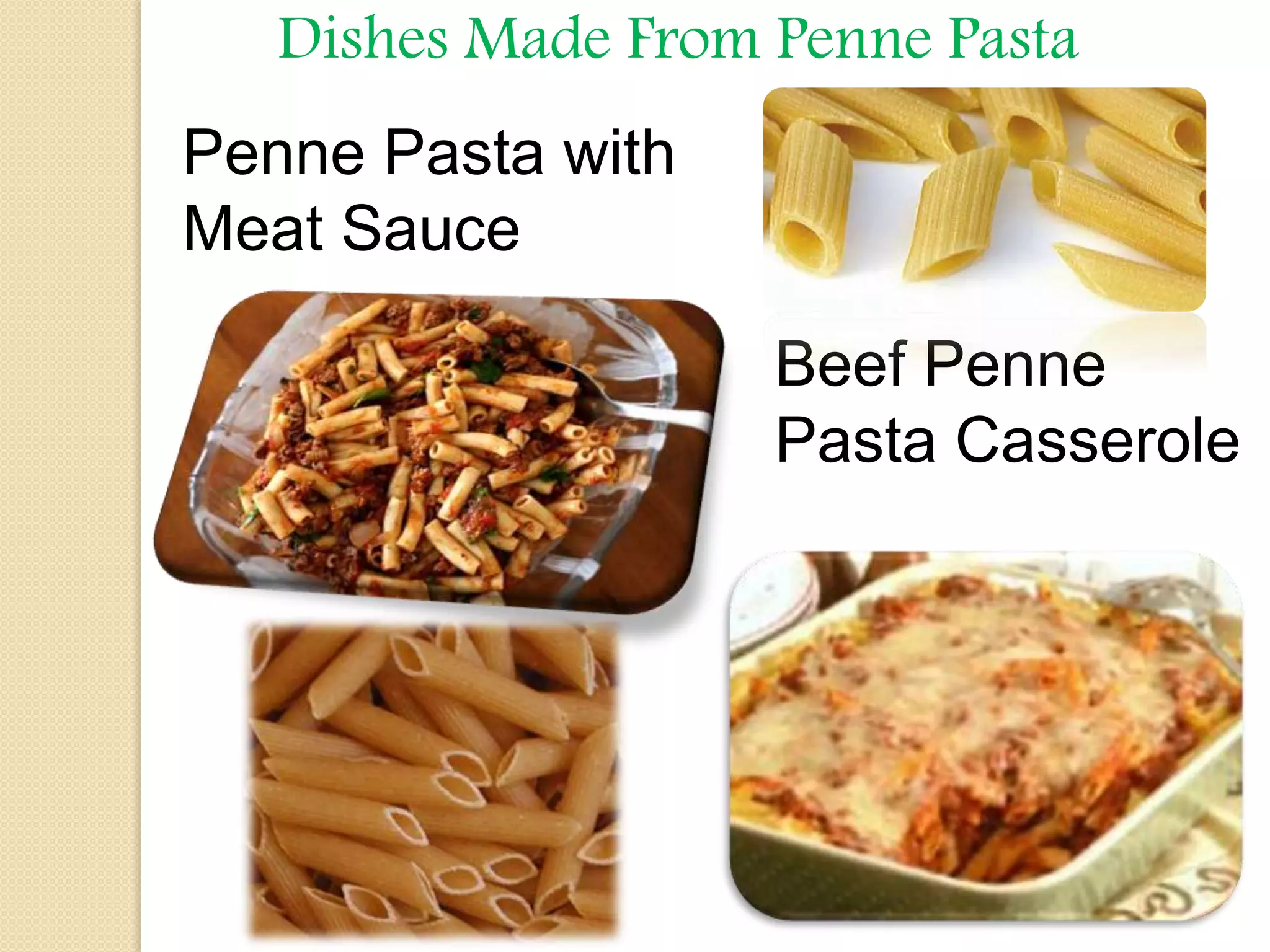
 Penne is a type of pasta with cylinder-
shaped pieces.
 The hollow center allows it to hold
sauce, while the angular ends act as
scoops.
 Penne is the plural form of the
Italian penna, deriving from
Latin penna (meaning "feather" or
Penne Pasta with
Meat Sauce
Beef Penne
Pasta Casserole
Dishes Made From Penne Pasta
10. RAVIOLI
 The word ravioli is reminiscent of the
Italian verb riavvolgere (to wrap).
 The earliest mention of ravioli appear
in the writings of Francesco di Marco,
a merchant of Venice in the 14th
century.
 They are composed of a filling sealed
between two layers of thin egg pasta
dough.
Dishes Made From Ravioli Pasta
Cheese Ravioli
Toasted Ravioli
11. Rotini
 Rotini is a type of helix or corkscrew
shaped pasta, the name derives from
the Italian word for “twists”
 Rotini is most often made from refined
flour.
 They are often used in pasta salads
with tomato-based sauces.
Dishes Made From Rotini Pasta
Rotini Salad
Rotini Pepperoni
12. ELBOW Macaroni
 Macaroni was brought to Italy by
Marco Polo in 1292.
 Macaroni is a variety of moderately
extended, machine-made, dry pasta
made with durum wheat.
 Macaroni noodles do not contain
eggs, and are normally cut in short,
hollow shapes.
Dishes Made From Macaroni Pasta
Macaroni With
Cheese
Macaroni With Broccoli
13. Cannelloni
 Cannelloni are a cylindrical shaped
pasta.
 It is generally served baked with
a filling and covered by a sauce.
 The stuffing may
include cheese, spinach and meat.
 The sauces typically used
are tomato or béchamel sauce.
Dishes Made From Cannelloni Pasta
Cannelloni Bolognaise
Cannelloni Spinach
14. Cencioni
 Cencioni is a type of pasta and the
name derives from the Italian word
for little rag
 Cencioni are oval and petal-shaped,
with a slight curve.
 They are larger and flatter
than orecchiette, with a more irregular
shape and a rough texture to one side
to help sauces cling better.
Dishes Made From Cencioni Pasta
Cencioni With
Tomato Sauce
Cencioni With
Minced Meat
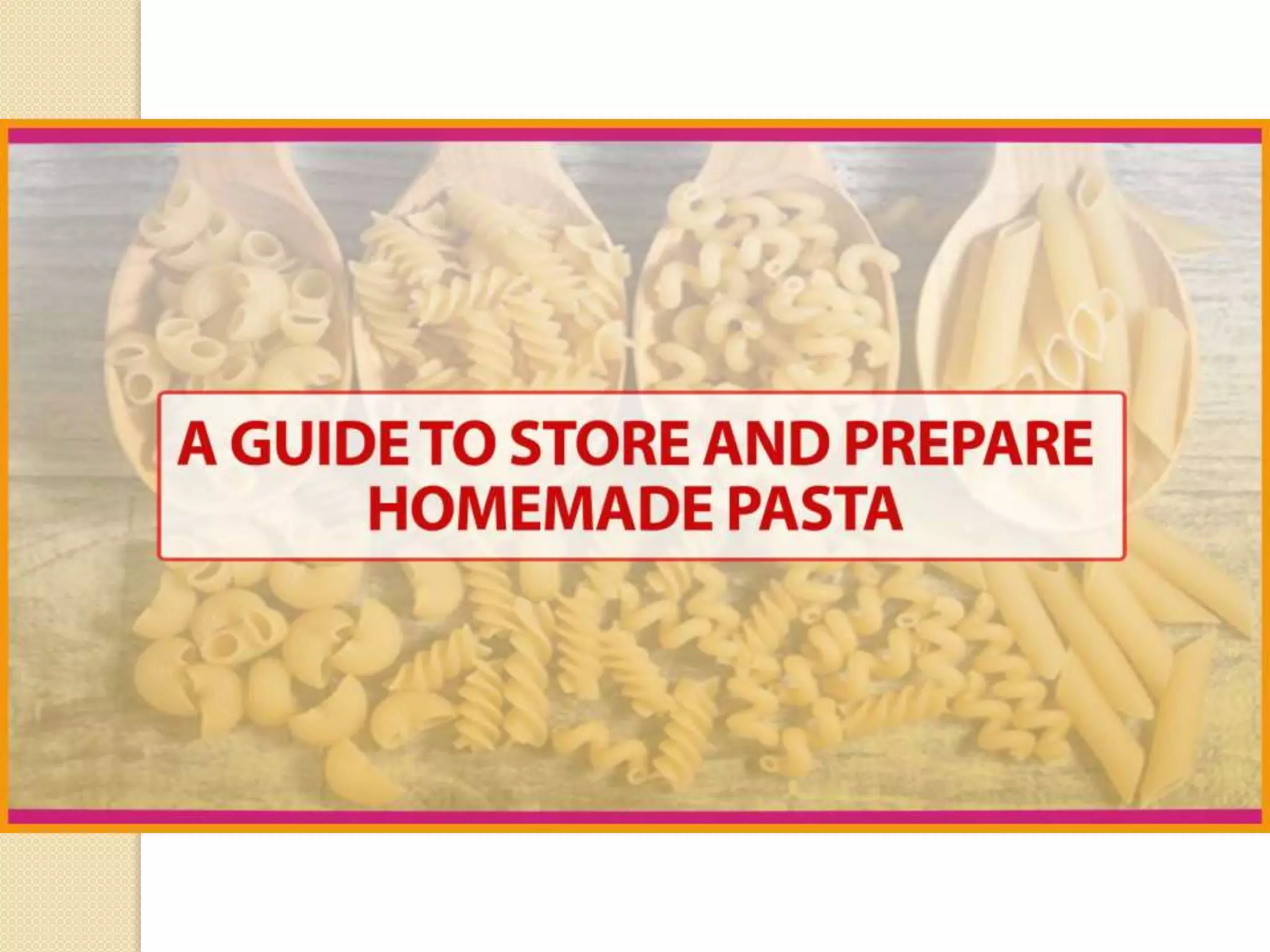
A Guide to Store and Prepare
Homemade Pasta
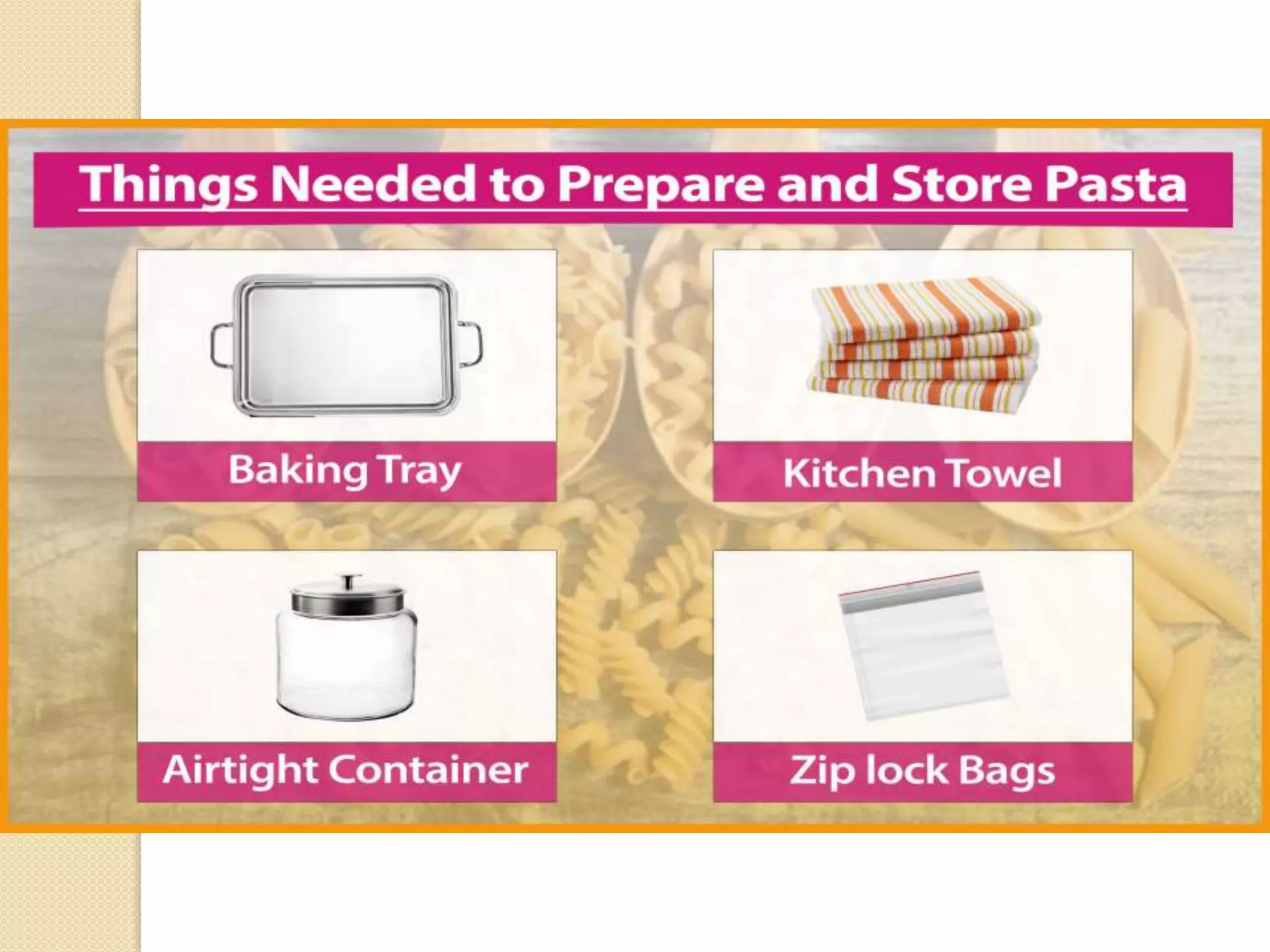
Things Needed to Prepare and Store Pasta
Baking Tray Kitchen Towel
Airtight Container Zip lock Bags
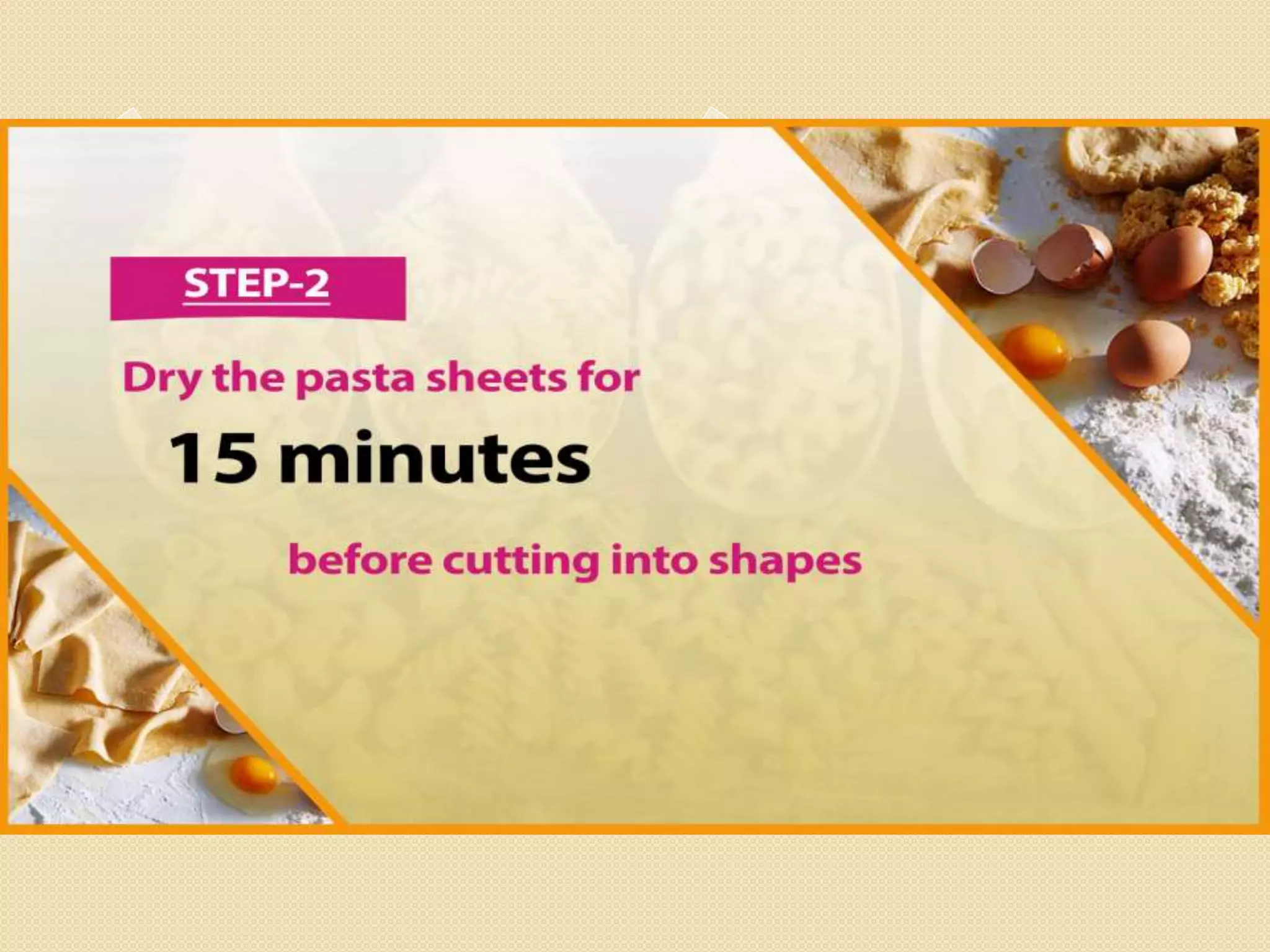
Step 2
Dry the pasta sheets for 15 minutes before cutting into
shapes
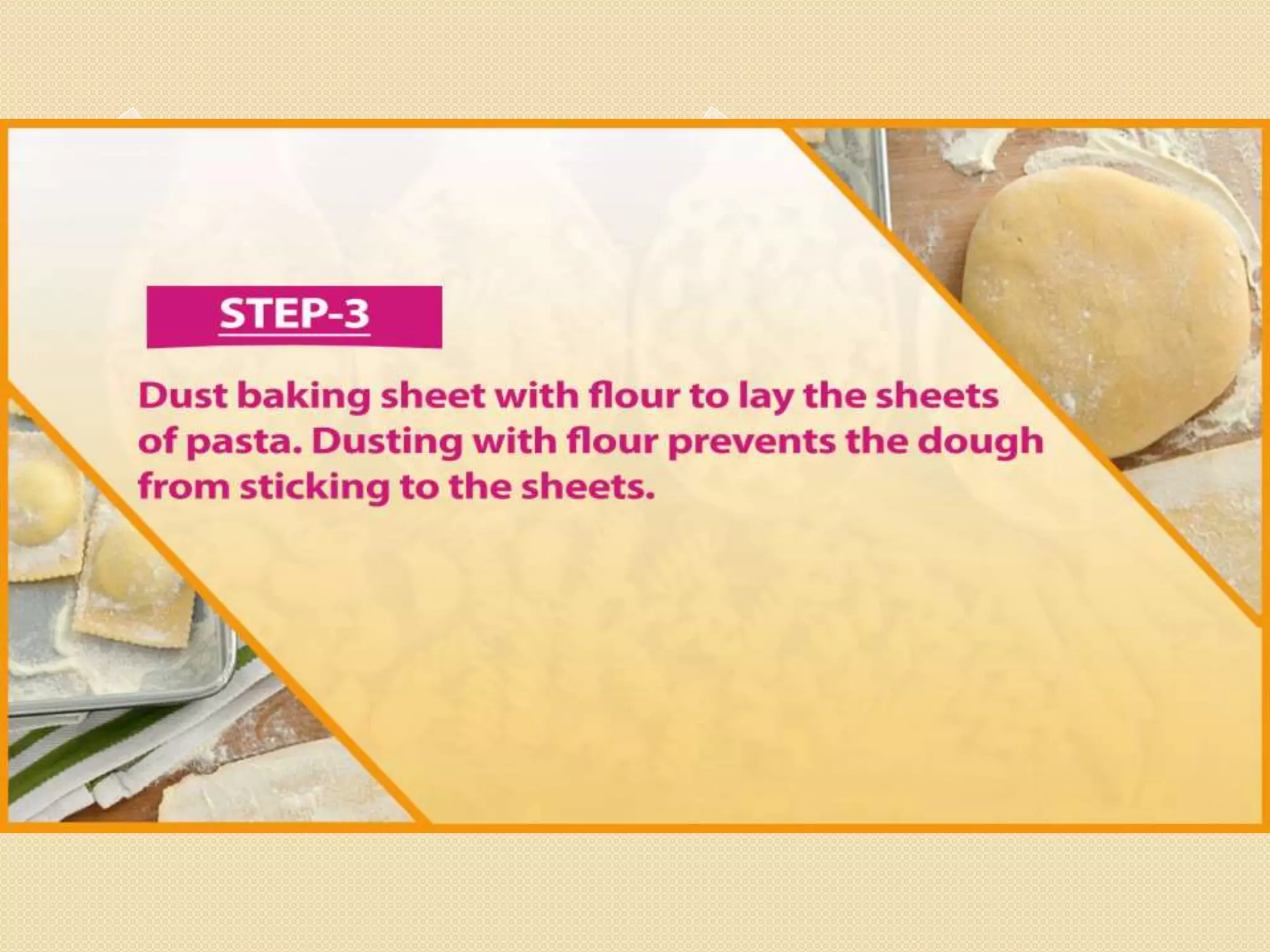
Step 3Dust baking sheet with flour to lay the
sheets of pasta. Dusting with flour
prevents the dough from sticking to the
sheets.
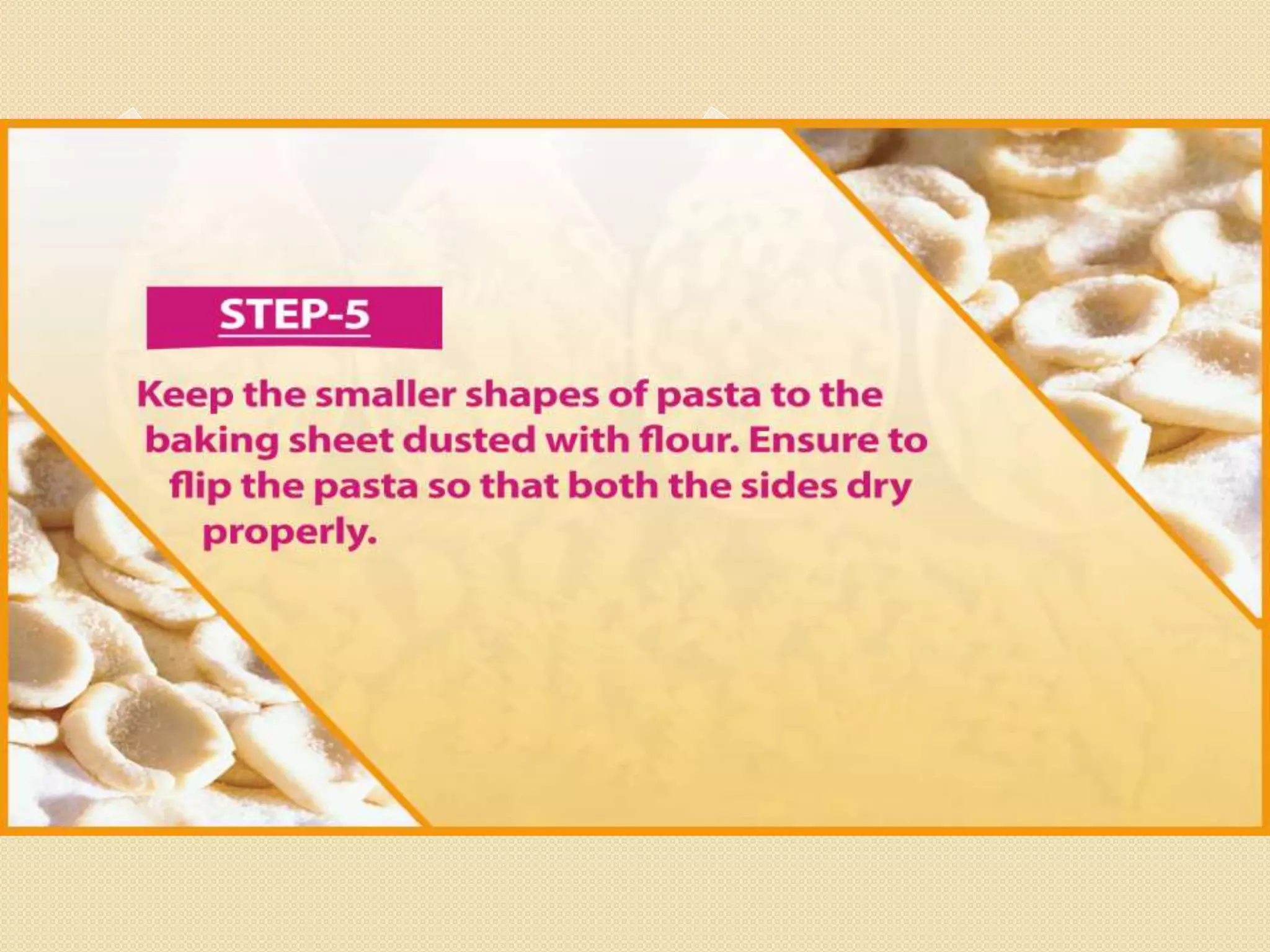
Step 5
Keep the smaller shapes of pasta to the baking sheet dusted with
flour. Ensure to flip the pasta so that both the sides dry properly.
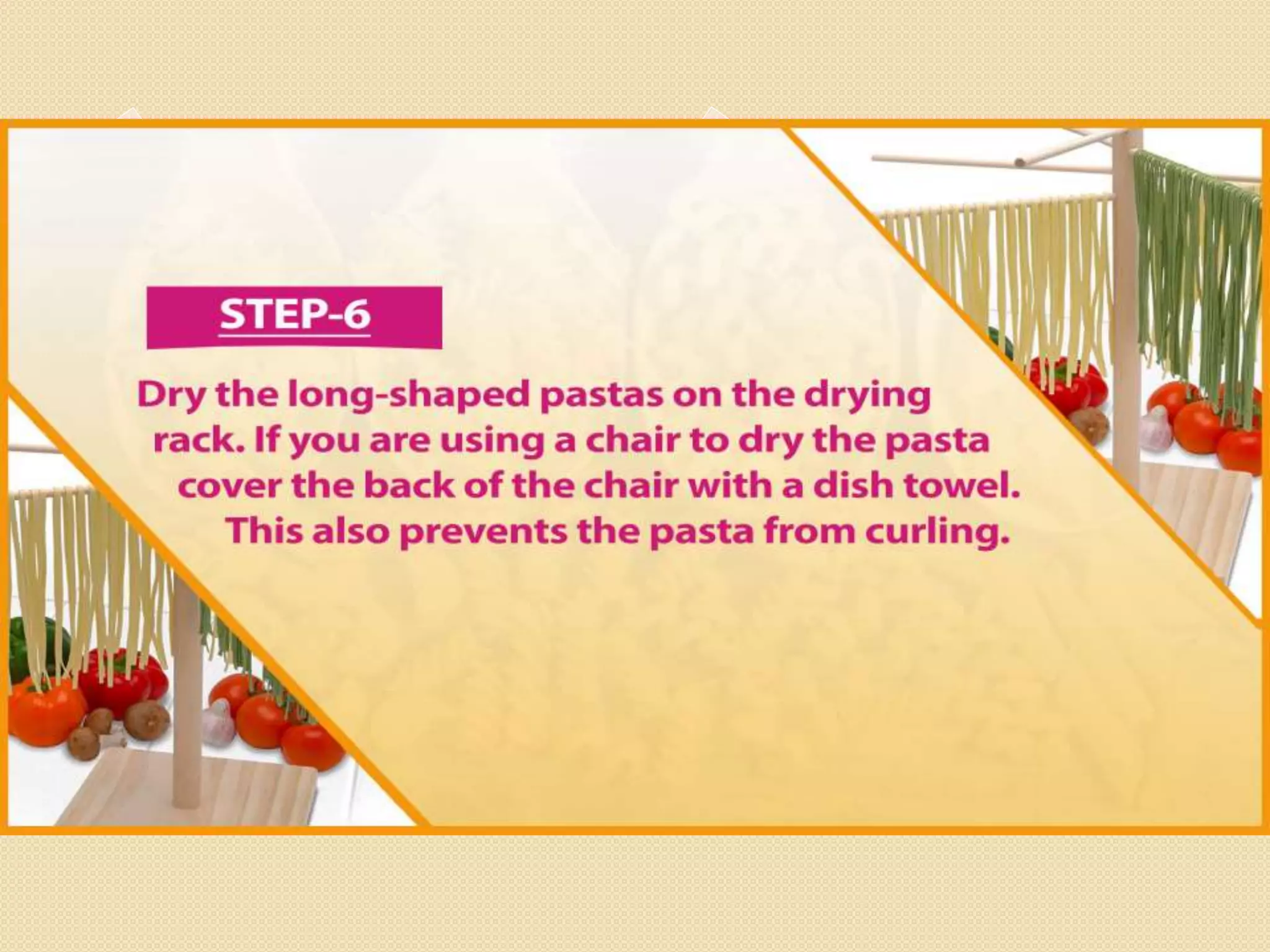
Step 6
Dry the long-shaped pastas on the drying rack. If you are using a
chair to dry the pasta cover the back of the chair with a dish towel.
This also prevents the pasta from curling.
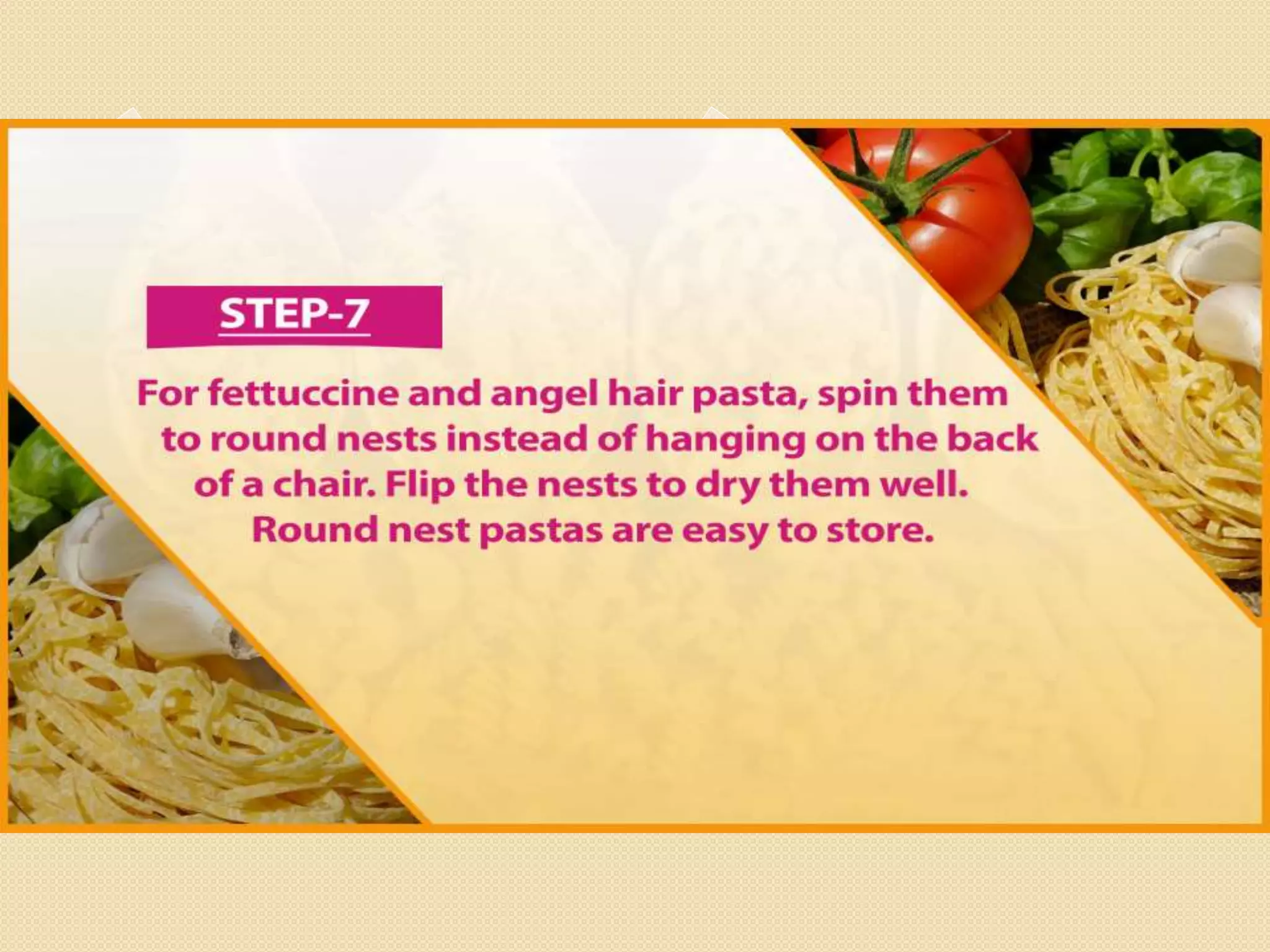
Step 7
For fettuccine and angel hair pasta, spin them to round nests instead of
hanging on the back of a chair. Flip the nests to dry them well. Round nest
pastas are easy to store.
Step 8Dry the soft pastas for 15 minutes
and hard pastas for 1 hour.
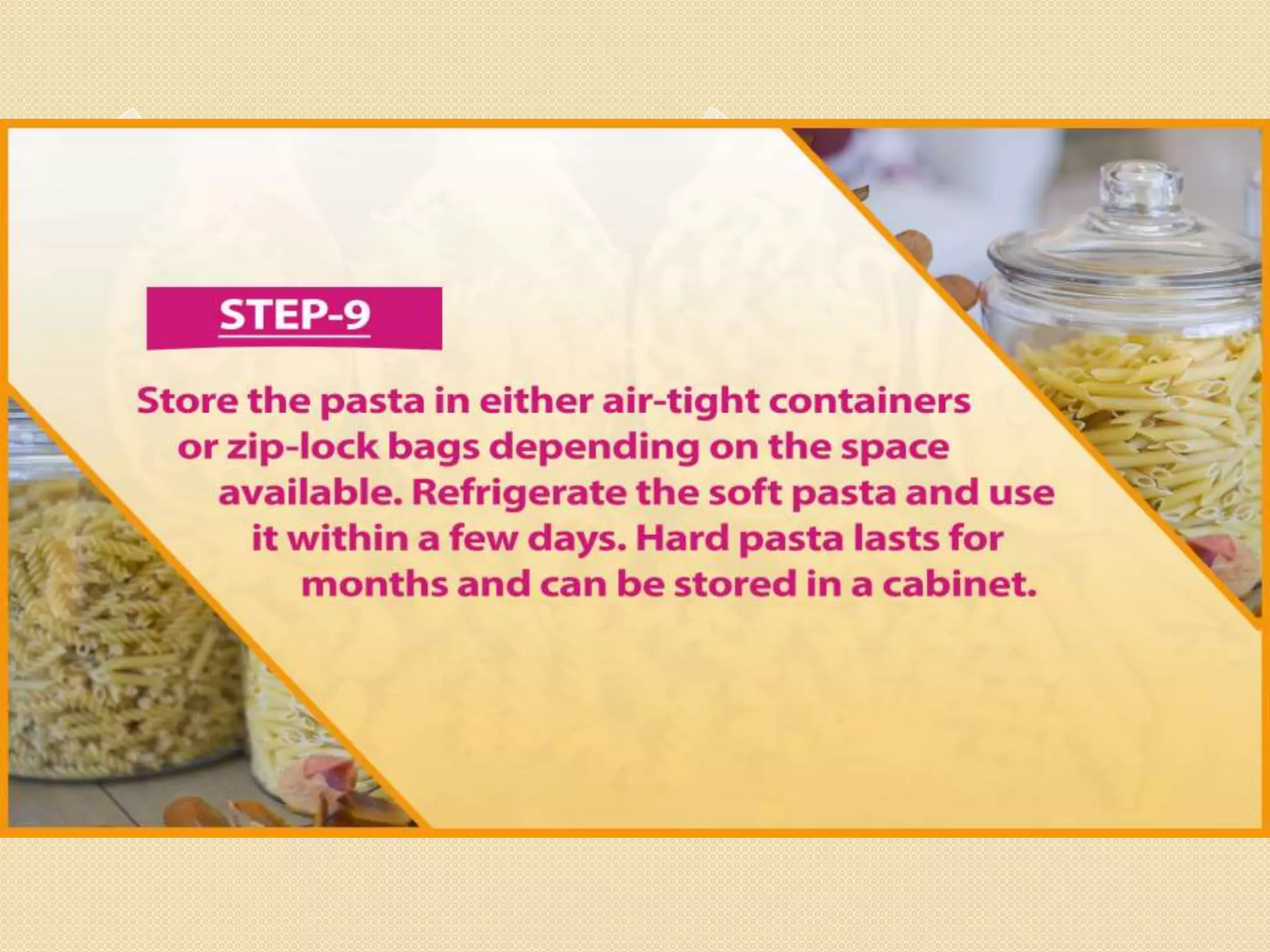
Step 9
Store the pasta in either air-tight containers or zip-lock bags depending on the
space available. Refrigerate the soft pasta and use it within a few days. Hard
pasta lasts for months and can be stored in a cabinet.
THAN YOU
COOKING PASTA
GENERAL RULE
 1 litre water to 100gm pasta
 Bring water to rolling boil.
 Add salt ,ratio is 1tablespoon salt to
100gm pasta
 Stir in pasta.
 Adding oil is optional.
 When water comes back to the
boil,begin timing.
 Strain or use tongs for removing at “Al
Dente.”
Al Dente
 Pasta is done when Al dente
 It means that pasta is tender but
resistant to the bite.
REMEMBER
 Never rinse pasta,accept when
required for cold salad.
 Serving:
Stir through a little oil or melted butter
and
serve
1. Topped with sauce.
2. Toss pasta straight into sauce,to get
even coating.
THE END

Lesson 2 preparing pasta

  • 1.
    LESSON 2 PREPARING PASTA Prepared by: ArlynP. Bonifacio TLE 10 The First Uniting Christian School
  • 2.
    LEARNING GOALS & TARGETS At the end of the lesson, the learner is expected to:  Discuss the principles of preparing pasta  Identify the different types and shapes of pasta  Demonstrate how to make homemade pasta  Demonstrate how to cook pasta
  • 3.
    Introduction  Pasta isa staple food of traditional Italian cuisine.  Pasta is eaten in Italy only as first .  The dough is made mostly from durum wheat or, buckwheat flour, with water and, sometimes, eggs.  Pasta comes in a variety of different shapes that acts as a carrier for the different types of sauce and foods.
  • 4.
     Pasta canbe purchased fresh, frozen, or dry.  Lasagna noodles are available frozen for use from the frozen state.  Filled pastas, such as ravioli and tortellini, are often purchased frozen.  Pasta can be substituted for Introduction
  • 5.
    PASTA Is a generalname for a simple dough mixture made from hard wheat, flour, and water. Hard wheat – is high in protein and gluten strength
  • 6.
     Pasta iscategorized in two basic styles: dried and fresh.  Dried pasta made without eggs can be stored for up to two years under ideal conditions, while fresh pasta will keep for a few days under refrigeration.  Pasta is enriched with iron, folate and several other B-vitamins, including thiamine, riboflavin and niacin.  Some varieties of whole grain pasta can provide up to 25% of daily fiber requirements in every one cup portion.
  • 7.
    PRINCIPLES OF PREPARINGPASTA  There are different pasta shapes.  Cooking time depends on the shape of the pasta  Pasta gets bigger and heavier when it is cooked.  Follow the recipe properly.  There are hundreds of shapes and sizes of pasta with each shape used for different preparations based on how the sauce will cling, what the desired texture is, or how the product will be used.
  • 8.
     Rotelle area type of pasta resembling wheels with spokes.  Also known as wagon wheels, the name derives from the Italian word for little wheels.  In Ohio, they are called as “Choo Choo 1. Rotelle Pasta/wagon wheels
  • 9.
    Dishes Made FromRotelle Pasta Chicken Rotelle Rotelle Carbonara Rotelle w/ basil orange Rotelle w/ bacon
  • 10.
  • 11.
    3. FARFALLE  Farfalleare a type of pasta, commonly known as "bow-tie pasta" the name is derived from the Italian word farfalla (butterfly).  Farfalle date back to the 16th century.  It originated in Lombardia and Emilia- Romagna in Northern Italy.  A larger variation of farfalle is known as farfallone, while there is a miniature version called farfalline.
  • 12.
    Garden Fresh Farfelle GarlicChicken Farfelle 3. Farfalle Pasta/ bow ties
  • 13.
    4. Fusilli  Fusilliare long, thick, corkscrew shaped pasta.  The word fusilli presumably comes from fusile, archaic word for “rifle” referring to the spiral-grooved barrel of the latter.  The word can also mean “little” in Italian.
  • 14.
     In additionto plain white colour, other colours can be made by mixing other ingredients into the dough. Eg. beetroot for red, spinach for green, and cuttlefish ink for black.  Fusilli may be solid or hollow. Hollow fusilli are also called fusilli bucati.
  • 15.
    Dishes Made FromFusilli Pasta Fusilli With Sausage & Artichokes Fusilli With Tomato Sauce And Tuna
  • 16.
    5. Tortellini  Tortelliniare ring-shaped pasta and their alternative name is "belly button"  They are stuffed with a mixture of meat or cheese.  Originally from the Italian region of Emilia, they are usually served in broth, either of beef or chicken.
  • 17.
    Dishes Made FromTortellini Pasta Tortellini Salad Tortellini Soup
  • 18.
    6. Rigatoni  Rigatoniis a form of tube- shaped pasta of varying lengths and diameters.  It is larger than penne and ziti and sometimes slightly curved.  Rigatoni is usually ridged, and the tube's end is square-cut like ziti, not diagonal like penne.  The word rigatoni comes from the Italian word rigati, which means "ridged" or “lined”.
  • 19.
    Dishes Made FromRigatoni Pasta Rigatoni Bolognese Rigatoni Abruzzi
  • 20.
    7. Conchiglie  Conchiglie,commonly known as "shells" or "seashells" is a type of pasta.  It is usually sold in the plain durum wheat variety, and also in coloured varieties.  The shell shape of the pasta is good at catching the sauce.
  • 21.
    Dishes Made FromConchiglie Pasta Conchiglie Gamberi Conchiglie Ham Salad
  • 22.
    8. LINGUINE PASTA SPAGHETTIPASTA  Linguine is a form of pasta, flat like fettuccine and trenette.  It is wider than spaghetti, about 1/4 to 3/8 inch, but not as wide as fettuccine.  The name linguine means "little tongues" in Italian.  A thinner version of linguine is called linguettine.
  • 23.
    Dishes Made FromLinguine Pasta Linguine With Prawns Linguine With Clam Sauce
  • 24.
    8. Fetttuccine  Fettuccine(literally "little ribbons" in Italian) is a type of pasta popular in Roman Cuisine.  It is a flat thick noodle made of egg and flour wider than but similar to the tagliatelle.  Fettuccine are traditionally made fresh but dried tagliatelle can also be bought in shops.
  • 25.
    Dishes Made FromFettuccine Pasta Chicken Fettuccine Fettuccine With Alfredo Sauce
  • 26.
    9. PENNE /ZITI  Penne is a type of pasta with cylinder- shaped pieces.  The hollow center allows it to hold sauce, while the angular ends act as scoops.  Penne is the plural form of the Italian penna, deriving from Latin penna (meaning "feather" or
  • 27.
    Penne Pasta with MeatSauce Beef Penne Pasta Casserole Dishes Made From Penne Pasta
  • 28.
    10. RAVIOLI  Theword ravioli is reminiscent of the Italian verb riavvolgere (to wrap).  The earliest mention of ravioli appear in the writings of Francesco di Marco, a merchant of Venice in the 14th century.  They are composed of a filling sealed between two layers of thin egg pasta dough.
  • 29.
    Dishes Made FromRavioli Pasta Cheese Ravioli Toasted Ravioli
  • 30.
    11. Rotini  Rotiniis a type of helix or corkscrew shaped pasta, the name derives from the Italian word for “twists”  Rotini is most often made from refined flour.  They are often used in pasta salads with tomato-based sauces.
  • 31.
    Dishes Made FromRotini Pasta Rotini Salad Rotini Pepperoni
  • 32.
    12. ELBOW Macaroni Macaroni was brought to Italy by Marco Polo in 1292.  Macaroni is a variety of moderately extended, machine-made, dry pasta made with durum wheat.  Macaroni noodles do not contain eggs, and are normally cut in short, hollow shapes.
  • 33.
    Dishes Made FromMacaroni Pasta Macaroni With Cheese Macaroni With Broccoli
  • 34.
    13. Cannelloni  Cannelloniare a cylindrical shaped pasta.  It is generally served baked with a filling and covered by a sauce.  The stuffing may include cheese, spinach and meat.  The sauces typically used are tomato or béchamel sauce.
  • 35.
    Dishes Made FromCannelloni Pasta Cannelloni Bolognaise Cannelloni Spinach
  • 36.
    14. Cencioni  Cencioniis a type of pasta and the name derives from the Italian word for little rag  Cencioni are oval and petal-shaped, with a slight curve.  They are larger and flatter than orecchiette, with a more irregular shape and a rough texture to one side to help sauces cling better.
  • 37.
    Dishes Made FromCencioni Pasta Cencioni With Tomato Sauce Cencioni With Minced Meat
  • 38.
    A Guide toStore and Prepare Homemade Pasta
  • 39.
    Things Needed toPrepare and Store Pasta Baking Tray Kitchen Towel Airtight Container Zip lock Bags
  • 41.
    Step 2 Dry thepasta sheets for 15 minutes before cutting into shapes
  • 42.
    Step 3Dust bakingsheet with flour to lay the sheets of pasta. Dusting with flour prevents the dough from sticking to the sheets.
  • 43.
    Step 5 Keep thesmaller shapes of pasta to the baking sheet dusted with flour. Ensure to flip the pasta so that both the sides dry properly.
  • 44.
    Step 6 Dry thelong-shaped pastas on the drying rack. If you are using a chair to dry the pasta cover the back of the chair with a dish towel. This also prevents the pasta from curling.
  • 45.
    Step 7 For fettuccineand angel hair pasta, spin them to round nests instead of hanging on the back of a chair. Flip the nests to dry them well. Round nest pastas are easy to store.
  • 46.
    Step 8Dry thesoft pastas for 15 minutes and hard pastas for 1 hour.
  • 47.
    Step 9 Store thepasta in either air-tight containers or zip-lock bags depending on the space available. Refrigerate the soft pasta and use it within a few days. Hard pasta lasts for months and can be stored in a cabinet.
  • 48.
  • 49.
  • 50.
    GENERAL RULE  1litre water to 100gm pasta  Bring water to rolling boil.  Add salt ,ratio is 1tablespoon salt to 100gm pasta  Stir in pasta.  Adding oil is optional.  When water comes back to the boil,begin timing.  Strain or use tongs for removing at “Al Dente.”
  • 51.
    Al Dente  Pastais done when Al dente  It means that pasta is tender but resistant to the bite.
  • 52.
    REMEMBER  Never rinsepasta,accept when required for cold salad.  Serving: Stir through a little oil or melted butter and serve 1. Topped with sauce. 2. Toss pasta straight into sauce,to get even coating.
  • 53.