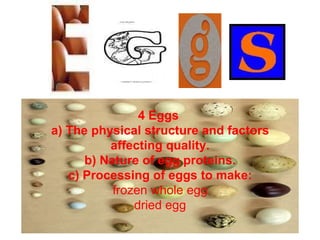
4 Eggs  a) The physical structure and factors affecting quality. b) Nature of egg proteins. c) Processing of eggs to make: frozen whole egg dried egg
Q What category of macronutrient do eggs primarily come under?
A What category of macronutrient do eggs primarily come under? Protein
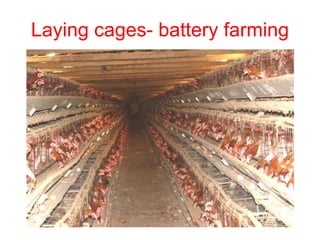
UK consumption In the UK, most people eat eggs which come from hens. It is also possible to eat eggs from geese, ducks and quails.  Cheap, convenient and nutritious (HBV protein).  Eat over 10 billion eggs a year in the UK 86% of these eggs still come from battery caged hens who do not have the freedom to express natural behaviour i.e. dust bathe, forage, roost & nest
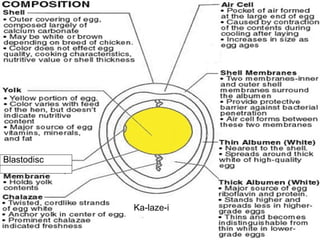
Blastodisc Ka-laze-i
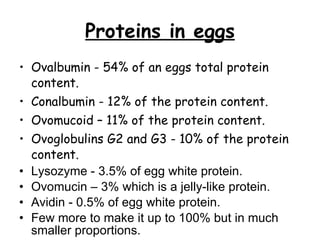
Proteins in eggs Ovalbumin - 54% of an eggs total protein content.  Conalbumin - 12% of the protein content.  Ovomucoid – 11% of the protein content. Ovoglobulins G2 and G3 - 10% of the protein content.  Lysozyme - 3.5% of egg white protein.  Ovomucin – 3% which is a jelly-like protein. Avidin - 0.5% of egg white protein. Few more to make it up to 100% but in much smaller proportions.
Structure of eggs Outer shell  composed mainly of calcium carbonate and a number of pores. Covered by a wax-like layer, known as cuticle.  Cuticle protects against microbial invasion and controls water loss.
Structure of eggs Egg white  is divided into thick around the yolk and thin next to the shell. The thick anchors the yolk with the chalazae. White foams readily therefore good for soufflés and meringues.
Structure of eggs Egg white –  beating egg white can create a foam.  The whisk drags the liquid through itself, creating a force that unfolds the protein molecules This process is called denaturation.
Structure of eggs Egg yolk  rick in nutrients. Protein, fat (33%), water, Vitamin A, D, E, K and iron. Emulsifying properties – contains lecithin Mayo, salad dressing and cakes.
Laying cages- battery farming
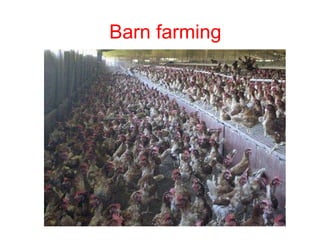
Barn eggs Barn farming
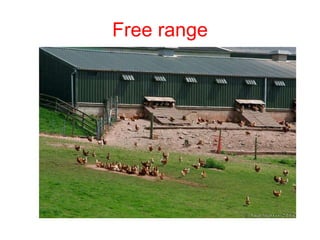
Free range
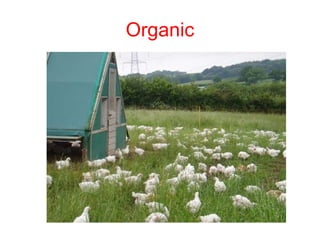
Organic
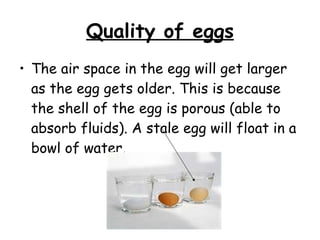
Quality of eggs The air space in the egg will get larger as the egg gets older. This is because the shell of the egg is porous (able to absorb fluids). A stale egg will float in a bowl of water.
Quality of eggs Biological changes gradually take place inside the egg. Thick white of egg becomes thinner and membranes of yolk weaken.  A fresh egg usually has an index of about 0.45 and this gradually falls on ageing as freshness decreases.
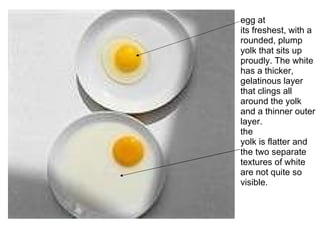
egg at its freshest, with a rounded, plump yolk that sits up proudly. The white has a thicker, gelatinous layer that clings all around the yolk and a thinner outer layer.  the yolk is flatter and the two separate textures of white are not quite so visible.
Egg processing Frozen whole egg is produced on a large scale.  Eggs washed and any bacteria destroyed.  Eggs are broken mechanically and mixed to an homogeneous product which is pasteurized at 63oC for 60secs. Liquid egg is filled into cans and frozen.
Egg processing Dried egg is usually made by spray drying although freeze-drying produces an excellent but expensive product.  Eggs are prepared as above and then spray dried in a drier and used for milk powder.  Task: Using Proudlove, find out what freeze-drying and spray drying is.
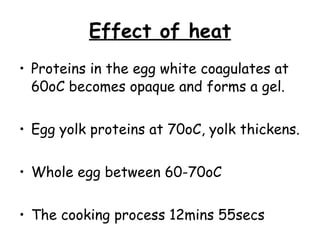
Effect of heat Proteins in the egg white coagulates at 60oC becomes opaque and forms a gel. Egg yolk proteins at 70oC, yolk thickens. Whole egg between 60-70oC The cooking process 12mins 55secs
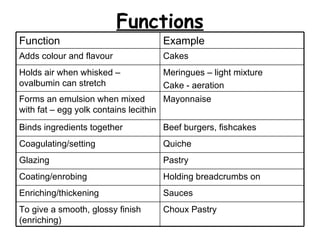
Functions Choux Pastry To give a smooth, glossy finish  (enriching) Sauces Enriching/thickening   Holding breadcrumbs on Coating/enrobing Pastry Glazing Quiche Coagulating/setting   Beef burgers, fishcakes Binds ingredients together Mayonnaise Forms an emulsion when mixed with fat – egg yolk contains lecithin Meringues – light mixture Cake - aeration Holds air when whisked – ovalbumin can stretch Cakes Adds colour and flavour Example Function
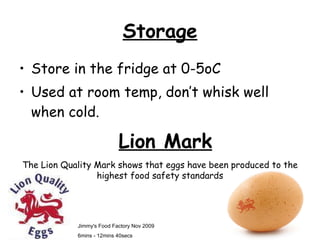
Storage Store in the fridge at 0-5oC Used at room temp, don’t whisk well when cold.  Lion Mark The Lion Quality Mark shows that eggs have been produced to the highest food safety standards Jimmy's Food Factory Nov 2009  6mins - 12mins 40secs
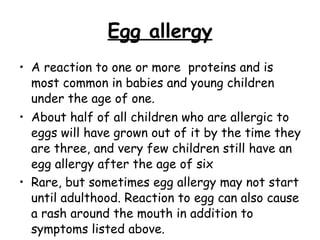
Egg allergy A reaction to one or more  proteins and is most common in babies and young children under the age of one.  About half of all children who are allergic to eggs will have grown out of it by the time they are three, and very few children still have an egg allergy after the age of six Rare, but sometimes egg allergy may not start until adulthood. Reaction to egg can also cause a rash around the mouth in addition to symptoms listed above.
Research Eggs www.britegg.co.uk Jamie Oliver's Fowl Dinners Using the above 2 sources,  Explain and account for trends in egg production in the UK (6 marks) Some people say that only free range eggs should be produced in the UK. Using your knowledge, evaluate the benefits and limitations of such a move. (8 marks) Explain what the lion mark means to consumers. (2 marks)
Egg Questions Discuss the 3 sections of the egg and state the role of each layer (6 marks) Discuss the effect that heat has on egg protein (2 marks) Discuss how eggs are used in cooking (3 marks)

Eggs

  • 1.
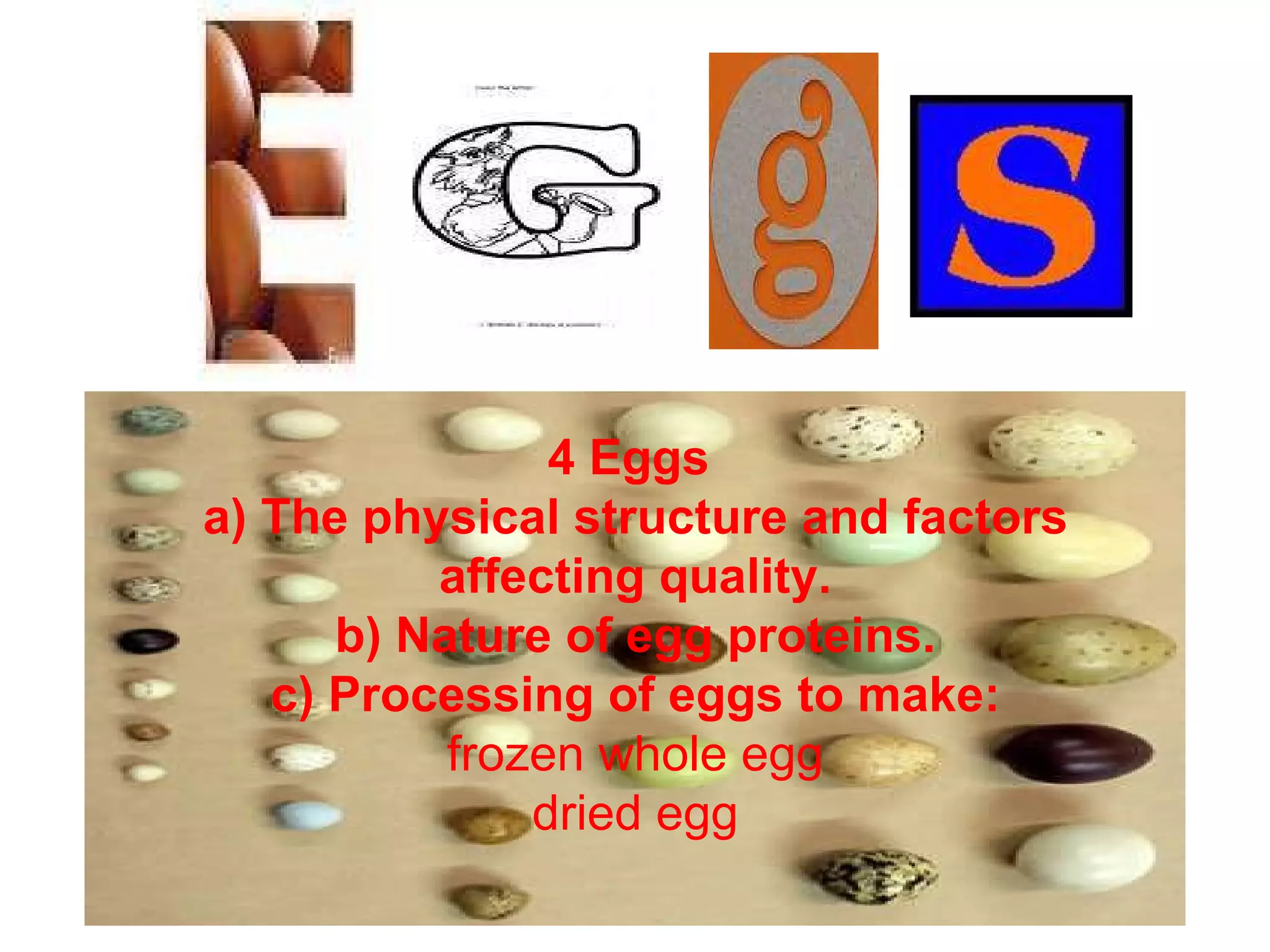
    4 Eggs a) The physical structure and factors affecting quality. b) Nature of egg proteins. c) Processing of eggs to make: frozen whole egg dried egg
  • 2.
    Q What categoryof macronutrient do eggs primarily come under?
  • 3.
    A What categoryof macronutrient do eggs primarily come under? Protein
  • 4.
    UK consumption Inthe UK, most people eat eggs which come from hens. It is also possible to eat eggs from geese, ducks and quails. Cheap, convenient and nutritious (HBV protein). Eat over 10 billion eggs a year in the UK 86% of these eggs still come from battery caged hens who do not have the freedom to express natural behaviour i.e. dust bathe, forage, roost & nest
  • 5.
  • 6.
    Proteins in eggsOvalbumin - 54% of an eggs total protein content. Conalbumin - 12% of the protein content. Ovomucoid – 11% of the protein content. Ovoglobulins G2 and G3 - 10% of the protein content. Lysozyme - 3.5% of egg white protein. Ovomucin – 3% which is a jelly-like protein. Avidin - 0.5% of egg white protein. Few more to make it up to 100% but in much smaller proportions.
  • 7.
    Structure of eggsOuter shell composed mainly of calcium carbonate and a number of pores. Covered by a wax-like layer, known as cuticle. Cuticle protects against microbial invasion and controls water loss.
  • 8.
    Structure of eggsEgg white is divided into thick around the yolk and thin next to the shell. The thick anchors the yolk with the chalazae. White foams readily therefore good for soufflés and meringues.
  • 9.
    Structure of eggsEgg white – beating egg white can create a foam. The whisk drags the liquid through itself, creating a force that unfolds the protein molecules This process is called denaturation.
  • 10.
    Structure of eggsEgg yolk rick in nutrients. Protein, fat (33%), water, Vitamin A, D, E, K and iron. Emulsifying properties – contains lecithin Mayo, salad dressing and cakes.
  • 11.
  • 12.
  • 13.
  • 14.
  • 15.
    Quality of eggsThe air space in the egg will get larger as the egg gets older. This is because the shell of the egg is porous (able to absorb fluids). A stale egg will float in a bowl of water.
  • 16.
    Quality of eggsBiological changes gradually take place inside the egg. Thick white of egg becomes thinner and membranes of yolk weaken. A fresh egg usually has an index of about 0.45 and this gradually falls on ageing as freshness decreases.
  • 17.
    egg at itsfreshest, with a rounded, plump yolk that sits up proudly. The white has a thicker, gelatinous layer that clings all around the yolk and a thinner outer layer. the yolk is flatter and the two separate textures of white are not quite so visible.
  • 18.
    Egg processing Frozenwhole egg is produced on a large scale. Eggs washed and any bacteria destroyed. Eggs are broken mechanically and mixed to an homogeneous product which is pasteurized at 63oC for 60secs. Liquid egg is filled into cans and frozen.
  • 19.
    Egg processing Driedegg is usually made by spray drying although freeze-drying produces an excellent but expensive product. Eggs are prepared as above and then spray dried in a drier and used for milk powder. Task: Using Proudlove, find out what freeze-drying and spray drying is.
  • 20.
    Effect of heatProteins in the egg white coagulates at 60oC becomes opaque and forms a gel. Egg yolk proteins at 70oC, yolk thickens. Whole egg between 60-70oC The cooking process 12mins 55secs
  • 21.
    Functions Choux PastryTo give a smooth, glossy finish (enriching) Sauces Enriching/thickening Holding breadcrumbs on Coating/enrobing Pastry Glazing Quiche Coagulating/setting Beef burgers, fishcakes Binds ingredients together Mayonnaise Forms an emulsion when mixed with fat – egg yolk contains lecithin Meringues – light mixture Cake - aeration Holds air when whisked – ovalbumin can stretch Cakes Adds colour and flavour Example Function
  • 22.
    Storage Store inthe fridge at 0-5oC Used at room temp, don’t whisk well when cold. Lion Mark The Lion Quality Mark shows that eggs have been produced to the highest food safety standards Jimmy's Food Factory Nov 2009 6mins - 12mins 40secs
  • 23.
    Egg allergy Areaction to one or more  proteins and is most common in babies and young children under the age of one. About half of all children who are allergic to eggs will have grown out of it by the time they are three, and very few children still have an egg allergy after the age of six Rare, but sometimes egg allergy may not start until adulthood. Reaction to egg can also cause a rash around the mouth in addition to symptoms listed above.
  • 24.
    Research Eggs www.britegg.co.ukJamie Oliver's Fowl Dinners Using the above 2 sources, Explain and account for trends in egg production in the UK (6 marks) Some people say that only free range eggs should be produced in the UK. Using your knowledge, evaluate the benefits and limitations of such a move. (8 marks) Explain what the lion mark means to consumers. (2 marks)
  • 25.
    Egg Questions Discussthe 3 sections of the egg and state the role of each layer (6 marks) Discuss the effect that heat has on egg protein (2 marks) Discuss how eggs are used in cooking (3 marks)