© Cengage Learning 2015
Understanding Food Principles and Preparation • Fifth Edition
AMY BROWN
© Cengage Learning 2015
Eggs
12
© Cengage Learning 2015
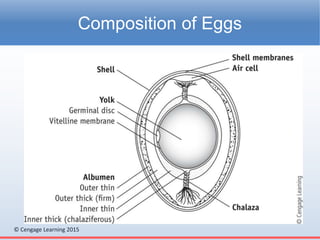
Composition of Eggs
© Cengage Learning 2015
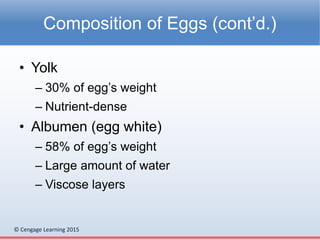
• Yolk
– 30% of egg’s weight
– Nutrient-dense
• Albumen (egg white)
– 58% of egg’s weight
– Large amount of water
– Viscose layers
Composition of Eggs (cont’d.)
© Cengage Learning 2015
• Shell membranes
– Protect from bacteria
• Air cell
– Provide chick with oxygen for first breath
• Shell
– 12% of egg’s weight
– Protects egg
Composition of Eggs (cont’d.)
© Cengage Learning 2015
• Inspection
– USDA Poultry Division
– Restricted eggs: those that fail inspection &
are not sold whole to consumer
• Checks: cracked shells
• Leakers: cracked shells & membranes
• Dirties: at least one-fourth of shell covered in dirt or
stains
• Inedibles: greenish egg whites, or fertilized, rotten,
moldy, or bloody
• Meat spots: blood spots
Purchasing Eggs
© Cengage Learning 2015
• Grading
– Optional, paid for by egg producer
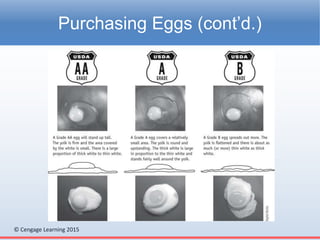
– USDA grades AA, A, and B
– Methods for grading
• Candling: holding egg against light to see defects
through shell
• Measuring Haugh units: comparing height of egg
white
• Evaluating appearance: shell, white, yolk, and air
cell
Purchasing Eggs (cont’d.)
© Cengage Learning 2015
Purchasing Eggs (cont’d.)
© Cengage Learning 2015
Purchasing Eggs (cont’d.)
© Cengage Learning 2015
Purchasing Eggs (cont’d.)
© Cengage Learning 2015
Purchasing Eggs (cont’d.)
© Cengage Learning 2015
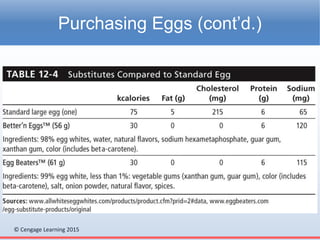
• Egg substitutes
– Made in response to consumer demand for
low cholesterol egg products
– Often have higher sodium content than eggs
Purchasing Eggs (cont’d.)
© Cengage Learning 2015
• Value-added eggs
– Special nutrient content or conditions under
which hens are raised
• Hen diet can lower cholesterol, and increase
omega-3 fatty acids and vitamin E
– For animal-friendly consumers, eggs from
hens that are free roaming, cage free, or fed
naturally
Purchasing Eggs (cont’d.)
© Cengage Learning 2015
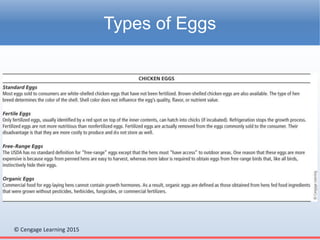
Types of Eggs
© Cengage Learning 2015
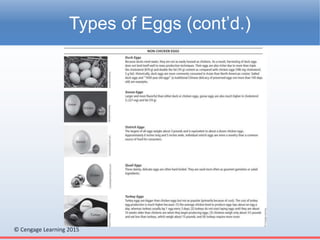
Types of Eggs (cont’d.)
© Cengage Learning 2015
• Emulsifying
• Binding
• Foaming
• Interfering
• Clarifying
• Color
Functions of Eggs in Foods
© Cengage Learning 2015
Functions of Eggs in Foods (cont’d.)
© Cengage Learning 2015
Functions of Eggs in Foods (cont’d.)
© Cengage Learning 2015
Calorie Control: Egg Breakfast
© Cengage Learning 2015
Preparation of Eggs
© Cengage Learning 2015
• Changes in prepared eggs
– Effects of temperature and time
• Coagulation temperatures
– Effects of added ingredients
– Color changes
Preparation of Eggs (cont’d.)
© Cengage Learning 2015
• Dry-heat preparation
– Fried
• Sunny-side up, over easy, over medium, over hard,
scrambled, omelets
– Baking
• Shirred eggs, meringues, and soufflés
Preparation of Eggs (cont’d.)
© Cengage Learning 2015
Preparation of Eggs (cont’d.)
© Cengage Learning 2015
• Moist-heat preparation
– Hard or soft “boiling”
• Hot-start method vs. cold-start method
– Coddling and poaching
– Custards
• Sweet & savory custards, stirred custards, and
baked custards
– Microwaving
• Fried, scrambled, poached, omelet, and quiche
Preparation of Eggs (cont’d.)
© Cengage Learning 2015
• Refrigerator
– Store whole eggs in their container
– Shelf life of refrigerated eggs
• Whole eggs: ~1 month
• Separated egg yolks submerged in water: 2 days
• Egg whites in glass container: 4 days
• Storage eggs (commercial use): up to 6 months
– Pasteurized eggs for commercial use
• Liquid, frozen, or powdered; for convenience
Storage of Eggs
© Cengage Learning 2015
• Frozen eggs
– Can’t freeze whole egg in shell; first crack
open egg and then freeze
• Drawbacks include: cost, hard to portion, and
lower quality
– Egg whites or yolks can be frozen
• At home, add 1 T of sugar or ½ t of salt for every
cup of blended eggs
• Separated egg whites need nothing added before
freezing
Storage of Eggs (cont’d.)
© Cengage Learning 2015
• Drying eggs
– Whole eggs or yolks are dried to a fine
powder
– Egg whites are dried to granule, flake, or
milled texture
– To use, add water or by mix in with dry
ingredients
Storage of Eggs (cont’d.)
© Cengage Learning 2015
• Buy only refrigerated eggs
• Check carton to make sure eggs are clean
and not cracked
• Do not add raw eggs to scrambled eggs
• Use an egg separator rather than passing
yolk back and forth between shells
• Ensure egg shells are not in food products
• Cook eggs until no visible liquid remains
Safety Tips
© Cengage Learning 2015
• Bake egg dishes until an inserted knife
comes out clean
• Hold scrambled eggs at appropriate
temperatures
• Be cautious when preparing barely cooked
egg dishes (mousse, meringue, etc.)
– Heat egg dishes to 160°F (145°F for
commercial dishes)
• Do not consume raw or undercooked eggs
Safety Tips (cont’d.)
© Cengage Learning 2015
• Use only pasteurized eggs for dishes
where eggs are cooked lightly or left raw
• Always store eggs in the refrigerator
– Unopened liquid egg products can be stored
for 7 days, but should be used within 3 days
of opening
Safety Tips (cont’d.)
© Cengage Learning 2015
• Dried egg mix should be used within 7 to
10 days of opening
• Cold egg dishes should be stored below
40°F; hot dishes should be kept above
140°F for up to one hour
Safety Tips (cont’d.)
© Cengage Learning 2015
• Egg protein is so high in quality that it has
become the standard (reference protein) by
which researchers rate all other food proteins
• The versatility of eggs, whether prepared
alone or in combination with other foods,
makes them nearly indispensable in cooking
• Important aspects for food preparation
– Composition, purchasing criteria, types and
functions of eggs, and preparation and storage
techniques
Chapter Summary

Chapter 12 - Eggs

  • 1.
    © Cengage Learning2015 Understanding Food Principles and Preparation • Fifth Edition AMY BROWN © Cengage Learning 2015 Eggs 12
  • 2.
    © Cengage Learning2015 Composition of Eggs
  • 3.
    © Cengage Learning2015 • Yolk – 30% of egg’s weight – Nutrient-dense • Albumen (egg white) – 58% of egg’s weight – Large amount of water – Viscose layers Composition of Eggs (cont’d.)
  • 4.
    © Cengage Learning2015 • Shell membranes – Protect from bacteria • Air cell – Provide chick with oxygen for first breath • Shell – 12% of egg’s weight – Protects egg Composition of Eggs (cont’d.)
  • 5.
    © Cengage Learning2015 • Inspection – USDA Poultry Division – Restricted eggs: those that fail inspection & are not sold whole to consumer • Checks: cracked shells • Leakers: cracked shells & membranes • Dirties: at least one-fourth of shell covered in dirt or stains • Inedibles: greenish egg whites, or fertilized, rotten, moldy, or bloody • Meat spots: blood spots Purchasing Eggs
  • 6.
    © Cengage Learning2015 • Grading – Optional, paid for by egg producer – USDA grades AA, A, and B – Methods for grading • Candling: holding egg against light to see defects through shell • Measuring Haugh units: comparing height of egg white • Evaluating appearance: shell, white, yolk, and air cell Purchasing Eggs (cont’d.)
  • 7.
    © Cengage Learning2015 Purchasing Eggs (cont’d.)
  • 8.
    © Cengage Learning2015 Purchasing Eggs (cont’d.)
  • 9.
    © Cengage Learning2015 Purchasing Eggs (cont’d.)
  • 10.
    © Cengage Learning2015 Purchasing Eggs (cont’d.)
  • 11.
    © Cengage Learning2015 • Egg substitutes – Made in response to consumer demand for low cholesterol egg products – Often have higher sodium content than eggs Purchasing Eggs (cont’d.)
  • 12.
    © Cengage Learning2015 • Value-added eggs – Special nutrient content or conditions under which hens are raised • Hen diet can lower cholesterol, and increase omega-3 fatty acids and vitamin E – For animal-friendly consumers, eggs from hens that are free roaming, cage free, or fed naturally Purchasing Eggs (cont’d.)
  • 13.
    © Cengage Learning2015 Types of Eggs
  • 14.
    © Cengage Learning2015 Types of Eggs (cont’d.)
  • 15.
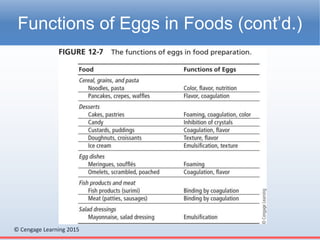
    © Cengage Learning2015 • Emulsifying • Binding • Foaming • Interfering • Clarifying • Color Functions of Eggs in Foods
  • 16.
    © Cengage Learning2015 Functions of Eggs in Foods (cont’d.)
  • 17.
    © Cengage Learning2015 Functions of Eggs in Foods (cont’d.)
  • 18.
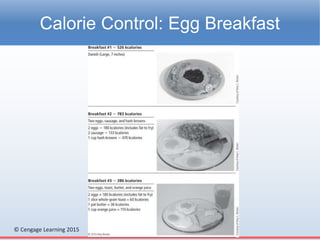
    © Cengage Learning2015 Calorie Control: Egg Breakfast
  • 19.
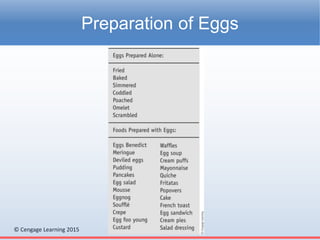
    © Cengage Learning2015 Preparation of Eggs
  • 20.
    © Cengage Learning2015 • Changes in prepared eggs – Effects of temperature and time • Coagulation temperatures – Effects of added ingredients – Color changes Preparation of Eggs (cont’d.)
  • 21.
    © Cengage Learning2015 • Dry-heat preparation – Fried • Sunny-side up, over easy, over medium, over hard, scrambled, omelets – Baking • Shirred eggs, meringues, and soufflés Preparation of Eggs (cont’d.)
  • 22.
    © Cengage Learning2015 Preparation of Eggs (cont’d.)
  • 23.
    © Cengage Learning2015 • Moist-heat preparation – Hard or soft “boiling” • Hot-start method vs. cold-start method – Coddling and poaching – Custards • Sweet & savory custards, stirred custards, and baked custards – Microwaving • Fried, scrambled, poached, omelet, and quiche Preparation of Eggs (cont’d.)
  • 24.
    © Cengage Learning2015 • Refrigerator – Store whole eggs in their container – Shelf life of refrigerated eggs • Whole eggs: ~1 month • Separated egg yolks submerged in water: 2 days • Egg whites in glass container: 4 days • Storage eggs (commercial use): up to 6 months – Pasteurized eggs for commercial use • Liquid, frozen, or powdered; for convenience Storage of Eggs
  • 25.
    © Cengage Learning2015 • Frozen eggs – Can’t freeze whole egg in shell; first crack open egg and then freeze • Drawbacks include: cost, hard to portion, and lower quality – Egg whites or yolks can be frozen • At home, add 1 T of sugar or ½ t of salt for every cup of blended eggs • Separated egg whites need nothing added before freezing Storage of Eggs (cont’d.)
  • 26.
    © Cengage Learning2015 • Drying eggs – Whole eggs or yolks are dried to a fine powder – Egg whites are dried to granule, flake, or milled texture – To use, add water or by mix in with dry ingredients Storage of Eggs (cont’d.)
  • 27.
    © Cengage Learning2015 • Buy only refrigerated eggs • Check carton to make sure eggs are clean and not cracked • Do not add raw eggs to scrambled eggs • Use an egg separator rather than passing yolk back and forth between shells • Ensure egg shells are not in food products • Cook eggs until no visible liquid remains Safety Tips
  • 28.
    © Cengage Learning2015 • Bake egg dishes until an inserted knife comes out clean • Hold scrambled eggs at appropriate temperatures • Be cautious when preparing barely cooked egg dishes (mousse, meringue, etc.) – Heat egg dishes to 160°F (145°F for commercial dishes) • Do not consume raw or undercooked eggs Safety Tips (cont’d.)
  • 29.
    © Cengage Learning2015 • Use only pasteurized eggs for dishes where eggs are cooked lightly or left raw • Always store eggs in the refrigerator – Unopened liquid egg products can be stored for 7 days, but should be used within 3 days of opening Safety Tips (cont’d.)
  • 30.
    © Cengage Learning2015 • Dried egg mix should be used within 7 to 10 days of opening • Cold egg dishes should be stored below 40°F; hot dishes should be kept above 140°F for up to one hour Safety Tips (cont’d.)
  • 31.
    © Cengage Learning2015 • Egg protein is so high in quality that it has become the standard (reference protein) by which researchers rate all other food proteins • The versatility of eggs, whether prepared alone or in combination with other foods, makes them nearly indispensable in cooking • Important aspects for food preparation – Composition, purchasing criteria, types and functions of eggs, and preparation and storage techniques Chapter Summary

Editor's Notes

  • #3 Figure 12-1. Composition of an egg.
  • #8 Figure 12-4. USDA grades for eggs.
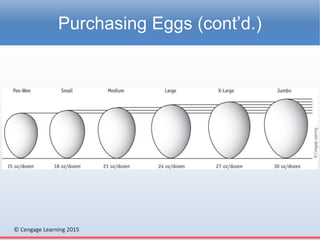
  • #9 Figure 12-5. Egg sizes determined by minimum weight (including shells) per dozen.
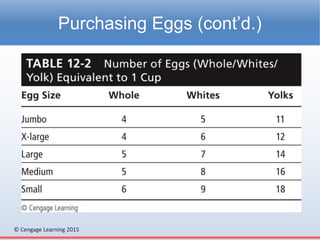
  • #10 Table 12-2. Number of Eggs (Whole/White/Yolk) Equivalent to 1 Cup
  • #11 Table 12-4. Substitutes Compared to Standard Egg
  • #14 Figure 12-6. Types of eggs.
  • #15 Figure 12-6. Types of eggs.
  • #17 Figure 12-7. The functions of eggs in food preparation.
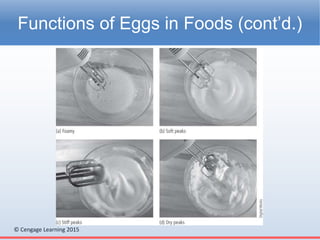
  • #18 Figure 12-8. Stages of foam formation.
  • #19 Figure 12-10. Kilocalorie content of three breakfast options.
  • #20 Figure 12-11. Food preparation with eggs.
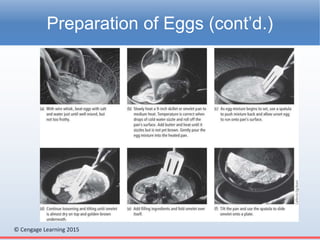
  • #23 Figure 12-12. Omelet preparation.