Abnormal uterine
bleeding
Dec,2012
AUB..
• Def: any bleeding from the uterus that differs
from the usual menstrual cycle in frequency,
amount, duration of flow.
Normal menstrual Cycle
• Cycle length 24 to 35 days, normal amount of
menstrual blood per cycle 30 to
50ml ,abnormal if > 80ml
Physiology of normal menstrual bleeding
• Is post ovulatory est- progesterone
withdrawal bleeding.
Physiology….
• Follicular phase
Ovary secret estrogen -endometrial
proliferation
• Secretory phase
after ovulation , C. Luteum secret Pro +
estrogen
Secretory…
• Pro limits endometrial growth & cause it to
differentiate
• If no pregnancy –C. luteum regresses &
hormonal support of the endometrium
ceases__ initiates a cascade of events that
results in menstrual bleeding.
Physiology…
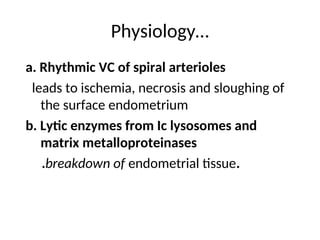
a. Rhythmic VC of spiral arterioles
leads to ischemia, necrosis and sloughing of
the surface endometrium
b. Lytic enzymes from Ic lysosomes and
matrix metalloproteinases
.breakdown of endometrial tissue.
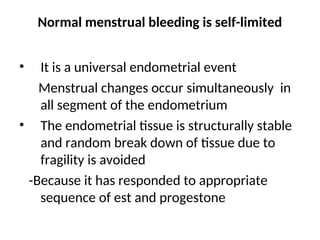
Normal menstrual bleeding is self-limited
• It is a universal endometrial event
Menstrual changes occur simultaneously in
all segment of the endometrium
• The endometrial tissue is structurally stable
and random break down of tissue due to
fragility is avoided
-Because it has responded to appropriate
sequence of est and progestone
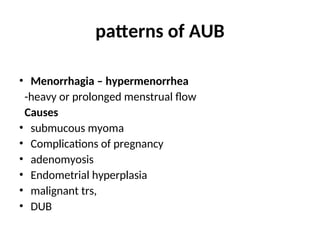
patterns of AUB
• Menorrhagia – hypermenorrhea
-heavy or prolonged menstrual flow
Causes
• submucous myoma
• Complications of pregnancy
• adenomyosis
• Endometrial hyperplasia
• malignant trs,
• DUB
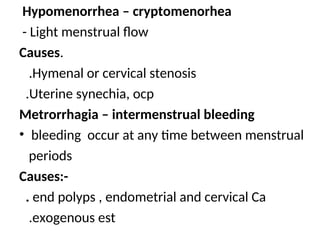
Hypomenorrhea – cryptomenorhea
- Light menstrual flow
Causes.
.Hymenal or cervical stenosis
.Uterine synechia, ocp
Metrorrhagia – intermenstrual bleeding
• bleeding occur at any time between menstrual
periods
Causes:-
. end polyps , endometrial and cervical Ca
.exogenous est
Menometrorrhagia
• period that occurs at irregular intervals
.irregular, prolonged and excessive in amount.
• Causes
.anovulation
.est secreting trs
Polymenorrhea
• period that occurs too frequently
• a menstrual cycle interval of < 21 days
causes. Anovulation
. shortened luteal phase
Oligomenorrhea
menstrual periods that occurs more than 35
days apart
causes.
. An ovulation
.est secreting trs
Patterns..
Contact bleeding- post coital bleeding
• Must be considered a sign of cervical Ca until
proved other wise.
Other causes
cervical polyp
cervical or vaginal infection
Causes of AUB
• prepubertal –premenarchal
• Vulval lesions –vulval fissure, maceration, condy lomas
• F. body
• Vulvovaginitis
• Precocious puberty
• Trauma - abuse, penetration
• Vaginal and ovarian trs
• Exogenous hormones
Causes of AUB…
Adolescence
• anovulation (90%)- hypothalamic immaturity
• pregnancy related bleeding
• exogenous hormones
• Hematologic abnormalities
ITP,Vonwillebrand’s disease
Adolescence AUB…
- infections- cervicitis, PID
- endocrine or systemic problems
. thyroid and hepatic dysfunction
.PCOS
- Anatomic causes
.Mullerian abnormalities
Long vaginal septa
UX didelphis
Reproductive age group
• pregnancy related bleeding
• DUB
• Exogenous hormones, endocrine causes
• Anatomic causes
* Myoma, adenomyosis , endometrial polyps
* cervical lesions –polyps, infections, lesions ,condyloma ,HSV ulcer
Hematologic causes
Coagulation abn – thrombocytopenia, v. will brand’s
- Leukemia
Neoplasia – Ca (cervical , endometrial ,vaginal)
Infectious causes - cervicitis,endometritis
Dysfunctional uterine bleeding
Def-abnormal Ux bleeding for which no specific
organic cause can be found , after a thorough
evaluation and work up of Pt.
• Most often occurs in the absence of the cyclic
hormonal changes that regulate the menstrual
cycle.
• Is often a dx of exclusion – organic causes must be
excluded
• AUB at extremes of reproductive life usually is due
to anovulation (DUB)
Pathophysiology of DUB
• Most common etiology is est. withdrawal or est
break through bleeding
• In absence of ovulation
est stimulates the endometrium without production
of progesterone
Pathophysiology..
• unopposed est  leads to excessive glandular
proliferation with lack of stromal support
unstable, fragile, hetrogenous endometrium prone
to superficial breakdown and bleeding.
• endometrium slough off in isolated location, the
remaining raw surface is restimulated by est and
heals as another part of endometrium is slough off
Etiology of DUB
A .Causes of anovulation or oligoovulation
• Anovulatory cycles are sms of disruption of
the normal regulatory mechanisms that
control menstrual cycle.
• abnormalities at any site of hypothalmo-
pituitary ovarian axis
1.Dysfunction of hypothalamic pituitary
ovarian axis
• Any factor that interferes with the normal
pulsatile secretion of GnRH leads to an
ovulation
Causes –
.Hyperprolactinemia – P. adenoma,
psychotropic drugs,hypothyroidism
• stress and anxiety
• rapid weight loss
• anorexia nervosa
2.Immaturity of hypothalamic pituitary ovarian axis
-in post pubertal adolescence shortly after
menarche
3. Abnormalities of normal feed back signals
Estradiol levels play a critical role in controlling the
sequence of events during normal ovulatory cycles
• medical conditions – hepatic ds , thyroid
abnormalities affect metabolism and clearance of
estradiol
`
4. other causes
Pcos
b. causes with ovulation
• DUB 2ry to hormonal causes may occur during
ovulatory cycles
• ovulatory pts with AUB are more likely to have an
underlying organic pathology & are not true DUB
pts
Evaluation of AUB
A. History
• age, parity, marital status, sexual Hx
• current pattern of bleeding
• menstrual Hx – age at menarche, cycle frequency
and duration, presence of molimina sms
• contraceptive use & other medications
- anticoagulants, psychotropic drugs
Evaluation …
• medical Hx – sms of endocrine & other
organic diseases
• bleeding tendency & family Hx of bleeding
disorder
• sms of stress & sms of PID
Physical examination
General P/E
• thyroid enlargement, galactorrhea,
ecchymosis, purpura
• pallor, v/s
Gynecologic exam
• 2ry sexual x-stics, vaginal trauma, sign of
infection, atrophic vaginitis and F.body
Lab evaluation
based on Hx physical findings
• CBC- Hgb & HCT, WBC, platlet count
• Pregnancy test – should be done in all pre
menopausal AUB
• Test for -STI
• Coagulation profile – PT, PTT
• TSH, PRL, LFT
• Androgen profile – Testesterone, DEA, 17
alpha hydoxy progestrone
D. Diagnostic procedures
1. ultrasonography & sonohysterography
• intra Ux polyps, submucous myoma, ovarian
masses
• Ux contour, endometrial thickness
2 endometrial biopsy
- to R/o endometrial ca
Indication
• those at risk for endometrial hyperplasia or ca
• those older than 40 yrs of age
• those younger than 40 yrs of age who have chronic
unopposed est breakthrough bleeding
3. D&C
• replaced by endometrial biopsy in the office
4. Hysteroscopy with endometrial sampling
Indication
• cervical stenosis precluding adequate end
ometrial biopsy
• pt intolerance of endometrial biopsy
• anatomic factors precluding adequate end
biopsy
Hysteroscopy…
• presence of AUB in a pt undergoing another
surgical procedure with GA
• Direct visualization of endometrial cavity,
allow targeted biopsy or excision of the lesion
• Gold standard for Dx of AUB
Management of AUB
Depends on the etiology of the bleeding
.In identifiable causes the Rx is targeted to
wards the cause
The Mx of DUB depends on
- age of pt
-severity of bleeding
- desire for future pregnancy
- presence of associated pathology
Objective of Rx
• Control bleeding
• Prevent recurrence
• Preserve fertility
• Correct associated disorders
Rx…
A. Hormonal Rx
1. progestins
- Rx of choice for anovulatory DUB
- stops endometrial growth, support & stabilize the
endometrium  an organized sloughing off the
endometrium occurs after its withdrawal.
- oral medroxy progesterone acetate 10 mg/day for
the 1st 12 days each month or day 16 through 25 of
each cycle
Rx…
2 .oral contraceptive therapy
• Convert a fragile, overgrown endometrium
into a pseudo decidualized structurally stable
lining
• Controls bleeding with in 24 hrs
OCP…
• Low dose combined OCP  2 to 3x a day for 5 to 7
days, then once a day for 3 months.
3. High dose estrogen
- promotes rapid endometrial regrowth to cover
denuded epithelial surfaces
- conjugated equine estrogen 10 mg Po/day qid or
25mg lv Q 2 to 4hrs for 24hrs then oral est 10mg/day
for 21 to 25days and medroxy progesterone
acetate10mg/day for the last 7-10days.
- bleeding usually stops with in 24hrs
B .Medical therapy
1. non steroidal anti inflammatory agents
- inhibit synthesis of PGs
- alter the balance b/n thromboxane &
prostacycline
- effective in ovulatory DUB
- eg. Ibuprofen, Naproxen
2. GnRH agonists
- down regulate pituitary synthesis of FSH & LH and
induce “medical menopause”
- last resort when all modalities fail
3. Rx of coagulation disorder
- desmopressine   factor VIII
- antifibrinolytic agents –
E. aminocaproic acid
tranexamic acid
Surgical therapy
1. D&C with or without hysteroscopy
• Done in pts with bleeding refractory to
medical therapy
• Can be diagnostic & therapeutic modality
• In age above 40 yrs it must be done
• Age 20 to 40yrs postponed
• Age <20yrs should be deffered
Surgical …
2 .Hysterectomy
• If failed to respond to medical Rx, repeated
curettage, endometrial ablation
• More definitive -consider age of the pt, her
desire for future fertility
3 Endometrial ablation
• Destruction of the endometrium
• For woman who are not candidate for
hysterectomy
• Using laser, electrocautery, thermal
destructive technique
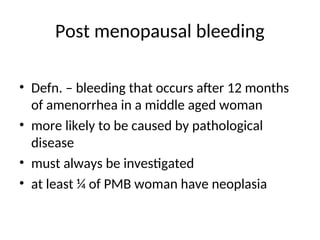
Post menopausal bleeding
• Defn. – bleeding that occurs after 12 months
of amenorrhea in a middle aged woman
• more likely to be caused by pathological
disease
• must always be investigated
• at least ¼ of PMB woman have neoplasia
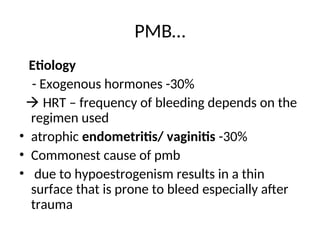
PMB…
Etiology
- Exogenous hormones -30%
 HRT – frequency of bleeding depends on the
regimen used
• atrophic endometritis/ vaginitis -30%
• Commonest cause of pmb
• due to hypoestrogenism results in a thin
surface that is prone to bleed especially after
trauma
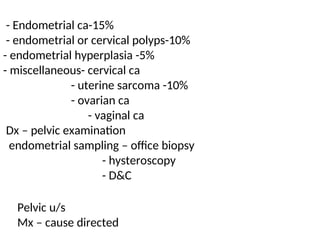
- Endometrial ca-15%
- endometrial or cervical polyps-10%
- endometrial hyperplasia -5%
- miscellaneous- cervical ca
- uterine sarcoma -10%
- ovarian ca
- vaginal ca
Dx – pelvic examination
endometrial sampling – office biopsy
- hysteroscopy
- D&C
Pelvic u/s
Mx – cause directed
abnormal uterine bleeding lecture (2).ppt

  • 1.
  • 2.
    AUB.. • Def: anybleeding from the uterus that differs from the usual menstrual cycle in frequency, amount, duration of flow.
  • 3.
    Normal menstrual Cycle •Cycle length 24 to 35 days, normal amount of menstrual blood per cycle 30 to 50ml ,abnormal if > 80ml
  • 4.
    Physiology of normalmenstrual bleeding • Is post ovulatory est- progesterone withdrawal bleeding.
  • 5.
    Physiology…. • Follicular phase Ovarysecret estrogen -endometrial proliferation • Secretory phase after ovulation , C. Luteum secret Pro + estrogen
  • 6.
    Secretory… • Pro limitsendometrial growth & cause it to differentiate • If no pregnancy –C. luteum regresses & hormonal support of the endometrium ceases__ initiates a cascade of events that results in menstrual bleeding.
  • 7.
    Physiology… a. Rhythmic VCof spiral arterioles leads to ischemia, necrosis and sloughing of the surface endometrium b. Lytic enzymes from Ic lysosomes and matrix metalloproteinases .breakdown of endometrial tissue.
  • 8.
    Normal menstrual bleedingis self-limited • It is a universal endometrial event Menstrual changes occur simultaneously in all segment of the endometrium • The endometrial tissue is structurally stable and random break down of tissue due to fragility is avoided -Because it has responded to appropriate sequence of est and progestone
  • 9.
    patterns of AUB •Menorrhagia – hypermenorrhea -heavy or prolonged menstrual flow Causes • submucous myoma • Complications of pregnancy • adenomyosis • Endometrial hyperplasia • malignant trs, • DUB
  • 10.
    Hypomenorrhea – cryptomenorhea -Light menstrual flow Causes. .Hymenal or cervical stenosis .Uterine synechia, ocp Metrorrhagia – intermenstrual bleeding • bleeding occur at any time between menstrual periods Causes:- . end polyps , endometrial and cervical Ca .exogenous est
  • 11.
    Menometrorrhagia • period thatoccurs at irregular intervals .irregular, prolonged and excessive in amount. • Causes .anovulation .est secreting trs
  • 12.
    Polymenorrhea • period thatoccurs too frequently • a menstrual cycle interval of < 21 days causes. Anovulation . shortened luteal phase Oligomenorrhea menstrual periods that occurs more than 35 days apart causes. . An ovulation .est secreting trs
  • 13.
    Patterns.. Contact bleeding- postcoital bleeding • Must be considered a sign of cervical Ca until proved other wise. Other causes cervical polyp cervical or vaginal infection
  • 14.
    Causes of AUB •prepubertal –premenarchal • Vulval lesions –vulval fissure, maceration, condy lomas • F. body • Vulvovaginitis • Precocious puberty • Trauma - abuse, penetration • Vaginal and ovarian trs • Exogenous hormones
  • 15.
    Causes of AUB… Adolescence •anovulation (90%)- hypothalamic immaturity • pregnancy related bleeding • exogenous hormones • Hematologic abnormalities ITP,Vonwillebrand’s disease
  • 16.
    Adolescence AUB… - infections-cervicitis, PID - endocrine or systemic problems . thyroid and hepatic dysfunction .PCOS - Anatomic causes .Mullerian abnormalities Long vaginal septa UX didelphis
  • 17.
    Reproductive age group •pregnancy related bleeding • DUB • Exogenous hormones, endocrine causes • Anatomic causes * Myoma, adenomyosis , endometrial polyps * cervical lesions –polyps, infections, lesions ,condyloma ,HSV ulcer Hematologic causes Coagulation abn – thrombocytopenia, v. will brand’s - Leukemia Neoplasia – Ca (cervical , endometrial ,vaginal) Infectious causes - cervicitis,endometritis
  • 18.
    Dysfunctional uterine bleeding Def-abnormalUx bleeding for which no specific organic cause can be found , after a thorough evaluation and work up of Pt. • Most often occurs in the absence of the cyclic hormonal changes that regulate the menstrual cycle.
  • 19.
    • Is oftena dx of exclusion – organic causes must be excluded • AUB at extremes of reproductive life usually is due to anovulation (DUB) Pathophysiology of DUB • Most common etiology is est. withdrawal or est break through bleeding • In absence of ovulation est stimulates the endometrium without production of progesterone
  • 20.
    Pathophysiology.. • unopposed est leads to excessive glandular proliferation with lack of stromal support unstable, fragile, hetrogenous endometrium prone to superficial breakdown and bleeding. • endometrium slough off in isolated location, the remaining raw surface is restimulated by est and heals as another part of endometrium is slough off
  • 21.
    Etiology of DUB A.Causes of anovulation or oligoovulation • Anovulatory cycles are sms of disruption of the normal regulatory mechanisms that control menstrual cycle. • abnormalities at any site of hypothalmo- pituitary ovarian axis
  • 22.
    1.Dysfunction of hypothalamicpituitary ovarian axis • Any factor that interferes with the normal pulsatile secretion of GnRH leads to an ovulation Causes – .Hyperprolactinemia – P. adenoma, psychotropic drugs,hypothyroidism • stress and anxiety • rapid weight loss • anorexia nervosa
  • 23.
    2.Immaturity of hypothalamicpituitary ovarian axis -in post pubertal adolescence shortly after menarche 3. Abnormalities of normal feed back signals Estradiol levels play a critical role in controlling the sequence of events during normal ovulatory cycles • medical conditions – hepatic ds , thyroid abnormalities affect metabolism and clearance of estradiol
  • 24.
    ` 4. other causes Pcos b.causes with ovulation • DUB 2ry to hormonal causes may occur during ovulatory cycles • ovulatory pts with AUB are more likely to have an underlying organic pathology & are not true DUB pts
  • 25.
    Evaluation of AUB A.History • age, parity, marital status, sexual Hx • current pattern of bleeding • menstrual Hx – age at menarche, cycle frequency and duration, presence of molimina sms • contraceptive use & other medications - anticoagulants, psychotropic drugs
  • 26.
    Evaluation … • medicalHx – sms of endocrine & other organic diseases • bleeding tendency & family Hx of bleeding disorder • sms of stress & sms of PID
  • 27.
    Physical examination General P/E •thyroid enlargement, galactorrhea, ecchymosis, purpura • pallor, v/s Gynecologic exam • 2ry sexual x-stics, vaginal trauma, sign of infection, atrophic vaginitis and F.body
  • 28.
    Lab evaluation based onHx physical findings • CBC- Hgb & HCT, WBC, platlet count • Pregnancy test – should be done in all pre menopausal AUB • Test for -STI • Coagulation profile – PT, PTT • TSH, PRL, LFT
  • 29.
    • Androgen profile– Testesterone, DEA, 17 alpha hydoxy progestrone D. Diagnostic procedures 1. ultrasonography & sonohysterography • intra Ux polyps, submucous myoma, ovarian masses • Ux contour, endometrial thickness
  • 30.
    2 endometrial biopsy -to R/o endometrial ca Indication • those at risk for endometrial hyperplasia or ca • those older than 40 yrs of age • those younger than 40 yrs of age who have chronic unopposed est breakthrough bleeding
  • 31.
    3. D&C • replacedby endometrial biopsy in the office 4. Hysteroscopy with endometrial sampling Indication • cervical stenosis precluding adequate end ometrial biopsy • pt intolerance of endometrial biopsy • anatomic factors precluding adequate end biopsy
  • 32.
    Hysteroscopy… • presence ofAUB in a pt undergoing another surgical procedure with GA • Direct visualization of endometrial cavity, allow targeted biopsy or excision of the lesion • Gold standard for Dx of AUB
  • 33.
    Management of AUB Dependson the etiology of the bleeding .In identifiable causes the Rx is targeted to wards the cause The Mx of DUB depends on - age of pt -severity of bleeding - desire for future pregnancy - presence of associated pathology Objective of Rx • Control bleeding • Prevent recurrence • Preserve fertility • Correct associated disorders
  • 34.
    Rx… A. Hormonal Rx 1.progestins - Rx of choice for anovulatory DUB - stops endometrial growth, support & stabilize the endometrium  an organized sloughing off the endometrium occurs after its withdrawal. - oral medroxy progesterone acetate 10 mg/day for the 1st 12 days each month or day 16 through 25 of each cycle
  • 35.
    Rx… 2 .oral contraceptivetherapy • Convert a fragile, overgrown endometrium into a pseudo decidualized structurally stable lining • Controls bleeding with in 24 hrs
  • 36.
    OCP… • Low dosecombined OCP  2 to 3x a day for 5 to 7 days, then once a day for 3 months. 3. High dose estrogen - promotes rapid endometrial regrowth to cover denuded epithelial surfaces - conjugated equine estrogen 10 mg Po/day qid or 25mg lv Q 2 to 4hrs for 24hrs then oral est 10mg/day for 21 to 25days and medroxy progesterone acetate10mg/day for the last 7-10days. - bleeding usually stops with in 24hrs
  • 37.
    B .Medical therapy 1.non steroidal anti inflammatory agents - inhibit synthesis of PGs - alter the balance b/n thromboxane & prostacycline - effective in ovulatory DUB - eg. Ibuprofen, Naproxen 2. GnRH agonists - down regulate pituitary synthesis of FSH & LH and induce “medical menopause” - last resort when all modalities fail
  • 38.
    3. Rx ofcoagulation disorder - desmopressine   factor VIII - antifibrinolytic agents – E. aminocaproic acid tranexamic acid
  • 39.
    Surgical therapy 1. D&Cwith or without hysteroscopy • Done in pts with bleeding refractory to medical therapy • Can be diagnostic & therapeutic modality • In age above 40 yrs it must be done • Age 20 to 40yrs postponed • Age <20yrs should be deffered
  • 40.
    Surgical … 2 .Hysterectomy •If failed to respond to medical Rx, repeated curettage, endometrial ablation • More definitive -consider age of the pt, her desire for future fertility
  • 41.
    3 Endometrial ablation •Destruction of the endometrium • For woman who are not candidate for hysterectomy • Using laser, electrocautery, thermal destructive technique
  • 42.
    Post menopausal bleeding •Defn. – bleeding that occurs after 12 months of amenorrhea in a middle aged woman • more likely to be caused by pathological disease • must always be investigated • at least ¼ of PMB woman have neoplasia
  • 43.
    PMB… Etiology - Exogenous hormones-30%  HRT – frequency of bleeding depends on the regimen used • atrophic endometritis/ vaginitis -30% • Commonest cause of pmb • due to hypoestrogenism results in a thin surface that is prone to bleed especially after trauma
  • 44.
    - Endometrial ca-15% -endometrial or cervical polyps-10% - endometrial hyperplasia -5% - miscellaneous- cervical ca - uterine sarcoma -10% - ovarian ca - vaginal ca Dx – pelvic examination endometrial sampling – office biopsy - hysteroscopy - D&C Pelvic u/s Mx – cause directed