Innovative Teaching to Improve Student EngagementAbel NyamapfeneNewcastle University Talk29 April 2010
Talk OrganisationDefine & Explain Student EngagementPoor Quality Teaching & Disengaged StudentsPrinciples of Student EngagementApplying the Principles:My Own TeachingStudent Evaluation of My TeachingInstitutional Evaluation of My TeachingEngaging with other Higher Education PractitionersQuestion & Answer Session
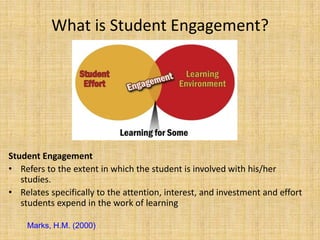
What is Student Engagement?Student EngagementRefers to the extent in which the student is involved with his/her studies.Relates specifically to the attention, interest, and investment and effort students expend in the work of learningMarks, H.M. (2000)
Student Engagement CategoriesBehavioural engagement refers to positive conduct such as:Following rules and avoiding disruptive behaviours such as skipping school and getting into troubleEffort, persistence, concentration, attention applied to studyAsking questions and contributing to class discussion. Emotional engagement refers to:Students’ affective reactions in the classroomThis includes interest, boredom, happiness, sadness and anxiety.Cognitive engagement focuses on:The psychological investment in learning,The desire to go beyond the required levelPreference for challengeFredricks, J. A., Blumenfeld, P. C., and Paris, A. H. (2004)
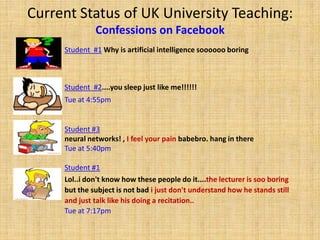
Current Status of UK University Teaching: Confessions on FacebookStudent  #1Why is artificial intelligence soooooo boring Student  #2....you sleep just like me!!!!!! Tue at 4:55pmStudent #3neural networks! , I feel your pain babebro. hang in thereTue at 5:40pmStudent #1Lol..i don't know how these people do it....the lecturer is soo boringbut the subject is not bad i just don't understand how he stands still and just talk like his doing a recitation..Tue at 7:17pm
Now Students Are Taking Matters Into Their Own HandsThe Sunday Times March 21, 2010 Students revolt as 150 are crammed into one tutorialHundreds of engineering students at Manchester University have become the latest undergraduates to stage a revolt against the poor quality of teaching they receive. The Sunday Times, May 10, 2009 Students at top university revolt over teaching standardsA PRESTIGIOUS university has been hit by Britain’s first tuition fee rebellion from hundreds of students angry at reduced teaching hours and attempts to have essays marked by undergraduates instead of lecturers.
Student Revolts can Even Escalate!!Students Revolt in Austria Enters 10th DayTim Bologna 29.10.2009 23:51 Themen: BildungSozialeKämpfeWeltweitVienna – The Students Revolt in Austria which began last week with the occupation of he Vienna School of Art and spread wildly over the whole country entered today its 10th Day. Today, four thousand people took the streets in Graz, in southeastern Austria, to protest against the continuing degradation of their study and living conditions.
Now WE can even be SUEDFormer animation student Rebecca Clay is taking legal action because she's unhappy about the quality of teaching and facilities on her university courseSource: BBC News, Monday, 21 August 2006http://news.bbc.co.uk/1/hi/programmes/breakfast/5269920.stmA law student who was unhappy with the quality of teaching on his university course has won £30,000 in an out-of-court settlement. Source: Wednesday, 31 July, 2002http://news.bbc.co.uk/1/hi/education/2163300.stm
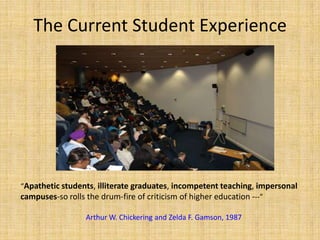
The Current Student Experience “Apathetic students, illiterate graduates, incompetent teaching, impersonal campuses-so rolls the drum-fire of criticism of higher education ---”Arthur W. Chickering and Zelda F. Gamson, 1987
Encourage student-faculty contact.Encourage cooperation among students.Encourage active learning.Give prompt feedback.Emphasise time on task.Communicate high expectations.Respect diverse talents and ways of learning.Seven Principles for Good Practice in Teaching and LearningArthur W. Chickering and Zelda F. Gamson, 1987
Putting the Principles Into PracticeMy Own Experiences
Principle 1Encouraging student-faculty contact.I maintain open contact with studentsEnsure prompt response to email queriesI sit and eat with them in the College Café; My office door is always open I know my students by name
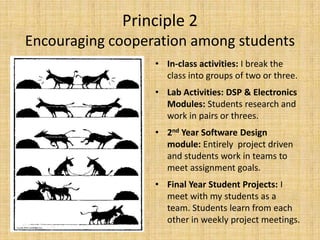
Principle 2Encouraging cooperation among studentsIn-class activities: I break the class into groups of two or three.Lab Activities: DSP & Electronics Modules: Students research and work in pairs or threes.2nd Year Software Design  module: Entirely  project driven and students work in teams to meet assignment goals. Final Year Student Projects: I meet with my students as a team. Students learn from each other in weekly project meetings.
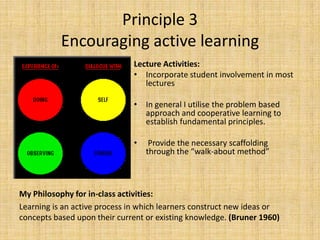
Principle 3Encouraging active learningLecture Activities: Incorporate student involvement in most lecturesIn general I utilise the problem based approach and cooperative learning to establish fundamental principles. Provide the necessary scaffolding through the “walk-about method”My Philosophy for in-class activities:Learning is an active process in which learners construct new ideas or concepts based upon their current or existing knowledge. (Bruner 1960)
Principle 3Encouraging Active Learning - IllustrationsExample #1 - Telecommunication Systems (2nd Yr Module): On the topic of next generation networks students propose their own Internet based telephony platform.  When the BT21CN network  is presented introduced, students are often amazed to discover how close their suggestions are  to some of the solutions proposed by BT network experts. (Nyamapfene, 2008)Example #2 – Digital Electronics (1st  Yr Module): Consider an expensive television set protected by an anti-theft alarm. The alarm is set up in such a way that it goes off (sounds an alarm) when the television set is picked up AND the front door is opened. If  the television set is moved about  whilst the front door is shut, the alarm does not sound. Also, the alarm does not sound when the front door is opened and the television set is not moved.  Again, when the door is not opened, and the television set is not moved, the alarm does not go off. Design a logic circuit that implements the alarm.
Principle 4:Give prompt feedbackDiscuss and guide students in classroom walk-aboutsSurgery hours Self-directed Quizzes on WebCTQuick Email Responses (within 3 hours)Prompt marking – (Within 2 Weeks of submission)
Principle 5:   Emphasise time on task“Time plus energy equals learning. There is no substitute for time on task. ……. Allocating realistic amounts of time means effective learning for students and effective teaching for faculty.” – Arthur W. Chickering and Zelda F. Gamson, 1987“Assessment defines what students regard as important, how they spend their time and how they come to see themselves as students and then as graduates.” (Brown, 1997: 7)
Principle 5:   ApplicationMy approach best described as Assessment Driven Learning:Lectures synchronised to lab and classroom activities, leading to staged assessment deadlinesEmphasis on timely feedback to students on their progress.Illustrations: 2nd year Electronics Module: Lectures and labs aligned to a construction project throughout the lecture period. 2nd Year Software Design Module: Software system design through teamwork with system development stages driven by assessment deadlines and synchronised to lectures.  3rd Year DSP Module:  Assessment on filter design, MATLAB simulation, and FPGA realisation aligned to appropriate labs and lectures and all the assessments build up to the delivery of a working system
Principle 6: Communicate high expectations Expect more and you will get it. High expectations are important for everyone—for the poorly prepared, for those unwilling to exert themselves, and for the bright and well motivated. Expecting students to perform well becomes a self-fulfilling prophecy when teachers and institutions hold high expectations for themselves and make extra efforts.Arthur W. Chickering and Zelda F. Gamson, 1987 2nd Year Software Design Module:   Team with highest  mark gets IBM prize and opportunity to compete against other Universities in the IBM competition2nd Year Communication System :  The two best reports to be submitted to a relevant conference in the UK.Final Year Individual Project: High quality report submitted to a conference
Principle 7Respect diverse talents and ways of learningIntroduce material using students past experiences and the thing they are familiar with (Nyamapfene, 2008)Make use of a wide number of resources – Internet, Internet forumsEncourage learning by doing – labs, analysis of existing systems/examplesEncourage team workingGuest lectures from Industry ExpertsMaintain contact In-class and out of class
Student EvaluationExtracts from Official End of Course Student  Feedback
I enjoyed this module, and look forward to carrying on with communications in the third year.The lecturer was approachable and provided a lot of support throughout the duration of the course. The course was enjoyable and provided a good introduction / understanding of networking technologies.Abel was more than willing to assist any students at any time, right up until the morning of the exam.This is not the first time Abel has lectured me, but I don't think any other teaching fellow has offered their students as much as abel did!The lectures were clear and very well explained and the information we were learning was very interesting, I would definitely tell other students to take this module, I really enjoyed it. My favourite module of this year and interesting
Institutional Recognition
Member:        University of Exeter College of Education   		            ChampionsDuties: 	                To promote and inspire education enhancement across the   	                University  (2009 – Present)Nomination:   University of Exeter Best Tutor Award  – Nominated  		by Computer Science StudentsAcademic Year 2009-10Recipient:        The University of Exeter Merit Award in Teaching Academic Year 2007-8Member:        Employability CommitteeCollege of Engineering, Mathematics & Physical SciencesDuties: 	               To promote and advise on embedding employability in  College 		               Curricula (2009 – Present)
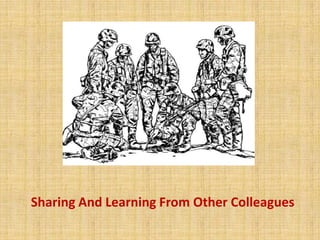
Sharing And Learning From Other Colleagues
Track Chair:  Undergraduate Teaching and Learning in a Networked 	        Environment 	9th European Conference on e-Learning 	       Instituto Superior de Engenharia do Porto, Porto, Portugal                       4-5 November 2010 PublicationsNyamapfene A. (2008). From everyday playthings to the underlying theory - How I turned a ‘boring’ Course into an ‘exciting’ Course. UK Higher Education Academy Workshop: Novel Approaches to Promoting Student Engagement, 30 October 2008, University of Ulster.Nyamapfene, A. (2010) Does Class Attendance Still Matter? Engineering Education: Journal of the Higher Education Academy Engineering Subject Centre. (In Press)Nyamapfene, A.  Supervisor Involvement in Undergraduate Student Project Assessment: Is Double-marking Robust?,Teaching in Higher Education(Under Revision)
Thank You – Now Question Time!!
ReferencesMarks, H.M. (2000) Student engagement in instructional activity: Patterns in the elementary, middle, and high school years. American Education Research Journal, 37 (1), 153-184.Fredricks, J. A., Blumenfeld, P. C., and Paris, A. H. (2004) School engagement: Potential of the concept, state of evidence, Review of Educational Research, 74 (1), 59-109.Arthur W. Chickering and Zelda F. Gamson, Seven Principles for Good Practice. AAHEBulletin 39: 3-7, March 1987Brown, G. (1997) Assessing Student Learning In Higher Education. London: RoutledgeBruner, J.S. (1960) The Process of Education. Cambridge: Harvard University Press.

Abel presentation29april2010

  • 1.
    Innovative Teaching toImprove Student EngagementAbel NyamapfeneNewcastle University Talk29 April 2010
  • 2.
    Talk OrganisationDefine &Explain Student EngagementPoor Quality Teaching & Disengaged StudentsPrinciples of Student EngagementApplying the Principles:My Own TeachingStudent Evaluation of My TeachingInstitutional Evaluation of My TeachingEngaging with other Higher Education PractitionersQuestion & Answer Session
  • 3.
    What is StudentEngagement?Student EngagementRefers to the extent in which the student is involved with his/her studies.Relates specifically to the attention, interest, and investment and effort students expend in the work of learningMarks, H.M. (2000)
  • 4.
    Student Engagement CategoriesBehaviouralengagement refers to positive conduct such as:Following rules and avoiding disruptive behaviours such as skipping school and getting into troubleEffort, persistence, concentration, attention applied to studyAsking questions and contributing to class discussion. Emotional engagement refers to:Students’ affective reactions in the classroomThis includes interest, boredom, happiness, sadness and anxiety.Cognitive engagement focuses on:The psychological investment in learning,The desire to go beyond the required levelPreference for challengeFredricks, J. A., Blumenfeld, P. C., and Paris, A. H. (2004)
  • 5.
    Current Status ofUK University Teaching: Confessions on FacebookStudent #1Why is artificial intelligence soooooo boring Student #2....you sleep just like me!!!!!! Tue at 4:55pmStudent #3neural networks! , I feel your pain babebro. hang in thereTue at 5:40pmStudent #1Lol..i don't know how these people do it....the lecturer is soo boringbut the subject is not bad i just don't understand how he stands still and just talk like his doing a recitation..Tue at 7:17pm
  • 6.
    Now Students AreTaking Matters Into Their Own HandsThe Sunday Times March 21, 2010 Students revolt as 150 are crammed into one tutorialHundreds of engineering students at Manchester University have become the latest undergraduates to stage a revolt against the poor quality of teaching they receive. The Sunday Times, May 10, 2009 Students at top university revolt over teaching standardsA PRESTIGIOUS university has been hit by Britain’s first tuition fee rebellion from hundreds of students angry at reduced teaching hours and attempts to have essays marked by undergraduates instead of lecturers.
  • 7.
    Student Revolts canEven Escalate!!Students Revolt in Austria Enters 10th DayTim Bologna 29.10.2009 23:51 Themen: BildungSozialeKämpfeWeltweitVienna – The Students Revolt in Austria which began last week with the occupation of he Vienna School of Art and spread wildly over the whole country entered today its 10th Day. Today, four thousand people took the streets in Graz, in southeastern Austria, to protest against the continuing degradation of their study and living conditions.
  • 8.
    Now WE caneven be SUEDFormer animation student Rebecca Clay is taking legal action because she's unhappy about the quality of teaching and facilities on her university courseSource: BBC News, Monday, 21 August 2006http://news.bbc.co.uk/1/hi/programmes/breakfast/5269920.stmA law student who was unhappy with the quality of teaching on his university course has won £30,000 in an out-of-court settlement. Source: Wednesday, 31 July, 2002http://news.bbc.co.uk/1/hi/education/2163300.stm
  • 9.
    The Current StudentExperience “Apathetic students, illiterate graduates, incompetent teaching, impersonal campuses-so rolls the drum-fire of criticism of higher education ---”Arthur W. Chickering and Zelda F. Gamson, 1987
  • 10.
    Encourage student-faculty contact.Encouragecooperation among students.Encourage active learning.Give prompt feedback.Emphasise time on task.Communicate high expectations.Respect diverse talents and ways of learning.Seven Principles for Good Practice in Teaching and LearningArthur W. Chickering and Zelda F. Gamson, 1987
  • 11.
    Putting the PrinciplesInto PracticeMy Own Experiences
  • 12.
    Principle 1Encouraging student-facultycontact.I maintain open contact with studentsEnsure prompt response to email queriesI sit and eat with them in the College Café; My office door is always open I know my students by name
  • 13.
    Principle 2Encouraging cooperationamong studentsIn-class activities: I break the class into groups of two or three.Lab Activities: DSP & Electronics Modules: Students research and work in pairs or threes.2nd Year Software Design module: Entirely project driven and students work in teams to meet assignment goals. Final Year Student Projects: I meet with my students as a team. Students learn from each other in weekly project meetings.
  • 14.
    Principle 3Encouraging activelearningLecture Activities: Incorporate student involvement in most lecturesIn general I utilise the problem based approach and cooperative learning to establish fundamental principles. Provide the necessary scaffolding through the “walk-about method”My Philosophy for in-class activities:Learning is an active process in which learners construct new ideas or concepts based upon their current or existing knowledge. (Bruner 1960)
  • 15.
    Principle 3Encouraging ActiveLearning - IllustrationsExample #1 - Telecommunication Systems (2nd Yr Module): On the topic of next generation networks students propose their own Internet based telephony platform. When the BT21CN network is presented introduced, students are often amazed to discover how close their suggestions are to some of the solutions proposed by BT network experts. (Nyamapfene, 2008)Example #2 – Digital Electronics (1st Yr Module): Consider an expensive television set protected by an anti-theft alarm. The alarm is set up in such a way that it goes off (sounds an alarm) when the television set is picked up AND the front door is opened. If the television set is moved about whilst the front door is shut, the alarm does not sound. Also, the alarm does not sound when the front door is opened and the television set is not moved. Again, when the door is not opened, and the television set is not moved, the alarm does not go off. Design a logic circuit that implements the alarm.
  • 16.
    Principle 4:Give promptfeedbackDiscuss and guide students in classroom walk-aboutsSurgery hours Self-directed Quizzes on WebCTQuick Email Responses (within 3 hours)Prompt marking – (Within 2 Weeks of submission)
  • 17.
    Principle 5: Emphasise time on task“Time plus energy equals learning. There is no substitute for time on task. ……. Allocating realistic amounts of time means effective learning for students and effective teaching for faculty.” – Arthur W. Chickering and Zelda F. Gamson, 1987“Assessment defines what students regard as important, how they spend their time and how they come to see themselves as students and then as graduates.” (Brown, 1997: 7)
  • 18.
    Principle 5: ApplicationMy approach best described as Assessment Driven Learning:Lectures synchronised to lab and classroom activities, leading to staged assessment deadlinesEmphasis on timely feedback to students on their progress.Illustrations: 2nd year Electronics Module: Lectures and labs aligned to a construction project throughout the lecture period. 2nd Year Software Design Module: Software system design through teamwork with system development stages driven by assessment deadlines and synchronised to lectures. 3rd Year DSP Module: Assessment on filter design, MATLAB simulation, and FPGA realisation aligned to appropriate labs and lectures and all the assessments build up to the delivery of a working system
  • 19.
    Principle 6: Communicatehigh expectations Expect more and you will get it. High expectations are important for everyone—for the poorly prepared, for those unwilling to exert themselves, and for the bright and well motivated. Expecting students to perform well becomes a self-fulfilling prophecy when teachers and institutions hold high expectations for themselves and make extra efforts.Arthur W. Chickering and Zelda F. Gamson, 1987 2nd Year Software Design Module: Team with highest mark gets IBM prize and opportunity to compete against other Universities in the IBM competition2nd Year Communication System : The two best reports to be submitted to a relevant conference in the UK.Final Year Individual Project: High quality report submitted to a conference
  • 20.
    Principle 7Respect diversetalents and ways of learningIntroduce material using students past experiences and the thing they are familiar with (Nyamapfene, 2008)Make use of a wide number of resources – Internet, Internet forumsEncourage learning by doing – labs, analysis of existing systems/examplesEncourage team workingGuest lectures from Industry ExpertsMaintain contact In-class and out of class
  • 21.
    Student EvaluationExtracts fromOfficial End of Course Student Feedback
  • 22.
    I enjoyed thismodule, and look forward to carrying on with communications in the third year.The lecturer was approachable and provided a lot of support throughout the duration of the course. The course was enjoyable and provided a good introduction / understanding of networking technologies.Abel was more than willing to assist any students at any time, right up until the morning of the exam.This is not the first time Abel has lectured me, but I don't think any other teaching fellow has offered their students as much as abel did!The lectures were clear and very well explained and the information we were learning was very interesting, I would definitely tell other students to take this module, I really enjoyed it. My favourite module of this year and interesting
  • 23.
  • 24.
    Member: University of Exeter College of Education ChampionsDuties: To promote and inspire education enhancement across the University (2009 – Present)Nomination: University of Exeter Best Tutor Award – Nominated by Computer Science StudentsAcademic Year 2009-10Recipient: The University of Exeter Merit Award in Teaching Academic Year 2007-8Member: Employability CommitteeCollege of Engineering, Mathematics & Physical SciencesDuties: To promote and advise on embedding employability in College Curricula (2009 – Present)
  • 25.
    Sharing And LearningFrom Other Colleagues
  • 26.
    Track Chair: Undergraduate Teaching and Learning in a Networked Environment 9th European Conference on e-Learning Instituto Superior de Engenharia do Porto, Porto, Portugal 4-5 November 2010 PublicationsNyamapfene A. (2008). From everyday playthings to the underlying theory - How I turned a ‘boring’ Course into an ‘exciting’ Course. UK Higher Education Academy Workshop: Novel Approaches to Promoting Student Engagement, 30 October 2008, University of Ulster.Nyamapfene, A. (2010) Does Class Attendance Still Matter? Engineering Education: Journal of the Higher Education Academy Engineering Subject Centre. (In Press)Nyamapfene, A. Supervisor Involvement in Undergraduate Student Project Assessment: Is Double-marking Robust?,Teaching in Higher Education(Under Revision)
  • 27.
    Thank You –Now Question Time!!
  • 28.
    ReferencesMarks, H.M. (2000)Student engagement in instructional activity: Patterns in the elementary, middle, and high school years. American Education Research Journal, 37 (1), 153-184.Fredricks, J. A., Blumenfeld, P. C., and Paris, A. H. (2004) School engagement: Potential of the concept, state of evidence, Review of Educational Research, 74 (1), 59-109.Arthur W. Chickering and Zelda F. Gamson, Seven Principles for Good Practice. AAHEBulletin 39: 3-7, March 1987Brown, G. (1997) Assessing Student Learning In Higher Education. London: RoutledgeBruner, J.S. (1960) The Process of Education. Cambridge: Harvard University Press.