2012 ABCD-GIS Meeting, December 19, 2012 @ CGIS South S050


  The Role of the Neogeography for
   Geospatial Information Sharing:
the Case Studies of the Crisis Mapping Project
    and the FOSS4G Community in Japan


      © sinsai.info All Rights Reserved.           © OpenStreetMap contributors, CC-BY-SA


           Toshikazu SETO ( Ph.D)
CGA, Harvard Univ. & DH-JAC, Ritsumeikan Univ.
Agenda
• Introductions
• Overview of the Crisis Geospatial Information
  Sharing during the 311 Disasters
• Case Studies “Crisis Mapping Project using FOSS4G”:
   – Base Map Creations (OSGeo.JP & OSM)
   – SNS + Mapping Platform (sinsai.info & Ushahidi)
• For the Monitoring and Recovery
• Conclusions
Introductions: Concepts


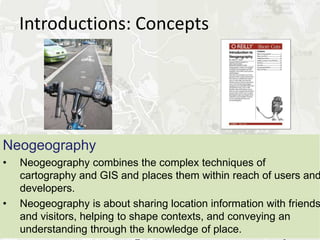
Neogeography
•Neogeography combines the complex techniques of cartography and GIS
and places them within reach of users and developers.
•Neogeography is about sharing location information with friends and
visitors, helping to shape contexts, and conveying an understanding
through the knowledge of place.
•Andrew Turner (2006): 『 Introduction to Neogeography 』
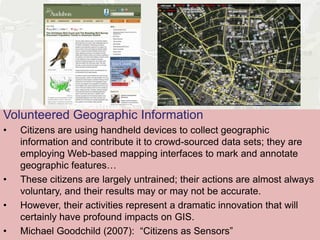
Volunteered Geographic Information
•   Citizens are using handheld devices to collect geographic information and
    contribute it to crowd-sourced data sets; they are employing Web-based
    mapping interfaces to mark and annotate geographic features…
•   These citizens are largely untrained; their actions are almost always
    voluntary, and their results may or may not be accurate.
•   However, their activities represent a dramatic innovation that will
    certainly have profound impacts on GIS.
•   Michael Goodchild (2007): “Citizens as Sensors”
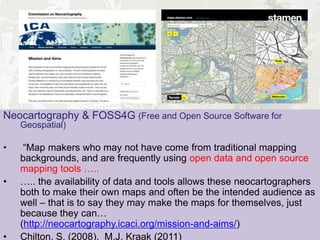
Neocartography & FOSS4G (Free and Open Source Software for Geospatial)

•    “Map makers who may not have come from traditional mapping
    backgrounds, and are frequently using open data and open source mapping
    tools …..
•   ….. the availability of data and tools allows these neocartographers both
    to make their own maps and often be the intended audience as well – that
    is to say they may make the maps for themselves, just because they can…
    (http://neocartography.icaci.org/mission-and-aims/)
•   Chilton, S. (2008), M.J. Kraak (2011)
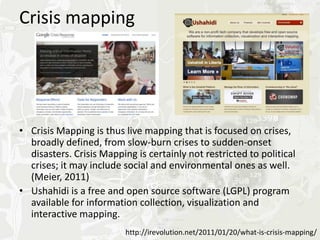
Crisis mapping


• Crisis Mapping is thus live mapping that is focused on crises,
  broadly defined, from slow-burn crises to sudden-onset
  disasters. Crisis Mapping is certainly not restricted to political
  crises; it may include social and environmental ones as well.
  (Meier, 2011)
• Ushahidi is a free and open source software (LGPL) program
  available for information collection, visualization and
  interactive mapping.
                          http://irevolution.net/2011/01/20/what-is-crisis-mapping/
Overview of the Crisis Geospatial
Information Sharing during the 311
Disasters
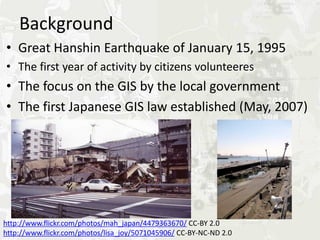
Background
•   Great Hanshin Earthquake of January 15, 1995
•   The first year of activity by citizens volunteers
•   The focus on the GIS by the local government
•   The first Japanese GIS law established (May, 2007)


http://www.flickr.com/photos/mah_japan/4479363670/ CC-BY 2.0
http://www.flickr.com/photos/lisa_joy/5071045906/ CC-BY-NC-ND 2.0
The Great East Japan Earthquake
• The Great East Japan Earthquake of March 11, 2011
  brought catastrophic damage to a huge area of Japan.
• In comparison to the 1995 earthquake, a greater tsunami
  caused more devastation and a grave nuclear
  accident(Fukushima Daiichi Nuclear Power) .
• Although the traffic and communication infrastructures
  were interrupted, people shared information on area
  damage or the conditions of victims by using social media,
  such as Twitter and the mobile Internet (Tsuda 2011,
  Peary, Shaw and Takeuchi 2012).
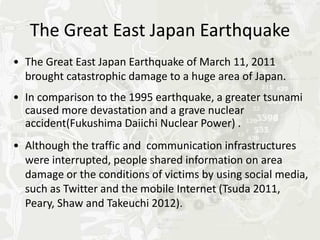
Enterprise: Google Crisis Response
              Traffic Performance Information


                               http://www.google.co.jp/intl/ja/crisisresponse/
                               japanquake2011_traffic.html
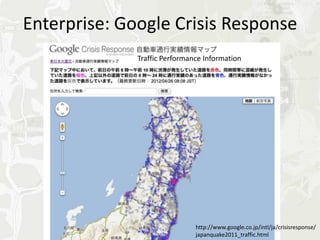
Professionals: ArcGIS Online


                         http://bit.ly/Owiof5
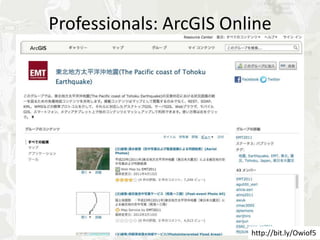
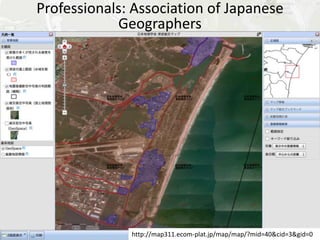
Professionals: Association of Japanese
Geographers (ex. Geoserver+GeoExt)


              http://map311.ecom-plat.jp/map/map/?mid=40&cid=3&gid=0
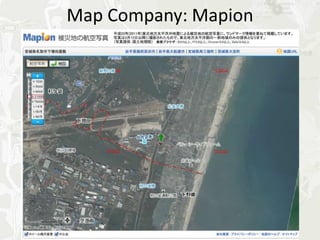
Map Company: Mapion (ex. Mapserver)
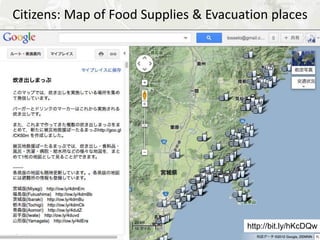
Citizens: Map of Food Supplies & Evacuation places


                                       http://bit.ly/hKcDQw
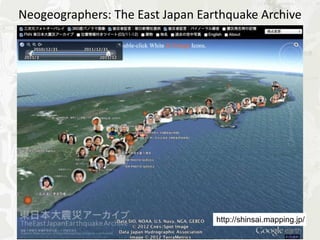
Neogeographers: The East Japan Earthquake Archive


                                  http://shinsai.mapping.jp/
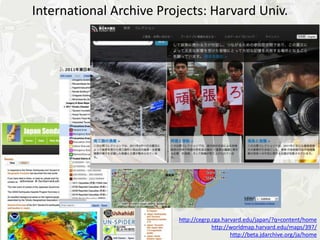
International Archive Projects: Harvard Univ.


                         http://cegrp.cga.harvard.edu/japan/?q=content/home
                                      http://worldmap.harvard.edu/maps/397/
                                             http://beta.jdarchive.org/ja/home
Progress and Issues
• Many portal sites started very quickly
   (one to five days after the disaster)
• They used FOSS4G architecture and API services
• Some of the Japanese enterprise/professional
  projects were mainly Web-map representation
  (source data could not be obtained and reused).
• Some of the projects closed or did not update
  their websites one-year after 311.
Case Studies:
“Crisis Mapping Project using FOSS4G”
Overviews
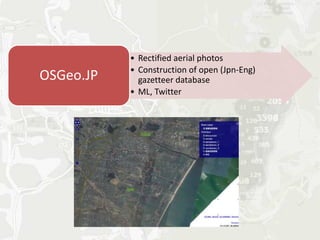
• Rectified aerial photos
           • Construction of open (Jpn-Eng)
OSGeo.JP     gazetteer database
           • ML, Twitter
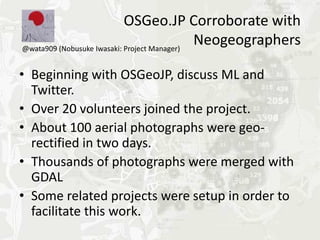
OSGeo.JP Corroborate with
@wata909 (Nobusuke Iwasaki: Project Manager)
                                             Neogeographers

• Beginning with OSGeoJP, discuss ML and
  Twitter.
• Over 20 volunteers joined the project.
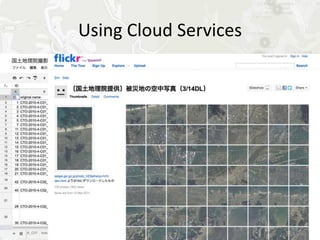
• About 100 aerial photographs were geo-
  rectified in two days.
• Thousands of photographs were merged with
  GDAL
• Some related projects were setup in order to
  facilitate this work.
Using Cloud Services
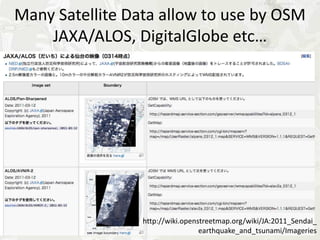
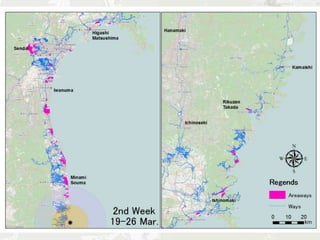
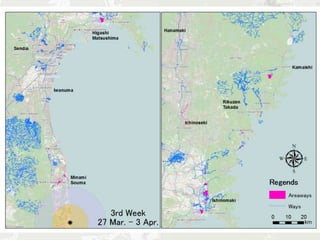
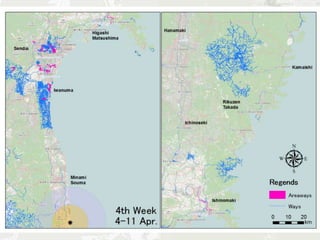
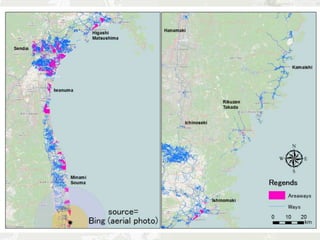
Many Satellite Data allow to use by OSM
    JAXA/ALOS, DigitalGlobe etc…


                 http://wiki.openstreetmap.org/wiki/JA:2011_Sendai_
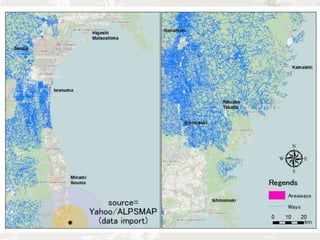
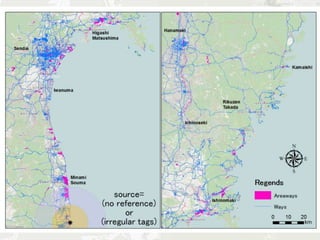
                                  earthquake_and_tsunami/Imageries
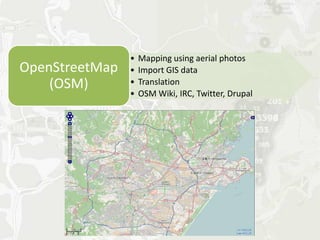
•   Mapping using aerial photos
OpenStreetMap   •   Import GIS data
    (OSM)       •
                •
                    Translation
                    OSM Wiki, IRC, Twitter, Drupal
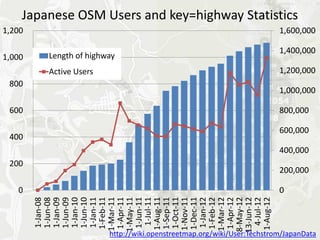
Japanese OSM Users and key=highway Statistics


              http://wiki.openstreetmap.org/wiki/User:Techstrom/JapanData
2011.03
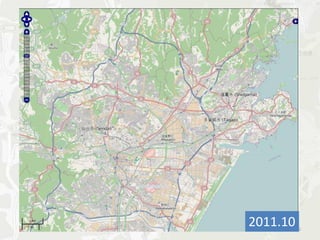
2011.10
      26
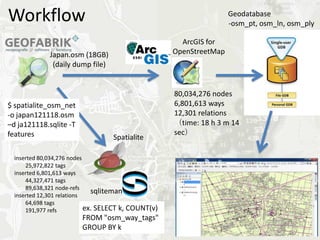
Workflow                                                                  Geodatabase
                                                                     -osm_pt, osm_ln, osm_ply

                                                       ArcGIS for
             Japan.osm (18GB)                        OpenStreetMap
              (daily dump file)


                                                     80,034,276 nodes
$ spatialite_osm_net                                 6,801,613 ways
-o japan121118.osm                                   12,301 relations
–d ja121118.sqlite -T                                ( time: 18 h 3 m 14
features                                             sec )
                                   Spatialite

  inserted 80,034,276 nodes
      25,972,822 tags
  inserted 6,801,613 ways
      44,327,471 tags
      89,638,321 node-refs
  inserted 12,301 relations
                              sqliteman
      64,698 tags
      191,977 refs          ex. SELECT k, COUNT(v)
                        FROM "osm_way_tags"
                        GROUP BY k
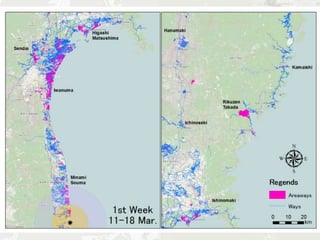
2011/3/11 – 4/11
2011/3/11 – 4/11
2011/3/11 – 4/11
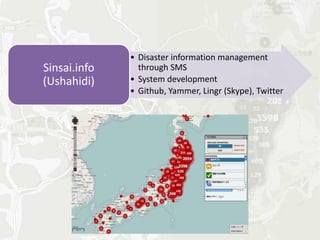
• Disaster information management
Sinsai.info     through SMS
(Ushahidi)    • System development
              • Github, Yammer, Lingr (Skype), Twitter
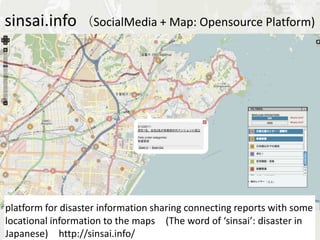
sinsai.info        ( SocialMedia + Map: Opensource
                           Platform)


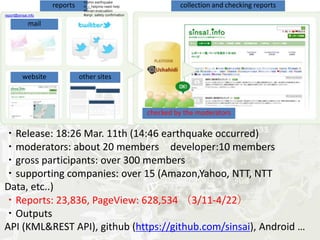
platform for disaster information sharing connecting reports with
some locational information to the maps   (The word of ‘sinsai’:
disaster in Japanese)   http://sinsai.info/
#jishin:earthquake   #j_j_helpme:need help
                       reports      #hinan:evacuation                                   collection and checking reports
                                  #anpi: safety confirmation
 report@sinsai.info

                mail


           website               other sites


                                                                               checked by the moderators

・ Release: 18:26 Mar. 11th (14:46 earthquake occurred)
・ moderators: about 20 members   developer:10 members
・ gross participants: over 300 members
・ supporting companies: over 15 (Amazon,Yahoo, NTT, NTT Data,
etc..)
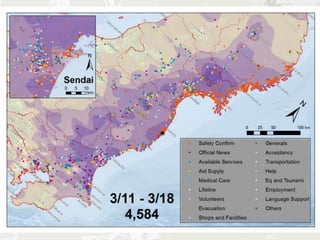
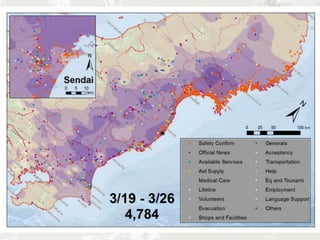
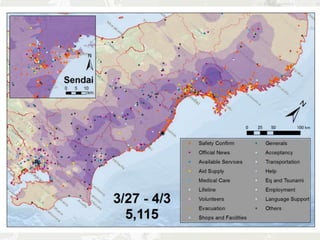
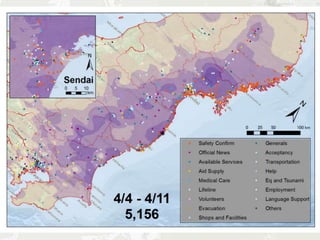
・ Reports: 23,836, PageView: 628,534 ( 3/11-4/22 )
・ Outputs
API (KML&REST API), GitHub (https://github.com/sinsai), Android …
For the Monitoring and Recovery
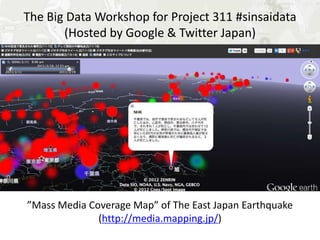
The Big Data Workshop for Project 311 #sinsaidata
       (Hosted by Google & Twitter Japan)


”Mass Media Coverage Map” of The East Japan Earthquake
             (http://media.mapping.jp/)
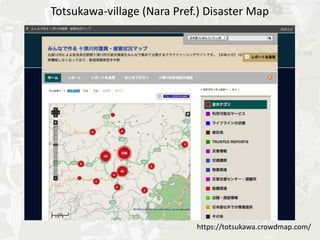
Totsukawa-village (Nara Pref.) Disaster Map


                             https://totsukawa.crowdmap.com/
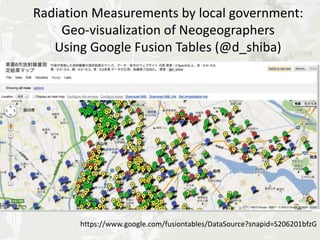
Radiation Measurements by local government:
    Geo-visualization of Neogeographers
   Using Google Fusion Tables (@d_shiba)


       https://www.google.com/fusiontables/DataSource?snapid=S206201bfzG
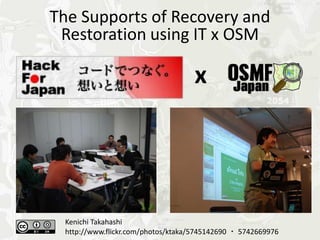
The Supports of Recovery and
 Restoration using IT x OSM

                                   x


  Kenichi Takahashi
  http://www.flickr.com/photos/ktaka/5745142690 ・ 5742669976  
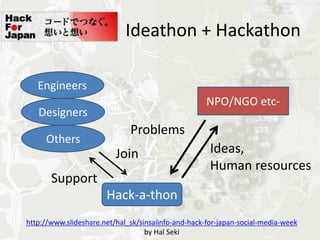
Ideathon + Hackathon

   Engineers
                                                     NPO/NGO etc-
   Designers
                              Problems
     Others
                          Join                        Ideas,
                                                      Human resources
       Support
                       Hack-a-thon
http://www.slideshare.net/hal_sk/sinsaiinfo-and-hack-for-japan-social-media-week
                                   by Hal Seki
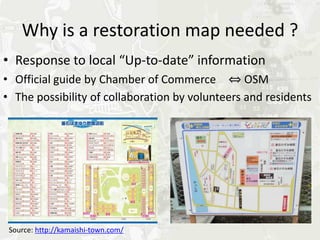
Why is a restoration map needed ?
• Response to local “Up-to-date” information
• Official guide by Chamber of Commerce  ⇔ OSM
• The possibility of collaboration by volunteers and residents


 Source: http://kamaishi-town.com/
2012/03/20 First Mapping Party
             in Kamaishi
■Purpose
•Where is the restoration ?
•What kinds of the restoration ?
•(Geo-)visualization of the recently conditions

■Challenges
•Collected detail information from the local residents
•It wants to visit a lot of people in Kamaishi
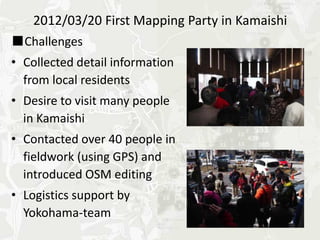
2012/03/20 First Mapping Party in Kamaishi
■Challenges
•Collected detail information
from local residents
•Desire to visit many people in
Kamaishi
•Contacted over 40 people in
fieldwork (using GPS) and
introduced OSM editing
•Logistics support by
Yokohama-team
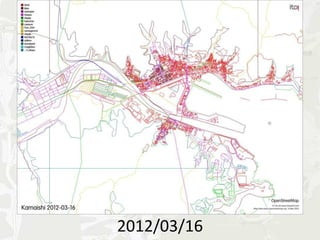
2012/03/16
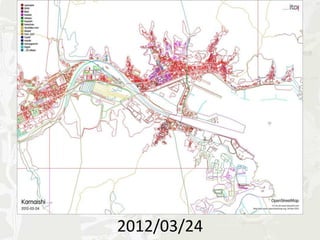
2012/03/24
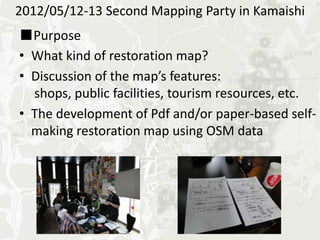
2012/05/12-13 Second Mapping Party in Kamaishi
■Purpose
•What kind of restoration map?
•Discussion of the map’s features:
 shops, public facilities, tourism resources, etc.
•The development of Pdf and/or paper-based self-
making restoration map using OSM data
2012/09/01-02 Field Excursion Tour with HOT


https://www.facebook.com/groups/hack4iwate.osm/
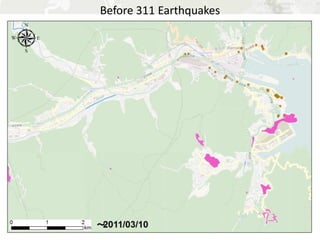
Before 311 Earthquakes
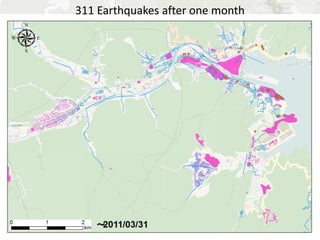
311 Earthquakes after one month
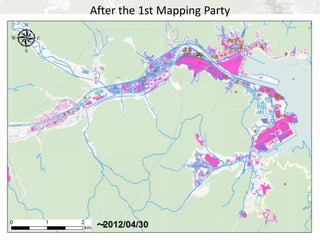
After the 1st Mapping Party
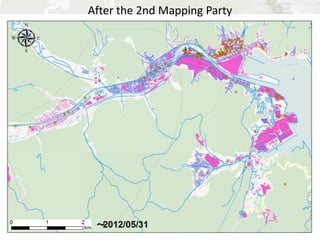
After the 2nd Mapping Party
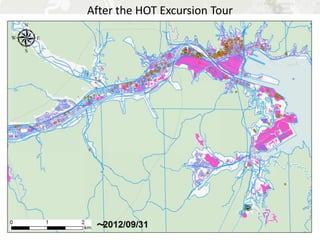
After the HOT Excursion Tour
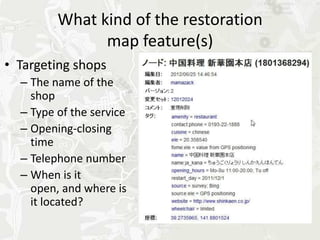
What kind of the restoration
               map feature(s)
• Targeting shops
  – The name of the
    shop
  – Type of the service
  – Opening-closing
    time
  – Telephone number
  – When is it open,
    and where is it
    located?
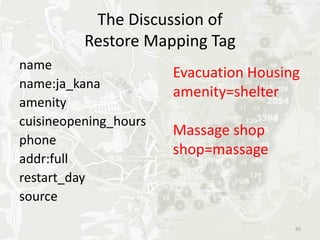
The Discussion of
          Restore Mapping Tag
name
                       Evacuation Housing
name:ja_kana
                       amenity=shelter
amenity
cuisineopening_hours
                       Massage shop
phone
                       shop=massage
addr:full
restart_day
source

                                        61
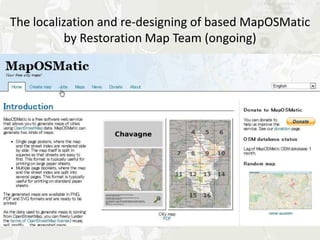
The localization and re-designing of based MapOSMatic
           by Restoration Map Team (ongoing)
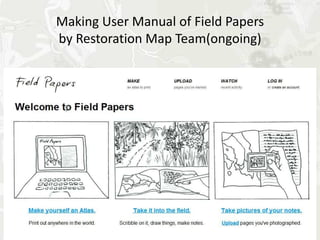
Making User Manual of Field Papers
by Restoration Map Team(ongoing)
Conclusions
• The Neogeographers contributed a vast amount
  of visual geospatial information in the response
  period.
• Crowd sourcing and FOSS4G easily furthered
  networking activities.
• The awareness of information sharing and
  openness in crisis response increased.
• FOSS4G and Neogeography were committed to
  other possible disaster uses.
  (However, they were not able to deliver information
  and services directly to disaster area residents.)
Issues
• The difficulty of the evaluation
  – VGI’s voluminous data; citizen motivation
• The gap of the IT literacy and GIS skills in the
  Tohoku area
  – Continuing collaboration with Tohoku area is
    necessary
• Too many geospatial archive projects and related
  social network channels
  – The continuity of the project and community growth
  – SNS: Twitter, Facebook, Lingr, Redmine, GitHub, etc.
The Role of the Neogeography and VGI
               for Next Steps
• More active support for mapping by local residents
• The special needs of easy-use, restoration
  mapping
• The visualization of opening-closing times,
  holidays, etc.
  – Not only by neogeographers but also citizens
• Need for more educational opportunities and
  resources to prepare (neo)geographers for next
  crisis
Thank you for your attention !

    Twitter & Facebook: @tosseto
     E-mail: tos@lt.ritsumei.ac.jp

Special Thanks to: Nishimura, Y., Furuhashi, T., Seki, H.,
   Kamaishi Mapping Team, OSMFJ and OSGeo.JP

ABCD-GIS_Seto_harvardCGA

  • 1.
    2012 ABCD-GIS Meeting,December 19, 2012 @ CGIS South S050 The Role of the Neogeography for Geospatial Information Sharing: the Case Studies of the Crisis Mapping Project and the FOSS4G Community in Japan © sinsai.info All Rights Reserved. © OpenStreetMap contributors, CC-BY-SA Toshikazu SETO ( Ph.D) CGA, Harvard Univ. & DH-JAC, Ritsumeikan Univ.
  • 2.
    Agenda • Introductions • Overviewof the Crisis Geospatial Information Sharing during the 311 Disasters • Case Studies “Crisis Mapping Project using FOSS4G”: – Base Map Creations (OSGeo.JP & OSM) – SNS + Mapping Platform (sinsai.info & Ushahidi) • For the Monitoring and Recovery • Conclusions
  • 3.
    Introductions: Concepts Neogeography •Neogeography combinesthe complex techniques of cartography and GIS and places them within reach of users and developers. •Neogeography is about sharing location information with friends and visitors, helping to shape contexts, and conveying an understanding through the knowledge of place. •Andrew Turner (2006): 『 Introduction to Neogeography 』
  • 4.
    Volunteered Geographic Information • Citizens are using handheld devices to collect geographic information and contribute it to crowd-sourced data sets; they are employing Web-based mapping interfaces to mark and annotate geographic features… • These citizens are largely untrained; their actions are almost always voluntary, and their results may or may not be accurate. • However, their activities represent a dramatic innovation that will certainly have profound impacts on GIS. • Michael Goodchild (2007): “Citizens as Sensors”
  • 5.
    Neocartography & FOSS4G(Free and Open Source Software for Geospatial) • “Map makers who may not have come from traditional mapping backgrounds, and are frequently using open data and open source mapping tools ….. • ….. the availability of data and tools allows these neocartographers both to make their own maps and often be the intended audience as well – that is to say they may make the maps for themselves, just because they can… (http://neocartography.icaci.org/mission-and-aims/) • Chilton, S. (2008), M.J. Kraak (2011)
  • 6.
    Crisis mapping • CrisisMapping is thus live mapping that is focused on crises, broadly defined, from slow-burn crises to sudden-onset disasters. Crisis Mapping is certainly not restricted to political crises; it may include social and environmental ones as well. (Meier, 2011) • Ushahidi is a free and open source software (LGPL) program available for information collection, visualization and interactive mapping. http://irevolution.net/2011/01/20/what-is-crisis-mapping/
  • 7.
    Overview of theCrisis Geospatial Information Sharing during the 311 Disasters
  • 8.
    Background • Great Hanshin Earthquake of January 15, 1995 • The first year of activity by citizens volunteers • The focus on the GIS by the local government • The first Japanese GIS law established (May, 2007) http://www.flickr.com/photos/mah_japan/4479363670/ CC-BY 2.0 http://www.flickr.com/photos/lisa_joy/5071045906/ CC-BY-NC-ND 2.0
  • 9.
    The Great EastJapan Earthquake • The Great East Japan Earthquake of March 11, 2011 brought catastrophic damage to a huge area of Japan. • In comparison to the 1995 earthquake, a greater tsunami caused more devastation and a grave nuclear accident(Fukushima Daiichi Nuclear Power) . • Although the traffic and communication infrastructures were interrupted, people shared information on area damage or the conditions of victims by using social media, such as Twitter and the mobile Internet (Tsuda 2011, Peary, Shaw and Takeuchi 2012).
  • 10.
    Enterprise: Google CrisisResponse Traffic Performance Information http://www.google.co.jp/intl/ja/crisisresponse/ japanquake2011_traffic.html
  • 11.
    Professionals: ArcGIS Online http://bit.ly/Owiof5
  • 12.
    Professionals: Association ofJapanese Geographers (ex. Geoserver+GeoExt) http://map311.ecom-plat.jp/map/map/?mid=40&cid=3&gid=0
  • 13.
    Map Company: Mapion(ex. Mapserver)
  • 14.
    Citizens: Map ofFood Supplies & Evacuation places http://bit.ly/hKcDQw
  • 15.
    Neogeographers: The EastJapan Earthquake Archive http://shinsai.mapping.jp/
  • 16.
    International Archive Projects:Harvard Univ. http://cegrp.cga.harvard.edu/japan/?q=content/home http://worldmap.harvard.edu/maps/397/ http://beta.jdarchive.org/ja/home
  • 17.
    Progress and Issues •Many portal sites started very quickly (one to five days after the disaster) • They used FOSS4G architecture and API services • Some of the Japanese enterprise/professional projects were mainly Web-map representation (source data could not be obtained and reused). • Some of the projects closed or did not update their websites one-year after 311.
  • 18.
    Case Studies: “Crisis MappingProject using FOSS4G”
  • 19.
  • 20.
    • Rectified aerialphotos • Construction of open (Jpn-Eng) OSGeo.JP gazetteer database • ML, Twitter
  • 21.
    OSGeo.JP Corroborate with @wata909(Nobusuke Iwasaki: Project Manager) Neogeographers • Beginning with OSGeoJP, discuss ML and Twitter. • Over 20 volunteers joined the project. • About 100 aerial photographs were geo- rectified in two days. • Thousands of photographs were merged with GDAL • Some related projects were setup in order to facilitate this work.
  • 22.
  • 23.
    Many Satellite Dataallow to use by OSM JAXA/ALOS, DigitalGlobe etc… http://wiki.openstreetmap.org/wiki/JA:2011_Sendai_ earthquake_and_tsunami/Imageries
  • 24.
    Mapping using aerial photos OpenStreetMap • Import GIS data (OSM) • • Translation OSM Wiki, IRC, Twitter, Drupal
  • 25.
    Japanese OSM Usersand key=highway Statistics http://wiki.openstreetmap.org/wiki/User:Techstrom/JapanData
  • 26.
  • 27.
    Workflow Geodatabase -osm_pt, osm_ln, osm_ply ArcGIS for Japan.osm (18GB) OpenStreetMap (daily dump file) 80,034,276 nodes $ spatialite_osm_net 6,801,613 ways -o japan121118.osm 12,301 relations –d ja121118.sqlite -T ( time: 18 h 3 m 14 features sec ) Spatialite inserted 80,034,276 nodes 25,972,822 tags inserted 6,801,613 ways 44,327,471 tags 89,638,321 node-refs inserted 12,301 relations sqliteman 64,698 tags 191,977 refs ex. SELECT k, COUNT(v) FROM "osm_way_tags" GROUP BY k
  • 32.
  • 33.
  • 34.
  • 35.
    • Disaster informationmanagement Sinsai.info through SMS (Ushahidi) • System development • Github, Yammer, Lingr (Skype), Twitter
  • 36.
    sinsai.info ( SocialMedia + Map: Opensource Platform) platform for disaster information sharing connecting reports with some locational information to the maps   (The word of ‘sinsai’: disaster in Japanese)   http://sinsai.info/
  • 37.
    #jishin:earthquake   #j_j_helpme:needhelp reports   #hinan:evacuation collection and checking reports #anpi: safety confirmation report@sinsai.info mail website other sites checked by the moderators ・ Release: 18:26 Mar. 11th (14:46 earthquake occurred) ・ moderators: about 20 members   developer:10 members ・ gross participants: over 300 members ・ supporting companies: over 15 (Amazon,Yahoo, NTT, NTT Data, etc..) ・ Reports: 23,836, PageView: 628,534 ( 3/11-4/22 ) ・ Outputs API (KML&REST API), GitHub (https://github.com/sinsai), Android …
  • 42.
    For the Monitoringand Recovery
  • 43.
    The Big DataWorkshop for Project 311 #sinsaidata (Hosted by Google & Twitter Japan) ”Mass Media Coverage Map” of The East Japan Earthquake (http://media.mapping.jp/)
  • 44.
    Totsukawa-village (Nara Pref.)Disaster Map https://totsukawa.crowdmap.com/
  • 45.
    Radiation Measurements bylocal government: Geo-visualization of Neogeographers Using Google Fusion Tables (@d_shiba) https://www.google.com/fusiontables/DataSource?snapid=S206201bfzG
  • 46.
    The Supports ofRecovery and Restoration using IT x OSM x Kenichi Takahashi http://www.flickr.com/photos/ktaka/5745142690 ・ 5742669976  
  • 47.
    Ideathon + Hackathon Engineers NPO/NGO etc- Designers Problems Others Join Ideas, Human resources Support Hack-a-thon http://www.slideshare.net/hal_sk/sinsaiinfo-and-hack-for-japan-social-media-week by Hal Seki
  • 48.
    Why is arestoration map needed ? • Response to local “Up-to-date” information • Official guide by Chamber of Commerce  ⇔ OSM • The possibility of collaboration by volunteers and residents Source: http://kamaishi-town.com/
  • 49.
    2012/03/20 First MappingParty in Kamaishi ■Purpose •Where is the restoration ? •What kinds of the restoration ? •(Geo-)visualization of the recently conditions ■Challenges •Collected detail information from the local residents •It wants to visit a lot of people in Kamaishi
  • 50.
    2012/03/20 First MappingParty in Kamaishi ■Challenges •Collected detail information from local residents •Desire to visit many people in Kamaishi •Contacted over 40 people in fieldwork (using GPS) and introduced OSM editing •Logistics support by Yokohama-team
  • 51.
  • 52.
  • 53.
    2012/05/12-13 Second MappingParty in Kamaishi ■Purpose •What kind of restoration map? •Discussion of the map’s features: shops, public facilities, tourism resources, etc. •The development of Pdf and/or paper-based self- making restoration map using OSM data
  • 54.
    2012/09/01-02 Field ExcursionTour with HOT https://www.facebook.com/groups/hack4iwate.osm/
  • 55.
  • 56.
  • 57.
    After the 1stMapping Party
  • 58.
    After the 2ndMapping Party
  • 59.
    After the HOTExcursion Tour
  • 60.
    What kind ofthe restoration map feature(s) • Targeting shops – The name of the shop – Type of the service – Opening-closing time – Telephone number – When is it open, and where is it located?
  • 61.
    The Discussion of Restore Mapping Tag name Evacuation Housing name:ja_kana amenity=shelter amenity cuisineopening_hours Massage shop phone shop=massage addr:full restart_day source 61
  • 62.
    The localization andre-designing of based MapOSMatic by Restoration Map Team (ongoing)
  • 63.
    Making User Manualof Field Papers by Restoration Map Team(ongoing)
  • 64.
    Conclusions • The Neogeographerscontributed a vast amount of visual geospatial information in the response period. • Crowd sourcing and FOSS4G easily furthered networking activities. • The awareness of information sharing and openness in crisis response increased. • FOSS4G and Neogeography were committed to other possible disaster uses. (However, they were not able to deliver information and services directly to disaster area residents.)
  • 65.
    Issues • The difficultyof the evaluation – VGI’s voluminous data; citizen motivation • The gap of the IT literacy and GIS skills in the Tohoku area – Continuing collaboration with Tohoku area is necessary • Too many geospatial archive projects and related social network channels – The continuity of the project and community growth – SNS: Twitter, Facebook, Lingr, Redmine, GitHub, etc.
  • 66.
    The Role ofthe Neogeography and VGI for Next Steps • More active support for mapping by local residents • The special needs of easy-use, restoration mapping • The visualization of opening-closing times, holidays, etc. – Not only by neogeographers but also citizens • Need for more educational opportunities and resources to prepare (neo)geographers for next crisis
  • 67.
    Thank you foryour attention ! Twitter & Facebook: @tosseto E-mail: tos@lt.ritsumei.ac.jp Special Thanks to: Nishimura, Y., Furuhashi, T., Seki, H., Kamaishi Mapping Team, OSMFJ and OSGeo.JP