A Study of the Development and Distribution of
Open Geospatial Data in Japanese Local Governments
*T. Seto 1 , Y. Sekimoto 2 and S. Higashi 3
*1: Center for Spatial Information Science, the University of Tokyo, 4-6-1, Komaba, Meguro-ku, Tokyo 153-8505, Japan, 153-8505 Email: tosseto@csis.u-tokyo.ac.jp
2: Institute of Industrial Science, the University of Tokyo 3: Open Knowledge Japan and Georepublic Japan
Center for Spatial Information Science at The University of Tokyo
2015.09.16-18@FOSS4G Seoul 2015
Academic Track Poster: PO-17
1. Introduction
Since the end of the last decade, the use of open data (secondary use and
machine-readable formats) has emerged as a political and cultural movement for the
realization of citizen participation. Open government, citizen participation, transparency in
government affairs, and cooperation of public and private entities were established as goals
by the Obama administration in the U.S. in 2009. In the G8 Open Data Charter, which was
declared at the G8 Lough Erne Summit in June 2013, geospatial information data was
recognized as an area of high value. In addition to open data policy, data flow is a necessity;
for example, the CKAN platform with data catalogs have been developed as open source with
the provision for the flow of information. Various policies and government strategies on open
data have been enforced since 2012 in Japan including the introduction of various guidelines
and standard government terms and conditions.
Fig.1 The Situation of Open Data Cities in Japan
(2012-Jan to 2015-May)
■: Prefecture
◆: City or Town
2. Transition of Japanese
 Open Data Cities
At present, over 130 local governments in Japan have published open data, including
Sabae City of Fukui Prefecture, which was the first to publish data in January 2012 and
helped to form the government policy that was adopted in July 2012. The open data
roadmap was formulated in May 2013, marking the beginning of advanced efforts toward
open data by local governments.
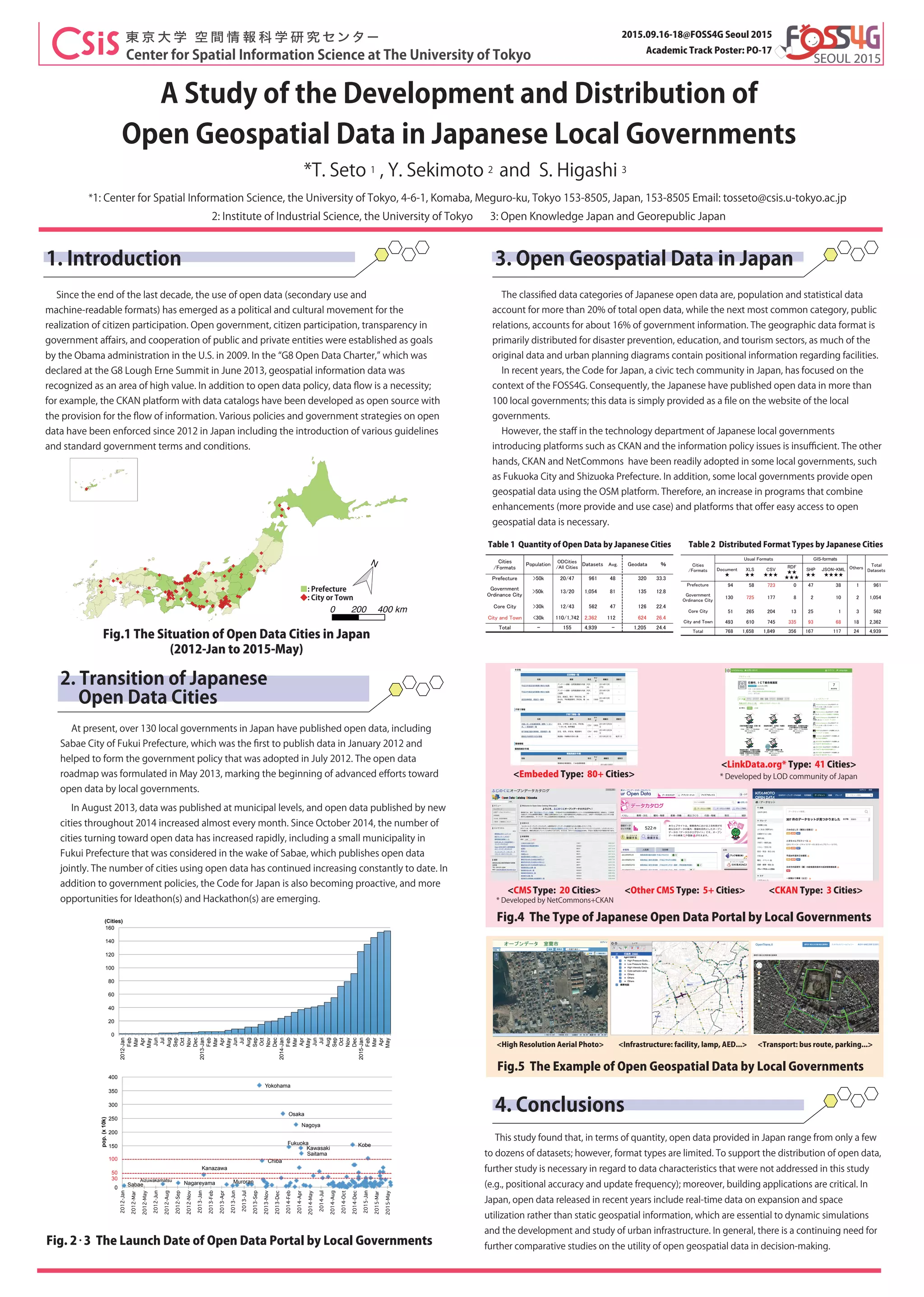
In August 2013, data was published at municipal levels, and open data published by new
cities throughout 2014 increased almost every month. Since October 2014, the number of
cities turning toward open data has increased rapidly, including a small municipality in
Fukui Prefecture that was considered in the wake of Sabae, which publishes open data
jointly. The number of cities using open data has continued increasing constantly to date. In
addition to government policies, the Code for Japan is also becoming proactive, and more
opportunities for Ideathon(s) and Hackathon(s) are emerging.
Fig. 2・3 The Launch Date of Open Data Portal by Local Governments
0
20
40
60
80
100
120
140
160
2012-Jan
Feb
Mar
Apr
May
Jun
Jul
Aug
Sep
Oct
Nov
Dec
2013-Jan
Feb
Mar
Apr
May
Jun
Jul
Aug
Sep
Oct
Nov
Dec
2014-Jan
Feb
Mar
Apr
May
Jun
Jul
Aug
Sep
Oct
Nov
Dec
2015-Jan
Feb
Mar
Apr
May
(Cities)
Yokohama
Chiba
Osaka
Fukuoka
Nagoya
Kawasaki
Saitama
Kobe
Kanazawa
Muroran
Sabae
Aizuwakamatsu
Nagareyama
0
50
30
100
150
200
250
300
350
400
pop.(x10k)
3. Open Geospatial Data in Japan
 The classified data categories of Japanese open data are, population and statistical data
account for more than 20% of total open data, while the next most common category, public
relations, accounts for about 16% of government information. The geographic data format is
primarily distributed for disaster prevention, education, and tourism sectors, as much of the
original data and urban planning diagrams contain positional information regarding facilities.
 In recent years, the Code for Japan, a civic tech community in Japan, has focused on the
context of the FOSS4G. Consequently, the Japanese have published open data in more than
100 local governments; this data is simply provided as a file on the website of the local
governments.
 However, the staff in the technology department of Japanese local governments
introducing platforms such as CKAN and the information policy issues is insufficient. The other
hands, CKAN and NetCommons have been readily adopted in some local governments, such
as Fukuoka City and Shizuoka Prefecture. In addition, some local governments provide open
geospatial data using the OSM platform. Therefore, an increase in programs that combine
enhancements (more provide and use case) and platforms that offer easy access to open
geospatial data is necessary.
4. Conclusions
This study found that, in terms of quantity, open data provided in Japan range from only a few
to dozens of datasets; however, format types are limited. To support the distribution of open data,
further study is necessary in regard to data characteristics that were not addressed in this study
(e.g., positional accuracy and update frequency); moreover, building applications are critical. In
Japan, open data released in recent years include real-time data on expansion and space
utilization rather than static geospatial information, which are essential to dynamic simulations
and the development and study of urban infrastructure. In general, there is a continuing need for
further comparative studies on the utility of open geospatial data in decision-making.
Table 1 Quantity of Open Data by Japanese Cities   Table 2 Distributed Format Types by Japanese Cities
GIS-formats
Fig.4 The Type of Japanese Open Data Portal by Local Governments
<Embeded Type: 80+ Cities>
<LinkData.org* Type: 41 Cities>
* Developed by LOD community of Japan
<CKAN Type: 3 Cities><CMSType: 20 Cities>
* Developed by NetCommons+CKAN
<Other CMS Type: 5+ Cities>
Fig.5 The Example of Open Geospatial Data by Local Governments
<High Resolution Aerial Photo> <Infrastructure: facility, lamp, AED...> <Transport: bus route, parking...>

A Study of the Development and Distribution of Open Geospatial Data in Japanese Local Governments

  • 1.
    A Study ofthe Development and Distribution of Open Geospatial Data in Japanese Local Governments *T. Seto 1 , Y. Sekimoto 2 and S. Higashi 3 *1: Center for Spatial Information Science, the University of Tokyo, 4-6-1, Komaba, Meguro-ku, Tokyo 153-8505, Japan, 153-8505 Email: tosseto@csis.u-tokyo.ac.jp 2: Institute of Industrial Science, the University of Tokyo 3: Open Knowledge Japan and Georepublic Japan Center for Spatial Information Science at The University of Tokyo 2015.09.16-18@FOSS4G Seoul 2015 Academic Track Poster: PO-17 1. Introduction Since the end of the last decade, the use of open data (secondary use and machine-readable formats) has emerged as a political and cultural movement for the realization of citizen participation. Open government, citizen participation, transparency in government affairs, and cooperation of public and private entities were established as goals by the Obama administration in the U.S. in 2009. In the G8 Open Data Charter, which was declared at the G8 Lough Erne Summit in June 2013, geospatial information data was recognized as an area of high value. In addition to open data policy, data flow is a necessity; for example, the CKAN platform with data catalogs have been developed as open source with the provision for the flow of information. Various policies and government strategies on open data have been enforced since 2012 in Japan including the introduction of various guidelines and standard government terms and conditions. Fig.1 The Situation of Open Data Cities in Japan (2012-Jan to 2015-May) ■: Prefecture ◆: City or Town 2. Transition of Japanese  Open Data Cities At present, over 130 local governments in Japan have published open data, including Sabae City of Fukui Prefecture, which was the first to publish data in January 2012 and helped to form the government policy that was adopted in July 2012. The open data roadmap was formulated in May 2013, marking the beginning of advanced efforts toward open data by local governments. In August 2013, data was published at municipal levels, and open data published by new cities throughout 2014 increased almost every month. Since October 2014, the number of cities turning toward open data has increased rapidly, including a small municipality in Fukui Prefecture that was considered in the wake of Sabae, which publishes open data jointly. The number of cities using open data has continued increasing constantly to date. In addition to government policies, the Code for Japan is also becoming proactive, and more opportunities for Ideathon(s) and Hackathon(s) are emerging. Fig. 2・3 The Launch Date of Open Data Portal by Local Governments 0 20 40 60 80 100 120 140 160 2012-Jan Feb Mar Apr May Jun Jul Aug Sep Oct Nov Dec 2013-Jan Feb Mar Apr May Jun Jul Aug Sep Oct Nov Dec 2014-Jan Feb Mar Apr May Jun Jul Aug Sep Oct Nov Dec 2015-Jan Feb Mar Apr May (Cities) Yokohama Chiba Osaka Fukuoka Nagoya Kawasaki Saitama Kobe Kanazawa Muroran Sabae Aizuwakamatsu Nagareyama 0 50 30 100 150 200 250 300 350 400 pop.(x10k) 3. Open Geospatial Data in Japan  The classified data categories of Japanese open data are, population and statistical data account for more than 20% of total open data, while the next most common category, public relations, accounts for about 16% of government information. The geographic data format is primarily distributed for disaster prevention, education, and tourism sectors, as much of the original data and urban planning diagrams contain positional information regarding facilities.  In recent years, the Code for Japan, a civic tech community in Japan, has focused on the context of the FOSS4G. Consequently, the Japanese have published open data in more than 100 local governments; this data is simply provided as a file on the website of the local governments.  However, the staff in the technology department of Japanese local governments introducing platforms such as CKAN and the information policy issues is insufficient. The other hands, CKAN and NetCommons have been readily adopted in some local governments, such as Fukuoka City and Shizuoka Prefecture. In addition, some local governments provide open geospatial data using the OSM platform. Therefore, an increase in programs that combine enhancements (more provide and use case) and platforms that offer easy access to open geospatial data is necessary. 4. Conclusions This study found that, in terms of quantity, open data provided in Japan range from only a few to dozens of datasets; however, format types are limited. To support the distribution of open data, further study is necessary in regard to data characteristics that were not addressed in this study (e.g., positional accuracy and update frequency); moreover, building applications are critical. In Japan, open data released in recent years include real-time data on expansion and space utilization rather than static geospatial information, which are essential to dynamic simulations and the development and study of urban infrastructure. In general, there is a continuing need for further comparative studies on the utility of open geospatial data in decision-making. Table 1 Quantity of Open Data by Japanese Cities   Table 2 Distributed Format Types by Japanese Cities GIS-formats Fig.4 The Type of Japanese Open Data Portal by Local Governments <Embeded Type: 80+ Cities> <LinkData.org* Type: 41 Cities> * Developed by LOD community of Japan <CKAN Type: 3 Cities><CMSType: 20 Cities> * Developed by NetCommons+CKAN <Other CMS Type: 5+ Cities> Fig.5 The Example of Open Geospatial Data by Local Governments <High Resolution Aerial Photo> <Infrastructure: facility, lamp, AED...> <Transport: bus route, parking...>