Welcome
to
Presentation
PRESENTATION ON
Water Resistance: Rain Test
AATCC Test Method 35
SCOPE
This test method is applicable to any textile
fabric, which may or may not have been
given a water-resistant or water-repellent
finish. It measures the resistance to the
penetration of water by impact, and thus can
be used to predict the probable rain
penetration resistance of fabrics. It is
especially suitable for measuring the
penetration resistance of garment fabrics.
With the instrument,
Tests may be made at different intensities
of water impact to give a complete overall
picture of the penetration resistance of a
single fabric or a combination of fabrics.
The results obtained with this test method
depend on the water repellency of the
fibers and yarns, and on the construction of
the fabric.
PRINCIPLE
A test specimen, backed by a weighed
blotter, is sprayed with water for 5 min
under controlled conditions. The blotter
is then reweighed to determine the
amount of water which has leaked
through the specimen during the test.
APPARATUS AND MATERIALS
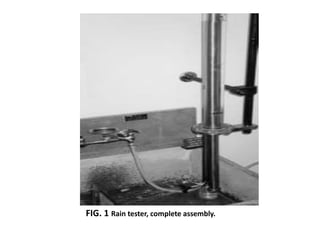
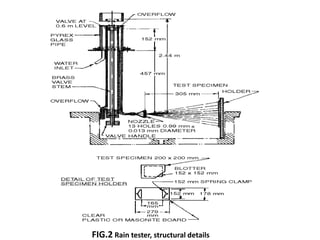
* AATCC Rain Tester (see Figs. 1 and 2 ).
* White AATCC Textile Blotting Paper .
FIG. 1 Rain tester, complete assembly.
FIG.2 Rain tester, structural details
SAMPLING
A minimum of three specimens of 20
*20 cm is cut from the test fabric. The
fabric samples and the blotting paper
should be conditioned in an
atmosphere of 65 ± 2% RH and 21 ±
1ºC for at least 4 h before testing.
PROCEDURE
The test specimen , backed by a 15.2*15.2 cm
standard paper blotter weighed to the nearest
0.1g is clamped in the specimen holder and the
assembly is mounted in a vertical rigid support
frame. The specimen assembly is positioned into
the central portion of the spray at a distance of
30.5 cm from the face of the spray nozzle . A
horizontal water spray at 27 ± 1°C is directed
against the specimen and is allowed to continue
for a period of 5 min. At the end of the spray
period the blotter is carefully removed and quickly
reweighed to the nearest 0.1 g.
Water penetration as indicated by the increase in
mass of the blotting paper during the 5 min test
period is calculated, and the average for the three
test specimens is reported. Individual
determinations or average values of over 5.0 g may
be simply reported to 5 + g or > 5 g. In order to
obtain a complete over- all picture of the
penetration resistance of a fabric or fabric
combination the average penetration with
different pressure heads on the nozzle should be
obtained
EVALUATION
pressure head should be varied by 300 mm
increments in order to determine the
maximum head at which no penetration
occurs, the change in penetration with
increasing head and the mini- mum head
required to cause “break- down” or the
penetration of more than 5 g of water. At each
pressure head a mini- mum of three
specimens should be tested in order to obtain
the average penetration for that head.
Report the individual
determinations. For values of
over 5.0 g simply re- port as 5 + g
or > 5 g.
REPORTING
THANK YOU
PREPARED BY
Engr.Shaharia Ahmed
EXECUTIVE ( CRS LAB )
SGS BANGLADESH LIMITED

AATCC- 35

  • 1.
  • 2.
    PRESENTATION ON Water Resistance:Rain Test AATCC Test Method 35
  • 3.
    SCOPE This test methodis applicable to any textile fabric, which may or may not have been given a water-resistant or water-repellent finish. It measures the resistance to the penetration of water by impact, and thus can be used to predict the probable rain penetration resistance of fabrics. It is especially suitable for measuring the penetration resistance of garment fabrics. With the instrument,
  • 4.
    Tests may bemade at different intensities of water impact to give a complete overall picture of the penetration resistance of a single fabric or a combination of fabrics. The results obtained with this test method depend on the water repellency of the fibers and yarns, and on the construction of the fabric.
  • 5.
    PRINCIPLE A test specimen,backed by a weighed blotter, is sprayed with water for 5 min under controlled conditions. The blotter is then reweighed to determine the amount of water which has leaked through the specimen during the test.
  • 6.
    APPARATUS AND MATERIALS *AATCC Rain Tester (see Figs. 1 and 2 ). * White AATCC Textile Blotting Paper .
  • 7.
    FIG. 1 Raintester, complete assembly.
  • 8.
    FIG.2 Rain tester,structural details
  • 9.
    SAMPLING A minimum ofthree specimens of 20 *20 cm is cut from the test fabric. The fabric samples and the blotting paper should be conditioned in an atmosphere of 65 ± 2% RH and 21 ± 1ºC for at least 4 h before testing.
  • 10.
    PROCEDURE The test specimen, backed by a 15.2*15.2 cm standard paper blotter weighed to the nearest 0.1g is clamped in the specimen holder and the assembly is mounted in a vertical rigid support frame. The specimen assembly is positioned into the central portion of the spray at a distance of 30.5 cm from the face of the spray nozzle . A horizontal water spray at 27 ± 1°C is directed against the specimen and is allowed to continue for a period of 5 min. At the end of the spray period the blotter is carefully removed and quickly reweighed to the nearest 0.1 g.
  • 11.
    Water penetration asindicated by the increase in mass of the blotting paper during the 5 min test period is calculated, and the average for the three test specimens is reported. Individual determinations or average values of over 5.0 g may be simply reported to 5 + g or > 5 g. In order to obtain a complete over- all picture of the penetration resistance of a fabric or fabric combination the average penetration with different pressure heads on the nozzle should be obtained EVALUATION
  • 12.
    pressure head shouldbe varied by 300 mm increments in order to determine the maximum head at which no penetration occurs, the change in penetration with increasing head and the mini- mum head required to cause “break- down” or the penetration of more than 5 g of water. At each pressure head a mini- mum of three specimens should be tested in order to obtain the average penetration for that head.
  • 13.
    Report the individual determinations.For values of over 5.0 g simply re- port as 5 + g or > 5 g. REPORTING
  • 14.
  • 15.
    PREPARED BY Engr.Shaharia Ahmed EXECUTIVE( CRS LAB ) SGS BANGLADESH LIMITED