 AARSKOG SYNDROME- A RARE GENETIC
DISORDER.
 BY- SUBHASMITH PRADHAN
 REG.NO- 163G1R0094
 BATCH -2016-20
 ADITYA PHARMACY COLLEGE
AARSKOG-SYNDROME-A RARE GENETIC
ABNORMALITIES(FGD1 GENE)ON HUMANE
DISCUSSED POINTS:
1.INTRODUCTION
2.SYNONIMS
3.GENERAL DISCUSSION
4.SIGNS AND SYMPTOMS
5.CAUSES
6.AFFECTED POPULATION
7.RELATED DISORDER
8.DIAGNOSIS
9.STANDERD THERAPIES
INTRODUCTION
Aarskog syndrome is a rare genetic condition characterized by short stature
and multiple facial, limb and genital abnormalities. Additionally, some types of
cognitive disorders may occasionally be present. Up to now, the FGD1 gene
on the X chromosome is the only gene known to be associated with Aarskog
syndrome.
SYNONIMS
Synonyms of Aarskog Syndrome:
1. Aarskog disease
2. Aarskog- Scott syndrome
3. AAS
4.faciodigitogenital syndrome
5.faciogenital dysplasia
6. FGDY
7. Scott Aarskog syndrome
GENERAL DISCUSSION
Aarskog syndrome is a rare genetic condition characterized by short stature
and multiple facial, limb and genital abnormalities. Additionally, some types of
cognitive disorders may occasionally be present. Up to now, the FGD1 gene
on the X chromosome is the only gene known to be associated with Aarskog
syndrome.
SIGNS AND SYMPTOMS
Aarskog syndrome primarily affects males. Affected boys exhibit a characteristic set of facial,
skeletal, and genital abnormalities. Clinical signs may vary from person to person (clinical
heterogeneity), even within families. Males with Aarskog syndrome often have a rounded face
with a broad forehead. Additional characteristic facial features include widely spaced eyes
(ocular hypertelorism), drooping (ptosis) of the eyelids, downwardly slanting eyelid folds
(palpebral fissures), a small nose with nostrils that are flared forward (anteverted nares), an
underdeveloped upper jawbone (maxilliary hypoplasia), and a widow’s peak. Affected
individuals may also have an abnormally long groove in the upper lip (philtrum) and a broad
nasal bridge.
These children may also have a variety of abnormalities affecting the ears and teeth. Ear
abnormalities include low-set ears and thickened, “fleshy” earlobes. Dental abnormalities
include missing teeth at birth, delayed eruption of teeth, and underdevelopment of the hard
outer covering of teeth (enamel hypoplasia).
Aarskog syndrome is basically a skeletal dysplasia and affected males develop characteristic
malformations of the skeletal system including disproportionate short stature; broad, short
hands and feet; short, stubby fingers (brachydactyly) with permanent fixation of the fifth fingers
in a bent position (clinodactyly); abnormally extendible finger joints; and wide flat feet with
bulbous toes. In addition, affected individuals may have a sunken chest (pectus excavatum),
protrusion of portions of the large intestine through an abnormal opening in the muscular lining
of the abdominal cavity (inguinal hernia), and a prominent navel (umbilicus). Individuals with
Aarskog syndrome may have spinal abnormalities such as incomplete closure of the bones of
the spinal column (spina bifida occulta), fusion of the upper bones of the spinal column
(cervical vertebrae), and underdevelopment of the “peg-like” projection of the second cervical
vertebra (odontoid hypoplasia).
Signs that help to make a diagnosis in males with Aarskog syndrome are the genital abnormalities,
including a characteristic abnormal fold of skin extending around the base of the penis (“shawl”
scrotum) and/or failure of one or both of the testes to descend into the scrotum
(cryptorchidism). In addition, the urinary opening (meatus) may be located on the underside of
the penis (hypospadias) and the scrotum may appear clefted or divided (bifid scrotum).
Intellectual disability has been described in some affected boys but it is not a consistent feature of
the disorder. Affected individuals may present with a range of mild learning difficulty and/or
behavioral disorders: affected children may exhibit developmental delay during infancy,
hyperactivity, attention deficit, impulsivity and opposition. Due to this possible spectrum of
characteristics, the condition is also referred to as an ADHD syndromic disorder (MRXS16).
Failure to gain weight and grow at the expected rate (failure to thrive) and development of
chronic respiratory infections have also been described.
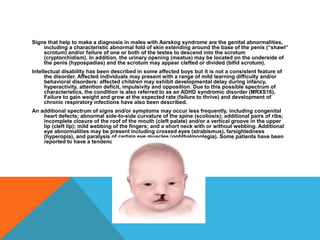
An additional spectrum of signs and/or symptoms may occur less frequently, including congenital
heart defects; abnormal side-to-side curvature of the spine (scoliosis); additional pairs of ribs;
incomplete closure of the roof of the mouth (cleft palate) and/or a vertical groove in the upper
lip (cleft lip); mild webbing of the fingers; and a short neck with or without webbing. Additional
eye abnormalities may be present including crossed eyes (strabismus), farsightedness
(hyperopia), and paralysis of certain eye muscles (ophthalmoplegia). Some patients have been
reported to have a tendency to be overweight.
CAUSES
Although Aarskog syndrome is a clinically and genetically heterogeneous condition, the
best characterized form of the disorder is inherited as an X-linked trait and caused by
changes (mutations) in the FGD1 gene. Aarskog syndrome primarily affects males.
However, females who carry a single copy of a FGD1 gene mutation (heterozygotes) may
exhibit some of the symptoms associated with the disorder. FGD1 gene mutations have
been identified in approximately 22% of affected males; therefore, it is likely that other
genes not yet identified may also be associated with this condition.
X-linked recessive genetic disorders are conditions caused by mutations in a gene located
on the X chromosome. Females have two X chromosomes but one of the X
chromosomes is “turned off” to correct a dosage imbalance and almost all of the genes
on that chromosome are silenced (inactivated) through a process defined as X-
chromosome inactivation. Females who have a disease causing mutation on one of their
X chromosomes are carriers for that disorder. Carrier females usually do not display
symptoms of the disorder because it is usually the X chromosome with the abnormal
gene that is “silenced”. Males have one only X chromosome and, if they inherit the X
chromosome that contains a disease gene, they will develop the disease. In turn, males
with a X-linked disorder will pass the disease gene to all of their daughters, who will be
carriers of the trait (obligate carriers). Males cannot pass X-linked traits to their sons
because they always pass their Y chromosome instead of their X chromosome to male
offspring. Female carriers of an X-linked disorder have a 25% chance with each
pregnancy to have a carrier daughter (like themselves), a 25% chance to have a non-
carrier daughter, a 25% chance to have a son affected with the disease, and a 25%
chance to have an unaffected son.
AFFECTED POPULATION:
Approximately 60 reports of Aarskog syndrome confirmed by identification
of a FGD1 gene mutation have been published worldwide. However, it is
possible that some mildly affected children may be unrecognized,
making it difficult to determine the true frequency of this condition in
the general population. An estimated population prevalence of Aarskog
syndrome is equal to or slightly lower than to 1/25,000.
RELATED DISORDER:
Symptoms of the following disorders can be similar to those of Aarskog syndrome. Comparisons
may be useful for a differential diagnosis:
Noonan syndrome :
It is a relatively common genetic disorder characterized by short stature, dysmorphic facial features
and congenital heart disease.
The disorder is characterized by a wide spectrum of symptoms and physical features that vary
greatly in range and severity. In many affected individuals, associated abnormalities include a
distinctive facial appearance; a broad or webbed neck; a low posterior hairline; a typical chest
deformity and short stature.
Characteristic abnormalities of the head and facial (craniofacial) area may include widely set eyes
(ocular hypertelorism);
skin folds that may cover the eyes’ inner corners (epicanthal folds); drooping of the upper eyelids
(ptosis); a small jaw (micrognathia); a depressed nasal root; a short nose with broad base; and
low-set, posteriorly rotated ears (pinnae).
Distinctive skeletal malformations are also typically present, such as abnormalities of the breastbone
(sternum), curvature of the spine (kyphosis and/or scoliosis), and outward deviation of the
elbows (cubitus valgus).
Many infants with Noonan syndrome also have heart (cardiac) defects, such as obstruction of
proper blood flow from the lower right chamber of the heart to the lungs (pulmonary valvular
stenosis)
Noonan syndrome is may be caused by mutations in a number of genes,
including PTPN11, KRAS, SOS1, RAF1, NRAS, RIT1 and SOS2
Robinow syndrome :
It is a rare genetic disorder that can be inherited in either a dominant or recessive pattern and is characterized
by mild to moderate short stature due to growth delays after birth (postnatal growth retardation);
distinctive abnormalities of the head and facial (craniofacial) area; additional skeletal malformations;
and/or genital abnormalities. The facial features of infants with Robinow syndrome resemble those of an
eight-week-old fetus; within the medical literature, this condition is often referred to as “fetal face.
The Robinow syndrome may be caused by mutations in different genes, such
as WNT5A, ROR2, DVL3 and DVL1
Noonan syndrome with multiple lentigines (NSML) is a rare genetic disorder characterized by abnormalities of
the skin, the structure and function of the heart, the inner ear, the head and facial (craniofacial) area,
and/or the genitals. In individuals with the disorder, the range and severity of symptoms and physical
characteristics may vary from person to person.
LEOPARD is an acronym for the characteristic abnormalities associated with the disorder: L stands for
(L)entigines (multiple black or dark brown spots on the skin); (E)lectrocardiographic conduction defects
(abnormalities of the electrical activity and the coordination of proper contractions of the heart); (0)cular
hypertelorism (widely-spaced eyes); (P)ulmonary stenosis (obstruction of the normal outflow of blood
from the right ventricle of the heart); (A)bnormalities of the genitals; (R)etarded growth resulting in short
stature; and (D)eafness or hearing loss due to malfunction of the inner ear (sensorineural deafness).
Some affected individuals may also exhibit mild intellectual disability, speech difficulties, and/or, in some
cases, additional physical abnormalities. NSML is an autosomal dominant genetic disorder. NSML and
Noonan syndrome are both caused by mutations in the PTPN11 and RAF1 genes. (For more information
on this disorder, choose “LEOPARD” as your search term in the Rare Disease Database.)
DIAGNOSIS:
A diagnosis of Aarskog syndrome may be considered based upon a
thorough clinical evaluation, a detailed patient and family history, and
the identification of characteristic findings. Molecular genetic testing for
FGD1 gene mutations is available to confirm the diagnosis. If a FGD1
gene mutation is not identified, molecular genetic testing for genes
associated with similar conditions may be suggested, such as the ROR2
and WNT5A genes associated with Robinow syndrome.
The transition from the classic sequencing of single genes to protocols of
next generation sequencing (NGS), recommends at least the use of
panels that include, in addition to FGD1, the genes that cause
overlapping conditions such as ROR2, WNT5A, PIK3R1, SRCAP, KMT2D,
KDM6A, SHOX, CUL7.
STANDARD THERAPY
Treatment:
The treatment of Aarskog syndrome is directed toward the specific symptoms that
are apparent in each individual. Treatment may require the coordinated efforts of a
team of specialists. Pediatricians, surgeons, cardiologists, dental specialists,
speech pathologists, specialists who asses and treat hearing problems
(audiologists), eye specialists, and other health care professionals may need to
systematically and comprehensively plan an affected child’s treatment.
Surgery may be necessary to treat specific congenital or structural malformations
sometimes associated with Aarskog syndrome (hypospadias, inguinal or umbilical
hernias, cryptorchidism, unusually severe craniofacial features). Individuals with
Aarskog syndrome should receive complete eye and dental evaluations. Growth
hormone treatment has been reported to improve height in some children, but
confirmation is needed to determine appropriate management and expectations for
response. For the possibly neurodevelopmental symptoms, a neuropsychiatric
evaluation and input may be indicated. Other treatment is symptomatic and
supportive.
Genetic counseling is recommended for affected individuals and their families to clarify
the genetic and clinical characteristics, the inheritance, and the recurrence risks of
the condition in their families.
AARSKOG- SYNDROME
AARSKOOG SYNDROME
AARSKOOG SYNDROME

AARSKOOG SYNDROME

  • 1.
     AARSKOG SYNDROME-A RARE GENETIC DISORDER.  BY- SUBHASMITH PRADHAN  REG.NO- 163G1R0094  BATCH -2016-20  ADITYA PHARMACY COLLEGE
  • 2.
    AARSKOG-SYNDROME-A RARE GENETIC ABNORMALITIES(FGD1GENE)ON HUMANE DISCUSSED POINTS: 1.INTRODUCTION 2.SYNONIMS 3.GENERAL DISCUSSION 4.SIGNS AND SYMPTOMS 5.CAUSES 6.AFFECTED POPULATION 7.RELATED DISORDER 8.DIAGNOSIS 9.STANDERD THERAPIES
  • 3.
    INTRODUCTION Aarskog syndrome isa rare genetic condition characterized by short stature and multiple facial, limb and genital abnormalities. Additionally, some types of cognitive disorders may occasionally be present. Up to now, the FGD1 gene on the X chromosome is the only gene known to be associated with Aarskog syndrome.
  • 4.
    SYNONIMS Synonyms of AarskogSyndrome: 1. Aarskog disease 2. Aarskog- Scott syndrome 3. AAS 4.faciodigitogenital syndrome 5.faciogenital dysplasia 6. FGDY 7. Scott Aarskog syndrome
  • 5.
    GENERAL DISCUSSION Aarskog syndromeis a rare genetic condition characterized by short stature and multiple facial, limb and genital abnormalities. Additionally, some types of cognitive disorders may occasionally be present. Up to now, the FGD1 gene on the X chromosome is the only gene known to be associated with Aarskog syndrome.
  • 6.
    SIGNS AND SYMPTOMS Aarskogsyndrome primarily affects males. Affected boys exhibit a characteristic set of facial, skeletal, and genital abnormalities. Clinical signs may vary from person to person (clinical heterogeneity), even within families. Males with Aarskog syndrome often have a rounded face with a broad forehead. Additional characteristic facial features include widely spaced eyes (ocular hypertelorism), drooping (ptosis) of the eyelids, downwardly slanting eyelid folds (palpebral fissures), a small nose with nostrils that are flared forward (anteverted nares), an underdeveloped upper jawbone (maxilliary hypoplasia), and a widow’s peak. Affected individuals may also have an abnormally long groove in the upper lip (philtrum) and a broad nasal bridge. These children may also have a variety of abnormalities affecting the ears and teeth. Ear abnormalities include low-set ears and thickened, “fleshy” earlobes. Dental abnormalities include missing teeth at birth, delayed eruption of teeth, and underdevelopment of the hard outer covering of teeth (enamel hypoplasia). Aarskog syndrome is basically a skeletal dysplasia and affected males develop characteristic malformations of the skeletal system including disproportionate short stature; broad, short hands and feet; short, stubby fingers (brachydactyly) with permanent fixation of the fifth fingers in a bent position (clinodactyly); abnormally extendible finger joints; and wide flat feet with bulbous toes. In addition, affected individuals may have a sunken chest (pectus excavatum), protrusion of portions of the large intestine through an abnormal opening in the muscular lining of the abdominal cavity (inguinal hernia), and a prominent navel (umbilicus). Individuals with Aarskog syndrome may have spinal abnormalities such as incomplete closure of the bones of the spinal column (spina bifida occulta), fusion of the upper bones of the spinal column (cervical vertebrae), and underdevelopment of the “peg-like” projection of the second cervical vertebra (odontoid hypoplasia).
  • 7.
    Signs that helpto make a diagnosis in males with Aarskog syndrome are the genital abnormalities, including a characteristic abnormal fold of skin extending around the base of the penis (“shawl” scrotum) and/or failure of one or both of the testes to descend into the scrotum (cryptorchidism). In addition, the urinary opening (meatus) may be located on the underside of the penis (hypospadias) and the scrotum may appear clefted or divided (bifid scrotum). Intellectual disability has been described in some affected boys but it is not a consistent feature of the disorder. Affected individuals may present with a range of mild learning difficulty and/or behavioral disorders: affected children may exhibit developmental delay during infancy, hyperactivity, attention deficit, impulsivity and opposition. Due to this possible spectrum of characteristics, the condition is also referred to as an ADHD syndromic disorder (MRXS16). Failure to gain weight and grow at the expected rate (failure to thrive) and development of chronic respiratory infections have also been described. An additional spectrum of signs and/or symptoms may occur less frequently, including congenital heart defects; abnormal side-to-side curvature of the spine (scoliosis); additional pairs of ribs; incomplete closure of the roof of the mouth (cleft palate) and/or a vertical groove in the upper lip (cleft lip); mild webbing of the fingers; and a short neck with or without webbing. Additional eye abnormalities may be present including crossed eyes (strabismus), farsightedness (hyperopia), and paralysis of certain eye muscles (ophthalmoplegia). Some patients have been reported to have a tendency to be overweight.
  • 8.
    CAUSES Although Aarskog syndromeis a clinically and genetically heterogeneous condition, the best characterized form of the disorder is inherited as an X-linked trait and caused by changes (mutations) in the FGD1 gene. Aarskog syndrome primarily affects males. However, females who carry a single copy of a FGD1 gene mutation (heterozygotes) may exhibit some of the symptoms associated with the disorder. FGD1 gene mutations have been identified in approximately 22% of affected males; therefore, it is likely that other genes not yet identified may also be associated with this condition. X-linked recessive genetic disorders are conditions caused by mutations in a gene located on the X chromosome. Females have two X chromosomes but one of the X chromosomes is “turned off” to correct a dosage imbalance and almost all of the genes on that chromosome are silenced (inactivated) through a process defined as X- chromosome inactivation. Females who have a disease causing mutation on one of their X chromosomes are carriers for that disorder. Carrier females usually do not display symptoms of the disorder because it is usually the X chromosome with the abnormal gene that is “silenced”. Males have one only X chromosome and, if they inherit the X chromosome that contains a disease gene, they will develop the disease. In turn, males with a X-linked disorder will pass the disease gene to all of their daughters, who will be carriers of the trait (obligate carriers). Males cannot pass X-linked traits to their sons because they always pass their Y chromosome instead of their X chromosome to male offspring. Female carriers of an X-linked disorder have a 25% chance with each pregnancy to have a carrier daughter (like themselves), a 25% chance to have a non- carrier daughter, a 25% chance to have a son affected with the disease, and a 25% chance to have an unaffected son.
  • 9.
    AFFECTED POPULATION: Approximately 60reports of Aarskog syndrome confirmed by identification of a FGD1 gene mutation have been published worldwide. However, it is possible that some mildly affected children may be unrecognized, making it difficult to determine the true frequency of this condition in the general population. An estimated population prevalence of Aarskog syndrome is equal to or slightly lower than to 1/25,000.
  • 10.
    RELATED DISORDER: Symptoms ofthe following disorders can be similar to those of Aarskog syndrome. Comparisons may be useful for a differential diagnosis: Noonan syndrome : It is a relatively common genetic disorder characterized by short stature, dysmorphic facial features and congenital heart disease. The disorder is characterized by a wide spectrum of symptoms and physical features that vary greatly in range and severity. In many affected individuals, associated abnormalities include a distinctive facial appearance; a broad or webbed neck; a low posterior hairline; a typical chest deformity and short stature. Characteristic abnormalities of the head and facial (craniofacial) area may include widely set eyes (ocular hypertelorism); skin folds that may cover the eyes’ inner corners (epicanthal folds); drooping of the upper eyelids (ptosis); a small jaw (micrognathia); a depressed nasal root; a short nose with broad base; and low-set, posteriorly rotated ears (pinnae). Distinctive skeletal malformations are also typically present, such as abnormalities of the breastbone (sternum), curvature of the spine (kyphosis and/or scoliosis), and outward deviation of the elbows (cubitus valgus). Many infants with Noonan syndrome also have heart (cardiac) defects, such as obstruction of proper blood flow from the lower right chamber of the heart to the lungs (pulmonary valvular stenosis) Noonan syndrome is may be caused by mutations in a number of genes, including PTPN11, KRAS, SOS1, RAF1, NRAS, RIT1 and SOS2
  • 11.
    Robinow syndrome : Itis a rare genetic disorder that can be inherited in either a dominant or recessive pattern and is characterized by mild to moderate short stature due to growth delays after birth (postnatal growth retardation); distinctive abnormalities of the head and facial (craniofacial) area; additional skeletal malformations; and/or genital abnormalities. The facial features of infants with Robinow syndrome resemble those of an eight-week-old fetus; within the medical literature, this condition is often referred to as “fetal face. The Robinow syndrome may be caused by mutations in different genes, such as WNT5A, ROR2, DVL3 and DVL1 Noonan syndrome with multiple lentigines (NSML) is a rare genetic disorder characterized by abnormalities of the skin, the structure and function of the heart, the inner ear, the head and facial (craniofacial) area, and/or the genitals. In individuals with the disorder, the range and severity of symptoms and physical characteristics may vary from person to person. LEOPARD is an acronym for the characteristic abnormalities associated with the disorder: L stands for (L)entigines (multiple black or dark brown spots on the skin); (E)lectrocardiographic conduction defects (abnormalities of the electrical activity and the coordination of proper contractions of the heart); (0)cular hypertelorism (widely-spaced eyes); (P)ulmonary stenosis (obstruction of the normal outflow of blood from the right ventricle of the heart); (A)bnormalities of the genitals; (R)etarded growth resulting in short stature; and (D)eafness or hearing loss due to malfunction of the inner ear (sensorineural deafness). Some affected individuals may also exhibit mild intellectual disability, speech difficulties, and/or, in some cases, additional physical abnormalities. NSML is an autosomal dominant genetic disorder. NSML and Noonan syndrome are both caused by mutations in the PTPN11 and RAF1 genes. (For more information on this disorder, choose “LEOPARD” as your search term in the Rare Disease Database.)
  • 12.
    DIAGNOSIS: A diagnosis ofAarskog syndrome may be considered based upon a thorough clinical evaluation, a detailed patient and family history, and the identification of characteristic findings. Molecular genetic testing for FGD1 gene mutations is available to confirm the diagnosis. If a FGD1 gene mutation is not identified, molecular genetic testing for genes associated with similar conditions may be suggested, such as the ROR2 and WNT5A genes associated with Robinow syndrome. The transition from the classic sequencing of single genes to protocols of next generation sequencing (NGS), recommends at least the use of panels that include, in addition to FGD1, the genes that cause overlapping conditions such as ROR2, WNT5A, PIK3R1, SRCAP, KMT2D, KDM6A, SHOX, CUL7.
  • 13.
    STANDARD THERAPY Treatment: The treatmentof Aarskog syndrome is directed toward the specific symptoms that are apparent in each individual. Treatment may require the coordinated efforts of a team of specialists. Pediatricians, surgeons, cardiologists, dental specialists, speech pathologists, specialists who asses and treat hearing problems (audiologists), eye specialists, and other health care professionals may need to systematically and comprehensively plan an affected child’s treatment. Surgery may be necessary to treat specific congenital or structural malformations sometimes associated with Aarskog syndrome (hypospadias, inguinal or umbilical hernias, cryptorchidism, unusually severe craniofacial features). Individuals with Aarskog syndrome should receive complete eye and dental evaluations. Growth hormone treatment has been reported to improve height in some children, but confirmation is needed to determine appropriate management and expectations for response. For the possibly neurodevelopmental symptoms, a neuropsychiatric evaluation and input may be indicated. Other treatment is symptomatic and supportive. Genetic counseling is recommended for affected individuals and their families to clarify the genetic and clinical characteristics, the inheritance, and the recurrence risks of the condition in their families.
  • 14.