RIPHAH INTERNATIONAL UNIVERSITY

NEOPLASIA
A detailed assignment
Tahir Ramzan
12/31/2013
Assignment No.1 Biochemistry

Neoplasia

23-2-2013

What is Neoplasia?
Neoplasia literally means "new growth." A neoplasm, as defined by Willis, is "an
abnormal mass of tissue the growth of which exceeds and is uncoordinated with that
of the normal tissues and persists in the same excessive manner after the cessation of
the stimuli which evoked the change."

Fundamental to the origin of all neoplasms are heritable (genetic) changes that allow
excessive and unregulated proliferation that is independent of physiologic growthregulatory stimuli. Neoplastic cells are said to be transformed because they continue
to replicate, apparently oblivious to the regulatory influences that control normal cell
growth. Neoplasms therefore enjoy a certain degree of autonomy and more or less
steadily increase in size regardless of their local environment and the nutritional status
of the host.
A tumor is said to be Benign when its microscopic and gross characteristics are
considered to be relatively innocent, implying that it will remain localized, it cannot
spread to other sites, and is amenable to local surgical removal; the patient generally
survives.

Malignant tumors are collectively referred to as cancers, derived from the Latin word
for crab-that is, they adhere to any part that they seize in an obstinate manner, similar
to a crab's behaviour. Malignant, as applied to a neoplasm, implies that the lesion can
invade and destroy adjacent structures and spread to distant sites (metastasize) to
cause death.

Nomenclature of Neoplasia:
 Malignant neoplasms arising in mesenchymal tissue or its derivatives are called
sarcomas.
 A cancer of fibrous tissue origin is a fibrosarcoma.
 Malignant neoplasm composed of chondrocytes is a chondrosarcoma.
Sarcomas are designated by their histogenesis (i.e., the cell type of which they
are composed).
 Malignant neoplasms of epithelial cell origin are called carcinomas.
 A malignant neoplasm arising in the renal tubular epithelium (mesoderm) is a
carcinoma, as are the cancers arising in the skin (ectoderm) and lining
epithelium of the gut (endoderm). It is evident that mesoderm may give rise to
carcinomas (epithelial) and sarcomas (mesenchymal). Carcinomas may be
qualified further. Carcinomas that grow in a glandular pattern are called
adenocarcinomas, and those that produce squamous cells are called squamous
cell carcinomas.
 Sometimes the tumor shows little or no differentiation and must be called
poorly differentiated or undifferentiated carcinoma.More detail of
Nomenclature of tumor is given in table:
Tissue of Origin

Endothelial and related tissues
Blood vessels
Lymph vessels
Synovium
Mesothelium
Blood cells and related cells
Hematopoietic cells
Muscle
Smooth
Striated
Tumors of epithelial origin
Stratified squamous
Basal cells of skin or adnexa
Epithelial lining of glands
Respiratory passages

Renal epithelium
Liver cells
Placental epithelium
Tumors of melanocytes
Salivary glands

Renal anlage

Malignant

Fibroma

Fibrosarcoma

Lipoma
Chondroma
Osteoma

Composed of One
Parenchymal Cell Type
Connective tissue and
derivatives

Benign

Liposarcoma
Chondrosarcoma
Osteogenic sarcoma

Hemangioma
Lymphangioma

Angiosarcoma
Lymphangiosarcoma
Synovial sarcoma
Mesothelioma
Leukemias

Leiomyoma
Rhabdomyoma

Leiomyosarcoma
Rhabdomyosarcoma

Squamous cell papilloma

Squamous cell carcinoma
Basal cell carcinoma
Papillary carcinomas
Cystadenocarcinoma
Bronchogenic carcinoma

Adenoma
Papilloma
Bronchial adenoma

Renal tubular adenoma
Liver cell adenoma
Hydatidiform mole
Nevus
Pleomorphic adenoma
(mixed tumor of salivary
gland)

Renal cell carcinoma
Hepatocellular carcinoma
Choriocarcinoma
Malignant melanoma
Malignant mixed tumor of
salivary gland
Wilms tumor
CARCINOGENESIS: THE MOLECULAR BASIS OF CANCER:
It could be argued that the proliferation of literature on the molecular basis of cancer has
outpaced the growth of even the most malignant of tumors. It is easy to get lost in the
growing forest of information. First, we list some fundamental principles before delving into
the details of the genetic basis of cancer.
Nonlethal genetic damage lies at the heart of carcinogenesis. Such genetic damage (or
mutation) may be acquired by the action of environmental agents, such as chemicals,
radiation, or viruses, or it may be inherited in the germ line. The genetic hypothesis of cancer
implies that a tumor mass results from the clonal expansion of a single progenitor cell that
has incurred genetic damage (i.e., tumors are monoclonal). This expectation has been realized
in most tumors that have been analyzed. Clonality of tumors is assessed readily in women
who are heterozygous for polymorphic X-linked markers, such as the enzyme glucose-6phosphate dehydrogenase or X-linked restriction-fragment-length polymorphisms. The
principle underlying such an analysis is illustrated below:

Carcinogenesis is a multistep process at both the phenotypic and the genetic levels, resulting from the
accumulation of multiple mutations. As malignant neoplasms have several phenotypic attributes, such
as excessive growth, local invasiveness, and the ability to form distant metastases. Furthermore, it is
well established that over a period of time, many tumors become more aggressive and acquire greater
malignant potential. This phenomenon is referred to as tumor progression and is not simply
represented by an increase in tumour size.
At the molecular level, tumor progression and associated heterogeneity most likely result from
multiple mutations that accumulate independently in different cells, generating subclones with
different characteristics as in figure. such as ability to invade, rate of growth, metastatic ability,
karyotype, hormonal responsiveness, and susceptibility to anti-neoplastic drugs. Some of the
mutations may be lethal; others may spur cell growth by affecting proto-oncogenes or cancer
suppressor genes. Even though most malignant tumors are monoclonal in origin, by the time they
become clinically evident, their constituent cells are extremely heterogeneous. During progression,
tumor cells are subjected to immune and nonimmune selection pressures.

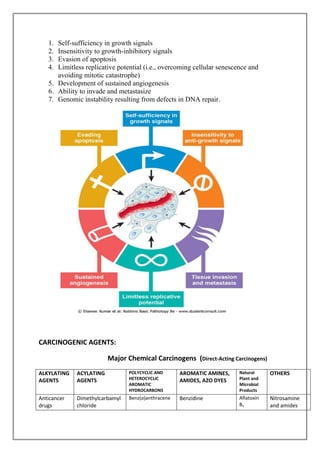
It is best therefore to consider cancer-related genes in the context of seven
fundamental changes in cell physiology that together dictate the malignant phenotype.
All except the mutator phenotype are illustrated in figure.
1.
2.
3.
4.

Self-sufficiency in growth signals
Insensitivity to growth-inhibitory signals
Evasion of apoptosis
Limitless replicative potential (i.e., overcoming cellular senescence and
avoiding mitotic catastrophe)
5. Development of sustained angiogenesis
6. Ability to invade and metastasize
7. Genomic instability resulting from defects in DNA repair.

CARCINOGENIC AGENTS:
Major Chemical Carcinogens (Direct-Acting Carcinogens)
ALKYLATING
AGENTS

ACYLATING
AGENTS

POLYCYCLIC AND
HETEROCYCLIC
AROMATIC
HYDROCARBONS

AROMATIC AMINES,
AMIDES, AZO DYES

Natural
Plant and
Microbial
Products

OTHERS

Anticancer
drugs

Dimethylcarbamyl
chloride

Benz(a)anthracene

Benzidine

Aflatoxin
B1

Nitrosamine
and amides
Diepoxybutane

Benzo(a)pyrene

2-Acetylaminofluorene

Cycasin

Vinyl chloride,

Dimethyl
sulfate

Dibenz(a,
h)anthracene

Dimethylaminoazobe

Safrole

β-Propiolactone

Methylcholanthrene

2-Naphthylamine

Betel nuts

Insecticides,
fungicides
Polychlorinated
biphenyls

1-Acetyl-imidazole

7, 12Dimethylbenz

Direct-acting agents require no metabolic conversion to become carcinogenic. They are in
general weak carcinogens but are important because some of them are cancer
chemotherapeutic drugs (e.g., alkylating agents) that have successfully cured, controlled, or
delayed recurrence of certain types of cancer (e.g., leukemia, lymphoma, Hodgkin
lymphoma, and ovarian carcinoma), only to evoke later a second form of cancer, usually
leukemia.

Indirect-Acting Agents
The designation indirect-acting agent refers to chemicals that require metabolic conversion to
an ultimate carcinogen before they become active. Some of the most potent indirect chemical
carcinogens-the polycyclic hydrocarbons-are present in fossil fuels. For example,
benzo[a]pyrene and other carcinogens are formed in the high-temperature combustion of
tobacco in cigarette smoking. These products are implicated in the causation of lung cancer
in cigarette smokers. Polycyclic hydrocarbons may also be produced from animal fats during
the process of broiling meats and are present in smoked meats and fish. The principal active
products in many hydrocarbons are epoxides, which form covalent adducts (addition
products) with molecules in the cell, principally DNA, but also with RNA and proteins.

CLINICAL ASPECTS OF NEOPLASIA
Effects of Tumor on Host

Location is crucial in both benign and malignant tumors. A small (1-cm) pituitary adenoma
can compress and destroy the surrounding normal gland and give rise to hypopituitarism. A
0.5-cm leiomyoma in the wall of the renal artery may lead to renal ischemia and serious
hypertension.
Cancer Cachexia :
Many cancer patients suffer progressive loss of body fat and lean body mass, accompanied by
profound weakness, anorexia, and anemia, referred to as cachexia. There is some correlation
between the size and extent of spread of the cancer and the severity of the cachexia.
However, cachexia is not caused by the nutritional demands of the tumor.
Paraneoplastic Syndromes:
Symptom complexes that occur in patients with cancer and that cannot be readily explained
by local or distant spread of the tumor or by the elaboration of hormones indigenous to the
tissue of origin of the tumor are referred to as paraneoplastic syndromes. They appear in 10%
to 15% of patients with cancer.
Grading and Staging of Cancer Clinically:
The grading of a cancer attempts to establish some estimate of its aggressiveness or level of
malignancy based on the cytologic differentiation of tumor cells and the number of mitoses
within the tumor. The cancer may be classified as grade I, II, III, or IV, in order of increasing
anaplasia.

Other Clinical Syndromes:
 Cushing syndrome
o Small-cell carcinoma of lung
o Pancreatic carcinoma
o Neural tumors
 Hypercalcemia
o Breast carcinoma
o Renal carcinoma
o Ovarian carcinoma
 Hypoglycemia
 Carcinoid syndrome
o Pancreatic carcinoma
o Gastric carcinoma
o Renal carcinoma
 Polycythemia
o Cerebellar hemangioma
o Hepatocellular carcinoma
 Myasthenia
 Acanthosis nigricans
o Gastric carcinoma
o Lung carcinoma
o Uterine carcinoma
 Dermatomyositis
 Venous thrombosis
 Nonbacterial thrombotic endocarditis
 Nephrotic syndrome

____________________ END ____________________

To Sir Mubeen Mustafa Kiyani
By: Tahir Ramzan Cms. 3855 , Pathology roll no. 37

Assignment on NEOPLASIA

  • 1.
    RIPHAH INTERNATIONAL UNIVERSITY NEOPLASIA Adetailed assignment Tahir Ramzan 12/31/2013
  • 2.
    Assignment No.1 Biochemistry Neoplasia 23-2-2013 Whatis Neoplasia? Neoplasia literally means "new growth." A neoplasm, as defined by Willis, is "an abnormal mass of tissue the growth of which exceeds and is uncoordinated with that of the normal tissues and persists in the same excessive manner after the cessation of the stimuli which evoked the change." Fundamental to the origin of all neoplasms are heritable (genetic) changes that allow excessive and unregulated proliferation that is independent of physiologic growthregulatory stimuli. Neoplastic cells are said to be transformed because they continue to replicate, apparently oblivious to the regulatory influences that control normal cell growth. Neoplasms therefore enjoy a certain degree of autonomy and more or less steadily increase in size regardless of their local environment and the nutritional status of the host. A tumor is said to be Benign when its microscopic and gross characteristics are considered to be relatively innocent, implying that it will remain localized, it cannot spread to other sites, and is amenable to local surgical removal; the patient generally survives. Malignant tumors are collectively referred to as cancers, derived from the Latin word for crab-that is, they adhere to any part that they seize in an obstinate manner, similar to a crab's behaviour. Malignant, as applied to a neoplasm, implies that the lesion can invade and destroy adjacent structures and spread to distant sites (metastasize) to cause death. Nomenclature of Neoplasia:  Malignant neoplasms arising in mesenchymal tissue or its derivatives are called sarcomas.  A cancer of fibrous tissue origin is a fibrosarcoma.  Malignant neoplasm composed of chondrocytes is a chondrosarcoma. Sarcomas are designated by their histogenesis (i.e., the cell type of which they are composed).
  • 3.
     Malignant neoplasmsof epithelial cell origin are called carcinomas.  A malignant neoplasm arising in the renal tubular epithelium (mesoderm) is a carcinoma, as are the cancers arising in the skin (ectoderm) and lining epithelium of the gut (endoderm). It is evident that mesoderm may give rise to carcinomas (epithelial) and sarcomas (mesenchymal). Carcinomas may be qualified further. Carcinomas that grow in a glandular pattern are called adenocarcinomas, and those that produce squamous cells are called squamous cell carcinomas.  Sometimes the tumor shows little or no differentiation and must be called poorly differentiated or undifferentiated carcinoma.More detail of Nomenclature of tumor is given in table: Tissue of Origin Endothelial and related tissues Blood vessels Lymph vessels Synovium Mesothelium Blood cells and related cells Hematopoietic cells Muscle Smooth Striated Tumors of epithelial origin Stratified squamous Basal cells of skin or adnexa Epithelial lining of glands Respiratory passages Renal epithelium Liver cells Placental epithelium Tumors of melanocytes Salivary glands Renal anlage Malignant Fibroma Fibrosarcoma Lipoma Chondroma Osteoma Composed of One Parenchymal Cell Type Connective tissue and derivatives Benign Liposarcoma Chondrosarcoma Osteogenic sarcoma Hemangioma Lymphangioma Angiosarcoma Lymphangiosarcoma Synovial sarcoma Mesothelioma Leukemias Leiomyoma Rhabdomyoma Leiomyosarcoma Rhabdomyosarcoma Squamous cell papilloma Squamous cell carcinoma Basal cell carcinoma Papillary carcinomas Cystadenocarcinoma Bronchogenic carcinoma Adenoma Papilloma Bronchial adenoma Renal tubular adenoma Liver cell adenoma Hydatidiform mole Nevus Pleomorphic adenoma (mixed tumor of salivary gland) Renal cell carcinoma Hepatocellular carcinoma Choriocarcinoma Malignant melanoma Malignant mixed tumor of salivary gland Wilms tumor
  • 4.
    CARCINOGENESIS: THE MOLECULARBASIS OF CANCER: It could be argued that the proliferation of literature on the molecular basis of cancer has outpaced the growth of even the most malignant of tumors. It is easy to get lost in the growing forest of information. First, we list some fundamental principles before delving into the details of the genetic basis of cancer. Nonlethal genetic damage lies at the heart of carcinogenesis. Such genetic damage (or mutation) may be acquired by the action of environmental agents, such as chemicals, radiation, or viruses, or it may be inherited in the germ line. The genetic hypothesis of cancer implies that a tumor mass results from the clonal expansion of a single progenitor cell that has incurred genetic damage (i.e., tumors are monoclonal). This expectation has been realized in most tumors that have been analyzed. Clonality of tumors is assessed readily in women who are heterozygous for polymorphic X-linked markers, such as the enzyme glucose-6phosphate dehydrogenase or X-linked restriction-fragment-length polymorphisms. The principle underlying such an analysis is illustrated below: Carcinogenesis is a multistep process at both the phenotypic and the genetic levels, resulting from the accumulation of multiple mutations. As malignant neoplasms have several phenotypic attributes, such as excessive growth, local invasiveness, and the ability to form distant metastases. Furthermore, it is
  • 5.
    well established thatover a period of time, many tumors become more aggressive and acquire greater malignant potential. This phenomenon is referred to as tumor progression and is not simply represented by an increase in tumour size. At the molecular level, tumor progression and associated heterogeneity most likely result from multiple mutations that accumulate independently in different cells, generating subclones with different characteristics as in figure. such as ability to invade, rate of growth, metastatic ability, karyotype, hormonal responsiveness, and susceptibility to anti-neoplastic drugs. Some of the mutations may be lethal; others may spur cell growth by affecting proto-oncogenes or cancer suppressor genes. Even though most malignant tumors are monoclonal in origin, by the time they become clinically evident, their constituent cells are extremely heterogeneous. During progression, tumor cells are subjected to immune and nonimmune selection pressures. It is best therefore to consider cancer-related genes in the context of seven fundamental changes in cell physiology that together dictate the malignant phenotype. All except the mutator phenotype are illustrated in figure.
  • 6.
    1. 2. 3. 4. Self-sufficiency in growthsignals Insensitivity to growth-inhibitory signals Evasion of apoptosis Limitless replicative potential (i.e., overcoming cellular senescence and avoiding mitotic catastrophe) 5. Development of sustained angiogenesis 6. Ability to invade and metastasize 7. Genomic instability resulting from defects in DNA repair. CARCINOGENIC AGENTS: Major Chemical Carcinogens (Direct-Acting Carcinogens) ALKYLATING AGENTS ACYLATING AGENTS POLYCYCLIC AND HETEROCYCLIC AROMATIC HYDROCARBONS AROMATIC AMINES, AMIDES, AZO DYES Natural Plant and Microbial Products OTHERS Anticancer drugs Dimethylcarbamyl chloride Benz(a)anthracene Benzidine Aflatoxin B1 Nitrosamine and amides
  • 7.
    Diepoxybutane Benzo(a)pyrene 2-Acetylaminofluorene Cycasin Vinyl chloride, Dimethyl sulfate Dibenz(a, h)anthracene Dimethylaminoazobe Safrole β-Propiolactone Methylcholanthrene 2-Naphthylamine Betel nuts Insecticides, fungicides Polychlorinated biphenyls 1-Acetyl-imidazole 7,12Dimethylbenz Direct-acting agents require no metabolic conversion to become carcinogenic. They are in general weak carcinogens but are important because some of them are cancer chemotherapeutic drugs (e.g., alkylating agents) that have successfully cured, controlled, or delayed recurrence of certain types of cancer (e.g., leukemia, lymphoma, Hodgkin lymphoma, and ovarian carcinoma), only to evoke later a second form of cancer, usually leukemia. Indirect-Acting Agents The designation indirect-acting agent refers to chemicals that require metabolic conversion to an ultimate carcinogen before they become active. Some of the most potent indirect chemical carcinogens-the polycyclic hydrocarbons-are present in fossil fuels. For example, benzo[a]pyrene and other carcinogens are formed in the high-temperature combustion of tobacco in cigarette smoking. These products are implicated in the causation of lung cancer in cigarette smokers. Polycyclic hydrocarbons may also be produced from animal fats during the process of broiling meats and are present in smoked meats and fish. The principal active products in many hydrocarbons are epoxides, which form covalent adducts (addition products) with molecules in the cell, principally DNA, but also with RNA and proteins. CLINICAL ASPECTS OF NEOPLASIA Effects of Tumor on Host Location is crucial in both benign and malignant tumors. A small (1-cm) pituitary adenoma can compress and destroy the surrounding normal gland and give rise to hypopituitarism. A 0.5-cm leiomyoma in the wall of the renal artery may lead to renal ischemia and serious hypertension. Cancer Cachexia : Many cancer patients suffer progressive loss of body fat and lean body mass, accompanied by profound weakness, anorexia, and anemia, referred to as cachexia. There is some correlation between the size and extent of spread of the cancer and the severity of the cachexia. However, cachexia is not caused by the nutritional demands of the tumor. Paraneoplastic Syndromes: Symptom complexes that occur in patients with cancer and that cannot be readily explained
  • 8.
    by local ordistant spread of the tumor or by the elaboration of hormones indigenous to the tissue of origin of the tumor are referred to as paraneoplastic syndromes. They appear in 10% to 15% of patients with cancer. Grading and Staging of Cancer Clinically: The grading of a cancer attempts to establish some estimate of its aggressiveness or level of malignancy based on the cytologic differentiation of tumor cells and the number of mitoses within the tumor. The cancer may be classified as grade I, II, III, or IV, in order of increasing anaplasia. Other Clinical Syndromes:  Cushing syndrome o Small-cell carcinoma of lung o Pancreatic carcinoma o Neural tumors  Hypercalcemia o Breast carcinoma o Renal carcinoma o Ovarian carcinoma  Hypoglycemia  Carcinoid syndrome o Pancreatic carcinoma o Gastric carcinoma o Renal carcinoma  Polycythemia o Cerebellar hemangioma o Hepatocellular carcinoma  Myasthenia  Acanthosis nigricans o Gastric carcinoma o Lung carcinoma o Uterine carcinoma  Dermatomyositis  Venous thrombosis  Nonbacterial thrombotic endocarditis  Nephrotic syndrome ____________________ END ____________________ To Sir Mubeen Mustafa Kiyani By: Tahir Ramzan Cms. 3855 , Pathology roll no. 37