AUTOSOMAL
  Aberrations


                CRISTOBAL, Erica Joyce B.
                JARABE, Renee Beatriz P.
                AAPD2B
UNIT V. Human Chromosomes and
            Chromosome Behavior
OBJECTIVES
 At the end of the unit, the students should be able to:

 1. Understand the importance of human karyotyping
 2. Characterize individuals with sex chromosome
    aberrations
 3. Differentiate the types of autosomal
    aberrations, and
 4. Illustrate and explain the different structural
    abnormalities
CHROMOSOMAL ABERRATIONS /
     ABNORMALITIES
                     ***
     *It is the disruptions in the normal
       chromosomal content of a cell.

     *Originates as a result of an error
          during meiosis (Non-
       Disjunction), specifically in
           ANAPHASE stage.
                    ***
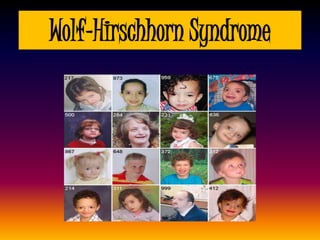
Wolf-Hirschhorn Syndrome
Wolf-Hirschhorn Syndrome (WHS) , also
known as Pitt-Rogers-Danks Syndrome or Pitt
Syndrome ----- was first described in 1961 by
Americans Herbert L. Cooper and Kurt Hirschhorn
and thereafter, gained worldwide attetion by
publications by the German Ulrich Wolf and
Hirschhorn, Humangenetik a German scientific
magazine.

  DELETION of the short arm of chromosome 4.
Physical Characteristics

   *Short Philtrum
   *Immunodeficient
   *Microcephaly (Small Head Size)
   *Seizures
   *Muscle Hypotonia
   *Renal Anomalies
   *Deafness
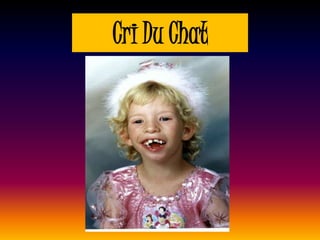
Cri Du Chat
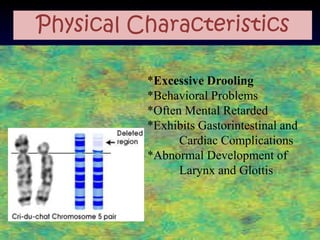
CRI DU CHAT also known as chromosome 5p
deletion syndrome, 5p minus syndrome or Lejeune’s
syndrome.
       *Is a rare genetic disorder due to a missing part
of chromosome 5. Its name is a French term (cat-cry
or call of the cat) referring to the characteristic cat-
like cry of affected children.
       *It was first described by Jerome Lejeune in
1963. The condition affects an 1 in 50,000 live
births, strikes all ethnicities, and is more common in
females by a 4:3 ratio.
   DELETION on the short arm of chromosome 5.
  Cries like a CAT
Physical Characteristics

          *Excessive Drooling
          *Behavioral Problems
          *Often Mental Retarded
          *Exhibits Gastorintestinal and
                Cardiac Complications
          *Abnormal Development of
                Larynx and Glottis
Jacobsen’s Syndrome
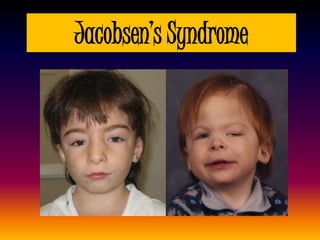
Jacobsen’s Syndrome also known as 11q deletion
disorder, is a rare congenital disorder resulting from
deletion of a terminal region of chromosome 11 that
includes band 11q24.1.
       *It can cause intellectual disabilities, a distinctive
facial appearance, and a variety of physical problems
including heart defects and a bleeding disorder.
       *The syndrome was first identified by Danish
physician Petra Jacobsen, and is believed to occur in
approximately 1 out of every 100,000 births.
  is a condition caused by the DELETION of a terminal
region of chromosome 11.
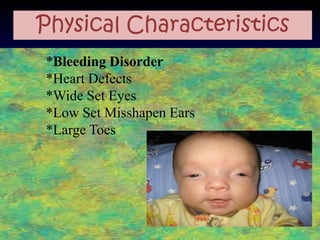
Physical Characteristics
*Bleeding Disorder
*Heart Defects
*Wide Set Eyes
*Low Set Misshapen Ears
*Large Toes
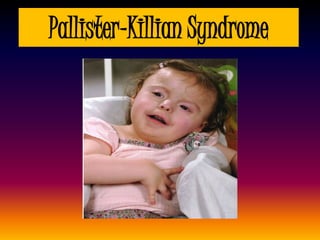
Pallister-Killian Syndrome
Pallister-Killian Syndrome also known as
Tetrasomy 12p Mosaicism or Pallister Mosaic
Aneuplody Syndrome.
       Is an extremely rare genetic disorder occurring in
humans. Pallister-Killian occurs due to the presence of
the anomalous extra isochromosome 12p, the short arm
of the twelfth chromosome.
       This leads to the development of Tetrasomy 12p.
Because      not     all   cells    have     the    extra
isochromosome, Pallister-Killian is a mosaic condition.
   TETRASOMY            in   the    smaller    arm     of
       chromosome 12.
  2n+2 or 48 chromosomes
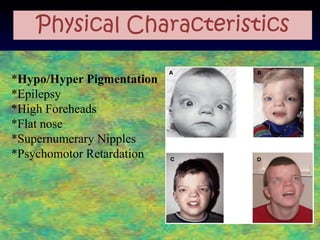
Physical Characteristics

*Hypo/Hyper Pigmentation
*Epilepsy
*High Foreheads
*Flat nose
*Supernumerary Nipples
*Psychomotor Retardation
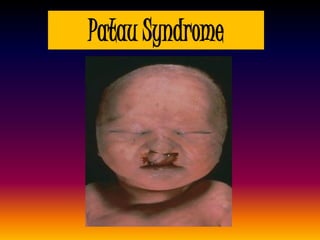
Patau Syndrome
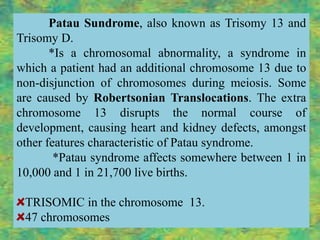
Patau Sundrome, also known as Trisomy 13 and
Trisomy D.
       *Is a chromosomal abnormality, a syndrome in
which a patient had an additional chromosome 13 due to
non-disjunction of chromosomes during meiosis. Some
are caused by Robertsonian Translocations. The extra
chromosome 13 disrupts the normal course of
development, causing heart and kidney defects, amongst
other features characteristic of Patau syndrome.
        *Patau syndrome affects somewhere between 1 in
10,000 and 1 in 21,700 live births.

 TRISOMIC in the chromosome 13.
 47 chromosomes
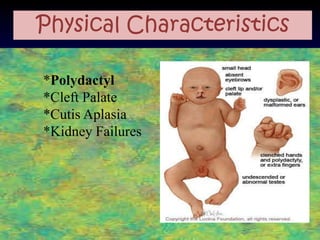
Physical Characteristics

*Polydactyl
*Cleft Palate
*Cutis Aplasia
*Kidney Failures
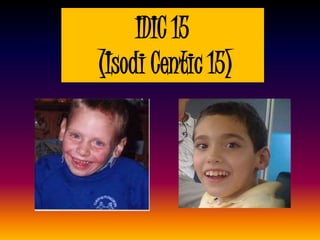
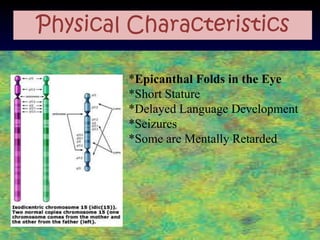
IDIC 15
(Isodi Centic 15)
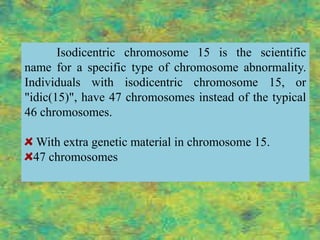
Isodicentric chromosome 15 is the scientific
name for a specific type of chromosome abnormality.
Individuals with isodicentric chromosome 15, or
"idic(15)", have 47 chromosomes instead of the typical
46 chromosomes.

 With extra genetic material in chromosome 15.
 47 chromosomes
Physical Characteristics

        *Epicanthal Folds in the Eye
        *Short Stature
        *Delayed Language Development
        *Seizures
        *Some are Mentally Retarded
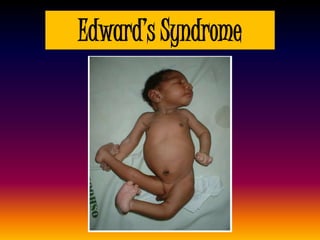
Edward’s Syndrome
Edward’s Syndrome also kwnon as Trisomy 18
(T18) or Trisome E.
        *It is a genetic disorder caused by the presence of
all of an extra 18th chromosome (Trisomy 18).
        *It is named after John H. Edwards, who first
described the syndrome in 1960. It is the second most
common autosomal trisomy, after Down Syndrome, that
carries to term.
        *Edward’s Syndrome occurs in around one in
6,000 live births and around 80 % of those affected are
female.
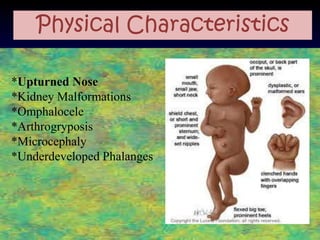
Physical Characteristics

*Upturned Nose
*Kidney Malformations
*Omphalocele
*Arthrogryposis
*Microcephaly
*Underdeveloped Phalanges
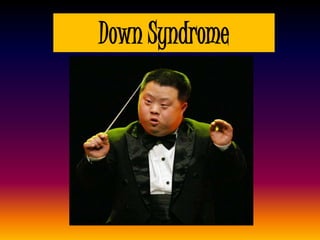
Down Syndrome
Down Syndrome also known as Trisomy 21, is a
chromosomal condition caused by the presence of all or
part of an extra 21st chromosome. It is named after John
Langdon Down, the British physician who described
the syndrome in 1866. The condition was clinically
described earlier in the 19th century by Jean Etienne
Dominique Esquirol in 1838 and Edouard Seguin in
1844. Down syndrome was identified as a chromosome
21Trisomy by Dr. Jerome Lejeune in 1959.
       *The average IQ of children with Down syndrome
is around 50, compared to normal children with an IQ of
100.
         With extra genetic material in chromosome 15.
         47 chromosomes
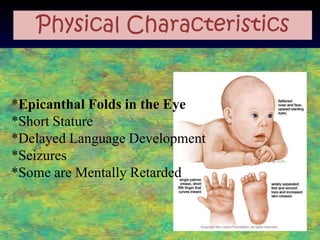
Physical Characteristics


*Epicanthal Folds in the Eye
*Short Stature
*Delayed Language Development
*Seizures
*Some are Mentally Retarded
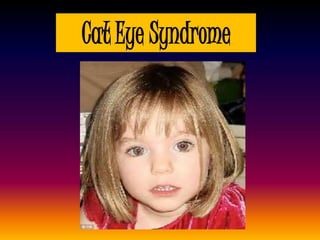
Cat Eye Syndrome
Cat Eye Syndrome is a rare condition caused
by the short arm (p) and a small section of the long
arm (q) of human Chromosome 22 being present three
(trisomic) or four times (tetrasomic) instead of the
usual two times.
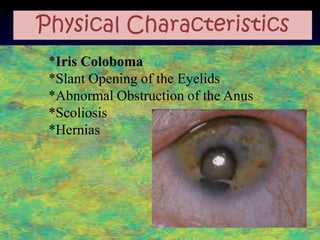
       *The term "Cat Eye" syndrome was coined
because of the particular appearance of the
vertical colobomas in the eyes of some patients.
However, over half of the CES patients in the
literature do not present with this trait.
       *There is no significant reduction in life
expectancy in patients who are not afflicted with one
of CES' life threatening abnormalities.
Physical Characteristics
 *Iris Coloboma
 *Slant Opening of the Eyelids
 *Abnormal Obstruction of the Anus
 *Scoliosis
 *Hernias

Autosomal Aberrations

  • 1.
    AUTOSOMAL Aberrations CRISTOBAL, Erica Joyce B. JARABE, Renee Beatriz P. AAPD2B
  • 2.
    UNIT V. HumanChromosomes and Chromosome Behavior OBJECTIVES At the end of the unit, the students should be able to: 1. Understand the importance of human karyotyping 2. Characterize individuals with sex chromosome aberrations 3. Differentiate the types of autosomal aberrations, and 4. Illustrate and explain the different structural abnormalities
  • 3.
    CHROMOSOMAL ABERRATIONS / ABNORMALITIES *** *It is the disruptions in the normal chromosomal content of a cell. *Originates as a result of an error during meiosis (Non- Disjunction), specifically in ANAPHASE stage. ***
  • 4.
  • 5.
    Wolf-Hirschhorn Syndrome (WHS), also known as Pitt-Rogers-Danks Syndrome or Pitt Syndrome ----- was first described in 1961 by Americans Herbert L. Cooper and Kurt Hirschhorn and thereafter, gained worldwide attetion by publications by the German Ulrich Wolf and Hirschhorn, Humangenetik a German scientific magazine. DELETION of the short arm of chromosome 4.
  • 6.
    Physical Characteristics *Short Philtrum *Immunodeficient *Microcephaly (Small Head Size) *Seizures *Muscle Hypotonia *Renal Anomalies *Deafness
  • 7.
  • 8.
    CRI DU CHATalso known as chromosome 5p deletion syndrome, 5p minus syndrome or Lejeune’s syndrome. *Is a rare genetic disorder due to a missing part of chromosome 5. Its name is a French term (cat-cry or call of the cat) referring to the characteristic cat- like cry of affected children. *It was first described by Jerome Lejeune in 1963. The condition affects an 1 in 50,000 live births, strikes all ethnicities, and is more common in females by a 4:3 ratio. DELETION on the short arm of chromosome 5. Cries like a CAT
  • 9.
    Physical Characteristics *Excessive Drooling *Behavioral Problems *Often Mental Retarded *Exhibits Gastorintestinal and Cardiac Complications *Abnormal Development of Larynx and Glottis
  • 10.
  • 11.
    Jacobsen’s Syndrome alsoknown as 11q deletion disorder, is a rare congenital disorder resulting from deletion of a terminal region of chromosome 11 that includes band 11q24.1. *It can cause intellectual disabilities, a distinctive facial appearance, and a variety of physical problems including heart defects and a bleeding disorder. *The syndrome was first identified by Danish physician Petra Jacobsen, and is believed to occur in approximately 1 out of every 100,000 births. is a condition caused by the DELETION of a terminal region of chromosome 11.
  • 12.
    Physical Characteristics *Bleeding Disorder *HeartDefects *Wide Set Eyes *Low Set Misshapen Ears *Large Toes
  • 13.
  • 14.
    Pallister-Killian Syndrome alsoknown as Tetrasomy 12p Mosaicism or Pallister Mosaic Aneuplody Syndrome. Is an extremely rare genetic disorder occurring in humans. Pallister-Killian occurs due to the presence of the anomalous extra isochromosome 12p, the short arm of the twelfth chromosome. This leads to the development of Tetrasomy 12p. Because not all cells have the extra isochromosome, Pallister-Killian is a mosaic condition. TETRASOMY in the smaller arm of chromosome 12. 2n+2 or 48 chromosomes
  • 15.
    Physical Characteristics *Hypo/Hyper Pigmentation *Epilepsy *HighForeheads *Flat nose *Supernumerary Nipples *Psychomotor Retardation
  • 16.
  • 17.
    Patau Sundrome, alsoknown as Trisomy 13 and Trisomy D. *Is a chromosomal abnormality, a syndrome in which a patient had an additional chromosome 13 due to non-disjunction of chromosomes during meiosis. Some are caused by Robertsonian Translocations. The extra chromosome 13 disrupts the normal course of development, causing heart and kidney defects, amongst other features characteristic of Patau syndrome. *Patau syndrome affects somewhere between 1 in 10,000 and 1 in 21,700 live births. TRISOMIC in the chromosome 13. 47 chromosomes
  • 18.
  • 19.
  • 20.
    Isodicentric chromosome 15is the scientific name for a specific type of chromosome abnormality. Individuals with isodicentric chromosome 15, or "idic(15)", have 47 chromosomes instead of the typical 46 chromosomes. With extra genetic material in chromosome 15. 47 chromosomes
  • 21.
    Physical Characteristics *Epicanthal Folds in the Eye *Short Stature *Delayed Language Development *Seizures *Some are Mentally Retarded
  • 22.
  • 23.
    Edward’s Syndrome alsokwnon as Trisomy 18 (T18) or Trisome E. *It is a genetic disorder caused by the presence of all of an extra 18th chromosome (Trisomy 18). *It is named after John H. Edwards, who first described the syndrome in 1960. It is the second most common autosomal trisomy, after Down Syndrome, that carries to term. *Edward’s Syndrome occurs in around one in 6,000 live births and around 80 % of those affected are female.
  • 24.
    Physical Characteristics *Upturned Nose *KidneyMalformations *Omphalocele *Arthrogryposis *Microcephaly *Underdeveloped Phalanges
  • 25.
  • 26.
    Down Syndrome alsoknown as Trisomy 21, is a chromosomal condition caused by the presence of all or part of an extra 21st chromosome. It is named after John Langdon Down, the British physician who described the syndrome in 1866. The condition was clinically described earlier in the 19th century by Jean Etienne Dominique Esquirol in 1838 and Edouard Seguin in 1844. Down syndrome was identified as a chromosome 21Trisomy by Dr. Jerome Lejeune in 1959. *The average IQ of children with Down syndrome is around 50, compared to normal children with an IQ of 100. With extra genetic material in chromosome 15. 47 chromosomes
  • 27.
    Physical Characteristics *Epicanthal Foldsin the Eye *Short Stature *Delayed Language Development *Seizures *Some are Mentally Retarded
  • 28.
  • 29.
    Cat Eye Syndromeis a rare condition caused by the short arm (p) and a small section of the long arm (q) of human Chromosome 22 being present three (trisomic) or four times (tetrasomic) instead of the usual two times. *The term "Cat Eye" syndrome was coined because of the particular appearance of the vertical colobomas in the eyes of some patients. However, over half of the CES patients in the literature do not present with this trait. *There is no significant reduction in life expectancy in patients who are not afflicted with one of CES' life threatening abnormalities.
  • 30.
    Physical Characteristics *IrisColoboma *Slant Opening of the Eyelids *Abnormal Obstruction of the Anus *Scoliosis *Hernias