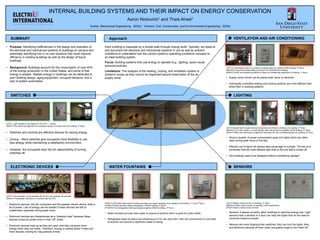
INTERNAL BUILDING SYSTEMS AND THEIR IMPACT ON ENERGY CONSERVATION
SUMMARY
Aaron Nickovich1 and Thais Alves2
ELECTRONIC DEVICES
LIGHTING
VENTILATION AND AIR CONDITIONING
WATER FOUNTAINS
• Purpose: Identifying inefficiencies in the design and operation of
the electrical and mechanical systems of buildings on campus and
potentially identifying low or no cost solutions that could improve
efficiency in existing buildings as well as the design of future
buildings.
• Background: Buildings account for the consumption of over 40%
of the energy production in the United States, and some of that
energy is wasted. Wasted energy in buildings can be attributed to
poor building design, aging equipment, occupant behavior, and a
lack of system automation.
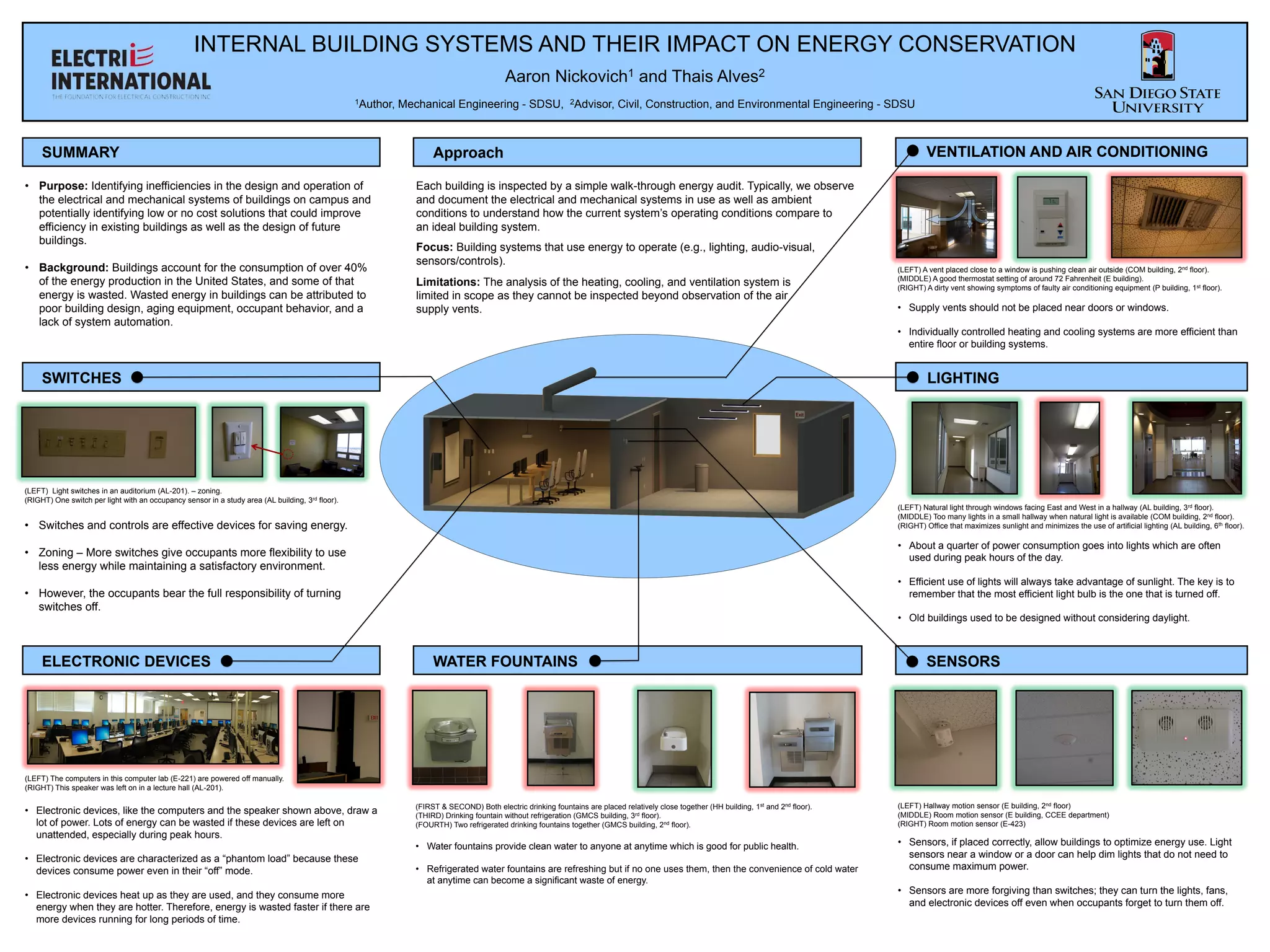
(LEFT) The computers in this computer lab (E-221) are powered off manually.
(RIGHT) This speaker was left on in a lecture hall (AL-201).
• Electronic devices, like the computers and the speaker shown above, draw a
lot of power. Lots of energy can be wasted if these devices are left on
unattended, especially during peak hours.
• Electronic devices are characterized as a “phantom load” because these
devices consume power even in their “off” mode.
• Electronic devices heat up as they are used, and they consume more
energy when they are hotter. Therefore, energy is wasted faster if there are
more devices running for long periods of time.
(LEFT) Natural light through windows facing East and West in a hallway (AL building, 3rd floor).
(MIDDLE) Too many lights in a small hallway when natural light is available (COM building, 2nd floor).
(RIGHT) Office that maximizes sunlight and minimizes the use of artificial lighting (AL building, 6th floor).
• About a quarter of power consumption goes into lights which are often
used during peak hours of the day.
• Efficient use of lights will always take advantage of sunlight. The key is to
remember that the most efficient light bulb is the one that is turned off.
• Old buildings used to be designed without considering daylight.
(FIRST & SECOND) Both electric drinking fountains are placed relatively close together (HH building, 1st and 2nd floor).
(THIRD) Drinking fountain without refrigeration (GMCS building, 3rd floor).
(FOURTH) Two refrigerated drinking fountains together (GMCS building, 2nd floor).
• Water fountains provide clean water to anyone at anytime which is good for public health.
• Refrigerated water fountains are refreshing but if no one uses them, then the convenience of cold water
at anytime can become a significant waste of energy.
SWITCHES
SENSORS
Text box
1Author, Mechanical Engineering - SDSU, 2Advisor, Civil, Construction, and Environmental Engineering - SDSU
Approach
Each building is inspected by a simple walk-through energy audit. Typically, we observe
and document the electrical and mechanical systems in use as well as ambient
conditions to understand how the current system’s operating conditions compare to
an ideal building system.
Focus: Building systems that use energy to operate (e.g., lighting, audio-visual,
sensors/controls).
Limitations: The analysis of the heating, cooling, and ventilation system is
limited in scope as they cannot be inspected beyond observation of the air
supply vents.
(LEFT) Light switches in an auditorium (AL-201). – zoning.
(RIGHT) One switch per light with an occupancy sensor in a study area (AL building, 3rd floor).
• Switches and controls are effective devices for saving energy.
• Zoning – More switches give occupants more flexibility to use
less energy while maintaining a satisfactory environment.
• However, the occupants bear the full responsibility of turning
switches off.
(LEFT) A vent placed close to a window is pushing clean air outside (COM building, 2nd floor).
(MIDDLE) A good thermostat setting of around 72 Fahrenheit (E building).
(RIGHT) A dirty vent showing symptoms of faulty air conditioning equipment (P building, 1st floor).
• Supply vents should not be placed near doors or windows.
• Individually controlled heating and cooling systems are more efficient than
entire floor or building systems.
(LEFT) Hallway motion sensor (E building, 2nd floor)
(MIDDLE) Room motion sensor (E building, CCEE department)
(RIGHT) Room motion sensor (E-423)
• Sensors, if placed correctly, allow buildings to optimize energy use. Light
sensors near a window or a door can help dim lights that do not need to
consume maximum power.
• Sensors are more forgiving than switches; they can turn the lights, fans,
and electronic devices off even when occupants forget to turn them off.

Aaron

  • 1.
    INTERNAL BUILDING SYSTEMSAND THEIR IMPACT ON ENERGY CONSERVATION SUMMARY Aaron Nickovich1 and Thais Alves2 ELECTRONIC DEVICES LIGHTING VENTILATION AND AIR CONDITIONING WATER FOUNTAINS • Purpose: Identifying inefficiencies in the design and operation of the electrical and mechanical systems of buildings on campus and potentially identifying low or no cost solutions that could improve efficiency in existing buildings as well as the design of future buildings. • Background: Buildings account for the consumption of over 40% of the energy production in the United States, and some of that energy is wasted. Wasted energy in buildings can be attributed to poor building design, aging equipment, occupant behavior, and a lack of system automation. (LEFT) The computers in this computer lab (E-221) are powered off manually. (RIGHT) This speaker was left on in a lecture hall (AL-201). • Electronic devices, like the computers and the speaker shown above, draw a lot of power. Lots of energy can be wasted if these devices are left on unattended, especially during peak hours. • Electronic devices are characterized as a “phantom load” because these devices consume power even in their “off” mode. • Electronic devices heat up as they are used, and they consume more energy when they are hotter. Therefore, energy is wasted faster if there are more devices running for long periods of time. (LEFT) Natural light through windows facing East and West in a hallway (AL building, 3rd floor). (MIDDLE) Too many lights in a small hallway when natural light is available (COM building, 2nd floor). (RIGHT) Office that maximizes sunlight and minimizes the use of artificial lighting (AL building, 6th floor). • About a quarter of power consumption goes into lights which are often used during peak hours of the day. • Efficient use of lights will always take advantage of sunlight. The key is to remember that the most efficient light bulb is the one that is turned off. • Old buildings used to be designed without considering daylight. (FIRST & SECOND) Both electric drinking fountains are placed relatively close together (HH building, 1st and 2nd floor). (THIRD) Drinking fountain without refrigeration (GMCS building, 3rd floor). (FOURTH) Two refrigerated drinking fountains together (GMCS building, 2nd floor). • Water fountains provide clean water to anyone at anytime which is good for public health. • Refrigerated water fountains are refreshing but if no one uses them, then the convenience of cold water at anytime can become a significant waste of energy. SWITCHES SENSORS Text box 1Author, Mechanical Engineering - SDSU, 2Advisor, Civil, Construction, and Environmental Engineering - SDSU Approach Each building is inspected by a simple walk-through energy audit. Typically, we observe and document the electrical and mechanical systems in use as well as ambient conditions to understand how the current system’s operating conditions compare to an ideal building system. Focus: Building systems that use energy to operate (e.g., lighting, audio-visual, sensors/controls). Limitations: The analysis of the heating, cooling, and ventilation system is limited in scope as they cannot be inspected beyond observation of the air supply vents. (LEFT) Light switches in an auditorium (AL-201). – zoning. (RIGHT) One switch per light with an occupancy sensor in a study area (AL building, 3rd floor). • Switches and controls are effective devices for saving energy. • Zoning – More switches give occupants more flexibility to use less energy while maintaining a satisfactory environment. • However, the occupants bear the full responsibility of turning switches off. (LEFT) A vent placed close to a window is pushing clean air outside (COM building, 2nd floor). (MIDDLE) A good thermostat setting of around 72 Fahrenheit (E building). (RIGHT) A dirty vent showing symptoms of faulty air conditioning equipment (P building, 1st floor). • Supply vents should not be placed near doors or windows. • Individually controlled heating and cooling systems are more efficient than entire floor or building systems. (LEFT) Hallway motion sensor (E building, 2nd floor) (MIDDLE) Room motion sensor (E building, CCEE department) (RIGHT) Room motion sensor (E-423) • Sensors, if placed correctly, allow buildings to optimize energy use. Light sensors near a window or a door can help dim lights that do not need to consume maximum power. • Sensors are more forgiving than switches; they can turn the lights, fans, and electronic devices off even when occupants forget to turn them off.