Literacy Magic 3 
• Speak like an essay in EVERY lesson 
• Write like an expert in EVERY subject 
• Aim high: allow TIME to improve work 
• Literacy in tutor time - Reading for pleasure, literacy booklets & 
tutorials, Accelerated Reader for selected Y7 students 
• DEAR – Drop Everything and Read Y7 
• Intervention - KS3 intervention timetable & one to one
Own your own CPD
News… 
• Sutton Trust report: What makes great teaching? 
• http://www.suttontrust.com/researcharchive/great-teaching/ 
• Ofsted inspections: clarification for schools 
• http://www.ofsted.gov.uk/sites/default/files/documents/inspection-- 
forms-and-guides/o/Ofsted%20inspections%20- 
%20clarification%20for%20schools.pdf 
• Survey on teacher workload from DfE – deadline 21 November 2014. 
• https://www.surveymonkey.com/s/Workloadchallenge
http://headguruteacher.com/2014/08/18/contemporary-educational- 
ideas-all-my-staff-should-know-about/ 
Twitter for CPD
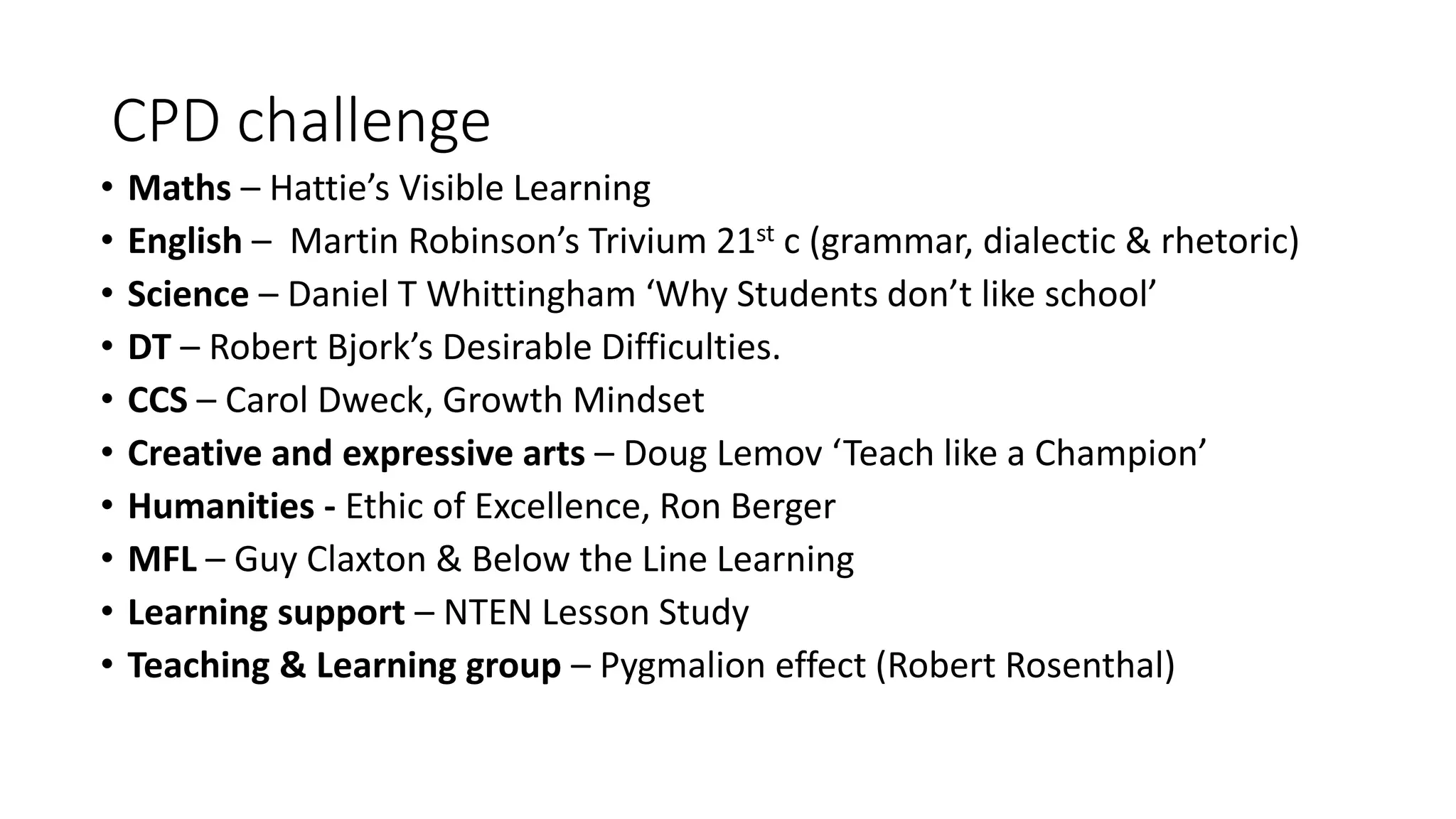
CPD challenge 
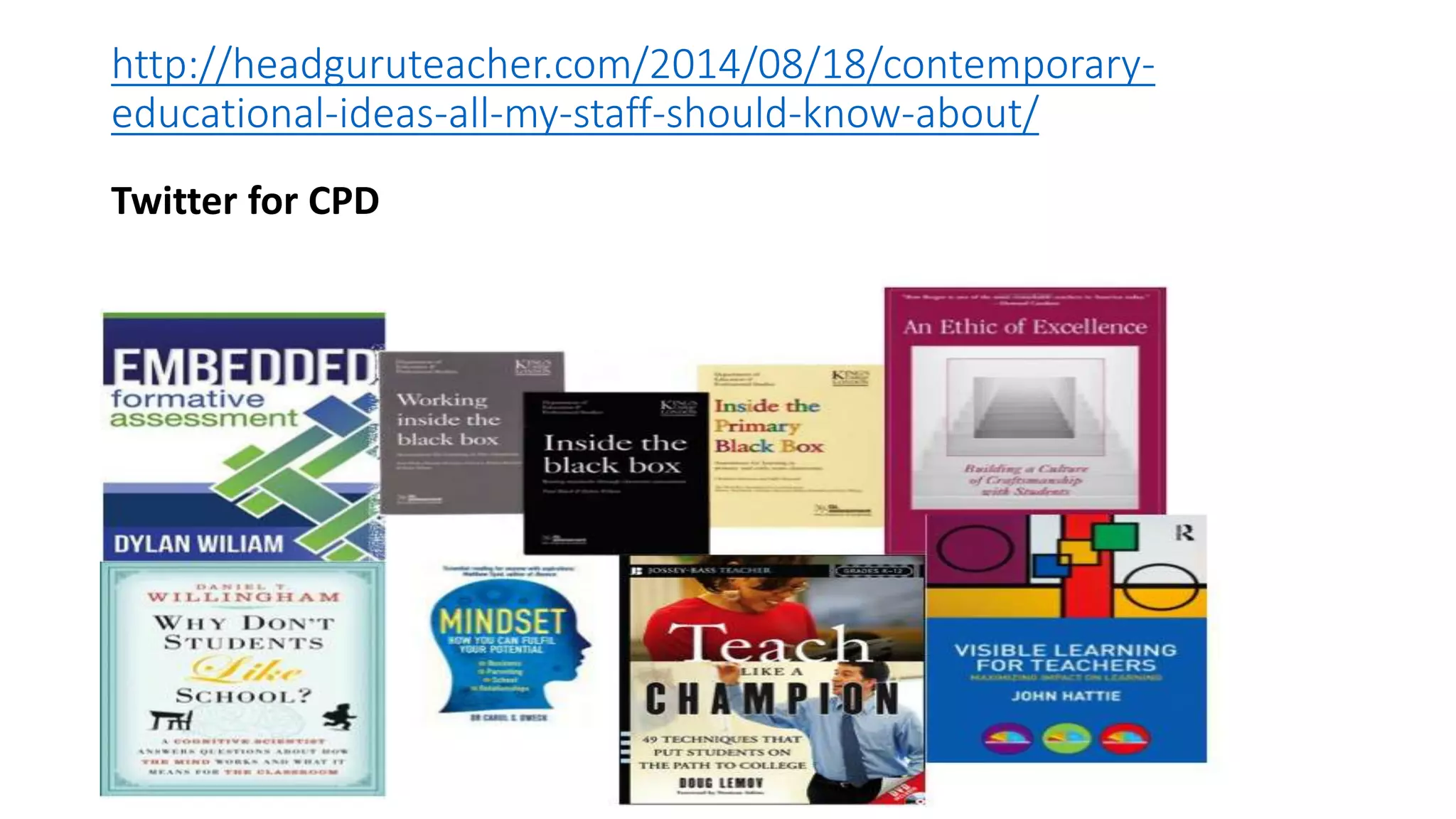
• Maths – Hattie’s Visible Learning 
• English – Martin Robinson’s Trivium 21st c (grammar, dialectic & rhetoric) 
• Science – Daniel T Whittingham ‘Why Students don’t like school’ 
• DT – Robert Bjork’s Desirable Difficulties. 
• CCS – Carol Dweck, Growth Mindset 
• Creative and expressive arts – Doug Lemov ‘Teach like a Champion’ 
• Humanities - Ethic of Excellence, Ron Berger 
• MFL – Guy Claxton & Below the Line Learning 
• Learning support – NTEN Lesson Study 
• Teaching & Learning group – Pygmalion effect (Robert Rosenthal)
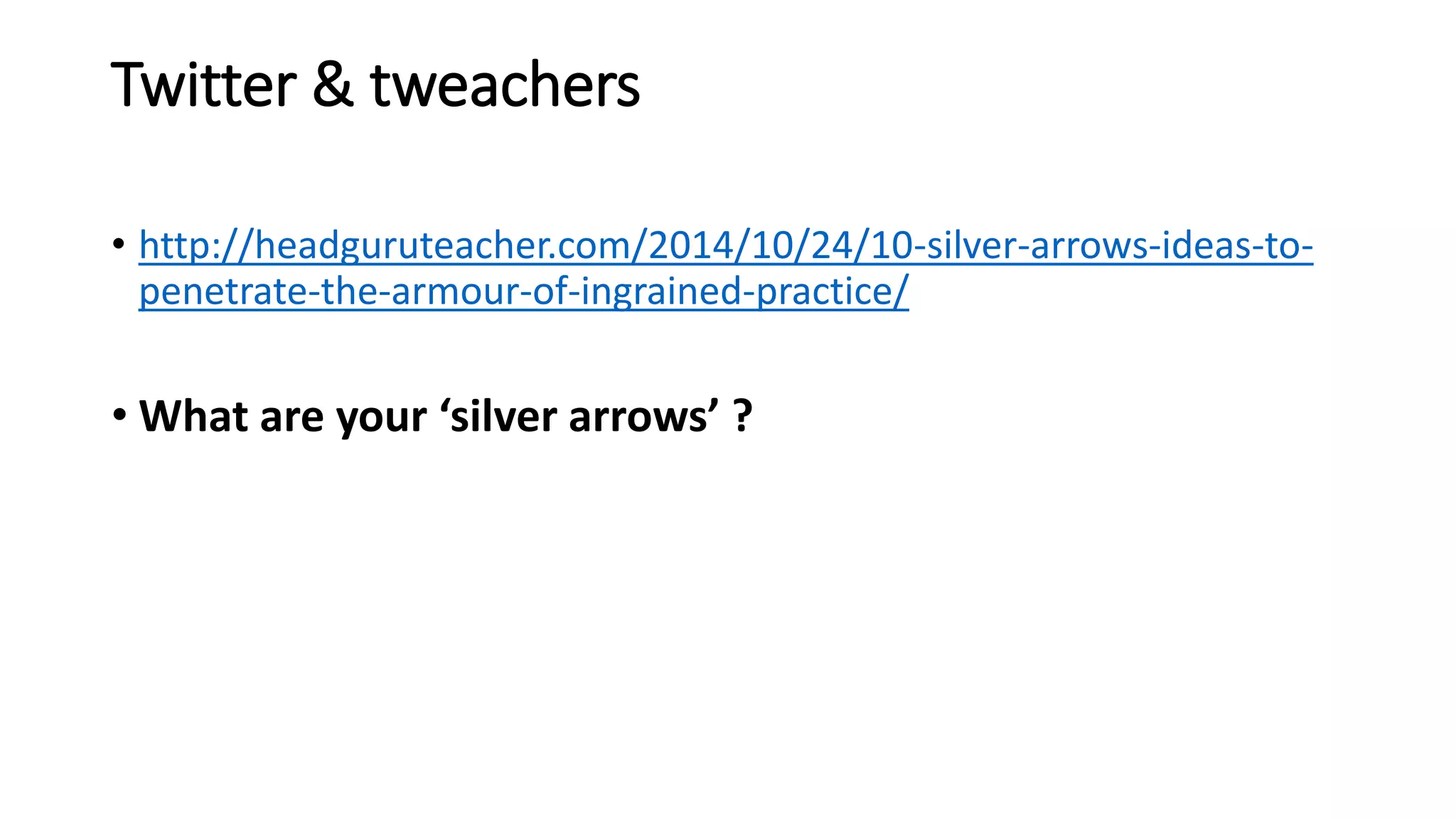
Twitter & tweachers 
• http://headguruteacher.com/2014/10/24/10-silver-arrows-ideas-to-penetrate- 
the-armour-of-ingrained-practice/ 
• What are your ‘silver arrows’ ?
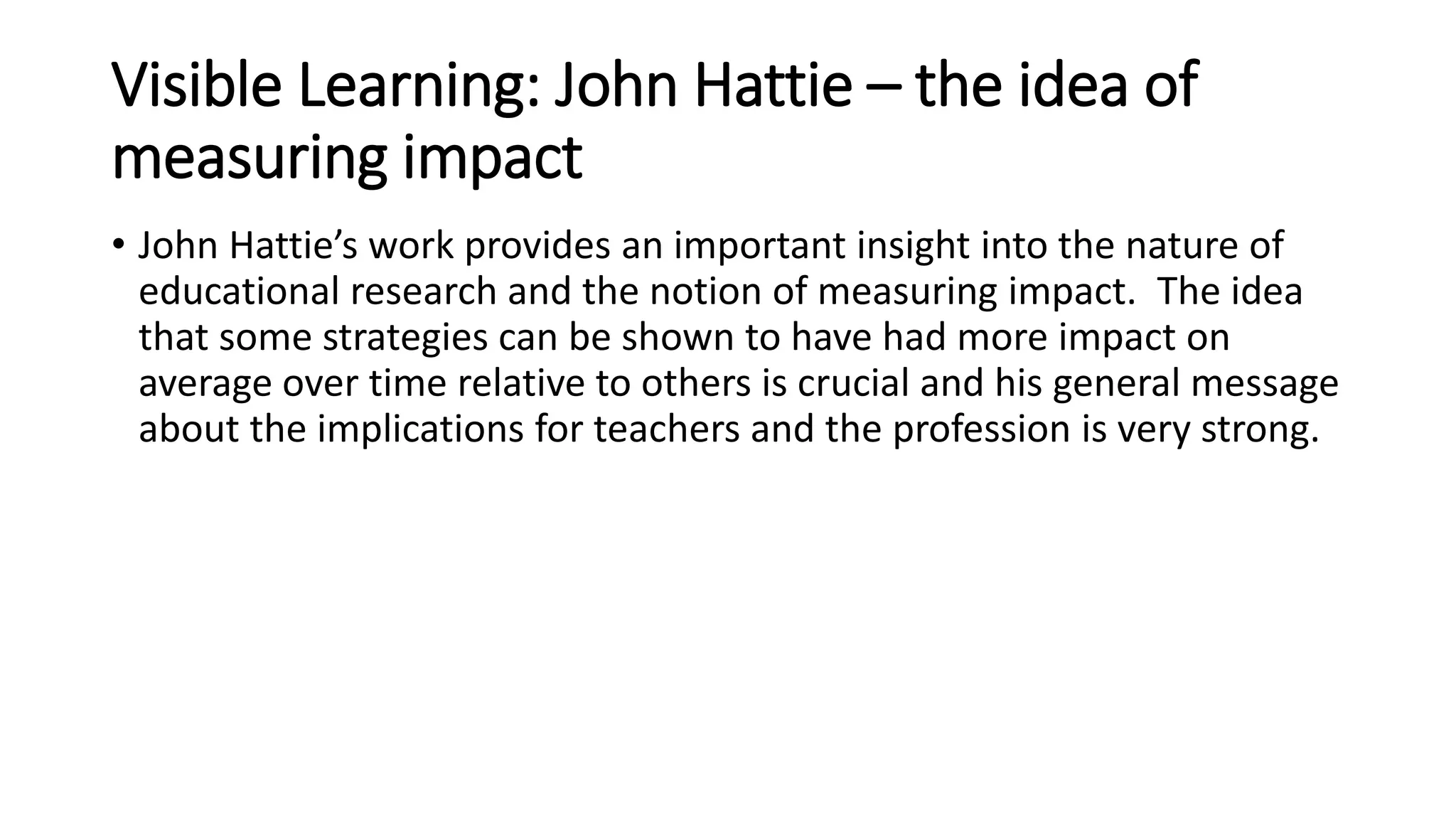
Visible Learning: John Hattie – the idea of 
measuring impact 
• John Hattie’s work provides an important insight into the nature of 
educational research and the notion of measuring impact. The idea 
that some strategies can be shown to have had more impact on 
average over time relative to others is crucial and his general message 
about the implications for teachers and the profession is very strong.
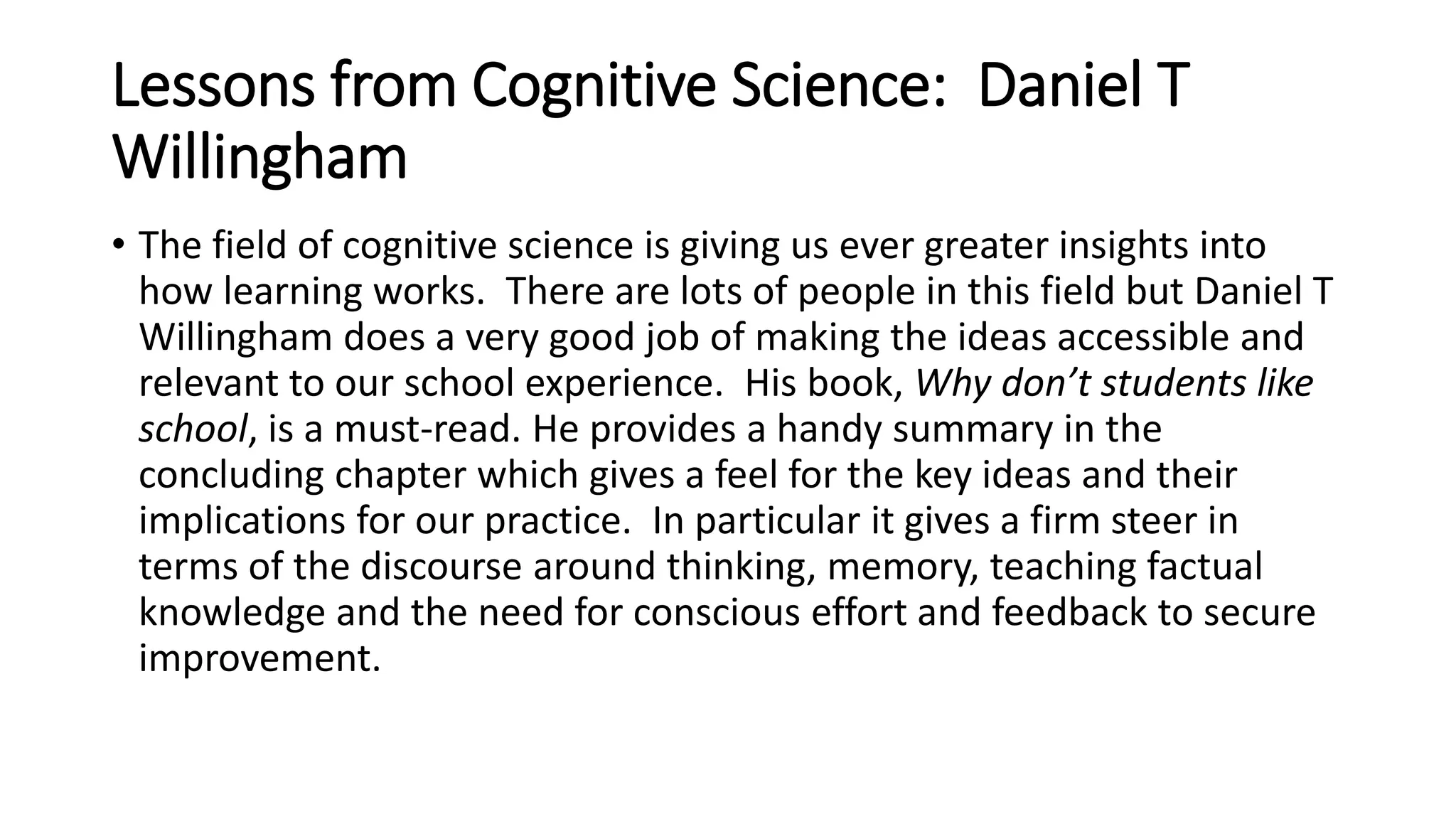
Lessons from Cognitive Science: Daniel T 
Willingham 
• The field of cognitive science is giving us ever greater insights into 
how learning works. There are lots of people in this field but Daniel T 
Willingham does a very good job of making the ideas accessible and 
relevant to our school experience. His book, Why don’t students like 
school, is a must-read. He provides a handy summary in the 
concluding chapter which gives a feel for the key ideas and their 
implications for our practice. In particular it gives a firm steer in 
terms of the discourse around thinking, memory, teaching factual 
knowledge and the need for conscious effort and feedback to secure 
improvement.
Sutton Trust: the seven examples of strategies 
unsupported by evidence are: 
• Using praise lavishly For low-attaining students praise that is meant to be encouraging and protective can 
actually convey a message of low expectations. The evidence shows children whose failure generates sympathy 
are more likely to attribute it to lack of ability than those who are presented with anger. 
• Allowing learners to discover key ideas for themselves Enthusiasm for ‘discovery learning’ is not supported by 
research evidence, which broadly favours direct instruction. 
• Grouping students by ability Evidence on the effects of grouping by ability, either by allocating students to 
different classes, or to within-class groups, suggests that it makes very little difference to learning outcomes. It 
can result in teachers failing to accommodate different needs within an ability group and over-playing differences 
between groups, going too fast with the high-ability groups and too slow with the low. 
• Encouraging re-reading and highlighting to memorise key ideasTesting yourself, trying to generate answers, and 
deliberately creating intervals between study to allow forgetting, are all more effective approaches to 
memorisation than re-reading or highlighting. 
• Addressing low confidence and aspirations before teaching content Attempts to enhance motivation prior to 
teaching content are unlikely to succeed and even if they do the impact on subsequent learning is close to zero. If 
the poor motivation of low attainers is a logical response to repeated failure starting to get them to succeed 
through learning content will improve motivation and confidence. 
• Presenting information to students in their preferred learning styleDespite a recent survey showing over 90% of 
teachers believe individuals learn better when they receive information in their preferred learning style, the 
psychological evidence is clear that there are no benefits to this method. 
• Being active, rather than listening passively, helps you rememberThis claim is commonly presented in the form 
of a ‘learning pyramid’ which shows precise percentages of material that will be retained when different levels of 
activity are employed. These percentages have no empirical basis and are pure fiction…

Briefing - 3rd Nov - Own Your CPD

  • 1.
    Literacy Magic 3 • Speak like an essay in EVERY lesson • Write like an expert in EVERY subject • Aim high: allow TIME to improve work • Literacy in tutor time - Reading for pleasure, literacy booklets & tutorials, Accelerated Reader for selected Y7 students • DEAR – Drop Everything and Read Y7 • Intervention - KS3 intervention timetable & one to one
  • 2.
  • 3.
    News… • SuttonTrust report: What makes great teaching? • http://www.suttontrust.com/researcharchive/great-teaching/ • Ofsted inspections: clarification for schools • http://www.ofsted.gov.uk/sites/default/files/documents/inspection-- forms-and-guides/o/Ofsted%20inspections%20- %20clarification%20for%20schools.pdf • Survey on teacher workload from DfE – deadline 21 November 2014. • https://www.surveymonkey.com/s/Workloadchallenge
  • 4.
  • 5.
    CPD challenge •Maths – Hattie’s Visible Learning • English – Martin Robinson’s Trivium 21st c (grammar, dialectic & rhetoric) • Science – Daniel T Whittingham ‘Why Students don’t like school’ • DT – Robert Bjork’s Desirable Difficulties. • CCS – Carol Dweck, Growth Mindset • Creative and expressive arts – Doug Lemov ‘Teach like a Champion’ • Humanities - Ethic of Excellence, Ron Berger • MFL – Guy Claxton & Below the Line Learning • Learning support – NTEN Lesson Study • Teaching & Learning group – Pygmalion effect (Robert Rosenthal)
  • 6.
    Twitter & tweachers • http://headguruteacher.com/2014/10/24/10-silver-arrows-ideas-to-penetrate- the-armour-of-ingrained-practice/ • What are your ‘silver arrows’ ?
  • 7.
    Visible Learning: JohnHattie – the idea of measuring impact • John Hattie’s work provides an important insight into the nature of educational research and the notion of measuring impact. The idea that some strategies can be shown to have had more impact on average over time relative to others is crucial and his general message about the implications for teachers and the profession is very strong.
  • 8.
    Lessons from CognitiveScience: Daniel T Willingham • The field of cognitive science is giving us ever greater insights into how learning works. There are lots of people in this field but Daniel T Willingham does a very good job of making the ideas accessible and relevant to our school experience. His book, Why don’t students like school, is a must-read. He provides a handy summary in the concluding chapter which gives a feel for the key ideas and their implications for our practice. In particular it gives a firm steer in terms of the discourse around thinking, memory, teaching factual knowledge and the need for conscious effort and feedback to secure improvement.
  • 9.
    Sutton Trust: theseven examples of strategies unsupported by evidence are: • Using praise lavishly For low-attaining students praise that is meant to be encouraging and protective can actually convey a message of low expectations. The evidence shows children whose failure generates sympathy are more likely to attribute it to lack of ability than those who are presented with anger. • Allowing learners to discover key ideas for themselves Enthusiasm for ‘discovery learning’ is not supported by research evidence, which broadly favours direct instruction. • Grouping students by ability Evidence on the effects of grouping by ability, either by allocating students to different classes, or to within-class groups, suggests that it makes very little difference to learning outcomes. It can result in teachers failing to accommodate different needs within an ability group and over-playing differences between groups, going too fast with the high-ability groups and too slow with the low. • Encouraging re-reading and highlighting to memorise key ideasTesting yourself, trying to generate answers, and deliberately creating intervals between study to allow forgetting, are all more effective approaches to memorisation than re-reading or highlighting. • Addressing low confidence and aspirations before teaching content Attempts to enhance motivation prior to teaching content are unlikely to succeed and even if they do the impact on subsequent learning is close to zero. If the poor motivation of low attainers is a logical response to repeated failure starting to get them to succeed through learning content will improve motivation and confidence. • Presenting information to students in their preferred learning styleDespite a recent survey showing over 90% of teachers believe individuals learn better when they receive information in their preferred learning style, the psychological evidence is clear that there are no benefits to this method. • Being active, rather than listening passively, helps you rememberThis claim is commonly presented in the form of a ‘learning pyramid’ which shows precise percentages of material that will be retained when different levels of activity are employed. These percentages have no empirical basis and are pure fiction…