+
Introduction to the
Advanced Portfolio
Learning Objective: Am I able to explore
documentary conventions within real media
texts?
+
Your brief
 To make a five-minute extract of an original
television documentary, to be submitted with two of
the following:
1) A 30-second radio advert for your documentary
2) A newspaper advert for your documentary
3) A double-page spread about your documentary,
from a TV listings magazine.
+
Research – Real Media
 Yup, this again…but MORE!
 This time you are going to film you talking about your
real media research, as a ‘Top 5 Documentaries’
video.
 The purpose of this is to get used to talking in from
of the camera naturally. A new requirement from the
exam board…
+
Getting Used to the Camera
 The point of this task – as well as successfully completing your
research – is to get used to creating a confident video diary.
 When you produce your evaluation you must be confident and clear
throughout your evaluation. The challenge you need to master is NOT
READING OFF THE SCREEN/A SCRIPT WHILST FILMING.
 If you look like you are reading from a script for the main task
evaluation you will be marked down. It might feel cheesy, but you must
be able to discuss your work as if you are having a conversation, not
reading off a sheet of paper.
 A tip is imagine you are talking to one person about your work – they
know nothing about media studies so you must be approachable and
explain it to them step-by-step.
+
Look at the experts…
 Have a look at these presenters talking to the camera…they
will have prepared and practised ahead of filming. So appear
natural and not stilted when speaking.
 Brian Cox - https://www.youtube.com/watch?v=NOqR1Csv7yg
 Charlie Brooker -
https://www.youtube.com/watch?v=y8MjoB3vgv8
 Homes Under the Hammer -
https://www.youtube.com/watch?v=ngNEPySNs14
+
Conventions refresher
Can you recall any general
documentary conventions?
+
Documentary Conventions
 Voiceover – Usually authoritative – allows audience to assume
they are an expert on subject or that they’re opinion is the
‘right’ one.
 ‘Actual’ Footage – Documentary is non-fiction so must include
footage which has captured reality in some way. The audience
must believe they are watching a ‘real’ event.
 ‘Natural’ Lighting and Sound – build up sense of reality.
 Archive footage – Aids authenticity and provides additional
information.
+
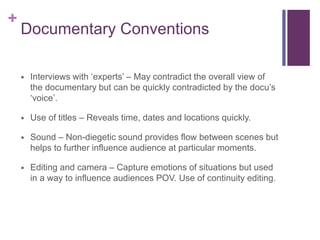
Documentary Conventions
 Interviews with ‘experts’ – May contradict the overall view of
the documentary but can be quickly contradicted by the docu’s
‘voice’.
 Use of titles – Reveals time, dates and locations quickly.
 Sound – Non-diegetic sound provides flow between scenes but
helps to further influence audience at particular moments.
 Editing and camera – Capture emotions of situations but used
in a way to influence audiences POV. Use of continuity editing.
+
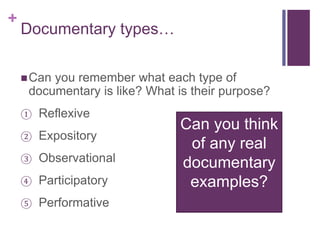
Documentary types…
Can you remember what each type of
documentary is like? What is their purpose?
① Reflexive
② Expository
③ Observational
④ Participatory
⑤ Performative
Can you think
of any real
documentary
examples?
+
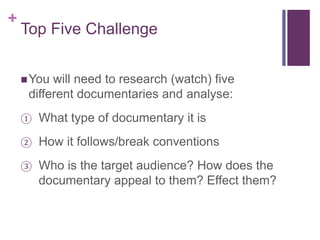
Top Five Challenge
You will need to research (watch) five
different documentaries and analyse:
① What type of documentary it is
② How it follows/break conventions
③ Who is the target audience? How does the
documentary appeal to them? Effect them?

A2 Media - Documentary Research Task

  • 1.
    + Introduction to the AdvancedPortfolio Learning Objective: Am I able to explore documentary conventions within real media texts?
  • 2.
    + Your brief  Tomake a five-minute extract of an original television documentary, to be submitted with two of the following: 1) A 30-second radio advert for your documentary 2) A newspaper advert for your documentary 3) A double-page spread about your documentary, from a TV listings magazine.
  • 3.
    + Research – RealMedia  Yup, this again…but MORE!  This time you are going to film you talking about your real media research, as a ‘Top 5 Documentaries’ video.  The purpose of this is to get used to talking in from of the camera naturally. A new requirement from the exam board…
  • 4.
    + Getting Used tothe Camera  The point of this task – as well as successfully completing your research – is to get used to creating a confident video diary.  When you produce your evaluation you must be confident and clear throughout your evaluation. The challenge you need to master is NOT READING OFF THE SCREEN/A SCRIPT WHILST FILMING.  If you look like you are reading from a script for the main task evaluation you will be marked down. It might feel cheesy, but you must be able to discuss your work as if you are having a conversation, not reading off a sheet of paper.  A tip is imagine you are talking to one person about your work – they know nothing about media studies so you must be approachable and explain it to them step-by-step.
  • 5.
    + Look at theexperts…  Have a look at these presenters talking to the camera…they will have prepared and practised ahead of filming. So appear natural and not stilted when speaking.  Brian Cox - https://www.youtube.com/watch?v=NOqR1Csv7yg  Charlie Brooker - https://www.youtube.com/watch?v=y8MjoB3vgv8  Homes Under the Hammer - https://www.youtube.com/watch?v=ngNEPySNs14
  • 6.
    + Conventions refresher Can yourecall any general documentary conventions?
  • 7.
    + Documentary Conventions  Voiceover– Usually authoritative – allows audience to assume they are an expert on subject or that they’re opinion is the ‘right’ one.  ‘Actual’ Footage – Documentary is non-fiction so must include footage which has captured reality in some way. The audience must believe they are watching a ‘real’ event.  ‘Natural’ Lighting and Sound – build up sense of reality.  Archive footage – Aids authenticity and provides additional information.
  • 8.
    + Documentary Conventions  Interviewswith ‘experts’ – May contradict the overall view of the documentary but can be quickly contradicted by the docu’s ‘voice’.  Use of titles – Reveals time, dates and locations quickly.  Sound – Non-diegetic sound provides flow between scenes but helps to further influence audience at particular moments.  Editing and camera – Capture emotions of situations but used in a way to influence audiences POV. Use of continuity editing.
  • 9.
    + Documentary types… Can youremember what each type of documentary is like? What is their purpose? ① Reflexive ② Expository ③ Observational ④ Participatory ⑤ Performative Can you think of any real documentary examples?
  • 10.
    + Top Five Challenge Youwill need to research (watch) five different documentaries and analyse: ① What type of documentary it is ② How it follows/break conventions ③ Who is the target audience? How does the documentary appeal to them? Effect them?