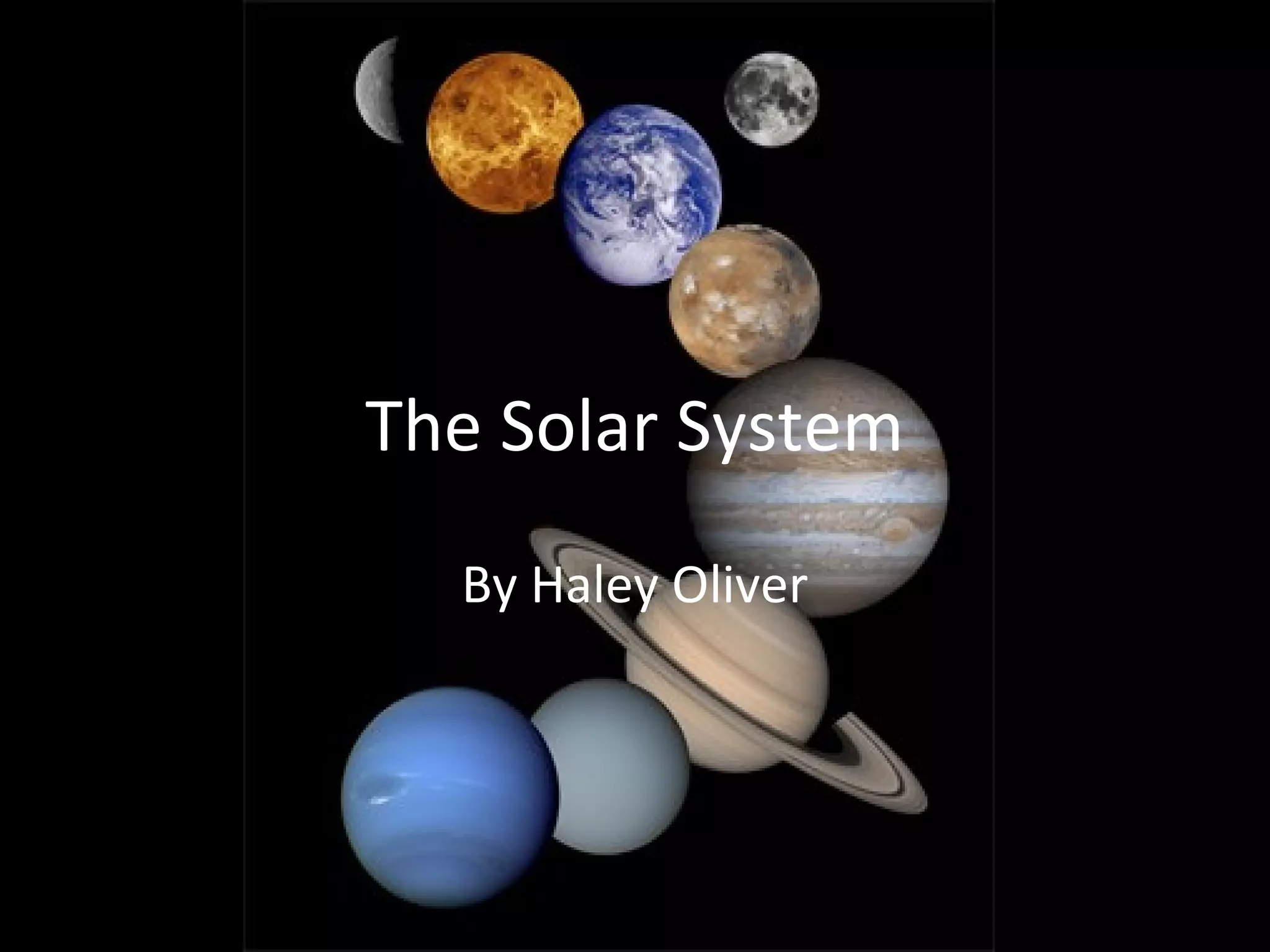
The Solar System
  By Haley Oliver
Title Page
                                  The Sun
                                  Mercury
                                  Venus
Click Here for a Quick Tour Through the Solar System

                                  Earth
                                  Mars
                                  Jupiter
                                  Saturn
                                  Uranus
                                  Neptune
                                  Luna
                                  Work Cited
The Sun
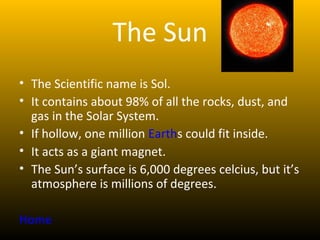
• The Scientific name is Sol.
• It contains about 98% of all the rocks, dust, and
  gas in the Solar System.
• If hollow, one million Earths could fit inside.
• It acts as a giant magnet.
• The Sun’s surface is 6,000 degrees celcius, but it’s
  atmosphere is millions of degrees.

Home
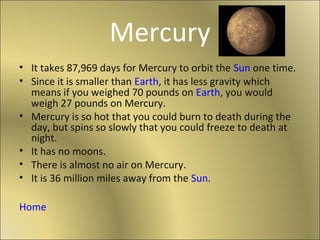
Mercury
• It takes 87,969 days for Mercury to orbit the Sun one time.
• Since it is smaller than Earth, it has less gravity which
  means if you weighed 70 pounds on Earth, you would
  weigh 27 pounds on Mercury.
• Mercury is so hot that you could burn to death during the
  day, but spins so slowly that you could freeze to death at
  night.
• It has no moons.
• There is almost no air on Mercury.
• It is 36 million miles away from the Sun.

Home
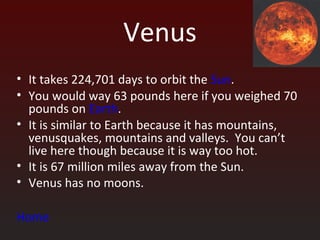
Venus
• It takes 224,701 days to orbit the Sun.
• You would way 63 pounds here if you weighed 70
  pounds on Earth.
• It is similar to Earth because it has mountains,
  venusquakes, mountains and valleys. You can’t
  live here though because it is way too hot.
• It is 67 million miles away from the Sun.
• Venus has no moons.

Home
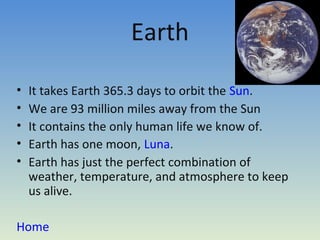
Earth

•   It takes Earth 365.3 days to orbit the Sun.
•   We are 93 million miles away from the Sun
•   It contains the only human life we know of.
•   Earth has one moon, Luna.
•   Earth has just the perfect combination of
    weather, temperature, and atmosphere to keep
    us alive.

Home
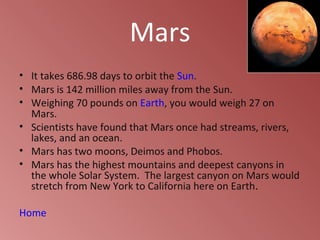
Mars
• It takes 686.98 days to orbit the Sun.
• Mars is 142 million miles away from the Sun.
• Weighing 70 pounds on Earth, you would weigh 27 on
  Mars.
• Scientists have found that Mars once had streams, rivers,
  lakes, and an ocean.
• Mars has two moons, Deimos and Phobos.
• Mars has the highest mountains and deepest canyons in
  the whole Solar System. The largest canyon on Mars would
  stretch from New York to California here on Earth.

Home
Jupiter
• It takes Jupiter 4332.59 days to complete one orbit around the Sun.
• It is 482 million miles away from the Sun.
• You would weight 185 pounds on Jupiter if you weighed 70 pounds
  on Earth.
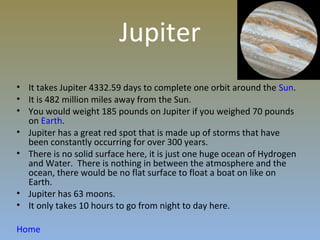
• Jupiter has a great red spot that is made up of storms that have
  been constantly occurring for over 300 years.
• There is no solid surface here, it is just one huge ocean of Hydrogen
  and Water. There is nothing in between the atmosphere and the
  ocean, there would be no flat surface to float a boat on like on
  Earth.
• Jupiter has 63 moons.
• It only takes 10 hours to go from night to day here.

Home
Saturn
• It takes 10,759.2 days to orbit the Sun.
• You would weigh 82 pounds here if you weighed 70
  pounds on Earth.
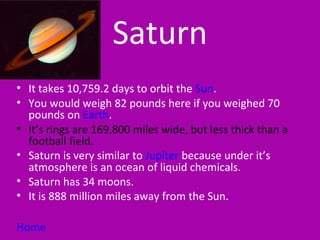
• It’s rings are 169,800 miles wide, but less thick than a
  football field.
• Saturn is very similar to Jupiter because under it’s
  atmosphere is an ocean of liquid chemicals.
• Saturn has 34 moons.
• It is 888 million miles away from the Sun.

Home
Uranus
• It takes 30,684 days for Uranus to orbit the Sun.
• It is 1, 784 million miles away from the Sun.
• You would weigh 82 pounds here, if you weighed 70
  pounds on Earth.
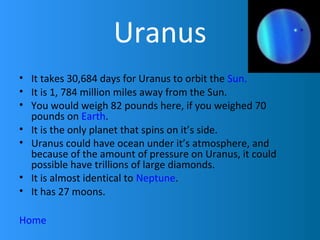
• It is the only planet that spins on it’s side.
• Uranus could have ocean under it’s atmosphere, and
  because of the amount of pressure on Uranus, it could
  possible have trillions of large diamonds.
• It is almost identical to Neptune.
• It has 27 moons.

Home
Neptune
• It takes 60,190 days to orbit the Sun.
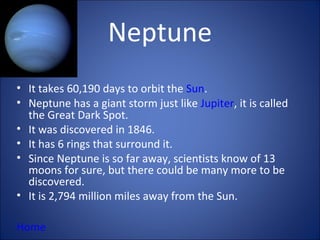
• Neptune has a giant storm just like Jupiter, it is called
  the Great Dark Spot.
• It was discovered in 1846.
• It has 6 rings that surround it.
• Since Neptune is so far away, scientists know of 13
  moons for sure, but there could be many more to be
  discovered.
• It is 2,794 million miles away from the Sun.

Home
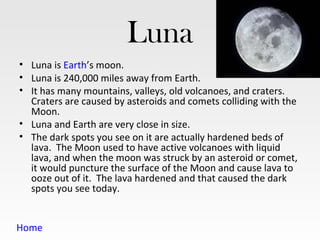
Luna
• Luna is Earth’s moon.
• Luna is 240,000 miles away from Earth.
• It has many mountains, valleys, old volcanoes, and craters.
  Craters are caused by asteroids and comets colliding with the
  Moon.
• Luna and Earth are very close in size.
• The dark spots you see on it are actually hardened beds of
  lava. The Moon used to have active volcanoes with liquid
  lava, and when the moon was struck by an asteroid or comet,
  it would puncture the surface of the Moon and cause lava to
  ooze out of it. The lava hardened and that caused the dark
  spots you see today.


Home
Work Cited                                             Home
"BNSC - Venus." BNSC - Home. 6 Oct. 2008 http://www.bnsc.gov.uk/lzconte.
"Discover Saturn." Windows to the Universe. 6 Oct. 2008 <http://www.windows.ucar.edu/to
"Geography4Kids.com: Wallpapers: Earth's Moon." Rader's GEOGRAPHY 4 KIDS.COM. 6 Oct. 2008
<http://www.geography4kids.com
"Google Earth Blog: Google Jupiter." Google Earth Blog. 6 Oct. 2008 http://gearthblog.com/blog/archiv.
http://www.youtube.com/watch?v=Yj5Lt3FxU28&feature=related
Jong, Ing-Chang. "ICJ Home Page." ICJ. 8 July 1998. 6 Oct. 2008 <www.comp.uark.edu/~icjong/>.

 "Mars, Earth - Closest Approach in Recorded History." Latest Email Hoaxes - Current Internet Scams - Hoax-
 Slayer. 6 Oct. 2008 http://www.hoax-slayer.com/mars
 "Neptune - DiracDelta Science & Engineering Encyclopedia." Engineering Database. 6 Oct. 2008
 <http://www.diracdelta.co.uk/science
 "RedShift™ Astronomy News » Uranus." RedShift™ Astronomy News . 6 Oct. 2008
 <http://news.redshift.de/index.php
 "Rocks from space." Rocks from space. 6 Oct. 2008 http://rocksfromspace.open.ac.uk.
 "Solar System - Interactive Solar System - By KidsAstronomy.com." Astronomy For Kids -
 KidsAstronomy.com. 6 Oct. 2008 <http://www.kidsastronomy.com/solar_s
  "StarDate Online | Solar System Guide | Sun." StarDate Online - Your Guide to the Universe. 6 Oct. 2008
  http://stardate.org/resources/ss.
 " What can mom serve us now? - Astronomy.com blog." Astronomy.com Forums. 6 Oct. 2008
 <http://cs.astronomy.com/asycs/b

The solar-system-1223322846399979-9 (1)

  • 1.
    The Solar System By Haley Oliver
  • 2.
    Title Page The Sun Mercury Venus Click Here for a Quick Tour Through the Solar System Earth Mars Jupiter Saturn Uranus Neptune Luna Work Cited
  • 3.
    The Sun • TheScientific name is Sol. • It contains about 98% of all the rocks, dust, and gas in the Solar System. • If hollow, one million Earths could fit inside. • It acts as a giant magnet. • The Sun’s surface is 6,000 degrees celcius, but it’s atmosphere is millions of degrees. Home
  • 4.
    Mercury • It takes87,969 days for Mercury to orbit the Sun one time. • Since it is smaller than Earth, it has less gravity which means if you weighed 70 pounds on Earth, you would weigh 27 pounds on Mercury. • Mercury is so hot that you could burn to death during the day, but spins so slowly that you could freeze to death at night. • It has no moons. • There is almost no air on Mercury. • It is 36 million miles away from the Sun. Home
  • 5.
    Venus • It takes224,701 days to orbit the Sun. • You would way 63 pounds here if you weighed 70 pounds on Earth. • It is similar to Earth because it has mountains, venusquakes, mountains and valleys. You can’t live here though because it is way too hot. • It is 67 million miles away from the Sun. • Venus has no moons. Home
  • 6.
    Earth • It takes Earth 365.3 days to orbit the Sun. • We are 93 million miles away from the Sun • It contains the only human life we know of. • Earth has one moon, Luna. • Earth has just the perfect combination of weather, temperature, and atmosphere to keep us alive. Home
  • 7.
    Mars • It takes686.98 days to orbit the Sun. • Mars is 142 million miles away from the Sun. • Weighing 70 pounds on Earth, you would weigh 27 on Mars. • Scientists have found that Mars once had streams, rivers, lakes, and an ocean. • Mars has two moons, Deimos and Phobos. • Mars has the highest mountains and deepest canyons in the whole Solar System. The largest canyon on Mars would stretch from New York to California here on Earth. Home
  • 8.
    Jupiter • It takesJupiter 4332.59 days to complete one orbit around the Sun. • It is 482 million miles away from the Sun. • You would weight 185 pounds on Jupiter if you weighed 70 pounds on Earth. • Jupiter has a great red spot that is made up of storms that have been constantly occurring for over 300 years. • There is no solid surface here, it is just one huge ocean of Hydrogen and Water. There is nothing in between the atmosphere and the ocean, there would be no flat surface to float a boat on like on Earth. • Jupiter has 63 moons. • It only takes 10 hours to go from night to day here. Home
  • 9.
    Saturn • It takes10,759.2 days to orbit the Sun. • You would weigh 82 pounds here if you weighed 70 pounds on Earth. • It’s rings are 169,800 miles wide, but less thick than a football field. • Saturn is very similar to Jupiter because under it’s atmosphere is an ocean of liquid chemicals. • Saturn has 34 moons. • It is 888 million miles away from the Sun. Home
  • 10.
    Uranus • It takes30,684 days for Uranus to orbit the Sun. • It is 1, 784 million miles away from the Sun. • You would weigh 82 pounds here, if you weighed 70 pounds on Earth. • It is the only planet that spins on it’s side. • Uranus could have ocean under it’s atmosphere, and because of the amount of pressure on Uranus, it could possible have trillions of large diamonds. • It is almost identical to Neptune. • It has 27 moons. Home
  • 11.
    Neptune • It takes60,190 days to orbit the Sun. • Neptune has a giant storm just like Jupiter, it is called the Great Dark Spot. • It was discovered in 1846. • It has 6 rings that surround it. • Since Neptune is so far away, scientists know of 13 moons for sure, but there could be many more to be discovered. • It is 2,794 million miles away from the Sun. Home
  • 12.
    Luna • Luna isEarth’s moon. • Luna is 240,000 miles away from Earth. • It has many mountains, valleys, old volcanoes, and craters. Craters are caused by asteroids and comets colliding with the Moon. • Luna and Earth are very close in size. • The dark spots you see on it are actually hardened beds of lava. The Moon used to have active volcanoes with liquid lava, and when the moon was struck by an asteroid or comet, it would puncture the surface of the Moon and cause lava to ooze out of it. The lava hardened and that caused the dark spots you see today. Home
  • 13.
    Work Cited Home "BNSC - Venus." BNSC - Home. 6 Oct. 2008 http://www.bnsc.gov.uk/lzconte. "Discover Saturn." Windows to the Universe. 6 Oct. 2008 <http://www.windows.ucar.edu/to "Geography4Kids.com: Wallpapers: Earth's Moon." Rader's GEOGRAPHY 4 KIDS.COM. 6 Oct. 2008 <http://www.geography4kids.com "Google Earth Blog: Google Jupiter." Google Earth Blog. 6 Oct. 2008 http://gearthblog.com/blog/archiv. http://www.youtube.com/watch?v=Yj5Lt3FxU28&feature=related Jong, Ing-Chang. "ICJ Home Page." ICJ. 8 July 1998. 6 Oct. 2008 <www.comp.uark.edu/~icjong/>. "Mars, Earth - Closest Approach in Recorded History." Latest Email Hoaxes - Current Internet Scams - Hoax- Slayer. 6 Oct. 2008 http://www.hoax-slayer.com/mars "Neptune - DiracDelta Science & Engineering Encyclopedia." Engineering Database. 6 Oct. 2008 <http://www.diracdelta.co.uk/science "RedShift™ Astronomy News » Uranus." RedShift™ Astronomy News . 6 Oct. 2008 <http://news.redshift.de/index.php "Rocks from space." Rocks from space. 6 Oct. 2008 http://rocksfromspace.open.ac.uk. "Solar System - Interactive Solar System - By KidsAstronomy.com." Astronomy For Kids - KidsAstronomy.com. 6 Oct. 2008 <http://www.kidsastronomy.com/solar_s "StarDate Online | Solar System Guide | Sun." StarDate Online - Your Guide to the Universe. 6 Oct. 2008 http://stardate.org/resources/ss. " What can mom serve us now? - Astronomy.com blog." Astronomy.com Forums. 6 Oct. 2008 <http://cs.astronomy.com/asycs/b