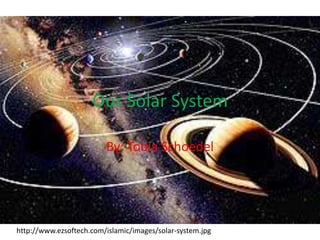
Our Solar System

                         By: Tobia Schoedel


http://www.ezsoftech.com/islamic/images/solar-system.jpg
WHAT IS IN OUR SOLAR SYSTEM?
•   Sun               •   Jupiter
•   Moon              •   Saturn
•   Mercury           •   Neptune
•   Venus             •   Pluton
•   Earth             •   Uranus
•   Mars
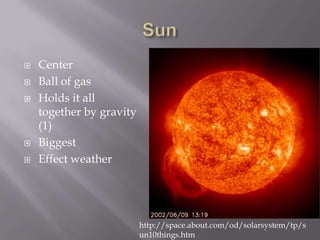
   Center
   Ball of gas
   Holds it all
    together by gravity
    (1)
   Biggest
   Effect weather


                          http://space.about.com/od/solarsystem/tp/s
                          un10things.htm
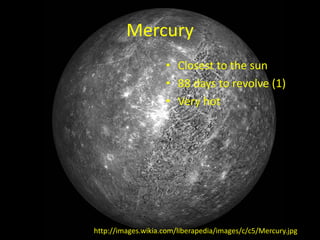
Mercury
                    • Closest to the sun
                    • 88 days to revolve (1)
                    • Very hot


http://images.wikia.com/liberapedia/images/c/c5/Mercury.jpg
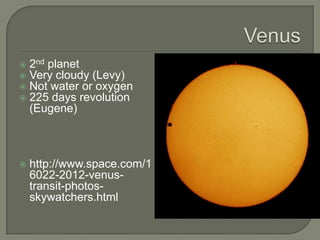
   2nd planet
   Very cloudy (Levy)
   Not water or oxygen
   225 days revolution
    (Eugene)


   http://www.space.com/1
    6022-2012-venus-
    transit-photos-
    skywatchers.html
Earth
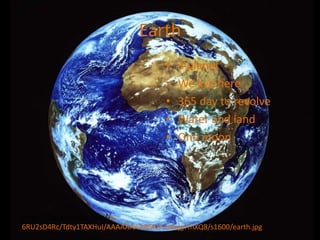
                                    •   3 planet
                                    •   We live here
                                    •   365 day to revolve
                                    •   Water and land
                                    •   One moon


http://2.bp.blogspot.com/-e-
6RU2sD4Rc/Tdty1TAXHuI/AAAAAAAABM0/nn8ajg7mXQ8/s1600/earth.jpg
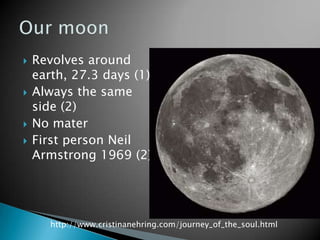
   Revolves around
    earth, 27.3 days (1)
   Always the same
    side (2)
   No mater
   First person Neil
    Armstrong 1969 (2)


       http://www.cristinanehring.com/journey_of_the_soul.html
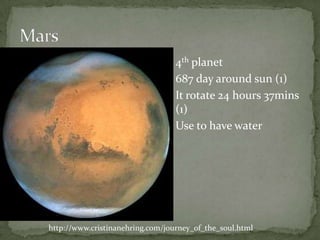
 4th planet
                                687 day around sun (1)
                                It rotate 24 hours 37mins
                                 (1)
                                Use to have water


http://www.cristinanehring.com/journey_of_the_soul.html
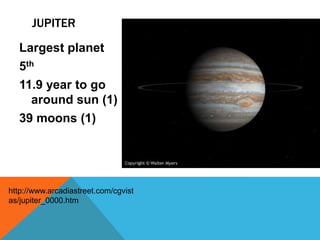
JUPITER
  Largest planet
  5th
  11.9 year to go
    around sun (1)
  39 moons (1)


http://www.arcadiastreet.com/cgvist
as/jupiter_0000.htm
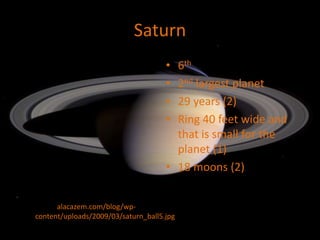
Saturn
                                     • 6th
                                     • 2nd largest planet
                                     • 29 years (2)
                                     • Ring 40 feet wide and
                                       that is small for the
                                       planet (1)
                                     • 18 moons (2)


http://alacazem.com/blog/wp-
content/uploads/2009/03/saturn_ball5.jpg
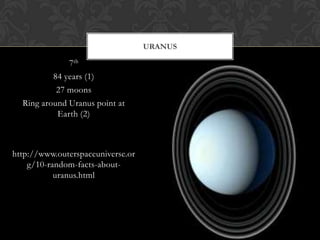
URANUS

              7th
          84 years (1)
           27 moons
  Ring around Uranus point at
           Earth (2)


http://www.outerspaceuniverse.or
    g/10-random-facts-about-
           uranus.html
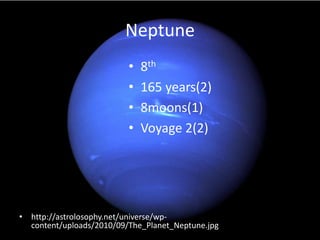
Neptune
                          •   8th
                          •   165 years(2)
                          •   8moons(1)
                          •   Voyage 2(2)


• http://astrolosophy.net/universe/wp-
  content/uploads/2010/09/The_Planet_Neptune.jpg
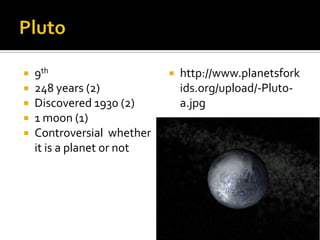
   9th                        http://www.planetsfork
   248 years (2)               ids.org/upload/-Pluto-
   Discovered 1930 (2)         a.jpg
   1 moon (1)
   Controversial whether
    it is a planet or not
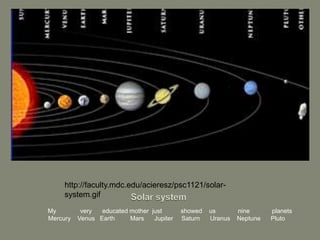
http://faculty.mdc.edu/acieresz/psc1121/solar-
     system.gif
My         very  educated mother just       showed   us       nine      planets
Mercury   Venus Earth     Mars    Jupiter   Saturn   Uranus   Neptune   Pluto
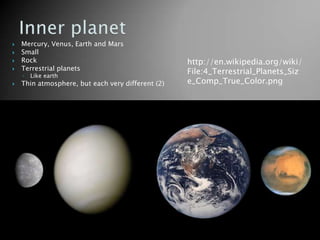
   Mercury, Venus, Earth and Mars
   Small
   Rock                                           http://en.wikipedia.org/wiki/
    Terrestrial planets

    ◦   Like earth
                                                   File:4_Terrestrial_Planets_Siz
   Thin atmosphere, but each very different (2)   e_Comp_True_Color.png
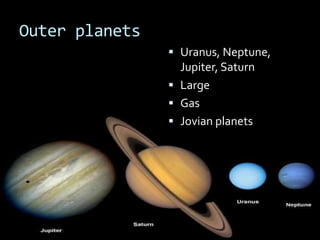
Outer planets
                 Uranus, Neptune,
                  Jupiter, Saturn
                 Large
                 Gas
                 Jovian planets
Sources
1.   Eugene, Toni, and Ellis D. Miner. Discover
     Stars & Planets. Lincolnwood, IL:
     Publications International, 1991. Print.
2.   Levy, David H. Stars & Planets. San
     Francisco: Sheena Coupe, 1996. Print.
THE END

Our solar system

  • 1.
    Our Solar System By: Tobia Schoedel http://www.ezsoftech.com/islamic/images/solar-system.jpg
  • 2.
    WHAT IS INOUR SOLAR SYSTEM? • Sun • Jupiter • Moon • Saturn • Mercury • Neptune • Venus • Pluton • Earth • Uranus • Mars
  • 3.
    Center  Ball of gas  Holds it all together by gravity (1)  Biggest  Effect weather http://space.about.com/od/solarsystem/tp/s un10things.htm
  • 4.
    Mercury • Closest to the sun • 88 days to revolve (1) • Very hot http://images.wikia.com/liberapedia/images/c/c5/Mercury.jpg
  • 5.
    2nd planet  Very cloudy (Levy)  Not water or oxygen  225 days revolution (Eugene)  http://www.space.com/1 6022-2012-venus- transit-photos- skywatchers.html
  • 6.
    Earth • 3 planet • We live here • 365 day to revolve • Water and land • One moon http://2.bp.blogspot.com/-e- 6RU2sD4Rc/Tdty1TAXHuI/AAAAAAAABM0/nn8ajg7mXQ8/s1600/earth.jpg
  • 7.
    Revolves around earth, 27.3 days (1)  Always the same side (2)  No mater  First person Neil Armstrong 1969 (2) http://www.cristinanehring.com/journey_of_the_soul.html
  • 8.
     4th planet  687 day around sun (1)  It rotate 24 hours 37mins (1)  Use to have water http://www.cristinanehring.com/journey_of_the_soul.html
  • 9.
    JUPITER Largestplanet 5th 11.9 year to go around sun (1) 39 moons (1) http://www.arcadiastreet.com/cgvist as/jupiter_0000.htm
  • 10.
    Saturn • 6th • 2nd largest planet • 29 years (2) • Ring 40 feet wide and that is small for the planet (1) • 18 moons (2) http://alacazem.com/blog/wp- content/uploads/2009/03/saturn_ball5.jpg
  • 11.
    URANUS 7th 84 years (1) 27 moons Ring around Uranus point at Earth (2) http://www.outerspaceuniverse.or g/10-random-facts-about- uranus.html
  • 12.
    Neptune • 8th • 165 years(2) • 8moons(1) • Voyage 2(2) • http://astrolosophy.net/universe/wp- content/uploads/2010/09/The_Planet_Neptune.jpg
  • 13.
    9th  http://www.planetsfork  248 years (2) ids.org/upload/-Pluto-  Discovered 1930 (2) a.jpg  1 moon (1)  Controversial whether it is a planet or not
  • 14.
    http://faculty.mdc.edu/acieresz/psc1121/solar- system.gif My very educated mother just showed us nine planets Mercury Venus Earth Mars Jupiter Saturn Uranus Neptune Pluto
  • 15.
    Mercury, Venus, Earth and Mars  Small  Rock http://en.wikipedia.org/wiki/ Terrestrial planets  ◦ Like earth File:4_Terrestrial_Planets_Siz  Thin atmosphere, but each very different (2) e_Comp_True_Color.png
  • 16.
    Outer planets  Uranus, Neptune, Jupiter, Saturn  Large  Gas  Jovian planets
  • 17.
    Sources 1. Eugene, Toni, and Ellis D. Miner. Discover Stars & Planets. Lincolnwood, IL: Publications International, 1991. Print. 2. Levy, David H. Stars & Planets. San Francisco: Sheena Coupe, 1996. Print.
  • 18.