IOSR Journal of Electronics and Communication Engineering (IOSR-JECE)
e-ISSN: 2278-2834,p- ISSN: 2278-8735.Volume 10, Issue 5, Ver. I (Sep - Oct .2015), PP 01-05
www.iosrjournals.org
DOI: 10.9790/2834-10510105 www.iosrjournals.org 1 | Page
Dual Feed Microstrip Patch Antenna for Wlan Applications
Dinesh kannan.R1
, Jisnu.P2
12
Scholar, SRM University, Chennai - 603203, India.
Abstract: Microstrip patch antennas represent one family of compact antennas that offer a conformal nature
and the capability of ready integration with communication system’s printed circuitry. In this paper, a 2.4 GHz
circular polarization microstrip antenna is designed and simulated. The selected microstrip antenna is a dual–
fed circular polarized microstrip antenna. The antenna consists of circular patch and 3 dB hybrid coupler. The
dual – fed circular polarized microstrip antenna is etched on a FR4 with dielectric substrate of 4.6 with the
height of 1.6 mm. Circular polarization is obtained when two orthogonal modes are equally excited with 90°
phase difference between them. Circular polarization is important because regardless of the receiver
orientation, it will always be receiving a component of the signal. This is due to the resulting wave having an
angular variation.
Keywords: Microstrip patch antenna, Hybrid coupler, circular patch, Polarization, WLAN.
I. Introduction
Wireless LAN can be used either to replace wired LAN or as an extension of the wired LAN
infrastructure. There are in general two types of antennas for WLAN applications, fixed WLAN base stations or
access points, and the other is for mobile communication terminals. For base station applications, impedance
matching for WLAN bandwidth should be better than 1.5:1 VSWR or about 14 dB return loss, similar to the
cellular system base station. Antenna that capable to excite circular polarization is very attractive because it can
overcome the multipath fading problem, thus enhance the system performance, especially indoor WLAN
operation. Currently, the most commonly used WLAN system is the IEEE 802.11b System. A key requirement
of WLAN system is that it should be low profile, where it is almost invisible to the user. For this reason, the
microstrip patch antennas are the antennas of choice for WLAN use due to their small real estate area and the
ability to be designed to blend into the surroundings.
II. Microstrip Patch Antenna
All In its most basic form, a Microstrip Patch antenna consists of a radiating patch on one side of a
dielectric substrate which has a ground plane on the other side. The patch is generally made of conducting
material such as copper or gold and can take any possible shape. The radiating patch and the feed lines are
usually photo etched on the dielectric substrate.
III. Directional Coupler
Generally branch-line couplers are 3dB, four ports directional couplers having a 90 phase difference
between its two output ports named through and coupled arms. Branch-line couplers (also named as Quadrature
Hybrid) are often made in microstrip line form.
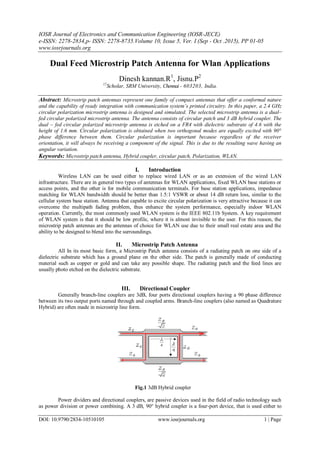
Fig.1 3dB Hybrid coupler
Power dividers and directional couplers, are passive devices used in the field of radio technology such
as power division or power combining. A 3 dB, 90° hybrid coupler is a four-port device, that is used either to
Dual Feed Microstrip Patch Antenna for Wlan Applications
DOI: 10.9790/2834-10510105 www.iosrjournals.org 2 | Page
equally split an input signal with a resultant 90° phase shift between output signals or to combine two signals
while maintaining high isolation between them. However, in a practical device the amplitude balance is
frequency dependent and departs from the ideal 0dB difference. All 90° Power Dividers/Combiners, also known
as quadrature hybrids or simply quad hybrids, are reciprocal four port networks. Fig.1 is a functional block
diagram of a 3 dB quad hybrid coupler. The hybrid coupler, or 3 dB directional coupler, in which the two
outputs are of equal amplitude, takes many forms. It is beginning when quadrature (90 degree) 3 dB coupler
coupling with outputs 90 degrees out of phased. Now any matched 4-port with isolated arms and equal power
division is called a hybrid or hybrid coupler. Today the characterizing feature is the phase difference of the
outputs. If 90 degrees, it is a 90 degree hybrid. If 180 degrees, it is a 180 degree hybrid. This terminology
defines the power difference in dB between the two output ports of a 3 dB hybrid. In an ideal hybrid circuit, the
difference should be 0 dB.
Fig. 2 Internal diagram of 3dB quad hybrid coupler
Referring to Fig.2, a signal applied to port 1 splits equally between ports 2 and 3 with one of the
outputs exhibiting a relative 90° phase shift. If ports 2 and 3 are properly terminated into matching impedances,
nearly all the signal applied to port 1 is transmitted to the loads connected to ports 2 and 3. In this circumstance,
port 4 receives negligible power and is termed isolated. However, if there is an impedance mismatch at port 2,
for example, then signal power reflected back from port 2 were divided proportionally between ports 1 and 4.
Power is not fed to port 3.
IV. Microstrip Antenna Polarization
A. Polarization types
Polarization of an antenna is defined as the polarization of the wave transmitted (radiated) by the
antenna, whereas polarization of radiated wave is defined as property of an electromagnetic wave describing the
time varying direction and relative magnitude of the electric field vector; specifically, the figure traced as a
function of time by the extremity of the vector at fixed location in the space, and the sense in which it is traced,
as observed along the direction of propagation. Polarization may be classified as linear, circular and elliptical.
a) Linear polarization
If the vector that describes the electrical field at a point in space as a function of time is always directed
along a line, the field is said to be linearly polarized. The polarization can also be determined by the propagating
antenna. Linear polarized electromagnetic (EM) wave. Linear polarized can be horizontal.
b) Circular polarization
A circular polarized wave radiates energy in both the horizontal and vertical planes and all planes in
between. Fig 4.5 below shows the electromagnetic (EM) wave for circular polarization. Circular polarization
occurs when two signals of equal amplitude but have 90° phase shifted. Circular polarization can result in Left
Hand circularly polarized (LHCP).Where the wave is rotating anticlockwise, or Right Hand circularly polarized
(RHCP) which denotes a clockwise rotation.
V. Design Of Microstrip Patch And Hybrid Coupler
The following specifications are used to design the microstrip antenna Substrate: Fr4, Dielectric
Constant εr =4.6, Operating Frequency: 2.4 GHz, Input Impedance: 50 Ohm, Thickness of the Substrate: 1.6
mm, Polarization: Circular Polarization.
In order to design a circular microstrip patch antenna operating at resonant frequency fr = 2.4 GHz, a
suitable dielectric substrate of relative permittivity εr = 4.6 and of thickness h=1.6 mm is chosen. Now we uses
following two equations to calculate the radius of circular patch
Dual Feed Microstrip Patch Antenna for Wlan Applications
DOI: 10.9790/2834-10510105 www.iosrjournals.org 3 | Page
where
Using above equations the radius is found to be a =30 mm at resonant frequency f r =2.4 GHz.
Calculated Hybrid coupler design for B=5.519, Length=16.81mm, W=2.958mm for B=7.884 Length of the
hybrid=13.115mm, W=5.135mm.
VI. Simulated Results
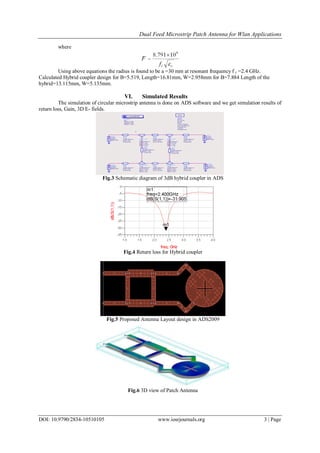
The simulation of circular microstrip antenna is done on ADS software and we get simulation results of
return loss, Gain, 3D E- fields.
Fig.3 Schematic diagram of 3dB hybrid coupler in ADS
Fig.4 Return loss for Hybrid coupler
Fig.5 Proposed Antenna Layout design in ADS2009
Fig.6 3D view of Patch Antenna
Dual Feed Microstrip Patch Antenna for Wlan Applications
DOI: 10.9790/2834-10510105 www.iosrjournals.org 4 | Page
Fig.7 Return loss of Proposed Microstrip patch antenna
Fig.8 3D Radiation Pattern of Patch Antenna
Fig.9 Gain and Directivity of Proposed Microstrip antenna
Fig.10 Efficiency of Proposed Microstrip antenna
Dual Feed Microstrip Patch Antenna for Wlan Applications
DOI: 10.9790/2834-10510105 www.iosrjournals.org 5 | Page
Fig.11 Effective Area of Microstrip antenna
Fig.12 Radiated power of Microstrip antenna
Table I: Simulated Circular Polarized Microstrip Patch Antenna Results
Specifications Observation
Frequency(GHz) 2.404
Return Loss (dB) -28.003
Power radiated(W) 2.1x10⁴
Effective angle 1.57615
Gain 6.36836
Directivity 9.01612
Efficiency 55%
Maximum intensity 1.26896x10⁴
HPBW(dB) 85.1496
VII. Conclusion
There are various types of microstrip antennas able to excite a circular polarization. In this paper, dual
fed circular polarization microstrip antenna was chosen. The microstrip antenna is design to operate at 2.404
GHz frequency. The dual fed circular polarization microstrip antenna is successfully implemented and
fabricated. The microstrip antenna resonates at 2.404 GHz and gives better return loss, which is -28.003 dB. The
proposed antenna given better value because only 0.47 % power is reflected and 99.53 % power is transmitted.
The VSWR of the microstrip antenna is 1.2:1, which shows that the level of mismatched for the microstrip
antenna is not very high. The bandwidth of this microstrip antenna is better, which is 17.04 % and the maximum
radiation occurs at -40° with gain of 6.36dB. The Microstrip antenna is said to be circular if the axial ratio is 0
dB. From the calculation of axial ratio, most of the angles give 0 dB value, thus prove that the microstrip
antenna polarize circularly.
References
[1] Pramendra Tilanthe, P. C. Sharma, and T. K. Bandopadhyay, “Gain Enhancement of Circular Microstrip Antenna for Personal
Communication Systems,” IACSIT International Journal of Engineering and Technology, Vol.3, No.2, April 2011.
[2] J. -Y. Park, C. Caloz, Y. Qian, and T. Itoh, “A compact circularly polarized subdivided microstrip patch antenna,” IEEE Microwave
Wireless Component Letters, vol. 12, pp. 18-19, Jan 2002.
[3] S. Zhang, C. Zhu, J. K. O. Sin, and P. K. T. Mok, “A novel ultrathin elevated channel low-temperature poly-Si TFT,” IEEE
Electron Device Lett., vol. 20, pp. 569–571, Nov. 1999.
[4] D. A. El Aziz and R. Hamad, “ Wideband Circular Microstrip Antenna For Wireless Communication Systems,” Radio Science
Conference, pp. 1-8, March 2007.
[5] Constantine. A. Balanis, “ Antenna Theory Analysis and Design,”2nd ed., John Wiely and Sons,Inc., 1997.
[6] N. A. Zakaria, A. A. Sulaiman., and M. A. A. Latip, “Design of a Circular Microstrip Antenna,”IEEE International RF and
Microwave Proceedings, pp. 289-292, December 2008.
[7] Jieh-Sen Kuo and Gui-Bin Hsieh, “Gain Enhancement of a Circularly Polarized Equilateral-Triangular Microstrip Antenna with a
Slotted Ground Plane,” IEEE Transactions on Antennas and Propagation, vol. 51, no. 7, July 2003.

A010510105

  • 1.
    IOSR Journal ofElectronics and Communication Engineering (IOSR-JECE) e-ISSN: 2278-2834,p- ISSN: 2278-8735.Volume 10, Issue 5, Ver. I (Sep - Oct .2015), PP 01-05 www.iosrjournals.org DOI: 10.9790/2834-10510105 www.iosrjournals.org 1 | Page Dual Feed Microstrip Patch Antenna for Wlan Applications Dinesh kannan.R1 , Jisnu.P2 12 Scholar, SRM University, Chennai - 603203, India. Abstract: Microstrip patch antennas represent one family of compact antennas that offer a conformal nature and the capability of ready integration with communication system’s printed circuitry. In this paper, a 2.4 GHz circular polarization microstrip antenna is designed and simulated. The selected microstrip antenna is a dual– fed circular polarized microstrip antenna. The antenna consists of circular patch and 3 dB hybrid coupler. The dual – fed circular polarized microstrip antenna is etched on a FR4 with dielectric substrate of 4.6 with the height of 1.6 mm. Circular polarization is obtained when two orthogonal modes are equally excited with 90° phase difference between them. Circular polarization is important because regardless of the receiver orientation, it will always be receiving a component of the signal. This is due to the resulting wave having an angular variation. Keywords: Microstrip patch antenna, Hybrid coupler, circular patch, Polarization, WLAN. I. Introduction Wireless LAN can be used either to replace wired LAN or as an extension of the wired LAN infrastructure. There are in general two types of antennas for WLAN applications, fixed WLAN base stations or access points, and the other is for mobile communication terminals. For base station applications, impedance matching for WLAN bandwidth should be better than 1.5:1 VSWR or about 14 dB return loss, similar to the cellular system base station. Antenna that capable to excite circular polarization is very attractive because it can overcome the multipath fading problem, thus enhance the system performance, especially indoor WLAN operation. Currently, the most commonly used WLAN system is the IEEE 802.11b System. A key requirement of WLAN system is that it should be low profile, where it is almost invisible to the user. For this reason, the microstrip patch antennas are the antennas of choice for WLAN use due to their small real estate area and the ability to be designed to blend into the surroundings. II. Microstrip Patch Antenna All In its most basic form, a Microstrip Patch antenna consists of a radiating patch on one side of a dielectric substrate which has a ground plane on the other side. The patch is generally made of conducting material such as copper or gold and can take any possible shape. The radiating patch and the feed lines are usually photo etched on the dielectric substrate. III. Directional Coupler Generally branch-line couplers are 3dB, four ports directional couplers having a 90 phase difference between its two output ports named through and coupled arms. Branch-line couplers (also named as Quadrature Hybrid) are often made in microstrip line form. Fig.1 3dB Hybrid coupler Power dividers and directional couplers, are passive devices used in the field of radio technology such as power division or power combining. A 3 dB, 90° hybrid coupler is a four-port device, that is used either to
  • 2.
    Dual Feed MicrostripPatch Antenna for Wlan Applications DOI: 10.9790/2834-10510105 www.iosrjournals.org 2 | Page equally split an input signal with a resultant 90° phase shift between output signals or to combine two signals while maintaining high isolation between them. However, in a practical device the amplitude balance is frequency dependent and departs from the ideal 0dB difference. All 90° Power Dividers/Combiners, also known as quadrature hybrids or simply quad hybrids, are reciprocal four port networks. Fig.1 is a functional block diagram of a 3 dB quad hybrid coupler. The hybrid coupler, or 3 dB directional coupler, in which the two outputs are of equal amplitude, takes many forms. It is beginning when quadrature (90 degree) 3 dB coupler coupling with outputs 90 degrees out of phased. Now any matched 4-port with isolated arms and equal power division is called a hybrid or hybrid coupler. Today the characterizing feature is the phase difference of the outputs. If 90 degrees, it is a 90 degree hybrid. If 180 degrees, it is a 180 degree hybrid. This terminology defines the power difference in dB between the two output ports of a 3 dB hybrid. In an ideal hybrid circuit, the difference should be 0 dB. Fig. 2 Internal diagram of 3dB quad hybrid coupler Referring to Fig.2, a signal applied to port 1 splits equally between ports 2 and 3 with one of the outputs exhibiting a relative 90° phase shift. If ports 2 and 3 are properly terminated into matching impedances, nearly all the signal applied to port 1 is transmitted to the loads connected to ports 2 and 3. In this circumstance, port 4 receives negligible power and is termed isolated. However, if there is an impedance mismatch at port 2, for example, then signal power reflected back from port 2 were divided proportionally between ports 1 and 4. Power is not fed to port 3. IV. Microstrip Antenna Polarization A. Polarization types Polarization of an antenna is defined as the polarization of the wave transmitted (radiated) by the antenna, whereas polarization of radiated wave is defined as property of an electromagnetic wave describing the time varying direction and relative magnitude of the electric field vector; specifically, the figure traced as a function of time by the extremity of the vector at fixed location in the space, and the sense in which it is traced, as observed along the direction of propagation. Polarization may be classified as linear, circular and elliptical. a) Linear polarization If the vector that describes the electrical field at a point in space as a function of time is always directed along a line, the field is said to be linearly polarized. The polarization can also be determined by the propagating antenna. Linear polarized electromagnetic (EM) wave. Linear polarized can be horizontal. b) Circular polarization A circular polarized wave radiates energy in both the horizontal and vertical planes and all planes in between. Fig 4.5 below shows the electromagnetic (EM) wave for circular polarization. Circular polarization occurs when two signals of equal amplitude but have 90° phase shifted. Circular polarization can result in Left Hand circularly polarized (LHCP).Where the wave is rotating anticlockwise, or Right Hand circularly polarized (RHCP) which denotes a clockwise rotation. V. Design Of Microstrip Patch And Hybrid Coupler The following specifications are used to design the microstrip antenna Substrate: Fr4, Dielectric Constant εr =4.6, Operating Frequency: 2.4 GHz, Input Impedance: 50 Ohm, Thickness of the Substrate: 1.6 mm, Polarization: Circular Polarization. In order to design a circular microstrip patch antenna operating at resonant frequency fr = 2.4 GHz, a suitable dielectric substrate of relative permittivity εr = 4.6 and of thickness h=1.6 mm is chosen. Now we uses following two equations to calculate the radius of circular patch
  • 3.
    Dual Feed MicrostripPatch Antenna for Wlan Applications DOI: 10.9790/2834-10510105 www.iosrjournals.org 3 | Page where Using above equations the radius is found to be a =30 mm at resonant frequency f r =2.4 GHz. Calculated Hybrid coupler design for B=5.519, Length=16.81mm, W=2.958mm for B=7.884 Length of the hybrid=13.115mm, W=5.135mm. VI. Simulated Results The simulation of circular microstrip antenna is done on ADS software and we get simulation results of return loss, Gain, 3D E- fields. Fig.3 Schematic diagram of 3dB hybrid coupler in ADS Fig.4 Return loss for Hybrid coupler Fig.5 Proposed Antenna Layout design in ADS2009 Fig.6 3D view of Patch Antenna
  • 4.
    Dual Feed MicrostripPatch Antenna for Wlan Applications DOI: 10.9790/2834-10510105 www.iosrjournals.org 4 | Page Fig.7 Return loss of Proposed Microstrip patch antenna Fig.8 3D Radiation Pattern of Patch Antenna Fig.9 Gain and Directivity of Proposed Microstrip antenna Fig.10 Efficiency of Proposed Microstrip antenna
  • 5.
    Dual Feed MicrostripPatch Antenna for Wlan Applications DOI: 10.9790/2834-10510105 www.iosrjournals.org 5 | Page Fig.11 Effective Area of Microstrip antenna Fig.12 Radiated power of Microstrip antenna Table I: Simulated Circular Polarized Microstrip Patch Antenna Results Specifications Observation Frequency(GHz) 2.404 Return Loss (dB) -28.003 Power radiated(W) 2.1x10⁴ Effective angle 1.57615 Gain 6.36836 Directivity 9.01612 Efficiency 55% Maximum intensity 1.26896x10⁴ HPBW(dB) 85.1496 VII. Conclusion There are various types of microstrip antennas able to excite a circular polarization. In this paper, dual fed circular polarization microstrip antenna was chosen. The microstrip antenna is design to operate at 2.404 GHz frequency. The dual fed circular polarization microstrip antenna is successfully implemented and fabricated. The microstrip antenna resonates at 2.404 GHz and gives better return loss, which is -28.003 dB. The proposed antenna given better value because only 0.47 % power is reflected and 99.53 % power is transmitted. The VSWR of the microstrip antenna is 1.2:1, which shows that the level of mismatched for the microstrip antenna is not very high. The bandwidth of this microstrip antenna is better, which is 17.04 % and the maximum radiation occurs at -40° with gain of 6.36dB. The Microstrip antenna is said to be circular if the axial ratio is 0 dB. From the calculation of axial ratio, most of the angles give 0 dB value, thus prove that the microstrip antenna polarize circularly. References [1] Pramendra Tilanthe, P. C. Sharma, and T. K. Bandopadhyay, “Gain Enhancement of Circular Microstrip Antenna for Personal Communication Systems,” IACSIT International Journal of Engineering and Technology, Vol.3, No.2, April 2011. [2] J. -Y. Park, C. Caloz, Y. Qian, and T. Itoh, “A compact circularly polarized subdivided microstrip patch antenna,” IEEE Microwave Wireless Component Letters, vol. 12, pp. 18-19, Jan 2002. [3] S. Zhang, C. Zhu, J. K. O. Sin, and P. K. T. Mok, “A novel ultrathin elevated channel low-temperature poly-Si TFT,” IEEE Electron Device Lett., vol. 20, pp. 569–571, Nov. 1999. [4] D. A. El Aziz and R. Hamad, “ Wideband Circular Microstrip Antenna For Wireless Communication Systems,” Radio Science Conference, pp. 1-8, March 2007. [5] Constantine. A. Balanis, “ Antenna Theory Analysis and Design,”2nd ed., John Wiely and Sons,Inc., 1997. [6] N. A. Zakaria, A. A. Sulaiman., and M. A. A. Latip, “Design of a Circular Microstrip Antenna,”IEEE International RF and Microwave Proceedings, pp. 289-292, December 2008. [7] Jieh-Sen Kuo and Gui-Bin Hsieh, “Gain Enhancement of a Circularly Polarized Equilateral-Triangular Microstrip Antenna with a Slotted Ground Plane,” IEEE Transactions on Antennas and Propagation, vol. 51, no. 7, July 2003.