This document summarizes the design and performance evaluation of a two-unit Yagi-Uda antenna array for UHF satellite communication. Simulations were conducted using 4NEC2 software to optimize the design for a gain of 18.6 dBi at 437.025 MHz. Field tests validated the antenna array achieved high gain and front-to-back ratio while maintaining low standing wave ratio across the UHF band. The two-unit circularly polarized crossed Yagi array design successfully improved communication link margins for small cube satellites operating with stringent power budgets.
![International Journal of Wireless & Mobile Networks (IJWMN) Vol. 6, No. 5, October 2014
DESIGN AND PERFORMANCE EVALUATION OF
TWO-UNIT YAGI-UDA ARRAY FOR UHF SATELLITE
COMMUNICATION
Rupesh Lad1, Pritesh Chhajed2, Lokeshsingh Bais3, Shyam Dahiwal4, Sukhada Saoji5,
Vaibhav Rekhate6, Pushkar Chaudhari7, Shimoli Shinde8, Ketan Chitale9, Anjali
Mondhe10 and Shreyas Kulkarni11
College of Engineering Pune, Pune, India
ABSTRACT
Cube satellite missions perform innovative scientific experiments on a low cost developmental platform but
have an inherent limitation of size and space. This restricts the total available solar power that can be
harnessed and as a result, the radio links operate on stringent power budgets. For improving the available
margins for communication in such satellites, it is desirable to improve upon the antenna system
performance at the ground station used for the establishment of the links with the satellite. This can be
achieved by improving the forward gain, the forward to backward ratio and the directivity of the antenna.
This paper describes the electrical simulations and the performance evaluation of the one unit, two unit and
four unit circularly polarized crossed Yagi-Uda antenna array designed for communication with amateur
radio (HAM) satellites operating over the 434 MHz to 438 MHz Amateur UHF band. The electro-magnetic
model has been developed using the 4NEC2 software. The simulations have been validated with the
practical field testing performed for estimating the SWR, antenna gain, the forward to backward ratio and
radiation pattern for the antenna system.
KEYWORDS
Array Antenna, polarization, radiation pattern, stacking distance, UHF antenna, Yagi-Uda
1. INTRODUCTION
Amateur cube satellites orbiting in Low Earth Orbit are categorized as pico satellites, nano
satellites based upon their size. Smaller the size of these cubesats, lesser is the power generation
capacity and thus lesser is the power of telemetry signals transmitted from such satellites.
Communication with such small cube satellites requires the establishment of an efficient ground
system. The performance of the system can be greatly increased by developing a high gain,
directional antenna. A specific gain is associated with each type of antenna based upon its
structure. A half wave dipole antenna has a nominal gain of about 2.14 dBi. It is omnidirectional
antenna and thus it has low directivity. When the reflectors and directors are added to the dipole
antenna, its gain starts increasing with each director. But the gain gets saturated at about 15 dBi,
with number of directors equal to 11 [1]. For further increase in the gain, a number of antennas
can be coupled together using proper impedance matching network. Horn antennas and parabolic
dish antennas have very high directionality but there lie structural constraints and incompatibility
with the antenna rotator system.
DOI : 10.5121/ijwmn.2014.6512 145](https://image.slidesharecdn.com/designandperformanceevaluationof-141112033152-conversion-gate01/85/Design-and-performance-evaluation-of-1-320.jpg)
![International Journal of Wireless & Mobile Networks (IJWMN) Vol. 6, No. 5, October 2014
DESIGN AND PERFORMANCE EVALUATION OF
TWO-UNIT YAGI-UDA ARRAY FOR UHF SATELLITE
COMMUNICATION
Rupesh Lad1, Pritesh Chhajed2, Lokeshsingh Bais3, Shyam Dahiwal4, Sukhada Saoji5,
Vaibhav Rekhate6, Pushkar Chaudhari7, Shimoli Shinde8, Ketan Chitale9, Anjali
Mondhe10 and Shreyas Kulkarni11
College of Engineering Pune, Pune, India
ABSTRACT
Cube satellite missions perform innovative scientific experiments on a low cost developmental platform but
have an inherent limitation of size and space. This restricts the total available solar power that can be
harnessed and as a result, the radio links operate on stringent power budgets. For improving the available
margins for communication in such satellites, it is desirable to improve upon the antenna system
performance at the ground station used for the establishment of the links with the satellite. This can be
achieved by improving the forward gain, the forward to backward ratio and the directivity of the antenna.
This paper describes the electrical simulations and the performance evaluation of the one unit, two unit and
four unit circularly polarized crossed Yagi-Uda antenna array designed for communication with amateur
radio (HAM) satellites operating over the 434 MHz to 438 MHz Amateur UHF band. The electro-magnetic
model has been developed using the 4NEC2 software. The simulations have been validated with the
practical field testing performed for estimating the SWR, antenna gain, the forward to backward ratio and
radiation pattern for the antenna system.
KEYWORDS
Array Antenna, polarization, radiation pattern, stacking distance, UHF antenna, Yagi-Uda
1. INTRODUCTION
Amateur cube satellites orbiting in Low Earth Orbit are categorized as pico satellites, nano
satellites based upon their size. Smaller the size of these cubesats, lesser is the power generation
capacity and thus lesser is the power of telemetry signals transmitted from such satellites.
Communication with such small cube satellites requires the establishment of an efficient ground
system. The performance of the system can be greatly increased by developing a high gain,
directional antenna. A specific gain is associated with each type of antenna based upon its
structure. A half wave dipole antenna has a nominal gain of about 2.14 dBi. It is omnidirectional
antenna and thus it has low directivity. When the reflectors and directors are added to the dipole
antenna, its gain starts increasing with each director. But the gain gets saturated at about 15 dBi,
with number of directors equal to 11 [1]. For further increase in the gain, a number of antennas
can be coupled together using proper impedance matching network. Horn antennas and parabolic
dish antennas have very high directionality but there lie structural constraints and incompatibility
with the antenna rotator system.
DOI : 10.5121/ijwmn.2014.6512 145](https://image.slidesharecdn.com/designandperformanceevaluationof-141112033152-conversion-gate01/75/Design-and-performance-evaluation-of-1-2048.jpg)
![g g g g b T R
4 + (1- )(1- ) cos2
(1+ )(1+ )
1
+
2
2
1
Loss =10 log
2
R
2
T
2
R
2
T
10 g g
(1)
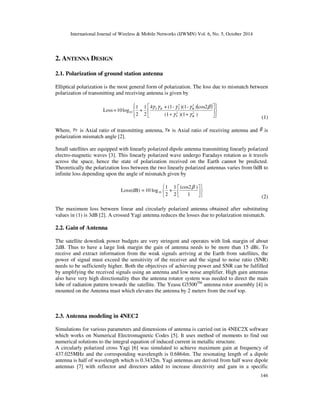
Where, is Axial ratio of transmitting antenna, is Axial ratio of receiving antenna and is
polarization mismatch angle [2].
Small satellites are equipped with linearly polarized dipole antenna transmitting linearly polarized
electro-magnetic waves [3]. This linearly polarized wave undergo Faradays rotation as it travels
across the space, hence the state of polarization received on the Earth cannot be predicted.
Theoretically the polarization loss between the two linearly polarized antennas varies from 0dB to
infinite loss depending upon the angle of mismatch given by](https://image.slidesharecdn.com/designandperformanceevaluationof-141112033152-conversion-gate01/85/Design-and-performance-evaluation-of-3-320.jpg)
![(cos2 )
1
1
+
2
2
1
Loss(dB) = 10 log10
b
(2)
The maximum loss between linear and circularly polarized antenna obtained after substituting
values in (1) is 3dB [2]. A crossed Yagi antenna reduces the losses due to polarization mismatch.
2.2. Gain of Antenna
The satellite downlink power budgets are very stringent and operates with link margin of about
2dB. Thus to have a large link margin the gain of antenna needs to be more than 15 dBi. To
receive and extract information from the weak signals arriving at the Earth from satellites, the
power of signal must exceed the sensitivity of the receiver and the signal to noise ratio (SNR)
needs to be sufficiently higher. Both the objectives of achieving power and SNR can be fulfilled
by amplifying the received signals using an antenna and low noise amplifier. High gain antennas
also have very high directionality thus the antenna rotator system was needed to direct the main
lobe of radiation pattern towards the satellite. The Yeasu G5500TM antenna rotor assembly [4] is
mounted on the Antenna mast which elevates the antenna by 2 meters from the roof top.
2.3. Antenna modeling in 4NEC2
Simulations for various parameters and dimensions of antenna is carried out in 4NEC2X software
which works on Numerical Electromagnetic Codes [5]. It uses method of moments to find out
numerical solutions to the integral equation of induced current in metallic structure.
A circularly polarized cross Yagi [6] was simulated to achieve maximum gain at frequency of
437.025MHz and the corresponding wavelength is 0.6864m. The resonating length of a dipole
antenna is half of wavelength which is 0.3432m. Yagi antennas are derived from half wave dipole
antennas [7] with reflector and directors added to increase directivity and gain in a specific](https://image.slidesharecdn.com/designandperformanceevaluationof-141112033152-conversion-gate01/85/Design-and-performance-evaluation-of-4-320.jpg)
![International Journal of Wireless Mobile Networks (IJWMN) Vol. 6, No. 5, October 2014
direction. The length of reflector is greater than driven element and the lengths of successive
directors go on decreasing. The cross Yagi as shown in Fig. 1 are further derived from the Yagi
antennas
Boom is the important part of antenna support assembly but it is also an unintended radiating part
of antenna. It is generally preferred to electrically insulate the elements and the conducting boom.
Presence of conducting boom close to the elements of antenna shortens the electrical length of
antenna [8]. Due to this the bandwidth of antenna shifts to higher frequencies. Thus the physical
lengths of elements are added with boom correction length which makes it slightly larger than the
simulated lengths. Boom correction help to improve the performance of antenna with respect to
standing wave ratio (SWR) and gain on the frequency band for which it is designed. The
dimensions of the cross Yagi elements are as mentioned in Table I.
147
Figure 1. A 2 unit array of Cross Yagi Antenna with elements labelled
The circularly polarized cross Yagi antenna simulated with the above dimensions have a
gain of about 15.5dBi and HPBW of 32o. The gain could be further increased by using
multiple such antenna and coupling those together [9].
Table 1. Dimensions of antenna elements.
Elements Length
(in metres)
Spacing from driven element
(in metres)
Reflector R1, R1’ 0.3892 -0.126
Driven elements D0, D0’ 0.3492 0
D1, D1’ 0.310 0.085
D2, D2’ 0.306 0.171
D3, D3’ 0.3022 0.342](https://image.slidesharecdn.com/designandperformanceevaluationof-141112033152-conversion-gate01/85/Design-and-performance-evaluation-of-5-320.jpg)
![2
2sin
(3)
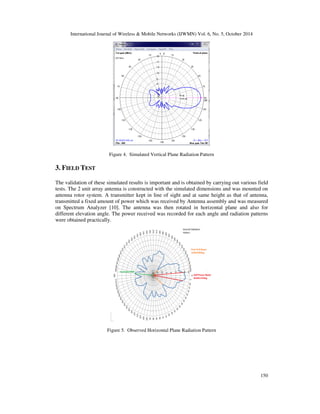
Where is half power beam width of individual antenna unit [1]. The signals from antennas are
combined together and fed to low noise amplifier for further amplification.
The effective gain of an antenna array depends upon the stacking distance between the units of
antenna. The optimum stacking distance for 2 unit array antenna obtained from (3) is 1.8. The
stacking distance was varied from 0.5 to 3 and the graph of gain vs stacking distance is shown
in Fig. 2. It was observed that the gain is maximum at stacking distance of 1.68 and on further
increase in stacking distance no significant change in gain is observed. Hence the stacking
distance of 1.68 i.e. 1.13m is optimum for the present configuration.
Simulations were carried out for 2 unit and 4 unit array using 4NEC2 software and the results are
summarized in Table II. Although the primary objective was to build a High gain antenna the
losses due to coaxial cables and connectors also have to be considered. The gain obtained from 4
unit cross Yagi antenna is increased but at a cost of physical stability of structure.
Figure 2. Gain as a function of Stacking distance for 2 unit array antenna](https://image.slidesharecdn.com/designandperformanceevaluationof-141112033152-conversion-gate01/85/Design-and-performance-evaluation-of-7-320.jpg)