IOSR Journal of Electrical and Electronics Engineering (IOSR-JEEE)
e-ISSN: 2278-1676,p-ISSN: 2320-3331, Volume 10, Issue 2 Ver. III (Mar – Apr. 2015), PP 01-05
www.iosrjournals.org
DOI: 10.9790/1676-10230105 www.iosrjournals.org 1 | Page
Online Model Based Control of Pv-Converter Unit for Maximum
Power Point Tracking
Samuel Hyginus1
, Geetha Kiranmayee Sathi2
(Design Engineer, Sustain Energy Solutions Ltd, United Kingdom)
(Graduate Electrical Engineer, Hyder Consulting, United Kingdom)
Abstract: Partial Shading is an important issue in PV Panels. It occurs due to the non-uniform illumination of
a PV Panel or a part of it. This decreases the overall output of the PV Panel. As a result of partial shading, the
unshaded cells cause a reverse bias on the shaded cell and hence large power is dissipated on the shaded cells,
thus overheating the shaded cell which results in glass crack or melting/degradation of the solar cell. This is
called Hot-spot. Here different control strategies are analysed and investigated for maximum power point
tracking capabilities for maximum power generation of the photovoltaic panel under partial shading conditions.
An online model based control of PV-Converter unit is presented in this project. This will involve practical tests
as well as simulations done in MATLAB and SIMULINK.
Keywords: Partial Shading, Photo Voltaic, Hot-spots, Maximum Power Point Tracking, Buck Converter
I. Introduction
There is a great substantial rise in the global energy demand over the past few years. This is limited due
to the enormous shortage in the conventional energy reserves and this is mainly accelerated due to the
environmental issues that are often caused by mankind. It is the duty of every man to make the effect use of the
energy available keeping in mind the future generation. Another fact that has led to the growth in energy
demand is the rise in population. In addition to this, the amount of carbon dioxide produced has increased
drastically and this has contributed a lot to global warming. This situation should be dealt wisely in terms of
increasing the ways of generating energy from many different alternative technologies in an environment
friendly manner [1].
Partial shading issues in PV panels are posing a great challenge in the solar PV industry. This problem
has been a topic of discussion for past few years in this field of study. As a result of partial shading, the
performance of the PV panels is reduced to a great extend thus hindering the extraction of electricity generated
by solar PV cells during uneven solar irradiation. The non-uniform illumination of solar irradiation on PV
panels leads to the reverse bias of the shaded cell thus causing the shaded cell to behave like a load. This way
large amount of heat is dissipated on the shaded cell thus degrading the overall PV panel by creating glass
cracks on the surface of the panel called hotspots. The overall PV system is irreversibly damaged and thereby
this issue is a major concern in the PV industry [2].
Previously the above problem was overcome by using by-pass and blocking diodes to each PV panel
which is connected in series or parallel respectively. The method introduced in this article however does not
eliminate partial shading but has the ability to reduce the effect of partial shading to a great extent. A new
Maximum Power Point Tracking (MPPT) model has been designed such that a logarithmic equation is
developed for calculating the maximum power point voltage under different weather conditions i.e. irradiance
and temperature. This method is described in detail in the following chapters to come.
II. Pv Panels Under Partial Shading
Partial shading is an issue which arises from the non-uniform illumination of sunlight over the PV
Panel surface due to obstacles like a shadow from a building, cloud, a bird, a tree leaf that’s present on the panel
surface etc. These obstacles can be sectioned into two types, static and dynamic. Static obstacle can be
explained as stationary dirt and dynamic obstacle can be labelled as a moving object like a moving cloud. As a
result of the shadow caused by these obstacles on the panel surface, the overall output of the panel is highly
affected in terms of both the efficiency and performance of the PV panel. During this condition, the photo
voltaic solar cell which is shaded behaves as a load to the entire panel and hence heat is dissipated on this cell
causing the glass to crack and thereby creating hotspots which damage the PV system [3].
The different levels of irradiation on the panel can be uniform over the complete surface of the PV
module or non-uniform i.e. a part of the panel may be partially shaded whether it is a PV array, multiple array or
module etc. When a string of PV cells having more than one bypass diodes are considered having irradiance
with different light intensities, multiple maximum power peaks can be observed. This can affect the different
MPPT techniques used for extracting maximum power from each panel individually. Extensive Research is
Online Model Based Control of Pv-Converter Unit for Maximum Power Point Tracking
DOI: 10.9790/1676-10230105 www.iosrjournals.org 2 | Page
being carried out for eliminating this problem and one of the solutions include calculating the MPPT for voltage
and power of a given shadow pattern and intensity. This study is carried out for evaluation the overall
performance of the PV system under such partial shading conditions [4, 5].
III. New Model For Mpp Voltage Prediction
Maximum efficiency is obtained from a PV system by achieving a proper match of various parameters
like PV generating systems, irradiation variations along with different changes in temperature. Hence this way,
the maximum power is harnessed from the PV panel using different control strategies by altering the above
given parameters. This is called maximum power point tracking of the PV system [6].
This section introduces a new design model which is used for the prediction of the maximum power
point voltage under different conditions of irradiance and temperature. The value of this MPP voltage is directly
calculated from the values of the irradiance and cell temperature measurements using the method explained
below. Firstly, the PV panel is simulated for different values of irradiance from 10 to 100 at a given reference
temperature. This way the panel is simulated in the same conditions but with a different temperature now. The
different values of irradiance, cell temperature, PV current, PV voltage and the respective maximum power
points are noted down respectively.
Figure 1 – Predicted MPP Voltage Vs Irradiance for 250
C and 300
C
The above voltage vs irradiance graph shows the different predicted MPP voltages for two temperatures of 25
and 30 and this data is obtained from the Simulink model. In this plot, the x-axis denotes the irradiance in
logarithmic format and y-axis denotes the voltage. Using the observation made from the above graph, a new
logarithmic relation between the maximum power point voltage and irradiance is established.
The maximum power point Voltage, VMPP is expressed as
The above equation consists of various terms such as m which denotes the slope, G showing the irradiance,
is the initial voltage, k indicating the temperature gradient, which refers the cell temperature and the
reference temperature, .
The slope m is calculated as,
is calculated as the initial voltage at that reference temperature which is considered.
K shows the temperature coefficient such that the maximum power point voltage is shifting per degree Celsius.
This is calculated as
denotes the difference in temperature i.e.
shows the difference between the cell temperature and the reference temperature.
The cell temperature is expressed as,
refers to the ambient temperature.
This equation (3.5.1) is design in such a way that it follows the equation of the straight line which is stated as,
Online Model Based Control of Pv-Converter Unit for Maximum Power Point Tracking
DOI: 10.9790/1676-10230105 www.iosrjournals.org 3 | Page
Where y denotes the y-intercept, m shows the slope of the line, x denotes the x-intercept and c shows the
gradient of the line.
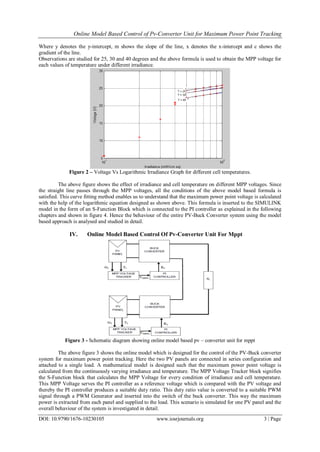
Observations are studied for 25, 30 and 40 degrees and the above formula is used to obtain the MPP voltage for
each values of temperature under different irradiance.
Figure 2 – Voltage Vs Logarithmic Irradiance Graph for different cell temperatures.
The above figure shows the effect of irradiance and cell temperature on different MPP voltages. Since
the straight line passes through the MPP voltages, all the conditions of the above model based formula is
satisfied. This curve fitting method enables us to understand that the maximum power point voltage is calculated
with the help of the logarithmic equation designed as shown above. This formula is inserted to the SIMULINK
model in the form of an S-Function Block which is connected to the PI controller as explained in the following
chapters and shown in figure 4. Hence the behaviour of the entire PV-Buck Converter system using the model
based approach is analysed and studied in detail.
IV. Online Model Based Control Of Pv-Converter Unit For Mppt
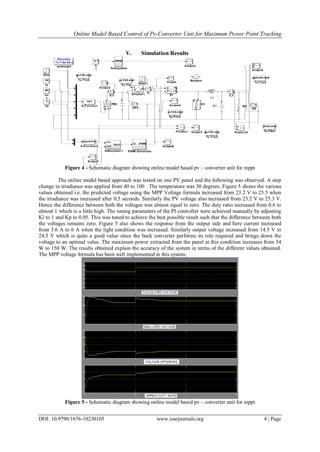
Figure 3 - Schematic diagram showing online model based pv – converter unit for mppt
The above figure 3 shows the online model which is designed for the control of the PV-Buck converter
system for maximum power point tracking. Here the two PV panels are connected in series configuration and
attached to a single load. A mathematical model is designed such that the maximum power point voltage is
calculated from the continuously varying irradiance and temperature. The MPP Voltage Tracker block signifies
the S-Function block that calculates the MPP Voltage for every condition of irradiance and cell temperature.
This MPP Voltage serves the PI controller as a reference voltage which is compared with the PV voltage and
thereby the PI controller produces a suitable duty ratio. This duty ratio value is converted to a suitable PWM
signal through a PWM Generator and inserted into the switch of the buck converter. This way the maximum
power is extracted from each panel and supplied to the load. This scenario is simulated for one PV panel and the
overall behaviour of the system is investigated in detail.
Online Model Based Control of Pv-Converter Unit for Maximum Power Point Tracking
DOI: 10.9790/1676-10230105 www.iosrjournals.org 4 | Page
V. Simulation Results
Figure 4 - Schematic diagram showing online model based pv – converter unit for mppt
The online model based approach was tested on one PV panel and the following was observed. A step
change in irradiance was applied from 40 to 100 . The temperature was 30 degrees. Figure 5 shows the various
values obtained i.e. the predicted voltage using the MPP Voltage formula increased from 23.2 V to 25.5 when
the irradiance was increased after 0.5 seconds. Similarly the PV voltage also increased from 23.2 V to 25.3 V.
Hence the difference between both the voltages was almost equal to zero. The duty ratio increased from 0.6 to
almost 1 which is a little high. The tuning parameters of the PI controller were achieved manually by adjusting
Ki to 1 and Kp to 0.05. This was tuned to achieve the best possible result such that the difference between both
the voltages remains zero. Figure 5 also shows the response from the output side and here current increased
from 3.6 A to 6 A when the light condition was increased. Similarly output voltage increased from 14.5 V to
24.5 V which is quite a good value since the buck converter performs its role required and brings down the
voltage to an optimal value. The maximum power extracted from the panel at this condition increases from 54
W to 150 W. The results obtained explain the accuracy of the system in terms of the different values obtained.
The MPP voltage formula has been well implemented in this system.
Figure 5 - Schematic diagram showing online model based pv – converter unit for mppt
Online Model Based Control of Pv-Converter Unit for Maximum Power Point Tracking
DOI: 10.9790/1676-10230105 www.iosrjournals.org 5 | Page
VI. Conclusion
The study of partial shading has been the main topic of interest in this report. The fundamentals of PV
and their operation were studied and analysed through various research papers. The concept of partial shading
has brought out a great challenge in the solar PV industry and extensive research in carried out in this field till
date and will continue to in the years to come. A model based PV-Converter unit is designed for MPPT. In this
model, the MPP voltage is determined by a formula which is formulated by using the values from the Voltage
Vs Irradiance characteristics in a logarithmic format. T`his technique has proved to be very useful for rapid
change in weather conditions in terms of temperature change and irradiance. Since the model is working and the
MPP voltage is calculated when the PV is in operation, this system is termed as the online model based PV-
Converter Unit for MPPT.
Looking at the future scope for this model developed, a no. of methods can be implemented to enhance
the operation of the PV system. The designed online can be attached to a multilevel inverter for connection to
the utility grid. This method can be implemented on a large scale by attaching n number of PV panels in series
and overall behaviour of the system can be investigated under partial shading conditions. Different multilevel
inverters can be analysed to make sure the power is delivered with less harmonics. Due to the continuous supply
of current from the PV to the input of the Buck converter, this capacitor can be replaced by a super- capacitor
(SC). Super-capacitor has the flexible property of charging and discharging and this can be of application to
Flexible AC Transmission Systems (FACTS).
References
[1]. S.C.W. Krauter, Solar Electric Power Generation - Photovoltaic Energy Systems: Modeling of Optical and Thermal Performance,
Electrical Yield, Energy Balance, Effect on reduction of Greenhouse Gas Emissions. Berlin: Springer-Verlag, 2006.
[2]. L. Gao, R. A. Dougal, S. Liu, and A. P. Iotova, "Parallel-Connected Solar PV System to Address Partial and Rapidly Fluctuating
Shadow Conditions," IEEE Transactions on Industrial Electronics, vol.56, no.5, pp.1548-1556, 2009
[3]. Markvart T.: “Solar Electricity”, John Wiley & Sons, 1994
[4]. J. Nelson, The physics of solar cells, London: Imperial College Press, 2003.
[5]. H. Kawamura, K. Naka, N. Yonekura, S. Yamanaka, H. Kawamura, H. Ohno, and K. Naito, “Simulation of I–V characteristics of a
PV module with shaded PV cells,” Solar Energy Mater. Solar Cells, vol. 75, no. 3/4, pp. 613–621, Feb. 2003.
[6]. C. Ben Salah, M. Ouali, “Comparision of Fuzzy Logic and Neural Network in Maximum Power Point Tracker for PV Systems,”
Electric Power Systems Research, Vol. 81, pp. 43-50, July 2010.

A010230105

  • 1.
    IOSR Journal ofElectrical and Electronics Engineering (IOSR-JEEE) e-ISSN: 2278-1676,p-ISSN: 2320-3331, Volume 10, Issue 2 Ver. III (Mar – Apr. 2015), PP 01-05 www.iosrjournals.org DOI: 10.9790/1676-10230105 www.iosrjournals.org 1 | Page Online Model Based Control of Pv-Converter Unit for Maximum Power Point Tracking Samuel Hyginus1 , Geetha Kiranmayee Sathi2 (Design Engineer, Sustain Energy Solutions Ltd, United Kingdom) (Graduate Electrical Engineer, Hyder Consulting, United Kingdom) Abstract: Partial Shading is an important issue in PV Panels. It occurs due to the non-uniform illumination of a PV Panel or a part of it. This decreases the overall output of the PV Panel. As a result of partial shading, the unshaded cells cause a reverse bias on the shaded cell and hence large power is dissipated on the shaded cells, thus overheating the shaded cell which results in glass crack or melting/degradation of the solar cell. This is called Hot-spot. Here different control strategies are analysed and investigated for maximum power point tracking capabilities for maximum power generation of the photovoltaic panel under partial shading conditions. An online model based control of PV-Converter unit is presented in this project. This will involve practical tests as well as simulations done in MATLAB and SIMULINK. Keywords: Partial Shading, Photo Voltaic, Hot-spots, Maximum Power Point Tracking, Buck Converter I. Introduction There is a great substantial rise in the global energy demand over the past few years. This is limited due to the enormous shortage in the conventional energy reserves and this is mainly accelerated due to the environmental issues that are often caused by mankind. It is the duty of every man to make the effect use of the energy available keeping in mind the future generation. Another fact that has led to the growth in energy demand is the rise in population. In addition to this, the amount of carbon dioxide produced has increased drastically and this has contributed a lot to global warming. This situation should be dealt wisely in terms of increasing the ways of generating energy from many different alternative technologies in an environment friendly manner [1]. Partial shading issues in PV panels are posing a great challenge in the solar PV industry. This problem has been a topic of discussion for past few years in this field of study. As a result of partial shading, the performance of the PV panels is reduced to a great extend thus hindering the extraction of electricity generated by solar PV cells during uneven solar irradiation. The non-uniform illumination of solar irradiation on PV panels leads to the reverse bias of the shaded cell thus causing the shaded cell to behave like a load. This way large amount of heat is dissipated on the shaded cell thus degrading the overall PV panel by creating glass cracks on the surface of the panel called hotspots. The overall PV system is irreversibly damaged and thereby this issue is a major concern in the PV industry [2]. Previously the above problem was overcome by using by-pass and blocking diodes to each PV panel which is connected in series or parallel respectively. The method introduced in this article however does not eliminate partial shading but has the ability to reduce the effect of partial shading to a great extent. A new Maximum Power Point Tracking (MPPT) model has been designed such that a logarithmic equation is developed for calculating the maximum power point voltage under different weather conditions i.e. irradiance and temperature. This method is described in detail in the following chapters to come. II. Pv Panels Under Partial Shading Partial shading is an issue which arises from the non-uniform illumination of sunlight over the PV Panel surface due to obstacles like a shadow from a building, cloud, a bird, a tree leaf that’s present on the panel surface etc. These obstacles can be sectioned into two types, static and dynamic. Static obstacle can be explained as stationary dirt and dynamic obstacle can be labelled as a moving object like a moving cloud. As a result of the shadow caused by these obstacles on the panel surface, the overall output of the panel is highly affected in terms of both the efficiency and performance of the PV panel. During this condition, the photo voltaic solar cell which is shaded behaves as a load to the entire panel and hence heat is dissipated on this cell causing the glass to crack and thereby creating hotspots which damage the PV system [3]. The different levels of irradiation on the panel can be uniform over the complete surface of the PV module or non-uniform i.e. a part of the panel may be partially shaded whether it is a PV array, multiple array or module etc. When a string of PV cells having more than one bypass diodes are considered having irradiance with different light intensities, multiple maximum power peaks can be observed. This can affect the different MPPT techniques used for extracting maximum power from each panel individually. Extensive Research is
  • 2.
    Online Model BasedControl of Pv-Converter Unit for Maximum Power Point Tracking DOI: 10.9790/1676-10230105 www.iosrjournals.org 2 | Page being carried out for eliminating this problem and one of the solutions include calculating the MPPT for voltage and power of a given shadow pattern and intensity. This study is carried out for evaluation the overall performance of the PV system under such partial shading conditions [4, 5]. III. New Model For Mpp Voltage Prediction Maximum efficiency is obtained from a PV system by achieving a proper match of various parameters like PV generating systems, irradiation variations along with different changes in temperature. Hence this way, the maximum power is harnessed from the PV panel using different control strategies by altering the above given parameters. This is called maximum power point tracking of the PV system [6]. This section introduces a new design model which is used for the prediction of the maximum power point voltage under different conditions of irradiance and temperature. The value of this MPP voltage is directly calculated from the values of the irradiance and cell temperature measurements using the method explained below. Firstly, the PV panel is simulated for different values of irradiance from 10 to 100 at a given reference temperature. This way the panel is simulated in the same conditions but with a different temperature now. The different values of irradiance, cell temperature, PV current, PV voltage and the respective maximum power points are noted down respectively. Figure 1 – Predicted MPP Voltage Vs Irradiance for 250 C and 300 C The above voltage vs irradiance graph shows the different predicted MPP voltages for two temperatures of 25 and 30 and this data is obtained from the Simulink model. In this plot, the x-axis denotes the irradiance in logarithmic format and y-axis denotes the voltage. Using the observation made from the above graph, a new logarithmic relation between the maximum power point voltage and irradiance is established. The maximum power point Voltage, VMPP is expressed as The above equation consists of various terms such as m which denotes the slope, G showing the irradiance, is the initial voltage, k indicating the temperature gradient, which refers the cell temperature and the reference temperature, . The slope m is calculated as, is calculated as the initial voltage at that reference temperature which is considered. K shows the temperature coefficient such that the maximum power point voltage is shifting per degree Celsius. This is calculated as denotes the difference in temperature i.e. shows the difference between the cell temperature and the reference temperature. The cell temperature is expressed as, refers to the ambient temperature. This equation (3.5.1) is design in such a way that it follows the equation of the straight line which is stated as,
  • 3.
    Online Model BasedControl of Pv-Converter Unit for Maximum Power Point Tracking DOI: 10.9790/1676-10230105 www.iosrjournals.org 3 | Page Where y denotes the y-intercept, m shows the slope of the line, x denotes the x-intercept and c shows the gradient of the line. Observations are studied for 25, 30 and 40 degrees and the above formula is used to obtain the MPP voltage for each values of temperature under different irradiance. Figure 2 – Voltage Vs Logarithmic Irradiance Graph for different cell temperatures. The above figure shows the effect of irradiance and cell temperature on different MPP voltages. Since the straight line passes through the MPP voltages, all the conditions of the above model based formula is satisfied. This curve fitting method enables us to understand that the maximum power point voltage is calculated with the help of the logarithmic equation designed as shown above. This formula is inserted to the SIMULINK model in the form of an S-Function Block which is connected to the PI controller as explained in the following chapters and shown in figure 4. Hence the behaviour of the entire PV-Buck Converter system using the model based approach is analysed and studied in detail. IV. Online Model Based Control Of Pv-Converter Unit For Mppt Figure 3 - Schematic diagram showing online model based pv – converter unit for mppt The above figure 3 shows the online model which is designed for the control of the PV-Buck converter system for maximum power point tracking. Here the two PV panels are connected in series configuration and attached to a single load. A mathematical model is designed such that the maximum power point voltage is calculated from the continuously varying irradiance and temperature. The MPP Voltage Tracker block signifies the S-Function block that calculates the MPP Voltage for every condition of irradiance and cell temperature. This MPP Voltage serves the PI controller as a reference voltage which is compared with the PV voltage and thereby the PI controller produces a suitable duty ratio. This duty ratio value is converted to a suitable PWM signal through a PWM Generator and inserted into the switch of the buck converter. This way the maximum power is extracted from each panel and supplied to the load. This scenario is simulated for one PV panel and the overall behaviour of the system is investigated in detail.
  • 4.
    Online Model BasedControl of Pv-Converter Unit for Maximum Power Point Tracking DOI: 10.9790/1676-10230105 www.iosrjournals.org 4 | Page V. Simulation Results Figure 4 - Schematic diagram showing online model based pv – converter unit for mppt The online model based approach was tested on one PV panel and the following was observed. A step change in irradiance was applied from 40 to 100 . The temperature was 30 degrees. Figure 5 shows the various values obtained i.e. the predicted voltage using the MPP Voltage formula increased from 23.2 V to 25.5 when the irradiance was increased after 0.5 seconds. Similarly the PV voltage also increased from 23.2 V to 25.3 V. Hence the difference between both the voltages was almost equal to zero. The duty ratio increased from 0.6 to almost 1 which is a little high. The tuning parameters of the PI controller were achieved manually by adjusting Ki to 1 and Kp to 0.05. This was tuned to achieve the best possible result such that the difference between both the voltages remains zero. Figure 5 also shows the response from the output side and here current increased from 3.6 A to 6 A when the light condition was increased. Similarly output voltage increased from 14.5 V to 24.5 V which is quite a good value since the buck converter performs its role required and brings down the voltage to an optimal value. The maximum power extracted from the panel at this condition increases from 54 W to 150 W. The results obtained explain the accuracy of the system in terms of the different values obtained. The MPP voltage formula has been well implemented in this system. Figure 5 - Schematic diagram showing online model based pv – converter unit for mppt
  • 5.
    Online Model BasedControl of Pv-Converter Unit for Maximum Power Point Tracking DOI: 10.9790/1676-10230105 www.iosrjournals.org 5 | Page VI. Conclusion The study of partial shading has been the main topic of interest in this report. The fundamentals of PV and their operation were studied and analysed through various research papers. The concept of partial shading has brought out a great challenge in the solar PV industry and extensive research in carried out in this field till date and will continue to in the years to come. A model based PV-Converter unit is designed for MPPT. In this model, the MPP voltage is determined by a formula which is formulated by using the values from the Voltage Vs Irradiance characteristics in a logarithmic format. T`his technique has proved to be very useful for rapid change in weather conditions in terms of temperature change and irradiance. Since the model is working and the MPP voltage is calculated when the PV is in operation, this system is termed as the online model based PV- Converter Unit for MPPT. Looking at the future scope for this model developed, a no. of methods can be implemented to enhance the operation of the PV system. The designed online can be attached to a multilevel inverter for connection to the utility grid. This method can be implemented on a large scale by attaching n number of PV panels in series and overall behaviour of the system can be investigated under partial shading conditions. Different multilevel inverters can be analysed to make sure the power is delivered with less harmonics. Due to the continuous supply of current from the PV to the input of the Buck converter, this capacitor can be replaced by a super- capacitor (SC). Super-capacitor has the flexible property of charging and discharging and this can be of application to Flexible AC Transmission Systems (FACTS). References [1]. S.C.W. Krauter, Solar Electric Power Generation - Photovoltaic Energy Systems: Modeling of Optical and Thermal Performance, Electrical Yield, Energy Balance, Effect on reduction of Greenhouse Gas Emissions. Berlin: Springer-Verlag, 2006. [2]. L. Gao, R. A. Dougal, S. Liu, and A. P. Iotova, "Parallel-Connected Solar PV System to Address Partial and Rapidly Fluctuating Shadow Conditions," IEEE Transactions on Industrial Electronics, vol.56, no.5, pp.1548-1556, 2009 [3]. Markvart T.: “Solar Electricity”, John Wiley & Sons, 1994 [4]. J. Nelson, The physics of solar cells, London: Imperial College Press, 2003. [5]. H. Kawamura, K. Naka, N. Yonekura, S. Yamanaka, H. Kawamura, H. Ohno, and K. Naito, “Simulation of I–V characteristics of a PV module with shaded PV cells,” Solar Energy Mater. Solar Cells, vol. 75, no. 3/4, pp. 613–621, Feb. 2003. [6]. C. Ben Salah, M. Ouali, “Comparision of Fuzzy Logic and Neural Network in Maximum Power Point Tracker for PV Systems,” Electric Power Systems Research, Vol. 81, pp. 43-50, July 2010.