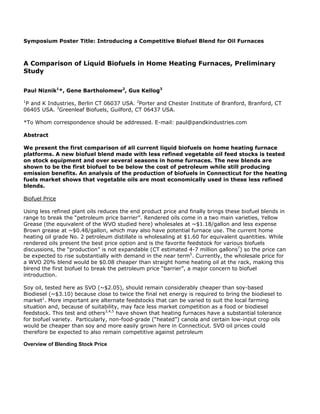
Symposium Poster Title: Introducing a Competitive Biofuel Blend for Oil Furnaces


A Comparison of Liquid Biofuels in Home Heating Furnaces, Preliminary
Study


Paul Niznik1*, Gene Bartholomew2, Gus Kellog3
1
 P and K Industries, Berlin CT 06037 USA. 2Porter and Chester Institute of Branford, Branford, CT
06405 USA. 3Greenleaf Biofuels, Guilford, CT 06437 USA.

*To Whom correspondence should be addressed. E-mail: paul@pandkindustries.com

Abstract

We present the first comparison of all current liquid biofuels on home heating furnace
platforms. A new biofuel blend made with less refined vegetable oil feed stocks is tested
on stock equipment and over several seasons in home furnaces. The new blends are
shown to be the first biofuel to be below the cost of petroleum while still producing
emission benefits. An analysis of the production of biofuels in Connecticut for the heating
fuels market shows that vegetable oils are most economically used in these less refined
blends.

Biofuel Price

Using less refined plant oils reduces the end product price and finally brings these biofuel blends in
range to break the “petroleum price barrier”. Rendered oils come in a two main varieties, Yellow
Grease (the equivalent of the WVO studied here) wholesales at ~$1.18/gallon and less expense
Brown grease at ~$0.48/gallon, which may also have potential furnace use. The current home
heating oil grade No. 2 petroleum distillate is wholesaling at $1.60 for equivalent quantities. While
rendered oils present the best price option and is the favorite feedstock for various biofuels
discussions, the “production” is not expandable (CT estimated 4-7 million gallons7) so the price can
be expected to rise substantially with demand in the near term5. Currently, the wholesale price for
a WVO 20% blend would be $0.08 cheaper than straight home heating oil at the rack, making this
blrend the first biofuel to break the petroleum price “barrier”, a major concern to biofuel
introduction.

Soy oil, tested here as SVO (~$2.05), should remain considerably cheaper than soy-based
Biodiesel (~$3.10) because close to twice the final net energy is required to bring the biodiesel to
market1. More important are alternate feedstocks that can be varied to suit the local farming
situation and, because of suitability, may face less market competition as a food or biodiesel
feedstock. This test and others3,4,5 have shown that heating furnaces have a substantial tolerance
for biofuel variety. Particularly, non-food-grade (“heated”) canola and certain low-input crop oils
would be cheaper than soy and more easily grown here in Connecticut. SVO oil prices could
therefore be expected to also remain competitive against petroleum

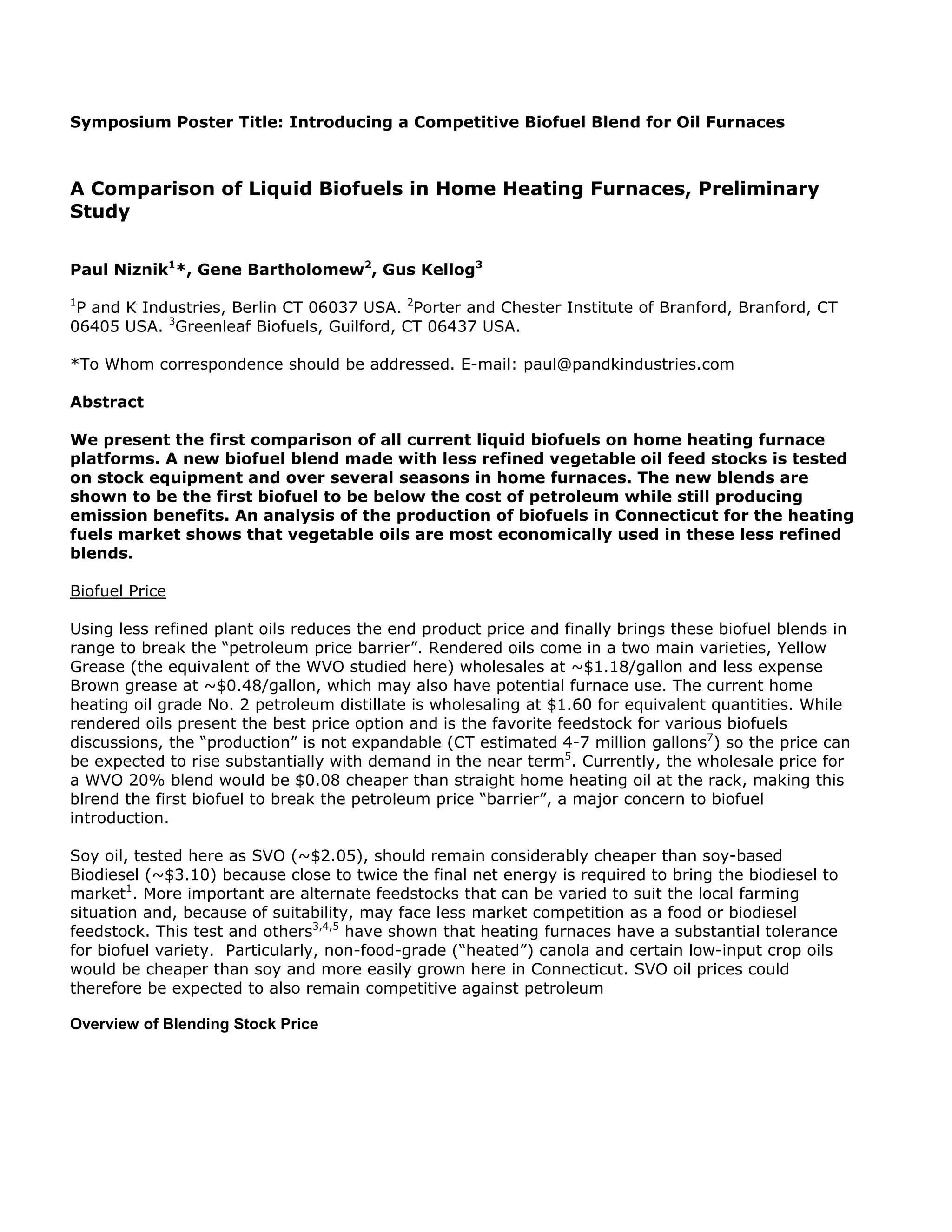
Overview of Blending Stock Price
Energy Production
  Heating Oil Blend-              Current CT         Expandable CT                                CT Wholesale
                                                                              Efficiency Ratio
        Stock                     Production          Production?                                    Pricea
                                                                              (Sustainability)


    Petroleum Home
                                        0                    no                     .831              $1.60
   Heating Oil (No.2)

     WVO Waste
                                  4-7 million
  Vegetable Oils and                                         no                     n.a.              $1.18
                                    gallons
        fats
 SVO Soy (and 0ther)
                                        0                   yes                  Soy 6.12             $2.05
   Vegetable Oils

                                  Beginning
         Biodiesel                                         Ye s                 3.21-3.672        $3.18-$2.25b
                                  production

         a                                                              b
             cost includes factor for transportation into CT               includes Federal Blending Credit

Part I: Home Furnace Multiplatform Comparison Data

Biofuel blends (and neat biodiesel) were compared against standard No. 2 on three common home
heating furnaces (boiler, steam, and hot forced air) using standard testing for the HVAC industry.
All fuels performed within acceptable standards for the equipment, and all combustion
characteristics were within acceptable limits for home usage.

The tests for increased motor strain (increased amperage draw do to higher viscosity) yielded
surprisingly little change vs. No. 2, as did flu-gas analysis. Qualitative analysis of the flames
confirmed the oxygenate effect of all the fuels (stronger flames), and improved fuel and flame odor
was a bonus for the testing crew.


Test data from 9/21/06 at labs Porter and Chester
schools, Branford.
B20 data from
3/15/06
Test Rig 1      Burner: Carlin EZPro

                  Pump Pressure: 140 PSI
                  Nozzle: 0.85 gph, 60 degree B Solid

                  Boiler: Weil McClain rated for .95 gph, 114 btu/hr


                       Diesel        20% Biodiesel      20%SVO 20% WVO           100%Biodiesel
Burner Motor            1.5              1.51             1.52   1.51                1.54
Amperage
Cad Cell                545                 639           601          796            1220
voltage ohms
Smoke                    0                   0              0          0               0
Number
CO2 %                   13.5                13.2          13.4         13              14
O2 %                    2.6                 3.2            2.4         3.4              2
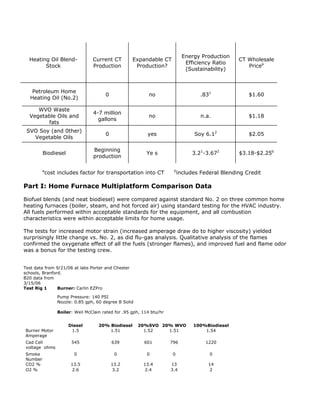
CO PPM               26                 36             38         43              55
Stack Temp F         337                446           437        465              400

Efficiency %        86.1                83.4          83.9       82.8            84.9


Test Rig 2     Burner: Becket AFG

               Pump Pressure: 140 psi

               Nozzle 0.65gph 70 degree Hollow


                         Forced Air Furnace: Burnham V-74 rated for 1.35 gph, 136 btu


                   Diesel         20% Biodiesel      20%SVO 20% WVO         100%Biodiesel

Burner Motor        2.17                2.26          2.52        2.2             2.4
Amperage
Cad Cell             255                362           565        230              970
voltage ohms
Smoke                    0               0             0           0               0
Number
CO2 %                9.9                10.1          10.4       10.2             8.6
O2 %                 7.5                7.2           7.5         7              10.8
CO PPM                19                 21            20         22              15
Stack Temp F         288                296           276        311             290

Efficiency %        85.1                85.4          85.6       85.2            84.6


Test Rig 3     Burner: Becket AFG

               140 PSI

               1.25 70* ES SOLID Nozzle


               Furnace: Trane rated 1.5 gh,170 btu


                   Diesel         20% Biodiesel      20%SVO 20% WVO         100%Biodiesel

BURNER               2.4                2.25          2.15        3.2            2.35
MOTOR AMPS
Cad Cell OHM         180                129            97         95              135
Smoke                    0               0             0           0               0
Number
CO2 %               12.2                12.4          12.2       12.6             12
O2 %                 4.3                 4             4.5        4.1             4.7

CO PPM               59                 35             33         40              38
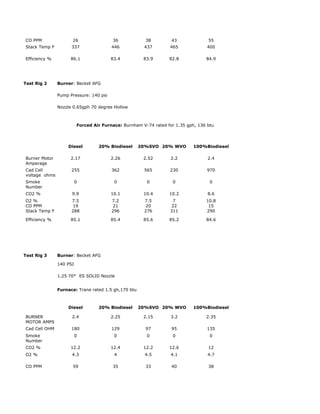
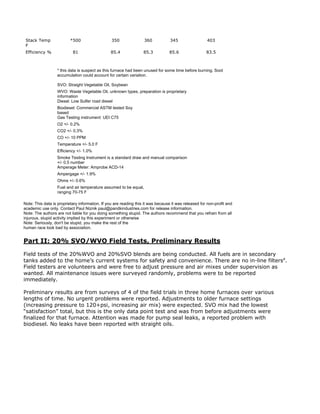
Stack Temp               *500                   350               360            345                 403
 F
 Efficiency %              81                   85.4               85.3          85.6                 83.5


                  * this data is suspect as this furnace had been unused for some time before burning. Soot
                  accumulation could account for certain variation.

                  SVO: Straight Vegetable Oil, Soybean
                  WVO: Waste Vegetable Oil, unknown types, preparation is proprietary
                  information
                  Diesel: Low Sulfer road diesel
                  Biodiesel: Commercial ASTM tested Soy
                  based
                  Gas Testing instrument: UEI C75
                  O2 +/- 0.2%
                  CO2 +/- 0.3%
                  CO +/- 10 PPM
                  Temperature +/- 5.0 F
                  Efficiency +/- 1.0%
                  Smoke Testing Instrument is a standard draw and manual comparison
                  +/- 0.5 number
                  Amperage Meter: Amprobe ACD-14
                  Ampergage +/- 1.9%
                  Ohms +/- 0.6%
                  Fuel and air temperature assumed to be equal,
                  ranging 70-75 F

Note: This data is proprietary information. If you are reading this it was because it was released for non-profit and
academic use only. Contact Paul Niznik paul@pandkindustries.com for release information.
Note: The authors are not liable for you doing something stupid. The authors recommend that you refrain from all
injurous, stupid activity implied by this experiment or otherwise
Note: Seriously, don't be stupid, you make the rest of the
human race look bad by association.


Part II: 20% SVO/WVO Field Tests, Preliminary Results

Field tests of the 20%WVO and 20%SVO blends are being conducted. All fuels are in secondary
tanks added to the home’s current systems for safety and convenience. There are no in-line filtersa.
Field testers are volunteers and were free to adjust pressure and air mixes under supervision as
wanted. All maintenance issues were surveyed randomly, problems were to be reported
immediately.

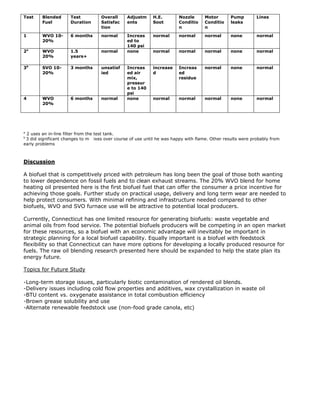
Preliminary results are from surveys of 4 of the field trials in three home furnaces over various
lengths of time. No urgent problems were reported. Adjustments to older furnace settings
(increasing pressure to 120+psi, increasing air mix) were expected. SVO mix had the lowest
“satisfaction” total, but this is the only data point test and was from before adjustments were
finalized for that furnace. Attention was made for pump seal leaks, a reported problem with
biodiesel. No leaks have been reported with straight oils.
Test    Blended      Test           Overall     Adjustm     H.E.        Nozzle      Motor       Pump        Lines
        Fuel         Duration       Satisfac    ents        Soot        Conditio    Conditio    leaks
                                    tion                                n           n

1       WVO 10-      6 months       normal      Increas     normal      normal      normal      none        normal
        20%                                     ed to
                                                140 psi
2a      WVO          1.5            normal      none        normal      normal      normal      none        normal
        20%          years+

3b      SVO 10-      3 months       unsatisf    Increas     increase    Increas     normal      none        normal
        20%                         ied         ed air      d           ed
                                                mix,                    residue
                                                pressur
                                                e to 140
                                                psi
4       WVO          6 months       normal      none        normal      normal      normal      none        normal
        20%


a
 2 uses an in-line filter from the test tank.
b
 3 did significant changes to m ixes over course of use until he was happy with flame. Other results were probably from
early problems


Discussion

A biofuel that is competitively priced with petroleum has long been the goal of those both wanting
to lower dependence on fossil fuels and to clean exhaust streams. The 20% WVO blend for home
heating oil presented here is the first biofuel fuel that can offer the consumer a price incentive for
achieving those goals. Further study on practical usage, delivery and long term wear are needed to
help protect consumers. With minimal refining and infrastructure needed compared to other
biofuels, WVO and SVO furnace use will be attractive to potential local producers.

Currently, Connecticut has one limited resource for generating biofuels: waste vegetable and
animal oils from food service. The potential biofuels producers will be competing in an open market
for these resources, so a biofuel with an economic advantage will inevitably be important in
strategic planning for a local biofuel capability. Equally important is a biofuel with feedstock
flexibility so that Connecticut can have more options for developing a locally produced resource for
fuels. The raw oil blending research presented here should be expanded to help the state plan its
energy future.

Topics for Future Study

-Long-term storage issues, particularly biotic contamination of rendered oil blends.
-Delivery issues including cold flow properties and additives, wax crystallization in waste oil
-BTU content vs. oxygenate assistance in total combustion efficiency
-Brown grease solubility and use
-Alternate renewable feedstock use (non-food grade canola, etc)

A Comparison of Liquid Biofuels in Home Heating Furnaces

  • 1.
    Symposium Poster Title:Introducing a Competitive Biofuel Blend for Oil Furnaces A Comparison of Liquid Biofuels in Home Heating Furnaces, Preliminary Study Paul Niznik1*, Gene Bartholomew2, Gus Kellog3 1 P and K Industries, Berlin CT 06037 USA. 2Porter and Chester Institute of Branford, Branford, CT 06405 USA. 3Greenleaf Biofuels, Guilford, CT 06437 USA. *To Whom correspondence should be addressed. E-mail: paul@pandkindustries.com Abstract We present the first comparison of all current liquid biofuels on home heating furnace platforms. A new biofuel blend made with less refined vegetable oil feed stocks is tested on stock equipment and over several seasons in home furnaces. The new blends are shown to be the first biofuel to be below the cost of petroleum while still producing emission benefits. An analysis of the production of biofuels in Connecticut for the heating fuels market shows that vegetable oils are most economically used in these less refined blends. Biofuel Price Using less refined plant oils reduces the end product price and finally brings these biofuel blends in range to break the “petroleum price barrier”. Rendered oils come in a two main varieties, Yellow Grease (the equivalent of the WVO studied here) wholesales at ~$1.18/gallon and less expense Brown grease at ~$0.48/gallon, which may also have potential furnace use. The current home heating oil grade No. 2 petroleum distillate is wholesaling at $1.60 for equivalent quantities. While rendered oils present the best price option and is the favorite feedstock for various biofuels discussions, the “production” is not expandable (CT estimated 4-7 million gallons7) so the price can be expected to rise substantially with demand in the near term5. Currently, the wholesale price for a WVO 20% blend would be $0.08 cheaper than straight home heating oil at the rack, making this blrend the first biofuel to break the petroleum price “barrier”, a major concern to biofuel introduction. Soy oil, tested here as SVO (~$2.05), should remain considerably cheaper than soy-based Biodiesel (~$3.10) because close to twice the final net energy is required to bring the biodiesel to market1. More important are alternate feedstocks that can be varied to suit the local farming situation and, because of suitability, may face less market competition as a food or biodiesel feedstock. This test and others3,4,5 have shown that heating furnaces have a substantial tolerance for biofuel variety. Particularly, non-food-grade (“heated”) canola and certain low-input crop oils would be cheaper than soy and more easily grown here in Connecticut. SVO oil prices could therefore be expected to also remain competitive against petroleum Overview of Blending Stock Price
  • 2.
    Energy Production Heating Oil Blend- Current CT Expandable CT CT Wholesale Efficiency Ratio Stock Production Production? Pricea (Sustainability) Petroleum Home 0 no .831 $1.60 Heating Oil (No.2) WVO Waste 4-7 million Vegetable Oils and no n.a. $1.18 gallons fats SVO Soy (and 0ther) 0 yes Soy 6.12 $2.05 Vegetable Oils Beginning Biodiesel Ye s 3.21-3.672 $3.18-$2.25b production a b cost includes factor for transportation into CT includes Federal Blending Credit Part I: Home Furnace Multiplatform Comparison Data Biofuel blends (and neat biodiesel) were compared against standard No. 2 on three common home heating furnaces (boiler, steam, and hot forced air) using standard testing for the HVAC industry. All fuels performed within acceptable standards for the equipment, and all combustion characteristics were within acceptable limits for home usage. The tests for increased motor strain (increased amperage draw do to higher viscosity) yielded surprisingly little change vs. No. 2, as did flu-gas analysis. Qualitative analysis of the flames confirmed the oxygenate effect of all the fuels (stronger flames), and improved fuel and flame odor was a bonus for the testing crew. Test data from 9/21/06 at labs Porter and Chester schools, Branford. B20 data from 3/15/06 Test Rig 1 Burner: Carlin EZPro Pump Pressure: 140 PSI Nozzle: 0.85 gph, 60 degree B Solid Boiler: Weil McClain rated for .95 gph, 114 btu/hr Diesel 20% Biodiesel 20%SVO 20% WVO 100%Biodiesel Burner Motor 1.5 1.51 1.52 1.51 1.54 Amperage Cad Cell 545 639 601 796 1220 voltage ohms Smoke 0 0 0 0 0 Number CO2 % 13.5 13.2 13.4 13 14 O2 % 2.6 3.2 2.4 3.4 2
  • 3.
    CO PPM 26 36 38 43 55 Stack Temp F 337 446 437 465 400 Efficiency % 86.1 83.4 83.9 82.8 84.9 Test Rig 2 Burner: Becket AFG Pump Pressure: 140 psi Nozzle 0.65gph 70 degree Hollow Forced Air Furnace: Burnham V-74 rated for 1.35 gph, 136 btu Diesel 20% Biodiesel 20%SVO 20% WVO 100%Biodiesel Burner Motor 2.17 2.26 2.52 2.2 2.4 Amperage Cad Cell 255 362 565 230 970 voltage ohms Smoke 0 0 0 0 0 Number CO2 % 9.9 10.1 10.4 10.2 8.6 O2 % 7.5 7.2 7.5 7 10.8 CO PPM 19 21 20 22 15 Stack Temp F 288 296 276 311 290 Efficiency % 85.1 85.4 85.6 85.2 84.6 Test Rig 3 Burner: Becket AFG 140 PSI 1.25 70* ES SOLID Nozzle Furnace: Trane rated 1.5 gh,170 btu Diesel 20% Biodiesel 20%SVO 20% WVO 100%Biodiesel BURNER 2.4 2.25 2.15 3.2 2.35 MOTOR AMPS Cad Cell OHM 180 129 97 95 135 Smoke 0 0 0 0 0 Number CO2 % 12.2 12.4 12.2 12.6 12 O2 % 4.3 4 4.5 4.1 4.7 CO PPM 59 35 33 40 38
  • 4.
    Stack Temp *500 350 360 345 403 F Efficiency % 81 85.4 85.3 85.6 83.5 * this data is suspect as this furnace had been unused for some time before burning. Soot accumulation could account for certain variation. SVO: Straight Vegetable Oil, Soybean WVO: Waste Vegetable Oil, unknown types, preparation is proprietary information Diesel: Low Sulfer road diesel Biodiesel: Commercial ASTM tested Soy based Gas Testing instrument: UEI C75 O2 +/- 0.2% CO2 +/- 0.3% CO +/- 10 PPM Temperature +/- 5.0 F Efficiency +/- 1.0% Smoke Testing Instrument is a standard draw and manual comparison +/- 0.5 number Amperage Meter: Amprobe ACD-14 Ampergage +/- 1.9% Ohms +/- 0.6% Fuel and air temperature assumed to be equal, ranging 70-75 F Note: This data is proprietary information. If you are reading this it was because it was released for non-profit and academic use only. Contact Paul Niznik paul@pandkindustries.com for release information. Note: The authors are not liable for you doing something stupid. The authors recommend that you refrain from all injurous, stupid activity implied by this experiment or otherwise Note: Seriously, don't be stupid, you make the rest of the human race look bad by association. Part II: 20% SVO/WVO Field Tests, Preliminary Results Field tests of the 20%WVO and 20%SVO blends are being conducted. All fuels are in secondary tanks added to the home’s current systems for safety and convenience. There are no in-line filtersa. Field testers are volunteers and were free to adjust pressure and air mixes under supervision as wanted. All maintenance issues were surveyed randomly, problems were to be reported immediately. Preliminary results are from surveys of 4 of the field trials in three home furnaces over various lengths of time. No urgent problems were reported. Adjustments to older furnace settings (increasing pressure to 120+psi, increasing air mix) were expected. SVO mix had the lowest “satisfaction” total, but this is the only data point test and was from before adjustments were finalized for that furnace. Attention was made for pump seal leaks, a reported problem with biodiesel. No leaks have been reported with straight oils.
  • 5.
    Test Blended Test Overall Adjustm H.E. Nozzle Motor Pump Lines Fuel Duration Satisfac ents Soot Conditio Conditio leaks tion n n 1 WVO 10- 6 months normal Increas normal normal normal none normal 20% ed to 140 psi 2a WVO 1.5 normal none normal normal normal none normal 20% years+ 3b SVO 10- 3 months unsatisf Increas increase Increas normal none normal 20% ied ed air d ed mix, residue pressur e to 140 psi 4 WVO 6 months normal none normal normal normal none normal 20% a 2 uses an in-line filter from the test tank. b 3 did significant changes to m ixes over course of use until he was happy with flame. Other results were probably from early problems Discussion A biofuel that is competitively priced with petroleum has long been the goal of those both wanting to lower dependence on fossil fuels and to clean exhaust streams. The 20% WVO blend for home heating oil presented here is the first biofuel fuel that can offer the consumer a price incentive for achieving those goals. Further study on practical usage, delivery and long term wear are needed to help protect consumers. With minimal refining and infrastructure needed compared to other biofuels, WVO and SVO furnace use will be attractive to potential local producers. Currently, Connecticut has one limited resource for generating biofuels: waste vegetable and animal oils from food service. The potential biofuels producers will be competing in an open market for these resources, so a biofuel with an economic advantage will inevitably be important in strategic planning for a local biofuel capability. Equally important is a biofuel with feedstock flexibility so that Connecticut can have more options for developing a locally produced resource for fuels. The raw oil blending research presented here should be expanded to help the state plan its energy future. Topics for Future Study -Long-term storage issues, particularly biotic contamination of rendered oil blends. -Delivery issues including cold flow properties and additives, wax crystallization in waste oil -BTU content vs. oxygenate assistance in total combustion efficiency -Brown grease solubility and use -Alternate renewable feedstock use (non-food grade canola, etc)