www.AmericanAgriculturist.com - October 2008


14                                                                                  Crops

Update: Grow your own biofuel crop


                                                                                                                                                                                         PHOTO COURTESY OF GENE HEMPHILL/NEW HOLLAND
By JOHN VOGEL
        IOFUEL — growing and making it

B       — was a top attraction at August’s
        Penn State Ag Progress Days.
Farmer interest in raising oilseed crops
such as canola and camelina, which can
be pressed and burned straight in diesel
engines, is growing beyond curiosity.
    Consider researching and experi-
menting with winter canola as a double-
crop and potential cover crop, suggests
Glen Cauffman, farm manager for Penn
State’s College of Ag Sciences. It’s more
winter-hardy than spring-seeded canola.
Since it’s a rapeseed crop, it may qualify
for cover crop payments if your state
offers them.
    Fall-seeded rapeseed (winter canola)
is already being tried in Maryland and
Delaware. Perdue Inc. put out plots this
fall, according to company officials.
    “Canola will take off now,” predicts
Cauffman. “Farmers are concerned
about diesel fuel costs. When you raise
your own fuel, you’ll know your costs.”

Twin-tank tech is here
Ag Progress Days was one of the first
North American public exposures of
a straight-vegetable-oil fuel system on
major-manufacturer Tier 3 tractor en-
gines. New Holland had fitted two trac-
tors with the Elsbett twin-tank system,
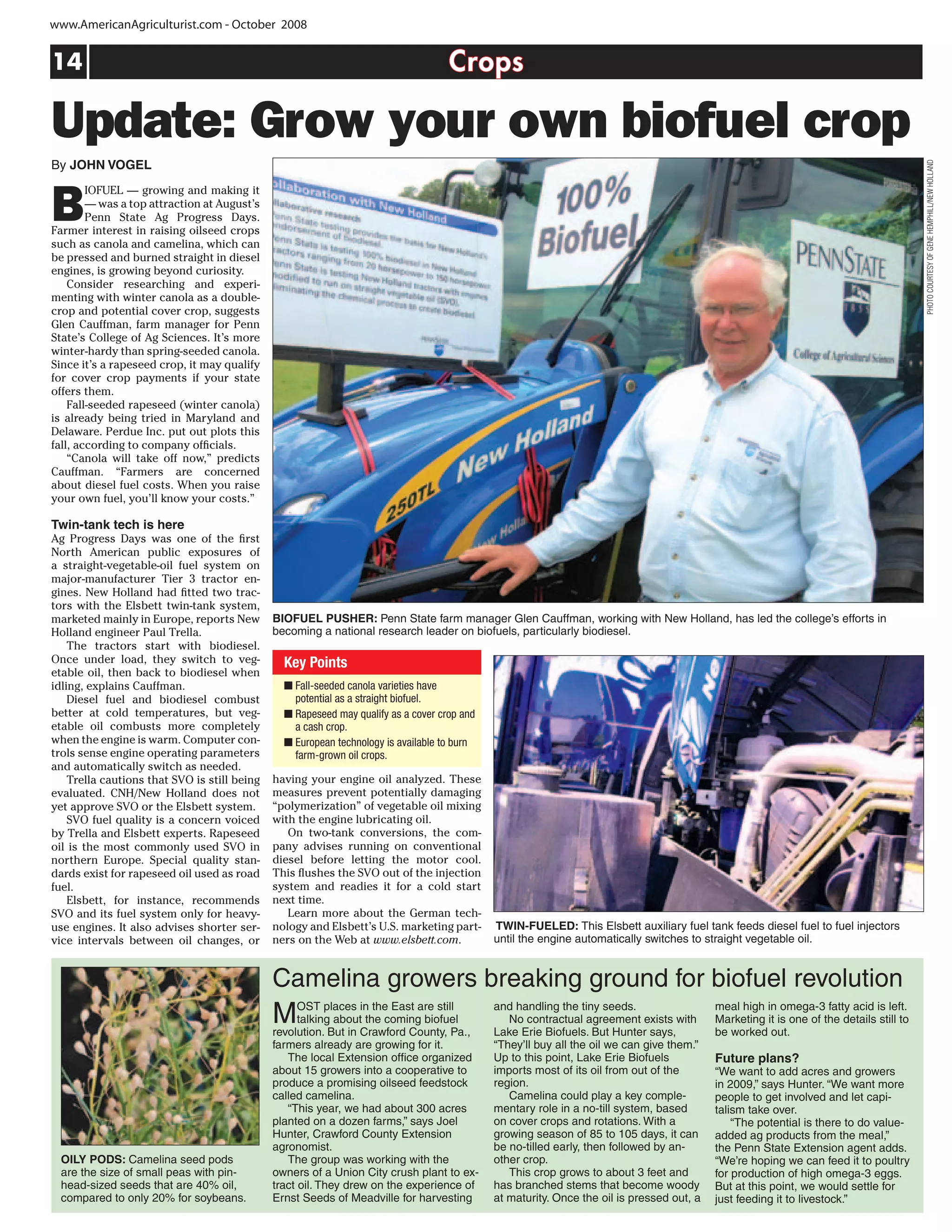
marketed mainly in Europe, reports New        BIOFUEL PUSHER: Penn State farm manager Glen Cauffman, working with New Holland, has led the college’s efforts in
Holland engineer Paul Trella.                 becoming a national research leader on biofuels, particularly biodiesel.
    The tractors start with biodiesel.
Once under load, they switch to veg-            Key Points
etable oil, then back to biodiesel when
idling, explains Cauffman.                      ■ Fall-seeded canola varieties have
    Diesel fuel and biodiesel combust             potential as a straight biofuel.
better at cold temperatures, but veg-           ■ Rapeseed may qualify as a cover crop and
etable oil combusts more completely               a cash crop.
when the engine is warm. Computer con-          ■ European technology is available to burn
trols sense engine operating parameters           farm-grown oil crops.
and automatically switch as needed.
    Trella cautions that SVO is still being   having your engine oil analyzed. These
evaluated. CNH/New Holland does not           measures prevent potentially damaging
yet approve SVO or the Elsbett system.        “polymerization” of vegetable oil mixing
    SVO fuel quality is a concern voiced      with the engine lubricating oil.
by Trella and Elsbett experts. Rapeseed          On two-tank conversions, the com-
oil is the most commonly used SVO in          pany advises running on conventional
northern Europe. Special quality stan-        diesel before letting the motor cool.
dards exist for rapeseed oil used as road     This flushes the SVO out of the injection
fuel.                                         system and readies it for a cold start
    Elsbett, for instance, recommends         next time.
SVO and its fuel system only for heavy-          Learn more about the German tech-
use engines. It also advises shorter ser-     nology and Elsbett’s U.S. marketing part-      TWIN-FUELED: This Elsbett auxiliary fuel tank feeds diesel fuel to fuel injectors
vice intervals between oil changes, or        ners on the Web at www.elsbett.com.            until the engine automatically switches to straight vegetable oil.


                                              Camelina growers breaking ground for biofuel revolution
                                              M     OST places in the East are still
                                                    talking about the coming biofuel
                                              revolution. But in Crawford County, Pa.,
                                                                                             and handling the tiny seeds.
                                                                                                No contractual agreement exists with
                                                                                             Lake Erie Biofuels. But Hunter says,
                                                                                                                                           meal high in omega-3 fatty acid is left.
                                                                                                                                           Marketing it is one of the details still to
                                                                                                                                           be worked out.
                                              farmers already are growing for it.            “They’ll buy all the oil we can give them.”
                                                 The local Extension office organized         Up to this point, Lake Erie Biofuels          Future plans?
                                              about 15 growers into a cooperative to         imports most of its oil from out of the       “We want to add acres and growers
                                              produce a promising oilseed feedstock          region.                                       in 2009,” says Hunter. “We want more
                                              called camelina.                                  Camelina could play a key comple-          people to get involved and let capi-
                                                 “This year, we had about 300 acres          mentary role in a no-till system, based       talism take over.
                                              planted on a dozen farms,” says Joel           on cover crops and rotations. With a              “The potential is there to do value-
                                              Hunter, Crawford County Extension              growing season of 85 to 105 days, it can      added ag products from the meal,”
                                              agronomist.                                    be no-tilled early, then followed by an-      the Penn State Extension agent adds.
  OILY PODS: Camelina seed pods                  The group was working with the              other crop.                                   “We’re hoping we can feed it to poultry
  are the size of small peas with pin-        owners of a Union City crush plant to ex-         This crop grows to about 3 feet and        for production of high omega-3 eggs.
  head-sized seeds that are 40% oil,          tract oil. They drew on the experience of      has branched stems that become woody          But at this point, we would settle for
  compared to only 20% for soybeans.          Ernst Seeds of Meadville for harvesting        at maturity. Once the oil is pressed out, a   just feeding it to livestock.”

Grow your Own Biofuel Crop - Penn State University

  • 1.
    www.AmericanAgriculturist.com - October2008 14 Crops Update: Grow your own biofuel crop PHOTO COURTESY OF GENE HEMPHILL/NEW HOLLAND By JOHN VOGEL IOFUEL — growing and making it B — was a top attraction at August’s Penn State Ag Progress Days. Farmer interest in raising oilseed crops such as canola and camelina, which can be pressed and burned straight in diesel engines, is growing beyond curiosity. Consider researching and experi- menting with winter canola as a double- crop and potential cover crop, suggests Glen Cauffman, farm manager for Penn State’s College of Ag Sciences. It’s more winter-hardy than spring-seeded canola. Since it’s a rapeseed crop, it may qualify for cover crop payments if your state offers them. Fall-seeded rapeseed (winter canola) is already being tried in Maryland and Delaware. Perdue Inc. put out plots this fall, according to company officials. “Canola will take off now,” predicts Cauffman. “Farmers are concerned about diesel fuel costs. When you raise your own fuel, you’ll know your costs.” Twin-tank tech is here Ag Progress Days was one of the first North American public exposures of a straight-vegetable-oil fuel system on major-manufacturer Tier 3 tractor en- gines. New Holland had fitted two trac- tors with the Elsbett twin-tank system, marketed mainly in Europe, reports New BIOFUEL PUSHER: Penn State farm manager Glen Cauffman, working with New Holland, has led the college’s efforts in Holland engineer Paul Trella. becoming a national research leader on biofuels, particularly biodiesel. The tractors start with biodiesel. Once under load, they switch to veg- Key Points etable oil, then back to biodiesel when idling, explains Cauffman. ■ Fall-seeded canola varieties have Diesel fuel and biodiesel combust potential as a straight biofuel. better at cold temperatures, but veg- ■ Rapeseed may qualify as a cover crop and etable oil combusts more completely a cash crop. when the engine is warm. Computer con- ■ European technology is available to burn trols sense engine operating parameters farm-grown oil crops. and automatically switch as needed. Trella cautions that SVO is still being having your engine oil analyzed. These evaluated. CNH/New Holland does not measures prevent potentially damaging yet approve SVO or the Elsbett system. “polymerization” of vegetable oil mixing SVO fuel quality is a concern voiced with the engine lubricating oil. by Trella and Elsbett experts. Rapeseed On two-tank conversions, the com- oil is the most commonly used SVO in pany advises running on conventional northern Europe. Special quality stan- diesel before letting the motor cool. dards exist for rapeseed oil used as road This flushes the SVO out of the injection fuel. system and readies it for a cold start Elsbett, for instance, recommends next time. SVO and its fuel system only for heavy- Learn more about the German tech- use engines. It also advises shorter ser- nology and Elsbett’s U.S. marketing part- TWIN-FUELED: This Elsbett auxiliary fuel tank feeds diesel fuel to fuel injectors vice intervals between oil changes, or ners on the Web at www.elsbett.com. until the engine automatically switches to straight vegetable oil. Camelina growers breaking ground for biofuel revolution M OST places in the East are still talking about the coming biofuel revolution. But in Crawford County, Pa., and handling the tiny seeds. No contractual agreement exists with Lake Erie Biofuels. But Hunter says, meal high in omega-3 fatty acid is left. Marketing it is one of the details still to be worked out. farmers already are growing for it. “They’ll buy all the oil we can give them.” The local Extension office organized Up to this point, Lake Erie Biofuels Future plans? about 15 growers into a cooperative to imports most of its oil from out of the “We want to add acres and growers produce a promising oilseed feedstock region. in 2009,” says Hunter. “We want more called camelina. Camelina could play a key comple- people to get involved and let capi- “This year, we had about 300 acres mentary role in a no-till system, based talism take over. planted on a dozen farms,” says Joel on cover crops and rotations. With a “The potential is there to do value- Hunter, Crawford County Extension growing season of 85 to 105 days, it can added ag products from the meal,” agronomist. be no-tilled early, then followed by an- the Penn State Extension agent adds. OILY PODS: Camelina seed pods The group was working with the other crop. “We’re hoping we can feed it to poultry are the size of small peas with pin- owners of a Union City crush plant to ex- This crop grows to about 3 feet and for production of high omega-3 eggs. head-sized seeds that are 40% oil, tract oil. They drew on the experience of has branched stems that become woody But at this point, we would settle for compared to only 20% for soybeans. Ernst Seeds of Meadville for harvesting at maturity. Once the oil is pressed out, a just feeding it to livestock.”