Coconut Oil as a biofuel in Pacific Islands


                                 Coconut Oil as a Biofuel in Pacific Islands
                                                                                        Jan Cloin
                                                    South Pacific Applied Geoscience Commission

There are great opportunities to utilise coconut oil as a fuel in the Pacific. Coconut oil can
be blended with diesel fuel, and under certain conditions totally replace it. Coconut oil in
Pacific islands countries is increasingly used in both transport and electricity generation
through its lower local cost. Other benefits include the support to local agro-industries
and a decrease in emissions.

Biofuels in the Pacific                                  extinct, especially through the high inputs
The use of biofuels is nearly as old as the              of labour required, with low return. By
diesel engine itself, as Mr. Diesel                      switching to mechanised production of
designed his original engine running on                  local fuel substitutes instead of focusing
peanut oil. During periods in history                    on highly competitive exports, economic
when     regular   diesel    supply    was               niches can be found on the islands
hampered seriously such as during World                  themselves.
War II, throughout the world vegetable
alternatives from different sources and in               There are a number of ways in which
different forms have been used.                          vegetable oils such as coconut oil can be
                                                         used in compression engines (See
The specific circumstances of small                      Coconut Oil Fuel Technology). Another
Pacific Islands call for local solutions.                promising technology includes straight
Since most Pacific island countries                      gasification of whole coconuts, however
import their fuels at very high transport                this    requires   further  technological
costs, it makes economic sense to find                   development.
local fuel supplies. Even though the
Pacific islands on a world-scale do not                  Coconut Oil Fuel Technology
contribute much to the emission of                       Use of Coconut Oil in Standard Engines
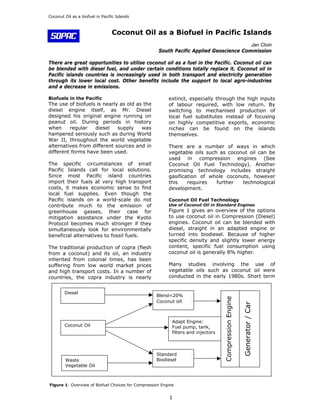
greenhouse gasses, their case for                        Figure 1 gives an overview of the options
mitigation assistance under the Kyoto                    to use coconut oil in Compression (Diesel)
Protocol becomes much stronger if they                   engines. Coconut oil can be blended with
simultaneously look for environmentally                  diesel, straight in an adapted engine or
beneficial alternatives to fossil fuels.                 turned into biodiesel. Because of higher
                                                         specific density and slightly lower energy
The traditional production of copra (flesh               content, specific fuel consumption using
from a coconut) and its oil, an industry                 coconut oil is generally 8% higher.
inherited from colonial times, has been
suffering from low world market prices                   Many studies involving the use of
and high transport costs. In a number of                 vegetable oils such as coconut oil were
countries, the copra industry is nearly                  conducted in the early 1980s. Short term


        Diesel
                                                   Blend<20%
                                                                                   Compression Engine


                                                   Coconut oil
                                                                                                        Generator / Car


                                                           Adapt Engine:
        Coconut Oil                                        Fuel pump, tank,
                                                           filters and injectors


                                                   Standard
        Waste                                      Biodiesel
        Vegetable Oil


Figure 1: Overview of Biofuel Choices for Compression Engine


                                                         1
Coconut Oil as a biofuel in Pacific Islands


engine testing indicates that vegetable
oils can readily be used as a fuel or in a
range of blends with diesel. Long-term
engine research however shows that
engine durability is questionable when
fuel blends contain more than 20%
vegetable oil [1,2,5,11]. Especially
deposits    on    the    pistons,   valves,
combustion chambers and injectors can
cause severe loss of output power,
engine lubricant deterioration or even
catastrophic failure to engines [6].

Using pure coconut oil in standard
engines is very attractive through its low
cost,   however     it  requires   special                 Figure 3: Coconut Oil Adapted Vehicles in
technical supervision and may shorten                      Vanuatu (Tony Deamer)
engine life.

Use of Coconut Oil in Adapted Engines                      Fuel System Adaptations
Fuel Heater                                                It is also possible to adapt the fuel system
As coconut oil has up to 30 times higher                   of a compression engine to start and stop
viscosity than regular diesel at the same                  on pure coconut oil. Mostly, these engines
temperature, most engine modifications                     feature adapted injectors, dedicated fuel
include a fuel heater. As heat is                          pumps and extra filters. A good example
exchanged between the engine coolant                       of this is the pilot plant in Ouvéa, New
and    the    fuel,    the  oil   viscosity                Caledonia, implemented by SPC and
approximates that of diesel [7]. As                        CIRAD in the 1990’s [3,12]. Further
coconut oil solidifies below temperatures                  feasibility studies have shown favourable
of 250C, often an electrical heater is                     opportunities      for    both     electricity
incorporated in the fuel tank.                             generation and taxis in Vanuatu [9,10].

Start / Stop on Diesel                                     In Europe and the United States, the use
Most adaptations incorporate a start and                   of dual fuel systems, mainly in automotive
stop on regular diesel. As soon as the                     applications, is slowly developing. Through
engine     is    operating   at    rated                   a combination of high taxation on fuels
temperature, the fuel supply switches to                   (Europe), low vegetable oil prices (U.S.)
coconut oil and just before shutting                       an increasing number of consumers have
down, the supply is switched back to                       acquired an alternative fuel system built in
diesel. This system ensures that the fuel                  their vehicles. Reportedly, the emission
system has diesel ready for a cold start                   reductions achieved through use of these
                                                           fuels have been mixed [8].

                                                           The main advantage of adapted engines is
                                                           their fuel flexibility and relatively low
                                                           additional cost. The major disadvantage is
                                                           the loss of guarantee from the engine
                                                           manufacturer, even though some engine
                                                           manufacturers are now supporting the use
                                                           of coconut oil under certain conditions. A
                                                           second disadvantage is the requirement
                                                           for higher loads, as low loads result in
                                                           heavy deposits on the combustion
                                                           chamber components, reducing engine life
                                                           [12].
 Figure 2: Fiji Rural Electricity             Generation
 adaptations: special pump and filter.


and avoids coconut oil residues in the
fuel system.

                                                            2
Coconut Oil as a biofuel in Pacific Islands


The use of Biodiesel
                                                                      CNO World Export Market and price per litre
Biodiesel is a standardised fuel that
consists of vegetable oil Methyl Ester.                         2.5                                                 0.8
It is a product of vegetable oil that
reacts with an alcohol (methanol) and                                                                               0.7
a catalyst (sodium hydroxide). This                              2
process generates two products:                                                                                     0.6
glycerine, which can be used in soap
production, and biodiesel. There are


                                               Million tonnes
                                                                                                                    0.5
                                                                1.5


                                                                                                                          US$/litre
two fully developed standards of
                                                                                                                    0.4
biodiesel, ASTM-D 6751 in the U.S.
and EN14214 in the E.U. Following                                1
                                                                                                                    0.3
these     standards     upholds    the
guarantee       of     the      engine                                                                              0.2
manufacturer [4].                                               0.5
                                                                                                                    0.1
Positive impacts on engines include
increased lubricity and a reduction of                           0                                                  0
visible particles in the exhaust.                                      1997 1998 1999 2000 2001 2002 2003
Secondly, other (waste) vegetable oil                                               Year               Market Volume
can be included in the feedstock of                                                                    US$ per litre
biodiesel production.
                                               Figure 4: Copra Oil World Export Market and Price
The major disadvantage of biodiesel is         (Source: Philippines Coconut Authority)
its high costs through the use of a
chemical facility and the requirement of                        world price. The price composition for
imported methanol. Current research by                          traditional production of copra oil in Fiji is
the University of the South Pacific will                        given in table 1. The value of the coconuts
have to point out whether the production                        and the labour to create copra (includes
of standard biodiesel can be competitive                        cutting the coconut flesh out of the shell
using locally produced ethanol from                             and drying it) are almost equal. On top of
sugarcane.                                                      that the mill obtains 11 US cents per litre
                                                                in return for producing and filtering the
Coconut Oil Economics                                           oil. Finally 11 US cents are required to get
The world production of coconuts in                             the oil to the world market, in this
copra equivalent has been floating                              example, the port of Rotterdam.
around 10 million tonnes per year. Of
this market, between 1 and 2 million                            One of the reasons why the copra oil
tonnes has been traded on the world                             industry in many Pacific island countries is
market. Figure 4 shows the volume of                            suffering is because they have a relatively
the global copra oil market and the                             small size and little opportunities for
associated price per litre over the last 5                      economies of scale. Because of the low
years.                                                          return for the harsh work involved with
                                                                the cutting and drying of copra, many
The price fluctuation of coconut oil has                        rural farmers are diverting to other cash
been significant, between 0.3 and 0.7                           crops, leaving coconuts unharvested in
US$/litre. The export market consists                           plantations. Regional potential production
mainly of industrial processes that can                         estimates amount up to a total of 100
use other vegetable oils if the world price                     million litres of coconut oil.
for coconut oil is high. This can be seen
for example 1999 when there was a                               There    are    many     opportunities     to
worldwide shortage of coconut oil. The                          mechanise     the     process     of    copra
world market price is therefore also very                       production, but this will only materialise
much linked to the prices and yields of                         when investors perceive the risks of the
other oils such as palm, corn and canola.                       investments required to be minimal.
Since the Pacific island countries only                         Switching to higher value product-market
produce a small percentage of the world                         combination such as Coconut Oil Fuel
export (Papua New Guinea: 2.2%,                                 might assist in this transition. The electric
Solomon Islands: 1% Samoa 0.4%, Fiji                            utility of Western Samoa (EPC) is
0.3%), any increase or decrease in                              currently carrying out a feasibility study of
production in the Pacific will not alter the
                                                                  3
Coconut Oil as a biofuel in Pacific Islands


               a   mechanised      Coconut     Oil  Fuel
               production plant on the island of Savai’i.

            Table 1: Fiji Coconut Oil Price Composition
                                                  Price in Oil    Share of
                                                  Equivalent      Local Oil
                                                  [US$/l]         Price [%]
            Coconuts on field                          0.22            39
            Return for labour to Cut/Dry Copra             0.25             42
            Dry Copra at Mill                          0.47            81
            Return for Milling / Filtering                 0.11             19
            Coconut Oil Price at Mill (Fiji)          0.48            100
            Storage, Transport, Financing                  0.11             19
            World Coconut Oil Price (Rotterdam)        0.59           123
                                                                                     Figure 5: Traditional Copra Production in Samoa
             What becomes apparent when looking at
            the figures in Table 1 is that the local                             depicts the opportunity cost of a litre of
            price of coconut oil is significantly lower                          coconut oil of being exported. The price
            than the world price, through the cost of                            difference is even larger for remote islands
            storage, transport and financing. Since                              and villages inside the Pacific islands
            one litre of diesel must be replaced by                              countries, where additional local transport
            1.08 litre of coconut oil (see box “Coconut                          costs have to be taken into account.
            Oil Fuel Technology”), the opportunity
            cost for local coconut oil versus diesel is                           Given the volatility of both the prices for
            therefore US$ 0.52 per litre.                                         coconut oil and diesel, flexible fuel
                                                                                  systems running on both fuels, have
            Figure 6 shows the retail prices and                                  preference. Even running generators on
            landed cost of diesel fuel in the region, the                         low blends (10-20%) of coconut oil
            difference being taxes, excise and                                    without investing in engine adaptation can
            distribution costs. The line in the graph                             have great financial benefits.

                                                             Pacific Regional Diesel Prices


             Niue

           Tuvalu

          Vanuatu

           Tonga

           Kiribati

   New Caledonia

  Marshall Islands

 French Polynesia

Papua New Guinea

 Solomon Islands

               Fiji                                                                      Pacific Island Opportunity Cost of Coconut Oil: US$0.52/litre

           Hawaii
                                                                                                                          Retail
           Samoa                                                                                                          Excluding Duty & Taxes

                      0          20               40               60               80                  100                 120                140
                                                                        US$cents/litre


    Figure 6: Pacific Regional Diesel Prices (Source: Pacific Islands Forum Secretariat Fuel Price Monitor Nov-Dec 2004)


                                                                                     4
Coconut Oil as a biofuel in Pacific Islands


                                                         coconut oil with diesel to decrease
The      further     rationalisation      and            costs per km. For coconut oil fuel to
mechanisation of the coconut oil supply                  be a sustainable alternative to diesel
chain will increase the security of supply,              fuel in the Pacific, restructuring of the
however       this   requires     significant            coconut industry and replanting of
investment in the coconut oil sector.                    coconut     plantations    is   required.
After restructuring and replanting of                    Widespread utilisation of alternative
coconut plantations, most Pacific islands                fuels will require active involvement
have the potential to provide one third to               of engine manufacturers and local
half of their current diesel imports.                    mechanics.

Environmental Benefits                                   Acknowledgement
The widespread use of Coconut Oil to                     The author is grateful for the essential
replace diesel has a range of potential                  contributions of: Patrice Courty, Tony Deamer
environmental benefits. First, there is                  and Dr. Gilles Vaitilingom.
the decrease of emissions of poisonous
gases    and   particulate   matter   as                 References
                                                         [1] Allen, M. (2002) “Straighter than straight vegetable oils
compared to diesel, through the higher                   as diesel fuels”, Prince of Songkla University, Thailand
oxygen content of coconut oil. These
                                                         [2] Calais, P. and Clark, A.R. (2004) “Waste Vegetable Oil as
benefits however do not materialise so                   a diesel Replacement Fuel”, Murdoch University and Western
well using straight vegetable oil in                     Australian Renewable Fuels Association, Western Australia.
standard engines [8]. Secondly, the use                  [3] Courty, P. (1998) “Potential for copra oil as a biofuel: A
of coconut oil can be considered CO2                     development tool for Pacific Community countries and
neutral. The CO2 stored in the coconuts,                 territories” SPC, New Caledonia

husks and shells are used in the process                 [4] EMA Engine Manufacturers Association (2003) “Technical
of oil production (husk and shells for                   statement on the use of biodiesel fuel in compression
                                                         ignition engines” EMA, Chicago, U.S.A.
drying the copra) and burning of the oil.
This CO2 is again sequestrated during                    [5] Jones, J. and Peterson, C.L. (2002) “Using unmodified
                                                         Vegetable Oil as a Diesel Fuel Extender” University of Idaho,
the growing of new trees and nuts.                       U.S.A.

Socio-Economic Benefits                                  [6] Knothe, G. et al (1997) “Biodiesel: The use of straight
                                                         vegetable oil and their derivatives as alternative diesel
Creating a local industry that substitutes               fuels”, U.S. Department of Agriculture, U.S.A.
fuel imports, benefits fragile Pacific
                                                         [7] Kopial, T. et al (2004) “Effects of reducing coconut oil
island countries substantially through                   viscosity on engine performance”, PNG University of
improvements in balance of payments                      Technology, Lae, Papua New Guinea
[13] and job creation. Simultaneously,                   [8] Lance, D. et al (2003) “DfT Biofuels Evaluation – Final
coconut farmers are given access to a                    Report of Test Programme to Evaluate Emissions
new, potentially booming market once                     Performance of Vegetable Oil Fuel on Two Light Duty Diesel
                                                         Vehicles”, Ricardo Consulting Engineers, U.K.
the difference with the benchmark of the
diesel price further increases.                          [9] Leplus, A. (2003) “Biofuel Energy from Coconut in the
                                                         Pacific Islands” MSc. Thesis, Wageningen University, The
                                                         Netherlands.
Conclusion
                                                         [10] Ribier, V. et al (2004) “Etude de faisabilité d’un projet
Even though there is quite some                          de valorisation de l’huile de coprah à l’échelle villageoise – le
evidence      of   the    environmental                  cas de la coopérative ‘Lory’, Nord Santo” CIRAD, France
benefits using vegetable oils as a
                                                         [11] Solly, R.K. (1983) “Coconut oil and Coconut Oil Ethanol
fuel, it is the local cost of fuel that is               Derivatives as fuel for Diesel Engines” University of the
the     real   driver    behind     these                South Pacific, Fiji Islands
developments in the Pacific island                       [12] Vaitilingom, G. et al. (1995) “Crude Copra Oil, a biofuel
economies.         Electric      Utilities               for diesel engines” CIRAD / SPC, New Caledonia
generally       suffer    from      great                [13] Zieroth, G. et al (1985) “Biofuels for developing
dependence on imported diesel for                        countries: Promising strategy or dead end?”, GTZ, Germany
power generation and are seeking
new ways to hedge these risks.                           Links for further information
Motorists have successfully blended                    http://www.journeytoforever.org/biofuel_library.html
                                                       http://www.sopac.org/tiki/tiki-index.php?page=Energy+Projects+COPRA


      Biography Jan Cloin
      Joined SOPAC – Community Lifelines Programme – in December 2003 as a U.N. Associate Expert. He
      started his career with PV Solar Home Systems research in Southern Africa for the Netherlands Energy
      Research Foundation (ECN). After that, he worked briefly for the UNDP Energy & Atmosphere Programme
      in New York. Before joining SOPAC, he was active in the green electricity sector in The Netherlands.
      Currently, he is working on the use of Biofuels, Wind Energy Education and Renewable Energy Training.

                                                           5

Coconut Oil as a Biofuel in Pacific Islands

  • 1.
    Coconut Oil asa biofuel in Pacific Islands Coconut Oil as a Biofuel in Pacific Islands Jan Cloin South Pacific Applied Geoscience Commission There are great opportunities to utilise coconut oil as a fuel in the Pacific. Coconut oil can be blended with diesel fuel, and under certain conditions totally replace it. Coconut oil in Pacific islands countries is increasingly used in both transport and electricity generation through its lower local cost. Other benefits include the support to local agro-industries and a decrease in emissions. Biofuels in the Pacific extinct, especially through the high inputs The use of biofuels is nearly as old as the of labour required, with low return. By diesel engine itself, as Mr. Diesel switching to mechanised production of designed his original engine running on local fuel substitutes instead of focusing peanut oil. During periods in history on highly competitive exports, economic when regular diesel supply was niches can be found on the islands hampered seriously such as during World themselves. War II, throughout the world vegetable alternatives from different sources and in There are a number of ways in which different forms have been used. vegetable oils such as coconut oil can be used in compression engines (See The specific circumstances of small Coconut Oil Fuel Technology). Another Pacific Islands call for local solutions. promising technology includes straight Since most Pacific island countries gasification of whole coconuts, however import their fuels at very high transport this requires further technological costs, it makes economic sense to find development. local fuel supplies. Even though the Pacific islands on a world-scale do not Coconut Oil Fuel Technology contribute much to the emission of Use of Coconut Oil in Standard Engines greenhouse gasses, their case for Figure 1 gives an overview of the options mitigation assistance under the Kyoto to use coconut oil in Compression (Diesel) Protocol becomes much stronger if they engines. Coconut oil can be blended with simultaneously look for environmentally diesel, straight in an adapted engine or beneficial alternatives to fossil fuels. turned into biodiesel. Because of higher specific density and slightly lower energy The traditional production of copra (flesh content, specific fuel consumption using from a coconut) and its oil, an industry coconut oil is generally 8% higher. inherited from colonial times, has been suffering from low world market prices Many studies involving the use of and high transport costs. In a number of vegetable oils such as coconut oil were countries, the copra industry is nearly conducted in the early 1980s. Short term Diesel Blend<20% Compression Engine Coconut oil Generator / Car Adapt Engine: Coconut Oil Fuel pump, tank, filters and injectors Standard Waste Biodiesel Vegetable Oil Figure 1: Overview of Biofuel Choices for Compression Engine 1
  • 2.
    Coconut Oil asa biofuel in Pacific Islands engine testing indicates that vegetable oils can readily be used as a fuel or in a range of blends with diesel. Long-term engine research however shows that engine durability is questionable when fuel blends contain more than 20% vegetable oil [1,2,5,11]. Especially deposits on the pistons, valves, combustion chambers and injectors can cause severe loss of output power, engine lubricant deterioration or even catastrophic failure to engines [6]. Using pure coconut oil in standard engines is very attractive through its low cost, however it requires special Figure 3: Coconut Oil Adapted Vehicles in technical supervision and may shorten Vanuatu (Tony Deamer) engine life. Use of Coconut Oil in Adapted Engines Fuel System Adaptations Fuel Heater It is also possible to adapt the fuel system As coconut oil has up to 30 times higher of a compression engine to start and stop viscosity than regular diesel at the same on pure coconut oil. Mostly, these engines temperature, most engine modifications feature adapted injectors, dedicated fuel include a fuel heater. As heat is pumps and extra filters. A good example exchanged between the engine coolant of this is the pilot plant in Ouvéa, New and the fuel, the oil viscosity Caledonia, implemented by SPC and approximates that of diesel [7]. As CIRAD in the 1990’s [3,12]. Further coconut oil solidifies below temperatures feasibility studies have shown favourable of 250C, often an electrical heater is opportunities for both electricity incorporated in the fuel tank. generation and taxis in Vanuatu [9,10]. Start / Stop on Diesel In Europe and the United States, the use Most adaptations incorporate a start and of dual fuel systems, mainly in automotive stop on regular diesel. As soon as the applications, is slowly developing. Through engine is operating at rated a combination of high taxation on fuels temperature, the fuel supply switches to (Europe), low vegetable oil prices (U.S.) coconut oil and just before shutting an increasing number of consumers have down, the supply is switched back to acquired an alternative fuel system built in diesel. This system ensures that the fuel their vehicles. Reportedly, the emission system has diesel ready for a cold start reductions achieved through use of these fuels have been mixed [8]. The main advantage of adapted engines is their fuel flexibility and relatively low additional cost. The major disadvantage is the loss of guarantee from the engine manufacturer, even though some engine manufacturers are now supporting the use of coconut oil under certain conditions. A second disadvantage is the requirement for higher loads, as low loads result in heavy deposits on the combustion chamber components, reducing engine life [12]. Figure 2: Fiji Rural Electricity Generation adaptations: special pump and filter. and avoids coconut oil residues in the fuel system. 2
  • 3.
    Coconut Oil asa biofuel in Pacific Islands The use of Biodiesel CNO World Export Market and price per litre Biodiesel is a standardised fuel that consists of vegetable oil Methyl Ester. 2.5 0.8 It is a product of vegetable oil that reacts with an alcohol (methanol) and 0.7 a catalyst (sodium hydroxide). This 2 process generates two products: 0.6 glycerine, which can be used in soap production, and biodiesel. There are Million tonnes 0.5 1.5 US$/litre two fully developed standards of 0.4 biodiesel, ASTM-D 6751 in the U.S. and EN14214 in the E.U. Following 1 0.3 these standards upholds the guarantee of the engine 0.2 manufacturer [4]. 0.5 0.1 Positive impacts on engines include increased lubricity and a reduction of 0 0 visible particles in the exhaust. 1997 1998 1999 2000 2001 2002 2003 Secondly, other (waste) vegetable oil Year Market Volume can be included in the feedstock of US$ per litre biodiesel production. Figure 4: Copra Oil World Export Market and Price The major disadvantage of biodiesel is (Source: Philippines Coconut Authority) its high costs through the use of a chemical facility and the requirement of world price. The price composition for imported methanol. Current research by traditional production of copra oil in Fiji is the University of the South Pacific will given in table 1. The value of the coconuts have to point out whether the production and the labour to create copra (includes of standard biodiesel can be competitive cutting the coconut flesh out of the shell using locally produced ethanol from and drying it) are almost equal. On top of sugarcane. that the mill obtains 11 US cents per litre in return for producing and filtering the Coconut Oil Economics oil. Finally 11 US cents are required to get The world production of coconuts in the oil to the world market, in this copra equivalent has been floating example, the port of Rotterdam. around 10 million tonnes per year. Of this market, between 1 and 2 million One of the reasons why the copra oil tonnes has been traded on the world industry in many Pacific island countries is market. Figure 4 shows the volume of suffering is because they have a relatively the global copra oil market and the small size and little opportunities for associated price per litre over the last 5 economies of scale. Because of the low years. return for the harsh work involved with the cutting and drying of copra, many The price fluctuation of coconut oil has rural farmers are diverting to other cash been significant, between 0.3 and 0.7 crops, leaving coconuts unharvested in US$/litre. The export market consists plantations. Regional potential production mainly of industrial processes that can estimates amount up to a total of 100 use other vegetable oils if the world price million litres of coconut oil. for coconut oil is high. This can be seen for example 1999 when there was a There are many opportunities to worldwide shortage of coconut oil. The mechanise the process of copra world market price is therefore also very production, but this will only materialise much linked to the prices and yields of when investors perceive the risks of the other oils such as palm, corn and canola. investments required to be minimal. Since the Pacific island countries only Switching to higher value product-market produce a small percentage of the world combination such as Coconut Oil Fuel export (Papua New Guinea: 2.2%, might assist in this transition. The electric Solomon Islands: 1% Samoa 0.4%, Fiji utility of Western Samoa (EPC) is 0.3%), any increase or decrease in currently carrying out a feasibility study of production in the Pacific will not alter the 3
  • 4.
    Coconut Oil asa biofuel in Pacific Islands a mechanised Coconut Oil Fuel production plant on the island of Savai’i. Table 1: Fiji Coconut Oil Price Composition Price in Oil Share of Equivalent Local Oil [US$/l] Price [%] Coconuts on field 0.22 39 Return for labour to Cut/Dry Copra 0.25 42 Dry Copra at Mill 0.47 81 Return for Milling / Filtering 0.11 19 Coconut Oil Price at Mill (Fiji) 0.48 100 Storage, Transport, Financing 0.11 19 World Coconut Oil Price (Rotterdam) 0.59 123 Figure 5: Traditional Copra Production in Samoa What becomes apparent when looking at the figures in Table 1 is that the local depicts the opportunity cost of a litre of price of coconut oil is significantly lower coconut oil of being exported. The price than the world price, through the cost of difference is even larger for remote islands storage, transport and financing. Since and villages inside the Pacific islands one litre of diesel must be replaced by countries, where additional local transport 1.08 litre of coconut oil (see box “Coconut costs have to be taken into account. Oil Fuel Technology”), the opportunity cost for local coconut oil versus diesel is Given the volatility of both the prices for therefore US$ 0.52 per litre. coconut oil and diesel, flexible fuel systems running on both fuels, have Figure 6 shows the retail prices and preference. Even running generators on landed cost of diesel fuel in the region, the low blends (10-20%) of coconut oil difference being taxes, excise and without investing in engine adaptation can distribution costs. The line in the graph have great financial benefits. Pacific Regional Diesel Prices Niue Tuvalu Vanuatu Tonga Kiribati New Caledonia Marshall Islands French Polynesia Papua New Guinea Solomon Islands Fiji Pacific Island Opportunity Cost of Coconut Oil: US$0.52/litre Hawaii Retail Samoa Excluding Duty & Taxes 0 20 40 60 80 100 120 140 US$cents/litre Figure 6: Pacific Regional Diesel Prices (Source: Pacific Islands Forum Secretariat Fuel Price Monitor Nov-Dec 2004) 4
  • 5.
    Coconut Oil asa biofuel in Pacific Islands coconut oil with diesel to decrease The further rationalisation and costs per km. For coconut oil fuel to mechanisation of the coconut oil supply be a sustainable alternative to diesel chain will increase the security of supply, fuel in the Pacific, restructuring of the however this requires significant coconut industry and replanting of investment in the coconut oil sector. coconut plantations is required. After restructuring and replanting of Widespread utilisation of alternative coconut plantations, most Pacific islands fuels will require active involvement have the potential to provide one third to of engine manufacturers and local half of their current diesel imports. mechanics. Environmental Benefits Acknowledgement The widespread use of Coconut Oil to The author is grateful for the essential replace diesel has a range of potential contributions of: Patrice Courty, Tony Deamer environmental benefits. First, there is and Dr. Gilles Vaitilingom. the decrease of emissions of poisonous gases and particulate matter as References [1] Allen, M. (2002) “Straighter than straight vegetable oils compared to diesel, through the higher as diesel fuels”, Prince of Songkla University, Thailand oxygen content of coconut oil. These [2] Calais, P. and Clark, A.R. (2004) “Waste Vegetable Oil as benefits however do not materialise so a diesel Replacement Fuel”, Murdoch University and Western well using straight vegetable oil in Australian Renewable Fuels Association, Western Australia. standard engines [8]. Secondly, the use [3] Courty, P. (1998) “Potential for copra oil as a biofuel: A of coconut oil can be considered CO2 development tool for Pacific Community countries and neutral. The CO2 stored in the coconuts, territories” SPC, New Caledonia husks and shells are used in the process [4] EMA Engine Manufacturers Association (2003) “Technical of oil production (husk and shells for statement on the use of biodiesel fuel in compression ignition engines” EMA, Chicago, U.S.A. drying the copra) and burning of the oil. This CO2 is again sequestrated during [5] Jones, J. and Peterson, C.L. (2002) “Using unmodified Vegetable Oil as a Diesel Fuel Extender” University of Idaho, the growing of new trees and nuts. U.S.A. Socio-Economic Benefits [6] Knothe, G. et al (1997) “Biodiesel: The use of straight vegetable oil and their derivatives as alternative diesel Creating a local industry that substitutes fuels”, U.S. Department of Agriculture, U.S.A. fuel imports, benefits fragile Pacific [7] Kopial, T. et al (2004) “Effects of reducing coconut oil island countries substantially through viscosity on engine performance”, PNG University of improvements in balance of payments Technology, Lae, Papua New Guinea [13] and job creation. Simultaneously, [8] Lance, D. et al (2003) “DfT Biofuels Evaluation – Final coconut farmers are given access to a Report of Test Programme to Evaluate Emissions new, potentially booming market once Performance of Vegetable Oil Fuel on Two Light Duty Diesel Vehicles”, Ricardo Consulting Engineers, U.K. the difference with the benchmark of the diesel price further increases. [9] Leplus, A. (2003) “Biofuel Energy from Coconut in the Pacific Islands” MSc. Thesis, Wageningen University, The Netherlands. Conclusion [10] Ribier, V. et al (2004) “Etude de faisabilité d’un projet Even though there is quite some de valorisation de l’huile de coprah à l’échelle villageoise – le evidence of the environmental cas de la coopérative ‘Lory’, Nord Santo” CIRAD, France benefits using vegetable oils as a [11] Solly, R.K. (1983) “Coconut oil and Coconut Oil Ethanol fuel, it is the local cost of fuel that is Derivatives as fuel for Diesel Engines” University of the the real driver behind these South Pacific, Fiji Islands developments in the Pacific island [12] Vaitilingom, G. et al. (1995) “Crude Copra Oil, a biofuel economies. Electric Utilities for diesel engines” CIRAD / SPC, New Caledonia generally suffer from great [13] Zieroth, G. et al (1985) “Biofuels for developing dependence on imported diesel for countries: Promising strategy or dead end?”, GTZ, Germany power generation and are seeking new ways to hedge these risks. Links for further information Motorists have successfully blended http://www.journeytoforever.org/biofuel_library.html http://www.sopac.org/tiki/tiki-index.php?page=Energy+Projects+COPRA Biography Jan Cloin Joined SOPAC – Community Lifelines Programme – in December 2003 as a U.N. Associate Expert. He started his career with PV Solar Home Systems research in Southern Africa for the Netherlands Energy Research Foundation (ECN). After that, he worked briefly for the UNDP Energy & Atmosphere Programme in New York. Before joining SOPAC, he was active in the green electricity sector in The Netherlands. Currently, he is working on the use of Biofuels, Wind Energy Education and Renewable Energy Training. 5