A tabu search algorithm for the min-
max k-Chinese postman problem
Dino Ahr, Gerhard Reinelt*
Computers & Operations Research 33
(2006) 3403–3422
報告人: 陳政謙
Outline
• The min-max k-Chinese postman problem
• Merging and separating edges
• Improving tours
• The tabu search algorithm
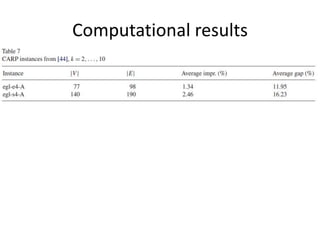
• Computational results
k-Chinese postman tour
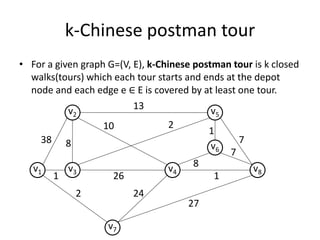
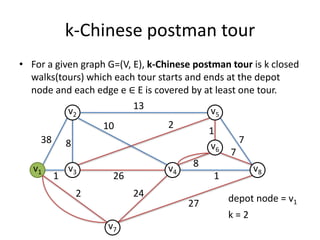
• For a given graph G=(V, E), k-Chinese postman tour is k closed
walks(tours) which each tour starts and ends at the depot
node and each edge e ∈ E is covered by at least one tour.
v2
v1
v5
v3
v6
v4
v7
v8
13
38 8
1
2 24
27
1
8
7
7
1
26
210
k-Chinese postman tour
• For a given graph G=(V, E), k-Chinese postman tour is k closed
walks(tours) which each tour starts and ends at the depot
node and each edge e ∈ E is covered by at least one tour.
v2
v1
v5
v3
v6
v4
v7
v8
13
38 8
1
2 24
27
1
8
7
7
1
26
210
depot node = v1
k-Chinese postman tour
• For a given graph G=(V, E), k-Chinese postman tour is k closed
walks(tours) which each tour starts and ends at the depot
node and each edge e ∈ E is covered by at least one tour.
v2
v1
v5
v3
v6
v4
v7
v8
13
38 8
1
2 24
27
1
8
7
7
1
26
210
depot node = v1
k = 2
k-Chinese postman tour
• For a given graph G=(V, E), k-Chinese postman tour is k closed
walks(tours) which each tour starts and ends at the depot
node and each edge e ∈ E is covered by at least one tour.
v2
v1
v5
v3
v6
v4
v7
v8
13
38 8
1
2 24
27
1
8
7
7
1
26
210
depot node = v1
k = 2
7
1
1
k-Chinese postman tour
• For a given graph G=(V, E), k-Chinese postman tour is k closed
walks(tours) which each tour starts and ends at the depot
node and each edge e ∈ E is covered by at least one tour.
v2
v1
v5
v3
v6
v4
v7
v8
13
38 8
2 24
27
1
8
7
26
210
depot node = v1
k = 2
The min-max k-Chinese postman
problem
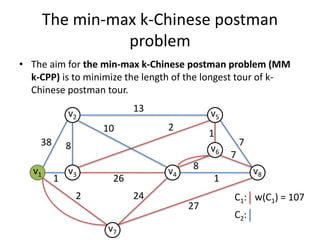
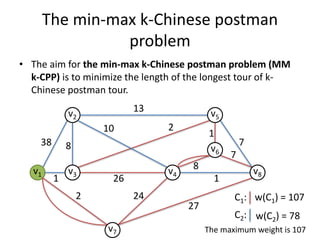
• The aim for the min-max k-Chinese postman problem (MM
k-CPP) is to minimize the length of the longest tour of k-
Chinese postman tour.
7
1
1
v2
v1
v5
v3
v6
v4
v7
v8
13
38 8
2 24
27
1
8
7
26
210
The min-max k-Chinese postman
problem
7
1
1
v2
v1
v5
v3
v6
v4
v7
v8
13
38 8
2 24
27
1
8
7
26
210
C1:
• The aim for the min-max k-Chinese postman problem (MM
k-CPP) is to minimize the length of the longest tour of k-
Chinese postman tour.
The min-max k-Chinese postman
problem
7
1
1
v2
v1
v5
v3
v6
v4
v7
v8
13
38 8
2 24
27
1
8
7
26
210
C2:
C1:
• The aim for the min-max k-Chinese postman problem (MM
k-CPP) is to minimize the length of the longest tour of k-
Chinese postman tour.
The min-max k-Chinese postman
problem
7
1
1
v2
v1
v5
v3
v6
v4
v7
v8
13
38 8
2 24
27
1
8
7
26
210
w(C1) = 107
C2:
C1:
• The aim for the min-max k-Chinese postman problem (MM
k-CPP) is to minimize the length of the longest tour of k-
Chinese postman tour.
The min-max k-Chinese postman
problem
7
1
1
v2
v1
v5
v3
v6
v4
v7
v8
13
38 8
2 24
27
1
8
7
26
210
w(C2) = 78
w(C1) = 107
C2:
C1:
• The aim for the min-max k-Chinese postman problem (MM
k-CPP) is to minimize the length of the longest tour of k-
Chinese postman tour.
The min-max k-Chinese postman
problem
7
1
1
v2
v1
v5
v3
v6
v4
v7
v8
13
38 8
2 24
27
1
8
7
26
210
w(C2) = 78
w(C1) = 107
C2:
C1:
The maximum weight is 107
• The aim for the min-max k-Chinese postman problem (MM
k-CPP) is to minimize the length of the longest tour of k-
Chinese postman tour.
The min-max k-Chinese postman
problem
7
1
1
v2
v1
v5
v3
v6
v4
v7
v8
13
38 8
2 24
27
1
8
7
26
210
w(C2) = 94
w(C1) = 93
C2:
C1:
The maximum weight is 94
• The aim for the min-max k-Chinese postman problem (MM
k-CPP) is to minimize the length of the longest tour of k-
Chinese postman tour.
Merging and separating edges
• Two Algorithms
– SeparateWalkFromTour
– MergeWalkWithTour
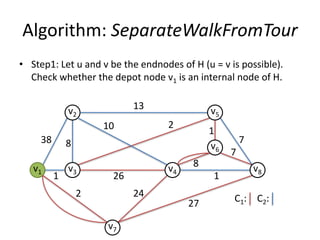
Algorithm: SeparateWalkFromTour
• Input: The tour Ci and the walk H to be
separated.
• Output: The tour represents a feasible tour
formed from the remaining of edges of Ci after
removing edges from H and possibly
additional edges needed to re-establish
feasibility.
Algorithm: SeparateWalkFromTour
• Step1: Let u and v be the endnodes of H (u = v is possible).
Check whether the depot node v1 is an internal node of H.
7
1
1
v2
v1
v5
v3
v6
v4
v7
v8
13
38 8
2 24
27
1
8
7
26
210
C1: C2:
Algorithm: SeparateWalkFromTour
7
1
1
v2
v1
v5
v3
v6
v4
v7
v8
13
38 8
2 24
27
1
8
7
26
210
C1: C2:
u = v4
• Step1: Let u and v be the endnodes of H (u = v is possible).
Check whether the depot node v1 is an internal node of H.
Algorithm: SeparateWalkFromTour
7
1
1
v2
v1
v5
v3
v6
v4
v7
v8
13
38 8
2 24
27
1
8
7
26
210
C1: C2: H:
u = v4
• Step1: Let u and v be the endnodes of H (u = v is possible).
Check whether the depot node v1 is an internal node of H.
Algorithm: SeparateWalkFromTour
7
1
1
v2
v1
v5
v3
v6
v4
v7
v8
13
38 8
2 24
27
1
8
7
26
210
C1: C2: H:
u = v4
• Step1: Let u and v be the endnodes of H (u = v is possible).
Check whether the depot node v1 is an internal node of H.
Algorithm: SeparateWalkFromTour
7
1
1
v2
v1
v5
v3
v6
v4
v7
v8
13
38 8
2 24
27
1
8
7
26
210
C1: C2:
v = v8
H:
u = v4
• Step1: Let u and v be the endnodes of H (u = v is possible).
Check whether the depot node v1 is an internal node of H.
Algorithm: SeparateWalkFromTour
7
1
1
v2
v1
v5
v3
v6
v4
v7
v8
13
38 8
2 24
27
1
8
7
26
210
C1: C2:
v1 is not an internal node of H.
H:
u = v4
v = v8
• Step1: Let u and v be the endnodes of H (u = v is possible).
Check whether the depot node v1 is an internal node of H.
Algorithm: SeparateWalkFromTour
7
1
1
v2
v1
v5
v3
v6
v4
v7
v8
13
38 8
2 24
27
1
8
7
26
210
C1: C2: H:
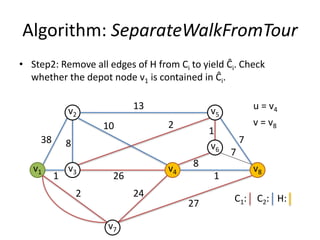
• Step2: Remove all edges of H from Ci to yield Ĉi. Check
whether the depot node v1 is contained in Ĉi.
u = v4
v = v8
Algorithm: SeparateWalkFromTour
7
1
1
v2
v1
v5
v3
v6
v4
v7
v8
13
38 8
2 24
27
1
8
7
26
210
C1: C2: H:
u = v4
v = v8
• Step2: Remove all edges of H from Ci to yield Ĉi. Check
whether the depot node v1 is contained in Ĉi.
Algorithm: SeparateWalkFromTour
7
1
1
v2
v1
v5
v3
v6
v4
v7
v8
13
38 8
2 24
27
1
8
7
26
210
C1: C2: H:
u = v4
v = v8
• Step2: Remove all edges of H from Ci to yield Ĉi. Check
whether the depot node v1 is contained in Ĉi.
Algorithm: SeparateWalkFromTour
7
1
1
v2
v1
v5
v3
v6
v4
v7
v8
13
38 8
2 24
27
1
8
7
26
210
C2: H:Ĉ1:
u = v4
v = v8
• Step2: Remove all edges of H from Ci to yield Ĉi. Check
whether the depot node v1 is contained in Ĉi.
Algorithm: SeparateWalkFromTour
7
1
1
v2
v1
v5
v3
v6
v4
v7
v8
13
38 8
2 24
27
1
8
7
26
210
C2: H:Ĉ1:
v1 is contained in Ĉ1.
u = v4
v = v8
• Step2: Remove all edges of H from Ci to yield Ĉi. Check
whether the depot node v1 is contained in Ĉi.
Algorithm: SeparateWalkFromTour
7
1
1
v2
v1
v5
v3
v6
v4
v7
v8
13
38 8
2 24
27
1
8
7
26
210
C2: H:Ĉ1:
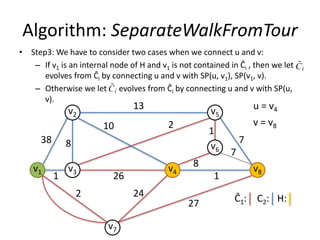
• Step3: We have to consider two cases when we connect u and v:
– If v1 is an internal node of H and v1 is not contained in Ĉi , then we let
evolves from Ĉi by connecting u and v with SP(u, v1), SP(v1, v).
– Otherwise we let evolves from Ĉi by connecting u and v with SP(u,
v).
u = v4
v = v8
Algorithm: SeparateWalkFromTour
7
1
1
v2
v1
v5
v3
v6
v4
v7
v8
13
38 8
2 24
27
1
8
7
26
210
C2: H:Ĉ1:
• Step3: We have to consider two cases when we connect u and v:
– If v1 is an internal node of H and v1 is not contained in Ĉi , then we let
evolves from Ĉi by connecting u and v with SP(u, v1), SP(v1, v).
– Otherwise we let evolves from Ĉi by connecting u and v with SP(u,
v).
u = v4
v = v8
Algorithm: MergeWalkWithTour
• Input: The tour Ci and the walk H to be merged.
• Output: The tour represents a feasible tour
formed from edges contained in Ci and H and
possibly additional edges.
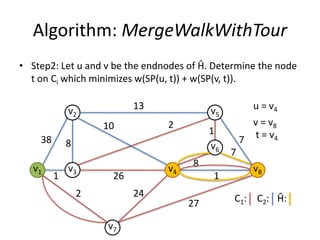
Algorithm: MergeWalkWithTour
• Step1: Remove those edges from the beginning and the end
of H which also occur in Ci to yield the result Ĥ.
7
1
1
v2
v1
v5
v3
v6
v4
v7
v8
13
38 8
2 24
27
1
8
7
26
210
C1: C2:
Algorithm: MergeWalkWithTour
7
1
1
v2
v1
v5
v3
v6
v4
v7
v8
13
38 8
2 24
27
1
8
7
26
210
C1: C2: H:
• Step1: Remove those edges from the beginning and the end
of H which also occur in Ci to yield the result Ĥ.
Algorithm: MergeWalkWithTour
7
1
1
v2
v1
v5
v3
v6
v4
v7
v8
13
38 8
2 24
27
1
8
7
26
210
C1: C2: Ĥ:
• Step1: Remove those edges from the beginning and the end
of H which also occur in Ci to yield the result Ĥ.
Algorithm: MergeWalkWithTour
7
1
1
v2
v1
v5
v3
v6
v4
v7
v8
13
38 8
2 24
27
1
8
7
26
210
C1: C2:
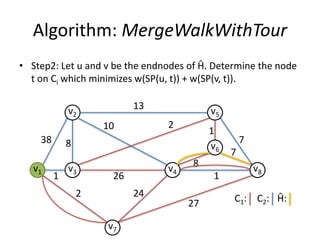
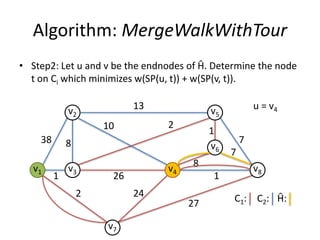
• Step2: Let u and v be the endnodes of Ĥ. Determine the node
t on Ci which minimizes w(SP(u, t)) + w(SP(v, t)).
Ĥ:
Algorithm: MergeWalkWithTour
7
1
1
v2
v1
v5
v3
v6
v4
v7
v8
13
38 8
2 24
27
1
8
7
26
210
C1: C2: Ĥ:
u = v4
• Step2: Let u and v be the endnodes of Ĥ. Determine the node
t on Ci which minimizes w(SP(u, t)) + w(SP(v, t)).
Algorithm: MergeWalkWithTour
7
1
1
v2
v1
v5
v3
v6
v4
v7
v8
13
38 8
2 24
27
1
8
7
26
210
C1: C2: Ĥ:
u = v4
v = v8
• Step2: Let u and v be the endnodes of Ĥ. Determine the node
t on Ci which minimizes w(SP(u, t)) + w(SP(v, t)).
Algorithm: MergeWalkWithTour
7
1
1
v2
v1
v5
v3
v6
v4
v7
v8
13
38 8
2 24
27
1
8
7
26
210
C1: C2: Ĥ:
u = v4
v = v8
t = v4
• Step2: Let u and v be the endnodes of Ĥ. Determine the node
t on Ci which minimizes w(SP(u, t)) + w(SP(v, t)).
Algorithm: MergeWalkWithTour
7
1
1
v2
v1
v5
v3
v6
v4
v7
v8
13
38 8
2 24
27
1
8
7
26
210
C1: C2: Ĥ:
u = v4
v = v8
t = v4
• Step3: The result evolves from splicing SP(t, u), Ĥ, SP(v, t)
into Ci at node t.
• Step3: The result evolves from splicing SP(t, u), Ĥ, SP(v, t)
into Ci at node t.
Algorithm: MergeWalkWithTour
7
1
1
v2
v1
v5
v3
v6
v4
v7
v8
13
38 8
2 24
27
1
8
7
26
210
C1: C2: Ĥ:
u = v4
v = v8
t = v4
Algorithm: MergeWalkWithTour
7
1
1
v2
v1
v5
v3
v6
v4
v7
v8
13
38 8
2 24
27
1
8
7
26
210
C1: C2: Ĥ:
u = v4
v = v8
t = v4
• Step3: The result evolves from splicing SP(t, u), Ĥ, SP(v, t)
into Ci at node t.
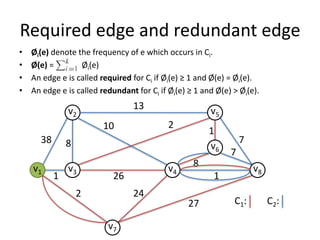
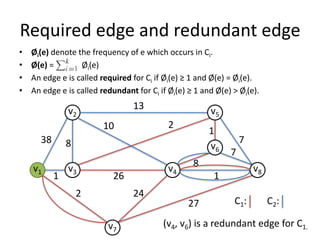
Required edge and redundant edge
• Øi(e) denote the frequency of e which occurs in Ci.
• Ø(e) = Øi(e)
• An edge e is called required for Ci if Øi(e) ≥ 1 and Ø(e) = Øi(e).
• An edge e is called redundant for Ci if Øi(e) ≥ 1 and Ø(e) > Øi(e).
C1: C2:
7
1
1
v2
v1
v5
v3
v6
v4
v7
v8
13
38 8
2 24
27
1
8
7
26
210
Required edge and redundant edge
• Øi(e) denote the frequency of e which occurs in Ci.
• Ø(e) = Øi(e)
• An edge e is called required for Ci if Øi(e) ≥ 1 and Ø(e) = Øi(e).
• An edge e is called redundant for Ci if Øi(e) ≥ 1 and Ø(e) > Øi(e).
(v1, v7) is a required edge for C1.
C1: C2:
7
1
1
v2
v1
v5
v3
v6
v4
v7
v8
13
38 8
2 24
27
1
8
7
26
210
Required edge and redundant edge
• Øi(e) denote the frequency of e which occurs in Ci.
• Ø(e) = Øi(e)
• An edge e is called required for Ci if Øi(e) ≥ 1 and Ø(e) = Øi(e).
• An edge e is called redundant for Ci if Øi(e) ≥ 1 and Ø(e) > Øi(e).
(v4, v6) is a redundant edge for C1.
C1: C2:
7
1
1
v2
v1
v5
v3
v6
v4
v7
v8
13
38 8
2 24
27
1
8
7
26
210
Improving tours
• Three improvement procedures
– RemoveReplicateEdgesKeepingParity
– RemoveEvenRedundantEdges
– ShortenRequiredEdgeConnections
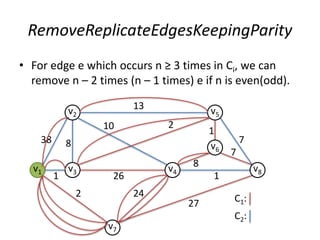
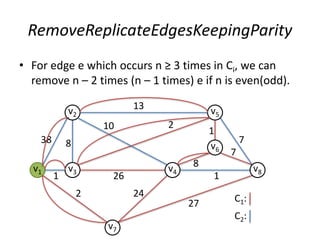
RemoveReplicateEdgesKeepingParity
• For edge e which occurs n ≥ 3 times in Ci, we can
remove n – 2 times (n – 1 times) e if n is even(odd).
7
1
1
v2
v1
v5
v3
v6
v4
v7
v8
13
38 8
2 24
27
1
8
7
26
210
C1:
C2:
RemoveReplicateEdgesKeepingParity
• For edge e which occurs n ≥ 3 times in Ci, we can
remove n – 2 times (n – 1 times) e if n is even(odd).
7
1
1
v2
v1
v5
v3
v6
v4
v7
v8
13
38 8
2 24
27
1
8
7
26
210
C1:
C2:
RemoveReplicateEdgesKeepingParity
• For edge e which occurs n ≥ 3 times in Ci, we can
remove n – 2 times (n – 1 times) e if n is even(odd).
7
1
1
v2
v1
v5
v3
v6
v4
v7
v8
13
38 8
2 24
27
1
8
7
26
210
C1:
C2:
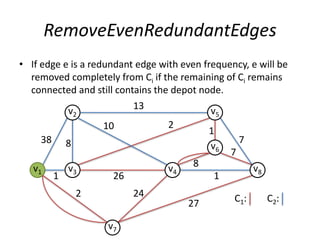
RemoveEvenRedundantEdges
• If edge e is a redundant edge with even frequency, e will be
removed completely from Ci if the remaining of Ci remains
connected and still contains the depot node.
7
1
1
v2
v1
v5
v3
v6
v4
v7
v8
13
38 8
2 24
27
1
8
7
26
210
C1: C2:
RemoveEvenRedundantEdges
• If edge e is a redundant edge with even frequency, e will be
removed completely from Ci if the remaining of Ci remains
connected and still contains the depot node.
7
1
1
v2
v1
v5
v3
v6
v4
v7
v8
13
38 8
2 24
27
1
8
7
26
210
C1: C2:
RemoveEvenRedundantEdges
• If edge e is a redundant edge with even frequency, e will be
removed completely from Ci if the remaining of Ci remains
connected and still contains the depot node.
7
1
1
v2
v1
v5
v3
v6
v4
v7
v8
13
38 8
2 24
27
1
8
7
26
210
C1: C2:
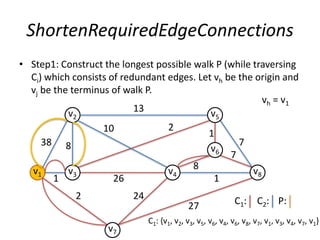
ShortenRequiredEdgeConnections
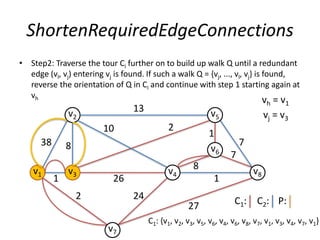
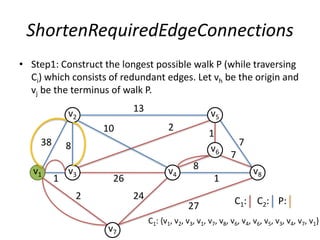
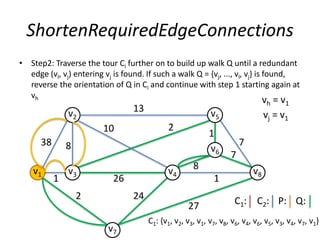
• Step1: Construct the longest possible walk P (while traversing
Ci) which consists of redundant edges. Let vh be the origin and
vj be the terminus of walk P.
7
1
1
v2
v1
v5
v3
v6
v4
v7
v8
13
38 8
2 24
27
1
8
7
26
210
C1: C2:
C1: {v1, v2, v3, v5, v6, v4, v6, v8, v7, v1, v3, v4, v7, v1}
ShortenRequiredEdgeConnections
• Step1: Construct the longest possible walk P (while traversing
Ci) which consists of redundant edges. Let vh be the origin and
vj be the terminus of walk P.
7
1
1
v2
v1
v5
v3
v6
v4
v7
v8
13
38 8
2 24
27
1
8
7
26
210
P:C1: C2:
C1: {v1, v2, v3, v5, v6, v4, v6, v8, v7, v1, v3, v4, v7, v1}
ShortenRequiredEdgeConnections
• Step1: Construct the longest possible walk P (while traversing
Ci) which consists of redundant edges. Let vh be the origin and
vj be the terminus of walk P.
7
1
1
v2
v1
v5
v3
v6
v4
v7
v8
13
38 8
2 24
27
1
8
7
26
210
P:C1: C2:
C1: {v1, v2, v3, v5, v6, v4, v6, v8, v7, v1, v3, v4, v7, v1}
ShortenRequiredEdgeConnections
• Step1: Construct the longest possible walk P (while traversing
Ci) which consists of redundant edges. Let vh be the origin and
vj be the terminus of walk P.
7
1
1
v2
v1
v5
v3
v6
v4
v7
v8
13
38 8
2 24
27
1
8
7
26
210
vh = v1
P:C1: C2:
C1: {v1, v2, v3, v5, v6, v4, v6, v8, v7, v1, v3, v4, v7, v1}
ShortenRequiredEdgeConnections
• Step1: Construct the longest possible walk P (while traversing
Ci) which consists of redundant edges. Let vh be the origin and
vj be the terminus of walk P.
7
1
1
v2
v1
v5
v3
v6
v4
v7
v8
13
38 8
2 24
27
1
8
7
26
210
vh = v1
vj = v3
P:C1: C2:
C1: {v1, v2, v3, v5, v6, v4, v6, v8, v7, v1, v3, v4, v7, v1}
ShortenRequiredEdgeConnections
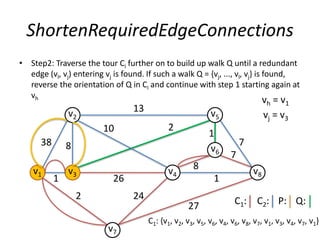
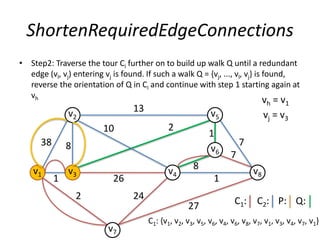
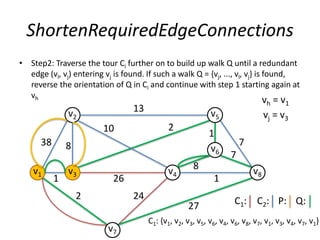
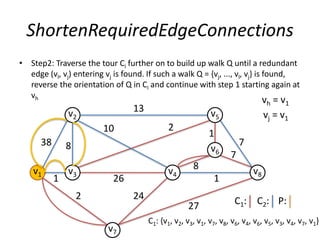
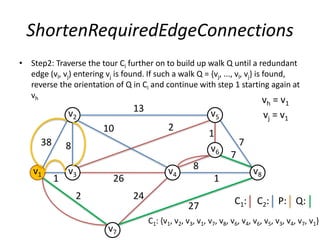
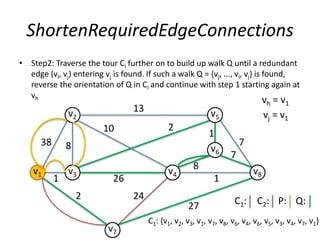
• Step2: Traverse the tour Ci further on to build up walk Q until a redundant
edge (vl, vj) entering vj is found. If such a walk Q = {vj, ..., vl, vj} is found,
reverse the orientation of Q in Ci and continue with step 1 starting again at
vh
7
1
1
v2
v1
v5
v3
v6
v4
v7
v8
13
38 8
2 24
27
1
8
7
26
210
vh = v1
vj = v3
P:C1: C2:
C1: {v1, v2, v3, v5, v6, v4, v6, v8, v7, v1, v3, v4, v7, v1}
ShortenRequiredEdgeConnections
• Step2: Traverse the tour Ci further on to build up walk Q until a redundant
edge (vl, vj) entering vj is found. If such a walk Q = {vj, ..., vl, vj} is found,
reverse the orientation of Q in Ci and continue with step 1 starting again at
vh
7
1
1
v2
v1
v5
v3
v6
v4
v7
v8
13
38 8
2 24
27
1
8
7
26
210
vh = v1
vj = v3
Q:P:C1: C2:
C1: {v1, v2, v3, v5, v6, v4, v6, v8, v7, v1, v3, v4, v7, v1}
ShortenRequiredEdgeConnections
• Step2: Traverse the tour Ci further on to build up walk Q until a redundant
edge (vl, vj) entering vj is found. If such a walk Q = {vj, ..., vl, vj} is found,
reverse the orientation of Q in Ci and continue with step 1 starting again at
vh
7
1
1
v2
v1
v5
v3
v6
v4
v7
v8
13
38 8
2 24
27
1
8
7
26
210
vh = v1
vj = v3
Q:P:C1: C2:
C1: {v1, v2, v3, v5, v6, v4, v6, v8, v7, v1, v3, v4, v7, v1}
ShortenRequiredEdgeConnections
• Step2: Traverse the tour Ci further on to build up walk Q until a redundant
edge (vl, vj) entering vj is found. If such a walk Q = {vj, ..., vl, vj} is found,
reverse the orientation of Q in Ci and continue with step 1 starting again at
vh
7
1
1
v2
v1
v5
v3
v6
v4
v7
v8
13
38 8
2 24
27
1
8
7
26
210
vh = v1
vj = v3
Q:P:C1: C2:
C1: {v1, v2, v3, v5, v6, v4, v6, v8, v7, v1, v3, v4, v7, v1}
ShortenRequiredEdgeConnections
• Step2: Traverse the tour Ci further on to build up walk Q until a redundant
edge (vl, vj) entering vj is found. If such a walk Q = {vj, ..., vl, vj} is found,
reverse the orientation of Q in Ci and continue with step 1 starting again at
vh
7
1
1
v2
v1
v5
v3
v6
v4
v7
v8
13
38 8
2 24
27
1
8
7
26
210
vh = v1
vj = v3
Q:P:C1: C2:
C1: {v1, v2, v3, v5, v6, v4, v6, v8, v7, v1, v3, v4, v7, v1}
ShortenRequiredEdgeConnections
• Step2: Traverse the tour Ci further on to build up walk Q until a redundant
edge (vl, vj) entering vj is found. If such a walk Q = {vj, ..., vl, vj} is found,
reverse the orientation of Q in Ci and continue with step 1 starting again at
vh
7
1
1
v2
v1
v5
v3
v6
v4
v7
v8
13
38 8
2 24
27
1
8
7
26
210
vh = v1
vj = v3
Q:P:C1: C2:
C1: {v1, v2, v3, v5, v6, v4, v6, v8, v7, v1, v3, v4, v7, v1}
ShortenRequiredEdgeConnections
• Step2: Traverse the tour Ci further on to build up walk Q until a redundant
edge (vl, vj) entering vj is found. If such a walk Q = {vj, ..., vl, vj} is found,
reverse the orientation of Q in Ci and continue with step 1 starting again at
vh
7
1
1
v2
v1
v5
v3
v6
v4
v7
v8
13
38 8
2 24
27
1
8
7
26
210
vh = v1
vj = v3
Q:P:C1: C2:
C1: {v1, v2, v3, v5, v6, v4, v6, v8, v7, v1, v3, v4, v7, v1}
ShortenRequiredEdgeConnections
• Step2: Traverse the tour Ci further on to build up walk Q until a redundant
edge (vl, vj) entering vj is found. If such a walk Q = {vj, ..., vl, vj} is found,
reverse the orientation of Q in Ci and continue with step 1 starting again at
vh
7
1
1
v2
v1
v5
v3
v6
v4
v7
v8
13
38 8
2 24
27
1
8
7
26
210
vh = v1
vj = v3
Q:P:C1: C2:
C1: {v1, v2, v3, v5, v6, v4, v6, v8, v7, v1, v3, v4, v7, v1}
ShortenRequiredEdgeConnections
• Step2: Traverse the tour Ci further on to build up walk Q until a redundant
edge (vl, vj) entering vj is found. If such a walk Q = {vj, ..., vl, vj} is found,
reverse the orientation of Q in Ci and continue with step 1 starting again at
vh
7
1
1
v2
v1
v5
v3
v6
v4
v7
v8
13
38 8
2 24
27
1
8
7
26
210
vh = v1
vj = v3
Q:P:C1: C2:
C1: {v1, v2, v3, v5, v6, v4, v6, v8, v7, v1, v3, v4, v7, v1}
ShortenRequiredEdgeConnections
• Step2: Traverse the tour Ci further on to build up walk Q until a redundant
edge (vl, vj) entering vj is found. If such a walk Q = {vj, ..., vl, vj} is found,
reverse the orientation of Q in Ci and continue with step 1 starting again at
vh
7
1
1
v2
v1
v5
v3
v6
v4
v7
v8
13
38 8
2 24
27
1
8
7
26
210
vh = v1
vj = v3
Q:P:C1: C2:
C1: {v1, v2, v3, v5, v6, v4, v6, v8, v7, v1, v3, v4, v7, v1}
ShortenRequiredEdgeConnections
• Step2: Traverse the tour Ci further on to build up walk Q until a redundant
edge (vl, vj) entering vj is found. If such a walk Q = {vj, ..., vl, vj} is found,
reverse the orientation of Q in Ci and continue with step 1 starting again at
vh
7
1
1
v2
v1
v5
v3
v6
v4
v7
v8
13
38 8
2 24
27
1
8
7
26
210
vh = v1
vj = v3
C1: C2:
C1: {v1, v2, v3, v1, v7, v8, v6, v4, v6, v5, v3, v4, v7, v1}
Q:P:
ShortenRequiredEdgeConnections
• Step1: Construct the longest possible walk P (while traversing
Ci) which consists of redundant edges. Let vh be the origin and
vj be the terminus of walk P.
7
1
1
v2
v1
v5
v3
v6
v4
v7
v8
13
38 8
2 24
27
1
8
7
26
210
C1: C2:
C1: {v1, v2, v3, v1, v7, v8, v6, v4, v6, v5, v3, v4, v7, v1}
ShortenRequiredEdgeConnections
• Step1: Construct the longest possible walk P (while traversing
Ci) which consists of redundant edges. Let vh be the origin and
vj be the terminus of walk P.
7
1
1
v2
v1
v5
v3
v6
v4
v7
v8
13
38 8
2 24
27
1
8
7
26
210
P:C1: C2:
C1: {v1, v2, v3, v1, v7, v8, v6, v4, v6, v5, v3, v4, v7, v1}
ShortenRequiredEdgeConnections
• Step1: Construct the longest possible walk P (while traversing
Ci) which consists of redundant edges. Let vh be the origin and
vj be the terminus of walk P.
7
1
1
v2
v1
v5
v3
v6
v4
v7
v8
13
38 8
2 24
27
1
8
7
26
210
P:C1: C2:
C1: {v1, v2, v3, v1, v7, v8, v6, v4, v6, v5, v3, v4, v7, v1}
ShortenRequiredEdgeConnections
• Step1: Construct the longest possible walk P (while traversing
Ci) which consists of redundant edges. Let vh be the origin and
vj be the terminus of walk P.
7
1
1
v2
v1
v5
v3
v6
v4
v7
v8
13
38 8
2 24
27
1
8
7
26
210
P:C1: C2:
C1: {v1, v2, v3, v1, v7, v8, v6, v4, v6, v5, v3, v4, v7, v1}
ShortenRequiredEdgeConnections
• Step1: Construct the longest possible walk P (while traversing
Ci) which consists of redundant edges. Let vh be the origin and
vj be the terminus of walk P.
7
1
1
v2
v1
v5
v3
v6
v4
v7
v8
13
38 8
2 24
27
1
8
7
26
210
vh = v1
P:C1: C2:
C1: {v1, v2, v3, v1, v7, v8, v6, v4, v6, v5, v3, v4, v7, v1}
ShortenRequiredEdgeConnections
• Step1: Construct the longest possible walk P (while traversing
Ci) which consists of redundant edges. Let vh be the origin and
vj be the terminus of walk P.
7
1
1
v2
v1
v5
v3
v6
v4
v7
v8
13
38 8
2 24
27
1
8
7
26
210
vh = v1
vj = v1
P:C1: C2:
C1: {v1, v2, v3, v1, v7, v8, v6, v4, v6, v5, v3, v4, v7, v1}
ShortenRequiredEdgeConnections
• Step2: Traverse the tour Ci further on to build up walk Q until a redundant
edge (vl, vj) entering vj is found. If such a walk Q = {vj, ..., vl, vj} is found,
reverse the orientation of Q in Ci and continue with step 1 starting again at
vh
7
1
1
v2
v1
v5
v3
v6
v4
v7
v8
13
38 8
2 24
27
1
8
7
26
210
vh = v1
vj = v1
P:C1: C2:
C1: {v1, v2, v3, v1, v7, v8, v6, v4, v6, v5, v3, v4, v7, v1}
ShortenRequiredEdgeConnections
• Step2: Traverse the tour Ci further on to build up walk Q until a redundant
edge (vl, vj) entering vj is found. If such a walk Q = {vj, ..., vl, vj} is found,
reverse the orientation of Q in Ci and continue with step 1 starting again at
vh
7
1
1
v2
v1
v5
v3
v6
v4
v7
v8
13
38 8
2 24
27
1
8
7
26
210
vh = v1
vj = v1
Q:P:C1: C2:
C1: {v1, v2, v3, v1, v7, v8, v6, v4, v6, v5, v3, v4, v7, v1}
ShortenRequiredEdgeConnections
• Step2: Traverse the tour Ci further on to build up walk Q until a redundant
edge (vl, vj) entering vj is found. If such a walk Q = {vj, ..., vl, vj} is found,
reverse the orientation of Q in Ci and continue with step 1 starting again at
vh
7
1
1
v2
v1
v5
v3
v6
v4
v7
v8
13
38 8
2 24
27
1
8
7
26
210
vh = v1
vj = v1
Q:P:C1: C2:
C1: {v1, v2, v3, v1, v7, v8, v6, v4, v6, v5, v3, v4, v7, v1}
ShortenRequiredEdgeConnections
• Step2: Traverse the tour Ci further on to build up walk Q until a redundant
edge (vl, vj) entering vj is found. If such a walk Q = {vj, ..., vl, vj} is found,
reverse the orientation of Q in Ci and continue with step 1 starting again at
vh
7
1
1
v2
v1
v5
v3
v6
v4
v7
v8
13
38 8
2 24
27
1
8
7
26
210
vh = v1
vj = v1
Q:P:C1: C2:
C1: {v1, v2, v3, v1, v7, v8, v6, v4, v6, v5, v3, v4, v7, v1}
ShortenRequiredEdgeConnections
• Step2: Traverse the tour Ci further on to build up walk Q until a redundant
edge (vl, vj) entering vj is found. If such a walk Q = {vj, ..., vl, vj} is found,
reverse the orientation of Q in Ci and continue with step 1 starting again at
vh
7
1
1
v2
v1
v5
v3
v6
v4
v7
v8
13
38 8
2 24
27
1
8
7
26
210
vh = v1
vj = v1
Q:P:C1: C2:
C1: {v1, v2, v3, v1, v7, v8, v6, v4, v6, v5, v3, v4, v7, v1}
ShortenRequiredEdgeConnections
• Step2: Traverse the tour Ci further on to build up walk Q until a redundant
edge (vl, vj) entering vj is found. If such a walk Q = {vj, ..., vl, vj} is found,
reverse the orientation of Q in Ci and continue with step 1 starting again at
vh
7
1
1
v2
v1
v5
v3
v6
v4
v7
v8
13
38 8
2 24
27
1
8
7
26
210
vh = v1
vj = v1
Q:P:C1: C2:
C1: {v1, v2, v3, v1, v7, v8, v6, v4, v6, v5, v3, v4, v7, v1}
ShortenRequiredEdgeConnections
• Step2: Traverse the tour Ci further on to build up walk Q until a redundant
edge (vl, vj) entering vj is found. If such a walk Q = {vj, ..., vl, vj} is found,
reverse the orientation of Q in Ci and continue with step 1 starting again at
vh
7
1
1
v2
v1
v5
v3
v6
v4
v7
v8
13
38 8
2 24
27
1
8
7
26
210
vh = v1
vj = v1
Q:P:C1: C2:
C1: {v1, v2, v3, v1, v7, v8, v6, v4, v6, v5, v3, v4, v7, v1}
ShortenRequiredEdgeConnections
• Step2: Traverse the tour Ci further on to build up walk Q until a redundant
edge (vl, vj) entering vj is found. If such a walk Q = {vj, ..., vl, vj} is found,
reverse the orientation of Q in Ci and continue with step 1 starting again at
vh
7
1
1
v2
v1
v5
v3
v6
v4
v7
v8
13
38 8
2 24
27
1
8
7
26
210
vh = v1
vj = v1
Q:P:C1: C2:
C1: {v1, v2, v3, v1, v7, v8, v6, v4, v6, v5, v3, v4, v7, v1}
ShortenRequiredEdgeConnections
• Step2: Traverse the tour Ci further on to build up walk Q until a redundant
edge (vl, vj) entering vj is found. If such a walk Q = {vj, ..., vl, vj} is found,
reverse the orientation of Q in Ci and continue with step 1 starting again at
vh
7
1
1
v2
v1
v5
v3
v6
v4
v7
v8
13
38 8
2 24
27
1
8
7
26
210
vh = v1
vj = v1
Q:P:C1: C2:
C1: {v1, v2, v3, v1, v7, v8, v6, v4, v6, v5, v3, v4, v7, v1}
ShortenRequiredEdgeConnections
• Step2: Traverse the tour Ci further on to build up walk Q until a redundant
edge (vl, vj) entering vj is found. If such a walk Q = {vj, ..., vl, vj} is found,
reverse the orientation of Q in Ci and continue with step 1 starting again at
vh
7
1
1
v2
v1
v5
v3
v6
v4
v7
v8
13
38 8
2 24
27
1
8
7
26
210
vh = v1
vj = v1
Q:P:C1: C2:
C1: {v1, v2, v3, v1, v7, v8, v6, v4, v6, v5, v3, v4, v7, v1}
ShortenRequiredEdgeConnections
• Step2: Traverse the tour Ci further on to build up walk Q until a redundant
edge (vl, vj) entering vj is found. If such a walk Q = {vj, ..., vl, vj} is found,
reverse the orientation of Q in Ci and continue with step 1 starting again at
vh
7
1
1
v2
v1
v5
v3
v6
v4
v7
v8
13
38 8
2 24
27
1
8
7
26
210
vh = v1
vj = v1
Q:P:C1: C2:
C1: {v1, v2, v3, v1, v7, v8, v6, v4, v6, v5, v3, v4, v7, v1}
ShortenRequiredEdgeConnections
Step3: Replace P by the shortest path SP(vh, vj) if w(SP(vh, vj)) <
w(P). Continue with step 1 with the edge following the last
edge of P.
7
1
1
v2
v1
v5
v3
v6
v4
v7
v8
13
38 8
2 24
27
1
8
7
26
210
vh = v1
vj = v1
Q:P:C1: C2:
C1: {v1, v2, v3, v1, v7, v8, v6, v4, v6, v5, v3, v4, v7, v1}
ShortenRequiredEdgeConnections
Step3: Replace P by the shortest path SP(vh, vj) if w(SP(vh, vj)) <
w(P). Continue with step 1 with the edge following the last
edge of P.
7
1
1
v2
v1
v5
v3
v6
v4
v7
v8
13
38 8
2 24
27
1
8
7
26
210
vh = v1
vj = v1
Q:P:C1: C2:
C1: {v1, v2, v3, v1, v7, v8, v6, v4, v6, v5, v3, v4, v7, v1}
ShortenRequiredEdgeConnections
Step3: Replace P by the shortest path SP(vh, vj) if w(SP(vh, vj)) <
w(P). Continue with step 1 with the edge following the last
edge of P.
7
1
1
v2
v1
v5
v3
v6
v4
v7
v8
13
38 8
2 24
27
1
8
7
26
210
vh = v1
vj = v1
Q:P:C1: C2:
C1: {v1, v2, v3, v1, v7, v8, v6, v4, v6, v5, v3, v4, v7, v1}
ShortenRequiredEdgeConnections
Step3: Replace P by the shortest path SP(vh, vj) if w(SP(vh, vj)) <
w(P). Continue with step 1 with the edge following the last
edge of P.
7
1
1
v2
v1
v5
v3
v6
v4
v7
v8
13
38 8
2 24
27
1
8
7
26
210
vh = v1
vj = v1
Q:P:C1: C2:
C1: {v1, v2, v3, v1, v7, v8, v6, v4, v6, v5, v3, v4, v7, v1}
What is Tabu search?
• Tabu search is created by Fred W. Glover in 1986.
• Tabu search is used for optimization problem.
• Neighborhood is a solution set which improves
the current solution.
• If a potential solution has been previously visited
within a certain short-term period or if it has
violated a rule, it is marked as "tabu" (forbidden)
so that the algorithm does not consider that
possibility repeatedly.
Neighborhoods
• Three Neighborhood structures
– TwoEdgeExchange
– RequiredEdgeWalkExchange
– SingleRequiredEdgeExchange
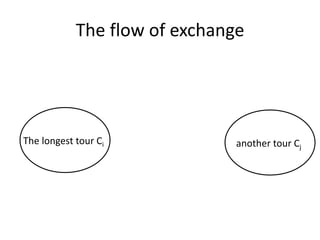
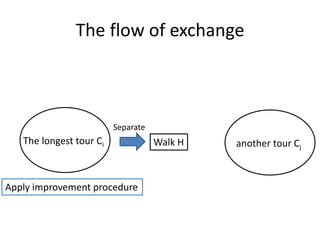
The flow of exchange
The longest tour Ci another tour Cj
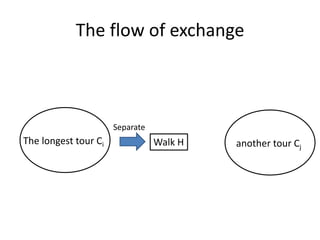
The flow of exchange
The longest tour Ci Walk H another tour Cj
Separate
The flow of exchange
The longest tour Ci Walk H
Apply improvement procedure
another tour Cj
Separate
The flow of exchange
The longest tour Ci Walk H
Apply improvement procedure
another tour Cj
Separate Merge
The flow of exchange
The longest tour Ci Walk H
Apply improvement procedure
another tour Cj
Apply improvement procedure
Separate Merge
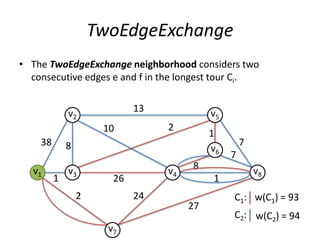
TwoEdgeExchange
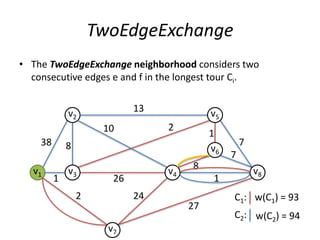
• The TwoEdgeExchange neighborhood considers two
consecutive edges e and f in the longest tour Ci.
7
1
1
v2
v1
v5
v3
v6
v4
v7
v8
13
38 8
2 24
27
1
8
7
26
210
w(C2) = 94
w(C1) = 93
C2:
C1:
TwoEdgeExchange
• The TwoEdgeExchange neighborhood considers two
consecutive edges e and f in the longest tour Ci.
7
1
1
v2
v1
v5
v3
v6
v4
v7
v8
13
38 8
2 24
27
1
8
7
26
210
w(C2) = 94
w(C1) = 93
C2:
C1:
TwoEdgeExchange
• The TwoEdgeExchange neighborhood considers two
consecutive edges e and f in the longest tour Ci.
7
1
1
v2
v1
v5
v3
v6
v4
v7
v8
13
38 8
2 24
27
1
8
7
26
210
w(C2) = 94
w(C1) = 93
C2:
C1:
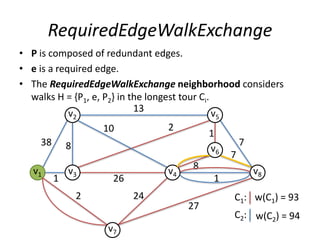
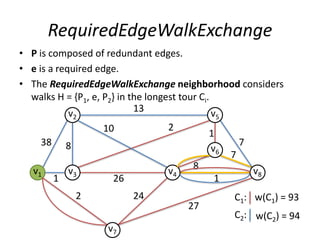
RequiredEdgeWalkExchange
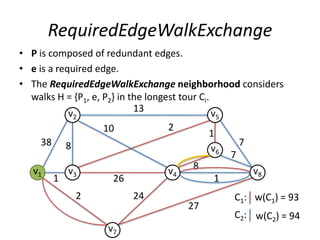
• P is composed of redundant edges.
• e is a required edge.
• The RequiredEdgeWalkExchange neighborhood considers
walks H = {P1, e, P2} in the longest tour Ci.
7
1
1
v2
v1
v5
v3
v6
v4
v7
v8
13
38 8
2 24
27
1
8
7
26
210
w(C2) = 94
w(C1) = 93
C2:
C1:
RequiredEdgeWalkExchange
• P is composed of redundant edges.
• e is a required edge.
• The RequiredEdgeWalkExchange neighborhood considers
walks H = {P1, e, P2} in the longest tour Ci.
7
1
1
v2
v1
v5
v3
v6
v4
v7
v8
13
38 8
2 24
27
1
8
7
26
210
w(C2) = 94
w(C1) = 93
C2:
C1:
RequiredEdgeWalkExchange
• P is composed of redundant edges.
• e is a required edge.
• The RequiredEdgeWalkExchange neighborhood considers
walks H = {P1, e, P2} in the longest tour Ci.
7
1
1
v2
v1
v5
v3
v6
v4
v7
v8
13
38 8
2 24
27
1
8
7
26
210
w(C2) = 94
w(C1) = 93
C2:
C1:
RequiredEdgeWalkExchange
• P is composed of redundant edges.
• e is a required edge.
• The RequiredEdgeWalkExchange neighborhood considers
walks H = {P1, e, P2} in the longest tour Ci.
7
1
1
v2
v1
v5
v3
v6
v4
v7
v8
13
38 8
2 24
27
1
8
7
26
210
w(C2) = 94
w(C1) = 93
C2:
C1:
RequiredEdgeWalkExchange
• P is composed of redundant edges.
• e is a required edge.
• The RequiredEdgeWalkExchange neighborhood considers
walks H = {P1, e, P2} in the longest tour Ci.
7
1
1
v2
v1
v5
v3
v6
v4
v7
v8
13
38 8
2 24
27
1
8
7
26
210
w(C2) = 94
w(C1) = 93
C2:
C1:
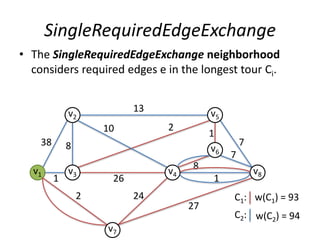
SingleRequiredEdgeExchange
• The SingleRequiredEdgeExchange neighborhood
considers required edges e in the longest tour Ci.
7
1
1
v2
v1
v5
v3
v6
v4
v7
v8
13
38 8
2 24
27
1
8
7
26
210
w(C2) = 94
w(C1) = 93
C2:
C1:
SingleRequiredEdgeExchange
• The SingleRequiredEdgeExchange neighborhood
considers required edges e in the longest tour Ci.
7
1
1
v2
v1
v5
v3
v6
v4
v7
v8
13
38 8
2 24
27
1
8
7
26
210
w(C2) = 94
w(C1) = 93
C2:
C1:
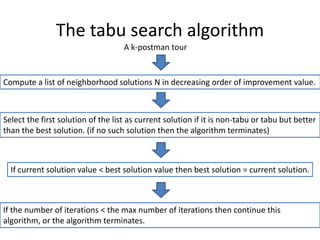
The tabu search algorithm
• Input: A k-postman tour, the maximum
number of iterations without improvement
called maxNOfItsWithoutImprovement, a tabu
tenure called tabuTenure and a flag called
improvementProcedure.
• Output: A possibly improved k-postman tour
The tabu search algorithm
A k-postman tour
The tabu search algorithm
Compute a list of neighborhood solutions N in decreasing order of improvement value.
A k-postman tour
The tabu search algorithm
Compute a list of neighborhood solutions N in decreasing order of improvement value.
Select the first solution of the list as current solution if it is non-tabu or tabu but better
than the best solution. (if no such solution then the algorithm terminates)
A k-postman tour
The tabu search algorithm
Compute a list of neighborhood solutions N in decreasing order of improvement value.
Select the first solution of the list as current solution if it is non-tabu or tabu but better
than the best solution. (if no such solution then the algorithm terminates)
A k-postman tour
If current solution value < best solution value then best solution = current solution.
The tabu search algorithm
Compute a list of neighborhood solutions N in decreasing order of improvement value.
Select the first solution of the list as current solution if it is non-tabu or tabu but better
than the best solution. (if no such solution then the algorithm terminates)
If the number of iterations < the max number of iterations then continue this
algorithm, or the algorithm terminates.
A k-postman tour
If current solution value < best solution value then best solution = current solution.
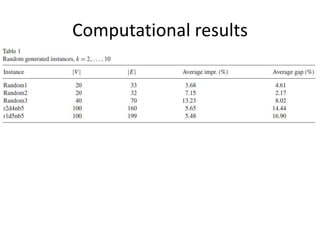
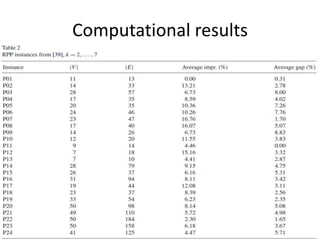
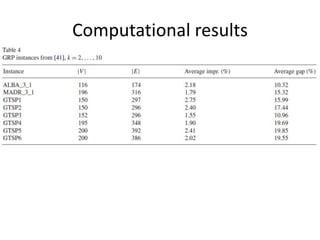
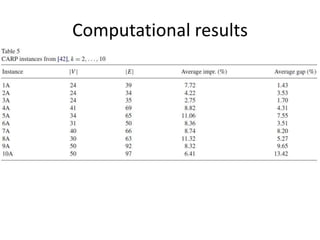
Computational results
• Parameters
– tabuTenure = 20
– maxNOfIterationsWithoutImprovement = 100
Computational results
• Two improvement index
– Let x be the value of the best heuristic solution from
[2]
– Let y be the best solution value obtained by the tabu
search algorithm for all possible configurations of
neighborhood structures and improvement
procedures.
– Let z be the best lower bound obtained by the lower
bounds SPT-LB and CPP/k-LB presented in [2].
– Average impr.(%) = (x - y) * 100 / x
– Average gap(%) = (y - z) * 100 / y
Computational results
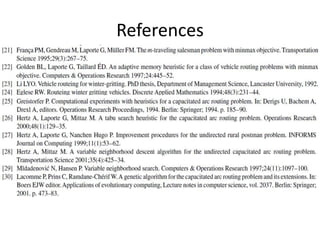
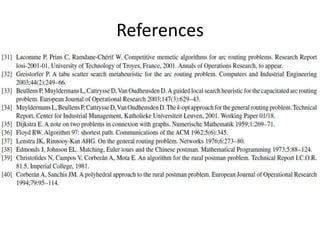
References
References
References
References
References

A tabu search algorithm for the min max k-chinese postman problem

  • 1.
    A tabu searchalgorithm for the min- max k-Chinese postman problem Dino Ahr, Gerhard Reinelt* Computers & Operations Research 33 (2006) 3403–3422 報告人: 陳政謙
  • 2.
    Outline • The min-maxk-Chinese postman problem • Merging and separating edges • Improving tours • The tabu search algorithm • Computational results
  • 3.
    k-Chinese postman tour •For a given graph G=(V, E), k-Chinese postman tour is k closed walks(tours) which each tour starts and ends at the depot node and each edge e ∈ E is covered by at least one tour. v2 v1 v5 v3 v6 v4 v7 v8 13 38 8 1 2 24 27 1 8 7 7 1 26 210
  • 4.
    k-Chinese postman tour •For a given graph G=(V, E), k-Chinese postman tour is k closed walks(tours) which each tour starts and ends at the depot node and each edge e ∈ E is covered by at least one tour. v2 v1 v5 v3 v6 v4 v7 v8 13 38 8 1 2 24 27 1 8 7 7 1 26 210 depot node = v1
  • 5.
    k-Chinese postman tour •For a given graph G=(V, E), k-Chinese postman tour is k closed walks(tours) which each tour starts and ends at the depot node and each edge e ∈ E is covered by at least one tour. v2 v1 v5 v3 v6 v4 v7 v8 13 38 8 1 2 24 27 1 8 7 7 1 26 210 depot node = v1 k = 2
  • 6.
    k-Chinese postman tour •For a given graph G=(V, E), k-Chinese postman tour is k closed walks(tours) which each tour starts and ends at the depot node and each edge e ∈ E is covered by at least one tour. v2 v1 v5 v3 v6 v4 v7 v8 13 38 8 1 2 24 27 1 8 7 7 1 26 210 depot node = v1 k = 2
  • 7.
    7 1 1 k-Chinese postman tour •For a given graph G=(V, E), k-Chinese postman tour is k closed walks(tours) which each tour starts and ends at the depot node and each edge e ∈ E is covered by at least one tour. v2 v1 v5 v3 v6 v4 v7 v8 13 38 8 2 24 27 1 8 7 26 210 depot node = v1 k = 2
  • 8.
    The min-max k-Chinesepostman problem • The aim for the min-max k-Chinese postman problem (MM k-CPP) is to minimize the length of the longest tour of k- Chinese postman tour. 7 1 1 v2 v1 v5 v3 v6 v4 v7 v8 13 38 8 2 24 27 1 8 7 26 210
  • 9.
    The min-max k-Chinesepostman problem 7 1 1 v2 v1 v5 v3 v6 v4 v7 v8 13 38 8 2 24 27 1 8 7 26 210 C1: • The aim for the min-max k-Chinese postman problem (MM k-CPP) is to minimize the length of the longest tour of k- Chinese postman tour.
  • 10.
    The min-max k-Chinesepostman problem 7 1 1 v2 v1 v5 v3 v6 v4 v7 v8 13 38 8 2 24 27 1 8 7 26 210 C2: C1: • The aim for the min-max k-Chinese postman problem (MM k-CPP) is to minimize the length of the longest tour of k- Chinese postman tour.
  • 11.
    The min-max k-Chinesepostman problem 7 1 1 v2 v1 v5 v3 v6 v4 v7 v8 13 38 8 2 24 27 1 8 7 26 210 w(C1) = 107 C2: C1: • The aim for the min-max k-Chinese postman problem (MM k-CPP) is to minimize the length of the longest tour of k- Chinese postman tour.
  • 12.
    The min-max k-Chinesepostman problem 7 1 1 v2 v1 v5 v3 v6 v4 v7 v8 13 38 8 2 24 27 1 8 7 26 210 w(C2) = 78 w(C1) = 107 C2: C1: • The aim for the min-max k-Chinese postman problem (MM k-CPP) is to minimize the length of the longest tour of k- Chinese postman tour.
  • 13.
    The min-max k-Chinesepostman problem 7 1 1 v2 v1 v5 v3 v6 v4 v7 v8 13 38 8 2 24 27 1 8 7 26 210 w(C2) = 78 w(C1) = 107 C2: C1: The maximum weight is 107 • The aim for the min-max k-Chinese postman problem (MM k-CPP) is to minimize the length of the longest tour of k- Chinese postman tour.
  • 14.
    The min-max k-Chinesepostman problem 7 1 1 v2 v1 v5 v3 v6 v4 v7 v8 13 38 8 2 24 27 1 8 7 26 210 w(C2) = 94 w(C1) = 93 C2: C1: The maximum weight is 94 • The aim for the min-max k-Chinese postman problem (MM k-CPP) is to minimize the length of the longest tour of k- Chinese postman tour.
  • 15.
    Merging and separatingedges • Two Algorithms – SeparateWalkFromTour – MergeWalkWithTour
  • 16.
    Algorithm: SeparateWalkFromTour • Input:The tour Ci and the walk H to be separated. • Output: The tour represents a feasible tour formed from the remaining of edges of Ci after removing edges from H and possibly additional edges needed to re-establish feasibility.
  • 17.
    Algorithm: SeparateWalkFromTour • Step1:Let u and v be the endnodes of H (u = v is possible). Check whether the depot node v1 is an internal node of H. 7 1 1 v2 v1 v5 v3 v6 v4 v7 v8 13 38 8 2 24 27 1 8 7 26 210 C1: C2:
  • 18.
    Algorithm: SeparateWalkFromTour 7 1 1 v2 v1 v5 v3 v6 v4 v7 v8 13 38 8 224 27 1 8 7 26 210 C1: C2: u = v4 • Step1: Let u and v be the endnodes of H (u = v is possible). Check whether the depot node v1 is an internal node of H.
  • 19.
    Algorithm: SeparateWalkFromTour 7 1 1 v2 v1 v5 v3 v6 v4 v7 v8 13 38 8 224 27 1 8 7 26 210 C1: C2: H: u = v4 • Step1: Let u and v be the endnodes of H (u = v is possible). Check whether the depot node v1 is an internal node of H.
  • 20.
    Algorithm: SeparateWalkFromTour 7 1 1 v2 v1 v5 v3 v6 v4 v7 v8 13 38 8 224 27 1 8 7 26 210 C1: C2: H: u = v4 • Step1: Let u and v be the endnodes of H (u = v is possible). Check whether the depot node v1 is an internal node of H.
  • 21.
    Algorithm: SeparateWalkFromTour 7 1 1 v2 v1 v5 v3 v6 v4 v7 v8 13 38 8 224 27 1 8 7 26 210 C1: C2: v = v8 H: u = v4 • Step1: Let u and v be the endnodes of H (u = v is possible). Check whether the depot node v1 is an internal node of H.
  • 22.
    Algorithm: SeparateWalkFromTour 7 1 1 v2 v1 v5 v3 v6 v4 v7 v8 13 38 8 224 27 1 8 7 26 210 C1: C2: v1 is not an internal node of H. H: u = v4 v = v8 • Step1: Let u and v be the endnodes of H (u = v is possible). Check whether the depot node v1 is an internal node of H.
  • 23.
    Algorithm: SeparateWalkFromTour 7 1 1 v2 v1 v5 v3 v6 v4 v7 v8 13 38 8 224 27 1 8 7 26 210 C1: C2: H: • Step2: Remove all edges of H from Ci to yield Ĉi. Check whether the depot node v1 is contained in Ĉi. u = v4 v = v8
  • 24.
    Algorithm: SeparateWalkFromTour 7 1 1 v2 v1 v5 v3 v6 v4 v7 v8 13 38 8 224 27 1 8 7 26 210 C1: C2: H: u = v4 v = v8 • Step2: Remove all edges of H from Ci to yield Ĉi. Check whether the depot node v1 is contained in Ĉi.
  • 25.
    Algorithm: SeparateWalkFromTour 7 1 1 v2 v1 v5 v3 v6 v4 v7 v8 13 38 8 224 27 1 8 7 26 210 C1: C2: H: u = v4 v = v8 • Step2: Remove all edges of H from Ci to yield Ĉi. Check whether the depot node v1 is contained in Ĉi.
  • 26.
    Algorithm: SeparateWalkFromTour 7 1 1 v2 v1 v5 v3 v6 v4 v7 v8 13 38 8 224 27 1 8 7 26 210 C2: H:Ĉ1: u = v4 v = v8 • Step2: Remove all edges of H from Ci to yield Ĉi. Check whether the depot node v1 is contained in Ĉi.
  • 27.
    Algorithm: SeparateWalkFromTour 7 1 1 v2 v1 v5 v3 v6 v4 v7 v8 13 38 8 224 27 1 8 7 26 210 C2: H:Ĉ1: v1 is contained in Ĉ1. u = v4 v = v8 • Step2: Remove all edges of H from Ci to yield Ĉi. Check whether the depot node v1 is contained in Ĉi.
  • 28.
    Algorithm: SeparateWalkFromTour 7 1 1 v2 v1 v5 v3 v6 v4 v7 v8 13 38 8 224 27 1 8 7 26 210 C2: H:Ĉ1: • Step3: We have to consider two cases when we connect u and v: – If v1 is an internal node of H and v1 is not contained in Ĉi , then we let evolves from Ĉi by connecting u and v with SP(u, v1), SP(v1, v). – Otherwise we let evolves from Ĉi by connecting u and v with SP(u, v). u = v4 v = v8
  • 29.
    Algorithm: SeparateWalkFromTour 7 1 1 v2 v1 v5 v3 v6 v4 v7 v8 13 38 8 224 27 1 8 7 26 210 C2: H:Ĉ1: • Step3: We have to consider two cases when we connect u and v: – If v1 is an internal node of H and v1 is not contained in Ĉi , then we let evolves from Ĉi by connecting u and v with SP(u, v1), SP(v1, v). – Otherwise we let evolves from Ĉi by connecting u and v with SP(u, v). u = v4 v = v8
  • 30.
    Algorithm: MergeWalkWithTour • Input:The tour Ci and the walk H to be merged. • Output: The tour represents a feasible tour formed from edges contained in Ci and H and possibly additional edges.
  • 31.
    Algorithm: MergeWalkWithTour • Step1:Remove those edges from the beginning and the end of H which also occur in Ci to yield the result Ĥ. 7 1 1 v2 v1 v5 v3 v6 v4 v7 v8 13 38 8 2 24 27 1 8 7 26 210 C1: C2:
  • 32.
    Algorithm: MergeWalkWithTour 7 1 1 v2 v1 v5 v3 v6 v4 v7 v8 13 38 8 224 27 1 8 7 26 210 C1: C2: H: • Step1: Remove those edges from the beginning and the end of H which also occur in Ci to yield the result Ĥ.
  • 33.
    Algorithm: MergeWalkWithTour 7 1 1 v2 v1 v5 v3 v6 v4 v7 v8 13 38 8 224 27 1 8 7 26 210 C1: C2: Ĥ: • Step1: Remove those edges from the beginning and the end of H which also occur in Ci to yield the result Ĥ.
  • 34.
    Algorithm: MergeWalkWithTour 7 1 1 v2 v1 v5 v3 v6 v4 v7 v8 13 38 8 224 27 1 8 7 26 210 C1: C2: • Step2: Let u and v be the endnodes of Ĥ. Determine the node t on Ci which minimizes w(SP(u, t)) + w(SP(v, t)). Ĥ:
  • 35.
    Algorithm: MergeWalkWithTour 7 1 1 v2 v1 v5 v3 v6 v4 v7 v8 13 38 8 224 27 1 8 7 26 210 C1: C2: Ĥ: u = v4 • Step2: Let u and v be the endnodes of Ĥ. Determine the node t on Ci which minimizes w(SP(u, t)) + w(SP(v, t)).
  • 36.
    Algorithm: MergeWalkWithTour 7 1 1 v2 v1 v5 v3 v6 v4 v7 v8 13 38 8 224 27 1 8 7 26 210 C1: C2: Ĥ: u = v4 v = v8 • Step2: Let u and v be the endnodes of Ĥ. Determine the node t on Ci which minimizes w(SP(u, t)) + w(SP(v, t)).
  • 37.
    Algorithm: MergeWalkWithTour 7 1 1 v2 v1 v5 v3 v6 v4 v7 v8 13 38 8 224 27 1 8 7 26 210 C1: C2: Ĥ: u = v4 v = v8 t = v4 • Step2: Let u and v be the endnodes of Ĥ. Determine the node t on Ci which minimizes w(SP(u, t)) + w(SP(v, t)).
  • 38.
    Algorithm: MergeWalkWithTour 7 1 1 v2 v1 v5 v3 v6 v4 v7 v8 13 38 8 224 27 1 8 7 26 210 C1: C2: Ĥ: u = v4 v = v8 t = v4 • Step3: The result evolves from splicing SP(t, u), Ĥ, SP(v, t) into Ci at node t.
  • 39.
    • Step3: Theresult evolves from splicing SP(t, u), Ĥ, SP(v, t) into Ci at node t. Algorithm: MergeWalkWithTour 7 1 1 v2 v1 v5 v3 v6 v4 v7 v8 13 38 8 2 24 27 1 8 7 26 210 C1: C2: Ĥ: u = v4 v = v8 t = v4
  • 40.
    Algorithm: MergeWalkWithTour 7 1 1 v2 v1 v5 v3 v6 v4 v7 v8 13 38 8 224 27 1 8 7 26 210 C1: C2: Ĥ: u = v4 v = v8 t = v4 • Step3: The result evolves from splicing SP(t, u), Ĥ, SP(v, t) into Ci at node t.
  • 41.
    Required edge andredundant edge • Øi(e) denote the frequency of e which occurs in Ci. • Ø(e) = Øi(e) • An edge e is called required for Ci if Øi(e) ≥ 1 and Ø(e) = Øi(e). • An edge e is called redundant for Ci if Øi(e) ≥ 1 and Ø(e) > Øi(e). C1: C2: 7 1 1 v2 v1 v5 v3 v6 v4 v7 v8 13 38 8 2 24 27 1 8 7 26 210
  • 42.
    Required edge andredundant edge • Øi(e) denote the frequency of e which occurs in Ci. • Ø(e) = Øi(e) • An edge e is called required for Ci if Øi(e) ≥ 1 and Ø(e) = Øi(e). • An edge e is called redundant for Ci if Øi(e) ≥ 1 and Ø(e) > Øi(e). (v1, v7) is a required edge for C1. C1: C2: 7 1 1 v2 v1 v5 v3 v6 v4 v7 v8 13 38 8 2 24 27 1 8 7 26 210
  • 43.
    Required edge andredundant edge • Øi(e) denote the frequency of e which occurs in Ci. • Ø(e) = Øi(e) • An edge e is called required for Ci if Øi(e) ≥ 1 and Ø(e) = Øi(e). • An edge e is called redundant for Ci if Øi(e) ≥ 1 and Ø(e) > Øi(e). (v4, v6) is a redundant edge for C1. C1: C2: 7 1 1 v2 v1 v5 v3 v6 v4 v7 v8 13 38 8 2 24 27 1 8 7 26 210
  • 44.
    Improving tours • Threeimprovement procedures – RemoveReplicateEdgesKeepingParity – RemoveEvenRedundantEdges – ShortenRequiredEdgeConnections
  • 45.
    RemoveReplicateEdgesKeepingParity • For edgee which occurs n ≥ 3 times in Ci, we can remove n – 2 times (n – 1 times) e if n is even(odd). 7 1 1 v2 v1 v5 v3 v6 v4 v7 v8 13 38 8 2 24 27 1 8 7 26 210 C1: C2:
  • 46.
    RemoveReplicateEdgesKeepingParity • For edgee which occurs n ≥ 3 times in Ci, we can remove n – 2 times (n – 1 times) e if n is even(odd). 7 1 1 v2 v1 v5 v3 v6 v4 v7 v8 13 38 8 2 24 27 1 8 7 26 210 C1: C2:
  • 47.
    RemoveReplicateEdgesKeepingParity • For edgee which occurs n ≥ 3 times in Ci, we can remove n – 2 times (n – 1 times) e if n is even(odd). 7 1 1 v2 v1 v5 v3 v6 v4 v7 v8 13 38 8 2 24 27 1 8 7 26 210 C1: C2:
  • 48.
    RemoveEvenRedundantEdges • If edgee is a redundant edge with even frequency, e will be removed completely from Ci if the remaining of Ci remains connected and still contains the depot node. 7 1 1 v2 v1 v5 v3 v6 v4 v7 v8 13 38 8 2 24 27 1 8 7 26 210 C1: C2:
  • 49.
    RemoveEvenRedundantEdges • If edgee is a redundant edge with even frequency, e will be removed completely from Ci if the remaining of Ci remains connected and still contains the depot node. 7 1 1 v2 v1 v5 v3 v6 v4 v7 v8 13 38 8 2 24 27 1 8 7 26 210 C1: C2:
  • 50.
    RemoveEvenRedundantEdges • If edgee is a redundant edge with even frequency, e will be removed completely from Ci if the remaining of Ci remains connected and still contains the depot node. 7 1 1 v2 v1 v5 v3 v6 v4 v7 v8 13 38 8 2 24 27 1 8 7 26 210 C1: C2:
  • 51.
    ShortenRequiredEdgeConnections • Step1: Constructthe longest possible walk P (while traversing Ci) which consists of redundant edges. Let vh be the origin and vj be the terminus of walk P. 7 1 1 v2 v1 v5 v3 v6 v4 v7 v8 13 38 8 2 24 27 1 8 7 26 210 C1: C2: C1: {v1, v2, v3, v5, v6, v4, v6, v8, v7, v1, v3, v4, v7, v1}
  • 52.
    ShortenRequiredEdgeConnections • Step1: Constructthe longest possible walk P (while traversing Ci) which consists of redundant edges. Let vh be the origin and vj be the terminus of walk P. 7 1 1 v2 v1 v5 v3 v6 v4 v7 v8 13 38 8 2 24 27 1 8 7 26 210 P:C1: C2: C1: {v1, v2, v3, v5, v6, v4, v6, v8, v7, v1, v3, v4, v7, v1}
  • 53.
    ShortenRequiredEdgeConnections • Step1: Constructthe longest possible walk P (while traversing Ci) which consists of redundant edges. Let vh be the origin and vj be the terminus of walk P. 7 1 1 v2 v1 v5 v3 v6 v4 v7 v8 13 38 8 2 24 27 1 8 7 26 210 P:C1: C2: C1: {v1, v2, v3, v5, v6, v4, v6, v8, v7, v1, v3, v4, v7, v1}
  • 54.
    ShortenRequiredEdgeConnections • Step1: Constructthe longest possible walk P (while traversing Ci) which consists of redundant edges. Let vh be the origin and vj be the terminus of walk P. 7 1 1 v2 v1 v5 v3 v6 v4 v7 v8 13 38 8 2 24 27 1 8 7 26 210 vh = v1 P:C1: C2: C1: {v1, v2, v3, v5, v6, v4, v6, v8, v7, v1, v3, v4, v7, v1}
  • 55.
    ShortenRequiredEdgeConnections • Step1: Constructthe longest possible walk P (while traversing Ci) which consists of redundant edges. Let vh be the origin and vj be the terminus of walk P. 7 1 1 v2 v1 v5 v3 v6 v4 v7 v8 13 38 8 2 24 27 1 8 7 26 210 vh = v1 vj = v3 P:C1: C2: C1: {v1, v2, v3, v5, v6, v4, v6, v8, v7, v1, v3, v4, v7, v1}
  • 56.
    ShortenRequiredEdgeConnections • Step2: Traversethe tour Ci further on to build up walk Q until a redundant edge (vl, vj) entering vj is found. If such a walk Q = {vj, ..., vl, vj} is found, reverse the orientation of Q in Ci and continue with step 1 starting again at vh 7 1 1 v2 v1 v5 v3 v6 v4 v7 v8 13 38 8 2 24 27 1 8 7 26 210 vh = v1 vj = v3 P:C1: C2: C1: {v1, v2, v3, v5, v6, v4, v6, v8, v7, v1, v3, v4, v7, v1}
  • 57.
    ShortenRequiredEdgeConnections • Step2: Traversethe tour Ci further on to build up walk Q until a redundant edge (vl, vj) entering vj is found. If such a walk Q = {vj, ..., vl, vj} is found, reverse the orientation of Q in Ci and continue with step 1 starting again at vh 7 1 1 v2 v1 v5 v3 v6 v4 v7 v8 13 38 8 2 24 27 1 8 7 26 210 vh = v1 vj = v3 Q:P:C1: C2: C1: {v1, v2, v3, v5, v6, v4, v6, v8, v7, v1, v3, v4, v7, v1}
  • 58.
    ShortenRequiredEdgeConnections • Step2: Traversethe tour Ci further on to build up walk Q until a redundant edge (vl, vj) entering vj is found. If such a walk Q = {vj, ..., vl, vj} is found, reverse the orientation of Q in Ci and continue with step 1 starting again at vh 7 1 1 v2 v1 v5 v3 v6 v4 v7 v8 13 38 8 2 24 27 1 8 7 26 210 vh = v1 vj = v3 Q:P:C1: C2: C1: {v1, v2, v3, v5, v6, v4, v6, v8, v7, v1, v3, v4, v7, v1}
  • 59.
    ShortenRequiredEdgeConnections • Step2: Traversethe tour Ci further on to build up walk Q until a redundant edge (vl, vj) entering vj is found. If such a walk Q = {vj, ..., vl, vj} is found, reverse the orientation of Q in Ci and continue with step 1 starting again at vh 7 1 1 v2 v1 v5 v3 v6 v4 v7 v8 13 38 8 2 24 27 1 8 7 26 210 vh = v1 vj = v3 Q:P:C1: C2: C1: {v1, v2, v3, v5, v6, v4, v6, v8, v7, v1, v3, v4, v7, v1}
  • 60.
    ShortenRequiredEdgeConnections • Step2: Traversethe tour Ci further on to build up walk Q until a redundant edge (vl, vj) entering vj is found. If such a walk Q = {vj, ..., vl, vj} is found, reverse the orientation of Q in Ci and continue with step 1 starting again at vh 7 1 1 v2 v1 v5 v3 v6 v4 v7 v8 13 38 8 2 24 27 1 8 7 26 210 vh = v1 vj = v3 Q:P:C1: C2: C1: {v1, v2, v3, v5, v6, v4, v6, v8, v7, v1, v3, v4, v7, v1}
  • 61.
    ShortenRequiredEdgeConnections • Step2: Traversethe tour Ci further on to build up walk Q until a redundant edge (vl, vj) entering vj is found. If such a walk Q = {vj, ..., vl, vj} is found, reverse the orientation of Q in Ci and continue with step 1 starting again at vh 7 1 1 v2 v1 v5 v3 v6 v4 v7 v8 13 38 8 2 24 27 1 8 7 26 210 vh = v1 vj = v3 Q:P:C1: C2: C1: {v1, v2, v3, v5, v6, v4, v6, v8, v7, v1, v3, v4, v7, v1}
  • 62.
    ShortenRequiredEdgeConnections • Step2: Traversethe tour Ci further on to build up walk Q until a redundant edge (vl, vj) entering vj is found. If such a walk Q = {vj, ..., vl, vj} is found, reverse the orientation of Q in Ci and continue with step 1 starting again at vh 7 1 1 v2 v1 v5 v3 v6 v4 v7 v8 13 38 8 2 24 27 1 8 7 26 210 vh = v1 vj = v3 Q:P:C1: C2: C1: {v1, v2, v3, v5, v6, v4, v6, v8, v7, v1, v3, v4, v7, v1}
  • 63.
    ShortenRequiredEdgeConnections • Step2: Traversethe tour Ci further on to build up walk Q until a redundant edge (vl, vj) entering vj is found. If such a walk Q = {vj, ..., vl, vj} is found, reverse the orientation of Q in Ci and continue with step 1 starting again at vh 7 1 1 v2 v1 v5 v3 v6 v4 v7 v8 13 38 8 2 24 27 1 8 7 26 210 vh = v1 vj = v3 Q:P:C1: C2: C1: {v1, v2, v3, v5, v6, v4, v6, v8, v7, v1, v3, v4, v7, v1}
  • 64.
    ShortenRequiredEdgeConnections • Step2: Traversethe tour Ci further on to build up walk Q until a redundant edge (vl, vj) entering vj is found. If such a walk Q = {vj, ..., vl, vj} is found, reverse the orientation of Q in Ci and continue with step 1 starting again at vh 7 1 1 v2 v1 v5 v3 v6 v4 v7 v8 13 38 8 2 24 27 1 8 7 26 210 vh = v1 vj = v3 Q:P:C1: C2: C1: {v1, v2, v3, v5, v6, v4, v6, v8, v7, v1, v3, v4, v7, v1}
  • 65.
    ShortenRequiredEdgeConnections • Step2: Traversethe tour Ci further on to build up walk Q until a redundant edge (vl, vj) entering vj is found. If such a walk Q = {vj, ..., vl, vj} is found, reverse the orientation of Q in Ci and continue with step 1 starting again at vh 7 1 1 v2 v1 v5 v3 v6 v4 v7 v8 13 38 8 2 24 27 1 8 7 26 210 vh = v1 vj = v3 Q:P:C1: C2: C1: {v1, v2, v3, v5, v6, v4, v6, v8, v7, v1, v3, v4, v7, v1}
  • 66.
    ShortenRequiredEdgeConnections • Step2: Traversethe tour Ci further on to build up walk Q until a redundant edge (vl, vj) entering vj is found. If such a walk Q = {vj, ..., vl, vj} is found, reverse the orientation of Q in Ci and continue with step 1 starting again at vh 7 1 1 v2 v1 v5 v3 v6 v4 v7 v8 13 38 8 2 24 27 1 8 7 26 210 vh = v1 vj = v3 C1: C2: C1: {v1, v2, v3, v1, v7, v8, v6, v4, v6, v5, v3, v4, v7, v1} Q:P:
  • 67.
    ShortenRequiredEdgeConnections • Step1: Constructthe longest possible walk P (while traversing Ci) which consists of redundant edges. Let vh be the origin and vj be the terminus of walk P. 7 1 1 v2 v1 v5 v3 v6 v4 v7 v8 13 38 8 2 24 27 1 8 7 26 210 C1: C2: C1: {v1, v2, v3, v1, v7, v8, v6, v4, v6, v5, v3, v4, v7, v1}
  • 68.
    ShortenRequiredEdgeConnections • Step1: Constructthe longest possible walk P (while traversing Ci) which consists of redundant edges. Let vh be the origin and vj be the terminus of walk P. 7 1 1 v2 v1 v5 v3 v6 v4 v7 v8 13 38 8 2 24 27 1 8 7 26 210 P:C1: C2: C1: {v1, v2, v3, v1, v7, v8, v6, v4, v6, v5, v3, v4, v7, v1}
  • 69.
    ShortenRequiredEdgeConnections • Step1: Constructthe longest possible walk P (while traversing Ci) which consists of redundant edges. Let vh be the origin and vj be the terminus of walk P. 7 1 1 v2 v1 v5 v3 v6 v4 v7 v8 13 38 8 2 24 27 1 8 7 26 210 P:C1: C2: C1: {v1, v2, v3, v1, v7, v8, v6, v4, v6, v5, v3, v4, v7, v1}
  • 70.
    ShortenRequiredEdgeConnections • Step1: Constructthe longest possible walk P (while traversing Ci) which consists of redundant edges. Let vh be the origin and vj be the terminus of walk P. 7 1 1 v2 v1 v5 v3 v6 v4 v7 v8 13 38 8 2 24 27 1 8 7 26 210 P:C1: C2: C1: {v1, v2, v3, v1, v7, v8, v6, v4, v6, v5, v3, v4, v7, v1}
  • 71.
    ShortenRequiredEdgeConnections • Step1: Constructthe longest possible walk P (while traversing Ci) which consists of redundant edges. Let vh be the origin and vj be the terminus of walk P. 7 1 1 v2 v1 v5 v3 v6 v4 v7 v8 13 38 8 2 24 27 1 8 7 26 210 vh = v1 P:C1: C2: C1: {v1, v2, v3, v1, v7, v8, v6, v4, v6, v5, v3, v4, v7, v1}
  • 72.
    ShortenRequiredEdgeConnections • Step1: Constructthe longest possible walk P (while traversing Ci) which consists of redundant edges. Let vh be the origin and vj be the terminus of walk P. 7 1 1 v2 v1 v5 v3 v6 v4 v7 v8 13 38 8 2 24 27 1 8 7 26 210 vh = v1 vj = v1 P:C1: C2: C1: {v1, v2, v3, v1, v7, v8, v6, v4, v6, v5, v3, v4, v7, v1}
  • 73.
    ShortenRequiredEdgeConnections • Step2: Traversethe tour Ci further on to build up walk Q until a redundant edge (vl, vj) entering vj is found. If such a walk Q = {vj, ..., vl, vj} is found, reverse the orientation of Q in Ci and continue with step 1 starting again at vh 7 1 1 v2 v1 v5 v3 v6 v4 v7 v8 13 38 8 2 24 27 1 8 7 26 210 vh = v1 vj = v1 P:C1: C2: C1: {v1, v2, v3, v1, v7, v8, v6, v4, v6, v5, v3, v4, v7, v1}
  • 74.
    ShortenRequiredEdgeConnections • Step2: Traversethe tour Ci further on to build up walk Q until a redundant edge (vl, vj) entering vj is found. If such a walk Q = {vj, ..., vl, vj} is found, reverse the orientation of Q in Ci and continue with step 1 starting again at vh 7 1 1 v2 v1 v5 v3 v6 v4 v7 v8 13 38 8 2 24 27 1 8 7 26 210 vh = v1 vj = v1 Q:P:C1: C2: C1: {v1, v2, v3, v1, v7, v8, v6, v4, v6, v5, v3, v4, v7, v1}
  • 75.
    ShortenRequiredEdgeConnections • Step2: Traversethe tour Ci further on to build up walk Q until a redundant edge (vl, vj) entering vj is found. If such a walk Q = {vj, ..., vl, vj} is found, reverse the orientation of Q in Ci and continue with step 1 starting again at vh 7 1 1 v2 v1 v5 v3 v6 v4 v7 v8 13 38 8 2 24 27 1 8 7 26 210 vh = v1 vj = v1 Q:P:C1: C2: C1: {v1, v2, v3, v1, v7, v8, v6, v4, v6, v5, v3, v4, v7, v1}
  • 76.
    ShortenRequiredEdgeConnections • Step2: Traversethe tour Ci further on to build up walk Q until a redundant edge (vl, vj) entering vj is found. If such a walk Q = {vj, ..., vl, vj} is found, reverse the orientation of Q in Ci and continue with step 1 starting again at vh 7 1 1 v2 v1 v5 v3 v6 v4 v7 v8 13 38 8 2 24 27 1 8 7 26 210 vh = v1 vj = v1 Q:P:C1: C2: C1: {v1, v2, v3, v1, v7, v8, v6, v4, v6, v5, v3, v4, v7, v1}
  • 77.
    ShortenRequiredEdgeConnections • Step2: Traversethe tour Ci further on to build up walk Q until a redundant edge (vl, vj) entering vj is found. If such a walk Q = {vj, ..., vl, vj} is found, reverse the orientation of Q in Ci and continue with step 1 starting again at vh 7 1 1 v2 v1 v5 v3 v6 v4 v7 v8 13 38 8 2 24 27 1 8 7 26 210 vh = v1 vj = v1 Q:P:C1: C2: C1: {v1, v2, v3, v1, v7, v8, v6, v4, v6, v5, v3, v4, v7, v1}
  • 78.
    ShortenRequiredEdgeConnections • Step2: Traversethe tour Ci further on to build up walk Q until a redundant edge (vl, vj) entering vj is found. If such a walk Q = {vj, ..., vl, vj} is found, reverse the orientation of Q in Ci and continue with step 1 starting again at vh 7 1 1 v2 v1 v5 v3 v6 v4 v7 v8 13 38 8 2 24 27 1 8 7 26 210 vh = v1 vj = v1 Q:P:C1: C2: C1: {v1, v2, v3, v1, v7, v8, v6, v4, v6, v5, v3, v4, v7, v1}
  • 79.
    ShortenRequiredEdgeConnections • Step2: Traversethe tour Ci further on to build up walk Q until a redundant edge (vl, vj) entering vj is found. If such a walk Q = {vj, ..., vl, vj} is found, reverse the orientation of Q in Ci and continue with step 1 starting again at vh 7 1 1 v2 v1 v5 v3 v6 v4 v7 v8 13 38 8 2 24 27 1 8 7 26 210 vh = v1 vj = v1 Q:P:C1: C2: C1: {v1, v2, v3, v1, v7, v8, v6, v4, v6, v5, v3, v4, v7, v1}
  • 80.
    ShortenRequiredEdgeConnections • Step2: Traversethe tour Ci further on to build up walk Q until a redundant edge (vl, vj) entering vj is found. If such a walk Q = {vj, ..., vl, vj} is found, reverse the orientation of Q in Ci and continue with step 1 starting again at vh 7 1 1 v2 v1 v5 v3 v6 v4 v7 v8 13 38 8 2 24 27 1 8 7 26 210 vh = v1 vj = v1 Q:P:C1: C2: C1: {v1, v2, v3, v1, v7, v8, v6, v4, v6, v5, v3, v4, v7, v1}
  • 81.
    ShortenRequiredEdgeConnections • Step2: Traversethe tour Ci further on to build up walk Q until a redundant edge (vl, vj) entering vj is found. If such a walk Q = {vj, ..., vl, vj} is found, reverse the orientation of Q in Ci and continue with step 1 starting again at vh 7 1 1 v2 v1 v5 v3 v6 v4 v7 v8 13 38 8 2 24 27 1 8 7 26 210 vh = v1 vj = v1 Q:P:C1: C2: C1: {v1, v2, v3, v1, v7, v8, v6, v4, v6, v5, v3, v4, v7, v1}
  • 82.
    ShortenRequiredEdgeConnections • Step2: Traversethe tour Ci further on to build up walk Q until a redundant edge (vl, vj) entering vj is found. If such a walk Q = {vj, ..., vl, vj} is found, reverse the orientation of Q in Ci and continue with step 1 starting again at vh 7 1 1 v2 v1 v5 v3 v6 v4 v7 v8 13 38 8 2 24 27 1 8 7 26 210 vh = v1 vj = v1 Q:P:C1: C2: C1: {v1, v2, v3, v1, v7, v8, v6, v4, v6, v5, v3, v4, v7, v1}
  • 83.
    ShortenRequiredEdgeConnections • Step2: Traversethe tour Ci further on to build up walk Q until a redundant edge (vl, vj) entering vj is found. If such a walk Q = {vj, ..., vl, vj} is found, reverse the orientation of Q in Ci and continue with step 1 starting again at vh 7 1 1 v2 v1 v5 v3 v6 v4 v7 v8 13 38 8 2 24 27 1 8 7 26 210 vh = v1 vj = v1 Q:P:C1: C2: C1: {v1, v2, v3, v1, v7, v8, v6, v4, v6, v5, v3, v4, v7, v1}
  • 84.
    ShortenRequiredEdgeConnections Step3: Replace Pby the shortest path SP(vh, vj) if w(SP(vh, vj)) < w(P). Continue with step 1 with the edge following the last edge of P. 7 1 1 v2 v1 v5 v3 v6 v4 v7 v8 13 38 8 2 24 27 1 8 7 26 210 vh = v1 vj = v1 Q:P:C1: C2: C1: {v1, v2, v3, v1, v7, v8, v6, v4, v6, v5, v3, v4, v7, v1}
  • 85.
    ShortenRequiredEdgeConnections Step3: Replace Pby the shortest path SP(vh, vj) if w(SP(vh, vj)) < w(P). Continue with step 1 with the edge following the last edge of P. 7 1 1 v2 v1 v5 v3 v6 v4 v7 v8 13 38 8 2 24 27 1 8 7 26 210 vh = v1 vj = v1 Q:P:C1: C2: C1: {v1, v2, v3, v1, v7, v8, v6, v4, v6, v5, v3, v4, v7, v1}
  • 86.
    ShortenRequiredEdgeConnections Step3: Replace Pby the shortest path SP(vh, vj) if w(SP(vh, vj)) < w(P). Continue with step 1 with the edge following the last edge of P. 7 1 1 v2 v1 v5 v3 v6 v4 v7 v8 13 38 8 2 24 27 1 8 7 26 210 vh = v1 vj = v1 Q:P:C1: C2: C1: {v1, v2, v3, v1, v7, v8, v6, v4, v6, v5, v3, v4, v7, v1}
  • 87.
    ShortenRequiredEdgeConnections Step3: Replace Pby the shortest path SP(vh, vj) if w(SP(vh, vj)) < w(P). Continue with step 1 with the edge following the last edge of P. 7 1 1 v2 v1 v5 v3 v6 v4 v7 v8 13 38 8 2 24 27 1 8 7 26 210 vh = v1 vj = v1 Q:P:C1: C2: C1: {v1, v2, v3, v1, v7, v8, v6, v4, v6, v5, v3, v4, v7, v1}
  • 88.
    What is Tabusearch? • Tabu search is created by Fred W. Glover in 1986. • Tabu search is used for optimization problem. • Neighborhood is a solution set which improves the current solution. • If a potential solution has been previously visited within a certain short-term period or if it has violated a rule, it is marked as "tabu" (forbidden) so that the algorithm does not consider that possibility repeatedly.
  • 89.
    Neighborhoods • Three Neighborhoodstructures – TwoEdgeExchange – RequiredEdgeWalkExchange – SingleRequiredEdgeExchange
  • 90.
    The flow ofexchange The longest tour Ci another tour Cj
  • 91.
    The flow ofexchange The longest tour Ci Walk H another tour Cj Separate
  • 92.
    The flow ofexchange The longest tour Ci Walk H Apply improvement procedure another tour Cj Separate
  • 93.
    The flow ofexchange The longest tour Ci Walk H Apply improvement procedure another tour Cj Separate Merge
  • 94.
    The flow ofexchange The longest tour Ci Walk H Apply improvement procedure another tour Cj Apply improvement procedure Separate Merge
  • 95.
    TwoEdgeExchange • The TwoEdgeExchangeneighborhood considers two consecutive edges e and f in the longest tour Ci. 7 1 1 v2 v1 v5 v3 v6 v4 v7 v8 13 38 8 2 24 27 1 8 7 26 210 w(C2) = 94 w(C1) = 93 C2: C1:
  • 96.
    TwoEdgeExchange • The TwoEdgeExchangeneighborhood considers two consecutive edges e and f in the longest tour Ci. 7 1 1 v2 v1 v5 v3 v6 v4 v7 v8 13 38 8 2 24 27 1 8 7 26 210 w(C2) = 94 w(C1) = 93 C2: C1:
  • 97.
    TwoEdgeExchange • The TwoEdgeExchangeneighborhood considers two consecutive edges e and f in the longest tour Ci. 7 1 1 v2 v1 v5 v3 v6 v4 v7 v8 13 38 8 2 24 27 1 8 7 26 210 w(C2) = 94 w(C1) = 93 C2: C1:
  • 98.
    RequiredEdgeWalkExchange • P iscomposed of redundant edges. • e is a required edge. • The RequiredEdgeWalkExchange neighborhood considers walks H = {P1, e, P2} in the longest tour Ci. 7 1 1 v2 v1 v5 v3 v6 v4 v7 v8 13 38 8 2 24 27 1 8 7 26 210 w(C2) = 94 w(C1) = 93 C2: C1:
  • 99.
    RequiredEdgeWalkExchange • P iscomposed of redundant edges. • e is a required edge. • The RequiredEdgeWalkExchange neighborhood considers walks H = {P1, e, P2} in the longest tour Ci. 7 1 1 v2 v1 v5 v3 v6 v4 v7 v8 13 38 8 2 24 27 1 8 7 26 210 w(C2) = 94 w(C1) = 93 C2: C1:
  • 100.
    RequiredEdgeWalkExchange • P iscomposed of redundant edges. • e is a required edge. • The RequiredEdgeWalkExchange neighborhood considers walks H = {P1, e, P2} in the longest tour Ci. 7 1 1 v2 v1 v5 v3 v6 v4 v7 v8 13 38 8 2 24 27 1 8 7 26 210 w(C2) = 94 w(C1) = 93 C2: C1:
  • 101.
    RequiredEdgeWalkExchange • P iscomposed of redundant edges. • e is a required edge. • The RequiredEdgeWalkExchange neighborhood considers walks H = {P1, e, P2} in the longest tour Ci. 7 1 1 v2 v1 v5 v3 v6 v4 v7 v8 13 38 8 2 24 27 1 8 7 26 210 w(C2) = 94 w(C1) = 93 C2: C1:
  • 102.
    RequiredEdgeWalkExchange • P iscomposed of redundant edges. • e is a required edge. • The RequiredEdgeWalkExchange neighborhood considers walks H = {P1, e, P2} in the longest tour Ci. 7 1 1 v2 v1 v5 v3 v6 v4 v7 v8 13 38 8 2 24 27 1 8 7 26 210 w(C2) = 94 w(C1) = 93 C2: C1:
  • 103.
    SingleRequiredEdgeExchange • The SingleRequiredEdgeExchangeneighborhood considers required edges e in the longest tour Ci. 7 1 1 v2 v1 v5 v3 v6 v4 v7 v8 13 38 8 2 24 27 1 8 7 26 210 w(C2) = 94 w(C1) = 93 C2: C1:
  • 104.
    SingleRequiredEdgeExchange • The SingleRequiredEdgeExchangeneighborhood considers required edges e in the longest tour Ci. 7 1 1 v2 v1 v5 v3 v6 v4 v7 v8 13 38 8 2 24 27 1 8 7 26 210 w(C2) = 94 w(C1) = 93 C2: C1:
  • 105.
    The tabu searchalgorithm • Input: A k-postman tour, the maximum number of iterations without improvement called maxNOfItsWithoutImprovement, a tabu tenure called tabuTenure and a flag called improvementProcedure. • Output: A possibly improved k-postman tour
  • 106.
    The tabu searchalgorithm A k-postman tour
  • 107.
    The tabu searchalgorithm Compute a list of neighborhood solutions N in decreasing order of improvement value. A k-postman tour
  • 108.
    The tabu searchalgorithm Compute a list of neighborhood solutions N in decreasing order of improvement value. Select the first solution of the list as current solution if it is non-tabu or tabu but better than the best solution. (if no such solution then the algorithm terminates) A k-postman tour
  • 109.
    The tabu searchalgorithm Compute a list of neighborhood solutions N in decreasing order of improvement value. Select the first solution of the list as current solution if it is non-tabu or tabu but better than the best solution. (if no such solution then the algorithm terminates) A k-postman tour If current solution value < best solution value then best solution = current solution.
  • 110.
    The tabu searchalgorithm Compute a list of neighborhood solutions N in decreasing order of improvement value. Select the first solution of the list as current solution if it is non-tabu or tabu but better than the best solution. (if no such solution then the algorithm terminates) If the number of iterations < the max number of iterations then continue this algorithm, or the algorithm terminates. A k-postman tour If current solution value < best solution value then best solution = current solution.
  • 111.
    Computational results • Parameters –tabuTenure = 20 – maxNOfIterationsWithoutImprovement = 100
  • 112.
    Computational results • Twoimprovement index – Let x be the value of the best heuristic solution from [2] – Let y be the best solution value obtained by the tabu search algorithm for all possible configurations of neighborhood structures and improvement procedures. – Let z be the best lower bound obtained by the lower bounds SPT-LB and CPP/k-LB presented in [2]. – Average impr.(%) = (x - y) * 100 / x – Average gap(%) = (y - z) * 100 / y
  • 113.
  • 114.
  • 115.
  • 116.
  • 117.
  • 118.
  • 119.
  • 120.
  • 121.
  • 122.
  • 123.
  • 124.
  • 125.