International Research Journal of Engineering and Technology (IRJET) e-ISSN: 2395 -0056
Volume: 04 Issue: 03| Mar -2017 www.irjet.net p-ISSN: 2395-0072
© 2017, IRJET | Impact Factor value: 5.181 | ISO 9001:2008 Certified Journal | Page 53
A Survey on Portable Camera-Based Assistive Text and Product Label
Reading From Hand-Held Objects for Blind Persons
Ms KOMAL MOHAN KALBHOR1,MR KALE S.D.2
PG Scholar,Departement of Electronics and telecommunication,SVPM College of
Engineering,Malegaon(BK),Maharashtra,India
Asst.Proffessor, Departement of Electronics and telecommunication,SVPM College of
Engineering,Malegaon(BK),Maharashtra,India
-------------------------------------------------------------------****---------------------------------------------------------------------------
Abstract: For blind person new approach a camera-based
assistive text reading framework to help read text labels and
product packaging from hand-held objects in their daily lives.
To seperate the object from cluttered backgrounds or other
surrounding objects in the camera view, first developed an
efficient and effective motion based method to define a region
of interest (ROI) in the video basking the user to shake the
object. This method unfairly moving object region by mixture-
of-Gaussians-based background subtraction method. In the
extracted ROI, text localization and recognition are carried to
obtain text information. To automatically localize the text
regions from the object ROI, propose a novel text localization
algorithm by learning gradient features of strokeorientations
and distributions of edge pixels in an Adaboost model. Text
characters in the localized text regions are then binarizedand
recognized by off-the-shelf optical character recognition
software.
Keywords: Assistive devices, distribution of edge
pixels, hand-held objects, optical character recognition
(OCR),stroke orientation, text reading, and text region
localization.
I. INTRODUCTION
Readingisnecessaryintoday’ssociety.Text
is everywhere in the form of printing reports,receipts,
bank statements, restaurant menus, productpackages,
instructions on medicine bottles etc. And while optical
aids, video magnifiers, and screen readers can help
blind persons and those with less vision to access
documents, there are few devices that can provide
better access to common hand-held objects such as
product packages and objectsprintedwithtextsuchas
prescription medication bottles.
This paper presents a prototype system of assistive
text reading. There are three main parts included
scene capture, data processing, and audio output. The
scene capture component collects scenes containing
objects of interest in the form of images or video. The
data processing component is used object-of-interest
detection and text localization to obtain image regions
containing text, and text recognition. The recognized
text codes is informed by audio output component to
the blind user. A Bluetooth earpiece with
minimicrophone is employed for speech output. The
main contributions of this paper are:
1) a novel motion-based algorithm are used to solve
the aiming problem for blind users by their simply
shaking the object of interest for a brief period.
2) a novel algorithm of automatic text localization to
obtain text regions from complex background and
multiple text patterns.
3) a portable camera-based assistive framework to aid
blind persons reading text from hand-held objects.
International Research Journal of Engineering and Technology (IRJET) e-ISSN: 2395 -0056
Volume: 04 Issue: 03| Mar -2017 www.irjet.net p-ISSN: 2395-0072
© 2017, IRJET | Impact Factor value: 5.181 | ISO 9001:2008 Certified Journal | Page 54
1. Literature Survey
A) Detecting and reading text in natural scenes X. Chen
and A. L. Yuille[2] ,proposes an algorithm for detecting
and reading text in natural images. The algorithm is
meant for use by blind and visually impaired subjects
walking through city scenes. This text includes
stereotypical forms – such as street signs, hospital
signs, and bus numbers as well as more variableforms
suchasshopsigns,housenumbers,andbillboards.This
paper selects this feature set guided by the principleof
informative feature . calculate joint probability
distributions of these feature responsesonandofftext,
so weak classifiers can be obtained as log-likelihood
ratio tests.
B) Automatic detection and recognition of signs from
natural scenes .This paper presents an method to
automatic detection and recognition of signs from
natural scenes, and its application to a sign translation
task. The proposed approach embeds multiresolution
and multistate edge detection, adaptive searching,
colour analysis,andaffinerectificationinahierarchical
framework for sign detection, with differentemphases
at each phase to handle the text in different sizes,
orientations, colour distributions and backgrounds by
Xilin Chen, Jie Yang, Jing Zhang, Alex Waibel[3].
C)WearableObstacleAvoidanceElectronicTravelAids
for Blind: A Survey Dimitrios DakopoulosandNikolaos
G. Bourbakis, Fellow [4]presents a comparativesurvey
among portable/wearable obstacle
detection/avoidance systems (a subcategory of ETAs)
in an effort to inform the research community and
users about the capabilities of thesesystemsandabout
the progress in assistive technology for visually
impaired people. The survey is depend on various
features and performance parameters of the systems
that classify them in categories, giving qualitative–
quantitative measures. Finally, it offers a ranking,
which will serve only as a reference point and not as a
critique on these systems.
D)Texture-based approach for textdetectioninimages
using support vector machines and continuously
adaptive mean shift algorithmThe above paper
presents by Kwang In Kim, KeechulJung,andJinHyung
Kim[5] a novel texture-based method for detecting
texts in images. A support vector machine (SVM) is
used to analyse the textural properties of texts.
External texture feature extractionmodule isnotused,
but rather the intensities of the raw pixels that make
up the textural pattern are fed directly to the SVM,
which works well even in high-dimensional spaces.
Next, text regions are identified by applying a
continuously adaptive mean shift algorithm
(CAMSHIFT) to the results of the texture analysis.
E)Text Detection in Natural Images Based on
MultiScale Edge Detetion and ClassificationLong Ma,
Chunheng Wang, Baihua Xiao[6] propose, a robust
method for textdetection in color scene image. The
algorithm is depend on edge detection and connected-
component. multi-scale edge detection is achieved by
Canny operator and an adaptive thresholding binary
method. the filtered edges are classified by the
classifiertrainedbySVMcombingHOG,LBPandseveral
statisticalfeatures,includingmean,standarddeviation,
energy, entropy, inertia, local homogeneity and
correlation. k-means clustering algorithm and the
binary gradient image are used to filter the candidate
regions and re-detect theregionsaroundthecandidate
International Research Journal of Engineering and Technology (IRJET) e-ISSN: 2395 -0056
Volume: 04 Issue: 03| Mar -2017 www.irjet.net p-ISSN: 2395-0072
© 2017, IRJET | Impact Factor value: 5.181 | ISO 9001:2008 Certified Journal | Page 55
text candidates. Finally, the texts are relocated
accurately by projection analysis.
Comparison between existing system and
proposed system
By studying this paper To analyse the accuracy
of the localized text regions, compare them with
ground truth text regions and characterize the results
with measures call precision, recall, and f-measure
regions. Table I indicates comparison of existing
system with paper proposed system,
Table I Comparative analysis of the Existingsystems &
proposed system
Existing
system
Precision(
%)
Recall(
%)
F_measure(
%)
HinnerBec
k
62 67 62
AlexChen 60 60 58
Ashida 55 46 50
HWDavid 44 46 45
Proposed
system
69 56 60
III SYSTEM ARCHITECTURE
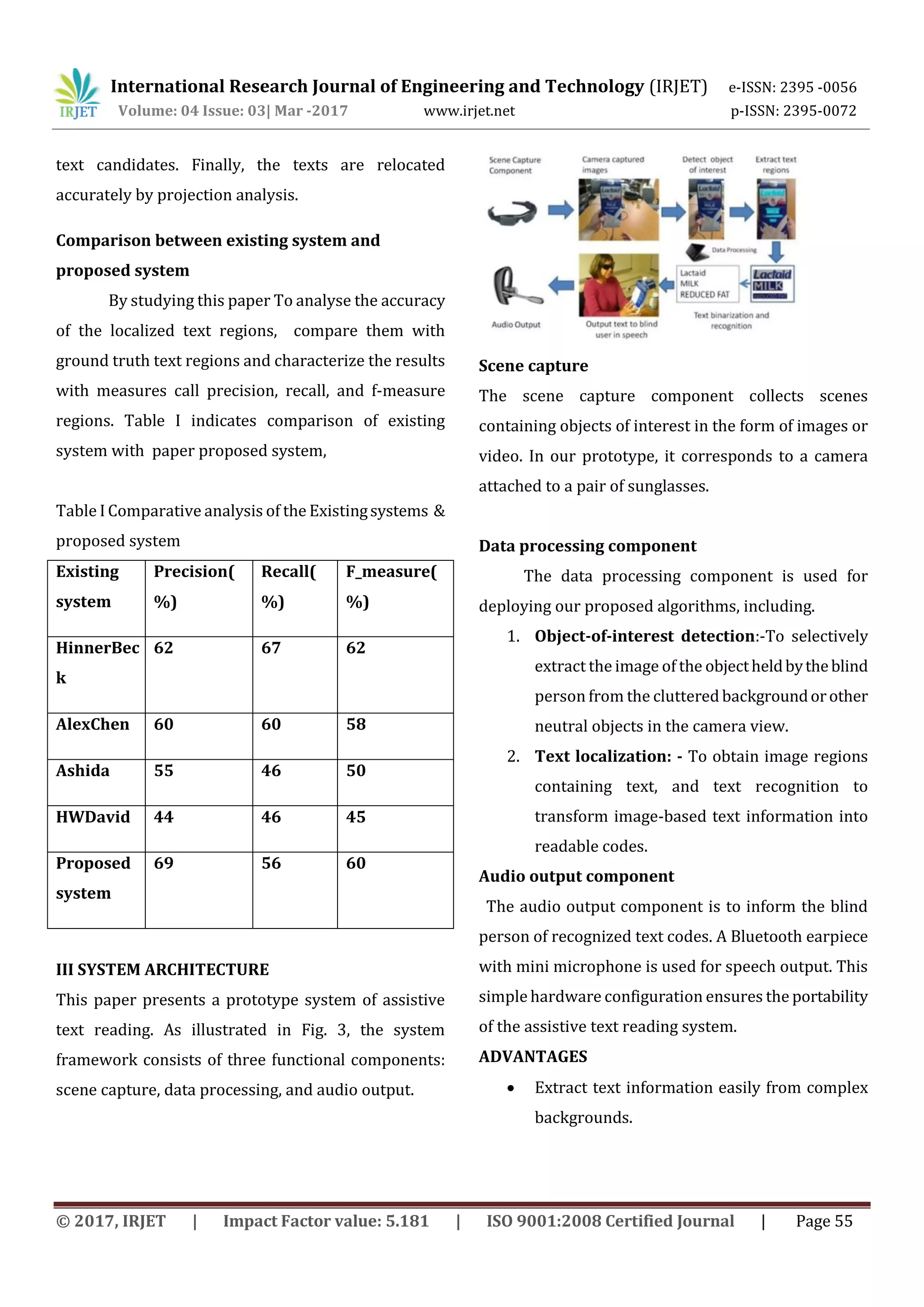
This paper presents a prototype system of assistive
text reading. As illustrated in Fig. 3, the system
framework consists of three functional components:
scene capture, data processing, and audio output.
Scene capture
The scene capture component collects scenes
containing objects of interest in the form of images or
video. In our prototype, it corresponds to a camera
attached to a pair of sunglasses.
Data processing component
The data processing component is used for
deploying our proposed algorithms, including.
1. Object-of-interest detection:-To selectively
extract the image of the objectheldbytheblind
person from the cluttered backgroundorother
neutral objects in the camera view.
2. Text localization: - To obtain image regions
containing text, and text recognition to
transform image-based text information into
readable codes.
Audio output component
The audio output component is to inform the blind
person of recognized text codes. A Bluetooth earpiece
with mini microphone is used for speech output. This
simple hardware configuration ensures the portability
of the assistive text reading system.
ADVANTAGES
 Extract text information easily from complex
backgrounds.
International Research Journal of Engineering and Technology (IRJET) e-ISSN: 2395 -0056
Volume: 04 Issue: 03| Mar -2017 www.irjet.net p-ISSN: 2395-0072
© 2017, IRJET | Impact Factor value: 5.181 | ISO 9001:2008 Certified Journal | Page 56
 Propose a text localization algorithm that
combines rule based layout analysis and
learning-based text classifier training.
 System is portable.
 Easy to operate.
 Accuracy is more than Existing system.
APPLICATIONS
 For blind people in mall, public place etc.
 For Illiterate people.
IV.CONCLUSION
This paper focuses a prototype system to read printed
text on hand-held objects for assisting blindpersonsIn
order to solve the common aiming problem for blind
users, This method can effectively distinguish the
object of interest from background or other objects in
the camera view. Adjacent character grouping is
performed to calculate candidates of text patches
prepared for text classification. An Ad boost learning
model is employed to localize text in camera-based
images. Off-the-shelf OCR is used to perform word
recognition on the localized textregionsandtransform
into audio output for blind users
REFERENCES
[1 Chucai Yi, Yingli Tian, Aries Arditi,’’ Portable
Camera-Based Assistive Text and Product
Label Reading From Hand-Held Objects for Blind
Persons”, IEEE/ASME TRANSACTIONS ON
MECHATRONICS, vol. 19, NO. 3, June 2014
[2]X. Chen and A. L. Yuille, “Detecting and reading text
in natural scenes,” in Proc. Compute. Vision Pattern
Recognise. 2004, vol. 2, pp. II-366–II-373
[3] Xilin Chen, Jie Yang, Jing Zhang, and Alex Waibel,
“Automatic Detection and Recognition of Signs from
Natural Scenes,” IEEE TRANSACTIONS ON IMAGE
PROCESSING, vol. 13, no. 1, January 2004
[4] K. Kim, K. Jung,andJ.Kim,“Texture-basedapproach
for text detection in images using support vector
machines and continuously adaptive mean shift
algorithm,” IEEE Trans. Pattern Anal. Mach. Intel., vol.
25, no. 12,pp. 1631–1639, Dec. 2003.
[5] M. A. Faisal, Z. Aung, J. R. Williams, and A. Sanchez,
“Data-stream based intrusion detection system for
advanced metering infrastructure in smart grid: A
feasibility study,” IEEE Syst. J., vol. 9, no. 1, pp. 1–14,
Jan. 2014.
[5] L. Ma, C. Wang, and B. Xiao, “Text detection in
naturalimagesbasedonmulti-scaleedgedetectionand
classification,” in Proc. Int. Congr. Image Signal
Process., 2010, vol. 4, pp. 1961–1965.
[6] C. Yi and Y. Tian, “Text detection in natural scene
images by stroke gabor words,” in Proc. Int. Conf.
Document Anal. Recognit., 2011, pp. 177–181.
[7] World Health Organization. (2009). 10 facts about
blindness and visual impairment [Online]. Available:
www.who.int/features/factfiles/
blindness/blindness_facts/en/index.html
Advance Data Reports from the National Health
Interview Survey (2008).[Online]. Available:
http://www.cdc.gov/nchs/nhis/nhis_ad.html.
BIOGRAPHIES
Ms KOMAL MOHAN KALBHOR
PursingMasterEngineering(M.E.E&TC),
From SVPM College of Engineering,
Malegaon(BK),Maharashtra,India
International Research Journal of Engineering and Technology (IRJET) e-ISSN: 2395 -0056
Volume: 04 Issue: 03| Mar -2017 www.irjet.net p-ISSN: 2395-0072
© 2017, IRJET | Impact Factor value: 5.181 | ISO 9001:2008 Certified Journal | Page 57
Santosh D.Kale:- currently working as a
Assistant Professor at college of
engineering,Malegaon(Bk),Baramati.He
received B.E.Degree in Electronics &
Telecommunication in 2001, from North Maharashtra
University of Jalgaon, Maharashtra, India.he received
M.Tech Degree in (Electronics Instrumentation) in
Electronics & Telecommunication, from college of
Engineering,Pune(COEP),India,heguidedseveralUG&
PG projects.his researchareaincludessignalandimage
processing.

A Survey on Portable Camera-Based Assistive Text and Product Label Reading From Hand-Held Objects for Blind Persons

  • 1.
    International Research Journalof Engineering and Technology (IRJET) e-ISSN: 2395 -0056 Volume: 04 Issue: 03| Mar -2017 www.irjet.net p-ISSN: 2395-0072 © 2017, IRJET | Impact Factor value: 5.181 | ISO 9001:2008 Certified Journal | Page 53 A Survey on Portable Camera-Based Assistive Text and Product Label Reading From Hand-Held Objects for Blind Persons Ms KOMAL MOHAN KALBHOR1,MR KALE S.D.2 PG Scholar,Departement of Electronics and telecommunication,SVPM College of Engineering,Malegaon(BK),Maharashtra,India Asst.Proffessor, Departement of Electronics and telecommunication,SVPM College of Engineering,Malegaon(BK),Maharashtra,India -------------------------------------------------------------------****--------------------------------------------------------------------------- Abstract: For blind person new approach a camera-based assistive text reading framework to help read text labels and product packaging from hand-held objects in their daily lives. To seperate the object from cluttered backgrounds or other surrounding objects in the camera view, first developed an efficient and effective motion based method to define a region of interest (ROI) in the video basking the user to shake the object. This method unfairly moving object region by mixture- of-Gaussians-based background subtraction method. In the extracted ROI, text localization and recognition are carried to obtain text information. To automatically localize the text regions from the object ROI, propose a novel text localization algorithm by learning gradient features of strokeorientations and distributions of edge pixels in an Adaboost model. Text characters in the localized text regions are then binarizedand recognized by off-the-shelf optical character recognition software. Keywords: Assistive devices, distribution of edge pixels, hand-held objects, optical character recognition (OCR),stroke orientation, text reading, and text region localization. I. INTRODUCTION Readingisnecessaryintoday’ssociety.Text is everywhere in the form of printing reports,receipts, bank statements, restaurant menus, productpackages, instructions on medicine bottles etc. And while optical aids, video magnifiers, and screen readers can help blind persons and those with less vision to access documents, there are few devices that can provide better access to common hand-held objects such as product packages and objectsprintedwithtextsuchas prescription medication bottles. This paper presents a prototype system of assistive text reading. There are three main parts included scene capture, data processing, and audio output. The scene capture component collects scenes containing objects of interest in the form of images or video. The data processing component is used object-of-interest detection and text localization to obtain image regions containing text, and text recognition. The recognized text codes is informed by audio output component to the blind user. A Bluetooth earpiece with minimicrophone is employed for speech output. The main contributions of this paper are: 1) a novel motion-based algorithm are used to solve the aiming problem for blind users by their simply shaking the object of interest for a brief period. 2) a novel algorithm of automatic text localization to obtain text regions from complex background and multiple text patterns. 3) a portable camera-based assistive framework to aid blind persons reading text from hand-held objects.
  • 2.
    International Research Journalof Engineering and Technology (IRJET) e-ISSN: 2395 -0056 Volume: 04 Issue: 03| Mar -2017 www.irjet.net p-ISSN: 2395-0072 © 2017, IRJET | Impact Factor value: 5.181 | ISO 9001:2008 Certified Journal | Page 54 1. Literature Survey A) Detecting and reading text in natural scenes X. Chen and A. L. Yuille[2] ,proposes an algorithm for detecting and reading text in natural images. The algorithm is meant for use by blind and visually impaired subjects walking through city scenes. This text includes stereotypical forms – such as street signs, hospital signs, and bus numbers as well as more variableforms suchasshopsigns,housenumbers,andbillboards.This paper selects this feature set guided by the principleof informative feature . calculate joint probability distributions of these feature responsesonandofftext, so weak classifiers can be obtained as log-likelihood ratio tests. B) Automatic detection and recognition of signs from natural scenes .This paper presents an method to automatic detection and recognition of signs from natural scenes, and its application to a sign translation task. The proposed approach embeds multiresolution and multistate edge detection, adaptive searching, colour analysis,andaffinerectificationinahierarchical framework for sign detection, with differentemphases at each phase to handle the text in different sizes, orientations, colour distributions and backgrounds by Xilin Chen, Jie Yang, Jing Zhang, Alex Waibel[3]. C)WearableObstacleAvoidanceElectronicTravelAids for Blind: A Survey Dimitrios DakopoulosandNikolaos G. Bourbakis, Fellow [4]presents a comparativesurvey among portable/wearable obstacle detection/avoidance systems (a subcategory of ETAs) in an effort to inform the research community and users about the capabilities of thesesystemsandabout the progress in assistive technology for visually impaired people. The survey is depend on various features and performance parameters of the systems that classify them in categories, giving qualitative– quantitative measures. Finally, it offers a ranking, which will serve only as a reference point and not as a critique on these systems. D)Texture-based approach for textdetectioninimages using support vector machines and continuously adaptive mean shift algorithmThe above paper presents by Kwang In Kim, KeechulJung,andJinHyung Kim[5] a novel texture-based method for detecting texts in images. A support vector machine (SVM) is used to analyse the textural properties of texts. External texture feature extractionmodule isnotused, but rather the intensities of the raw pixels that make up the textural pattern are fed directly to the SVM, which works well even in high-dimensional spaces. Next, text regions are identified by applying a continuously adaptive mean shift algorithm (CAMSHIFT) to the results of the texture analysis. E)Text Detection in Natural Images Based on MultiScale Edge Detetion and ClassificationLong Ma, Chunheng Wang, Baihua Xiao[6] propose, a robust method for textdetection in color scene image. The algorithm is depend on edge detection and connected- component. multi-scale edge detection is achieved by Canny operator and an adaptive thresholding binary method. the filtered edges are classified by the classifiertrainedbySVMcombingHOG,LBPandseveral statisticalfeatures,includingmean,standarddeviation, energy, entropy, inertia, local homogeneity and correlation. k-means clustering algorithm and the binary gradient image are used to filter the candidate regions and re-detect theregionsaroundthecandidate
  • 3.
    International Research Journalof Engineering and Technology (IRJET) e-ISSN: 2395 -0056 Volume: 04 Issue: 03| Mar -2017 www.irjet.net p-ISSN: 2395-0072 © 2017, IRJET | Impact Factor value: 5.181 | ISO 9001:2008 Certified Journal | Page 55 text candidates. Finally, the texts are relocated accurately by projection analysis. Comparison between existing system and proposed system By studying this paper To analyse the accuracy of the localized text regions, compare them with ground truth text regions and characterize the results with measures call precision, recall, and f-measure regions. Table I indicates comparison of existing system with paper proposed system, Table I Comparative analysis of the Existingsystems & proposed system Existing system Precision( %) Recall( %) F_measure( %) HinnerBec k 62 67 62 AlexChen 60 60 58 Ashida 55 46 50 HWDavid 44 46 45 Proposed system 69 56 60 III SYSTEM ARCHITECTURE This paper presents a prototype system of assistive text reading. As illustrated in Fig. 3, the system framework consists of three functional components: scene capture, data processing, and audio output. Scene capture The scene capture component collects scenes containing objects of interest in the form of images or video. In our prototype, it corresponds to a camera attached to a pair of sunglasses. Data processing component The data processing component is used for deploying our proposed algorithms, including. 1. Object-of-interest detection:-To selectively extract the image of the objectheldbytheblind person from the cluttered backgroundorother neutral objects in the camera view. 2. Text localization: - To obtain image regions containing text, and text recognition to transform image-based text information into readable codes. Audio output component The audio output component is to inform the blind person of recognized text codes. A Bluetooth earpiece with mini microphone is used for speech output. This simple hardware configuration ensures the portability of the assistive text reading system. ADVANTAGES  Extract text information easily from complex backgrounds.
  • 4.
    International Research Journalof Engineering and Technology (IRJET) e-ISSN: 2395 -0056 Volume: 04 Issue: 03| Mar -2017 www.irjet.net p-ISSN: 2395-0072 © 2017, IRJET | Impact Factor value: 5.181 | ISO 9001:2008 Certified Journal | Page 56  Propose a text localization algorithm that combines rule based layout analysis and learning-based text classifier training.  System is portable.  Easy to operate.  Accuracy is more than Existing system. APPLICATIONS  For blind people in mall, public place etc.  For Illiterate people. IV.CONCLUSION This paper focuses a prototype system to read printed text on hand-held objects for assisting blindpersonsIn order to solve the common aiming problem for blind users, This method can effectively distinguish the object of interest from background or other objects in the camera view. Adjacent character grouping is performed to calculate candidates of text patches prepared for text classification. An Ad boost learning model is employed to localize text in camera-based images. Off-the-shelf OCR is used to perform word recognition on the localized textregionsandtransform into audio output for blind users REFERENCES [1 Chucai Yi, Yingli Tian, Aries Arditi,’’ Portable Camera-Based Assistive Text and Product Label Reading From Hand-Held Objects for Blind Persons”, IEEE/ASME TRANSACTIONS ON MECHATRONICS, vol. 19, NO. 3, June 2014 [2]X. Chen and A. L. Yuille, “Detecting and reading text in natural scenes,” in Proc. Compute. Vision Pattern Recognise. 2004, vol. 2, pp. II-366–II-373 [3] Xilin Chen, Jie Yang, Jing Zhang, and Alex Waibel, “Automatic Detection and Recognition of Signs from Natural Scenes,” IEEE TRANSACTIONS ON IMAGE PROCESSING, vol. 13, no. 1, January 2004 [4] K. Kim, K. Jung,andJ.Kim,“Texture-basedapproach for text detection in images using support vector machines and continuously adaptive mean shift algorithm,” IEEE Trans. Pattern Anal. Mach. Intel., vol. 25, no. 12,pp. 1631–1639, Dec. 2003. [5] M. A. Faisal, Z. Aung, J. R. Williams, and A. Sanchez, “Data-stream based intrusion detection system for advanced metering infrastructure in smart grid: A feasibility study,” IEEE Syst. J., vol. 9, no. 1, pp. 1–14, Jan. 2014. [5] L. Ma, C. Wang, and B. Xiao, “Text detection in naturalimagesbasedonmulti-scaleedgedetectionand classification,” in Proc. Int. Congr. Image Signal Process., 2010, vol. 4, pp. 1961–1965. [6] C. Yi and Y. Tian, “Text detection in natural scene images by stroke gabor words,” in Proc. Int. Conf. Document Anal. Recognit., 2011, pp. 177–181. [7] World Health Organization. (2009). 10 facts about blindness and visual impairment [Online]. Available: www.who.int/features/factfiles/ blindness/blindness_facts/en/index.html Advance Data Reports from the National Health Interview Survey (2008).[Online]. Available: http://www.cdc.gov/nchs/nhis/nhis_ad.html. BIOGRAPHIES Ms KOMAL MOHAN KALBHOR PursingMasterEngineering(M.E.E&TC), From SVPM College of Engineering, Malegaon(BK),Maharashtra,India
  • 5.
    International Research Journalof Engineering and Technology (IRJET) e-ISSN: 2395 -0056 Volume: 04 Issue: 03| Mar -2017 www.irjet.net p-ISSN: 2395-0072 © 2017, IRJET | Impact Factor value: 5.181 | ISO 9001:2008 Certified Journal | Page 57 Santosh D.Kale:- currently working as a Assistant Professor at college of engineering,Malegaon(Bk),Baramati.He received B.E.Degree in Electronics & Telecommunication in 2001, from North Maharashtra University of Jalgaon, Maharashtra, India.he received M.Tech Degree in (Electronics Instrumentation) in Electronics & Telecommunication, from college of Engineering,Pune(COEP),India,heguidedseveralUG& PG projects.his researchareaincludessignalandimage processing.