PORTABLE CAMERA-BASED ASSISTIVE TEXT AND PRODUCT
LABEL READING FROM HAND-HELD OBJECTS FOR
BLIND PERSONS
RAVINDRA COLLEGE OF ENGINEERING FOR WOMEN
GUIDE BY:
Professor Raja
shekhar
PRESENTED BY:
S Shahnaaz Begum
113T1A05A3
 Introduction
 Existing Method
 Proposed Method
 Frame Work
 Object Region detection
 Audio Detection
 Advantages
 Conclusion
 Future Work
 References
 Over all the 314 million visually impaired people worldwide, 45 million are
blind
 Recent developments in computer vision, digital cameras and portable
computers make it feasible to assist these individuals by developing camera
based products that combine computer vision technology with other existing
commercial products such optical character recognition (OCR) systems.
 The ability of people who are blind or have significant visual impairments to
read printed labels and product packages will enhance independent living and
foster economic and social self-sufficiency.
Walking safely and confidently without any human assistance in urban or
unknown environments is a difficult task for blind people.
 Visually impaired people generally use either the typical white cane or the
guide dog to travel independently.
But these methods are used only to guide blind people for safe path movement.
but these cannot provide any product assistance like shopping………..
EXISTING METHOD
 We propose a camera-based label reader to help blind persons to read names
of labels on the products.
 Camera acts as main vision in detecting the label image of the product or
board then image is processed internally .
 And separates label from image , and finally identifies the product and
identified product name is pronounced through voice.
 Then received label image is converted to text .
 Once the identified label name is converted to text and converted text is
displayed on display unit connected to controller.
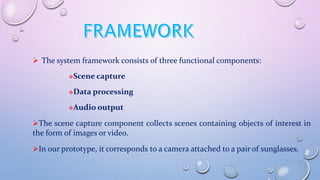
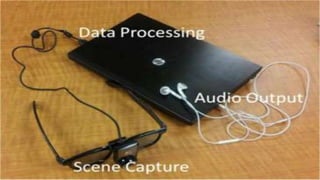
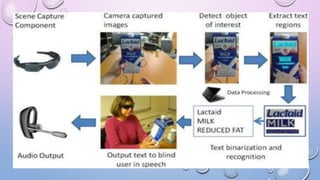
 The system framework consists of three functional components:
Scene capture
Data processing
Audio output
The scene capture component collects scenes containing objects of interest in
the form of images or video.
In our prototype, it corresponds to a camera attached to a pair of sunglasses.
The data processing component is used for deploying our proposed algorithms,
including.
 object-of-interest detection to selectively extract the image of the object held
by the blind user from the cluttered background or other neutral objects in the
camera view
 Text localization to obtain image regions containing text, and text recognition
to transform image-based text information into readable codes
The audio output component is to inform the blind user of recognized text codes.
A Bluetooth earpiece with mini microphone is employed for speech output.
Cont…
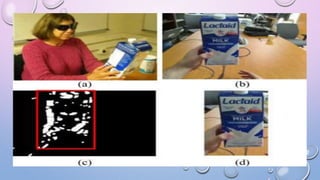
 To ensure that the hand-held object appears in the camera view, we employ a
camera with a reasonably wide angle in our prototype system (since the blind user
may not aim accurately) .
 This may result in some other extraneous but perhaps text-like objects appearing in
the camera view.
 To extract the hand-held object of interest from other objects in the camera view,
 We ask users to shake the hand-held objects containing the text they wish identify.
 Then employ a motion-based method to localize the objects from cluttered
background.
OBJECT REGION DETECTION
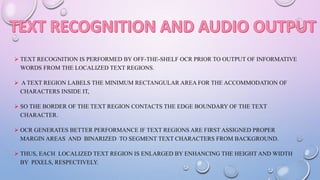
 TEXT RECOGNITION IS PERFORMED BY OFF-THE-SHELF OCR PRIOR TO OUTPUT OF INFORMATIVE
WORDS FROM THE LOCALIZED TEXT REGIONS.
 A TEXT REGION LABELS THE MINIMUM RECTANGULAR AREA FOR THE ACCOMMODATION OF
CHARACTERS INSIDE IT,
 SO THE BORDER OF THE TEXT REGION CONTACTS THE EDGE BOUNDARY OF THE TEXT
CHARACTER.
 OCR GENERATES BETTER PERFORMANCE IF TEXT REGIONS ARE FIRST ASSIGNED PROPER
MARGIN AREAS AND BINARIZED TO SEGMENT TEXT CHARACTERS FROM BACKGROUND.
 THUS, EACH LOCALIZED TEXT REGION IS ENLARGED BY ENHANCING THE HEIGHT AND WIDTH
BY PIXELS, RESPECTIVELY.
 IT REMOVES PHYSICAL HARDWARE REQUIREMENT .
 PORTABILITY.
 ACCURACY AND FLEXIBILITY.
 AUTOMATIC DETECTION
 TO READ PRINTED TEXT ON HAND-HELD OBJECTS FOR ASSISTING BLIND PERSON
 IN ORDER TO SOLVE THE COMMON AIMING PROBLEM FOR BLIND USERS.
 THIS METHOD CAN EFFECTIVELY DISTINGUISH THE OBJECT OF INTEREST FROM BACKGROUND OR
OTHER OBJECTS IN THE CAMERA VIEW.
 TO EXTRACT TEXT REGIONS FROM COMPLEX BACKGROUNDS, WE HAVE PROPOSED A NOVEL TEXT
LOCALIZATION ALGORITHM BASED ON MODELS OF STROKE ORIENTATION AND EDGE
DISTRIBUTIONS.
 OCR IS USED TO PERFORM WORD RECOGNITION ON THE LOCALIZED TEXT REGIONS AND
TRANSFORM INTO AUDIO OUTPUT FOR BLIND USERS.
 OUR FUTURE WORK WILL EXTEND OUR LOCALIZATION ALGORITHM TO PROCESS
TEXT STRINGS WITH CHARACTERS FEWER THAN THREE AND TO DESIGN MORE
ROBUST BLOCK PATTERNS FOR TEXT FEATURE EXTRACTION.
 WE WILL ALSO EXTEND OUR ALGORITHM TO HANDLE NON HORIZONTAL TEXT
STRINGS.
 FURTHERMORE, WE WILL ADDRESS THE SIGNIFICANT HUMAN INTERFACE ISSUES
ASSOCIATED WITH READING TEXT BY BLIND USERS.
 World Health Organization. (2013). 10 facts about blindness and visual
impairment [Online]. Available:
www.who.int/features/factfiles/blindness/blindness_facts/en/index.html[28]
C. Stauffer and W. E. L. Grim son, “Adaptive background mixture models
for real-time tracking,” presented at the IEEE Computer. Soc. Conf.Comput.
Vision Pattern Recognition., Fort Collins, CO, USA, 2013
New Technology
New Technology

New Technology

  • 1.
    PORTABLE CAMERA-BASED ASSISTIVETEXT AND PRODUCT LABEL READING FROM HAND-HELD OBJECTS FOR BLIND PERSONS RAVINDRA COLLEGE OF ENGINEERING FOR WOMEN GUIDE BY: Professor Raja shekhar PRESENTED BY: S Shahnaaz Begum 113T1A05A3
  • 2.
     Introduction  ExistingMethod  Proposed Method  Frame Work  Object Region detection  Audio Detection  Advantages  Conclusion  Future Work  References
  • 3.
     Over allthe 314 million visually impaired people worldwide, 45 million are blind  Recent developments in computer vision, digital cameras and portable computers make it feasible to assist these individuals by developing camera based products that combine computer vision technology with other existing commercial products such optical character recognition (OCR) systems.  The ability of people who are blind or have significant visual impairments to read printed labels and product packages will enhance independent living and foster economic and social self-sufficiency.
  • 4.
    Walking safely andconfidently without any human assistance in urban or unknown environments is a difficult task for blind people.  Visually impaired people generally use either the typical white cane or the guide dog to travel independently. But these methods are used only to guide blind people for safe path movement. but these cannot provide any product assistance like shopping……….. EXISTING METHOD
  • 5.
     We proposea camera-based label reader to help blind persons to read names of labels on the products.  Camera acts as main vision in detecting the label image of the product or board then image is processed internally .  And separates label from image , and finally identifies the product and identified product name is pronounced through voice.  Then received label image is converted to text .  Once the identified label name is converted to text and converted text is displayed on display unit connected to controller.
  • 6.
     The systemframework consists of three functional components: Scene capture Data processing Audio output The scene capture component collects scenes containing objects of interest in the form of images or video. In our prototype, it corresponds to a camera attached to a pair of sunglasses.
  • 7.
    The data processingcomponent is used for deploying our proposed algorithms, including.  object-of-interest detection to selectively extract the image of the object held by the blind user from the cluttered background or other neutral objects in the camera view  Text localization to obtain image regions containing text, and text recognition to transform image-based text information into readable codes The audio output component is to inform the blind user of recognized text codes. A Bluetooth earpiece with mini microphone is employed for speech output. Cont…
  • 10.
     To ensurethat the hand-held object appears in the camera view, we employ a camera with a reasonably wide angle in our prototype system (since the blind user may not aim accurately) .  This may result in some other extraneous but perhaps text-like objects appearing in the camera view.  To extract the hand-held object of interest from other objects in the camera view,  We ask users to shake the hand-held objects containing the text they wish identify.  Then employ a motion-based method to localize the objects from cluttered background. OBJECT REGION DETECTION
  • 12.
     TEXT RECOGNITIONIS PERFORMED BY OFF-THE-SHELF OCR PRIOR TO OUTPUT OF INFORMATIVE WORDS FROM THE LOCALIZED TEXT REGIONS.  A TEXT REGION LABELS THE MINIMUM RECTANGULAR AREA FOR THE ACCOMMODATION OF CHARACTERS INSIDE IT,  SO THE BORDER OF THE TEXT REGION CONTACTS THE EDGE BOUNDARY OF THE TEXT CHARACTER.  OCR GENERATES BETTER PERFORMANCE IF TEXT REGIONS ARE FIRST ASSIGNED PROPER MARGIN AREAS AND BINARIZED TO SEGMENT TEXT CHARACTERS FROM BACKGROUND.  THUS, EACH LOCALIZED TEXT REGION IS ENLARGED BY ENHANCING THE HEIGHT AND WIDTH BY PIXELS, RESPECTIVELY.
  • 13.
     IT REMOVESPHYSICAL HARDWARE REQUIREMENT .  PORTABILITY.  ACCURACY AND FLEXIBILITY.  AUTOMATIC DETECTION
  • 14.
     TO READPRINTED TEXT ON HAND-HELD OBJECTS FOR ASSISTING BLIND PERSON  IN ORDER TO SOLVE THE COMMON AIMING PROBLEM FOR BLIND USERS.  THIS METHOD CAN EFFECTIVELY DISTINGUISH THE OBJECT OF INTEREST FROM BACKGROUND OR OTHER OBJECTS IN THE CAMERA VIEW.  TO EXTRACT TEXT REGIONS FROM COMPLEX BACKGROUNDS, WE HAVE PROPOSED A NOVEL TEXT LOCALIZATION ALGORITHM BASED ON MODELS OF STROKE ORIENTATION AND EDGE DISTRIBUTIONS.  OCR IS USED TO PERFORM WORD RECOGNITION ON THE LOCALIZED TEXT REGIONS AND TRANSFORM INTO AUDIO OUTPUT FOR BLIND USERS.
  • 15.
     OUR FUTUREWORK WILL EXTEND OUR LOCALIZATION ALGORITHM TO PROCESS TEXT STRINGS WITH CHARACTERS FEWER THAN THREE AND TO DESIGN MORE ROBUST BLOCK PATTERNS FOR TEXT FEATURE EXTRACTION.  WE WILL ALSO EXTEND OUR ALGORITHM TO HANDLE NON HORIZONTAL TEXT STRINGS.  FURTHERMORE, WE WILL ADDRESS THE SIGNIFICANT HUMAN INTERFACE ISSUES ASSOCIATED WITH READING TEXT BY BLIND USERS.
  • 16.
     World HealthOrganization. (2013). 10 facts about blindness and visual impairment [Online]. Available: www.who.int/features/factfiles/blindness/blindness_facts/en/index.html[28] C. Stauffer and W. E. L. Grim son, “Adaptive background mixture models for real-time tracking,” presented at the IEEE Computer. Soc. Conf.Comput. Vision Pattern Recognition., Fort Collins, CO, USA, 2013