
1
CHAPTER 1
INTRODUCTION
1.1 GENERAL
Lung cancer was uncommon at the beginning of the 20th century, is now a
worldwide dilemma, which is more recurrent cancer in the world. Lung cancer is a
major cause of cancer-related deaths in humans worldwide. Approximately 20% of
cases with lung nodules represent lung cancers; therefore, the identification of
potentially malignant lung nodules is essential for the screening and diagnosis of lung
cancer. Lung nodules are small masses in the human lung, and are usually spherical;
however, they can be distorted by surrounding anatomical structures, such as vessels
and the adjacent pleura. Intra-parenchyma lung nodules are more likely to be malignant
than those connected with the surrounding structures, and thus lung nodules are divided
into different types according to their relative positions. At present, the classification
from Diciottiet al. is the most popular approach and it divides nodules into four types:
well-circumscribed (W) with the nodule located centrally in the lung without any
connection to vasculature; vascularized (V) with the nodule located centrally in the lung
but closely connected to neighbouring vessels; juxta-pleural (J) with a large portion of
the nodule connected to the pleural surface; and pleural-tail (P) with the nodule near the
pleural surface connected by a thin tail. Sample images are shown in Fig. 1, with the
nodule encircled in red.
Computed tomography (CT) is the most accurate imaging modality to obtain
anatomical information about lung nodules and the surrounding structures. In current
clinical practice, however, interpretation of CT images is challenging for radiologists
due to the large number of cases. This manual reading can be error-prone and the reader
may miss nodules and thus a potential cancer. Computer-aided diagnosis (CAD)
systems would be helpful for radiologists by offering initial screening or second
opinions to classify lung nodules. CAD’s provide depictions by automatically
computing quantitative measures, and are capable of analyzing the large number of
small nodules identified by CT scans.
2
Fig. 1.1 Transaxial CT images with the four types of nodules, shown from left to
right, juxta-pleural, pleural-tail, vascularized and well-circumscribed
In recent years, the image processing mechanisms are used in several medical
professions for improving detection of lung cancer. Medical professionals look time as
one of the important parameter to discover the cancer in the patient at the earlier stage;
which is very important for successful treatment.
1.2 BASICS OF IMAGE PROCESSING
Image Processing is the science of manipulating an image. With the advent of digital
cameras and their easy interoperability with computers, the process of digital image
processing has acquired an entire new dimension and meaning. Image processing works
with the digital images to enhance, distort, accentuate or highlight inherent details in the
image. The goal of each operation is to achieve some details or, we can generalize by
saying, extracting information from the system.
The area of image analysis (also called image understanding) is in between image
processing and computer vision. There are no clear-cut boundaries in the continuum
from image processing at one end to computer vision at the other. However, one useful
paradigm is to consider three types of computerized processes in this continuum: low-,
mid-, and high-level processes.
Low-level processes involve primitive operations such as image preprocessing to reduce
noise, contrast enhancement, and image sharpening. A low-level process is characterized
by the fact that both its inputs and outputs are images.
Mid-level processing on images involves tasks such as segmentation (partitioning an
image into regions or objects), descriptions of those objects to reduce them to a form
suitable for computer processing, and classifications (recognition) of individual objects.
A mid-level process is characterized by the fact that its inputs generally are
images, but its outputs are attributes extracted from those images (e.g., edges, contours,
and the identity of individual objects).
3
High-level processing involves “making sense” of an ensemble of recognized objects, as
in image analysis, and, at the far end of the continuum, performing the cognitive
functions normally associated with vision.
Based on the preceding comments, it shows that a logical place of overlap
between image processing and image analysis is the area of image recognition of
individual regions or objects in an image. Thus, we call digital image processing
encompasses processes whose inputs and outputs are images and, in addition,
encompasses processes that extracts attributes from images, up to and including
recognition of individual objects.
1.2.1 TYPES OF IMAGE PROCESSING
 Analog Image Processing
Our eyes see the objects. They pass the information to the brain. Brain can
understand the image. Such a human image processing mechanism is called analog
image processing.
 Digital Image Processing
With the help of scanning devices, our computer systems acquire the image, store
the image in memory in digital form, process the image in various ways .This mechanism
is called digital image processing.
 Digital Image Representation
The form monochrome image refers to a two dimensional light function f(x, y),
here x and y denote spatial coordinates and the value of any point (x, y) is proportional to
the brightness of the image of that point. A digital image can be considered a matrix of
row and column indices identify a point in the image and the corresponding matrix
elements value identifies the gray level at that point. The elements of such a digital array
are called pixels or picture elements. When x, y and the amplitude values of f are all
finite, discrete quantities, The image is a digital image. The field of digital image
processing refers processing of digital images by means of a digital computer. A digital
image is composed of a finite number of elements, each of which has a particular
location and value. These elements are referred to as picture elements, image elements
and pixels. Pixel is the term most widely used to denote the elements of the digital
image.
4
Vision is the most advanced of our senses, so it is not surprising that images play
the single most important role in human perception. However unlike humans who are
limited to the visual band of the electromagnetic (EM) spectrum, imaging machines
cover almost the entire EM spectrum, ranging from gamma to radio waves. They can
operate on images generated by sources that humans are not accustomed to associating
with images. These include ultra sound, electron microscopy, and computer generated
images. Thus digital image processing encompasses a wide and varied field of
application.
1.3 FUNDAMENTAL STEPS IN DIGITAL IMAGE PROCESSING
Digital image processing encompasses a broad range of hardware, software, and
theoretical underpinnings. The following are the fundamental steps in image processing
shows in the block diagram for fundamental steps in Digital Image Processing.
 Image acquisition
The image acquisition is to acquire a digital image. To do so require an image sensor
and the capability to digitize the signal produced by the sensor. The sensor could be a
monochrome camera that produces an entire image of the problem domain every 1/30
sec and the imaging sensor could be a line-scan camera that produces a single image line
at that time. In this case, the object’s motion past the line scanner produces a two
dimensional image. If the output of the camera or the other imaging sensor is not already
in the digital form, an analog to digital converter digitizes it.
 Preprocessing
The key function of pre-processing is to improve the image in ways that increase the
chances for success of the other processes.
 Segmentation
Segmentation procedures partition an image into its constituent parts or objects. In
general, autonomous segmentation is one of the most difficult tasks in digital image
processing. A rugged segmentation procedure brings the process a long way toward
successful solution of imaging problems that require object to be identified individually.
5
 Representation and Description
Representation and description almost always follow the output of the segmentation
stage, which usually is raw pixel data, constituting either the boundary of a region or all
the points in the region itself. The first decision that must be made is whether the data
should be represented as a boundary or as a complete region. Boundary representation
is appropriate when the focus is on external shape characteristic, such as corners and
inflections. Regional representation is appropriate when the focus on internal properties,
such as texture or skeletal shape.
 Recognition
Recognition is the process that assigns a label to an object based on its descriptors.
We conclude coverage of digital image processing with the development of methods for
recognition of individual objects.
 Knowledge Base
Knowledge about the problem domain is coded into an image processing system
in the form of a Knowledge database. This knowledge may be as simple as detailing
regions of an image where the information of interest is known to be located, thus
limiting the search that has to be conducted in seeking that information. The Knowledge
base also can be quiet complex, such as an interrelated list of all major possible defects
in materials inspection problem
1.4 ELEMENTS OF DIGITAL IMAGE PROCESSING SYSTEMS
The elements of a general purpose system capable of performing the image
processing operations generally perform image acquisition, storage, processing,
communication and display.
 Image acquisition
Two elements are required to acquire digital images. The first is a physical
device that is sensitive to a band in the electromagnetic energy spectrum (such as the X-
ray, ultraviolet, visible, or infrared bands) and that produces an electrical signal output
proportional to the level of energy sensed. The second, called a digitizer, is a device for
converting the electrical output of the physical sensing device into digital form.
6
 Storage
An 8-bit image of size 1024*1024 pixels requires one million bytes of storage.
Digital storage for image processing applications falls into 3 principle categories. They
are (1) short term storage used during processing (2) on line storage relatively used for
fast recall (3) archival storage. Storage is measured in bytes, Kbytes, Mbytes, Gbytes
and TBytes.
 Processing
Processing of digital images involves procedures that are usually expressed in
algorithmic form. Thus, with the exception of image acquisition and display, most
images processing function can be implemented in software. The only reason for
specialized image processing hardware is the need for speed in some application or to
overcome some fundamental computer limitations. For example, an important
application of digital imaging is low-light microscopy.
 Communication
Communication in digital image processing primarily involves local
communication between image processing systems and remote communication from
one point to another typically in connection with the transmission of image data.
Hardware and software for local communication are readily available for most
computers.
 Display
Monochrome and colour TV monitors are the principle display devices used in
modern image processing systems. Monitors are driven by the output of a hardware
image display module the backplane of the host computer or as a part of the hardware
associated with an image processor. The signals and the output of the display module
can be fed into an image recording device that produces the hard copy of the image
being viewed on the monitor screen. Other display media include random-access
Cathode Ray Tubes (CRTs), and printing devices.
1.5 BIO MEDICAL ENGINEERING
Three applications of nanotechnology are particularly suited to biomedicine:
diagnostic techniques, drugs, and prostheses and implants. Interest is booming in
biomedical applications for use outside the body, such as diagnostic sensors and “labon-
7
a-chip” techniques, which are suitable for analyzing blood and other samples, and for
inclusion in analytical instruments for R&D on new drugs. For inside the body, many
companies are developing nanotechnology applications for anticancer drugs.
Principles of voluntariness, informed consent and community agreement
whereby research participants are fully apprised of the research and the impact and risk
of such research on the research participant and others; and where by the research
participants retain the right to abstain from further participation in the research
irrespective of any legal or other obligation that may have been entered into by such
human participants or someone on their behalf, subject to only minimal recitative
obligations of any advance consideration received and outstanding. Where any such
research entails treating any community or group of persons as a research participant,
these principles of voluntariness and informed consent shall apply, mutatis mutandis, to
the community as a whole and to each individual member who is the participant of the
research or experiment. Where the human participant is incapable of giving consent and
it is considered essential that research or experimentation be conducted on such a
person incompetent to give consent, the principle of voluntariness and informed consent
shall continue to apply and such consent and voluntariness shall be obtained and
exercised on behalf of such research participants by someone who is empowered and
under a duty to act on their behalf. The principles of informed consent and
voluntariness are cardinal principles to be observed throughout the research and
experiment, including its aftermath and applied use so that research participants are
continually kept informed of any and all developments in so far as they affect them and
others. However, without in any way undermining the cardinal importance of obtaining
informed consent from any human participant involved in any research, the nature and
form of the consent and the evidentiary requirements to prove that such consent was
taken, shall depend upon the degree and seriousness of the invasiveness into the
concerned human participant’s person and privacy, health and life generally, and, the
overall purpose and the importance of the research. Ethics committees hall decide on
the form of consent to be taken or its waiver based on the degree of risk that may be
involved.
Semiautomatic methods require user interaction to set algorithm parameters, to
perform initial segmentation, or to select critical features. They can be classified
according to the space in which features are grouped together. A commonly used
method is global thresholding where pixel intensities from the image are mapped into a
8
feature space called a histogram. Thresholds are chosen at valleys between pixel
clusters so that each pair represents a region of similar pixels in the image. This works
well if the target object has distinct and homogeneous pixel values, which is usually the
case with bony structures in CT datasets. On the other hand, spatial information is lost
in the transformation, which may produce disjoint regions.
Spatial-domain methods use spatial proximity in the image to group pixels.
Edge-detection methods use local gradient information to define edge elements, which
are then combined into contours to form region boundaries. For example, a 3-D version
of the Marr–Hildreth operator was used to segment the brain from MRI data. However,
edge operators are generally sensitive to noise and produce spurious edge elements that
make it difficult to construct a reasonable region boundary. Region growing methods on
the other hand, construct regions by grouping spatially proximate pixels so that some
homogeneity criterion is satisfied over the region. In particular, seeded-region-growing
algorithms grow a region from a seed, which can be a single pixel or cluster of pixels.
Seeds may be chosen by the user, which can be difficult because the user must predict
the growth behaviour of the region based on the homogeneity metric. Since the number,
locations, and sizes of seeds may be arbitrary, segmentation results are difficult to
reproduce. Alternatively, seeds may be defined automatically, for example, the
min/max pixel intensities in an image may be chosen as seeds if the region mean is used
as homogeneity metric. A region is constructed by iteratively incorporating pixels on
the region boundary. In addition, active-contour-based methods and neural-network-
based classification methods have also been proposed to perform image segmentation.
1.5.1 MEDICAL IMAGING
Medical imaging is the technique and process used to create images of the
human body (or parts and function thereof) for clinical purposes (medical procedures
seeking to reveal, diagnose or examine disease) or medical science (including the study
of normal anatomy and physiology). Although imaging of removed organs and tissues
can be performed for medical reasons, such procedures are not usually referred to as
medical imaging, but rather are a part of pathology.
As a discipline and in its widest sense, it is part of biological imaging and
incorporates radiology (in the wider sense), nuclear medicine, investigative radiological
sciences, endoscopy, (medical) thermograph, medical photography and microscopy
(e.g. for human pathological investigations).
9
Measurement and recording techniques which are not primarily designed to
produce images, such as electroencephalography (EEG), magneto encephalography
(MEG), Electrocardiography (EKG) and others, but which produce data susceptible to
be represented as maps (i.e. containing positional information), can be seen as forms of
medical imaging
In the clinical context, "invisible light" medical imaging is generally equated to
radiology or "clinical imaging" and the medical practitioner responsible for interpreting
(and sometimes acquiring) the images are a radiologist. "Visible light" medical imaging
involves digital video or still pictures that can be seen without special equipment.
Dermatology and wound care are two modalities that utilize visible light imagery.
Diagnostic radiography designates the technical aspects of medical imaging and in
particular the acquisition of medical images. The radiographer or radiologic
technologist is usually responsible for acquiring medical images of diagnostic quality,
although some radiological interventions are performed by radiologists. While
radiology is an evaluation of anatomy, nuclear medicine provides functional
assessment.
As a field of scientific investigation, medical imaging constitutes a sub-
discipline of biomedical engineering, medical physics or medicine depending on the
context: Research and development in the area of instrumentation, image acquisition
(e.g. radiography), modelling and quantification are usually the preserve of biomedical
engineering, medical physics and computer science; Research into the application and
interpretation of medical images is usually the preserve of radiology and the medical
sub-discipline relevant to medical condition or area of medical science (neuroscience,
cardiology, psychiatry, psychology, etc.) under investigation. Many of the techniques
developed for medical imaging also have scientific and industrial applications.
Medical imaging is often perceived to designate the set of techniques that
noninvasively produce images of the internal aspect of the body. In this restricted sense,
medical imaging can be seen as the solution of mathematical inverse problems. This
means that cause (the properties of living tissue) is inferred from effect (the observed
signal). In the case of ultra tomography the probe consists of ultrasonic pressure waves
and echoes inside the tissue show the internal structure. In the case of projection
radiography, the probe is X-ray radiation which is absorbed at different rates in
different tissue types such as bone, muscle and fat.
10
The term non-invasive is a term based on the fact that following medical
imaging modalities do not penetrate the skin physically. But on the electromagnetic and
radiation level, they are quite invasive. From the high energy photons in X-Ray
Computed Tomography, to the 2+ Tesla coils of an MRI device, these modalities alter
the physical and chemical reactions of the body in order to obtain data.
1.5.2 MEDICAL IMAGE SEGMENTATION
Medical image segmentation refers to the segmentation of known anatomic
structures from medical images. Structures of interest include organs or parts thereof,
such as cardiac ventricles or kidneys, abnormalities such as tumours and cysts, as well
as other structures such as bones, vessels, brain structures etc. The overall objective of
such methods is referred to as computer-aided diagnosis; in other words, they are used
for assisting doctors in evaluating medical imagery or in recognizing abnormal findings
in a medical image. In contrast to generic segmentation methods, methods used for
medical image segmentation are often application-specific; as such, they can make use
of prior knowledge for the particular objects of interest and other expected or possible
structures in the image. This has led to the development of a wide range of
segmentation methods addressing specific problems in medical applications.
Some methods proposed in the literature are extensions of methods originally
proposed for generic image segmentation. In, a modification of the watershed transform
is proposed for knee cartilage and gray matter/white matter segmentation in magnetic
resonance images (MRI). This introduces prior information in the watershed method via
the use of a previous probability calculation for the classes present in the image and via
the combination of the watershed transform with atlas registration for the automatic
generation of markers.
Other methods are more application specific; for example in, segmentation tools
are developed for use in the study of the function of the brain, i.e. for the classification
of brain areas as activating, deactivating, or not activating, using functional magnetic
resonance imaging (FMRI) data. The method of performs segmentation based on
intensity histogram information, augmented with adaptive spatial regularization using
Markov random fields. The latter contributes to improved segmentation as compared to
non-spatial mixture models, while not requiring the heuristic fine-tuning that is
necessary for non-adaptive spatial regularization previously proposed.
11
Another important application of segmentation tools is in the study of the
function of the heart. In, a contour detection algorithm based on a radial edge-detection
filter is developed for cardiac echo graphic images. Objective of this algorithm is to
define a region of interest in which measurements (e.g. image intensity) can lead, after
appropriate interpretation, to the estimation of important cardiovascular parameters
without the need for invasive techniques.
In addition to the aforementioned techniques, numerous other algorithms for
applications of segmentation to specialized medical imagery interpretation exist.
1.5.3 LUNG NODULES
A lung nodule is defined as a “spot” on the lung that is 3 cm (about 1 ½ inches)
in diameter or less. If an abnormality is seen on an x-ray of the lungs that is larger than
3 cm, it is considered a “lung mass” instead of a nodule, and is more likely to be
cancerous. Lung nodules usually need to be at least 1 cm in size before they can be seen
on a chest x-ray.
Lung nodules are quite common, and are found on 1 in 500 chest x-rays, and 1
in 100 CT scans of the chest. Approximately 150,000 lung nodules are detected in
people in the United States each year. Roughly half of smokers over the age of 50 will
have nodules on a CT scan of their chest.
Overall, the likelihood that a lung nodule is cancer is 40%, but the risk of a lung
nodule being cancerous varies considerably depending on several things. In people less
than 35 years of age, the chance that a lung nodule is cancer is less than 1%, whereas
half of lung nodules in people over age 50 are malignant (cancerous). Other factors that
raise or lower the risk that a lung nodule is cancer include:
 Size – Larger nodules are more likely to be cancerous than smaller ones.
 Smoking – Current and former smokers are more likely to have cancerous lung
nodules than never smokers.
 Occupation – Some occupational exposures raise the likelihood that a nodule is
cancer.
 Medical history - Having a history of cancer increases the chance that it could
be malignant.
 Shape – Smooth, round nodules are more likely to be benign, whereas irregular
or “speculated” nodules are more likely to be cancerous.
12
 Growth – Cancerous lung nodules tend to grow fairly rapidly with an average
doubling time of about 4 months, while benign nodules tend to remain the same
size over time.
 Calcification – Lung nodules that are calcified are more likely to be benign.
 Cavitations – Nodules described as “cavitary,” meaning that the interior part of
the nodule appears darker on x-rays, are more likely to be benign.
Lung cancer screening in appropriate people has been found to decrease the
mortality rate from lung cancer by 20%. But as with any screening test there is the risk
of false positives, and it's common to find nodules on CT screening. But finding
nodules does not always mean cancer. In fact, studies thus far estimate that only around
5% of nodules found on a first lung CT screening are cancerous.
13
CHAPTER 2
LITERATURE SURVEY
2.1 INTRODUCTION
Analysis of primary lung nodule and disease is important for lung cancer
staging. Literature survey is an overview of all the existing techniques to detect lung
cancer at initial stage. Data Mining and Image processing plays very crucial role in
healthcare industry especially for disease diagnosis. Data Mining is very beneficial for
finding hidden information or pattern form the huge databases, some widely used data
mining techniques are classification, prediction, association analysis, pattern matching
and clustering. Image Processing plays significant role in cancer detection when input
data is in the form of images; some techniques used in Image Processing for
information retrieval are Image acquisition, Noise Removal, Segmentation, and
Morphological operations etc., Literature survey analyses some of the methods for lung
nodule cancer detection.
2.1.1 A. Farag, S. Elhabian, J. Graham, A. Farag, and R. Falk,
“Toward precise pulmonary nodule descriptors for nodule type
classification,” in Proc. Med. Image Comput. Comput.-Assisted
Intervention Conf. Lecture Notes Comput. Sci., 2010, vol. 13, no. 3
A framework for nodule feature-based extraction is presented to classify lung
nodules in low-dose CT slices (LDCT) into four categories: juxta, well-circumscribed,
vascularized and pleural-tail, based on the extracted information. The Scale Invariant
Feature Transform (SIFT) and an adaptation to Daugman’s Iris Recognition algorithm
are used for analysis. The SIFT descriptor results are projected to lower-dimensional
subspaces using PCA and LDA. Iris Recognition algorithm revealed improvements
from the original Daugman binary iris code. But here the larger nodule database cannot
be generated.
14
2.1.2 A. Farag, A. Ali, J. Graham, S. Elshazly, and R. Falk,
“Evaluation of geometric feature descriptors for detection and
classification of lung nodules in low dose CT scans of the chest,” in
Proc. Int. Symp. Biomed. Imag., 2011
This paper examines a data-driven lung nodule modelling approach creates
templates for common nodule types, using active appearance models (AAM); which are
then used to detect candidate nodules based on optimum similarity measured by the
normalized cross-correlation (NCC). Geometric feature descriptors (e.g., SIFT, LBP
and SURF) are applied to the output of the detection step, in order to extract features
from the nodule candidates, for further enhancement of output and possible reduction
of false positives. In the concluding section, we present our view on the false positive.
Here it has high false positive and low sensitivity.
2.1.3 A. Farag, J. Graham, A. A. Farag, S. Elshazly, and R. Falk,
“Parametric and non-parametric nodule models: Design and
evaluation,” in Proc. 3rd
Int. Workshop Pulmon. Image Process. 2010
This paper presents a novel method for generating lung nodules using
variational level sets to obtain the shape properties of real nodules to form an average
model template per nodule type. The texture information used for filling the nodules is
based on a devised approach that uses the probability density of the radial distance of
each nodule to obtain the maximum and minimum Hounsfield density (HU). There are
two main categories that lung nodule models fall within; parametric and non-
parametric. But this method was not effective for overlapping nodule.
2.1.4 Kakar Manish,Dag Rune Olsen,”Automatic segmentation and
recognition of lungs and lesion from CT scans of thorax”original
researchArticle computerized MedicalImaging and Graphics,Volume
33, Issue 1 ,January 2009.
For the segmentation part ,they have extracted texture features by Gabor
filtering the images, and, then combined these features to segment the target volume by
15
using Fussy C means(FCM) clustering. Since clustering is sensitive to initialization of
cluster prototypes, optimal initialization of the cluster prototypes was done by using
Genetic algorithm. For the recognition stage, they have used cortex like mechanism for
extracting statistical features in addition to shape-based features
2.1.5 Jianhua Yao, Andrew Dwter, Ronald M. Summers, Daniel j.
Molluura.”Computer-aided diagnosis of pulmonary infections using
texture analysis and support vector machine classification” Original
Reasearch Article Academic Radiology, Volume 18, Issue 3,March
2011
The purpose of this study was to develop and test a Computer-assisted detection
method for the identification and measurement of pulmonary abnormalities on chest
computed tomography (CT) imaging in cases of infection, such as novel H1N1
influenza. The method developed could be a potentially useful tool for classifying and
quantifying pulmonary infectious diseases on CT imaging. Materials and methods:
forty chest CT examinations were studied using texture analysis and support vector
machine classification to differentiate normal from abnormal lung regions on CT
imaging, including 10 patients with immune histochemistry-proven infection, 10
normal controls, and 20 patients with fibrosis. Results: statistically significant
differences in the receiver-operating characteristic curves for detecting abnormal
regions in H1N1 infection were obtained between normal lung and regions of fibrosis,
with significant differences in texture features of different infections. This method was
applied to segment and visualize the lobes of the lungs on chest CT of 10 patients with
pulmonary nodules. Only 78 out of 3286 left or right lung regions with fissures required
manual correction. The method has a linear-time worst-case complexity and segments
the upper lung from the lower lung on a standard computer in less than 5 minute.
2.1.6 Jun-Wei LIU, Huan-Qing FENG, Ying-Yue ZHOU,
Chuan-Fu LI,”A Novel automatic extraction method of lung
texture tree from HRCT images” Original Research Article
Acta Automatic Sinica, Volume 32, Issue 4, April 2009
16
Firstly, proposed an improved implicit active contour model driven by local
binary fitting energy and the parameters are dynamic and modulated by image gradient
information. Secondly, a new technique of painting background based on intensity
nonlinear mapping is brought forward to remove the influence of background during the
evolution of single level set function. At last, a number of contrast experiments are
performed, and the results of 3D surface reconstruction show the method is efficient
and powerful for the segmentation of fine lung tree texture structures.
2.1.7 Messay T, Hardie RC, Rogers SK, “Computationally
efficient CAD system for pulmonary nodule detection in CT
imagery” Medical Image Analysis Volume 14, Issue 3, June 2010.
The CAD system uses a fully automated lung segmentation algorithm to define
the boundaries of the lung regions. It combines intensity thresholding with
morphological processing to detect and segment nodule candidates simultaneously. A
set of 245 features is computed for each segmented nodule candidate. A sequential
forward selection process is used to determine the optimum subset of features for two
distinct classifiers, a fisher linear dicriminant (FLD) classifier and a quadratic classifier.
A performance comparison between the two classifier is presented, and based on this,
the FLD classifier is selected for the CAD system. The proposed front-end detector
/segmentor are able to detect 92.8% of all the nodules in the LIDC/testing dataset.
2.1.8 M.F.McNittGray, N.Wyckoff, J.W.Sayre, J.G.Goldin,
D.R.Aberle, “The effects of co-occurrence matrix based texture
parameters on the classification of solitary pulmonary nodules imaged
on computed tomography“ original research article computerized
medical imaging and graphics, volume 23, issue 6, December 1999
In this project, patients with a solitary nodule were imaged using high resolution
computed tomography. Quantitative measures of texture were extracted from these
images using co-occurrence matrices. These matrices were formed with different
combinations of gray level quantization, distance between pixels and angles. The
derived measures were input to a linear discriminant classifier to predict the
classification (benign or malignant) of each nodule.
17
2.1.9 Youngjoo Lee,Joon Bom Seo, June Goo Lee, Song Soo Kim,
Namkug Kim, Suk Ho Kang “Performance testing of severalclassifiers
for differentiating obstructive lung diseases based on texture analysis
at high-resolution computerised tomography (HRCT)” original
research article computer methods and programs in Biomedicine,
Volume 93, Issue 2, February 2009
Machine classifiers have been used to automate quantitative analysis and avoid
intra-inter –reader variability in previous studies. The selection of an appropriate
classification scheme is important for improving performance based on the
characteristics of the data set. This paper investigated the performance of several
machine classifiers for differentiating obstructive lung diseases using texture analysis
on various ROI (region of interest) sizes the SVM had the best performance in overall
accuracy .There was no significant overall accuracy difference between Bayesian and
ANN. The Bayesian method performed significantly worse than the other
classifiers.SVM showed the best performance for classification of the obstructive lung
diseases.
2.2 EXISTING SYSTEM
In existing system, an overlapping nodule identification procedure is designed to
help the classification, but this work mainly focused on identifying the nodules located
in the intersections among different types. In prior work, we suggested that contextual
information surrounding the lung nodules could be incorporated to improve nodule
classification. Patch-based approach, which is based on partitioning the original
image into an order less collection of smaller patches, is usually used to construct the
bag-of-feature model. To better capture the irregular contextual structures, simple
linear iterative clustering is proposed which tends to generate more regular super
pixels with similar size and shape. Filter based feature extraction techniques,
maximum response are also widely applied to highlight specific image information to
identify edges and shapes. Scale-invariant feature transform (SIFT) which is
invariant to image translation, scaling, rotation, and illumination changes, Local binary
pattern (LBP) which provides the texture description of objects by incorporating multi
scale, rotation-invariant property, and histogram of oriented gradients (HOG), which
18
represents objects by occurrences of gradient orientation in local portions. A classifier
is needed to label the feature descriptors for image classification. The most commonly
used classifiers include support vector machine (SVM), k-nearest neighbour (k-NN),
etc.
Disadvantage
1. Not effective.
2. Low performance.
3. Complicated segmentation process.
19
CHAPTER 3
PROPOSED SYSTEM
The proposed system configures about a novel image classification method for the
four common types of lung nodules. The system uses LDCT (Low Dose Computed
Tomography) image as input. It uses less than a quarter radiations than CT image. The
method is based on contextual analysis by combining the lung nodule and surrounding
anatomical structures, and has three main stages: an adaptive patch-based division is
used to construct concentric multilevel partition; it consist two steps
 Super pixel formulation
 Concentric level partition construction.
Then, a new feature set is designed to incorporate intensity, texture, and gradient
information for image patch feature description, here we are using FS3descriptors.FS3
descriptors are SIFT,HOG and MR8+LBP. Then a contextual latent semantic analysis-
based classifier and SVM classifier are designed to calculate the probabilistic
estimations for the relevant images. This projects deals with one of the efficient method
to classify four types of lung nodules
Advantage
1. Noise can be reduced.
2. Can achieve better classification accuracy.
3. High performance.
20
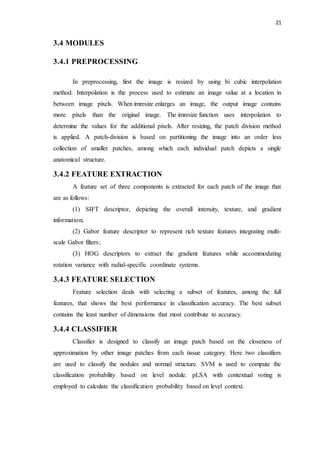
3.3 FLOW CHART
Fig: 1.2 Flow chart of proposed method
TEST IMAGE
PREPROCESSING
RESIZE PATCH
DIVISION
FEATURE EXTRACTION
FS3 DESCRIPTOR
(INTENSITY, TEXTURE,
GRADIENT)
FEATURE
SELECTION
SVM&LATENT
SEMANTIC
CLASSIFIER
CLASSIFIED RESULT
TRAINING
IMAGES
FEATURE
EXTRACTION
21
3.4 MODULES
3.4.1 PREPROCESSING
In preprocessing, first the image is resized by using bi cubic interpolation
method. Interpolation is the process used to estimate an image value at a location in
between image pixels. When imresize enlarges an image, the output image contains
more pixels than the original image. The imresize function uses interpolation to
determine the values for the additional pixels. After resizing, the patch division method
is applied. A patch-division is based on partitioning the image into an order less
collection of smaller patches, among which each individual patch depicts a single
anatomical structure.
3.4.2 FEATURE EXTRACTION
A feature set of three components is extracted for each patch of the image that
are as follows:
(1) SIFT descriptor, depicting the overall intensity, texture, and gradient
information;
(2) Gabor feature descriptor to represent rich texture features integrating multi-
scale Gabor filters;
(3) HOG descriptors to extract the gradient features while accommodating
rotation variance with radial-specific coordinate systems.
3.4.3 FEATURE SELECTION
Feature selection deals with selecting a subset of features, among the full
features, that shows the best performance in classification accuracy. The best subset
contains the least number of dimensions that most contribute to accuracy.
3.4.4 CLASSIFIER
Classifier is designed to classify an image patch based on the closeness of
approximation by other image patches from each tissue category. Here two classifiers
are used to classify the nodules and normal structure. SVM is used to compute the
classification probability based on level nodule. pLSA with contextual voting is
employed to calculate the classification probability based on level context.
22
3.4.5 PERFORMANCEANALYSIS
In performance analysis, the efficiency and accuracy of the existing system is
compared with the proposed system.
3.5 MODULE DESCRIPTION
In light of the above, this paper presents a novel image classification method for
the four common types of lung nodules. We suggest that the major contributions of our
work are as follows:
1. A patch-based image representation with multilevel concentric partition
2. A feature set design for image patch description,
3. A contextual latent semantic analysis-based classifier to calculate the
probabilistic estimations for each lung nodule image.
More specifically, a concentric level partition of the image is designed in an
adaptive manner with:
1. An improved super pixel clustering method based on quick shift is designed to
generate the patch division;
2. Multilevel partition of the derived patches is used to construct level-nodule (i.e.,
patches containing the nodules),
3. Level-context (i.e., patches containing the contextual structures).
A concentric level partition is thus constructed to tackle the rigid partitioning
problem. Second, a feature set of three components is extracted for each patch of the
image that is as follows:
1. A SIFT descriptor, depicting the overall intensity, texture, and gradient
information;
2. A MR8+LBP descriptor, representing a richer texture feature incorporating
MR8 filters before calculating LBP histograms;
3. A multi orientation HOG descriptor, describing the gradients and
accommodating rotation variance in a multi coordinate system.
Third, the category of the lung nodule image is finally determined with a
probabilistic estimation based on the combination of the nodule structure and
surrounding anatomical context:
1. SVM is used to compute the classification probability based on level-nodule;
2. pLSA with contextual voting is employed to calculate the classification
probability based on level-context.
23
The designed classifier can obtain better classification accuracy, with SVM
capturing the differences from various nodules, and pLSA further revising the decision
by analyzing the context.
3.5.1 CONCENTRIC LEVEL PARTITION
Our method is built upon a patch-based image representation. The current
approaches are usually based on patches with fixed shape and size, such as dividing the
image into the square patches or into circular sectors based on radial partitions with a
predefined number of pixels in these areas. However, such rigid partition methods
would unavoidably group unrelated pixels together, as illustrated. Ideally, pixels in the
same patch should share similar information, such as intensities. Therefore, we
designed an adaptive patch partitioning method formulating super pixels using an
improved quick shift clustering method.
Then, a concentric level partition model is constructed based on the distances
from patches to the centroid of the lung nodule. The shape and size of our patches are
derived adaptively according to the local intensity variation, instead of being predefined
by rigid partitioning.
3.5.1.1 Superpixel Formulation
Superpixel formulation is the process of dividing an image into multiple
segments, which can incorporate local spatial information and reduce spurious labeling
due to noise. This can perfectly fit our requirement of patch partitioning. In particular,
quick shift is a mode seeking algorithm that can be used to partition an image into a set
of superpixels forming a tree of links to the nearest neighbor which increases an
estimate of the density. However, due to the small size of lung nodules, a poor partition
is often obtained when directly applying the quick shift method. To tackle this problem,
we employ quick shift in an iterative way with image amplification and down sampling.
At the first stage, the image is amplified with nearest neighbor interpolation. A
problem with direct use of quick shift on the original nodule image is that the image is
so small that only a few pixels could present a particular anatomical structure, leading
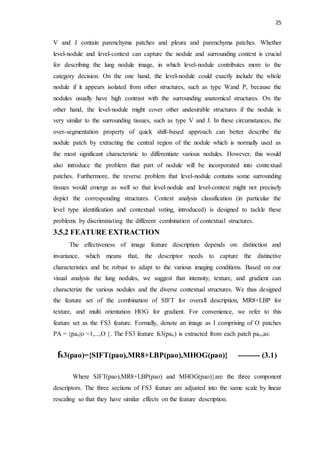
to the possibility of incorporating trans-regional pixels, as illustrated. The bottom-left
area in the sample image, corresponding to the white patch, should be further divided
because of the high contrast (white and grey). To obtain such an effect, our idea is to
amplify the original image based on the local intensity information. Quad-amplification
generated the best performance by amplifying the image twice with twofold
24
amplification each time through the experiments. Then, the quick shift method is
applied to the amplified image in an iterative way. Two parameters are introduced in
quick shift: kernelsize, the size of the kernel used to estimate the density, and maxdist,
the maximum distance between points in the feature space that may be linked if the
density is increased. Fixing them at particular values, i.e., the best performing
parameter settings that obtain the highest classification rate with the standard quick shift
generates too many patches, as shown. Dividing the image into too many patches would
not only separate the integrated anatomical structure but also reduce the efficiency of
the method, specifically during the feature extraction stage which extracts the feature
set individually for each patch. Therefore, an iterative scheme is designed to handle this
problem by increasing the initial values step by step to combine the clusters obtained in
the previous iteration. Both kernelsize and maxdist were initialized at 2, increased by
0.3, and 1, respectively in each of the three iterations in our experiments.
Finally, the down sampling stage is employed to restore the superpixel image to
the original size. The clusters are thus the desired image patches.
3.5.1.2 Concentric Level Partition Construction
In Concentric Level Partition we divide the patches in one image into multiple
con-centric levels, based on the distances between the patches and the centroid of the
nodule patch. The nodule patch is the patch that contains the nodule centroid, which is
given in the dataset. For one image I comprising of O patches PA = {pao: o =1,...,O },
we define L as the total number of concentric levels, with levels LV∈{lv (l ): l =0,
1,...,L } in which lv (l ) contains the patches whose distances are l to the nodule patch.
Here, the distance refers to the smallest number of patches passed from patch pao to the
nodule patch. For lv (0), it comprises only one patch which contains the centroid of the
lung nodule; for lv (l) (l> 0), it comprises the immediate outside neighboring patches of
lv (l − 1) . To facilitate contextual analysis, we divided the various levels into two
categories: level-nodule, which is lv (0) composed by the lung nodule patch, and level-
context, which is lv (l) (l> 0) composed by the context patches.
While level-nodule tends to represent the lung nodule for each image, level-
context tries to indicate different surrounding anatomical structures. Taking the sample
images as examples, lv (1) of type W, V, J, and P represents the (1) parenchyma (2)
vessel, (3) pleura and parenchyma, and (4) pleural tail and parenchyma patches,
respectively. For lv (2), while type W and J contain the same structures with lv (1), type
25
V and J contain parenchyma patches and pleura and parenchyma patches. Whether
level-nodule and level-context can capture the nodule and surrounding context is crucial
for describing the lung nodule image, in which level-nodule contributes more to the
category decision. On the one hand, the level-nodule could exactly include the whole
nodule if it appears isolated from other structures, such as type Wand P, because the
nodules usually have high contrast with the surrounding anatomical structures. On the
other hand, the level-nodule might cover other undesirable structures if the nodule is
very similar to the surrounding tissues, such as type V and J. In these circumstances, the
over-segmentation property of quick shift-based approach can better describe the
nodule patch by extracting the central region of the nodule which is normally used as
the most significant characteristic to differentiate various nodules. However, this would
also introduce the problem that part of nodule will be incorporated into contextual
patches. Furthermore, the reverse problem that level-nodule contains some surrounding
tissues would emerge as well so that level-nodule and level-context might not precisely
depict the corresponding structures. Context analysis classification (in particular the
level type identification and contextual voting, introduced) is designed to tackle these
problems by discriminating the different combination of contextual structures.
3.5.2 FEATURE EXTRACTION
The effectiveness of image feature description depends on: distinction and
invariance, which means that, the descriptor needs to capture the distinctive
characteristics and be robust to adapt to the various imaging conditions. Based on our
visual analysis the lung nodules, we suggest that intensity, texture, and gradient can
characterize the various nodules and the diverse contextual structures. We thus designed
the feature set of the combination of SIFT for overall description, MR8+LBP for
texture, and multi orientation HOG for gradient. For convenience, we refer to this
feature set as the FS3 feature. Formally, denote an image as I comprising of O patches
PA = {pao|o =1,...,O }. The FS3 feature fs3(pao) is extracted from each patch pao,as:
fs3(pao)={SIFT(pao),MR8+LBP(pao),MHOG(pao)} --------- (3.1)
Where SIFT(pao),MR8+LBP(pao) and MHOG(pao)}are the three component
descriptors. The three sections of FS3 feature are adjusted into the same scale by linear
rescaling so that they have similar effects on the feature description.
26
3.5.2.1 SIFT Descriptor for Overall Description
The SIFT process generates a 128-length vector for each key point. Since SIFT
is invariant to image translation, scaling, rotation and illumination changes, and robust
to local geometric distortion, it provides valuable lung nodule data. SIFT is robust and
is able to carry out semantic classification due to its ability to capture the texture and
gradient information. Besides, it identifies the key points by computing extremum
pixels in the image local area to incorporate the intensity information. Thus, SIFT
descriptor was adopted as the first component of FS3 to give an overall description
from intensity, texture, and gradient perspectives.
In our case, we extract only one 128-length vector near the centroid of each
patch. Specially, since the shapes of the extracted patches are not uniform, we selected
the smallest rectangle sub window to cover all pixels for each patch and then ran SIFT
on this window. The final SIFT descriptor SIFT (pao)of patch pao is calculated by
selecting one key point near the centroid of the rectangle window.
3.5.2.2 MR8+LBP Descriptor for Texture Description
The combination of MR8 filters and LBP feature is designed to provide richer
texture description of patches by incorporating multi scale and rotation-invariant
properties. LBP is a powerful feature for texture based image classification.
Although LBP can be easily configured to describe the local texture structure
with multi resolution and rotation-invariance, it captures too many trivial image
variations. Therefore, we in-corporate the MR filters set before computing LBP
histogram. The MR set contains both isotropic and anisotropic filters at multiple
orientations and multiple scales and records the angle of maximum response, which
makes it possible to discriminate textures that appear to be very similar.
Specifically, MR8 bank is used in our method, which consists of 38 filters but
produces only eight filter responses by recording only the maximum filter response
across all orientations for one scale. This yields rotation invariance. The final filter
response contains two anisotropic filters for each of three different scales and two
isotropic filters (2 × 3+2). MR8 filters are directly applied to the original image. For
image I, we get eight filter responses represented by IMR8(f )where f∈ [1 , 8] .Next, as
for patch pao in image I , LBP descriptor LBP pa’o is computed for the corresponding
patch pa’o in each filter response of IMR8. As explained by Song et al., the total number
27
of possible values is 36, and hence the histogram of each response patch contains 36
dimensions.
With eight filter responses, patch pao in image I thus gives8 × 36-dimension
histograms. All histograms are concatenated to obtain the final MR8+LBP descriptor
MR8+LBP ( pao) for Patch pao. This generates a 288-length vector.
3.5.2.3 Multi orientation HOG Descriptor for Gradient
Gradient distribution provides helpful supplementary in-formation to texture for
discriminating various anatomical structures in nodule images. Among various
gradient-based methods, HOG is being widely used and can also improve performance
considerably when coupled with LBP. However, unlike SIFT and MR8+LBP
descriptors, the raw HOG descriptor cannot handle rotation-invariant problems.
Therefore, we designed a multi orientation HOG descriptor inspired by our previous
work to provide further an advanced gradient description in addition to that from SIFT.
The designed descriptor is adaptive to the locations of patches relative to the centroid of
the nodule, rather than having the same initial orientation for all patches.
Assuming that the center of patch pao is cpao, we built eight coordinate systems
that share the same origin cpao but have different initial orientations (0 degree). Two of
them are shown with (x0, y0) and (x1, y1). Contra rotating the first coordinate system
(i.e., (x0, y0)) by 45 degree generates the next one (i.e., (x1, y1)). Instead of predefining
the initial orientation of the first coordinate system, we set it as the direction (blue dash
line) from the centroid of the patch (green area) to the centroid of lung nodule (yellow
area).Next, for each coordinate system, patch pao is divided into nine cells, within which
gradient orientations of the pixels in nine undirected histograms are counted to encode
the gradient distribution. Instead of adopting the histogram statistics directly, we apply
the UOCTTI variant from Felsenszwalb et al. which computes the L1norm of each of
the L2normalizedundirected histograms to get a four-dimensional (4-D) texture-energy
feature for each coordinate system. As a result, for patch pao, we obtain a 288-length
(eight systems× nine cells × 4-D features) multi orientation HOG descriptor MHOG
(pao).
3.5.3 CONTEXT ANALYSIS CLASSIFICATION
With the concentric level partition and feature set, the next stage is to label each
image with one of the four nodule categories. Considering that the morphology of lung
28
nodules forms a continuum, which means the structures of lung nodules among
different categories are similar, even with the comprehensive feature design, it remains
difficult to classify the images precisely. So to aid classification, we incorporated the
contextual information.
The proposed method involves SVM analysis for lung nodule patches, and
pLSA analysis for context patches. In a supervised manner, besides the explicit label
information (with SVM), we also extracted the implicit latent semantic information
hidden in the relationship between the images and their categories (with pLSA). In this
way, the training data are used twofold, which acquires much more information. The
first step is lung nodule probability estimation using SVM. This step works on level-
nodule that focuses on lung nodule description. The proposed feature sets are extracted
for all patches in level-0, and the SVM classification procedure is performed with a
probability estimate. For each lung nodule image I , we thus compute its probability of
each of the four types TP = {tpt|t∈{w, v, j, p}} based on level-nodule, called the level-
nodule probability, as:
Plevel-nodule(tpt|I)=PSVM(tpt|I) --------- (3.2)
Where Psvm(tpt|I ) is the probability estimate from SVM. Specifically, a four-
type SVM was trained with polynomial kernel by C-SVC (with the default parameters,
i.e., gamma =1/number of features, coef 0=0, and degree =3) from in our experiments.
The second step is the context probability estimates using the proposed topic-based
classification method. Topic model was originally used for natural language processing
by extracting the semantic topics between the documents and words. The underlying
idea is that each document can be considered as mixture of topics, where the topic is a
probability distribution of words. pLSA is one of the techniques to extract the latent
semantic topics hidden between documents and words, which means that it infers the
visual topics.
As mentioned, each level lv in level-context tends to represent certain
anatomical structures, which can be used to determine the type of lung nodule. pLSA is
thus used to identify the potential type of level lv , called level type LT P={ltpt: t = {w,
v, j, p}} , i.e., to which type level lv belongs, by calculating the probability of level lv
given certain level type ltpt, called level type probability P (ltpt|lv ). Specifically, in
level type identification process, treating the levels as documents and the patches as
29
words, the representation of level in terms of latent semantic topics can be derived by
pLSA, and the probabilities of the types upon these topics can be obtained in the
training stage. Therefore, level type probability is calculated based on these two
components.
The combination of all obtained level type probabilities of context levels lv (l)
(l> 0) can be used to describe the level-context. However, the level types might overlap
because similar anatomical structures can be shared among the nodule types. Therefore,
rather than a simple concatenation, the contextual voting is designed to obtain the
combined level context. The probability Plevel−context of the lung nodule image given the
four types is then derived based on the voting result. The final step is to calculate
probability of image I given the type tpt through level-nodule and level-context
probabilities with a weighted parameter λ ∈ (0, 1), as:
P(tpt|I) =λ*plevel-nodule(tpt|I)+(1- λ)*plevel- context(tpt|I) --------- (3.3)
The nodule image I is classified into the type tpt that has the highest probability.
3.5.3.1 Level Type Identification with pLSA
As for the level type identification stage, the first step is dictionary construction.
Here, we apply the conventional k-means clustering strategy to all patches in the same
level across the whole dataset to construct the dictionary. Next, latent semantic topics
for certain level are extracted by pLSA.
Assuming there are M images and the dictionary size is N, for each level- l, we
could obtain the dataset of M levels LV = {lv m: m =1,…,M} represented by subsets of
N patches PA = {pan: n =1,…,N}. The dataset can be summarized by a co-occurrence
matrix X of size M × N, where X (lv m, pan) denotes the weighted occurrences of patch
pan appeared in level lvm.
With the co-occurrence matrix X, the occurrence of patches in a set of levels can
be interpreted by a reduced size of hidden variables, i.e., latent semantic topics, Z = {zk:
k =1,…, K}through pLSA. Formally, the occurrence of patch pan in level v m can be
represented as:
P(pan,lvm)≈∑P(pan|zk)*P(zk|lvm)*P(lvm) --------- (3.4)
30
We use the expectation–maximization (EM) algorithm to maximize the
likelihood Lh so that we can learn the parameters Z,
Lh=∏ ∏ 𝑷(𝑵𝑨𝒏, 𝑳𝑽𝒎) 𝒙(𝑷𝒏,𝑳𝑽𝒎)
𝒏𝒎 --------- (3.5)
P(ltpt|zk)≈∑P(ltpt|lvm)*P(lvm|zk) --------- (3.6)
The aforementioned (ltpt|zk) can be regarded as a weighting factor of latent topic
zk for determining the level type ltpt. On the whole, the proportion of the factor should
be increased if the number of times zk appears in one type, but is offset by the frequency
of zk in the whole dataset. For instance, the parenchyma patches appear commonly on
all level-contexts, which are usually inconsequential for topic prediction, especially for
type J and P. Hence, we need to find a way to control the case that some latent topics
are generally more common than others.
To manage this problem, we make an adjustment of P (ltpt|zk) based on the term
frequency-inverse document frequency (TF-IDF) algorithm. For latent topic zk, we
firstly compute its TF value in determining level type ltpt with the following equation,
𝑻𝑭( 𝒍𝒕𝒑𝒕, 𝒛𝒌) = 𝑷
( 𝒍𝒕𝒑𝒕| 𝒛𝒌)
∑ 𝒕𝑷(𝒍𝒕𝒑𝒕|𝒛𝒌)
--------- (3.7)
Next, the IDF value is calculated to measure whether the latent topic is common
or rare across the whole dataset,
IDF(zk)=𝐥𝐨𝐠⁡(
∑ 𝒌𝑷( 𝒍𝒕𝒑𝒕| 𝒛𝒌)
𝟏+𝑷( 𝒍𝒕𝒑𝒕| 𝒛𝒌)
) ---------(3.8)
At last, the conditional probability of type ltpt given the latent topic zk is
obtained by calculating the TF-IDF value,
P(ltpt|zk)=TF-IDF(ltpt,zk) --------- (3.9)
=TF(ltpt,zk)*IDF(zk) --------- (3.10)
P(ltpt|lv’)≈∑ 𝒌 𝑷(𝒍𝒕𝒑𝒕| 𝒛𝒌) ∗ 𝑷(𝒛𝒌|𝒍𝒗′
) ---------(3.11)
31
CHAPTER 4
EXPERIMENTAL RESULTS
For detecting lung nodules number of tests should be required from the patient.
But automated diagnosis system for prediction of lung cancer by using image
processing and data mining techniques, plays an important role in time and performance
which decreases mortality rate because of early detection of lung cancer. The Multi
Level patch based context analysis method gives an efficient classification result for
four types of lung nodules that is well-circumscribed, vascularized, juxta-pleural, and
pleural-tail.
4.1 INPUT IMAGE
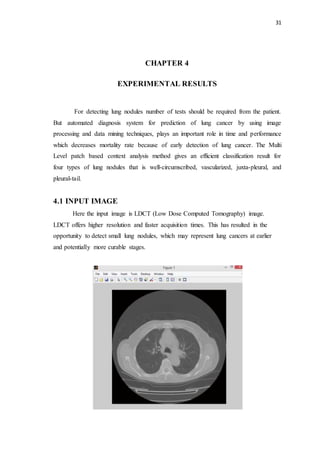
Here the input image is LDCT (Low Dose Computed Tomography) image.
LDCT offers higher resolution and faster acquisition times. This has resulted in the
opportunity to detect small lung nodules, which may represent lung cancers at earlier
and potentially more curable stages.
32
Fig: 4.1 Input LDCT Image
4.2 CROP IMAGE
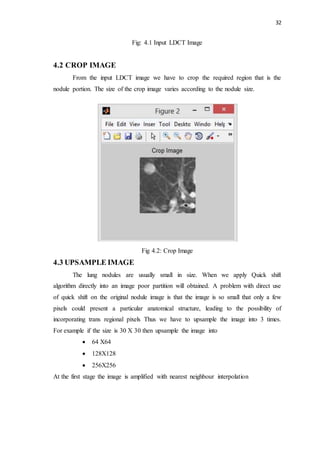
From the input LDCT image we have to crop the required region that is the
nodule portion. The size of the crop image varies according to the nodule size.
Fig 4.2: Crop Image
4.3 UPSAMPLE IMAGE
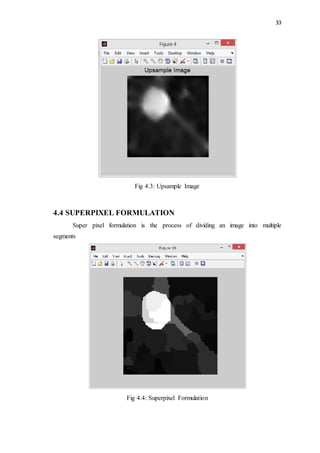
The lung nodules are usually small in size. When we apply Quick shift
algorithm directly into an image poor partition will obtained. A problem with direct use
of quick shift on the original nodule image is that the image is so small that only a few
pixels could present a particular anatomical structure, leading to the possibility of
incorporating trans regional pixels Thus we have to upsample the image into 3 times.
For example if the size is 30 X 30 then upsample the image into
 64 X64
 128X128
 256X256
At the first stage the image is amplified with nearest neighbour interpolation
33
Fig 4.3: Upsample Image
4.4 SUPERPIXEL FORMULATION
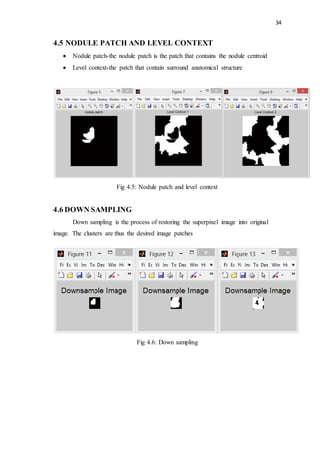
Super pixel formulation is the process of dividing an image into multiple
segments
Fig 4.4: Superpixel Formulation
34
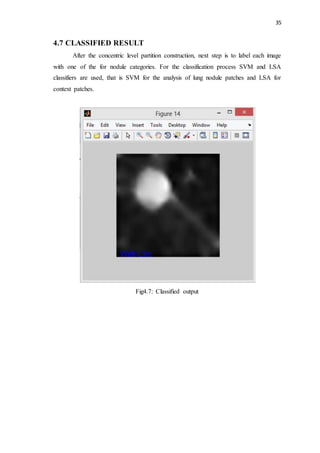
4.5 NODULE PATCH AND LEVEL CONTEXT
 Nodule patch-the nodule patch is the patch that contains the nodule centroid
 Level context-the patch that contain surround anatomical structure
Fig 4.5: Nodule patch and level context
4.6 DOWN SAMPLING
Down sampling is the process of restoring the superpixel image into original
image. The clusters are thus the desired image patches
Fig 4.6: Down sampling
35
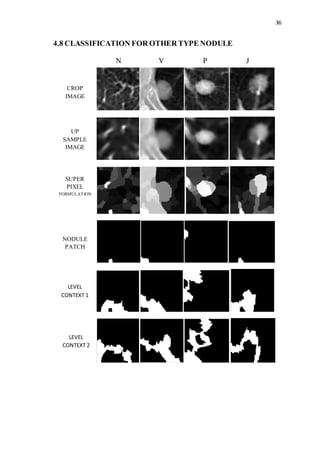
4.7 CLASSIFIED RESULT
After the concentric level partition construction, next step is to label each image
with one of the for nodule categories. For the classification process SVM and LSA
classifiers are used, that is SVM for the analysis of lung nodule patches and LSA for
context patches.
Fig4.7: Classified output
36
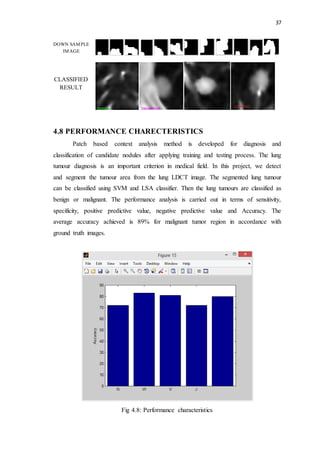
4.8 CLASSIFICATION FOR OTHER TYPE NODULE
V JPN
CROP
IMAGE
UP
SAMPLE
IMAGE
SUPER
PIXEL
FORMULATION
NODULE
PATCH
LEVEL
CONTEXT 1
LEVEL
CONTEXT 2
37
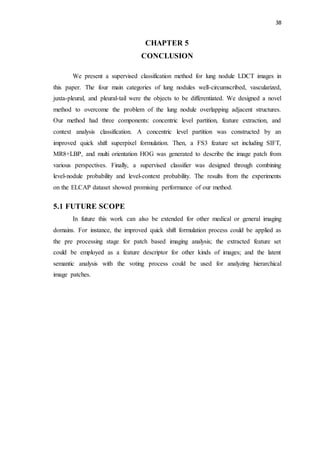
4.8 PERFORMANCE CHARECTERISTICS
Patch based context analysis method is developed for diagnosis and
classification of candidate nodules after applying training and testing process. The lung
tumour diagnosis is an important criterion in medical field. In this project, we detect
and segment the tumour area from the lung LDCT image. The segmented lung tumour
can be classified using SVM and LSA classifier. Then the lung tumours are classified as
benign or malignant. The performance analysis is carried out in terms of sensitivity,
specificity, positive predictive value, negative predictive value and Accuracy. The
average accuracy achieved is 89% for malignant tumor region in accordance with
ground truth images.
Fig 4.8: Performance characteristics
DOWN SAMPLE
IMAGE
CLASSIFIED
RESULT
38
CHAPTER 5
CONCLUSION
We present a supervised classification method for lung nodule LDCT images in
this paper. The four main categories of lung nodules well-circumscribed, vascularized,
juxta-pleural, and pleural-tail were the objects to be differentiated. We designed a novel
method to overcome the problem of the lung nodule overlapping adjacent structures.
Our method had three components: concentric level partition, feature extraction, and
context analysis classification. A concentric level partition was constructed by an
improved quick shift superpixel formulation. Then, a FS3 feature set including SIFT,
MR8+LBP, and multi orientation HOG was generated to describe the image patch from
various perspectives. Finally, a supervised classifier was designed through combining
level-nodule probability and level-context probability. The results from the experiments
on the ELCAP dataset showed promising performance of our method.
5.1 FUTURE SCOPE
In future this work can also be extended for other medical or general imaging
domains. For instance, the improved quick shift formulation process could be applied as
the pre processing stage for patch based imaging analysis; the extracted feature set
could be employed as a feature descriptor for other kinds of images; and the latent
semantic analysis with the voting process could be used for analyzing hierarchical
image patches.
39
APPENDICES
1. SYSTEM REQUIREMENTS
 Hardware Requirements
The most common set of requirements defined by any operating system or software
application is the physical component resources, also known as hardware. A hardware
requirements list is often accompanied by a Hardware compatible and sometimes
incompatible hardware for a particular operating system or application.
 The minimal hardware requirements are as follows,
 System : Dual core processor
 Hard Disk : 160 GB
 RAM : 2 GB
 Software Requirements
Software is a program that provides interacts between hardware system and user.
Specifications are as follows
 Operating System : Windows Xp,
 Language : Mat lab
2. SOFTWARE DESCRIPTION
2.1 MATLAB
It is a high-performance language for technical computing. It integrates
computation, visualization, and programming in an easy-to-use environment where
problems and solution are expressed in familiar mathematical notation. Typical uses
include Math and computation Algorithm development Data acquisition Modelling,
simulation, and prototyping data analysis, exploration, and visualization scientific and
engineering graphics application development, including graphical user interface
building MATLAB is an interactive system whose basic data element is an array that
does not require dimensioning. This allows us to solve many technical computing
problems, in a fraction of the time it would take to write a program in a scalar non
interactive language such as C or FORTRAN.
40
The name MATLAB stands for matrix laboratory. MATLAB was originally
written to provide easy access to matrix software developed by the LINPACK and
EISPACK projects. Today, MATLAB engines incorporate the LAPACK and BLAS
libraries, embedding the state of the art in software for matrix computation. MATLAB
has evolved over a period of years with input from many users.
In university environments, it is the standard instructional tool for introductory
and advanced courses in mathematics, engineering, and science. In industry, MATLAB
is the tool of choice for high-productivity research, development, and analysis.
Key Features
 High-level language for technical computing
 Development environment for managing code, files, and data
 Interactive tools for iterative exploration, design, and problem solving
 Mathematical functions for linear algebra, statistics, Fourier analysis, filtering,
optimization, and numerical integration
 2-D and 3-D graphics functions for visualizing data
 Tools for building custom graphical user interfaces
 Functions for integrating MATLAB based algorithms with external applications
and languages, such as C, C++, Fortran, Java, COM, and Microsoft Excel
The MATLAB Language
The MATLAB language supports the vector and matrix operations that are
fundamental to engineering and scientific problems. It enables fast development and
execution. With the MATLAB language, you can program and develop algorithms
faster than with traditional languages because we do not need to perform low-level
administrative tasks, such as declaring variables, specifying data types, and allocating
memory. In many cases, MATLAB eliminates the need for ‘for’ loops. As a result, one
line of MATLAB code can often replace several lines of C or C++ code.
At the same time, MATLAB provides all the features of a traditional
programming language, including arithmetic operators, flow control, data structures,
data types, object-oriented programming (OOP), and debugging features.
41
Development environment
MATLAB includes development tools that help you implement your algorithm
efficiently. These include the following:
 MATLAB Editor - Provides standard editing and debugging features, such as
setting breakpoints and single stepping
 Code Analyzer - Checks your code for problems and recommends modifications
to maximize performance and maintainability
 MATLAB Profiler - Records the time spent executing each line of code
 Directory Reports - Scan all the files in a directory and report on code
efficiency, file differences, file dependencies, and code coverage
Mathematicalfunction library
This is a vast collection of computational algorithms ranging from elementary
functions like sum, sine, cosine, and complex arithmetic, to more sophisticated
functions like matrix inverse, matrix Eigen values, Bessel functions, and fast Fourier
transforms.
42
REFERENCES
[1] Fan Zhan, Yang Song, Weidong Cai, Min-Zhao Lee, Yun Zhou, Heng Huang,
Shimin Shan, Michael J Fulham, and Dagan Feng “Lung nodule classification with
multi-level patch based context analysis” IEEE Transactions on Biomedical
Engineering, vol.61,no.4, April 2014.
[2] J. J. Erasmus, J. E. Connolly, H. P. McAdams, and V. L. Roggli, “Solitary
pulmonary nodules: Part I. morphologic evaluation for differentiation of benign and
malignant lesions,” Radiographic, vol. 20, no. 1, 2000.
[3] D. Wu, L. Lu, J. Bi, Y. Shinagawa, K. Boyer, A. Krishnan, and M. Salganicoff,
“Stratified learning of local anatomical context for lung nodules in CT images,” in Proc.
CVPR, 2010,
[4] R. A. Ochs, J. G. Goldin, F. Abtin, H. J. Kim, K. Brown, P. Batra, D. Roback, M. F.
McNitt-Gray, and M. S. Brown, “Automated classification of lung bronchovascular
anatomy in CT using adaboost,” Medical Image Analysis, vol. 11, no. 3, 2007.
[5] A. Farag, S. Elhabian, J. Graham, A. Farag, and R. Falk, “Toward precise
pulmonary nodule descriptors for nodule type classification,” in MICCAI LNCS, vol.
13, no. 3, 2010.
[6] A. A. Farag, “A variational approach for small-size lung nodule segmentation,” in
Proc. ISBI, 2013.
[7] D. Xu, H. J. van der Zaag-Loonen, M. Oudkerk, Y. Wang, R. Vliegenthart, E. T.
Scholten, J. Verschakelen, M. Prokop, H. J. de Koning, and R. J. van Klaveren,
“Smooth or attached solid indeterminate nodules detected at baseline CT screening in
the NELSON study: Cancer risk during 1 year of follow-up,” Radiology, vol. 250, no.
1,2009.
43
[8] S. Diciotti, G. Picozzi, M. Falchini, M. Mascalchi, N. Villari, and G. Valli, “3-D
segmentation algorithm of small lung nodules in spiral CT images,” IEEE Trans.
Information Technology in Biomedicine, vol. 12, no. 1, 2008.
[9] B. Zhao, “Automatic detection of small lung nodules on CT utilizing a local density
maximum algorithm,” Journal of Applied Clinical Medical Physics, vol. 4, no. 3, 2003.
[10] Kakar Manish,Dag Rune Olsen,”Automatic segmentation and recognition of lungs
and lesion from CT scans of thorax”original research Article computerized Medical
Imaging and Graphics,Volume 33, Issue 1 ,January 2009.
[11] Jun-Wei LIU, Huan-Qing FENG, Ying-Yue ZHOU, Chuan-Fu LI,”A Novel
automatic extraction method of lung texture tree from HRCT images” Original
Research Article Acta Automatic Sinica, Volume 32, Issue 4, April 2009
[12]M.F.McNittGray, N.Wyckoff, J.W.Sayre, J.G.Goldin, D.R.Aberle, “The effects of
co-occurrence matrix based texture parameters on the classification of solitary
pulmonary nodules imaged on computed tomography“ original research article
computerized medical imaging and graphics, volume 23, issue 6, December 1999
[13]A. Farag, A. Ali, J. Graham, S. Elshazly, and R. Falk, “Evaluation of geometric
feature descriptors for detection and classification of lung nodules in low dose CT scans
of the chest,” in Proc. ISBI, 2011.
[14] F. Zhang, W. Cai, Y. Song, M.-Z. Lee, S. Shan, and D. Feng, “Overlapping node
discovery for improving classification of lung nodules,” in Proc. EMBC, 2013.
[15] Y. Song, W. Cai, Y. Wang, and D. Feng, “Location classification of lung nodules
with optimized graph construction,” in Proc. ISBI, 2012.
[16] S. O’Hara and B. A. Draper, “Introduction to the bag of features paradigm for
image classification and retrieval,” Computer Vision and Pattern Recognition, 2011.
[17] D. Unay and A. Ekin, “Dementia diagnosis using similar and dissimilarretrieval
items,” in Proc. ISBI, 2011.
44
[18] Y. Song, W. Cai, Y. Zhou, L. Wen, and D. Feng, “Pathology-centric medical
image retrieval with hierarchical contextual spatial descriptor,” in Proc. ISBI, 2013.
[19] D. Unay and A. Ekin, “Dementia diagnosis using similar and dissimilar retrieval
items,” in Proc. Int. Symp. Biomed. Imag., 2011.
[20] Y. Song,W. Cai,Y. Zhou, L.Wen, andD. Feng, “Pathology-centric medical image
retrieval with hierarchical contextual spatial descriptor,” in Proc. Int. Symp. Biomed.
Imag., 2013.

A supervised lung nodule classification method using patch based context analysis in LDCT image

  • 1.
    1 CHAPTER 1 INTRODUCTION 1.1 GENERAL Lungcancer was uncommon at the beginning of the 20th century, is now a worldwide dilemma, which is more recurrent cancer in the world. Lung cancer is a major cause of cancer-related deaths in humans worldwide. Approximately 20% of cases with lung nodules represent lung cancers; therefore, the identification of potentially malignant lung nodules is essential for the screening and diagnosis of lung cancer. Lung nodules are small masses in the human lung, and are usually spherical; however, they can be distorted by surrounding anatomical structures, such as vessels and the adjacent pleura. Intra-parenchyma lung nodules are more likely to be malignant than those connected with the surrounding structures, and thus lung nodules are divided into different types according to their relative positions. At present, the classification from Diciottiet al. is the most popular approach and it divides nodules into four types: well-circumscribed (W) with the nodule located centrally in the lung without any connection to vasculature; vascularized (V) with the nodule located centrally in the lung but closely connected to neighbouring vessels; juxta-pleural (J) with a large portion of the nodule connected to the pleural surface; and pleural-tail (P) with the nodule near the pleural surface connected by a thin tail. Sample images are shown in Fig. 1, with the nodule encircled in red. Computed tomography (CT) is the most accurate imaging modality to obtain anatomical information about lung nodules and the surrounding structures. In current clinical practice, however, interpretation of CT images is challenging for radiologists due to the large number of cases. This manual reading can be error-prone and the reader may miss nodules and thus a potential cancer. Computer-aided diagnosis (CAD) systems would be helpful for radiologists by offering initial screening or second opinions to classify lung nodules. CAD’s provide depictions by automatically computing quantitative measures, and are capable of analyzing the large number of small nodules identified by CT scans.
  • 2.
    2 Fig. 1.1 TransaxialCT images with the four types of nodules, shown from left to right, juxta-pleural, pleural-tail, vascularized and well-circumscribed In recent years, the image processing mechanisms are used in several medical professions for improving detection of lung cancer. Medical professionals look time as one of the important parameter to discover the cancer in the patient at the earlier stage; which is very important for successful treatment. 1.2 BASICS OF IMAGE PROCESSING Image Processing is the science of manipulating an image. With the advent of digital cameras and their easy interoperability with computers, the process of digital image processing has acquired an entire new dimension and meaning. Image processing works with the digital images to enhance, distort, accentuate or highlight inherent details in the image. The goal of each operation is to achieve some details or, we can generalize by saying, extracting information from the system. The area of image analysis (also called image understanding) is in between image processing and computer vision. There are no clear-cut boundaries in the continuum from image processing at one end to computer vision at the other. However, one useful paradigm is to consider three types of computerized processes in this continuum: low-, mid-, and high-level processes. Low-level processes involve primitive operations such as image preprocessing to reduce noise, contrast enhancement, and image sharpening. A low-level process is characterized by the fact that both its inputs and outputs are images. Mid-level processing on images involves tasks such as segmentation (partitioning an image into regions or objects), descriptions of those objects to reduce them to a form suitable for computer processing, and classifications (recognition) of individual objects. A mid-level process is characterized by the fact that its inputs generally are images, but its outputs are attributes extracted from those images (e.g., edges, contours, and the identity of individual objects).
  • 3.
    3 High-level processing involves“making sense” of an ensemble of recognized objects, as in image analysis, and, at the far end of the continuum, performing the cognitive functions normally associated with vision. Based on the preceding comments, it shows that a logical place of overlap between image processing and image analysis is the area of image recognition of individual regions or objects in an image. Thus, we call digital image processing encompasses processes whose inputs and outputs are images and, in addition, encompasses processes that extracts attributes from images, up to and including recognition of individual objects. 1.2.1 TYPES OF IMAGE PROCESSING  Analog Image Processing Our eyes see the objects. They pass the information to the brain. Brain can understand the image. Such a human image processing mechanism is called analog image processing.  Digital Image Processing With the help of scanning devices, our computer systems acquire the image, store the image in memory in digital form, process the image in various ways .This mechanism is called digital image processing.  Digital Image Representation The form monochrome image refers to a two dimensional light function f(x, y), here x and y denote spatial coordinates and the value of any point (x, y) is proportional to the brightness of the image of that point. A digital image can be considered a matrix of row and column indices identify a point in the image and the corresponding matrix elements value identifies the gray level at that point. The elements of such a digital array are called pixels or picture elements. When x, y and the amplitude values of f are all finite, discrete quantities, The image is a digital image. The field of digital image processing refers processing of digital images by means of a digital computer. A digital image is composed of a finite number of elements, each of which has a particular location and value. These elements are referred to as picture elements, image elements and pixels. Pixel is the term most widely used to denote the elements of the digital image.
  • 4.
    4 Vision is themost advanced of our senses, so it is not surprising that images play the single most important role in human perception. However unlike humans who are limited to the visual band of the electromagnetic (EM) spectrum, imaging machines cover almost the entire EM spectrum, ranging from gamma to radio waves. They can operate on images generated by sources that humans are not accustomed to associating with images. These include ultra sound, electron microscopy, and computer generated images. Thus digital image processing encompasses a wide and varied field of application. 1.3 FUNDAMENTAL STEPS IN DIGITAL IMAGE PROCESSING Digital image processing encompasses a broad range of hardware, software, and theoretical underpinnings. The following are the fundamental steps in image processing shows in the block diagram for fundamental steps in Digital Image Processing.  Image acquisition The image acquisition is to acquire a digital image. To do so require an image sensor and the capability to digitize the signal produced by the sensor. The sensor could be a monochrome camera that produces an entire image of the problem domain every 1/30 sec and the imaging sensor could be a line-scan camera that produces a single image line at that time. In this case, the object’s motion past the line scanner produces a two dimensional image. If the output of the camera or the other imaging sensor is not already in the digital form, an analog to digital converter digitizes it.  Preprocessing The key function of pre-processing is to improve the image in ways that increase the chances for success of the other processes.  Segmentation Segmentation procedures partition an image into its constituent parts or objects. In general, autonomous segmentation is one of the most difficult tasks in digital image processing. A rugged segmentation procedure brings the process a long way toward successful solution of imaging problems that require object to be identified individually.
  • 5.
    5  Representation andDescription Representation and description almost always follow the output of the segmentation stage, which usually is raw pixel data, constituting either the boundary of a region or all the points in the region itself. The first decision that must be made is whether the data should be represented as a boundary or as a complete region. Boundary representation is appropriate when the focus is on external shape characteristic, such as corners and inflections. Regional representation is appropriate when the focus on internal properties, such as texture or skeletal shape.  Recognition Recognition is the process that assigns a label to an object based on its descriptors. We conclude coverage of digital image processing with the development of methods for recognition of individual objects.  Knowledge Base Knowledge about the problem domain is coded into an image processing system in the form of a Knowledge database. This knowledge may be as simple as detailing regions of an image where the information of interest is known to be located, thus limiting the search that has to be conducted in seeking that information. The Knowledge base also can be quiet complex, such as an interrelated list of all major possible defects in materials inspection problem 1.4 ELEMENTS OF DIGITAL IMAGE PROCESSING SYSTEMS The elements of a general purpose system capable of performing the image processing operations generally perform image acquisition, storage, processing, communication and display.  Image acquisition Two elements are required to acquire digital images. The first is a physical device that is sensitive to a band in the electromagnetic energy spectrum (such as the X- ray, ultraviolet, visible, or infrared bands) and that produces an electrical signal output proportional to the level of energy sensed. The second, called a digitizer, is a device for converting the electrical output of the physical sensing device into digital form.
  • 6.
    6  Storage An 8-bitimage of size 1024*1024 pixels requires one million bytes of storage. Digital storage for image processing applications falls into 3 principle categories. They are (1) short term storage used during processing (2) on line storage relatively used for fast recall (3) archival storage. Storage is measured in bytes, Kbytes, Mbytes, Gbytes and TBytes.  Processing Processing of digital images involves procedures that are usually expressed in algorithmic form. Thus, with the exception of image acquisition and display, most images processing function can be implemented in software. The only reason for specialized image processing hardware is the need for speed in some application or to overcome some fundamental computer limitations. For example, an important application of digital imaging is low-light microscopy.  Communication Communication in digital image processing primarily involves local communication between image processing systems and remote communication from one point to another typically in connection with the transmission of image data. Hardware and software for local communication are readily available for most computers.  Display Monochrome and colour TV monitors are the principle display devices used in modern image processing systems. Monitors are driven by the output of a hardware image display module the backplane of the host computer or as a part of the hardware associated with an image processor. The signals and the output of the display module can be fed into an image recording device that produces the hard copy of the image being viewed on the monitor screen. Other display media include random-access Cathode Ray Tubes (CRTs), and printing devices. 1.5 BIO MEDICAL ENGINEERING Three applications of nanotechnology are particularly suited to biomedicine: diagnostic techniques, drugs, and prostheses and implants. Interest is booming in biomedical applications for use outside the body, such as diagnostic sensors and “labon-
  • 7.
    7 a-chip” techniques, whichare suitable for analyzing blood and other samples, and for inclusion in analytical instruments for R&D on new drugs. For inside the body, many companies are developing nanotechnology applications for anticancer drugs. Principles of voluntariness, informed consent and community agreement whereby research participants are fully apprised of the research and the impact and risk of such research on the research participant and others; and where by the research participants retain the right to abstain from further participation in the research irrespective of any legal or other obligation that may have been entered into by such human participants or someone on their behalf, subject to only minimal recitative obligations of any advance consideration received and outstanding. Where any such research entails treating any community or group of persons as a research participant, these principles of voluntariness and informed consent shall apply, mutatis mutandis, to the community as a whole and to each individual member who is the participant of the research or experiment. Where the human participant is incapable of giving consent and it is considered essential that research or experimentation be conducted on such a person incompetent to give consent, the principle of voluntariness and informed consent shall continue to apply and such consent and voluntariness shall be obtained and exercised on behalf of such research participants by someone who is empowered and under a duty to act on their behalf. The principles of informed consent and voluntariness are cardinal principles to be observed throughout the research and experiment, including its aftermath and applied use so that research participants are continually kept informed of any and all developments in so far as they affect them and others. However, without in any way undermining the cardinal importance of obtaining informed consent from any human participant involved in any research, the nature and form of the consent and the evidentiary requirements to prove that such consent was taken, shall depend upon the degree and seriousness of the invasiveness into the concerned human participant’s person and privacy, health and life generally, and, the overall purpose and the importance of the research. Ethics committees hall decide on the form of consent to be taken or its waiver based on the degree of risk that may be involved. Semiautomatic methods require user interaction to set algorithm parameters, to perform initial segmentation, or to select critical features. They can be classified according to the space in which features are grouped together. A commonly used method is global thresholding where pixel intensities from the image are mapped into a
  • 8.
    8 feature space calleda histogram. Thresholds are chosen at valleys between pixel clusters so that each pair represents a region of similar pixels in the image. This works well if the target object has distinct and homogeneous pixel values, which is usually the case with bony structures in CT datasets. On the other hand, spatial information is lost in the transformation, which may produce disjoint regions. Spatial-domain methods use spatial proximity in the image to group pixels. Edge-detection methods use local gradient information to define edge elements, which are then combined into contours to form region boundaries. For example, a 3-D version of the Marr–Hildreth operator was used to segment the brain from MRI data. However, edge operators are generally sensitive to noise and produce spurious edge elements that make it difficult to construct a reasonable region boundary. Region growing methods on the other hand, construct regions by grouping spatially proximate pixels so that some homogeneity criterion is satisfied over the region. In particular, seeded-region-growing algorithms grow a region from a seed, which can be a single pixel or cluster of pixels. Seeds may be chosen by the user, which can be difficult because the user must predict the growth behaviour of the region based on the homogeneity metric. Since the number, locations, and sizes of seeds may be arbitrary, segmentation results are difficult to reproduce. Alternatively, seeds may be defined automatically, for example, the min/max pixel intensities in an image may be chosen as seeds if the region mean is used as homogeneity metric. A region is constructed by iteratively incorporating pixels on the region boundary. In addition, active-contour-based methods and neural-network- based classification methods have also been proposed to perform image segmentation. 1.5.1 MEDICAL IMAGING Medical imaging is the technique and process used to create images of the human body (or parts and function thereof) for clinical purposes (medical procedures seeking to reveal, diagnose or examine disease) or medical science (including the study of normal anatomy and physiology). Although imaging of removed organs and tissues can be performed for medical reasons, such procedures are not usually referred to as medical imaging, but rather are a part of pathology. As a discipline and in its widest sense, it is part of biological imaging and incorporates radiology (in the wider sense), nuclear medicine, investigative radiological sciences, endoscopy, (medical) thermograph, medical photography and microscopy (e.g. for human pathological investigations).
  • 9.
    9 Measurement and recordingtechniques which are not primarily designed to produce images, such as electroencephalography (EEG), magneto encephalography (MEG), Electrocardiography (EKG) and others, but which produce data susceptible to be represented as maps (i.e. containing positional information), can be seen as forms of medical imaging In the clinical context, "invisible light" medical imaging is generally equated to radiology or "clinical imaging" and the medical practitioner responsible for interpreting (and sometimes acquiring) the images are a radiologist. "Visible light" medical imaging involves digital video or still pictures that can be seen without special equipment. Dermatology and wound care are two modalities that utilize visible light imagery. Diagnostic radiography designates the technical aspects of medical imaging and in particular the acquisition of medical images. The radiographer or radiologic technologist is usually responsible for acquiring medical images of diagnostic quality, although some radiological interventions are performed by radiologists. While radiology is an evaluation of anatomy, nuclear medicine provides functional assessment. As a field of scientific investigation, medical imaging constitutes a sub- discipline of biomedical engineering, medical physics or medicine depending on the context: Research and development in the area of instrumentation, image acquisition (e.g. radiography), modelling and quantification are usually the preserve of biomedical engineering, medical physics and computer science; Research into the application and interpretation of medical images is usually the preserve of radiology and the medical sub-discipline relevant to medical condition or area of medical science (neuroscience, cardiology, psychiatry, psychology, etc.) under investigation. Many of the techniques developed for medical imaging also have scientific and industrial applications. Medical imaging is often perceived to designate the set of techniques that noninvasively produce images of the internal aspect of the body. In this restricted sense, medical imaging can be seen as the solution of mathematical inverse problems. This means that cause (the properties of living tissue) is inferred from effect (the observed signal). In the case of ultra tomography the probe consists of ultrasonic pressure waves and echoes inside the tissue show the internal structure. In the case of projection radiography, the probe is X-ray radiation which is absorbed at different rates in different tissue types such as bone, muscle and fat.
  • 10.
    10 The term non-invasiveis a term based on the fact that following medical imaging modalities do not penetrate the skin physically. But on the electromagnetic and radiation level, they are quite invasive. From the high energy photons in X-Ray Computed Tomography, to the 2+ Tesla coils of an MRI device, these modalities alter the physical and chemical reactions of the body in order to obtain data. 1.5.2 MEDICAL IMAGE SEGMENTATION Medical image segmentation refers to the segmentation of known anatomic structures from medical images. Structures of interest include organs or parts thereof, such as cardiac ventricles or kidneys, abnormalities such as tumours and cysts, as well as other structures such as bones, vessels, brain structures etc. The overall objective of such methods is referred to as computer-aided diagnosis; in other words, they are used for assisting doctors in evaluating medical imagery or in recognizing abnormal findings in a medical image. In contrast to generic segmentation methods, methods used for medical image segmentation are often application-specific; as such, they can make use of prior knowledge for the particular objects of interest and other expected or possible structures in the image. This has led to the development of a wide range of segmentation methods addressing specific problems in medical applications. Some methods proposed in the literature are extensions of methods originally proposed for generic image segmentation. In, a modification of the watershed transform is proposed for knee cartilage and gray matter/white matter segmentation in magnetic resonance images (MRI). This introduces prior information in the watershed method via the use of a previous probability calculation for the classes present in the image and via the combination of the watershed transform with atlas registration for the automatic generation of markers. Other methods are more application specific; for example in, segmentation tools are developed for use in the study of the function of the brain, i.e. for the classification of brain areas as activating, deactivating, or not activating, using functional magnetic resonance imaging (FMRI) data. The method of performs segmentation based on intensity histogram information, augmented with adaptive spatial regularization using Markov random fields. The latter contributes to improved segmentation as compared to non-spatial mixture models, while not requiring the heuristic fine-tuning that is necessary for non-adaptive spatial regularization previously proposed.
  • 11.
    11 Another important applicationof segmentation tools is in the study of the function of the heart. In, a contour detection algorithm based on a radial edge-detection filter is developed for cardiac echo graphic images. Objective of this algorithm is to define a region of interest in which measurements (e.g. image intensity) can lead, after appropriate interpretation, to the estimation of important cardiovascular parameters without the need for invasive techniques. In addition to the aforementioned techniques, numerous other algorithms for applications of segmentation to specialized medical imagery interpretation exist. 1.5.3 LUNG NODULES A lung nodule is defined as a “spot” on the lung that is 3 cm (about 1 ½ inches) in diameter or less. If an abnormality is seen on an x-ray of the lungs that is larger than 3 cm, it is considered a “lung mass” instead of a nodule, and is more likely to be cancerous. Lung nodules usually need to be at least 1 cm in size before they can be seen on a chest x-ray. Lung nodules are quite common, and are found on 1 in 500 chest x-rays, and 1 in 100 CT scans of the chest. Approximately 150,000 lung nodules are detected in people in the United States each year. Roughly half of smokers over the age of 50 will have nodules on a CT scan of their chest. Overall, the likelihood that a lung nodule is cancer is 40%, but the risk of a lung nodule being cancerous varies considerably depending on several things. In people less than 35 years of age, the chance that a lung nodule is cancer is less than 1%, whereas half of lung nodules in people over age 50 are malignant (cancerous). Other factors that raise or lower the risk that a lung nodule is cancer include:  Size – Larger nodules are more likely to be cancerous than smaller ones.  Smoking – Current and former smokers are more likely to have cancerous lung nodules than never smokers.  Occupation – Some occupational exposures raise the likelihood that a nodule is cancer.  Medical history - Having a history of cancer increases the chance that it could be malignant.  Shape – Smooth, round nodules are more likely to be benign, whereas irregular or “speculated” nodules are more likely to be cancerous.
  • 12.
    12  Growth –Cancerous lung nodules tend to grow fairly rapidly with an average doubling time of about 4 months, while benign nodules tend to remain the same size over time.  Calcification – Lung nodules that are calcified are more likely to be benign.  Cavitations – Nodules described as “cavitary,” meaning that the interior part of the nodule appears darker on x-rays, are more likely to be benign. Lung cancer screening in appropriate people has been found to decrease the mortality rate from lung cancer by 20%. But as with any screening test there is the risk of false positives, and it's common to find nodules on CT screening. But finding nodules does not always mean cancer. In fact, studies thus far estimate that only around 5% of nodules found on a first lung CT screening are cancerous.
  • 13.
    13 CHAPTER 2 LITERATURE SURVEY 2.1INTRODUCTION Analysis of primary lung nodule and disease is important for lung cancer staging. Literature survey is an overview of all the existing techniques to detect lung cancer at initial stage. Data Mining and Image processing plays very crucial role in healthcare industry especially for disease diagnosis. Data Mining is very beneficial for finding hidden information or pattern form the huge databases, some widely used data mining techniques are classification, prediction, association analysis, pattern matching and clustering. Image Processing plays significant role in cancer detection when input data is in the form of images; some techniques used in Image Processing for information retrieval are Image acquisition, Noise Removal, Segmentation, and Morphological operations etc., Literature survey analyses some of the methods for lung nodule cancer detection. 2.1.1 A. Farag, S. Elhabian, J. Graham, A. Farag, and R. Falk, “Toward precise pulmonary nodule descriptors for nodule type classification,” in Proc. Med. Image Comput. Comput.-Assisted Intervention Conf. Lecture Notes Comput. Sci., 2010, vol. 13, no. 3 A framework for nodule feature-based extraction is presented to classify lung nodules in low-dose CT slices (LDCT) into four categories: juxta, well-circumscribed, vascularized and pleural-tail, based on the extracted information. The Scale Invariant Feature Transform (SIFT) and an adaptation to Daugman’s Iris Recognition algorithm are used for analysis. The SIFT descriptor results are projected to lower-dimensional subspaces using PCA and LDA. Iris Recognition algorithm revealed improvements from the original Daugman binary iris code. But here the larger nodule database cannot be generated.
  • 14.
    14 2.1.2 A. Farag,A. Ali, J. Graham, S. Elshazly, and R. Falk, “Evaluation of geometric feature descriptors for detection and classification of lung nodules in low dose CT scans of the chest,” in Proc. Int. Symp. Biomed. Imag., 2011 This paper examines a data-driven lung nodule modelling approach creates templates for common nodule types, using active appearance models (AAM); which are then used to detect candidate nodules based on optimum similarity measured by the normalized cross-correlation (NCC). Geometric feature descriptors (e.g., SIFT, LBP and SURF) are applied to the output of the detection step, in order to extract features from the nodule candidates, for further enhancement of output and possible reduction of false positives. In the concluding section, we present our view on the false positive. Here it has high false positive and low sensitivity. 2.1.3 A. Farag, J. Graham, A. A. Farag, S. Elshazly, and R. Falk, “Parametric and non-parametric nodule models: Design and evaluation,” in Proc. 3rd Int. Workshop Pulmon. Image Process. 2010 This paper presents a novel method for generating lung nodules using variational level sets to obtain the shape properties of real nodules to form an average model template per nodule type. The texture information used for filling the nodules is based on a devised approach that uses the probability density of the radial distance of each nodule to obtain the maximum and minimum Hounsfield density (HU). There are two main categories that lung nodule models fall within; parametric and non- parametric. But this method was not effective for overlapping nodule. 2.1.4 Kakar Manish,Dag Rune Olsen,”Automatic segmentation and recognition of lungs and lesion from CT scans of thorax”original researchArticle computerized MedicalImaging and Graphics,Volume 33, Issue 1 ,January 2009. For the segmentation part ,they have extracted texture features by Gabor filtering the images, and, then combined these features to segment the target volume by
  • 15.
    15 using Fussy Cmeans(FCM) clustering. Since clustering is sensitive to initialization of cluster prototypes, optimal initialization of the cluster prototypes was done by using Genetic algorithm. For the recognition stage, they have used cortex like mechanism for extracting statistical features in addition to shape-based features 2.1.5 Jianhua Yao, Andrew Dwter, Ronald M. Summers, Daniel j. Molluura.”Computer-aided diagnosis of pulmonary infections using texture analysis and support vector machine classification” Original Reasearch Article Academic Radiology, Volume 18, Issue 3,March 2011 The purpose of this study was to develop and test a Computer-assisted detection method for the identification and measurement of pulmonary abnormalities on chest computed tomography (CT) imaging in cases of infection, such as novel H1N1 influenza. The method developed could be a potentially useful tool for classifying and quantifying pulmonary infectious diseases on CT imaging. Materials and methods: forty chest CT examinations were studied using texture analysis and support vector machine classification to differentiate normal from abnormal lung regions on CT imaging, including 10 patients with immune histochemistry-proven infection, 10 normal controls, and 20 patients with fibrosis. Results: statistically significant differences in the receiver-operating characteristic curves for detecting abnormal regions in H1N1 infection were obtained between normal lung and regions of fibrosis, with significant differences in texture features of different infections. This method was applied to segment and visualize the lobes of the lungs on chest CT of 10 patients with pulmonary nodules. Only 78 out of 3286 left or right lung regions with fissures required manual correction. The method has a linear-time worst-case complexity and segments the upper lung from the lower lung on a standard computer in less than 5 minute. 2.1.6 Jun-Wei LIU, Huan-Qing FENG, Ying-Yue ZHOU, Chuan-Fu LI,”A Novel automatic extraction method of lung texture tree from HRCT images” Original Research Article Acta Automatic Sinica, Volume 32, Issue 4, April 2009
  • 16.
    16 Firstly, proposed animproved implicit active contour model driven by local binary fitting energy and the parameters are dynamic and modulated by image gradient information. Secondly, a new technique of painting background based on intensity nonlinear mapping is brought forward to remove the influence of background during the evolution of single level set function. At last, a number of contrast experiments are performed, and the results of 3D surface reconstruction show the method is efficient and powerful for the segmentation of fine lung tree texture structures. 2.1.7 Messay T, Hardie RC, Rogers SK, “Computationally efficient CAD system for pulmonary nodule detection in CT imagery” Medical Image Analysis Volume 14, Issue 3, June 2010. The CAD system uses a fully automated lung segmentation algorithm to define the boundaries of the lung regions. It combines intensity thresholding with morphological processing to detect and segment nodule candidates simultaneously. A set of 245 features is computed for each segmented nodule candidate. A sequential forward selection process is used to determine the optimum subset of features for two distinct classifiers, a fisher linear dicriminant (FLD) classifier and a quadratic classifier. A performance comparison between the two classifier is presented, and based on this, the FLD classifier is selected for the CAD system. The proposed front-end detector /segmentor are able to detect 92.8% of all the nodules in the LIDC/testing dataset. 2.1.8 M.F.McNittGray, N.Wyckoff, J.W.Sayre, J.G.Goldin, D.R.Aberle, “The effects of co-occurrence matrix based texture parameters on the classification of solitary pulmonary nodules imaged on computed tomography“ original research article computerized medical imaging and graphics, volume 23, issue 6, December 1999 In this project, patients with a solitary nodule were imaged using high resolution computed tomography. Quantitative measures of texture were extracted from these images using co-occurrence matrices. These matrices were formed with different combinations of gray level quantization, distance between pixels and angles. The derived measures were input to a linear discriminant classifier to predict the classification (benign or malignant) of each nodule.
  • 17.
    17 2.1.9 Youngjoo Lee,JoonBom Seo, June Goo Lee, Song Soo Kim, Namkug Kim, Suk Ho Kang “Performance testing of severalclassifiers for differentiating obstructive lung diseases based on texture analysis at high-resolution computerised tomography (HRCT)” original research article computer methods and programs in Biomedicine, Volume 93, Issue 2, February 2009 Machine classifiers have been used to automate quantitative analysis and avoid intra-inter –reader variability in previous studies. The selection of an appropriate classification scheme is important for improving performance based on the characteristics of the data set. This paper investigated the performance of several machine classifiers for differentiating obstructive lung diseases using texture analysis on various ROI (region of interest) sizes the SVM had the best performance in overall accuracy .There was no significant overall accuracy difference between Bayesian and ANN. The Bayesian method performed significantly worse than the other classifiers.SVM showed the best performance for classification of the obstructive lung diseases. 2.2 EXISTING SYSTEM In existing system, an overlapping nodule identification procedure is designed to help the classification, but this work mainly focused on identifying the nodules located in the intersections among different types. In prior work, we suggested that contextual information surrounding the lung nodules could be incorporated to improve nodule classification. Patch-based approach, which is based on partitioning the original image into an order less collection of smaller patches, is usually used to construct the bag-of-feature model. To better capture the irregular contextual structures, simple linear iterative clustering is proposed which tends to generate more regular super pixels with similar size and shape. Filter based feature extraction techniques, maximum response are also widely applied to highlight specific image information to identify edges and shapes. Scale-invariant feature transform (SIFT) which is invariant to image translation, scaling, rotation, and illumination changes, Local binary pattern (LBP) which provides the texture description of objects by incorporating multi scale, rotation-invariant property, and histogram of oriented gradients (HOG), which
  • 18.
    18 represents objects byoccurrences of gradient orientation in local portions. A classifier is needed to label the feature descriptors for image classification. The most commonly used classifiers include support vector machine (SVM), k-nearest neighbour (k-NN), etc. Disadvantage 1. Not effective. 2. Low performance. 3. Complicated segmentation process.
  • 19.
    19 CHAPTER 3 PROPOSED SYSTEM Theproposed system configures about a novel image classification method for the four common types of lung nodules. The system uses LDCT (Low Dose Computed Tomography) image as input. It uses less than a quarter radiations than CT image. The method is based on contextual analysis by combining the lung nodule and surrounding anatomical structures, and has three main stages: an adaptive patch-based division is used to construct concentric multilevel partition; it consist two steps  Super pixel formulation  Concentric level partition construction. Then, a new feature set is designed to incorporate intensity, texture, and gradient information for image patch feature description, here we are using FS3descriptors.FS3 descriptors are SIFT,HOG and MR8+LBP. Then a contextual latent semantic analysis- based classifier and SVM classifier are designed to calculate the probabilistic estimations for the relevant images. This projects deals with one of the efficient method to classify four types of lung nodules Advantage 1. Noise can be reduced. 2. Can achieve better classification accuracy. 3. High performance.
  • 20.
    20 3.3 FLOW CHART Fig:1.2 Flow chart of proposed method TEST IMAGE PREPROCESSING RESIZE PATCH DIVISION FEATURE EXTRACTION FS3 DESCRIPTOR (INTENSITY, TEXTURE, GRADIENT) FEATURE SELECTION SVM&LATENT SEMANTIC CLASSIFIER CLASSIFIED RESULT TRAINING IMAGES FEATURE EXTRACTION
  • 21.
    21 3.4 MODULES 3.4.1 PREPROCESSING Inpreprocessing, first the image is resized by using bi cubic interpolation method. Interpolation is the process used to estimate an image value at a location in between image pixels. When imresize enlarges an image, the output image contains more pixels than the original image. The imresize function uses interpolation to determine the values for the additional pixels. After resizing, the patch division method is applied. A patch-division is based on partitioning the image into an order less collection of smaller patches, among which each individual patch depicts a single anatomical structure. 3.4.2 FEATURE EXTRACTION A feature set of three components is extracted for each patch of the image that are as follows: (1) SIFT descriptor, depicting the overall intensity, texture, and gradient information; (2) Gabor feature descriptor to represent rich texture features integrating multi- scale Gabor filters; (3) HOG descriptors to extract the gradient features while accommodating rotation variance with radial-specific coordinate systems. 3.4.3 FEATURE SELECTION Feature selection deals with selecting a subset of features, among the full features, that shows the best performance in classification accuracy. The best subset contains the least number of dimensions that most contribute to accuracy. 3.4.4 CLASSIFIER Classifier is designed to classify an image patch based on the closeness of approximation by other image patches from each tissue category. Here two classifiers are used to classify the nodules and normal structure. SVM is used to compute the classification probability based on level nodule. pLSA with contextual voting is employed to calculate the classification probability based on level context.
  • 22.
    22 3.4.5 PERFORMANCEANALYSIS In performanceanalysis, the efficiency and accuracy of the existing system is compared with the proposed system. 3.5 MODULE DESCRIPTION In light of the above, this paper presents a novel image classification method for the four common types of lung nodules. We suggest that the major contributions of our work are as follows: 1. A patch-based image representation with multilevel concentric partition 2. A feature set design for image patch description, 3. A contextual latent semantic analysis-based classifier to calculate the probabilistic estimations for each lung nodule image. More specifically, a concentric level partition of the image is designed in an adaptive manner with: 1. An improved super pixel clustering method based on quick shift is designed to generate the patch division; 2. Multilevel partition of the derived patches is used to construct level-nodule (i.e., patches containing the nodules), 3. Level-context (i.e., patches containing the contextual structures). A concentric level partition is thus constructed to tackle the rigid partitioning problem. Second, a feature set of three components is extracted for each patch of the image that is as follows: 1. A SIFT descriptor, depicting the overall intensity, texture, and gradient information; 2. A MR8+LBP descriptor, representing a richer texture feature incorporating MR8 filters before calculating LBP histograms; 3. A multi orientation HOG descriptor, describing the gradients and accommodating rotation variance in a multi coordinate system. Third, the category of the lung nodule image is finally determined with a probabilistic estimation based on the combination of the nodule structure and surrounding anatomical context: 1. SVM is used to compute the classification probability based on level-nodule; 2. pLSA with contextual voting is employed to calculate the classification probability based on level-context.
  • 23.
    23 The designed classifiercan obtain better classification accuracy, with SVM capturing the differences from various nodules, and pLSA further revising the decision by analyzing the context. 3.5.1 CONCENTRIC LEVEL PARTITION Our method is built upon a patch-based image representation. The current approaches are usually based on patches with fixed shape and size, such as dividing the image into the square patches or into circular sectors based on radial partitions with a predefined number of pixels in these areas. However, such rigid partition methods would unavoidably group unrelated pixels together, as illustrated. Ideally, pixels in the same patch should share similar information, such as intensities. Therefore, we designed an adaptive patch partitioning method formulating super pixels using an improved quick shift clustering method. Then, a concentric level partition model is constructed based on the distances from patches to the centroid of the lung nodule. The shape and size of our patches are derived adaptively according to the local intensity variation, instead of being predefined by rigid partitioning. 3.5.1.1 Superpixel Formulation Superpixel formulation is the process of dividing an image into multiple segments, which can incorporate local spatial information and reduce spurious labeling due to noise. This can perfectly fit our requirement of patch partitioning. In particular, quick shift is a mode seeking algorithm that can be used to partition an image into a set of superpixels forming a tree of links to the nearest neighbor which increases an estimate of the density. However, due to the small size of lung nodules, a poor partition is often obtained when directly applying the quick shift method. To tackle this problem, we employ quick shift in an iterative way with image amplification and down sampling. At the first stage, the image is amplified with nearest neighbor interpolation. A problem with direct use of quick shift on the original nodule image is that the image is so small that only a few pixels could present a particular anatomical structure, leading to the possibility of incorporating trans-regional pixels, as illustrated. The bottom-left area in the sample image, corresponding to the white patch, should be further divided because of the high contrast (white and grey). To obtain such an effect, our idea is to amplify the original image based on the local intensity information. Quad-amplification generated the best performance by amplifying the image twice with twofold
  • 24.
    24 amplification each timethrough the experiments. Then, the quick shift method is applied to the amplified image in an iterative way. Two parameters are introduced in quick shift: kernelsize, the size of the kernel used to estimate the density, and maxdist, the maximum distance between points in the feature space that may be linked if the density is increased. Fixing them at particular values, i.e., the best performing parameter settings that obtain the highest classification rate with the standard quick shift generates too many patches, as shown. Dividing the image into too many patches would not only separate the integrated anatomical structure but also reduce the efficiency of the method, specifically during the feature extraction stage which extracts the feature set individually for each patch. Therefore, an iterative scheme is designed to handle this problem by increasing the initial values step by step to combine the clusters obtained in the previous iteration. Both kernelsize and maxdist were initialized at 2, increased by 0.3, and 1, respectively in each of the three iterations in our experiments. Finally, the down sampling stage is employed to restore the superpixel image to the original size. The clusters are thus the desired image patches. 3.5.1.2 Concentric Level Partition Construction In Concentric Level Partition we divide the patches in one image into multiple con-centric levels, based on the distances between the patches and the centroid of the nodule patch. The nodule patch is the patch that contains the nodule centroid, which is given in the dataset. For one image I comprising of O patches PA = {pao: o =1,...,O }, we define L as the total number of concentric levels, with levels LV∈{lv (l ): l =0, 1,...,L } in which lv (l ) contains the patches whose distances are l to the nodule patch. Here, the distance refers to the smallest number of patches passed from patch pao to the nodule patch. For lv (0), it comprises only one patch which contains the centroid of the lung nodule; for lv (l) (l> 0), it comprises the immediate outside neighboring patches of lv (l − 1) . To facilitate contextual analysis, we divided the various levels into two categories: level-nodule, which is lv (0) composed by the lung nodule patch, and level- context, which is lv (l) (l> 0) composed by the context patches. While level-nodule tends to represent the lung nodule for each image, level- context tries to indicate different surrounding anatomical structures. Taking the sample images as examples, lv (1) of type W, V, J, and P represents the (1) parenchyma (2) vessel, (3) pleura and parenchyma, and (4) pleural tail and parenchyma patches, respectively. For lv (2), while type W and J contain the same structures with lv (1), type
  • 25.
    25 V and Jcontain parenchyma patches and pleura and parenchyma patches. Whether level-nodule and level-context can capture the nodule and surrounding context is crucial for describing the lung nodule image, in which level-nodule contributes more to the category decision. On the one hand, the level-nodule could exactly include the whole nodule if it appears isolated from other structures, such as type Wand P, because the nodules usually have high contrast with the surrounding anatomical structures. On the other hand, the level-nodule might cover other undesirable structures if the nodule is very similar to the surrounding tissues, such as type V and J. In these circumstances, the over-segmentation property of quick shift-based approach can better describe the nodule patch by extracting the central region of the nodule which is normally used as the most significant characteristic to differentiate various nodules. However, this would also introduce the problem that part of nodule will be incorporated into contextual patches. Furthermore, the reverse problem that level-nodule contains some surrounding tissues would emerge as well so that level-nodule and level-context might not precisely depict the corresponding structures. Context analysis classification (in particular the level type identification and contextual voting, introduced) is designed to tackle these problems by discriminating the different combination of contextual structures. 3.5.2 FEATURE EXTRACTION The effectiveness of image feature description depends on: distinction and invariance, which means that, the descriptor needs to capture the distinctive characteristics and be robust to adapt to the various imaging conditions. Based on our visual analysis the lung nodules, we suggest that intensity, texture, and gradient can characterize the various nodules and the diverse contextual structures. We thus designed the feature set of the combination of SIFT for overall description, MR8+LBP for texture, and multi orientation HOG for gradient. For convenience, we refer to this feature set as the FS3 feature. Formally, denote an image as I comprising of O patches PA = {pao|o =1,...,O }. The FS3 feature fs3(pao) is extracted from each patch pao,as: fs3(pao)={SIFT(pao),MR8+LBP(pao),MHOG(pao)} --------- (3.1) Where SIFT(pao),MR8+LBP(pao) and MHOG(pao)}are the three component descriptors. The three sections of FS3 feature are adjusted into the same scale by linear rescaling so that they have similar effects on the feature description.
  • 26.
    26 3.5.2.1 SIFT Descriptorfor Overall Description The SIFT process generates a 128-length vector for each key point. Since SIFT is invariant to image translation, scaling, rotation and illumination changes, and robust to local geometric distortion, it provides valuable lung nodule data. SIFT is robust and is able to carry out semantic classification due to its ability to capture the texture and gradient information. Besides, it identifies the key points by computing extremum pixels in the image local area to incorporate the intensity information. Thus, SIFT descriptor was adopted as the first component of FS3 to give an overall description from intensity, texture, and gradient perspectives. In our case, we extract only one 128-length vector near the centroid of each patch. Specially, since the shapes of the extracted patches are not uniform, we selected the smallest rectangle sub window to cover all pixels for each patch and then ran SIFT on this window. The final SIFT descriptor SIFT (pao)of patch pao is calculated by selecting one key point near the centroid of the rectangle window. 3.5.2.2 MR8+LBP Descriptor for Texture Description The combination of MR8 filters and LBP feature is designed to provide richer texture description of patches by incorporating multi scale and rotation-invariant properties. LBP is a powerful feature for texture based image classification. Although LBP can be easily configured to describe the local texture structure with multi resolution and rotation-invariance, it captures too many trivial image variations. Therefore, we in-corporate the MR filters set before computing LBP histogram. The MR set contains both isotropic and anisotropic filters at multiple orientations and multiple scales and records the angle of maximum response, which makes it possible to discriminate textures that appear to be very similar. Specifically, MR8 bank is used in our method, which consists of 38 filters but produces only eight filter responses by recording only the maximum filter response across all orientations for one scale. This yields rotation invariance. The final filter response contains two anisotropic filters for each of three different scales and two isotropic filters (2 × 3+2). MR8 filters are directly applied to the original image. For image I, we get eight filter responses represented by IMR8(f )where f∈ [1 , 8] .Next, as for patch pao in image I , LBP descriptor LBP pa’o is computed for the corresponding patch pa’o in each filter response of IMR8. As explained by Song et al., the total number
  • 27.
    27 of possible valuesis 36, and hence the histogram of each response patch contains 36 dimensions. With eight filter responses, patch pao in image I thus gives8 × 36-dimension histograms. All histograms are concatenated to obtain the final MR8+LBP descriptor MR8+LBP ( pao) for Patch pao. This generates a 288-length vector. 3.5.2.3 Multi orientation HOG Descriptor for Gradient Gradient distribution provides helpful supplementary in-formation to texture for discriminating various anatomical structures in nodule images. Among various gradient-based methods, HOG is being widely used and can also improve performance considerably when coupled with LBP. However, unlike SIFT and MR8+LBP descriptors, the raw HOG descriptor cannot handle rotation-invariant problems. Therefore, we designed a multi orientation HOG descriptor inspired by our previous work to provide further an advanced gradient description in addition to that from SIFT. The designed descriptor is adaptive to the locations of patches relative to the centroid of the nodule, rather than having the same initial orientation for all patches. Assuming that the center of patch pao is cpao, we built eight coordinate systems that share the same origin cpao but have different initial orientations (0 degree). Two of them are shown with (x0, y0) and (x1, y1). Contra rotating the first coordinate system (i.e., (x0, y0)) by 45 degree generates the next one (i.e., (x1, y1)). Instead of predefining the initial orientation of the first coordinate system, we set it as the direction (blue dash line) from the centroid of the patch (green area) to the centroid of lung nodule (yellow area).Next, for each coordinate system, patch pao is divided into nine cells, within which gradient orientations of the pixels in nine undirected histograms are counted to encode the gradient distribution. Instead of adopting the histogram statistics directly, we apply the UOCTTI variant from Felsenszwalb et al. which computes the L1norm of each of the L2normalizedundirected histograms to get a four-dimensional (4-D) texture-energy feature for each coordinate system. As a result, for patch pao, we obtain a 288-length (eight systems× nine cells × 4-D features) multi orientation HOG descriptor MHOG (pao). 3.5.3 CONTEXT ANALYSIS CLASSIFICATION With the concentric level partition and feature set, the next stage is to label each image with one of the four nodule categories. Considering that the morphology of lung
  • 28.
    28 nodules forms acontinuum, which means the structures of lung nodules among different categories are similar, even with the comprehensive feature design, it remains difficult to classify the images precisely. So to aid classification, we incorporated the contextual information. The proposed method involves SVM analysis for lung nodule patches, and pLSA analysis for context patches. In a supervised manner, besides the explicit label information (with SVM), we also extracted the implicit latent semantic information hidden in the relationship between the images and their categories (with pLSA). In this way, the training data are used twofold, which acquires much more information. The first step is lung nodule probability estimation using SVM. This step works on level- nodule that focuses on lung nodule description. The proposed feature sets are extracted for all patches in level-0, and the SVM classification procedure is performed with a probability estimate. For each lung nodule image I , we thus compute its probability of each of the four types TP = {tpt|t∈{w, v, j, p}} based on level-nodule, called the level- nodule probability, as: Plevel-nodule(tpt|I)=PSVM(tpt|I) --------- (3.2) Where Psvm(tpt|I ) is the probability estimate from SVM. Specifically, a four- type SVM was trained with polynomial kernel by C-SVC (with the default parameters, i.e., gamma =1/number of features, coef 0=0, and degree =3) from in our experiments. The second step is the context probability estimates using the proposed topic-based classification method. Topic model was originally used for natural language processing by extracting the semantic topics between the documents and words. The underlying idea is that each document can be considered as mixture of topics, where the topic is a probability distribution of words. pLSA is one of the techniques to extract the latent semantic topics hidden between documents and words, which means that it infers the visual topics. As mentioned, each level lv in level-context tends to represent certain anatomical structures, which can be used to determine the type of lung nodule. pLSA is thus used to identify the potential type of level lv , called level type LT P={ltpt: t = {w, v, j, p}} , i.e., to which type level lv belongs, by calculating the probability of level lv given certain level type ltpt, called level type probability P (ltpt|lv ). Specifically, in level type identification process, treating the levels as documents and the patches as
  • 29.
    29 words, the representationof level in terms of latent semantic topics can be derived by pLSA, and the probabilities of the types upon these topics can be obtained in the training stage. Therefore, level type probability is calculated based on these two components. The combination of all obtained level type probabilities of context levels lv (l) (l> 0) can be used to describe the level-context. However, the level types might overlap because similar anatomical structures can be shared among the nodule types. Therefore, rather than a simple concatenation, the contextual voting is designed to obtain the combined level context. The probability Plevel−context of the lung nodule image given the four types is then derived based on the voting result. The final step is to calculate probability of image I given the type tpt through level-nodule and level-context probabilities with a weighted parameter λ ∈ (0, 1), as: P(tpt|I) =λ*plevel-nodule(tpt|I)+(1- λ)*plevel- context(tpt|I) --------- (3.3) The nodule image I is classified into the type tpt that has the highest probability. 3.5.3.1 Level Type Identification with pLSA As for the level type identification stage, the first step is dictionary construction. Here, we apply the conventional k-means clustering strategy to all patches in the same level across the whole dataset to construct the dictionary. Next, latent semantic topics for certain level are extracted by pLSA. Assuming there are M images and the dictionary size is N, for each level- l, we could obtain the dataset of M levels LV = {lv m: m =1,…,M} represented by subsets of N patches PA = {pan: n =1,…,N}. The dataset can be summarized by a co-occurrence matrix X of size M × N, where X (lv m, pan) denotes the weighted occurrences of patch pan appeared in level lvm. With the co-occurrence matrix X, the occurrence of patches in a set of levels can be interpreted by a reduced size of hidden variables, i.e., latent semantic topics, Z = {zk: k =1,…, K}through pLSA. Formally, the occurrence of patch pan in level v m can be represented as: P(pan,lvm)≈∑P(pan|zk)*P(zk|lvm)*P(lvm) --------- (3.4)
  • 30.
    30 We use theexpectation–maximization (EM) algorithm to maximize the likelihood Lh so that we can learn the parameters Z, Lh=∏ ∏ 𝑷(𝑵𝑨𝒏, 𝑳𝑽𝒎) 𝒙(𝑷𝒏,𝑳𝑽𝒎) 𝒏𝒎 --------- (3.5) P(ltpt|zk)≈∑P(ltpt|lvm)*P(lvm|zk) --------- (3.6) The aforementioned (ltpt|zk) can be regarded as a weighting factor of latent topic zk for determining the level type ltpt. On the whole, the proportion of the factor should be increased if the number of times zk appears in one type, but is offset by the frequency of zk in the whole dataset. For instance, the parenchyma patches appear commonly on all level-contexts, which are usually inconsequential for topic prediction, especially for type J and P. Hence, we need to find a way to control the case that some latent topics are generally more common than others. To manage this problem, we make an adjustment of P (ltpt|zk) based on the term frequency-inverse document frequency (TF-IDF) algorithm. For latent topic zk, we firstly compute its TF value in determining level type ltpt with the following equation, 𝑻𝑭( 𝒍𝒕𝒑𝒕, 𝒛𝒌) = 𝑷 ( 𝒍𝒕𝒑𝒕| 𝒛𝒌) ∑ 𝒕𝑷(𝒍𝒕𝒑𝒕|𝒛𝒌) --------- (3.7) Next, the IDF value is calculated to measure whether the latent topic is common or rare across the whole dataset, IDF(zk)=𝐥𝐨𝐠⁡( ∑ 𝒌𝑷( 𝒍𝒕𝒑𝒕| 𝒛𝒌) 𝟏+𝑷( 𝒍𝒕𝒑𝒕| 𝒛𝒌) ) ---------(3.8) At last, the conditional probability of type ltpt given the latent topic zk is obtained by calculating the TF-IDF value, P(ltpt|zk)=TF-IDF(ltpt,zk) --------- (3.9) =TF(ltpt,zk)*IDF(zk) --------- (3.10) P(ltpt|lv’)≈∑ 𝒌 𝑷(𝒍𝒕𝒑𝒕| 𝒛𝒌) ∗ 𝑷(𝒛𝒌|𝒍𝒗′ ) ---------(3.11)
  • 31.
    31 CHAPTER 4 EXPERIMENTAL RESULTS Fordetecting lung nodules number of tests should be required from the patient. But automated diagnosis system for prediction of lung cancer by using image processing and data mining techniques, plays an important role in time and performance which decreases mortality rate because of early detection of lung cancer. The Multi Level patch based context analysis method gives an efficient classification result for four types of lung nodules that is well-circumscribed, vascularized, juxta-pleural, and pleural-tail. 4.1 INPUT IMAGE Here the input image is LDCT (Low Dose Computed Tomography) image. LDCT offers higher resolution and faster acquisition times. This has resulted in the opportunity to detect small lung nodules, which may represent lung cancers at earlier and potentially more curable stages.
  • 32.
    32 Fig: 4.1 InputLDCT Image 4.2 CROP IMAGE From the input LDCT image we have to crop the required region that is the nodule portion. The size of the crop image varies according to the nodule size. Fig 4.2: Crop Image 4.3 UPSAMPLE IMAGE The lung nodules are usually small in size. When we apply Quick shift algorithm directly into an image poor partition will obtained. A problem with direct use of quick shift on the original nodule image is that the image is so small that only a few pixels could present a particular anatomical structure, leading to the possibility of incorporating trans regional pixels Thus we have to upsample the image into 3 times. For example if the size is 30 X 30 then upsample the image into  64 X64  128X128  256X256 At the first stage the image is amplified with nearest neighbour interpolation
  • 33.
    33 Fig 4.3: UpsampleImage 4.4 SUPERPIXEL FORMULATION Super pixel formulation is the process of dividing an image into multiple segments Fig 4.4: Superpixel Formulation
  • 34.
    34 4.5 NODULE PATCHAND LEVEL CONTEXT  Nodule patch-the nodule patch is the patch that contains the nodule centroid  Level context-the patch that contain surround anatomical structure Fig 4.5: Nodule patch and level context 4.6 DOWN SAMPLING Down sampling is the process of restoring the superpixel image into original image. The clusters are thus the desired image patches Fig 4.6: Down sampling
  • 35.
    35 4.7 CLASSIFIED RESULT Afterthe concentric level partition construction, next step is to label each image with one of the for nodule categories. For the classification process SVM and LSA classifiers are used, that is SVM for the analysis of lung nodule patches and LSA for context patches. Fig4.7: Classified output
  • 36.
    36 4.8 CLASSIFICATION FOROTHER TYPE NODULE V JPN CROP IMAGE UP SAMPLE IMAGE SUPER PIXEL FORMULATION NODULE PATCH LEVEL CONTEXT 1 LEVEL CONTEXT 2
  • 37.
    37 4.8 PERFORMANCE CHARECTERISTICS Patchbased context analysis method is developed for diagnosis and classification of candidate nodules after applying training and testing process. The lung tumour diagnosis is an important criterion in medical field. In this project, we detect and segment the tumour area from the lung LDCT image. The segmented lung tumour can be classified using SVM and LSA classifier. Then the lung tumours are classified as benign or malignant. The performance analysis is carried out in terms of sensitivity, specificity, positive predictive value, negative predictive value and Accuracy. The average accuracy achieved is 89% for malignant tumor region in accordance with ground truth images. Fig 4.8: Performance characteristics DOWN SAMPLE IMAGE CLASSIFIED RESULT
  • 38.
    38 CHAPTER 5 CONCLUSION We presenta supervised classification method for lung nodule LDCT images in this paper. The four main categories of lung nodules well-circumscribed, vascularized, juxta-pleural, and pleural-tail were the objects to be differentiated. We designed a novel method to overcome the problem of the lung nodule overlapping adjacent structures. Our method had three components: concentric level partition, feature extraction, and context analysis classification. A concentric level partition was constructed by an improved quick shift superpixel formulation. Then, a FS3 feature set including SIFT, MR8+LBP, and multi orientation HOG was generated to describe the image patch from various perspectives. Finally, a supervised classifier was designed through combining level-nodule probability and level-context probability. The results from the experiments on the ELCAP dataset showed promising performance of our method. 5.1 FUTURE SCOPE In future this work can also be extended for other medical or general imaging domains. For instance, the improved quick shift formulation process could be applied as the pre processing stage for patch based imaging analysis; the extracted feature set could be employed as a feature descriptor for other kinds of images; and the latent semantic analysis with the voting process could be used for analyzing hierarchical image patches.
  • 39.
    39 APPENDICES 1. SYSTEM REQUIREMENTS Hardware Requirements The most common set of requirements defined by any operating system or software application is the physical component resources, also known as hardware. A hardware requirements list is often accompanied by a Hardware compatible and sometimes incompatible hardware for a particular operating system or application.  The minimal hardware requirements are as follows,  System : Dual core processor  Hard Disk : 160 GB  RAM : 2 GB  Software Requirements Software is a program that provides interacts between hardware system and user. Specifications are as follows  Operating System : Windows Xp,  Language : Mat lab 2. SOFTWARE DESCRIPTION 2.1 MATLAB It is a high-performance language for technical computing. It integrates computation, visualization, and programming in an easy-to-use environment where problems and solution are expressed in familiar mathematical notation. Typical uses include Math and computation Algorithm development Data acquisition Modelling, simulation, and prototyping data analysis, exploration, and visualization scientific and engineering graphics application development, including graphical user interface building MATLAB is an interactive system whose basic data element is an array that does not require dimensioning. This allows us to solve many technical computing problems, in a fraction of the time it would take to write a program in a scalar non interactive language such as C or FORTRAN.
  • 40.
    40 The name MATLABstands for matrix laboratory. MATLAB was originally written to provide easy access to matrix software developed by the LINPACK and EISPACK projects. Today, MATLAB engines incorporate the LAPACK and BLAS libraries, embedding the state of the art in software for matrix computation. MATLAB has evolved over a period of years with input from many users. In university environments, it is the standard instructional tool for introductory and advanced courses in mathematics, engineering, and science. In industry, MATLAB is the tool of choice for high-productivity research, development, and analysis. Key Features  High-level language for technical computing  Development environment for managing code, files, and data  Interactive tools for iterative exploration, design, and problem solving  Mathematical functions for linear algebra, statistics, Fourier analysis, filtering, optimization, and numerical integration  2-D and 3-D graphics functions for visualizing data  Tools for building custom graphical user interfaces  Functions for integrating MATLAB based algorithms with external applications and languages, such as C, C++, Fortran, Java, COM, and Microsoft Excel The MATLAB Language The MATLAB language supports the vector and matrix operations that are fundamental to engineering and scientific problems. It enables fast development and execution. With the MATLAB language, you can program and develop algorithms faster than with traditional languages because we do not need to perform low-level administrative tasks, such as declaring variables, specifying data types, and allocating memory. In many cases, MATLAB eliminates the need for ‘for’ loops. As a result, one line of MATLAB code can often replace several lines of C or C++ code. At the same time, MATLAB provides all the features of a traditional programming language, including arithmetic operators, flow control, data structures, data types, object-oriented programming (OOP), and debugging features.
  • 41.
    41 Development environment MATLAB includesdevelopment tools that help you implement your algorithm efficiently. These include the following:  MATLAB Editor - Provides standard editing and debugging features, such as setting breakpoints and single stepping  Code Analyzer - Checks your code for problems and recommends modifications to maximize performance and maintainability  MATLAB Profiler - Records the time spent executing each line of code  Directory Reports - Scan all the files in a directory and report on code efficiency, file differences, file dependencies, and code coverage Mathematicalfunction library This is a vast collection of computational algorithms ranging from elementary functions like sum, sine, cosine, and complex arithmetic, to more sophisticated functions like matrix inverse, matrix Eigen values, Bessel functions, and fast Fourier transforms.
  • 42.
    42 REFERENCES [1] Fan Zhan,Yang Song, Weidong Cai, Min-Zhao Lee, Yun Zhou, Heng Huang, Shimin Shan, Michael J Fulham, and Dagan Feng “Lung nodule classification with multi-level patch based context analysis” IEEE Transactions on Biomedical Engineering, vol.61,no.4, April 2014. [2] J. J. Erasmus, J. E. Connolly, H. P. McAdams, and V. L. Roggli, “Solitary pulmonary nodules: Part I. morphologic evaluation for differentiation of benign and malignant lesions,” Radiographic, vol. 20, no. 1, 2000. [3] D. Wu, L. Lu, J. Bi, Y. Shinagawa, K. Boyer, A. Krishnan, and M. Salganicoff, “Stratified learning of local anatomical context for lung nodules in CT images,” in Proc. CVPR, 2010, [4] R. A. Ochs, J. G. Goldin, F. Abtin, H. J. Kim, K. Brown, P. Batra, D. Roback, M. F. McNitt-Gray, and M. S. Brown, “Automated classification of lung bronchovascular anatomy in CT using adaboost,” Medical Image Analysis, vol. 11, no. 3, 2007. [5] A. Farag, S. Elhabian, J. Graham, A. Farag, and R. Falk, “Toward precise pulmonary nodule descriptors for nodule type classification,” in MICCAI LNCS, vol. 13, no. 3, 2010. [6] A. A. Farag, “A variational approach for small-size lung nodule segmentation,” in Proc. ISBI, 2013. [7] D. Xu, H. J. van der Zaag-Loonen, M. Oudkerk, Y. Wang, R. Vliegenthart, E. T. Scholten, J. Verschakelen, M. Prokop, H. J. de Koning, and R. J. van Klaveren, “Smooth or attached solid indeterminate nodules detected at baseline CT screening in the NELSON study: Cancer risk during 1 year of follow-up,” Radiology, vol. 250, no. 1,2009.
  • 43.
    43 [8] S. Diciotti,G. Picozzi, M. Falchini, M. Mascalchi, N. Villari, and G. Valli, “3-D segmentation algorithm of small lung nodules in spiral CT images,” IEEE Trans. Information Technology in Biomedicine, vol. 12, no. 1, 2008. [9] B. Zhao, “Automatic detection of small lung nodules on CT utilizing a local density maximum algorithm,” Journal of Applied Clinical Medical Physics, vol. 4, no. 3, 2003. [10] Kakar Manish,Dag Rune Olsen,”Automatic segmentation and recognition of lungs and lesion from CT scans of thorax”original research Article computerized Medical Imaging and Graphics,Volume 33, Issue 1 ,January 2009. [11] Jun-Wei LIU, Huan-Qing FENG, Ying-Yue ZHOU, Chuan-Fu LI,”A Novel automatic extraction method of lung texture tree from HRCT images” Original Research Article Acta Automatic Sinica, Volume 32, Issue 4, April 2009 [12]M.F.McNittGray, N.Wyckoff, J.W.Sayre, J.G.Goldin, D.R.Aberle, “The effects of co-occurrence matrix based texture parameters on the classification of solitary pulmonary nodules imaged on computed tomography“ original research article computerized medical imaging and graphics, volume 23, issue 6, December 1999 [13]A. Farag, A. Ali, J. Graham, S. Elshazly, and R. Falk, “Evaluation of geometric feature descriptors for detection and classification of lung nodules in low dose CT scans of the chest,” in Proc. ISBI, 2011. [14] F. Zhang, W. Cai, Y. Song, M.-Z. Lee, S. Shan, and D. Feng, “Overlapping node discovery for improving classification of lung nodules,” in Proc. EMBC, 2013. [15] Y. Song, W. Cai, Y. Wang, and D. Feng, “Location classification of lung nodules with optimized graph construction,” in Proc. ISBI, 2012. [16] S. O’Hara and B. A. Draper, “Introduction to the bag of features paradigm for image classification and retrieval,” Computer Vision and Pattern Recognition, 2011. [17] D. Unay and A. Ekin, “Dementia diagnosis using similar and dissimilarretrieval items,” in Proc. ISBI, 2011.
  • 44.
    44 [18] Y. Song,W. Cai, Y. Zhou, L. Wen, and D. Feng, “Pathology-centric medical image retrieval with hierarchical contextual spatial descriptor,” in Proc. ISBI, 2013. [19] D. Unay and A. Ekin, “Dementia diagnosis using similar and dissimilar retrieval items,” in Proc. Int. Symp. Biomed. Imag., 2011. [20] Y. Song,W. Cai,Y. Zhou, L.Wen, andD. Feng, “Pathology-centric medical image retrieval with hierarchical contextual spatial descriptor,” in Proc. Int. Symp. Biomed. Imag., 2013.