
A Smarter Pig: Building a SQL
interface to Pig using Apache Calcite
Eli Levine & Julian Hyde
Apache: Big Data, Miami
2017/05/17
Julian Hyde @julianhyde
Original developer of Calcite
PMC member of Calcite, Drill, Eagle, Kylin
ASF member
About us
Eli Levine @teleturn
PMC member of Phoenix
ASF member
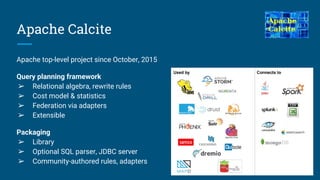
Apache Calcite
Apache top-level project since October, 2015
Query planning framework
➢ Relational algebra, rewrite rules
➢ Cost model & statistics
➢ Federation via adapters
➢ Extensible
Packaging
➢ Library
➢ Optional SQL parser, JDBC server
➢ Community-authored rules, adapters
Apache Pig
Apache top-level project
Platform for Analyzing Large Datasets
➢ Uses Pig Latin language
○ Relational operators (join, filter)
○ Functional operators (mapreduce)
➢ Runs as MapReduce (also Tez)
➢ ETL
➢ Extensible
○ LOAD/STORE
○ UDFs
Outline
Batch compute on Force.com Platform (Eli Levine)
Apache Calcite deep dive (Julian Hyde)
Building Pig adapter for Calcite (Eli Levine)
Q&A
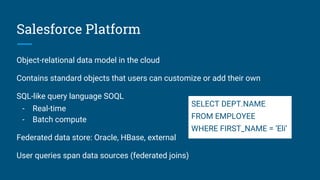
Salesforce Platform
Object-relational data model in the cloud
Contains standard objects that users can customize or add their own
SQL-like query language SOQL
- Real-time
- Batch compute
Federated data store: Oracle, HBase, external
User queries span data sources (federated joins)
SELECT DEPT.NAME
FROM EMPLOYEE
WHERE FIRST_NAME = ‘Eli’
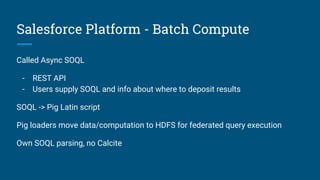
Salesforce Platform - Batch Compute
Called Async SOQL
- REST API
- Users supply SOQL and info about where to deposit results
SOQL -> Pig Latin script
Pig loaders move data/computation to HDFS for federated query execution
Own SOQL parsing, no Calcite
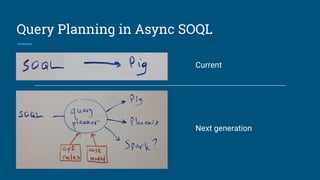
Query Planning in Async SOQL
Current
Next generation
Apache Calcite for Next-Gen Optimizer
- Strong relational algebra foundation
- Support for different physical engines
- Pluggable cost model
- Optimization rules
- Federation-aware
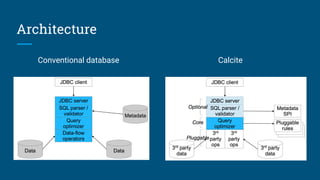
Architecture
Conventional database Calcite
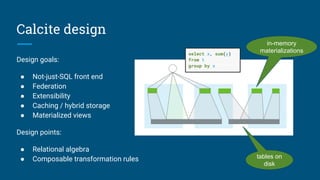
Calcite design
Design goals:
● Not-just-SQL front end
● Federation
● Extensibility
● Caching / hybrid storage
● Materialized views
Design points:
● Relational algebra
● Composable transformation rules tables on
disk
in-memory
materializationsselect x, sum(y)
from t
group by x
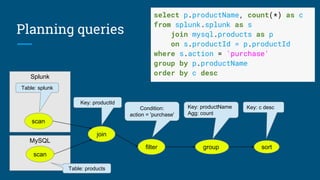
Planning queries
MySQL
Splunk
join
Key: productId
group
Key: productName
Agg: count
filter
Condition:
action = 'purchase'
sort
Key: c desc
scan
scan
Table: products
select p.productName, count(*) as c
from splunk.splunk as s
join mysql.products as p
on s.productId = p.productId
where s.action = 'purchase'
group by p.productName
order by c desc
Table: splunk
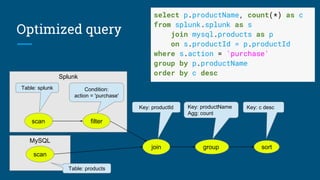
Optimized query
MySQL
Splunk
join
Key: productId
group
Key: productName
Agg: count
filter
Condition:
action = 'purchase'
sort
Key: c desc
scan
scan
Table: splunk
Table: products
select p.productName, count(*) as c
from splunk.splunk as s
join mysql.products as p
on s.productId = p.productId
where s.action = 'purchase'
group by p.productName
order by c desc
Calcite framework
Cost, statistics
RelOptCost
RelOptCostFactory
RelMetadataProvider
• RelMdColumnUniquensss
• RelMdDistinctRowCount
• RelMdSelectivity
SQL parser
SqlNode
SqlParser
SqlValidator
Transformation rules
RelOptRule
• FilterMergeRule
• AggregateUnionTransposeRule
• 100+ more
Global transformations
Unification (materialized view)
Column trimming
De-correlation
Relational algebra
RelNode (operator)
• TableScan
• Filter
• Project
• Union
• Aggregate
• …
RelDataType (type)
RexNode (expression)
RelTrait (physical property)
• RelConvention (calling-convention)
• RelCollation (sortedness)
• RelDistribution (partitioning)
RelBuilder
JDBC driver
Metadata
Schema
Table
Function
• TableFunction
• TableMacro
Lattice
Adapter
Implement SchemaFactory interface
Connect to a data source using
parameters
Extract schema - return a list of tables
Push down processing to the data source:
● A set of planner rules
● Calling convention (optional)
● Query model & query generator
(optional)
"schemas": [
{
"name": "HR",
"type": "custom",
"factory":
"org.apache.calcite.adapter.file.FileSchemaFactory",
"operand": {
"directory": "hr-csv"
}
}
]
$ ls -l hr-csv
-rw-r--r-- 1 jhyde staff 62 Mar 29 12:57 DEPTS.csv
-rw-r--r-- 1 jhyde staff 262 Mar 29 12:57 EMPS.csv.gz
$ ./sqlline -u jdbc:calcite:model=hr.json -n scott -p tiger
sqlline> select count(*) as c from emp;
'C'
'5'
1 row selected (0.135 seconds)
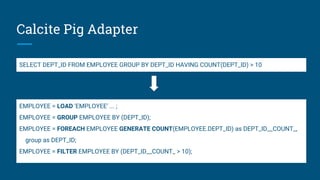
Calcite Pig Adapter
EMPLOYEE = LOAD 'EMPLOYEE' ... ;
EMPLOYEE = GROUP EMPLOYEE BY (DEPT_ID);
EMPLOYEE = FOREACH EMPLOYEE GENERATE COUNT(EMPLOYEE.DEPT_ID) as DEPT_ID__COUNT_,
group as DEPT_ID;
EMPLOYEE = FILTER EMPLOYEE BY (DEPT_ID__COUNT_ > 10);
SELECT DEPT_ID FROM EMPLOYEE GROUP BY DEPT_ID HAVING COUNT(DEPT_ID) > 10
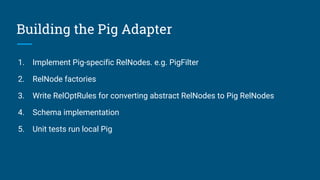
Building the Pig Adapter
1. Implement Pig-specific RelNodes. e.g. PigFilter
2. RelNode factories
3. Write RelOptRules for converting abstract RelNodes to Pig RelNodes
4. Schema implementation
5. Unit tests run local Pig
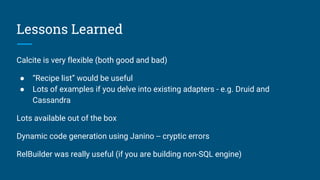
Lessons Learned
Calcite is very flexible (both good and bad)
● “Recipe list” would be useful
● Lots of examples if you delve into existing adapters - e.g. Druid and
Cassandra
Lots available out of the box
Dynamic code generation using Janino -- cryptic errors
RelBuilder was really useful (if you are building non-SQL engine)
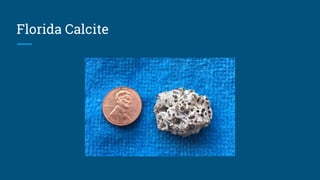
Florida Calcite
Thank you!
Eli Levine @teleturn
Julian Hyde @julianhyde
http://calcite.apache.org
http://pig.apache.org

A smarter Pig: Building a SQL interface to Apache Pig using Apache Calcite

  • 1.
    A Smarter Pig:Building a SQL interface to Pig using Apache Calcite Eli Levine & Julian Hyde Apache: Big Data, Miami 2017/05/17
  • 2.
    Julian Hyde @julianhyde Originaldeveloper of Calcite PMC member of Calcite, Drill, Eagle, Kylin ASF member About us Eli Levine @teleturn PMC member of Phoenix ASF member
  • 3.
    Apache Calcite Apache top-levelproject since October, 2015 Query planning framework ➢ Relational algebra, rewrite rules ➢ Cost model & statistics ➢ Federation via adapters ➢ Extensible Packaging ➢ Library ➢ Optional SQL parser, JDBC server ➢ Community-authored rules, adapters
  • 4.
    Apache Pig Apache top-levelproject Platform for Analyzing Large Datasets ➢ Uses Pig Latin language ○ Relational operators (join, filter) ○ Functional operators (mapreduce) ➢ Runs as MapReduce (also Tez) ➢ ETL ➢ Extensible ○ LOAD/STORE ○ UDFs
  • 5.
    Outline Batch compute onForce.com Platform (Eli Levine) Apache Calcite deep dive (Julian Hyde) Building Pig adapter for Calcite (Eli Levine) Q&A
  • 6.
    Salesforce Platform Object-relational datamodel in the cloud Contains standard objects that users can customize or add their own SQL-like query language SOQL - Real-time - Batch compute Federated data store: Oracle, HBase, external User queries span data sources (federated joins) SELECT DEPT.NAME FROM EMPLOYEE WHERE FIRST_NAME = ‘Eli’
  • 7.
    Salesforce Platform -Batch Compute Called Async SOQL - REST API - Users supply SOQL and info about where to deposit results SOQL -> Pig Latin script Pig loaders move data/computation to HDFS for federated query execution Own SOQL parsing, no Calcite
  • 8.
    Query Planning inAsync SOQL Current Next generation
  • 9.
    Apache Calcite forNext-Gen Optimizer - Strong relational algebra foundation - Support for different physical engines - Pluggable cost model - Optimization rules - Federation-aware
  • 10.
  • 11.
    Calcite design Design goals: ●Not-just-SQL front end ● Federation ● Extensibility ● Caching / hybrid storage ● Materialized views Design points: ● Relational algebra ● Composable transformation rules tables on disk in-memory materializationsselect x, sum(y) from t group by x
  • 12.
    Planning queries MySQL Splunk join Key: productId group Key:productName Agg: count filter Condition: action = 'purchase' sort Key: c desc scan scan Table: products select p.productName, count(*) as c from splunk.splunk as s join mysql.products as p on s.productId = p.productId where s.action = 'purchase' group by p.productName order by c desc Table: splunk
  • 13.
    Optimized query MySQL Splunk join Key: productId group Key:productName Agg: count filter Condition: action = 'purchase' sort Key: c desc scan scan Table: splunk Table: products select p.productName, count(*) as c from splunk.splunk as s join mysql.products as p on s.productId = p.productId where s.action = 'purchase' group by p.productName order by c desc
  • 14.
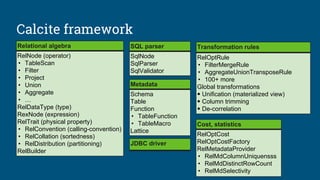
    Calcite framework Cost, statistics RelOptCost RelOptCostFactory RelMetadataProvider •RelMdColumnUniquensss • RelMdDistinctRowCount • RelMdSelectivity SQL parser SqlNode SqlParser SqlValidator Transformation rules RelOptRule • FilterMergeRule • AggregateUnionTransposeRule • 100+ more Global transformations Unification (materialized view) Column trimming De-correlation Relational algebra RelNode (operator) • TableScan • Filter • Project • Union • Aggregate • … RelDataType (type) RexNode (expression) RelTrait (physical property) • RelConvention (calling-convention) • RelCollation (sortedness) • RelDistribution (partitioning) RelBuilder JDBC driver Metadata Schema Table Function • TableFunction • TableMacro Lattice
  • 15.
    Adapter Implement SchemaFactory interface Connectto a data source using parameters Extract schema - return a list of tables Push down processing to the data source: ● A set of planner rules ● Calling convention (optional) ● Query model & query generator (optional) "schemas": [ { "name": "HR", "type": "custom", "factory": "org.apache.calcite.adapter.file.FileSchemaFactory", "operand": { "directory": "hr-csv" } } ] $ ls -l hr-csv -rw-r--r-- 1 jhyde staff 62 Mar 29 12:57 DEPTS.csv -rw-r--r-- 1 jhyde staff 262 Mar 29 12:57 EMPS.csv.gz $ ./sqlline -u jdbc:calcite:model=hr.json -n scott -p tiger sqlline> select count(*) as c from emp; 'C' '5' 1 row selected (0.135 seconds)
  • 16.
    Calcite Pig Adapter EMPLOYEE= LOAD 'EMPLOYEE' ... ; EMPLOYEE = GROUP EMPLOYEE BY (DEPT_ID); EMPLOYEE = FOREACH EMPLOYEE GENERATE COUNT(EMPLOYEE.DEPT_ID) as DEPT_ID__COUNT_, group as DEPT_ID; EMPLOYEE = FILTER EMPLOYEE BY (DEPT_ID__COUNT_ > 10); SELECT DEPT_ID FROM EMPLOYEE GROUP BY DEPT_ID HAVING COUNT(DEPT_ID) > 10
  • 17.
    Building the PigAdapter 1. Implement Pig-specific RelNodes. e.g. PigFilter 2. RelNode factories 3. Write RelOptRules for converting abstract RelNodes to Pig RelNodes 4. Schema implementation 5. Unit tests run local Pig
  • 18.
    Lessons Learned Calcite isvery flexible (both good and bad) ● “Recipe list” would be useful ● Lots of examples if you delve into existing adapters - e.g. Druid and Cassandra Lots available out of the box Dynamic code generation using Janino -- cryptic errors RelBuilder was really useful (if you are building non-SQL engine)
  • 19.
  • 20.
    Thank you! Eli Levine@teleturn Julian Hyde @julianhyde http://calcite.apache.org http://pig.apache.org