Processing graph/relational data
             with
         Map-Reduce
             and
   Bulk Synchronous Parallel
              v. 1.1


                          Tomasz Chodakowski,

                          1st Bristol Hadoop Workshop, 08-11-2010
Irregular Algorithms

●   Map-reduce – a simplified model for “embarasingly
    parallel” problems
        –   Easily separable into independent tasks
        –   Captured by static dependence graph

●   Most graph algorithms are irregular, ie.:
        –   Dependencies between tasks arise during
             execution
        –   “don't care non-determinism” - tasks can be
              executed in arbitrary order yet still yield
              correct results.
Irregular Algorithms

●   Often operate on data structures with
    complex topologies:
          –   Graphs, trees, grids, ...
          –   Where “data elements” are connected by
               “relations”


●   Computations on such structures depend
    strongly on relations between data elements
          –   primary source of dependencies between
                tasks

    more in [ADP] “Amorphous Data-parallelism in Irregular Algorithms”
Relational Data

●   Example relations between elements:
        –   social interactions (co-authorship,
              friendship)
        –   web links, document references
        –   linked data or semantic network relations
        –   geo-spatial relations
        –   ...
●   Different from a relational model
        –   in that relations are arbitrary
Graph Algorithms Rough Classification

●   Aggregation, feature extraction
        –   Not leveraging latent relations
●   Network analysis (matrix-based, single relational)
        –   Geodesic (radius, diameter etc.)
        –   Spectral (eigenvector-based, centrality)
●   Algorithmic/node-based algorithms
        –   Recommender systems, belief/label
             propagation
        –   Traversal, path detection, interaction
              networks, etc.
Iterative Vertex-based Graph Algorithms

●   Iteratively:
         –   Compute local function of a vertex that
              depends on the vertex state and local
              graph structure (neighbourhood)
         –   and/or Modify local state
         –   and/or Modify local topology
         –   pass messages to neighbouring nodes

●   -> “vertex-based computation”
             Amorphous Data-Parallelism [ADP] operator formulation:
             “repeated application of neighbourhood operators in a specific order”
Recent applications/developments


●   Google work on graph-based YouTube
    recommendations:
        –   Leveraging latent information
        –   Diffusing interest in sparsely labeled video
             clips
●   User profiling, sentiment analysis
        –   Facebook likes, Hunch, Gravity, MusicMetric
             ...
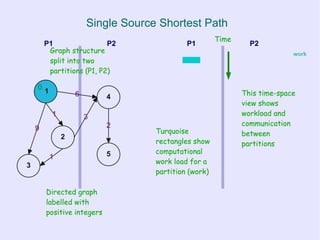
Single Source Shortest Path
                                                        Time
        P1                 P2                 P1                 P2
         Graph structure                                                     work
         split into two
         partitions (P1, P2)

    0
        1           6                                          This time-space
                            4
                                                               view shows
            1           3                                      workload and
                            2                                  communication
    9                                Turquoise
                2                                              between
                                     rectangles show           partitions
                            5        computational
            1
                                     work load for a
3
                                     partition (work)

        Directed graph
        labelled with
        positive integers
Single Source Shortest Path
        P1                      P2                      P1    P2
                                                                            work
                                                                           comm


    0                     0+6
                          0+6
        1             6         4

            1             3
                0+1
                0+1             2
    9
                2

    0+9
    0+9                         5
            1
3
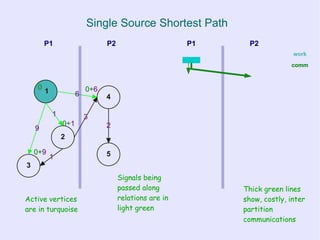
                                     Signals being
                                     passed along            Thick green lines
Active vertices                      relations are in        show, costly, inter
are in turquoise                     light green             partition
                                                             communications
Single Source Shortest Path
        P1                      P2           P1          P2
                                                                      work
                                                                      comm

                                                                     barrier
    0                     0+6
                          0+6
        1             6         4

            1             3
                0+1
                0+1             2
    9
                2

    0+9
    0+9                         5
            1
3

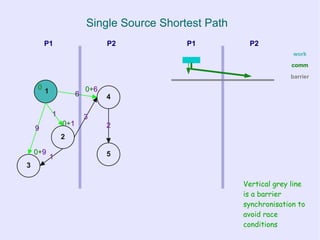
                                                        Vertical grey line
                                                        is a barrier
                                                        synchronisation to
                                                        avoid race
                                                        conditions
Single Source Shortest Path
         P1                          P2              P1       P2
                                                                          work
                                                                         comm

                                                                         barrier
     0                                                                    work
         1               6       6
                                     4

             1               3
     9                               2
                 1
                     2

             1                       5
9
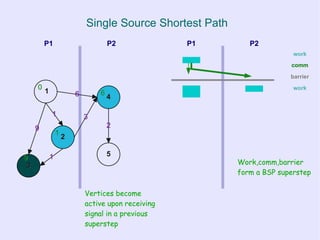
 3                                                         Work,comm,barrier
                                                           form a BSP superstep

                             Vertices become
                             active upon receiving
                             signal in a previous
                             superstep
Single Source Shortest Path
         P1                         P2                P1   P2
                                                                work
                                                                comm

                                                                barrier
     0                                                          work
         1            6         6
                                    4                           comm
                              1+3
                              1+3
             1            3
     9                              2
              1
                  2
                                        6+2
                                        6+2

          1                         5
9
 3       1+1
         1+1

                               After performing
                               local computation
                               they send signals to
                               their neighbouring
                               vertices
Single Source Shortest Path
         P1                         P2        P1        P2
                                                             work
                                                             comm

                                                             barrier
     0                                                       work
         1            6         6
                                    4                        comm
                              1+3
                              1+3                            barrier
             1            3
     9                              2
              1
                  2
                                        6+2
                                        6+2

          1                         5
9
 3       1+1
         1+1
Single Source Shortest Path
         P1                          P2         P1         P2
                                                                work
                                                                comm

                                                                barrier
     0                                                          work
         1               6       4
                                     4                          comm

                                                                barrier
             1               3
                                                                work
     9                               2
                 1
                     2
                                 8
             1                       5
9
 3
Single Source Shortest Path
         P1                          P2         P1         P2
                                                                work
                                                                comm

                                                                barrier
     0                                                          work
         1               6       4
                                     4                          comm

                                                                barrier
             1               3
                                                                work
     9                               2
                 1                                              comm
                     2
                                         4+2
                                         4+2
                                 8
             1                       5
9
 3
Single Source Shortest Path
         P1                          P2         P1         P2
                                                                work
                                                                comm

                                                                barrier
     0                                                          work
         1               6       4
                                     4                          comm

                                                                barrier
             1               3
                                                                work
     9                               2
                 1                                              comm
                     2
                                         4+2
                                         4+2
                                                                barrier
                                 8
             1                       5
9
 3
Single Source Shortest Path
         P1                          P2         P1         P2
                                                                work
                                                                comm

                                                                barrier
     0                                                          work
         1               6       4
                                     4                          comm

                                                                barrier
             1               3
                                                                work
     9                               2
                 1                                              comm
                     2
                                                                barrier
                                 6
             1                       5
9                                                               work
 3
Single Source Shortest Path
         P1                          P2                P1         P2
                                                                       work
                                                                       comm

                                                                       barrier
     0                                                                 work
         1               6       4
                                     4                                 comm

                                                                       barrier
             1               3
                                                                       work
     9                               2
                 1                                                     comm
                     2
                                                                       barrier
                                 6
             1                       5
9                                                                       work
                                                                       comm
 3                                                                     barrier


                                          Computation ends when
                                          there are no active
                                          vertices left
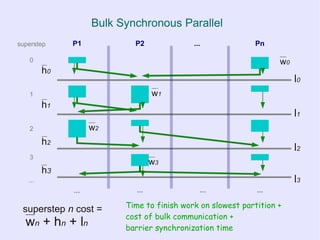
Bulk Synchronous Parallel
superstep     P1            P2              ...             Pn

   0                                                               w0
         h0
                                                                        l0
   1                               w1
         h1
                                                                        l1
   2                w2
         h2
                                                                        l2
   3
                                   w3
         h3
   ...                                                                  l3
              ...            ...              ...            ...

                          Time to finish work on slowest partition +
 superstep n cost =
                          cost of bulk communication +
  wn + hn + ln            barrier synchronization time
Bulk Synchronous Parallel

●   Advantages
           –   Simple and portable execution model
           –   Clear cost model
           –   No concurrency control, no data races,
                deadlocks, etc.
●   Disadvantages
           –   Coarse grained
                    ●Depends on a large “parallel slack”
           –   Requires well-partitioned problem space for
                efficiency (well balanced partitions)

    more in [BSP] “A bridging model for parallel computation”
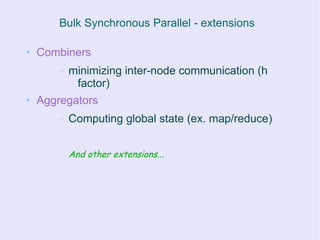
Bulk Synchronous Parallel - extensions

●   Combiners
        –   minimizing inter-node communication (h
             factor)
●   Aggregators
        –   Computing global state (ex. map/reduce)


            And other extensions...
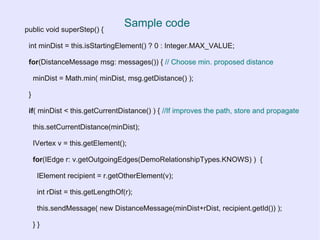
public void superStep() {
                                   Sample code
 int minDist = this.isStartingElement() ? 0 : Integer.MAX_VALUE;

 for(DistanceMessage msg: messages()) { // Choose min. proposed distance
 for(DistanceMessage

     minDist = Math.min( minDist, msg.getDistance() );

 }

 if( minDist < this.getCurrentDistance() ) { //If improves the path, store and propagate
 if(

     this.setCurrentDistance(minDist);

     IVertex v = this.getElement();

     for(IEdge r: v.getOutgoingEdges(DemoRelationshipTypes.KNOWS) ) {
     for(IEdge

      IElement recipient = r.getOtherElement(v);

      int rDist = this.getLengthOf(r);

      this.sendMessage( new DistanceMessage(minDist+rDist, recipient.getId()) );

     }}
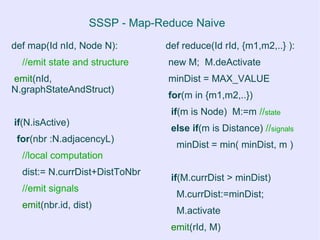
SSSP - Map-Reduce Naive

●   Idea [DPMR]:
        –   In map phase:
                ●  emit both signals and local vertex
                    structure and state
        –   In reduce phase:
                ●  gather signals and local vertex
                    structure messages
                ● reconstruct vertex structure and state
SSSP - Map-Reduce Naive
def map(Id nId, Node N):        def reduce(Id rId, {m1,m2,..} ):
  //emit state and structure    new M; M.deActivate
emit(nId,                       minDist = MAX_VALUE
N.graphStateAndStruct)
                                for(m in {m1,m2,..})
                                 if(m is Node) M:=m //state
if(N.isActive)
                                 else if(m is Distance) //signals
 for(nbr :N.adjacencyL)
                                  minDist = min( minDist, m )
  //local computation
  dist:= N.currDist+DistToNbr
                                 if(M.currDist > minDist)
  //emit signals
                                  M.currDist:=minDist;
  emit(nbr.id, dist)
                                  M.activate
                                 emit(rId, M)
SSSP - Map Reduce Naive - issues

●   Cost associated with marshaling intermediate
    <k,v> pairs for combiners (which are optional)
        –   -> in-line combiner

●   Need to pass the whole graph state and structure
    around
        –   -> “Shimmy trick” -- pin down the structure

●   Partitions verticies without regard to graph
    topology
        –   -> cluster highly connected components
              together
Inline Combiners

●   In job configure:
        –   Initialize a map<NodeId, Distance>;
●   In job map operation:
        –   Do not emit interm. pairs ( emit(nbr.id, dist) ) ;
        –   Store them in the local map;
        –   Combine values in the same slots.
●   In job close:
        –   Emit a value from each slot in the map to a
             corresponding neighbour
                 ●   emit(nbr.id, map[nbr.id])
“Shimmy trick”

●   Store graph structure in a file system (no shuffle)
●   Inspired by a parallel merge join


                            partition           p1         p1


                                                        p2           p2


                                           p3         p3


     sorted by join key                 sorted and partitioned by join key
“Shimmy trick”

●   Assume:
        –   Graph G representation sorted by node ids;
        –   G partitioned into n parts: G1, G2, .., Gn
        –   Use the same partitioner as in MR
        –   Set number of reducers to n
●   The above gives us:


        –   Reducer Ri, receives the same intermediate
             keys as those in Gi graph partition (in
             sorted order).
“Shimmy trick”
def configure( ):              def reduce(Id rId, {m1,m2,..} ):
  P.openGraphPartition()       repeat:
                                  (id nId, node N) <- P.read()
                                  if (nId != rId): N.deact; emit(nId, N)
                               until: nId == rId
                               minDist = MAX_VALUE
                               for(m in {m1,m2,..}):
def close( ):                     minDist = min( minDist, m )
repeat:                         if(N.currDist > minDist)
 (id nId, node N) <-P.read()     N.currDist:=minDist;
 N.deactivate                    N.activate
 emit(nId, N)                   emit(rId, N)
“Shimmy trick”

●   Improvements:
        –   Files containing graph structure reside on
              dfs
        –   Reducers arbitrarily assigned to cluster
             machines
                ●   -> remote reads.

●   -> change the scheduler to assign key ranges to
    the same machines consistently.
Topology-aware Partitioner

●   Choose a partitioner that:
         –   minimizes inter-block traffic;
         –   maximizes intra-block traffic;
         –   places adjacent nodes in the same block

●   Difficult to achieve particularly with many real world
    datasets:
         –   Power-law distributions
         –   Reported that state of the art partitioners
              (ex. parmetis) fail for such cases (???)
MR Graph Processing Design Pattern

●   [DPMR] reports 60% 70% improvement over naive
    implementation
●   Solution closely resembles the BSP model
BSP (inspired) implementations

●   Google Pregel:
          –   classic BSP, C++, production
●   CMU GraphLab
          –   inspired by BSP, java, multi-core
          –   consistency models, custom schedulers
●   Apache Hama
          –   scientific computation package that runs on top of
                Hadoop, BSP, MS Dryad (?)
●   Signal/Collect (Zurich University)
          –   Scala, not yet distributed
●   ...
Open questions

●   What problems are particularly suitable for MR and
    which ones for BSP – where are the boundaries?
        –   Topology-based centrality algorithms
             (PageRank):
                ●   Algebraic, matrix-based methods vs.
                     vertex-based ones?

●   When considering graph algorithms:
        –   MR user base vs. BSP ergonomy?
        –   Performance overheads?
●   Relaxing the BSP synchronous schedule -->
    “Amorphous data parallelism”
POC, Sample Code

●   Project Masuria (early stages, 2011-02)
         –   http://masuria-project.org/
         –   As much POC of BSP framework as it is
               (distributed) OSGI playground.
●   Sample code:
         –   https://github.com/tch/Cloud9 *
         –   git@git.assembla.com:tch_sandbox.git
         –   RunSSSPNaive.java
         –   RunSSSPShimmy.java *
    * - expect (my) bugs
    Based on Jimmy Lin and Michael Schatz Cloud9 library
References

●   [ADP] “Amorphous Data-parallelism in Irregular Algorithms”, Keshav
    Pingali et al.
●   [BSP] “A bridging model for parallel computation”, Leslie G. Valiant
●   [DPMR] “Design Patterns for Efficient Graph Algorithms in
    MapReduce”, Jimmy Lin and Michael Schatz

Processing graph/relational data with Map-Reduce and Bulk Synchronous Parallel

  • 1.
    Processing graph/relational data with Map-Reduce and Bulk Synchronous Parallel v. 1.1 Tomasz Chodakowski, 1st Bristol Hadoop Workshop, 08-11-2010
  • 2.
    Irregular Algorithms ● Map-reduce – a simplified model for “embarasingly parallel” problems – Easily separable into independent tasks – Captured by static dependence graph ● Most graph algorithms are irregular, ie.: – Dependencies between tasks arise during execution – “don't care non-determinism” - tasks can be executed in arbitrary order yet still yield correct results.
  • 3.
    Irregular Algorithms ● Often operate on data structures with complex topologies: – Graphs, trees, grids, ... – Where “data elements” are connected by “relations” ● Computations on such structures depend strongly on relations between data elements – primary source of dependencies between tasks more in [ADP] “Amorphous Data-parallelism in Irregular Algorithms”
  • 4.
    Relational Data ● Example relations between elements: – social interactions (co-authorship, friendship) – web links, document references – linked data or semantic network relations – geo-spatial relations – ... ● Different from a relational model – in that relations are arbitrary
  • 5.
    Graph Algorithms RoughClassification ● Aggregation, feature extraction – Not leveraging latent relations ● Network analysis (matrix-based, single relational) – Geodesic (radius, diameter etc.) – Spectral (eigenvector-based, centrality) ● Algorithmic/node-based algorithms – Recommender systems, belief/label propagation – Traversal, path detection, interaction networks, etc.
  • 6.
    Iterative Vertex-based GraphAlgorithms ● Iteratively: – Compute local function of a vertex that depends on the vertex state and local graph structure (neighbourhood) – and/or Modify local state – and/or Modify local topology – pass messages to neighbouring nodes ● -> “vertex-based computation” Amorphous Data-Parallelism [ADP] operator formulation: “repeated application of neighbourhood operators in a specific order”
  • 7.
    Recent applications/developments ● Google work on graph-based YouTube recommendations: – Leveraging latent information – Diffusing interest in sparsely labeled video clips ● User profiling, sentiment analysis – Facebook likes, Hunch, Gravity, MusicMetric ...
  • 8.
    Single Source ShortestPath Time P1 P2 P1 P2 Graph structure work split into two partitions (P1, P2) 0 1 6 This time-space 4 view shows 1 3 workload and 2 communication 9 Turquoise 2 between rectangles show partitions 5 computational 1 work load for a 3 partition (work) Directed graph labelled with positive integers
  • 9.
    Single Source ShortestPath P1 P2 P1 P2 work comm 0 0+6 0+6 1 6 4 1 3 0+1 0+1 2 9 2 0+9 0+9 5 1 3 Signals being passed along Thick green lines Active vertices relations are in show, costly, inter are in turquoise light green partition communications
  • 10.
    Single Source ShortestPath P1 P2 P1 P2 work comm barrier 0 0+6 0+6 1 6 4 1 3 0+1 0+1 2 9 2 0+9 0+9 5 1 3 Vertical grey line is a barrier synchronisation to avoid race conditions
  • 11.
    Single Source ShortestPath P1 P2 P1 P2 work comm barrier 0 work 1 6 6 4 1 3 9 2 1 2 1 5 9 3 Work,comm,barrier form a BSP superstep Vertices become active upon receiving signal in a previous superstep
  • 12.
    Single Source ShortestPath P1 P2 P1 P2 work comm barrier 0 work 1 6 6 4 comm 1+3 1+3 1 3 9 2 1 2 6+2 6+2 1 5 9 3 1+1 1+1 After performing local computation they send signals to their neighbouring vertices
  • 13.
    Single Source ShortestPath P1 P2 P1 P2 work comm barrier 0 work 1 6 6 4 comm 1+3 1+3 barrier 1 3 9 2 1 2 6+2 6+2 1 5 9 3 1+1 1+1
  • 14.
    Single Source ShortestPath P1 P2 P1 P2 work comm barrier 0 work 1 6 4 4 comm barrier 1 3 work 9 2 1 2 8 1 5 9 3
  • 15.
    Single Source ShortestPath P1 P2 P1 P2 work comm barrier 0 work 1 6 4 4 comm barrier 1 3 work 9 2 1 comm 2 4+2 4+2 8 1 5 9 3
  • 16.
    Single Source ShortestPath P1 P2 P1 P2 work comm barrier 0 work 1 6 4 4 comm barrier 1 3 work 9 2 1 comm 2 4+2 4+2 barrier 8 1 5 9 3
  • 17.
    Single Source ShortestPath P1 P2 P1 P2 work comm barrier 0 work 1 6 4 4 comm barrier 1 3 work 9 2 1 comm 2 barrier 6 1 5 9 work 3
  • 18.
    Single Source ShortestPath P1 P2 P1 P2 work comm barrier 0 work 1 6 4 4 comm barrier 1 3 work 9 2 1 comm 2 barrier 6 1 5 9 work comm 3 barrier Computation ends when there are no active vertices left
  • 19.
    Bulk Synchronous Parallel superstep P1 P2 ... Pn 0 w0 h0 l0 1 w1 h1 l1 2 w2 h2 l2 3 w3 h3 ... l3 ... ... ... ... Time to finish work on slowest partition + superstep n cost = cost of bulk communication + wn + hn + ln barrier synchronization time
  • 20.
    Bulk Synchronous Parallel ● Advantages – Simple and portable execution model – Clear cost model – No concurrency control, no data races, deadlocks, etc. ● Disadvantages – Coarse grained ●Depends on a large “parallel slack” – Requires well-partitioned problem space for efficiency (well balanced partitions) more in [BSP] “A bridging model for parallel computation”
  • 21.
    Bulk Synchronous Parallel- extensions ● Combiners – minimizing inter-node communication (h factor) ● Aggregators – Computing global state (ex. map/reduce) And other extensions...
  • 22.
    public void superStep(){ Sample code int minDist = this.isStartingElement() ? 0 : Integer.MAX_VALUE; for(DistanceMessage msg: messages()) { // Choose min. proposed distance for(DistanceMessage minDist = Math.min( minDist, msg.getDistance() ); } if( minDist < this.getCurrentDistance() ) { //If improves the path, store and propagate if( this.setCurrentDistance(minDist); IVertex v = this.getElement(); for(IEdge r: v.getOutgoingEdges(DemoRelationshipTypes.KNOWS) ) { for(IEdge IElement recipient = r.getOtherElement(v); int rDist = this.getLengthOf(r); this.sendMessage( new DistanceMessage(minDist+rDist, recipient.getId()) ); }}
  • 23.
    SSSP - Map-ReduceNaive ● Idea [DPMR]: – In map phase: ● emit both signals and local vertex structure and state – In reduce phase: ● gather signals and local vertex structure messages ● reconstruct vertex structure and state
  • 24.
    SSSP - Map-ReduceNaive def map(Id nId, Node N): def reduce(Id rId, {m1,m2,..} ): //emit state and structure new M; M.deActivate emit(nId, minDist = MAX_VALUE N.graphStateAndStruct) for(m in {m1,m2,..}) if(m is Node) M:=m //state if(N.isActive) else if(m is Distance) //signals for(nbr :N.adjacencyL) minDist = min( minDist, m ) //local computation dist:= N.currDist+DistToNbr if(M.currDist > minDist) //emit signals M.currDist:=minDist; emit(nbr.id, dist) M.activate emit(rId, M)
  • 25.
    SSSP - MapReduce Naive - issues ● Cost associated with marshaling intermediate <k,v> pairs for combiners (which are optional) – -> in-line combiner ● Need to pass the whole graph state and structure around – -> “Shimmy trick” -- pin down the structure ● Partitions verticies without regard to graph topology – -> cluster highly connected components together
  • 26.
    Inline Combiners ● In job configure: – Initialize a map<NodeId, Distance>; ● In job map operation: – Do not emit interm. pairs ( emit(nbr.id, dist) ) ; – Store them in the local map; – Combine values in the same slots. ● In job close: – Emit a value from each slot in the map to a corresponding neighbour ● emit(nbr.id, map[nbr.id])
  • 27.
    “Shimmy trick” ● Store graph structure in a file system (no shuffle) ● Inspired by a parallel merge join partition p1 p1 p2 p2 p3 p3 sorted by join key sorted and partitioned by join key
  • 28.
    “Shimmy trick” ● Assume: – Graph G representation sorted by node ids; – G partitioned into n parts: G1, G2, .., Gn – Use the same partitioner as in MR – Set number of reducers to n ● The above gives us: – Reducer Ri, receives the same intermediate keys as those in Gi graph partition (in sorted order).
  • 29.
    “Shimmy trick” def configure(): def reduce(Id rId, {m1,m2,..} ): P.openGraphPartition() repeat: (id nId, node N) <- P.read() if (nId != rId): N.deact; emit(nId, N) until: nId == rId minDist = MAX_VALUE for(m in {m1,m2,..}): def close( ): minDist = min( minDist, m ) repeat: if(N.currDist > minDist) (id nId, node N) <-P.read() N.currDist:=minDist; N.deactivate N.activate emit(nId, N) emit(rId, N)
  • 30.
    “Shimmy trick” ● Improvements: – Files containing graph structure reside on dfs – Reducers arbitrarily assigned to cluster machines ● -> remote reads. ● -> change the scheduler to assign key ranges to the same machines consistently.
  • 31.
    Topology-aware Partitioner ● Choose a partitioner that: – minimizes inter-block traffic; – maximizes intra-block traffic; – places adjacent nodes in the same block ● Difficult to achieve particularly with many real world datasets: – Power-law distributions – Reported that state of the art partitioners (ex. parmetis) fail for such cases (???)
  • 32.
    MR Graph ProcessingDesign Pattern ● [DPMR] reports 60% 70% improvement over naive implementation ● Solution closely resembles the BSP model
  • 33.
    BSP (inspired) implementations ● Google Pregel: – classic BSP, C++, production ● CMU GraphLab – inspired by BSP, java, multi-core – consistency models, custom schedulers ● Apache Hama – scientific computation package that runs on top of Hadoop, BSP, MS Dryad (?) ● Signal/Collect (Zurich University) – Scala, not yet distributed ● ...
  • 34.
    Open questions ● What problems are particularly suitable for MR and which ones for BSP – where are the boundaries? – Topology-based centrality algorithms (PageRank): ● Algebraic, matrix-based methods vs. vertex-based ones? ● When considering graph algorithms: – MR user base vs. BSP ergonomy? – Performance overheads? ● Relaxing the BSP synchronous schedule --> “Amorphous data parallelism”
  • 35.
    POC, Sample Code ● Project Masuria (early stages, 2011-02) – http://masuria-project.org/ – As much POC of BSP framework as it is (distributed) OSGI playground. ● Sample code: – https://github.com/tch/Cloud9 * – git@git.assembla.com:tch_sandbox.git – RunSSSPNaive.java – RunSSSPShimmy.java * * - expect (my) bugs Based on Jimmy Lin and Michael Schatz Cloud9 library
  • 36.
    References ● [ADP] “Amorphous Data-parallelism in Irregular Algorithms”, Keshav Pingali et al. ● [BSP] “A bridging model for parallel computation”, Leslie G. Valiant ● [DPMR] “Design Patterns for Efficient Graph Algorithms in MapReduce”, Jimmy Lin and Michael Schatz