SUMMER INTERNSHIP AT
LOGISTIC INTEGRATORS
Pvt. Ltd.SUMMER INTERNSHIP
AT
LOGISTIC
INTEGRATORS
Pvt. Ltd.
Chirag Shah
{SUMMER INTERNSHIP TRAINEE}
2013
1/1/2013
PDF created with pdfFactory Pro trial version www.pdffactory.com
Page 2 of 92
A
SUMMER INTERNSHIP PROJECT REPORT
on
LOGOISTIC INDUSTRY
at
Logistic Integrators (I) Pvt. Ltd.
FOR THE PARTIAL FULFILLMENT OF REQUIREMENT OF DEGREE OF
POST GRADUATE PROGRAMME IN MANAGEMENT
at
NAVRANGPURA, AHMEDABAD
2012-14
Company Guide : Mr. Ajay Kawadia
Academic Guide : Prof. Devang Patel
Submitted By : Chirag Shah
(G.R. No. : M00117)
PDF created with pdfFactory Pro trial version www.pdffactory.com
Page 3 of 92
Acknowledgement
I have taken efforts in this project. However, it would not have been possible without the kind support and help
of many individuals and organizations. I would like to extend my sincere thanks to all of them.
I am highly indebted to Mr. Ajay Kawadia for their guidance and constant supervision as well as for providing
necessary information regarding the project & also for their support in completing the project.
I would like to express my gratitude towards my parents & member of Logistic Integrators Pvt. Ltd. for their
kind co-operation and encouragement which help me in completion of this project.
I would like to express my special gratitude and thanks to industry persons for giving me such attention and
time.
My thanks and appreciations also go to my academic mentor Prof. Devang Patel in developing the project and
people who have willingly helped me out with their abilities.
Regards
Chirag Shah
PDF created with pdfFactory Pro trial version www.pdffactory.com
Page 4 of 92
Preface
Internship is the last step of a student's academic career. For a student of Business Management it is essential
for the complete understanding of the concepts learned from formal education. There remains a huge gap
between academic learning and the implementation of that hypothetical knowledge in the practical world of
modern business and commerce. Internship can compensate this wide gap as it brings opportunities for a
student to comprehend the main trends of business activities.
In compiling this report I have intended to provide a synthesis of theoretical approaches and methods of
implementing them in the world of business. I have tried to discover the relationship between theoretical and
practical type of knowledge. I have tried to bridge the gap between theoretical assumptions and practical
necessities. During the entire course of our academic study we remain engaged in theoretical learning where the
primary objective is academic success. A concise knowledge of the modern business arena can only be attained
through the pragmatic implementation of hypothetical ideas, which we learn from our academic activities.
With these objectives, I have made all possible efforts and the necessary investigations to submit this report in an
enlightened form in a very short time. I have tried my level best to eliminate errors from the report. As I had to
complete my internship within a short period of time so the study admits its limitations.
PDF created with pdfFactory Pro trial version www.pdffactory.com
Page 5 of 92
Executive Summary
The internship is an integral part of the Logistic Industry. The organization that choose for my internship project
is Logistic Integrators (I) Pvt. Ltd., Ahmedabad.
This Eight-week period of my internship in such a huge organization gave me a real time exposure to know
about the organizational working process I made many itinerary over there with the help of my company guide
Mr. Ajay Kawadia (sales manager) and he gave me a lot of knowledge howto talk with industrialist people. All
types of logistic in India have registered phenomenal growth in the last decade ever since the Indian
government decided to boost revenues from the logistic sector by projecting India as the ultimate logistic
oriented nation.
The basic objectives of my study were:
• To know about basic of logistic industry
• To gain different industry knowledge
• To know more corporate people
• To know how logistic takes place
Main summary in this project is to know about the logistic industry is growing day by day, I came to know with
the help of my seniors and secondary data.
PDF created with pdfFactory Pro trial version www.pdffactory.com
Page 6 of 92
Table of Contents
DESCRIPTION PAGE NO.
1. Chapter 1 : 10
Logistic Industry
1.1 Logistic – Introduction and origin
1.2 Objective of the logistics
1.2.0 Rapid response
1.2.1 Reduce total distribution costs
1.2.2 Generating additional sales
1.2.3 Creating time and place utilities
1.2.4 Price stabilization
1.2.5 Quality improvement
1.2.6 Movement consolidation
1.2.7 Improving customer service
1.3 Logistic management function
1.3.0 Order processing
1.3.1 Inventory management
1.3.2 Warehousing
1.3.3 Transportation
1.3.4 Material handling storage
1.3.5 Packing
1.3.6 Information flow
1.4 Indian logistic industry
1.4.0 Overview
1.5 Mediums of logistic
1.5.0 Road
1.5.1 Railway
1.5.2 Water/Port
1.5.3 Air
2. Chapter 2 : 20
Logistics Integrators (I) Pvt. Ltd.
2.1 Profile
2.2 Value
2.3 Culture
2.4 Vision
2.5 Mission
2.6 No boundaries
2.7 Beyond boundaries
PDF created with pdfFactory Pro trial version www.pdffactory.com
Page 7 of 92
2.8 Advantages
2.8.0 Location
2.8.1 USP
2.9 Products & Services
2.9.0 International air freight
2.9.1 International ocean freight
2.9.2 Customs brokerage
2.9.3 Project cargo
2.9.4 Warehousing and faculty management
2.10 Other advantages
2.10.0 360 services
2.10.1 Warehousing services
2.10.2 Distribution and 3PL services
2.11 Future plans
2.12 SWOT Analysis
2.12.0 Strength
2.12.1 Weaknesses
2.12.2 Opportunities
2.12.3 Threats
3. Chapter 3 : 31
Project : Detailed study of Inbound & Outbound International Logistic Activities
• Task assigned for the project
• Methodology used
3.1 Incoterms
3.1.0 EXW (Ex Works)
3.1.1 FOB (Free On Board)
3.1.2 FCA (Free Carrier)
3.1.3 CFR (Cost & Freight)
3.1.4 CIF (Cost, Insurance & Freight)
3.1.5 CPT (Freight Carriage Paid)
3.1.6 CIP (Freight, Carriage & Insurance Paid)
3.1.7 DDU (Delivery Duty Unpaid)
3.2 Types of containers
3.3 Dimensions of containers
3.4 Import
3.4.0 Import general manifest
3.4.1 Bill of entry
3.4.2 Documents submitted by Importer
3.4.3 Assessment of custom duty
3.5 Export
PDF created with pdfFactory Pro trial version www.pdffactory.com
Page 8 of 92
3.5.0 Export general manifest
3.5.1 Shipping Bill
3.5.2 Commercial Invoice
3.5.3 Bill of lading
3.5.4 Packing list
3.5.5 Certificate of origin
3.5.6 Certificate of sampling and analysis
3.5.7 Certificate weight
3.5.8 Letter of credit (L/c.)
3.5.9 Export procedure
3.5.10 Documents required for export
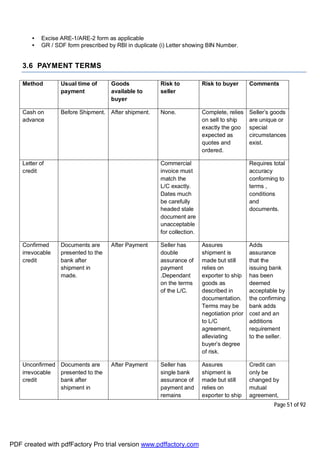
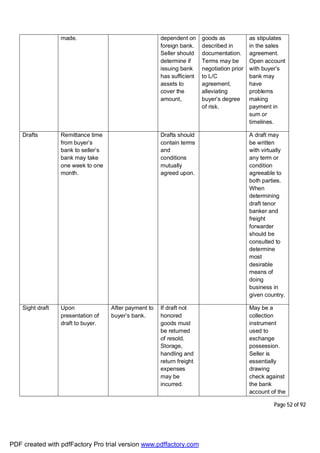
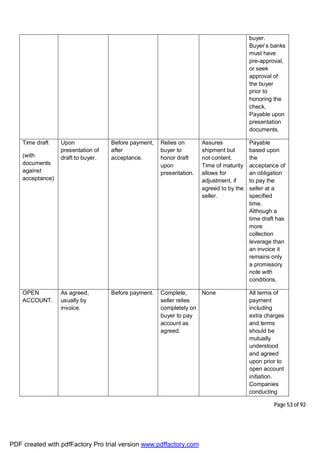
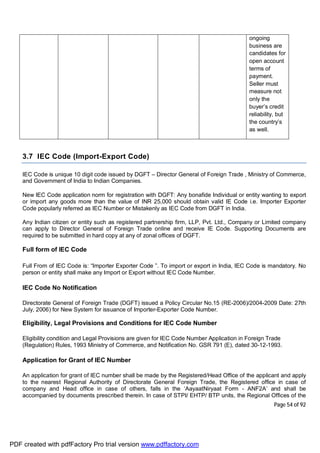
3.6 Payment Terms
3.7 IEC Code
3.8 HS Code
3.8.0 Structure
3.8.1 Classification
3.8.2 Importance
3.9 Custom House Agent (CHA)
3.10 High Sea Sales
3.11 Export Logistic Cost
4. Chapter 4 : 62
Study at ICD – Ahmedabad
• Methodology used
4.1 Export Transport Logistic Cost
4.2 Containerized Shipment
4.3 Movement of Containerized Shipment
4.4 Customs Clearing Charges
4.5 ICD & CFS
4.5.0 Services offered by ICD/CFS
4.5.1 Advantage
4.5.2 Terminal Handling Charges
5. Chapter 5 : 67
Study of Taiwan Economy
• Task assigned for the project
• Methodology used
5.1 Introduction
5.2 Location
5.3 History
5.4 Geography
5.4.0 Geographic Situation Chart
5.5 Airports
PDF created with pdfFactory Pro trial version www.pdffactory.com
Page 9 of 92
5.6 Seaports
5.7 Economy
5.8 Chart of GDP Growth Rate
5.9 Export Commodities
5.10 Import Commodities
5.11 Table :Foreign trade
5.12 Table : Trade between India – Taiwan
5.13 Chart : Export from Taiwan to India
5.14 Chart : Import by Taiwan from India
5.15 Bibliography
6. Chapter 6 : 79
Project :Research on Logistic management of different industry
• Task assigned for the project
• Methodology used
• Respective persons.
6.1 AshimaDyecot Ltd.
6.1.0 Profile
6.1.1 Findings
6.2 Aarvee Denims & Export Ltd.
6.2.0 Profile
6.2.1 Findings
6.3 VishakhaPolyfab Pvt. Ltd.
6.3.0 Profile
6.3.1 Findings
6.4 Syntron Industries
6.4.0 Profile
6.4.1 Findings
6.5 Encore Natural Polymers Pvt. Ltd.
6.5.0 Profile
6.5.1 Findings
6.6 Rushil Décor Ltd.
6.6.0 Profile
6.6.1 Findings
7. Chapter 7 : 86
Learnings + Experiential Learning
8. Reference 88
8.1 Bibliography
9. Annexure 90
PDF created with pdfFactory Pro trial version www.pdffactory.com
Page 10 of 92
Chapter 1 :
LOGISTIC INDUSTRY
PDF created with pdfFactory Pro trial version www.pdffactory.com
Page 11 of 92
1.1 WHAT IS THE LOGISTIC?
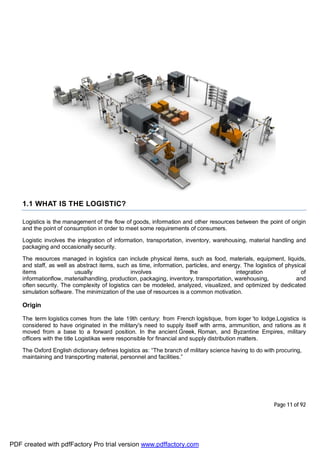
Logistics is the management of the flow of goods, information and other resources between the point of origin
and the point of consumption in order to meet some requirements of consumers.
Logistic involves the integration of information, transportation, inventory, warehousing, material handling and
packaging and occasionally security.
The resources managed in logistics can include physical items, such as food, materials, equipment, liquids,
and staff, as well as abstract items, such as time, information, particles, and energy. The logistics of physical
items usually involves the integration of
informationflow, materialhandling, production, packaging, inventory, transportation, warehousing, and
often security. The complexity of logistics can be modeled, analyzed, visualized, and optimized by dedicated
simulation software. The minimization of the use of resources is a common motivation.
Origin
The term logistics comes from the late 19th century: from French logistique, from loger 'to lodge.Logistics is
considered to have originated in the military's need to supply itself with arms, ammunition, and rations as it
moved from a base to a forward position. In the ancient Greek, Roman, and Byzantine Empires, military
officers with the title Logistikas were responsible for financial and supply distribution matters.
The Oxford English dictionary defines logistics as: “The branch of military science having to do with procuring,
maintaining and transporting material, personnel and facilities.”
PDF created with pdfFactory Pro trial version www.pdffactory.com
Page 12 of 92
1.2 OBJECTIVES OF LOGISTIC
The primaryobjective of logistics management is to effectively and efficiently move the supply chain so as to
extend the desired level of customer service at the least cost. Thus, logistics management starts with
ascertaining customers’ needs till theirfulfilment through product supplies. However,there are some definite
objectives to be achieved through a proper logistics system.These can be described as follows:
1.2.0 Rapid Response:
Rapid response is concerned with a firm's ability to satisfy customer service requirements in a timely manner.
Information technology has increased the capability to postpone logistical operations to the latest possible time
and then accomplish rapid delivery of required inventory.
1.2.1 Reduce total distribution costs:
The cost of physical distribution consists of various elements such as transportation, warehousing and
inventory maintenance, and any reduction in the cost of one element may result in an increase in the cost of
the other elements. Thus, the objective of the firm should be to reduce the total cost of distribution and not just
the cost incurred on any one element.
1.2.2 Generating additional sales:
A firm can attract additional customers by offering better services at lowest prices. For example, by
decentralizing its warehousing operations or by using economic and efficient modes of transportation, a firm
can achieve larger market share. Also by avoiding the out-of-stock situation, the loss of loyal customers can be
arrested.
1.2.3 Creating time and place utilities:
The products are physically moved from the place of their origin to the place where they are required for
consumption; they do not serve any purpose to the users. Similarly, the products have to be made available at
the time they are needed for consumption.
1.2.4 Price stabilization:
It can be achieved by regulating the flow of the products to the market through a judicious use of available
transport facilities and compatible warehouse operations. By stocking the raw material during the period of
excess supply and made available during the periods of short supply, the prices can be stabilized.
1.2.5 Quality improvement:
The long-term objective of the logistical system is to seek continuous quality improvement. Total quality
management (TQM) has become a major commitment throughout all facets of industry. If a product becomes
defective or if service promises are not kept, little, if any, value is added by the logistics. Logistical costs, once
expended, cannot be reversed.
1.2.6 Movement consolidation:
Consolidation one of the most significant logistical costs is transportation. Transportation cost is directly related
to the type of product, size of shipment, and distance. Many Logistical systems that feature premium service
depend on high-speed, small shipment transportation. Premium transportation is typically high-cost. To reduce
transportation cost. It is desirable to achieve movement consolidation.
PDF created with pdfFactory Pro trial version www.pdffactory.com
Page 13 of 92
1.2.7 Improving customer service:
An important objective of all marketing efforts, including the physical distribution activities, is to improve the
customer service. An efficient management of physical distribution can help in improving the level of customer
service by developing an effective system of warehousing, quick and economic transportation, and maintaining
optimum level of inventory.
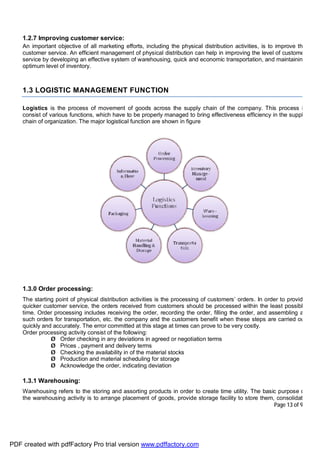
1.3 LOGISTIC MANAGEMENT FUNCTION
Logistics is the process of movement of goods across the supply chain of the company. This process is
consist of various functions, which have to be properly managed to bring effectiveness efficiency in the supply
chain of organization. The major logistical function are shown in figure
1.3.0 Order processing:
The starting point of physical distribution activities is the processing of customers’ orders. In order to provide
quicker customer service, the orders received from customers should be processed within the least possible
time. Order processing includes receiving the order, recording the order, filling the order, and assembling all
such orders for transportation, etc. the company and the customers benefit when these steps are carried out
quickly and accurately. The error committed at this stage at times can prove to be very costly.
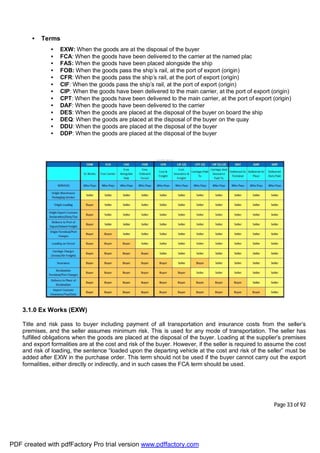
Order processing activity consist of the following:
Ø Order checking in any deviations in agreed or negotiation terms
Ø Prices , payment and delivery terms
Ø Checking the availability in of the material stocks
Ø Production and material scheduling for storage
Ø Acknowledge the order, indicating deviation
1.3.1 Warehousing:
Warehousing refers to the storing and assorting products in order to create time utility. The basic purpose of
the warehousing activity is to arrange placement of goods, provide storage facility to store them, consolidate
PDF created with pdfFactory Pro trial version www.pdffactory.com
Page 14 of 92
them with other similar products, divide them into smaller quantities and build up assortment of products.
Generally, larger the number of warehouses a firm has the lesser would be the time taken in serving customers
at different locations, but greater would be the cost of warehousing. Thus, the firm has to strike a balance
between the cost of warehousing and the level of customer service.
Major decision in warehousing is as follow:
Ø Location of warehousing facility
Ø Number of warehousing
Ø Size of warehouse
Ø Design of the building
Ø Ownership of the warehouse
1.3.2 Inventory Management:
Linked to warehousing decisions are the inventory decisions which hold the key to success of physical
distribution especially where the inventory costs may be as high 15 as 30-40 per cent (e.g., steel and
automobiles). No wonder, therefore, that the new concept of Just-in-Time-Inventory decision is increasingly
becoming popular with a number of companies. The decision regarding level of inventory involves estimate of
demand for the product. A correct estimate of the demand helps to hold proper inventory level and control the
inventory costs. This is not only helps the firm in terms of the cost of inventory and supply to customers in time
but also to maintain production at a consistent level. The major factors determining the inventory levels are:
The firm’s policy regarding the customer service level, Degree of accuracy of the sales forecasts,
Responsiveness of the distribution system i.e., ability of the system to transmit inventory needs to the factory
and get the products in the market. The cost inventory consists of holding cost (such as cost of warehousing,
tied up capital and obsolescence) and replenishment cost (including the manufacturing cost).
1.3.3 Transportation:
Transportation seeks to move goods from points of production and sale to points of consumption in the
quantities required at times needed and at a reasonable cost. The transportation system adds time and place
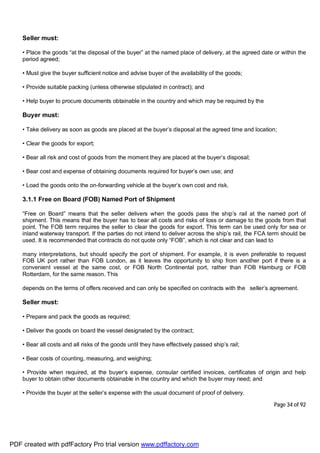
utilities to the goods handled and thus, increases their economic value. To achieve these goals, transportation
facilities must be adequate, regular, dependable and equitable in terms of costs and benefits of the facilities
and service provided.
1.3.5 Information:
The physical distribution managers continuously need up-to-date information about inventory, transportation
and warehousing. For example, in respect on inventory, information about present stock position at each
location, future commitment and replenishment capabilities are constantly required. Similarly, before choosing
a 16 carrier, information about the availability of various modes of transport, their costs, services and suitability
for a particular product is needed. About warehousing, information with respect to space utilization, work
schedules, unit load performance, etc., is required.
In order to receive all the information stated above, an efficient management information system would be of
immense use in controlling costs, improving services and determining the overall effectiveness of distribution.
Of course, it is difficult to correctly assess the cost of physical distribution operations. But if correct information
is available it can be analyzed systematically and a great deal of saving can be ensured.
1.3.6 Facilities:
The Facilities logistics element is composed of a variety of planning activities, all of which are directed toward
ensuring that all required permanent or semi permanent operating and support facilities (for instance, training,
field and depot maintenance, storage, operational, and testing) are available concurrently with system fielding.
Planning must be comprehensive and include the need for new construction as well as modifications to existing
facilities. Facility construction can take from 5 to 7 years from concept formulation to user occupancy. It also
PDF created with pdfFactory Pro trial version www.pdffactory.com
Page 15 of 92
includes studies to define and establish impacts on life cycle cost, funding requirements, facility locations and
improvements, space requirements, environmental impacts, duration or frequency of use, safety and health
standards requirements, and security restrictions. Also included are any utility requirements, for both fixed and
mobile facilities, with emphasis on limiting requirements of scarce or unique resources.
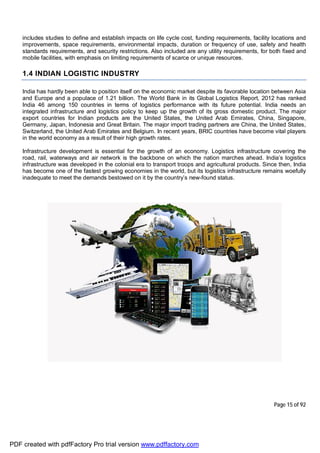
1.4 INDIAN LOGISTIC INDUSTRY
India has hardly been able to position itself on the economic market despite its favorable location between Asia
and Europe and a populace of 1.21 billion. The World Bank in its Global Logistics Report, 2012 has ranked
India 46 among 150 countries in terms of logistics performance with its future potential. India needs an
integrated infrastructure and logistics policy to keep up the growth of its gross domestic product. The major
export countries for Indian products are the United States, the United Arab Emirates, China, Singapore,
Germany, Japan, Indonesia and Great Britain. The major import trading partners are China, the United States,
Switzerland, the United Arab Emirates and Belgium. In recent years, BRIC countries have become vital players
in the world economy as a result of their high growth rates.
Infrastructure development is essential for the growth of an economy. Logistics infrastructure covering the
road, rail, waterways and air network is the backbone on which the nation marches ahead. India’s logistics
infrastructure was developed in the colonial era to transport troops and agricultural products. Since then, India
has become one of the fastest growing economies in the world, but its logistics infrastructure remains woefully
inadequate to meet the demands bestowed on it by the country’s new-found status.
PDF created with pdfFactory Pro trial version www.pdffactory.com
Page 16 of 92
1.4.0 Overview
• The Logistics industry includes five broad segments – ocean freight, rail freight,
air freight, trucking and third party Logistics (3PL) services.
• The current size of the Indian Logistics Industry is estimated around $225bn
and is expected to reach around $350bn by 2015.
• As per industry estimates as provided by the Fitch Rating Agency, there is a
positive future outlook for the Indian Logistics Industry and it is estimated that
the industry will grow at 15-20% over the next few years.
• Several factors helped the growth of logistics industry in India over the last
decade that include changing tax system as well as a rapid growth in industries
such as automobile, pharmaceuticals, FMCG and retail.
• 70% of the total domestic product is transported through the road network and
15% through the rail network. Domestic companies are willing to expand their
efficiency to meet rising demand globally according to a study by industry body.
• Logistics costs in India are estimated to be approximately 13% of GDP which is
considerably high when compared to the corresponding figures for other major
economies of the world (as per World Bank 2010 report). For example in
2011 the logistics costs in the European Countries accounted for 7.15% of
GDP (as per an article in ‘The Hindu’)
• Higher logistics costs are mainly due to poor infrastructure facilities in the
country. The higher logistics cost represents higher products/services cost in
the international market
• The country’s organized logistics market represents 6% of the total market
• The three major contributors for the growth of logistics industry are: emergence
of organized retail, increase in foreign trade and India becoming a global
manufacturing hub.
1.5 MEDIUMS OF LOGISTIC
There are four way of logistics services in India. These can be categorized in the following way:
1.5.0 ROAD :
The road freight industry in India is worth about INR 1.42 trillion and is growing at about 6-8 percent year on
year (refer figure 6). Manpower spends amount to only about 4 percent of sales as against the overall sector
average of 8-10 percent. The industry has traditionally been extremely fragmented - almost 75 percent of the
trucking 'companies' are single truck operators and almost 90 percent of trucking companies have a turnover of
less than INR 10 million.
A majority of players in this industry have been small entrepreneurs running family owned businesses. Given
their small scale and limited investment capability, most of their investments have been focused on short term
gains - direct and immediate impact on the top line / bottom line of the business being the key decision
criterion. As a result, investments that pay off in the longer term, such as those in manpower development,
have been minimal historically. Also, these businesses are typically tightly controlled by the proprietor and his /
her family and as such, making it unattractive for professionals. Poor working conditions, low pay scales
relative to alternate careers, poor or non-existent manpower policies and prevalence of unscrupulous practices
have added to the segment's woes creating the image of a segment that holds few attractions for those
seeking employment.
PDF created with pdfFactory Pro trial version www.pdffactory.com
Page 17 of 92
While industry players have been incapable of investing in manpower development, the government has also
not focused sufficiently on the same. There exist very few formal training institutions for driver training and
practically none for operational training on associated areas like loading / unloading supervisory, proper
handling practices etc.
The result has been that in the current scenario, there exist gaps in core technical skills of the existing set of
personnel. For example, the backbone of the trucking industry truck drivers lack knowledge of good driving
practices and areas associated with driving like understanding of VAT. Taking a level-wise view of the skill
issues, it is seen that in the road sector, skill issues are widespread across the board with the situation being
most severe at the operational level.
Advantages:
• Road network of 3.3 million km is the second largest globally
• 55% of total freight movement is via roadways
• Roads offer wide reach and easy accessibility to even small markets
Disadvantages:
• High cost of transportation
• National Highways account for only 2% of the total network but carries 40% of total freight
Key Developments:
• National Highway Development Project to upgrade and modernise highways
• 24,000 km of National Highways are to be upgraded to four/six lanes. Connectivity to ports is also being
improved
1.5.1 RAILWAY:
Rail freight traffic revenues stood at around INR 350 billion in 2006 having grown at around 8 percent in the
recent past with the growth in the last couple of years being around 10 percent. It is the world's second largest
rail network spread over 81,500 km and covering around 7000 stations. Manpower spends amount to about 45
percent of revenues as against the overall sector average of 8-10 percent. Also, non-salary expenditure
comprises 36 percent of overall manpower expenditure compared to the sector average of 13-14 percent.
With the government being the only employer, recruitment systems in the railways segment are formalized and
there exists an institutionalized training infrastructure and policy. Though the employee numbers are high
(around 1.4 million) there are no significant skill gaps owing to this traditionally strong in-house training
infrastructure. With technological up gradation, certain jobs are made redundant every year with the people on
these jobs being absorbed in newer areas through training. However, the rapid introduction of modern
technology that is creating gaps even in technical areas such as signalling and telecom. Also, the Railways is
facing increase in attrition levels due to gradual opening of the sector.
To counter the emerging gaps, the Railways is overhauling the curriculum and infrastructure and rolling out
training to the lowest levels (Grade D) to increase productivity. With competition from road and air, the
Railways is focusing on making its large manpower more customer friendly. In the overall assessment,
therefore, the skill gaps situation in the railways segment does not seem to be alarming.
The host of new players entering into the rail container services segment (15 licenses have been awarded for
the same) will however require skills that hitherto were only residing with the Indian Railways. While the
quantum of requirement at this stage would be small and the need would likely be filled by the buffer created
by the Railways, this could become a gap area going forward
PDF created with pdfFactory Pro trial version www.pdffactory.com
Page 18 of 92
Advantages:
• Spread over 81,500 km, railways carries 25% of total freight movement
• Low transportation cost as compared to roads
Disadvantages:
• Bulk commodities account for 90% of total freight revenues
• Inflexibility to reach deep interiors
Key Developments:
• Phase 1 of dedicated freight corridor along Golden Quadrilateral to be initiated in 2008-09
1.5.3 WATER/PORT:
The growth in shipping has been even higher than that of the railways driven by strong growth in foreign trade
both in bulk and containerized cargo. Manpower spends amount to about 8-10 percent; non-salary expenditure
varies greatly between companies ranging from 3-20 percent of overall man power expenditure.
The nature of liner shipping services to and from India has undergone a sea change in the last few years as a
result of the growth in break-bulk and conventional cargoes. With the nature of goods being shipped changing,
the potential and opportunities for container transport and logistics companies are enormous. Over the past
few years the size and the number of vessels that are being deployed by India has increased.
With increasing capacity and infrastructural support, the scope of the operations is set to increase! India now
has the largest merchant shipping fleet among the developing countries! India ranks 17th in the world in
shipping tonnage. ! Indian share of maritime transport services is 1 percent of world market.! The container
traffic has registered an impressive growth of 15 per cent over the last five years.
The Government is responsible for creation of the trained manpower required for the country's merchant navy
fleet and also facilitation of training and employment of seafarers in foreign flag vessels. .
In addition to the above, there are about 124 training institutes in the private sector approved by the Director
General of Shipping, imparting pre-sea and post sea training in various disciplines. The Directorate General of
Shipping maintains a system of inspections to ensure the quality of training. India is globally recognized as a
very important source of mercantile manpower.
Accentuating the situation is the inherent disadvantage to the Indian ship owners as employers arising by virtue
of extra burden of income tax on Indian seafarers' income. This makes the employment on a foreign flag the
first choice of any Indian seafarer, and thereby denies the best talent to the local shipping industry.
Thus, in the core shipping industry, while the manpower situation in terms of quality fares much better than the
other segments of logistics, the issue here is that of quantity with an increasing number of qualified people
being attracted towards working on foreign vessels as they offer better salaries and perks. However, if one
were to look at the ports side, there is an increasing lack of trained manpower for pilotage functions and
equipment operators
Advantages:
• Cheapest mode of transportation
Disadvantages:
• Poor state of inland waterways in the country
• High turnover time
PDF created with pdfFactory Pro trial version www.pdffactory.com
Page 19 of 92
Key Developments:
• Cargo handling capacity of ports to be increased from 600 million tones in 2007 to 1500 million tones
by 2015
1.5.4 AIR :
Though the air freight segment holds a small share of India's freight market, it is growing at a fast
ace. While India accounts for meagre 3 percent of the global air cargo market, the Indian air cargo industry is
expected to double in size by the year 2010, as per an expert estimate.
As in the case of sea freight, the level of formalization and standardization of operations in the air freight
segment is greater than in the road sector. By virtue of the level of investments in assets, network and
relationships required to be a player in this segment, it has traditionally been relatively more organized leading
to greater regard for manpower development. The market leaders typically have established internal structured
training practices to train the staff employed at this level.
Nevertheless, there exist perceived gaps at the operational / front line level and are primarily to do with soft
skills, such as relationship management, interpersonal and managerial, and supervisory skills.
Advantages:
• Fastest mode of transportation
Disadvantages:
• Low freight movement
• 87% of total freight traffic being handled by airports in metro cities
Key Developments:
• Modernization of 37 operational airports and development of new airports will increase air cargo
handling capacity
PDF created with pdfFactory Pro trial version www.pdffactory.com
Page 20 of 92
Chapter 2 :
LOGISTIC INTEGRATORS (I)
PVT. LTD.
PDF created with pdfFactory Pro trial version www.pdffactory.com
Page 21 of 92
2.1 PROFILE
Logistic Integrators is a company that is focused on integrating a whole logistic and supply chain with a clock
work precision. It is a challenge to bridge the two polarities of "Personal Approach" and "System Approach".
With this aspect in mind we steer towards bringing an excellent service to the door step of our clients.
Logistic Integrators brings in a century worth of knowledge in logistics, experience and expertise. The team is
highly professional and assertive to ideas that offer innovative and result oriented solutions.
On board are the veterans of the freight and logistics industry who have spent their best part of their time in
honing their skills in the industry. Thus they are adept with all the necessary skills, knowledge and technical
knowhow which are the key to success. Collectively they bring in 100 Years of pure experience in
logistics which is now available to be unplugged!!!
From plain international freight to complex custom clearance, from handling of technical Project cargo to time
sensitive shipments, from perishable cargo to warehousing, from offering TMS to micro distribution, the team
has handled all in their stint with the industry.
2.2 VALUE
Logistic Integrators has unearthed its value system and firmly commits itself to follow this path of reality
throughout in daily walks of life and living. These values are close to the heart of each employees of the
company and we shall walk that extra mile to fulfill and keep committed. These values are representative of
each individual being as it has been discovered in them by a scientific process and intuitive mind.
The values which we cherish are;
§ Trust
§ Growth
§ Care
§ Creativity
§ Celebration
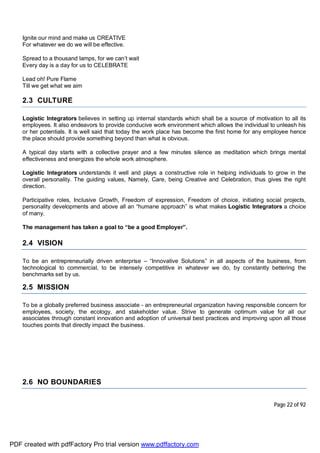
The values are interconnected and beautifully merge it selves into
one another to form the essence of Logistic Integrators. It thus
emerges as poetry of life;
Lead Oh! Pure flame
Till we get what we aim
Light our heart with love and CARE
And in each step make us aware
Show us the way as we GROW
For many maps on the way we have to draw
In every step, be our symbol of TRUST
So with you we will pass all the test
PDF created with pdfFactory Pro trial version www.pdffactory.com
Page 22 of 92
Ignite our mind and make us CREATIVE
For whatever we do we will be effective.
Spread to a thousand lamps, for we can’t wait
Every day is a day for us to CELEBRATE
Lead oh! Pure Flame
Till we get what we aim
2.3 CULTURE
Logistic Integrators believes in setting up internal standards which shall be a source of motivation to all its
employees. It also endeavors to provide conducive work environment which allows the individual to unleash his
or her potentials. It is well said that today the work place has become the first home for any employee hence
the place should provide something beyond than what is obvious.
A typical day starts with a collective prayer and a few minutes silence as meditation which brings mental
effectiveness and energizes the whole work atmosphere.
Logistic Integrators understands it well and plays a constructive role in helping individuals to grow in the
overall personality. The guiding values, Namely, Care, being Creative and Celebration, thus gives the right
direction.
Participative roles, Inclusive Growth, Freedom of expression, Freedom of choice, initiating social projects,
personality developments and above all an “humane approach” is what makes Logistic Integrators a choice
of many.
The management has taken a goal to “be a good Employer”.
2.4 VISION
To be an entrepreneurially driven enterprise – “Innovative Solutions” in all aspects of the business, from
technological to commercial, to be intensely competitive in whatever we do, by constantly bettering the
benchmarks set by us.
2.5 MISSION
To be a globally preferred business associate - an entrepreneurial organization having responsible concern for
employees, society, the ecology, and stakeholder value. Strive to generate optimum value for all our
associates through constant innovation and adoption of universal best practices and improving upon all those
touches points that directly impact the business.
2.6 NO BOUNDARIES
PDF created with pdfFactory Pro trial version www.pdffactory.com
Page 23 of 92
The process necessarily involves an exploration, discovery, breaking mind sets and looking beyond the
obvious.
Thinking should be limitless, without boundaries, infinite......no boundaries!!
At Logistic Integrators, every solution undergoes the process of exploration.
Hence at Logistic Integrators, it is all “no boundaries”
Geography, Distance, Network, Coverage...no boundaries!!
Associates, strategic alliances, partnerships...no boundaries!!
Range of services, Products, Industry verticals...no boundaries!!
Nationality of staff, Relationship...no boundaries!!!
Creativity, imagination, Freedom of expression...no boundaries!!
Opportunities, Choice, Solutions, Growth...no boundaries!!
It is that state of meditative mind where one observes boundary-less-ness, everything is within hence infinite!!
It is simply...........no boundaries......................
2.7 BEYOND BOUNDARIES
Logistic Integrators – A young, dynamic and vibrant company manned by professionals who between them
have more than a century’s worth of experience in logistics.
Specializing in integrating the entire logistic in supply chain with immaculate precision, Logistic Integrators aims
to go beyond boundaries to facilitate commerce and create a world with no boundaries.
With the company’s Pan India presence, group companies in selected global market and exclusive network
partners in more than 70 countries worldwide, staffed by personnel who are constantly upgrading their skills
and keeping abreast with the latest trends in global standards of service and technology, Logistic Integrators
strives to provide creative and out of box solutions to maximize customer satisfaction with optimum resource
utilization. At Logistic Integrators, we believe that this approach is the foundation of our loyal customer base
built up over the years.
They are proud to be one of the few selected companies who use web based customized enterprise resource
planning software to operate their business. This unique software seamlessly integrates all business activities
and functions from client acquisition to account settlement and also provide visibility throughout the entire
process on a real time basis. This enhances efficiency and client satisfaction thus accelerating business
growth.
PDF created with pdfFactory Pro trial version www.pdffactory.com
Page 24 of 92
2.8 ADVANTAGES:
2.8.1 Location
• Western Region
Logistic Integrators (I) Pvt. Ltd.
706/707, Sakar V,
B/H Natraj Cinema,
Off. Ashram Road,
Ahmedabad- 380009
Phone: +91 79 30228899
Fax: +91 79 30226699
URL: www.logisticintegrators.com
• Corporate Headquarter
A 310, Sagartech Plaza,
Sakinaka, Andheri (E).
Mumbai - 400 072
India
Tel.: +91 22 4223 5555
Fax: +91 22 4223 5550
2.8.2 USP
• Service and customer centric
• Customized solution provider
• Sales oriented organization
• Activities designed based on emotional touch
• Hardcore dedicated operation team
2.9 PRODUCTS& SERVICES:
§ International Air Freight
§ International Ocean Freight
§ Customs brokerage
§ Project Cargo
§ Warehousing and Facility Management
§ Distribution and Transport solutions
§ 3 PL Services
§ Allied Logistic services
2.9.0International Air Freight
PDF created with pdfFactory Pro trial version www.pdffactory.com
Page 25 of 92
Logistic Integrators have a unique advantage in form of strategic alliances with its global partners. Together
with a matrix of business flow in all directions it provides a unique synergy to its association, thereby bringing
measurable advantages to its foray.
Logistic Integrators believes in picking up the best deals existing at the time of your shipment which not only
gives a cost advantage but also economies the route length.
To simplify, Logistic Integrators with its worldwide associates offers following solutions in Air freight Logistics.
• Time Critical Shipments :
These are the shipment which needs to fly on SOS basis cutting across all limitations and boundaries.
Defined in more appropriate way are the AOG, Perishable, Medicine, Biological Samples, Temperature
controlled shipments, Critical machine parts, or any shipment where time is the essence. Logistic
Integrators have the access and options of various carriers to organize priority for these shipments and
cut deadlines. Be into Inbound or Outbound the network is geared to take up these challenge and our
success is the testimony of the same.
• Cost Critical Shipments:
If time is the parameter of performance, we also witness cost as the parameters of benchmark. In this
trying terms where the corporate balances the speed with cost, pushing both parameters in opposite
direction, Logistic Integrators provide a solution in form of “Air consolidation” Services. In simple terms it
allows us and partners to consolidate multiple shipment and do bulk buying from the carriers thereby
bringing a cost economising solutions. While keeping an eye on cost we do not lose focus on time
parameters.
2.9.1 International Ocean Freight
Last few years the industry has witnessed a shift from air mode of shipments to ocean mode of shipments. The
shift is not only a part of cost improvements but the shipping industry has reciprocated with adding values in
the overall service patterns. The industry has now witnessed large scale capacities, shorter routings, faster
sailing times, Direct and special services, improved frequency and competition to keep the price at check.
Logistic Integrators, understands the urge of all supply chain manager to innovate an optimum solution which
shall meet both ends.
They offer following prime products for as a part of Ocean freight solutions;
§ Full Container Load :
FCL as popularly known as, is a product which serves the urgency and Volume-economy freight
solutions. Logistic Integrators with its extended relations in various countries makes it convenient to
explore the best solution in terms of cost, optimum routing, and Minimum transit time, frequency of
vessel and space availability. With reach in every key world ports and a carrier relations its network
assist in sourcing the best solution for your ocean freight shipment.
§ Less Container Load :
LCL, is the more understood terminology. Logistic integrators have a solution for smaller load in form of
LCL consolidation, part consolidation which retains the advantage of all features of a Full Container
Load but priced as per use basis. Hence every shipper who has lesser volumes gains the advantage of
bulk buying capacity of Logistic Integrator and its network partners.
§ Special Equipments :
PDF created with pdfFactory Pro trial version www.pdffactory.com
Page 26 of 92
There are challenges faced by shipper where the shipped cargo does not match up the size of standard
General Purpose Container. That is the time where the shipper is faced with a challenge of using
special Equipments to move this shipment. Special equipments involves Flat Rack, ISO tanks, Flat
beds, Platform, Open top, Flexi container etc.
2.9.2 Custom Brokerage
Logistic Integrators, understands this challenge well and have a unique strategy of synergizing with competent
partners all across the country thereby bringing the best of talents and competency in this unique services. The
role thus becomes as a 3PL service provider who on the behalf of the Importer and Exporter engages the best
in the trade.
In house we have professional who supervises and monitors the whole operation keeping the control and
visibility throughout the process.
• General Clearance:
This involves handling custom Clearance for various products cutting across Industry verticals. It
involves steps from analyzing the documents till the physical clearance of the shipment, be it inbound or
outbound.
• Custom clearance for imported goods.
• Custom clearance for Export of goods.
• Documentation, DEPB, DEEC, SVB, Licenses.
• Transit Warehousing, Consolidated transportation.
• Part of value added services, Door to door services.
• Special Clearance:
This involves performance against certain challenging parameters. The complexities arise due to the
nature of the products or situations. It thus calls for a specialized skill from understanding the product to
sensitivity as attitude.
• Temperature controlled shipment.
• Project cargo clearance.
• AOG.
• Direct delivery.
• Exhibition cargo.
• Re export.
• Multi location clearance.
2.9.3 Project Cargo & Heavy Lift Cargo
Project cargo comes with bundles of surprises, challenges, excitement and leaves with a unique experience.
Logistic Integrators considers this as an opportunity to showcase its competency, capability and creativity in its
full. Along with its Global strategic Partner Logistic Integrators can offer solutions in tough conditions. It strongly
believes in synergizing and networking with competent vendors to offer multiple solutions. Be it Over
Dimension Cargo (ODC) or a heavy lift shipment, logistic Integrators brings on table its history of experience to
offer solutions.
They offer following specialized solutions for Project Cargo;
§ Project Forwarding.
§ Project Custom Clearance.
§ Multimodal Transport.
PDF created with pdfFactory Pro trial version www.pdffactory.com
Page 27 of 92
§ Air and Sea charter.
§ Door to Door service.
§ Heavy lift Transportation.
§ Route Survey.
§ Allied Services.
2.9.4 Warehousing
It is well understood that warehousing and supply chain shall differ from clients to client business model.
Hence Logistic Integrators plays a key role in assisting the client to select the best model to leverage his
business. From site to size, space to height, Racks to floor, Staff to system, labour to automation, manual to
machine, design to engineering, team of professionals at Logistic Integrators can help to solve this puzzle. We
offer various value added solution along with warehousing;
§ Facility Management
§ Dealer distribution
§ Inventory management
§ Bonded warehousing
§ Returns Management
2.10 OTHER ADVANTAGES:
2.10.0 360 Degrees services...
Logistic Integrators offer a complete range of logistic solutions through a
single zero-hitch window. Our services are firmly geared towards ensuring
flawless operations from start to finish to the satisfaction of each and every
customer on the world map. No matter where you are our solutions reach your
table, exclusively tailored to your specific requirement.
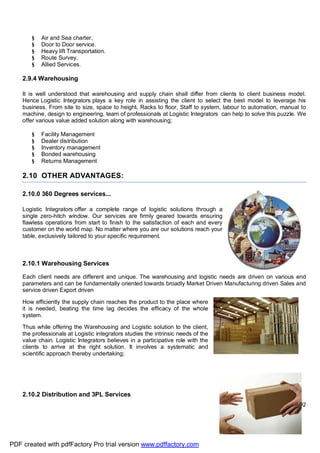
2.10.1 Warehousing Services
Each client needs are different and unique. The warehousing and logistic needs are driven on various end
parameters and can be fundamentally oriented towards broadly Market Driven Manufacturing driven Sales and
service driven Export driven
How efficiently the supply chain reaches the product to the place where
it is needed, beating the time lag decides the efficacy of the whole
system.
Thus while offering the Warehousing and Logistic solution to the client,
the professionals at Logistic integrators studies the intrinsic needs of the
value chain. Logistic Integrators believes in a participative role with the
clients to arrive at the right solution. It involves a systematic and
scientific approach thereby undertaking;
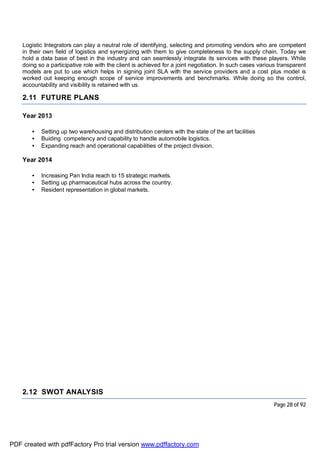
2.10.2 Distribution and 3PL Services
PDF created with pdfFactory Pro trial version www.pdffactory.com
Page 28 of 92
Logistic Integrators can play a neutral role of identifying, selecting and promoting vendors who are competent
in their own field of logistics and synergizing with them to give completeness to the supply chain. Today we
hold a data base of best in the industry and can seamlessly integrate its services with these players. While
doing so a participative role with the client is achieved for a joint negotiation. In such cases various transparent
models are put to use which helps in signing joint SLA with the service providers and a cost plus model is
worked out keeping enough scope of service improvements and benchmarks. While doing so the control,
accountability and visibility is retained with us.
2.11 FUTURE PLANS
Year 2013
• Setting up two warehousing and distribution centers with the state of the art facilities
• Buiding competency and capability to handle automobile logistics.
• Expanding reach and operational capabilities of the project division.
Year 2014
• Increasing Pan India reach to 15 strategic markets.
• Setting up pharmaceutical hubs across the country.
• Resident representation in global markets.
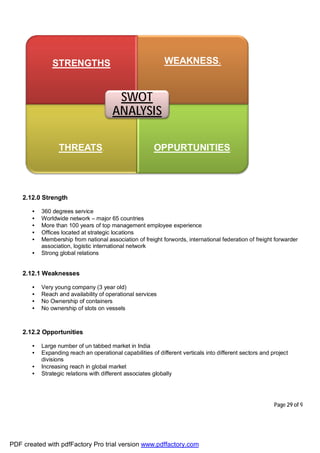
2.12 SWOT ANALYSIS
PDF created with pdfFactory Pro trial version www.pdffactory.com
Page 29 of 92
2.12.0 Strength
• 360 degrees service
• Worldwide network – major 65 countries
• More than 100 years of top management employee experience
• Offices located at strategic locations
• Membership from national association of freight forwords, international federation of freight forwarder
association, logistic international network
• Strong global relations
2.12.1 Weaknesses
• Very young company (3 year old)
• Reach and availability of operational services
• No Ownership of containers
• No ownership of slots on vessels
2.12.2 Opportunities
• Large number of un tabbed market in India
• Expanding reach an operational capabilities of different verticals into different sectors and project
divisions
• Increasing reach in global market
• Strategic relations with different associates globally
STRENGTHS WEAKNESS.
THREATS. OPPURTUNITIES.
SWOT
ANALYSIS
PDF created with pdfFactory Pro trial version www.pdffactory.com
Page 30 of 92
2.12.3 Threats
• Highly competitive market
• Fluctuation of foreign currency
• Fluctuations of demand and supply v/s. infrastructure requirement in india
PDF created with pdfFactory Pro trial version www.pdffactory.com
Page 31 of 92
Chapter 3 :
Project: Detailed study of
Inbound & Outbound
International Logistic Activities
PDF created with pdfFactory Pro trial version www.pdffactory.com
Page 32 of 92
A. Task Assigned for the Project
i. To learn the procedure of exports and imports :
Import - Export is the important procedures connected with port operations, each and every compliance
are so vague and many persons are interconnected.
ii. To learn documentation needed for import – export :
There is much important documentation and each document has significance for it. So it was necessary
to learn about the documentation
iii. To know different documentation requirement from port , exporter, CHA and bank for import – export
procedures :
Which document is submitted to whom and when
iv. To know about the Incoterms :
How are the risk transferring at every stage
v. To know about the containers :
What are the types and dimensions
vi. To know about the various terms for the payments :
How the payment will be made
B. Methodology used
1. From the manual book of training
2. Secondary search
3. Observations
4. Interactive communications
3.1 INCOTERMS
To avoid conflicts and difficulties, importers and exporters – or buyers and sellers – must have a common
understanding of the terms and conditions under which they trade. The latest issue was released in 2000, and
the mention of “Incoterms 2000” in a contract determines the obligations of the buyer and the seller and greatly
contributes towards eliminating causes of disagreement.
• When do Incoterms apply ?
Validity of Incoterms apply only if incorporated in the contract of sale or if they are specified in the
solicitation document, mentioned in the offer, the sales conditions, the purchase order, the confirmation
of an order or if they are stipulated by the parties in separate agreement. Parties wishing to use
Incoterms 2000 should clearly specify that their solicitation document and the contract are governed by
Incoterms 2000.
• Structure
Incoterms 2000 are governed by the International Chamber of Commerce (ICC) in Paris and are
grouped into four different categories. In Groups E and F the seller’s obligations are minimal and the
buyer must do most of the work and assume maximum risk. As we move to Group C the supplier’s
obligations become more extensive, however the buyer still assumes risks. As we move to group D the
supplier makes most arrangements and assumes maximum risk, whereas the buyer must pay for and
arrange import customs clearance and un-loading from the forwarder’s vehicle at the final destination.
PDF created with pdfFactory Pro trial version www.pdffactory.com
Page 33 of 92
• Terms
• EXW: When the goods are at the disposal of the buyer
• FCA: When the goods have been delivered to the carrier at the named plac
• FAS: When the goods have been placed alongside the ship
• FOB: When the goods pass the ship’s rail, at the port of export (origin)
• CFR: When the goods pass the ship’s rail, at the port of export (origin)
• CIF: When the goods pass the ship’s rail, at the port of export (origin)
• CIP: When the goods have been delivered to the main carrier, at the port of export (origin)
• CPT: When the goods have been delivered to the main carrier, at the port of export (origin)
• DAF: When the goods have been delivered to the carrier
• DES: When the goods are placed at the disposal of the buyer on board the ship
• DEQ: When the goods are placed at the disposal of the buyer on the quay
• DDU: When the goods are placed at the disposal of the buyer
• DDP: When the goods are placed at the disposal of the buyer
3.1.0 Ex Works (EXW)
Title and risk pass to buyer including payment of all transportation and insurance costs from the seller’s
premises, and the seller assumes minimum risk. This is used for any mode of transportation. The seller has
fulfilled obligations when the goods are placed at the disposal of the buyer. Loading at the supplier’s premises
and export formalities are at the cost and risk of the buyer. However, if the seller is required to assume the cost
and risk of loading, the sentence “loaded upon the departing vehicle at the cost and risk of the seller” must be
added after EXW in the purchase order. This term should not be used if the buyer cannot carry out the export
formalities, either directly or indirectly, and in such cases the FCA term should be used.
PDF created with pdfFactory Pro trial version www.pdffactory.com
Page 34 of 92
Seller must:
• Place the goods “at the disposal of the buyer” at the named place of delivery, at the agreed date or within the
period agreed;
• Must give the buyer sufficient notice and advise buyer of the availability of the goods;
• Provide suitable packing (unless otherwise stipulated in contract); and
• Help buyer to procure documents obtainable in the country and which may be required by the
Buyer must:
• Take delivery as soon as goods are placed at the buyer’s disposal at the agreed time and location;
• Clear the goods for export;
• Bear all risk and cost of goods from the moment they are placed at the buyer’s disposal;
• Bear cost and expense of obtaining documents required for buyer’s own use; and
• Load the goods onto the on-forwarding vehicle at the buyer’s own cost and risk.
3.1.1 Free on Board (FOB) Named Port of Shipment
“Free on Board” means that the seller delivers when the goods pass the ship’s rail at the named port of
shipment. This means that the buyer has to bear all costs and risks of loss or damage to the goods from that
point. The FOB term requires the seller to clear the goods for export. This term can be used only for sea or
inland waterway transport. If the parties do not intend to deliver across the ship’s rail, the FCA term should be
used. It is recommended that contracts do not quote only “FOB”, which is not clear and can lead to
many interpretations, but should specify the port of shipment. For example, it is even preferable to request
FOB UK port rather than FOB London, as it leaves the opportunity to ship from another port if there is a
convenient vessel at the same cost, or FOB North Continental port, rather than FOB Hamburg or FOB
Rotterdam, for the same reason. This
depends on the terms of offers received and can only be specified on contracts with the seller’s agreement.
Seller must:
• Prepare and pack the goods as required;
• Deliver the goods on board the vessel designated by the contract;
• Bear all costs and all risks of the goods until they have effectively passed ship’s rail;
• Bear costs of counting, measuring, and weighing;
• Provide when required, at the buyer’s expense, consular certified invoices, certificates of origin and help
buyer to obtain other documents obtainable in the country and which the buyer may need; and
• Provide the buyer at the seller’s expense with the usual document of proof of delivery.
PDF created with pdfFactory Pro trial version www.pdffactory.com
Page 35 of 92
Buyer must:
• At own expense, reserve space on board a vessel and give all the required instructions to the
seller enabling it to deliver in time for shipment (NOTE: this registration and calling forward are normally carried
out by the buyer’s forwarding agent.);
• Bear all expenses and risks of the goods from the time they have effectively passed ships
• Bear the cost of obtaining documents required for the export of the goods;
• Pay demurrage incurred at the port of shipment unless the detention is attributable to the
Seller Bear any costs incurred if the vessel designated by the buyer or buyer’s agent is unable to take the
goods;
• Bear the cost of B/L and any documents the buyer may have asked the seller to provide; and
• Pay the cost of inspection, if required
3.1.2 Free Carrier (FCA)
This term has been designed to meet the requirements of modern transport, particularly such “multimodal”
transport as container or “roll on-roll off” (RO/RO) traffic by trailers and ferries. It is based on the same main
principles as FOB except that the seller fulfils his obligations when the goods are delivered into the custody of
the carrier at the named point (and not loaded onto any means of transport used for the main voyage). “Free
Carrier” means that the seller fulfills the obligation to deliver at the point when the goods are handed over and
cleared for export into the charge of the carrier named by the buyer at the
named place or point. If no precise point is indicated by the buyer, the seller may choose within the place or
range stipulated where the carrier shall take the goods into their charge. When, according to commercial
practice, the seller’s assistance is required in making the contract with the carrier (such as in rail or air
transport) the seller may act at the buyer’s risk and expense. This term may be used for any mode of transport,
including multimodal transport. “Carrier” means any company who, in a contract of carriage, undertakes to
perform or to procure the performance of carriage by rail, road, sea, air, inland waterway or by a combination of
such modes. If the buyer instructs the seller to deliver the cargo to a person, e.g. a freight forwarder who is not
a “carrier”, the seller is deemed to have fulfilled his obligation to deliver the goods when they are in the custody
of that company. “Transport terminal” means a railway terminal, a freight station, a container terminal or yard, a
multi-purpose cargo terminal or any similar receiving point. “Container” includes any equipment used to unitize
cargo, e.g. all types of containers and/or flats, whether ISO accepted or not, trailers swap bodies and RO/RO
equipment, and applies to all modes of transport. In order to clarify the seller’s obligations as regards delivery,
we are quoting below the full text of the Incoterms 2000:
Delivery to the carrier is completed:
1. In the case of rail transport when the goods constitute a wagon load (or a container load carried by rail) the
seller has to load the wagon or container in the appropriate manner. Delivery is completed when the loaded
wagon or container is taken over by the railway or by another person acting on its behalf.
2. In the case of road transport when loading takes place at the seller’s premises, delivery is completed when
the goods have been loaded on the vehicle provided by the buyer. When the goods are delivered to a carrier’s
PDF created with pdfFactory Pro trial version www.pdffactory.com
Page 36 of 92
premises, delivery is completed when they have been handed over to the road carrier or to another person
acting on this behalf.
3. In the case of transport by inland waterway when loading takes place at the seller’s premises, delivery is
completed when the goods have been loaded on the carrying vessel provided by the buyer. When the goods
are delivered to the carrier’s premises, delivery is completed when they have been handed over to the inland
waterway carrier or to another person acting on this behalf.
4. In the case of sea transport when the goods constitute a full container load (FCL), delivery is completed
when the loaded container is taken over by the sea carrier. Do not use FOB for containerized shipments,
instead use FCA. When the container has been carried to an operator of a transport terminal acting on behalf
of the carrier, the goods shall be deemed to have been taken over when the container has entered into the
premises of that terminal.
5. In the case of air transport, delivery is completed when the goods have been handed over to the air carrier
or to another company acting on its behalf.
6. In the case of multimodal transport, delivery is completed when the goods have been handed over as
specified in the case may be.
3.1.3 Cost and Freight (CFR) Port of Destination
Seller must:
• Contract and pay for the carriage of the goods to the port of destination on a sea-going vessel,
by the usual route unless otherwise stipulated in the contract of sale;
• Obtain and pay for a clean B/L (a through B/L) for the goods;
• Prepare and pack the goods as required;
• Bear the cost of checking, counting, weighing, measuring;
• Bear the cost of obtaining documents required for the export of the goods, and the cost of demurrage if any at
the port of shipment;
• Bear all risks of the goods until they have passed ship’s rail at the port of shipment;
• Provide, at buyer’s expense, consular/certified invoices and/or certificates of origin and assist in obtaining
other documents upon request of the seller to procure;
• Notify the buyer without delay of the shipment; and
• Unless otherwise agreed, at seller’s own expense provide the buyer without delay with the usual transport
document for the agreed port of destination.
PDF created with pdfFactory Pro trial version www.pdffactory.com
Page 37 of 92
Buyer must:
• Bear all risks of the goods from the time they have passed the ship’s rail at the port of shipment;
• Bear costs incurred in obtaining documents such as consular/certified invoices, etc. (not the
cost of B/L);
• Accept, as proof of payment of freight, B/L stamped “freight paid” or “freight prepaid”, and arrange payment
on receipt of documents in accordance with terms of contract, even before actual arrival of goods at
destinations;
• Bear the cost of unloading, lighter age, dock charges at destination, as well as all further expenses such as
customs clearance, duties and taxes, etc.;
• Except freight and bear extra expenses that may be incurred during the course of the carriage by sea (by
reason of emergencies, back freight, etc.); and
• Bear cost of inspection when inspection is required.
3.1.4 Cost, Insurance and Freight (CIF)
The respective duties of seller and buyer are the same as for CFR contracts, with the addition of the insurance
coverage. The additional obligations are the following:
Seller must:
• Contract at own expense with an insurance company, a transferable insurance coverage for the risks,
duration and journey specified in the contract of sale or accepted purchase order (NOTE: it is advisable that
buyer includes in the solicitation document and in the contract, a provision for additional coverage at seller’s
expense, i.e. Institute Cargo Clauses • Provide the insurance policy or certificate together with B/L and other
documents, for the buyer to receive them in time for collection of the goods upon arrival. insurance on behalf of
the buyer.
Buyer must:
• Bear supplementary expenses of insurance against risks requested that the seller cover, and which were not
included in the contract of sale; and
• Do their work in connection with an insurance claim.
3.1.5 Freight Carriage Paid (CPT)
The CPT term requires the seller to clear the goods for export. This term may be used for any mode of
transport including multimodal transport (i.e. including containers, roll-on/roll-off traffic by trailers and ferries).
CPT can be used for any mode of transport, including containerized shipments delivered to a seaport. “CPT
Cape Town” means that the seller pays the freight for the carriage of the goods to the named destination, in
this case Cape Town. The risk of loss or damage to the goods is transferred from the seller to the buyer when
the goods have been delivered into the custody of the carrier and not at ship’s rail. Risk passes from the seller
to the buyer at so-called FCA point. If subsequent carriers are used for the carriage to the agreed destination,
the risk passes when the goods have been delivered to the first carrier. “Carrier” means any person who, in a
contract of carriage, undertakes to perform or to procure the performance of carriage by rail, sea, road, air,
inland waterway or by a combination of such modes.
PDF created with pdfFactory Pro trial version www.pdffactory.com
Page 38 of 92
3.1.6 Freight Carriage and Insurance Paid (CIP)
“Carriage and insurance paid to …” means that the seller has the same obligations as under CPT but with the
addition that the seller has to procure cargo insurance against the buyer’s risk of loss of or damage to the
goods during the carriage. The seller contracts for insurance and pays the insurance premium. The buyer
should note that under CIP term the seller is only required to obtain insurance on minimum coverage. It is
advisable that buyer includes in the solicitation document and in the contract, a provision for additional
coverage at seller’s expense, (i.e. Institute Cargo Clauses A). The CIP term requires the seller to clear the
goods for export. This term may be used for any mode of transport including multimodal transport.
3.1.7 Delivered Duty Unpaid (DDU)
The seller clears the goods for export and is responsible for making the goods available (usually in the buyer’s
country) at the named point and place and on the date or period specified in the sales contract but not
unloaded from any arriving means of transport. DDU can be used on all means of transport. The buyer bears
the cost and risk of carrying out import customs formalities, including the payment of formalities, customs
duties, taxes and other charges (unless otherwise specified in the contract). The seller’s business risk is high
compared to the C terms above, because the seller bears the risk of loss during transit and may not invoice the
buyer until delivery at the final destination has taken place. However, the risk may pass even before the goods
have reached the agreed delivery point, for example, when the goods are detained at a customs station
because of the buyer’s failure to fulfill the obligation to clear the goods for import (thus the buyer may bear the
cost of any loss and demurrage charges during this time). Overall, the buyer’s risks are minimized, but at a cost
which is factored into the offered DDU price. Because of the risks involved the supplier may, depending on the
destination and other commercial considerations, be reluctant to offer DDU delivery.
3.2 TYPES OF CONTAINERS
• Dry storage container:
The most commonly used shipping containers; they come in various dimensions
standardized by ISO. They are used for shipping of dry materials and come in
size of 20ft, 40 ft and 10ft.
• Flat rack container:
With collapsible sides, these are like simple storage shipping containers
where the sides can be folded so as to make a flat rack for shipping of
wide variety of goods.
• Open top container:
With a convertible top that can be completely removed to
make an open top so that materials of any height can be
shipped easily.
PDF created with pdfFactory Pro trial version www.pdffactory.com
Page 39 of 92
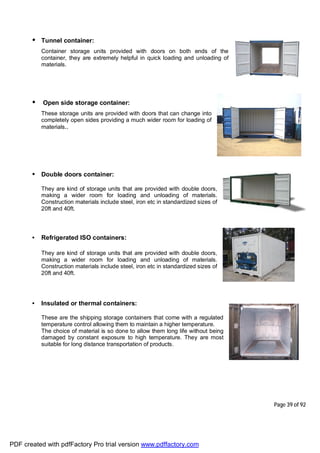
• Tunnel container:
Container storage units provided with doors on both ends of the
container, they are extremely helpful in quick loading and unloading of
materials.
• Open side storage container:
These storage units are provided with doors that can change into
completely open sides providing a much wider room for loading of
materials..
• Double doors container:
They are kind of storage units that are provided with double doors,
making a wider room for loading and unloading of materials.
Construction materials include steel, iron etc in standardized sizes of
20ft and 40ft.
• Refrigerated ISO containers:
They are kind of storage units that are provided with double doors,
making a wider room for loading and unloading of materials.
Construction materials include steel, iron etc in standardized sizes of
20ft and 40ft.
• Insulated or thermal containers:
These are the shipping storage containers that come with a regulated
temperature control allowing them to maintain a higher temperature.
The choice of material is so done to allow them long life without being
damaged by constant exposure to high temperature. They are most
suitable for long distance transportation of products.
PDF created with pdfFactory Pro trial version www.pdffactory.com
Page 40 of 92
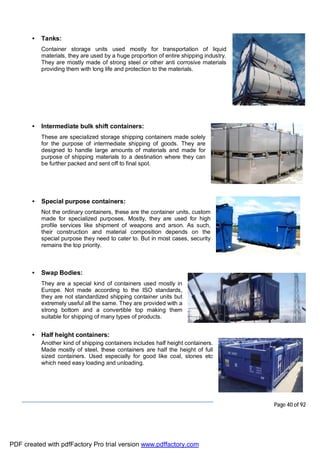
• Tanks:
Container storage units used mostly for transportation of liquid
materials, they are used by a huge proportion of entire shipping industry.
They are mostly made of strong steel or other anti corrosive materials
providing them with long life and protection to the materials.
• Intermediate bulk shift containers:
These are specialized storage shipping containers made solely
for the purpose of intermediate shipping of goods. They are
designed to handle large amounts of materials and made for
purpose of shipping materials to a destination where they can
be further packed and sent off to final spot.
• Special purpose containers:
Not the ordinary containers, these are the container units, custom
made for specialized purposes. Mostly, they are used for high
profile services like shipment of weapons and arson. As such,
their construction and material composition depends on the
special purpose they need to cater to. But in most cases, security
remains the top priority.
• Swap Bodies:
They are a special kind of containers used mostly in
Europe. Not made according to the ISO standards,
they are not standardized shipping container units but
extremely useful all the same. They are provided with a
strong bottom and a convertible top making them
suitable for shipping of many types of products.
• Half height containers:
Another kind of shipping containers includes half height containers.
Made mostly of steel, these containers are half the height of full
sized containers. Used especially for good like coal, stones etc
which need easy loading and unloading.
PDF created with pdfFactory Pro trial version www.pdffactory.com
Page 41 of 92
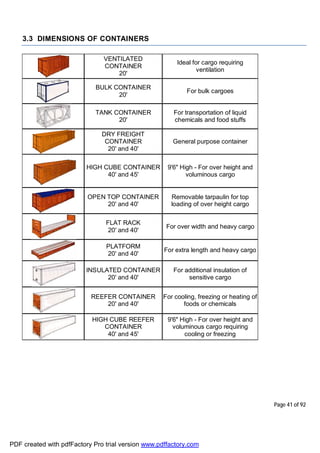
3.3 DIMENSIONS OF CONTAINERS
VENTILATED
CONTAINER
20'
Ideal for cargo requiring
ventilation
BULK CONTAINER
20'
For bulk cargoes
TANK CONTAINER
20'
For transportation of liquid
chemicals and food stuffs
DRY FREIGHT
CONTAINER
20' and 40'
General purpose container
HIGH CUBE CONTAINER
40' and 45'
9'6" High - For over height and
voluminous cargo
OPEN TOP CONTAINER
20' and 40'
Removable tarpaulin for top
loading of over height cargo
FLAT RACK
20' and 40'
For over width and heavy cargo
PLATFORM
20' and 40'
For extra length and heavy cargo
INSULATED CONTAINER
20' and 40'
For additional insulation of
sensitive cargo
REEFER CONTAINER
20' and 40'
For cooling, freezing or heating of
foods or chemicals
HIGH CUBE REEFER
CONTAINER
40' and 45'
9'6" High - For over height and
voluminous cargo requiring
cooling or freezing
PDF created with pdfFactory Pro trial version www.pdffactory.com
Page 42 of 92
3.4 IMPORT
3.4.0 Import General Manifest (IGM)
The import general manifest is a mandatory document to be filled by the person/ entity/ agents in-charge of a
foreign vessel reaching a port or any such facility of another country. Import general manifest is required to be
filed within 24 hours of arrival of the vessel in the customs station (the port of arrival). In case of imports by
ship, manifest may be delivered even before the arrival of the vessel. A manifest means the list of items or
goods in customs parlance. The idea behind the IGM is that the cargo intended for unloading in a specific port
of arrival is needed discharged and accurately reported.
3.4.1 Bill of Entry
This is a very vital and important document which every importer has to submit.
The Bill of Entry should be in prescribed form. The standard size of Bill of Entry is 16" × 13". However, for
computerization purposes, 15" × 12" size is permitted.
PDF created with pdfFactory Pro trial version www.pdffactory.com
Page 43 of 92
Bill of Entry should be submitted in quadruplicate – original and duplicate for customs, triplicate for the importer
and fourth copy is meant for bank for making remittances.
Under EDI system, Bill of Entry is actually printed on computer in triplicate only after ‘out of charge’ order is
given. Duplicate copy is given to importer.
Types of Bill of Entry
Bills of Entry should be of one of three types. Out of these, two types are for clearance from customs while third
is for clearance from warehouse.
BILL OF ENTRY FOR HOME CONSUMPTION - This form, called ‘Bill of Entry for Home Consumption’, is
used when the imported goods are to be cleared on payment of full duty. Home consumption means use within
India. It is white coloured and hence often called ‘white bill of entry’.
BILL OF ENTRY FOR WAREHOUSING - If the imported goods are not required immediately, importer may
like to store the goods in a warehouse without payment of duty under a bond and then clear from warehouse
when required on payment of duty.
This will enable him to defer payment of customs duty till goods are actually required by him. This Bill of Entry
is printed on yellow paper and often called ‘Yellow Bill of Entry’. It is also called ‘Into Bond Bill of Entry’ as bond
is executed for transfer of goods in warehouse without payment of duty.
Filing of Bill of Entry
Normally, Bill of Entry is filed by CHA on behalf of the importer. Customs work at some ports has been
computerized. In that case, the Bill of Entry has to be filed electronically, i.e. through Customs EDI system
through computerization of work.
3.4.2 Documents to be submitted by Importer
Documents required by customs authorities are required to be submitted to enable them to
• Check the goods
• Decide value and classification of goods
• To ensure that the import is legally permitted. The documents that are essentially required are :
• Invoice
• Packing List
• Bill of Lading / Delivery Order
• GATT declaration form duly filled in
• Importers / CHAs declaration duly signed
• Import Licence or attested photocopy when clearance is under licence
• Letter of Credit / Bank Draft wherever necessary
• Insurance memo or insurance policy
• Industrial License if required
• Certificate of country of origin, if preferential rate is claimed.
• Technical literature.
• Test report in case of chemicals
• Advance License / DEPB in original, where applicable
PDF created with pdfFactory Pro trial version www.pdffactory.com
Page 44 of 92
• Split up of value of spares, components and machinery
• No commission declaration. – A declaration in prescribed form about correctness of information
should be submitted.
3.4.3 Assessment of Customs duty
Assessment of goods will be made after Bill of Entry is filed. Date stamp of receipt is put on the ‘Bill of Entry’
and then it is sent to appraising department either manually or electronically
APPRAISING THE GOODS -Appraiser has to
(a) Correctly classify the goods
(b) Decide the Value for purpose of Customs duty
(c) Find out rate of duty applicable as per any exemption notification and
(d) Verify that goods are not imported in violation of any law. He can call for any further documents that may be
required for assessment. If he is of the opinion that goods have to be examined for appraisal, he will issue an
examination order, usually on the reverse of Bill of Entry. If such order is issued, the Bill of Entry is presented to
appraising staff at docks / air cargo complexes, where the goods are examined in presence of importer’s
representative.
VALUATION OF GOODS
As per rule of Customs Valuation Rules, the importer has to file declaration about full 'value' of goods. If the
assessing officer has doubts about the truth and accuracy of 'value' as declared, he can ask importer to submit
further information, details and documents.
If the doubt persists, the assessing officer can reject the value declared by importer. If the importer requests,
the assessing officer has to give reasons for doubting the value declared by importer, If the value declared by
importer is rejected, the assessing officer can value imported goods on other basis e.g. value of identical
goods, value of similar goods etc. as provided in Customs Valuation Rules.
Assessing Officer should not arbitrarily reject the declared value and increase the assessable value. He should
follow due process of law and issue appealable order.
APPROVAL OF ASSESSMENT
The assessment has to be approved by Assistant Commissioner, if the value is more than Rs one lakh. (In
cases covered under ‘fast track clearance for imports’, appraiser is also authorized to approve valuation). After
the approval, duty payable is typed by a “pin-point typewriter” so that it cannot be tampered with. Assessing
Officer should sign in full in Bill of Entry followed by his name, preferably by rubber stamp.
PAYMENT OF CUSTOMS DUTY –
After assessment of duty, necessary duty is paid. Regular importers and Custom House Agents keep current
account with Customs department. The duty can be debited to such current account, or it can be paid in
cash/DD through TR-6 challan in designated banks.
After payment of duty, if goods were already examined, delivery of goods can be taken from custodians (port
trust) after paying their dues. If goods were not examined before assessment, these have to be submitted for
examination in import shed to the examining staff. After shed appraiser gives ‘out of charge’ order, delivery of
goods can be taken from custodian.
PDF created with pdfFactory Pro trial version www.pdffactory.com
Page 45 of 92
EXAMINATION OF GOODS –
Examiners carry out physical examination and quantitative checking like weighing, measuring etc. Selected
packages are opened and examined on sample basis in ‘Customs Examination Yard’. Examination report is
prepared by the examiner.
The importer/exporter has to furnish guarantee/security as required by Customs Officer for payment of
difference if any.
Goods can be cleared after payment of duty provisionally assessed and after providing the security.
After final assessment, difference is paid by importer or refunded to him as the case may be.
If the imported goods were warehoused after provisional assessment, the Customs Officer may require
importer to execute a bond for twice the difference in duty, if duty finally assessed is higher. The bond is called
as Provisional Duty Bond. The bond is with security or surety. Bank guarantee can also be given as a security.
Checking of duty drawback / license documents -Documents in respect of Duty Entitlement Pass Book (DEPB),
advance license, duty drawback etc. will be checked.
Execution of bond and payment of duty -Once the duty is assessed, the bill of entry is returned to importer.
The Bill of Entry should be presented to comptist for calculation and pinpointing of the duty. If bond has to be
executed, it will be taken in bond section.
OUT OF CUSTOMS CHARGE ORDER
After goods are examined, it is verified that import is not prohibited and after customs duty is paid, Customs
Officer will issue ‘Out of Customs Charge’ order. Goods can be cleared from customs area only on receipt of
such order.
Demurrage if goods not cleared -Heavy demurrage is payable if goods are not cleared from port within three
days
3.5 EXPORT
PDF created with pdfFactory Pro trial version www.pdffactory.com
Page 46 of 92
3.5.0Export General Manifest
— The Export General Manifest is a complete list of all items the conveyance carries on board, including
those to be transshipped and those to be carried to the subsequent ports of call.
— Thereby, entity in charge of conveyance (shipping agent) of carrying exported goods should hand over,
within 24 hours of arrival of conveyance, an export general manifest to the customs.
— When cargo is exported by seaair route, the declaration is termed as Export General Manifest (EGM).
— The EGM is submitted by shipping linesagent to officer of customs, called Inspector of EGM.
3.5.1 Shipping Bill
— Shipping bill is a main and important customs document, required by customs authorities for granting
permission for shipment of goods.
— The cargo can be moved inside dock area only after shipping bill is duly signed, stamped and certified
by customs.
Types of Shipping Bill
— Shipping Bill of exports without any export incentive (OGL- Open General License)
— Shipping Bill of export for dutiable goods
— Shipping Bill of exports with DEPB Claim
— Shipping Bill of exports with Duty Drawback Scheme
— Shipping Bill of exports under DEEC/EPCG/DFIA Scheme
— Shipping Bill of Ex-bond exportation.
PDF created with pdfFactory Pro trial version www.pdffactory.com
Page 47 of 92
Contents of Shipping Bill
— CHA Details
— Exporter’s Details (Exporter License No.) (i.e. IEC & BIN with name & address)
— Importer’s details (Name & Address) (Consignee)
— Port of loading
— Port of discharge
— Goods description – Quantity, Quality, Country of Origin etc
— Value of goods
— H S N Code of goods
— Applicability of export duty (if any)
— Permissibility of export incentive in terms of DEPB/Duty Drawback etc.
— Details of effective customs notifications for duty calculation
— Ocean Freight, Insurance, Commission, Discount.
— Applicable Exchange Rate
3.5.2 Commercial Invoice
— Commercial Invoice is prepared by exporter after execution of export order giving details about the
goods to be shipped. It is actually seller’s bill of merchandise as it contains all the information required
for the preparation of other documents.
— It is essential that the invoice is prepared in the name of buyer or consignee mentioned in the Purchase
Order / Letter of Credit. It is a prima facie evidence of the contract of sale or purchase and therefore,
must be prepared strictly in accordance with contract of sale.
Contents of Commercial Invoice:
— Exporter details
— Consignee details
— Vessel details
— Load port
— Discharge port
— Invoice no. and date
— Country of origin
— Country of final destination
— Terms of delivery and payment
— Packing description
— Signature of exporter with date
3.5.3 Bill of Lading
— Bill of lading is a document issued by shipping companyagent acknowledging receipt of goods on
board the vessel & undertaking to deliver goods in like order & condition as received to consignee,
provided the freight and other charges specified in bill of lading are duly paid.
— It’s also a document of title of goods and is free transferable by endorsement and delivery.
Significance of Bill of Lading to Exporter
— Acknowledgment indicating that goods mentioned in document have been received on board for
purpose of shipment.
PDF created with pdfFactory Pro trial version www.pdffactory.com
Page 48 of 92
— Exporter can claim damages from shipping company if goods are lost damaged after issue of clean bill
of lading.
Significance of Bill of Lading for Importer
— It acts as a document of title to goods which is transferable by endorsement & delivery.
— Bill of lading sent by exporter to importer OR importer’s bank (as the terms agreed between both
parties) enables him to take delivery of goods.
Contents of Bill of Lading:
— Name & logo of shipping line
— Shipper’s details
— Consignee details
— Name of vessel and vessel no.
— Load port
— Discharge port
— Goods marking  Container No.
— Packing List
— Goods description (quantity)
— Goods weight
— Amount of freight payable to charter party
— Shipping bill no. (Date & Place)
— Signature and initials of Chief Master/agents, ensuring the goods are loaded in apparent good order.
3.5.4 Packing List
The exporter prepares packing list to facilitate the buyer check the shipment. It contains detailed description of
goods packed in each case and gross weight.
3.5.5 Certificate of Origin
— The certificate of origin states that goods exported are originally manufactured in country whose name
is mentioned in certificate.
— It helps buyer in adhering to import regulations of the country.
— On the basis of declaration made by exporter, local Chamber of Commerce or Export Inspection Agent
regulated by ministry of commerce and industry duly after verification of facts.
3.5.6 Certificate Of Sampling & Analysis
— This document ensures that cargo loaded by exporter is of right quality and specifications as per
mentioned by exporter in commercial invoice.
— This inspection can be done by any independent or buyer-nominated inspection agency prior to loading.
Contents of Certificate of Sampling & Analysis
— Exporter details
— Consignee details
PDF created with pdfFactory Pro trial version www.pdffactory.com
Page 49 of 92
— Vessel details
— Load port
— Discharge port
— Goods description
— Samples
— Type of tests
— Analysis results in terms of percentage and acceptable norms
— Letter of credit number
— Signed and certified by inspection agency.
3.5.7 Certificate Of Weight
— This document certifies that following cargo is in such particular quantity, after loading on vessel.
Contents
— Vessel details
— Shipper details
— Consignee details
— Load port
— Discharge port
— Cargo description
— Weighing method
3.5.8 Letter Of Credit
Letter of credit is a document issued by the importer’s bank in favour of exporter giving him authority to draw
bills up to a particular amount (as per contract price) covering specified shipment of goods and assuring him of
payment against the delivery of shipping documents.
Parties to Letter of Credit
— Applicant or Opener
— The buyer or importer opens the letter of credit through his bank in favour of exporter.
— Beneficiary
— Beneficiary is the exporter of goods in whose favour the letter of credit is opened by importer through
his bank.
— Issuing bank
— Importer’s bank issues letter of credit in favour of exporter on request of importer.
— Advising bank
— The branch of issuing bank situated in exporter’s country.
— Confirming bank
— It is the bank situated in exporter’s country which guarantees credit on request of issuing bank.
Generally, advising bank and confirming bank are the same.
— Negotiating bank (It is bank situated in exporter’s country through which documents are negotiated by
exporters, i.e. exporter’s bank.)
Terms & Conditions in Letter of Credit
— Received from (Issuing bank)
— Advising bank
— Form of documentary credit (IrrevocableRevocable)
PDF created with pdfFactory Pro trial version www.pdffactory.com
Page 50 of 92
— Letter of Credit number
— Date and Place of Expiry
— Applicant details
— Beneficiary details
— Amount
— Transshipment provision
— Load port
— Discharge port
— Latest shipment date
— Goods description
3.5.9 Export Procedures
Procedures have to be followed by (a) ‘person-in-charge of conveyance’ and (b) the exporter. The procedures
are similar to procedures for import, of course, in reverse direction.
Procedures by person in charge of conveyance – Any new airline, shipping line, steamer agent should be
registered in Customs Systems for electronic processing of shipping bills etc.
The ‘person in charge of conveyance’ has to follow prescribed procedures.
• Entry outward
The vessel should be granted ‘Entry Outward’. Loading can start only after entry outward is granted.
Steamer Agents can file ‘application for entry outwards’ 14 days in advance so that intending exporters
can start submitting ‘Shipping Bills’. This ensures that formalities are completed as quickly as possible
and loading in ship starts quickly.
• Loading with permission
Export goods can be loaded only after Shipping Bill or Bill of Export, duly passed by Customs Officer is
handed over by Exporter to the person-in-charge of conveyance. In case of baggage and mail bags,
shipping bill is not necessary, but permission of Customs Officer is required.
Procedures to be followed by Exporter
Every exporter should take following initial steps -–
• Obtain BIN (Business Identification Number) from DGFT. It is a PAN based number
• Open current account with designated bank for credit of duty drawback claims
• Register licenses / advance license / DEPB etc. at the customs station, if exports are under Export
Promotion Schemes .
• Exporter has to submit ‘shipping bill’ for export by sea or air and ‘bill of export’ for export by road. Goods
have to be assessed for duty, even if no duty is payable for most of exports, as ‘Nil Duty’ assessment is
also an assessment.
Other documents required for export
• Four copies of Commercial Invoice
• Four copies of Packing List
• Certificate of Origin or pre-shipment inspection where required
• Insurance policy.
• Letter of Credit
• Declaration of Value
PDF created with pdfFactory Pro trial version www.pdffactory.com
Page 51 of 92
• Excise ARE-1/ARE-2 form as applicable
• GR / SDF form prescribed by RBI in duplicate (i) Letter showing BIN Number.
3.6 PAYMENT TERMS
Method Usual time of
payment
Goods
available to
buyer
Risk to
seller
Risk to buyer Comments
Cash on
advance
Before Shipment. After shipment. None. Complete, relies
on sell to ship
exactly the goo
expected as
quotes and
ordered.
Seller’s goods
are unique or
special
circumstances
exist.
Letter of
credit
Commercial
invoice must
match the
L/C exactly.
Dates much
be carefully
headed stale
document are
unacceptable
for collection.
Requires total
accuracy
conforming to
terms ,
conditions
and
documents.
Confirmed
irrevocable
credit
Documents are
presented to the
bank after
shipment in
made.
After Payment Seller has
double
assurance of
payment
.Dependant
on the terms
of the L/C.
Assures
shipment is
made but still
relies on
exporter to ship
goods as
described in
documentation.
Terms may be
negotiation prior
to L/C
agreement,
alleviating
buyer’s degree
of risk.
Adds
assurance
that the
issuing bank
has been
deemed
acceptable by
the confirming
bank adds
cost and an
additions
requirement
to the seller.
Unconfirmed
irrevocable
credit
Documents are
presented to the
bank after
shipment in
After Payment Seller has
single bank
assurance of
payment and
remains
Assures
shipment is
made but still
relies on
exporter to ship
Credit can
only be
changed by
mutual
agreement,
PDF created with pdfFactory Pro trial version www.pdffactory.com
Page 52 of 92
made. dependent on
foreign bank.
Seller should
determine if
issuing bank
has sufficient
assets to
cover the
amount,
goods as
described in
documentation.
Terms may be
negotiation prior
to L/C
agreement,
alleviating
buyer’s degree
of risk.
as stipulates
in the sales
agreement.
Open account
with buyer’s
bank may
have
problems
making
payment in
sum or
timelines.
Drafts Remittance time
from buyer’s
bank to seller’s
bank may take
one week to one
month.
Drafts should
contain terms
and
conditions
mutually
agreed upon.
A draft may
be written
with virtually
any term or
condition
agreeable to
both parties.
When
determining
draft tenor
banker and
freight
forwarder
should be
consulted to
determine
most
desirable
means of
doing
business in
given country.
Sight draft Upon
presentation of
draft to buyer.
After payment to
buyer’s bank.
If draft not
honored
goods must
be returned
of resold.
Storage,
handling and
return freight
expenses
may be
incurred.
May be a
collection
instrument
used to
exchange
possession.
Seller is
essentially
drawing
check against
the bank
account of the
PDF created with pdfFactory Pro trial version www.pdffactory.com
Page 53 of 92
buyer.
Buyer’s banks
must have
pre-approval,
or seek
approval of
the buyer
prior to
honoring the
check.
Payable upon
presentation
documents.
Time draft
(with
documents
against
acceptance)
Upon
presentation of
draft to buyer.
Before payment,
after
acceptance.
Relies on
buyer to
honor draft
upon
presentation.
Assures
shipment but
not content.
Time of maturity
allows for
adjustment, if
agreed to by the
seller.
Payable
based upon
the
acceptance of
an obligation
to pay the
seller at a
specified
time.
Although a
time draft has
more
collection
leverage than
an invoice it
remains only
a promissory
note with
conditions.
OPEN
ACCOUNT.
As agreed,
usually by
invoice.
Before payment. Complete,
seller relies
completely on
buyer to pay
account as
agreed.
None All terms of
payment
including
extra charges
and terms
should be
mutually
understood
and agreed
upon prior to
open account
initiation.
Companies
conducting
PDF created with pdfFactory Pro trial version www.pdffactory.com
Page 54 of 92
ongoing
business are
candidates for
open account
terms of
payment.
Seller must
measure not
only the
buyer’s credit
reliability, but
the country’s
as well.
3.7 IEC Code (Import-Export Code)
IEC Code is unique 10 digit code issued by DGFT – Director General of Foreign Trade , Ministry of Commerce,
and Government of India to Indian Companies.
New IEC Code application norm for registration with DGFT: Any bonafide Individual or entity wanting to export
or import any goods more than the value of INR 25,000 should obtain valid IE Code i.e. Importer Exporter
Code popularly referred as IEC Number or Mistakenly as IEC Code from DGFT in India.
Any Indian citizen or entity such as registered partnership firm, LLP, Pvt. Ltd., Company or Limited company
can apply to Director General of Foreign Trade online and receive IE Code. Supporting Documents are
required to be submitted in hard copy at any of zonal offices of DGFT.
Full form of IEC Code
Full From of IEC Code is: “Importer Exporter Code ”. To import or export in India, IEC Code is mandatory. No
person or entity shall make any Import or Export without IEC Code Number.
IEC Code No Notification
Directorate General of Foreign Trade (DGFT) issued a Policy Circular No.15 (RE-2006)/2004-2009 Date: 27th
July, 2006) for New System for issuance of Importer-Exporter Code Number.
Eligibility, Legal Provisions and Conditions for IEC Code Number
Eligibility condition and Legal Provisions are given for IEC Code Number Application in Foreign Trade
(Regulation) Rules, 1993 Ministry of Commerce, and Notification No. GSR 791 (E), dated 30-12-1993.
Application for Grant of IEC Number
An application for grant of IEC number shall be made by the Registered/Head Office of the applicant and apply
to the nearest Regional Authority of Directorate General Foreign Trade, the Registered office in case of
company and Head office in case of others, falls in the ‘AayaatNiryaat Form - ANF2A’ and shall be
accompanied by documents prescribed therein. In case of STPI/ EHTP/ BTP units, the Regional Offices of the
PDF created with pdfFactory Pro trial version www.pdffactory.com
Page 55 of 92
DGFT having jurisdiction over the district in which the Registered/ Head Office of the STPI unit is located shall
issue or amend the IECs.
Only one IEC would be issued against a single PAN number. Any proprietor can have only one IEC number
and in case there are more than one IECs allotted to a proprietor, the same may be surrendered to the
Regional Office for cancellation
.
Validity of IEC Code No
An IEC number allotted to an applicant shall be valid for all its branches/divisions/units/factories as indicated in
the format of IEC given in Appendix- 18B.
Duplicate Copy of IEC Number
Where an IEC Number is lost or misplaced, the issuing authority may consider requests for grant of a duplicate
copy of IEC number, if accompanied by an affidavit. Surrender of IEC Number If an IEC holder does not wish
to operate the allotted IEC number, he may surrender the same by informing the issuing authority. On receipt
of such intimation, the issuing authority shall immediately cancel the same and electronically transmit it to
DGFT for onward transmission to the Customs and Regional Authorities.
Particular Amount
Within local area 20 Rs.
Up to 200 kms 25 Rs.
Between 200 to 1000 kms 30 Rs.
Beyond 1000 kms 50 Rs.
IEC No: Exempted Categories
1. Importers covered by clause 3 (1) [except sub-clauses (e) and (l)] and exporters covered by clause 3(2)
[except sub-clauses (i) and (k)] of the Foreign Trade (Exemption from application of Rules in certain
cases) Order, 1993.
2. Ministries/Departments of the Central or State Government.
3. Persons importing or exporting goods for personal use not connected with trade or manufacture or
agriculture.
4. Persons importing/exporting goods from/to Nepal provided the CIF value of a single consignment does
not exceed Indian Rs.25,000.
5. Persons importing/exporting goods from/to Myanmar through Indo-Myanmar border areas provided the
CIF value of a single consignment does not exceed Indian Rs.25,000.
However, the exemption from obtaining Importer-Exporter Code (IEC) number shall not be applicable
for the export of Special Chemicals, Organisms, Materials, Equipments and Technologies (SCOMET)
as listed in Appendix- 3, Schedule 2 of the ITC(HS) except in the case of exports by category(ii) above.
6. The following permanent IEC numbers shall be used by the categories of importers/ exporters
mentioned against them for import/ export purposes..
PDF created with pdfFactory Pro trial version www.pdffactory.com
Page 56 of 92
Mandatory Requirements to apply for IEC Code Number
1. PAN Number
2. Current Bank Account
3. Bankers Certificate
4. IEC Code Number Application FeeRs 250.00 (Expert TIP : Pay via EFT (Electronic und Transfer ), and
submit IEC Online Application form, If you wish to receive IEC Number instantly)
5. The physical application containing required documents should reach DGFT RLA concerned within 15
days of its online submission.
6. E-mail is not mandatory. If it is provided it will facilitate faster communication.
Check List of Documents to apply for IEC Code
1. Covering Letter on your company's letter head for issue of new IEC Code Number.
2. Two copies of the application in prescribed format must be submitted to your regional Jt.DGFT Office.
3. Each individual page of the application has to be signed by the applicant.
4. Part 1 & Part 4 has to be filled in by all applicants. In case of applications submitted electronically.
5. No hard copies of Part 1 may be submitted. However in cases where applications are submitted
otherwise, hard copy of Part 1has to be submitted.
6. Only relevant portions of Part 2 need to be filled in.
7. Rs 250.00 Bank Receipt (in duplicate)/Demand Draft/EFT details evidencing payment of application fee
in terms of
8. Certificate from the Banker of the applicant firm in the format given in
9. Self certified copy of PAN issuing letter or PAN (Permanent Account Number) Card issued by Income
Tax Authority.
10. Two copies of passport size photographs of the applicant duly attested by the Banker of the applicant.
11. Self addresses envelope with Rs.25/- postal stamp for delivery of IEC certificate by registered post or
challan/DD of Rs.100/- for speed post.
3.8 HS CODE (HARMONIZED SYSTEM)
The Harmonized Commodity Description and Coding System (HS) of tariff nomenclature is an internationally
standardized system of names and numbers for classifying traded products developed and maintained by
the World Customs Organization (WCO) (formerly the Customs Co-operation Council), an independent
intergovernmental organization with over 170 member countries based in Brussels, Belgium.
3.8.0 Structure
Under the HS Convention, the contracting parties are obliged to base their tariff schedules on the HS
nomenclature, although parties set their own rates of duty. The HS is organized into 21 sections and 96
chapters, accompanied with general rules of interpretation and explanatory notes. The system begins by
assigning goods to categories of crude and natural products, and from there proceeds to categories with
increasing complexity. The codes with the broadest coverage are the first four digits, and are referred to as the
heading. The HTS therefore sets forth all the international nomenclature through the 6-digit level and, where
needed, contains added subdivisions assigned 2 more digits, for a total of 8 at the tariff-rate line (legal) level.
Two final (non-legal) digits are assigned as statistical reporting numbers if warranted, for a total of 10 digits to
be listed on entries.
PDF created with pdfFactory Pro trial version www.pdffactory.com
Page 57 of 92
To ensure harmonization, the contracting parties must employ all 4- and 6-digit provisions and the international
rules and notes without deviation, but are free to adopt additional subcategories and notes. The two final
chapters, 98 and 99, are reserved for national use. Chapter 77 is reserved for future international use only.
Chapter 98 comprises special classification provisions, and chapter 99 contains temporary modifications
pursuant to a parties' national directive or legislation.
3.8.1 Classification.
All existing products can be classified into the existing HS utilizing the General Rules of Interpretation. This
structure allows for placement through research of the products form and function. An example of the former
would be whole potatoes, while an example of the latter would be a resistance heated electric oven
The classification will change depending on whether the potatoes are fresh or frozen. Fresh potatoes are
classified in position 0701.90, under the Header Potatoes, fresh or chilled, Sub header Other, while frozen
potatoes are classified in position 0710.10 under the Header Vegetables (uncooked or cooked by steaming or
boiling in water), frozen, Sub header Potatoes.
The classification for an electric oven depends on whether the oven is for domestic or industrial use. An electric
oven for domestic use is classified in position 8516.60 under the Header Electric instantaneous or storage
water heaters and immersion heaters; electric space heating apparatus and soil heating apparatus;
electrothermic hairdressing apparatus and hand dryers; electric flatirons; other electrothermic appliances of a
kind used for domestic purposes; electric heating resistors, other than those of heading 8545; parts thereof,
Sub header Other ovens; cooking stoves, ranges, cooking plates, boiling rings, grillers and roasters.
Industrial electric ovens are classified in position 8514.10 under the Header Industrial or laboratory electric
furnaces and ovens (including those functioning by induction or dielectric loss); other industrial or laboratory
equipment for the heat treatment of materials by induction or dielectric loss; parts thereof, Sub
header Resistance heated furnaces and ovens .
This applies to all products for classification and is able to accept new products for which there is no current
classification through the use of the Other classification. This term encompasses all products of the nature in
which the Header and Sub header describe.
The potatoes in the first example fall into this category, as they can also describe genetically-
modified potatoes, which were not available during the elaboration of the first HTS.
3.8.2 Importance
When you do international business, it is your responsibility to make sure your customs broker uses the correct
Harmonized System (HS) code for your declaration. For the past two years, I’ve noticed that too often
companies think their customs broker will do the job for them. This mistake could cost you money and reduce
your credibility with your international customers. To avoid this type of mistake, I suggest you do your
homework and make sure you perfectly understand the meaning of the HS code you use to export. After all,
you’re the expert when it comes to your product. Some basic information on how to find the HS code is
exposed below.
The HS is the international standard for reporting goods to customs and other government agencies. It is a
numeric language that is used by more than 190 countries worldwide. The classification determines a product’s
rate of duty, its import and export admissibility, and whether or not it should be physically examined. The HS
was created and is administered by the Brussels-based World Customs Organization (WCO). The first 6 digits
of an HS code indicate the same product description for all 190 countries, but that does not mean that the rates
of customs duties are the same. There are over 5,000 groups of 6-digit codes.
PDF created with pdfFactory Pro trial version www.pdffactory.com
Page 58 of 92
The HS code is also used to establish the basic rules of various trade agreements such as NAFTA. You might
find it difficult to complete the form if you don’t know the coding of your merchandise.
It is important to note that the HS is constantly evolving. The last version was updated in 2007 and the next
reform of the Harmonized System will be issued in January 2012. The main reasons for those changes are due
to new trade partners and the evolution of new technologies.
3.9 CUSTOM HOUSE AGENT (CHA)
Customs House Agent (CHA) is a person who is licensed to act as an agent for transaction of any business
relating to the entry or departure of conveyances or the import or export of goods at any Customs station.
No person is authorized to carry on business of Clearing House Agent unless he has obtained license under
section 146 of the Customs Act, 1962 in accordance with these regulations. But following persons are excluded
from the requirement of a Clearing House Agent License:
• An importer or exporter transacting any business at a customs station solely on his own account;
• Any employee of any person or a firm transacting business generally on behalf of such person or firm,
and holding an identity card or a temporary pass issued by the Deputy Commissioner of customs or
Assistant commissioner of customs.
• An agent employed for one or more vessels or aircrafts in order solely to enter or clear such vessels or
aircrafts for work incidental to this as such agent.
Qualifications/Conditions:
Any individual person or a firm or a company can seek license for working as a Clearing House Agent. When
the applicant is a firm or a company then the director, managing director, manager or the duly authorized
employee, who will actually be engaged in the clearance of goods or conveyances through the customs on
behalf of such firm or the company is required to fulfill the eligibility qualifications/conditions prescribed under
the regulations.
The prescribed qualifications/conditions for an applicant are:
1. Graduate from a recognized University
2. Has (a) a professional degree of C.A., M.B.A. or L.L.B. (only these degree are recognized for purpose of
grant of license and not any other professional degree as clarified by Government vide Customs Circular
No- 42 dated 10.6.2004) or
(b) a Diploma in customs clearance work from any Institute or university recognized by the Government with
working knowledge of computers and customs procedures, or
(c) is a graduate having at least three years experience in transacting custom House Agent work as a G-Card
holder
(d) or has passed the examination referred to in regulation 8 or is a retired Group 'A' officer from the Indian
customs and central Excise service (IC&CES) having a minimum of ten years experience in Group 'A.
PDF created with pdfFactory Pro trial version www.pdffactory.com
Page 59 of 92
3. Applicant has financial viability supported by a certificate issued by a scheduled Bank or such other proof
acceptable to the Commissioner of customs evidencing possession of assets of value of not less than Rs.
2 lakhs
4. The applicant is a citizen of India (Regulation 6)
Application for License:
The Commissioner of Customs is authorized to invite applications for grant of license during month of January
only.
The application has to be made in Form A as prescribed by the Regulations.
Where the applicant is a firm the application should include
(a) the name and address of every partner of the firm, the firm's name, and (b) the name of the partner or the
duly authorized employee, who will actually be engaged in the clearance of goods or conveyances through the
customs.
Where the applicant is a company the application should include the
(a) the name of each director, managing director, manager, and(b) the names of director, managing director,
manager or the duly authorised employee, who will actually be engaged in the clearance of goods or
conveyancesthrough
the customs.
Examination of the Applicant:
The applicant fulfilling the eligibility conditions stated above is required to appear in an examination conducted
by the Commissioner of Customs in whose jurisdiction the application has been made.
1. the applicant is required to appear in written an oral examinations.
2. only those applicants who pass the written exam are allowed to appear for oral exam i.e. interview.
3. only those candidates who pass both the written and oral exams will be granted license
4. an applicant who has passed written exam but failed in oral exam is allowed to appear and pass the oral
exam within two years of his passing the written exam irrespective of number of attempts
5. applicant is allowed a period of 7 (seven) years to appear and pass the written and oral exams from the
date of making the application
Grant of License:
An applicant who has passed the written and oral exams as stated above will be granted license in Form B by
the Commissioner of Customs in whose jurisdiction the application was made on payment of Rs. 5000.
The applicant who has been granted license by the Commissioner is allowed to work at all custom stations
within the country provided intimation has been made in Form C to the Commissioner of Customs of the
custom station where the licensee intends to transact the business. No separate license is required in places
where in addition to a Customs House handling imports by sea, there is also an International airport to handle
imports by air, even if under the jurisdiction of a different Commissioner of Customs
Execution of Bond:
PDF created with pdfFactory Pro trial version www.pdffactory.com
Page 60 of 92
Before the license is granted the applicant is required to enter into a bond in Form D and a surety bond in Form
E for due observance of the Customs House Agents Licensing Regulations, 2004. and is also required to
furnish a bank guarantee, postal security or National Savings Certificate in the name of the Commissioner of
Customs for an amount of Rs. 50,000/- for carrying out of business as a Customs House Agent
Validity of Bond:
A license granted under regulation 9 is valid for a period of ten years from the date of issue of such license.
Such a license is not transferable to any other person.
3.10 HIGH SEA SALES (HSS)
1. High Sea sales (HSS) is a sale carried out by the carrier document consignee to another buyer while
the goods are yet on high seas or after their dispatch from the port/ airport of origin and before their
arrival at the port / airport of destination.
2. HSS is accepted under the import trade control regulation. Refer para - of export import policy.
3. HSS contract/ agreement should be signed after dispatch of goods from origin & prior to their arrival at
destination. The agreement should be on stamp paper.
4. On concluding the HSS agreement, the B/L should be endorsed in favour of the new buyer. In respect
of air shipment, HSS seller should write to the airline / consol agent informing that a HSS agreement
has been established with the HSS buyer and that the carrier document should therefore be considered
as endorsed in favour of the HSS buyer and further the IGM should be filed by the carrier in the name
of the HSS buyer.
5. If the EDI system allows name of HSS buyer to be entered in the system, then there may not be any
need to amend the IGM. In this case the B/E is filed in the name of the original importer as the IGM is in
this importer name. However , the B/E shows the name of HSS buyer under a separate head in the B/E
format. If the system has no provision for showing the name of HSS buyer on the B/E ,then the IGM
should be got amended and B/E filed in the name of the HSS buyer.
6. In the case of HSS , the CIF value for calculation of duty is taken to be the HSS value.
7. There is practice followed in customs that in case the HSS transfer takes place at import invoice value
only , the custom would add 4% of CIF value as HSS loading factor . There have been cases where
HSS sellers have sold at two percent more than import CIF but custom have added 4% of CIF as HSS
value addition. Such practice of customs can be challenged at the customs duty is chargeable on
genuine transaction value.
8. In HSS contracts the HSS seller may not like to disclose the import value to the HSS buyer. However,
the customs can call for the original import invoice, in which case the HSS seller may have to part with
this information. To overcome this, HSS seller should take on the responsibility of custom clearance
and site delivery. After custom clearance, the HSS seller could withdraw import invoices and only hand
over clearance documents with HSS agreement to the HSS buyer. The custom bill of entry does not
indicate original import value and is prepared on HSS value.
9. There is no bar on same goods being sold more than once on high seas. In such cases, the last HSS
value is taken by customs for purposes of duty levying. The last HSS agreement should give indication
PDF created with pdfFactory Pro trial version www.pdffactory.com
Page 61 of 92
of previous title transfers. The last HSS buyer should also obtain copies of previous HSS agreement as
such documents may be called upon by the customs.
10. HSS is considered as a sale carried out outside the territorial jurisdiction of India. Accordingly, no sales
tax is levied in respect of HSS. The customs documents (B/E) is either filed in the name of HSS buyer
or such B/E has an endorsement indicating HSS buyer's name.
11. The title of goods transfers to HSS buyer prior to entry of goods in territorial jurisdiction of India. The
delivery from customs is therefore on account of HSS buyer. The CENVAT credit in respect of CVD
paid on import is entitled to HSS buyer.
12. HSS goods are entitled to classification, rates of duty and all notification benefits as would be applicable
to similar import goods on normal sale.
13. HSS is also applicable to goods imported by air. Sea appearing in HSS should not be constructed by its
grammatical meaning. As long as the sale is formalized after dispatch from airport / port of origin and
before arrival at the first port of discharge / airport at destination, such sale is considered as HSS.
14. Sometime HSS buyers buy goods after their arrival. Such sale are not HSS. The stamp paper on which
the HSS agreement is executed must not bear the stamp paper purchase date as being post cargo
arrival date. Such a case can easily be detected by customs as being a post arrival sale.
15. If the HSS does not mind disclosing original import values to HSS buyer, in such case it is better from
custom clearance point of view for the seller to endorse the B/L, invoice , packing list in favour of the
HSS buyer. The endorsement should read "Transferred on High Sea Sales basis to M/S -------- for a
sales consideration of Rupees --------". Such endorsement should be stamped and signed by the HSS
seller.
PDF created with pdfFactory Pro trial version www.pdffactory.com
Page 62 of 92
Chapter 4 :
Study at ICD - Ahmedabad
PDF created with pdfFactory Pro trial version www.pdffactory.com
Page 63 of 92
A. Methodology used
1. Visit
2. Secondary search
3. Observations
4. Interactive communications
4.1 EXPORT TRANSPORT LOGISTICS COST
Ocean and surface transport costs are excessive and create a major barrier to foreign market. Transport
infrastructure, such as ports, ICDs, CFSs, etc., plays an essential role in facilitation international trade,
constituting as they do the main interface between ocean transport and surface transport. The level of
infrastructure development and the quality of services are major factors in the cost of transportation.
The major component of export transport logistics cost are:
i. Labor charges for handling, stowing etc
ii. Road transport charges
iii. ICD charges
iv. CFS charges
v. Port Terminal Handling charges
vi. Clearing charges
vii. Consolidation charges
viii. Liner freight
4.2 CONTAINERIZED SHIPMENT
Basically, shipments are classified into two broad categories, bulk shipment and small shipment. Bulk shipment
is further divided into two, liquid bulk, e.g. POL, chemicals, edible oil etc. and dry bulk e.g. ore, food grain,
fertilizer etc. Small shipment is further divided into two, Containerized shipment and non- Containerized
shipment (break-bulk or general cargo).
4.3 MOVEMENT OF CONTAINERIZED SHIPMENT
Generally, an exporter based in hinterland, irrespective of distance from the servicing gateway port, prefers to
move cargo by road to CFS (a transit facility where he stuffs cargo in containers and containers are transported
to port for loading on board the ship).Some preferred to move cargo in container under ‘factory stuffed’ facility
by road. In both LCL/FCL and factory stuffed, cargo moves through the CFS (Container Freight Station), a
transit facility, before entering in port premises for loading on board the ship.
PDF created with pdfFactory Pro trial version www.pdffactory.com
Page 64 of 92
4.3.0 Following are the steps involved in the movement of shipment by road and stuffing of
shipment in container is done at CFS, port:
1. Transfer of cargo into truck
2. Storage of cargo in truck
3. Road (truck) journey
4. Breaking out of cargo from truck
5. Transfer of cargo from truck to storage point/shed/yard in CFS
6. Unpacking for customs examination
7. Repacking for customs examination
8. Consolidation of cargo according to destination
9. Stuffing of cargo in the container
10. Locking and sealing of container
11. Loading of container on truck
12. Transportation of loaded container to container yard in port
13. Unloading of container in container yard in port
14. Stacking of container tin container yard in port
15. Loading of container on truck to move container alongside ship
16. Truck journey from container yard to alongside ship, i.e., Quay
17. Loading of container from truck to cellular hold of ship
18. Sea voyage
4.3.2 Following are the steps involved in the movement of factory stuffed FCL shipment
container:
1. Central excise clearance
2. Transfer of cargo into container in presence of Central Excise Inspector
3. Stowage of cargo in container
4. Central excise sealing
5. Loading of container on truck
6. Road journey
7. Unloading of container from truck and storage/stacking of container in buffer yard in CFS.
8. Customs clearance/sealing of container
9. Loading of container on truck
10. Transportation of loaded container to container yard in port
11. Unloading of container in Container Yard in Port
12. Stacking of container in Container Yard in Port
13. Loading of container on truck to move container alongside ship
14. Truck journey from Container Yard to alongside ship i.e., Quay.
15. Loading of container from truck to cellular hold of ship
16. Sea voyage
Factory stuffing serves certain advantages over CFS stuffing. It reduces multiple handlings of
packages/cases, etc., thus reducing labor cost and material handling equipment hiring cost. Further, it also
reduces risk related to loss or damage due to theft, mishandling.
PDF created with pdfFactory Pro trial version www.pdffactory.com
Page 65 of 92
4.3.3 Following are the steps involved in the movement of shipment by road and rail and
stuffing done at ICD:
1. Transfer of cargo into truck
2. Stowage of cargo in truck
3. Road journey
4. Breaking out of cargo from truck
5. Transfer of cargo from truck to shed/place of examination in ICD
6. Unpacking for customs examination
7. Repacking after Customs examination
8. Consolidation (in case of LCL)
9. Stuffing of cargo in container
10. Locking and sealing of container
11. Loading of container on flatbed wagon
12. Rail journey
13. Unloading of container from flat bed wagon and storage of container in container yard in port.
14. Loading of container on truck to move container alongside ship.
15. Truck journey from container yard to quay.
16. Loading of container from truck to cellular hold of ship
17. Sea voyage
4.4 CUSTOMS CLEARING CHARGES
Custom House Agent’s (CHA) main job responsibility is to study the laws governing the export and import and
interpreting the levies payable and incentives receivable by clients. They also assist their clients in preparation
of document according to expectation of customs authorities.
These Custom House Agents are known by different names in different countries such as Customs Clearing
Agent, Freight Forwarding Agent, Customs Broker and Shipping and Forwarding Agent. But one aspect of their
activities, which is common to all of them, whatever name they use, is that they all sell their services only.
On behalf of the shipper, CHA does all procedural and documentation formalities, involved in the Customs and
port clearance. Such as:
i. Processing of documents, shipping bills etc.
ii. Carting of goods/cargo to CFS
iii. Arranging of physical examination of goods
iv. Collection of measurement certificate
v. Handover goods/cargo to carrier i.e., shipping line
vi. Personally attending stuffing of cargo in container
vii. Collection of Bill of Lading from shipping line
viii. Collection of documents from Customs such as duplicate copy of shipping bill, attested copy of Invoice
& Packing List.
PDF created with pdfFactory Pro trial version www.pdffactory.com
Page 66 of 92
4.5 INLAND CONTAINER DEPOT (ICD) & CONTAINER FREIGHT STATION
(CFS)
Both ICD and CFS is an infrastructure facility, owned and operated by public or private authority, especially
designed for offering services of handling, storage and movement of containerized cargo and cargo under
Customs supervision.
4.5.0 Services offered by ICD/CFS
ICD and CFS handle only containerized shipment, thus special kind of facilities are provided like:
1. Sheds for temporary storage of cargo
2. Container yard for temporary storage of container
3. Customs clearance facility
4. Cargo handling equipment
5. Container handling equipment
6. Manpower for stuffing the cargo into container and destuffing the cargo from container
7. Road/rail connectivity to and from serving gateway port.
8. Bonded warehousing facility
9. Maintenance and repair of container unit
10. Packaging, palletisation fumigation
4.5.1 Advantage
Basically, shipping company, CHA and individual exporter and importer are the users of these infrastructure
facilities. Every user has some unique advantages:
1. Port authority receives ready-to-load condition container, thus port authority relieved from traditional job
of preparing tally sheets etc and enable port to provide faster turnaround time to shipping lines
ultimately port’s productivity and profitability increases.
2. Almost all ICDs linked to port by rail thus quick transit at lower transport cost, no traffic congestion, no
detention at octroi post.
3. ICD / CFS is a logistic hub for LCL cargo thus consolidation became more easy.
4. ICD / CFS assist exporter / importer is reducing inventory cost.
5. ICD / CFS are owned and operated by public and private authorities thus every user gets quality service
at competitive rates.
4.5.2 Terminal Handling Charges
Once the cargo is stuffed in container to its fullest capacity and after completion of all due documentation
formality, sealed containers are moved from CFS/ICD to gateway servicing port for further loading on
containership.
Port authority provides facility to receive container, stacking of container in yard, transportation of container
from yard to quayside and loading on board the ship. For providing these facility, port authority recover some
charges from shipping line or agent of vessel or cargo agent, commonly known as Terminal Handling Charges
(THCs).
PDF created with pdfFactory Pro trial version www.pdffactory.com
Page 67 of 92
Chapter 5 :
Study of Taiwan Economy
PDF created with pdfFactory Pro trial version www.pdffactory.com
Page 68 of 92
A. Task Assigned for the Project
i. To learn about the history of Taiwan
ii. To know the geography of Taiwan
iii. To know about the demographic position of Taiwan
iv. To get information about the airports (International + Domestic)
v. To learn the current economic status
vi. To know the total imports and exports
vii. To know the commodities of exporting by Taiwan
viii. To know the commodities of importing by Taiwan
ix. To know the import + export of Taiwan with India
B. Methodology used
i. Secondary search
ii. Interactive communications
5.1 INTRODUCTION
The Republic of China (Taiwan) was founded in 1912, making it the first democratic republic in Asia. In 1949,
the government moved to Taiwan and maintained jurisdiction over an area encompassing the islands of
Taiwan, Penghu, Kinmen, Matsu, Dongsha, Zhongsha and Nansha.
Capital : Taipei
Currency : New Taiwan Dollar (NT$)
Area :36000 square kilometres
Population :23 million
Languages :Mandarin / Taiwanese / Hakka
Religion :Buddhism / Taoism / Islam / Christianity
PDF created with pdfFactory Pro trial version www.pdffactory.com
Page 69 of 92
5.2 LOCATION
Taiwan's total land area is about 36,000 square kilometers (14,400
square miles). It is shaped like a leaf that is narrow at both ends. It
lies off the south eastern coast of mainland Asia, across the
Taiwan Strait from China-- an island on the western edge of the
Pacific Ocean. To the north is Japan; to the south is the
Philippines. Many airlines fly to Taiwan, making it the perfect travel
destination.
Taiwan lies on the western edge of the Pacific "rim of fire," and
continuous tectonic movements have created majestic peaks,
rolling hills and plains, basins, coastlines, and other natural
landscapes. Taiwan's tropical, sub-tropical, and temperate
climates provide clear differentiation between the different
seasons. There are about 18,400 species of wildlife on the island,
with more than 20% being rare or endangered species. Among
these are the land-locked salmon, Taiwan serow, Formosan rock
monkey, Formosan black bear, blue magpie, Mikado pheasant,
and Xueshan grass lizard.
5.3 HISTORY
The history of Taiwan can be traced back to at least 7000 years ago. Between 7000 and 400 years ago,
Austronesians, the ancestor of the island's indigenous peoples, arrived in small groups and became the
earliest known inhabitants of Taiwan.
During the age of discovery in the 16th century, Western sailors arrived in the Far East to set up colonies and
conduct trade.
As Taiwan was located at the conjunction of the East Asia and the ocean, as well as being where the
Northeast Asian waters meet the Southeast waters, it became the focus of the Western powers that were
operating in East Asian waters at the time.
In the first half of the 17th Century, the Dutch established a presence at Anping (in modern-day Tainan city).
They conducted missionary activities, trade and the production of various goods. They also recruited many
Han Chinese immigrants from the China coast, leading to a multicultural history of Taiwan. The number of Han
Chinese immigrants in Taiwan steadily increased during the short-lived Cheng (Koxinga) regime and Qing
period over the next 200 years, creating a primarily Han society in Taiwan.
In the late 19th century, the wave of imperialism touched the shores of Taiwan. The island became a colony of
Japan and remained under Japanese rule for 50 years, during which time it evolved from a traditional society
into a modern society. At the end of World War II in 1945, Taiwan was liberated from colonial rule. Since then,
the island has experienced an economic miracle and introduced political democracy achievements that have
attracted the world's attention.
Today, Taiwan boasts an excellent infrastructure, convenient transportation system, and high-quality
communication services. It also has accomplished, in the face of several international energy crises and
economic downturns, a remarkable record of economic development and political democracy by virtue of the
perseverance and unremitting efforts of its people.
PDF created with pdfFactory Pro trial version www.pdffactory.com
Page 70 of 92
5.4 GEOGRAPHY
Taiwan is an island and an archipelago in East Asia, composed of Taiwan Island
and several much smaller islands such as the Penghu Islands, Orchid Island, Green
Island, and Lamay Island. The main island is located some 180 kilometres (112
miles) off the south eastern coast of China across the Taiwan Strait. It has an area
of 35,883 square kilometers (13,855 sq mi) and spans the Tropic of Cancer. The
East China Sea lies to the north, the Philippine Sea to the east, the Luzon Strait
directly to the south and the South China Sea to the southwest. The archipelago
makes up the majority (99%) of the territory of the Republic of China (ROC), after
the ROC lost its mainland China territory in the Chinese Civil War and fled to the
island in 1949. For this reason, Taiwan has become the common name of the
country itself.
The main island of the archipelago, comprising over 99% of ROC territory, is the
island of Taiwan, which is 394 km (245 mi) long, 144 km (89 mi) wide and has an area of 35,883 km2 (13,855
sq mi).[2] The shape of the main island is similar to a sweet potato oriented in a south-to-north direction, and
therefore Taiwanese, especially the Min-nan division, often call themselves "children of the Sweet Potato
The island of Taiwan is separated from the southeast coast of mainland China by the Taiwan Strait, which
ranges from 220 km (140 mi) at its widest point to 130 km (81 mi) at its narrowest.[3] Part of the continental
shelf, the Strait is no more than 100 m (330 ft) deep, and has become a land bridge during glacial periods.[6]
To the south, the island of Taiwan is separated from the Philippine island of Luzon by the 250 km (155 mi)-
wide Luzon Strait. The South China Sea lies to the southwest, the East China Sea to the north, and the
Philippine Sea to the east.[7]
Smaller islands of the archipelago include the Penghu islands in the Taiwan Strait 50 km (31 mi) west of the
main island, with an area of 127 km2 (49 sq mi), the tiny islet of Hsiao Liuchiu off the southwest coast, and
Orchid Island and Green Island to the southeast, separated from the northernmost islands of the Philippines by
the Bashi Channel. The islands of Quemoy, Matsu and Wuchiu near the coast of Fujian across the Taiwan
Strait, with a total area of 180 km2 (69 sq mi) and the Pratas and Taiping islets in the South China Sea, are
also administered by Taiwan,[3] but are not part of the Taiwanese archipelago.
5.4.0 Geographic Situation Chart
Population 23,234,936 (July 2012 est.)
Age structure 0-14 years: 14.7% (male 1,771,850/female 1,652,808)
15-24 years: 13.9% (male 1,654,984/female 1,564,132)
25-54 years: 47.9% (male 5,577,587/female 5,559,325)
55-64 years: 12.2% (male 1,388,020/female 1,441,167)
65 years and over: 11.3% (male 1,235,020/female 1,390,043)
(2012 est.)
Median age total: 38.1 years
male: 37.4 years
female: 38.8 years (2012 est.)
Population growth rate 0.29% (2012 est.)
Birth rate 8.7 births/1,000 population (2012 est.)
Death rate 6.7 deaths/1,000 population (July 2012 est.)
PDF created with pdfFactory Pro trial version www.pdffactory.com
Page 71 of 92
Net migration rate 0.03 migrant(s)/1,000 population (2012 est.)
Sex ratio at birth: 1.08 male(s)/female
under 15 years: 1.08 male(s)/female
15-64 years: 1.01 male(s)/female
65 years and over: 0.9 male(s)/female
total population: 1.01 male(s)/female (2011 est.)
Infant mortality rate total: 4.6 deaths/1,000 live births
male: 5 deaths/1,000 live births
female: 4.2 deaths/1,000 live births (2012 est.)
Life expectancy at birth total population: 78.48 years
male: 75.66 years
female: 81.53 years (2012 est.)
Total fertility rate 1.1 children born/woman (2012 est.)
HIV/AIDS - adult prevalence
rate
NA
HIV/AIDS - people living with
HIV/AIDS
NA
HIV/AIDS – deaths NA
Nationality noun: Taiwan (singular and plural)
note: example - he or she is from Taiwan; they are from
Taiwan
adjective: Taiwan (or Taiwanese)
Ethnic groups Taiwanese (including Hakka) 84%, mainland Chinese 14%,
indigenous 2%
Religions mixture of Buddhist and Taoist 93%, Christian 4.5%, other
2.5%
Languages Mandarin Chinese (official), Taiwanese (Min), Hakka dialects
Education expenditures NA
5.5 AIRPORTS OF TAIWAN
Airport Name Location IATA Code
International Airports
Kaohsiung International
Airport
Kaohsiung KHH
Taichung Airport Taichung RMQ
Taipei Songshan Airport Taipei TSA
Taiwan Taoyuan International
Airport
Taoyuan TPE
Domestic Airports
Chiayi Airport Chiayi CYI
Lyudao Airport Green Island GNI
PDF created with pdfFactory Pro trial version www.pdffactory.com
Page 72 of 92
Hengchun Airport Hengchun HCN
Hualien Airport Hualien County HUN
Kinmen Airport Kinmen KNH
Magong Airport Magong MZG
Matsu Beigan Airport Matsu Beigan MFK
Matsu Nangan Airport Matsu Nangan LZN
Lanyu Airport Orchid Island KYD
Pingtung Airport Pingtung PIF
Qimei Airport Qimei CMJ
Tainan Airport Tainan TNN
Taitung Airport Taitung TTT
Wangan Airport Wangan WOT
Kaohsiung International Airport, Kaohsiung
PDF created with pdfFactory Pro trial version www.pdffactory.com
Page 73 of 92
5.6 SEAPORTS OF TAIWAN
Port Name Location Description
Keelung Port Keelung The Port of Keelung, also refers to Keelung Harbor,
located in the vicinity of Keelung City, Taiwan. It is
operated by the Keelung Harbor Bureau, Ministry
of Transportation and Communications of Republic
of China. The Treaties of Tianjin of 1860 specified
Tamsui as an open port. The Port of Keelung
opened the following year. In the Japanese colonial
period, the Governor-General of Taiwan started the
development of Keelung Harbor. By the early and
middle 20th century, it was the largest port of
Taiwan at the time.
Kaohsiung Port Kaohsiung The Port of Kaohsiung is the largest harbor in
Taiwan, handling approximately 10 million twenty-
foot equivalent units (TEU) worth of cargo in 2007.
The port is located in southern Taiwan, adjacent to
Kaohsiung City, surrounded by the city districts of
Gushan, Yancheng, Lingya, Cianjhen, Siaogang,
and Cijin. It is administrated by Kaohsiung Harbor
Bureau, a division under the Ministry of
Transportation of Executive Yuan, the central
government of Taiwan (Republic of China).
Taichung Port Taichung Taichung Port is one of Taiwan's largest, busiest
international ports, providing a wide range of
facilities and services for shipping, logistics and
other companies. Located in Wuchi, Taichung
County, the harbor area is about 20 kilometers
from downtown Taichung, conveniently connected
via the main thoroughfare of Taichung Gang Road.
The man-made port, which began services in 1976,
covers 3,760 hectares (including 2,800 hectares of
land area) and is 12.5 kilometers long and between
2.5 and 4.5 kilometers wide. In terms of total area,
it is 1.8 times larger than Kaohsiung Port and eight
times larger than Keelung Port. It includes
business, industrial and fishing ports. Shipping
facilities--which can accommodate vessels of up to
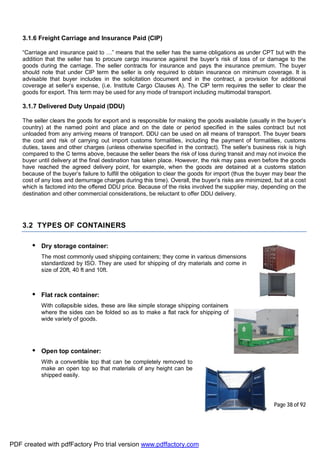
60,000 tons--include 46 running deep-water
wharves: 7 container, 17 general cargo, 4 bulk
cargo, 7 liquid, 3 cement, 2 grain, 4 coal, 1 waste
steel and 1 passenger. There are also 13
miscellaneous goods warehouses, 20 cement silos,
8 goods yards, 3 container years and 225 liquid
tanks. The port also boasts high-efficiency, full-
automated warehousing operations, which are
PDF created with pdfFactory Pro trial version www.pdffactory.com
Page 74 of 92
fullyopen to private investment. The port is
administered by the Taichung Harbor Bureau
which, in June, 2000, earned an ISO-9001 rating.
5.7 ECONOMY
Taiwan has a dynamic capitalist economy with gradually decreasing government guidance of investment and
foreign trade.
Exports, led by electronics, machinery, and petrochemicals have provided the primary impetus for economic
development. This heavy dependence on exports exposes the economy to fluctuations in world demand. In
2009, Taiwan's GDP contracted 1.9%, due primarily to a 20% year-on-year decline in exports. In 2010 GDP
grew 10.9%, as exports returned to the level of previous years, and in 2011, grew 4%. However, 2012 growth
fell to just 1.3%, because of softening global demand. Taiwan's diplomatic isolation, low birth rate, and rapidly
aging population are major long-term challenges. Free trade agreements have proliferated in East Asia over
the past several years, but so far Taiwan has been excluded from this greater economic integration - with the
exception of the landmark Economic Cooperation Framework Agreement (ECFA) signed with China in June
2010 - in part because of its diplomatic status. Follow-on components of ECFA, including deals on trade in
goods and services, have yet to be completed. The MA administration has said that the ECFA will serve as a
stepping stone toward trade pacts with other key trade partners, and talks with Singapore on a deal began in
2010.
Taiwan's Total Fertility rate of just over one child per woman is among the lowest in the world, raising the
prospect of future labor shortages, falling domestic demand, and declining tax revenues. Taiwan's population is
aging quickly, with the number of people over 65 accounting for 10.9% of the island's total population as of
2011. The island runs a large trade surplus largely because of its surplus with China, and its foreign reserves
are the world's fourth largest, behind China, Japan, and Russia. In 2006 China overtook the US to become
Taiwan's second-largest source of imports after Japan. China is also the island's number one destination for
foreign direct investment. Three financial memorandums of understanding, covering banking, securities, and
insurance, took effect in mid-January 2010, opening the island to greater investments from the mainland's
financial firms and institutional investors, and providing new opportunities for Taiwan financial firms to operate
in China. Closer economic links with the mainland bring greater opportunities for the Taiwan economy, but also
poses new challenges as the island becomes more economically dependent on China while political
differences remain unresolved.
PDF created with pdfFactory Pro trial version www.pdffactory.com
Page 75 of 92
5.8 GDP GROWTH RATE OF TAIWAN
Country 1999 2000 2001 2002 2003 2004 2005 2006 2007 2008 2009 2010 2011
Taiwan 5.5 6.3 -2.2 3.5 3.2 6 4 4.6 5.7 0.1 -1.9 10.8 4
5.9 KEY EXPORT COMMODITIES
• Electronics
• Flat panels
• Machinery
• Metals
• Textiles
• Plastics
• Chemicals
• Optical
• Medical instruments
• Toys
• Telecom Equipments
• Automatic data processing equipment
5.10 KEY IMPORT COMMODITIES
• Electronics
• Machinery
• Crude petroleum
• Precision instruments
• Organic chemicals
• Metals
PDF created with pdfFactory Pro trial version www.pdffactory.com
Page 76 of 92
5.11 FOREIGN TRADE OF TAIWAN
Unit : billion dollars; %
Nations
Total trade Export Import
Rank Amount % Rank Amount % Rank Amount %
China 1 92.64 21.46 1 63.69 28.13 2 28.94 14.11
Japan 2 57.96 13.43 4 15.04 6.64 1 42.92 20.92
U.S. 3 46.25 10.71 3 25.8 11.4 3 20.44 9.96
Hong kong 4 32.74 7.89 2 31.4 13.87 28 1.34 0.65
Korea 5 21.94 5.08 6 8.83 3.90 4 13.11 6.39
Singapore 6 16.44 3.81 5 10.08 4.45 8 6.36 3.10
Germany 7 12.01 2.78 8 5.32 2.35 7 6.68 3.26
Malaysia 8 11.25 2.61 10 4.90 2.16 9 6.35 3.10
Saudi
Arabia
9 10.55 2.44 26 0.83 0.37 5 9.72 4.74
Australia 10 10.04 2.33 16 2.62 1.16 6 7.43 3.62
Indonesia 11 8.49 1.97 13 3.68 1.63 11 4.81 2.34
Thailand 12 7.50 1.74 11 4.39 1.94 12 3.10 1.51
Vietnam 13 7.24 1.68 7 6.22 2.75 31 1.02 0.50
Philippines 14 6.84 1.58 9 4.96 2.10 20 1.87 0.91
Netherlands 15 6.48 1.50 12 4.11 1.81 14 2.38 1.16
India 16 5.23 1.21 15 2.88 1.27 15 2.35 1.14
Kuwait 17 5.05 1.17 59 0.12 0.05 10 4.94 2.41
U.K. 18 4.28 0.99 14 2.91 1.29 27 1.37 0.67
U.A.E. 19 4.25 0.98 23 1.16 0.51 13 3.08 1.51
Italy 20 3.54 0.82 17 1.92 0.85 25 1.62 0.79
5.12 TRADE BETWEEN INDIA & TAIWAN
Unit : billion dollars; %
Year
Total Trade Export Import
Amount
Growth
Rate %
Amount
Growth
Rate %
Amount
Growth
Rate %
2005 2.44 25.57 1.58 46.25 0.86 -0.37
2006 2.72 11.22 1.47 -7.06 1.25 44.87
2007 4.88 79.63 2.34 59.20 2.54 103.75
2008 5.34 9.45 3.01 28.40 2.33 -8.05
2009 4.15 -22.20 2.53 -15.82 1.62 -30.43
2010 5.23 56.49 2.88 39.11 2.35 84.81
PDF created with pdfFactory Pro trial version www.pdffactory.com
Page 77 of 92
5.13 CHART : EXPORT FROM TAIWAN TO INDIA
5.14 CHART : IMPORT BY TAIWAN FROM INDIA
PDF created with pdfFactory Pro trial version www.pdffactory.com
Page 78 of 92
5.15 BIBLIOGRAPHY
• http://eng.taiwan.net.tw/m1.aspx?sNo=0002007
• http://en.wikipedia.org/wiki/Geography_of_Taiwan
• http://www.indexmundi.com/taiwan/demographics_profile.html
• http://en.wikipedia.org/wiki/List_of_airports_in_Taiwan
• http://www.gcoupon.com/browse/ports/1/sort/2/asc/1#top
• http://www.theodora.com/wfbcurrent/taiwan/taiwan_economy.html
• http://www.indexmundi.com/g/g.aspx?v=66&c=tw&l=en
PDF created with pdfFactory Pro trial version www.pdffactory.com
Page 79 of 92
Chapter 6 :
Project :Research on Logistic
management of different
industry
PDF created with pdfFactory Pro trial version www.pdffactory.com
Page 80 of 92
A. Task Assigned for the project
I. To get the information about their production.
II. To get the information about products which they import – export.
III. To get the volume of their import – export (daily/monthly/annually)
IV. To get the information about their present freight forwarder.
V. To get the information about their present problem of logistic.
VI. To get the information about how they analyze the market of their product and how the market their
products.
VII. To get their opinion about present logistic industry.
VIII. To get to know that, what are the impact of currency fluctuation on their business.
B. Methodology used.
I. Personal Interaction with respective persons of the company.
II. Secondary search.
C. Respective persons.
Sr. No. Name of the company Industry Interaction with
1 Ashima Dycoat Ltd.
Textile
Mr. Urjit Naik
2 Aarvee Denims Export Ltd. Mr. Shashi Sinha
3 Vishakha Ployfab Ltd. Polymer
Mr. Pramod
Prajapati
4 Syntron Industries
Industrial Chemicals
Mr. Rushay Trivedi
5
Encore Natural Polymers
Ltd.
Mr. H K Magar
6 Rushil Décor Ltd. Decorative Parts Mr. Sameer
PDF created with pdfFactory Pro trial version www.pdffactory.com
Page 81 of 92
6.1 ASHIMA DYCOT LTD. – AHMEDABAD.
6.1.0 Profile
Industry : Textile
Products : Manufacture Textiles & Fabrics
Employees : More than 1000
Address : Texcellence Complex, KhokharaMehmedabad,
Ahmedabad – 380021
Ph. 079-67777000
Website : www.ashimagroup.com
AshimaDyecotLtd..is an enterprise born in 1982, with a moderate capital base of US$ 20,000.
The present form is seen today, as the foremost cotton textile manufacturer with over US$ 100 million turnover
and spread over 40 acres of land. This is the result of a vision, and commitment of its founder Mr. Chintan
Parikh.Today, Group Ashima has become one of the major success stories in the Indian textiles arena.
In the last 18 years, Ashima has spread its wings across five continents to emerge as one of India's foremost
cotton textiles manufacturers.
6.1.1 Findings
• Turnover : INR 650 to 700 crores per annum.
• Total Production : Approx. 3,000,000 meters.
• Exports 65% of the total production.
• Exports products into U.S.A., Europe, Turkey, Bangladesh, Far East countries etc.
• More than 100 containers monthly are exported
• Using 20” and 40” containers for exports.
• Factory side stuffing of shipments.
• Exports 95% by sea voyage and other 5% by air voyage.
• Mostly use incoterms : CIF, FOB etc.
• Direct contacts with shipping lines for booking the containers.
• Domestic brands : Jack & Jones, Madura, Polo etc.
• International brands : GAP, Louis Philippe, Van Heusen etc.
• Payment Terms : Letter of Credit only.
• Participation in trade fairs for international marketing.
• Competitors :Arvind Mills, Aarvee Denims etc.
• Distinct in market by quality products from the competitors.
6.2 AARVEE DENIMS & EXPORT LTD. – AHMEDABAD.
6.2.0 Profile
Industry : Textile
Products : Manufacture Fabrics& Garments.
Employees : More than 1000
Address : 188/2, Ranipur Village, Opp. CNI Church, Narol,
Ahmedabad – 382 405.
Ph. 079-30417000
Website : www.arvee-denims.com
PDF created with pdfFactory Pro trial version www.pdffactory.com
Page 82 of 92
Aarvee Denims and Exports Ltd is a leading global player in the textile industry. Being backed by experienced
promoters, the company is spreading its wings all over the globe at a very fast pace. Established in 1988 by
Arora& VB Group, which has been involved in textile trade for over 50 years, are the forces behind this
dynamic organization.
More than five decades of experience, well qualified human resources and state of the art production units
have made “ADEL” today World’s one of the largest Vertically Integrated Denim Mill.
6.2.1 Findings
• Turnover : INR 550 to 600 crores per annum.
• Total Production : Approx. 2,500,000 meters.
• Exports 75% of the total production.
• Exports products into Venezuela, Morocco, Egypt, Bangladesh etc.
• More than 80 containers monthly are exported
• Using only 40” containers for exports.
• Factory side stuffing of shipments.
• Exports 100% by sea voyage.
• Import raw materials like Cotton from U.S., Argentina and Dyes from China.
• Approx. 4 to 5 containers monthly are imported from abroad.
• Mostly use incoterms : CIF, FOB, Ex Works etc.
• Retail brands : De Extase, Fashion Wrapper, Aden etc.
• Payment Terms : Letter of Credit, Advance, 60 – 90 days credit etc.
• Participation in trade fairs for international marketing.
• Marketing Agents are everywhere for the marketing.
• Competitors :Arvind Mills, Nanadan Exports etc.
• Distinct in market by quality products from the competitors.
6.3 VISHAKHA PLOYFAB PVT. LTD. – AHMEDABAD.
6.3.0 Profile
Industry : Packaging
Products : Manufacture of packaging films, pouches & Bulk bags liner
Address : Plot No. 549/2, Vadsar, P.O. Khatraj, Tal. Kalol,
Gandhinagar – 382721.
Ph. 02764-282048.
Website : www.vishakhapolyfab.com
VishakhaPolyfab Pvt. Ltd. An ISO 22000:2005, 9001:2008 & BRC Certified Company is a pioneer when it
comes to high-barrier 9 and 7 layer flexible packaging films in India. Since its inception in the year 2001, the
company has time and again set new benchmarks in the industry and has today become the country’s largest
high-barrier multilayer flexible film manufacturer.
The company possesses a great production capacity of over 13,500 metric tonnes per annum (and growing).
With such a track record and promising future plans, the company is slated to emerge as the undisputed leader
in high barrier Nylon/Evoh based flexible packaging in India. The company believes in a ‘greener’,
environment-friendly approach to manufacturing.
PDF created with pdfFactory Pro trial version www.pdffactory.com
Page 83 of 92
6.3.1 Findings
• Turnover : INR 150 to 200 crores per annum.
• Exports 25% of the total production in international market and remaining 75%
business is in domestic market.
• Exports products into U.S.A., Europe, Australia etc.
• Approx. 15 – 20 containers monthly are exported
• Using only 40” high cube containers for exports.
• Factory side stuffing of shipments.
• Exports 70% by sea voyage and other 30% by air voyage.
• Import raw materials from Thailand, Singapore, U.S.A. etc.
• Approx. 2 to 3 containers monthly are imported from abroad.
• Mostly use incoterms : CIF, FOB, DDU etc.
• Payment Terms : Letter of Credit only.
• Participation in trade fairs for international marketing.
• For domestic marketing, they have their own agents.
• Competitors : Gopala Polyplast, Guajarat Craft Ltd. etc.
• Distinct in market by quality products from the competitors.
6.4 SYNTRON INDUSTRIES – AHMEDABAD.
6.4.0 Profile
Industry : Industrial Chemicals
Products : Manufacture of Dyes & Dyestuff, Color Pigments etc.
Address : 411/5, Phase-2, G I D C Industrial Estate, Vatva
Ahmedabad – 382445.
Website : www.syntronindutries.com
6.4.1 Findings
• Turnover : INR 90 to 120 crores per annum.
• Exports 15% of the total production in international market and remaining 85%
business is in domestic market.
• Exports products into U.S.A., Europe, Australia, New Zeeland, Africa etc.
• Approx. 2 – 3 containers monthly are exported
• Using 20” and 40” containers for exports.
• Sometimes also using tank containers.
• The shipments are LCL or FCL both.
• Stuffing of shipments at ICD – Ahmedabad.
• From factory to ICD, local transport services are used.
• Mostly interested in domestic clients.
• No any import materials from abroad countries.
• Mostly use incoterms : CIF
• Payment Terms : Letter of Credit and 100% advance from new customer.
• Own distributors at international level.
• Distinct in market by quality products from the competitors.
PDF created with pdfFactory Pro trial version www.pdffactory.com
Page 84 of 92
6.5 ENCORE NATURAL POLYMERS PVT. LTD.
6.5.0 Profile
Industry : Industrial Chemicals
Products : Manufacture of Dyes 7 Dyestuff, Color Pigments etc.
Address : 227/233, GIDC Industrial Estate, Naroda
Ahmedabad – 382330.
Ph. 079-22822548
Website : www.encorenaturalpolymers.com
Encore natural polymers private limited had its beginnings in 1958 when INDIAN GUM INDUSTRIES LTD also
known as IGI was set up in Financial and Technical collaboration between Merchant Family & Cesalpinia
Group of Italy.
Encore is a pioneer in the field of manufacturing value added native and derivatives of polysaccharides and
has kept itself abreast in the emerging trends of Guar, Tamarind and other natural polymers thickener
applications in various sectors.
6.5.1 Findings
• Turnover : INR 700 to 750 crores per annum.
• Exports 95% in international markets.
• Exports products into U.S.A., China, Turkey, Egypt, Taiwan, Bangladesh, Sri Lanka, Pakistan etc.
• Approx. 40 – 50 containers monthly are exported.
• Exports volume : More than 10,000 tons annum.
• Direct contacts with shipping lines for booking the containers.
• Using 20” and 40” containers for exports.
• The shipments are FCL only.
• Factory side stuffing of shipments.
• Import raw materials from Taiwan and Europe.
• Mostly use incoterms : CIF
• Payment Terms : Letter of Credit at sight and 100% advance from new customer.
• Own distributors at international level.
• Distinct in market by customized products as per customer requirement.
6.6 RUSHIL DECOR LTD.
6.7.0 Profile
Industry : Decorative Parts
Products : Manufacture of laminates sheets.
Address : No. 1, KrinkalAppartment,
Mahalaxmi Society, Paldi,
Ahmedabad - 380 007,
Ph. 079-26622323
Website : www.virlaminate.com
PDF created with pdfFactory Pro trial version www.pdffactory.com
Page 85 of 92
Established in the year 1992, we at Rushil Decor Private Limited are engaged in manufacturing and exporting
a quality range of decorative laminates. Our complete range includes Bamboo Series Laminate, Illusion Series
Laminate, Jute Laminate, Cotton Fiber Laminate, Metal Bond Laminate and Microline Series Laminate,
Decorative Color Laminate, Antique Laminate, Solid Color Laminate, Microline Series Laminate. Apart from
these, we also offer Shaping Techno Series Laminate, Antique Laminate and Solid Color Laminate. Fabricated
using high-grade material, these are widely appreciated by our clients owing to their beautiful designs, nice
color combinations and durability to count a few.
6.4.1 Findings
• Turnover : INR 150 to 200 crores per annum.
• Exports 65% of the total production in international market and remaining 35%
business is in domestic market.
• From the exports, 50% export to Gulf countries.
• Exports products into Gulf and Far East countries.
• Approx. 30 – 35 containers monthly are exported
• Using only 20” high cube containers for exports.
• The shipments are only in FCL.
• Stuffing of shipments at ICD – Ahmedabad.
• From factory to ICD, local transport services are used.
• Plants are at Dhangdhra and Mansar.
• Import raw materials like foils, paper etc. from China and Germany.
• Mostly use incoterms : CIF
• Payment Terms : Letter of Credit of 90 days, on credit for 90 days etc.
• Distinct in market by quality products from the competitors.
• Participation in trade fairs for international marketing.
PDF created with pdfFactory Pro trial version www.pdffactory.com
Page 86 of 92
Chapter 7 :
Learnings +
Experiential Learnings
PDF created with pdfFactory Pro trial version www.pdffactory.com
Page 87 of 92
7.1 LEARNINGS
I. Learned how to work in corporate.
II. Learned how people take work from others.
III. I learnt in corporate, the communication is keep on changing as per the person.
IV. English is not use for all work. It is used if person is educated. Otherwise most of the people are using
Hindi or Gujarati.
V. I learnt the procedure of import, export.
VI. Learned different types of documentation for import and export.
VII. Observed the documentation process of import and export.
VIII. I visited ICD (Inland Container Depot) of Ahmedabad which is placed at Khodiyar (28 km. from
Ahmedabad). We can call it the warehouse of the containers.
IX. I observed different types of containers there. (20” ft. and 40” ft.)
X. I saw there live stuffing of goods in the containers.
XI. After the stuffing, in charge person put seal on the container.
7.2 EXPERINTIAL LEARNINGS
I. The main thing about Logistic Integrators (I) Pvt. Ltd. which I would like to appreciate is about the office
environment which is really very good and positive.
II. From one of the project, I was able to make comparison between the learning from books at college and
practical situation.
III. The lots of experiences derived, when I met 9 – 10 experienced persons of the big companies and did interaction
with them.
IV. The best experience in these 8 weeks is when I met Mr. Urjit Naik (Head of Int. Buss. @ Ashima Group). I
interacted with him about an hour and I got lots of learnings from him which I can’t know how to express.
V. With my experiences, now I can say that the students can enter in any company.
VI. I really enjoyed working with Logistic Integrators (I) Pvt. Ltd. in last eight weeks with loads of experience by small
and big experience at every activity done and observed.
PDF created with pdfFactory Pro trial version www.pdffactory.com
Page 88 of 92
Chapter 7 :
Reference
PDF created with pdfFactory Pro trial version www.pdffactory.com
Page 89 of 92
7.1 BIBLIOGRAPHY
http://en.wikipedia.org/wiki/Logistics
http://articles.economictimes.indiatimes.com/2012-05-16/news/31726637_1_logistics-performance-trade-logistics-
global-trade
http://business.mapsofindia.com/india-industry/logistics-industry.html
http://www.marineinsight.com/sports-luxury/equipment/16-types-of-container-units-and-designs-for-shipping-cargo/
http://logisticseducation.blogspot.in/2010/04/import-general-manifest-igm.html
http://creative.sulekha.com/registration-of-custom-house-agent_149106_blog
http://www.psbedi.com/highseasales.htm
PDF created with pdfFactory Pro trial version www.pdffactory.com
Page 90 of 92
Chapter 8 :
Annexure
PDF created with pdfFactory Pro trial version www.pdffactory.com
Page 91 of 92
8.1 LIST OF QUESTIONS FOR THE RESEARCH PROJECT.
Learning Objective Question
Ø Various products Ø Types of product
manufactured &
Export/import
Ø Which product
export/import.
Ø Quantity of product
Ø Variety of the product
Ø Which countries.
Ø Import/export in
various countries
Ø How many countries
are doing with you?
Ø Doing by air /sea.
Ø What they expecting from
your side.
Ø How many time you doing
business with them.
Ø Are you doing business
with new customer?
Ø How promoting your
product of them.
Ø How you identified of
demand of countries.
Ø How you generated
demand in various
countries
Ø If you exporting good
which airline majorly used.
Ø Nature of business Ø Seasonal
Ø Manufacturing
Ø Only assemble of the
product.
Ø Domestic/international
area doing business.
Ø Are you able to fulfill the
demand of them
Ø Are product limited
product/ mass products.
Ø What is your turn over?
Ø container Ø types of containers Ø 20’fit
Ø 40’fit
Ø Which company hire of
containers.
Ø How many containers in
month.
Ø How many tons/kgs are
import/export?
Ø How you doing
import/export
Ø Freight forwarding Ø Your selected freight
forwarding company.
Ø Are you giving chance to
new one freight
forwarders?
Ø You have any selected
CHA for import/export.
Ø How many freight
forwarding company doing
business with you.
Ø What are the major
incoterms used.
Ø Problems in
import/export
Ø Impact of your
business.
Ø If import/export you
shipment was late what
PDF created with pdfFactory Pro trial version www.pdffactory.com
Page 92 of 92
kind of problem are facing.
Ø Are you backup plan for
the business?
Ø Competitors Ø Only domestic or
international
Ø What are the strategies
use to bit them
Ø Are you different of them
or similar?
Ø What is your specialties
from others competitors
PDF created with pdfFactory Pro trial version www.pdffactory.com

SIP Final Report (Logistic)

  • 1.
    SUMMER INTERNSHIP AT LOGISTICINTEGRATORS Pvt. Ltd.SUMMER INTERNSHIP AT LOGISTIC INTEGRATORS Pvt. Ltd. Chirag Shah {SUMMER INTERNSHIP TRAINEE} 2013 1/1/2013 PDF created with pdfFactory Pro trial version www.pdffactory.com
  • 2.
    Page 2 of92 A SUMMER INTERNSHIP PROJECT REPORT on LOGOISTIC INDUSTRY at Logistic Integrators (I) Pvt. Ltd. FOR THE PARTIAL FULFILLMENT OF REQUIREMENT OF DEGREE OF POST GRADUATE PROGRAMME IN MANAGEMENT at NAVRANGPURA, AHMEDABAD 2012-14 Company Guide : Mr. Ajay Kawadia Academic Guide : Prof. Devang Patel Submitted By : Chirag Shah (G.R. No. : M00117) PDF created with pdfFactory Pro trial version www.pdffactory.com
  • 3.
    Page 3 of92 Acknowledgement I have taken efforts in this project. However, it would not have been possible without the kind support and help of many individuals and organizations. I would like to extend my sincere thanks to all of them. I am highly indebted to Mr. Ajay Kawadia for their guidance and constant supervision as well as for providing necessary information regarding the project & also for their support in completing the project. I would like to express my gratitude towards my parents & member of Logistic Integrators Pvt. Ltd. for their kind co-operation and encouragement which help me in completion of this project. I would like to express my special gratitude and thanks to industry persons for giving me such attention and time. My thanks and appreciations also go to my academic mentor Prof. Devang Patel in developing the project and people who have willingly helped me out with their abilities. Regards Chirag Shah PDF created with pdfFactory Pro trial version www.pdffactory.com
  • 4.
    Page 4 of92 Preface Internship is the last step of a student's academic career. For a student of Business Management it is essential for the complete understanding of the concepts learned from formal education. There remains a huge gap between academic learning and the implementation of that hypothetical knowledge in the practical world of modern business and commerce. Internship can compensate this wide gap as it brings opportunities for a student to comprehend the main trends of business activities. In compiling this report I have intended to provide a synthesis of theoretical approaches and methods of implementing them in the world of business. I have tried to discover the relationship between theoretical and practical type of knowledge. I have tried to bridge the gap between theoretical assumptions and practical necessities. During the entire course of our academic study we remain engaged in theoretical learning where the primary objective is academic success. A concise knowledge of the modern business arena can only be attained through the pragmatic implementation of hypothetical ideas, which we learn from our academic activities. With these objectives, I have made all possible efforts and the necessary investigations to submit this report in an enlightened form in a very short time. I have tried my level best to eliminate errors from the report. As I had to complete my internship within a short period of time so the study admits its limitations. PDF created with pdfFactory Pro trial version www.pdffactory.com
  • 5.
    Page 5 of92 Executive Summary The internship is an integral part of the Logistic Industry. The organization that choose for my internship project is Logistic Integrators (I) Pvt. Ltd., Ahmedabad. This Eight-week period of my internship in such a huge organization gave me a real time exposure to know about the organizational working process I made many itinerary over there with the help of my company guide Mr. Ajay Kawadia (sales manager) and he gave me a lot of knowledge howto talk with industrialist people. All types of logistic in India have registered phenomenal growth in the last decade ever since the Indian government decided to boost revenues from the logistic sector by projecting India as the ultimate logistic oriented nation. The basic objectives of my study were: • To know about basic of logistic industry • To gain different industry knowledge • To know more corporate people • To know how logistic takes place Main summary in this project is to know about the logistic industry is growing day by day, I came to know with the help of my seniors and secondary data. PDF created with pdfFactory Pro trial version www.pdffactory.com
  • 6.
    Page 6 of92 Table of Contents DESCRIPTION PAGE NO. 1. Chapter 1 : 10 Logistic Industry 1.1 Logistic – Introduction and origin 1.2 Objective of the logistics 1.2.0 Rapid response 1.2.1 Reduce total distribution costs 1.2.2 Generating additional sales 1.2.3 Creating time and place utilities 1.2.4 Price stabilization 1.2.5 Quality improvement 1.2.6 Movement consolidation 1.2.7 Improving customer service 1.3 Logistic management function 1.3.0 Order processing 1.3.1 Inventory management 1.3.2 Warehousing 1.3.3 Transportation 1.3.4 Material handling storage 1.3.5 Packing 1.3.6 Information flow 1.4 Indian logistic industry 1.4.0 Overview 1.5 Mediums of logistic 1.5.0 Road 1.5.1 Railway 1.5.2 Water/Port 1.5.3 Air 2. Chapter 2 : 20 Logistics Integrators (I) Pvt. Ltd. 2.1 Profile 2.2 Value 2.3 Culture 2.4 Vision 2.5 Mission 2.6 No boundaries 2.7 Beyond boundaries PDF created with pdfFactory Pro trial version www.pdffactory.com
  • 7.
    Page 7 of92 2.8 Advantages 2.8.0 Location 2.8.1 USP 2.9 Products & Services 2.9.0 International air freight 2.9.1 International ocean freight 2.9.2 Customs brokerage 2.9.3 Project cargo 2.9.4 Warehousing and faculty management 2.10 Other advantages 2.10.0 360 services 2.10.1 Warehousing services 2.10.2 Distribution and 3PL services 2.11 Future plans 2.12 SWOT Analysis 2.12.0 Strength 2.12.1 Weaknesses 2.12.2 Opportunities 2.12.3 Threats 3. Chapter 3 : 31 Project : Detailed study of Inbound & Outbound International Logistic Activities • Task assigned for the project • Methodology used 3.1 Incoterms 3.1.0 EXW (Ex Works) 3.1.1 FOB (Free On Board) 3.1.2 FCA (Free Carrier) 3.1.3 CFR (Cost & Freight) 3.1.4 CIF (Cost, Insurance & Freight) 3.1.5 CPT (Freight Carriage Paid) 3.1.6 CIP (Freight, Carriage & Insurance Paid) 3.1.7 DDU (Delivery Duty Unpaid) 3.2 Types of containers 3.3 Dimensions of containers 3.4 Import 3.4.0 Import general manifest 3.4.1 Bill of entry 3.4.2 Documents submitted by Importer 3.4.3 Assessment of custom duty 3.5 Export PDF created with pdfFactory Pro trial version www.pdffactory.com
  • 8.
    Page 8 of92 3.5.0 Export general manifest 3.5.1 Shipping Bill 3.5.2 Commercial Invoice 3.5.3 Bill of lading 3.5.4 Packing list 3.5.5 Certificate of origin 3.5.6 Certificate of sampling and analysis 3.5.7 Certificate weight 3.5.8 Letter of credit (L/c.) 3.5.9 Export procedure 3.5.10 Documents required for export 3.6 Payment Terms 3.7 IEC Code 3.8 HS Code 3.8.0 Structure 3.8.1 Classification 3.8.2 Importance 3.9 Custom House Agent (CHA) 3.10 High Sea Sales 3.11 Export Logistic Cost 4. Chapter 4 : 62 Study at ICD – Ahmedabad • Methodology used 4.1 Export Transport Logistic Cost 4.2 Containerized Shipment 4.3 Movement of Containerized Shipment 4.4 Customs Clearing Charges 4.5 ICD & CFS 4.5.0 Services offered by ICD/CFS 4.5.1 Advantage 4.5.2 Terminal Handling Charges 5. Chapter 5 : 67 Study of Taiwan Economy • Task assigned for the project • Methodology used 5.1 Introduction 5.2 Location 5.3 History 5.4 Geography 5.4.0 Geographic Situation Chart 5.5 Airports PDF created with pdfFactory Pro trial version www.pdffactory.com
  • 9.
    Page 9 of92 5.6 Seaports 5.7 Economy 5.8 Chart of GDP Growth Rate 5.9 Export Commodities 5.10 Import Commodities 5.11 Table :Foreign trade 5.12 Table : Trade between India – Taiwan 5.13 Chart : Export from Taiwan to India 5.14 Chart : Import by Taiwan from India 5.15 Bibliography 6. Chapter 6 : 79 Project :Research on Logistic management of different industry • Task assigned for the project • Methodology used • Respective persons. 6.1 AshimaDyecot Ltd. 6.1.0 Profile 6.1.1 Findings 6.2 Aarvee Denims & Export Ltd. 6.2.0 Profile 6.2.1 Findings 6.3 VishakhaPolyfab Pvt. Ltd. 6.3.0 Profile 6.3.1 Findings 6.4 Syntron Industries 6.4.0 Profile 6.4.1 Findings 6.5 Encore Natural Polymers Pvt. Ltd. 6.5.0 Profile 6.5.1 Findings 6.6 Rushil Décor Ltd. 6.6.0 Profile 6.6.1 Findings 7. Chapter 7 : 86 Learnings + Experiential Learning 8. Reference 88 8.1 Bibliography 9. Annexure 90 PDF created with pdfFactory Pro trial version www.pdffactory.com
  • 10.
    Page 10 of92 Chapter 1 : LOGISTIC INDUSTRY PDF created with pdfFactory Pro trial version www.pdffactory.com
  • 11.
    Page 11 of92 1.1 WHAT IS THE LOGISTIC? Logistics is the management of the flow of goods, information and other resources between the point of origin and the point of consumption in order to meet some requirements of consumers. Logistic involves the integration of information, transportation, inventory, warehousing, material handling and packaging and occasionally security. The resources managed in logistics can include physical items, such as food, materials, equipment, liquids, and staff, as well as abstract items, such as time, information, particles, and energy. The logistics of physical items usually involves the integration of informationflow, materialhandling, production, packaging, inventory, transportation, warehousing, and often security. The complexity of logistics can be modeled, analyzed, visualized, and optimized by dedicated simulation software. The minimization of the use of resources is a common motivation. Origin The term logistics comes from the late 19th century: from French logistique, from loger 'to lodge.Logistics is considered to have originated in the military's need to supply itself with arms, ammunition, and rations as it moved from a base to a forward position. In the ancient Greek, Roman, and Byzantine Empires, military officers with the title Logistikas were responsible for financial and supply distribution matters. The Oxford English dictionary defines logistics as: “The branch of military science having to do with procuring, maintaining and transporting material, personnel and facilities.” PDF created with pdfFactory Pro trial version www.pdffactory.com
  • 12.
    Page 12 of92 1.2 OBJECTIVES OF LOGISTIC The primaryobjective of logistics management is to effectively and efficiently move the supply chain so as to extend the desired level of customer service at the least cost. Thus, logistics management starts with ascertaining customers’ needs till theirfulfilment through product supplies. However,there are some definite objectives to be achieved through a proper logistics system.These can be described as follows: 1.2.0 Rapid Response: Rapid response is concerned with a firm's ability to satisfy customer service requirements in a timely manner. Information technology has increased the capability to postpone logistical operations to the latest possible time and then accomplish rapid delivery of required inventory. 1.2.1 Reduce total distribution costs: The cost of physical distribution consists of various elements such as transportation, warehousing and inventory maintenance, and any reduction in the cost of one element may result in an increase in the cost of the other elements. Thus, the objective of the firm should be to reduce the total cost of distribution and not just the cost incurred on any one element. 1.2.2 Generating additional sales: A firm can attract additional customers by offering better services at lowest prices. For example, by decentralizing its warehousing operations or by using economic and efficient modes of transportation, a firm can achieve larger market share. Also by avoiding the out-of-stock situation, the loss of loyal customers can be arrested. 1.2.3 Creating time and place utilities: The products are physically moved from the place of their origin to the place where they are required for consumption; they do not serve any purpose to the users. Similarly, the products have to be made available at the time they are needed for consumption. 1.2.4 Price stabilization: It can be achieved by regulating the flow of the products to the market through a judicious use of available transport facilities and compatible warehouse operations. By stocking the raw material during the period of excess supply and made available during the periods of short supply, the prices can be stabilized. 1.2.5 Quality improvement: The long-term objective of the logistical system is to seek continuous quality improvement. Total quality management (TQM) has become a major commitment throughout all facets of industry. If a product becomes defective or if service promises are not kept, little, if any, value is added by the logistics. Logistical costs, once expended, cannot be reversed. 1.2.6 Movement consolidation: Consolidation one of the most significant logistical costs is transportation. Transportation cost is directly related to the type of product, size of shipment, and distance. Many Logistical systems that feature premium service depend on high-speed, small shipment transportation. Premium transportation is typically high-cost. To reduce transportation cost. It is desirable to achieve movement consolidation. PDF created with pdfFactory Pro trial version www.pdffactory.com
  • 13.
    Page 13 of92 1.2.7 Improving customer service: An important objective of all marketing efforts, including the physical distribution activities, is to improve the customer service. An efficient management of physical distribution can help in improving the level of customer service by developing an effective system of warehousing, quick and economic transportation, and maintaining optimum level of inventory. 1.3 LOGISTIC MANAGEMENT FUNCTION Logistics is the process of movement of goods across the supply chain of the company. This process is consist of various functions, which have to be properly managed to bring effectiveness efficiency in the supply chain of organization. The major logistical function are shown in figure 1.3.0 Order processing: The starting point of physical distribution activities is the processing of customers’ orders. In order to provide quicker customer service, the orders received from customers should be processed within the least possible time. Order processing includes receiving the order, recording the order, filling the order, and assembling all such orders for transportation, etc. the company and the customers benefit when these steps are carried out quickly and accurately. The error committed at this stage at times can prove to be very costly. Order processing activity consist of the following: Ø Order checking in any deviations in agreed or negotiation terms Ø Prices , payment and delivery terms Ø Checking the availability in of the material stocks Ø Production and material scheduling for storage Ø Acknowledge the order, indicating deviation 1.3.1 Warehousing: Warehousing refers to the storing and assorting products in order to create time utility. The basic purpose of the warehousing activity is to arrange placement of goods, provide storage facility to store them, consolidate PDF created with pdfFactory Pro trial version www.pdffactory.com
  • 14.
    Page 14 of92 them with other similar products, divide them into smaller quantities and build up assortment of products. Generally, larger the number of warehouses a firm has the lesser would be the time taken in serving customers at different locations, but greater would be the cost of warehousing. Thus, the firm has to strike a balance between the cost of warehousing and the level of customer service. Major decision in warehousing is as follow: Ø Location of warehousing facility Ø Number of warehousing Ø Size of warehouse Ø Design of the building Ø Ownership of the warehouse 1.3.2 Inventory Management: Linked to warehousing decisions are the inventory decisions which hold the key to success of physical distribution especially where the inventory costs may be as high 15 as 30-40 per cent (e.g., steel and automobiles). No wonder, therefore, that the new concept of Just-in-Time-Inventory decision is increasingly becoming popular with a number of companies. The decision regarding level of inventory involves estimate of demand for the product. A correct estimate of the demand helps to hold proper inventory level and control the inventory costs. This is not only helps the firm in terms of the cost of inventory and supply to customers in time but also to maintain production at a consistent level. The major factors determining the inventory levels are: The firm’s policy regarding the customer service level, Degree of accuracy of the sales forecasts, Responsiveness of the distribution system i.e., ability of the system to transmit inventory needs to the factory and get the products in the market. The cost inventory consists of holding cost (such as cost of warehousing, tied up capital and obsolescence) and replenishment cost (including the manufacturing cost). 1.3.3 Transportation: Transportation seeks to move goods from points of production and sale to points of consumption in the quantities required at times needed and at a reasonable cost. The transportation system adds time and place utilities to the goods handled and thus, increases their economic value. To achieve these goals, transportation facilities must be adequate, regular, dependable and equitable in terms of costs and benefits of the facilities and service provided. 1.3.5 Information: The physical distribution managers continuously need up-to-date information about inventory, transportation and warehousing. For example, in respect on inventory, information about present stock position at each location, future commitment and replenishment capabilities are constantly required. Similarly, before choosing a 16 carrier, information about the availability of various modes of transport, their costs, services and suitability for a particular product is needed. About warehousing, information with respect to space utilization, work schedules, unit load performance, etc., is required. In order to receive all the information stated above, an efficient management information system would be of immense use in controlling costs, improving services and determining the overall effectiveness of distribution. Of course, it is difficult to correctly assess the cost of physical distribution operations. But if correct information is available it can be analyzed systematically and a great deal of saving can be ensured. 1.3.6 Facilities: The Facilities logistics element is composed of a variety of planning activities, all of which are directed toward ensuring that all required permanent or semi permanent operating and support facilities (for instance, training, field and depot maintenance, storage, operational, and testing) are available concurrently with system fielding. Planning must be comprehensive and include the need for new construction as well as modifications to existing facilities. Facility construction can take from 5 to 7 years from concept formulation to user occupancy. It also PDF created with pdfFactory Pro trial version www.pdffactory.com
  • 15.
    Page 15 of92 includes studies to define and establish impacts on life cycle cost, funding requirements, facility locations and improvements, space requirements, environmental impacts, duration or frequency of use, safety and health standards requirements, and security restrictions. Also included are any utility requirements, for both fixed and mobile facilities, with emphasis on limiting requirements of scarce or unique resources. 1.4 INDIAN LOGISTIC INDUSTRY India has hardly been able to position itself on the economic market despite its favorable location between Asia and Europe and a populace of 1.21 billion. The World Bank in its Global Logistics Report, 2012 has ranked India 46 among 150 countries in terms of logistics performance with its future potential. India needs an integrated infrastructure and logistics policy to keep up the growth of its gross domestic product. The major export countries for Indian products are the United States, the United Arab Emirates, China, Singapore, Germany, Japan, Indonesia and Great Britain. The major import trading partners are China, the United States, Switzerland, the United Arab Emirates and Belgium. In recent years, BRIC countries have become vital players in the world economy as a result of their high growth rates. Infrastructure development is essential for the growth of an economy. Logistics infrastructure covering the road, rail, waterways and air network is the backbone on which the nation marches ahead. India’s logistics infrastructure was developed in the colonial era to transport troops and agricultural products. Since then, India has become one of the fastest growing economies in the world, but its logistics infrastructure remains woefully inadequate to meet the demands bestowed on it by the country’s new-found status. PDF created with pdfFactory Pro trial version www.pdffactory.com
  • 16.
    Page 16 of92 1.4.0 Overview • The Logistics industry includes five broad segments – ocean freight, rail freight, air freight, trucking and third party Logistics (3PL) services. • The current size of the Indian Logistics Industry is estimated around $225bn and is expected to reach around $350bn by 2015. • As per industry estimates as provided by the Fitch Rating Agency, there is a positive future outlook for the Indian Logistics Industry and it is estimated that the industry will grow at 15-20% over the next few years. • Several factors helped the growth of logistics industry in India over the last decade that include changing tax system as well as a rapid growth in industries such as automobile, pharmaceuticals, FMCG and retail. • 70% of the total domestic product is transported through the road network and 15% through the rail network. Domestic companies are willing to expand their efficiency to meet rising demand globally according to a study by industry body. • Logistics costs in India are estimated to be approximately 13% of GDP which is considerably high when compared to the corresponding figures for other major economies of the world (as per World Bank 2010 report). For example in 2011 the logistics costs in the European Countries accounted for 7.15% of GDP (as per an article in ‘The Hindu’) • Higher logistics costs are mainly due to poor infrastructure facilities in the country. The higher logistics cost represents higher products/services cost in the international market • The country’s organized logistics market represents 6% of the total market • The three major contributors for the growth of logistics industry are: emergence of organized retail, increase in foreign trade and India becoming a global manufacturing hub. 1.5 MEDIUMS OF LOGISTIC There are four way of logistics services in India. These can be categorized in the following way: 1.5.0 ROAD : The road freight industry in India is worth about INR 1.42 trillion and is growing at about 6-8 percent year on year (refer figure 6). Manpower spends amount to only about 4 percent of sales as against the overall sector average of 8-10 percent. The industry has traditionally been extremely fragmented - almost 75 percent of the trucking 'companies' are single truck operators and almost 90 percent of trucking companies have a turnover of less than INR 10 million. A majority of players in this industry have been small entrepreneurs running family owned businesses. Given their small scale and limited investment capability, most of their investments have been focused on short term gains - direct and immediate impact on the top line / bottom line of the business being the key decision criterion. As a result, investments that pay off in the longer term, such as those in manpower development, have been minimal historically. Also, these businesses are typically tightly controlled by the proprietor and his / her family and as such, making it unattractive for professionals. Poor working conditions, low pay scales relative to alternate careers, poor or non-existent manpower policies and prevalence of unscrupulous practices have added to the segment's woes creating the image of a segment that holds few attractions for those seeking employment. PDF created with pdfFactory Pro trial version www.pdffactory.com
  • 17.
    Page 17 of92 While industry players have been incapable of investing in manpower development, the government has also not focused sufficiently on the same. There exist very few formal training institutions for driver training and practically none for operational training on associated areas like loading / unloading supervisory, proper handling practices etc. The result has been that in the current scenario, there exist gaps in core technical skills of the existing set of personnel. For example, the backbone of the trucking industry truck drivers lack knowledge of good driving practices and areas associated with driving like understanding of VAT. Taking a level-wise view of the skill issues, it is seen that in the road sector, skill issues are widespread across the board with the situation being most severe at the operational level. Advantages: • Road network of 3.3 million km is the second largest globally • 55% of total freight movement is via roadways • Roads offer wide reach and easy accessibility to even small markets Disadvantages: • High cost of transportation • National Highways account for only 2% of the total network but carries 40% of total freight Key Developments: • National Highway Development Project to upgrade and modernise highways • 24,000 km of National Highways are to be upgraded to four/six lanes. Connectivity to ports is also being improved 1.5.1 RAILWAY: Rail freight traffic revenues stood at around INR 350 billion in 2006 having grown at around 8 percent in the recent past with the growth in the last couple of years being around 10 percent. It is the world's second largest rail network spread over 81,500 km and covering around 7000 stations. Manpower spends amount to about 45 percent of revenues as against the overall sector average of 8-10 percent. Also, non-salary expenditure comprises 36 percent of overall manpower expenditure compared to the sector average of 13-14 percent. With the government being the only employer, recruitment systems in the railways segment are formalized and there exists an institutionalized training infrastructure and policy. Though the employee numbers are high (around 1.4 million) there are no significant skill gaps owing to this traditionally strong in-house training infrastructure. With technological up gradation, certain jobs are made redundant every year with the people on these jobs being absorbed in newer areas through training. However, the rapid introduction of modern technology that is creating gaps even in technical areas such as signalling and telecom. Also, the Railways is facing increase in attrition levels due to gradual opening of the sector. To counter the emerging gaps, the Railways is overhauling the curriculum and infrastructure and rolling out training to the lowest levels (Grade D) to increase productivity. With competition from road and air, the Railways is focusing on making its large manpower more customer friendly. In the overall assessment, therefore, the skill gaps situation in the railways segment does not seem to be alarming. The host of new players entering into the rail container services segment (15 licenses have been awarded for the same) will however require skills that hitherto were only residing with the Indian Railways. While the quantum of requirement at this stage would be small and the need would likely be filled by the buffer created by the Railways, this could become a gap area going forward PDF created with pdfFactory Pro trial version www.pdffactory.com
  • 18.
    Page 18 of92 Advantages: • Spread over 81,500 km, railways carries 25% of total freight movement • Low transportation cost as compared to roads Disadvantages: • Bulk commodities account for 90% of total freight revenues • Inflexibility to reach deep interiors Key Developments: • Phase 1 of dedicated freight corridor along Golden Quadrilateral to be initiated in 2008-09 1.5.3 WATER/PORT: The growth in shipping has been even higher than that of the railways driven by strong growth in foreign trade both in bulk and containerized cargo. Manpower spends amount to about 8-10 percent; non-salary expenditure varies greatly between companies ranging from 3-20 percent of overall man power expenditure. The nature of liner shipping services to and from India has undergone a sea change in the last few years as a result of the growth in break-bulk and conventional cargoes. With the nature of goods being shipped changing, the potential and opportunities for container transport and logistics companies are enormous. Over the past few years the size and the number of vessels that are being deployed by India has increased. With increasing capacity and infrastructural support, the scope of the operations is set to increase! India now has the largest merchant shipping fleet among the developing countries! India ranks 17th in the world in shipping tonnage. ! Indian share of maritime transport services is 1 percent of world market.! The container traffic has registered an impressive growth of 15 per cent over the last five years. The Government is responsible for creation of the trained manpower required for the country's merchant navy fleet and also facilitation of training and employment of seafarers in foreign flag vessels. . In addition to the above, there are about 124 training institutes in the private sector approved by the Director General of Shipping, imparting pre-sea and post sea training in various disciplines. The Directorate General of Shipping maintains a system of inspections to ensure the quality of training. India is globally recognized as a very important source of mercantile manpower. Accentuating the situation is the inherent disadvantage to the Indian ship owners as employers arising by virtue of extra burden of income tax on Indian seafarers' income. This makes the employment on a foreign flag the first choice of any Indian seafarer, and thereby denies the best talent to the local shipping industry. Thus, in the core shipping industry, while the manpower situation in terms of quality fares much better than the other segments of logistics, the issue here is that of quantity with an increasing number of qualified people being attracted towards working on foreign vessels as they offer better salaries and perks. However, if one were to look at the ports side, there is an increasing lack of trained manpower for pilotage functions and equipment operators Advantages: • Cheapest mode of transportation Disadvantages: • Poor state of inland waterways in the country • High turnover time PDF created with pdfFactory Pro trial version www.pdffactory.com
  • 19.
    Page 19 of92 Key Developments: • Cargo handling capacity of ports to be increased from 600 million tones in 2007 to 1500 million tones by 2015 1.5.4 AIR : Though the air freight segment holds a small share of India's freight market, it is growing at a fast ace. While India accounts for meagre 3 percent of the global air cargo market, the Indian air cargo industry is expected to double in size by the year 2010, as per an expert estimate. As in the case of sea freight, the level of formalization and standardization of operations in the air freight segment is greater than in the road sector. By virtue of the level of investments in assets, network and relationships required to be a player in this segment, it has traditionally been relatively more organized leading to greater regard for manpower development. The market leaders typically have established internal structured training practices to train the staff employed at this level. Nevertheless, there exist perceived gaps at the operational / front line level and are primarily to do with soft skills, such as relationship management, interpersonal and managerial, and supervisory skills. Advantages: • Fastest mode of transportation Disadvantages: • Low freight movement • 87% of total freight traffic being handled by airports in metro cities Key Developments: • Modernization of 37 operational airports and development of new airports will increase air cargo handling capacity PDF created with pdfFactory Pro trial version www.pdffactory.com
  • 20.
    Page 20 of92 Chapter 2 : LOGISTIC INTEGRATORS (I) PVT. LTD. PDF created with pdfFactory Pro trial version www.pdffactory.com
  • 21.
    Page 21 of92 2.1 PROFILE Logistic Integrators is a company that is focused on integrating a whole logistic and supply chain with a clock work precision. It is a challenge to bridge the two polarities of "Personal Approach" and "System Approach". With this aspect in mind we steer towards bringing an excellent service to the door step of our clients. Logistic Integrators brings in a century worth of knowledge in logistics, experience and expertise. The team is highly professional and assertive to ideas that offer innovative and result oriented solutions. On board are the veterans of the freight and logistics industry who have spent their best part of their time in honing their skills in the industry. Thus they are adept with all the necessary skills, knowledge and technical knowhow which are the key to success. Collectively they bring in 100 Years of pure experience in logistics which is now available to be unplugged!!! From plain international freight to complex custom clearance, from handling of technical Project cargo to time sensitive shipments, from perishable cargo to warehousing, from offering TMS to micro distribution, the team has handled all in their stint with the industry. 2.2 VALUE Logistic Integrators has unearthed its value system and firmly commits itself to follow this path of reality throughout in daily walks of life and living. These values are close to the heart of each employees of the company and we shall walk that extra mile to fulfill and keep committed. These values are representative of each individual being as it has been discovered in them by a scientific process and intuitive mind. The values which we cherish are; § Trust § Growth § Care § Creativity § Celebration The values are interconnected and beautifully merge it selves into one another to form the essence of Logistic Integrators. It thus emerges as poetry of life; Lead Oh! Pure flame Till we get what we aim Light our heart with love and CARE And in each step make us aware Show us the way as we GROW For many maps on the way we have to draw In every step, be our symbol of TRUST So with you we will pass all the test PDF created with pdfFactory Pro trial version www.pdffactory.com
  • 22.
    Page 22 of92 Ignite our mind and make us CREATIVE For whatever we do we will be effective. Spread to a thousand lamps, for we can’t wait Every day is a day for us to CELEBRATE Lead oh! Pure Flame Till we get what we aim 2.3 CULTURE Logistic Integrators believes in setting up internal standards which shall be a source of motivation to all its employees. It also endeavors to provide conducive work environment which allows the individual to unleash his or her potentials. It is well said that today the work place has become the first home for any employee hence the place should provide something beyond than what is obvious. A typical day starts with a collective prayer and a few minutes silence as meditation which brings mental effectiveness and energizes the whole work atmosphere. Logistic Integrators understands it well and plays a constructive role in helping individuals to grow in the overall personality. The guiding values, Namely, Care, being Creative and Celebration, thus gives the right direction. Participative roles, Inclusive Growth, Freedom of expression, Freedom of choice, initiating social projects, personality developments and above all an “humane approach” is what makes Logistic Integrators a choice of many. The management has taken a goal to “be a good Employer”. 2.4 VISION To be an entrepreneurially driven enterprise – “Innovative Solutions” in all aspects of the business, from technological to commercial, to be intensely competitive in whatever we do, by constantly bettering the benchmarks set by us. 2.5 MISSION To be a globally preferred business associate - an entrepreneurial organization having responsible concern for employees, society, the ecology, and stakeholder value. Strive to generate optimum value for all our associates through constant innovation and adoption of universal best practices and improving upon all those touches points that directly impact the business. 2.6 NO BOUNDARIES PDF created with pdfFactory Pro trial version www.pdffactory.com
  • 23.
    Page 23 of92 The process necessarily involves an exploration, discovery, breaking mind sets and looking beyond the obvious. Thinking should be limitless, without boundaries, infinite......no boundaries!! At Logistic Integrators, every solution undergoes the process of exploration. Hence at Logistic Integrators, it is all “no boundaries” Geography, Distance, Network, Coverage...no boundaries!! Associates, strategic alliances, partnerships...no boundaries!! Range of services, Products, Industry verticals...no boundaries!! Nationality of staff, Relationship...no boundaries!!! Creativity, imagination, Freedom of expression...no boundaries!! Opportunities, Choice, Solutions, Growth...no boundaries!! It is that state of meditative mind where one observes boundary-less-ness, everything is within hence infinite!! It is simply...........no boundaries...................... 2.7 BEYOND BOUNDARIES Logistic Integrators – A young, dynamic and vibrant company manned by professionals who between them have more than a century’s worth of experience in logistics. Specializing in integrating the entire logistic in supply chain with immaculate precision, Logistic Integrators aims to go beyond boundaries to facilitate commerce and create a world with no boundaries. With the company’s Pan India presence, group companies in selected global market and exclusive network partners in more than 70 countries worldwide, staffed by personnel who are constantly upgrading their skills and keeping abreast with the latest trends in global standards of service and technology, Logistic Integrators strives to provide creative and out of box solutions to maximize customer satisfaction with optimum resource utilization. At Logistic Integrators, we believe that this approach is the foundation of our loyal customer base built up over the years. They are proud to be one of the few selected companies who use web based customized enterprise resource planning software to operate their business. This unique software seamlessly integrates all business activities and functions from client acquisition to account settlement and also provide visibility throughout the entire process on a real time basis. This enhances efficiency and client satisfaction thus accelerating business growth. PDF created with pdfFactory Pro trial version www.pdffactory.com
  • 24.
    Page 24 of92 2.8 ADVANTAGES: 2.8.1 Location • Western Region Logistic Integrators (I) Pvt. Ltd. 706/707, Sakar V, B/H Natraj Cinema, Off. Ashram Road, Ahmedabad- 380009 Phone: +91 79 30228899 Fax: +91 79 30226699 URL: www.logisticintegrators.com • Corporate Headquarter A 310, Sagartech Plaza, Sakinaka, Andheri (E). Mumbai - 400 072 India Tel.: +91 22 4223 5555 Fax: +91 22 4223 5550 2.8.2 USP • Service and customer centric • Customized solution provider • Sales oriented organization • Activities designed based on emotional touch • Hardcore dedicated operation team 2.9 PRODUCTS& SERVICES: § International Air Freight § International Ocean Freight § Customs brokerage § Project Cargo § Warehousing and Facility Management § Distribution and Transport solutions § 3 PL Services § Allied Logistic services 2.9.0International Air Freight PDF created with pdfFactory Pro trial version www.pdffactory.com
  • 25.
    Page 25 of92 Logistic Integrators have a unique advantage in form of strategic alliances with its global partners. Together with a matrix of business flow in all directions it provides a unique synergy to its association, thereby bringing measurable advantages to its foray. Logistic Integrators believes in picking up the best deals existing at the time of your shipment which not only gives a cost advantage but also economies the route length. To simplify, Logistic Integrators with its worldwide associates offers following solutions in Air freight Logistics. • Time Critical Shipments : These are the shipment which needs to fly on SOS basis cutting across all limitations and boundaries. Defined in more appropriate way are the AOG, Perishable, Medicine, Biological Samples, Temperature controlled shipments, Critical machine parts, or any shipment where time is the essence. Logistic Integrators have the access and options of various carriers to organize priority for these shipments and cut deadlines. Be into Inbound or Outbound the network is geared to take up these challenge and our success is the testimony of the same. • Cost Critical Shipments: If time is the parameter of performance, we also witness cost as the parameters of benchmark. In this trying terms where the corporate balances the speed with cost, pushing both parameters in opposite direction, Logistic Integrators provide a solution in form of “Air consolidation” Services. In simple terms it allows us and partners to consolidate multiple shipment and do bulk buying from the carriers thereby bringing a cost economising solutions. While keeping an eye on cost we do not lose focus on time parameters. 2.9.1 International Ocean Freight Last few years the industry has witnessed a shift from air mode of shipments to ocean mode of shipments. The shift is not only a part of cost improvements but the shipping industry has reciprocated with adding values in the overall service patterns. The industry has now witnessed large scale capacities, shorter routings, faster sailing times, Direct and special services, improved frequency and competition to keep the price at check. Logistic Integrators, understands the urge of all supply chain manager to innovate an optimum solution which shall meet both ends. They offer following prime products for as a part of Ocean freight solutions; § Full Container Load : FCL as popularly known as, is a product which serves the urgency and Volume-economy freight solutions. Logistic Integrators with its extended relations in various countries makes it convenient to explore the best solution in terms of cost, optimum routing, and Minimum transit time, frequency of vessel and space availability. With reach in every key world ports and a carrier relations its network assist in sourcing the best solution for your ocean freight shipment. § Less Container Load : LCL, is the more understood terminology. Logistic integrators have a solution for smaller load in form of LCL consolidation, part consolidation which retains the advantage of all features of a Full Container Load but priced as per use basis. Hence every shipper who has lesser volumes gains the advantage of bulk buying capacity of Logistic Integrator and its network partners. § Special Equipments : PDF created with pdfFactory Pro trial version www.pdffactory.com
  • 26.
    Page 26 of92 There are challenges faced by shipper where the shipped cargo does not match up the size of standard General Purpose Container. That is the time where the shipper is faced with a challenge of using special Equipments to move this shipment. Special equipments involves Flat Rack, ISO tanks, Flat beds, Platform, Open top, Flexi container etc. 2.9.2 Custom Brokerage Logistic Integrators, understands this challenge well and have a unique strategy of synergizing with competent partners all across the country thereby bringing the best of talents and competency in this unique services. The role thus becomes as a 3PL service provider who on the behalf of the Importer and Exporter engages the best in the trade. In house we have professional who supervises and monitors the whole operation keeping the control and visibility throughout the process. • General Clearance: This involves handling custom Clearance for various products cutting across Industry verticals. It involves steps from analyzing the documents till the physical clearance of the shipment, be it inbound or outbound. • Custom clearance for imported goods. • Custom clearance for Export of goods. • Documentation, DEPB, DEEC, SVB, Licenses. • Transit Warehousing, Consolidated transportation. • Part of value added services, Door to door services. • Special Clearance: This involves performance against certain challenging parameters. The complexities arise due to the nature of the products or situations. It thus calls for a specialized skill from understanding the product to sensitivity as attitude. • Temperature controlled shipment. • Project cargo clearance. • AOG. • Direct delivery. • Exhibition cargo. • Re export. • Multi location clearance. 2.9.3 Project Cargo & Heavy Lift Cargo Project cargo comes with bundles of surprises, challenges, excitement and leaves with a unique experience. Logistic Integrators considers this as an opportunity to showcase its competency, capability and creativity in its full. Along with its Global strategic Partner Logistic Integrators can offer solutions in tough conditions. It strongly believes in synergizing and networking with competent vendors to offer multiple solutions. Be it Over Dimension Cargo (ODC) or a heavy lift shipment, logistic Integrators brings on table its history of experience to offer solutions. They offer following specialized solutions for Project Cargo; § Project Forwarding. § Project Custom Clearance. § Multimodal Transport. PDF created with pdfFactory Pro trial version www.pdffactory.com
  • 27.
    Page 27 of92 § Air and Sea charter. § Door to Door service. § Heavy lift Transportation. § Route Survey. § Allied Services. 2.9.4 Warehousing It is well understood that warehousing and supply chain shall differ from clients to client business model. Hence Logistic Integrators plays a key role in assisting the client to select the best model to leverage his business. From site to size, space to height, Racks to floor, Staff to system, labour to automation, manual to machine, design to engineering, team of professionals at Logistic Integrators can help to solve this puzzle. We offer various value added solution along with warehousing; § Facility Management § Dealer distribution § Inventory management § Bonded warehousing § Returns Management 2.10 OTHER ADVANTAGES: 2.10.0 360 Degrees services... Logistic Integrators offer a complete range of logistic solutions through a single zero-hitch window. Our services are firmly geared towards ensuring flawless operations from start to finish to the satisfaction of each and every customer on the world map. No matter where you are our solutions reach your table, exclusively tailored to your specific requirement. 2.10.1 Warehousing Services Each client needs are different and unique. The warehousing and logistic needs are driven on various end parameters and can be fundamentally oriented towards broadly Market Driven Manufacturing driven Sales and service driven Export driven How efficiently the supply chain reaches the product to the place where it is needed, beating the time lag decides the efficacy of the whole system. Thus while offering the Warehousing and Logistic solution to the client, the professionals at Logistic integrators studies the intrinsic needs of the value chain. Logistic Integrators believes in a participative role with the clients to arrive at the right solution. It involves a systematic and scientific approach thereby undertaking; 2.10.2 Distribution and 3PL Services PDF created with pdfFactory Pro trial version www.pdffactory.com
  • 28.
    Page 28 of92 Logistic Integrators can play a neutral role of identifying, selecting and promoting vendors who are competent in their own field of logistics and synergizing with them to give completeness to the supply chain. Today we hold a data base of best in the industry and can seamlessly integrate its services with these players. While doing so a participative role with the client is achieved for a joint negotiation. In such cases various transparent models are put to use which helps in signing joint SLA with the service providers and a cost plus model is worked out keeping enough scope of service improvements and benchmarks. While doing so the control, accountability and visibility is retained with us. 2.11 FUTURE PLANS Year 2013 • Setting up two warehousing and distribution centers with the state of the art facilities • Buiding competency and capability to handle automobile logistics. • Expanding reach and operational capabilities of the project division. Year 2014 • Increasing Pan India reach to 15 strategic markets. • Setting up pharmaceutical hubs across the country. • Resident representation in global markets. 2.12 SWOT ANALYSIS PDF created with pdfFactory Pro trial version www.pdffactory.com
  • 29.
    Page 29 of92 2.12.0 Strength • 360 degrees service • Worldwide network – major 65 countries • More than 100 years of top management employee experience • Offices located at strategic locations • Membership from national association of freight forwords, international federation of freight forwarder association, logistic international network • Strong global relations 2.12.1 Weaknesses • Very young company (3 year old) • Reach and availability of operational services • No Ownership of containers • No ownership of slots on vessels 2.12.2 Opportunities • Large number of un tabbed market in India • Expanding reach an operational capabilities of different verticals into different sectors and project divisions • Increasing reach in global market • Strategic relations with different associates globally STRENGTHS WEAKNESS. THREATS. OPPURTUNITIES. SWOT ANALYSIS PDF created with pdfFactory Pro trial version www.pdffactory.com
  • 30.
    Page 30 of92 2.12.3 Threats • Highly competitive market • Fluctuation of foreign currency • Fluctuations of demand and supply v/s. infrastructure requirement in india PDF created with pdfFactory Pro trial version www.pdffactory.com
  • 31.
    Page 31 of92 Chapter 3 : Project: Detailed study of Inbound & Outbound International Logistic Activities PDF created with pdfFactory Pro trial version www.pdffactory.com
  • 32.
    Page 32 of92 A. Task Assigned for the Project i. To learn the procedure of exports and imports : Import - Export is the important procedures connected with port operations, each and every compliance are so vague and many persons are interconnected. ii. To learn documentation needed for import – export : There is much important documentation and each document has significance for it. So it was necessary to learn about the documentation iii. To know different documentation requirement from port , exporter, CHA and bank for import – export procedures : Which document is submitted to whom and when iv. To know about the Incoterms : How are the risk transferring at every stage v. To know about the containers : What are the types and dimensions vi. To know about the various terms for the payments : How the payment will be made B. Methodology used 1. From the manual book of training 2. Secondary search 3. Observations 4. Interactive communications 3.1 INCOTERMS To avoid conflicts and difficulties, importers and exporters – or buyers and sellers – must have a common understanding of the terms and conditions under which they trade. The latest issue was released in 2000, and the mention of “Incoterms 2000” in a contract determines the obligations of the buyer and the seller and greatly contributes towards eliminating causes of disagreement. • When do Incoterms apply ? Validity of Incoterms apply only if incorporated in the contract of sale or if they are specified in the solicitation document, mentioned in the offer, the sales conditions, the purchase order, the confirmation of an order or if they are stipulated by the parties in separate agreement. Parties wishing to use Incoterms 2000 should clearly specify that their solicitation document and the contract are governed by Incoterms 2000. • Structure Incoterms 2000 are governed by the International Chamber of Commerce (ICC) in Paris and are grouped into four different categories. In Groups E and F the seller’s obligations are minimal and the buyer must do most of the work and assume maximum risk. As we move to Group C the supplier’s obligations become more extensive, however the buyer still assumes risks. As we move to group D the supplier makes most arrangements and assumes maximum risk, whereas the buyer must pay for and arrange import customs clearance and un-loading from the forwarder’s vehicle at the final destination. PDF created with pdfFactory Pro trial version www.pdffactory.com
  • 33.
    Page 33 of92 • Terms • EXW: When the goods are at the disposal of the buyer • FCA: When the goods have been delivered to the carrier at the named plac • FAS: When the goods have been placed alongside the ship • FOB: When the goods pass the ship’s rail, at the port of export (origin) • CFR: When the goods pass the ship’s rail, at the port of export (origin) • CIF: When the goods pass the ship’s rail, at the port of export (origin) • CIP: When the goods have been delivered to the main carrier, at the port of export (origin) • CPT: When the goods have been delivered to the main carrier, at the port of export (origin) • DAF: When the goods have been delivered to the carrier • DES: When the goods are placed at the disposal of the buyer on board the ship • DEQ: When the goods are placed at the disposal of the buyer on the quay • DDU: When the goods are placed at the disposal of the buyer • DDP: When the goods are placed at the disposal of the buyer 3.1.0 Ex Works (EXW) Title and risk pass to buyer including payment of all transportation and insurance costs from the seller’s premises, and the seller assumes minimum risk. This is used for any mode of transportation. The seller has fulfilled obligations when the goods are placed at the disposal of the buyer. Loading at the supplier’s premises and export formalities are at the cost and risk of the buyer. However, if the seller is required to assume the cost and risk of loading, the sentence “loaded upon the departing vehicle at the cost and risk of the seller” must be added after EXW in the purchase order. This term should not be used if the buyer cannot carry out the export formalities, either directly or indirectly, and in such cases the FCA term should be used. PDF created with pdfFactory Pro trial version www.pdffactory.com
  • 34.
    Page 34 of92 Seller must: • Place the goods “at the disposal of the buyer” at the named place of delivery, at the agreed date or within the period agreed; • Must give the buyer sufficient notice and advise buyer of the availability of the goods; • Provide suitable packing (unless otherwise stipulated in contract); and • Help buyer to procure documents obtainable in the country and which may be required by the Buyer must: • Take delivery as soon as goods are placed at the buyer’s disposal at the agreed time and location; • Clear the goods for export; • Bear all risk and cost of goods from the moment they are placed at the buyer’s disposal; • Bear cost and expense of obtaining documents required for buyer’s own use; and • Load the goods onto the on-forwarding vehicle at the buyer’s own cost and risk. 3.1.1 Free on Board (FOB) Named Port of Shipment “Free on Board” means that the seller delivers when the goods pass the ship’s rail at the named port of shipment. This means that the buyer has to bear all costs and risks of loss or damage to the goods from that point. The FOB term requires the seller to clear the goods for export. This term can be used only for sea or inland waterway transport. If the parties do not intend to deliver across the ship’s rail, the FCA term should be used. It is recommended that contracts do not quote only “FOB”, which is not clear and can lead to many interpretations, but should specify the port of shipment. For example, it is even preferable to request FOB UK port rather than FOB London, as it leaves the opportunity to ship from another port if there is a convenient vessel at the same cost, or FOB North Continental port, rather than FOB Hamburg or FOB Rotterdam, for the same reason. This depends on the terms of offers received and can only be specified on contracts with the seller’s agreement. Seller must: • Prepare and pack the goods as required; • Deliver the goods on board the vessel designated by the contract; • Bear all costs and all risks of the goods until they have effectively passed ship’s rail; • Bear costs of counting, measuring, and weighing; • Provide when required, at the buyer’s expense, consular certified invoices, certificates of origin and help buyer to obtain other documents obtainable in the country and which the buyer may need; and • Provide the buyer at the seller’s expense with the usual document of proof of delivery. PDF created with pdfFactory Pro trial version www.pdffactory.com
  • 35.
    Page 35 of92 Buyer must: • At own expense, reserve space on board a vessel and give all the required instructions to the seller enabling it to deliver in time for shipment (NOTE: this registration and calling forward are normally carried out by the buyer’s forwarding agent.); • Bear all expenses and risks of the goods from the time they have effectively passed ships • Bear the cost of obtaining documents required for the export of the goods; • Pay demurrage incurred at the port of shipment unless the detention is attributable to the Seller Bear any costs incurred if the vessel designated by the buyer or buyer’s agent is unable to take the goods; • Bear the cost of B/L and any documents the buyer may have asked the seller to provide; and • Pay the cost of inspection, if required 3.1.2 Free Carrier (FCA) This term has been designed to meet the requirements of modern transport, particularly such “multimodal” transport as container or “roll on-roll off” (RO/RO) traffic by trailers and ferries. It is based on the same main principles as FOB except that the seller fulfils his obligations when the goods are delivered into the custody of the carrier at the named point (and not loaded onto any means of transport used for the main voyage). “Free Carrier” means that the seller fulfills the obligation to deliver at the point when the goods are handed over and cleared for export into the charge of the carrier named by the buyer at the named place or point. If no precise point is indicated by the buyer, the seller may choose within the place or range stipulated where the carrier shall take the goods into their charge. When, according to commercial practice, the seller’s assistance is required in making the contract with the carrier (such as in rail or air transport) the seller may act at the buyer’s risk and expense. This term may be used for any mode of transport, including multimodal transport. “Carrier” means any company who, in a contract of carriage, undertakes to perform or to procure the performance of carriage by rail, road, sea, air, inland waterway or by a combination of such modes. If the buyer instructs the seller to deliver the cargo to a person, e.g. a freight forwarder who is not a “carrier”, the seller is deemed to have fulfilled his obligation to deliver the goods when they are in the custody of that company. “Transport terminal” means a railway terminal, a freight station, a container terminal or yard, a multi-purpose cargo terminal or any similar receiving point. “Container” includes any equipment used to unitize cargo, e.g. all types of containers and/or flats, whether ISO accepted or not, trailers swap bodies and RO/RO equipment, and applies to all modes of transport. In order to clarify the seller’s obligations as regards delivery, we are quoting below the full text of the Incoterms 2000: Delivery to the carrier is completed: 1. In the case of rail transport when the goods constitute a wagon load (or a container load carried by rail) the seller has to load the wagon or container in the appropriate manner. Delivery is completed when the loaded wagon or container is taken over by the railway or by another person acting on its behalf. 2. In the case of road transport when loading takes place at the seller’s premises, delivery is completed when the goods have been loaded on the vehicle provided by the buyer. When the goods are delivered to a carrier’s PDF created with pdfFactory Pro trial version www.pdffactory.com
  • 36.
    Page 36 of92 premises, delivery is completed when they have been handed over to the road carrier or to another person acting on this behalf. 3. In the case of transport by inland waterway when loading takes place at the seller’s premises, delivery is completed when the goods have been loaded on the carrying vessel provided by the buyer. When the goods are delivered to the carrier’s premises, delivery is completed when they have been handed over to the inland waterway carrier or to another person acting on this behalf. 4. In the case of sea transport when the goods constitute a full container load (FCL), delivery is completed when the loaded container is taken over by the sea carrier. Do not use FOB for containerized shipments, instead use FCA. When the container has been carried to an operator of a transport terminal acting on behalf of the carrier, the goods shall be deemed to have been taken over when the container has entered into the premises of that terminal. 5. In the case of air transport, delivery is completed when the goods have been handed over to the air carrier or to another company acting on its behalf. 6. In the case of multimodal transport, delivery is completed when the goods have been handed over as specified in the case may be. 3.1.3 Cost and Freight (CFR) Port of Destination Seller must: • Contract and pay for the carriage of the goods to the port of destination on a sea-going vessel, by the usual route unless otherwise stipulated in the contract of sale; • Obtain and pay for a clean B/L (a through B/L) for the goods; • Prepare and pack the goods as required; • Bear the cost of checking, counting, weighing, measuring; • Bear the cost of obtaining documents required for the export of the goods, and the cost of demurrage if any at the port of shipment; • Bear all risks of the goods until they have passed ship’s rail at the port of shipment; • Provide, at buyer’s expense, consular/certified invoices and/or certificates of origin and assist in obtaining other documents upon request of the seller to procure; • Notify the buyer without delay of the shipment; and • Unless otherwise agreed, at seller’s own expense provide the buyer without delay with the usual transport document for the agreed port of destination. PDF created with pdfFactory Pro trial version www.pdffactory.com
  • 37.
    Page 37 of92 Buyer must: • Bear all risks of the goods from the time they have passed the ship’s rail at the port of shipment; • Bear costs incurred in obtaining documents such as consular/certified invoices, etc. (not the cost of B/L); • Accept, as proof of payment of freight, B/L stamped “freight paid” or “freight prepaid”, and arrange payment on receipt of documents in accordance with terms of contract, even before actual arrival of goods at destinations; • Bear the cost of unloading, lighter age, dock charges at destination, as well as all further expenses such as customs clearance, duties and taxes, etc.; • Except freight and bear extra expenses that may be incurred during the course of the carriage by sea (by reason of emergencies, back freight, etc.); and • Bear cost of inspection when inspection is required. 3.1.4 Cost, Insurance and Freight (CIF) The respective duties of seller and buyer are the same as for CFR contracts, with the addition of the insurance coverage. The additional obligations are the following: Seller must: • Contract at own expense with an insurance company, a transferable insurance coverage for the risks, duration and journey specified in the contract of sale or accepted purchase order (NOTE: it is advisable that buyer includes in the solicitation document and in the contract, a provision for additional coverage at seller’s expense, i.e. Institute Cargo Clauses • Provide the insurance policy or certificate together with B/L and other documents, for the buyer to receive them in time for collection of the goods upon arrival. insurance on behalf of the buyer. Buyer must: • Bear supplementary expenses of insurance against risks requested that the seller cover, and which were not included in the contract of sale; and • Do their work in connection with an insurance claim. 3.1.5 Freight Carriage Paid (CPT) The CPT term requires the seller to clear the goods for export. This term may be used for any mode of transport including multimodal transport (i.e. including containers, roll-on/roll-off traffic by trailers and ferries). CPT can be used for any mode of transport, including containerized shipments delivered to a seaport. “CPT Cape Town” means that the seller pays the freight for the carriage of the goods to the named destination, in this case Cape Town. The risk of loss or damage to the goods is transferred from the seller to the buyer when the goods have been delivered into the custody of the carrier and not at ship’s rail. Risk passes from the seller to the buyer at so-called FCA point. If subsequent carriers are used for the carriage to the agreed destination, the risk passes when the goods have been delivered to the first carrier. “Carrier” means any person who, in a contract of carriage, undertakes to perform or to procure the performance of carriage by rail, sea, road, air, inland waterway or by a combination of such modes. PDF created with pdfFactory Pro trial version www.pdffactory.com
  • 38.
    Page 38 of92 3.1.6 Freight Carriage and Insurance Paid (CIP) “Carriage and insurance paid to …” means that the seller has the same obligations as under CPT but with the addition that the seller has to procure cargo insurance against the buyer’s risk of loss of or damage to the goods during the carriage. The seller contracts for insurance and pays the insurance premium. The buyer should note that under CIP term the seller is only required to obtain insurance on minimum coverage. It is advisable that buyer includes in the solicitation document and in the contract, a provision for additional coverage at seller’s expense, (i.e. Institute Cargo Clauses A). The CIP term requires the seller to clear the goods for export. This term may be used for any mode of transport including multimodal transport. 3.1.7 Delivered Duty Unpaid (DDU) The seller clears the goods for export and is responsible for making the goods available (usually in the buyer’s country) at the named point and place and on the date or period specified in the sales contract but not unloaded from any arriving means of transport. DDU can be used on all means of transport. The buyer bears the cost and risk of carrying out import customs formalities, including the payment of formalities, customs duties, taxes and other charges (unless otherwise specified in the contract). The seller’s business risk is high compared to the C terms above, because the seller bears the risk of loss during transit and may not invoice the buyer until delivery at the final destination has taken place. However, the risk may pass even before the goods have reached the agreed delivery point, for example, when the goods are detained at a customs station because of the buyer’s failure to fulfill the obligation to clear the goods for import (thus the buyer may bear the cost of any loss and demurrage charges during this time). Overall, the buyer’s risks are minimized, but at a cost which is factored into the offered DDU price. Because of the risks involved the supplier may, depending on the destination and other commercial considerations, be reluctant to offer DDU delivery. 3.2 TYPES OF CONTAINERS • Dry storage container: The most commonly used shipping containers; they come in various dimensions standardized by ISO. They are used for shipping of dry materials and come in size of 20ft, 40 ft and 10ft. • Flat rack container: With collapsible sides, these are like simple storage shipping containers where the sides can be folded so as to make a flat rack for shipping of wide variety of goods. • Open top container: With a convertible top that can be completely removed to make an open top so that materials of any height can be shipped easily. PDF created with pdfFactory Pro trial version www.pdffactory.com
  • 39.
    Page 39 of92 • Tunnel container: Container storage units provided with doors on both ends of the container, they are extremely helpful in quick loading and unloading of materials. • Open side storage container: These storage units are provided with doors that can change into completely open sides providing a much wider room for loading of materials.. • Double doors container: They are kind of storage units that are provided with double doors, making a wider room for loading and unloading of materials. Construction materials include steel, iron etc in standardized sizes of 20ft and 40ft. • Refrigerated ISO containers: They are kind of storage units that are provided with double doors, making a wider room for loading and unloading of materials. Construction materials include steel, iron etc in standardized sizes of 20ft and 40ft. • Insulated or thermal containers: These are the shipping storage containers that come with a regulated temperature control allowing them to maintain a higher temperature. The choice of material is so done to allow them long life without being damaged by constant exposure to high temperature. They are most suitable for long distance transportation of products. PDF created with pdfFactory Pro trial version www.pdffactory.com
  • 40.
    Page 40 of92 • Tanks: Container storage units used mostly for transportation of liquid materials, they are used by a huge proportion of entire shipping industry. They are mostly made of strong steel or other anti corrosive materials providing them with long life and protection to the materials. • Intermediate bulk shift containers: These are specialized storage shipping containers made solely for the purpose of intermediate shipping of goods. They are designed to handle large amounts of materials and made for purpose of shipping materials to a destination where they can be further packed and sent off to final spot. • Special purpose containers: Not the ordinary containers, these are the container units, custom made for specialized purposes. Mostly, they are used for high profile services like shipment of weapons and arson. As such, their construction and material composition depends on the special purpose they need to cater to. But in most cases, security remains the top priority. • Swap Bodies: They are a special kind of containers used mostly in Europe. Not made according to the ISO standards, they are not standardized shipping container units but extremely useful all the same. They are provided with a strong bottom and a convertible top making them suitable for shipping of many types of products. • Half height containers: Another kind of shipping containers includes half height containers. Made mostly of steel, these containers are half the height of full sized containers. Used especially for good like coal, stones etc which need easy loading and unloading. PDF created with pdfFactory Pro trial version www.pdffactory.com
  • 41.
    Page 41 of92 3.3 DIMENSIONS OF CONTAINERS VENTILATED CONTAINER 20' Ideal for cargo requiring ventilation BULK CONTAINER 20' For bulk cargoes TANK CONTAINER 20' For transportation of liquid chemicals and food stuffs DRY FREIGHT CONTAINER 20' and 40' General purpose container HIGH CUBE CONTAINER 40' and 45' 9'6" High - For over height and voluminous cargo OPEN TOP CONTAINER 20' and 40' Removable tarpaulin for top loading of over height cargo FLAT RACK 20' and 40' For over width and heavy cargo PLATFORM 20' and 40' For extra length and heavy cargo INSULATED CONTAINER 20' and 40' For additional insulation of sensitive cargo REEFER CONTAINER 20' and 40' For cooling, freezing or heating of foods or chemicals HIGH CUBE REEFER CONTAINER 40' and 45' 9'6" High - For over height and voluminous cargo requiring cooling or freezing PDF created with pdfFactory Pro trial version www.pdffactory.com
  • 42.
    Page 42 of92 3.4 IMPORT 3.4.0 Import General Manifest (IGM) The import general manifest is a mandatory document to be filled by the person/ entity/ agents in-charge of a foreign vessel reaching a port or any such facility of another country. Import general manifest is required to be filed within 24 hours of arrival of the vessel in the customs station (the port of arrival). In case of imports by ship, manifest may be delivered even before the arrival of the vessel. A manifest means the list of items or goods in customs parlance. The idea behind the IGM is that the cargo intended for unloading in a specific port of arrival is needed discharged and accurately reported. 3.4.1 Bill of Entry This is a very vital and important document which every importer has to submit. The Bill of Entry should be in prescribed form. The standard size of Bill of Entry is 16" × 13". However, for computerization purposes, 15" × 12" size is permitted. PDF created with pdfFactory Pro trial version www.pdffactory.com
  • 43.
    Page 43 of92 Bill of Entry should be submitted in quadruplicate – original and duplicate for customs, triplicate for the importer and fourth copy is meant for bank for making remittances. Under EDI system, Bill of Entry is actually printed on computer in triplicate only after ‘out of charge’ order is given. Duplicate copy is given to importer. Types of Bill of Entry Bills of Entry should be of one of three types. Out of these, two types are for clearance from customs while third is for clearance from warehouse. BILL OF ENTRY FOR HOME CONSUMPTION - This form, called ‘Bill of Entry for Home Consumption’, is used when the imported goods are to be cleared on payment of full duty. Home consumption means use within India. It is white coloured and hence often called ‘white bill of entry’. BILL OF ENTRY FOR WAREHOUSING - If the imported goods are not required immediately, importer may like to store the goods in a warehouse without payment of duty under a bond and then clear from warehouse when required on payment of duty. This will enable him to defer payment of customs duty till goods are actually required by him. This Bill of Entry is printed on yellow paper and often called ‘Yellow Bill of Entry’. It is also called ‘Into Bond Bill of Entry’ as bond is executed for transfer of goods in warehouse without payment of duty. Filing of Bill of Entry Normally, Bill of Entry is filed by CHA on behalf of the importer. Customs work at some ports has been computerized. In that case, the Bill of Entry has to be filed electronically, i.e. through Customs EDI system through computerization of work. 3.4.2 Documents to be submitted by Importer Documents required by customs authorities are required to be submitted to enable them to • Check the goods • Decide value and classification of goods • To ensure that the import is legally permitted. The documents that are essentially required are : • Invoice • Packing List • Bill of Lading / Delivery Order • GATT declaration form duly filled in • Importers / CHAs declaration duly signed • Import Licence or attested photocopy when clearance is under licence • Letter of Credit / Bank Draft wherever necessary • Insurance memo or insurance policy • Industrial License if required • Certificate of country of origin, if preferential rate is claimed. • Technical literature. • Test report in case of chemicals • Advance License / DEPB in original, where applicable PDF created with pdfFactory Pro trial version www.pdffactory.com
  • 44.
    Page 44 of92 • Split up of value of spares, components and machinery • No commission declaration. – A declaration in prescribed form about correctness of information should be submitted. 3.4.3 Assessment of Customs duty Assessment of goods will be made after Bill of Entry is filed. Date stamp of receipt is put on the ‘Bill of Entry’ and then it is sent to appraising department either manually or electronically APPRAISING THE GOODS -Appraiser has to (a) Correctly classify the goods (b) Decide the Value for purpose of Customs duty (c) Find out rate of duty applicable as per any exemption notification and (d) Verify that goods are not imported in violation of any law. He can call for any further documents that may be required for assessment. If he is of the opinion that goods have to be examined for appraisal, he will issue an examination order, usually on the reverse of Bill of Entry. If such order is issued, the Bill of Entry is presented to appraising staff at docks / air cargo complexes, where the goods are examined in presence of importer’s representative. VALUATION OF GOODS As per rule of Customs Valuation Rules, the importer has to file declaration about full 'value' of goods. If the assessing officer has doubts about the truth and accuracy of 'value' as declared, he can ask importer to submit further information, details and documents. If the doubt persists, the assessing officer can reject the value declared by importer. If the importer requests, the assessing officer has to give reasons for doubting the value declared by importer, If the value declared by importer is rejected, the assessing officer can value imported goods on other basis e.g. value of identical goods, value of similar goods etc. as provided in Customs Valuation Rules. Assessing Officer should not arbitrarily reject the declared value and increase the assessable value. He should follow due process of law and issue appealable order. APPROVAL OF ASSESSMENT The assessment has to be approved by Assistant Commissioner, if the value is more than Rs one lakh. (In cases covered under ‘fast track clearance for imports’, appraiser is also authorized to approve valuation). After the approval, duty payable is typed by a “pin-point typewriter” so that it cannot be tampered with. Assessing Officer should sign in full in Bill of Entry followed by his name, preferably by rubber stamp. PAYMENT OF CUSTOMS DUTY – After assessment of duty, necessary duty is paid. Regular importers and Custom House Agents keep current account with Customs department. The duty can be debited to such current account, or it can be paid in cash/DD through TR-6 challan in designated banks. After payment of duty, if goods were already examined, delivery of goods can be taken from custodians (port trust) after paying their dues. If goods were not examined before assessment, these have to be submitted for examination in import shed to the examining staff. After shed appraiser gives ‘out of charge’ order, delivery of goods can be taken from custodian. PDF created with pdfFactory Pro trial version www.pdffactory.com
  • 45.
    Page 45 of92 EXAMINATION OF GOODS – Examiners carry out physical examination and quantitative checking like weighing, measuring etc. Selected packages are opened and examined on sample basis in ‘Customs Examination Yard’. Examination report is prepared by the examiner. The importer/exporter has to furnish guarantee/security as required by Customs Officer for payment of difference if any. Goods can be cleared after payment of duty provisionally assessed and after providing the security. After final assessment, difference is paid by importer or refunded to him as the case may be. If the imported goods were warehoused after provisional assessment, the Customs Officer may require importer to execute a bond for twice the difference in duty, if duty finally assessed is higher. The bond is called as Provisional Duty Bond. The bond is with security or surety. Bank guarantee can also be given as a security. Checking of duty drawback / license documents -Documents in respect of Duty Entitlement Pass Book (DEPB), advance license, duty drawback etc. will be checked. Execution of bond and payment of duty -Once the duty is assessed, the bill of entry is returned to importer. The Bill of Entry should be presented to comptist for calculation and pinpointing of the duty. If bond has to be executed, it will be taken in bond section. OUT OF CUSTOMS CHARGE ORDER After goods are examined, it is verified that import is not prohibited and after customs duty is paid, Customs Officer will issue ‘Out of Customs Charge’ order. Goods can be cleared from customs area only on receipt of such order. Demurrage if goods not cleared -Heavy demurrage is payable if goods are not cleared from port within three days 3.5 EXPORT PDF created with pdfFactory Pro trial version www.pdffactory.com
  • 46.
    Page 46 of92 3.5.0Export General Manifest — The Export General Manifest is a complete list of all items the conveyance carries on board, including those to be transshipped and those to be carried to the subsequent ports of call. — Thereby, entity in charge of conveyance (shipping agent) of carrying exported goods should hand over, within 24 hours of arrival of conveyance, an export general manifest to the customs. — When cargo is exported by seaair route, the declaration is termed as Export General Manifest (EGM). — The EGM is submitted by shipping linesagent to officer of customs, called Inspector of EGM. 3.5.1 Shipping Bill — Shipping bill is a main and important customs document, required by customs authorities for granting permission for shipment of goods. — The cargo can be moved inside dock area only after shipping bill is duly signed, stamped and certified by customs. Types of Shipping Bill — Shipping Bill of exports without any export incentive (OGL- Open General License) — Shipping Bill of export for dutiable goods — Shipping Bill of exports with DEPB Claim — Shipping Bill of exports with Duty Drawback Scheme — Shipping Bill of exports under DEEC/EPCG/DFIA Scheme — Shipping Bill of Ex-bond exportation. PDF created with pdfFactory Pro trial version www.pdffactory.com
  • 47.
    Page 47 of92 Contents of Shipping Bill — CHA Details — Exporter’s Details (Exporter License No.) (i.e. IEC & BIN with name & address) — Importer’s details (Name & Address) (Consignee) — Port of loading — Port of discharge — Goods description – Quantity, Quality, Country of Origin etc — Value of goods — H S N Code of goods — Applicability of export duty (if any) — Permissibility of export incentive in terms of DEPB/Duty Drawback etc. — Details of effective customs notifications for duty calculation — Ocean Freight, Insurance, Commission, Discount. — Applicable Exchange Rate 3.5.2 Commercial Invoice — Commercial Invoice is prepared by exporter after execution of export order giving details about the goods to be shipped. It is actually seller’s bill of merchandise as it contains all the information required for the preparation of other documents. — It is essential that the invoice is prepared in the name of buyer or consignee mentioned in the Purchase Order / Letter of Credit. It is a prima facie evidence of the contract of sale or purchase and therefore, must be prepared strictly in accordance with contract of sale. Contents of Commercial Invoice: — Exporter details — Consignee details — Vessel details — Load port — Discharge port — Invoice no. and date — Country of origin — Country of final destination — Terms of delivery and payment — Packing description — Signature of exporter with date 3.5.3 Bill of Lading — Bill of lading is a document issued by shipping companyagent acknowledging receipt of goods on board the vessel & undertaking to deliver goods in like order & condition as received to consignee, provided the freight and other charges specified in bill of lading are duly paid. — It’s also a document of title of goods and is free transferable by endorsement and delivery. Significance of Bill of Lading to Exporter — Acknowledgment indicating that goods mentioned in document have been received on board for purpose of shipment. PDF created with pdfFactory Pro trial version www.pdffactory.com
  • 48.
    Page 48 of92 — Exporter can claim damages from shipping company if goods are lost damaged after issue of clean bill of lading. Significance of Bill of Lading for Importer — It acts as a document of title to goods which is transferable by endorsement & delivery. — Bill of lading sent by exporter to importer OR importer’s bank (as the terms agreed between both parties) enables him to take delivery of goods. Contents of Bill of Lading: — Name & logo of shipping line — Shipper’s details — Consignee details — Name of vessel and vessel no. — Load port — Discharge port — Goods marking Container No. — Packing List — Goods description (quantity) — Goods weight — Amount of freight payable to charter party — Shipping bill no. (Date & Place) — Signature and initials of Chief Master/agents, ensuring the goods are loaded in apparent good order. 3.5.4 Packing List The exporter prepares packing list to facilitate the buyer check the shipment. It contains detailed description of goods packed in each case and gross weight. 3.5.5 Certificate of Origin — The certificate of origin states that goods exported are originally manufactured in country whose name is mentioned in certificate. — It helps buyer in adhering to import regulations of the country. — On the basis of declaration made by exporter, local Chamber of Commerce or Export Inspection Agent regulated by ministry of commerce and industry duly after verification of facts. 3.5.6 Certificate Of Sampling & Analysis — This document ensures that cargo loaded by exporter is of right quality and specifications as per mentioned by exporter in commercial invoice. — This inspection can be done by any independent or buyer-nominated inspection agency prior to loading. Contents of Certificate of Sampling & Analysis — Exporter details — Consignee details PDF created with pdfFactory Pro trial version www.pdffactory.com
  • 49.
    Page 49 of92 — Vessel details — Load port — Discharge port — Goods description — Samples — Type of tests — Analysis results in terms of percentage and acceptable norms — Letter of credit number — Signed and certified by inspection agency. 3.5.7 Certificate Of Weight — This document certifies that following cargo is in such particular quantity, after loading on vessel. Contents — Vessel details — Shipper details — Consignee details — Load port — Discharge port — Cargo description — Weighing method 3.5.8 Letter Of Credit Letter of credit is a document issued by the importer’s bank in favour of exporter giving him authority to draw bills up to a particular amount (as per contract price) covering specified shipment of goods and assuring him of payment against the delivery of shipping documents. Parties to Letter of Credit — Applicant or Opener — The buyer or importer opens the letter of credit through his bank in favour of exporter. — Beneficiary — Beneficiary is the exporter of goods in whose favour the letter of credit is opened by importer through his bank. — Issuing bank — Importer’s bank issues letter of credit in favour of exporter on request of importer. — Advising bank — The branch of issuing bank situated in exporter’s country. — Confirming bank — It is the bank situated in exporter’s country which guarantees credit on request of issuing bank. Generally, advising bank and confirming bank are the same. — Negotiating bank (It is bank situated in exporter’s country through which documents are negotiated by exporters, i.e. exporter’s bank.) Terms & Conditions in Letter of Credit — Received from (Issuing bank) — Advising bank — Form of documentary credit (IrrevocableRevocable) PDF created with pdfFactory Pro trial version www.pdffactory.com
  • 50.
    Page 50 of92 — Letter of Credit number — Date and Place of Expiry — Applicant details — Beneficiary details — Amount — Transshipment provision — Load port — Discharge port — Latest shipment date — Goods description 3.5.9 Export Procedures Procedures have to be followed by (a) ‘person-in-charge of conveyance’ and (b) the exporter. The procedures are similar to procedures for import, of course, in reverse direction. Procedures by person in charge of conveyance – Any new airline, shipping line, steamer agent should be registered in Customs Systems for electronic processing of shipping bills etc. The ‘person in charge of conveyance’ has to follow prescribed procedures. • Entry outward The vessel should be granted ‘Entry Outward’. Loading can start only after entry outward is granted. Steamer Agents can file ‘application for entry outwards’ 14 days in advance so that intending exporters can start submitting ‘Shipping Bills’. This ensures that formalities are completed as quickly as possible and loading in ship starts quickly. • Loading with permission Export goods can be loaded only after Shipping Bill or Bill of Export, duly passed by Customs Officer is handed over by Exporter to the person-in-charge of conveyance. In case of baggage and mail bags, shipping bill is not necessary, but permission of Customs Officer is required. Procedures to be followed by Exporter Every exporter should take following initial steps -– • Obtain BIN (Business Identification Number) from DGFT. It is a PAN based number • Open current account with designated bank for credit of duty drawback claims • Register licenses / advance license / DEPB etc. at the customs station, if exports are under Export Promotion Schemes . • Exporter has to submit ‘shipping bill’ for export by sea or air and ‘bill of export’ for export by road. Goods have to be assessed for duty, even if no duty is payable for most of exports, as ‘Nil Duty’ assessment is also an assessment. Other documents required for export • Four copies of Commercial Invoice • Four copies of Packing List • Certificate of Origin or pre-shipment inspection where required • Insurance policy. • Letter of Credit • Declaration of Value PDF created with pdfFactory Pro trial version www.pdffactory.com
  • 51.
    Page 51 of92 • Excise ARE-1/ARE-2 form as applicable • GR / SDF form prescribed by RBI in duplicate (i) Letter showing BIN Number. 3.6 PAYMENT TERMS Method Usual time of payment Goods available to buyer Risk to seller Risk to buyer Comments Cash on advance Before Shipment. After shipment. None. Complete, relies on sell to ship exactly the goo expected as quotes and ordered. Seller’s goods are unique or special circumstances exist. Letter of credit Commercial invoice must match the L/C exactly. Dates much be carefully headed stale document are unacceptable for collection. Requires total accuracy conforming to terms , conditions and documents. Confirmed irrevocable credit Documents are presented to the bank after shipment in made. After Payment Seller has double assurance of payment .Dependant on the terms of the L/C. Assures shipment is made but still relies on exporter to ship goods as described in documentation. Terms may be negotiation prior to L/C agreement, alleviating buyer’s degree of risk. Adds assurance that the issuing bank has been deemed acceptable by the confirming bank adds cost and an additions requirement to the seller. Unconfirmed irrevocable credit Documents are presented to the bank after shipment in After Payment Seller has single bank assurance of payment and remains Assures shipment is made but still relies on exporter to ship Credit can only be changed by mutual agreement, PDF created with pdfFactory Pro trial version www.pdffactory.com
  • 52.
    Page 52 of92 made. dependent on foreign bank. Seller should determine if issuing bank has sufficient assets to cover the amount, goods as described in documentation. Terms may be negotiation prior to L/C agreement, alleviating buyer’s degree of risk. as stipulates in the sales agreement. Open account with buyer’s bank may have problems making payment in sum or timelines. Drafts Remittance time from buyer’s bank to seller’s bank may take one week to one month. Drafts should contain terms and conditions mutually agreed upon. A draft may be written with virtually any term or condition agreeable to both parties. When determining draft tenor banker and freight forwarder should be consulted to determine most desirable means of doing business in given country. Sight draft Upon presentation of draft to buyer. After payment to buyer’s bank. If draft not honored goods must be returned of resold. Storage, handling and return freight expenses may be incurred. May be a collection instrument used to exchange possession. Seller is essentially drawing check against the bank account of the PDF created with pdfFactory Pro trial version www.pdffactory.com
  • 53.
    Page 53 of92 buyer. Buyer’s banks must have pre-approval, or seek approval of the buyer prior to honoring the check. Payable upon presentation documents. Time draft (with documents against acceptance) Upon presentation of draft to buyer. Before payment, after acceptance. Relies on buyer to honor draft upon presentation. Assures shipment but not content. Time of maturity allows for adjustment, if agreed to by the seller. Payable based upon the acceptance of an obligation to pay the seller at a specified time. Although a time draft has more collection leverage than an invoice it remains only a promissory note with conditions. OPEN ACCOUNT. As agreed, usually by invoice. Before payment. Complete, seller relies completely on buyer to pay account as agreed. None All terms of payment including extra charges and terms should be mutually understood and agreed upon prior to open account initiation. Companies conducting PDF created with pdfFactory Pro trial version www.pdffactory.com
  • 54.
    Page 54 of92 ongoing business are candidates for open account terms of payment. Seller must measure not only the buyer’s credit reliability, but the country’s as well. 3.7 IEC Code (Import-Export Code) IEC Code is unique 10 digit code issued by DGFT – Director General of Foreign Trade , Ministry of Commerce, and Government of India to Indian Companies. New IEC Code application norm for registration with DGFT: Any bonafide Individual or entity wanting to export or import any goods more than the value of INR 25,000 should obtain valid IE Code i.e. Importer Exporter Code popularly referred as IEC Number or Mistakenly as IEC Code from DGFT in India. Any Indian citizen or entity such as registered partnership firm, LLP, Pvt. Ltd., Company or Limited company can apply to Director General of Foreign Trade online and receive IE Code. Supporting Documents are required to be submitted in hard copy at any of zonal offices of DGFT. Full form of IEC Code Full From of IEC Code is: “Importer Exporter Code ”. To import or export in India, IEC Code is mandatory. No person or entity shall make any Import or Export without IEC Code Number. IEC Code No Notification Directorate General of Foreign Trade (DGFT) issued a Policy Circular No.15 (RE-2006)/2004-2009 Date: 27th July, 2006) for New System for issuance of Importer-Exporter Code Number. Eligibility, Legal Provisions and Conditions for IEC Code Number Eligibility condition and Legal Provisions are given for IEC Code Number Application in Foreign Trade (Regulation) Rules, 1993 Ministry of Commerce, and Notification No. GSR 791 (E), dated 30-12-1993. Application for Grant of IEC Number An application for grant of IEC number shall be made by the Registered/Head Office of the applicant and apply to the nearest Regional Authority of Directorate General Foreign Trade, the Registered office in case of company and Head office in case of others, falls in the ‘AayaatNiryaat Form - ANF2A’ and shall be accompanied by documents prescribed therein. In case of STPI/ EHTP/ BTP units, the Regional Offices of the PDF created with pdfFactory Pro trial version www.pdffactory.com
  • 55.
    Page 55 of92 DGFT having jurisdiction over the district in which the Registered/ Head Office of the STPI unit is located shall issue or amend the IECs. Only one IEC would be issued against a single PAN number. Any proprietor can have only one IEC number and in case there are more than one IECs allotted to a proprietor, the same may be surrendered to the Regional Office for cancellation . Validity of IEC Code No An IEC number allotted to an applicant shall be valid for all its branches/divisions/units/factories as indicated in the format of IEC given in Appendix- 18B. Duplicate Copy of IEC Number Where an IEC Number is lost or misplaced, the issuing authority may consider requests for grant of a duplicate copy of IEC number, if accompanied by an affidavit. Surrender of IEC Number If an IEC holder does not wish to operate the allotted IEC number, he may surrender the same by informing the issuing authority. On receipt of such intimation, the issuing authority shall immediately cancel the same and electronically transmit it to DGFT for onward transmission to the Customs and Regional Authorities. Particular Amount Within local area 20 Rs. Up to 200 kms 25 Rs. Between 200 to 1000 kms 30 Rs. Beyond 1000 kms 50 Rs. IEC No: Exempted Categories 1. Importers covered by clause 3 (1) [except sub-clauses (e) and (l)] and exporters covered by clause 3(2) [except sub-clauses (i) and (k)] of the Foreign Trade (Exemption from application of Rules in certain cases) Order, 1993. 2. Ministries/Departments of the Central or State Government. 3. Persons importing or exporting goods for personal use not connected with trade or manufacture or agriculture. 4. Persons importing/exporting goods from/to Nepal provided the CIF value of a single consignment does not exceed Indian Rs.25,000. 5. Persons importing/exporting goods from/to Myanmar through Indo-Myanmar border areas provided the CIF value of a single consignment does not exceed Indian Rs.25,000. However, the exemption from obtaining Importer-Exporter Code (IEC) number shall not be applicable for the export of Special Chemicals, Organisms, Materials, Equipments and Technologies (SCOMET) as listed in Appendix- 3, Schedule 2 of the ITC(HS) except in the case of exports by category(ii) above. 6. The following permanent IEC numbers shall be used by the categories of importers/ exporters mentioned against them for import/ export purposes.. PDF created with pdfFactory Pro trial version www.pdffactory.com
  • 56.
    Page 56 of92 Mandatory Requirements to apply for IEC Code Number 1. PAN Number 2. Current Bank Account 3. Bankers Certificate 4. IEC Code Number Application FeeRs 250.00 (Expert TIP : Pay via EFT (Electronic und Transfer ), and submit IEC Online Application form, If you wish to receive IEC Number instantly) 5. The physical application containing required documents should reach DGFT RLA concerned within 15 days of its online submission. 6. E-mail is not mandatory. If it is provided it will facilitate faster communication. Check List of Documents to apply for IEC Code 1. Covering Letter on your company's letter head for issue of new IEC Code Number. 2. Two copies of the application in prescribed format must be submitted to your regional Jt.DGFT Office. 3. Each individual page of the application has to be signed by the applicant. 4. Part 1 & Part 4 has to be filled in by all applicants. In case of applications submitted electronically. 5. No hard copies of Part 1 may be submitted. However in cases where applications are submitted otherwise, hard copy of Part 1has to be submitted. 6. Only relevant portions of Part 2 need to be filled in. 7. Rs 250.00 Bank Receipt (in duplicate)/Demand Draft/EFT details evidencing payment of application fee in terms of 8. Certificate from the Banker of the applicant firm in the format given in 9. Self certified copy of PAN issuing letter or PAN (Permanent Account Number) Card issued by Income Tax Authority. 10. Two copies of passport size photographs of the applicant duly attested by the Banker of the applicant. 11. Self addresses envelope with Rs.25/- postal stamp for delivery of IEC certificate by registered post or challan/DD of Rs.100/- for speed post. 3.8 HS CODE (HARMONIZED SYSTEM) The Harmonized Commodity Description and Coding System (HS) of tariff nomenclature is an internationally standardized system of names and numbers for classifying traded products developed and maintained by the World Customs Organization (WCO) (formerly the Customs Co-operation Council), an independent intergovernmental organization with over 170 member countries based in Brussels, Belgium. 3.8.0 Structure Under the HS Convention, the contracting parties are obliged to base their tariff schedules on the HS nomenclature, although parties set their own rates of duty. The HS is organized into 21 sections and 96 chapters, accompanied with general rules of interpretation and explanatory notes. The system begins by assigning goods to categories of crude and natural products, and from there proceeds to categories with increasing complexity. The codes with the broadest coverage are the first four digits, and are referred to as the heading. The HTS therefore sets forth all the international nomenclature through the 6-digit level and, where needed, contains added subdivisions assigned 2 more digits, for a total of 8 at the tariff-rate line (legal) level. Two final (non-legal) digits are assigned as statistical reporting numbers if warranted, for a total of 10 digits to be listed on entries. PDF created with pdfFactory Pro trial version www.pdffactory.com
  • 57.
    Page 57 of92 To ensure harmonization, the contracting parties must employ all 4- and 6-digit provisions and the international rules and notes without deviation, but are free to adopt additional subcategories and notes. The two final chapters, 98 and 99, are reserved for national use. Chapter 77 is reserved for future international use only. Chapter 98 comprises special classification provisions, and chapter 99 contains temporary modifications pursuant to a parties' national directive or legislation. 3.8.1 Classification. All existing products can be classified into the existing HS utilizing the General Rules of Interpretation. This structure allows for placement through research of the products form and function. An example of the former would be whole potatoes, while an example of the latter would be a resistance heated electric oven The classification will change depending on whether the potatoes are fresh or frozen. Fresh potatoes are classified in position 0701.90, under the Header Potatoes, fresh or chilled, Sub header Other, while frozen potatoes are classified in position 0710.10 under the Header Vegetables (uncooked or cooked by steaming or boiling in water), frozen, Sub header Potatoes. The classification for an electric oven depends on whether the oven is for domestic or industrial use. An electric oven for domestic use is classified in position 8516.60 under the Header Electric instantaneous or storage water heaters and immersion heaters; electric space heating apparatus and soil heating apparatus; electrothermic hairdressing apparatus and hand dryers; electric flatirons; other electrothermic appliances of a kind used for domestic purposes; electric heating resistors, other than those of heading 8545; parts thereof, Sub header Other ovens; cooking stoves, ranges, cooking plates, boiling rings, grillers and roasters. Industrial electric ovens are classified in position 8514.10 under the Header Industrial or laboratory electric furnaces and ovens (including those functioning by induction or dielectric loss); other industrial or laboratory equipment for the heat treatment of materials by induction or dielectric loss; parts thereof, Sub header Resistance heated furnaces and ovens . This applies to all products for classification and is able to accept new products for which there is no current classification through the use of the Other classification. This term encompasses all products of the nature in which the Header and Sub header describe. The potatoes in the first example fall into this category, as they can also describe genetically- modified potatoes, which were not available during the elaboration of the first HTS. 3.8.2 Importance When you do international business, it is your responsibility to make sure your customs broker uses the correct Harmonized System (HS) code for your declaration. For the past two years, I’ve noticed that too often companies think their customs broker will do the job for them. This mistake could cost you money and reduce your credibility with your international customers. To avoid this type of mistake, I suggest you do your homework and make sure you perfectly understand the meaning of the HS code you use to export. After all, you’re the expert when it comes to your product. Some basic information on how to find the HS code is exposed below. The HS is the international standard for reporting goods to customs and other government agencies. It is a numeric language that is used by more than 190 countries worldwide. The classification determines a product’s rate of duty, its import and export admissibility, and whether or not it should be physically examined. The HS was created and is administered by the Brussels-based World Customs Organization (WCO). The first 6 digits of an HS code indicate the same product description for all 190 countries, but that does not mean that the rates of customs duties are the same. There are over 5,000 groups of 6-digit codes. PDF created with pdfFactory Pro trial version www.pdffactory.com
  • 58.
    Page 58 of92 The HS code is also used to establish the basic rules of various trade agreements such as NAFTA. You might find it difficult to complete the form if you don’t know the coding of your merchandise. It is important to note that the HS is constantly evolving. The last version was updated in 2007 and the next reform of the Harmonized System will be issued in January 2012. The main reasons for those changes are due to new trade partners and the evolution of new technologies. 3.9 CUSTOM HOUSE AGENT (CHA) Customs House Agent (CHA) is a person who is licensed to act as an agent for transaction of any business relating to the entry or departure of conveyances or the import or export of goods at any Customs station. No person is authorized to carry on business of Clearing House Agent unless he has obtained license under section 146 of the Customs Act, 1962 in accordance with these regulations. But following persons are excluded from the requirement of a Clearing House Agent License: • An importer or exporter transacting any business at a customs station solely on his own account; • Any employee of any person or a firm transacting business generally on behalf of such person or firm, and holding an identity card or a temporary pass issued by the Deputy Commissioner of customs or Assistant commissioner of customs. • An agent employed for one or more vessels or aircrafts in order solely to enter or clear such vessels or aircrafts for work incidental to this as such agent. Qualifications/Conditions: Any individual person or a firm or a company can seek license for working as a Clearing House Agent. When the applicant is a firm or a company then the director, managing director, manager or the duly authorized employee, who will actually be engaged in the clearance of goods or conveyances through the customs on behalf of such firm or the company is required to fulfill the eligibility qualifications/conditions prescribed under the regulations. The prescribed qualifications/conditions for an applicant are: 1. Graduate from a recognized University 2. Has (a) a professional degree of C.A., M.B.A. or L.L.B. (only these degree are recognized for purpose of grant of license and not any other professional degree as clarified by Government vide Customs Circular No- 42 dated 10.6.2004) or (b) a Diploma in customs clearance work from any Institute or university recognized by the Government with working knowledge of computers and customs procedures, or (c) is a graduate having at least three years experience in transacting custom House Agent work as a G-Card holder (d) or has passed the examination referred to in regulation 8 or is a retired Group 'A' officer from the Indian customs and central Excise service (IC&CES) having a minimum of ten years experience in Group 'A. PDF created with pdfFactory Pro trial version www.pdffactory.com
  • 59.
    Page 59 of92 3. Applicant has financial viability supported by a certificate issued by a scheduled Bank or such other proof acceptable to the Commissioner of customs evidencing possession of assets of value of not less than Rs. 2 lakhs 4. The applicant is a citizen of India (Regulation 6) Application for License: The Commissioner of Customs is authorized to invite applications for grant of license during month of January only. The application has to be made in Form A as prescribed by the Regulations. Where the applicant is a firm the application should include (a) the name and address of every partner of the firm, the firm's name, and (b) the name of the partner or the duly authorized employee, who will actually be engaged in the clearance of goods or conveyances through the customs. Where the applicant is a company the application should include the (a) the name of each director, managing director, manager, and(b) the names of director, managing director, manager or the duly authorised employee, who will actually be engaged in the clearance of goods or conveyancesthrough the customs. Examination of the Applicant: The applicant fulfilling the eligibility conditions stated above is required to appear in an examination conducted by the Commissioner of Customs in whose jurisdiction the application has been made. 1. the applicant is required to appear in written an oral examinations. 2. only those applicants who pass the written exam are allowed to appear for oral exam i.e. interview. 3. only those candidates who pass both the written and oral exams will be granted license 4. an applicant who has passed written exam but failed in oral exam is allowed to appear and pass the oral exam within two years of his passing the written exam irrespective of number of attempts 5. applicant is allowed a period of 7 (seven) years to appear and pass the written and oral exams from the date of making the application Grant of License: An applicant who has passed the written and oral exams as stated above will be granted license in Form B by the Commissioner of Customs in whose jurisdiction the application was made on payment of Rs. 5000. The applicant who has been granted license by the Commissioner is allowed to work at all custom stations within the country provided intimation has been made in Form C to the Commissioner of Customs of the custom station where the licensee intends to transact the business. No separate license is required in places where in addition to a Customs House handling imports by sea, there is also an International airport to handle imports by air, even if under the jurisdiction of a different Commissioner of Customs Execution of Bond: PDF created with pdfFactory Pro trial version www.pdffactory.com
  • 60.
    Page 60 of92 Before the license is granted the applicant is required to enter into a bond in Form D and a surety bond in Form E for due observance of the Customs House Agents Licensing Regulations, 2004. and is also required to furnish a bank guarantee, postal security or National Savings Certificate in the name of the Commissioner of Customs for an amount of Rs. 50,000/- for carrying out of business as a Customs House Agent Validity of Bond: A license granted under regulation 9 is valid for a period of ten years from the date of issue of such license. Such a license is not transferable to any other person. 3.10 HIGH SEA SALES (HSS) 1. High Sea sales (HSS) is a sale carried out by the carrier document consignee to another buyer while the goods are yet on high seas or after their dispatch from the port/ airport of origin and before their arrival at the port / airport of destination. 2. HSS is accepted under the import trade control regulation. Refer para - of export import policy. 3. HSS contract/ agreement should be signed after dispatch of goods from origin & prior to their arrival at destination. The agreement should be on stamp paper. 4. On concluding the HSS agreement, the B/L should be endorsed in favour of the new buyer. In respect of air shipment, HSS seller should write to the airline / consol agent informing that a HSS agreement has been established with the HSS buyer and that the carrier document should therefore be considered as endorsed in favour of the HSS buyer and further the IGM should be filed by the carrier in the name of the HSS buyer. 5. If the EDI system allows name of HSS buyer to be entered in the system, then there may not be any need to amend the IGM. In this case the B/E is filed in the name of the original importer as the IGM is in this importer name. However , the B/E shows the name of HSS buyer under a separate head in the B/E format. If the system has no provision for showing the name of HSS buyer on the B/E ,then the IGM should be got amended and B/E filed in the name of the HSS buyer. 6. In the case of HSS , the CIF value for calculation of duty is taken to be the HSS value. 7. There is practice followed in customs that in case the HSS transfer takes place at import invoice value only , the custom would add 4% of CIF value as HSS loading factor . There have been cases where HSS sellers have sold at two percent more than import CIF but custom have added 4% of CIF as HSS value addition. Such practice of customs can be challenged at the customs duty is chargeable on genuine transaction value. 8. In HSS contracts the HSS seller may not like to disclose the import value to the HSS buyer. However, the customs can call for the original import invoice, in which case the HSS seller may have to part with this information. To overcome this, HSS seller should take on the responsibility of custom clearance and site delivery. After custom clearance, the HSS seller could withdraw import invoices and only hand over clearance documents with HSS agreement to the HSS buyer. The custom bill of entry does not indicate original import value and is prepared on HSS value. 9. There is no bar on same goods being sold more than once on high seas. In such cases, the last HSS value is taken by customs for purposes of duty levying. The last HSS agreement should give indication PDF created with pdfFactory Pro trial version www.pdffactory.com
  • 61.
    Page 61 of92 of previous title transfers. The last HSS buyer should also obtain copies of previous HSS agreement as such documents may be called upon by the customs. 10. HSS is considered as a sale carried out outside the territorial jurisdiction of India. Accordingly, no sales tax is levied in respect of HSS. The customs documents (B/E) is either filed in the name of HSS buyer or such B/E has an endorsement indicating HSS buyer's name. 11. The title of goods transfers to HSS buyer prior to entry of goods in territorial jurisdiction of India. The delivery from customs is therefore on account of HSS buyer. The CENVAT credit in respect of CVD paid on import is entitled to HSS buyer. 12. HSS goods are entitled to classification, rates of duty and all notification benefits as would be applicable to similar import goods on normal sale. 13. HSS is also applicable to goods imported by air. Sea appearing in HSS should not be constructed by its grammatical meaning. As long as the sale is formalized after dispatch from airport / port of origin and before arrival at the first port of discharge / airport at destination, such sale is considered as HSS. 14. Sometime HSS buyers buy goods after their arrival. Such sale are not HSS. The stamp paper on which the HSS agreement is executed must not bear the stamp paper purchase date as being post cargo arrival date. Such a case can easily be detected by customs as being a post arrival sale. 15. If the HSS does not mind disclosing original import values to HSS buyer, in such case it is better from custom clearance point of view for the seller to endorse the B/L, invoice , packing list in favour of the HSS buyer. The endorsement should read "Transferred on High Sea Sales basis to M/S -------- for a sales consideration of Rupees --------". Such endorsement should be stamped and signed by the HSS seller. PDF created with pdfFactory Pro trial version www.pdffactory.com
  • 62.
    Page 62 of92 Chapter 4 : Study at ICD - Ahmedabad PDF created with pdfFactory Pro trial version www.pdffactory.com
  • 63.
    Page 63 of92 A. Methodology used 1. Visit 2. Secondary search 3. Observations 4. Interactive communications 4.1 EXPORT TRANSPORT LOGISTICS COST Ocean and surface transport costs are excessive and create a major barrier to foreign market. Transport infrastructure, such as ports, ICDs, CFSs, etc., plays an essential role in facilitation international trade, constituting as they do the main interface between ocean transport and surface transport. The level of infrastructure development and the quality of services are major factors in the cost of transportation. The major component of export transport logistics cost are: i. Labor charges for handling, stowing etc ii. Road transport charges iii. ICD charges iv. CFS charges v. Port Terminal Handling charges vi. Clearing charges vii. Consolidation charges viii. Liner freight 4.2 CONTAINERIZED SHIPMENT Basically, shipments are classified into two broad categories, bulk shipment and small shipment. Bulk shipment is further divided into two, liquid bulk, e.g. POL, chemicals, edible oil etc. and dry bulk e.g. ore, food grain, fertilizer etc. Small shipment is further divided into two, Containerized shipment and non- Containerized shipment (break-bulk or general cargo). 4.3 MOVEMENT OF CONTAINERIZED SHIPMENT Generally, an exporter based in hinterland, irrespective of distance from the servicing gateway port, prefers to move cargo by road to CFS (a transit facility where he stuffs cargo in containers and containers are transported to port for loading on board the ship).Some preferred to move cargo in container under ‘factory stuffed’ facility by road. In both LCL/FCL and factory stuffed, cargo moves through the CFS (Container Freight Station), a transit facility, before entering in port premises for loading on board the ship. PDF created with pdfFactory Pro trial version www.pdffactory.com
  • 64.
    Page 64 of92 4.3.0 Following are the steps involved in the movement of shipment by road and stuffing of shipment in container is done at CFS, port: 1. Transfer of cargo into truck 2. Storage of cargo in truck 3. Road (truck) journey 4. Breaking out of cargo from truck 5. Transfer of cargo from truck to storage point/shed/yard in CFS 6. Unpacking for customs examination 7. Repacking for customs examination 8. Consolidation of cargo according to destination 9. Stuffing of cargo in the container 10. Locking and sealing of container 11. Loading of container on truck 12. Transportation of loaded container to container yard in port 13. Unloading of container in container yard in port 14. Stacking of container tin container yard in port 15. Loading of container on truck to move container alongside ship 16. Truck journey from container yard to alongside ship, i.e., Quay 17. Loading of container from truck to cellular hold of ship 18. Sea voyage 4.3.2 Following are the steps involved in the movement of factory stuffed FCL shipment container: 1. Central excise clearance 2. Transfer of cargo into container in presence of Central Excise Inspector 3. Stowage of cargo in container 4. Central excise sealing 5. Loading of container on truck 6. Road journey 7. Unloading of container from truck and storage/stacking of container in buffer yard in CFS. 8. Customs clearance/sealing of container 9. Loading of container on truck 10. Transportation of loaded container to container yard in port 11. Unloading of container in Container Yard in Port 12. Stacking of container in Container Yard in Port 13. Loading of container on truck to move container alongside ship 14. Truck journey from Container Yard to alongside ship i.e., Quay. 15. Loading of container from truck to cellular hold of ship 16. Sea voyage Factory stuffing serves certain advantages over CFS stuffing. It reduces multiple handlings of packages/cases, etc., thus reducing labor cost and material handling equipment hiring cost. Further, it also reduces risk related to loss or damage due to theft, mishandling. PDF created with pdfFactory Pro trial version www.pdffactory.com
  • 65.
    Page 65 of92 4.3.3 Following are the steps involved in the movement of shipment by road and rail and stuffing done at ICD: 1. Transfer of cargo into truck 2. Stowage of cargo in truck 3. Road journey 4. Breaking out of cargo from truck 5. Transfer of cargo from truck to shed/place of examination in ICD 6. Unpacking for customs examination 7. Repacking after Customs examination 8. Consolidation (in case of LCL) 9. Stuffing of cargo in container 10. Locking and sealing of container 11. Loading of container on flatbed wagon 12. Rail journey 13. Unloading of container from flat bed wagon and storage of container in container yard in port. 14. Loading of container on truck to move container alongside ship. 15. Truck journey from container yard to quay. 16. Loading of container from truck to cellular hold of ship 17. Sea voyage 4.4 CUSTOMS CLEARING CHARGES Custom House Agent’s (CHA) main job responsibility is to study the laws governing the export and import and interpreting the levies payable and incentives receivable by clients. They also assist their clients in preparation of document according to expectation of customs authorities. These Custom House Agents are known by different names in different countries such as Customs Clearing Agent, Freight Forwarding Agent, Customs Broker and Shipping and Forwarding Agent. But one aspect of their activities, which is common to all of them, whatever name they use, is that they all sell their services only. On behalf of the shipper, CHA does all procedural and documentation formalities, involved in the Customs and port clearance. Such as: i. Processing of documents, shipping bills etc. ii. Carting of goods/cargo to CFS iii. Arranging of physical examination of goods iv. Collection of measurement certificate v. Handover goods/cargo to carrier i.e., shipping line vi. Personally attending stuffing of cargo in container vii. Collection of Bill of Lading from shipping line viii. Collection of documents from Customs such as duplicate copy of shipping bill, attested copy of Invoice & Packing List. PDF created with pdfFactory Pro trial version www.pdffactory.com
  • 66.
    Page 66 of92 4.5 INLAND CONTAINER DEPOT (ICD) & CONTAINER FREIGHT STATION (CFS) Both ICD and CFS is an infrastructure facility, owned and operated by public or private authority, especially designed for offering services of handling, storage and movement of containerized cargo and cargo under Customs supervision. 4.5.0 Services offered by ICD/CFS ICD and CFS handle only containerized shipment, thus special kind of facilities are provided like: 1. Sheds for temporary storage of cargo 2. Container yard for temporary storage of container 3. Customs clearance facility 4. Cargo handling equipment 5. Container handling equipment 6. Manpower for stuffing the cargo into container and destuffing the cargo from container 7. Road/rail connectivity to and from serving gateway port. 8. Bonded warehousing facility 9. Maintenance and repair of container unit 10. Packaging, palletisation fumigation 4.5.1 Advantage Basically, shipping company, CHA and individual exporter and importer are the users of these infrastructure facilities. Every user has some unique advantages: 1. Port authority receives ready-to-load condition container, thus port authority relieved from traditional job of preparing tally sheets etc and enable port to provide faster turnaround time to shipping lines ultimately port’s productivity and profitability increases. 2. Almost all ICDs linked to port by rail thus quick transit at lower transport cost, no traffic congestion, no detention at octroi post. 3. ICD / CFS is a logistic hub for LCL cargo thus consolidation became more easy. 4. ICD / CFS assist exporter / importer is reducing inventory cost. 5. ICD / CFS are owned and operated by public and private authorities thus every user gets quality service at competitive rates. 4.5.2 Terminal Handling Charges Once the cargo is stuffed in container to its fullest capacity and after completion of all due documentation formality, sealed containers are moved from CFS/ICD to gateway servicing port for further loading on containership. Port authority provides facility to receive container, stacking of container in yard, transportation of container from yard to quayside and loading on board the ship. For providing these facility, port authority recover some charges from shipping line or agent of vessel or cargo agent, commonly known as Terminal Handling Charges (THCs). PDF created with pdfFactory Pro trial version www.pdffactory.com
  • 67.
    Page 67 of92 Chapter 5 : Study of Taiwan Economy PDF created with pdfFactory Pro trial version www.pdffactory.com
  • 68.
    Page 68 of92 A. Task Assigned for the Project i. To learn about the history of Taiwan ii. To know the geography of Taiwan iii. To know about the demographic position of Taiwan iv. To get information about the airports (International + Domestic) v. To learn the current economic status vi. To know the total imports and exports vii. To know the commodities of exporting by Taiwan viii. To know the commodities of importing by Taiwan ix. To know the import + export of Taiwan with India B. Methodology used i. Secondary search ii. Interactive communications 5.1 INTRODUCTION The Republic of China (Taiwan) was founded in 1912, making it the first democratic republic in Asia. In 1949, the government moved to Taiwan and maintained jurisdiction over an area encompassing the islands of Taiwan, Penghu, Kinmen, Matsu, Dongsha, Zhongsha and Nansha. Capital : Taipei Currency : New Taiwan Dollar (NT$) Area :36000 square kilometres Population :23 million Languages :Mandarin / Taiwanese / Hakka Religion :Buddhism / Taoism / Islam / Christianity PDF created with pdfFactory Pro trial version www.pdffactory.com
  • 69.
    Page 69 of92 5.2 LOCATION Taiwan's total land area is about 36,000 square kilometers (14,400 square miles). It is shaped like a leaf that is narrow at both ends. It lies off the south eastern coast of mainland Asia, across the Taiwan Strait from China-- an island on the western edge of the Pacific Ocean. To the north is Japan; to the south is the Philippines. Many airlines fly to Taiwan, making it the perfect travel destination. Taiwan lies on the western edge of the Pacific "rim of fire," and continuous tectonic movements have created majestic peaks, rolling hills and plains, basins, coastlines, and other natural landscapes. Taiwan's tropical, sub-tropical, and temperate climates provide clear differentiation between the different seasons. There are about 18,400 species of wildlife on the island, with more than 20% being rare or endangered species. Among these are the land-locked salmon, Taiwan serow, Formosan rock monkey, Formosan black bear, blue magpie, Mikado pheasant, and Xueshan grass lizard. 5.3 HISTORY The history of Taiwan can be traced back to at least 7000 years ago. Between 7000 and 400 years ago, Austronesians, the ancestor of the island's indigenous peoples, arrived in small groups and became the earliest known inhabitants of Taiwan. During the age of discovery in the 16th century, Western sailors arrived in the Far East to set up colonies and conduct trade. As Taiwan was located at the conjunction of the East Asia and the ocean, as well as being where the Northeast Asian waters meet the Southeast waters, it became the focus of the Western powers that were operating in East Asian waters at the time. In the first half of the 17th Century, the Dutch established a presence at Anping (in modern-day Tainan city). They conducted missionary activities, trade and the production of various goods. They also recruited many Han Chinese immigrants from the China coast, leading to a multicultural history of Taiwan. The number of Han Chinese immigrants in Taiwan steadily increased during the short-lived Cheng (Koxinga) regime and Qing period over the next 200 years, creating a primarily Han society in Taiwan. In the late 19th century, the wave of imperialism touched the shores of Taiwan. The island became a colony of Japan and remained under Japanese rule for 50 years, during which time it evolved from a traditional society into a modern society. At the end of World War II in 1945, Taiwan was liberated from colonial rule. Since then, the island has experienced an economic miracle and introduced political democracy achievements that have attracted the world's attention. Today, Taiwan boasts an excellent infrastructure, convenient transportation system, and high-quality communication services. It also has accomplished, in the face of several international energy crises and economic downturns, a remarkable record of economic development and political democracy by virtue of the perseverance and unremitting efforts of its people. PDF created with pdfFactory Pro trial version www.pdffactory.com
  • 70.
    Page 70 of92 5.4 GEOGRAPHY Taiwan is an island and an archipelago in East Asia, composed of Taiwan Island and several much smaller islands such as the Penghu Islands, Orchid Island, Green Island, and Lamay Island. The main island is located some 180 kilometres (112 miles) off the south eastern coast of China across the Taiwan Strait. It has an area of 35,883 square kilometers (13,855 sq mi) and spans the Tropic of Cancer. The East China Sea lies to the north, the Philippine Sea to the east, the Luzon Strait directly to the south and the South China Sea to the southwest. The archipelago makes up the majority (99%) of the territory of the Republic of China (ROC), after the ROC lost its mainland China territory in the Chinese Civil War and fled to the island in 1949. For this reason, Taiwan has become the common name of the country itself. The main island of the archipelago, comprising over 99% of ROC territory, is the island of Taiwan, which is 394 km (245 mi) long, 144 km (89 mi) wide and has an area of 35,883 km2 (13,855 sq mi).[2] The shape of the main island is similar to a sweet potato oriented in a south-to-north direction, and therefore Taiwanese, especially the Min-nan division, often call themselves "children of the Sweet Potato The island of Taiwan is separated from the southeast coast of mainland China by the Taiwan Strait, which ranges from 220 km (140 mi) at its widest point to 130 km (81 mi) at its narrowest.[3] Part of the continental shelf, the Strait is no more than 100 m (330 ft) deep, and has become a land bridge during glacial periods.[6] To the south, the island of Taiwan is separated from the Philippine island of Luzon by the 250 km (155 mi)- wide Luzon Strait. The South China Sea lies to the southwest, the East China Sea to the north, and the Philippine Sea to the east.[7] Smaller islands of the archipelago include the Penghu islands in the Taiwan Strait 50 km (31 mi) west of the main island, with an area of 127 km2 (49 sq mi), the tiny islet of Hsiao Liuchiu off the southwest coast, and Orchid Island and Green Island to the southeast, separated from the northernmost islands of the Philippines by the Bashi Channel. The islands of Quemoy, Matsu and Wuchiu near the coast of Fujian across the Taiwan Strait, with a total area of 180 km2 (69 sq mi) and the Pratas and Taiping islets in the South China Sea, are also administered by Taiwan,[3] but are not part of the Taiwanese archipelago. 5.4.0 Geographic Situation Chart Population 23,234,936 (July 2012 est.) Age structure 0-14 years: 14.7% (male 1,771,850/female 1,652,808) 15-24 years: 13.9% (male 1,654,984/female 1,564,132) 25-54 years: 47.9% (male 5,577,587/female 5,559,325) 55-64 years: 12.2% (male 1,388,020/female 1,441,167) 65 years and over: 11.3% (male 1,235,020/female 1,390,043) (2012 est.) Median age total: 38.1 years male: 37.4 years female: 38.8 years (2012 est.) Population growth rate 0.29% (2012 est.) Birth rate 8.7 births/1,000 population (2012 est.) Death rate 6.7 deaths/1,000 population (July 2012 est.) PDF created with pdfFactory Pro trial version www.pdffactory.com
  • 71.
    Page 71 of92 Net migration rate 0.03 migrant(s)/1,000 population (2012 est.) Sex ratio at birth: 1.08 male(s)/female under 15 years: 1.08 male(s)/female 15-64 years: 1.01 male(s)/female 65 years and over: 0.9 male(s)/female total population: 1.01 male(s)/female (2011 est.) Infant mortality rate total: 4.6 deaths/1,000 live births male: 5 deaths/1,000 live births female: 4.2 deaths/1,000 live births (2012 est.) Life expectancy at birth total population: 78.48 years male: 75.66 years female: 81.53 years (2012 est.) Total fertility rate 1.1 children born/woman (2012 est.) HIV/AIDS - adult prevalence rate NA HIV/AIDS - people living with HIV/AIDS NA HIV/AIDS – deaths NA Nationality noun: Taiwan (singular and plural) note: example - he or she is from Taiwan; they are from Taiwan adjective: Taiwan (or Taiwanese) Ethnic groups Taiwanese (including Hakka) 84%, mainland Chinese 14%, indigenous 2% Religions mixture of Buddhist and Taoist 93%, Christian 4.5%, other 2.5% Languages Mandarin Chinese (official), Taiwanese (Min), Hakka dialects Education expenditures NA 5.5 AIRPORTS OF TAIWAN Airport Name Location IATA Code International Airports Kaohsiung International Airport Kaohsiung KHH Taichung Airport Taichung RMQ Taipei Songshan Airport Taipei TSA Taiwan Taoyuan International Airport Taoyuan TPE Domestic Airports Chiayi Airport Chiayi CYI Lyudao Airport Green Island GNI PDF created with pdfFactory Pro trial version www.pdffactory.com
  • 72.
    Page 72 of92 Hengchun Airport Hengchun HCN Hualien Airport Hualien County HUN Kinmen Airport Kinmen KNH Magong Airport Magong MZG Matsu Beigan Airport Matsu Beigan MFK Matsu Nangan Airport Matsu Nangan LZN Lanyu Airport Orchid Island KYD Pingtung Airport Pingtung PIF Qimei Airport Qimei CMJ Tainan Airport Tainan TNN Taitung Airport Taitung TTT Wangan Airport Wangan WOT Kaohsiung International Airport, Kaohsiung PDF created with pdfFactory Pro trial version www.pdffactory.com
  • 73.
    Page 73 of92 5.6 SEAPORTS OF TAIWAN Port Name Location Description Keelung Port Keelung The Port of Keelung, also refers to Keelung Harbor, located in the vicinity of Keelung City, Taiwan. It is operated by the Keelung Harbor Bureau, Ministry of Transportation and Communications of Republic of China. The Treaties of Tianjin of 1860 specified Tamsui as an open port. The Port of Keelung opened the following year. In the Japanese colonial period, the Governor-General of Taiwan started the development of Keelung Harbor. By the early and middle 20th century, it was the largest port of Taiwan at the time. Kaohsiung Port Kaohsiung The Port of Kaohsiung is the largest harbor in Taiwan, handling approximately 10 million twenty- foot equivalent units (TEU) worth of cargo in 2007. The port is located in southern Taiwan, adjacent to Kaohsiung City, surrounded by the city districts of Gushan, Yancheng, Lingya, Cianjhen, Siaogang, and Cijin. It is administrated by Kaohsiung Harbor Bureau, a division under the Ministry of Transportation of Executive Yuan, the central government of Taiwan (Republic of China). Taichung Port Taichung Taichung Port is one of Taiwan's largest, busiest international ports, providing a wide range of facilities and services for shipping, logistics and other companies. Located in Wuchi, Taichung County, the harbor area is about 20 kilometers from downtown Taichung, conveniently connected via the main thoroughfare of Taichung Gang Road. The man-made port, which began services in 1976, covers 3,760 hectares (including 2,800 hectares of land area) and is 12.5 kilometers long and between 2.5 and 4.5 kilometers wide. In terms of total area, it is 1.8 times larger than Kaohsiung Port and eight times larger than Keelung Port. It includes business, industrial and fishing ports. Shipping facilities--which can accommodate vessels of up to 60,000 tons--include 46 running deep-water wharves: 7 container, 17 general cargo, 4 bulk cargo, 7 liquid, 3 cement, 2 grain, 4 coal, 1 waste steel and 1 passenger. There are also 13 miscellaneous goods warehouses, 20 cement silos, 8 goods yards, 3 container years and 225 liquid tanks. The port also boasts high-efficiency, full- automated warehousing operations, which are PDF created with pdfFactory Pro trial version www.pdffactory.com
  • 74.
    Page 74 of92 fullyopen to private investment. The port is administered by the Taichung Harbor Bureau which, in June, 2000, earned an ISO-9001 rating. 5.7 ECONOMY Taiwan has a dynamic capitalist economy with gradually decreasing government guidance of investment and foreign trade. Exports, led by electronics, machinery, and petrochemicals have provided the primary impetus for economic development. This heavy dependence on exports exposes the economy to fluctuations in world demand. In 2009, Taiwan's GDP contracted 1.9%, due primarily to a 20% year-on-year decline in exports. In 2010 GDP grew 10.9%, as exports returned to the level of previous years, and in 2011, grew 4%. However, 2012 growth fell to just 1.3%, because of softening global demand. Taiwan's diplomatic isolation, low birth rate, and rapidly aging population are major long-term challenges. Free trade agreements have proliferated in East Asia over the past several years, but so far Taiwan has been excluded from this greater economic integration - with the exception of the landmark Economic Cooperation Framework Agreement (ECFA) signed with China in June 2010 - in part because of its diplomatic status. Follow-on components of ECFA, including deals on trade in goods and services, have yet to be completed. The MA administration has said that the ECFA will serve as a stepping stone toward trade pacts with other key trade partners, and talks with Singapore on a deal began in 2010. Taiwan's Total Fertility rate of just over one child per woman is among the lowest in the world, raising the prospect of future labor shortages, falling domestic demand, and declining tax revenues. Taiwan's population is aging quickly, with the number of people over 65 accounting for 10.9% of the island's total population as of 2011. The island runs a large trade surplus largely because of its surplus with China, and its foreign reserves are the world's fourth largest, behind China, Japan, and Russia. In 2006 China overtook the US to become Taiwan's second-largest source of imports after Japan. China is also the island's number one destination for foreign direct investment. Three financial memorandums of understanding, covering banking, securities, and insurance, took effect in mid-January 2010, opening the island to greater investments from the mainland's financial firms and institutional investors, and providing new opportunities for Taiwan financial firms to operate in China. Closer economic links with the mainland bring greater opportunities for the Taiwan economy, but also poses new challenges as the island becomes more economically dependent on China while political differences remain unresolved. PDF created with pdfFactory Pro trial version www.pdffactory.com
  • 75.
    Page 75 of92 5.8 GDP GROWTH RATE OF TAIWAN Country 1999 2000 2001 2002 2003 2004 2005 2006 2007 2008 2009 2010 2011 Taiwan 5.5 6.3 -2.2 3.5 3.2 6 4 4.6 5.7 0.1 -1.9 10.8 4 5.9 KEY EXPORT COMMODITIES • Electronics • Flat panels • Machinery • Metals • Textiles • Plastics • Chemicals • Optical • Medical instruments • Toys • Telecom Equipments • Automatic data processing equipment 5.10 KEY IMPORT COMMODITIES • Electronics • Machinery • Crude petroleum • Precision instruments • Organic chemicals • Metals PDF created with pdfFactory Pro trial version www.pdffactory.com
  • 76.
    Page 76 of92 5.11 FOREIGN TRADE OF TAIWAN Unit : billion dollars; % Nations Total trade Export Import Rank Amount % Rank Amount % Rank Amount % China 1 92.64 21.46 1 63.69 28.13 2 28.94 14.11 Japan 2 57.96 13.43 4 15.04 6.64 1 42.92 20.92 U.S. 3 46.25 10.71 3 25.8 11.4 3 20.44 9.96 Hong kong 4 32.74 7.89 2 31.4 13.87 28 1.34 0.65 Korea 5 21.94 5.08 6 8.83 3.90 4 13.11 6.39 Singapore 6 16.44 3.81 5 10.08 4.45 8 6.36 3.10 Germany 7 12.01 2.78 8 5.32 2.35 7 6.68 3.26 Malaysia 8 11.25 2.61 10 4.90 2.16 9 6.35 3.10 Saudi Arabia 9 10.55 2.44 26 0.83 0.37 5 9.72 4.74 Australia 10 10.04 2.33 16 2.62 1.16 6 7.43 3.62 Indonesia 11 8.49 1.97 13 3.68 1.63 11 4.81 2.34 Thailand 12 7.50 1.74 11 4.39 1.94 12 3.10 1.51 Vietnam 13 7.24 1.68 7 6.22 2.75 31 1.02 0.50 Philippines 14 6.84 1.58 9 4.96 2.10 20 1.87 0.91 Netherlands 15 6.48 1.50 12 4.11 1.81 14 2.38 1.16 India 16 5.23 1.21 15 2.88 1.27 15 2.35 1.14 Kuwait 17 5.05 1.17 59 0.12 0.05 10 4.94 2.41 U.K. 18 4.28 0.99 14 2.91 1.29 27 1.37 0.67 U.A.E. 19 4.25 0.98 23 1.16 0.51 13 3.08 1.51 Italy 20 3.54 0.82 17 1.92 0.85 25 1.62 0.79 5.12 TRADE BETWEEN INDIA & TAIWAN Unit : billion dollars; % Year Total Trade Export Import Amount Growth Rate % Amount Growth Rate % Amount Growth Rate % 2005 2.44 25.57 1.58 46.25 0.86 -0.37 2006 2.72 11.22 1.47 -7.06 1.25 44.87 2007 4.88 79.63 2.34 59.20 2.54 103.75 2008 5.34 9.45 3.01 28.40 2.33 -8.05 2009 4.15 -22.20 2.53 -15.82 1.62 -30.43 2010 5.23 56.49 2.88 39.11 2.35 84.81 PDF created with pdfFactory Pro trial version www.pdffactory.com
  • 77.
    Page 77 of92 5.13 CHART : EXPORT FROM TAIWAN TO INDIA 5.14 CHART : IMPORT BY TAIWAN FROM INDIA PDF created with pdfFactory Pro trial version www.pdffactory.com
  • 78.
    Page 78 of92 5.15 BIBLIOGRAPHY • http://eng.taiwan.net.tw/m1.aspx?sNo=0002007 • http://en.wikipedia.org/wiki/Geography_of_Taiwan • http://www.indexmundi.com/taiwan/demographics_profile.html • http://en.wikipedia.org/wiki/List_of_airports_in_Taiwan • http://www.gcoupon.com/browse/ports/1/sort/2/asc/1#top • http://www.theodora.com/wfbcurrent/taiwan/taiwan_economy.html • http://www.indexmundi.com/g/g.aspx?v=66&c=tw&l=en PDF created with pdfFactory Pro trial version www.pdffactory.com
  • 79.
    Page 79 of92 Chapter 6 : Project :Research on Logistic management of different industry PDF created with pdfFactory Pro trial version www.pdffactory.com
  • 80.
    Page 80 of92 A. Task Assigned for the project I. To get the information about their production. II. To get the information about products which they import – export. III. To get the volume of their import – export (daily/monthly/annually) IV. To get the information about their present freight forwarder. V. To get the information about their present problem of logistic. VI. To get the information about how they analyze the market of their product and how the market their products. VII. To get their opinion about present logistic industry. VIII. To get to know that, what are the impact of currency fluctuation on their business. B. Methodology used. I. Personal Interaction with respective persons of the company. II. Secondary search. C. Respective persons. Sr. No. Name of the company Industry Interaction with 1 Ashima Dycoat Ltd. Textile Mr. Urjit Naik 2 Aarvee Denims Export Ltd. Mr. Shashi Sinha 3 Vishakha Ployfab Ltd. Polymer Mr. Pramod Prajapati 4 Syntron Industries Industrial Chemicals Mr. Rushay Trivedi 5 Encore Natural Polymers Ltd. Mr. H K Magar 6 Rushil Décor Ltd. Decorative Parts Mr. Sameer PDF created with pdfFactory Pro trial version www.pdffactory.com
  • 81.
    Page 81 of92 6.1 ASHIMA DYCOT LTD. – AHMEDABAD. 6.1.0 Profile Industry : Textile Products : Manufacture Textiles & Fabrics Employees : More than 1000 Address : Texcellence Complex, KhokharaMehmedabad, Ahmedabad – 380021 Ph. 079-67777000 Website : www.ashimagroup.com AshimaDyecotLtd..is an enterprise born in 1982, with a moderate capital base of US$ 20,000. The present form is seen today, as the foremost cotton textile manufacturer with over US$ 100 million turnover and spread over 40 acres of land. This is the result of a vision, and commitment of its founder Mr. Chintan Parikh.Today, Group Ashima has become one of the major success stories in the Indian textiles arena. In the last 18 years, Ashima has spread its wings across five continents to emerge as one of India's foremost cotton textiles manufacturers. 6.1.1 Findings • Turnover : INR 650 to 700 crores per annum. • Total Production : Approx. 3,000,000 meters. • Exports 65% of the total production. • Exports products into U.S.A., Europe, Turkey, Bangladesh, Far East countries etc. • More than 100 containers monthly are exported • Using 20” and 40” containers for exports. • Factory side stuffing of shipments. • Exports 95% by sea voyage and other 5% by air voyage. • Mostly use incoterms : CIF, FOB etc. • Direct contacts with shipping lines for booking the containers. • Domestic brands : Jack & Jones, Madura, Polo etc. • International brands : GAP, Louis Philippe, Van Heusen etc. • Payment Terms : Letter of Credit only. • Participation in trade fairs for international marketing. • Competitors :Arvind Mills, Aarvee Denims etc. • Distinct in market by quality products from the competitors. 6.2 AARVEE DENIMS & EXPORT LTD. – AHMEDABAD. 6.2.0 Profile Industry : Textile Products : Manufacture Fabrics& Garments. Employees : More than 1000 Address : 188/2, Ranipur Village, Opp. CNI Church, Narol, Ahmedabad – 382 405. Ph. 079-30417000 Website : www.arvee-denims.com PDF created with pdfFactory Pro trial version www.pdffactory.com
  • 82.
    Page 82 of92 Aarvee Denims and Exports Ltd is a leading global player in the textile industry. Being backed by experienced promoters, the company is spreading its wings all over the globe at a very fast pace. Established in 1988 by Arora& VB Group, which has been involved in textile trade for over 50 years, are the forces behind this dynamic organization. More than five decades of experience, well qualified human resources and state of the art production units have made “ADEL” today World’s one of the largest Vertically Integrated Denim Mill. 6.2.1 Findings • Turnover : INR 550 to 600 crores per annum. • Total Production : Approx. 2,500,000 meters. • Exports 75% of the total production. • Exports products into Venezuela, Morocco, Egypt, Bangladesh etc. • More than 80 containers monthly are exported • Using only 40” containers for exports. • Factory side stuffing of shipments. • Exports 100% by sea voyage. • Import raw materials like Cotton from U.S., Argentina and Dyes from China. • Approx. 4 to 5 containers monthly are imported from abroad. • Mostly use incoterms : CIF, FOB, Ex Works etc. • Retail brands : De Extase, Fashion Wrapper, Aden etc. • Payment Terms : Letter of Credit, Advance, 60 – 90 days credit etc. • Participation in trade fairs for international marketing. • Marketing Agents are everywhere for the marketing. • Competitors :Arvind Mills, Nanadan Exports etc. • Distinct in market by quality products from the competitors. 6.3 VISHAKHA PLOYFAB PVT. LTD. – AHMEDABAD. 6.3.0 Profile Industry : Packaging Products : Manufacture of packaging films, pouches & Bulk bags liner Address : Plot No. 549/2, Vadsar, P.O. Khatraj, Tal. Kalol, Gandhinagar – 382721. Ph. 02764-282048. Website : www.vishakhapolyfab.com VishakhaPolyfab Pvt. Ltd. An ISO 22000:2005, 9001:2008 & BRC Certified Company is a pioneer when it comes to high-barrier 9 and 7 layer flexible packaging films in India. Since its inception in the year 2001, the company has time and again set new benchmarks in the industry and has today become the country’s largest high-barrier multilayer flexible film manufacturer. The company possesses a great production capacity of over 13,500 metric tonnes per annum (and growing). With such a track record and promising future plans, the company is slated to emerge as the undisputed leader in high barrier Nylon/Evoh based flexible packaging in India. The company believes in a ‘greener’, environment-friendly approach to manufacturing. PDF created with pdfFactory Pro trial version www.pdffactory.com
  • 83.
    Page 83 of92 6.3.1 Findings • Turnover : INR 150 to 200 crores per annum. • Exports 25% of the total production in international market and remaining 75% business is in domestic market. • Exports products into U.S.A., Europe, Australia etc. • Approx. 15 – 20 containers monthly are exported • Using only 40” high cube containers for exports. • Factory side stuffing of shipments. • Exports 70% by sea voyage and other 30% by air voyage. • Import raw materials from Thailand, Singapore, U.S.A. etc. • Approx. 2 to 3 containers monthly are imported from abroad. • Mostly use incoterms : CIF, FOB, DDU etc. • Payment Terms : Letter of Credit only. • Participation in trade fairs for international marketing. • For domestic marketing, they have their own agents. • Competitors : Gopala Polyplast, Guajarat Craft Ltd. etc. • Distinct in market by quality products from the competitors. 6.4 SYNTRON INDUSTRIES – AHMEDABAD. 6.4.0 Profile Industry : Industrial Chemicals Products : Manufacture of Dyes & Dyestuff, Color Pigments etc. Address : 411/5, Phase-2, G I D C Industrial Estate, Vatva Ahmedabad – 382445. Website : www.syntronindutries.com 6.4.1 Findings • Turnover : INR 90 to 120 crores per annum. • Exports 15% of the total production in international market and remaining 85% business is in domestic market. • Exports products into U.S.A., Europe, Australia, New Zeeland, Africa etc. • Approx. 2 – 3 containers monthly are exported • Using 20” and 40” containers for exports. • Sometimes also using tank containers. • The shipments are LCL or FCL both. • Stuffing of shipments at ICD – Ahmedabad. • From factory to ICD, local transport services are used. • Mostly interested in domestic clients. • No any import materials from abroad countries. • Mostly use incoterms : CIF • Payment Terms : Letter of Credit and 100% advance from new customer. • Own distributors at international level. • Distinct in market by quality products from the competitors. PDF created with pdfFactory Pro trial version www.pdffactory.com
  • 84.
    Page 84 of92 6.5 ENCORE NATURAL POLYMERS PVT. LTD. 6.5.0 Profile Industry : Industrial Chemicals Products : Manufacture of Dyes 7 Dyestuff, Color Pigments etc. Address : 227/233, GIDC Industrial Estate, Naroda Ahmedabad – 382330. Ph. 079-22822548 Website : www.encorenaturalpolymers.com Encore natural polymers private limited had its beginnings in 1958 when INDIAN GUM INDUSTRIES LTD also known as IGI was set up in Financial and Technical collaboration between Merchant Family & Cesalpinia Group of Italy. Encore is a pioneer in the field of manufacturing value added native and derivatives of polysaccharides and has kept itself abreast in the emerging trends of Guar, Tamarind and other natural polymers thickener applications in various sectors. 6.5.1 Findings • Turnover : INR 700 to 750 crores per annum. • Exports 95% in international markets. • Exports products into U.S.A., China, Turkey, Egypt, Taiwan, Bangladesh, Sri Lanka, Pakistan etc. • Approx. 40 – 50 containers monthly are exported. • Exports volume : More than 10,000 tons annum. • Direct contacts with shipping lines for booking the containers. • Using 20” and 40” containers for exports. • The shipments are FCL only. • Factory side stuffing of shipments. • Import raw materials from Taiwan and Europe. • Mostly use incoterms : CIF • Payment Terms : Letter of Credit at sight and 100% advance from new customer. • Own distributors at international level. • Distinct in market by customized products as per customer requirement. 6.6 RUSHIL DECOR LTD. 6.7.0 Profile Industry : Decorative Parts Products : Manufacture of laminates sheets. Address : No. 1, KrinkalAppartment, Mahalaxmi Society, Paldi, Ahmedabad - 380 007, Ph. 079-26622323 Website : www.virlaminate.com PDF created with pdfFactory Pro trial version www.pdffactory.com
  • 85.
    Page 85 of92 Established in the year 1992, we at Rushil Decor Private Limited are engaged in manufacturing and exporting a quality range of decorative laminates. Our complete range includes Bamboo Series Laminate, Illusion Series Laminate, Jute Laminate, Cotton Fiber Laminate, Metal Bond Laminate and Microline Series Laminate, Decorative Color Laminate, Antique Laminate, Solid Color Laminate, Microline Series Laminate. Apart from these, we also offer Shaping Techno Series Laminate, Antique Laminate and Solid Color Laminate. Fabricated using high-grade material, these are widely appreciated by our clients owing to their beautiful designs, nice color combinations and durability to count a few. 6.4.1 Findings • Turnover : INR 150 to 200 crores per annum. • Exports 65% of the total production in international market and remaining 35% business is in domestic market. • From the exports, 50% export to Gulf countries. • Exports products into Gulf and Far East countries. • Approx. 30 – 35 containers monthly are exported • Using only 20” high cube containers for exports. • The shipments are only in FCL. • Stuffing of shipments at ICD – Ahmedabad. • From factory to ICD, local transport services are used. • Plants are at Dhangdhra and Mansar. • Import raw materials like foils, paper etc. from China and Germany. • Mostly use incoterms : CIF • Payment Terms : Letter of Credit of 90 days, on credit for 90 days etc. • Distinct in market by quality products from the competitors. • Participation in trade fairs for international marketing. PDF created with pdfFactory Pro trial version www.pdffactory.com
  • 86.
    Page 86 of92 Chapter 7 : Learnings + Experiential Learnings PDF created with pdfFactory Pro trial version www.pdffactory.com
  • 87.
    Page 87 of92 7.1 LEARNINGS I. Learned how to work in corporate. II. Learned how people take work from others. III. I learnt in corporate, the communication is keep on changing as per the person. IV. English is not use for all work. It is used if person is educated. Otherwise most of the people are using Hindi or Gujarati. V. I learnt the procedure of import, export. VI. Learned different types of documentation for import and export. VII. Observed the documentation process of import and export. VIII. I visited ICD (Inland Container Depot) of Ahmedabad which is placed at Khodiyar (28 km. from Ahmedabad). We can call it the warehouse of the containers. IX. I observed different types of containers there. (20” ft. and 40” ft.) X. I saw there live stuffing of goods in the containers. XI. After the stuffing, in charge person put seal on the container. 7.2 EXPERINTIAL LEARNINGS I. The main thing about Logistic Integrators (I) Pvt. Ltd. which I would like to appreciate is about the office environment which is really very good and positive. II. From one of the project, I was able to make comparison between the learning from books at college and practical situation. III. The lots of experiences derived, when I met 9 – 10 experienced persons of the big companies and did interaction with them. IV. The best experience in these 8 weeks is when I met Mr. Urjit Naik (Head of Int. Buss. @ Ashima Group). I interacted with him about an hour and I got lots of learnings from him which I can’t know how to express. V. With my experiences, now I can say that the students can enter in any company. VI. I really enjoyed working with Logistic Integrators (I) Pvt. Ltd. in last eight weeks with loads of experience by small and big experience at every activity done and observed. PDF created with pdfFactory Pro trial version www.pdffactory.com
  • 88.
    Page 88 of92 Chapter 7 : Reference PDF created with pdfFactory Pro trial version www.pdffactory.com
  • 89.
    Page 89 of92 7.1 BIBLIOGRAPHY http://en.wikipedia.org/wiki/Logistics http://articles.economictimes.indiatimes.com/2012-05-16/news/31726637_1_logistics-performance-trade-logistics- global-trade http://business.mapsofindia.com/india-industry/logistics-industry.html http://www.marineinsight.com/sports-luxury/equipment/16-types-of-container-units-and-designs-for-shipping-cargo/ http://logisticseducation.blogspot.in/2010/04/import-general-manifest-igm.html http://creative.sulekha.com/registration-of-custom-house-agent_149106_blog http://www.psbedi.com/highseasales.htm PDF created with pdfFactory Pro trial version www.pdffactory.com
  • 90.
    Page 90 of92 Chapter 8 : Annexure PDF created with pdfFactory Pro trial version www.pdffactory.com
  • 91.
    Page 91 of92 8.1 LIST OF QUESTIONS FOR THE RESEARCH PROJECT. Learning Objective Question Ø Various products Ø Types of product manufactured & Export/import Ø Which product export/import. Ø Quantity of product Ø Variety of the product Ø Which countries. Ø Import/export in various countries Ø How many countries are doing with you? Ø Doing by air /sea. Ø What they expecting from your side. Ø How many time you doing business with them. Ø Are you doing business with new customer? Ø How promoting your product of them. Ø How you identified of demand of countries. Ø How you generated demand in various countries Ø If you exporting good which airline majorly used. Ø Nature of business Ø Seasonal Ø Manufacturing Ø Only assemble of the product. Ø Domestic/international area doing business. Ø Are you able to fulfill the demand of them Ø Are product limited product/ mass products. Ø What is your turn over? Ø container Ø types of containers Ø 20’fit Ø 40’fit Ø Which company hire of containers. Ø How many containers in month. Ø How many tons/kgs are import/export? Ø How you doing import/export Ø Freight forwarding Ø Your selected freight forwarding company. Ø Are you giving chance to new one freight forwarders? Ø You have any selected CHA for import/export. Ø How many freight forwarding company doing business with you. Ø What are the major incoterms used. Ø Problems in import/export Ø Impact of your business. Ø If import/export you shipment was late what PDF created with pdfFactory Pro trial version www.pdffactory.com
  • 92.
    Page 92 of92 kind of problem are facing. Ø Are you backup plan for the business? Ø Competitors Ø Only domestic or international Ø What are the strategies use to bit them Ø Are you different of them or similar? Ø What is your specialties from others competitors PDF created with pdfFactory Pro trial version www.pdffactory.com