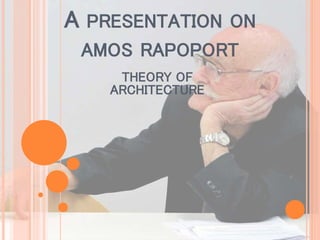
A PRESENTATION ON
AMOS RAPOPORT
THEORY OF
ARCHITECTURE
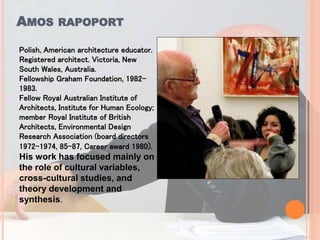
AMOS RAPOPORT
Polish, American architecture educator.
Registered architect. Victoria, New
South Wales, Australia.
Fellowship Graham Foundation, 1982-
1983.
Fellow Royal Australian Institute of
Architects, Institute for Human Ecology;
member Royal Institute of British
Architects, Environmental Design
Research Association (board directors
1972-1974, 85-87, Career award 1980).
His work has focused mainly on
the role of cultural variables,
cross-cultural studies, and
theory development and
synthesis.
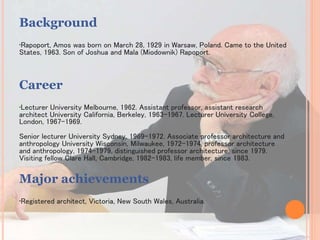
Background
•Rapoport, Amos was born on March 28, 1929 in Warsaw, Poland. Came to the United
States, 1963. Son of Joshua and Mala (Miodownik) Rapoport.
Career
•Lecturer University Melbourne, 1962. Assistant professor, assistant research
architect University California, Berkeley, 1963-1967. Lecturer University College,
London, 1967-1969.
Senior lecturer University Sydney, 1969-1972. Associate professor architecture and
anthropology University Wisconsin, Milwaukee, 1972-1974, professor architecture
and anthropology, 1974-1979, distinguished professor architecture, since 1979.
Visiting fellow Clare Hall, Cambridge, 1982-1983, life member, since 1983.
Major achievements
•Registered architect, Victoria, New South Wales, Australia.
Works
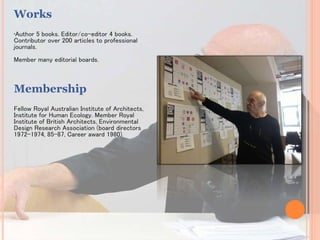
•Author 5 books. Editor/co-editor 4 books.
Contributor over 200 articles to professional
journals.
Member many editorial boards.
Membership
Fellow Royal Australian Institute of Architects,
Institute for Human Ecology. Member Royal
Institute of British Architects, Environmental
Design Research Association (board directors
1972-1974, 85-87, Career award 1980).
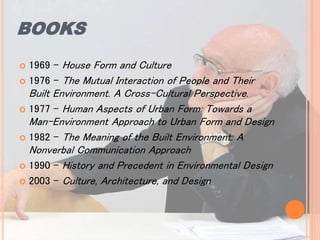
BOOKS
 1969 - House Form and Culture
 1976 - The Mutual Interaction of People and Their
Built Environment. A Cross-Cultural Perspective.
 1977 - Human Aspects of Urban Form: Towards a
Man-Environment Approach to Urban Form and Design
 1982 - The Meaning of the Built Environment: A
Nonverbal Communication Approach
 1990 - History and Precedent in Environmental Design
 2003 - Culture, Architecture, and Design
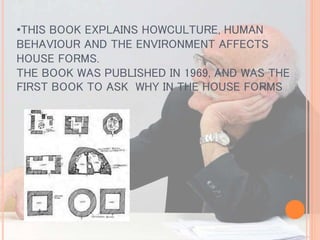
•THIS BOOK EXPLAINS HOWCULTURE, HUMAN
BEHAVIOUR AND THE ENVIRONMENT AFFECTS
HOUSE FORMS.
THE BOOK WAS PUBLISHED IN 1969, AND WAS THE
FIRST BOOK TO ASK WHY IN THE HOUSE FORMS
HOUSE, FORM AND CULTURE
 THE FORM THAT HOUSING
TAKES IS RELATED TO
THE CULTURE IN WHICH
THE HOUSING IS.
 USED PRIMITIVE AND
VERNACULAR HOUSING.
 FOCUSED MOSTLY ON
MONUMENTS WITHOUT
HELP OF ARCHITECTURE.
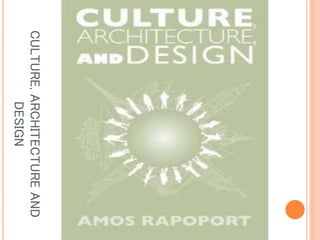
CULTURE,ARCHITECTUREAND
DESIGN
CULTURE, ARCHITECTURE, AND DESIGN
 The three basic questions are (1) What bio-social,
psychological, and cultural characteristics of human
beings influence which characteristics of the built
environment?; (2) What effects do which aspects of
which environments have on which groups of
people, under what circumstances, and when, why,
and how?; and (3) Given this two-way interaction
between people and environments.
THANK YOU

A presentation on AMOS RAPOPORT

  • 1.
    A PRESENTATION ON AMOSRAPOPORT THEORY OF ARCHITECTURE
  • 2.
    AMOS RAPOPORT Polish, Americanarchitecture educator. Registered architect. Victoria, New South Wales, Australia. Fellowship Graham Foundation, 1982- 1983. Fellow Royal Australian Institute of Architects, Institute for Human Ecology; member Royal Institute of British Architects, Environmental Design Research Association (board directors 1972-1974, 85-87, Career award 1980). His work has focused mainly on the role of cultural variables, cross-cultural studies, and theory development and synthesis.
  • 3.
    Background •Rapoport, Amos wasborn on March 28, 1929 in Warsaw, Poland. Came to the United States, 1963. Son of Joshua and Mala (Miodownik) Rapoport. Career •Lecturer University Melbourne, 1962. Assistant professor, assistant research architect University California, Berkeley, 1963-1967. Lecturer University College, London, 1967-1969. Senior lecturer University Sydney, 1969-1972. Associate professor architecture and anthropology University Wisconsin, Milwaukee, 1972-1974, professor architecture and anthropology, 1974-1979, distinguished professor architecture, since 1979. Visiting fellow Clare Hall, Cambridge, 1982-1983, life member, since 1983. Major achievements •Registered architect, Victoria, New South Wales, Australia.
  • 4.
    Works •Author 5 books.Editor/co-editor 4 books. Contributor over 200 articles to professional journals. Member many editorial boards. Membership Fellow Royal Australian Institute of Architects, Institute for Human Ecology. Member Royal Institute of British Architects, Environmental Design Research Association (board directors 1972-1974, 85-87, Career award 1980).
  • 5.
    BOOKS  1969 -House Form and Culture  1976 - The Mutual Interaction of People and Their Built Environment. A Cross-Cultural Perspective.  1977 - Human Aspects of Urban Form: Towards a Man-Environment Approach to Urban Form and Design  1982 - The Meaning of the Built Environment: A Nonverbal Communication Approach  1990 - History and Precedent in Environmental Design  2003 - Culture, Architecture, and Design
  • 7.
    •THIS BOOK EXPLAINSHOWCULTURE, HUMAN BEHAVIOUR AND THE ENVIRONMENT AFFECTS HOUSE FORMS. THE BOOK WAS PUBLISHED IN 1969, AND WAS THE FIRST BOOK TO ASK WHY IN THE HOUSE FORMS
  • 8.
    HOUSE, FORM ANDCULTURE  THE FORM THAT HOUSING TAKES IS RELATED TO THE CULTURE IN WHICH THE HOUSING IS.  USED PRIMITIVE AND VERNACULAR HOUSING.  FOCUSED MOSTLY ON MONUMENTS WITHOUT HELP OF ARCHITECTURE.
  • 9.
  • 10.
    CULTURE, ARCHITECTURE, ANDDESIGN  The three basic questions are (1) What bio-social, psychological, and cultural characteristics of human beings influence which characteristics of the built environment?; (2) What effects do which aspects of which environments have on which groups of people, under what circumstances, and when, why, and how?; and (3) Given this two-way interaction between people and environments.
  • 11.