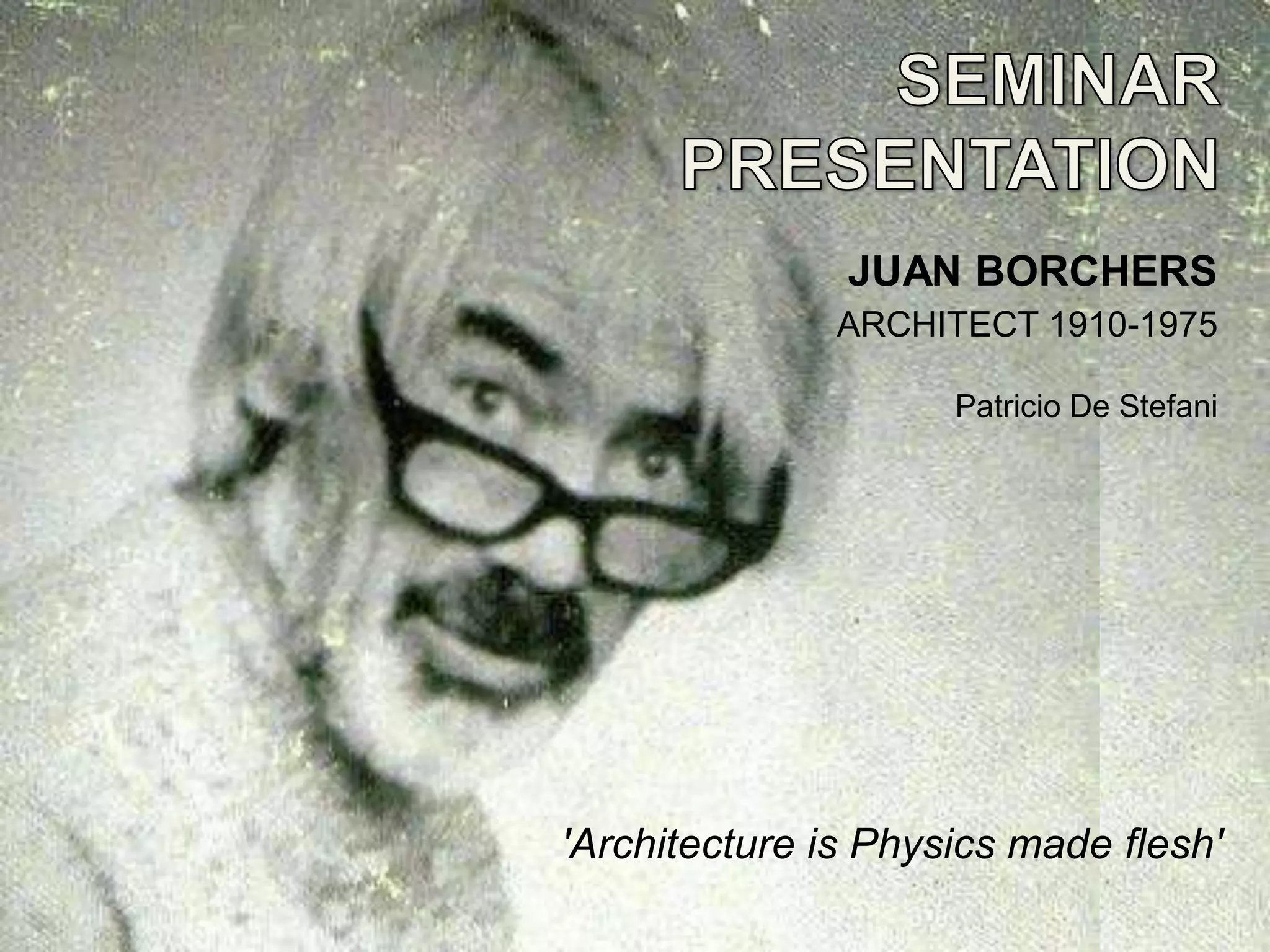
JUAN BORCHERS
               ARCHITECT 1910-1975

                     Patricio De Stefani


'Architecture is Physics made flesh'
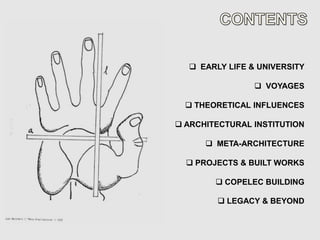
 EARLY LIFE & UNIVERSITY

                 VOYAGES

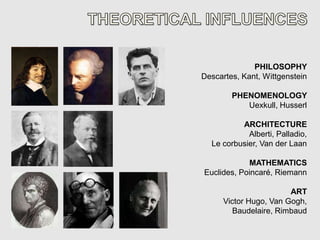
   THEORETICAL INFLUENCES

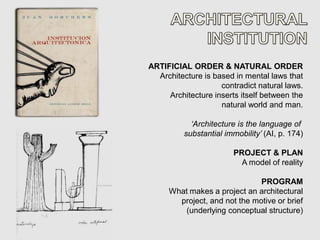
 ARCHITECTURAL INSTITUTION

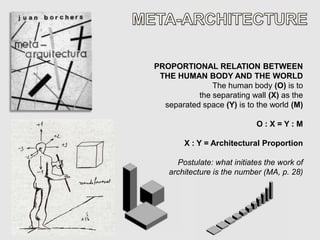
       META-ARCHITECTURE

   PROJECTS & BUILT WORKS

         COPELEC BUILDING

         LEGACY & BEYOND
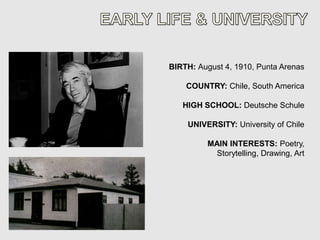
BIRTH: August 4, 1910, Punta Arenas

    COUNTRY: Chile, South America

   HIGH SCHOOL: Deutsche Schule

    UNIVERSITY: University of Chile

         MAIN INTERESTS: Poetry,
          Storytelling, Drawing, Art
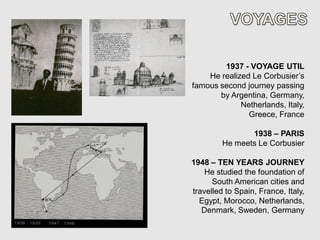
1937 - VOYAGE UTIL
    He realized Le Corbusier’s
famous second journey passing
       by Argentina, Germany,
             Netherlands, Italy,
               Greece, France

                1938 – PARIS
         He meets Le Corbusier

1948 – TEN YEARS JOURNEY
    He studied the foundation of
      South American cities and
travelled to Spain, France, Italy,
  Egypt, Morocco, Netherlands,
   Denmark, Sweden, Germany
PHILOSOPHY
Descartes, Kant, Wittgenstein

        PHENOMENOLOGY
           Uexkull, Husserl

          ARCHITECTURE
            Alberti, Palladio,
  Le corbusier, Van der Laan

            MATHEMATICS
Euclides, Poincaré, Riemann

                        ART
      Victor Hugo, Van Gogh,
         Baudelaire, Rimbaud
ARTIFICIAL ORDER & NATURAL ORDER
  Architecture is based in mental laws that
                    contradict natural laws.
     Architecture inserts itself between the
                    natural world and man.

            ‘Architecture is the language of
          substantial immobility’ (AI, p. 174)

                        PROJECT & PLAN
                          A model of reality

                              PROGRAM
     What makes a project an architectural
       project, and not the motive or brief
        (underlying conceptual structure)
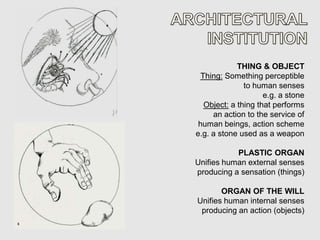
THING & OBJECT
  Thing: Something perceptible
               to human senses
                     e.g. a stone
   Object: a thing that performs
     an action to the service of
 human beings, action scheme
e.g. a stone used as a weapon

           PLASTIC ORGAN
Unifies human external senses
producing a sensation (things)

       ORGAN OF THE WILL
Unifies human internal senses
 producing an action (objects)
PROPORTIONAL RELATION BETWEEN
 THE HUMAN BODY AND THE WORLD
               The human body (O) is to
           the separating wall (X) as the
  separated space (Y) is to the world (M)

                             O:X=Y:M

        X : Y = Architectural Proportion

      Postulate: what initiates the work of
    architecture is the number (MA, p. 28)
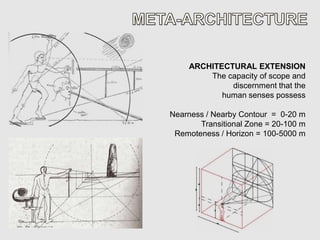
ARCHITECTURAL EXTENSION
        The capacity of scope and
             discernment that the
           human senses possess

Nearness / Nearby Contour = 0-20 m
       Transitional Zone = 20-100 m
 Remoteness / Horizon = 100-5000 m
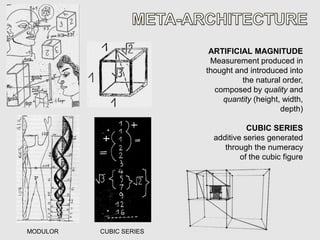
ARTIFICIAL MAGNITUDE
                          Measurement produced in
                         thought and introduced into
                                   the natural order,
                           composed by quality and
                             quantity (height, width,
                                              depth)

                                     CUBIC SERIES
                           additive series generated
                              through the numeracy
                                   of the cubic figure


MODULOR   CUBIC SERIES
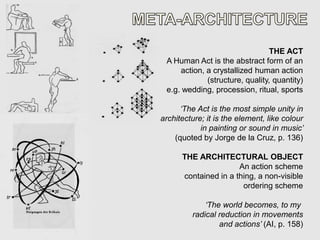
THE ACT
 A Human Act is the abstract form of an
     action, a crystallized human action
             (structure, quality, quantity)
 e.g. wedding, procession, ritual, sports

      ‘The Act is the most simple unity in
architecture; it is the element, like colour
            in painting or sound in music’
    (quoted by Jorge de la Cruz, p. 136)

      THE ARCHITECTURAL OBJECT
                      An action scheme
      contained in a thing, a non-visible
                       ordering scheme

             ‘The world becomes, to my
         radical reduction in movements
                 and actions’ (AI, p. 158)
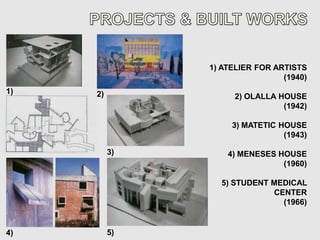
1) ATELIER FOR ARTISTS
                                (1940)
1)   2)             2) OLALLA HOUSE
                               (1942)

                    3) MATETIC HOUSE
                                (1943)

          3)       4) MENESES HOUSE
                               (1960)

                 5) STUDENT MEDICAL
                            CENTER
                              (1966)


4)        5)
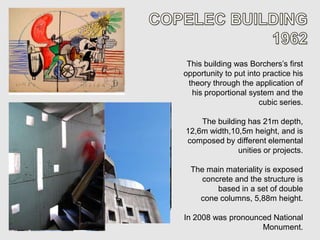
This building was Borchers’s first
opportunity to put into practice his
 theory through the application of
  his proportional system and the
                       cubic series.

    The building has 21m depth,
12,6m width,10,5m height, and is
composed by different elemental
              unities or projects.

  The main materiality is exposed
    concrete and the structure is
        based in a set of double
    cone columns, 5,88m height.

In 2008 was pronounced National
                    Monument.
Borchers’s legacy and original contribution to
  architecture is acknowledged not only in Chile
         but also in Spain, where Rafael Moneo
             dedicated an article to his theories.

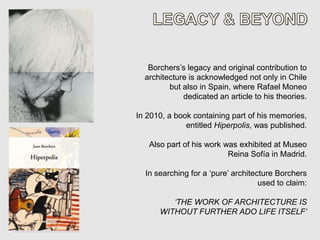
In 2010, a book containing part of his memories,
              entitled Hiperpolis, was published.

   Also part of his work was exhibited at Museo
                          Reina Sofía in Madrid.

  In searching for a ‘pure’ architecture Borchers
                                    used to claim:

         ‘THE WORK OF ARCHITECTURE IS
      WITHOUT FURTHER ADO LIFE ITSELF’
http://es.wikipedia.org/wiki/Juan_Borchers

                          Revista CA N° 98. Santiago, September, 1999

De la Cruz, Jorge. Alquimia: El Acto y el Número. Santiago, Escuela de
  Arquitectura Pontificia Universidad Católica de Chile, November, 2000.

Bochers, Juan. Institución Arquitectónica. Santiago, Andres Bello, 1968.

           Bochers, Juan. Meta-Arquitectura. Santiago, Mathesis, 1975.

Seminar Presentation Juan Borchers

  • 1.
    JUAN BORCHERS ARCHITECT 1910-1975 Patricio De Stefani 'Architecture is Physics made flesh'
  • 2.
     EARLY LIFE& UNIVERSITY  VOYAGES  THEORETICAL INFLUENCES  ARCHITECTURAL INSTITUTION  META-ARCHITECTURE  PROJECTS & BUILT WORKS  COPELEC BUILDING  LEGACY & BEYOND
  • 3.
    BIRTH: August 4,1910, Punta Arenas COUNTRY: Chile, South America HIGH SCHOOL: Deutsche Schule UNIVERSITY: University of Chile MAIN INTERESTS: Poetry, Storytelling, Drawing, Art
  • 4.
    1937 - VOYAGEUTIL He realized Le Corbusier’s famous second journey passing by Argentina, Germany, Netherlands, Italy, Greece, France 1938 – PARIS He meets Le Corbusier 1948 – TEN YEARS JOURNEY He studied the foundation of South American cities and travelled to Spain, France, Italy, Egypt, Morocco, Netherlands, Denmark, Sweden, Germany
  • 5.
    PHILOSOPHY Descartes, Kant, Wittgenstein PHENOMENOLOGY Uexkull, Husserl ARCHITECTURE Alberti, Palladio, Le corbusier, Van der Laan MATHEMATICS Euclides, Poincaré, Riemann ART Victor Hugo, Van Gogh, Baudelaire, Rimbaud
  • 6.
    ARTIFICIAL ORDER &NATURAL ORDER Architecture is based in mental laws that contradict natural laws. Architecture inserts itself between the natural world and man. ‘Architecture is the language of substantial immobility’ (AI, p. 174) PROJECT & PLAN A model of reality PROGRAM What makes a project an architectural project, and not the motive or brief (underlying conceptual structure)
  • 7.
    THING & OBJECT Thing: Something perceptible to human senses e.g. a stone Object: a thing that performs an action to the service of human beings, action scheme e.g. a stone used as a weapon PLASTIC ORGAN Unifies human external senses producing a sensation (things) ORGAN OF THE WILL Unifies human internal senses producing an action (objects)
  • 8.
    PROPORTIONAL RELATION BETWEEN THE HUMAN BODY AND THE WORLD The human body (O) is to the separating wall (X) as the separated space (Y) is to the world (M) O:X=Y:M X : Y = Architectural Proportion Postulate: what initiates the work of architecture is the number (MA, p. 28)
  • 9.
    ARCHITECTURAL EXTENSION The capacity of scope and discernment that the human senses possess Nearness / Nearby Contour = 0-20 m Transitional Zone = 20-100 m Remoteness / Horizon = 100-5000 m
  • 10.
    ARTIFICIAL MAGNITUDE Measurement produced in thought and introduced into the natural order, composed by quality and quantity (height, width, depth) CUBIC SERIES additive series generated through the numeracy of the cubic figure MODULOR CUBIC SERIES
  • 11.
    THE ACT AHuman Act is the abstract form of an action, a crystallized human action (structure, quality, quantity) e.g. wedding, procession, ritual, sports ‘The Act is the most simple unity in architecture; it is the element, like colour in painting or sound in music’ (quoted by Jorge de la Cruz, p. 136) THE ARCHITECTURAL OBJECT An action scheme contained in a thing, a non-visible ordering scheme ‘The world becomes, to my radical reduction in movements and actions’ (AI, p. 158)
  • 12.
    1) ATELIER FORARTISTS (1940) 1) 2) 2) OLALLA HOUSE (1942) 3) MATETIC HOUSE (1943) 3) 4) MENESES HOUSE (1960) 5) STUDENT MEDICAL CENTER (1966) 4) 5)
  • 13.
    This building wasBorchers’s first opportunity to put into practice his theory through the application of his proportional system and the cubic series. The building has 21m depth, 12,6m width,10,5m height, and is composed by different elemental unities or projects. The main materiality is exposed concrete and the structure is based in a set of double cone columns, 5,88m height. In 2008 was pronounced National Monument.
  • 14.
    Borchers’s legacy andoriginal contribution to architecture is acknowledged not only in Chile but also in Spain, where Rafael Moneo dedicated an article to his theories. In 2010, a book containing part of his memories, entitled Hiperpolis, was published. Also part of his work was exhibited at Museo Reina Sofía in Madrid. In searching for a ‘pure’ architecture Borchers used to claim: ‘THE WORK OF ARCHITECTURE IS WITHOUT FURTHER ADO LIFE ITSELF’
  • 15.
    http://es.wikipedia.org/wiki/Juan_Borchers Revista CA N° 98. Santiago, September, 1999 De la Cruz, Jorge. Alquimia: El Acto y el Número. Santiago, Escuela de Arquitectura Pontificia Universidad Católica de Chile, November, 2000. Bochers, Juan. Institución Arquitectónica. Santiago, Andres Bello, 1968. Bochers, Juan. Meta-Arquitectura. Santiago, Mathesis, 1975.