A New Perspective on
    Vascular Access


                           by Steve Chen

           Director of Nephrology,
              Shin-Chu Branch of Taipei Veterans General Hospital
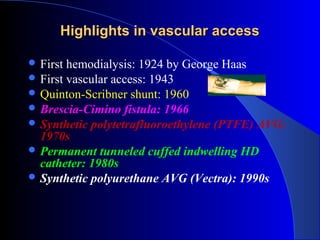
Highlights in vascular access

 First hemodialysis: 1924 by George Haas
 First vascular access: 1943
 Quinton-Scribner shunt: 1960
 Brescia-Cimino fistula: 1966
 Synthetic polytetrafluoroethylene (PTFE) AVG:
  1970s
 Permanent tunneled cuffed indwelling HD
  catheter: 1980s
 Synthetic polyurethane AVG (Vectra): 1990s
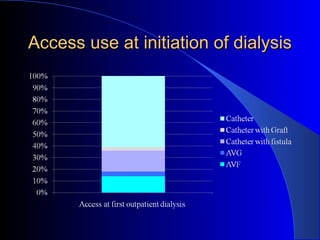
Shunt


AVG           AVF

                    Catheter
Access use at initiation of dialysis
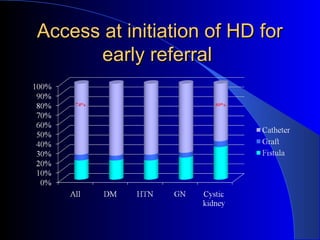
Access at initiation of HD for
      early referral
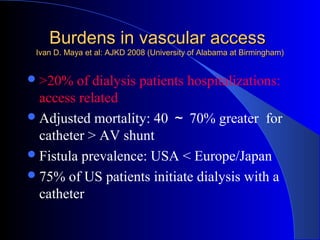
Burdens in vascular access
 Ivan D. Maya et al: AJKD 2008 (University of Alabama at Birmingham)


 >20%   of dialysis patients hospitalizations:
  access related
 Adjusted mortality: 40 ~ 70% greater for
  catheter > AV shunt
 Fistula prevalence: USA < Europe/Japan
 75% of US patients initiate dialysis with a
  catheter
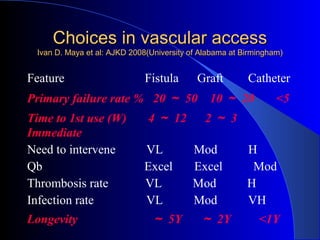
Choices in vascular access
 Ivan D. Maya et al: AJKD 2008(University of Alabama at Birmingham)


Feature                      Fistula       Graft         Catheter
Primary failure rate % 20 ~ 50 10 ~ 20                           <5
Time to 1st use (W)           4 ~ 12          2~ 3
Immediate
Need to intervene            VL           Mod            H
Qb                           Excel        Excel           Mod
Thrombosis rate              VL           Mod            H
Infection rate               VL           Mod            VH
Longevity                      ~ 5Y         ~ 2Y            <1Y
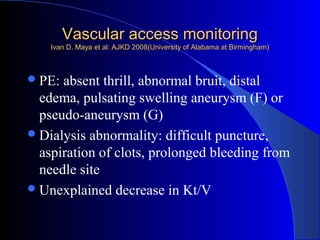
Vascular access monitoring
    Ivan D. Maya et al: AJKD 2008(University of Alabama at Birmingham)


 PE: absent thrill, abnormal bruit, distal
  edema, pulsating swelling aneurysm (F) or
  pseudo-aneurysm (G)
 Dialysis abnormality: difficult puncture,
  aspiration of clots, prolonged bleeding from
  needle site
 Unexplained decrease in Kt/V
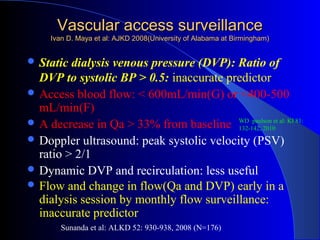
Vascular access surveillance
     Ivan D. Maya et al: AJKD 2008(University of Alabama at Birmingham)


 Static dialysis venous pressure (DVP): Ratio of
  DVP to systolic BP > 0.5: inaccurate predictor
 Access blood flow: < 600mL/min(G) or <400-500
  mL/min(F)
 A decrease in Qa > 33% from baseline WD paulson et al: KI 81:
                                          132-142, 2010
 Doppler ultrasound: peak systolic velocity (PSV)
  ratio > 2/1
 Dynamic DVP and recirculation: less useful
 Flow and change in flow(Qa and DVP) early in a
  dialysis session by monthly flow surveillance:
  inaccurate predictor
        Sunanda et al: ALKD 52: 930-938, 2008 (N=176)
AVF
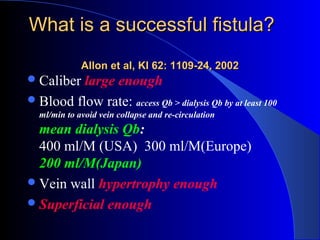
What is a successful fistula?
             Allon et al, KI 62: 1109-24, 2002
 Caliber large enough
 Blood flow rate: access Qb > dialysis Qb by at least 100
  ml/min to avoid vein collapse and re-circulation
  mean dialysis Qb:
  400 ml/M (USA) 300 ml/M(Europe)
  200 ml/M(Japan)
 Vein wall hypertrophy enough
 Superficial enough
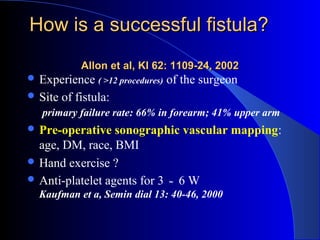
How is a successful fistula?
             Allon et al, KI 62: 1109-24, 2002
 Experience ( >12 procedures)   of the surgeon
 Site   of fistula:
   primary failure rate: 66% in forearm; 41% upper arm
 Pre-operative   sonographic vascular mapping:
  age, DM, race, BMI
 Hand exercise ?
 Anti-platelet agents for 3 ~ 6 W
  Kaufman et a, Semin dial 13: 40-46, 2000
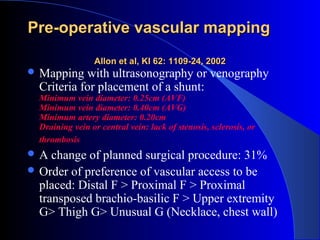
Pre-operative vascular mapping
                 Allon et al, KI 62: 1109-24, 2002
 Mapping   with ultrasonography or venography
  Criteria for placement of a shunt:
  Minimum vein diameter: 0.25cm (AVF)
  Minimum vein diameter: 0.40cm (AVG)
  Minimum artery diameter: 0.20cm
  Draining vein or central vein: lack of stenosis, sclerosis, or
  thrombosis
A   change of planned surgical procedure: 31%
 Order of preference of vascular access to be
  placed: Distal F > Proximal F > Proximal
  transposed brachio-basilic F > Upper extremity
  G> Thigh G> Unusual G (Necklace, chest wall)
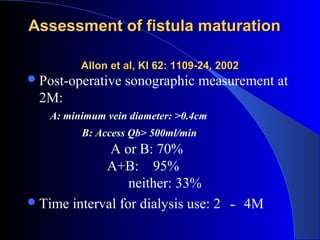
Assessment of fistula maturation

          Allon et al, KI 62: 1109-24, 2002
 Post-operative   sonographic measurement at
  2M:
    A: minimum vein diameter: >0.4cm
          B: Access Qb> 500ml/min
              A or B: 70%
             A+B: 95%
                  neither: 33%
 Time interval for dialysis use: 2     ~     4M
AF fistulas: primary failure
 Ivan D. Maya et al: AJKD 2008(University of Alabama at Birmingham)

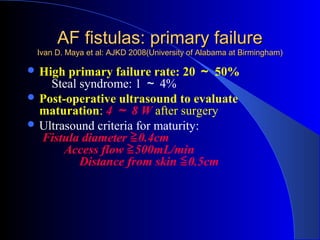
 High  primary failure rate: 20 ~ 50%
    Steal syndrome: 1 ~ 4%
 Post-operative ultrasound to evaluate
  maturation: 4 ~ 8 W after surgery
 Ultrasound criteria for maturity:
  Fistula diameter ≧ 0.4cm
       Access flow ≧ 500mL/min
          Distance from skin ≦ 0.5cm
Primary failure
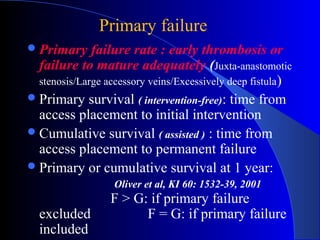
 Primary     failure rate : early thrombosis or
  failure to mature adequately (Juxta-anastomotic
  stenosis/Large accessory veins/Excessively deep fistula )
 Primary survival ( intervention-free): time from
  access placement to initial intervention
 Cumulative survival ( assisted ) : time from
  access placement to permanent failure
 Primary or cumulative survival at 1 year:
                   Oliver et al, KI 60: 1532-39, 2001
                  F > G: if primary failure
  excluded              F = G: if primary failure
  included
Effect of clopidogrel on early
        failure of AVFs for HD
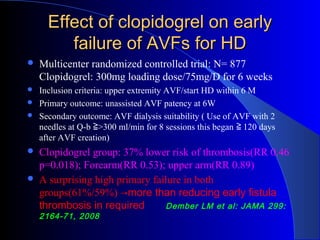
   Multicenter randomized controlled trial: N= 877
    Clopidogrel: 300mg loading dose/75mg/D for 6 weeks
 Inclusion criteria: upper extremity AVF/start HD within 6 M
 Primary outcome: unassisted AVF patency at 6W
 Secondary outcome: AVF dialysis suitability ( Use of AVF with 2
  needles at Q-b ≧>300 ml/min for 8 sessions this began ≧ 120 days
  after AVF creation)
   Clopidogrel group: 37% lower risk of thrombosis(RR 0.46
    p=0.018); Forearm(RR 0.53); upper arm(RR 0.89)
   A surprising high primary failure in both
    groups(61%/59%) →more than reducing early fistula
    thrombosis in required       Dember LM et al: JAMA 299:
    2164-71, 2008
Anti-platelet agents for fistula
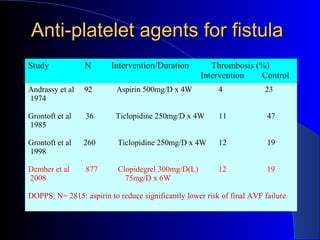
Study            N       Intervention/Duration         Thrombosis (%)
                                                    Intervention   Control
Andrassy et al   92        Aspirin 500mg/D x 4W           4             23
1974

Grontoft et al   36       Ticlopidine 250mg/D x 4W        11             47
1985

Grontoft et al   260       Ticlopidine 250mg/D x 4W       12             19
1998

Dember et al     877       Clopidegrel 300mg/D(L)         12             19
2008                         75mg/D x 6W

DOPPS: N= 2815: aspirin to reduce significantly lower risk of final AVF failure
AV fistulas: late failure
  Ivan D. Maya et al: AJKD 2008(University of Alabama at Birmingham)


 Late fistula failure by stenosis
             60% at venous outlet
                   25% at arterial anastomosis
                       5% at central vessels
                                   A large aneurysm,
  rarely
 Thrombosed fistula requires thrombectomy with
  48 Hr
 Primary patency rate after:
   27 ~ 81% at 6M; 18 ~ 70% at 12M
AVG: go faster!
AV grafts: graft failure
 Ivan D. Maya et al: AJKD 2008(University of Alabama at Birmingham)


 Graft   failure:
               ~ 80% thrombosis
                    ~ 20% infection
                     A large pseudo-aneurysm,
  rarely
 Underlying stenosis in most thrombosed grafts:
                           ~ 60% Venous
  anastomosis                         15% venous
  outlet                                       10%
  central veins
  10% intragraft
          5% arterial anastomosis
AV grafts: graft failure
 Ivan D. Maya et al: AJKD 2008(University of Alabama at Birmingham)


 Intervention-free patency after elective
  angioplasty: 70 ~ 85% at 3M; 20 ~ 40% at 12M
 Intervention-free patency after thrombectomy:
            33 ~ 63% at 3M; 10 ~ 39% at 6M
 Stents may prolong patency in selected grafts:
  elastic lesion
 No clear advantage of bovine or cadaveric human
  vein grafts over PTFE grafts
 Polyurethane grafts (Vectra): can be cannulated
  within 24 Hr
Vascular access stenosis: VNH
 Ivan D. Maya et al: AJKD 2008(University of Alabama at Birmingham)

 VNH:   venous neo-intimal hyperplasia (SMC +
  micro-F + microvessels)
 Hemo-dynamic turbulence: an shear forces
 Dialysis needle injury
 Surgical vascular damage
 PTFE
 Uremia
 Vascular damage from angioplasty
 Expression of genes for cytokines
 Local anti-proliferative drug delivery system:
  Human study in progress
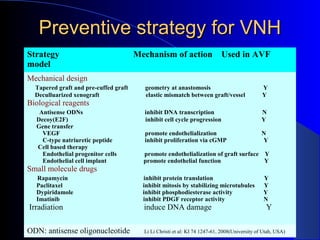
Preventive strategy for VNH
Strategy                               Mechanism of action                  Used in AVF
model
Mechanical design
  Tapered graft and pre-cuffed graft     geometry at anastomosis                               Y
  Deculluarized xenograft                elastic mismatch between graft/vessel                 Y
Biological reagents
   Antisense ODNs                        inhibit DNA transcription                             N
  Decoy(E2F)                             inhibit cell cycle progression                        Y
  Gene transfer
    VEGF                                 promote endothelialization                            N
    C-type natriuretic peptide           inhibit proliferation via cGMP                        Y
  Cell based therapy
    Endothelial progenitor cells         promote endothelialization of graft surface Y
    Endothelial cell implant             promote endothelial function                Y
Small molecule drugs
  Rapamycin                              inhibit protein translation                            Y
  Paclitaxel                             inhibit mitosis by stabilizing microtubules            Y
  Dypiridamole                           inhibit phosphodiesterase activity                     Y
  Imatinib                               inhibit PDGF receptor activity                         N
Irradiation                              induce DNA damage                                       Y

ODN: antisense oligonucleotide           Li Li Christi et al: KI 74 1247-61, 2008(University of Utah, USA)
Catheter: fastest!
So think twice…
              26
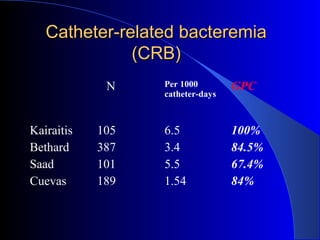
Catheter-related bacteremia
              (CRB)
             N    Per 1000        GPC
                  catheter-days


Kairaitis   105   6.5             100%
Bethard     387   3.4             84.5%
Saad        101   5.5             67.4%
Cuevas      189   1.54            84%
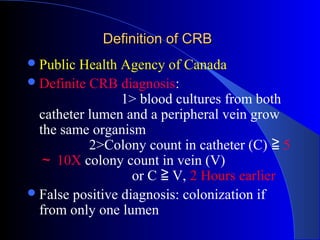
Definition of CRB
 Public Health Agency of Canada
 Definite CRB diagnosis:
                 1> blood cultures from both
  catheter lumen and a peripheral vein grow
  the same organism
           2>Colony count in catheter (C) ≧ 5
  ~ 10X colony count in vein (V)
                   or C ≧ V, 2 Hours earlier
 False positive diagnosis: colonization if
  from only one lumen
Diagnosis of CRB

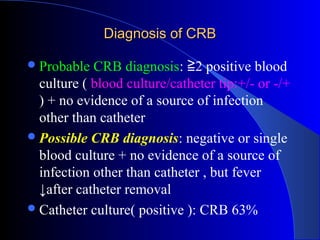
 Probable  CRB diagnosis: ≧2 positive blood
  culture ( blood culture/catheter tip:+/- or -/+
  ) + no evidence of a source of infection
  other than catheter
 Possible CRB diagnosis: negative or single
  blood culture + no evidence of a source of
  infection other than catheter , but fever
  ↓after catheter removal
 Catheter culture( positive ): CRB 63%
Catheter-related bacteremia (CRB)

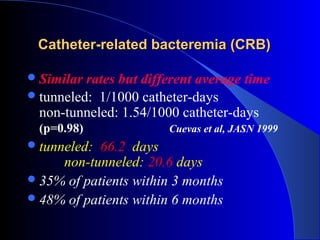
 Similar rates but different average time
 tunneled: 1/1000 catheter-days
  non-tunneled: 1.54/1000 catheter-days
  (p=0.98)              Cuevas et al, JASN 1999
 tunneled: 66.2 days
     non-tunneled: 20.6 days
 35% of patients within 3 months
 48% of patients within 6 months
Risk factors for CRB
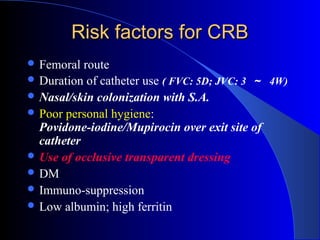
 Femoral  route
 Duration of catheter use ( FVC: 5D; JVC: 3 ~ 4W)
 Nasal/skin colonization with S.A.
 Poor personal hygiene:
  Povidone-iodine/Mupirocin over exit site of
  catheter
 Use of occlusive transparent dressing
 DM
 Immuno-suppression
 Low albumin; high ferritin
Complications of bacteremia
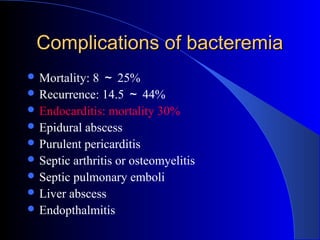
 Mortality: 8 ~ 25%
 Recurrence: 14.5 ~ 44%
 Endocarditis: mortality 30%
 Epidural abscess
 Purulent pericarditis
 Septic arthritis or osteomyelitis
 Septic pulmonary emboli
 Liver abscess
 Endopthalmitis
Use rate of HD permanent
 catheter < 10%
 NKF-K/DOQI guidelines
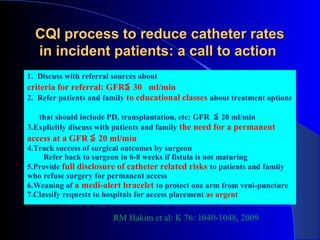
CQI process to reduce catheter rates
  in incident patients: a call to action
1. Discuss with referral sources about
criteria for referral: GFR≦ 30 ml/min
2. Refer patients and family to educational classes about treatment options

   that should include PD, transplantation, etc: GFR ≦ 20 ml/min
3.Explicitly discuss with patients and family the need for a permanent
access at a GFR ≦ 20 ml/min
4.Track success of surgical outcomes by surgeon
     Refer back to surgeon in 6-8 weeks if fistula is not maturing
5.Provide full disclosure of catheter related risks to patients and family
who refuse surgery for permanent access
6.Weaning of a medi-alert bracelet to protect one arm from veni-puncture
7.Classify requests to hospitals for access placement as urgent

                         RM Hakim et al: K 76: 1040-1048, 2009
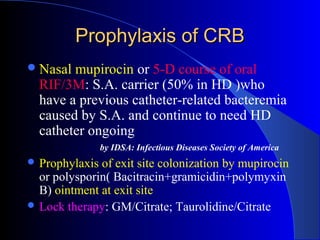
Prophylaxis of CRB
 Nasal mupirocin or 5-D course of oral
  RIF/3M: S.A. carrier (50% in HD )who
  have a previous catheter-related bacteremia
  caused by S.A. and continue to need HD
  catheter ongoing
                by IDSA: Infectious Diseases Society of America
 Prophylaxis of exit site colonization by mupirocin
  or polysporin( Bacitracin+gramicidin+polymyxin
  B) ointment at exit site
 Lock therapy: GM/Citrate; Taurolidine/Citrate
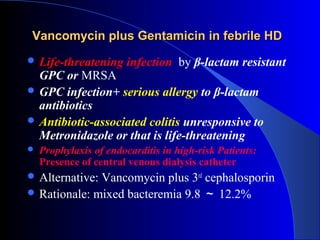
Vancomycin plus Gentamicin in febrile HD
 Life-threatening      infection by β-lactam resistant
  GPC or MRSA
 GPC infection+ serious allergy to β-lactam
  antibiotics
 Antibiotic-associated colitis unresponsive to
  Metronidazole or that is life-threatening
   Prophylaxis of endocarditis in high-risk Patients:
    Presence of central venous dialysis catheter
 Alternative:Vancomycin plus 3rd cephalosporin
 Rationale: mixed bacteremia 9.8 ~ 12.2%
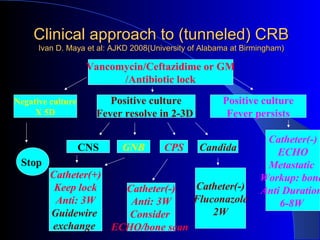
Clinical approach to (tunneled) CRB
      Ivan D. Maya et al: AJKD 2008(University of Alabama at Birmingham)

                    Vancomycin/Ceftazidime or GM
                          /Antibiotic lock

Negative culture        Positive culture               Positive culture
     X 5D            Fever resolve in 2-3D              Fever persists

                                                                  Catheter(-)
                   CNS      GNB        CPS       Candida            ECHO
 Stop                                                             Metastatic
         Catheter(+)                                             Workup: bone
          Keep lock  Catheter(-) Catheter(-)                     Anti Duration
          Anti: 3W    Anti: 3W   Fluconazole                         6-8W
         Guidewire   Consider        2W
         exchange ECHO/bone scan
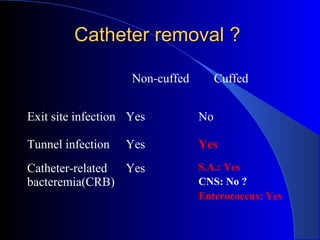
Catheter removal ?

                    Non-cuffed        Cuffed


Exit site infection Yes          No

Tunnel infection   Yes           Yes
Catheter-related Yes             S.A.: Yes
bacteremia(CRB)                  CNS: No ?
                                 Enterococcus: Yes
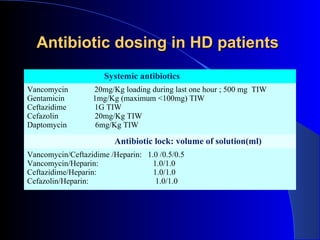
Antibiotic dosing in HD patients
                      Systemic antibiotics
Vancomycin        20mg/Kg loading during last one hour ; 500 mg TIW
Gentamicin        1mg/Kg (maximum <100mg) TIW
Ceftazidime       1G TIW
Cefazolin         20mg/Kg TIW
Daptomycin         6mg/Kg TIW

                         Antibiotic lock: volume of solution(ml)
Vancomycin/Ceftazidime /Heparin: 1.0 /0.5/0.5
Vancomycin/Heparin:                1.0/1.0
Ceftazidime/Heparin:               1.0/1.0
Cefazolin/Heparin:                  1.0/1.0
Tunnel infection
 CDC   guideline:
              Erythema, tenderness, and induration in
 tissues overlying the catheter + > 2cm from the exit site
 Public   Health Agency of Canada:
   Definite:
            1> Purulent discharge from tunnel
                2> Erythema, tenderness, induration(2/3) at
 tunnel with a positive culture from serous discharge
                Probable: Erythema, tenderness,
 induration(2/3) at tunnel with serous discharge, but
 negative culture /no discharge, but lack of alternative
                                                  Possible:
 Erythema, tenderness, induration(2/3) at tunnel , but
Careful observation needed for tunnel infection !
Exit site infection
   CDC guideline:
    Erythema, tenderness, and induration or purulence in
    tissues overlying the catheter within 2cm from the exit
    site
   Public Health Agency of Canada:
       Definite:
      1> Purulent discharge at exit site
        2> Erythema, tenderness, induration(2/3) at exit site
    with a positive culture from serous discharge
             Probable: Erythema, tenderness, induration(2/3) at
    exit site with serous discharge, but negative culture /no
    discharge, but lack of alternative
                                 Possible: Erythema, tenderness,
    induration(2/3) at exit site , but alternative cause cannot be
    ruled out
Watch out the signs of AVG
infection!
AVG infection
 30-day  infection rate: 6%
 Risk factors:
  femoral route
  poor hygiene
  repetitive cannulations
  perigraft hematoma formation
     prolonged postdialysis bleeding from graft
  repeat surgical revisions
  HIV status(30%), DM, low albumin, high ferritin
  transient bacteremia from distal site or CRB
AVG infection: S/S
 Local pain, irritation, tenderness
 Redness, warmth
 Diffuse or local swelling
 Skin breakdown
 Serous or purulent discharge
 Leukocytosis, fever
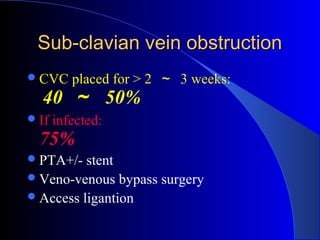
Sub-clavian vein obstruction
 CVC     placed for > 2 ~ 3 weeks:
  40 ~ 50%
 If   infected:
  75%
 PTA+/-  stent
 Veno-venous bypass surgery
 Access ligantion
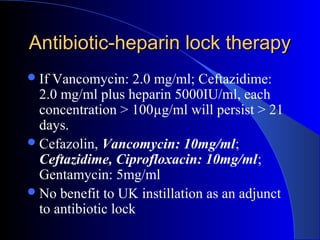
Antibiotic-heparin lock therapy
 If Vancomycin: 2.0 mg/ml; Ceftazidime:
  2.0 mg/ml plus heparin 5000IU/ml, each
  concentration > 100µg/ml will persist > 21
  days.
 Cefazolin, Vancomycin: 10mg/ml;
  Ceftazidime, Ciprofloxacin: 10mg/ml;
  Gentamycin: 5mg/ml
 No benefit to UK instillation as an adjunct
  to antibiotic lock
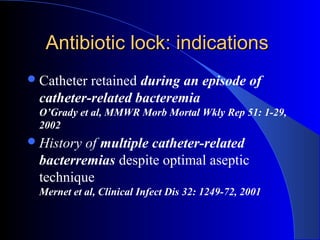
Antibiotic lock: indications
 Catheterretained during an episode of
 catheter-related bacteremia
 O’Grady et al, MMWR Morb Mortal Wkly Rep 51: 1-29,
 2002
 Historyof multiple catheter-related
 bacterremias despite optimal aseptic
 technique
 Mernet et al, Clinical Infect Dis 32: 1249-72, 2001
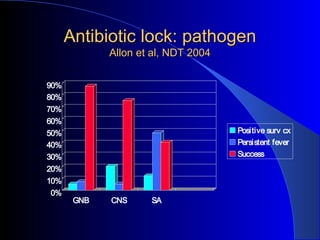
Antibiotic lock: pathogen
             Allon et al, NDT 2004

90%
80%
70%
60%
50%                                  Positive surv cx
40%                                  Persistent fever
30%                                  Success
20%
10%
 0%
       GNB   CNS     SA
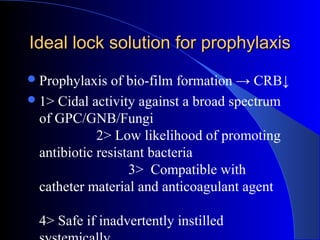
Ideal lock solution for prophylaxis
 Prophylaxis   of bio-film formation → CRB↓
 1> Cidal activity against a broad spectrum
  of GPC/GNB/Fungi
             2> Low likelihood of promoting
  antibiotic resistant bacteria
                   3> Compatible with
  catheter material and anticoagulant agent

  4> Safe if inadvertently instilled
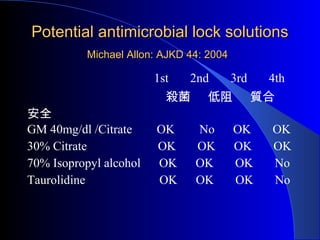
Potential antimicrobial lock solutions
           Michael Allon: AJKD 44: 2004

                        1st    2nd        3rd    4th
                          殺菌      低阻            質合
安全
GM 40mg/dl /Citrate     OK      No        OK     OK
30% Citrate             OK      OK        OK     OK
70% Isopropyl alcohol   OK      OK        OK     No
Taurolidine             OK      OK        OK     No
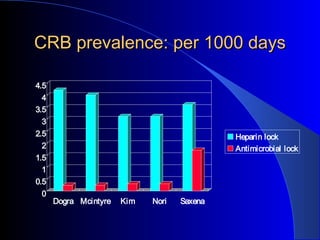
CRB prevalence: per 1000 days

4.5
  4
3.5
  3
2.5                                          Heparin lock
  2                                          Antimicrobial lock
1.5
  1
0.5
  0
      Dogra Mcintyre   Kim   Nori   Saxena
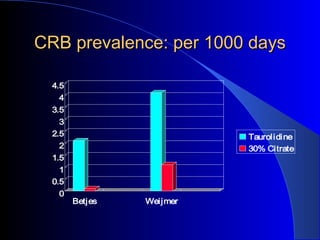
CRB prevalence: per 1000 days

  4.5
    4
  3.5
    3
  2.5                      Taurolidine
    2                      30% Citrate
  1.5
    1
  0.5
    0
        Betjes   Weijmer
Antibiotic lock: barriers
 All randomized trials: F-U for < 6M
  Selection of antibiotic resistant infection if
  longer use
 Systemic toxicity from leaks into
  circulation 10-fold lower concentration of
  GM: 4 ~ 5 mg/mL
 Economic
 FDA not approved
A New Perspective on Vascular Access

A New Perspective on Vascular Access

  • 1.
    A New Perspectiveon Vascular Access by Steve Chen Director of Nephrology, Shin-Chu Branch of Taipei Veterans General Hospital
  • 2.
    Highlights in vascularaccess  First hemodialysis: 1924 by George Haas  First vascular access: 1943  Quinton-Scribner shunt: 1960  Brescia-Cimino fistula: 1966  Synthetic polytetrafluoroethylene (PTFE) AVG: 1970s  Permanent tunneled cuffed indwelling HD catheter: 1980s  Synthetic polyurethane AVG (Vectra): 1990s
  • 3.
    Shunt AVG AVF Catheter
  • 4.
    Access use atinitiation of dialysis
  • 5.
    Access at initiationof HD for early referral
  • 6.
    Burdens in vascularaccess Ivan D. Maya et al: AJKD 2008 (University of Alabama at Birmingham)  >20% of dialysis patients hospitalizations: access related  Adjusted mortality: 40 ~ 70% greater for catheter > AV shunt  Fistula prevalence: USA < Europe/Japan  75% of US patients initiate dialysis with a catheter
  • 7.
    Choices in vascularaccess Ivan D. Maya et al: AJKD 2008(University of Alabama at Birmingham) Feature Fistula Graft Catheter Primary failure rate % 20 ~ 50 10 ~ 20 <5 Time to 1st use (W) 4 ~ 12 2~ 3 Immediate Need to intervene VL Mod H Qb Excel Excel Mod Thrombosis rate VL Mod H Infection rate VL Mod VH Longevity ~ 5Y ~ 2Y <1Y
  • 8.
    Vascular access monitoring Ivan D. Maya et al: AJKD 2008(University of Alabama at Birmingham)  PE: absent thrill, abnormal bruit, distal edema, pulsating swelling aneurysm (F) or pseudo-aneurysm (G)  Dialysis abnormality: difficult puncture, aspiration of clots, prolonged bleeding from needle site  Unexplained decrease in Kt/V
  • 9.
    Vascular access surveillance Ivan D. Maya et al: AJKD 2008(University of Alabama at Birmingham)  Static dialysis venous pressure (DVP): Ratio of DVP to systolic BP > 0.5: inaccurate predictor  Access blood flow: < 600mL/min(G) or <400-500 mL/min(F)  A decrease in Qa > 33% from baseline WD paulson et al: KI 81: 132-142, 2010  Doppler ultrasound: peak systolic velocity (PSV) ratio > 2/1  Dynamic DVP and recirculation: less useful  Flow and change in flow(Qa and DVP) early in a dialysis session by monthly flow surveillance: inaccurate predictor Sunanda et al: ALKD 52: 930-938, 2008 (N=176)
  • 10.
  • 11.
    What is asuccessful fistula? Allon et al, KI 62: 1109-24, 2002  Caliber large enough  Blood flow rate: access Qb > dialysis Qb by at least 100 ml/min to avoid vein collapse and re-circulation mean dialysis Qb: 400 ml/M (USA) 300 ml/M(Europe) 200 ml/M(Japan)  Vein wall hypertrophy enough  Superficial enough
  • 12.
    How is asuccessful fistula? Allon et al, KI 62: 1109-24, 2002  Experience ( >12 procedures) of the surgeon  Site of fistula: primary failure rate: 66% in forearm; 41% upper arm  Pre-operative sonographic vascular mapping: age, DM, race, BMI  Hand exercise ?  Anti-platelet agents for 3 ~ 6 W Kaufman et a, Semin dial 13: 40-46, 2000
  • 13.
    Pre-operative vascular mapping Allon et al, KI 62: 1109-24, 2002  Mapping with ultrasonography or venography Criteria for placement of a shunt: Minimum vein diameter: 0.25cm (AVF) Minimum vein diameter: 0.40cm (AVG) Minimum artery diameter: 0.20cm Draining vein or central vein: lack of stenosis, sclerosis, or thrombosis A change of planned surgical procedure: 31%  Order of preference of vascular access to be placed: Distal F > Proximal F > Proximal transposed brachio-basilic F > Upper extremity G> Thigh G> Unusual G (Necklace, chest wall)
  • 14.
    Assessment of fistulamaturation Allon et al, KI 62: 1109-24, 2002  Post-operative sonographic measurement at 2M: A: minimum vein diameter: >0.4cm B: Access Qb> 500ml/min A or B: 70% A+B: 95% neither: 33%  Time interval for dialysis use: 2 ~ 4M
  • 15.
    AF fistulas: primaryfailure Ivan D. Maya et al: AJKD 2008(University of Alabama at Birmingham)  High primary failure rate: 20 ~ 50% Steal syndrome: 1 ~ 4%  Post-operative ultrasound to evaluate maturation: 4 ~ 8 W after surgery  Ultrasound criteria for maturity: Fistula diameter ≧ 0.4cm Access flow ≧ 500mL/min Distance from skin ≦ 0.5cm
  • 16.
    Primary failure  Primary failure rate : early thrombosis or failure to mature adequately (Juxta-anastomotic stenosis/Large accessory veins/Excessively deep fistula )  Primary survival ( intervention-free): time from access placement to initial intervention  Cumulative survival ( assisted ) : time from access placement to permanent failure  Primary or cumulative survival at 1 year: Oliver et al, KI 60: 1532-39, 2001 F > G: if primary failure excluded F = G: if primary failure included
  • 17.
    Effect of clopidogrelon early failure of AVFs for HD  Multicenter randomized controlled trial: N= 877 Clopidogrel: 300mg loading dose/75mg/D for 6 weeks  Inclusion criteria: upper extremity AVF/start HD within 6 M  Primary outcome: unassisted AVF patency at 6W  Secondary outcome: AVF dialysis suitability ( Use of AVF with 2 needles at Q-b ≧>300 ml/min for 8 sessions this began ≧ 120 days after AVF creation)  Clopidogrel group: 37% lower risk of thrombosis(RR 0.46 p=0.018); Forearm(RR 0.53); upper arm(RR 0.89)  A surprising high primary failure in both groups(61%/59%) →more than reducing early fistula thrombosis in required Dember LM et al: JAMA 299: 2164-71, 2008
  • 18.
    Anti-platelet agents forfistula Study N Intervention/Duration Thrombosis (%) Intervention Control Andrassy et al 92 Aspirin 500mg/D x 4W 4 23 1974 Grontoft et al 36 Ticlopidine 250mg/D x 4W 11 47 1985 Grontoft et al 260 Ticlopidine 250mg/D x 4W 12 19 1998 Dember et al 877 Clopidegrel 300mg/D(L) 12 19 2008 75mg/D x 6W DOPPS: N= 2815: aspirin to reduce significantly lower risk of final AVF failure
  • 19.
    AV fistulas: latefailure Ivan D. Maya et al: AJKD 2008(University of Alabama at Birmingham)  Late fistula failure by stenosis 60% at venous outlet 25% at arterial anastomosis 5% at central vessels A large aneurysm, rarely  Thrombosed fistula requires thrombectomy with 48 Hr  Primary patency rate after: 27 ~ 81% at 6M; 18 ~ 70% at 12M
  • 20.
  • 21.
    AV grafts: graftfailure Ivan D. Maya et al: AJKD 2008(University of Alabama at Birmingham)  Graft failure: ~ 80% thrombosis ~ 20% infection A large pseudo-aneurysm, rarely  Underlying stenosis in most thrombosed grafts: ~ 60% Venous anastomosis 15% venous outlet 10% central veins 10% intragraft 5% arterial anastomosis
  • 22.
    AV grafts: graftfailure Ivan D. Maya et al: AJKD 2008(University of Alabama at Birmingham)  Intervention-free patency after elective angioplasty: 70 ~ 85% at 3M; 20 ~ 40% at 12M  Intervention-free patency after thrombectomy: 33 ~ 63% at 3M; 10 ~ 39% at 6M  Stents may prolong patency in selected grafts: elastic lesion  No clear advantage of bovine or cadaveric human vein grafts over PTFE grafts  Polyurethane grafts (Vectra): can be cannulated within 24 Hr
  • 23.
    Vascular access stenosis:VNH Ivan D. Maya et al: AJKD 2008(University of Alabama at Birmingham)  VNH: venous neo-intimal hyperplasia (SMC + micro-F + microvessels)  Hemo-dynamic turbulence: an shear forces  Dialysis needle injury  Surgical vascular damage  PTFE  Uremia  Vascular damage from angioplasty  Expression of genes for cytokines  Local anti-proliferative drug delivery system: Human study in progress
  • 24.
    Preventive strategy forVNH Strategy Mechanism of action Used in AVF model Mechanical design Tapered graft and pre-cuffed graft geometry at anastomosis Y Deculluarized xenograft elastic mismatch between graft/vessel Y Biological reagents Antisense ODNs inhibit DNA transcription N Decoy(E2F) inhibit cell cycle progression Y Gene transfer VEGF promote endothelialization N C-type natriuretic peptide inhibit proliferation via cGMP Y Cell based therapy Endothelial progenitor cells promote endothelialization of graft surface Y Endothelial cell implant promote endothelial function Y Small molecule drugs Rapamycin inhibit protein translation Y Paclitaxel inhibit mitosis by stabilizing microtubules Y Dypiridamole inhibit phosphodiesterase activity Y Imatinib inhibit PDGF receptor activity N Irradiation induce DNA damage Y ODN: antisense oligonucleotide Li Li Christi et al: KI 74 1247-61, 2008(University of Utah, USA)
  • 25.
  • 26.
  • 27.
    Catheter-related bacteremia (CRB) N Per 1000 GPC catheter-days Kairaitis 105 6.5 100% Bethard 387 3.4 84.5% Saad 101 5.5 67.4% Cuevas 189 1.54 84%
  • 28.
    Definition of CRB Public Health Agency of Canada  Definite CRB diagnosis: 1> blood cultures from both catheter lumen and a peripheral vein grow the same organism 2>Colony count in catheter (C) ≧ 5 ~ 10X colony count in vein (V) or C ≧ V, 2 Hours earlier  False positive diagnosis: colonization if from only one lumen
  • 29.
    Diagnosis of CRB Probable CRB diagnosis: ≧2 positive blood culture ( blood culture/catheter tip:+/- or -/+ ) + no evidence of a source of infection other than catheter  Possible CRB diagnosis: negative or single blood culture + no evidence of a source of infection other than catheter , but fever ↓after catheter removal  Catheter culture( positive ): CRB 63%
  • 30.
    Catheter-related bacteremia (CRB) Similar rates but different average time  tunneled: 1/1000 catheter-days non-tunneled: 1.54/1000 catheter-days (p=0.98) Cuevas et al, JASN 1999  tunneled: 66.2 days non-tunneled: 20.6 days  35% of patients within 3 months  48% of patients within 6 months
  • 31.
    Risk factors forCRB  Femoral route  Duration of catheter use ( FVC: 5D; JVC: 3 ~ 4W)  Nasal/skin colonization with S.A.  Poor personal hygiene: Povidone-iodine/Mupirocin over exit site of catheter  Use of occlusive transparent dressing  DM  Immuno-suppression  Low albumin; high ferritin
  • 32.
    Complications of bacteremia Mortality: 8 ~ 25%  Recurrence: 14.5 ~ 44%  Endocarditis: mortality 30%  Epidural abscess  Purulent pericarditis  Septic arthritis or osteomyelitis  Septic pulmonary emboli  Liver abscess  Endopthalmitis
  • 33.
    Use rate ofHD permanent catheter < 10% NKF-K/DOQI guidelines
  • 34.
    CQI process toreduce catheter rates in incident patients: a call to action 1. Discuss with referral sources about criteria for referral: GFR≦ 30 ml/min 2. Refer patients and family to educational classes about treatment options that should include PD, transplantation, etc: GFR ≦ 20 ml/min 3.Explicitly discuss with patients and family the need for a permanent access at a GFR ≦ 20 ml/min 4.Track success of surgical outcomes by surgeon Refer back to surgeon in 6-8 weeks if fistula is not maturing 5.Provide full disclosure of catheter related risks to patients and family who refuse surgery for permanent access 6.Weaning of a medi-alert bracelet to protect one arm from veni-puncture 7.Classify requests to hospitals for access placement as urgent RM Hakim et al: K 76: 1040-1048, 2009
  • 35.
    Prophylaxis of CRB Nasal mupirocin or 5-D course of oral RIF/3M: S.A. carrier (50% in HD )who have a previous catheter-related bacteremia caused by S.A. and continue to need HD catheter ongoing by IDSA: Infectious Diseases Society of America  Prophylaxis of exit site colonization by mupirocin or polysporin( Bacitracin+gramicidin+polymyxin B) ointment at exit site  Lock therapy: GM/Citrate; Taurolidine/Citrate
  • 36.
    Vancomycin plus Gentamicinin febrile HD  Life-threatening infection by β-lactam resistant GPC or MRSA  GPC infection+ serious allergy to β-lactam antibiotics  Antibiotic-associated colitis unresponsive to Metronidazole or that is life-threatening  Prophylaxis of endocarditis in high-risk Patients: Presence of central venous dialysis catheter  Alternative:Vancomycin plus 3rd cephalosporin  Rationale: mixed bacteremia 9.8 ~ 12.2%
  • 37.
    Clinical approach to(tunneled) CRB Ivan D. Maya et al: AJKD 2008(University of Alabama at Birmingham) Vancomycin/Ceftazidime or GM /Antibiotic lock Negative culture Positive culture Positive culture X 5D Fever resolve in 2-3D Fever persists Catheter(-) CNS GNB CPS Candida ECHO Stop Metastatic Catheter(+) Workup: bone Keep lock Catheter(-) Catheter(-) Anti Duration Anti: 3W Anti: 3W Fluconazole 6-8W Guidewire Consider 2W exchange ECHO/bone scan
  • 38.
    Catheter removal ? Non-cuffed Cuffed Exit site infection Yes No Tunnel infection Yes Yes Catheter-related Yes S.A.: Yes bacteremia(CRB) CNS: No ? Enterococcus: Yes
  • 39.
    Antibiotic dosing inHD patients Systemic antibiotics Vancomycin 20mg/Kg loading during last one hour ; 500 mg TIW Gentamicin 1mg/Kg (maximum <100mg) TIW Ceftazidime 1G TIW Cefazolin 20mg/Kg TIW Daptomycin 6mg/Kg TIW Antibiotic lock: volume of solution(ml) Vancomycin/Ceftazidime /Heparin: 1.0 /0.5/0.5 Vancomycin/Heparin: 1.0/1.0 Ceftazidime/Heparin: 1.0/1.0 Cefazolin/Heparin: 1.0/1.0
  • 40.
    Tunnel infection  CDC guideline: Erythema, tenderness, and induration in tissues overlying the catheter + > 2cm from the exit site  Public Health Agency of Canada: Definite: 1> Purulent discharge from tunnel 2> Erythema, tenderness, induration(2/3) at tunnel with a positive culture from serous discharge Probable: Erythema, tenderness, induration(2/3) at tunnel with serous discharge, but negative culture /no discharge, but lack of alternative Possible: Erythema, tenderness, induration(2/3) at tunnel , but
  • 41.
    Careful observation neededfor tunnel infection !
  • 42.
    Exit site infection  CDC guideline: Erythema, tenderness, and induration or purulence in tissues overlying the catheter within 2cm from the exit site  Public Health Agency of Canada: Definite: 1> Purulent discharge at exit site 2> Erythema, tenderness, induration(2/3) at exit site with a positive culture from serous discharge Probable: Erythema, tenderness, induration(2/3) at exit site with serous discharge, but negative culture /no discharge, but lack of alternative Possible: Erythema, tenderness, induration(2/3) at exit site , but alternative cause cannot be ruled out
  • 43.
    Watch out thesigns of AVG infection!
  • 44.
    AVG infection  30-day infection rate: 6%  Risk factors: femoral route poor hygiene repetitive cannulations perigraft hematoma formation prolonged postdialysis bleeding from graft repeat surgical revisions HIV status(30%), DM, low albumin, high ferritin transient bacteremia from distal site or CRB
  • 45.
    AVG infection: S/S Local pain, irritation, tenderness  Redness, warmth  Diffuse or local swelling  Skin breakdown  Serous or purulent discharge  Leukocytosis, fever
  • 46.
    Sub-clavian vein obstruction CVC placed for > 2 ~ 3 weeks: 40 ~ 50%  If infected: 75%  PTA+/- stent  Veno-venous bypass surgery  Access ligantion
  • 48.
    Antibiotic-heparin lock therapy If Vancomycin: 2.0 mg/ml; Ceftazidime: 2.0 mg/ml plus heparin 5000IU/ml, each concentration > 100µg/ml will persist > 21 days.  Cefazolin, Vancomycin: 10mg/ml; Ceftazidime, Ciprofloxacin: 10mg/ml; Gentamycin: 5mg/ml  No benefit to UK instillation as an adjunct to antibiotic lock
  • 49.
    Antibiotic lock: indications Catheterretained during an episode of catheter-related bacteremia O’Grady et al, MMWR Morb Mortal Wkly Rep 51: 1-29, 2002  Historyof multiple catheter-related bacterremias despite optimal aseptic technique Mernet et al, Clinical Infect Dis 32: 1249-72, 2001
  • 50.
    Antibiotic lock: pathogen Allon et al, NDT 2004 90% 80% 70% 60% 50% Positive surv cx 40% Persistent fever 30% Success 20% 10% 0% GNB CNS SA
  • 51.
    Ideal lock solutionfor prophylaxis  Prophylaxis of bio-film formation → CRB↓  1> Cidal activity against a broad spectrum of GPC/GNB/Fungi 2> Low likelihood of promoting antibiotic resistant bacteria 3> Compatible with catheter material and anticoagulant agent 4> Safe if inadvertently instilled
  • 52.
    Potential antimicrobial locksolutions Michael Allon: AJKD 44: 2004 1st 2nd 3rd 4th 殺菌 低阻 質合 安全 GM 40mg/dl /Citrate OK No OK OK 30% Citrate OK OK OK OK 70% Isopropyl alcohol OK OK OK No Taurolidine OK OK OK No
  • 53.
    CRB prevalence: per1000 days 4.5 4 3.5 3 2.5 Heparin lock 2 Antimicrobial lock 1.5 1 0.5 0 Dogra Mcintyre Kim Nori Saxena
  • 54.
    CRB prevalence: per1000 days 4.5 4 3.5 3 2.5 Taurolidine 2 30% Citrate 1.5 1 0.5 0 Betjes Weijmer
  • 55.
    Antibiotic lock: barriers All randomized trials: F-U for < 6M Selection of antibiotic resistant infection if longer use  Systemic toxicity from leaks into circulation 10-fold lower concentration of GM: 4 ~ 5 mg/mL  Economic  FDA not approved