Teaching Tomorrow: The Importance of Technology in Our Classrooms Heidi Selzler-Echola
 
What Does Technology Mean to Us? Improves Cognitive Thinking  Prepares Students for the Workplace Improves Student Motivation  Increase in Test Scores  Quality of Technology
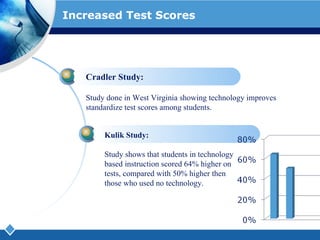
Increased Test Scores Cradler Study: Study done in West Virginia showing technology improves standardize test scores among students.  Kulik Study: Study shows that students in technology based instruction scored 64% higher on tests, compared with 50% higher then those who used no technology.
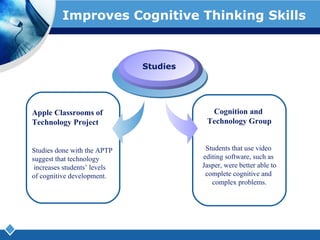
Improves Cognitive Thinking Skills Cognition and  Technology Group Students that use video  editing software, such as  Jasper, were better able to complete cognitive and  complex problems. Apple Classrooms of  Technology Project Studies done with the APTP  suggest that technology increases students’ levels  of cognitive development.  Studies
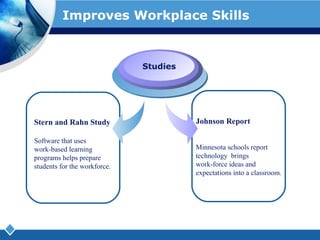
Improves Workplace Skills Johnson Report Minnesota schools report  technology  brings  work-force ideas and  expectations into a classroom. Stern and Rahn Study Software that uses  work-based learning  programs helps prepare  students for the workforce. Studies
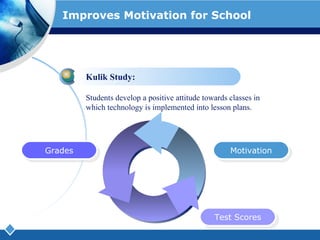
Improves Motivation for School Kulik Study: Students develop a positive attitude towards classes in which technology is implemented into lesson plans. Motivation Grades Test Scores
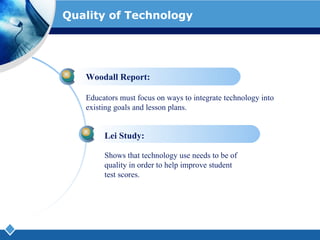
Quality of Technology Woodall Report: Educators must focus on ways to integrate technology into existing goals and lesson plans. Lei Study: Shows that technology use needs to be of quality in order to help improve student test scores.
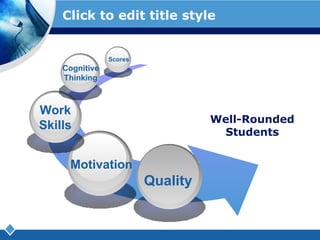
Click to edit title style Work Skills Cognitive Thinking Scores Well-Rounded Students Motivation Quality
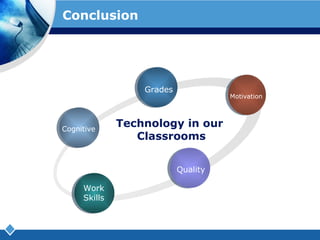
Conclusion Technology in our  Classrooms Cognitive Grades Motivation Quality Work Skills
Works Cited Brabec, K., Fisher, K., & Pitler, H. (2004). Building Better Instruction: How Technology Supports Nine Research-Proven Instructional Strategies.  Learning and Leading with Technology   , 31  (5), 7-11. Cradler, J., McNabb, M., Freeman, M., & Burchett, R. (2002). How Does Technology Influence Student Learning?  Learning and Leading with Technoloy   , 29  (8), 46-49, 56. Harvey-Woodall, A. (2009).  Integrating Technology into the Classroom: How Does It Impact Student Achievement?   Lei, J. (2010). Quanity Versus Quality: A New Approach to Examine the Relationship Between Technology Use and Student Outcomes.  British Journal of Educational Technology   , 41  (3), 1-19. Schacter, J. (1999).  The Impact of Education Technology on Student Achievement: What the Most Current Research Has to Say.  Santa Monica: Milken Family Foundation.  

Presentationfinal

  • 1.
    Teaching Tomorrow: TheImportance of Technology in Our Classrooms Heidi Selzler-Echola
  • 2.
  • 3.
    What Does TechnologyMean to Us? Improves Cognitive Thinking Prepares Students for the Workplace Improves Student Motivation Increase in Test Scores Quality of Technology
  • 4.
    Increased Test ScoresCradler Study: Study done in West Virginia showing technology improves standardize test scores among students. Kulik Study: Study shows that students in technology based instruction scored 64% higher on tests, compared with 50% higher then those who used no technology.
  • 5.
    Improves Cognitive ThinkingSkills Cognition and Technology Group Students that use video editing software, such as Jasper, were better able to complete cognitive and complex problems. Apple Classrooms of Technology Project Studies done with the APTP suggest that technology increases students’ levels of cognitive development. Studies
  • 6.
    Improves Workplace SkillsJohnson Report Minnesota schools report technology brings work-force ideas and expectations into a classroom. Stern and Rahn Study Software that uses work-based learning programs helps prepare students for the workforce. Studies
  • 7.
    Improves Motivation forSchool Kulik Study: Students develop a positive attitude towards classes in which technology is implemented into lesson plans. Motivation Grades Test Scores
  • 8.
    Quality of TechnologyWoodall Report: Educators must focus on ways to integrate technology into existing goals and lesson plans. Lei Study: Shows that technology use needs to be of quality in order to help improve student test scores.
  • 9.
    Click to edittitle style Work Skills Cognitive Thinking Scores Well-Rounded Students Motivation Quality
  • 10.
    Conclusion Technology inour Classrooms Cognitive Grades Motivation Quality Work Skills
  • 11.
    Works Cited Brabec,K., Fisher, K., & Pitler, H. (2004). Building Better Instruction: How Technology Supports Nine Research-Proven Instructional Strategies. Learning and Leading with Technology , 31 (5), 7-11. Cradler, J., McNabb, M., Freeman, M., & Burchett, R. (2002). How Does Technology Influence Student Learning? Learning and Leading with Technoloy , 29 (8), 46-49, 56. Harvey-Woodall, A. (2009). Integrating Technology into the Classroom: How Does It Impact Student Achievement? Lei, J. (2010). Quanity Versus Quality: A New Approach to Examine the Relationship Between Technology Use and Student Outcomes. British Journal of Educational Technology , 41 (3), 1-19. Schacter, J. (1999). The Impact of Education Technology on Student Achievement: What the Most Current Research Has to Say. Santa Monica: Milken Family Foundation.  

Editor's Notes

  • #3 I am starting this presentation with a short quote. Please keep this in mind as we discuss implementing technology into our classrooms. Technology has changed the ways in which people around the globe view and interact with the world.  In an ever changing technological society, it is important to look at how technology can help us, as educators, improve the learning experience for students. With the integration of technology into classrooms, it is important to consider new challenges educators face.
  • #4 Technology has been shown to help students in many different ways. Test scores, cognitive thinking abilities, workplace skills and motivation levels have all shown to increase. While integrating technology into educational settings, it is also important to remember that the quality and structure of how technology is used can influence the benefits and learning outcomes.
  • #5 Many studies have shown that the use of technology in classrooms can increase standardized test scores. In a West Virginia study, Cradler, at el, says that combining technology with lesson plans for basic skills, such as math and reading, has an increase on student test scores. A study done by Kulik (1994) shows that students technology base instruction scored 64% higher on tests, compared with 50% higher then those who used no technology.  Kulik's research is important, as he combined information from over 500 different studies to come to his conclusions. Although technology is not a magic bullet to raise student's test scores, it needs to be considered as an effective tool to help student's learning abilities.
  • #6 Research shows the positive impact technology has on student's cognitive thinking skills. In the Apple Classrooms of Tomorrow project, studies show that education infused with technology increases student’s cognitive awareness. Another study, done by the Cognition and Technology Group in 1992, shows that students who used Jasper video software were better able to complete cognitive and complex problems. Critical thinking skill are an important aspect of education, not just for academic scores, but for life-long skills.  The research shows that technology can help improve cognitive skills, better preparing students for their academic and professional futures.
  • #7 Lets face it, in today's workforce, technology skills are a must.  Providing students with the basic technology skills they need for future careers should be considered an important goal for any educator. Stern and Rahn (1995) show that software that used work-based learning programs help prepare students for the workforce.  This type of learning software prepares students for the working conditions for jobs they may be interested in. A report from Johnson (1998) shows how schools in Minnesota report technology can bring work-force ideas and expectations into a classroom.
  • #8 Student's motivation is another important aspect when considering their learning goals.  Many studies show that integrating technology into the classroom can help improve motivation for students. Kulik's 1994 study also showed that students develop a positive attitude towards classes when they implement technology into their lesson plans.  When students are motivated, their attitude will reflect on their test scores and grades. It is all connected.
  • #9 Technology can be a wonderful tool for helping students become more proficient in many areas of academic and personal study.  With the introduction of technology, it is also important to remember that it needs to be used responsibly and thoughtful to ensure the intended student outcomes. Woodall (2009) states that educators must focus on ways to integrate technology into existing goals and lesson plans.  Using technology without an intended learning goal will not help students learn. Lei (2009) conducted a study researching the impact of quality versus quantity in relation to technology and student achievement. His study shows that technology use needs to be of quality in order to help improve student test scores.  Letting students use technology without a desired learning outcome does not improve their understanding of the topics studied.
  • #10 Technology has a positive influence on many different academic areas. With high quality planning, technology creates well-rounded students.
  • #11 When used correctly, technology can play a vital role in helping students' grades, cognitive abilities, work skills and motivation improve.  The importance of technology in classrooms can not be overlooked.  We must use technology to help our students achieve desired learning outcomes, and to keep up with students from around the globe.  The quality of technology is also important. Quality must be high in order for students to walk away from their education enriched with life-long knowledge.
  • #12 Thank you. Questions?