International INTERNATIONAL Journal of Computer JOURNAL Engineering OF and COMPUTER Technology (IJCET), ENGINEERING ISSN 0976-6367(Print), 
& 
ISSN 0976 - 6375(Online), Volume 5, Issue 11, November (2014), pp. 23-31 © IAEME 
TECHNOLOGY (IJCET) 
ISSN 0976 – 6367(Print) 
ISSN 0976 – 6375(Online) 
Volume 5, Issue 11, November (2014), pp. 23-31 
© IAEME: www.iaeme.com/IJCET.asp 
Journal Impact Factor (2014): 8.5328 (Calculated by GISI) 
www.jifactor.com 
IJCET 
© I A E M E 
A MINIMIZATION APPROACH FOR TWO LEVEL LOGIC 
SYNTHESIS USING CONSTRAINED DEPTH-FIRST 
SEARCH 
Vikul Gupta 
Oregon Episcopal School, Portland, Oregon, USA 
23 
ABSTRACT 
Two-level optimization of Boolean logic circuits, expressed as Sum-of-Products (SOP), is an 
important task in VLSI design. It is well known that an optimal SOP representation for minimizing 
gate input count is a cover of prime implicants. Determination of an optimal SOP involves two steps: 
first step is generating all prime implicants of the Boolean function, and the second step is finding an 
optimal cover from the set of all prime implicants. A cube absorption method for generating all 
prime implicants is significantly more efficient than the tabular Quine-McCluskey method, when 
implemented using the position cube notation (PCN) to represent product cubes, and efficient bit 
manipulations to implement the cube operations. The main contribution of this paper is a constrained 
depth-first search (dfs) of the prime implicant decision tree to find the optimal cover, which is posed 
as a combinational optimization problem. A virtual representation of the decision tree is arranged 
such that the first path explored in a depth first search manner corresponds to the greedy solution to 
this problem, and further paths are explored only if they improve the current minimum solution. The 
exponential explosion of the search space is tamed by using this efficient search approach, and 
terminating the search at suitably large thresholds. Numerical results of synthesizing benchmark 
PLA functions show that for a vast majority of the tests, the results produced by constrained dfs 
approach are better or as good as those produced by state-of-the-art logic synthesis. Another 
interesting observation is that the greedy solution is often a minimum solution, and even in the other 
cases, it was not improved significantly by the dfs search. 
Keywords: Two-Level Logic Synthesis, Minimum Prime Implicant Covers, Constrained Depth First 
Search, PCN Implementation of Product Cubes, VLSI Design.
International Journal of Computer Engineering and Technology (IJCET), ISSN 0976-6367(Print), 
ISSN 0976 - 6375(Online), Volume 5, Issue 11, November (2014), pp. 23-31 © IAEME 
24 
I. INTRODUCTION 
Digital electronics has revolutionized our world in the last 50 years. Starting with arithmetic 
computations on behemoth computers, today digital systems are pervasive everywhere, in smart 
phones, notepads, audio and video systems, medical devices, automotive systems, and of course, in 
global communication systems and back offices of all corporations. This has been enabled by the 
exponential increase in the number of transistors that can be integrated on a silicon wafer since the 
1960s, with state of the art chips today containing upwards of 5 billion transistors [1]. With such 
powerful implementation technologies available, increasingly innovative and complex systems are 
being designed and implemented in semiconductor technology. Logic design of such systems has 
been feasible with electronic design automation (EDA) systems because it is impossible to design 
such complex systems manually. As a result, automated synthesis of optimal logic design from high 
level description has received considerable research attention over the years. This paper describes a 
new logic synthesis approach for minimization of two level logic circuits. 
In the high-level design of digital systems, combinational logic is expressed as Boolean 
expressions in some suitable format, typically expressions in a hardware description language such 
as SystemVerilog. Logic synthesis is the process of transforming these expressions to a network of 
logic gates which can be implemented with the desired semiconductor technology. Two-level 
synthesis converts the logic functions to a sum-of-products (SOP) form which is technology 
independent. Multiple two-level networks of AND and OR gates representing a logic function can be 
generated. The goal is to find the network which uses the minimum number of gates. Even though 
this was one of the early problems analyzed in logic synthesis, it is still a significant problem. Circuit 
realizations with technologies like programming logic arrays (PLAs) benefit directly from optimal 
SOP representations. Further, a common approach to logic synthesis is to first perform technology 
independent optimization of logic in a presentation like SOP, and then map this technology 
independent solution to the appropriate semiconductor technology. 
It is well known that a minimizing sum-of-products representation with respect to number of 
gates is a cover of prime implicants[2, 3]. Determining the optimal SOP representation involves first 
determining all prime implicants of the logic function, and then selecting a set of prime implicants 
that cover the function with minimum number of gates. Karnaugh maps provide a manual, textbook 
approach for determining the prime implicants of a Boolean function. Then, ad hoc heuristics can be 
employed to select a low cost SOP implementation. This approach works for 5 or 6 variables, 
beyond that it is not humanly possible to manage all the possibilities. A tabulation procedure, known 
as the Quine-McCluskey method of reduction[3], can be used to determine all prime implicants 
given the on-set or minterms of a logic function. This systematic procedure could be programmed on 
a computer to automatically generate prime implicants of functions with larger number of variables. 
Once all prime implicants have been obtained, prime covers are generated using the prime implicant 
charts. The Petrick-method provides another interesting approach for generating all the covers from 
the set of prime implicants. The cost of each of these covers can be obtained in terms of the number 
of gates used, and the minimum cover is selected as the exact minimum solution. The fundamental 
problem is the exponential growth in the search space as the problem size in terms of the number of 
input variables increases. Heuristic approaches described in [6] are used to get around this problem 
of exponential increase in search space and compute resources. These approaches do not guarantee 
the exact minimum solutions but lead to sub-optimal solutions which are quite efficient in practice. 
This paper alleviates the limitations of the current exact minimization approaches with a new 
search scheme that allows exact minimum of larger problems. Efficient software implementation of 
the cube absorption approach [3, 4] is used generating all prime implicants of a logic function. New 
algorithms for cube operations in PCN representation are presented. The main contribution of this 
paper is a constrained depth first search approach to determine exact minimum cost covers of prime
International Journal of Computer Engineering and Technology (IJCET), ISSN 0976-6367(Print), 
ISSN 0976 - 6375(Online), Volume 5, Issue 11, November (2014), pp. 23-31 © IAEME 
implicants. A decision tree of prime implicants is arranged in a manner that enables rapid search of 
minimum solutions; in particular, the greedy solution is the first solution obtained in this search. 
Further, the dfs search is constrained to traverse only those paths that could potentially improve the 
current minimum cost. Details of this method are described in Section 4 of this paper. 
This paper is organized as follows: Section 2 describes the necessary background ideas 
needed in this work. Cube operations and their efficient implementation are described in Section 3. 
The main contribution of this work, the cost-constrained depth first search is described in detail 
Section 4. Numerical results are presented in Section 5, comparing this approach with state-of-the-art 
logic synthesis tools, to quantify the benefits of this approach. Finally, Section 6 discusses 
conclusions of this work and possible extensions for future. 
25 
II. BACKGROUND 
Minimal two level logic synthesis, in terms of sum-of-products, of Boolean logic functions, is 
discussed in this paper. This section reviews relevant concepts for this discussion. Note that, 
mathematically, Boolean algebra characterizes a class of abstract algebras. However, in this paper, 
the commonly understood meaning of Boolean algebra as the binary Boolean algebra or switching 
algebra is used. 
The Boolean values are denoted as  and . Thus, the set of Boolean values is   . A 
Boolean variable takes one of these Boolean values,  	 . The domain of n input variables
is 
. Thus,  
  , is a Boolean function of n input variables. The on-set 
of a function, , is defined as    	 
  . Similarly, the off-setis   
 	 
  . Note that since  	 , 0 and 1 are the only possible values of , thus, the on-set, 
, completely specifies the Boolean function. 
Boolean values of  variables can be viewed as a string of binary values, which can be 
interpreted as an unsigned decimal number. For example, suppose a 3-input variable,  	 , has 
the values
. These values can be viewed as the binary string 110 which may be 
interpreted as the number 6. With this interpretation, all possible values of n variables can be 
represented as integers between 0 and 
  . In particular, the on-set of a Boolean function can be 
specified as a subset of integers in this range. For example,
, is equivalently defined 
by    !#. 
A literal is an input variable in true or complemented form, that is, $ or $ 
 . A product term is 

 a product  
of one or more literals. If all the literals are present in a product term, it is called a 
minterm. The on-set of a minterm is one integer. For example, on-set of
, is {5}. Similarly, 
the on-set of product term   1, 3}. 
A product term, %, is an implicant of a Boolean function, , if %, or equivalently, 
% ' . An implicant is a prime implicant of if there is no other product implicant of which 
implies this implicant as well. A set of prime implicants, (  %
%
 %), is said to cover the 
function, , if the union of on-sets of these prime implicants is equal to the on-set of the function, 
(  *%$ 
  . A set of prime implicants is irredundant if no prime implicant can be removed 
from the set without changing its on-set. As shown in [2], a minimal sum-of-products representation 
of a Boolean function must be an irredundant set of prime implicants. Thus, using the number of 
gates as the cost, a minimal two-level implementation is an irredundant set of prime implicants. 
Minimal two-level representations of Boolean functions are obtained in two steps. First, 
generate all possible prime implicants of the Boolean function, and, second, search for lowest cost 
irredundant set of prime implicants that covers the function, from all possible sets. The textbook 
approach to generate all prime implicants of a function is the Quine-McClusky tabulation approach 
[2, 3]. However, it is noted that a cube absorption approach [4, 5], with efficient algorithmic
International Journal of Computer Engineering and Technology (IJCET), ISSN 0976-6367(Print), 
ISSN 0976 - 6375(Online), Volume 5, Issue 11, November (2014), pp. 23-31 © IAEME 
implementation described in the next section, results in significantly better performance on large 
problems. The second aspect of minimal two-level synthesis is searching for the lowest cost 
irredundant set of prime implicants covering the Boolean function [6]. The prime-implicant chart and 
the Petrick method are common approaches for exhaustively enumerating all possible covers. These 
exhaustive approaches are limited to small problems, because of exponential growth as the number 
of input variables increases. Combinational optimization approach to this problem leads to efficient 
solutions. This paper presents a greedy algorithm [7], which can be extended to constrained depth 
first search for an exact minimum. 
III. PRIME IMPLICANTS WITH CUBE ABSORBTION 
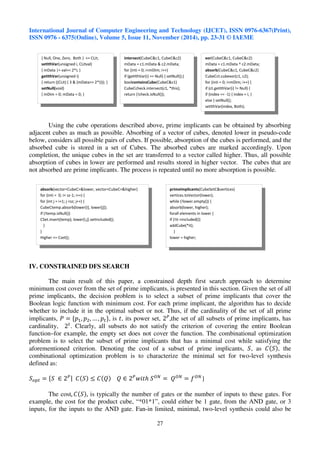
Computational Boolean reasoning can be performed very efficiently with vertices of a unit 
cube in -dimensional space [4]. Product terms with  Boolean variables can be represented as 
vertices of an -d unit cube. For example, a 3 variable minterm

A minimization approach for two level logic synthesis using constrained depth first search

  • 1.
    International INTERNATIONAL Journalof Computer JOURNAL Engineering OF and COMPUTER Technology (IJCET), ENGINEERING ISSN 0976-6367(Print), & ISSN 0976 - 6375(Online), Volume 5, Issue 11, November (2014), pp. 23-31 © IAEME TECHNOLOGY (IJCET) ISSN 0976 – 6367(Print) ISSN 0976 – 6375(Online) Volume 5, Issue 11, November (2014), pp. 23-31 © IAEME: www.iaeme.com/IJCET.asp Journal Impact Factor (2014): 8.5328 (Calculated by GISI) www.jifactor.com IJCET © I A E M E A MINIMIZATION APPROACH FOR TWO LEVEL LOGIC SYNTHESIS USING CONSTRAINED DEPTH-FIRST SEARCH Vikul Gupta Oregon Episcopal School, Portland, Oregon, USA 23 ABSTRACT Two-level optimization of Boolean logic circuits, expressed as Sum-of-Products (SOP), is an important task in VLSI design. It is well known that an optimal SOP representation for minimizing gate input count is a cover of prime implicants. Determination of an optimal SOP involves two steps: first step is generating all prime implicants of the Boolean function, and the second step is finding an optimal cover from the set of all prime implicants. A cube absorption method for generating all prime implicants is significantly more efficient than the tabular Quine-McCluskey method, when implemented using the position cube notation (PCN) to represent product cubes, and efficient bit manipulations to implement the cube operations. The main contribution of this paper is a constrained depth-first search (dfs) of the prime implicant decision tree to find the optimal cover, which is posed as a combinational optimization problem. A virtual representation of the decision tree is arranged such that the first path explored in a depth first search manner corresponds to the greedy solution to this problem, and further paths are explored only if they improve the current minimum solution. The exponential explosion of the search space is tamed by using this efficient search approach, and terminating the search at suitably large thresholds. Numerical results of synthesizing benchmark PLA functions show that for a vast majority of the tests, the results produced by constrained dfs approach are better or as good as those produced by state-of-the-art logic synthesis. Another interesting observation is that the greedy solution is often a minimum solution, and even in the other cases, it was not improved significantly by the dfs search. Keywords: Two-Level Logic Synthesis, Minimum Prime Implicant Covers, Constrained Depth First Search, PCN Implementation of Product Cubes, VLSI Design.
  • 2.
    International Journal ofComputer Engineering and Technology (IJCET), ISSN 0976-6367(Print), ISSN 0976 - 6375(Online), Volume 5, Issue 11, November (2014), pp. 23-31 © IAEME 24 I. INTRODUCTION Digital electronics has revolutionized our world in the last 50 years. Starting with arithmetic computations on behemoth computers, today digital systems are pervasive everywhere, in smart phones, notepads, audio and video systems, medical devices, automotive systems, and of course, in global communication systems and back offices of all corporations. This has been enabled by the exponential increase in the number of transistors that can be integrated on a silicon wafer since the 1960s, with state of the art chips today containing upwards of 5 billion transistors [1]. With such powerful implementation technologies available, increasingly innovative and complex systems are being designed and implemented in semiconductor technology. Logic design of such systems has been feasible with electronic design automation (EDA) systems because it is impossible to design such complex systems manually. As a result, automated synthesis of optimal logic design from high level description has received considerable research attention over the years. This paper describes a new logic synthesis approach for minimization of two level logic circuits. In the high-level design of digital systems, combinational logic is expressed as Boolean expressions in some suitable format, typically expressions in a hardware description language such as SystemVerilog. Logic synthesis is the process of transforming these expressions to a network of logic gates which can be implemented with the desired semiconductor technology. Two-level synthesis converts the logic functions to a sum-of-products (SOP) form which is technology independent. Multiple two-level networks of AND and OR gates representing a logic function can be generated. The goal is to find the network which uses the minimum number of gates. Even though this was one of the early problems analyzed in logic synthesis, it is still a significant problem. Circuit realizations with technologies like programming logic arrays (PLAs) benefit directly from optimal SOP representations. Further, a common approach to logic synthesis is to first perform technology independent optimization of logic in a presentation like SOP, and then map this technology independent solution to the appropriate semiconductor technology. It is well known that a minimizing sum-of-products representation with respect to number of gates is a cover of prime implicants[2, 3]. Determining the optimal SOP representation involves first determining all prime implicants of the logic function, and then selecting a set of prime implicants that cover the function with minimum number of gates. Karnaugh maps provide a manual, textbook approach for determining the prime implicants of a Boolean function. Then, ad hoc heuristics can be employed to select a low cost SOP implementation. This approach works for 5 or 6 variables, beyond that it is not humanly possible to manage all the possibilities. A tabulation procedure, known as the Quine-McCluskey method of reduction[3], can be used to determine all prime implicants given the on-set or minterms of a logic function. This systematic procedure could be programmed on a computer to automatically generate prime implicants of functions with larger number of variables. Once all prime implicants have been obtained, prime covers are generated using the prime implicant charts. The Petrick-method provides another interesting approach for generating all the covers from the set of prime implicants. The cost of each of these covers can be obtained in terms of the number of gates used, and the minimum cover is selected as the exact minimum solution. The fundamental problem is the exponential growth in the search space as the problem size in terms of the number of input variables increases. Heuristic approaches described in [6] are used to get around this problem of exponential increase in search space and compute resources. These approaches do not guarantee the exact minimum solutions but lead to sub-optimal solutions which are quite efficient in practice. This paper alleviates the limitations of the current exact minimization approaches with a new search scheme that allows exact minimum of larger problems. Efficient software implementation of the cube absorption approach [3, 4] is used generating all prime implicants of a logic function. New algorithms for cube operations in PCN representation are presented. The main contribution of this paper is a constrained depth first search approach to determine exact minimum cost covers of prime
  • 3.
    International Journal ofComputer Engineering and Technology (IJCET), ISSN 0976-6367(Print), ISSN 0976 - 6375(Online), Volume 5, Issue 11, November (2014), pp. 23-31 © IAEME implicants. A decision tree of prime implicants is arranged in a manner that enables rapid search of minimum solutions; in particular, the greedy solution is the first solution obtained in this search. Further, the dfs search is constrained to traverse only those paths that could potentially improve the current minimum cost. Details of this method are described in Section 4 of this paper. This paper is organized as follows: Section 2 describes the necessary background ideas needed in this work. Cube operations and their efficient implementation are described in Section 3. The main contribution of this work, the cost-constrained depth first search is described in detail Section 4. Numerical results are presented in Section 5, comparing this approach with state-of-the-art logic synthesis tools, to quantify the benefits of this approach. Finally, Section 6 discusses conclusions of this work and possible extensions for future. 25 II. BACKGROUND Minimal two level logic synthesis, in terms of sum-of-products, of Boolean logic functions, is discussed in this paper. This section reviews relevant concepts for this discussion. Note that, mathematically, Boolean algebra characterizes a class of abstract algebras. However, in this paper, the commonly understood meaning of Boolean algebra as the binary Boolean algebra or switching algebra is used. The Boolean values are denoted as and . Thus, the set of Boolean values is . A Boolean variable takes one of these Boolean values, . The domain of n input variables
  • 4.
    is . Thus, , is a Boolean function of n input variables. The on-set of a function, , is defined as . Similarly, the off-setis . Note that since , 0 and 1 are the only possible values of , thus, the on-set, , completely specifies the Boolean function. Boolean values of variables can be viewed as a string of binary values, which can be interpreted as an unsigned decimal number. For example, suppose a 3-input variable, , has the values
  • 5.
    . These valuescan be viewed as the binary string 110 which may be interpreted as the number 6. With this interpretation, all possible values of n variables can be represented as integers between 0 and . In particular, the on-set of a Boolean function can be specified as a subset of integers in this range. For example,
  • 6.
    , is equivalentlydefined by !#. A literal is an input variable in true or complemented form, that is, $ or $ . A product term is a product of one or more literals. If all the literals are present in a product term, it is called a minterm. The on-set of a minterm is one integer. For example, on-set of
  • 7.
    , is {5}.Similarly, the on-set of product term 1, 3}. A product term, %, is an implicant of a Boolean function, , if %, or equivalently, % ' . An implicant is a prime implicant of if there is no other product implicant of which implies this implicant as well. A set of prime implicants, ( %
  • 8.
    % %), issaid to cover the function, , if the union of on-sets of these prime implicants is equal to the on-set of the function, ( *%$ . A set of prime implicants is irredundant if no prime implicant can be removed from the set without changing its on-set. As shown in [2], a minimal sum-of-products representation of a Boolean function must be an irredundant set of prime implicants. Thus, using the number of gates as the cost, a minimal two-level implementation is an irredundant set of prime implicants. Minimal two-level representations of Boolean functions are obtained in two steps. First, generate all possible prime implicants of the Boolean function, and, second, search for lowest cost irredundant set of prime implicants that covers the function, from all possible sets. The textbook approach to generate all prime implicants of a function is the Quine-McClusky tabulation approach [2, 3]. However, it is noted that a cube absorption approach [4, 5], with efficient algorithmic
  • 9.
    International Journal ofComputer Engineering and Technology (IJCET), ISSN 0976-6367(Print), ISSN 0976 - 6375(Online), Volume 5, Issue 11, November (2014), pp. 23-31 © IAEME implementation described in the next section, results in significantly better performance on large problems. The second aspect of minimal two-level synthesis is searching for the lowest cost irredundant set of prime implicants covering the Boolean function [6]. The prime-implicant chart and the Petrick method are common approaches for exhaustively enumerating all possible covers. These exhaustive approaches are limited to small problems, because of exponential growth as the number of input variables increases. Combinational optimization approach to this problem leads to efficient solutions. This paper presents a greedy algorithm [7], which can be extended to constrained depth first search for an exact minimum. III. PRIME IMPLICANTS WITH CUBE ABSORBTION Computational Boolean reasoning can be performed very efficiently with vertices of a unit cube in -dimensional space [4]. Product terms with Boolean variables can be represented as vertices of an -d unit cube. For example, a 3 variable minterm